FORM [had + past participle]   Examples: You  had studied  English before you moved to New York.  Had  you  studied  English before you moved to New York?  You  had  not  studied  English before you moved to New York.
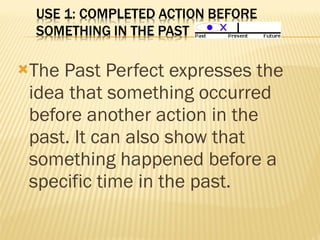
The Past Perfect expresses the idea that something occurred before another action in the past. It can also show that something happened before a specific time in the past.
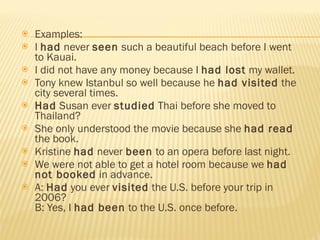
Examples: I  had  never  seen  such a beautiful beach before I went to Kauai.  I did not have any money because I  had lost  my wallet.  Tony knew Istanbul so well because he  had visited  the city several times.  Had  Susan ever  studied  Thai before she moved to Thailand?  She only understood the movie because she  had read  the book.  Kristine  had  never  been  to an opera before last night.  We were not able to get a hotel room because we  had not booked  in advance.  A:  Had  you ever  visited  the U.S. before your trip in 2006? B: Yes, I  had been  to the U.S. once before.
With Non-Continuous Verbs and some non-continuous uses of Mixed Verbs, we use the Past Perfect to show that something started in the past and continued up until another action in the past.
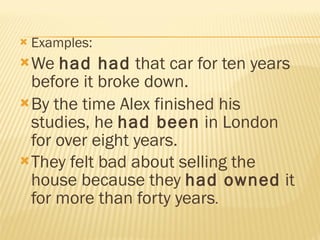
Examples: We  had had  that car for ten years before it broke down.  By the time Alex finished his studies, he  had been  in London for over eight years.  They felt bad about selling the house because they  had owned  it for more than forty years .
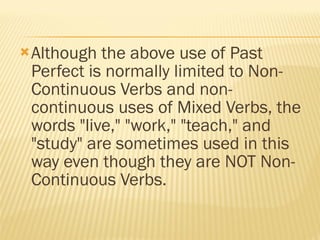
Although the above use of Past Perfect is normally limited to Non-Continuous Verbs and non-continuous uses of Mixed Verbs, the words "live," "work," "teach," and "study" are sometimes used in this way even though they are NOT Non-Continuous Verbs.
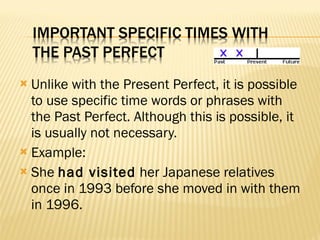
Unlike with the Present Perfect, it is possible to use specific time words or phrases with the Past Perfect. Although this is possible, it is usually not necessary. Example: She  had visited  her Japanese relatives once in 1993 before she moved in with them in 1996.
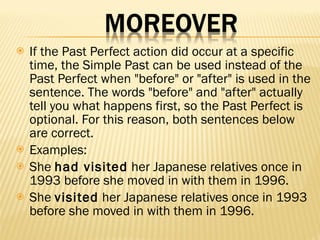
If the Past Perfect action did occur at a specific time, the Simple Past can be used instead of the Past Perfect when "before" or "after" is used in the sentence. The words "before" and "after" actually tell you what happens first, so the Past Perfect is optional.  For this reason, both sentences below are correct. Examples: She  had visited  her Japanese relatives once in 1993 before she moved in with them in 1996.  She  visited  her Japanese relatives once in 1993 before she moved in with them in 1996.
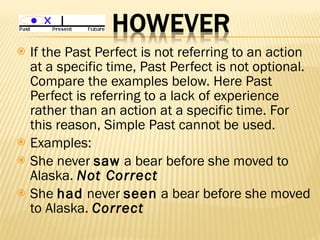
If the Past Perfect is not referring to an action at a specific time, Past Perfect is not optional. Compare the examples below. Here Past Perfect is referring to a lack of experience rather than an action at a specific time.  For this reason, Simple Past cannot be used. Examples: She never  saw  a bear before she moved to Alaska.  Not Correct   She  had  never  seen  a bear before she moved to Alaska.  Correct
The examples below show the placement for grammar adverbs such as: always, only, never, ever, still, just, etc.  Examples: You had  previously  studied English before you moved to New York.  Had you  previously  studied English before you moved to New York?
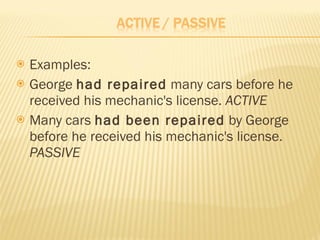
Examples: George  had repaired  many cars before he received his mechanic's license.  ACTIVE   Many cars  had been repaired  by George before he received his mechanic's license.  PASSIVE
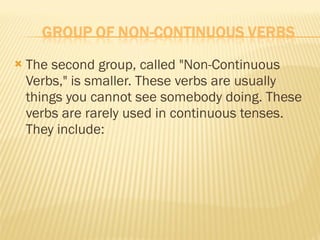
The second group, called "Non-Continuous Verbs," is smaller. These verbs are usually things you cannot see somebody doing. These verbs are rarely used in continuous tenses. They include:
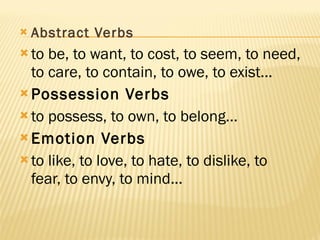
Abstract Verbs to be, to want, to cost, to seem, to need, to care, to contain, to owe, to exist... Possession Verbs to possess, to own, to belong... Emotion Verbs to like, to love, to hate, to dislike, to fear, to envy, to mind...
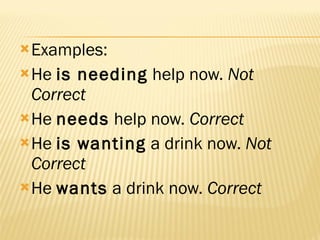
Examples: He  is needing  help now.  Not Correct   He  needs  help now.  Correct   He  is wanting  a drink now.  Not Correct   He  wants  a drink now.  Correct
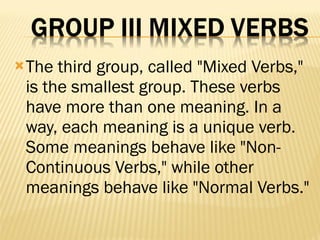
The third group, called "Mixed Verbs," is the smallest group. These verbs have more than one meaning. In a way, each meaning is a unique verb. Some meanings behave like "Non-Continuous Verbs," while other meanings behave like "Normal Verbs."
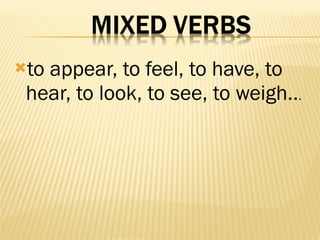
to appear, to feel, to have, to hear, to look, to see, to weigh.. .

Past perfect presentation

  • 1.
    FORM [had +past participle]   Examples: You had studied English before you moved to New York. Had you studied English before you moved to New York? You had not studied English before you moved to New York.
  • 2.
    The Past Perfectexpresses the idea that something occurred before another action in the past. It can also show that something happened before a specific time in the past.
  • 3.
    Examples: I had never seen such a beautiful beach before I went to Kauai. I did not have any money because I had lost my wallet. Tony knew Istanbul so well because he had visited the city several times. Had Susan ever studied Thai before she moved to Thailand? She only understood the movie because she had read the book. Kristine had never been to an opera before last night. We were not able to get a hotel room because we had not booked in advance. A: Had you ever visited the U.S. before your trip in 2006? B: Yes, I had been to the U.S. once before.
  • 4.
    With Non-Continuous Verbsand some non-continuous uses of Mixed Verbs, we use the Past Perfect to show that something started in the past and continued up until another action in the past.
  • 5.
    Examples: We had had that car for ten years before it broke down. By the time Alex finished his studies, he had been in London for over eight years. They felt bad about selling the house because they had owned it for more than forty years .
  • 6.
    Although the aboveuse of Past Perfect is normally limited to Non-Continuous Verbs and non-continuous uses of Mixed Verbs, the words "live," "work," "teach," and "study" are sometimes used in this way even though they are NOT Non-Continuous Verbs.
  • 7.
    Unlike with thePresent Perfect, it is possible to use specific time words or phrases with the Past Perfect. Although this is possible, it is usually not necessary. Example: She had visited her Japanese relatives once in 1993 before she moved in with them in 1996.
  • 8.
    If the PastPerfect action did occur at a specific time, the Simple Past can be used instead of the Past Perfect when "before" or "after" is used in the sentence. The words "before" and "after" actually tell you what happens first, so the Past Perfect is optional. For this reason, both sentences below are correct. Examples: She had visited her Japanese relatives once in 1993 before she moved in with them in 1996. She visited her Japanese relatives once in 1993 before she moved in with them in 1996.
  • 9.
    If the PastPerfect is not referring to an action at a specific time, Past Perfect is not optional. Compare the examples below. Here Past Perfect is referring to a lack of experience rather than an action at a specific time. For this reason, Simple Past cannot be used. Examples: She never saw a bear before she moved to Alaska. Not Correct She had never seen a bear before she moved to Alaska. Correct
  • 10.
    The examples belowshow the placement for grammar adverbs such as: always, only, never, ever, still, just, etc.  Examples: You had previously studied English before you moved to New York. Had you previously studied English before you moved to New York?
  • 11.
    Examples: George had repaired many cars before he received his mechanic's license. ACTIVE Many cars had been repaired by George before he received his mechanic's license. PASSIVE
  • 12.
    The second group,called "Non-Continuous Verbs," is smaller. These verbs are usually things you cannot see somebody doing. These verbs are rarely used in continuous tenses. They include:
  • 13.
    Abstract Verbs tobe, to want, to cost, to seem, to need, to care, to contain, to owe, to exist... Possession Verbs to possess, to own, to belong... Emotion Verbs to like, to love, to hate, to dislike, to fear, to envy, to mind...
  • 14.
    Examples: He is needing help now. Not Correct He needs help now. Correct He is wanting a drink now. Not Correct He wants a drink now. Correct
  • 15.
    The third group,called "Mixed Verbs," is the smallest group. These verbs have more than one meaning. In a way, each meaning is a unique verb. Some meanings behave like "Non-Continuous Verbs," while other meanings behave like "Normal Verbs."
  • 16.
    to appear, tofeel, to have, to hear, to look, to see, to weigh.. .