
© HWTK 2017
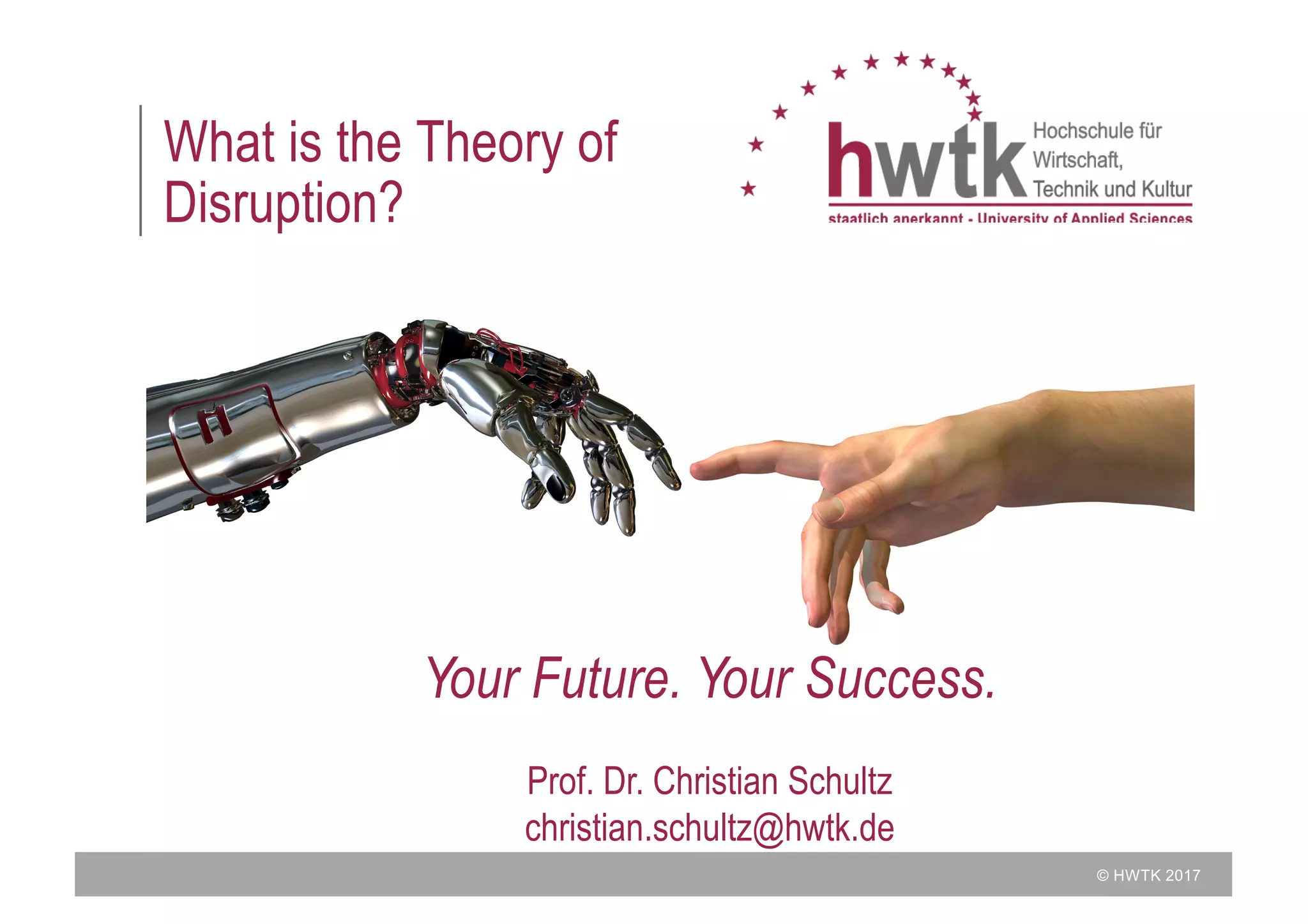
What is the Theory of
Disruption?
Your Future. Your Success.
Prof. Dr. Christian Schultz
christian.schultz@hwtk.de
© HWTK 2017
We start with a simple
question!
Why did Nokia fail?
Task:
Please brainstorm this question briefly with your partner and write the
strongest reason(s) in your opinion on your card!
Time:
2 Minutes
Verbal gathering of results:
1 Minute
© HWTK 2017
Another (not-so-simple)
question ...
Why do good companies fail?
Note
It is easy to explain why poorly companies fail; but many of history‘s most
successful and best-run firms have lost their positions of leadership, too.
Why is it so hard to sustain success?
Clayton M. Christensen, 2003, 1.
Christensen and Raynor (2003): The Innovator´s Solution – Creating and
Sustaining Successful Growth, Boston: HBR Press.
© HWTK 2017
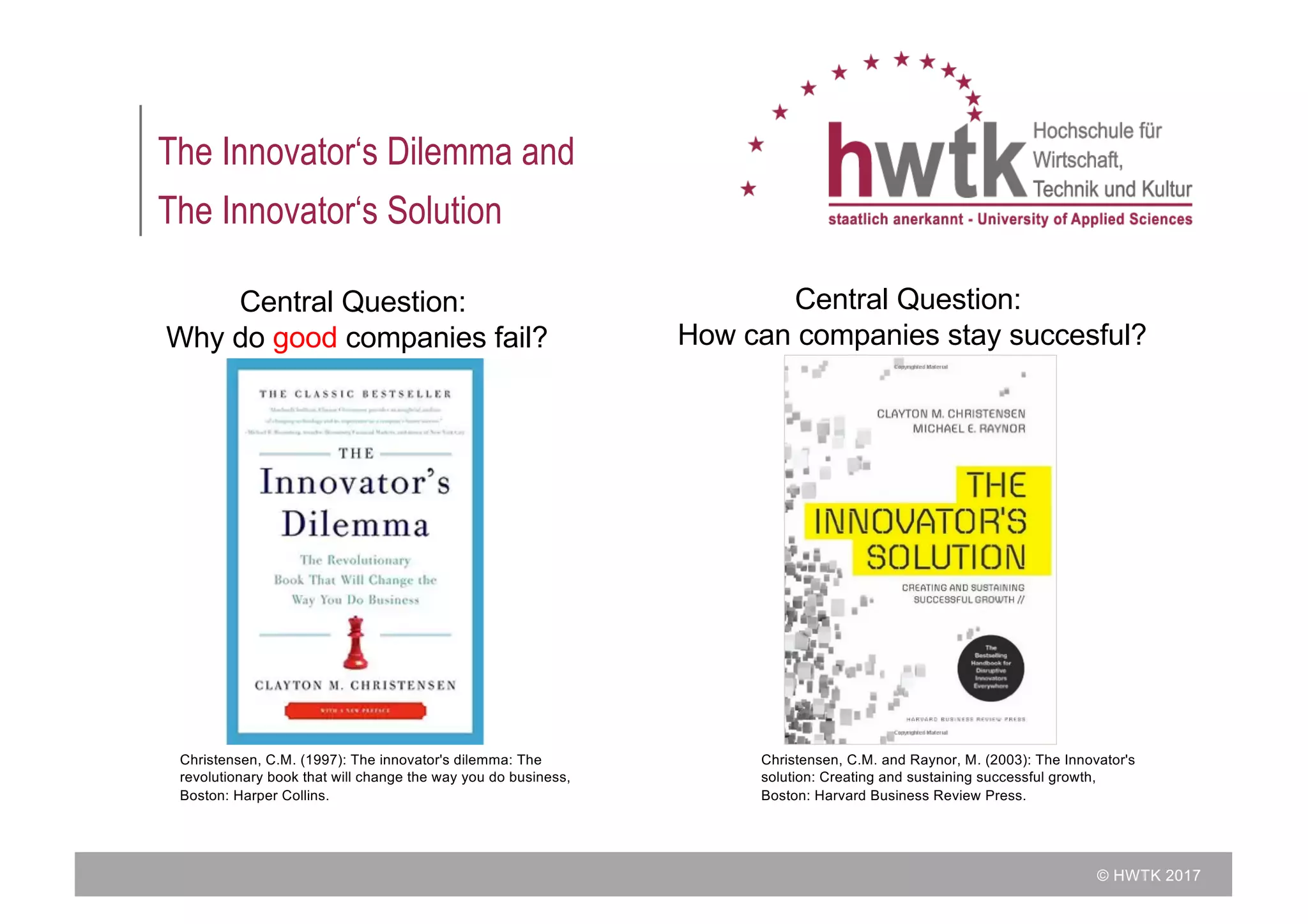
The Innovator‘s Dilemma and
The Innovator‘s Solution
Central Question:
Why do good companies fail?
Central Question:
How can companies stay succesful?
Christensen, C.M. (1997): The innovator's dilemma: The
revolutionary book that will change the way you do business,
Boston: Harper Collins.
Christensen, C.M. and Raynor, M. (2003): The Innovator's
solution: Creating and sustaining successful growth,
Boston: Harvard Business Review Press.
© HWTK 2017
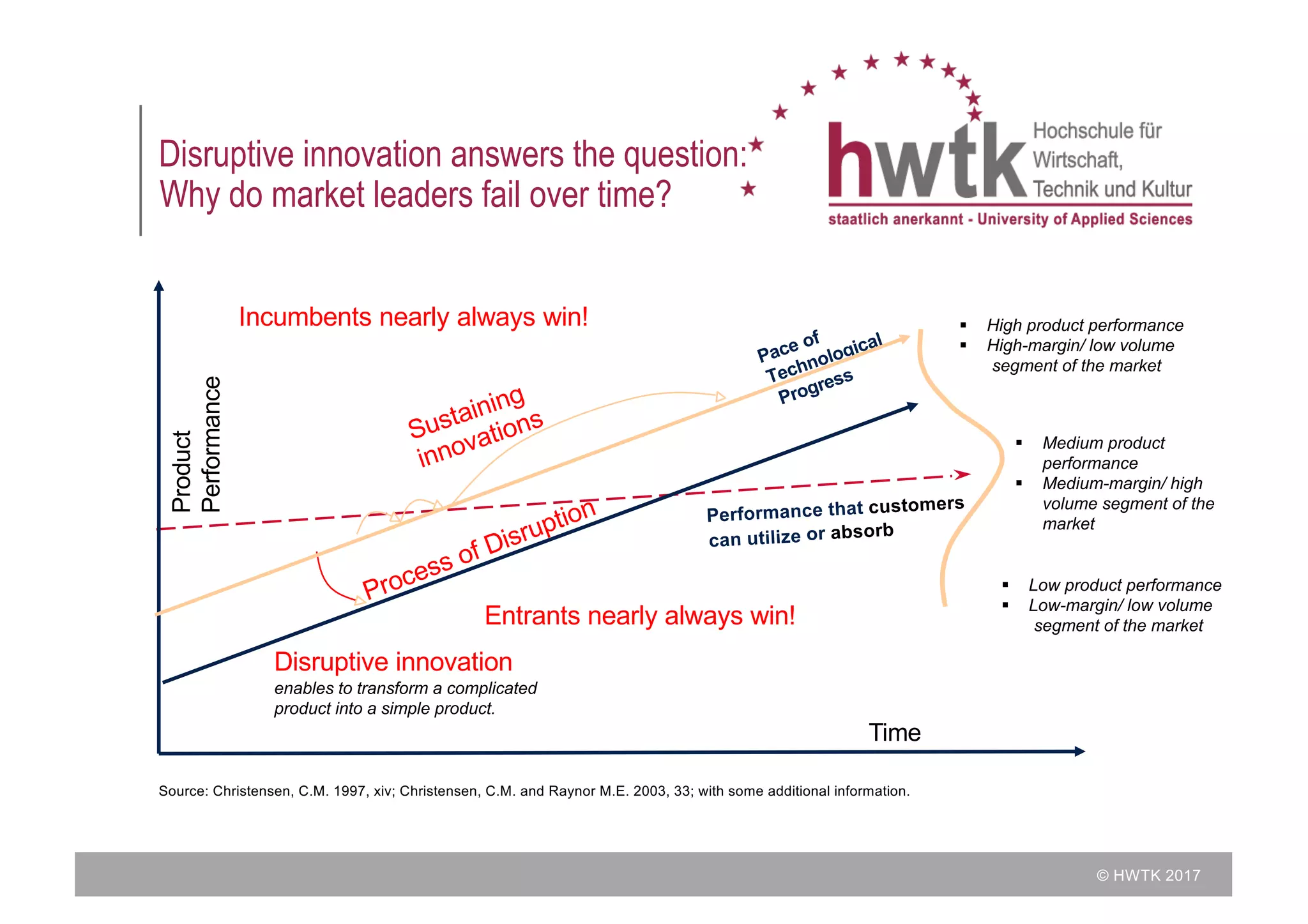
Product
Performance
Disruptive innovation
enables to transform a complicated
product into a simple product.
Incumbents nearly always win!
Entrants nearly always win!
§ High product performance
§ High-margin/ low volume
segment of the market
§ Low product performance
§ Low-margin/ low volume
segment of the market
§ Medium product
performance
§ Medium-margin/ high
volume segment of the
market
Time
Source: Christensen, C.M. 1997, xiv; Christensen, C.M. and Raynor M.E. 2003, 33; with some additional information.
Disruptive innovation answers the question:
Why do market leaders fail over time?
© HWTK 2017
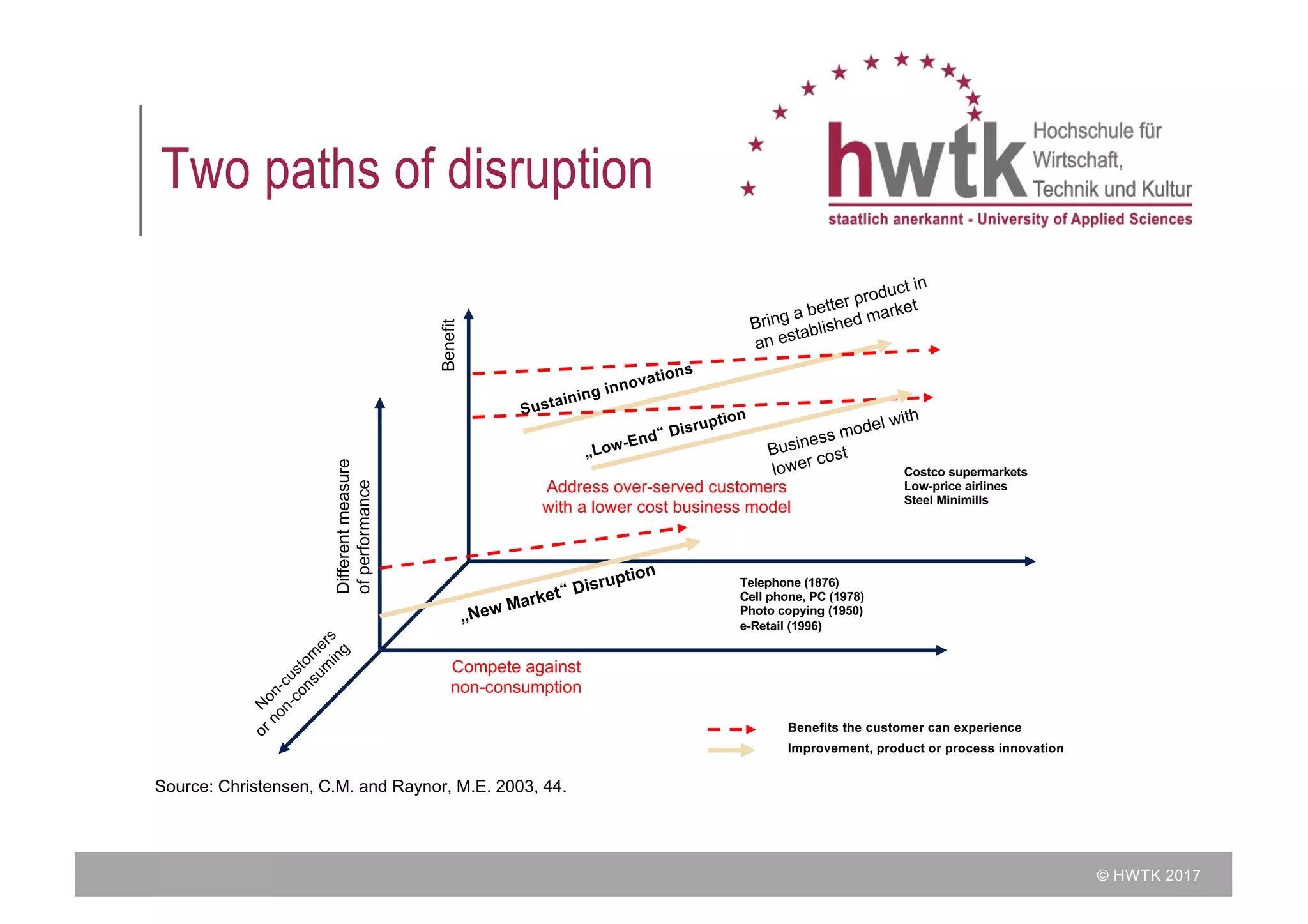
Benefit
Costco supermarkets
Low-price airlines
Steel Minimills
Differentmeasure
ofperformance
Telephone (1876)
Cell phone, PC (1978)
Photo copying (1950)
e-Retail (1996)
Benefits the customer can experience
Improvement, product or process innovation
Source: Christensen, C.M. and Raynor, M.E. 2003, 44.
Compete against
non-consumption
Address over-served customers
with a lower cost business model
Two paths of disruption
© HWTK 2017
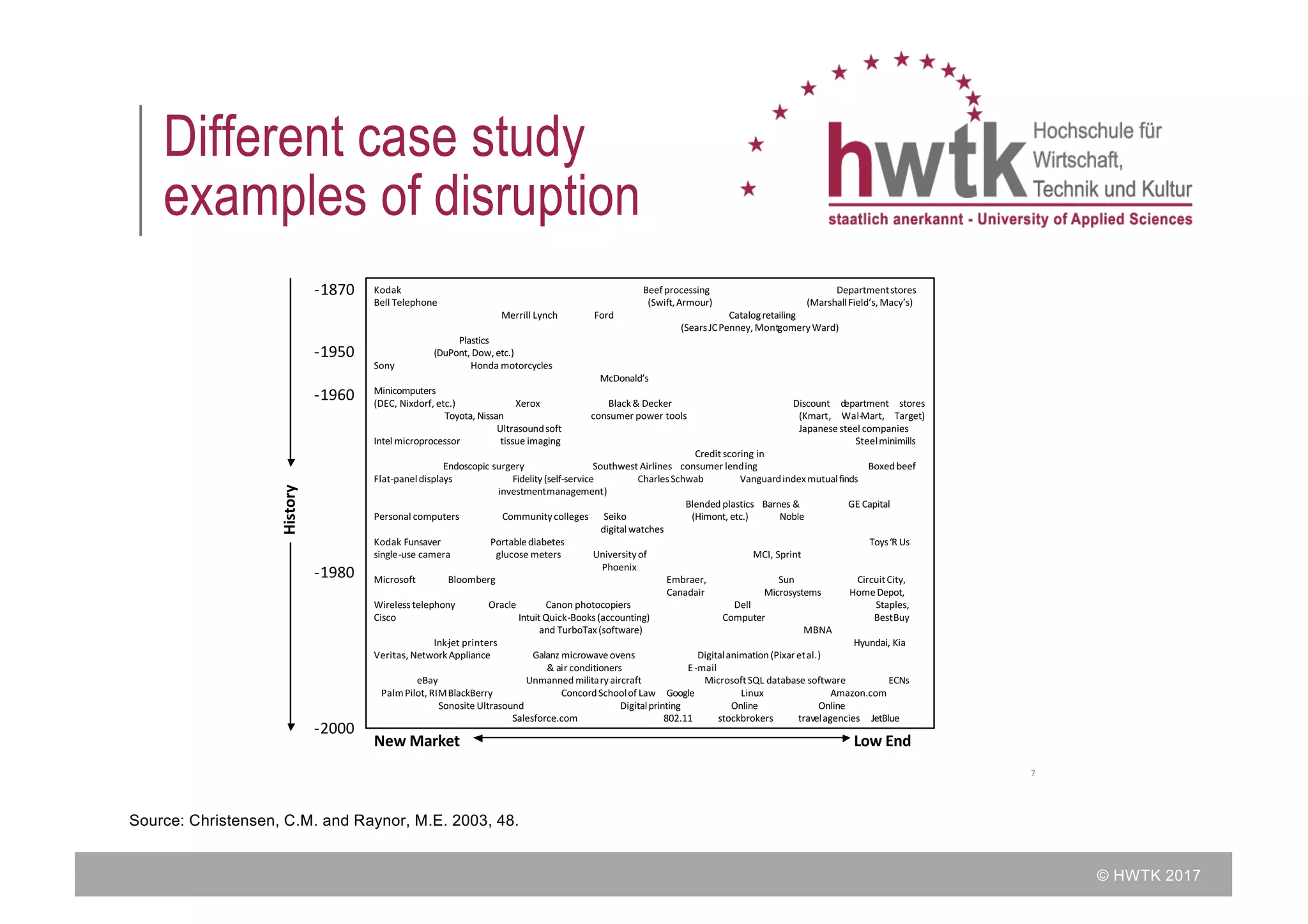
Examples of Companies and Products Whose Roots Were in Disruption
-1870 Kodak
Bell Telephone
Beefprocessing	
(Swift,Armour)
Departmentstores
(MarshallField’s, Macy’s)
Merrill Lynch Ford Catalogretailing
(SearsJCPenney,MontgomeryWard)
Plastics	
(DuPont, Dow, etc.)
Sony Honda motorcycles
McDonald’s
Minicomputers
(DEC, Nixdorf, etc.) Xerox Black& Decker
Toyota, Nissan consumer power tools
Discount department stores
(Kmart, Wal-Mart, Target)
Japanese steel companies
Steelminimills
Ultrasoundsoft
Intel microprocessor tissue imaging
Credit scoring in
Endoscopic surgery Southwest Airlines consumer lending Boxedbeef
Flat-paneldisplays Fidelity (self-service CharlesSchwab Vanguardindexmutualfinds
investmentmanagement)
Blended plastics Barnes & GE Capital
Personal computers Communitycolleges Seiko
digital watches
Portablediabetes
(Himont, etc.) Noble
Kodak	Funsaver
single-use camera glucose meters
Toys‘R Us
Universityof MCI, Sprint
Phoenix
Microsoft Bloomberg Embraer, Sun
Canadair Microsystems
CircuitCity,
HomeDepot,
Staples,	
BestBuy
Wireless telephony Oracle	
Cisco
Canon photocopiers
Intuit Quick-Books (accounting)	
and TurboTax(software)
Dell	
Computer
MBNA
Ink-jet printers Hyundai, Kia
Veritas, NetworkAppliance Galanz microwaveovens Digitalanimation(Pixar etal.)
& air conditioners E -mail
Unmanned militaryaircraft MicrosoftSQL database software ECNseBay
PalmPilot, RIMBlackBerry ConcordSchoolof Law Google Linux
Digitalprinting Online
Amazon.com	
Online
travelagencies JetBlue
Sonosite Ultrasound
Salesforce.com 802.11 stockbrokers
-1950
-1960
-1980
-2000
History
Low EndNew Market
Source: Christensen, C.M. and Raynor, M.E. 2003, 48.
7
Different case study
examples of disruption
© HWTK 2017
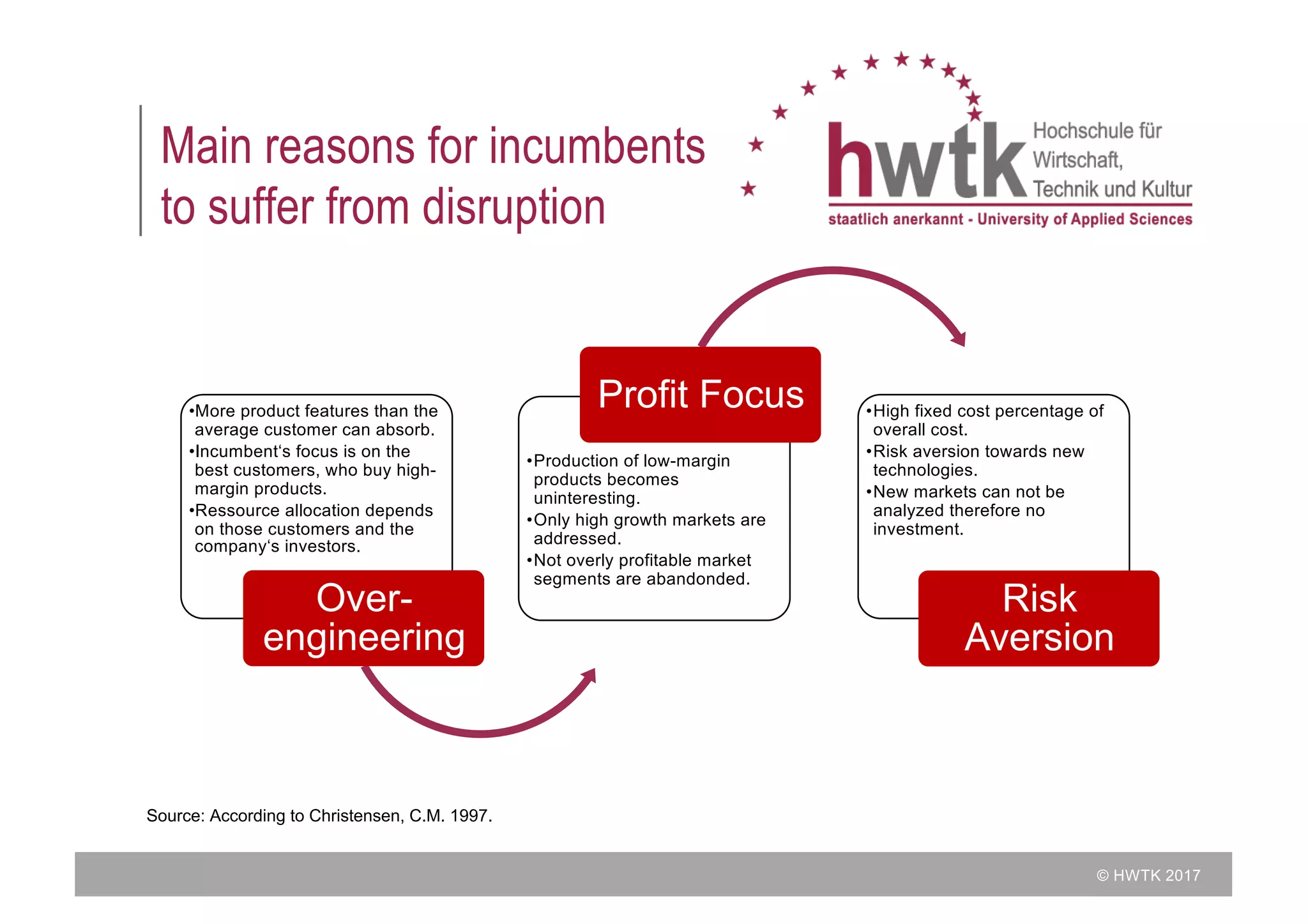
Main reasons for incumbents
to suffer from disruption
•More product features than the
average customer can absorb.
•Incumbent‘s focus is on the
best customers, who buy high-
margin products.
•Ressource allocation depends
on those customers and the
company‘s investors.
Over-
engineering
•Production of low-margin
products becomes
uninteresting.
•Only high growth markets are
addressed.
•Not overly profitable market
segments are abandonded.
Profit Focus •High fixed cost percentage of
overall cost.
•Risk aversion towards new
technologies.
•New markets can not be
analyzed therefore no
investment.
Risk
Aversion
Source: According to Christensen, C.M. 1997.
© HWTK 2017
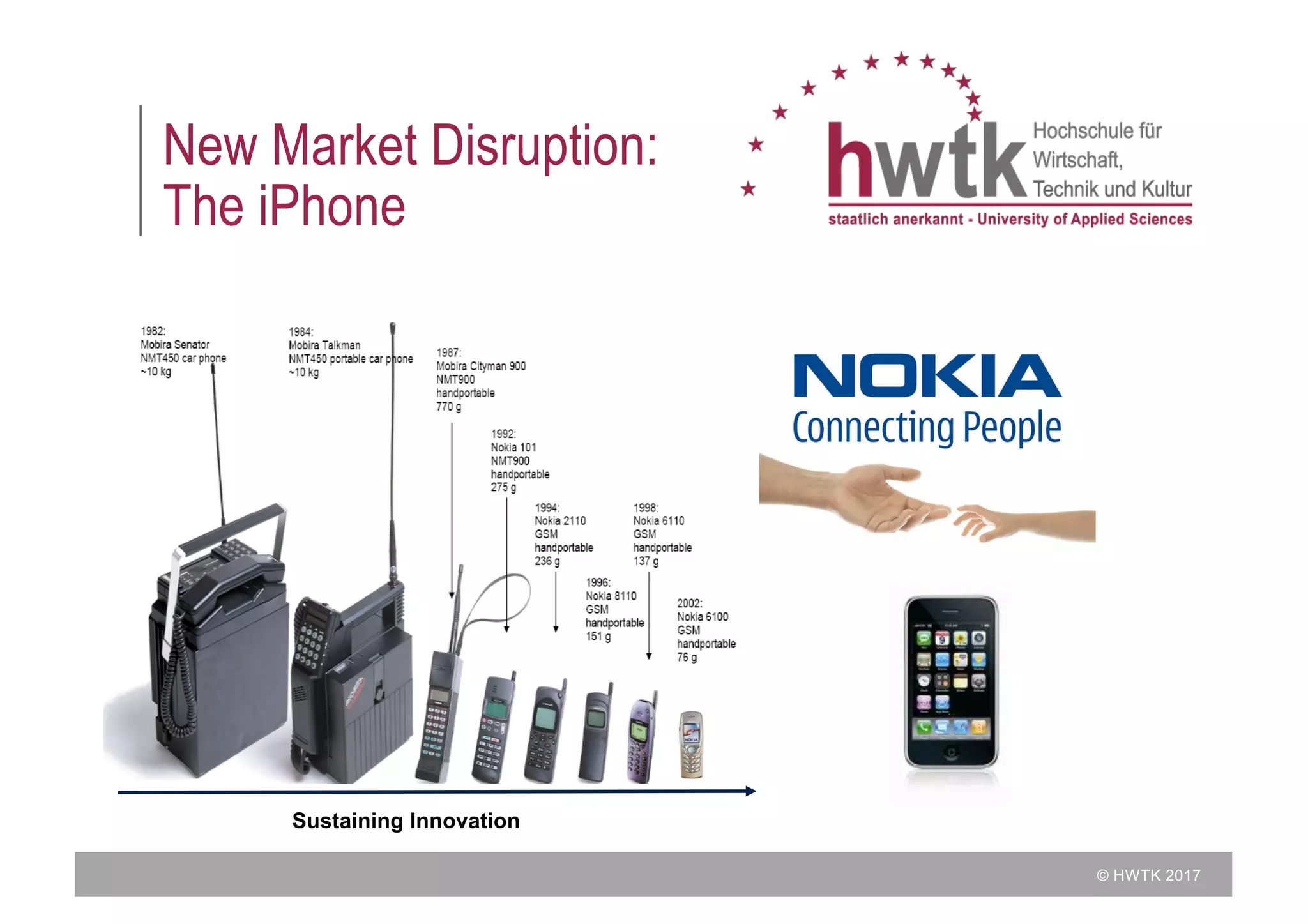
New Market Disruption:
The iPhone
Sustaining Innovation
© HWTK 2017
Some of Nokia‘s mistakes
§ Nokia missed the market change that customers began to
measure and use an iphone differently than a traditional cell
phone. A smartphone is rather a computer substitute than a
conventional phone.
§ While Nokia still concentrates on their hardware development
Apple and Google develop new operating systems and create
software ecosystems of softwarer (apps) around their products.
§ Customers start buying more and more smartphones and ignore
traditional cell phones.
§ In the smartphone category Nokia is not able to offer competitive
products.
© HWTK 2017
Key points about disruption
§ Disruption enables average customers to buy sophisticated products and services.
§ Disruption is a process and not a single event.
§ Not every company‘s failure can be attributed to disruption. Sometimes firms just go out of
business, because somebody else creates a better product.
§ There are 2 disruptive paths:
o Low-end disruption: A disruptive innovation initially offers a lower performance
according to what the mainstream market has historically demanded. As the
incumbents abandons low-margin products the entrant becomes better and better
and starts to offer products with high margins. Eventually, the entrant might displace
the former technology with its market leader (example: integrated steel mills vs. mini
mills).
o New market disruption: The entrant rather targets non-consumers and aims at
creating a new market. The product offers new performance attributes, which makes
it prosper and eventually crowds out the old product (example: typewriter vs. PC).
§ An incumbent‘s failure through disruption is enabled through the success and the
sustaining innovation of the incumbent („innovator‘s dilemma“). Success breeds arrogant
managers, handicaps the innovation culture and makes the company averse to change.
© HWTK 2017
12
Literature
Christensen, C. M. (1997): The Innovator's Dilemma: The
Revolutionary Book that Will Change the Way You Do Business.
New York: Harper Collins.
Christensen, C.M. and Raynor, M.E. (2003): The Innovator´s Solution
– Creating and Sustaining Successful Growth. Boston: HBR Press.
.
© HWTK, 2015© HWTK, 2015
© HWTK 2016
Your Future. Your Success.
Prof. Dr. Christian Schultz
Head of Distance Learning at HWTK
christian.schultz@hwtk.de

What is the Theory of Disruption?

  • 1.
    © HWTK 2017 Whatis the Theory of Disruption? Your Future. Your Success. Prof. Dr. Christian Schultz christian.schultz@hwtk.de
  • 2.
    © HWTK 2017 Westart with a simple question! Why did Nokia fail? Task: Please brainstorm this question briefly with your partner and write the strongest reason(s) in your opinion on your card! Time: 2 Minutes Verbal gathering of results: 1 Minute
  • 3.
    © HWTK 2017 Another(not-so-simple) question ... Why do good companies fail? Note It is easy to explain why poorly companies fail; but many of history‘s most successful and best-run firms have lost their positions of leadership, too. Why is it so hard to sustain success? Clayton M. Christensen, 2003, 1. Christensen and Raynor (2003): The Innovator´s Solution – Creating and Sustaining Successful Growth, Boston: HBR Press.
  • 4.
    © HWTK 2017 TheInnovator‘s Dilemma and The Innovator‘s Solution Central Question: Why do good companies fail? Central Question: How can companies stay succesful? Christensen, C.M. (1997): The innovator's dilemma: The revolutionary book that will change the way you do business, Boston: Harper Collins. Christensen, C.M. and Raynor, M. (2003): The Innovator's solution: Creating and sustaining successful growth, Boston: Harvard Business Review Press.
  • 5.
    © HWTK 2017 Product Performance Disruptiveinnovation enables to transform a complicated product into a simple product. Incumbents nearly always win! Entrants nearly always win! § High product performance § High-margin/ low volume segment of the market § Low product performance § Low-margin/ low volume segment of the market § Medium product performance § Medium-margin/ high volume segment of the market Time Source: Christensen, C.M. 1997, xiv; Christensen, C.M. and Raynor M.E. 2003, 33; with some additional information. Disruptive innovation answers the question: Why do market leaders fail over time?
  • 6.
    © HWTK 2017 Benefit Costcosupermarkets Low-price airlines Steel Minimills Differentmeasure ofperformance Telephone (1876) Cell phone, PC (1978) Photo copying (1950) e-Retail (1996) Benefits the customer can experience Improvement, product or process innovation Source: Christensen, C.M. and Raynor, M.E. 2003, 44. Compete against non-consumption Address over-served customers with a lower cost business model Two paths of disruption
  • 7.
    © HWTK 2017 Examplesof Companies and Products Whose Roots Were in Disruption -1870 Kodak Bell Telephone Beefprocessing (Swift,Armour) Departmentstores (MarshallField’s, Macy’s) Merrill Lynch Ford Catalogretailing (SearsJCPenney,MontgomeryWard) Plastics (DuPont, Dow, etc.) Sony Honda motorcycles McDonald’s Minicomputers (DEC, Nixdorf, etc.) Xerox Black& Decker Toyota, Nissan consumer power tools Discount department stores (Kmart, Wal-Mart, Target) Japanese steel companies Steelminimills Ultrasoundsoft Intel microprocessor tissue imaging Credit scoring in Endoscopic surgery Southwest Airlines consumer lending Boxedbeef Flat-paneldisplays Fidelity (self-service CharlesSchwab Vanguardindexmutualfinds investmentmanagement) Blended plastics Barnes & GE Capital Personal computers Communitycolleges Seiko digital watches Portablediabetes (Himont, etc.) Noble Kodak Funsaver single-use camera glucose meters Toys‘R Us Universityof MCI, Sprint Phoenix Microsoft Bloomberg Embraer, Sun Canadair Microsystems CircuitCity, HomeDepot, Staples, BestBuy Wireless telephony Oracle Cisco Canon photocopiers Intuit Quick-Books (accounting) and TurboTax(software) Dell Computer MBNA Ink-jet printers Hyundai, Kia Veritas, NetworkAppliance Galanz microwaveovens Digitalanimation(Pixar etal.) & air conditioners E -mail Unmanned militaryaircraft MicrosoftSQL database software ECNseBay PalmPilot, RIMBlackBerry ConcordSchoolof Law Google Linux Digitalprinting Online Amazon.com Online travelagencies JetBlue Sonosite Ultrasound Salesforce.com 802.11 stockbrokers -1950 -1960 -1980 -2000 History Low EndNew Market Source: Christensen, C.M. and Raynor, M.E. 2003, 48. 7 Different case study examples of disruption
  • 8.
    © HWTK 2017 Mainreasons for incumbents to suffer from disruption •More product features than the average customer can absorb. •Incumbent‘s focus is on the best customers, who buy high- margin products. •Ressource allocation depends on those customers and the company‘s investors. Over- engineering •Production of low-margin products becomes uninteresting. •Only high growth markets are addressed. •Not overly profitable market segments are abandonded. Profit Focus •High fixed cost percentage of overall cost. •Risk aversion towards new technologies. •New markets can not be analyzed therefore no investment. Risk Aversion Source: According to Christensen, C.M. 1997.
  • 9.
    © HWTK 2017 NewMarket Disruption: The iPhone Sustaining Innovation
  • 10.
    © HWTK 2017 Someof Nokia‘s mistakes § Nokia missed the market change that customers began to measure and use an iphone differently than a traditional cell phone. A smartphone is rather a computer substitute than a conventional phone. § While Nokia still concentrates on their hardware development Apple and Google develop new operating systems and create software ecosystems of softwarer (apps) around their products. § Customers start buying more and more smartphones and ignore traditional cell phones. § In the smartphone category Nokia is not able to offer competitive products.
  • 11.
    © HWTK 2017 Keypoints about disruption § Disruption enables average customers to buy sophisticated products and services. § Disruption is a process and not a single event. § Not every company‘s failure can be attributed to disruption. Sometimes firms just go out of business, because somebody else creates a better product. § There are 2 disruptive paths: o Low-end disruption: A disruptive innovation initially offers a lower performance according to what the mainstream market has historically demanded. As the incumbents abandons low-margin products the entrant becomes better and better and starts to offer products with high margins. Eventually, the entrant might displace the former technology with its market leader (example: integrated steel mills vs. mini mills). o New market disruption: The entrant rather targets non-consumers and aims at creating a new market. The product offers new performance attributes, which makes it prosper and eventually crowds out the old product (example: typewriter vs. PC). § An incumbent‘s failure through disruption is enabled through the success and the sustaining innovation of the incumbent („innovator‘s dilemma“). Success breeds arrogant managers, handicaps the innovation culture and makes the company averse to change.
  • 12.
    © HWTK 2017 12 Literature Christensen,C. M. (1997): The Innovator's Dilemma: The Revolutionary Book that Will Change the Way You Do Business. New York: Harper Collins. Christensen, C.M. and Raynor, M.E. (2003): The Innovator´s Solution – Creating and Sustaining Successful Growth. Boston: HBR Press. .
  • 13.
    © HWTK, 2015©HWTK, 2015 © HWTK 2016 Your Future. Your Success. Prof. Dr. Christian Schultz Head of Distance Learning at HWTK christian.schultz@hwtk.de