Example Projects in
Fauquier/Warrenton and Beyond
But mostly some practical how-to, where-to,
and resources for making stuff happen.
Ari Daniels, P.E. (he/him)
Water Resources Engineer
Center for Watershed Protection
add@cwp.org
410-461-8323; ext. 3204
6/11/2020
www.cwp.org
Outline
• Examples of Fauquier/Warrenton BMPs
• Tips for getting help ($$ and/or peoplepower)
• VERY quick walk through a resource for small-ish
scale stormwater BMPs, and some lessons learned
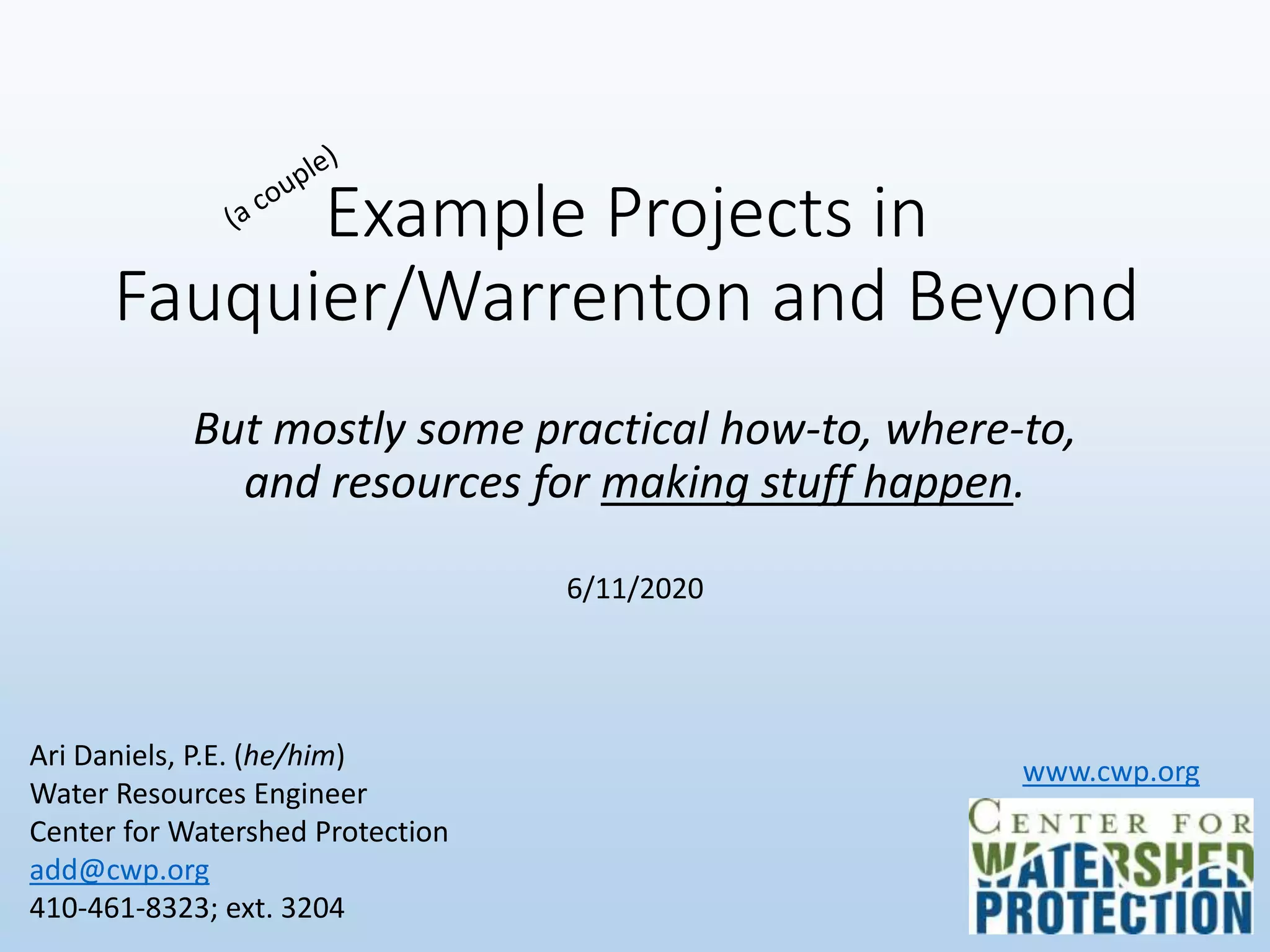
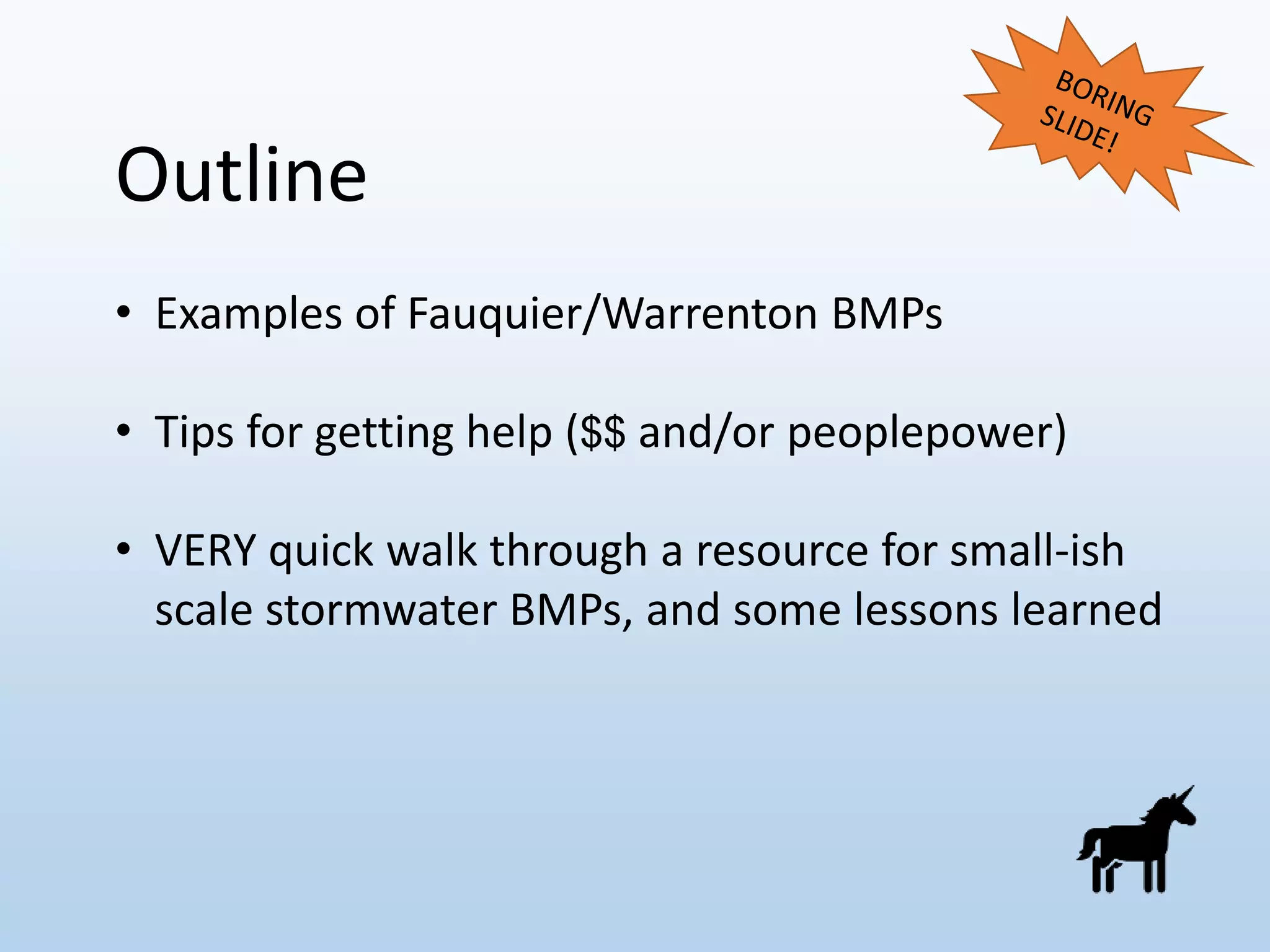
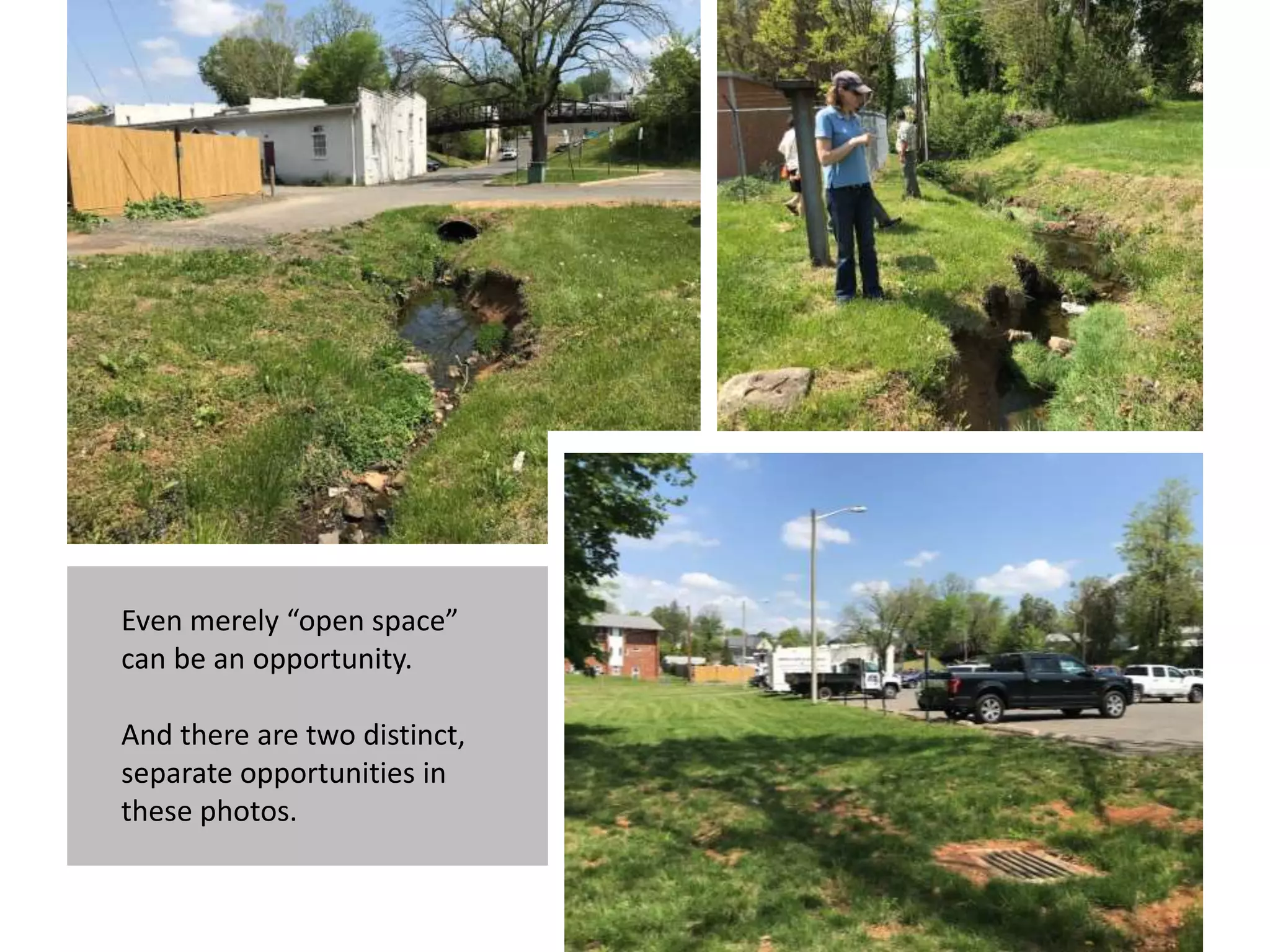
Even merely “open space”
can be an opportunity.
And there are two distinct,
separate opportunities in
these photos.
Even merely “open space”
can be an opportunity.
And there are two distinct,
separate opportunities in
these photos.
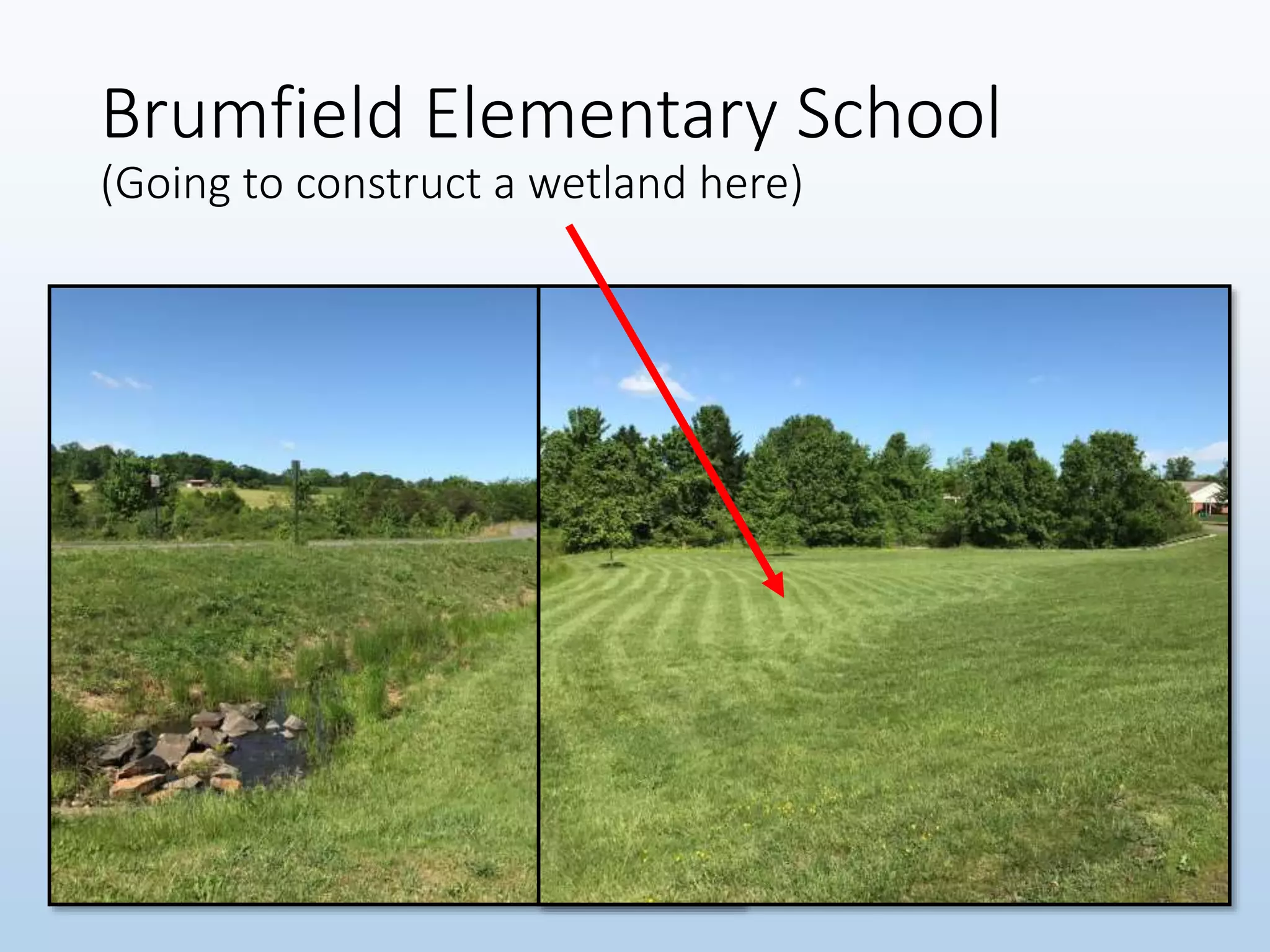
Brumfield Elementary School
(Going to construct a wetland here)
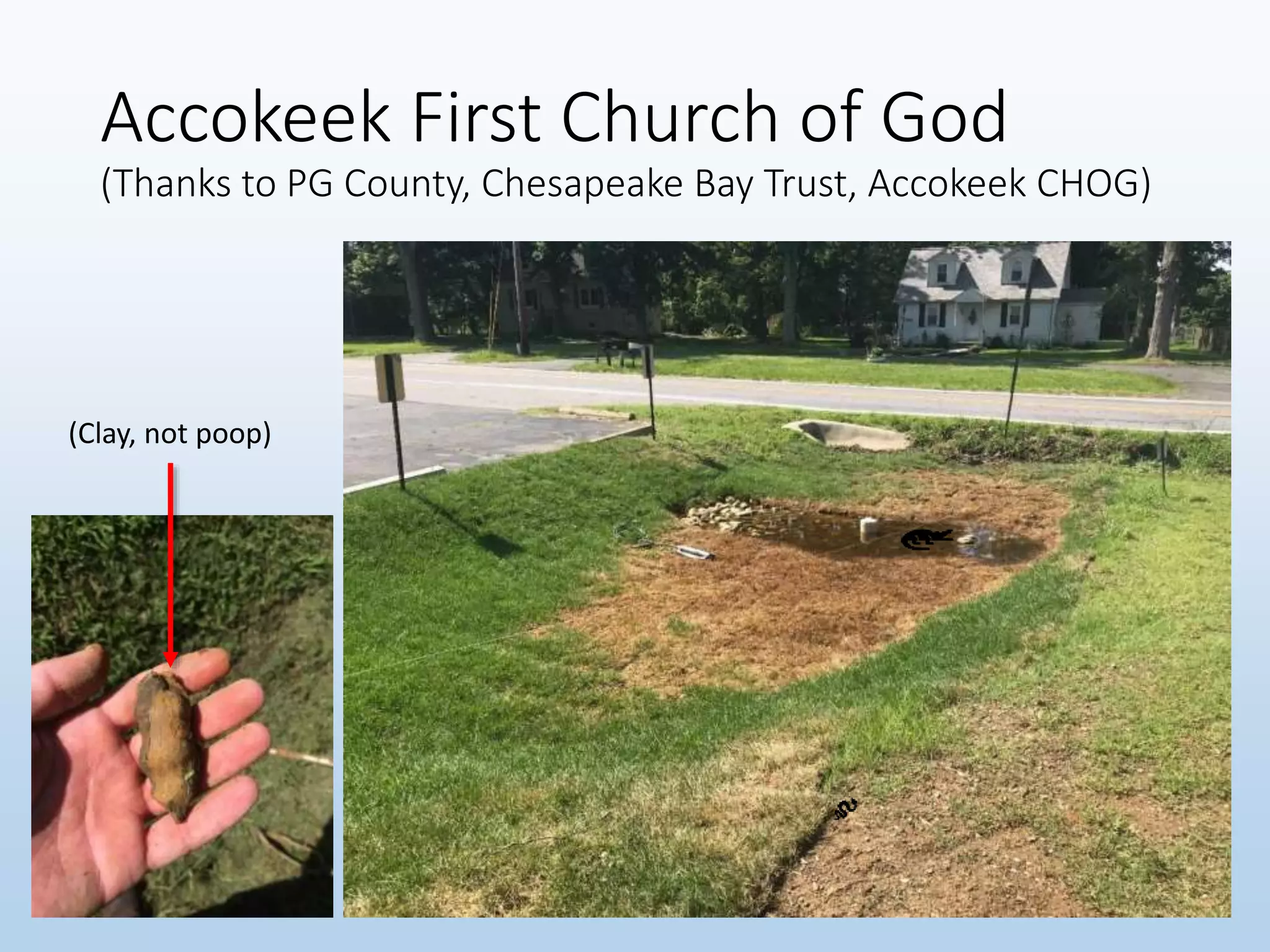
Accokeek First Church of God
(Thanks to PG County, Chesapeake Bay Trust, Accokeek CHOG)
(Clay, not poop)
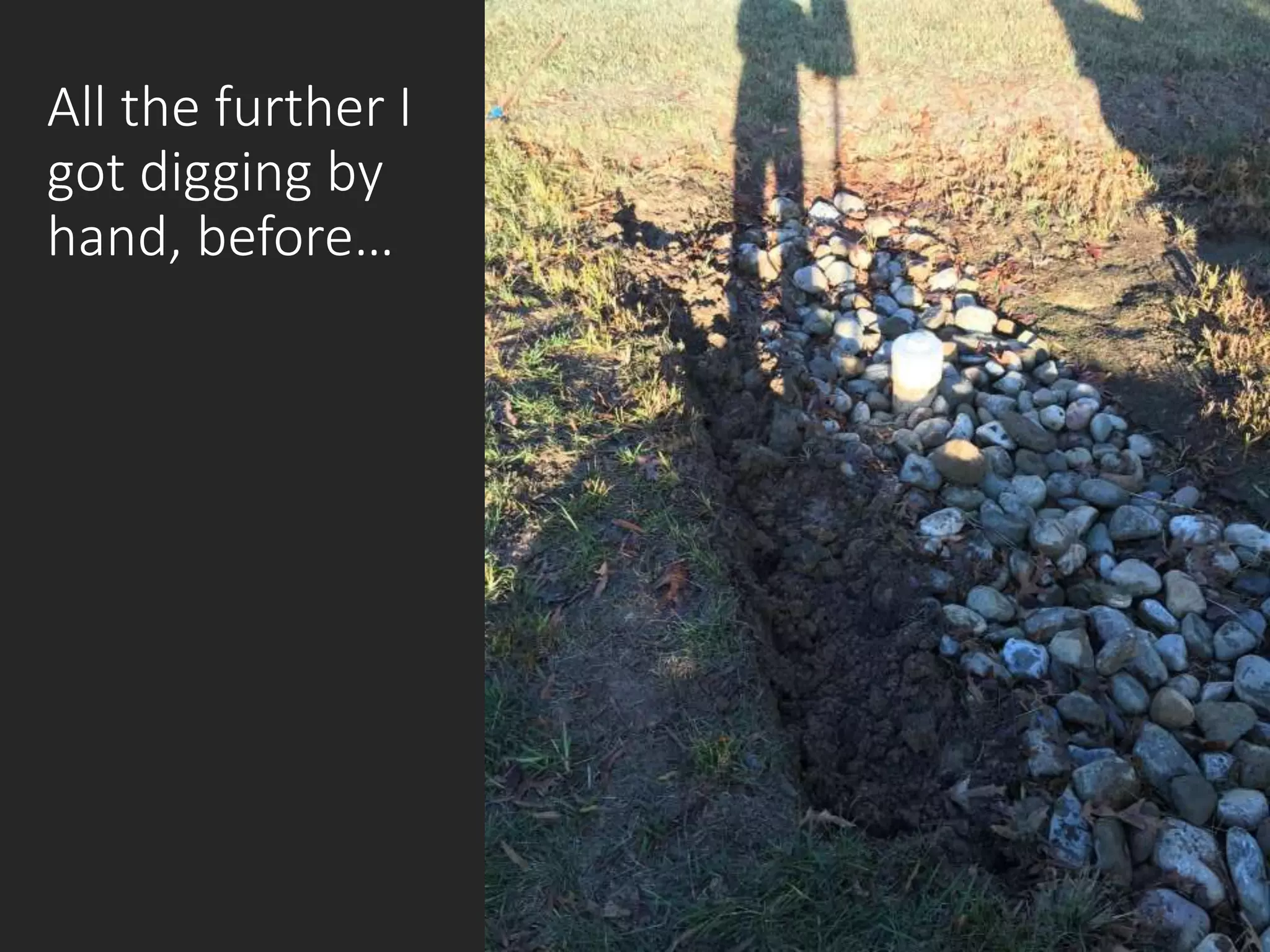
All the further I
got digging by
hand, before…
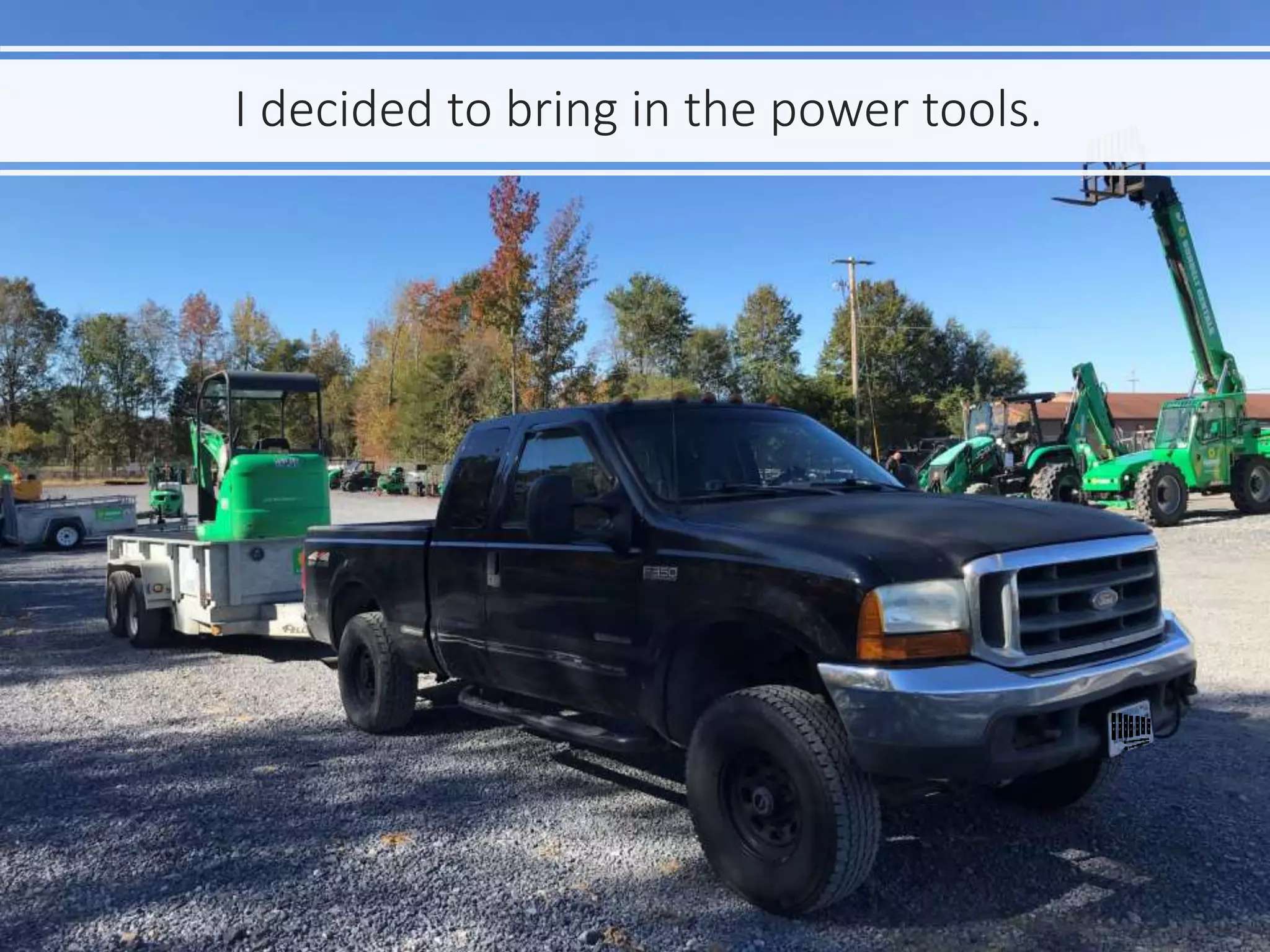
I decided to bring in the power tools.
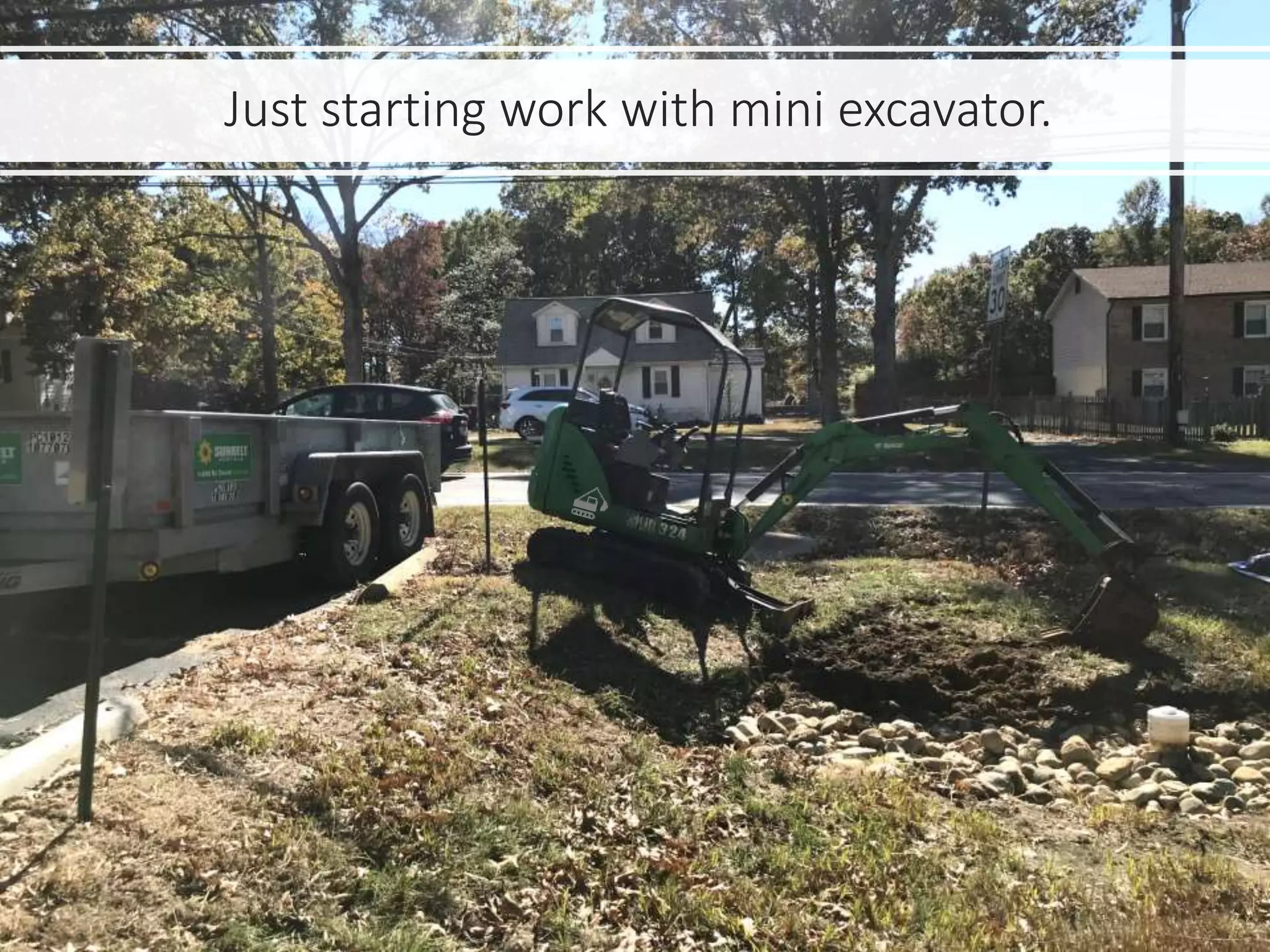
Just starting work with mini excavator.
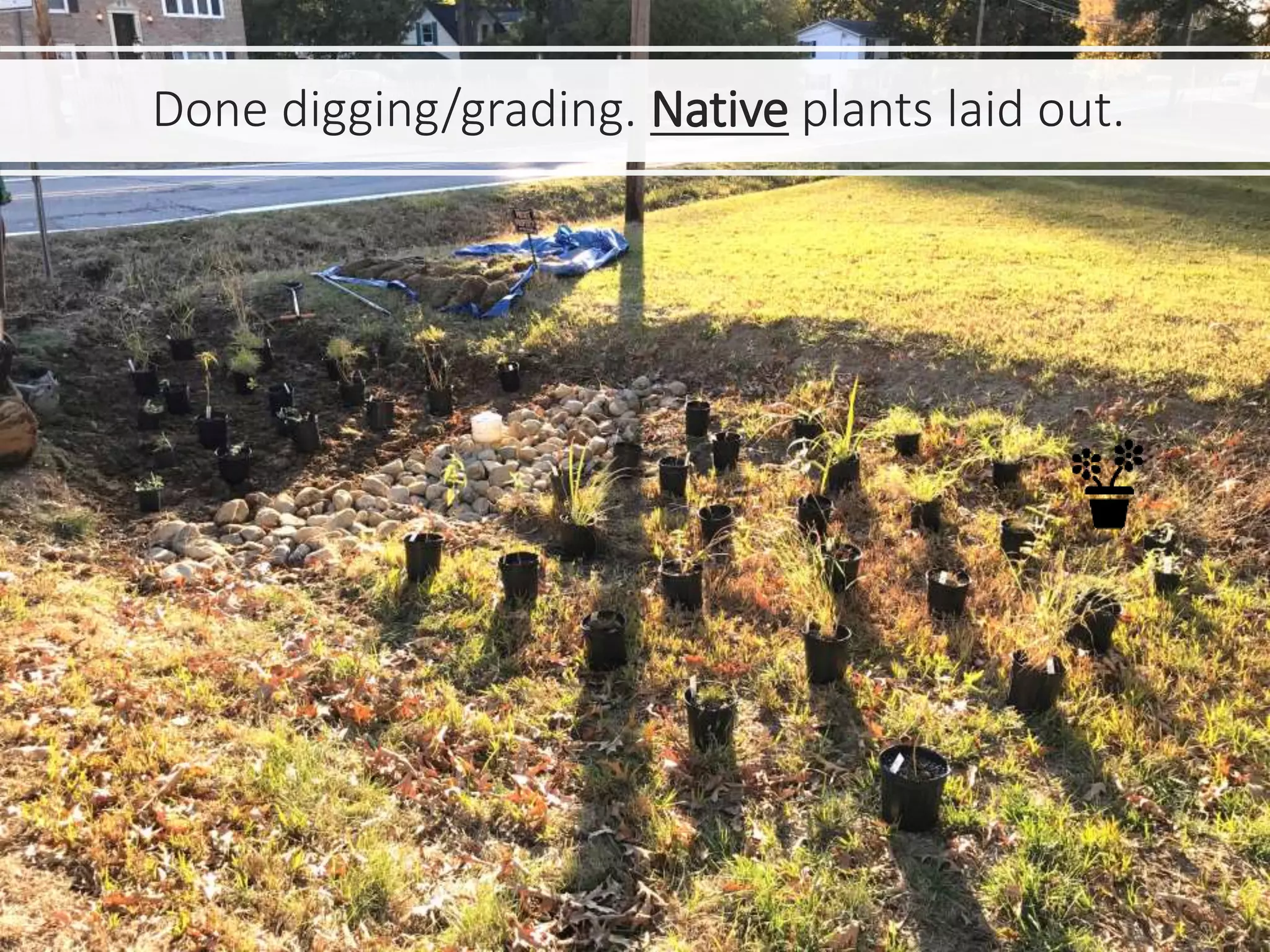
Done digging/grading. Native plants laid out.
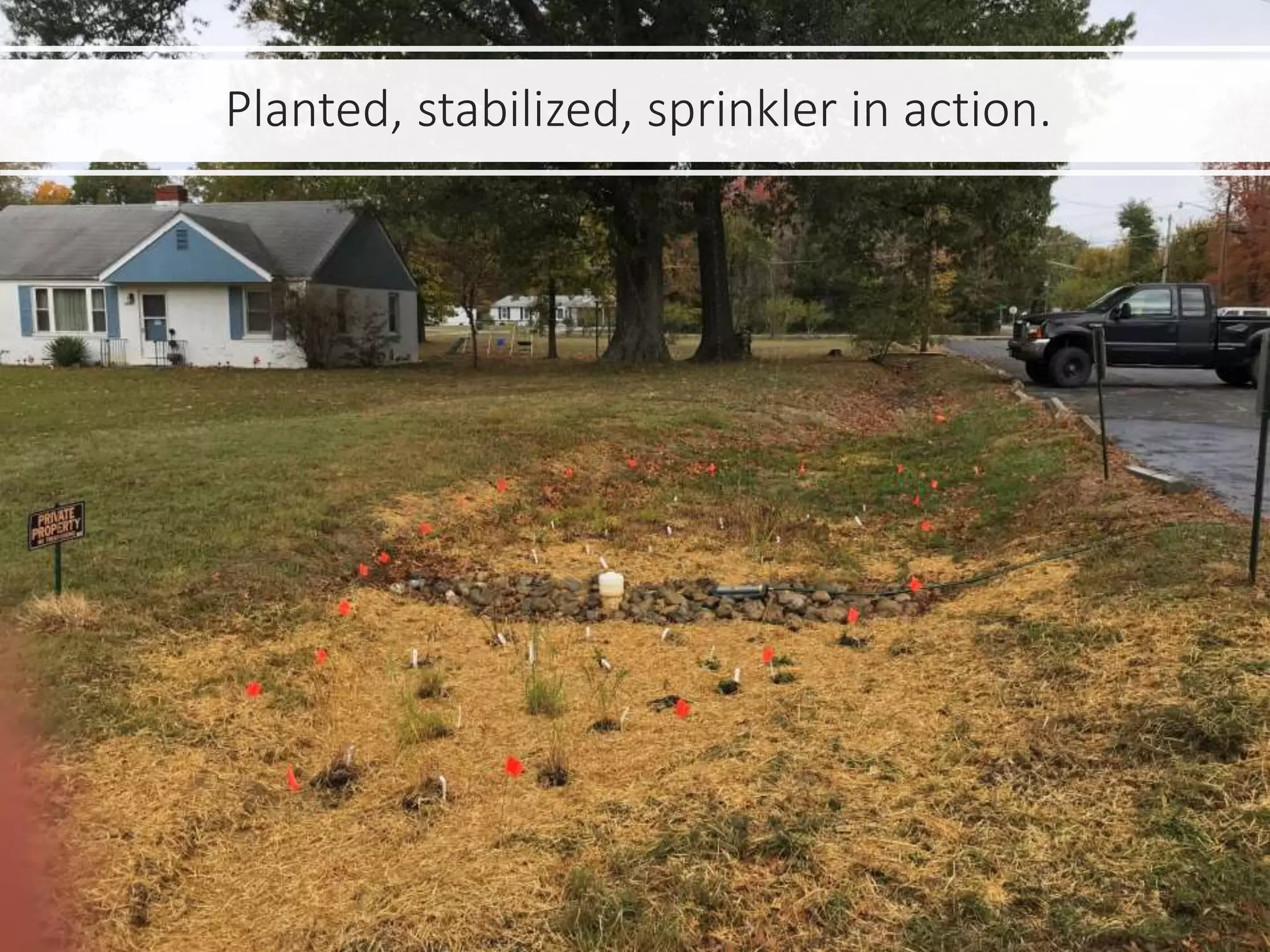
Planted, stabilized, sprinkler in action.
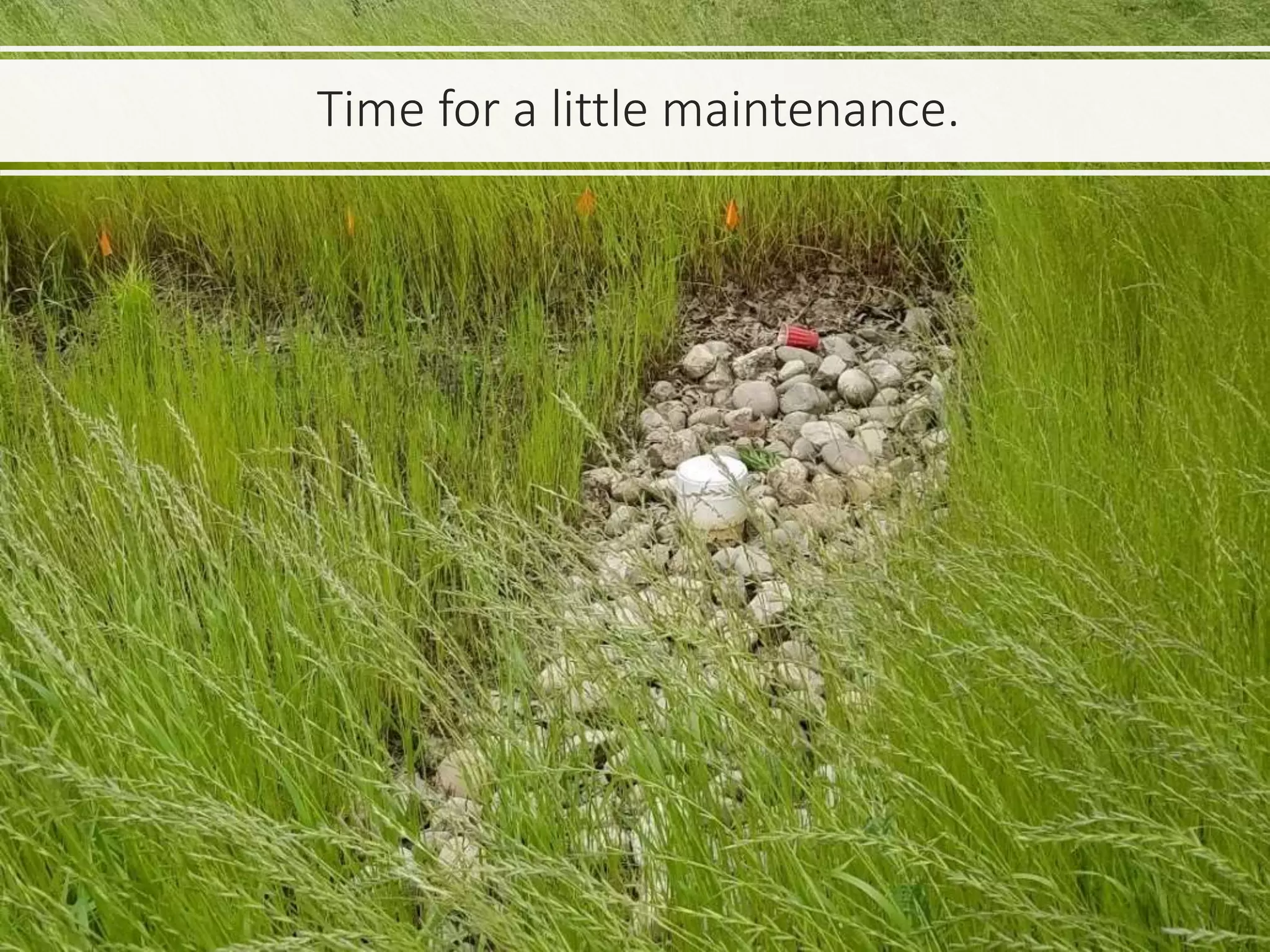
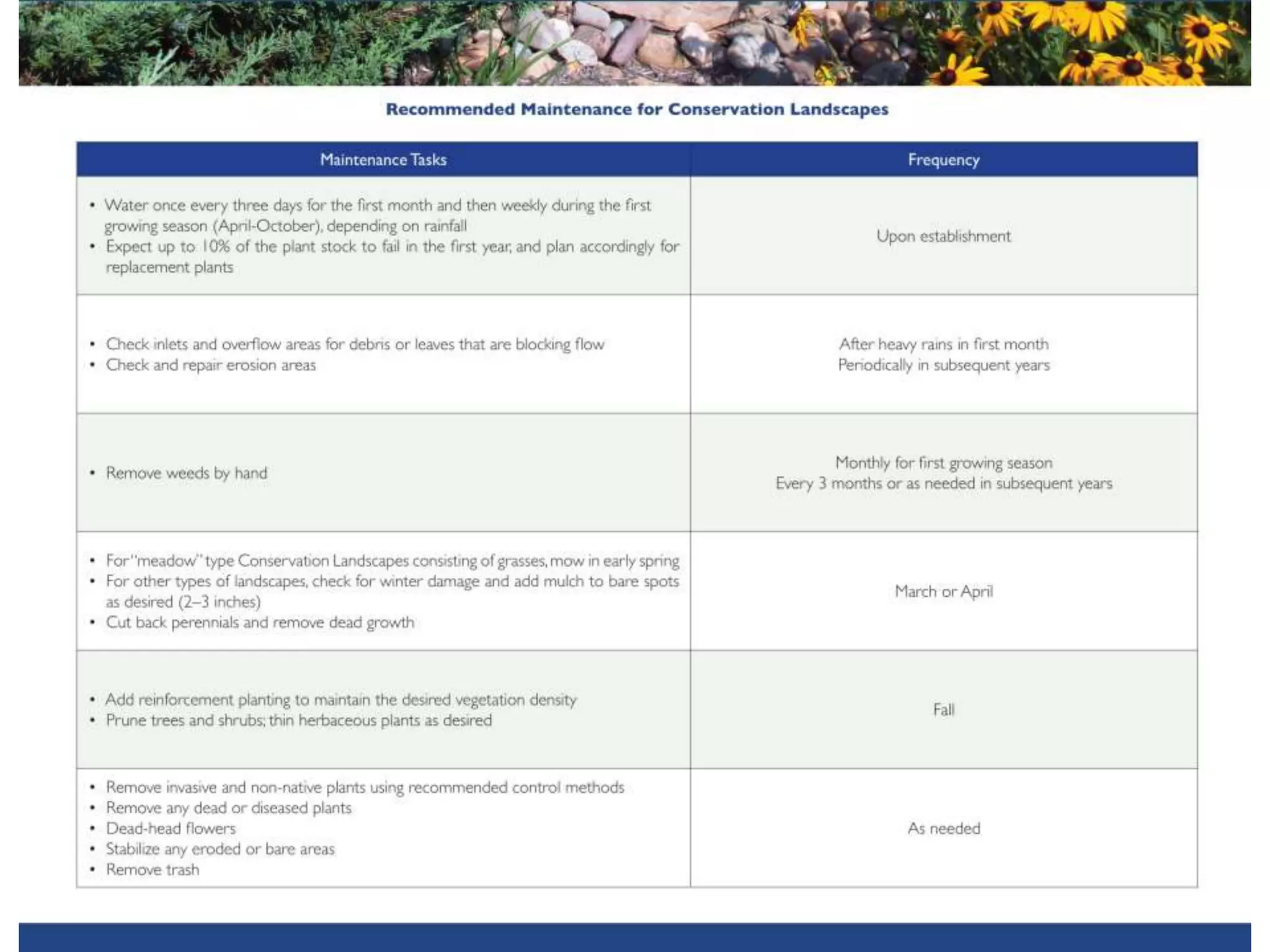
Time for a little maintenance.
Where/How to Look for Help
Starting out
• Soil & Water
Conservation District
• Local government
• Local watershed
association/non-profit
• “I think so-and-so
knows a bunch about
this hippie stuff.”
Search terms
• Watershed
• Stormwater BMP
• Conservation / Native
Landscaping
• Rain garden
• Grant program
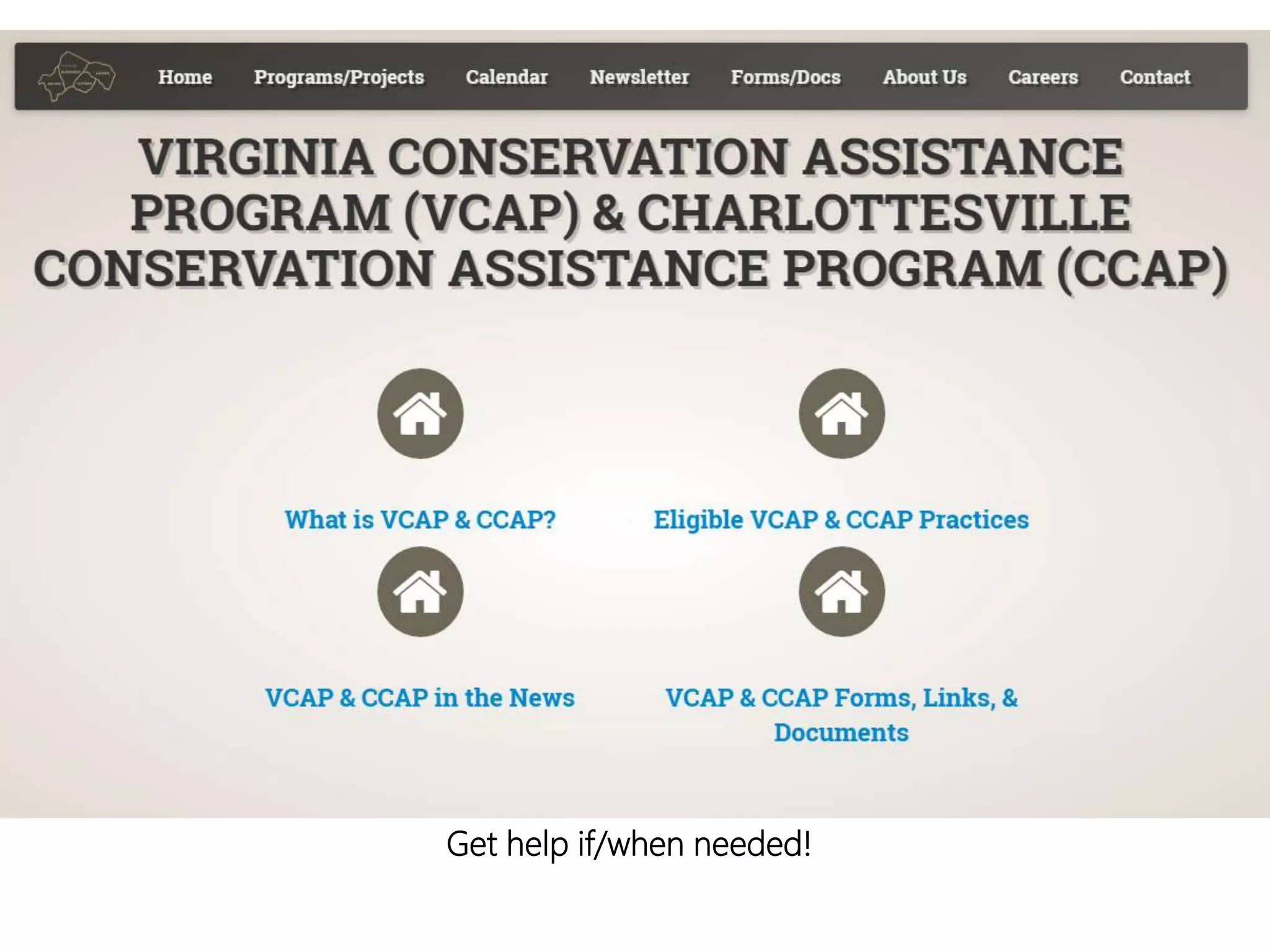
Get help if/when needed!
General Rules for BMP Design, Installation, Maintenance
Water is Lazy
(Water flows downhill, and follows the path of least resistance.)
Regulations/specifications differ by locality, sometimes greatly
(With almost 1,800 local governments in the Bay watershed, just because both are called
"rain garden" doesn't mean they are the same.)
Maintenance/repair should be strong considerations
(Even dirt needs to be maintained.)
Get help if/when needed
(There are many funding and implementation support options. Use them!)
Every little bit counts (or “How do you eat an elephant?)
(Even a small conservation landscape helps the overall quality of the Bay. 51 billion
gallons enter per day, but even 20 gallons reduced or cleaned is a benefit.)
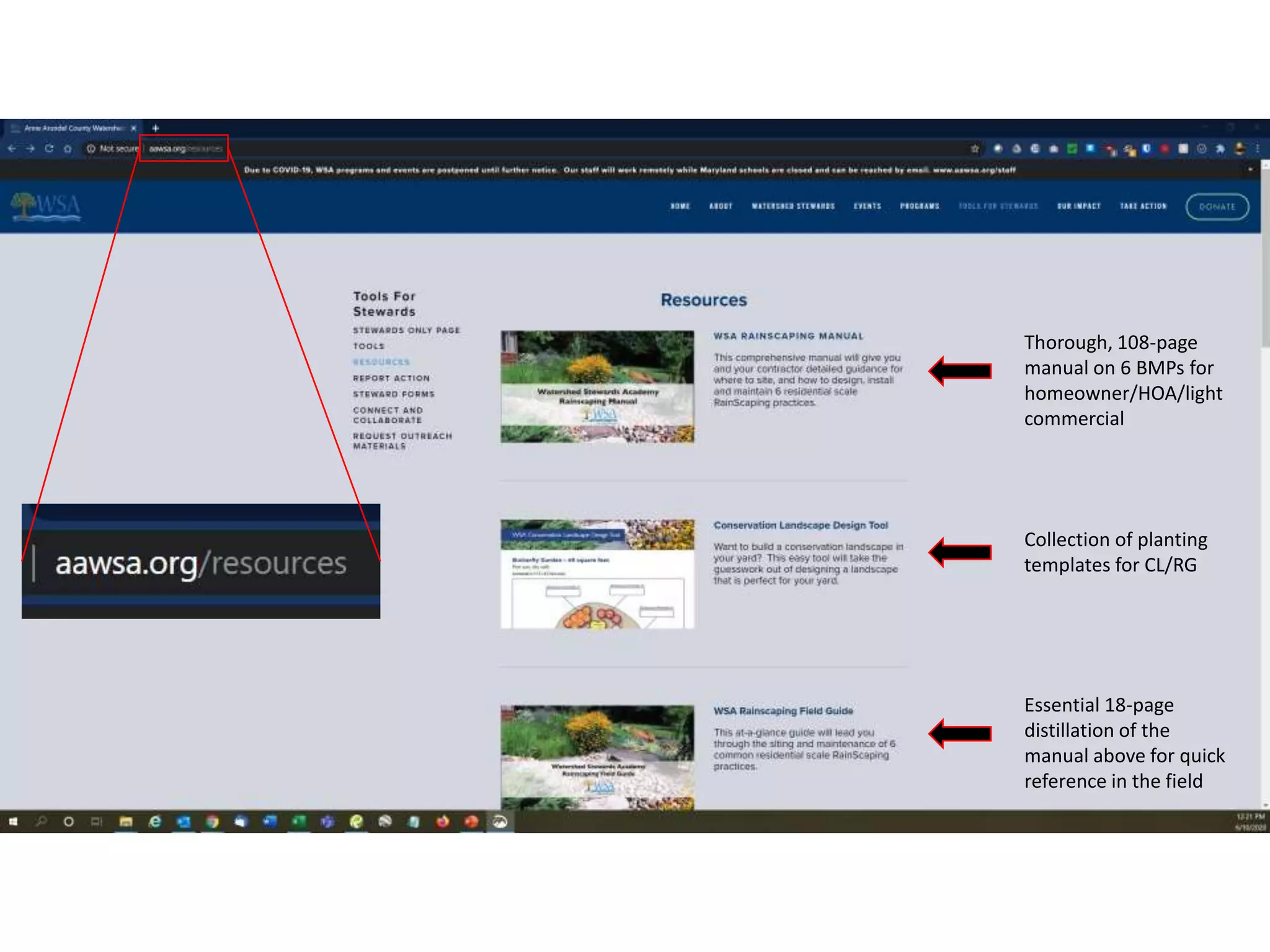
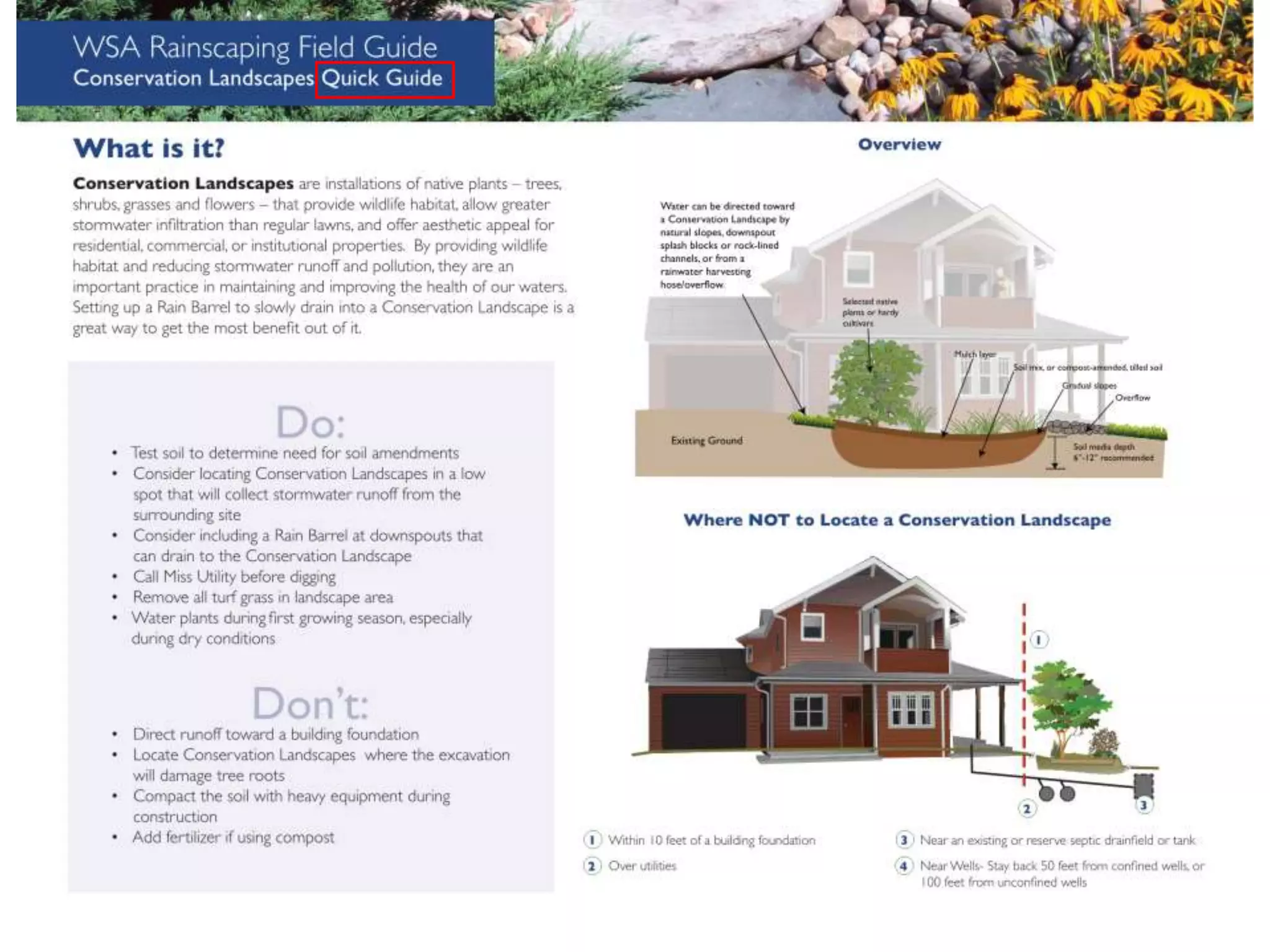
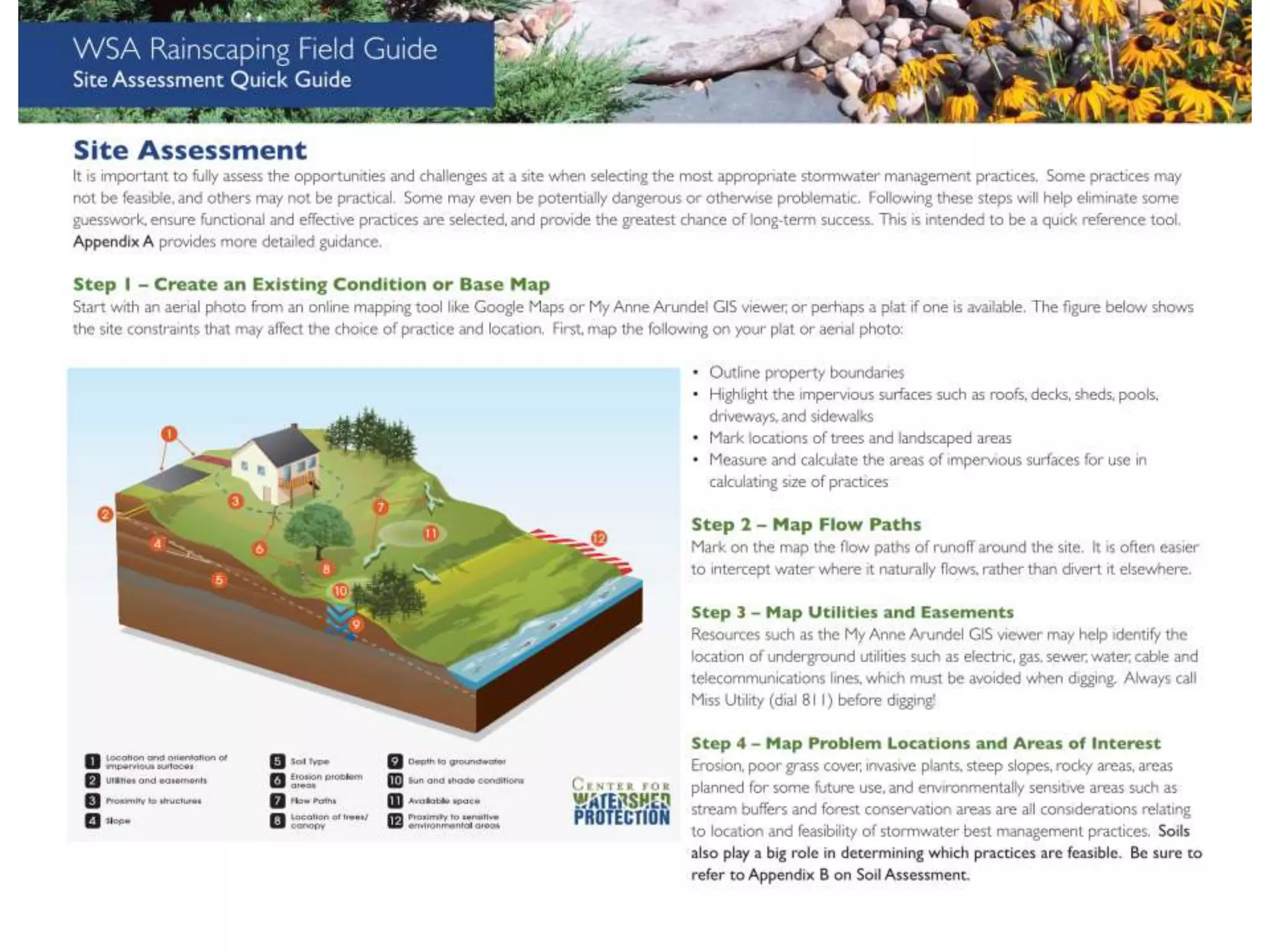
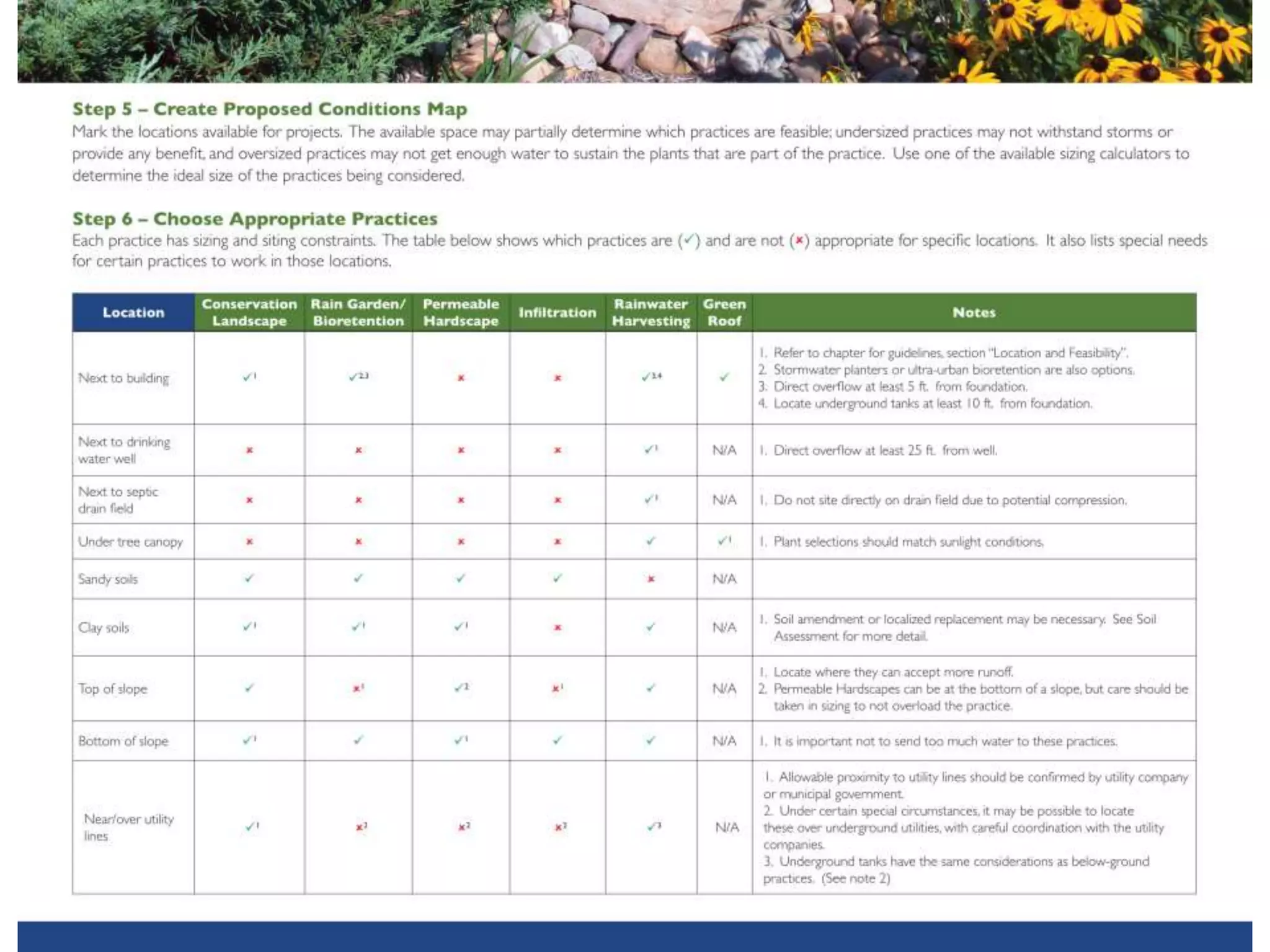
Thorough, 108-page
manual on 6 BMPs for
homeowner/HOA/light
commercial
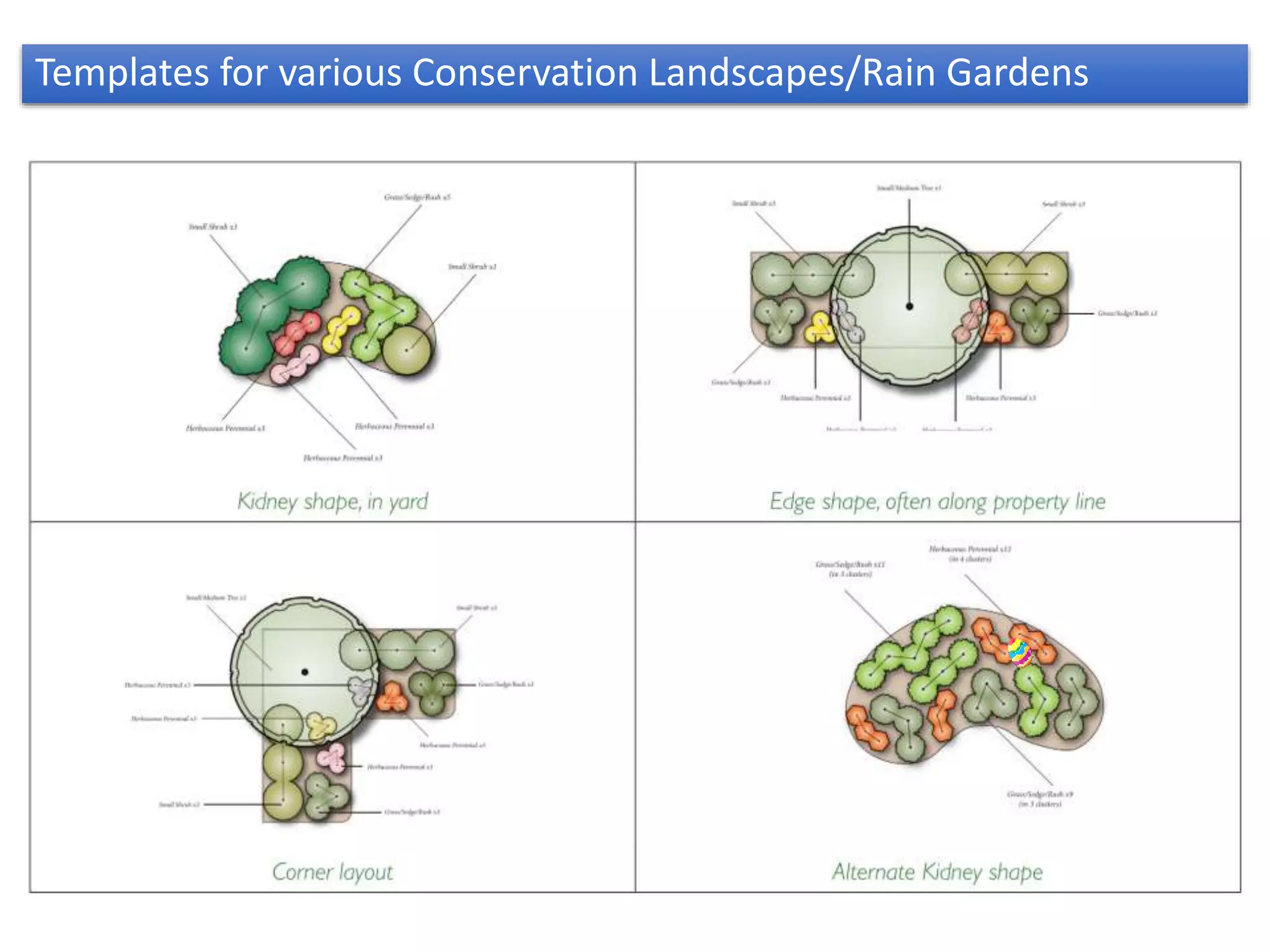
Collection of planting
templates for CL/RG
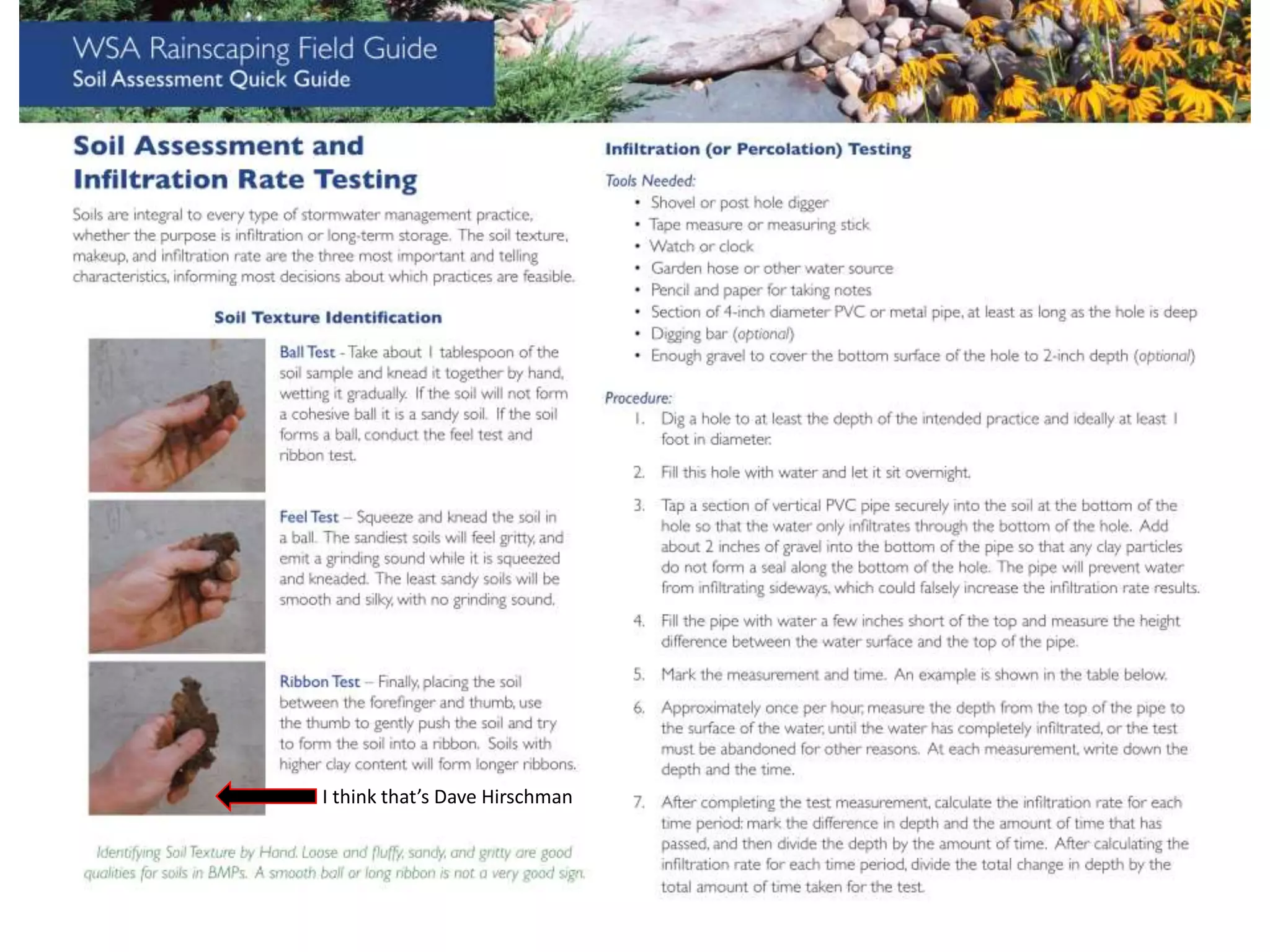
Essential 18-page
distillation of the
manual above for quick
reference in the field
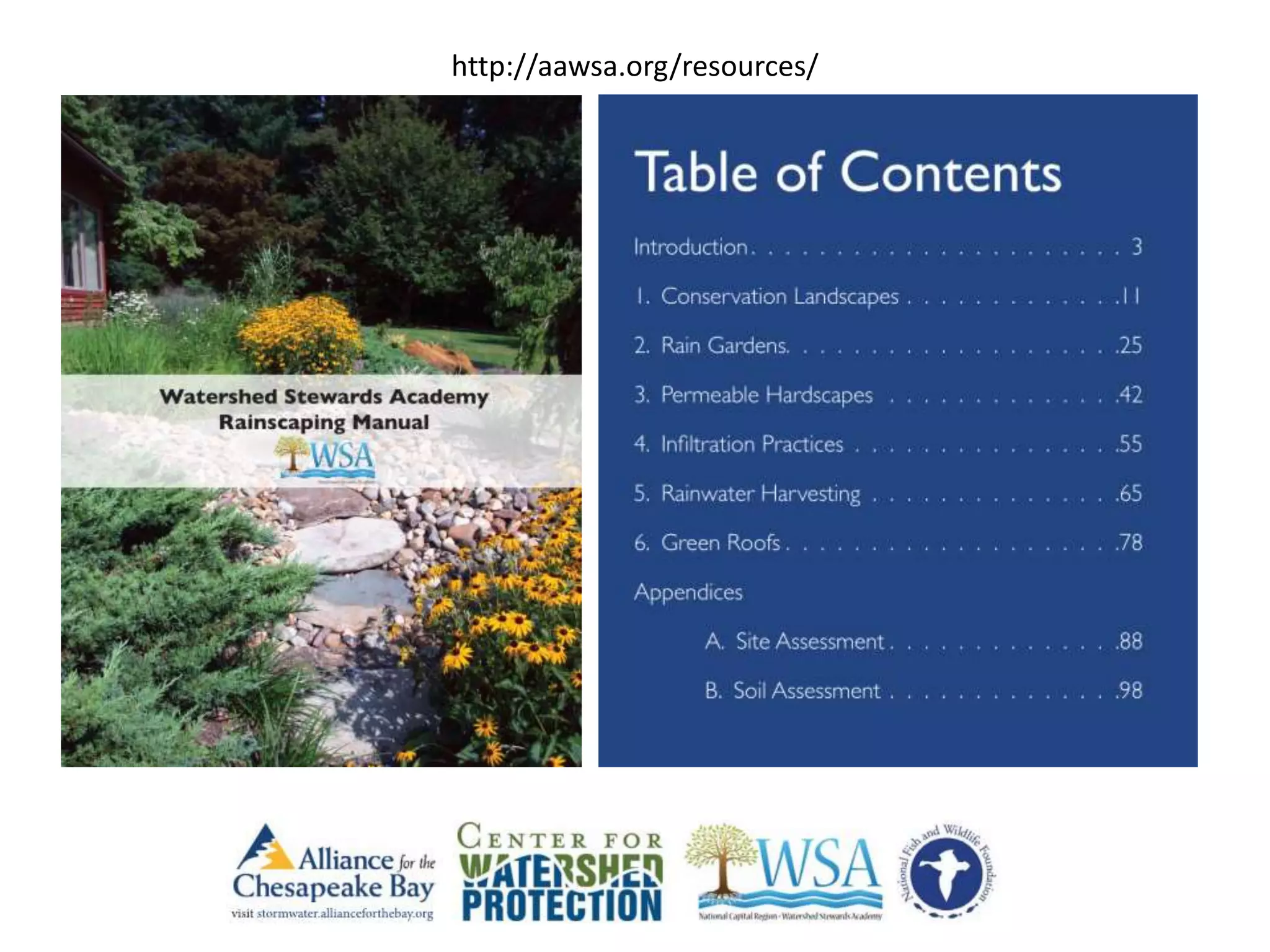
http://aawsa.org/resources/
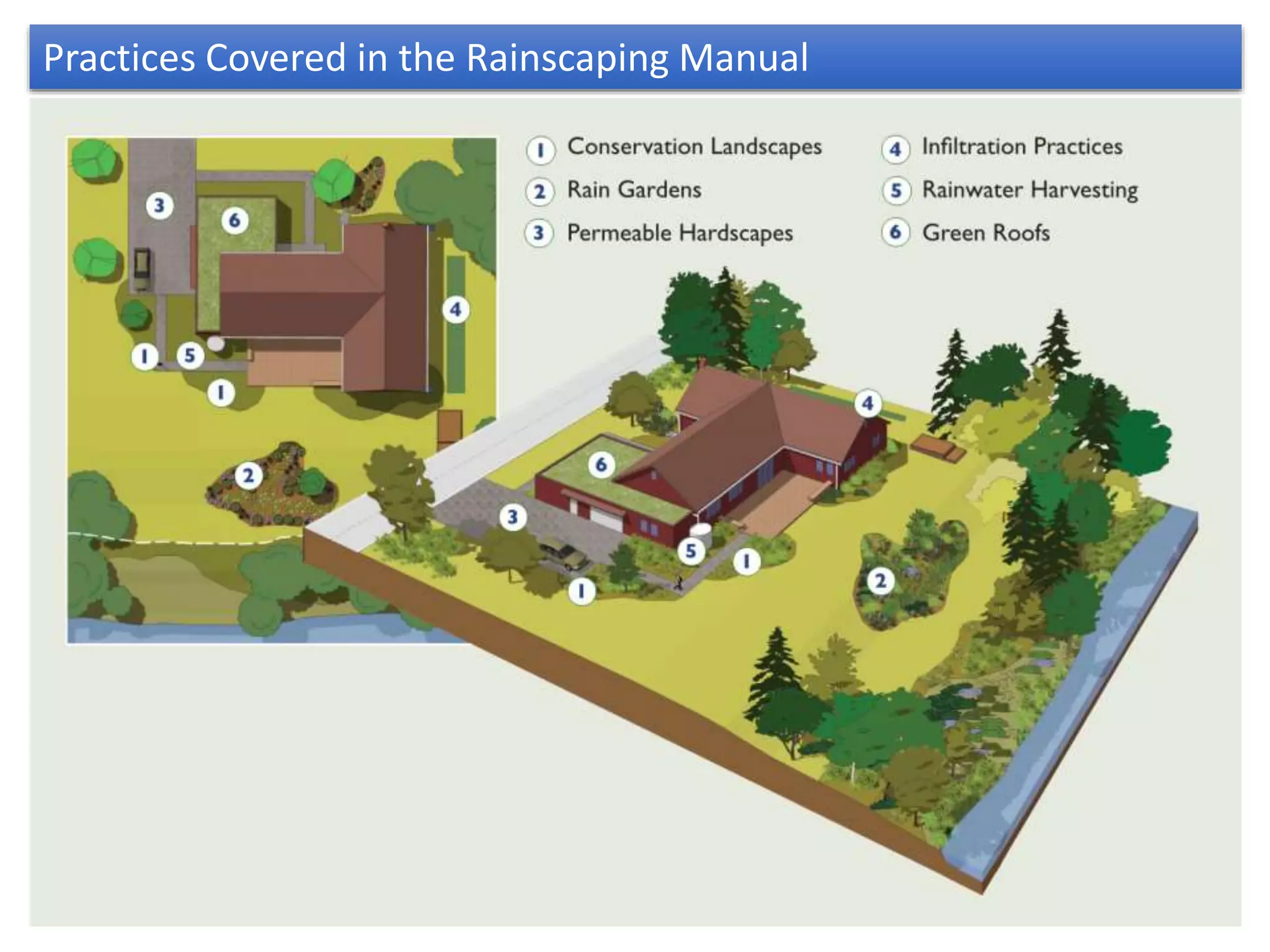
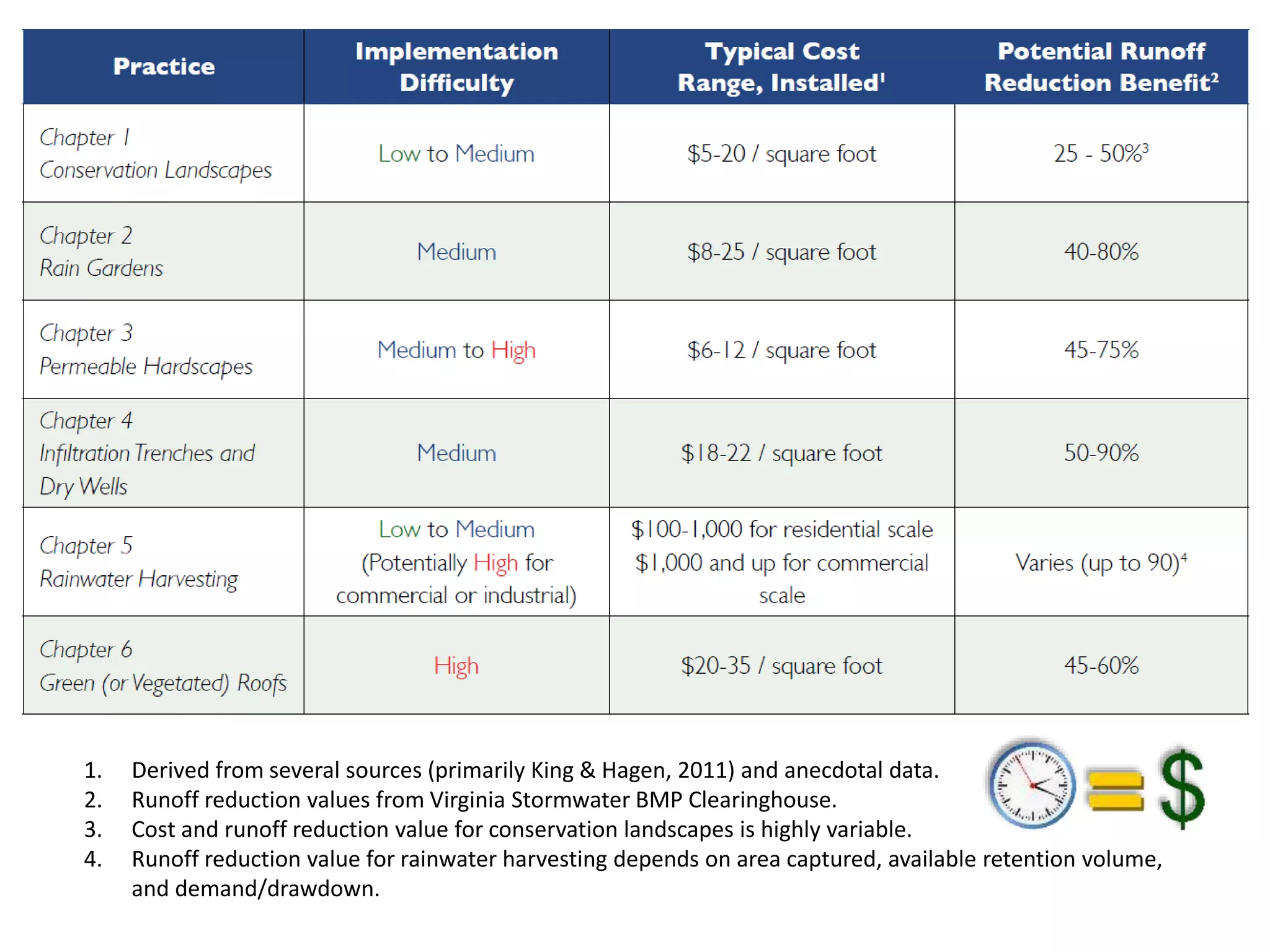
Practices Covered in the Rainscaping Manual
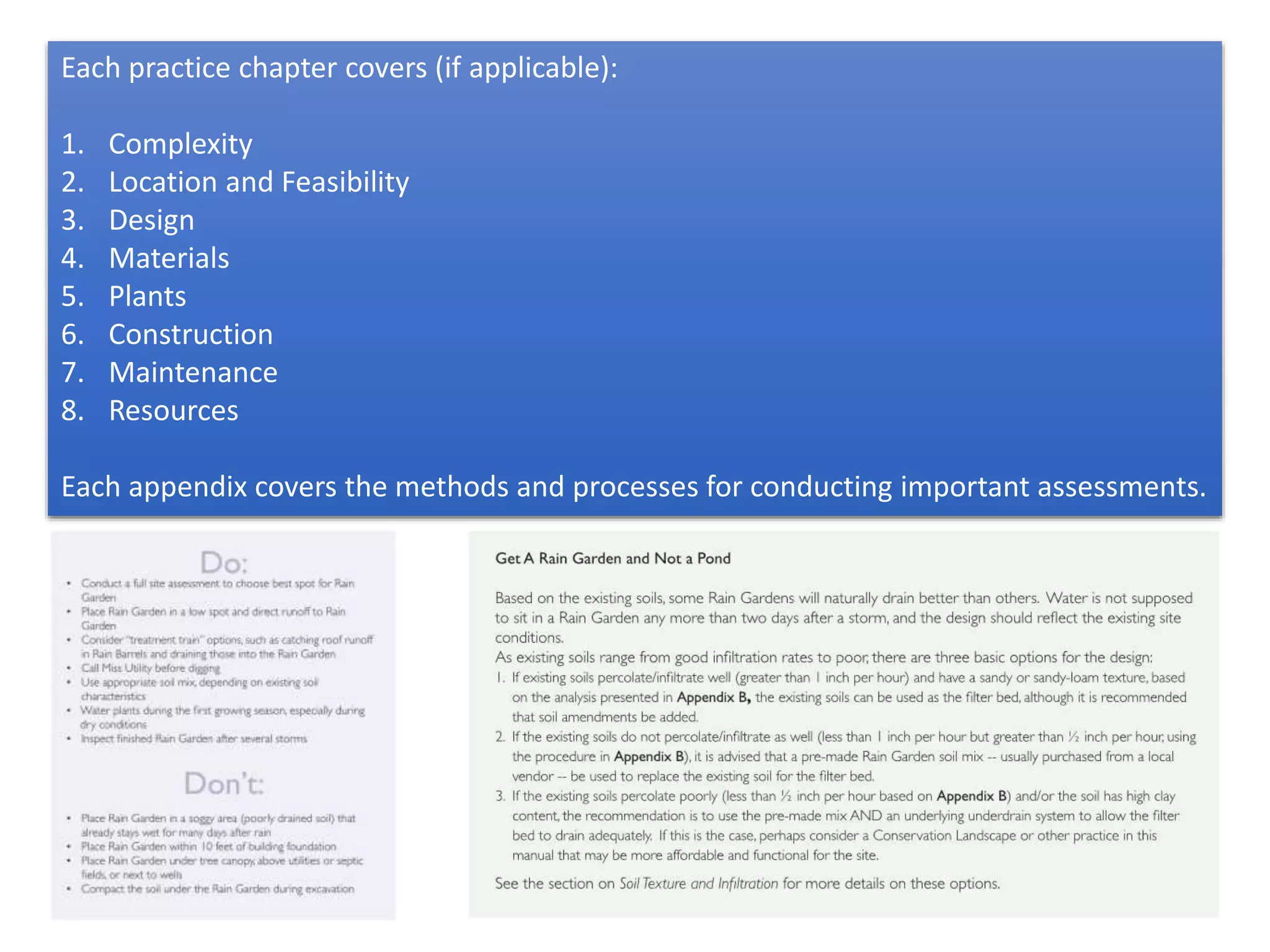
Each practice chapter covers (if applicable):
1. Complexity
2. Location and Feasibility
3. Design
4. Materials
5. Plants
6. Construction
7. Maintenance
8. Resources
Each appendix covers the methods and processes for conducting important assessments.
1. Derived from several sources (primarily King & Hagen, 2011) and anecdotal data.
2. Runoff reduction values from Virginia Stormwater BMP Clearinghouse.
3. Cost and runoff reduction value for conservation landscapes is highly variable.
4. Runoff reduction value for rainwater harvesting depends on area captured, available retention volume,
and demand/drawdown.
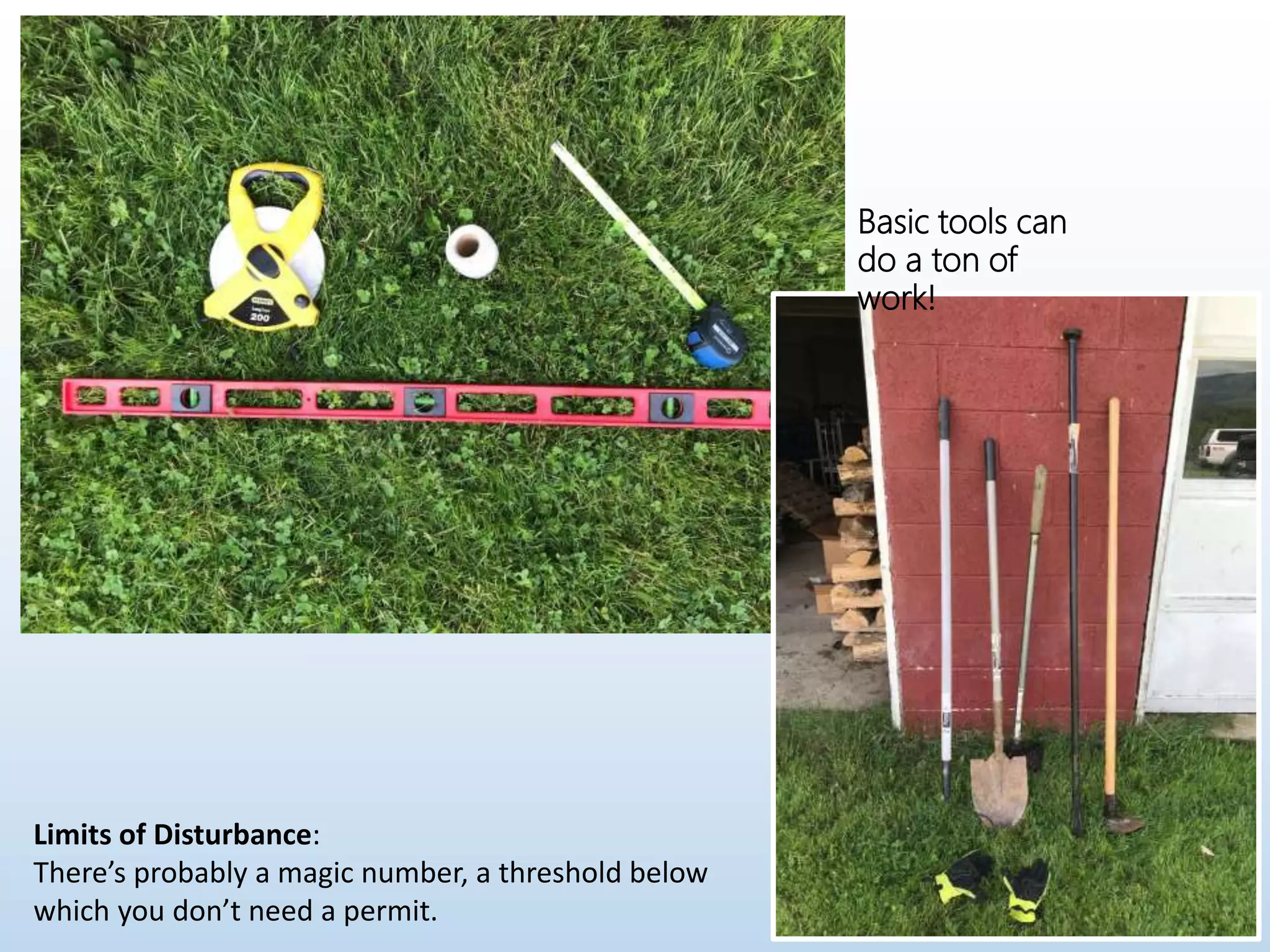
Basic tools can
do a ton of
work!
Limits of Disturbance:
There’s probably a magic number, a threshold below
which you don’t need a permit.
I think that’s Dave Hirschman
Templates for various Conservation Landscapes/Rain Gardens
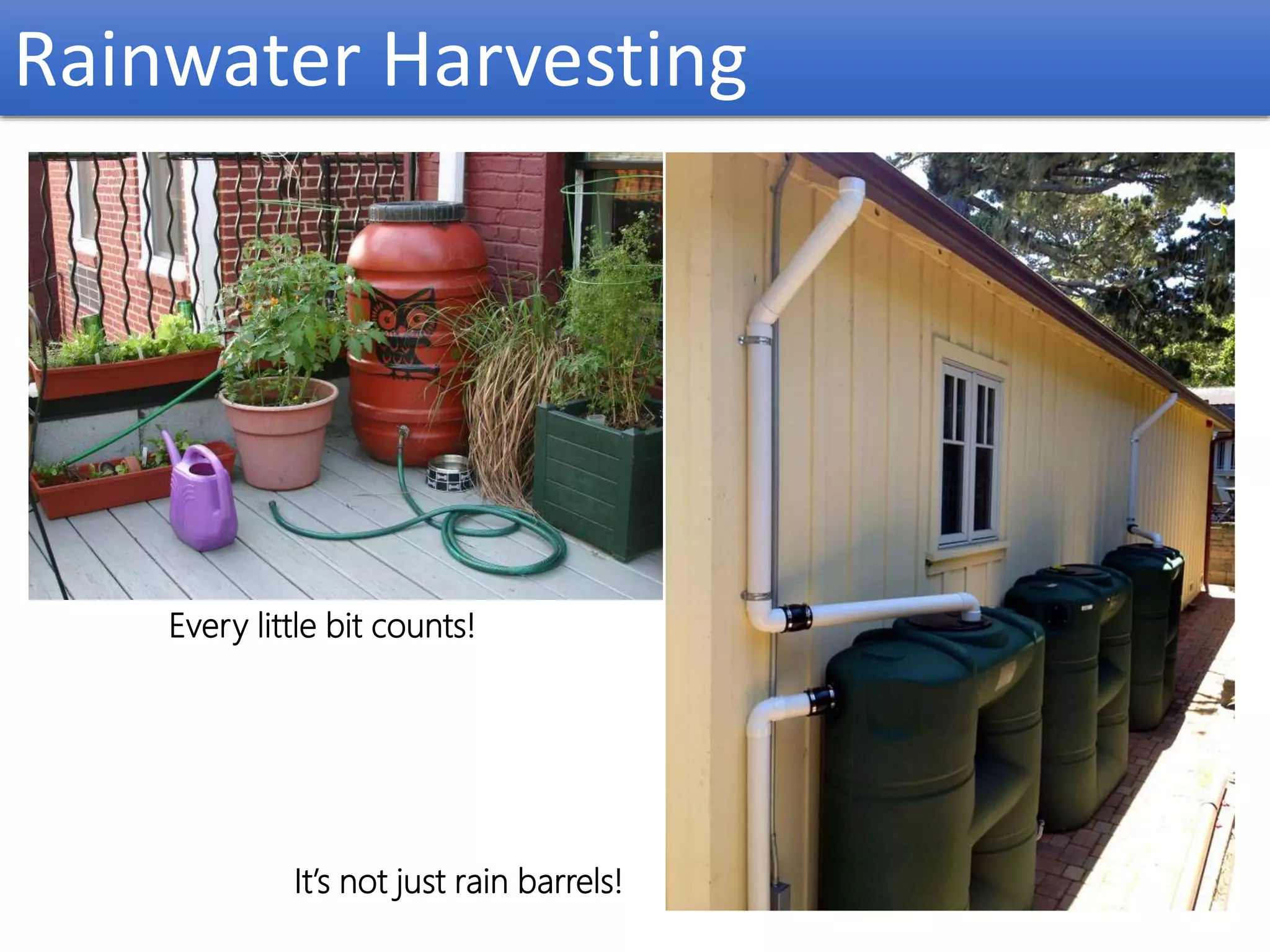
Rainwater Harvesting
Every little bit counts!
It’s not just rain barrels!

Capturing the Rain: Example Projects in Fauquier/Warrenton and Beyond

  • 1.
    Example Projects in Fauquier/Warrentonand Beyond But mostly some practical how-to, where-to, and resources for making stuff happen. Ari Daniels, P.E. (he/him) Water Resources Engineer Center for Watershed Protection add@cwp.org 410-461-8323; ext. 3204 6/11/2020 www.cwp.org
  • 2.
    Outline • Examples ofFauquier/Warrenton BMPs • Tips for getting help ($$ and/or peoplepower) • VERY quick walk through a resource for small-ish scale stormwater BMPs, and some lessons learned
  • 4.
    Even merely “openspace” can be an opportunity. And there are two distinct, separate opportunities in these photos.
  • 5.
    Even merely “openspace” can be an opportunity. And there are two distinct, separate opportunities in these photos.
  • 6.
    Brumfield Elementary School (Goingto construct a wetland here)
  • 7.
    Accokeek First Churchof God (Thanks to PG County, Chesapeake Bay Trust, Accokeek CHOG) (Clay, not poop)
  • 9.
    All the furtherI got digging by hand, before…
  • 10.
    I decided tobring in the power tools.
  • 12.
    Just starting workwith mini excavator.
  • 14.
  • 16.
  • 17.
    Time for alittle maintenance.
  • 18.
    Where/How to Lookfor Help Starting out • Soil & Water Conservation District • Local government • Local watershed association/non-profit • “I think so-and-so knows a bunch about this hippie stuff.” Search terms • Watershed • Stormwater BMP • Conservation / Native Landscaping • Rain garden • Grant program
  • 19.
  • 20.
    General Rules forBMP Design, Installation, Maintenance Water is Lazy (Water flows downhill, and follows the path of least resistance.) Regulations/specifications differ by locality, sometimes greatly (With almost 1,800 local governments in the Bay watershed, just because both are called "rain garden" doesn't mean they are the same.) Maintenance/repair should be strong considerations (Even dirt needs to be maintained.) Get help if/when needed (There are many funding and implementation support options. Use them!) Every little bit counts (or “How do you eat an elephant?) (Even a small conservation landscape helps the overall quality of the Bay. 51 billion gallons enter per day, but even 20 gallons reduced or cleaned is a benefit.)
  • 21.
    Thorough, 108-page manual on6 BMPs for homeowner/HOA/light commercial Collection of planting templates for CL/RG Essential 18-page distillation of the manual above for quick reference in the field
  • 22.
  • 23.
    Practices Covered inthe Rainscaping Manual
  • 24.
    Each practice chaptercovers (if applicable): 1. Complexity 2. Location and Feasibility 3. Design 4. Materials 5. Plants 6. Construction 7. Maintenance 8. Resources Each appendix covers the methods and processes for conducting important assessments.
  • 25.
    1. Derived fromseveral sources (primarily King & Hagen, 2011) and anecdotal data. 2. Runoff reduction values from Virginia Stormwater BMP Clearinghouse. 3. Cost and runoff reduction value for conservation landscapes is highly variable. 4. Runoff reduction value for rainwater harvesting depends on area captured, available retention volume, and demand/drawdown.
  • 26.
    Basic tools can doa ton of work! Limits of Disturbance: There’s probably a magic number, a threshold below which you don’t need a permit.
  • 31.
    I think that’sDave Hirschman
  • 32.
    Templates for variousConservation Landscapes/Rain Gardens
  • 34.
    Rainwater Harvesting Every littlebit counts! It’s not just rain barrels!

Editor's Notes

  • #2 Introduce self Background Offer to contact
  • #3 (For only “points” and bragging rights, keep your eyes peeled for “Easter eggs” in the slides. First person to comment on the incidental/out-of-place object gets the point. Person with the most points at the end gets… well, the most points. You score yourselves.)
  • #4 Easter egg: unicorn
  • #5 Warrenton Dog Park Even just “open space” is potentially an opportunity.
  • #6 “Forget” is a much nicer ‘F’ word than I normally use. Anyone who enjoys mowing and trimming, type “ME!” in the chat box.
  • #7 11 acres drains to a ditch that runs alongside a large, wide-open turfgrass area. Sooooo much potential. NFWF funding this project.
  • #8 CBT grant, PG County funding/permitting, church grantee (non-profit) Design: wet swale  grass swale  infiltration trench Construction: infiltration trench  abandoned infiltration trench (shown)  rain garden
  • #9 Easter eggs: alligator in ponded area, snake in shadow of sod toward bottom
  • #10 Clay is heavy, and resistant. You can do a lot with peoplepower, but set expectations appropriately, and make sure food, water, and medical guidance (at least) is available. I’m a trained medic, but need to be acutely aware when I’m the person most likely to need medical assistance.
  • #11 This is an accessible and manageable level of power for many people, and the total cost (not including original purchase of a full-sized truck) for the dump trailer and mini excavator was somewhere in the $500/day range. With careful planning, a LOT of projects can be handled in 1-2 days.
  • #12 Easter egg: xylophone on my license plate
  • #13 Just getting started with the mini excavator.
  • #14 Easter egg: excavator on mini excavator
  • #15 Done digging/grading, *native* plants laid out.
  • #16 Easter egg: potted plant
  • #17 Planted, stabilized, sprinkler rocking. Proper plant care is important – you’ve paid for plants, you want them to survive.
  • #18 The Solo cup is not an Easter egg, it’s just trash.
  • #21 “If you wish to converse with me, define your terms.” -- Voltaire Easter egg: whoever enters the punchline “one bite at a time,” or something like “Please don’t!”
  • #23 Thanks: Nissa, Liz (ACB); Cecilia (CSN); Suzanne Etgen and Brad Deise (WSA); NFWF (for funding); Dan Gariepy and the Washington State Department of Ecology (for graphics)
  • #24 The practices in the manual Also site and soil assessment
  • #33 Easter egg: Easter egg in bottom right panel
  • #34 Easter egg: Easter egg in bottom right panel