2
Relations
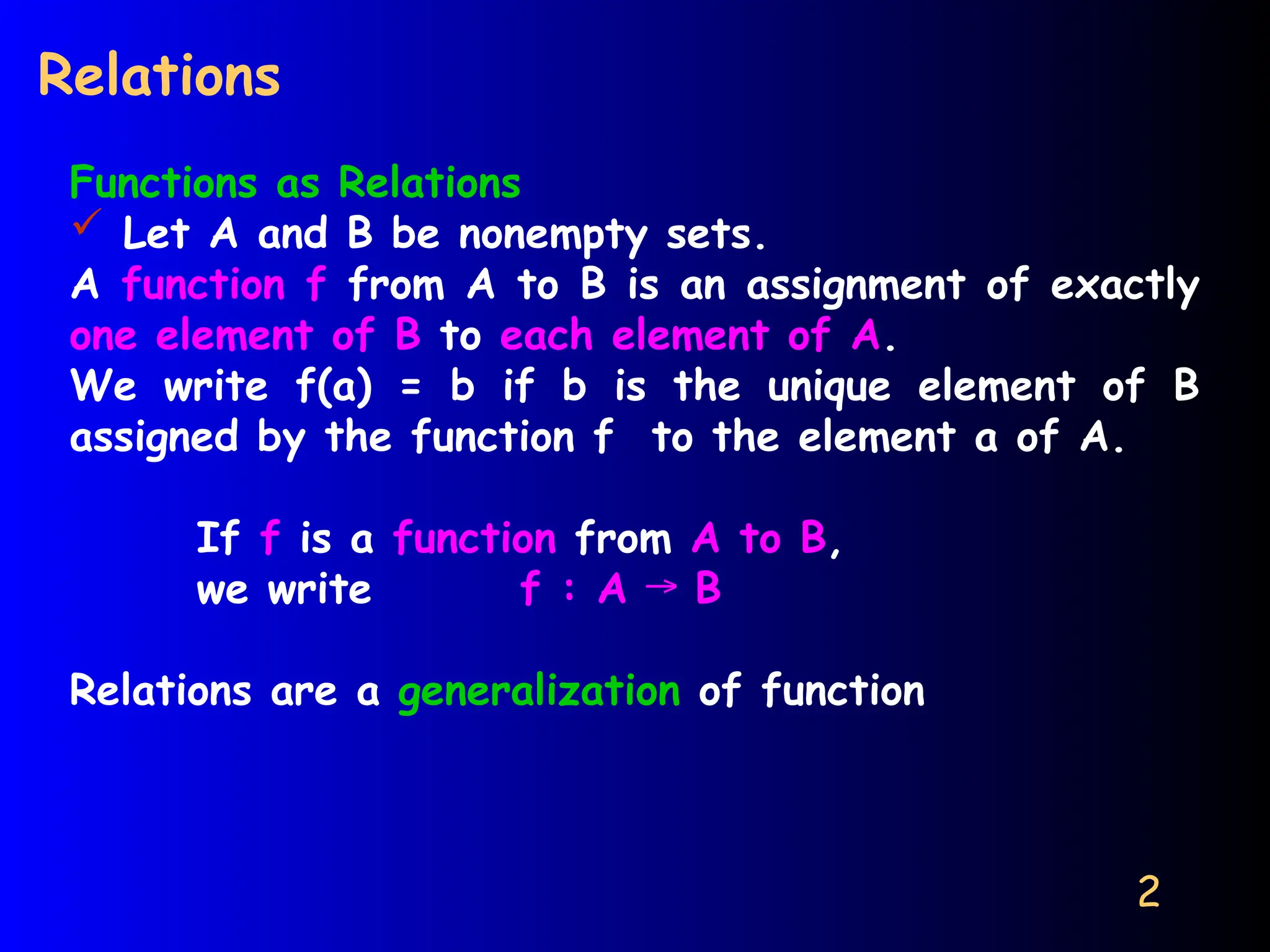
Functions as Relations
Let A and B be nonempty sets.
A function f from A to B is an assignment of exactly
one element of B to each element of A.
We write f(a) = b if b is the unique element of B
assigned by the function f to the element a of A.
If f is a function from A to B,
we write f : A B
→
Relations are a generalization of function
3.
3
Relations
binary relation
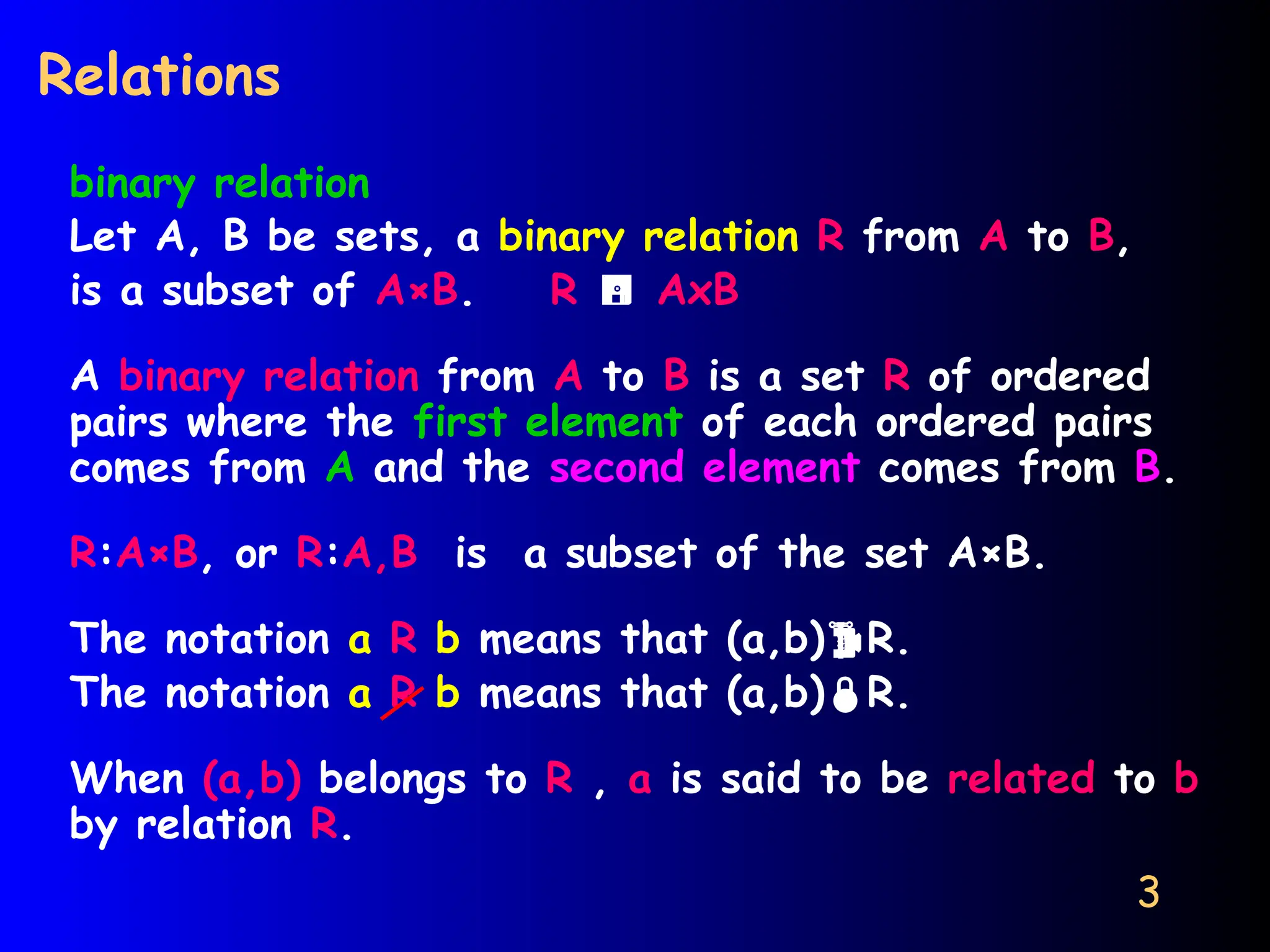
Let A,B be sets, a binary relation R from A to B,
is a subset of A×B. R AxB
A binary relation from A to B is a set R of ordered
pairs where the first element of each ordered pairs
comes from A and the second element comes from B.
R:A×B, or R:A,B is a subset of the set A×B.
The notation a R b means that (a,b)R.
The notation a R b means that (a,b)R.
When (a,b) belongs to R , a is said to be related to b
by relation R.
4.
4
Relations
binary relation
Example
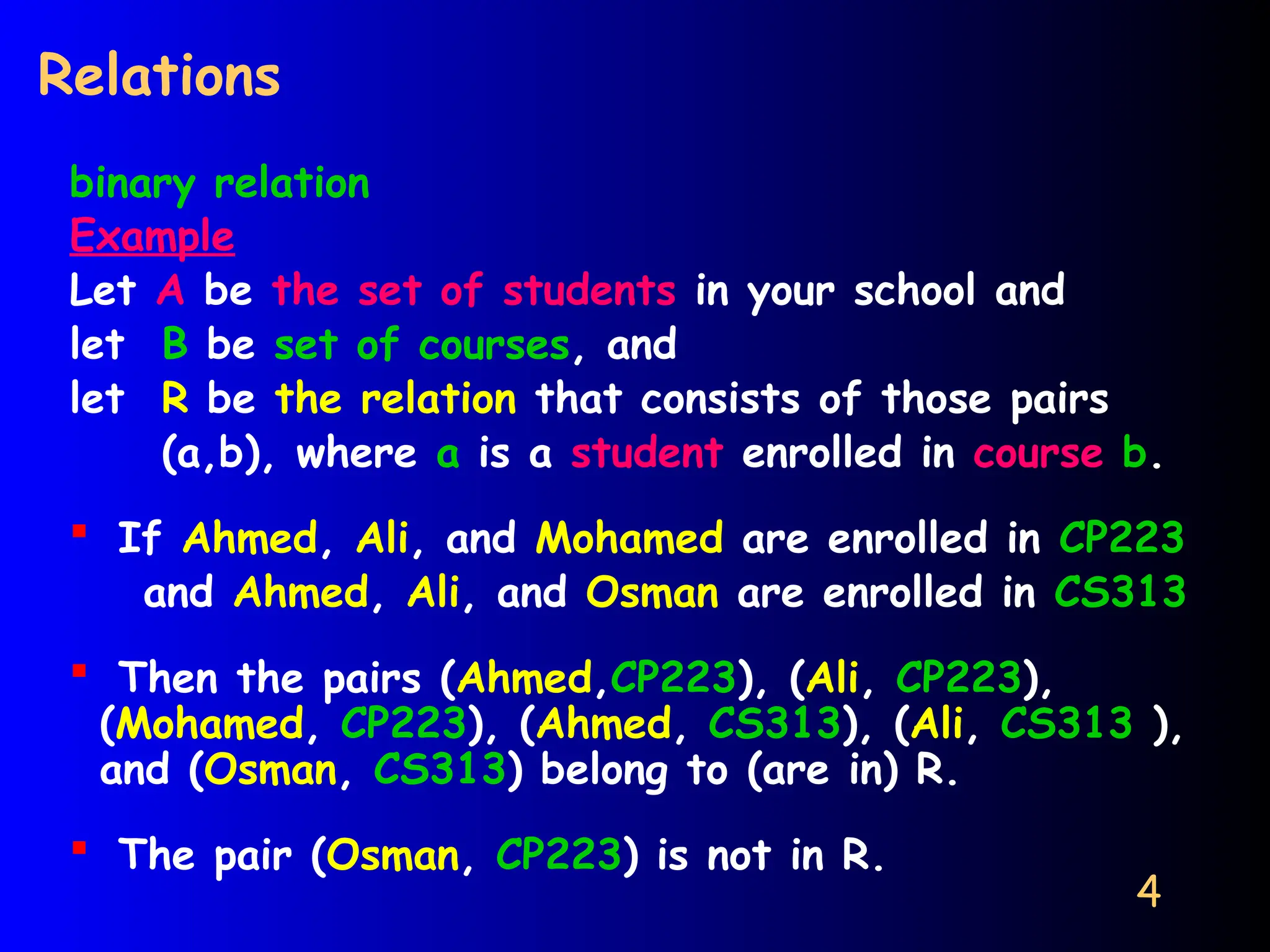
Let Abe the set of students in your school and
let B be set of courses, and
let R be the relation that consists of those pairs
(a,b), where a is a student enrolled in course b.
If Ahmed, Ali, and Mohamed are enrolled in CP223
and Ahmed, Ali, and Osman are enrolled in CS313
Then the pairs (Ahmed,CP223), (Ali, CP223),
(Mohamed, CP223), (Ahmed, CS313), (Ali, CS313 ),
and (Osman, CS313) belong to (are in) R.
The pair (Osman, CP223) is not in R.
5.
5
Relations
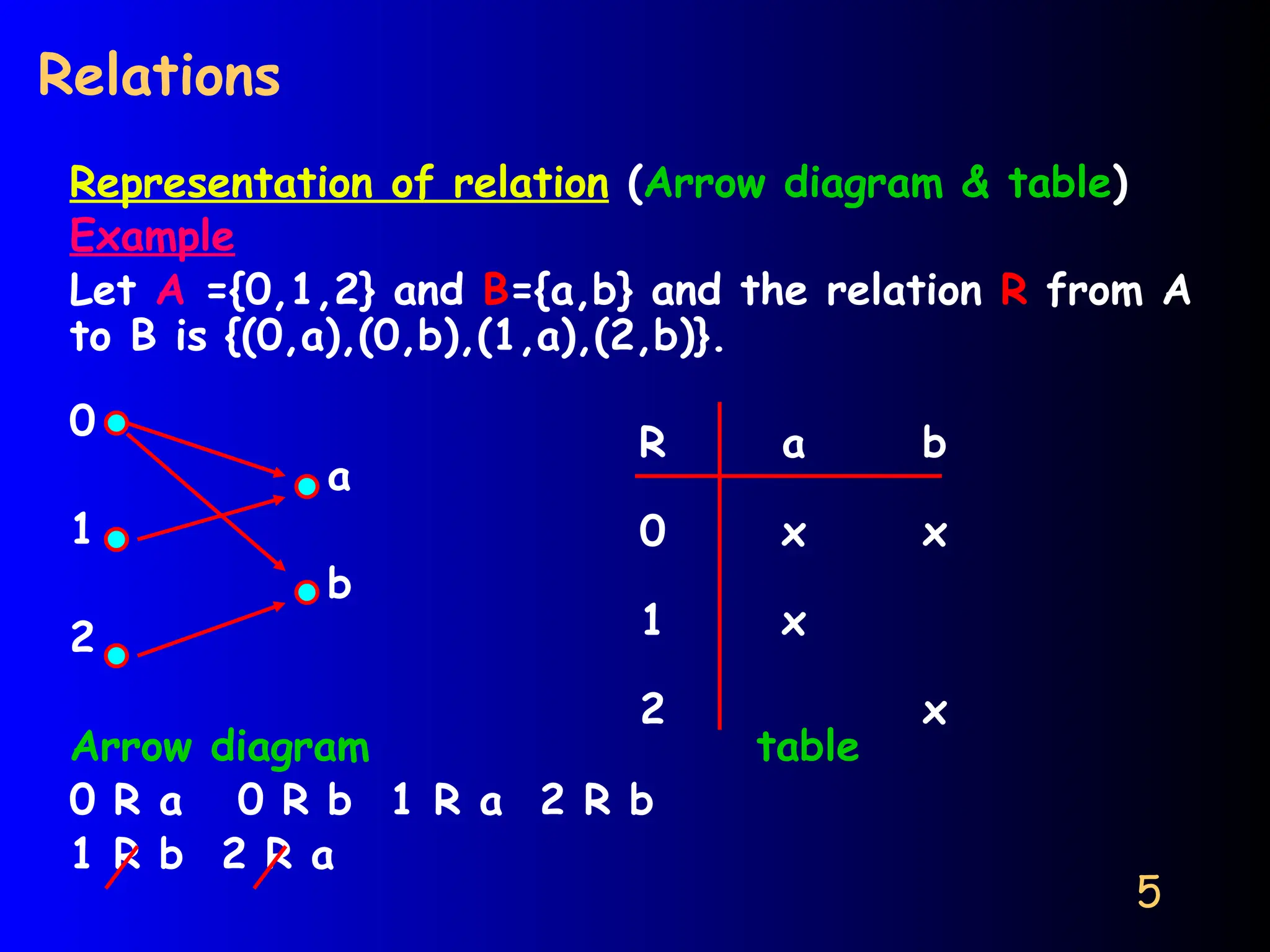
Representation of relation(Arrow diagram & table)
Example
Let A ={0,1,2} and B={a,b} and the relation R from A
to B is {(0,a),(0,b),(1,a),(2,b)}.
0
a
1
b
2
Arrow diagram table
0 R a 0 R b 1 R a 2 R b
1 R b 2 R a
R a b
0 x x
1 x
2 x
6.
6
Relations
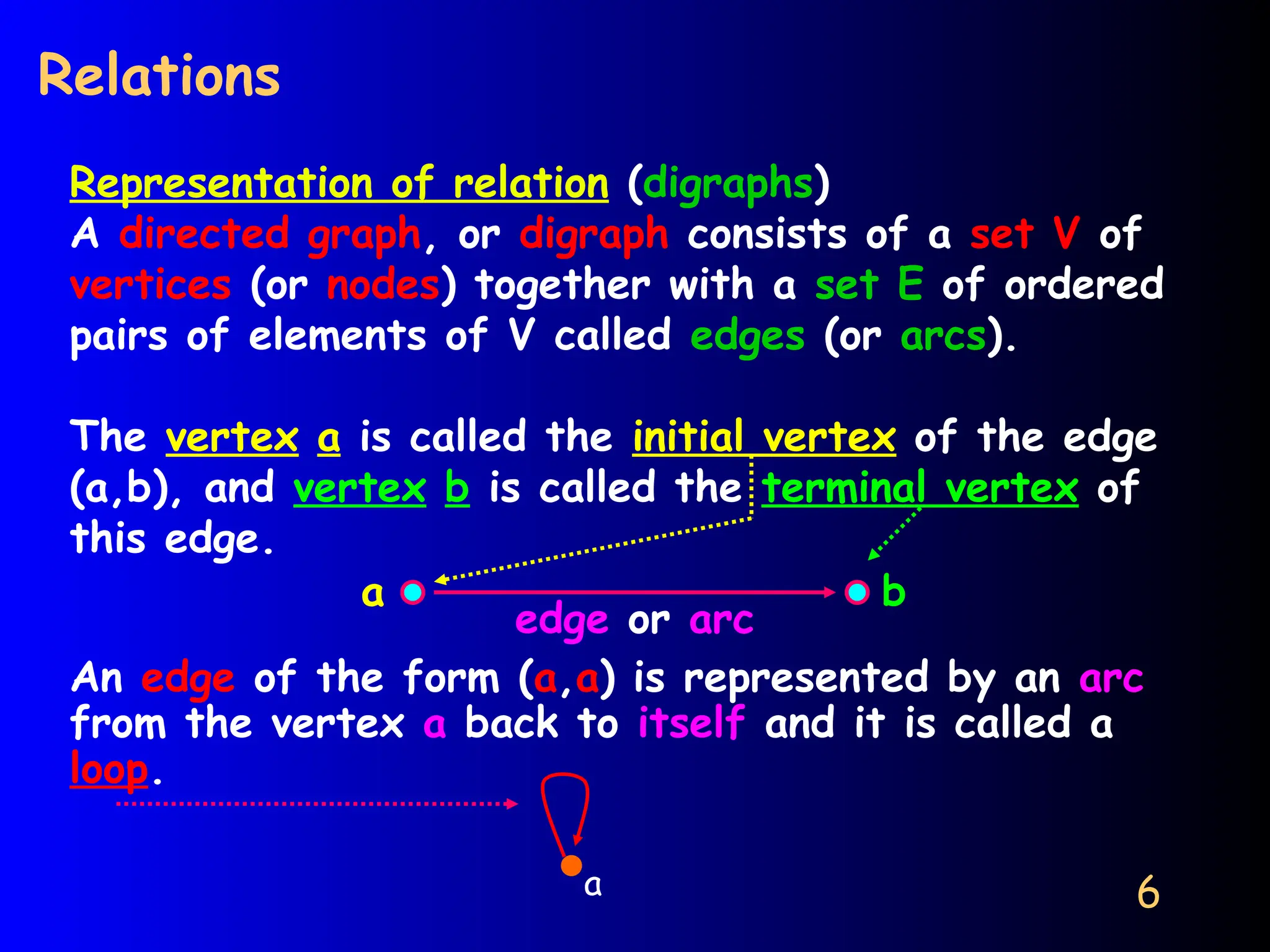
Representation of relation(digraphs)
A directed graph, or digraph consists of a set V of
vertices (or nodes) together with a set E of ordered
pairs of elements of V called edges (or arcs).
The vertex a is called the initial vertex of the edge
(a,b), and vertex b is called the terminal vertex of
this edge.
a b
An edge of the form (a,a) is represented by an arc
from the vertex a back to itself and it is called a
loop.
a
edge or arc
7.
7
Relations
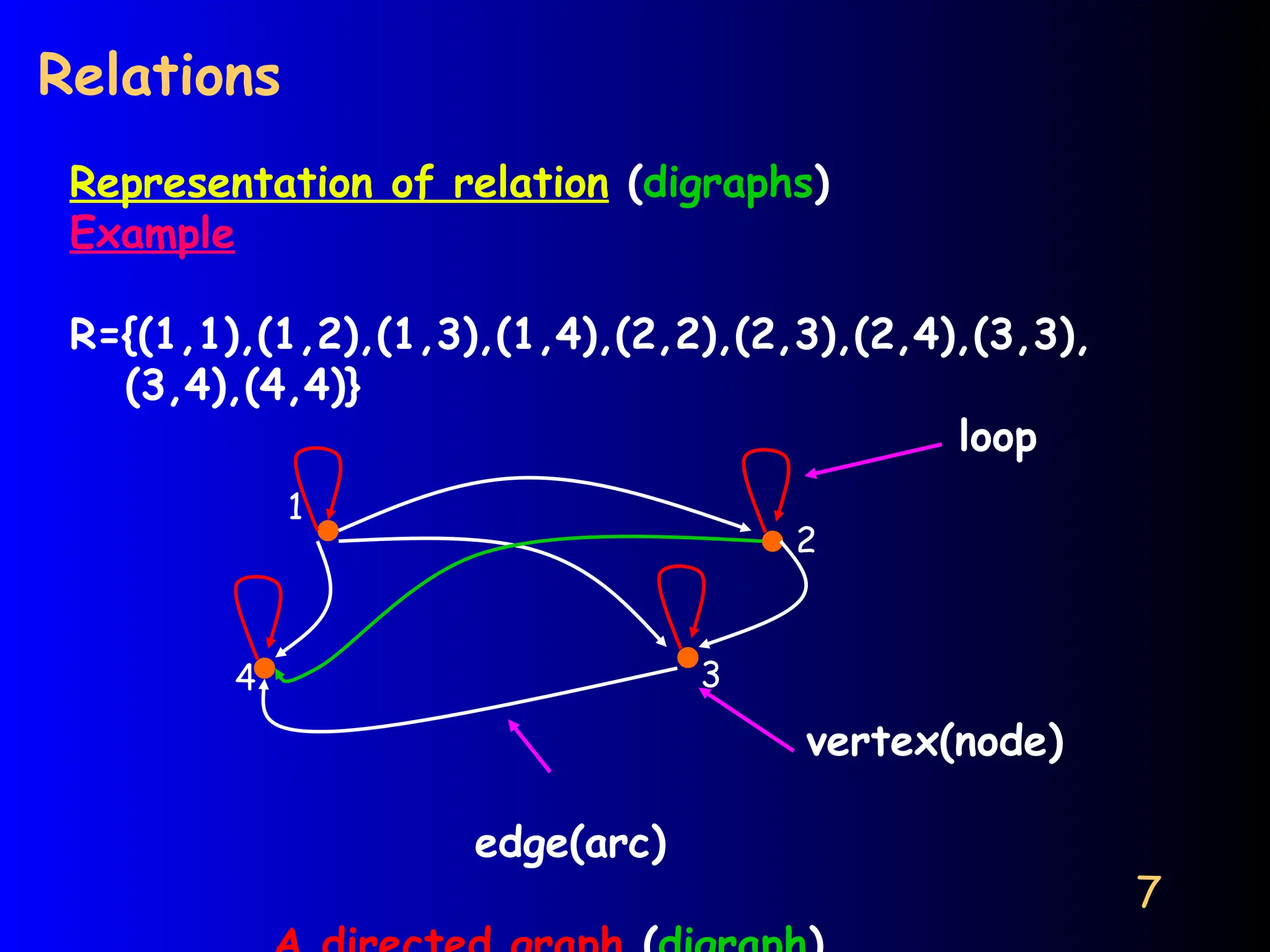
Representation of relation(digraphs)
Example
R={(1,1),(1,2),(1,3),(1,4),(2,2),(2,3),(2,4),(3,3),
(3,4),(4,4)}
loop
vertex(node)
edge(arc)
1
2
3
4
8.
8
Relations
Representation of relation(matrix)
A relation between finite sets can be represented
using a zero-one matrix.
Suppose that R is a relation from A={a1,a2,…,am) to
B={b1,b2,….,bn}. This relation can be represented by
the matrix MR=[mij], where:
[mij]= 1 if (ai,bj) R
0 if (ai,bj) R
Example Let A ={0,1,2} and B={a,b} and the relation
R from A to B is {(0,a),(0,b),(1,a),(2,b)}.
1 1
1 0
0 1
MR=
a b
0
1
2
9.
9
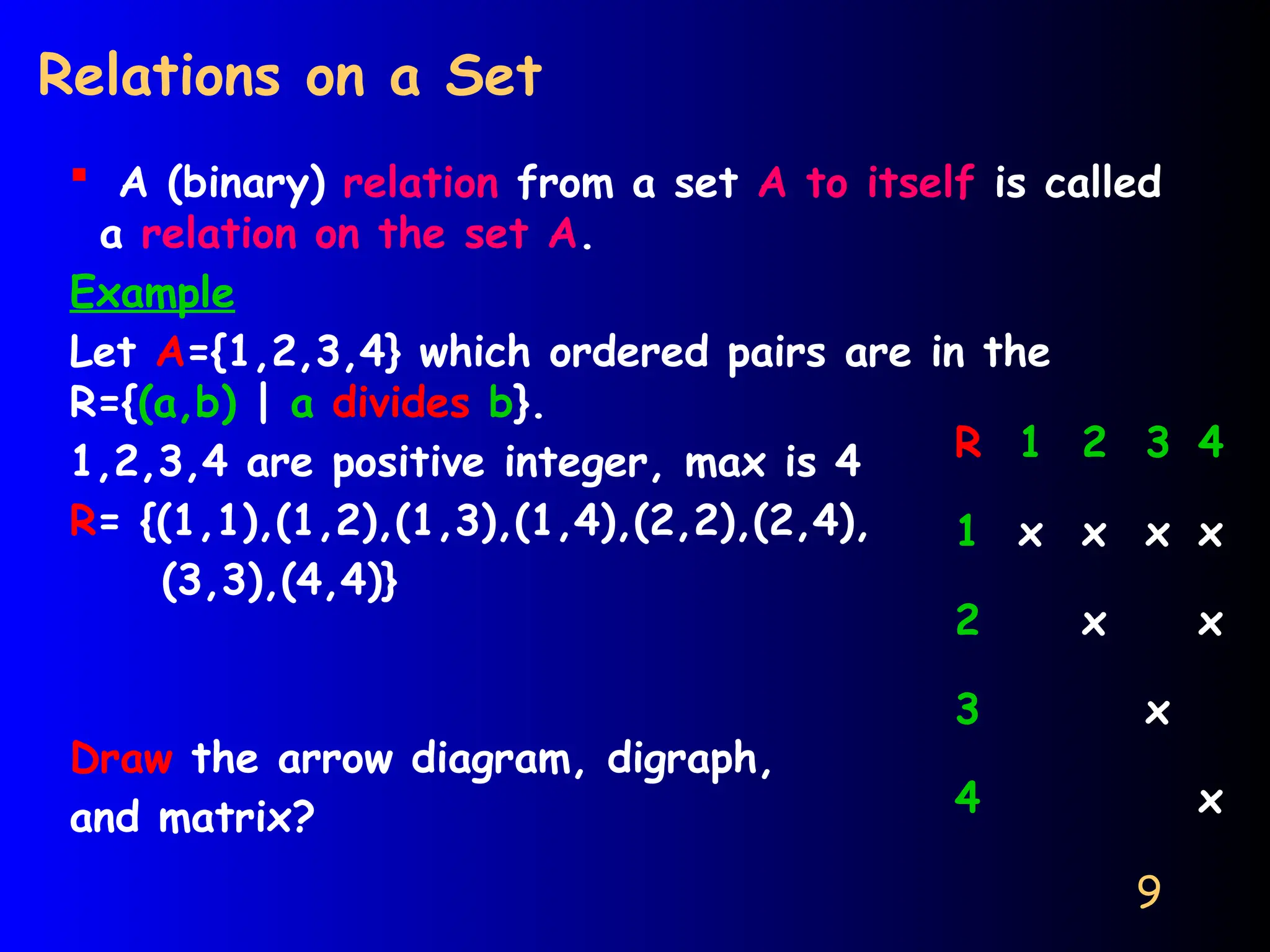
Relations on aSet
A (binary) relation from a set A to itself is called
a relation on the set A.
Example
Let A={1,2,3,4} which ordered pairs are in the
R={(a,b) | a divides b}.
1,2,3,4 are positive integer, max is 4
R= {(1,1),(1,2),(1,3),(1,4),(2,2),(2,4),
(3,3),(4,4)}
Draw the arrow diagram, digraph,
and matrix?
R 1 2 3 4
1 x x x x
2 x x
3 x
4 x
10.
10
Relations on aSet
Example
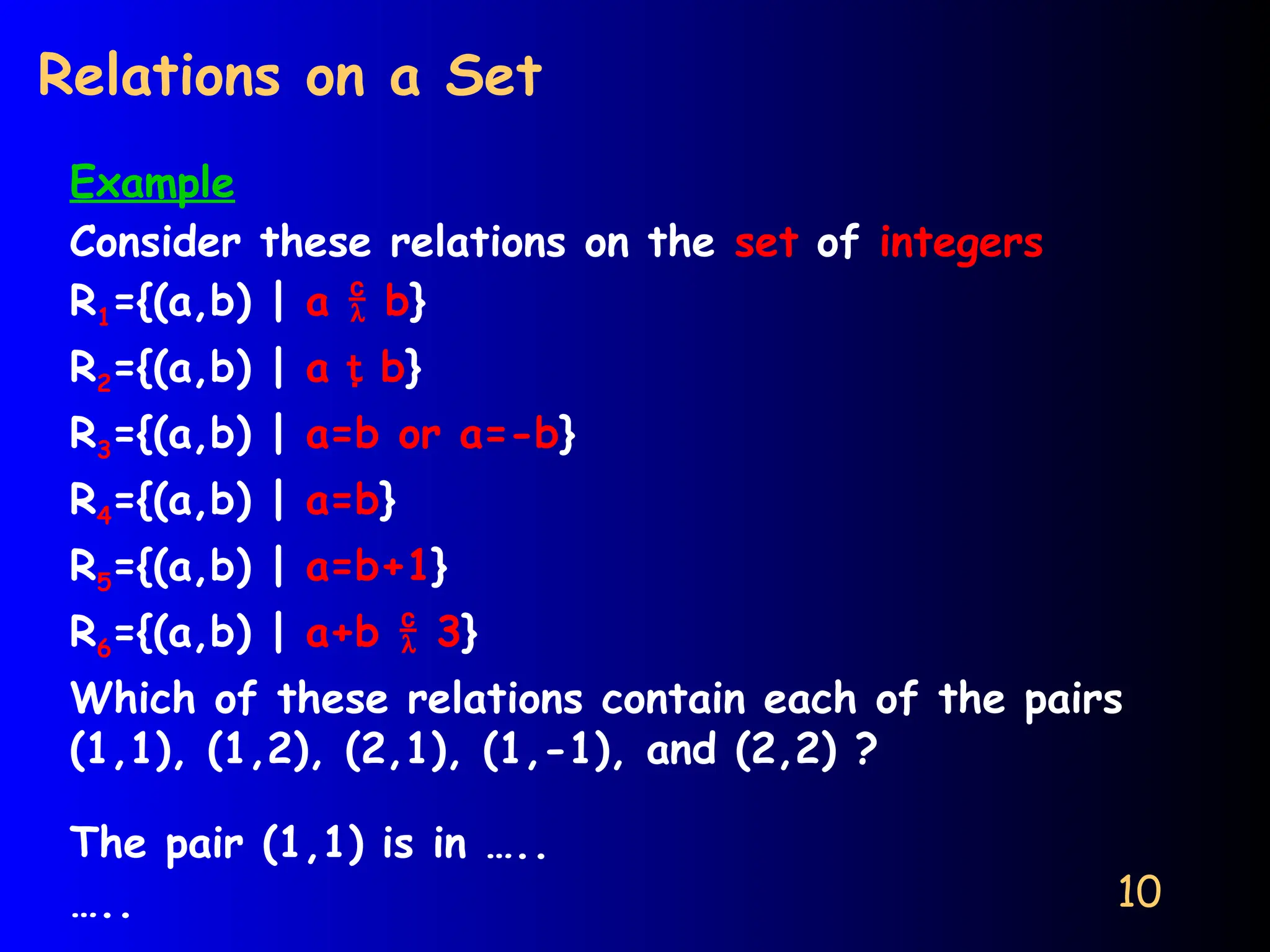
Consider these relations on the set of integers
R1={(a,b) | a b}
R2={(a,b) | a b}
R3={(a,b) | a=b or a=-b}
R4={(a,b) | a=b}
R5={(a,b) | a=b+1}
R6={(a,b) | a+b 3}
Which of these relations contain each of the pairs
(1,1), (1,2), (2,1), (1,-1), and (2,2) ?
The pair (1,1) is in …..
…..
11.
11
Relations on aSet
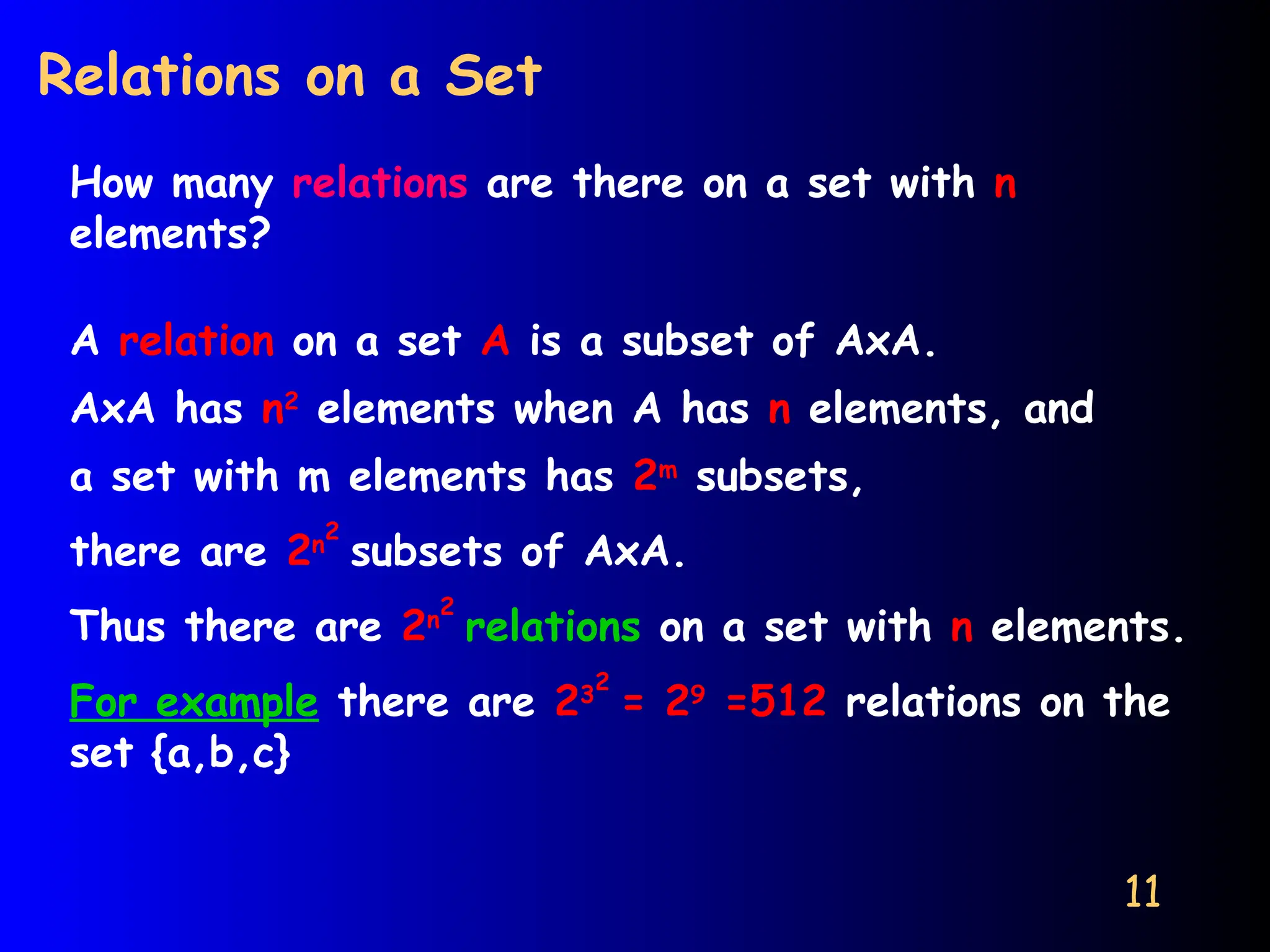
How many relations are there on a set with n
elements?
A relation on a set A is a subset of AxA.
AxA has n2
elements when A has n elements, and
a set with m elements has 2m
subsets,
there are 2n
2
subsets of AxA.
Thus there are 2n
2
relations on a set with n elements.
For example there are 23
2
= 29
=512 relations on the
set {a,b,c}
12.
12
Properties of Relations
Thereare several properties that are used to
classify relations on a set.
In some relations an element is always related to
itself.
For example, let R be the relation on the set of all
people consisting of pairs (x,y) where x and y has the
same father and the same mother. Then xRx for
every person x.
13.
13
Properties of Relations
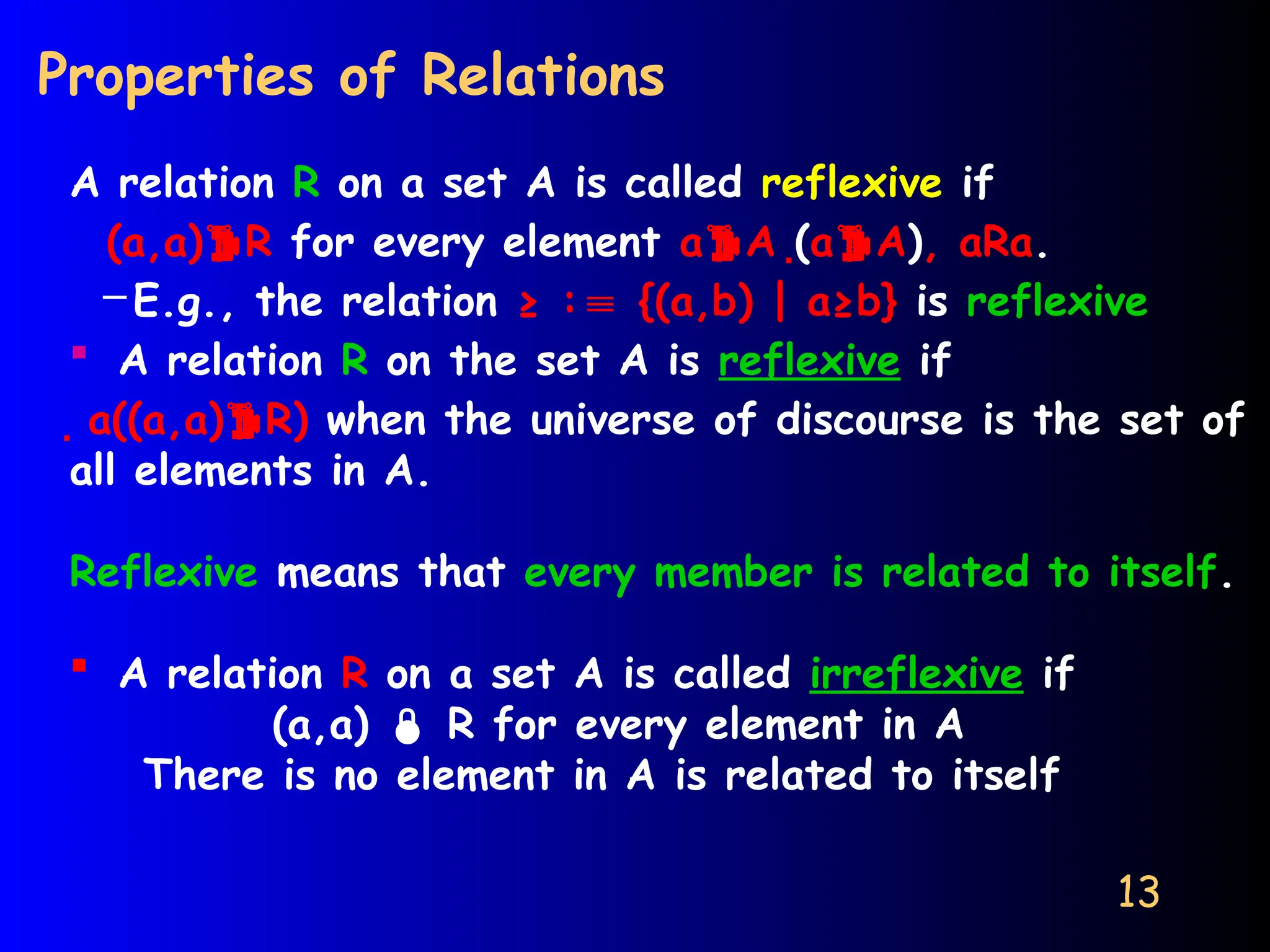
Arelation R on a set A is called reflexive if
(a,a)R for every element aA (aA), aRa.
– E.g., the relation ≥ : {(a,b) | a≥b}
≡ is reflexive
A relation R on the set A is reflexive if
a((a,a)R) when the universe of discourse is the set of
all elements in A.
Reflexive means that every member is related to itself.
A relation R on a set A is called irreflexive if
(a,a) R for every element in A
There is no element in A is related to itself
14.
14
Properties of Relations
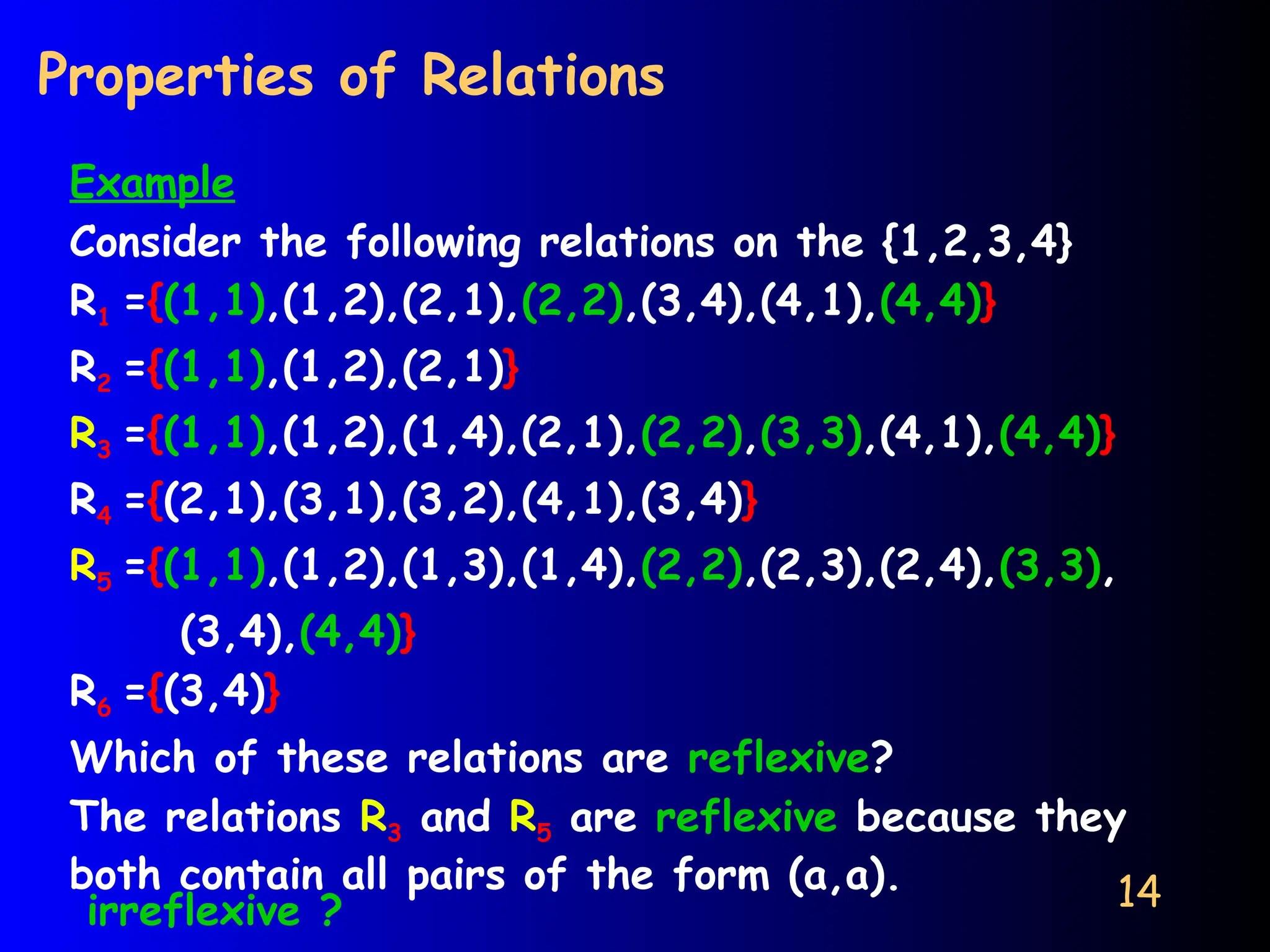
Example
Considerthe following relations on the {1,2,3,4}
R1 ={(1,1),(1,2),(2,1),(2,2),(3,4),(4,1),(4,4)}
R2 ={(1,1),(1,2),(2,1)}
R3 ={(1,1),(1,2),(1,4),(2,1),(2,2),(3,3),(4,1),(4,4)}
R4 ={(2,1),(3,1),(3,2),(4,1),(3,4)}
R5 ={(1,1),(1,2),(1,3),(1,4),(2,2),(2,3),(2,4),(3,3),
(3,4),(4,4)}
R6 ={(3,4)}
Which of these relations are reflexive?
The relations R3 and R5 are reflexive because they
both contain all pairs of the form (a,a).
irreflexive ?
15.
15
Properties of Relations
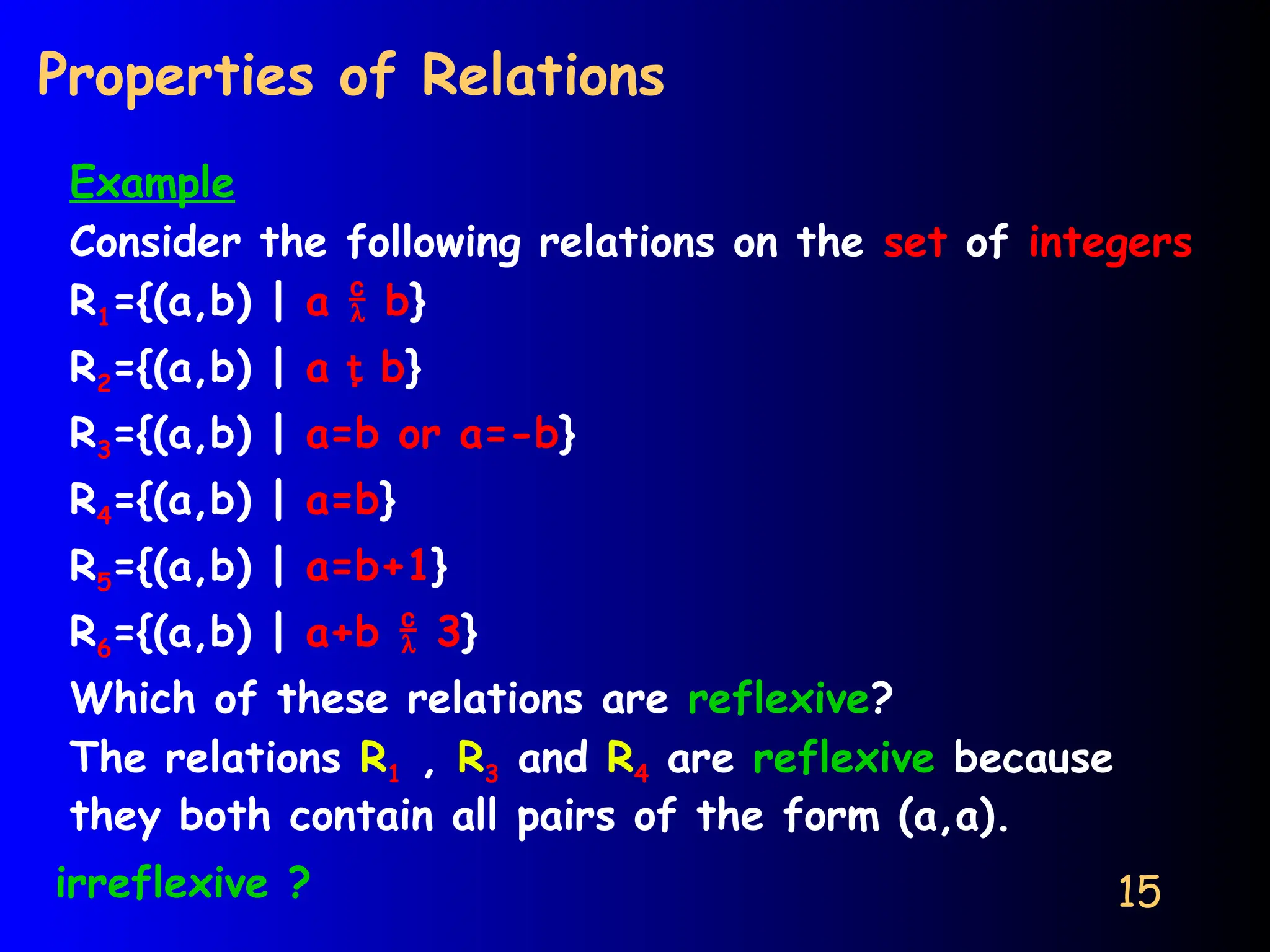
Example
Considerthe following relations on the set of integers
R1={(a,b) | a b}
R2={(a,b) | a b}
R3={(a,b) | a=b or a=-b}
R4={(a,b) | a=b}
R5={(a,b) | a=b+1}
R6={(a,b) | a+b 3}
Which of these relations are reflexive?
The relations R1 , R3 and R4 are reflexive because
they both contain all pairs of the form (a,a).
irreflexive ?
16.
16
Properties of Relations
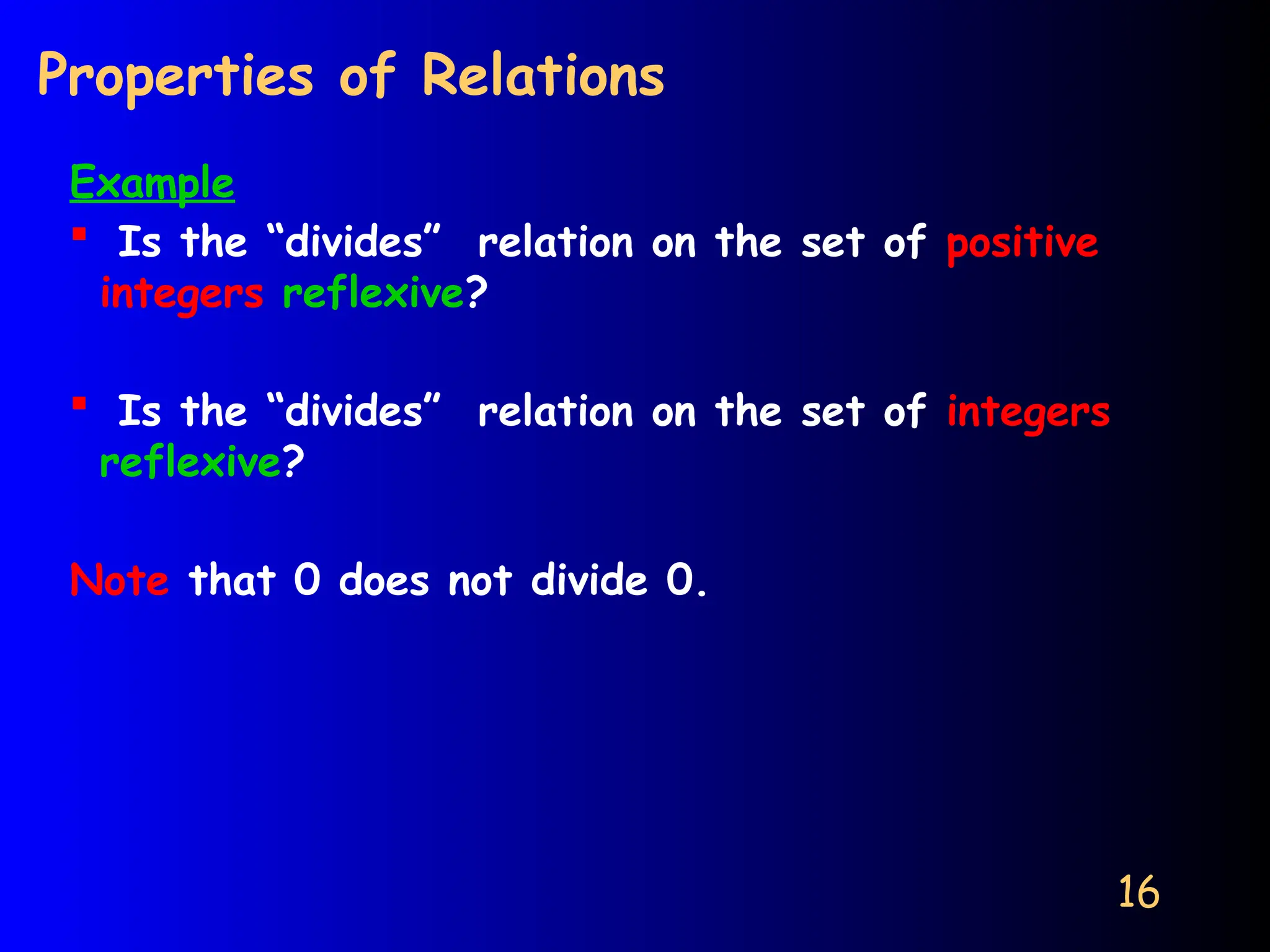
Example
Is the “divides” relation on the set of positive
integers reflexive?
Is the “divides” relation on the set of integers
reflexive?
Note that 0 does not divide 0.
17.
17
Properties of Relations
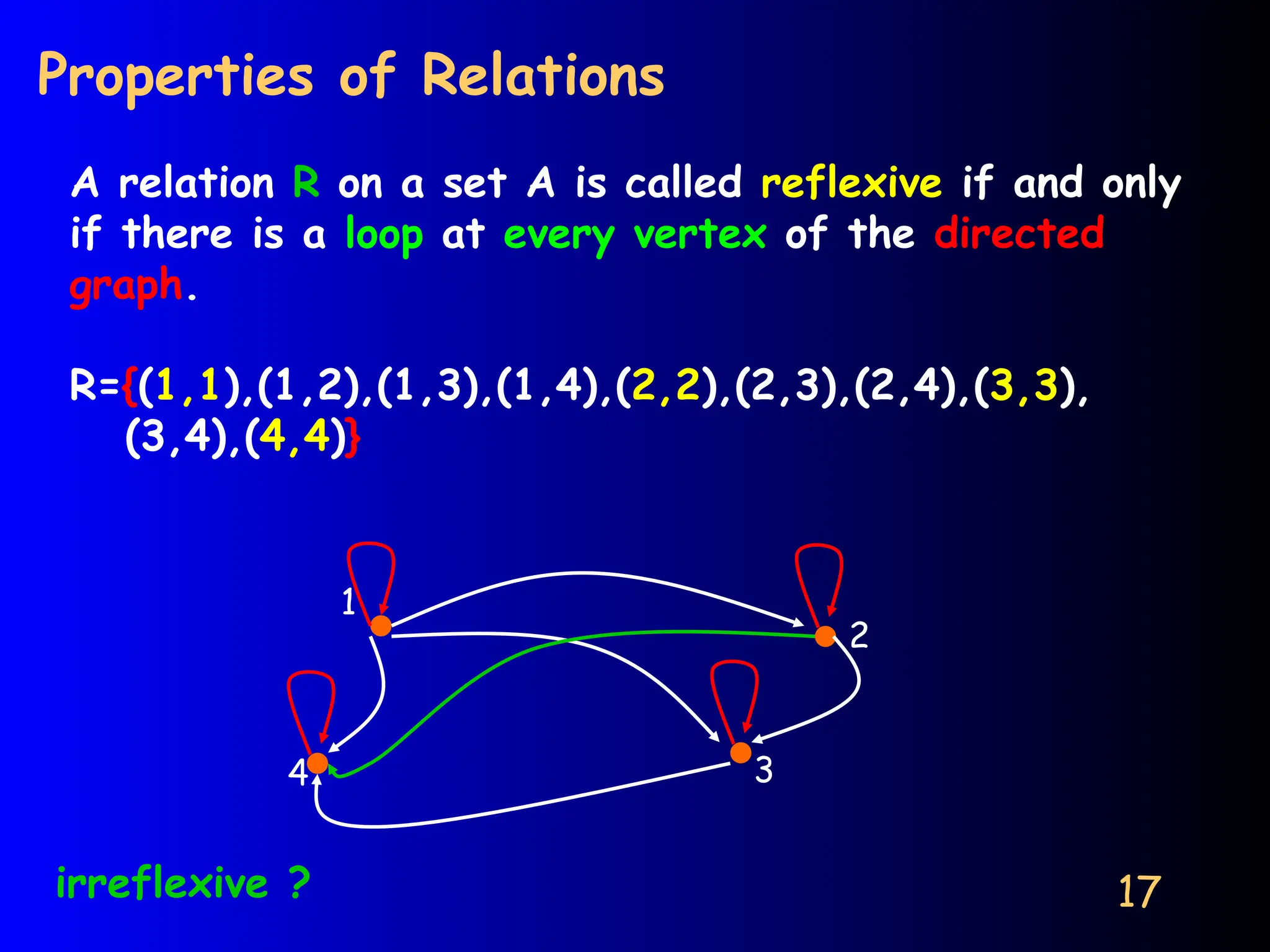
Arelation R on a set A is called reflexive if and only
if there is a loop at every vertex of the directed
graph.
R={(1,1),(1,2),(1,3),(1,4),(2,2),(2,3),(2,4),(3,3),
(3,4),(4,4)}
1
2
3
4
irreflexive ?
18.
18
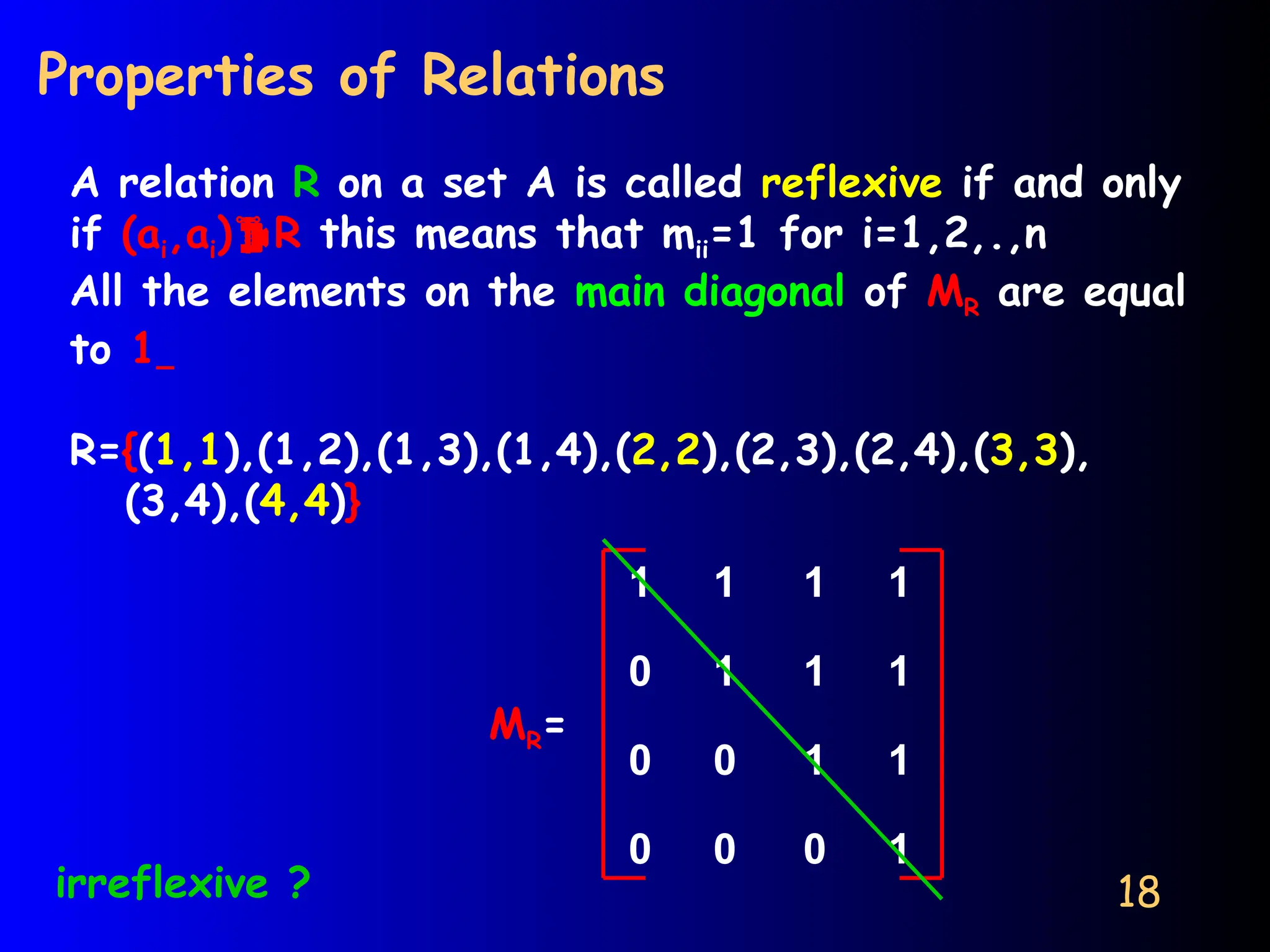
Properties of Relations
Arelation R on a set A is called reflexive if and only
if (ai,ai)R this means that mii=1 for i=1,2,.,n
All the elements on the main diagonal of MR are equal
to 1
R={(1,1),(1,2),(1,3),(1,4),(2,2),(2,3),(2,4),(3,3),
(3,4),(4,4)}
1 1 1 1
0 1 1 1
0 0 1 1
0 0 0 1
MR=
irreflexive ?
19.
19
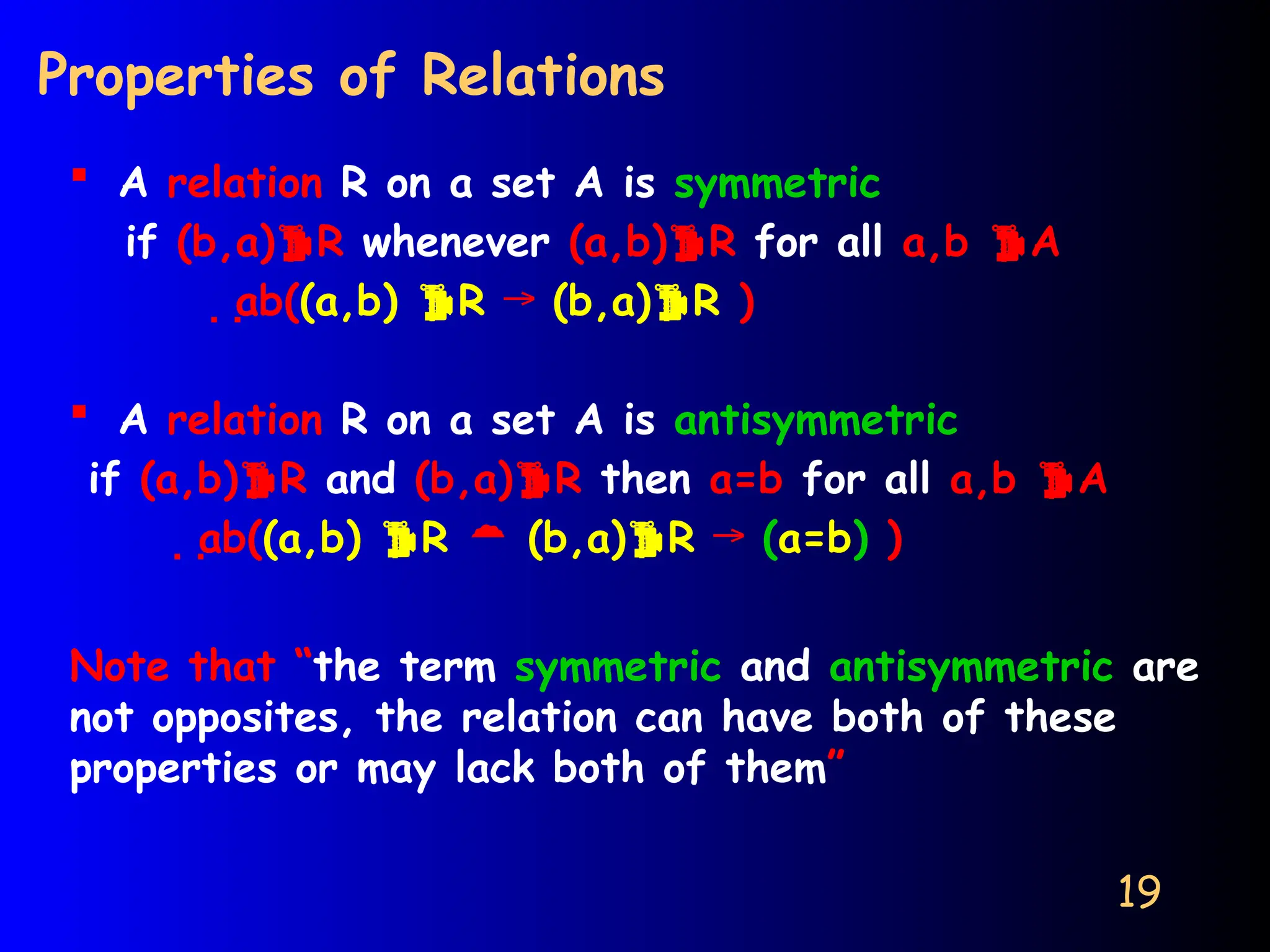
Properties of Relations
A relation R on a set A is symmetric
if (b,a)R whenever (a,b)R for all a,b A
ab((a,b) R → (b,a)R )
A relation R on a set A is antisymmetric
if (a,b)R and (b,a)R then a=b for all a,b A
ab((a,b) R (b,a)R → (a=b) )
Note that “the term symmetric and antisymmetric are
not opposites, the relation can have both of these
properties or may lack both of them”
20.
20
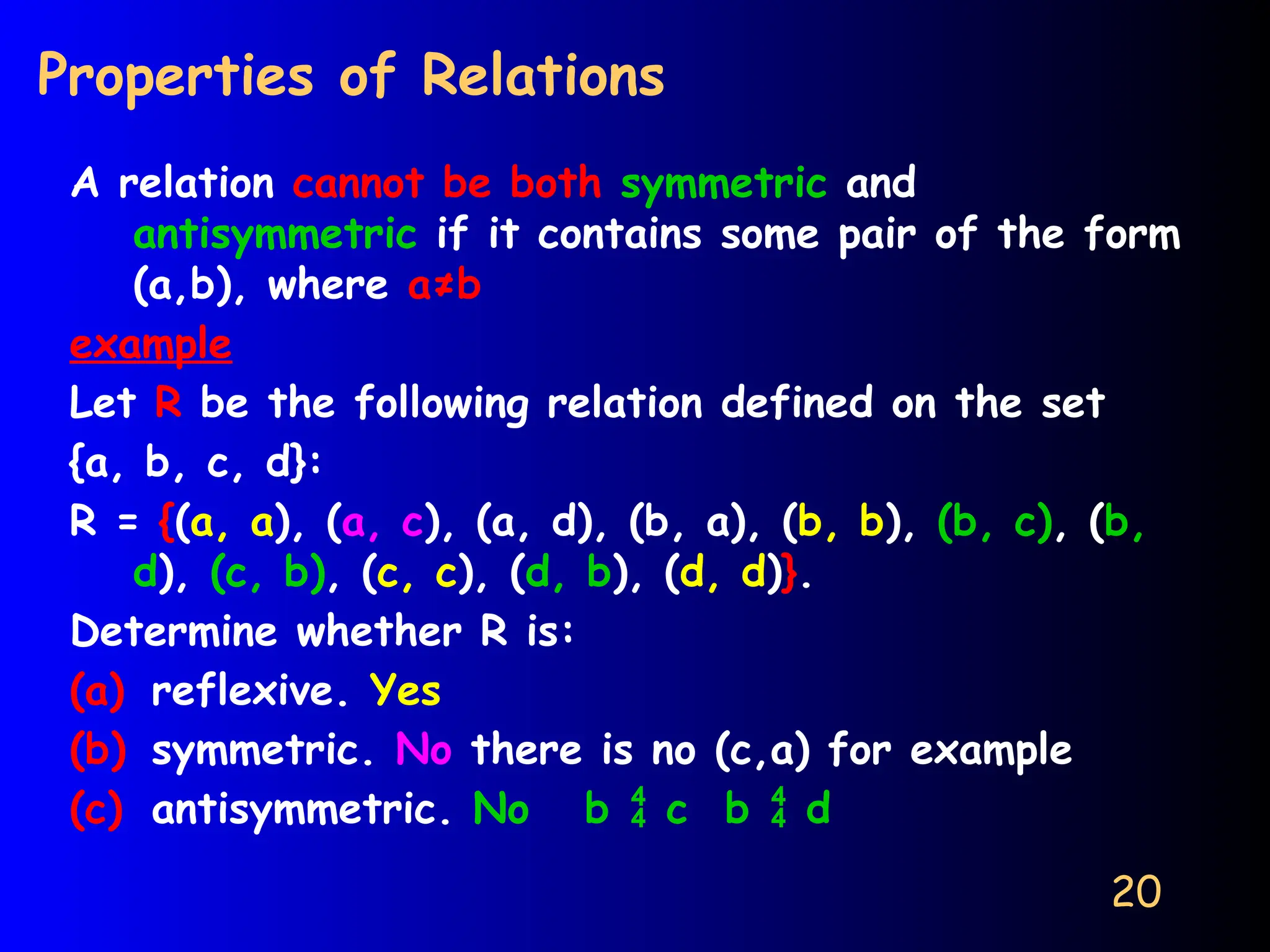
Properties of Relations
Arelation cannot be both symmetric and
antisymmetric if it contains some pair of the form
(a,b), where a≠b
example
Let R be the following relation defined on the set
{a, b, c, d}:
R = {(a, a), (a, c), (a, d), (b, a), (b, b), (b, c), (b,
d), (c, b), (c, c), (d, b), (d, d)}.
Determine whether R is:
(a) reflexive. Yes
(b) symmetric. No there is no (c,a) for example
(c) antisymmetric. No b c b d
21.
21
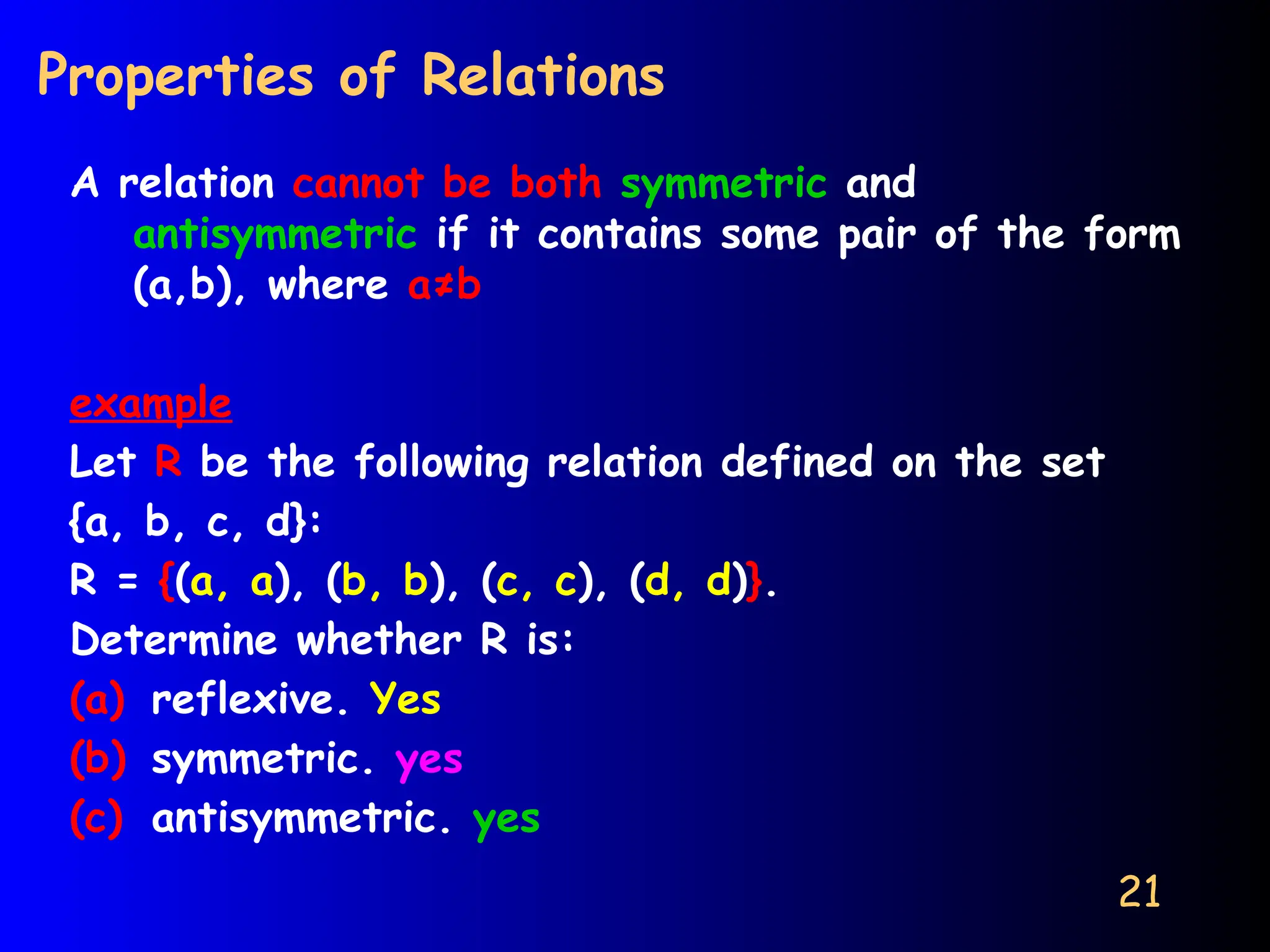
Properties of Relations
Arelation cannot be both symmetric and
antisymmetric if it contains some pair of the form
(a,b), where a≠b
example
Let R be the following relation defined on the set
{a, b, c, d}:
R = {(a, a), (b, b), (c, c), (d, d)}.
Determine whether R is:
(a) reflexive. Yes
(b) symmetric. yes
(c) antisymmetric. yes
22.
22
Properties of Relations
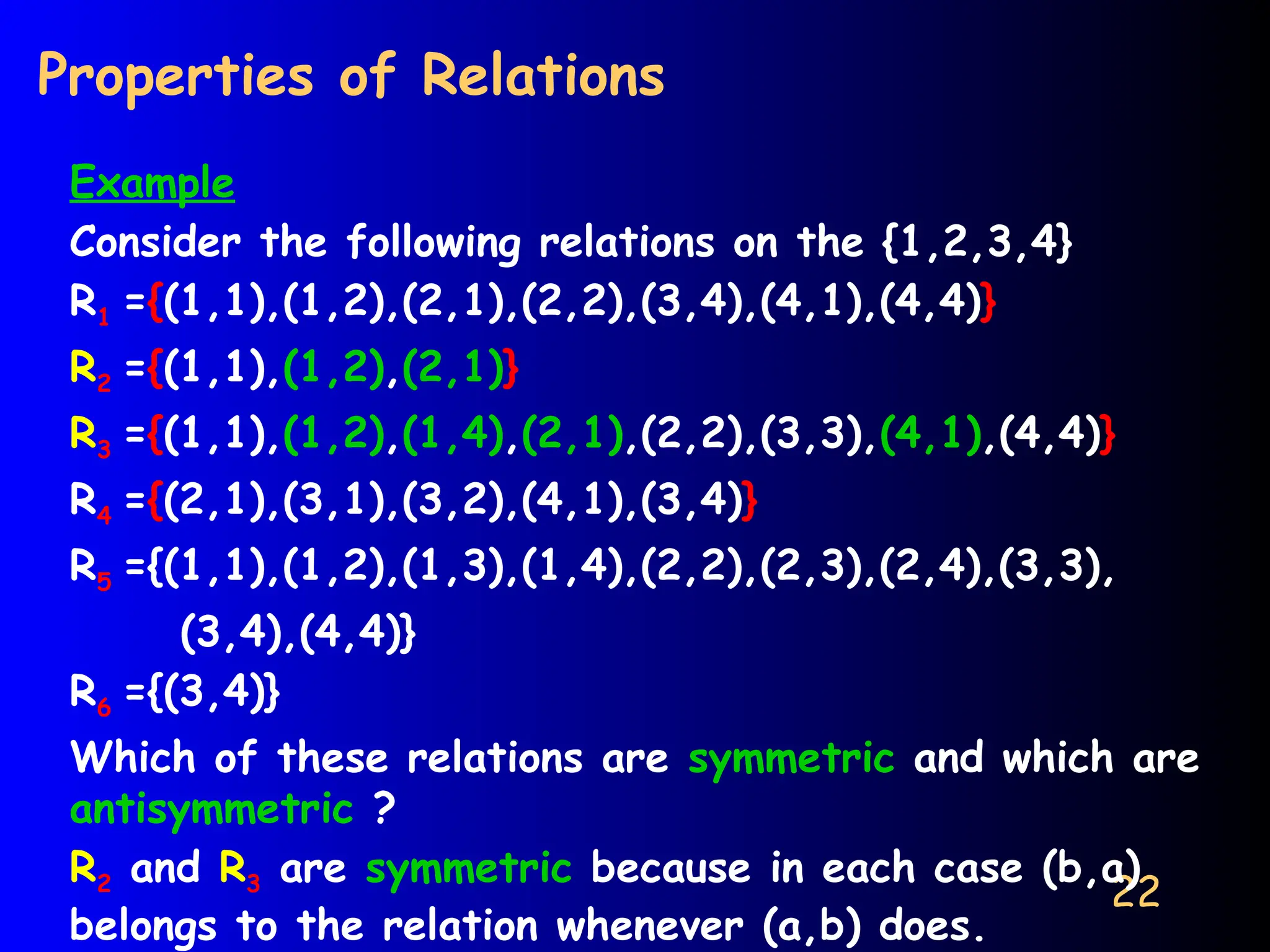
Example
Considerthe following relations on the {1,2,3,4}
R1 ={(1,1),(1,2),(2,1),(2,2),(3,4),(4,1),(4,4)}
R2 ={(1,1),(1,2),(2,1)}
R3 ={(1,1),(1,2),(1,4),(2,1),(2,2),(3,3),(4,1),(4,4)}
R4 ={(2,1),(3,1),(3,2),(4,1),(3,4)}
R5 ={(1,1),(1,2),(1,3),(1,4),(2,2),(2,3),(2,4),(3,3),
(3,4),(4,4)}
R6 ={(3,4)}
Which of these relations are symmetric and which are
antisymmetric ?
R2 and R3 are symmetric because in each case (b,a)
belongs to the relation whenever (a,b) does.
23.
23
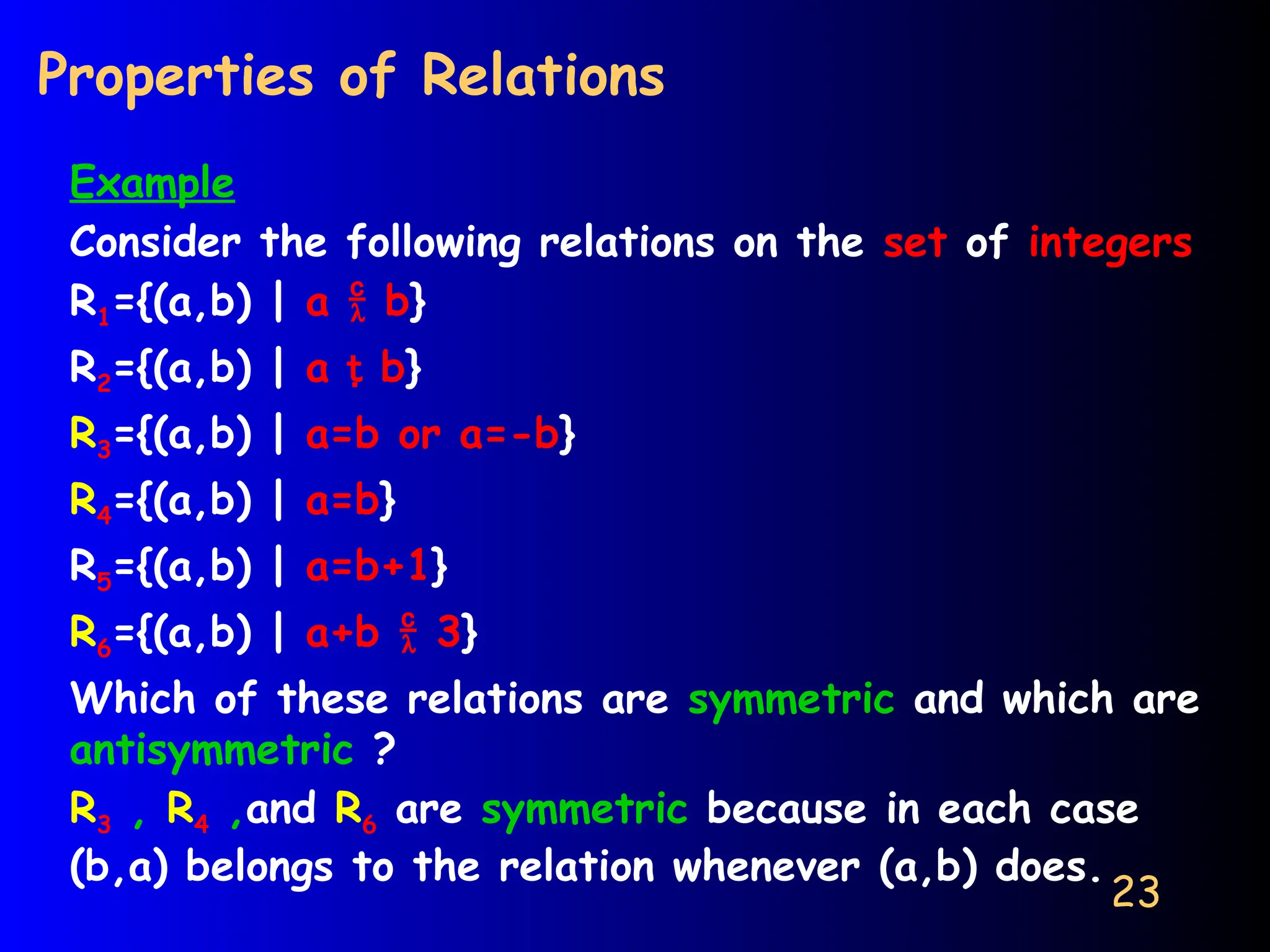
Properties of Relations
Example
Considerthe following relations on the set of integers
R1={(a,b) | a b}
R2={(a,b) | a b}
R3={(a,b) | a=b or a=-b}
R4={(a,b) | a=b}
R5={(a,b) | a=b+1}
R6={(a,b) | a+b 3}
Which of these relations are symmetric and which are
antisymmetric ?
R3 , R4 ,and R6 are symmetric because in each case
(b,a) belongs to the relation whenever (a,b) does.
24.
24
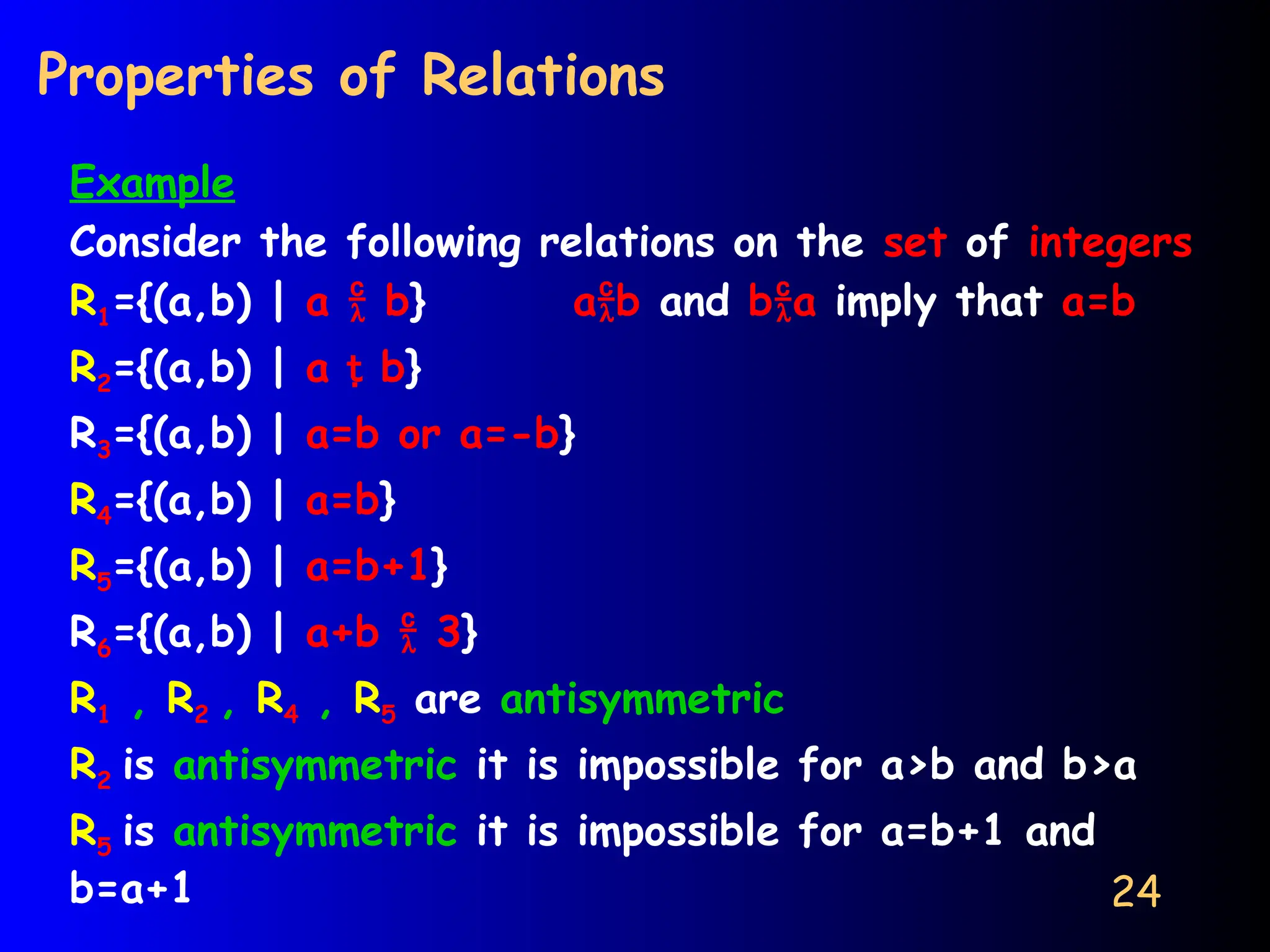
Properties of Relations
Example
Considerthe following relations on the set of integers
R1={(a,b) | a b} ab and ba imply that a=b
R2={(a,b) | a b}
R3={(a,b) | a=b or a=-b}
R4={(a,b) | a=b}
R5={(a,b) | a=b+1}
R6={(a,b) | a+b 3}
R1 , R2 , R4 , R5 are antisymmetric
R2 is antisymmetric it is impossible for a>b and b>a
R5 is antisymmetric it is impossible for a=b+1 and
b=a+1
25.
25
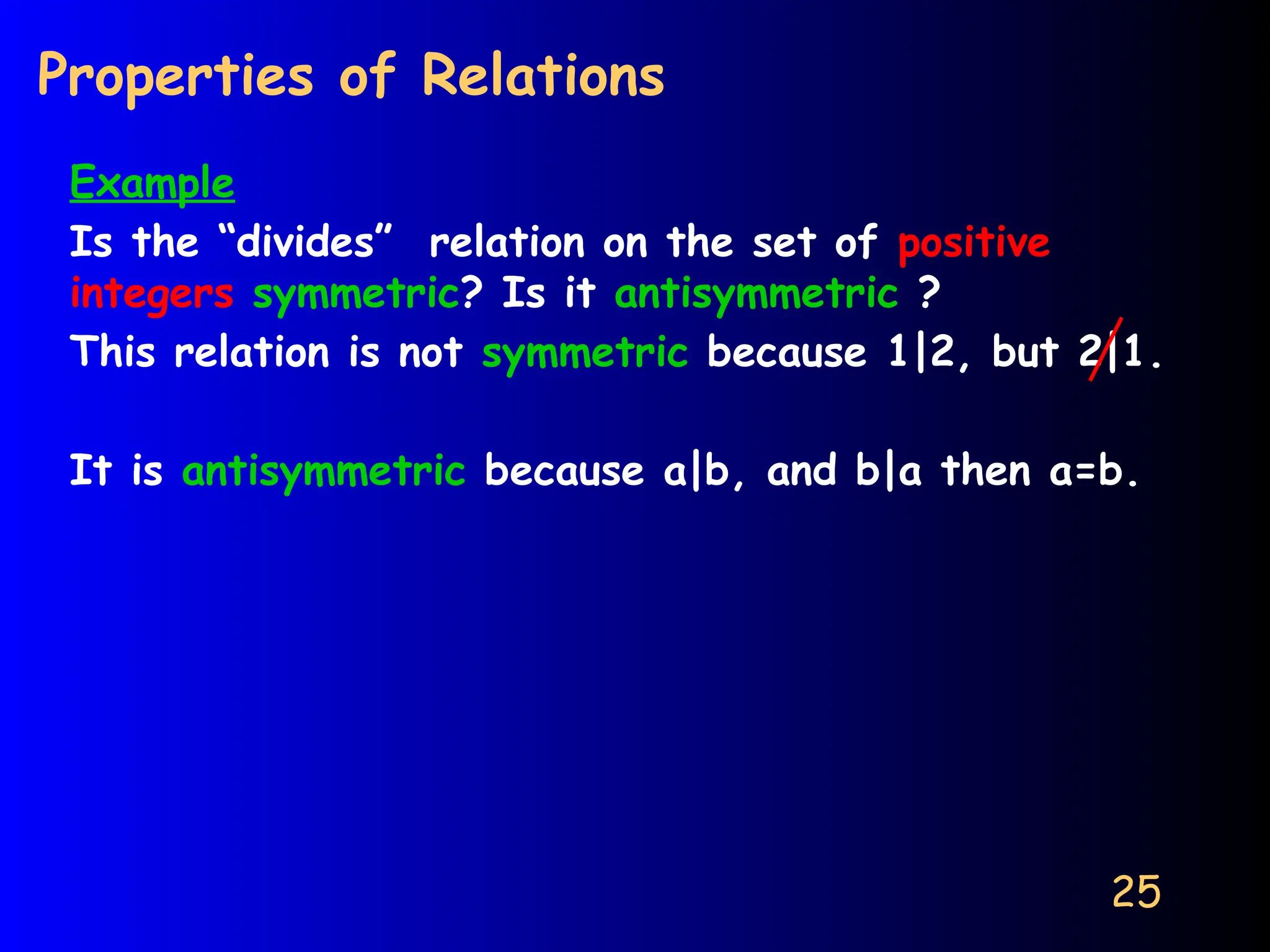
Properties of Relations
Example
Isthe “divides” relation on the set of positive
integers symmetric? Is it antisymmetric ?
This relation is not symmetric because 1|2, but 2|1.
It is antisymmetric because a|b, and b|a then a=b.
26.
26
Properties of Relations
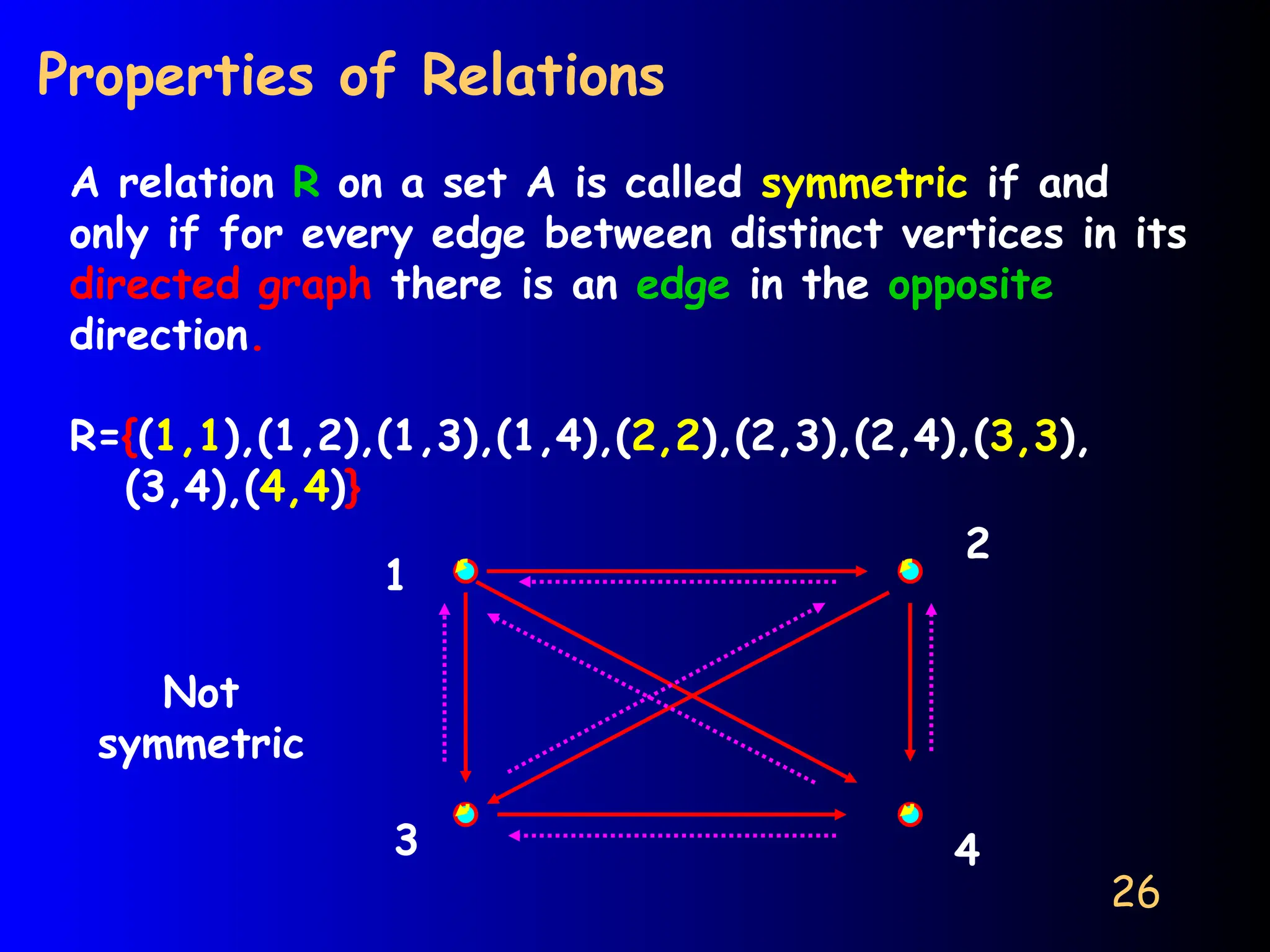
Arelation R on a set A is called symmetric if and
only if for every edge between distinct vertices in its
directed graph there is an edge in the opposite
direction.
R={(1,1),(1,2),(1,3),(1,4),(2,2),(2,3),(2,4),(3,3),
(3,4),(4,4)}
1
2
3 4
Not
symmetric
27.
27
Properties of Relations
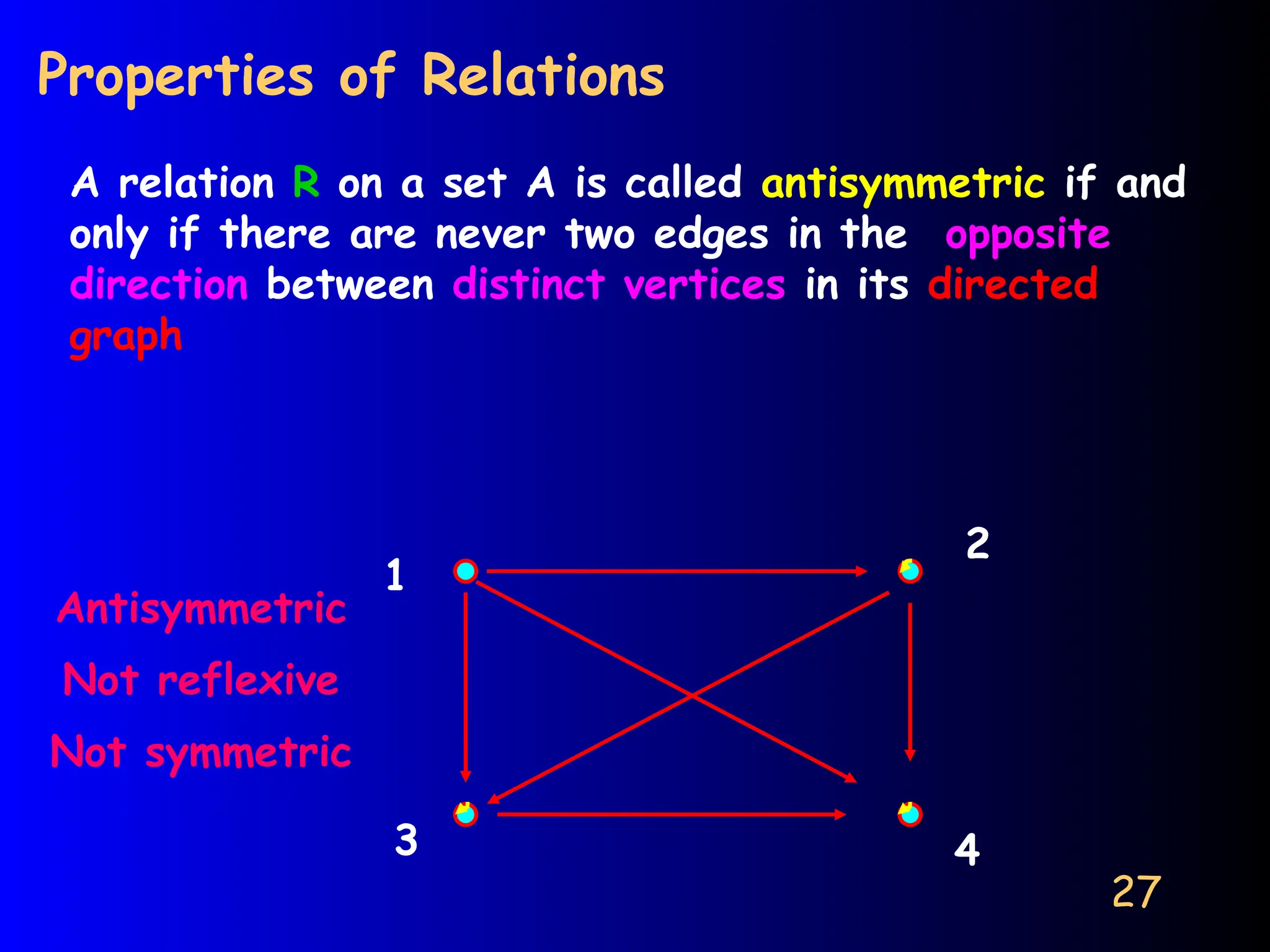
Arelation R on a set A is called antisymmetric if and
only if there are never two edges in the opposite
direction between distinct vertices in its directed
graph
1
2
3 4
Antisymmetric
Not reflexive
Not symmetric
28.
28
Properties of Relations
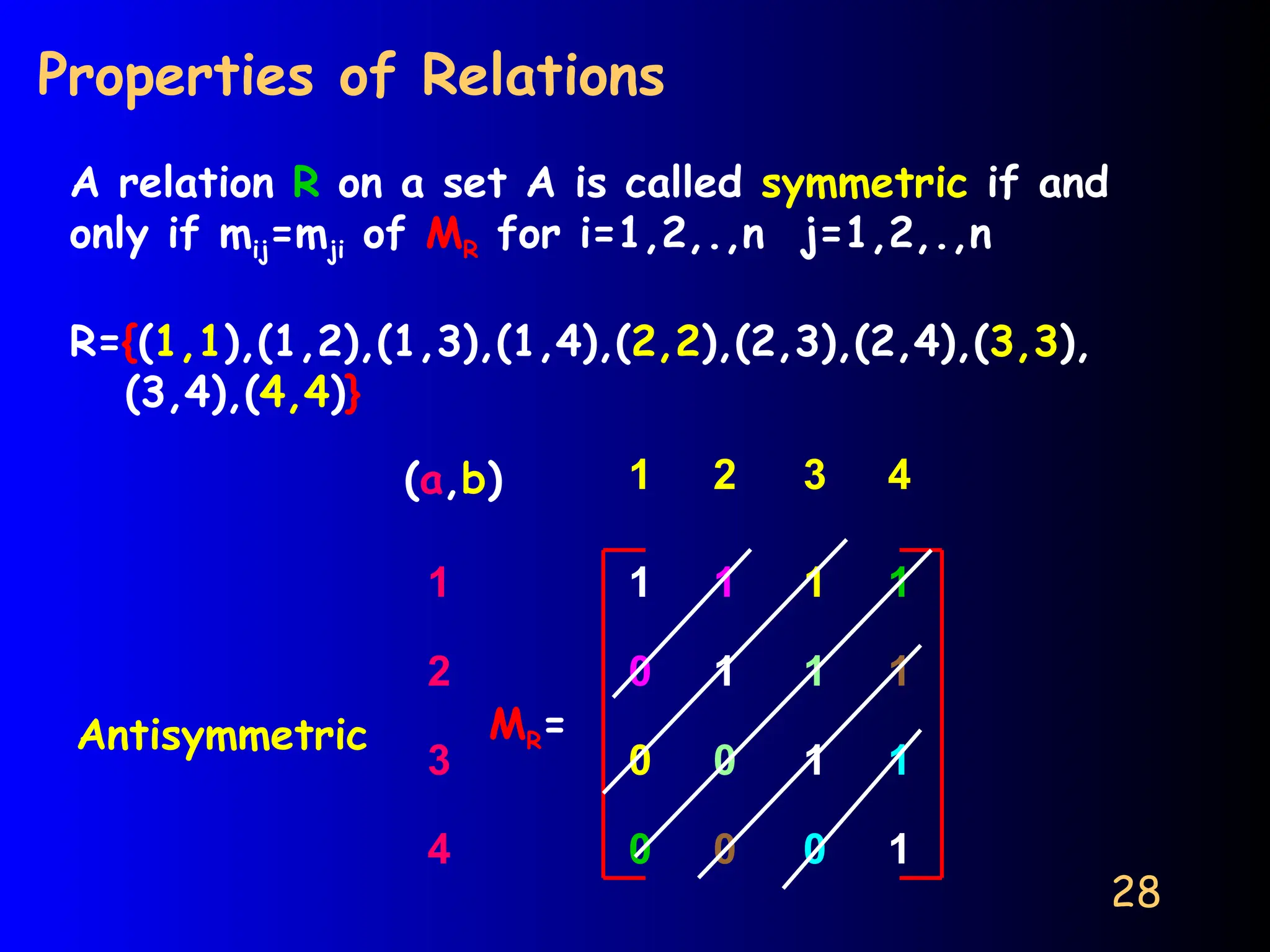
Arelation R on a set A is called symmetric if and
only if mij=mji of MR for i=1,2,.,n j=1,2,.,n
R={(1,1),(1,2),(1,3),(1,4),(2,2),(2,3),(2,4),(3,3),
(3,4),(4,4)}
1 1 1 1
0 1 1 1
0 0 1 1
0 0 0 1
MR=
1 2 3 4
1
2
3
4
(a,b)
Antisymmetric
29.
29
Properties of Relations
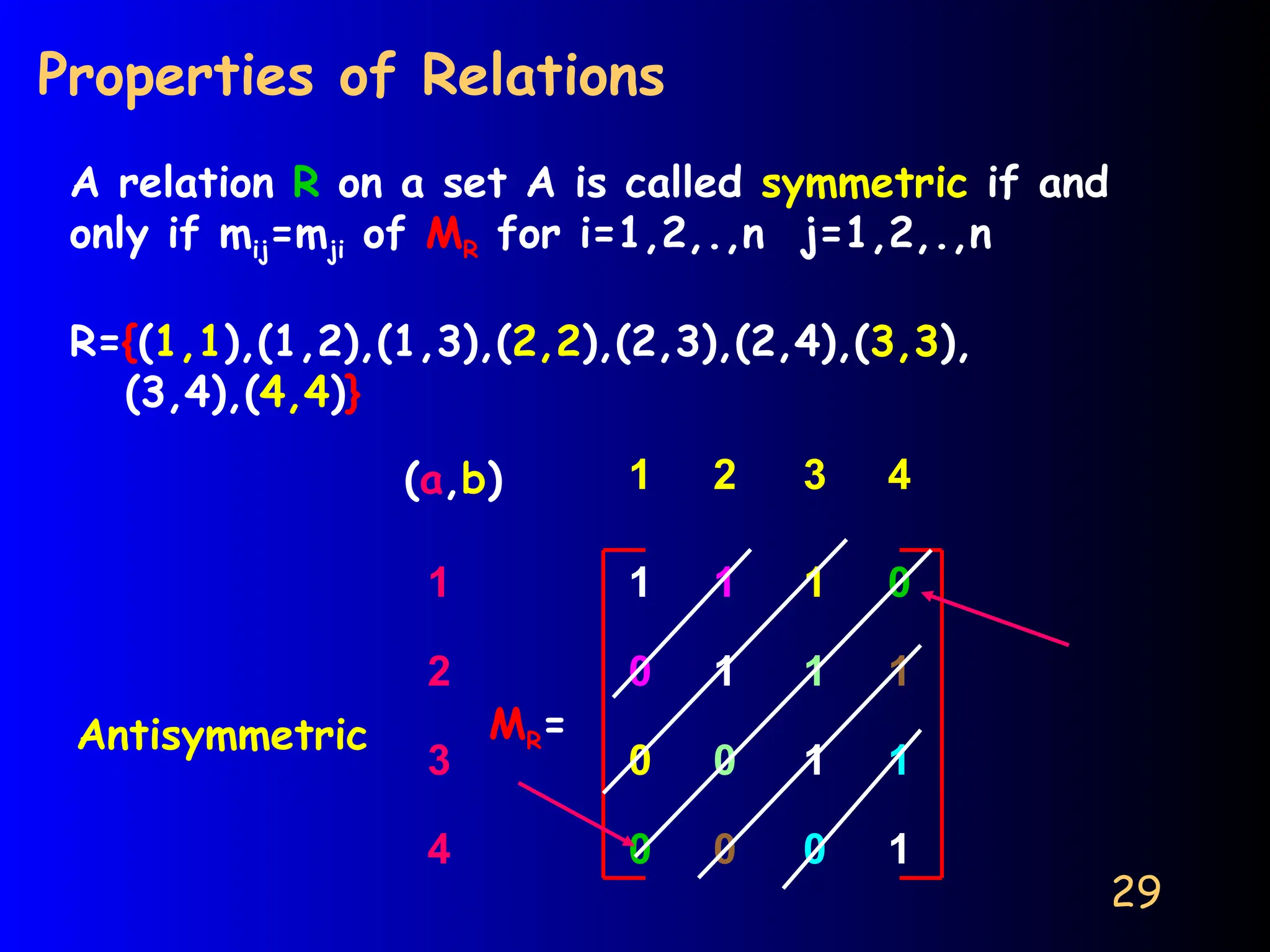
Arelation R on a set A is called symmetric if and
only if mij=mji of MR for i=1,2,.,n j=1,2,.,n
R={(1,1),(1,2),(1,3),(2,2),(2,3),(2,4),(3,3),
(3,4),(4,4)}
1 1 1 0
0 1 1 1
0 0 1 1
0 0 0 1
MR=
1 2 3 4
1
2
3
4
(a,b)
Antisymmetric
30.
30
Properties of Relations
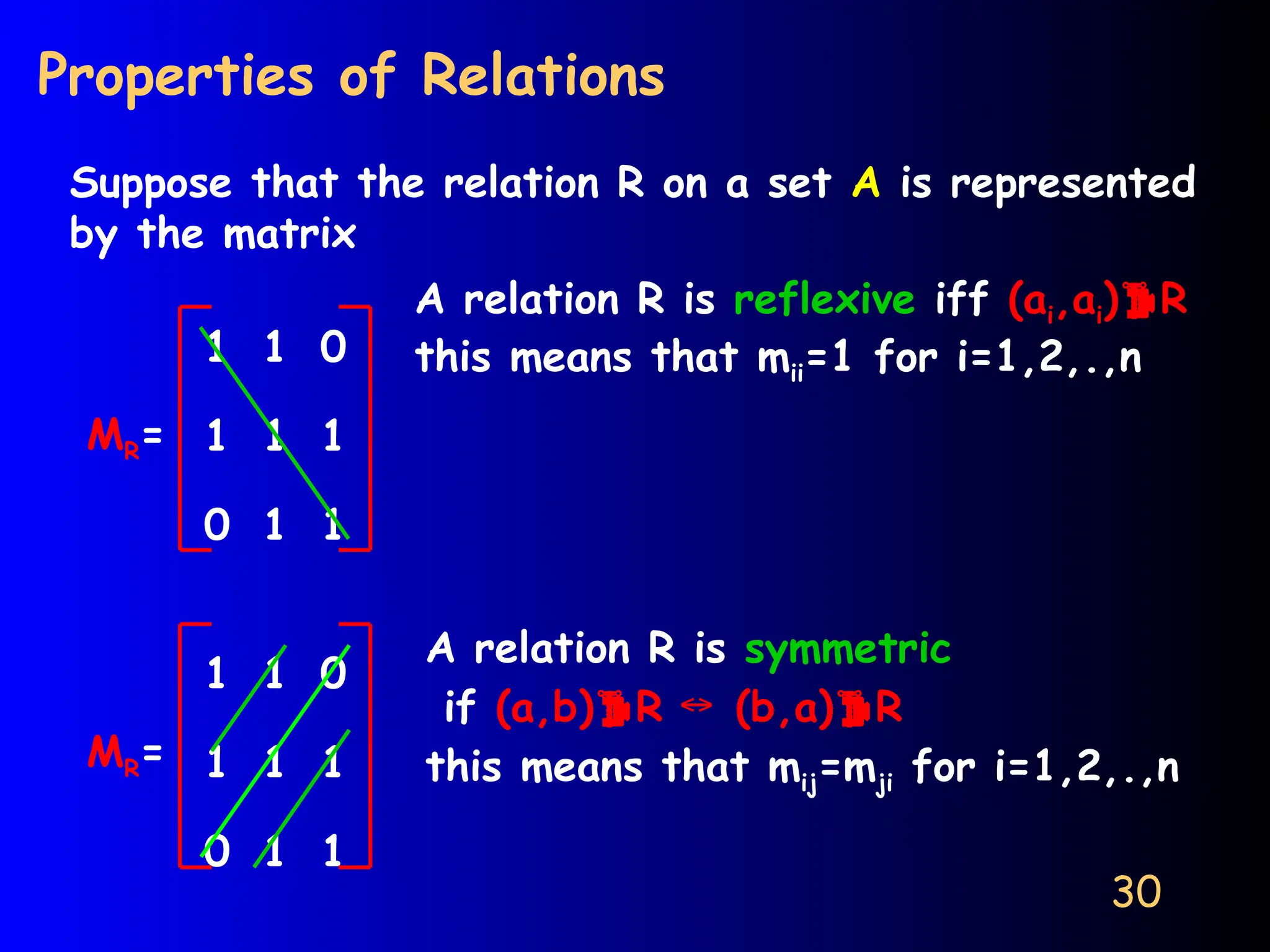
Supposethat the relation R on a set A is represented
by the matrix
1 1 0
1 1 1
0 1 1
MR=
A relation R is reflexive iff (ai,ai)R
this means that mii=1 for i=1,2,.,n
A relation R is symmetric
if (a,b)R (b,a)
↔ R
this means that mij=mji for i=1,2,.,n
1 1 0
1 1 1
0 1 1
MR=
31.
31
Properties of Relations
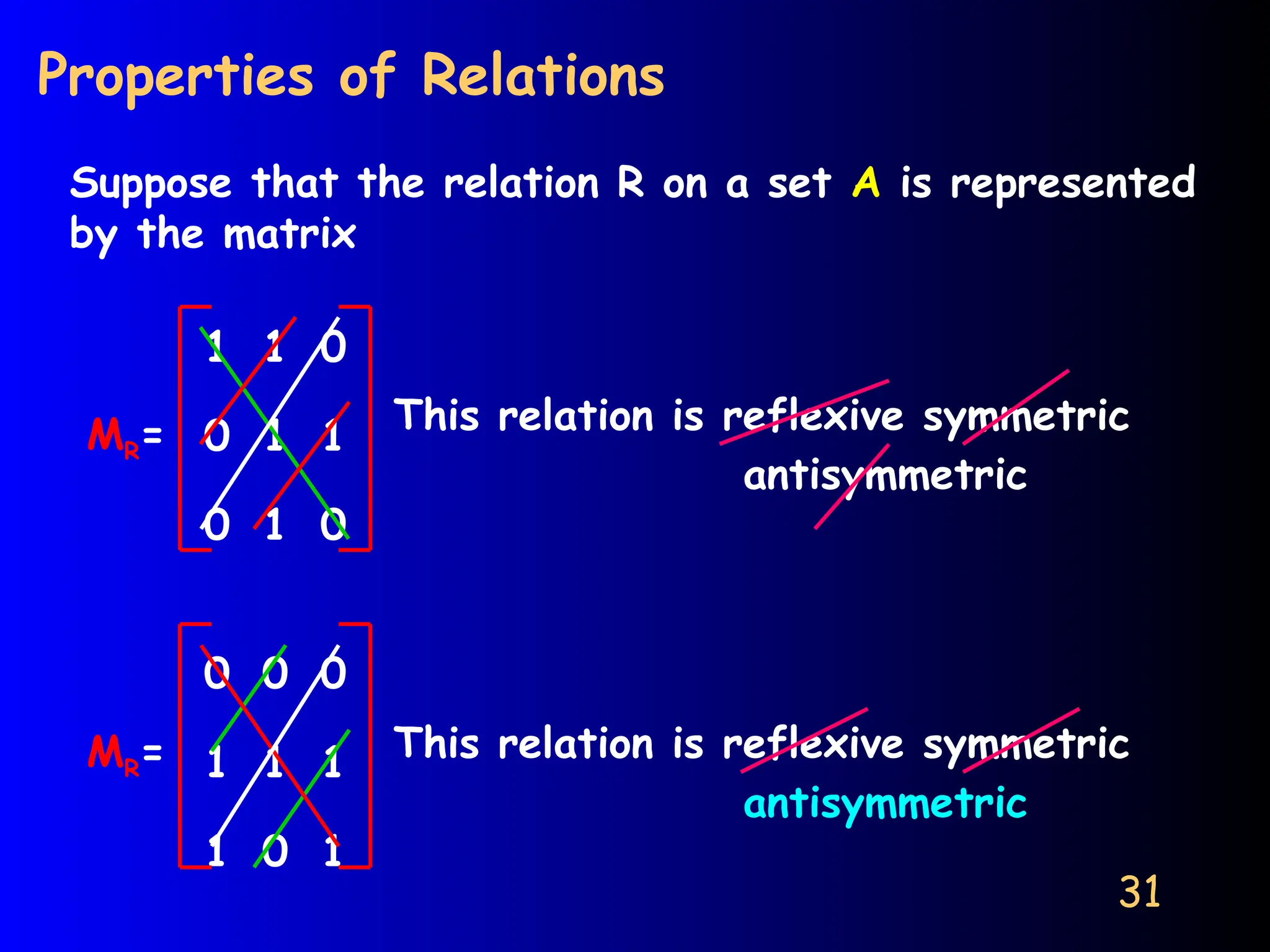
Supposethat the relation R on a set A is represented
by the matrix
1 1 0
0 1 1
0 1 0
MR= This relation is reflexive symmetric
antisymmetric
This relation is reflexive symmetric
antisymmetric
0 0 0
1 1 1
1 0 1
MR=
32.
32
Properties of Relations
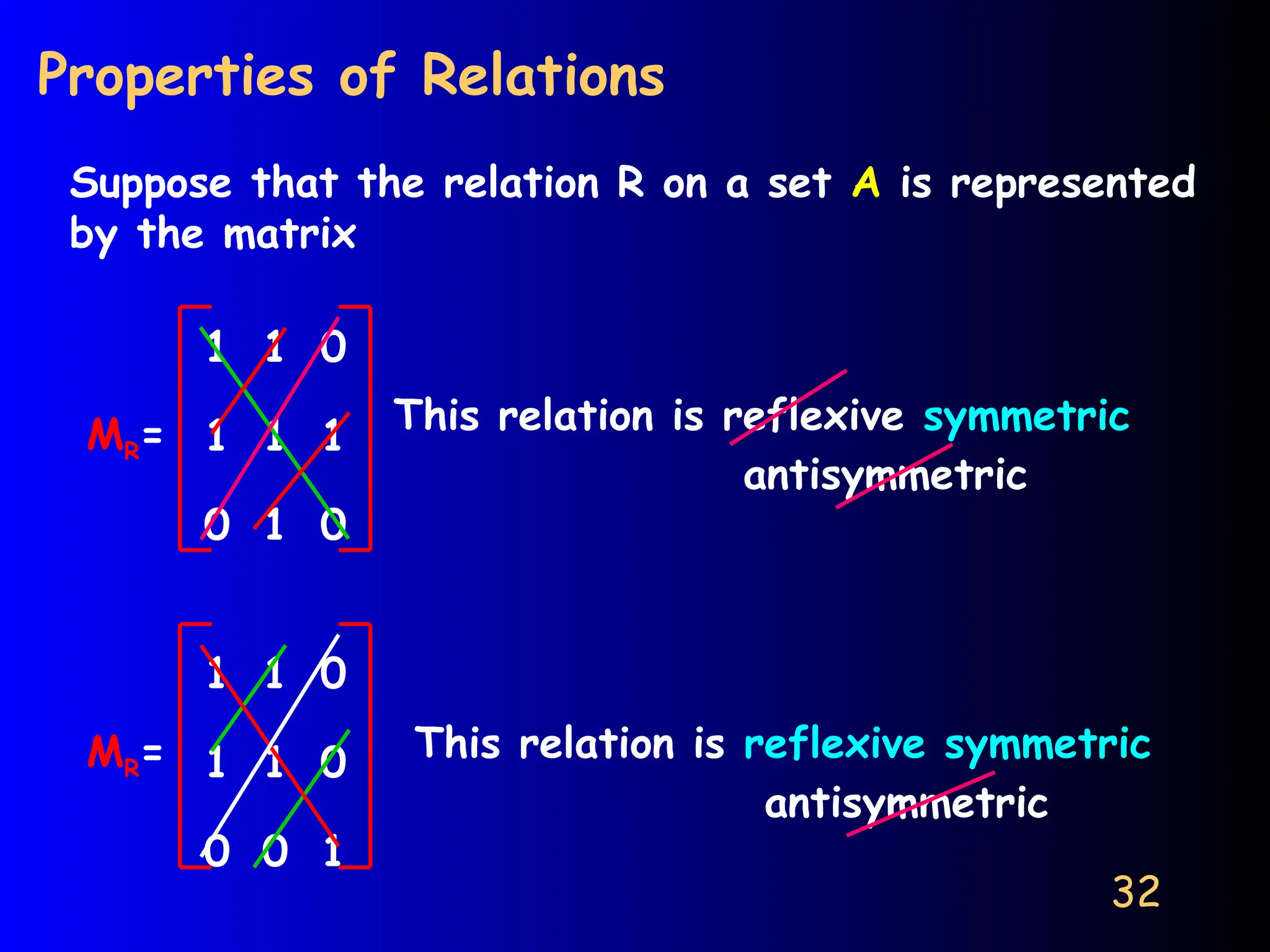
Supposethat the relation R on a set A is represented
by the matrix
1 1 0
1 1 1
0 1 0
MR= This relation is reflexive symmetric
antisymmetric
This relation is reflexive symmetric
antisymmetric
1 1 0
1 1 0
0 0 1
MR=
33.
33
Properties of Relations
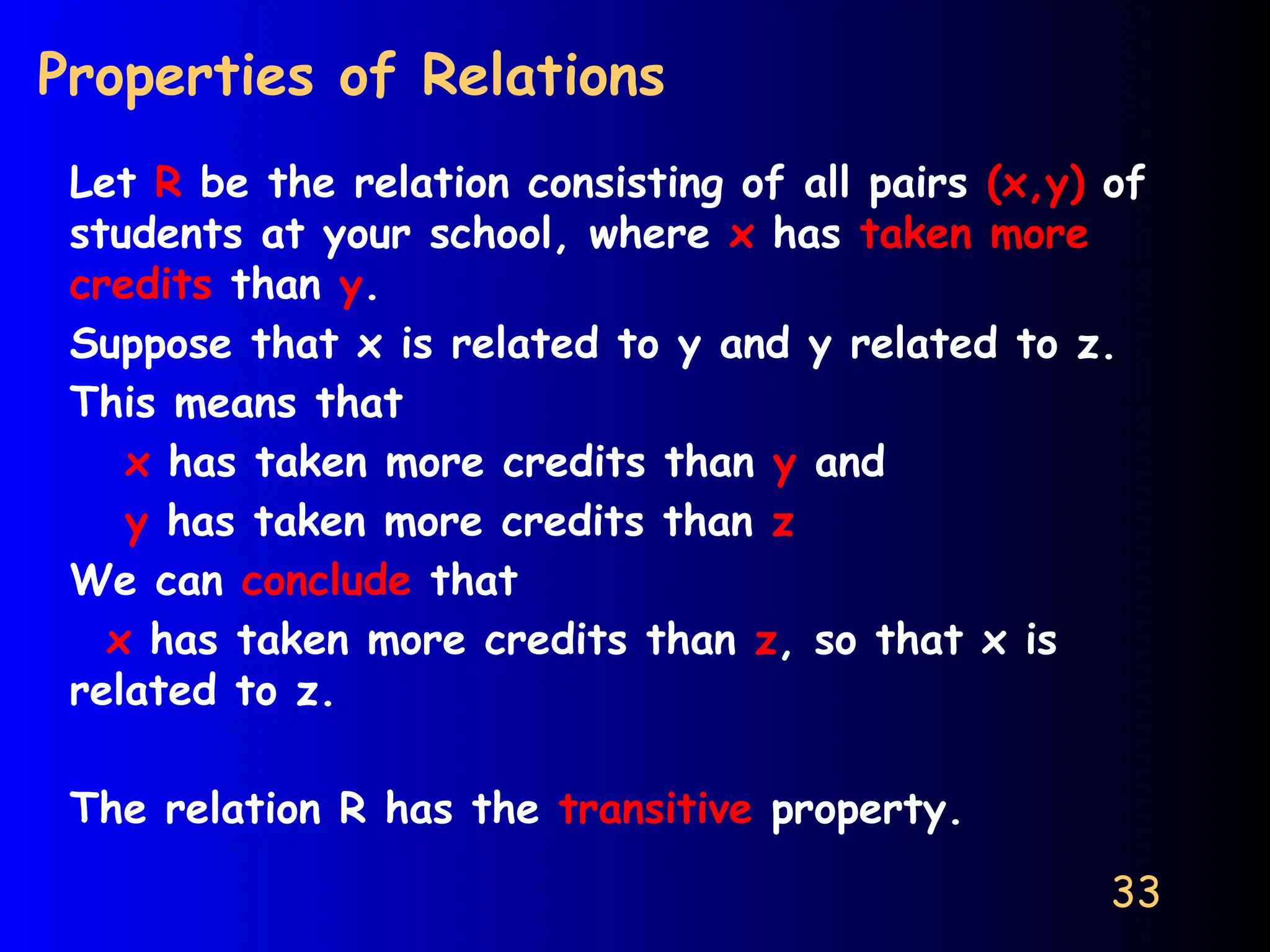
LetR be the relation consisting of all pairs (x,y) of
students at your school, where x has taken more
credits than y.
Suppose that x is related to y and y related to z.
This means that
x has taken more credits than y and
y has taken more credits than z
We can conclude that
x has taken more credits than z, so that x is
related to z.
The relation R has the transitive property.
34.
34
Properties of Relations
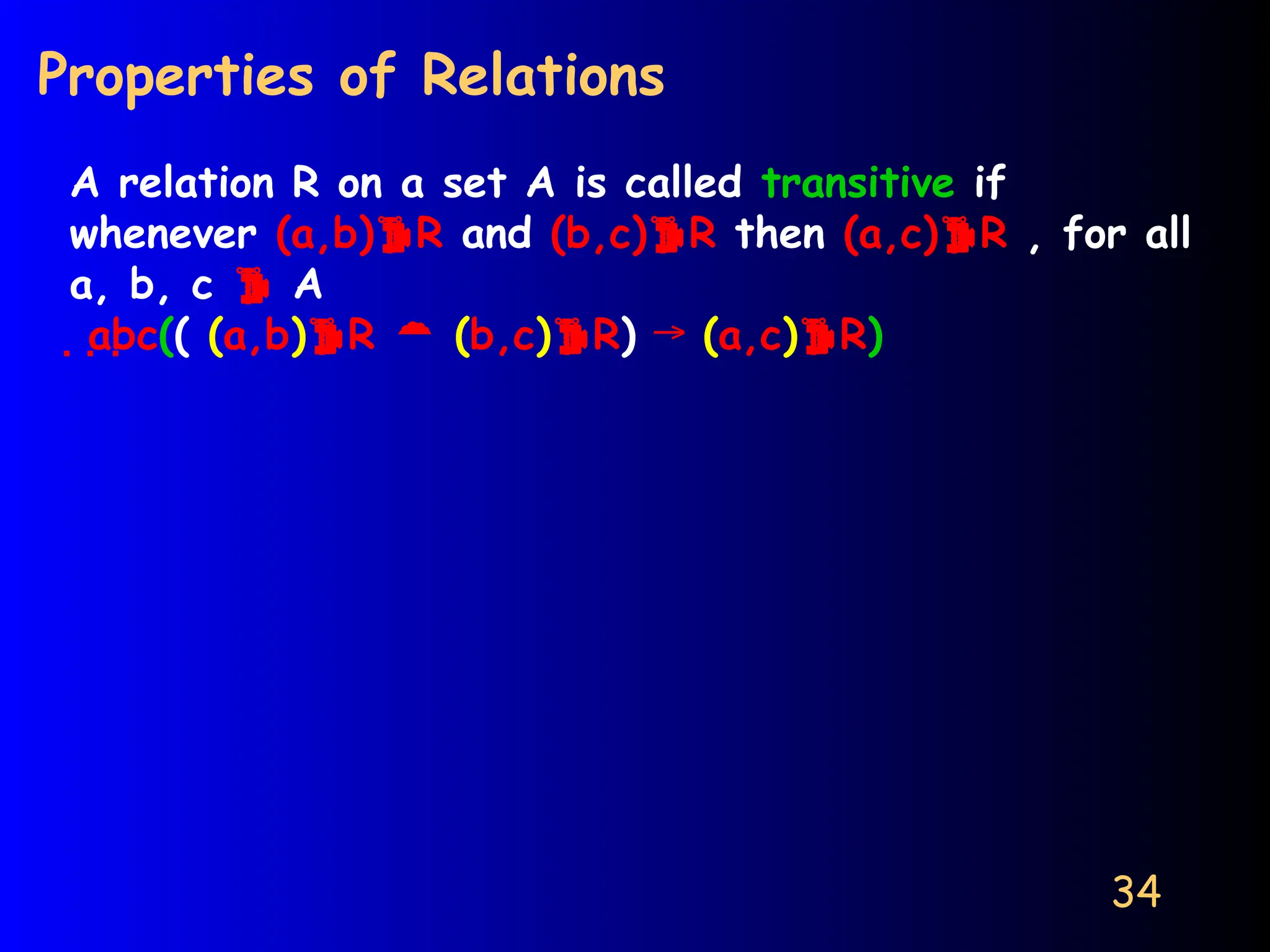
Arelation R on a set A is called transitive if
whenever (a,b)R and (b,c)R then (a,c)R , for all
a, b, c A
abc(( (a,b)R (b,c)R) → (a,c)R)
35.
35
Properties of Relations
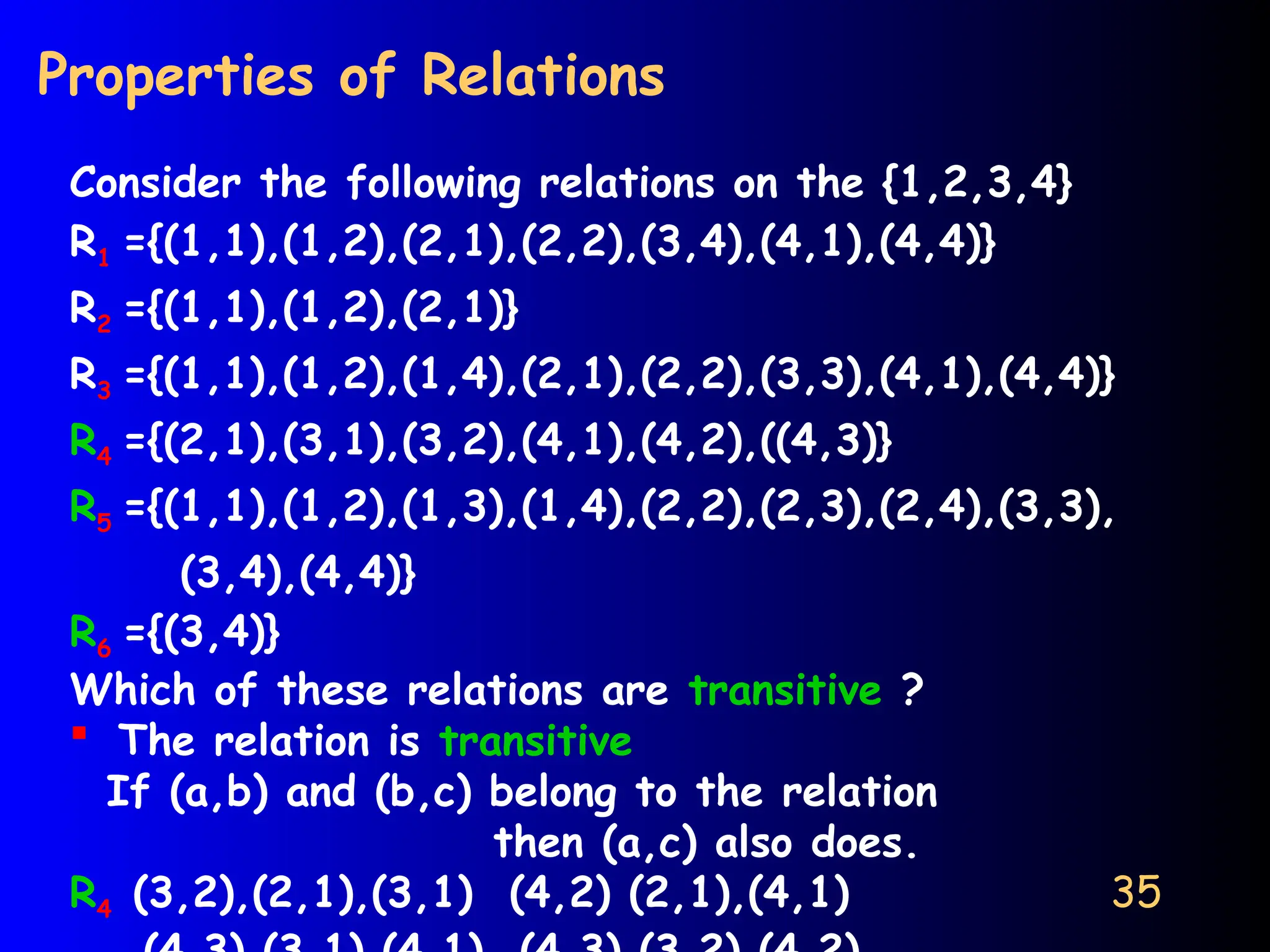
Considerthe following relations on the {1,2,3,4}
R1 ={(1,1),(1,2),(2,1),(2,2),(3,4),(4,1),(4,4)}
R2 ={(1,1),(1,2),(2,1)}
R3 ={(1,1),(1,2),(1,4),(2,1),(2,2),(3,3),(4,1),(4,4)}
R4 ={(2,1),(3,1),(3,2),(4,1),(4,2),((4,3)}
R5 ={(1,1),(1,2),(1,3),(1,4),(2,2),(2,3),(2,4),(3,3),
(3,4),(4,4)}
R6 ={(3,4)}
Which of these relations are transitive ?
The relation is transitive
If (a,b) and (b,c) belong to the relation
then (a,c) also does.
R4 (3,2),(2,1),(3,1) (4,2) (2,1),(4,1)
36.
36
Properties of Relations
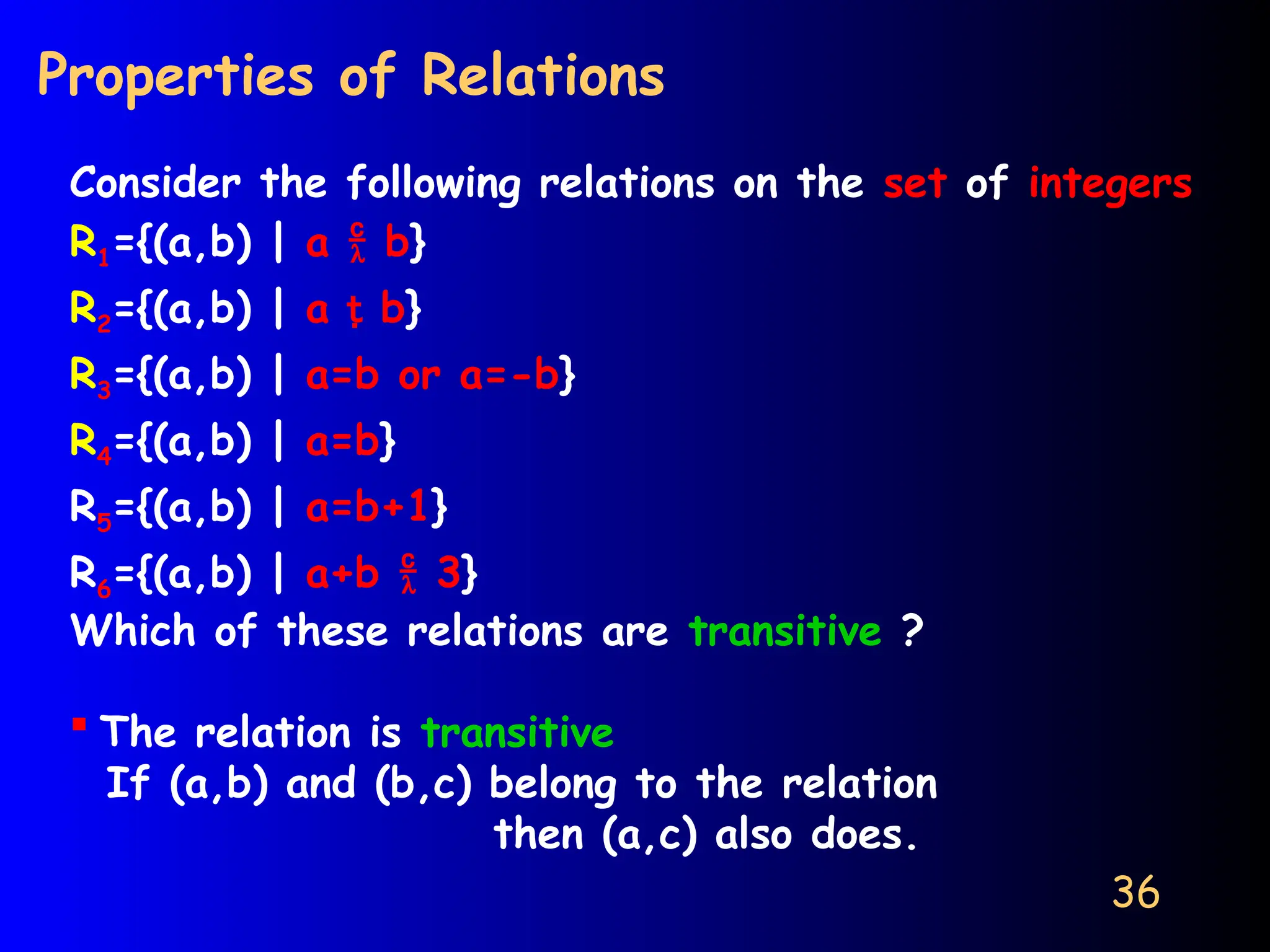
Considerthe following relations on the set of integers
R1={(a,b) | a b}
R2={(a,b) | a b}
R3={(a,b) | a=b or a=-b}
R4={(a,b) | a=b}
R5={(a,b) | a=b+1}
R6={(a,b) | a+b 3}
Which of these relations are transitive ?
The relation is transitive
If (a,b) and (b,c) belong to the relation
then (a,c) also does.
37.
37
Properties of Relations
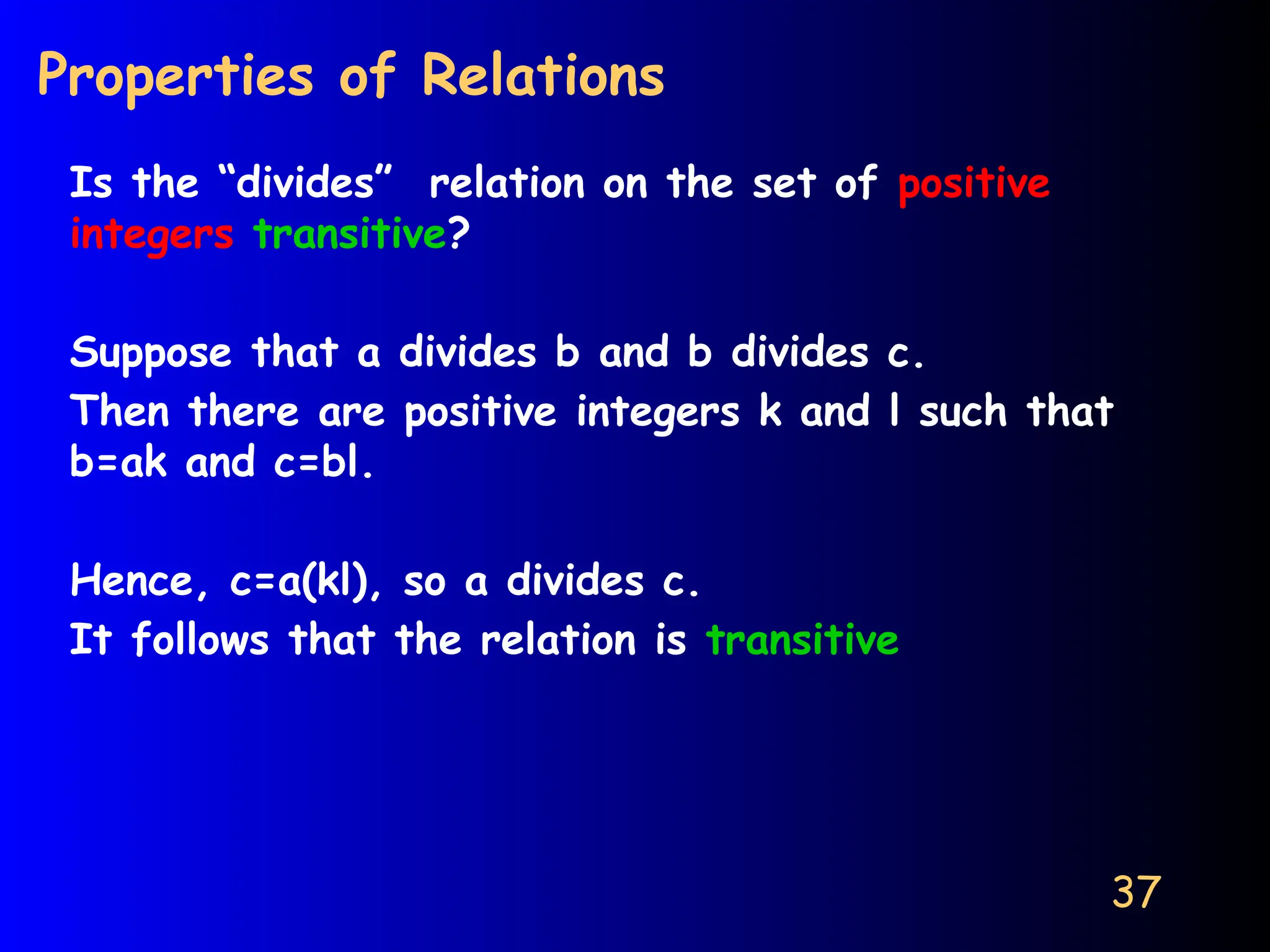
Isthe “divides” relation on the set of positive
integers transitive?
Suppose that a divides b and b divides c.
Then there are positive integers k and l such that
b=ak and c=bl.
Hence, c=a(kl), so a divides c.
It follows that the relation is transitive
38.
38
Properties of Relations
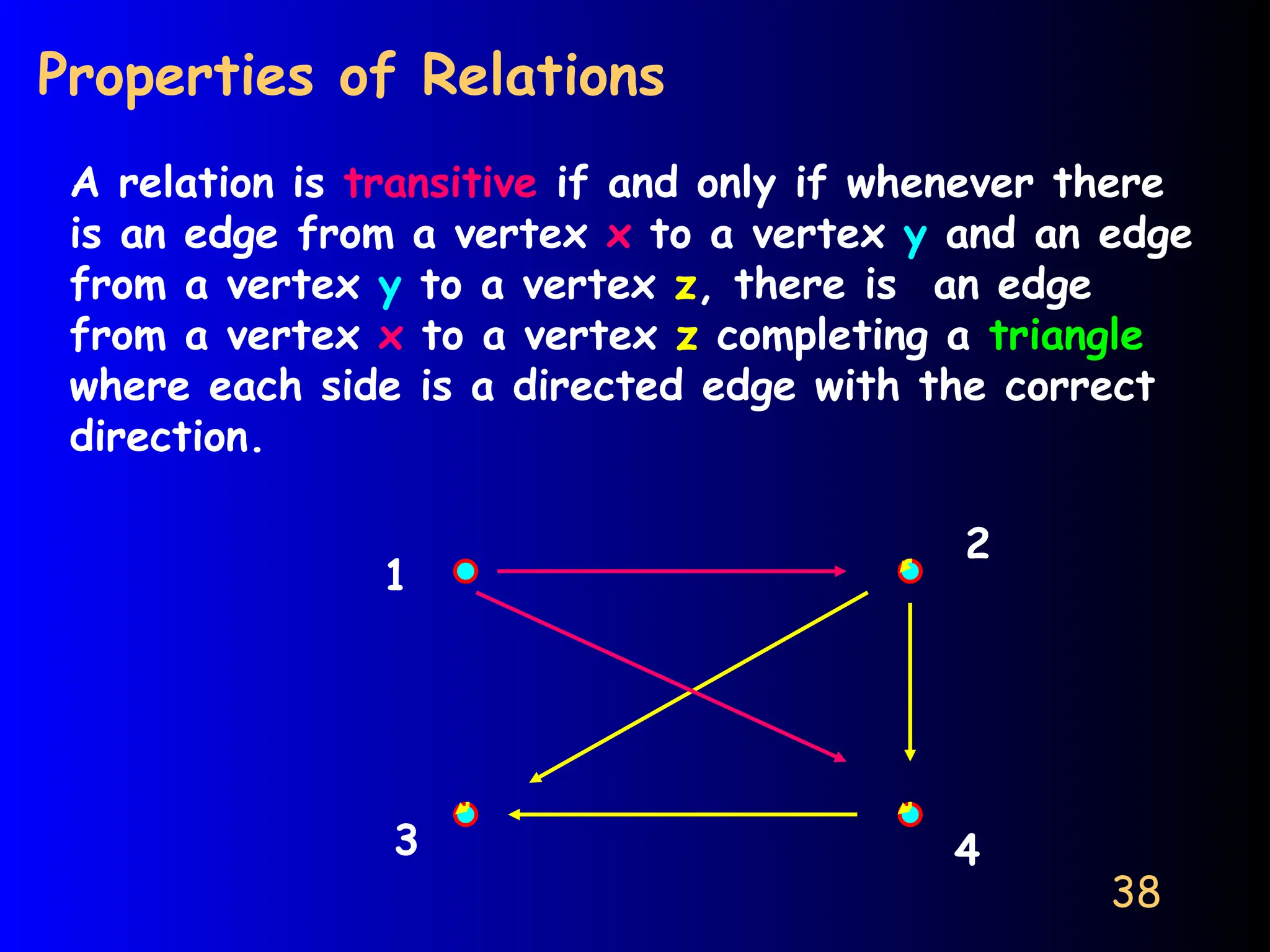
Arelation is transitive if and only if whenever there
is an edge from a vertex x to a vertex y and an edge
from a vertex y to a vertex z, there is an edge
from a vertex x to a vertex z completing a triangle
where each side is a directed edge with the correct
direction.
1
2
3 4
41
Compositions of Relations
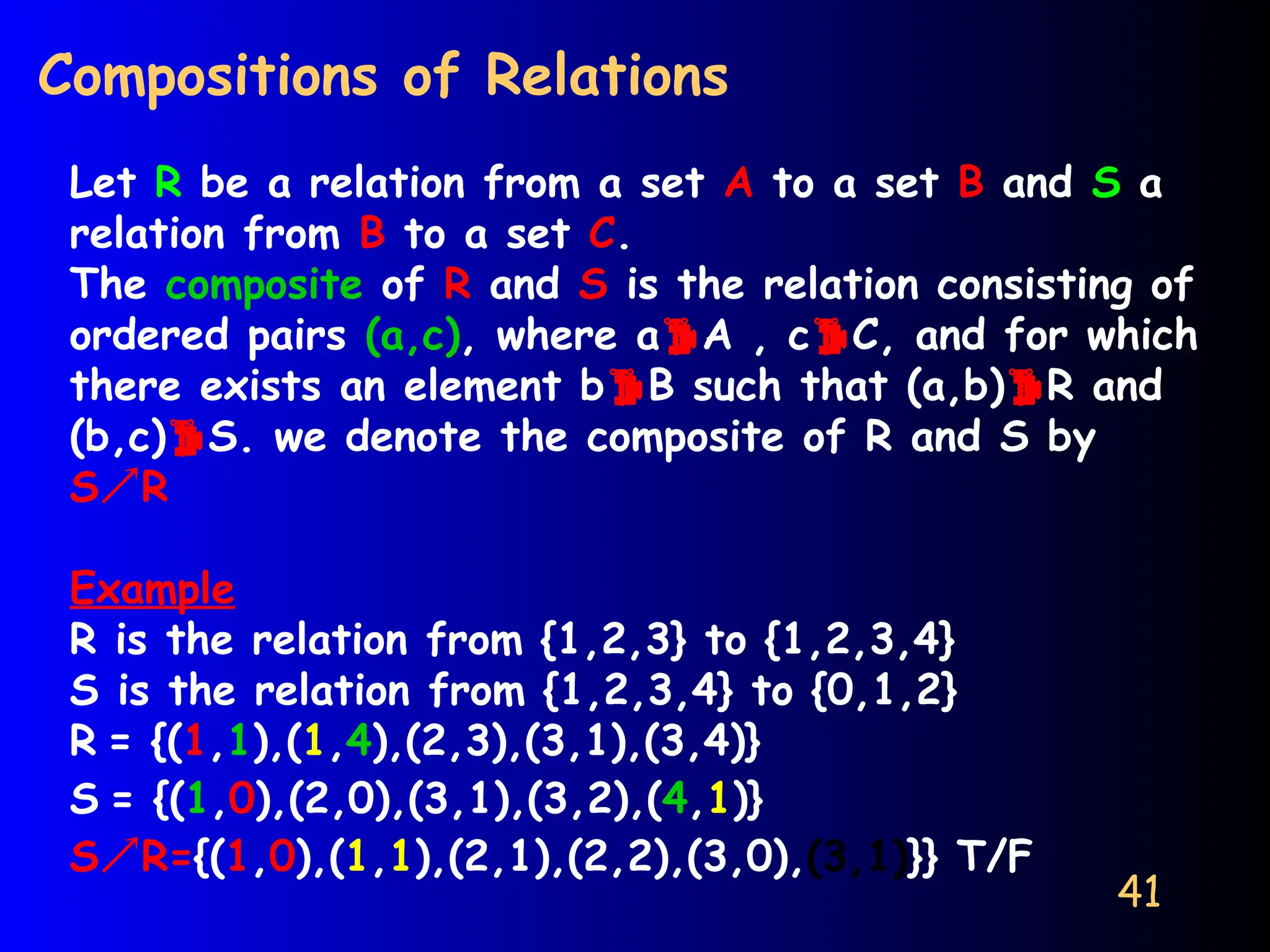
LetR be a relation from a set A to a set B and S a
relation from B to a set C.
The composite of R and S is the relation consisting of
ordered pairs (a,c), where aA , cC, and for which
there exists an element bB such that (a,b)R and
(b,c)S. we denote the composite of R and S by
SR
Example
R is the relation from {1,2,3} to {1,2,3,4}
S is the relation from {1,2,3,4} to {0,1,2}
R = {(1,1),(1,4),(2,3),(3,1),(3,4)}
S = {(1,0),(2,0),(3,1),(3,2),(4,1)}
SR={(1,0),(1,1),(2,1),(2,2),(3,0),(3,1)}} T/F
42.
42
Compositions of Relations
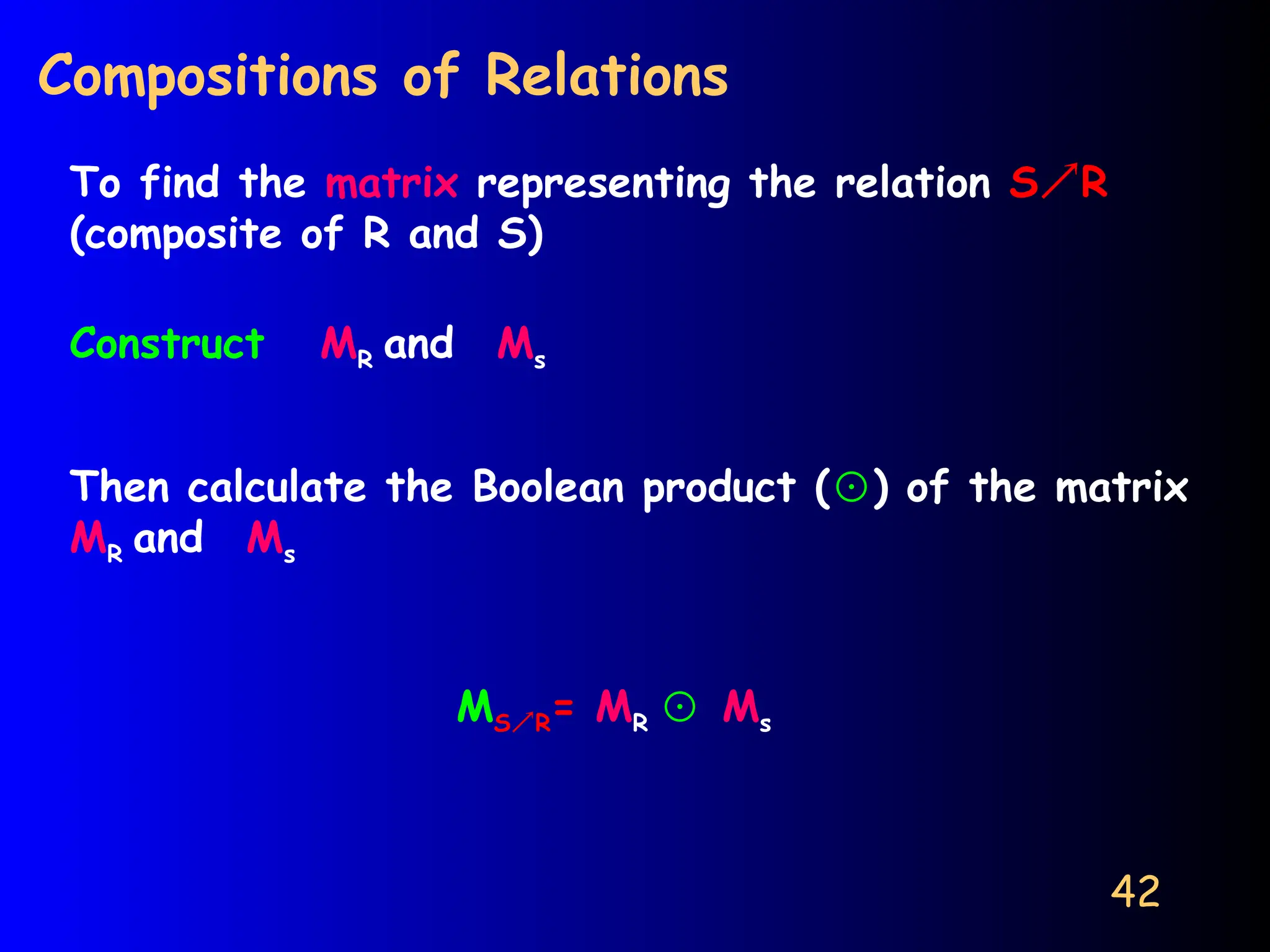
Tofind the matrix representing the relation SR
(composite of R and S)
Construct MR and Ms
Then calculate the Boolean product (⊙) of the matrix
MR and Ms
MSR= MR ⊙ Ms
43.
43
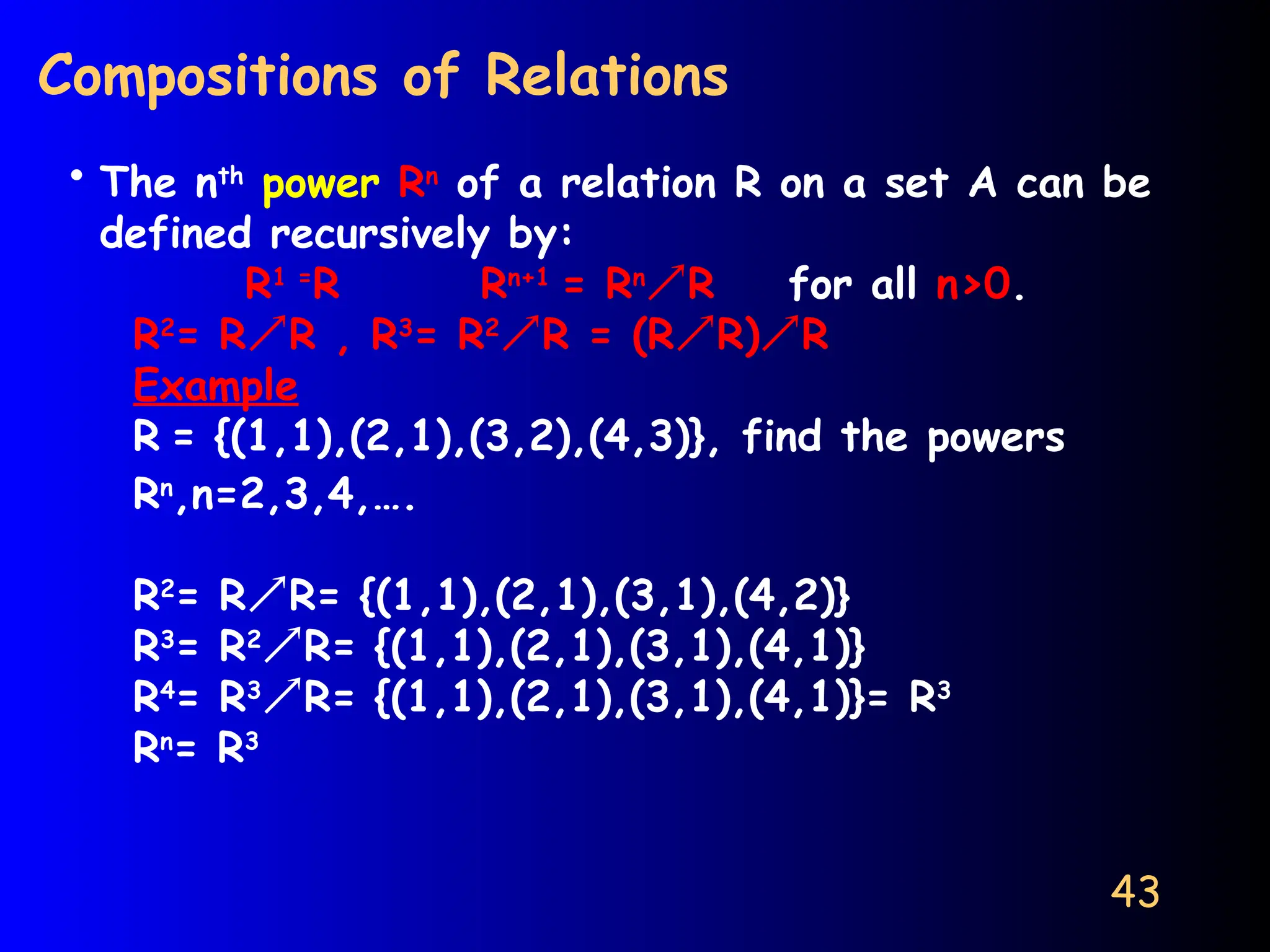
Compositions of Relations
•The nth
power Rn
of a relation R on a set A can be
defined recursively by:
R1 =
R Rn+1
= Rn
R for all n>0.
R2
= RR , R3
= R2
R = (RR)R
Example
R = {(1,1),(2,1),(3,2),(4,3)}, find the powers
Rn
,n=2,3,4,….
R2
= RR= {(1,1),(2,1),(3,1),(4,2)}
R3
= R2
R= {(1,1),(2,1),(3,1),(4,1)}
R4
= R3
R= {(1,1),(2,1),(3,1),(4,1)}= R3
Rn
= R3
44.
44
Compositions of Relations
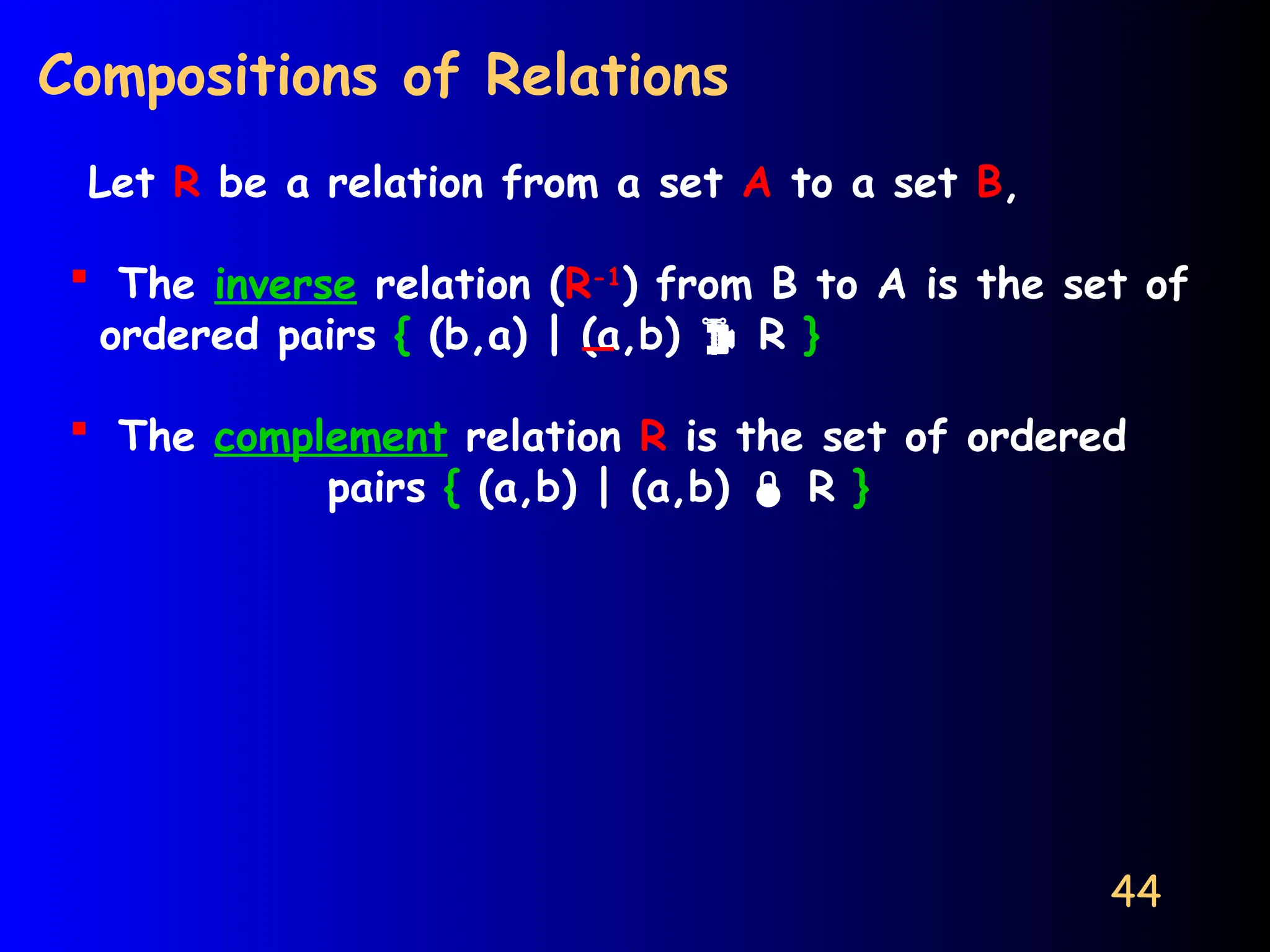
LetR be a relation from a set A to a set B,
The inverse relation (R-1
) from B to A is the set of
ordered pairs { (b,a) | (a,b) R }
The complement relation R is the set of ordered
pairs { (a,b) | (a,b) R }
45.
45
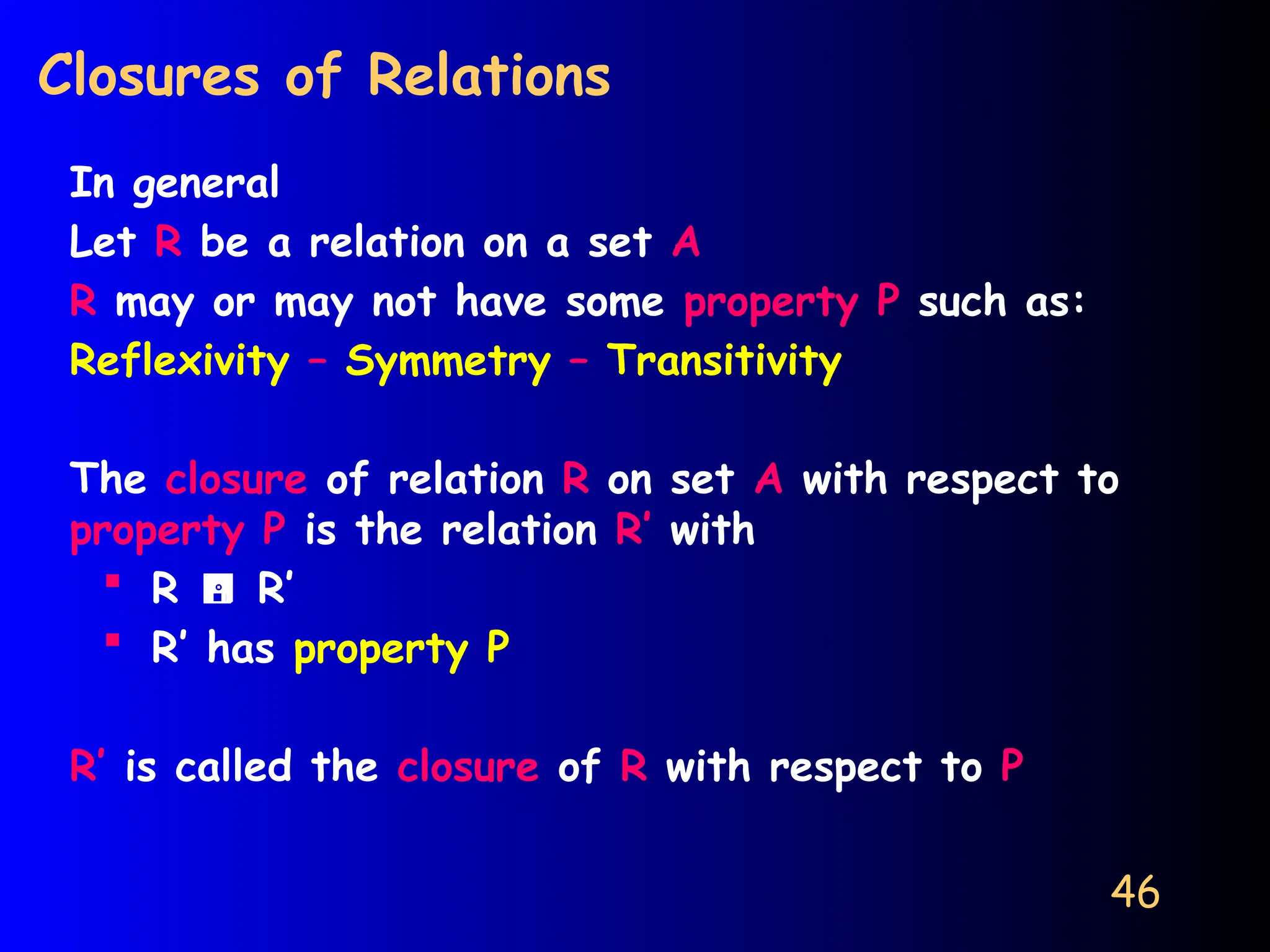
Closures of Relations
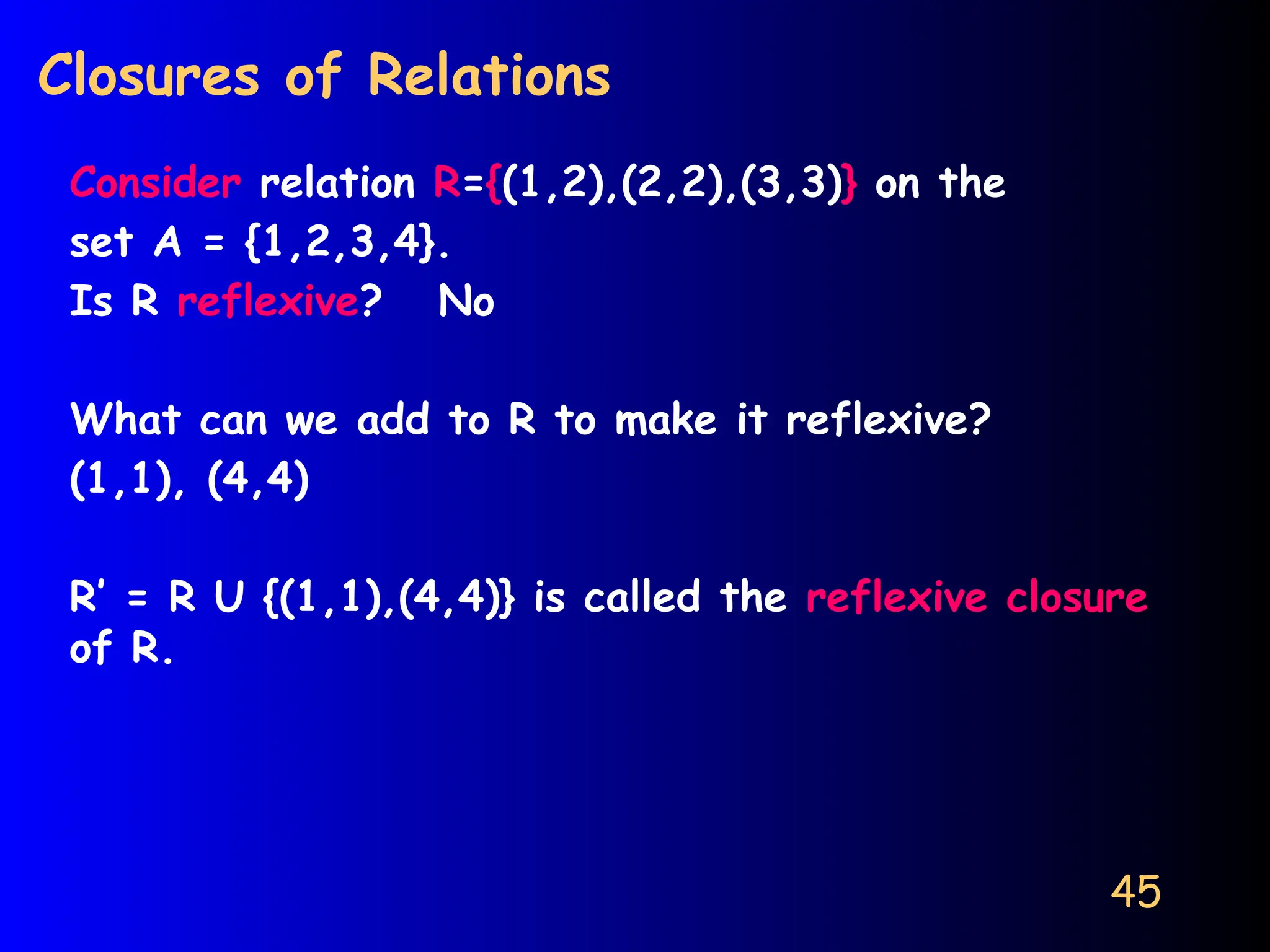
Considerrelation R={(1,2),(2,2),(3,3)} on the
set A = {1,2,3,4}.
Is R reflexive? No
What can we add to R to make it reflexive?
(1,1), (4,4)
R’ = R U {(1,1),(4,4)} is called the reflexive closure
of R.
46.
46
Closures of Relations
Ingeneral
Let R be a relation on a set A
R may or may not have some property P such as:
Reflexivity – Symmetry – Transitivity
The closure of relation R on set A with respect to
property P is the relation R’ with
R R’
R’ has property P
R’ is called the closure of R with respect to P
47.
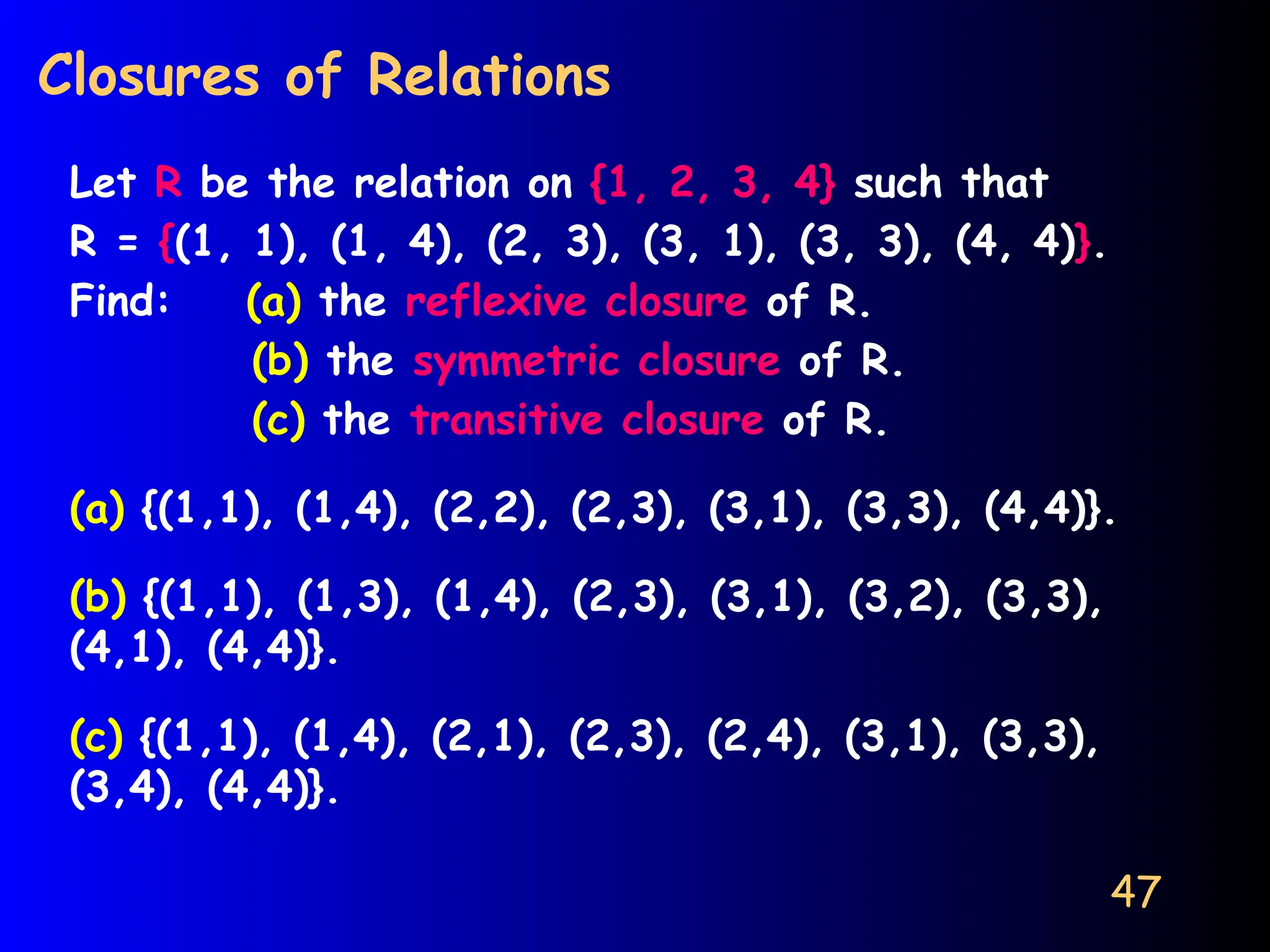
47
Closures of Relations
LetR be the relation on {1, 2, 3, 4} such that
R = {(1, 1), (1, 4), (2, 3), (3, 1), (3, 3), (4, 4)}.
Find: (a) the reflexive closure of R.
(b) the symmetric closure of R.
(c) the transitive closure of R.
(a) {(1,1), (1,4), (2,2), (2,3), (3,1), (3,3), (4,4)}.
(b) {(1,1), (1,3), (1,4), (2,3), (3,1), (3,2), (3,3),
(4,1), (4,4)}.
(c) {(1,1), (1,4), (2,1), (2,3), (2,4), (3,1), (3,3),
(3,4), (4,4)}.
48.
48
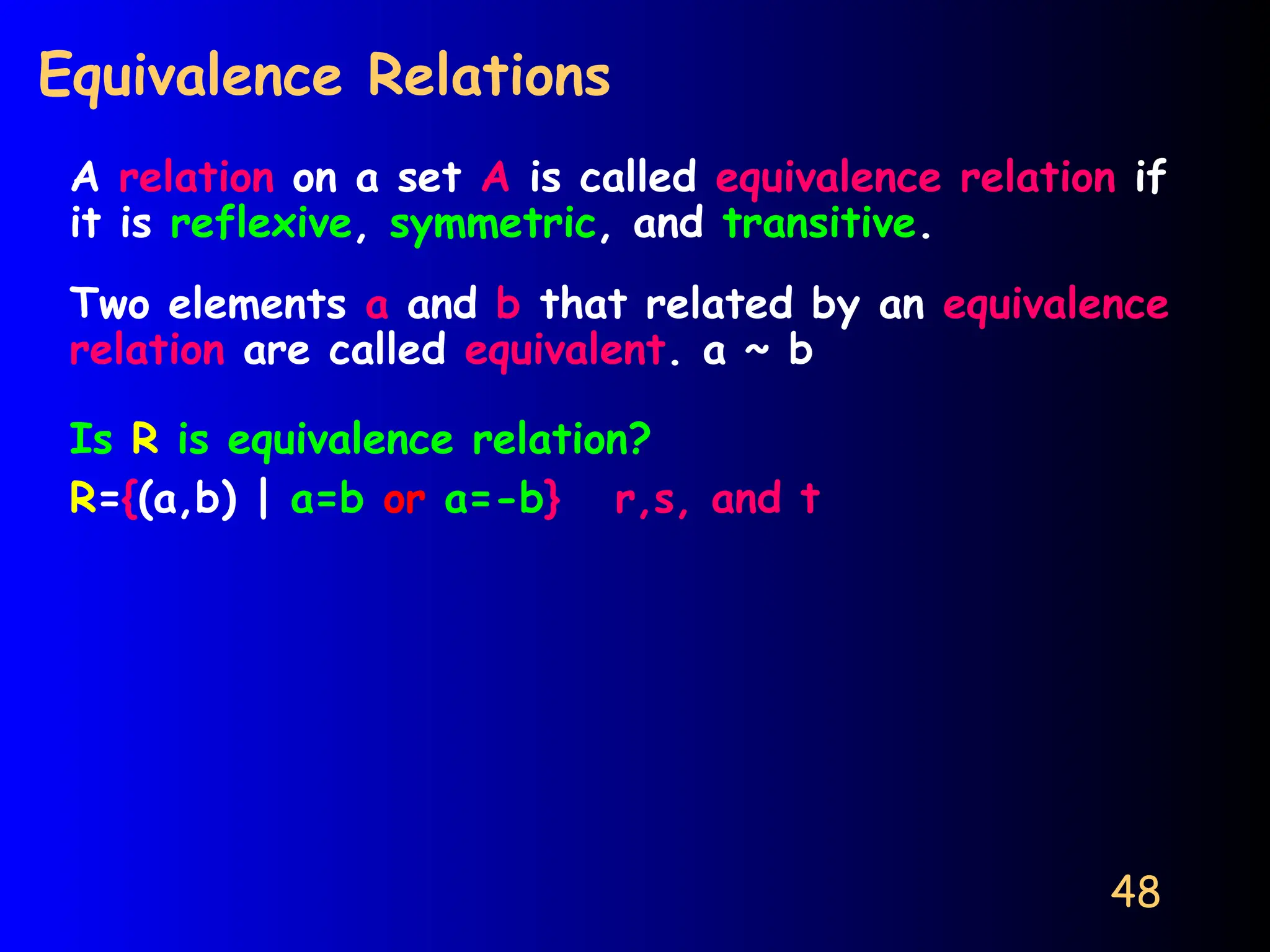
Equivalence Relations
A relationon a set A is called equivalence relation if
it is reflexive, symmetric, and transitive.
Two elements a and b that related by an equivalence
relation are called equivalent. a ~ b
Is R is equivalence relation?
R={(a,b) | a=b or a=-b} r,s, and t
49.
49
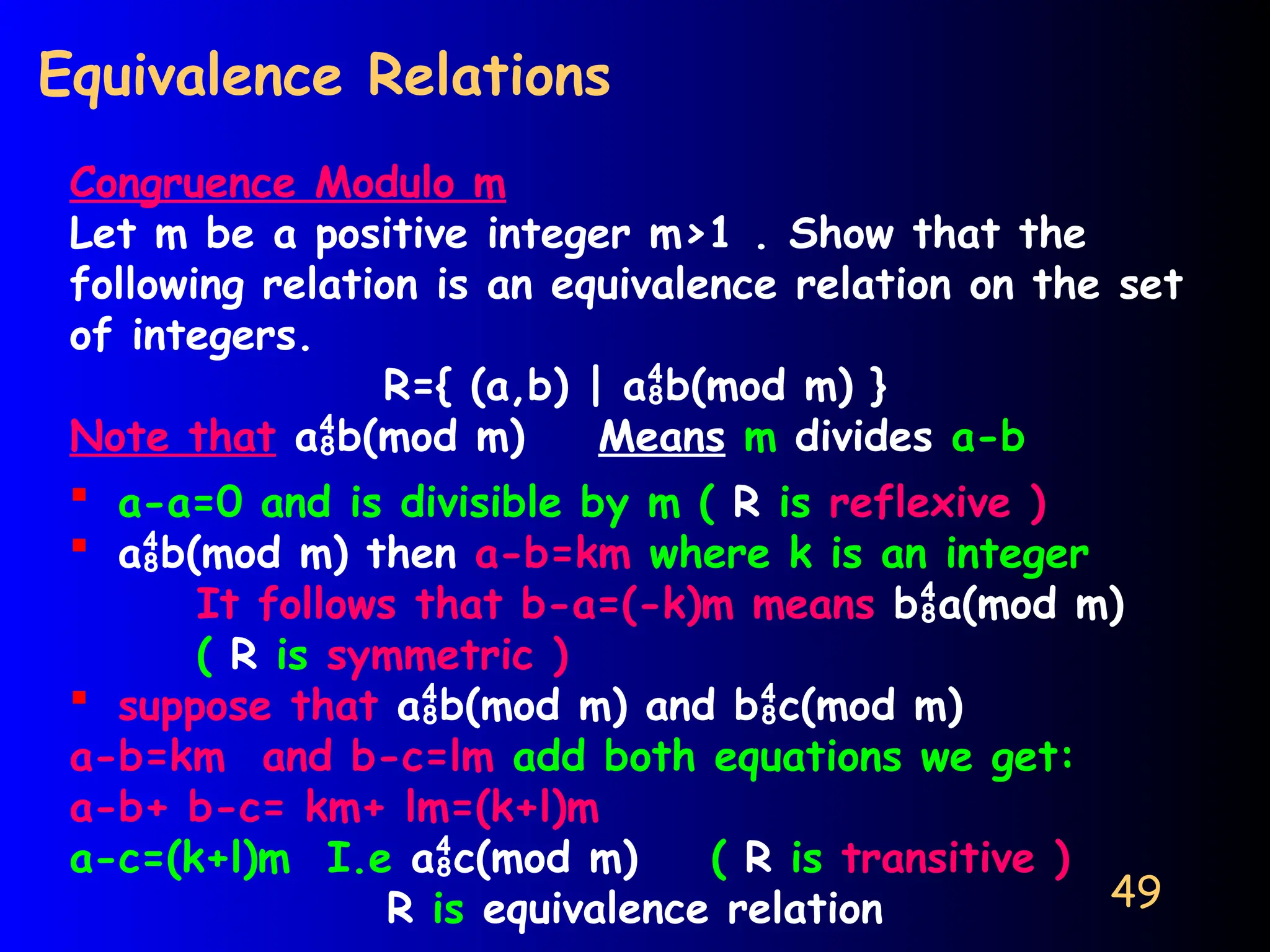
Equivalence Relations
Congruence Modulom
Let m be a positive integer m>1 . Show that the
following relation is an equivalence relation on the set
of integers.
R={ (a,b) | ab(mod m) }
Note that ab(mod m) Means m divides a-b
a-a=0 and is divisible by m ( R is reflexive )
ab(mod m) then a-b=km where k is an integer
It follows that b-a=(-k)m means ba(mod m)
( R is symmetric )
suppose that ab(mod m) and bc(mod m)
a-b=km and b-c=lm add both equations we get:
a-b+ b-c= km+ lm=(k+l)m
a-c=(k+l)m I.e ac(mod m) ( R is transitive )
R is equivalence relation
50.
50
Equivalence Classes
Let Rbe an equivalence relation on S. The set of all
elements that are related to an element a of S is
called equivalence class of a. the equivalence class of
a with respect to R is denoted by [a]R .
a S, [a]R, is
[a]R = {s|(a,s) R} or
[a]R = {s: aRs}
If b [a]R b is called a representative of this
equivalence relation
Any element of a class can be used as a
representative of this class.
51.
51
Equivalence Classes
Example
What isequivalence class of an integer for the
following equivalence relation?
R={(a,b) | a=b or a=-b}
In this equivalence relation the integer is related to
itself and its negative, so :
[a]R={-a,a} or [a] ={-a,a}
[7] ={-7,7}
[5] ={-5,5}
[0] ={0}
52.
52
Equivalence Classes
Example
What isequivalence class of 0 and 1 for the
Congruence Modulo 4?
The equivalence class of 0 contains all integers a such
that a0(mod 4)
[0] ={…………,-8,-4,0,4,8,……………….}
The equivalence class of 1 contains all integers a such
that a1(mod 4)
[1] ={…………,-7,-3,1,5,9,……………….}
Congruence classes modulo m
[a]m={……………,a-2m,a-m,a,a+m,a+2m,……………..}
53.
53
Equivalence Classes
Example
Let nbe a positive integer and S a set of strings.
Rn is the relation on S such that sRnt iff s=t or both
s and t have at least n characters and the first n
characters of s and t are the same.
sR3t 01 R3 01 00111 R3 00101
01 R3 11 00111 R3 01101
What is equivalence class of the string 0111 with
respect to the R3?
[011]R3 ={ 011, 0110,0111,01100,01101,01110,
01111,………}
54.
54
Equivalence Classes andPartitions
Let n be a positive integer and S a set of strings.
Rn is the relation on S such that sRnt iff s=t or both
s and t have at least n characters and the first n
characters of s and t are the same.
sR3t
[ ]R3 ={ }
[0]R3 ={0}
[1]R3 ={1}
[00]R3 ={00}
[01]R3 ={01}
[10]R3 ={10}
[11]R3 ={11}
55.
55
Equivalence Classes andPartitions
[000]R3 ={000,0000,0001,00000,00001,00011,………}
[001]R3 ={001,0010,0011,00100,00101,00111,………}
[010]R3 ={010,0100,0101,01000,01001,01011,………}
[011]R3 ={011,0110,0111,01100,01101,01111,………}
[100]R3 ={100,1000,1001,10000,10001,10011,………}
[101]R3 ={101,1010,1011,10100,10101,10111,………}
[110]R3 ={110,1100,1101,11000,11001,11011,………}
[111]R3 ={111, 1110,1111,11100,11101,11111,………}
These 15 equivalence classes are disjoint and every
bit string is in exactly one of them.
These equivalence classes partition the set of all bit
strings.
56.
56
Partial Orderings
Let Rbe a relation on a set S, then R is a Partially
Ordered Set (POSet) if it is
Reflexive - aRa, a
Transitive - aRb bRc aRc, a,b,c
Antisymmetric - aRb bRa a=b, a,b
and denoted by (R,S)
R={(a,b) | a b}
a a Reflexive
a b and b a implies a=b Antisymmetric
a b and b c implies a c Transitive
is is a partial ordering on Z, and (Z,) is poset
57.
57
Partial Orderings
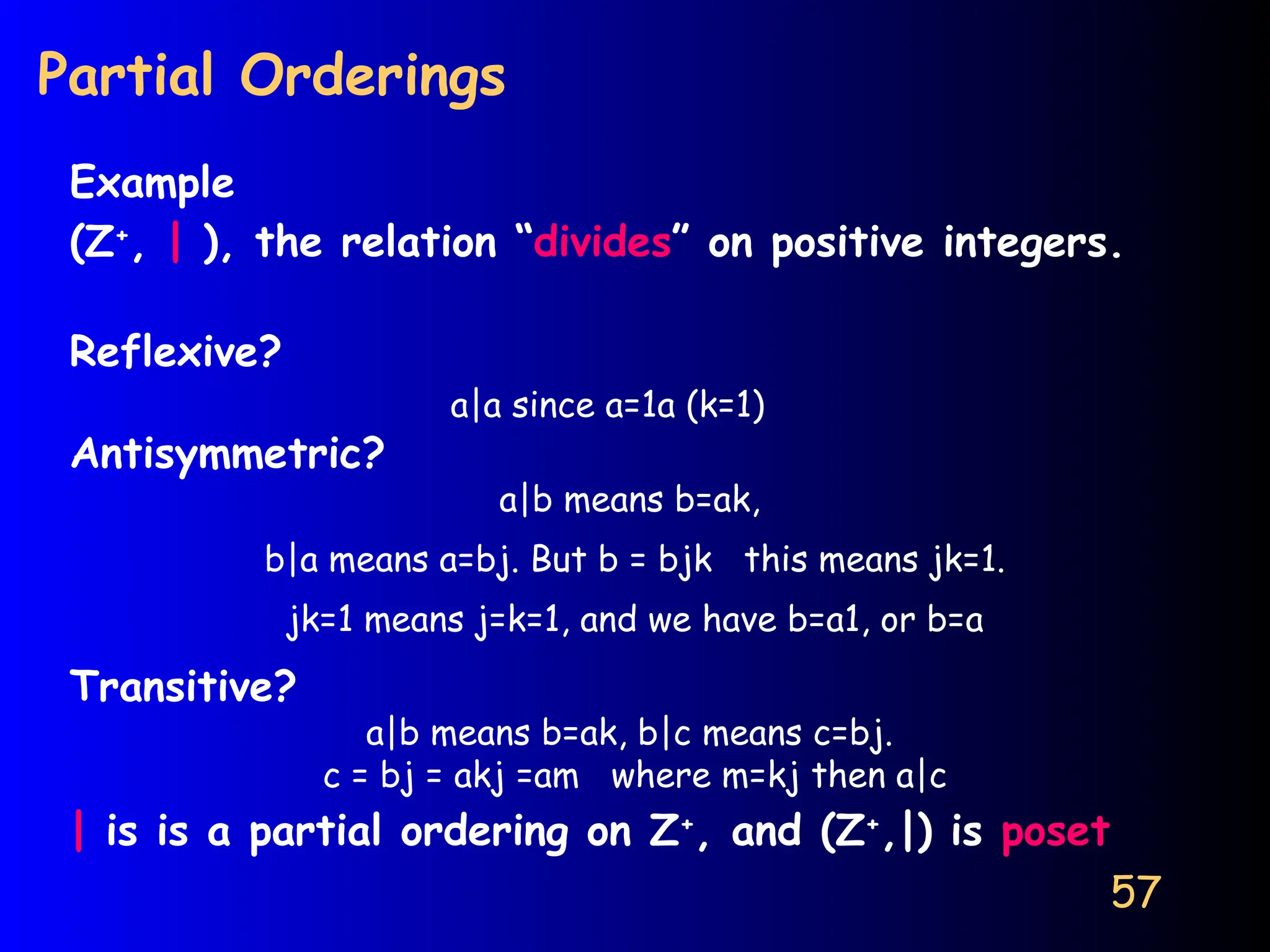
Example
(Z+
, |), the relation “divides” on positive integers.
Reflexive?
a|a since a=1a (k=1)
Antisymmetric?
a|b means b=ak,
b|a means a=bj. But b = bjk this means jk=1.
jk=1 means j=k=1, and we have b=a1, or b=a
Transitive?
a|b means b=ak, b|c means c=bj.
c = bj = akj =am where m=kj then a|c
| is is a partial ordering on Z+
, and (Z+
,|) is poset
58.
58
Partial Orderings
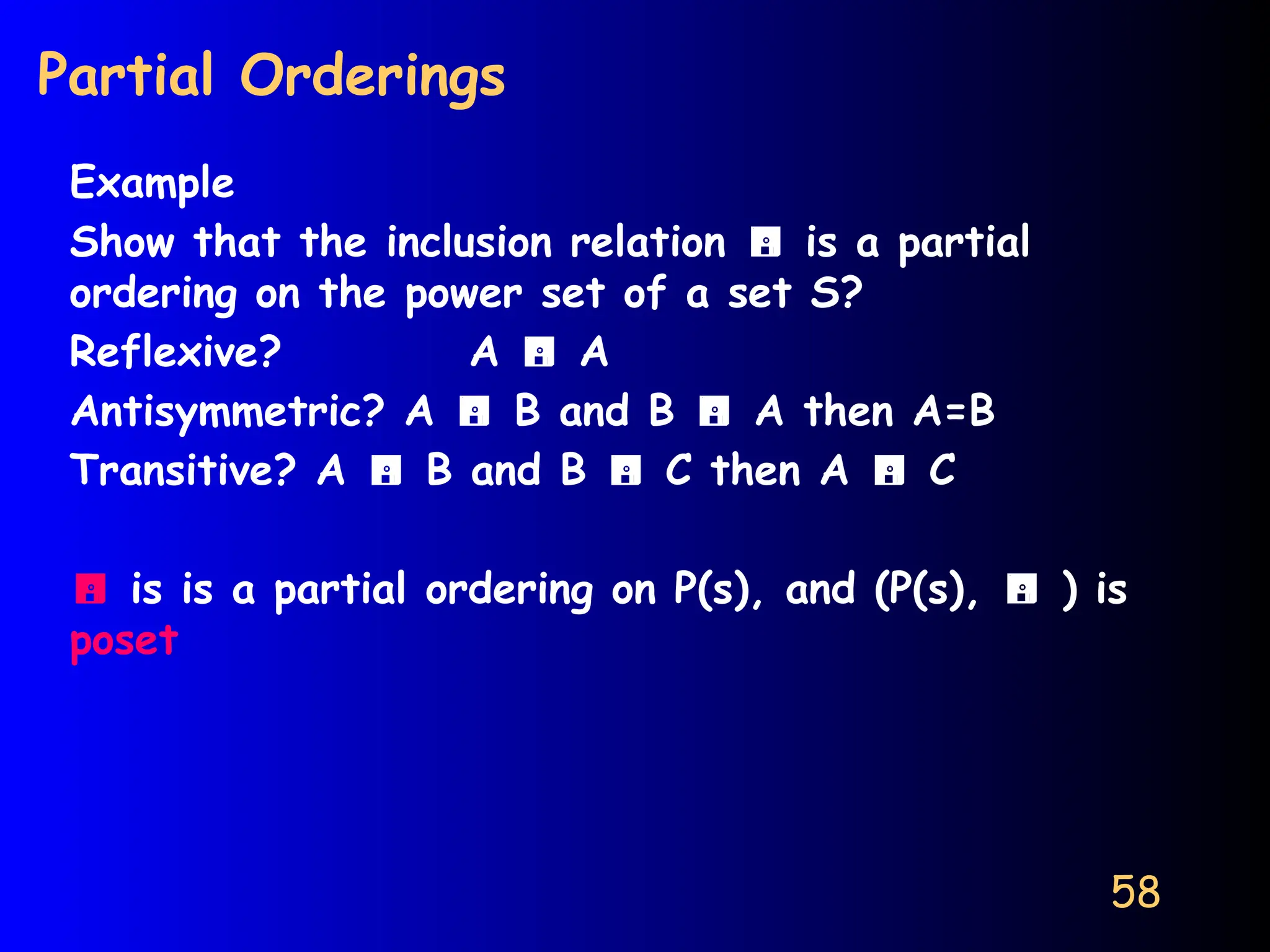
Example
Show thatthe inclusion relation is a partial
ordering on the power set of a set S?
Reflexive? A A
Antisymmetric? A B and B A then A=B
Transitive? A B and B C then A C
is is a partial ordering on P(s), and (P(s), ) is
poset
59.
59
Partial Orderings
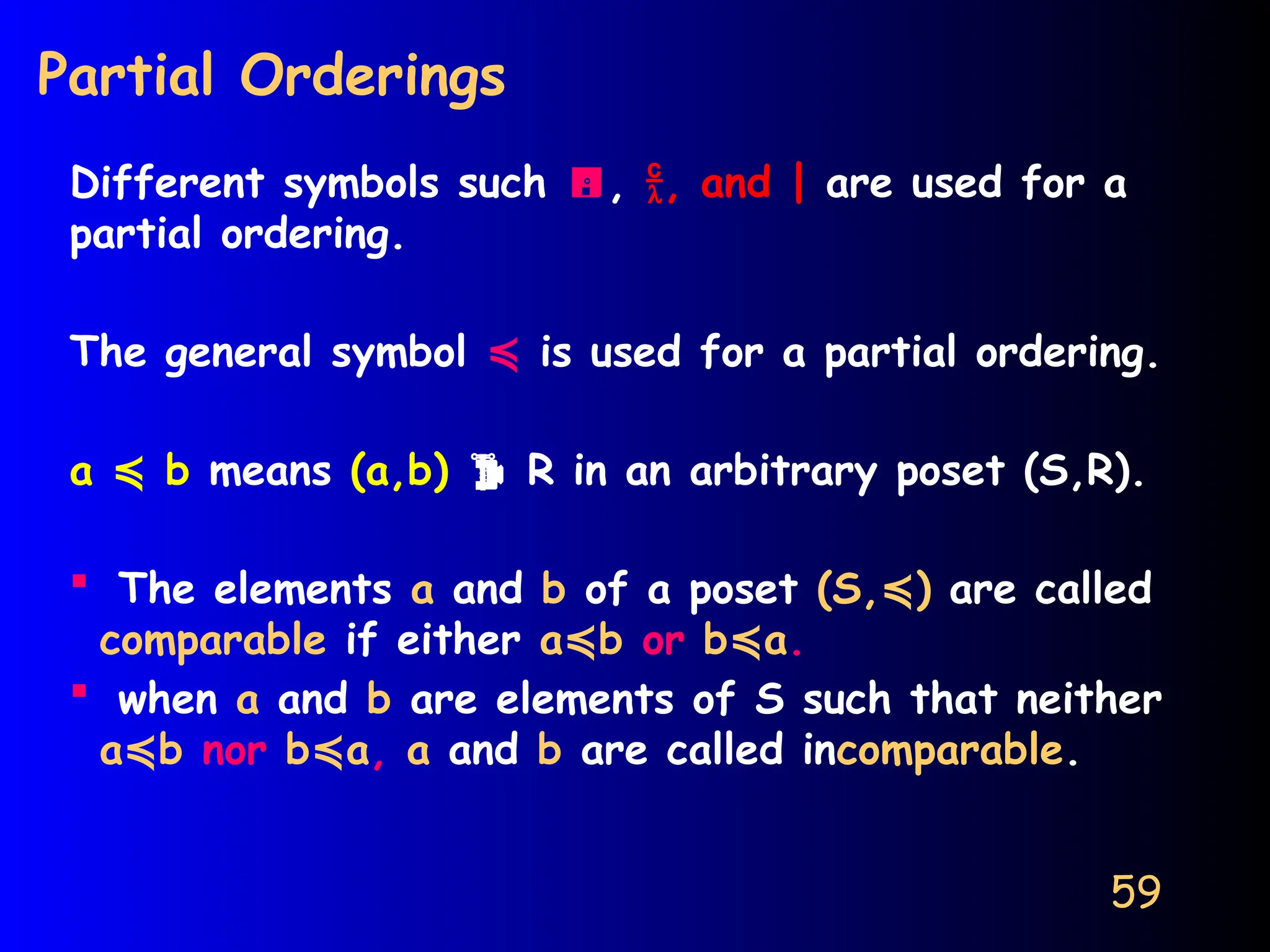
Different symbolssuch , , and | are used for a
partial ordering.
The general symbol ≼ is used for a partial ordering.
a b
≼ means (a,b) R in an arbitrary poset (S,R).
The elements a and b of a poset (S, )
≼ are called
comparable if either a b
≼ or b a
≼ .
when a and b are elements of S such that neither
a b
≼ nor b a
≼ , a and b are called incomparable.
60.
60
Partial Orderings
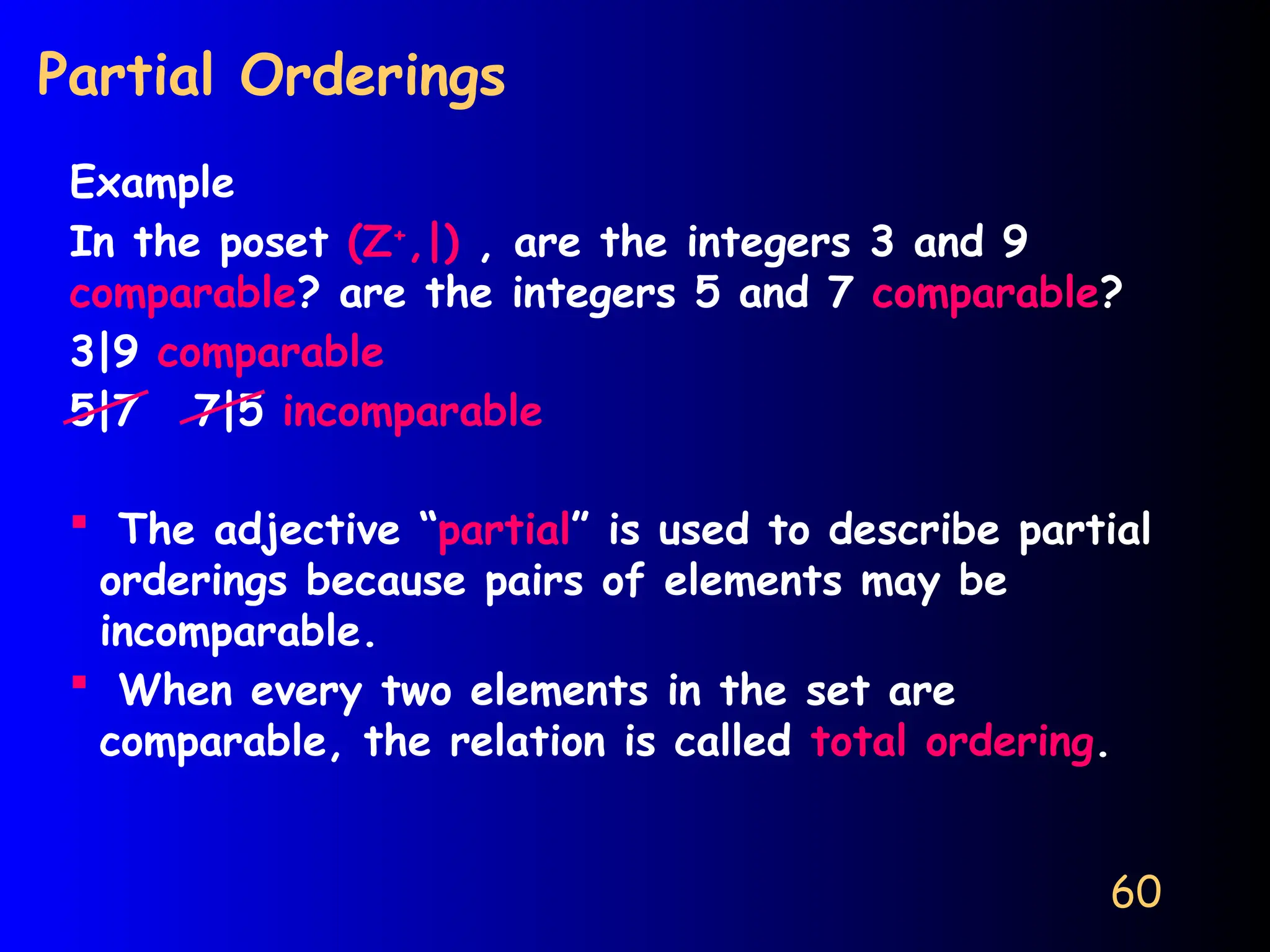
Example
In theposet (Z+
,|) , are the integers 3 and 9
comparable? are the integers 5 and 7 comparable?
3|9 comparable
5|7 7|5 incomparable
The adjective “partial” is used to describe partial
orderings because pairs of elements may be
incomparable.
When every two elements in the set are
comparable, the relation is called total ordering.
61.
61
Partial Orderings
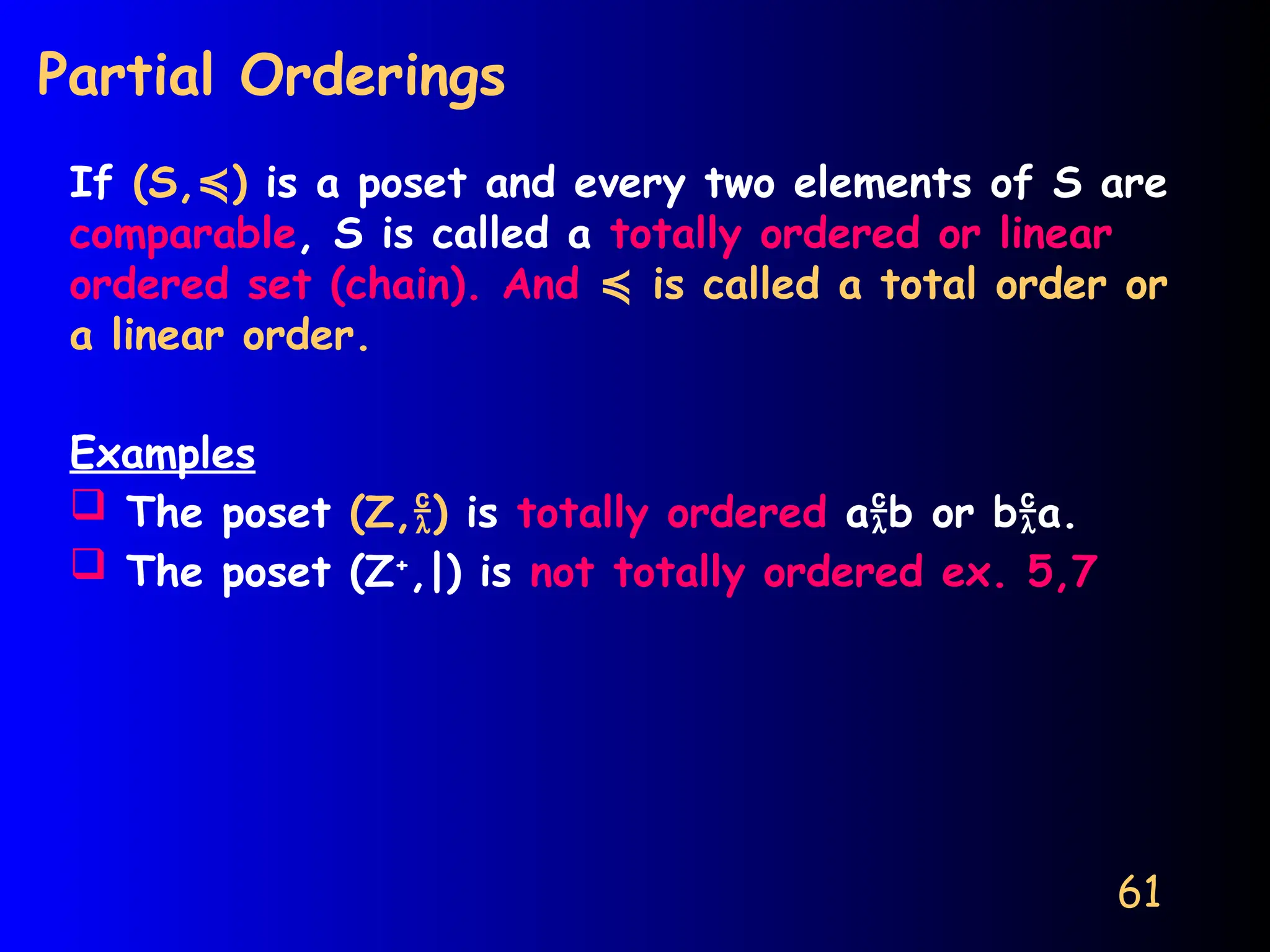
If (S,)
≼ is a poset and every two elements of S are
comparable, S is called a totally ordered or linear
ordered set (chain). And is called a total order or
≼
a linear order.
Examples
The poset (Z,) is totally ordered ab or ba.
The poset (Z+
,|) is not totally ordered ex. 5,7
62.
62
Hasse Diagrams
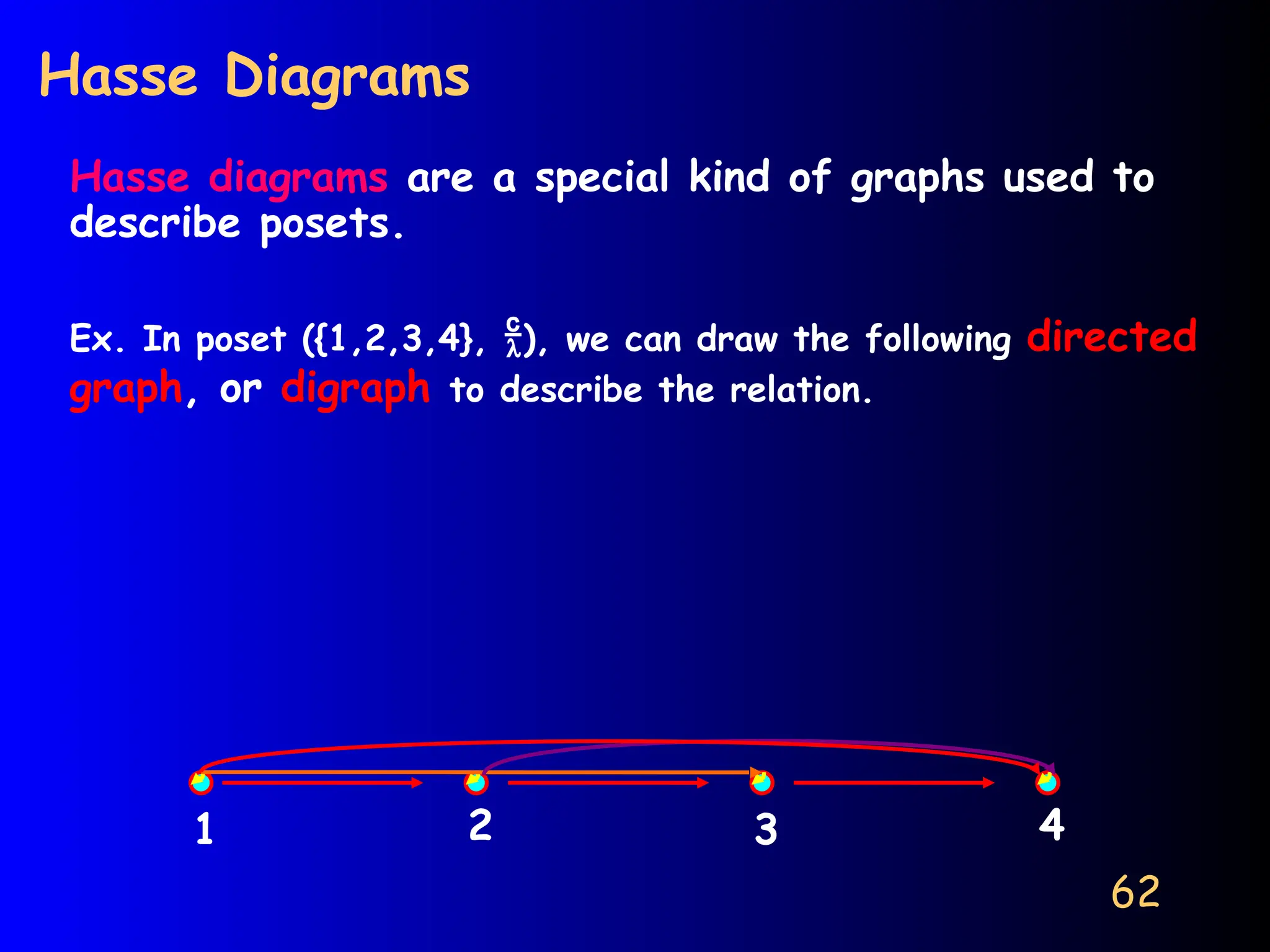
Hasse diagramsare a special kind of graphs used to
describe posets.
Ex. In poset ({1,2,3,4}, ), we can draw the following directed
graph, or digraph to describe the relation.
1 2 3 4
63.
63
Hasse Diagrams
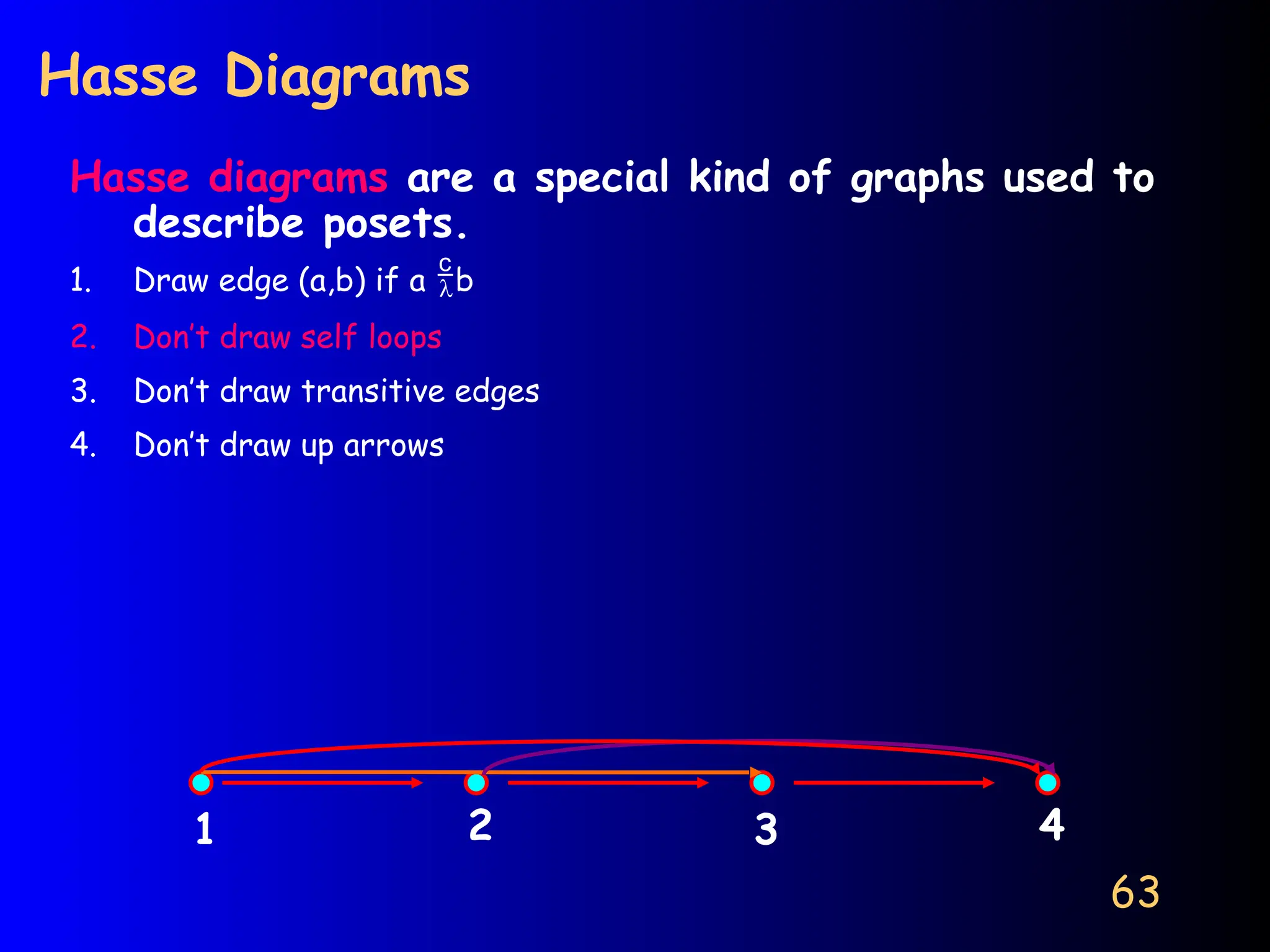
Hasse diagramsare a special kind of graphs used to
describe posets.
1. Draw edge (a,b) if a b
2. Don’t draw self loops
3. Don’t draw transitive edges
4. Don’t draw up arrows
1 2 3 4
64.
64
Hasse Diagrams
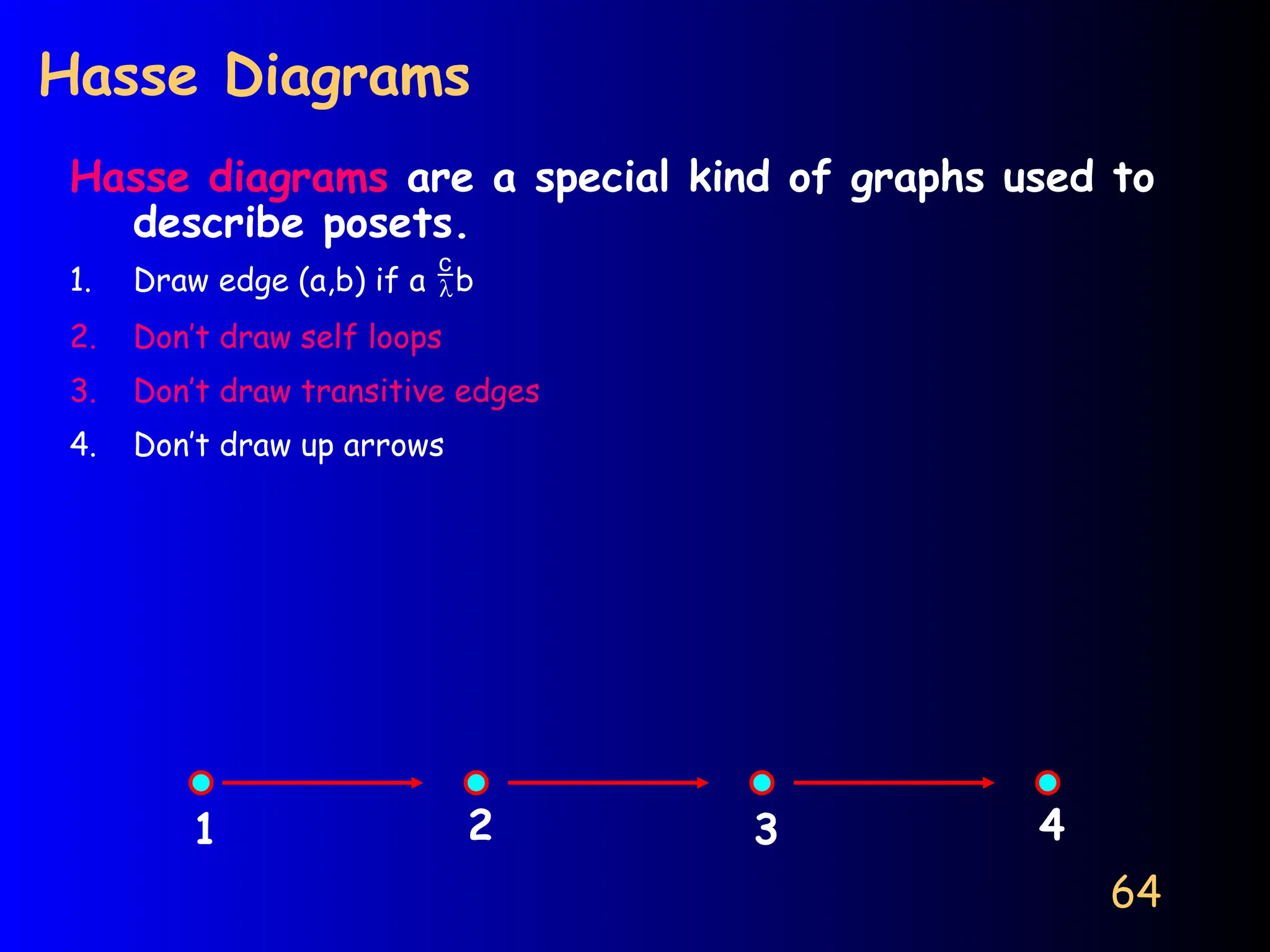
Hasse diagramsare a special kind of graphs used to
describe posets.
1. Draw edge (a,b) if a b
2. Don’t draw self loops
3. Don’t draw transitive edges
4. Don’t draw up arrows
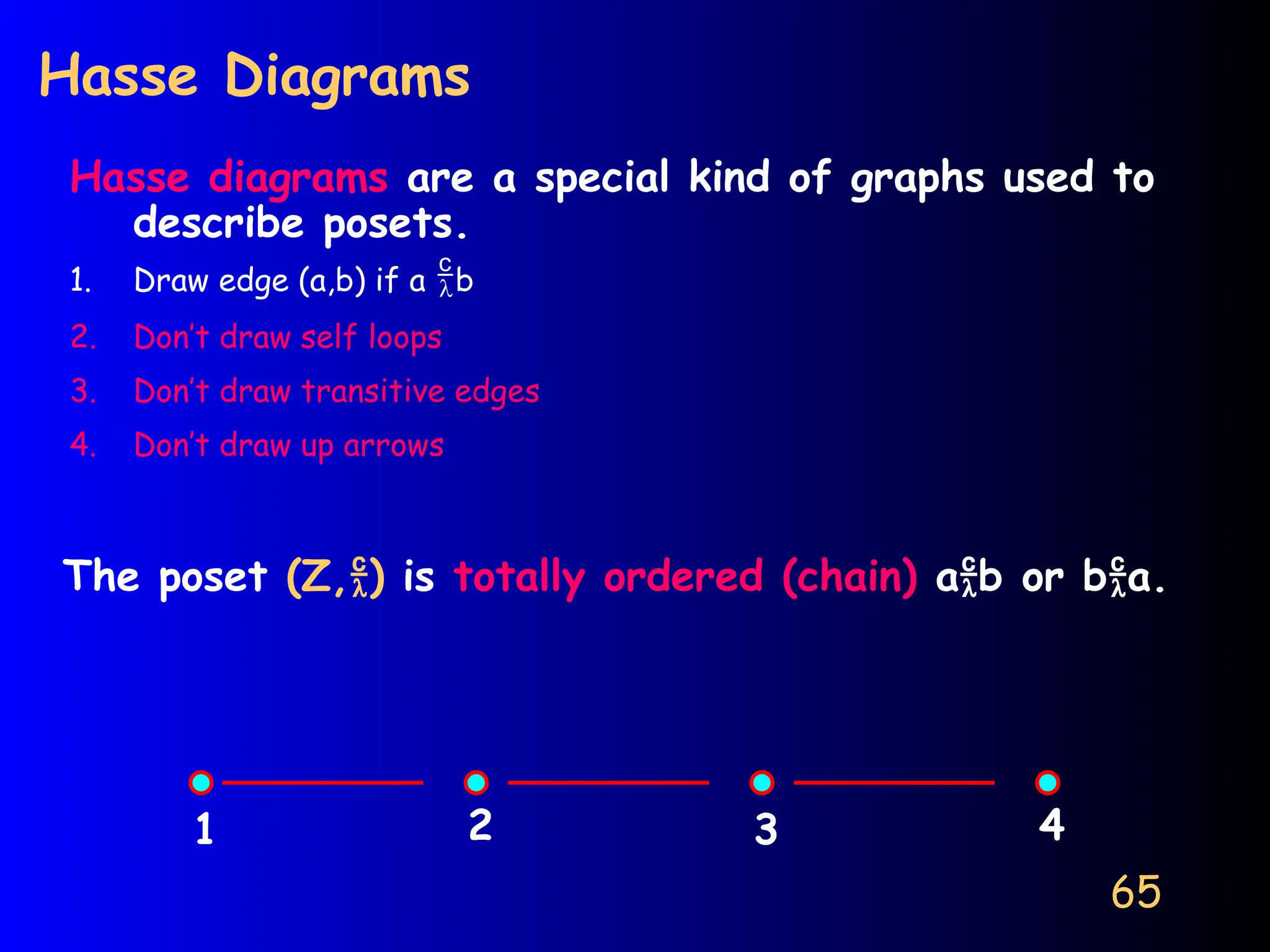
1 2 3 4
65.
65
Hasse Diagrams
Hasse diagramsare a special kind of graphs used to
describe posets.
1. Draw edge (a,b) if a b
2. Don’t draw self loops
3. Don’t draw transitive edges
4. Don’t draw up arrows
1 2 3 4
The poset (Z,) is totally ordered (chain) ab or ba.
66.
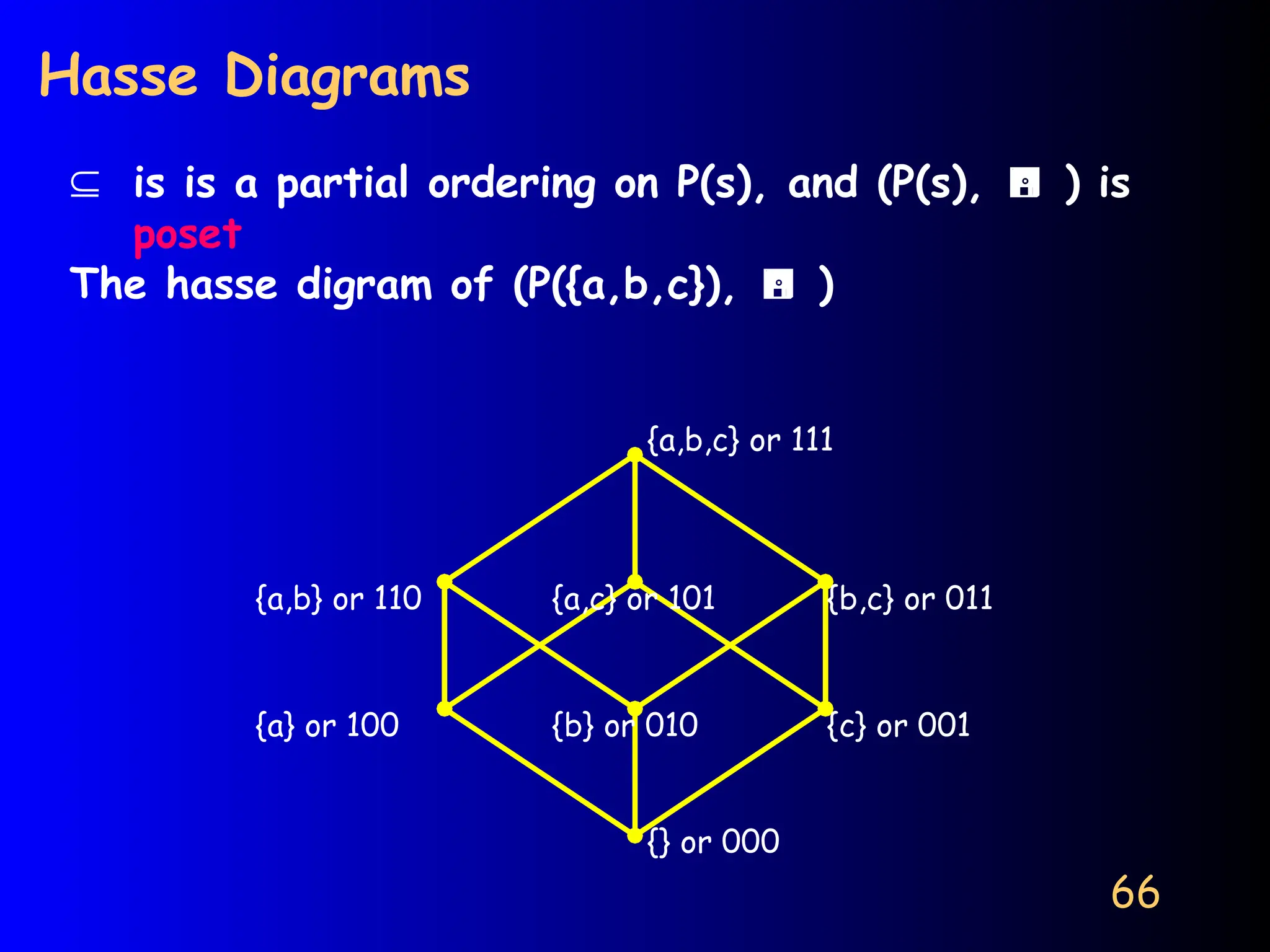
66
Hasse Diagrams
Í isis a partial ordering on P(s), and (P(s), ) is
poset
The hasse digram of (P({a,b,c}), )
{a,b,c} or 111
{a,b} or 110 {a,c} or 101 {b,c} or 011
{a} or 100 {b} or 010 {c} or 001
{} or 000
67.
67
Hasse Diagrams
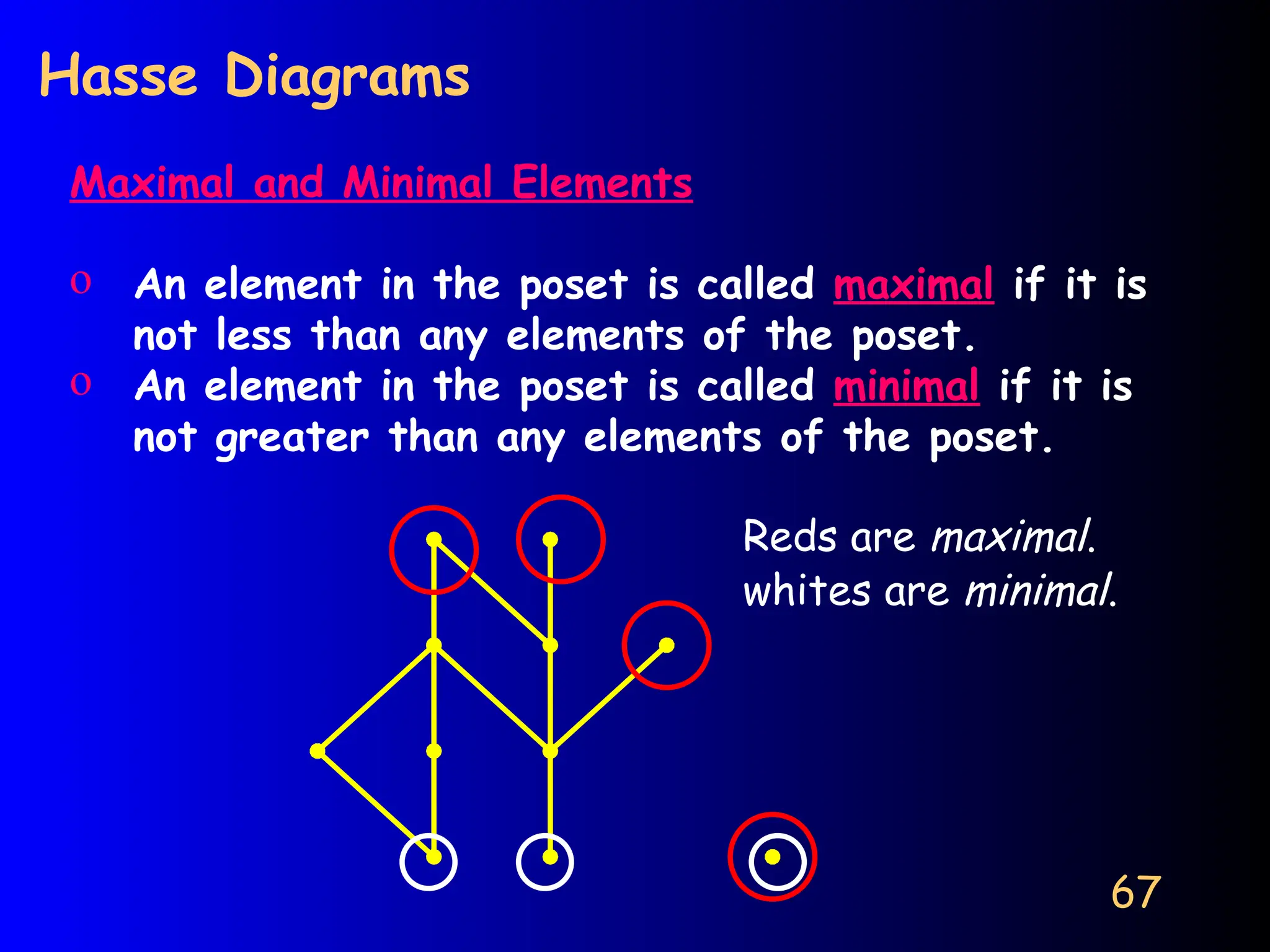
Maximal andMinimal Elements
o An element in the poset is called maximal if it is
not less than any elements of the poset.
o An element in the poset is called minimal if it is
not greater than any elements of the poset.
Reds are maximal.
whites are minimal.
68.
68
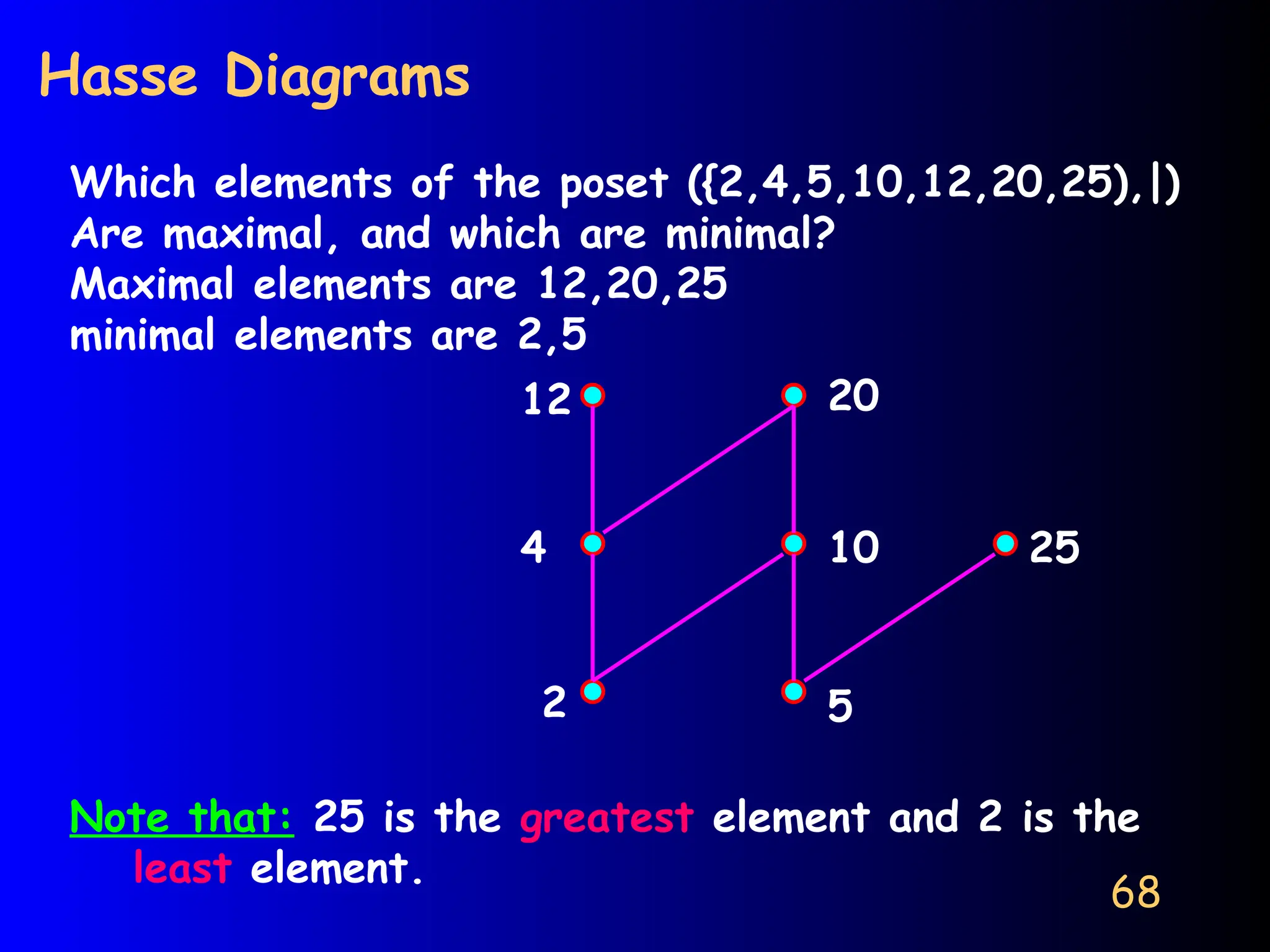
Hasse Diagrams
Which elementsof the poset ({2,4,5,10,12,20,25),|)
Are maximal, and which are minimal?
Maximal elements are 12,20,25
minimal elements are 2,5
2
4
12
5
10
20
25
Note that: 25 is the greatest element and 2 is the
least element.
69.
69
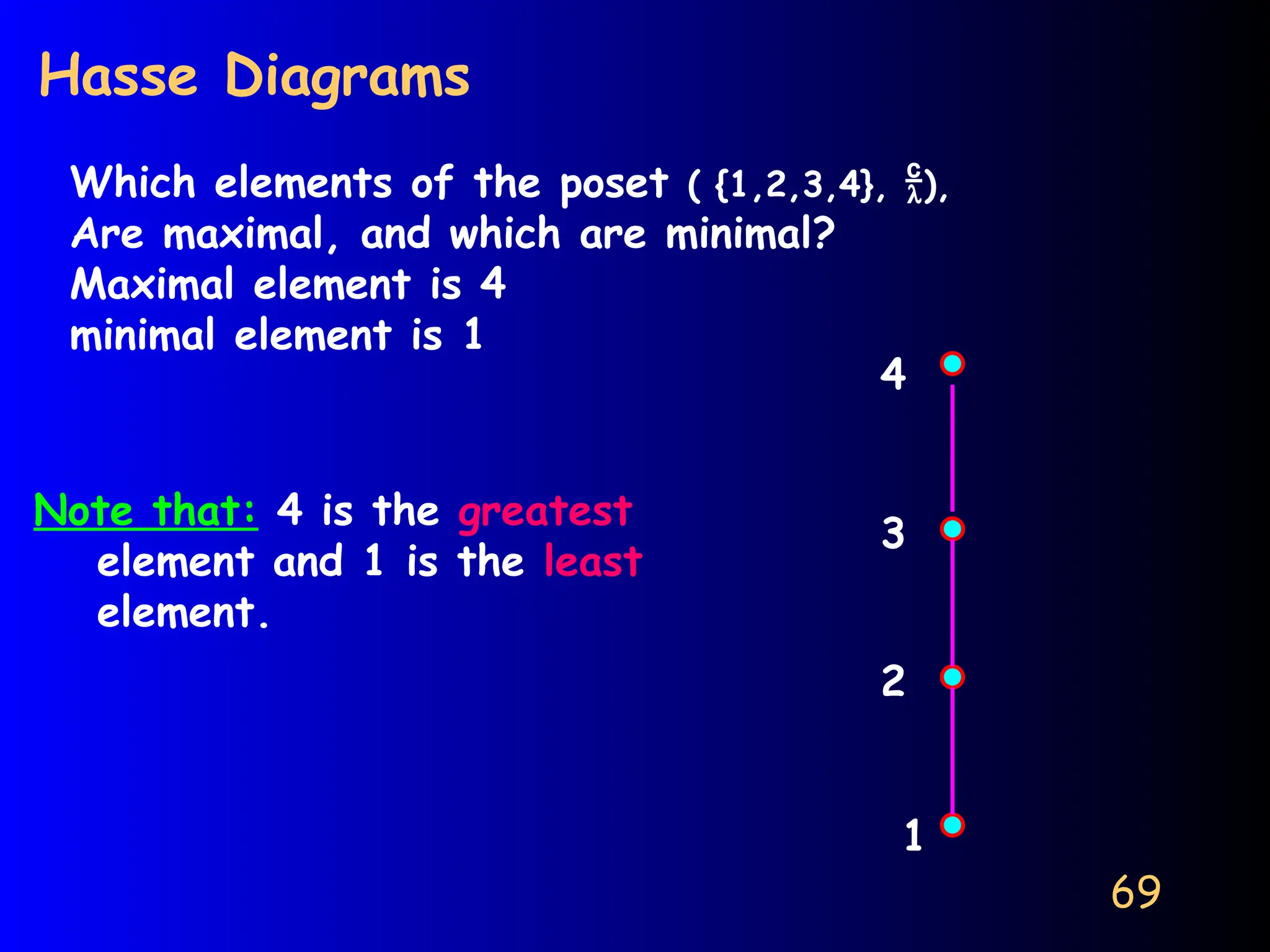
Hasse Diagrams
Which elementsof the poset ( {1,2,3,4}, ),
Are maximal, and which are minimal?
Maximal element is 4
minimal element is 1
1
2
3
4
Note that: 4 is the greatest
element and 1 is the least
element.
70.
70
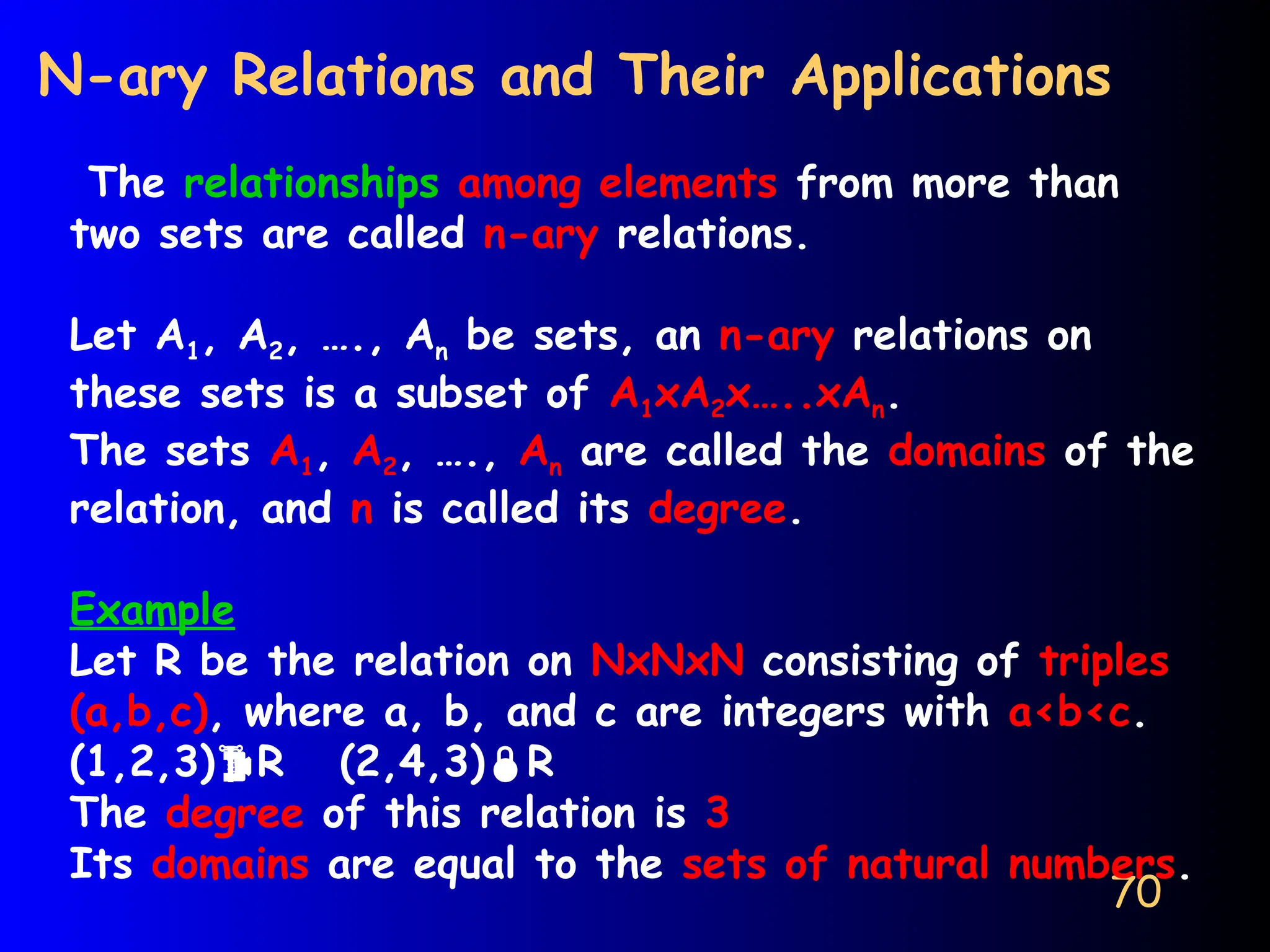
N-ary Relations andTheir Applications
The relationships among elements from more than
two sets are called n-ary relations.
Let A1, A2, …., An be sets, an n-ary relations on
these sets is a subset of A1xA2x…..xAn.
The sets A1, A2, …., An are called the domains of the
relation, and n is called its degree.
Example
Let R be the relation on NxNxN consisting of triples
(a,b,c), where a, b, and c are integers with a<b<c.
(1,2,3)R (2,4,3)R
The degree of this relation is 3
Its domains are equal to the sets of natural numbers.
71.
71
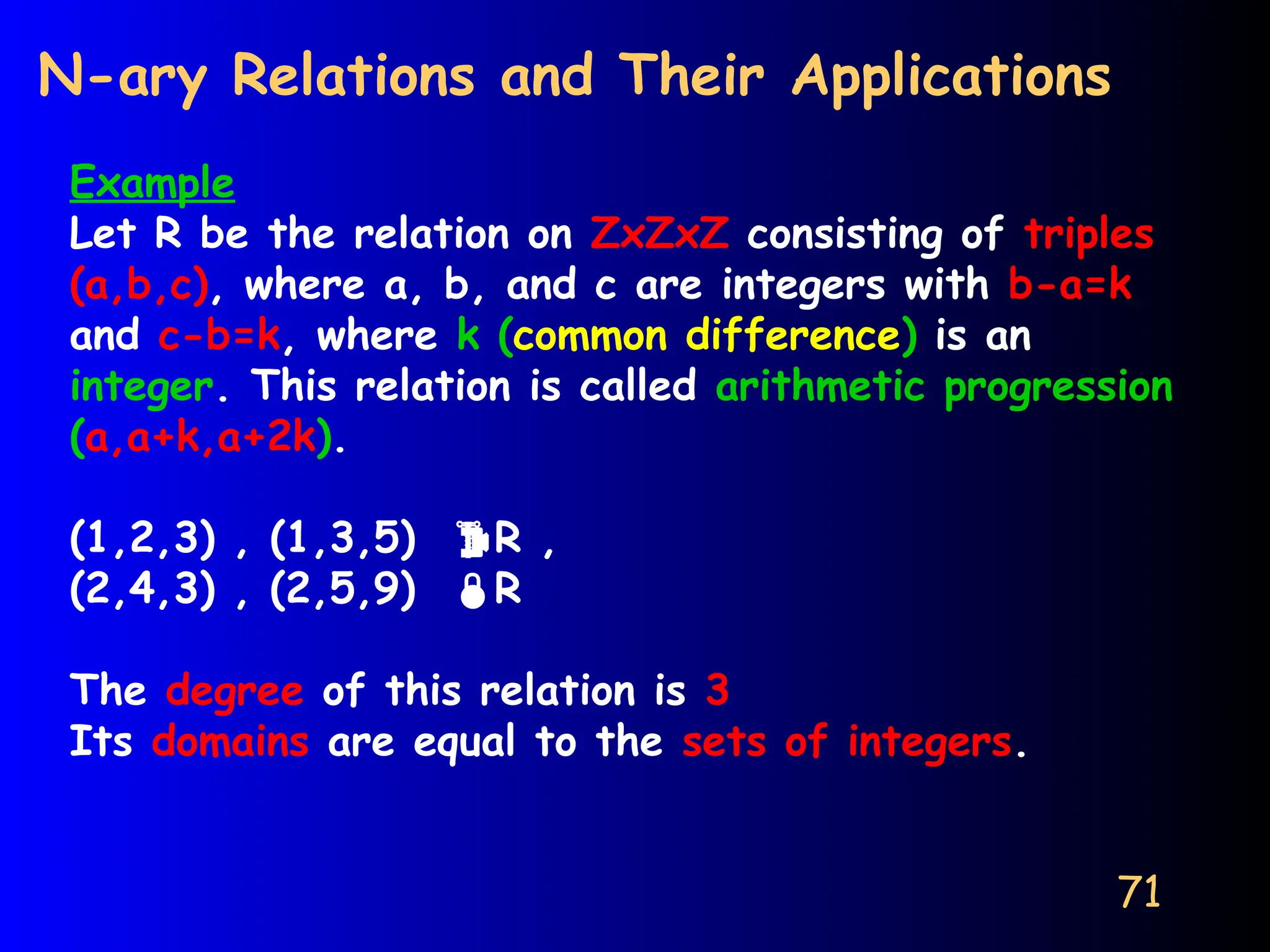
N-ary Relations andTheir Applications
Example
Let R be the relation on ZxZxZ consisting of triples
(a,b,c), where a, b, and c are integers with b-a=k
and c-b=k, where k (common difference) is an
integer. This relation is called arithmetic progression
(a,a+k,a+2k).
(1,2,3) , (1,3,5) R ,
(2,4,3) , (2,5,9) R
The degree of this relation is 3
Its domains are equal to the sets of integers.
72.
72
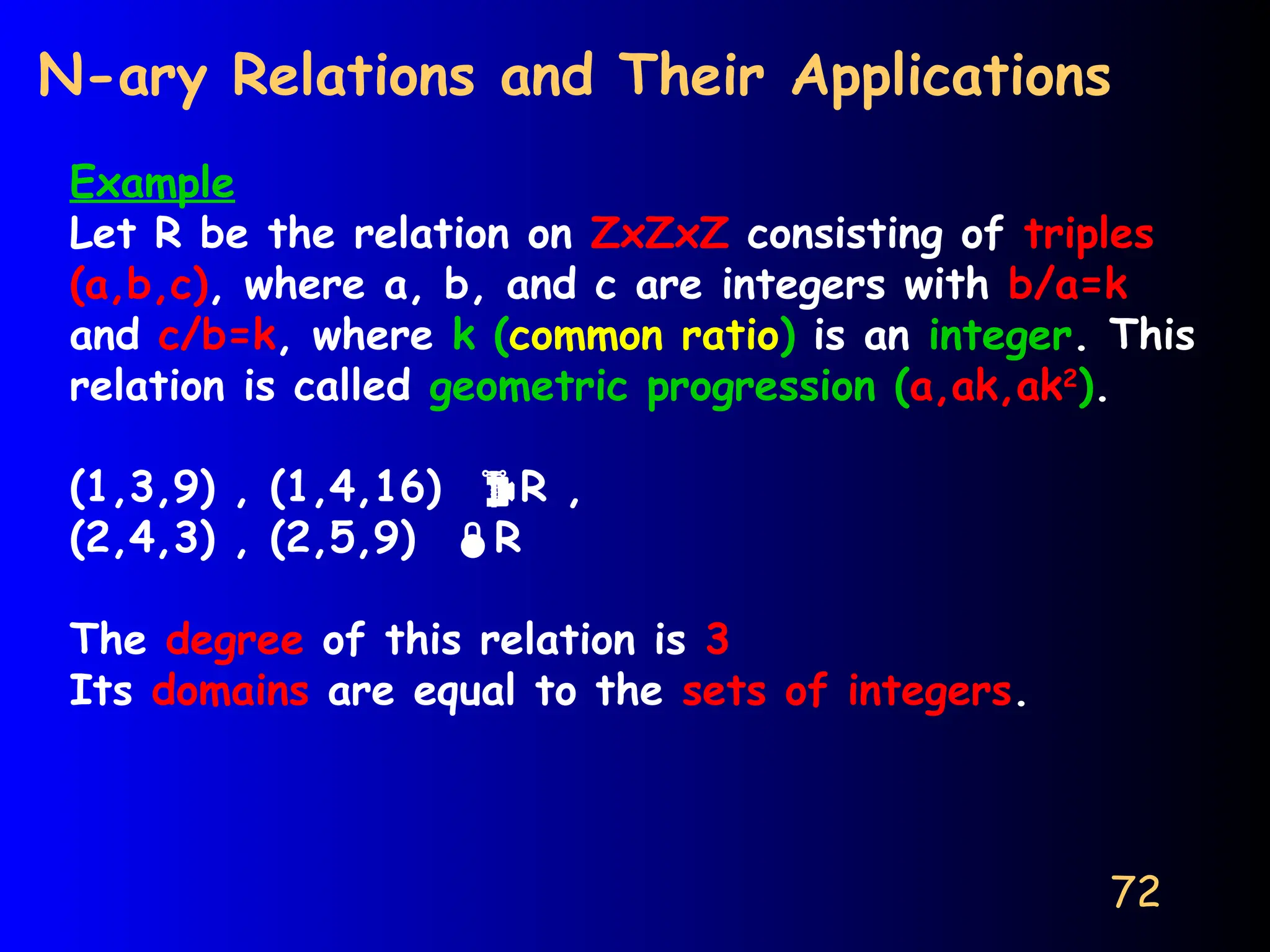
N-ary Relations andTheir Applications
Example
Let R be the relation on ZxZxZ consisting of triples
(a,b,c), where a, b, and c are integers with b/a=k
and c/b=k, where k (common ratio) is an integer. This
relation is called geometric progression (a,ak,ak2
).
(1,3,9) , (1,4,16) R ,
(2,4,3) , (2,5,9) R
The degree of this relation is 3
Its domains are equal to the sets of integers.
73.
73
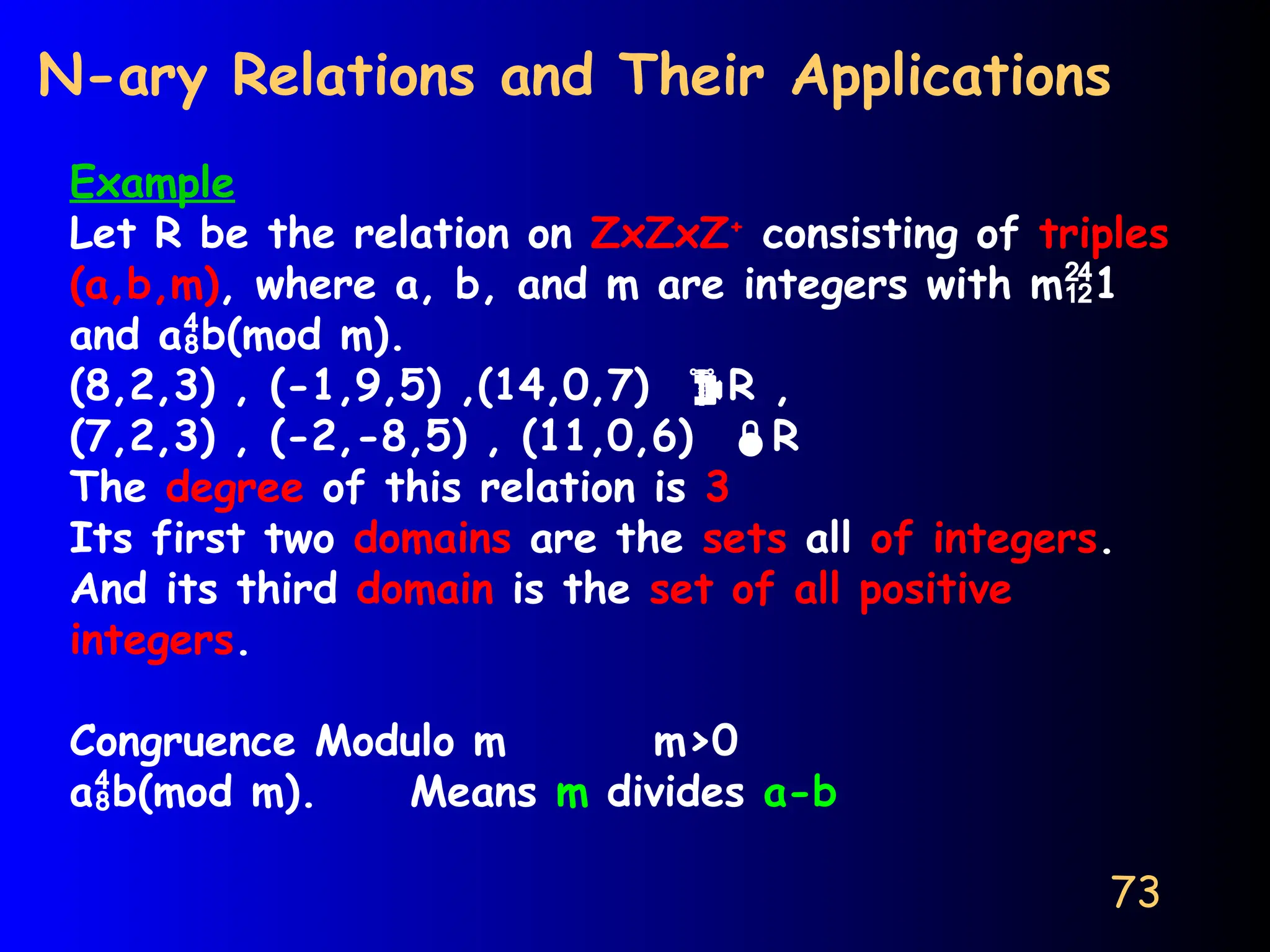
N-ary Relations andTheir Applications
Example
Let R be the relation on ZxZxZ+
consisting of triples
(a,b,m), where a, b, and m are integers with m1
and ab(mod m).
(8,2,3) , (-1,9,5) ,(14,0,7) R ,
(7,2,3) , (-2,-8,5) , (11,0,6) R
The degree of this relation is 3
Its first two domains are the sets all of integers.
And its third domain is the set of all positive
integers.
Congruence Modulo m m>0
ab(mod m). Means m divides a-b
74.
74
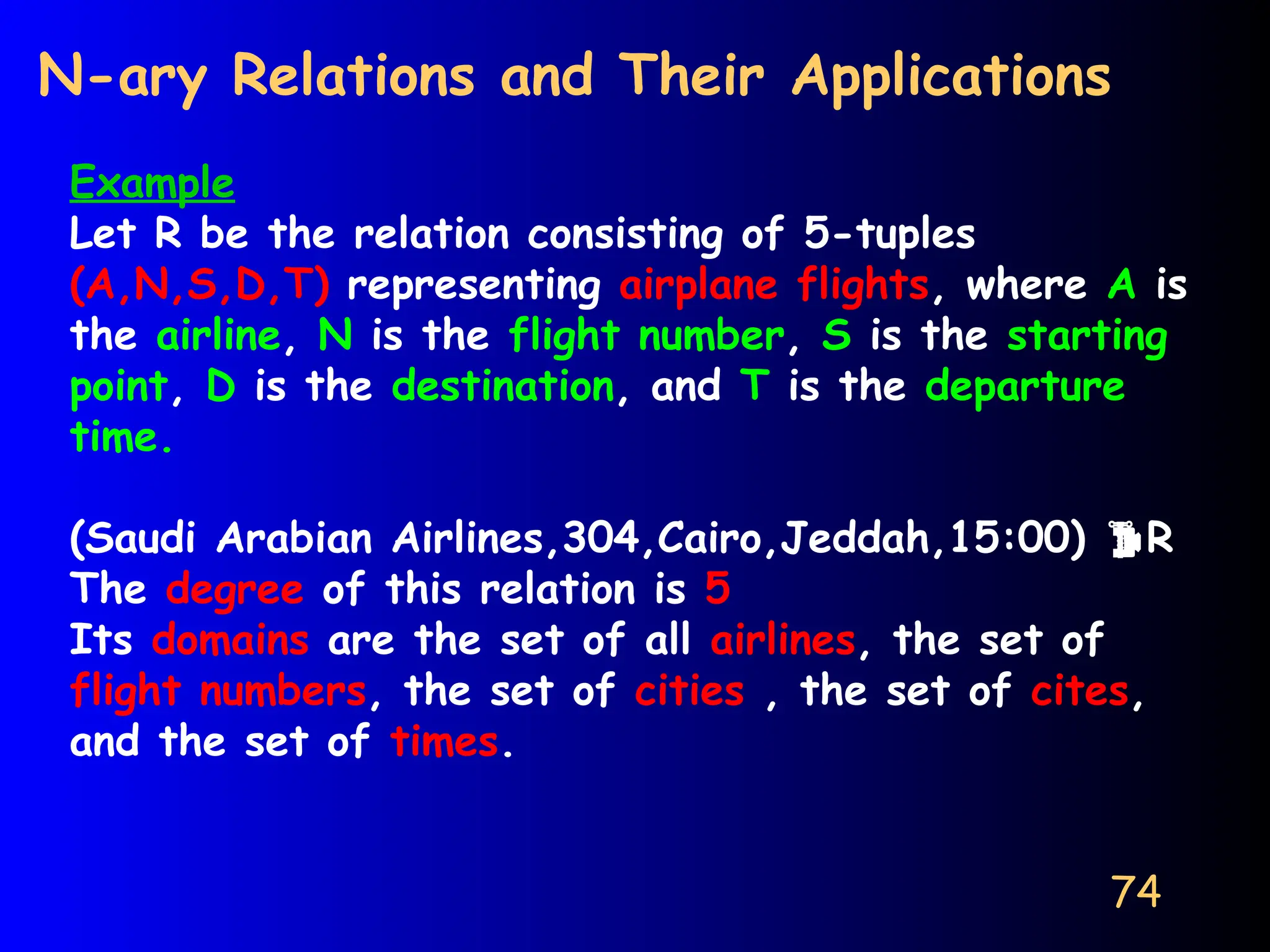
N-ary Relations andTheir Applications
Example
Let R be the relation consisting of 5-tuples
(A,N,S,D,T) representing airplane flights, where A is
the airline, N is the flight number, S is the starting
point, D is the destination, and T is the departure
time.
(Saudi Arabian Airlines,304,Cairo,Jeddah,15:00) R
The degree of this relation is 5
Its domains are the set of all airlines, the set of
flight numbers, the set of cities , the set of cites,
and the set of times.
75.
75
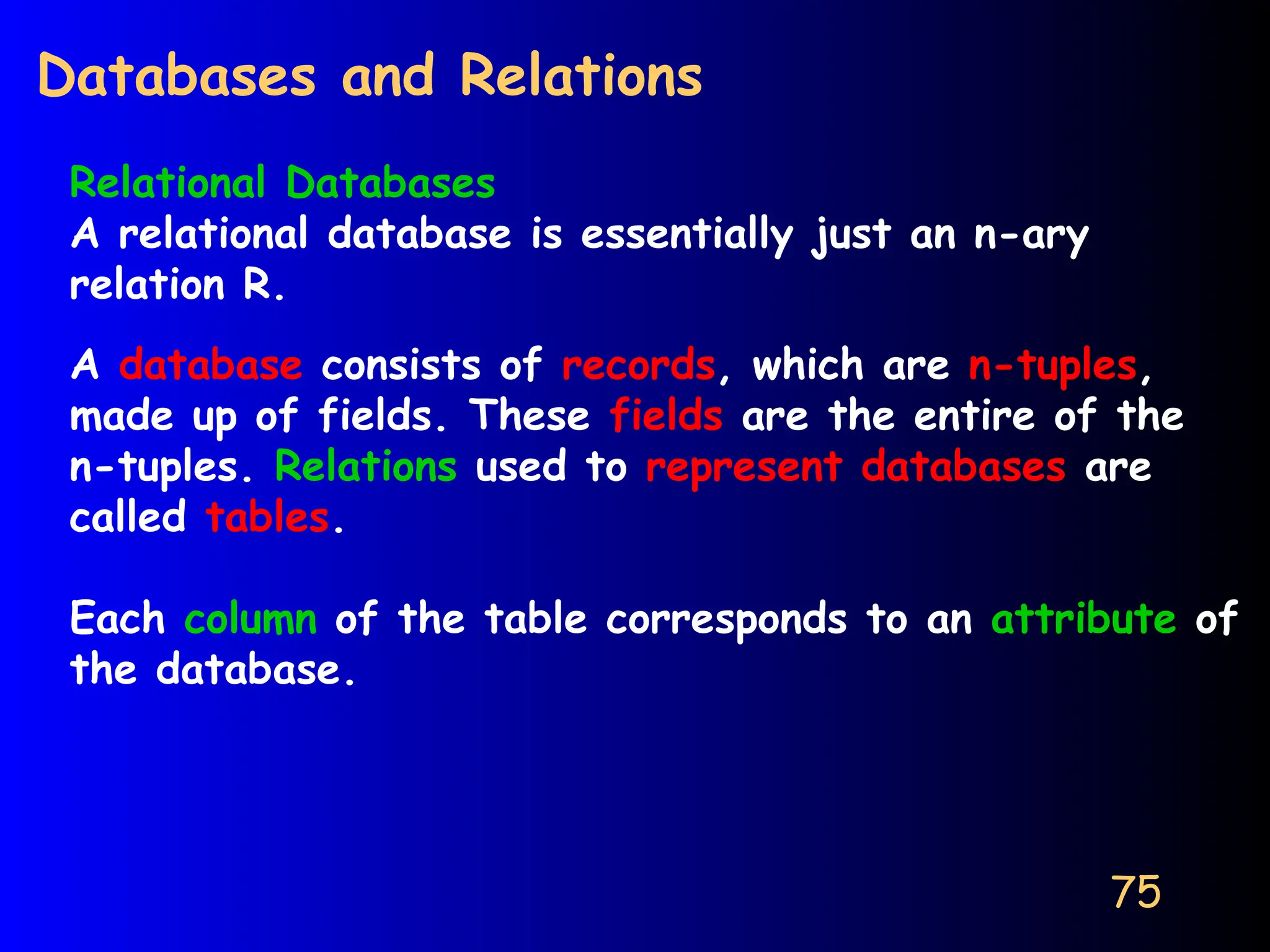
Databases and Relations
RelationalDatabases
A relational database is essentially just an n-ary
relation R.
A database consists of records, which are n-tuples,
made up of fields. These fields are the entire of the
n-tuples. Relations used to represent databases are
called tables.
Each column of the table corresponds to an attribute of
the database.
76.
76
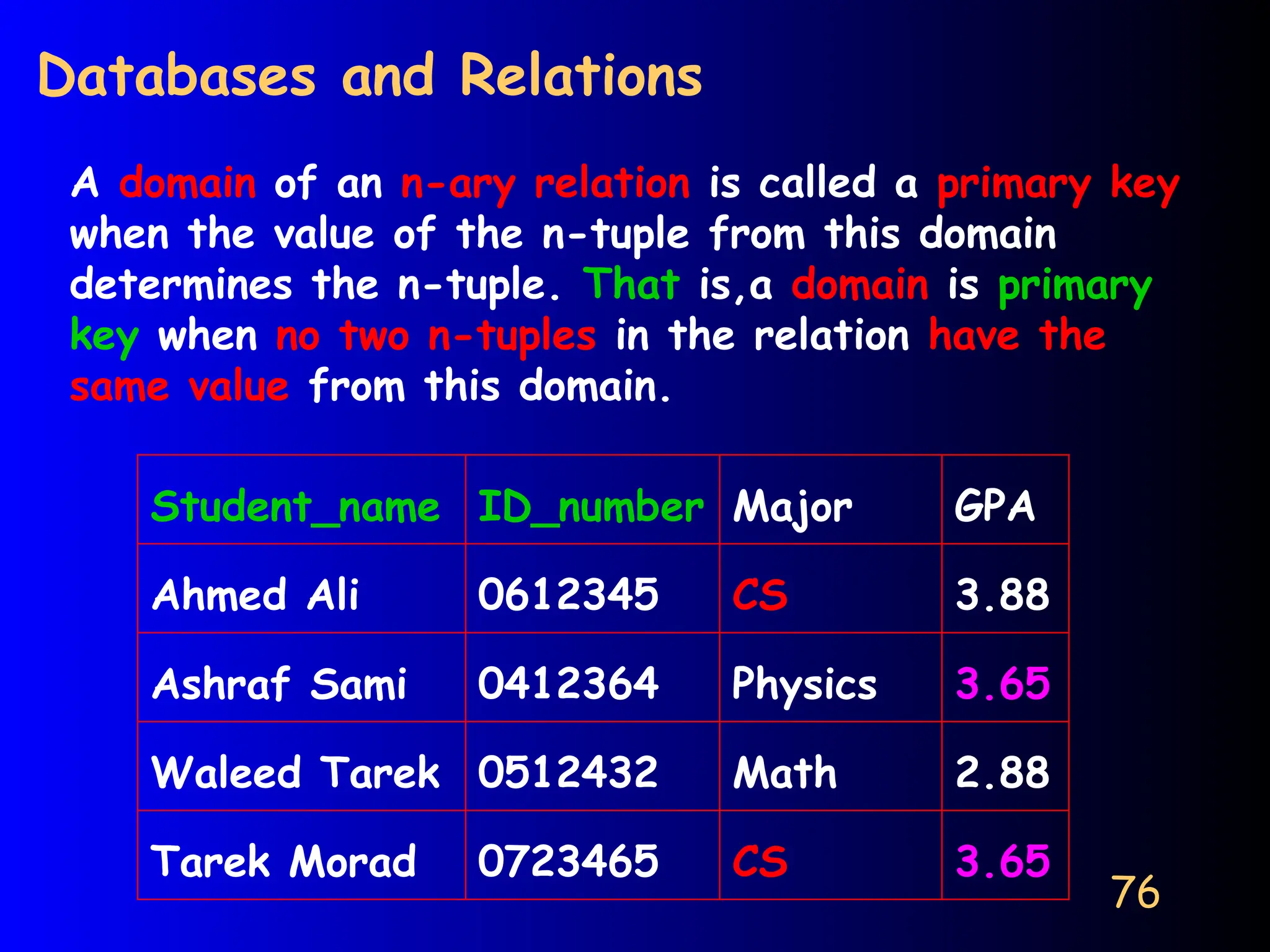
Databases and Relations
Adomain of an n-ary relation is called a primary key
when the value of the n-tuple from this domain
determines the n-tuple. That is,a domain is primary
key when no two n-tuples in the relation have the
same value from this domain.
Student_name ID_number Major GPA
Ahmed Ali 0612345 CS 3.88
Ashraf Sami 0412364 Physics 3.65
Waleed Tarek 0512432 Math 2.88
Tarek Morad 0723465 CS 3.65
77.
77
Databases and Relations
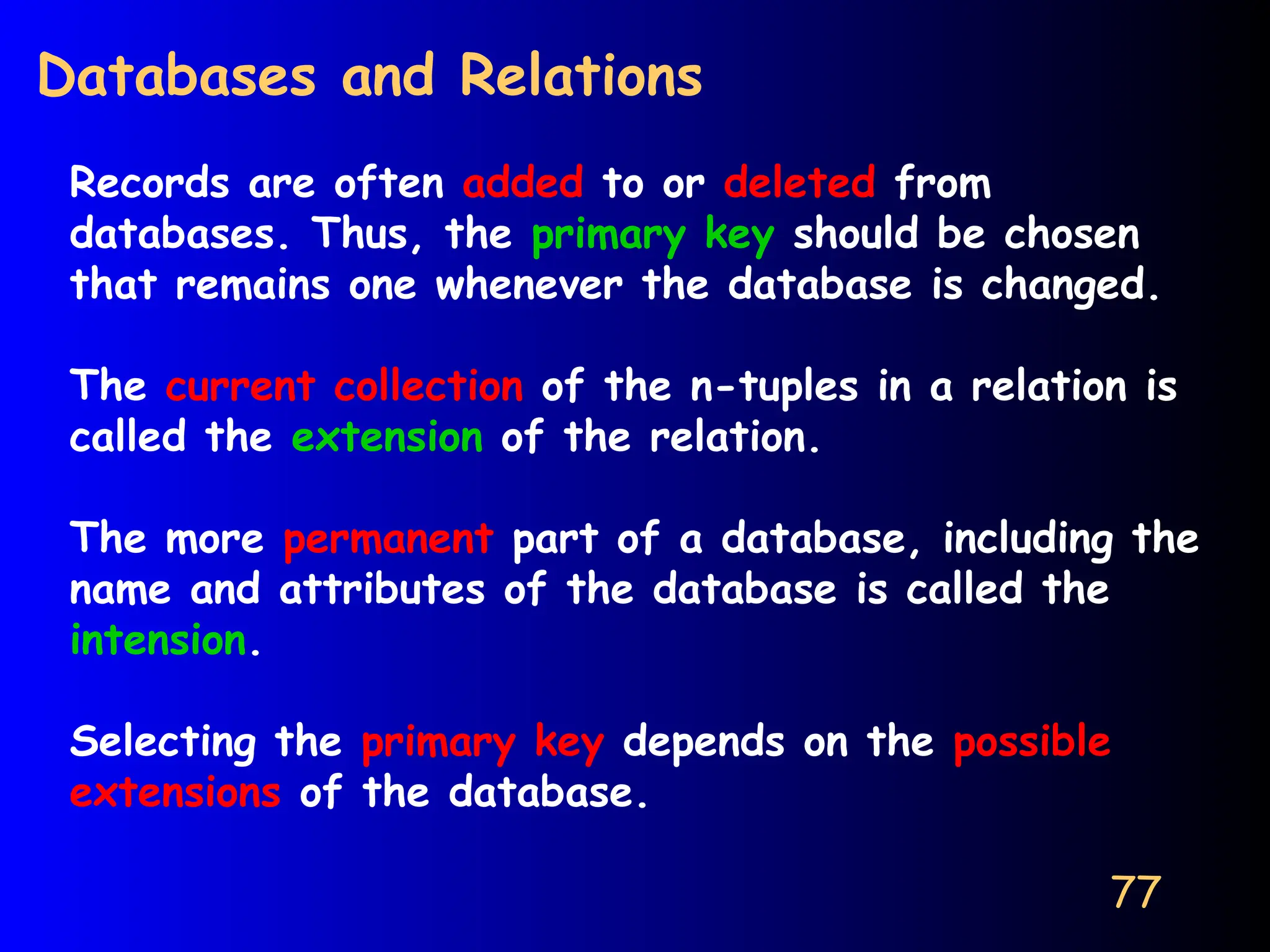
Recordsare often added to or deleted from
databases. Thus, the primary key should be chosen
that remains one whenever the database is changed.
The current collection of the n-tuples in a relation is
called the extension of the relation.
The more permanent part of a database, including the
name and attributes of the database is called the
intension.
Selecting the primary key depends on the possible
extensions of the database.
78.
78
Databases and Relations
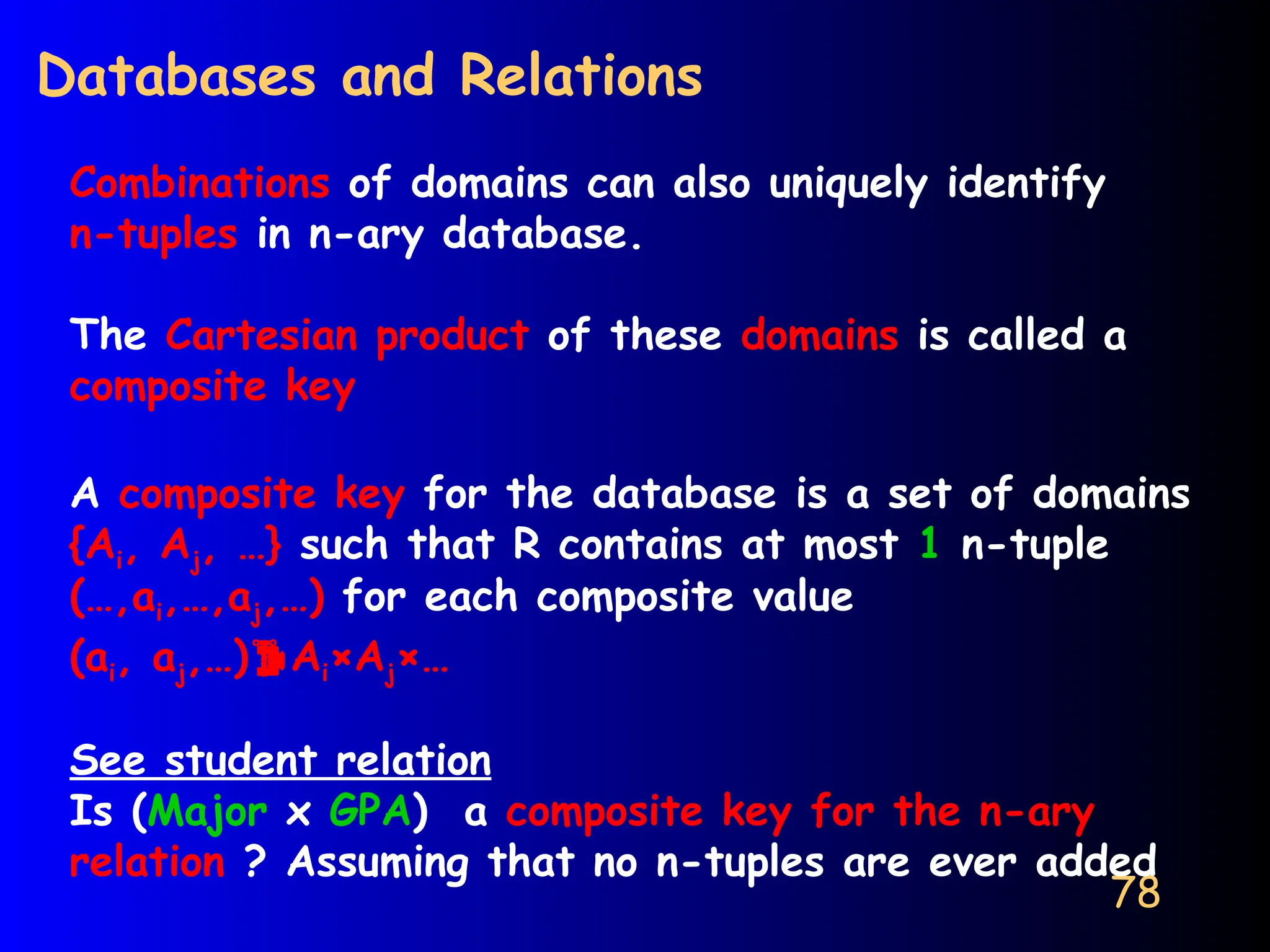
Combinationsof domains can also uniquely identify
n-tuples in n-ary database.
The Cartesian product of these domains is called a
composite key
A composite key for the database is a set of domains
{Ai, Aj, …} such that R contains at most 1 n-tuple
(…,ai,…,aj,…) for each composite value
(ai, aj,…)Ai×Aj×…
See student relation
Is (Major x GPA) a composite key for the n-ary
relation ? Assuming that no n-tuples are ever added
79.
79
Operations on n-aryRelations
Selection Operator
Let R be an n-ary relation and C a condition that
elements in R may satisfy.
Then the selection operator sC maps the n-ary
relation R to the n-ary relation of all n-tuples from R
that satisfy the condition C.
80.
80
Operations on n-aryRelations
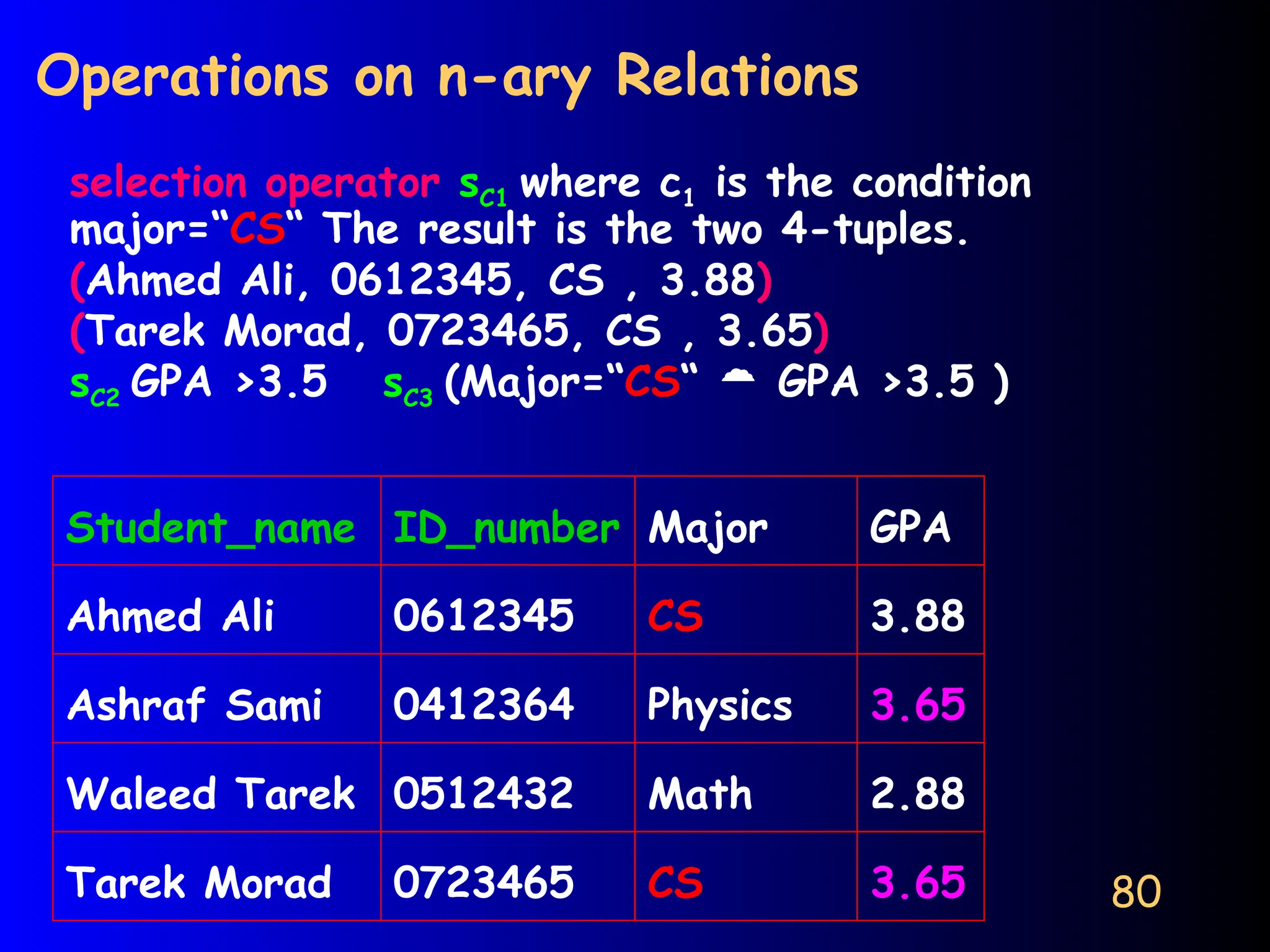
selection operator sC1 where c1 is the condition
major=“CS“ The result is the two 4-tuples.
(Ahmed Ali, 0612345, CS , 3.88)
(Tarek Morad, 0723465, CS , 3.65)
sC2 GPA >3.5 sC3 (Major=“CS“ GPA >3.5 )
Student_name ID_number Major GPA
Ahmed Ali 0612345 CS 3.88
Ashraf Sami 0412364 Physics 3.65
Waleed Tarek 0512432 Math 2.88
Tarek Morad 0723465 CS 3.65
81.
81
Operations on n-aryRelations
Projection Operators
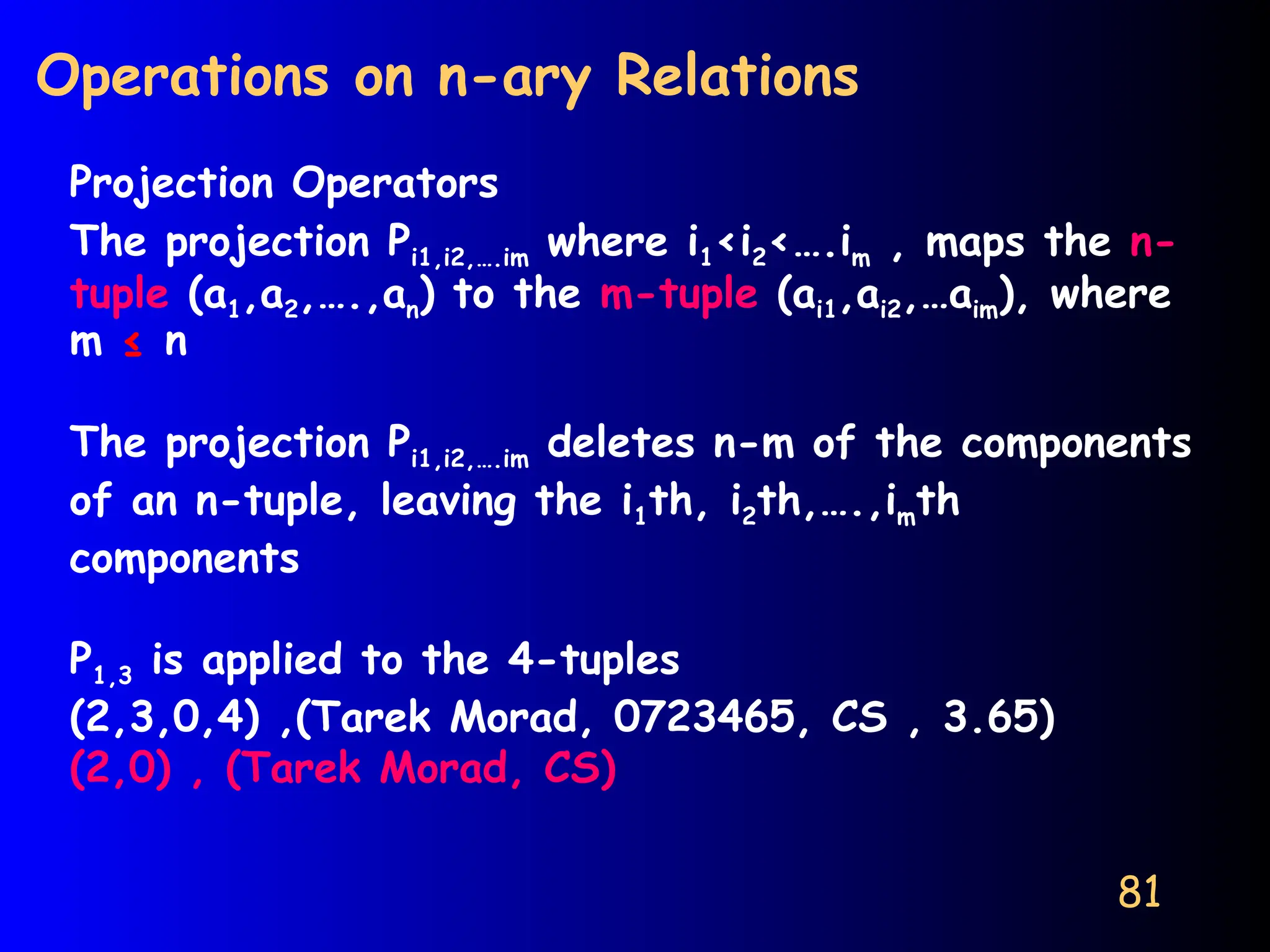
The projection Pi1,i2,….im where i1<i2<….im , maps the n-
tuple (a1,a2,….,an) to the m-tuple (ai1,ai2,…aim), where
m ≤ n
The projection Pi1,i2,….im deletes n-m of the components
of an n-tuple, leaving the i1th, i2th,….,imth
components
P1,3 is applied to the 4-tuples
(2,3,0,4) ,(Tarek Morad, 0723465, CS , 3.65)
(2,0) , (Tarek Morad, CS)
82.
82
Operations on n-aryRelations
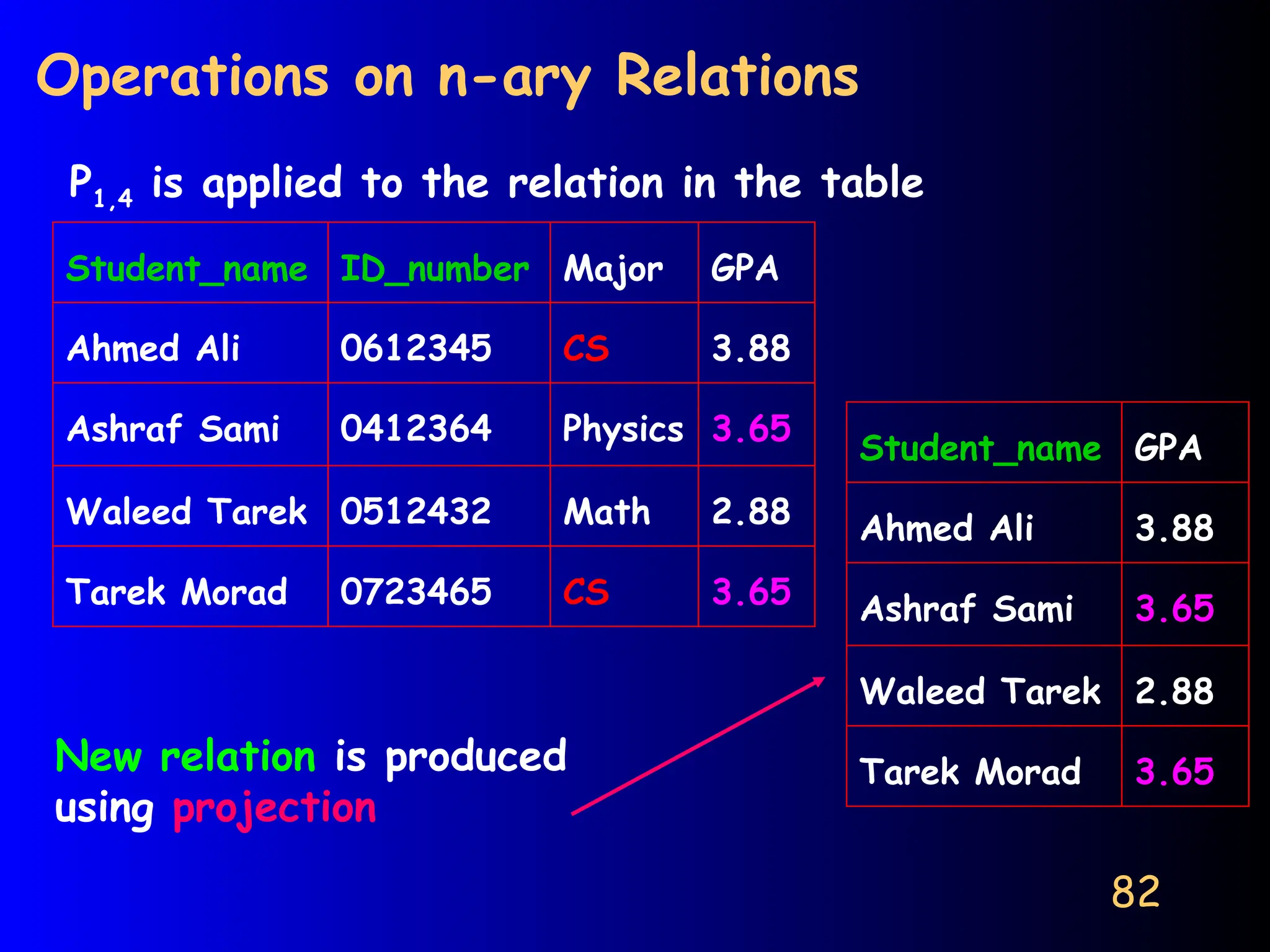
P1,4 is applied to the relation in the table
Student_name ID_number Major GPA
Ahmed Ali 0612345 CS 3.88
Ashraf Sami 0412364 Physics 3.65
Waleed Tarek 0512432 Math 2.88
Tarek Morad 0723465 CS 3.65
Student_name GPA
Ahmed Ali 3.88
Ashraf Sami 3.65
Waleed Tarek 2.88
Tarek Morad 3.65
New relation is produced
using projection
83.
83
Operations on n-aryRelations
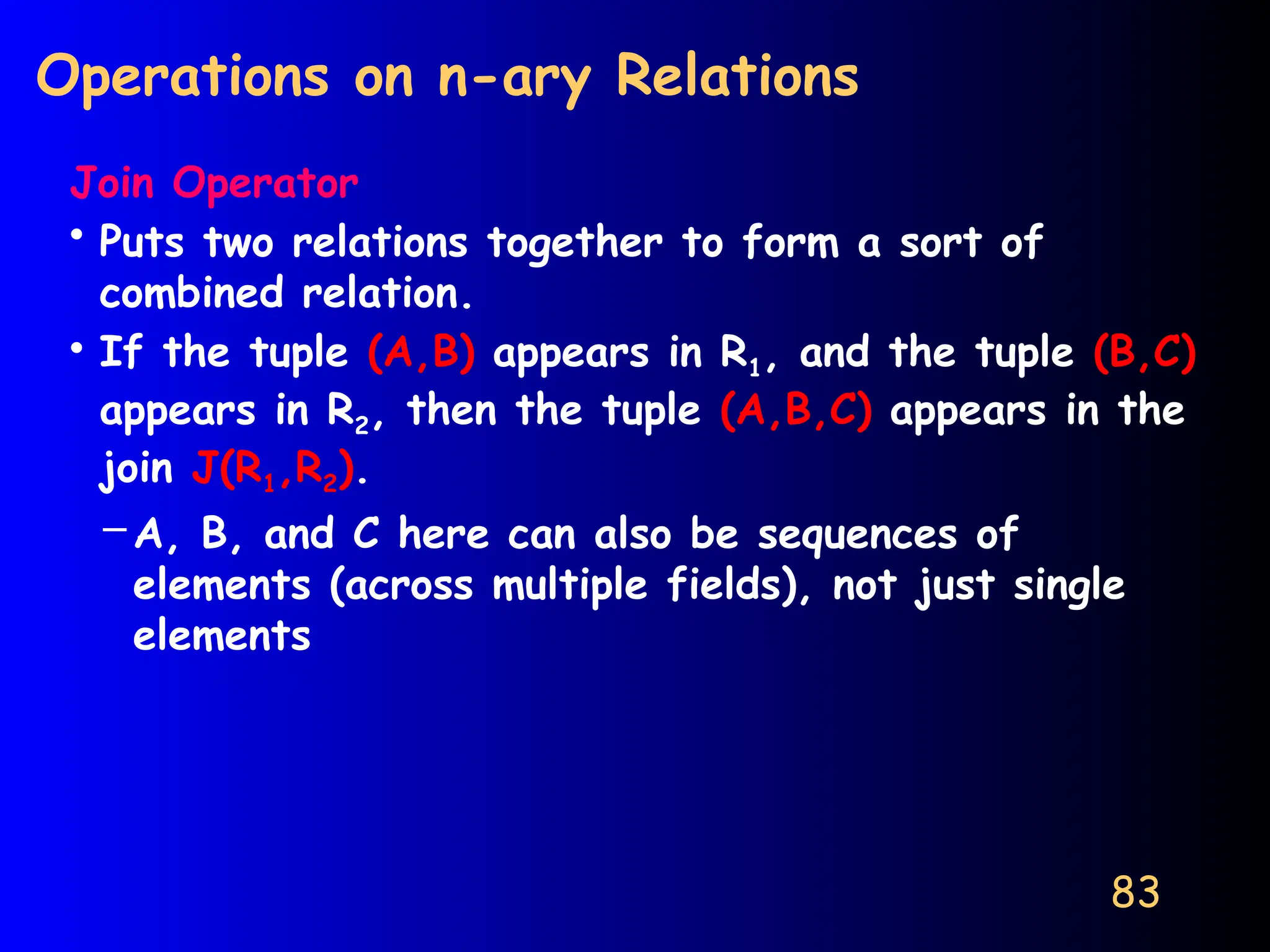
Join Operator
• Puts two relations together to form a sort of
combined relation.
• If the tuple (A,B) appears in R1, and the tuple (B,C)
appears in R2, then the tuple (A,B,C) appears in the
join J(R1,R2).
– A, B, and C here can also be sequences of
elements (across multiple fields), not just single
elements
84.
84
Operations on n-aryRelations
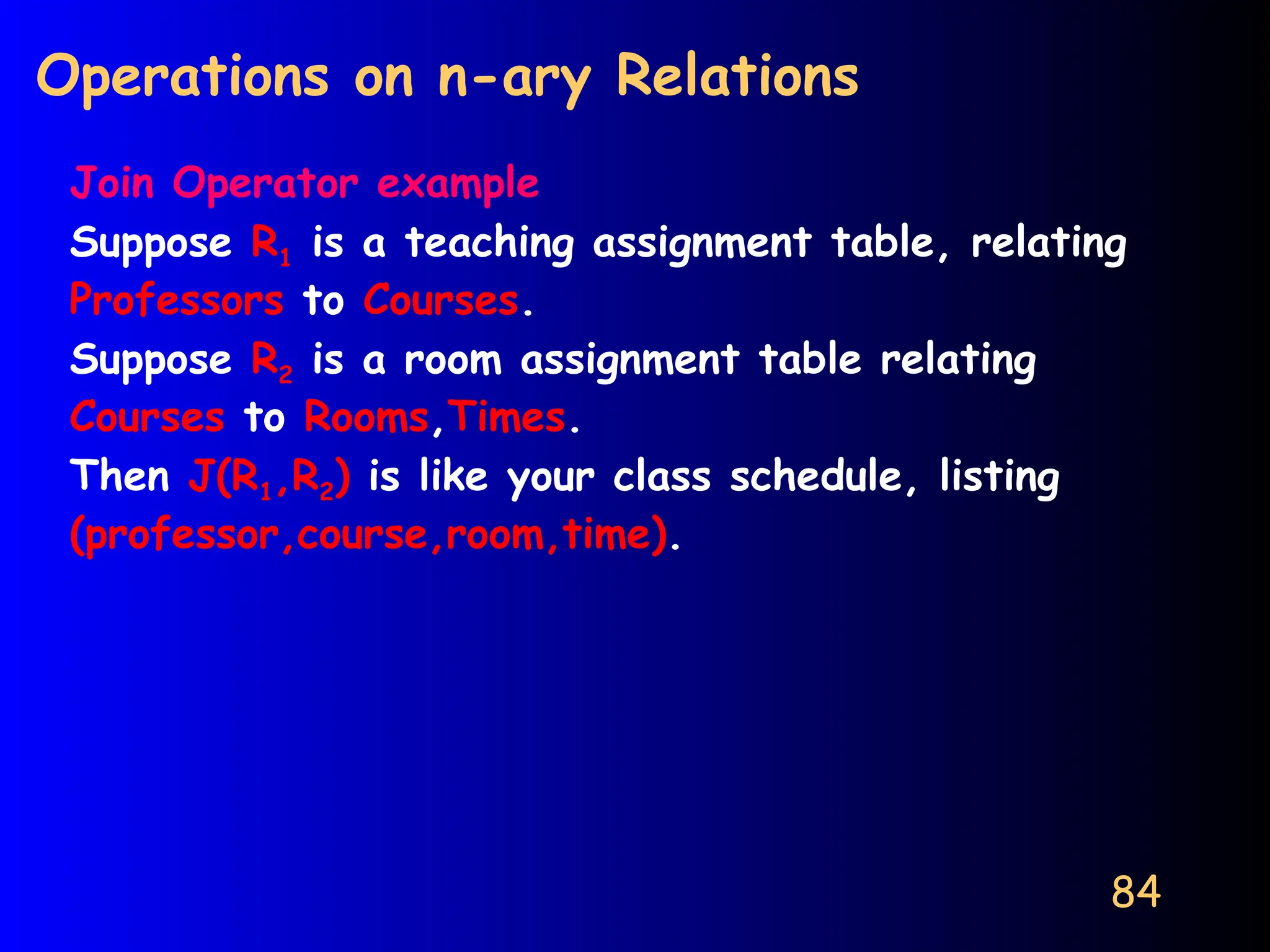
Join Operator example
Suppose R1 is a teaching assignment table, relating
Professors to Courses.
Suppose R2 is a room assignment table relating
Courses to Rooms,Times.
Then J(R1,R2) is like your class schedule, listing
(professor,course,room,time).
![8
Relations
Representation of relation (matrix)
A relation between finite sets can be represented
using a zero-one matrix.
Suppose that R is a relation from A={a1,a2,…,am) to
B={b1,b2,….,bn}. This relation can be represented by
the matrix MR=[mij], where:
[mij]= 1 if (ai,bj) R
0 if (ai,bj) R
Example Let A ={0,1,2} and B={a,b} and the relation
R from A to B is {(0,a),(0,b),(1,a),(2,b)}.
1 1
1 0
0 1
MR=
a b
0
1
2](https://image.slidesharecdn.com/relations-250417005653-38e5526d/75/Discrete-Structures_Relations_Lec-1-pptx-8-2048.jpg)
![50
Equivalence Classes
Let R be an equivalence relation on S. The set of all
elements that are related to an element a of S is
called equivalence class of a. the equivalence class of
a with respect to R is denoted by [a]R .
a S, [a]R, is
[a]R = {s|(a,s) R} or
[a]R = {s: aRs}
If b [a]R b is called a representative of this
equivalence relation
Any element of a class can be used as a
representative of this class.](https://image.slidesharecdn.com/relations-250417005653-38e5526d/75/Discrete-Structures_Relations_Lec-1-pptx-50-2048.jpg)
![51
Equivalence Classes
Example
What is equivalence class of an integer for the
following equivalence relation?
R={(a,b) | a=b or a=-b}
In this equivalence relation the integer is related to
itself and its negative, so :
[a]R={-a,a} or [a] ={-a,a}
[7] ={-7,7}
[5] ={-5,5}
[0] ={0}](https://image.slidesharecdn.com/relations-250417005653-38e5526d/75/Discrete-Structures_Relations_Lec-1-pptx-51-2048.jpg)
![52
Equivalence Classes
Example
What is equivalence class of 0 and 1 for the
Congruence Modulo 4?
The equivalence class of 0 contains all integers a such
that a0(mod 4)
[0] ={…………,-8,-4,0,4,8,……………….}
The equivalence class of 1 contains all integers a such
that a1(mod 4)
[1] ={…………,-7,-3,1,5,9,……………….}
Congruence classes modulo m
[a]m={……………,a-2m,a-m,a,a+m,a+2m,……………..}](https://image.slidesharecdn.com/relations-250417005653-38e5526d/75/Discrete-Structures_Relations_Lec-1-pptx-52-2048.jpg)
![53
Equivalence Classes
Example
Let n be a positive integer and S a set of strings.
Rn is the relation on S such that sRnt iff s=t or both
s and t have at least n characters and the first n
characters of s and t are the same.
sR3t 01 R3 01 00111 R3 00101
01 R3 11 00111 R3 01101
What is equivalence class of the string 0111 with
respect to the R3?
[011]R3 ={ 011, 0110,0111,01100,01101,01110,
01111,………}](https://image.slidesharecdn.com/relations-250417005653-38e5526d/75/Discrete-Structures_Relations_Lec-1-pptx-53-2048.jpg)
![54
Equivalence Classes and Partitions
Let n be a positive integer and S a set of strings.
Rn is the relation on S such that sRnt iff s=t or both
s and t have at least n characters and the first n
characters of s and t are the same.
sR3t
[ ]R3 ={ }
[0]R3 ={0}
[1]R3 ={1}
[00]R3 ={00}
[01]R3 ={01}
[10]R3 ={10}
[11]R3 ={11}](https://image.slidesharecdn.com/relations-250417005653-38e5526d/75/Discrete-Structures_Relations_Lec-1-pptx-54-2048.jpg)
![55
Equivalence Classes and Partitions
[000]R3 ={000,0000,0001,00000,00001,00011,………}
[001]R3 ={001,0010,0011,00100,00101,00111,………}
[010]R3 ={010,0100,0101,01000,01001,01011,………}
[011]R3 ={011,0110,0111,01100,01101,01111,………}
[100]R3 ={100,1000,1001,10000,10001,10011,………}
[101]R3 ={101,1010,1011,10100,10101,10111,………}
[110]R3 ={110,1100,1101,11000,11001,11011,………}
[111]R3 ={111, 1110,1111,11100,11101,11111,………}
These 15 equivalence classes are disjoint and every
bit string is in exactly one of them.
These equivalence classes partition the set of all bit
strings.](https://image.slidesharecdn.com/relations-250417005653-38e5526d/75/Discrete-Structures_Relations_Lec-1-pptx-55-2048.jpg)