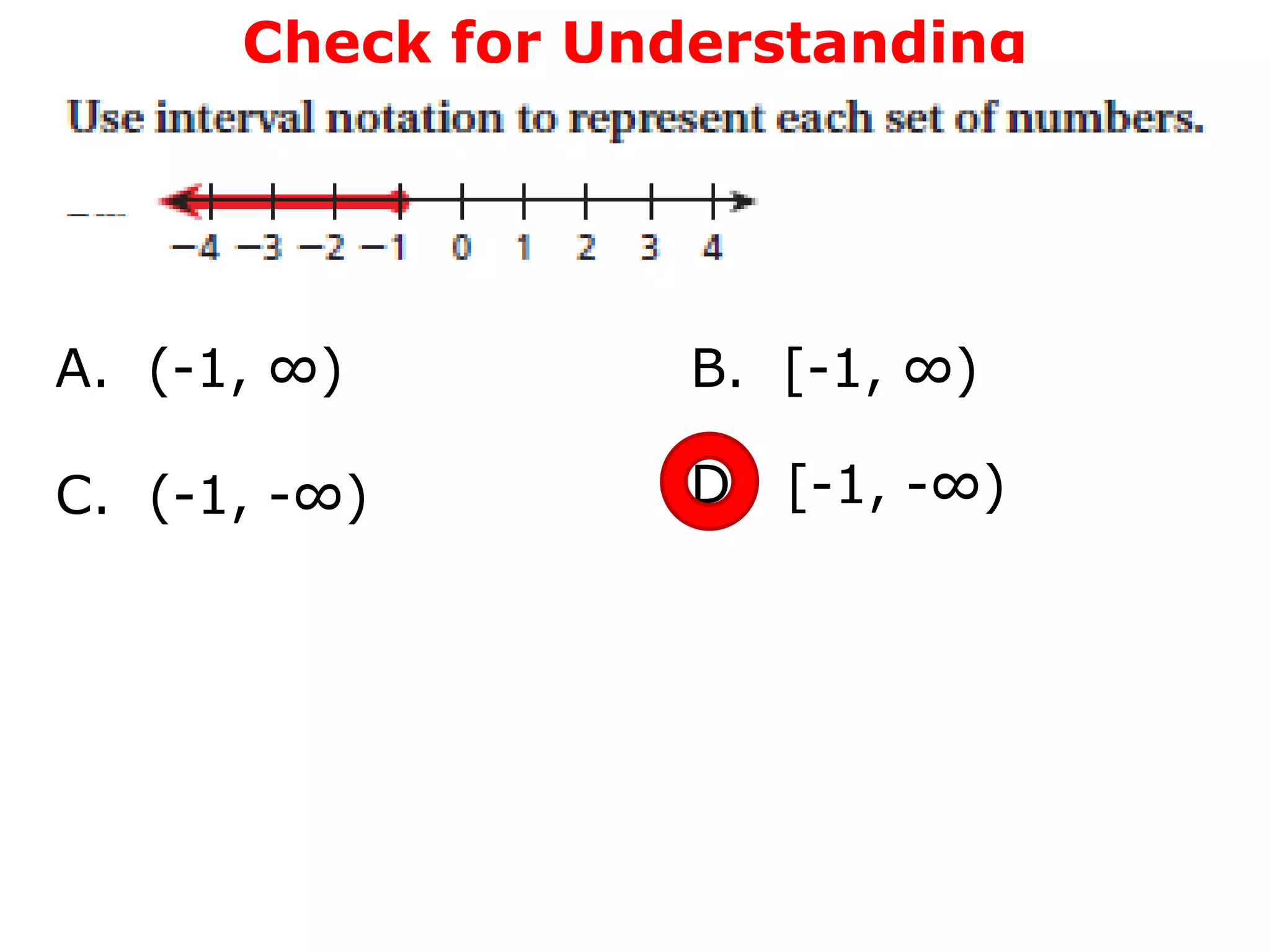
1 – 1 Sets of numbers
Warm Up
Lesson Presentation
Lesson Quiz
2.
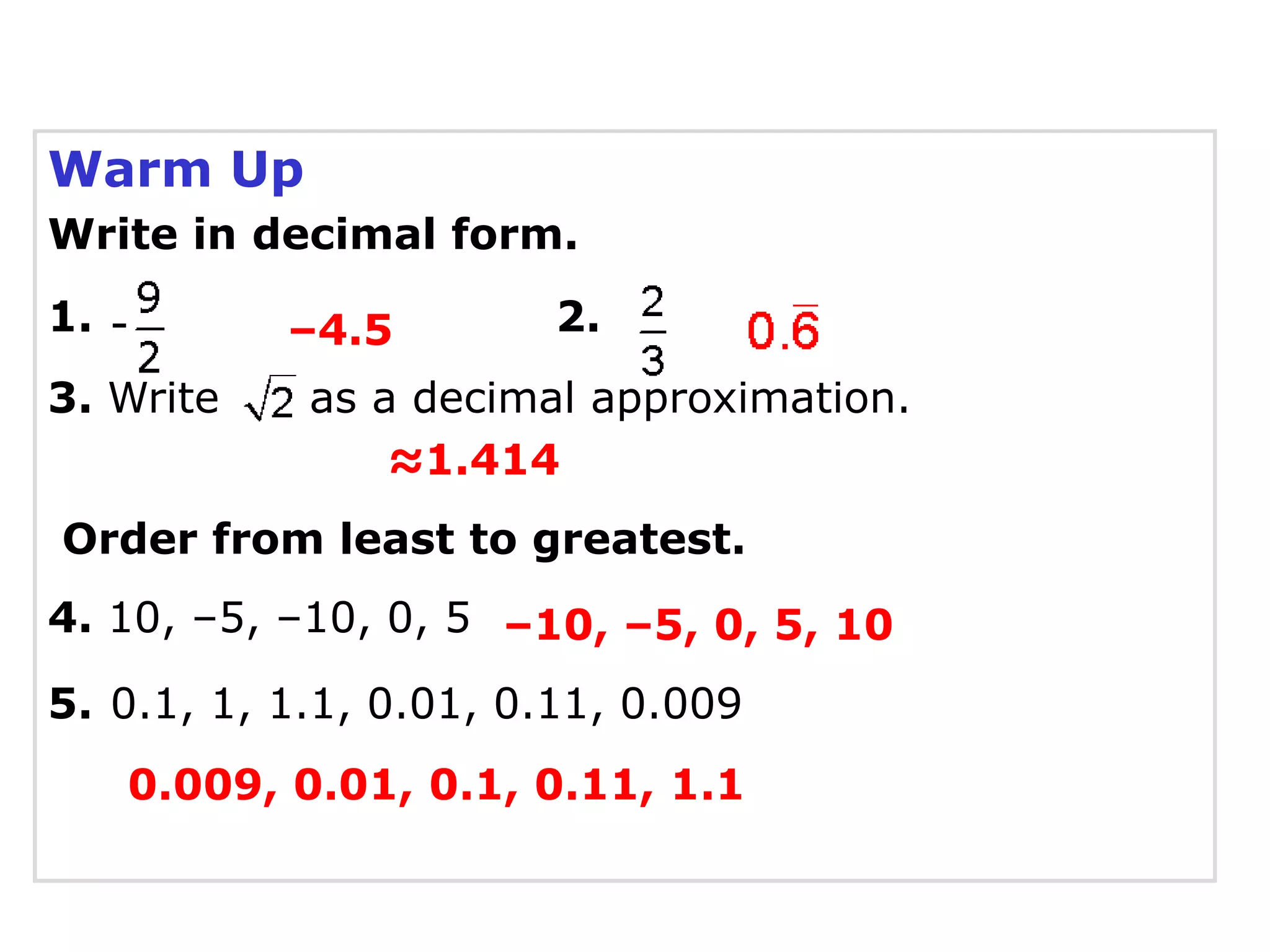
Warm Up
Write indecimal form.
1. –4.5 2.
3. Write as a decimal approximation.
≈1.414
Order from least to greatest.
4. 10, –5, –10, 0, 5 –10, –5, 0, 5, 10
5. 0.1, 1, 1.1, 0.01, 0.11, 0.009
0.009, 0.01, 0.1, 0.11, 1.1
3.
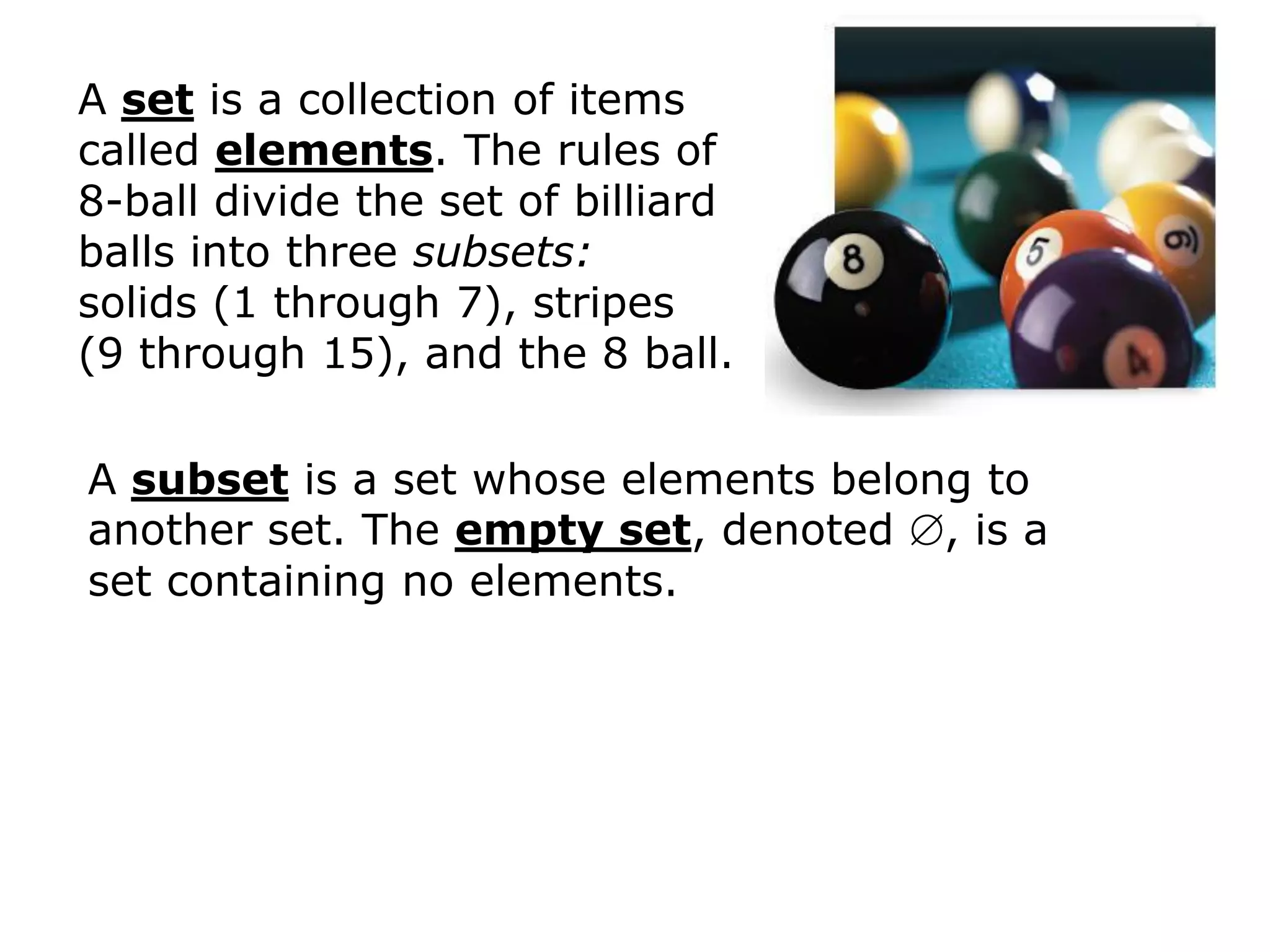
A set isa collection of items
called elements. The rules of
8-ball divide the set of billiard
balls into three subsets:
solids (1 through 7), stripes
(9 through 15), and the 8 ball.
A subset is a set whose elements belong to
another set. The empty set, denoted , is a
set containing no elements.
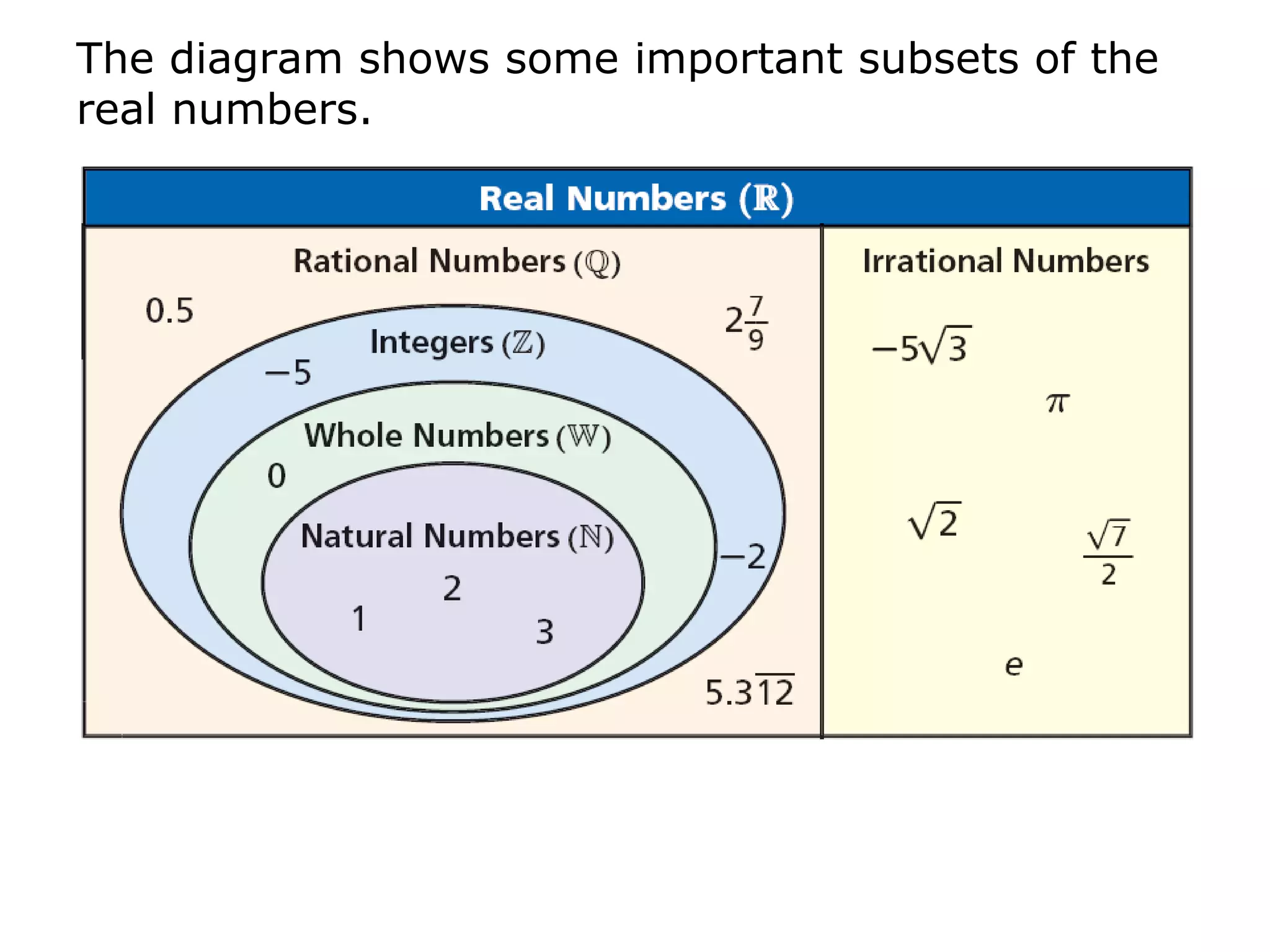
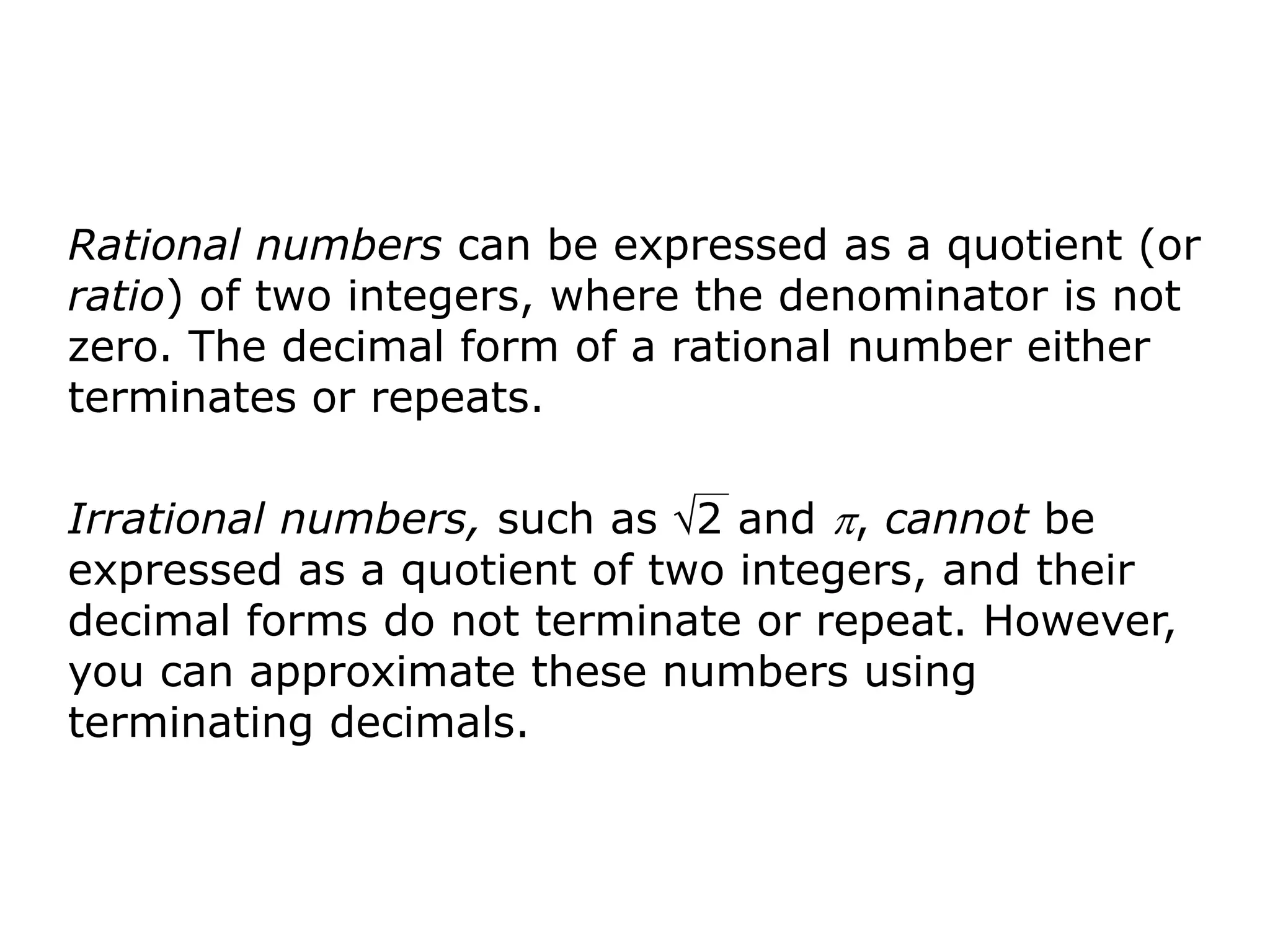
Rational numbers canbe expressed as a quotient (or
ratio) of two integers, where the denominator is not
zero. The decimal form of a rational number either
terminates or repeats.
Irrational numbers, such as 2 and , cannot be
expressed as a quotient of two integers, and their
decimal forms do not terminate or repeat. However,
you can approximate these numbers using
terminating decimals.
7.
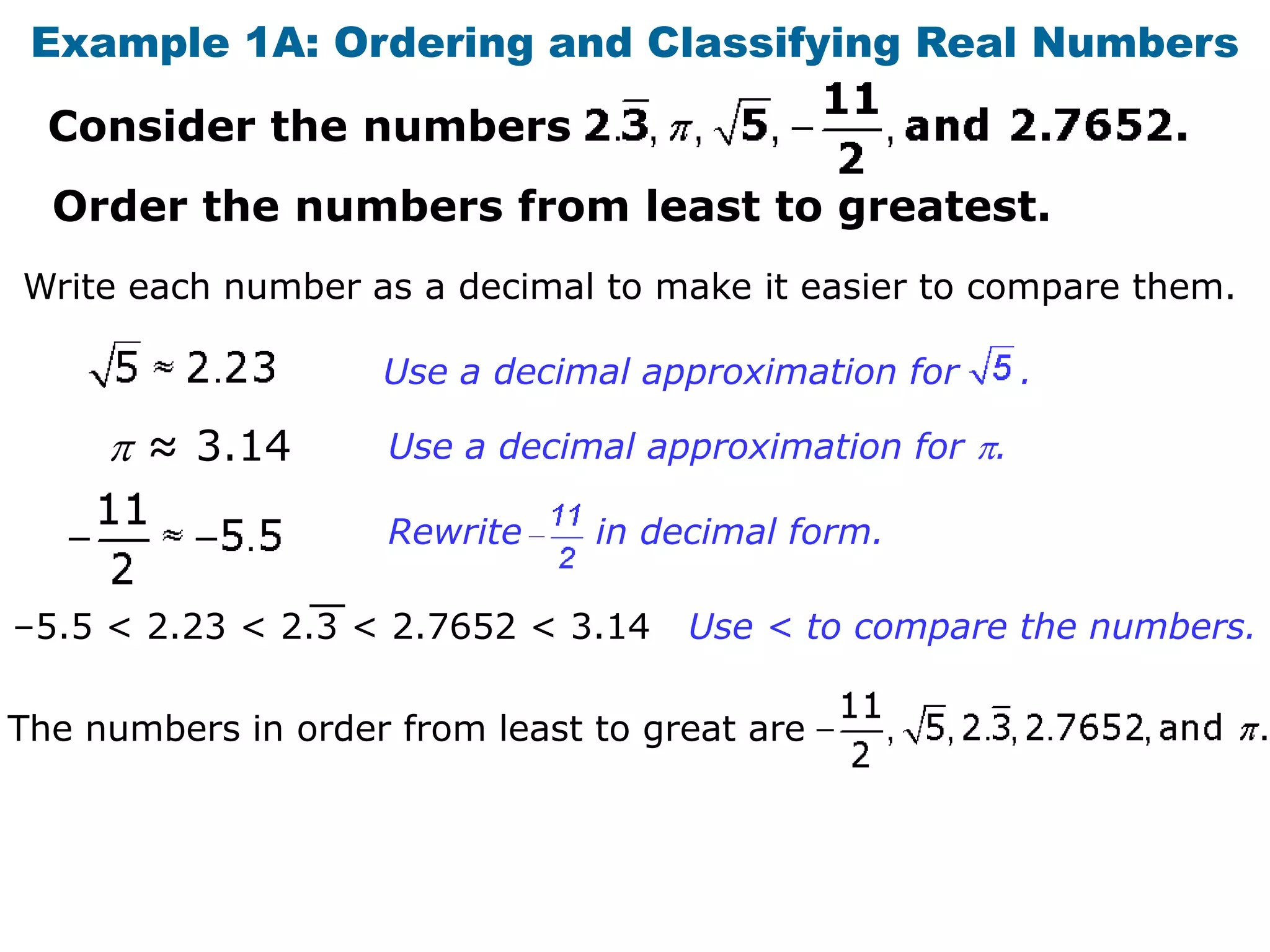
Example 1A: Orderingand Classifying Real Numbers
Consider the numbers
Order the numbers from least to greatest.
Write each number as a decimal to make it easier to compare them.
Use a decimal approximation for .
≈ 3.14 Use a decimal approximation for .
Rewrite in decimal form.
–5.5 < 2.23 < 2.3 < 2.7652 < 3.14 Use < to compare the numbers.
The numbers in order from least to great are
8.
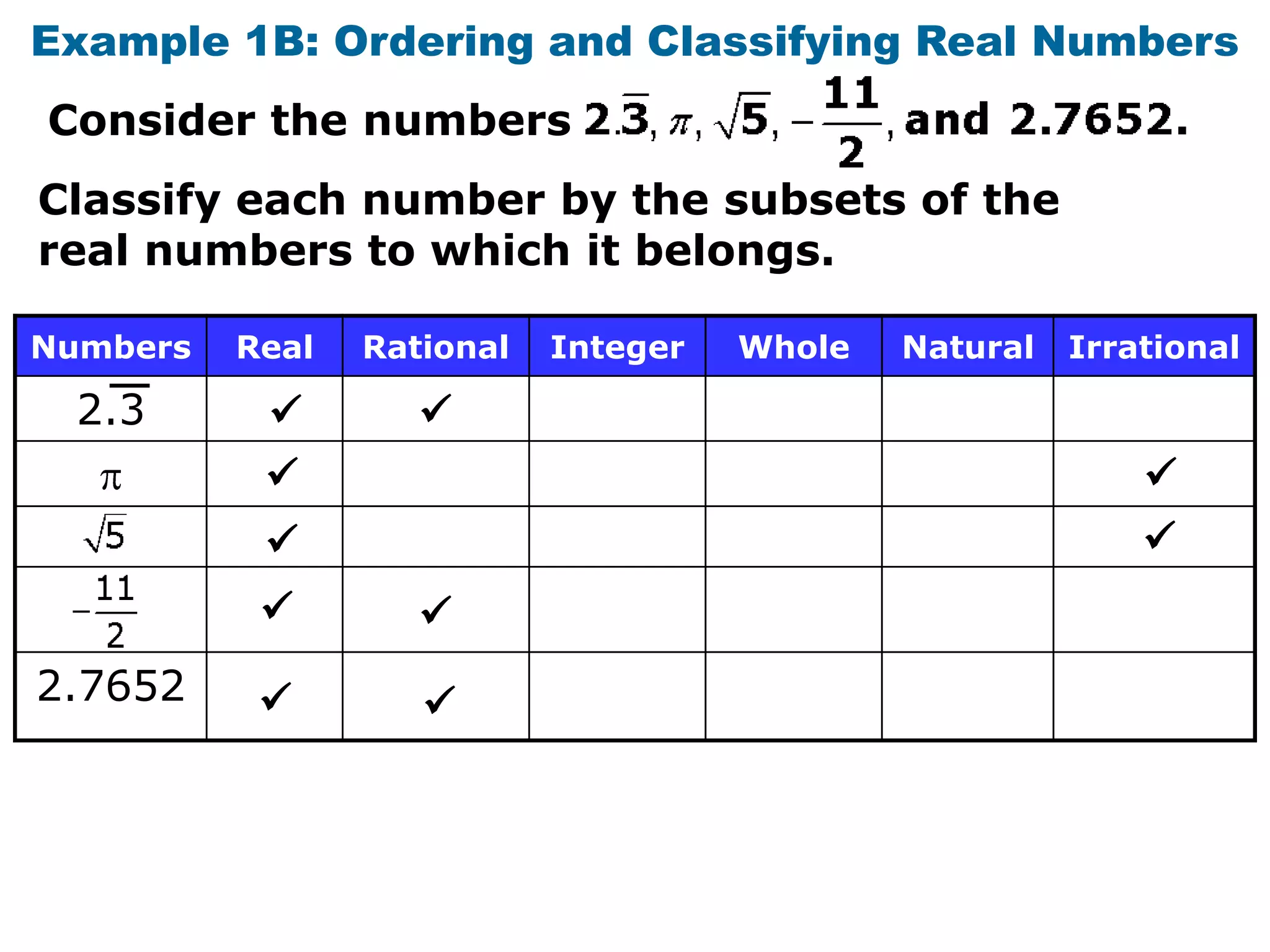
Example 1B: Orderingand Classifying Real Numbers
Consider the numbers
Classify each number by the subsets of the
real numbers to which it belongs.
Numbers Real Rational Integer Whole Natural Irrational
2.3
2.7652
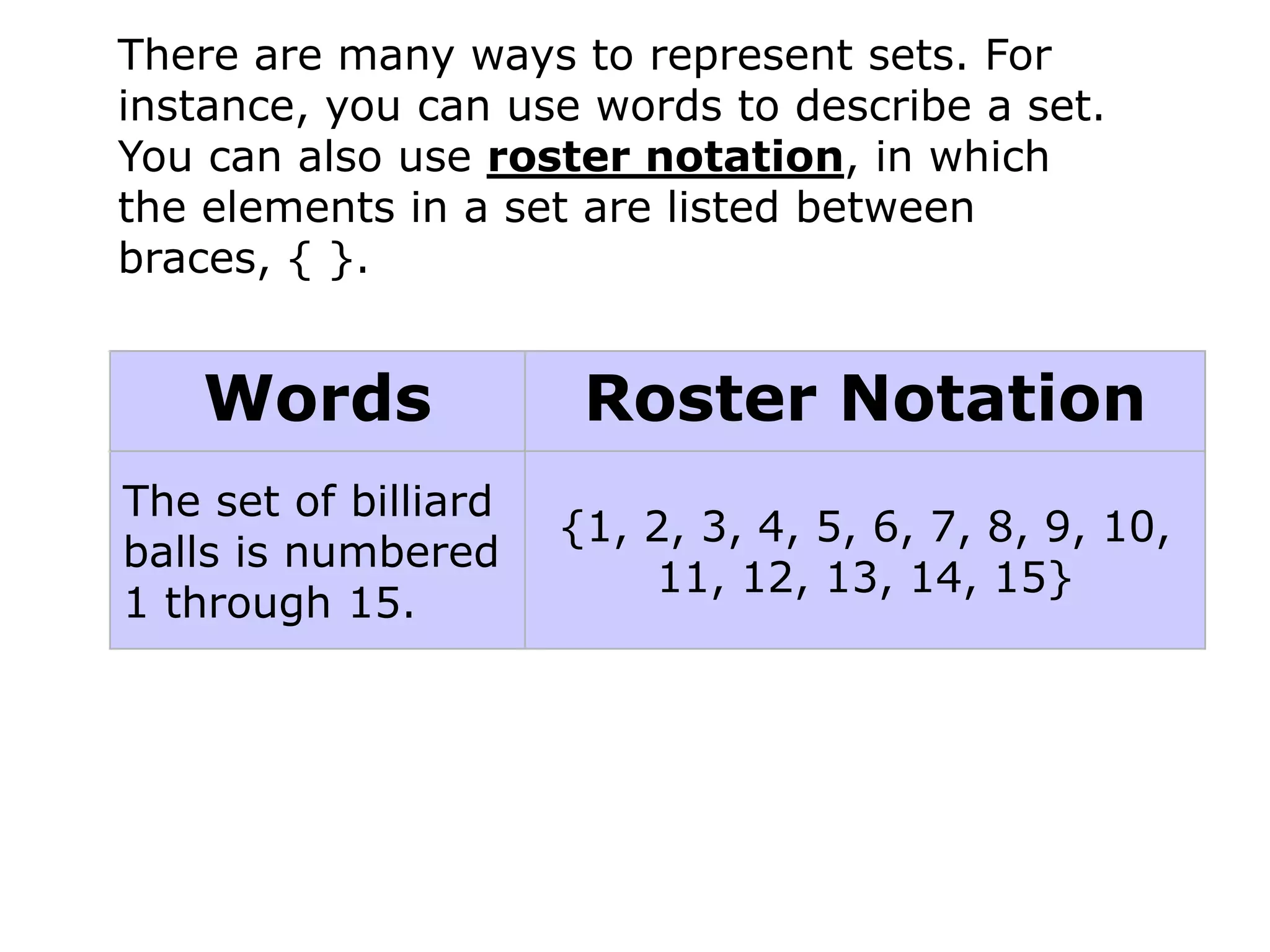
There are manyways to represent sets. For
instance, you can use words to describe a set.
You can also use roster notation, in which
the elements in a set are listed between
braces, { }.
Words Roster Notation
The set of billiard
{1, 2, 3, 4, 5, 6, 7, 8, 9, 10,
balls is numbered
11, 12, 13, 14, 15}
1 through 15.
11.
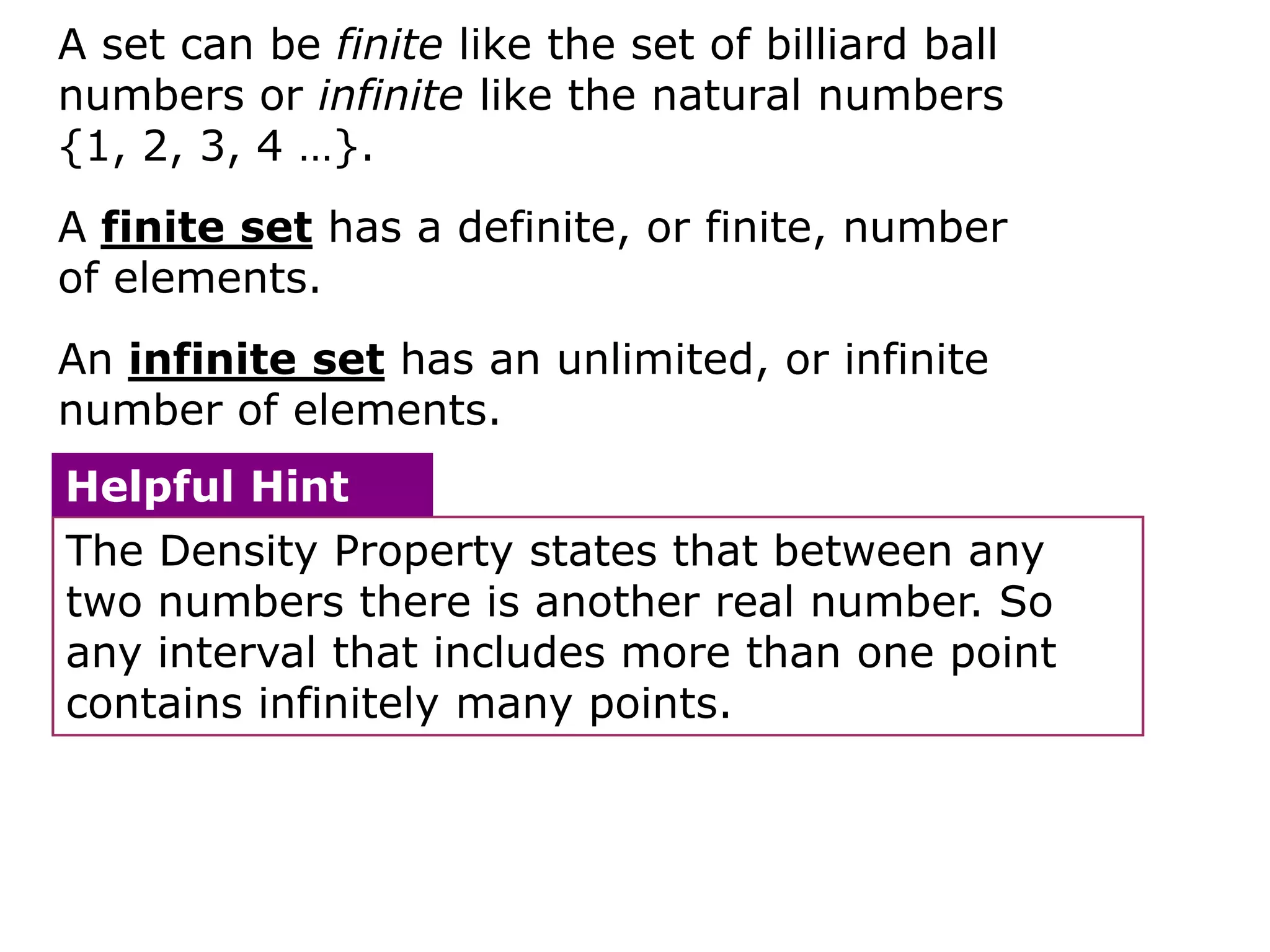
A set canbe finite like the set of billiard ball
numbers or infinite like the natural numbers
{1, 2, 3, 4 …}.
A finite set has a definite, or finite, number
of elements.
An infinite set has an unlimited, or infinite
number of elements.
Helpful Hint
The Density Property states that between any
two numbers there is another real number. So
any interval that includes more than one point
contains infinitely many points.
12.
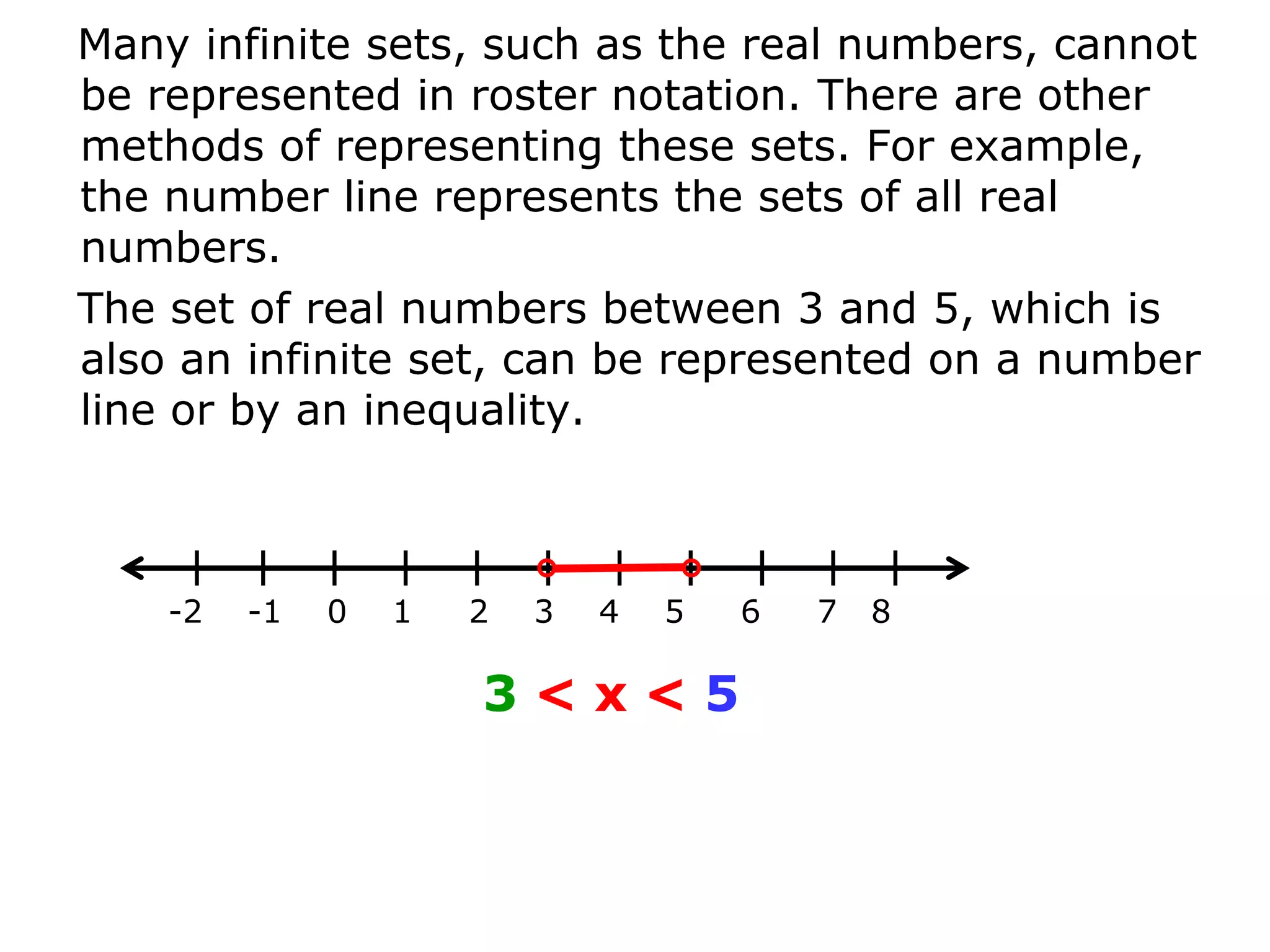
Many infinite sets,such as the real numbers, cannot
be represented in roster notation. There are other
methods of representing these sets. For example,
the number line represents the sets of all real
numbers.
The set of real numbers between 3 and 5, which is
also an infinite set, can be represented on a number
line or by an inequality.
-2 -1 0 1 2 3 4 5 6 7 8
3<x<5
13.
An interval isthe set of all numbers between
two endpoints, such as 3 and 5. In interval
notation the symbols [ and ] are used to
include an endpoint in an interval, and the
symbols ( and ) are used to exclude an
endpoint from an interval.
(3, 5) The set of real numbers between but not
including 3 and 5.
-2 -1 0 1 2 3 4 5 6 7 8
3<x<5
14.
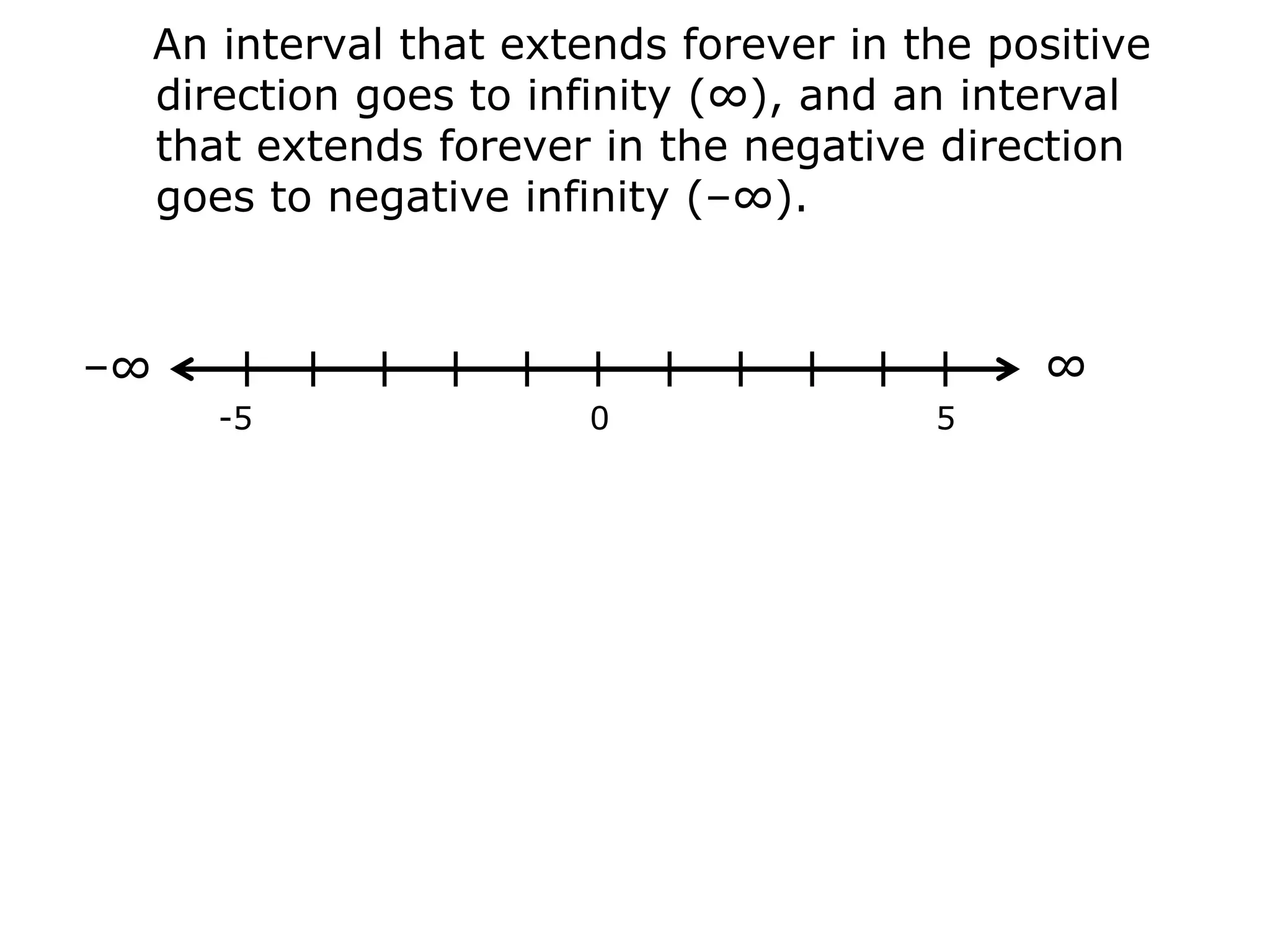
An interval thatextends forever in the positive
direction goes to infinity (∞), and an interval
that extends forever in the negative direction
goes to negative infinity (–∞).
–∞ ∞
-5 0 5
15.
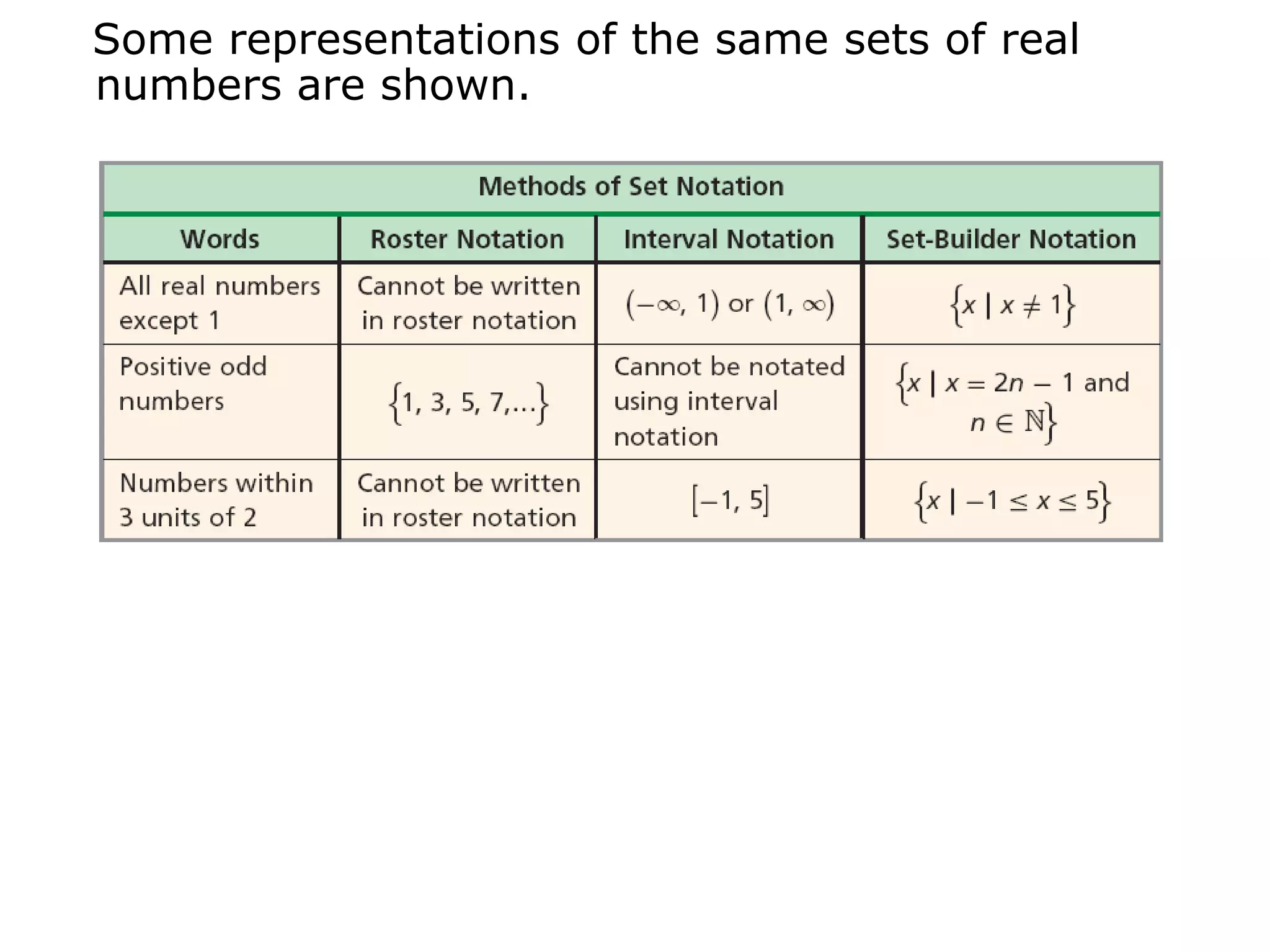
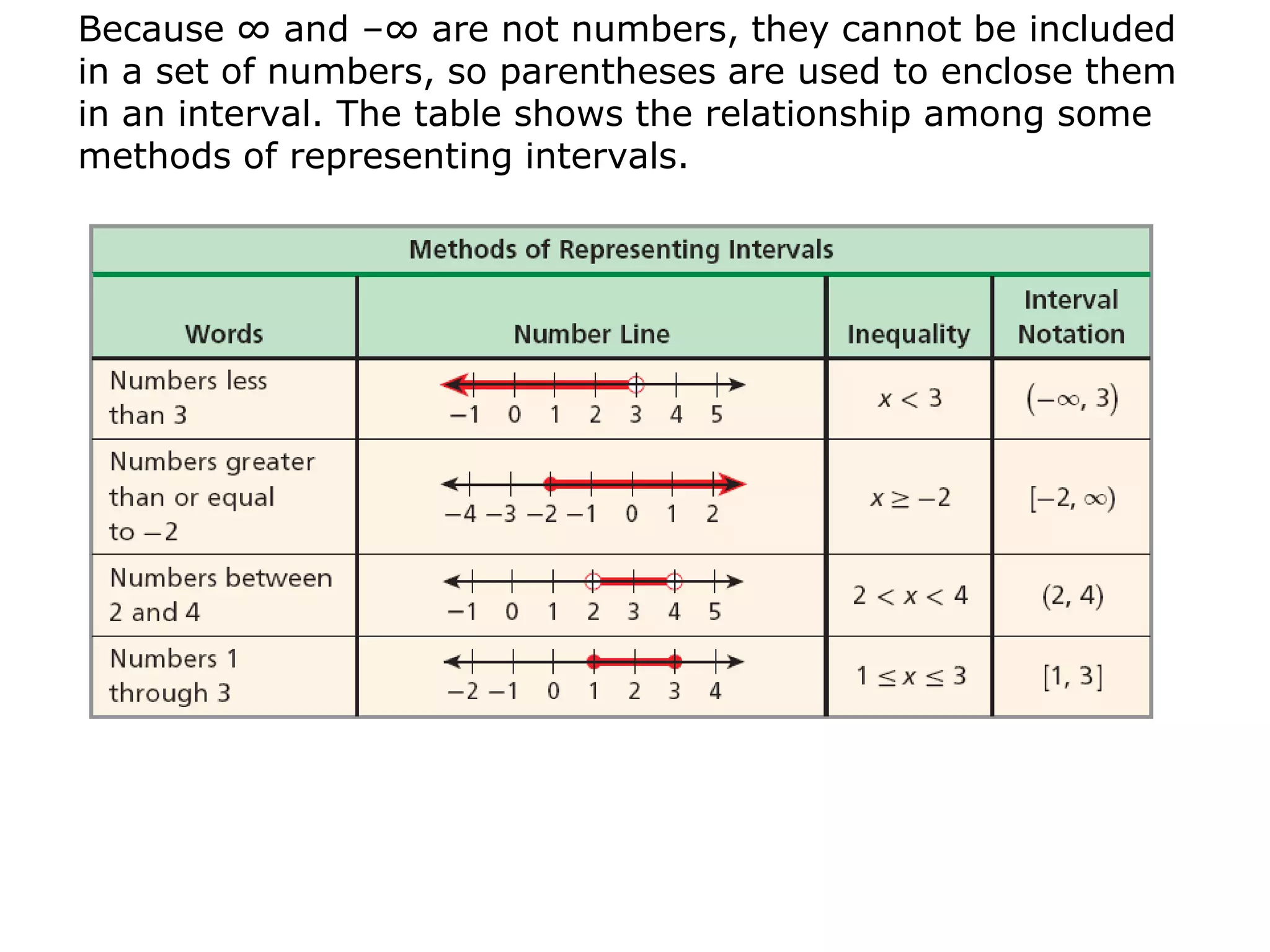
Because ∞ and–∞ are not numbers, they cannot be included
in a set of numbers, so parentheses are used to enclose them
in an interval. The table shows the relationship among some
methods of representing intervals.
16.
Example 2A: IntervalNotation
Use interval notation to represent the set of
numbers.
7 < x ≤ 12
(7, 12] 7 is not included, but 12 is.
17.
Example 2B: IntervalNotation
Use interval notation to represent the set of
numbers.
–6 –4 –2 0 2 4 6
There are two intervals graphed on the number line.
[–6, –4] –6 and –4 are included.
5 is not included, and the interval
(5, ∞) continues forever in the positive
direction.
The word “or” is used to indicate
[–6, –4] or (5, ∞) that a set includes more than one
interval.
Another way torepresent sets is set-builder
notation. Set-builder notation uses the
properties of the elements in the set to define
the set. Inequalities and the element symbol
are often used in the set-builder notation. The
set of striped-billiard-ball numbers, or {9, 10,
11, 12, 13, 14, 15}, is represented in set-
builder notation on the following slide.
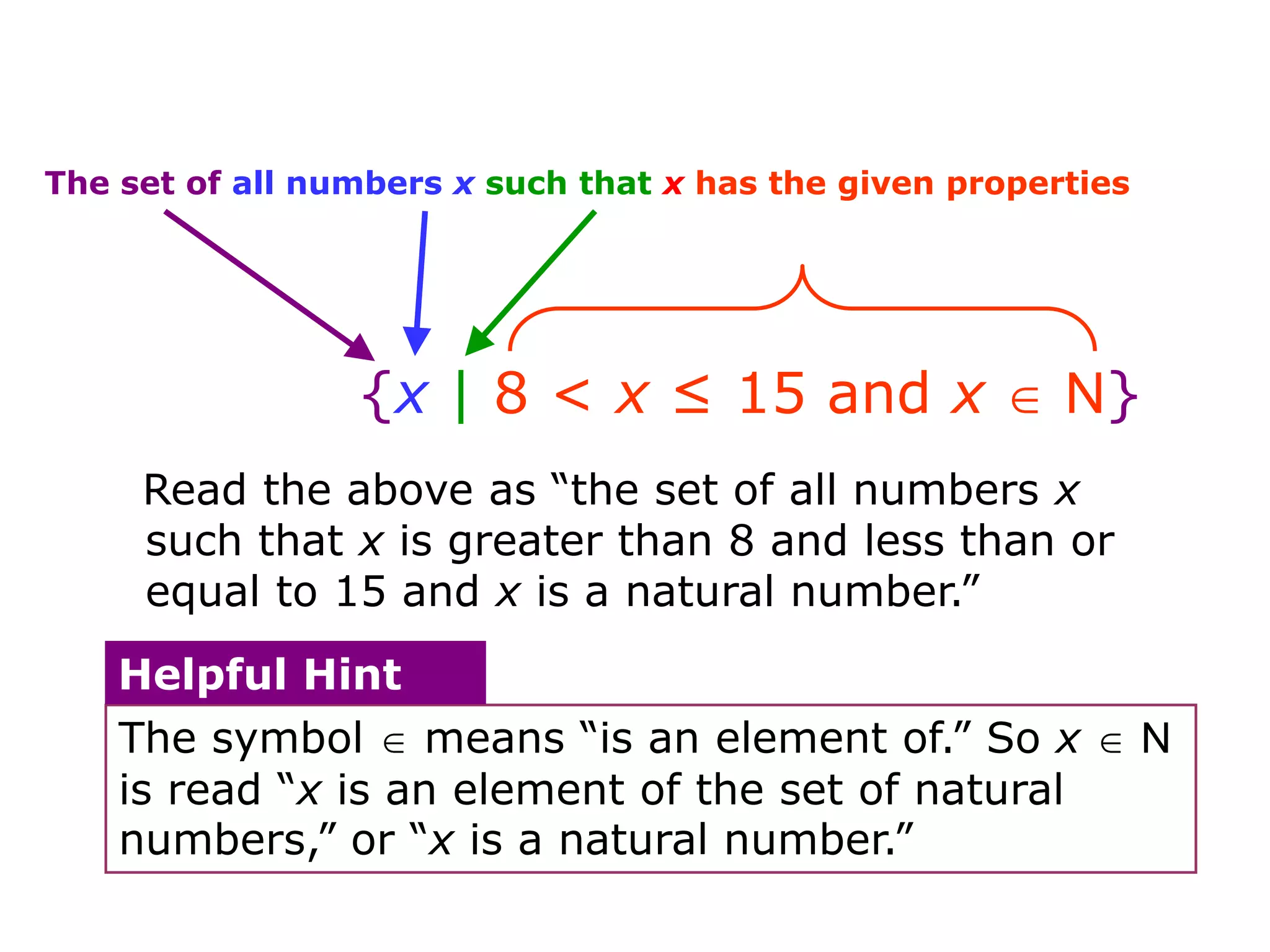
20.
The set ofall numbers x such that x has the given properties
{x | 8 < x ≤ 15 and x N}
Read the above as “the set of all numbers x
such that x is greater than 8 and less than or
equal to 15 and x is a natural number.”
Helpful Hint
The symbol means “is an element of.” So x N
is read “x is an element of the set of natural
numbers,” or “x is a natural number.”
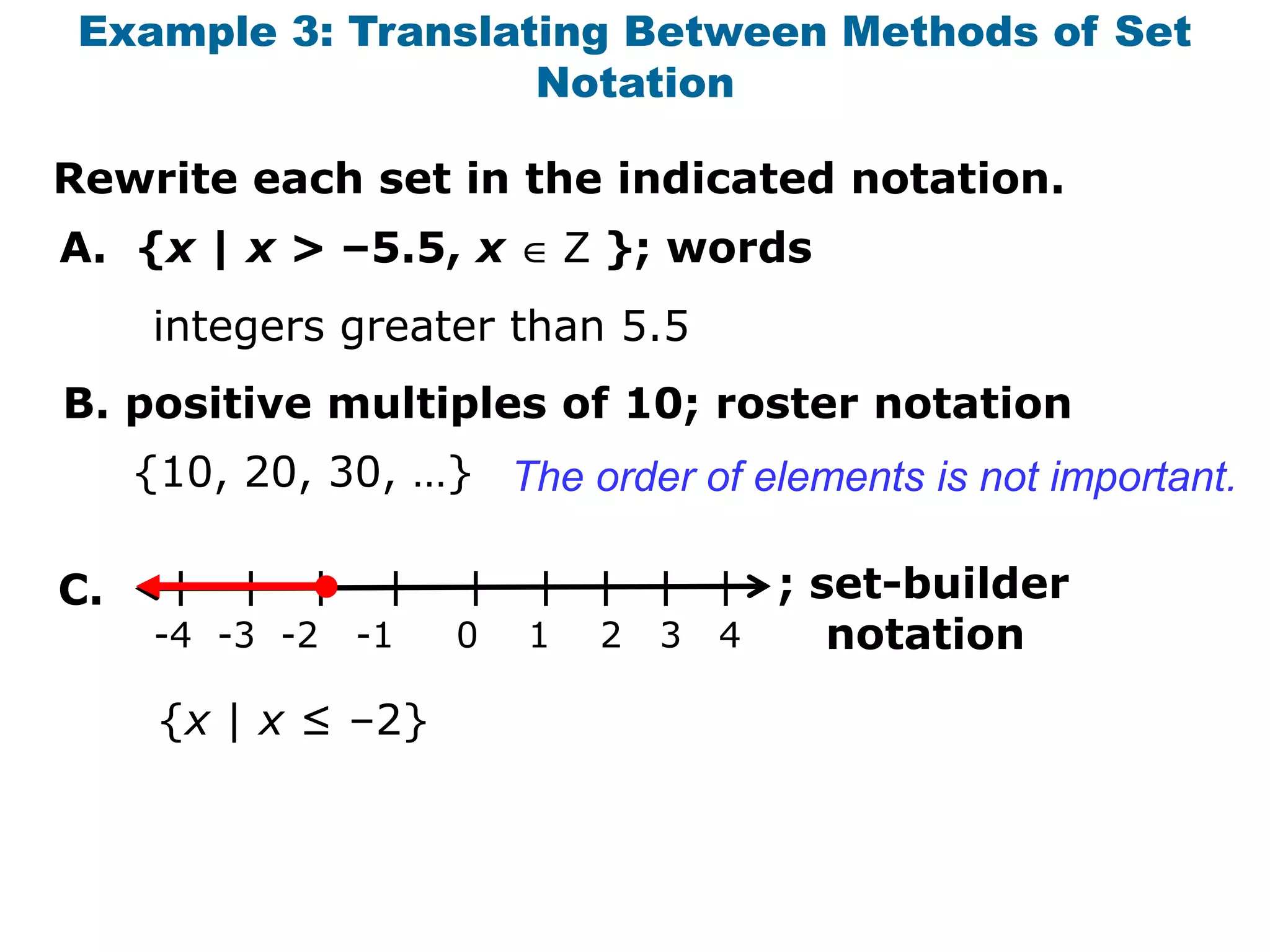
Example 3: TranslatingBetween Methods of Set
Notation
Rewrite each set in the indicated notation.
A. {x | x > –5.5, x Z }; words
integers greater than 5.5
B. positive multiples of 10; roster notation
{10, 20, 30, …} The order of elements is not important.
C. ; set-builder
-4 -3 -2 -1 0 1 2 3 4 notation
{x | x ≤ –2}
![An interval is the set of all numbers between
two endpoints, such as 3 and 5. In interval
notation the symbols [ and ] are used to
include an endpoint in an interval, and the
symbols ( and ) are used to exclude an
endpoint from an interval.
(3, 5) The set of real numbers between but not
including 3 and 5.
-2 -1 0 1 2 3 4 5 6 7 8
3<x<5](https://image.slidesharecdn.com/number-130103213356-phpapp01/75/Sets-of-numbers-13-2048.jpg)
![Example 2A: Interval Notation
Use interval notation to represent the set of
numbers.
7 < x ≤ 12
(7, 12] 7 is not included, but 12 is.](https://image.slidesharecdn.com/number-130103213356-phpapp01/75/Sets-of-numbers-16-2048.jpg)
![Example 2B: Interval Notation
Use interval notation to represent the set of
numbers.
–6 –4 –2 0 2 4 6
There are two intervals graphed on the number line.
[–6, –4] –6 and –4 are included.
5 is not included, and the interval
(5, ∞) continues forever in the positive
direction.
The word “or” is used to indicate
[–6, –4] or (5, ∞) that a set includes more than one
interval.](https://image.slidesharecdn.com/number-130103213356-phpapp01/75/Sets-of-numbers-17-2048.jpg)