The Fascinating Worldof Set
Theory
Welcome to the fascinating world of set theory - the oldest and
youngest mathematical discipline that forms the foundation of modern
mathematics. As G.H. Hardy aptly noted, set theory "did not begin with
Pythagoras and will not end with Einstein." Developed by German
mathematician Georg Cantor in the late 19th century, set theory
provides the fundamental language and structure used throughout
mathematics today.
In this presentation, we will explore the beautiful simplicity and
profound complexity of sets - from basic definitions to operations that
allow mathematicians to express complex relationships with elegant
precision. Join us on this journey through the essential concepts that
underpin much of modern mathematical thinking.
2.
What is aSet?
Definition
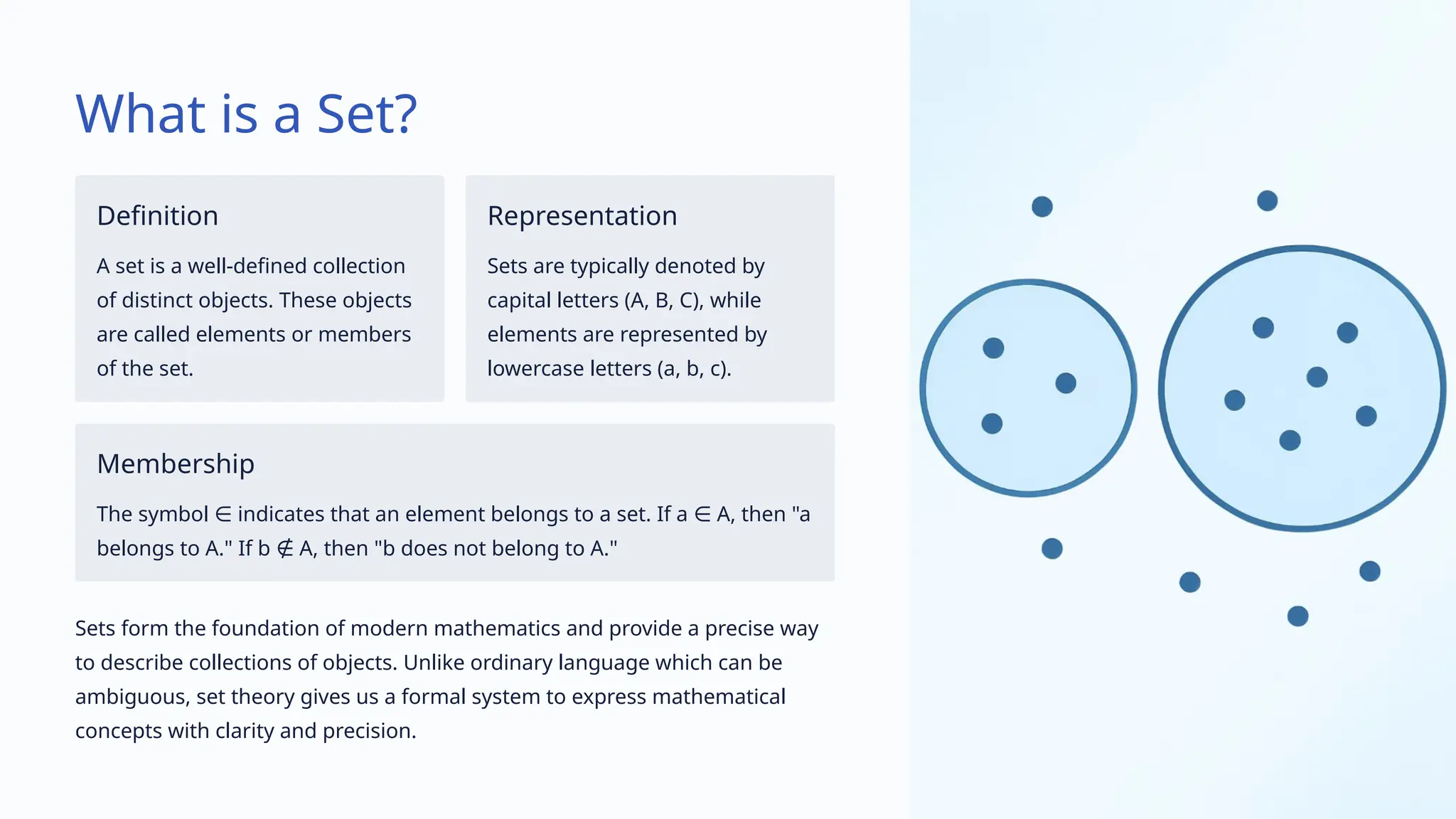
A set is a well-defined collection
of distinct objects. These objects
are called elements or members
of the set.
Representation
Sets are typically denoted by
capital letters (A, B, C), while
elements are represented by
lowercase letters (a, b, c).
Membership
The symbol indicates that an element belongs to a set. If a A, then "a
∈ ∈
belongs to A." If b A, then "b does not belong to A."
∉
Sets form the foundation of modern mathematics and provide a precise way
to describe collections of objects. Unlike ordinary language which can be
ambiguous, set theory gives us a formal system to express mathematical
concepts with clarity and precision.
3.
The Architect ofSet Theory
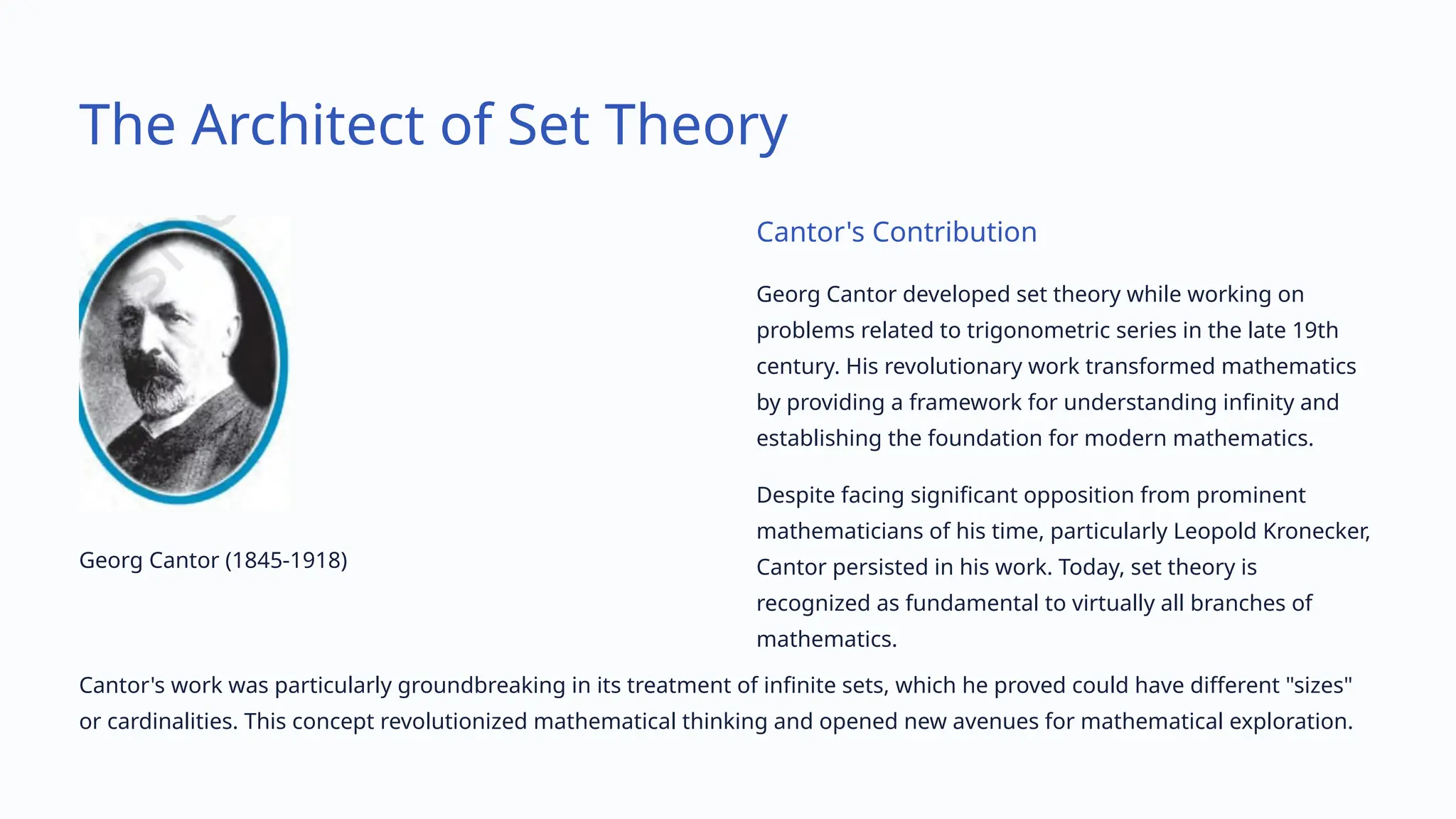
Georg Cantor (1845-1918)
Cantor's Contribution
Georg Cantor developed set theory while working on
problems related to trigonometric series in the late 19th
century. His revolutionary work transformed mathematics
by providing a framework for understanding infinity and
establishing the foundation for modern mathematics.
Despite facing significant opposition from prominent
mathematicians of his time, particularly Leopold Kronecker,
Cantor persisted in his work. Today, set theory is
recognized as fundamental to virtually all branches of
mathematics.
Cantor's work was particularly groundbreaking in its treatment of infinite sets, which he proved could have different "sizes"
or cardinalities. This concept revolutionized mathematical thinking and opened new avenues for mathematical exploration.
4.
Set Representation Methods
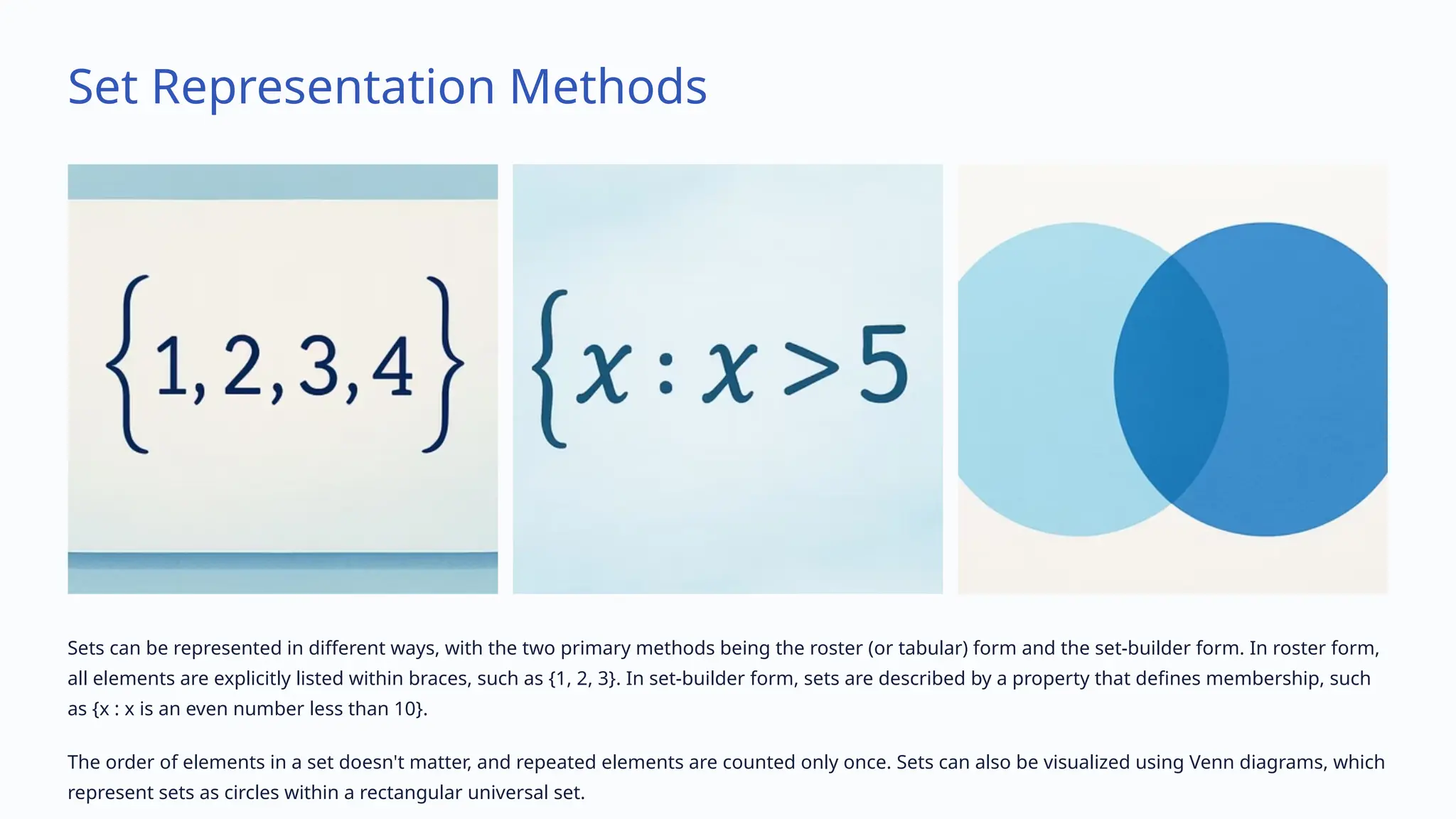
Setscan be represented in different ways, with the two primary methods being the roster (or tabular) form and the set-builder form. In roster form,
all elements are explicitly listed within braces, such as {1, 2, 3}. In set-builder form, sets are described by a property that defines membership, such
as {x : x is an even number less than 10}.
The order of elements in a set doesn't matter, and repeated elements are counted only once. Sets can also be visualized using Venn diagrams, which
represent sets as circles within a rectangular universal set.
5.
Roster Form Representation
ElementsListed Explicitly
In roster form, all elements of a set are listed
explicitly, separated by commas and enclosed within
braces { }. For example, {2, 4, 6} represents the set of
even positive integers less than 7.
No Repetition of Elements
Elements are not repeated in a set. For instance, the
set of letters in "SCHOOL" is {S, C, H, O, L}, not {S, C, H,
O, O, L}, as 'O' is only counted once.
Order is Irrelevant
The order in which elements are listed does not
matter. So {1, 2, 3} is the same set as {3, 1, 2}.
Ellipsis for Infinite Sets
For infinite sets, we use ellipsis (...) to indicate
continuation. For example, {1, 3, 5, ...} represents the
set of all odd natural numbers.
6.
Set-Builder Form
Representation
Define byCommon Property
Set-builder form describes a set by specifying a property that all
its elements satisfy. This is especially useful for sets with many or
infinite elements.
Standard Notation
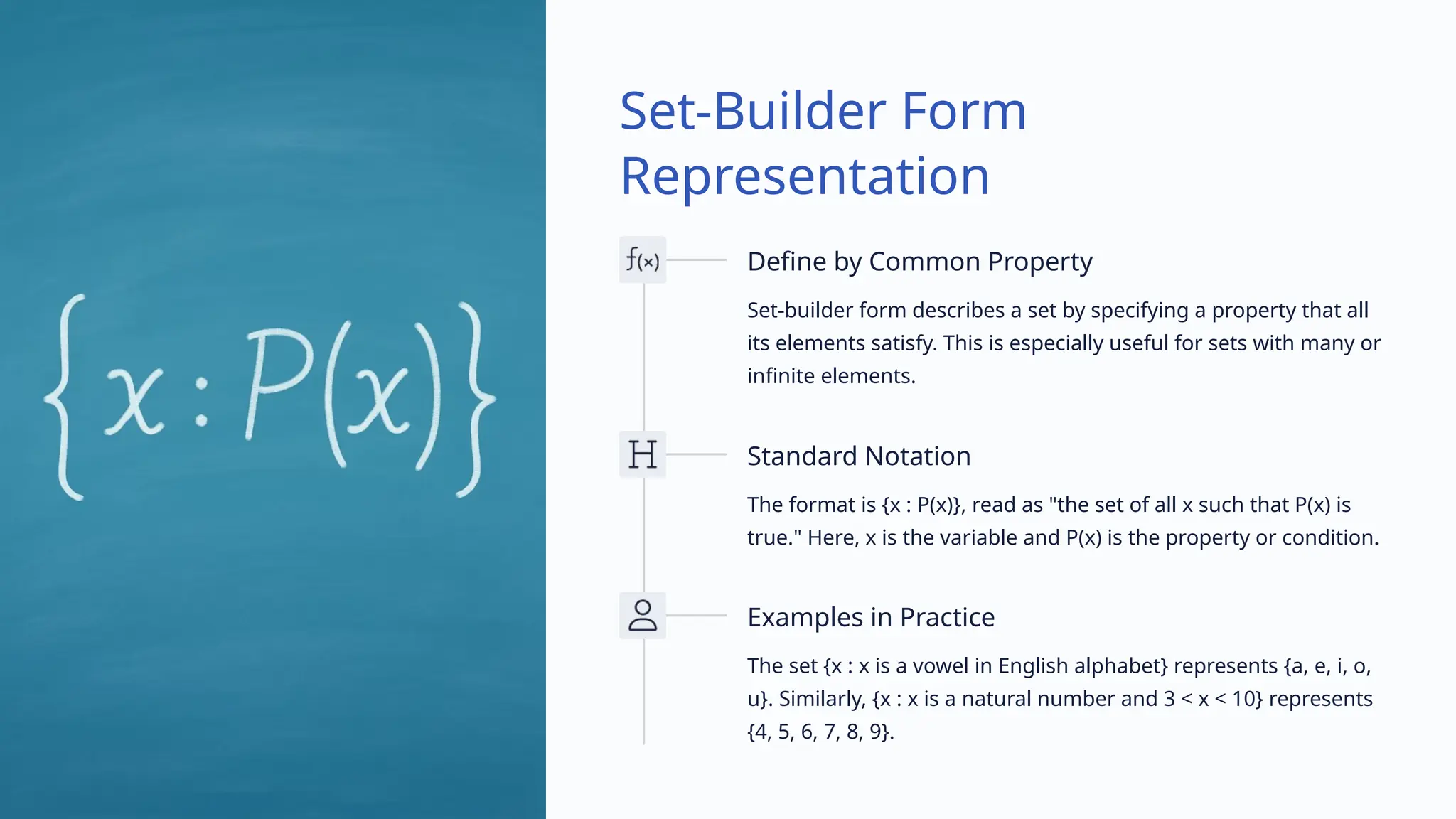
The format is {x : P(x)}, read as "the set of all x such that P(x) is
true." Here, x is the variable and P(x) is the property or condition.
Examples in Practice
The set {x : x is a vowel in English alphabet} represents {a, e, i, o,
u}. Similarly, {x : x is a natural number and 3 < x < 10} represents
{4, 5, 6, 7, 8, 9}.
7.
Example: Converting BetweenRepresentations
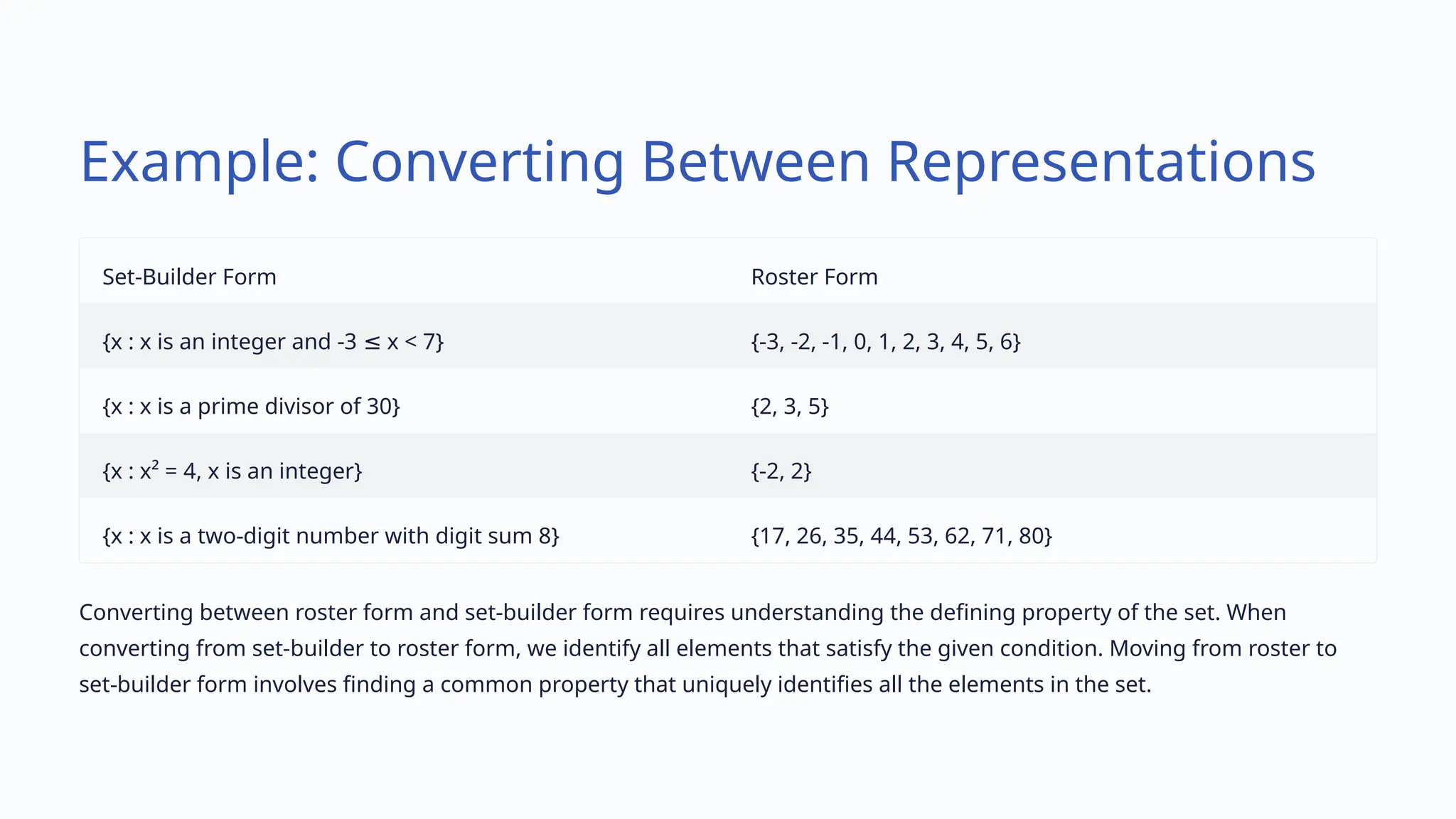
Set-Builder Form Roster Form
{x : x is an integer and -3 x < 7}
≤ {-3, -2, -1, 0, 1, 2, 3, 4, 5, 6}
{x : x is a prime divisor of 30} {2, 3, 5}
{x : x² = 4, x is an integer} {-2, 2}
{x : x is a two-digit number with digit sum 8} {17, 26, 35, 44, 53, 62, 71, 80}
Converting between roster form and set-builder form requires understanding the defining property of the set. When
converting from set-builder to roster form, we identify all elements that satisfy the given condition. Moving from roster to
set-builder form involves finding a common property that uniquely identifies all the elements in the set.
8.
The Empty Set
Definition
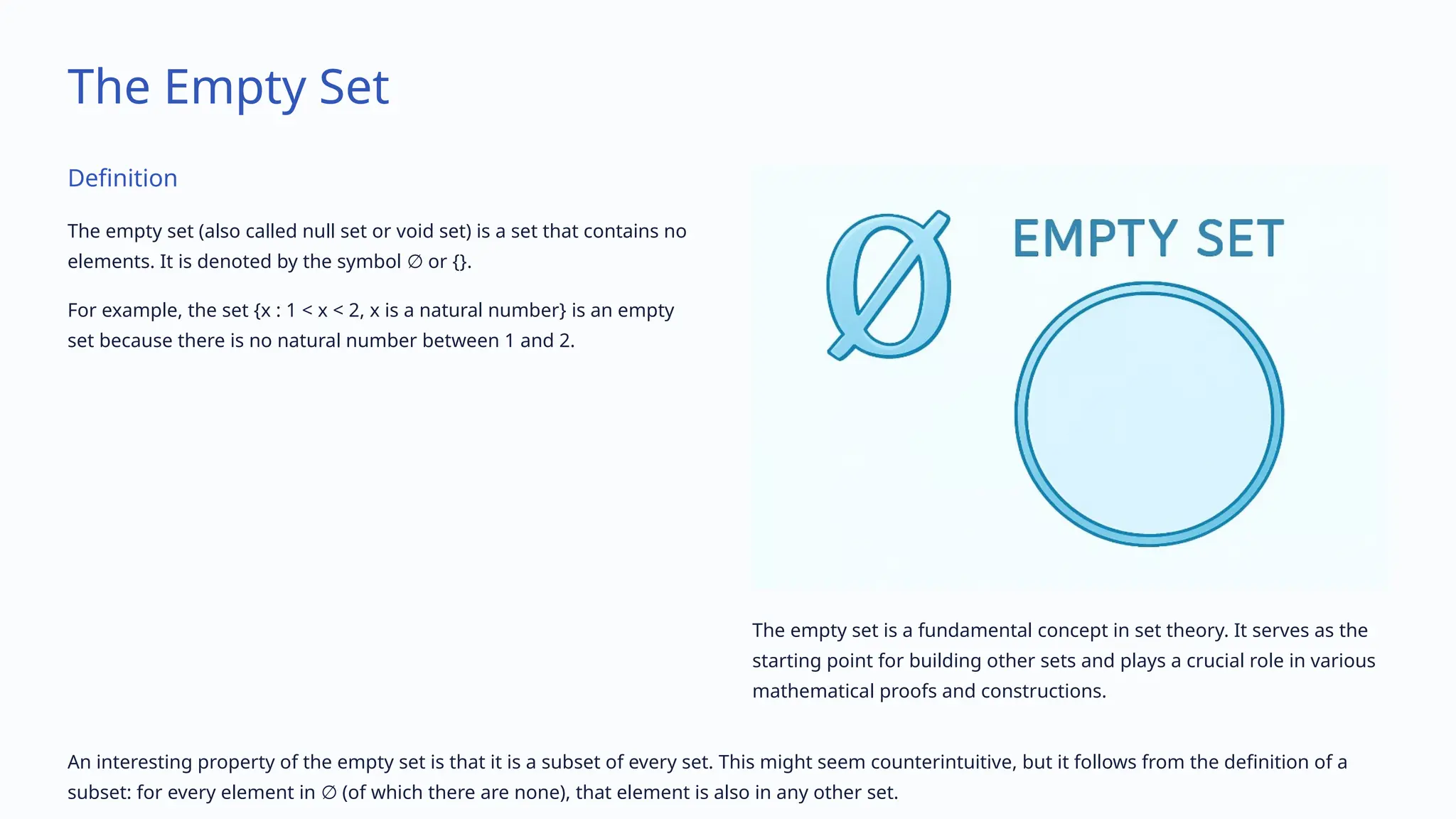
Theempty set (also called null set or void set) is a set that contains no
elements. It is denoted by the symbol or {}.
∅
For example, the set {x : 1 < x < 2, x is a natural number} is an empty
set because there is no natural number between 1 and 2.
The empty set is a fundamental concept in set theory. It serves as the
starting point for building other sets and plays a crucial role in various
mathematical proofs and constructions.
An interesting property of the empty set is that it is a subset of every set. This might seem counterintuitive, but it follows from the definition of a
subset: for every element in (of which there are none), that element is also in any other set.
∅
9.
Examples of EmptySets
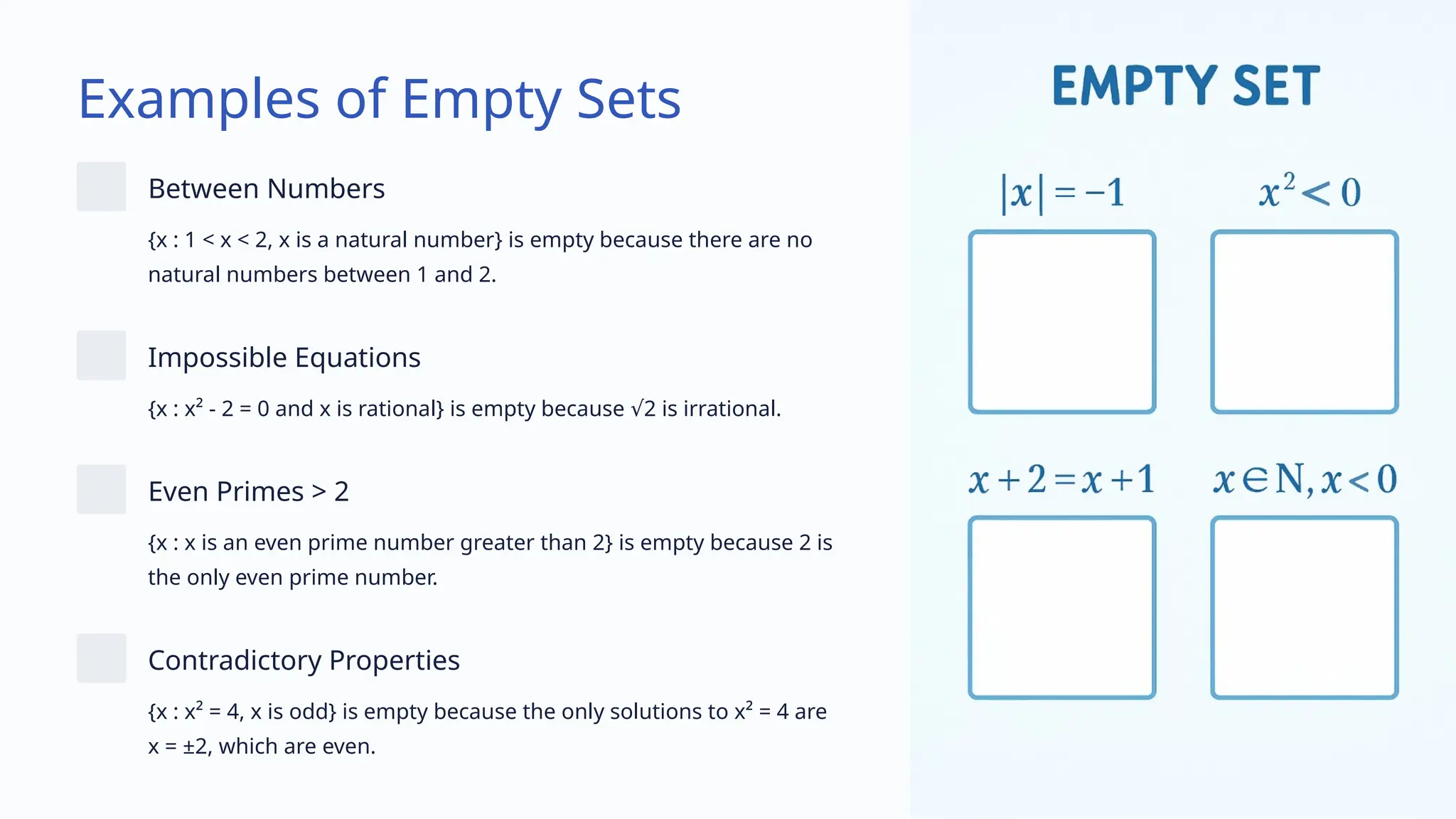
Between Numbers
{x : 1 < x < 2, x is a natural number} is empty because there are no
natural numbers between 1 and 2.
Impossible Equations
{x : x² - 2 = 0 and x is rational} is empty because 2 is irrational.
√
Even Primes > 2
{x : x is an even prime number greater than 2} is empty because 2 is
the only even prime number.
Contradictory Properties
{x : x² = 4, x is odd} is empty because the only solutions to x² = 4 are
x = ±2, which are even.
10.
Finite and InfiniteSets
Finite Sets
A set is finite if it is empty or contains a definite number of
elements. Examples include:
• The days of the week {Monday, Tuesday, Wednesday,
Thursday, Friday, Saturday, Sunday}
• The set {1, 2, 3, 4, 5}
• The set of solutions to x² = 16
Infinite Sets
A set is infinite if it is not finite. Examples include:
• The set of natural numbers {1, 2, 3, ...}
• The set of integers {..., -2, -1, 0, 1, 2, ...}
• The set of points on a line
11.
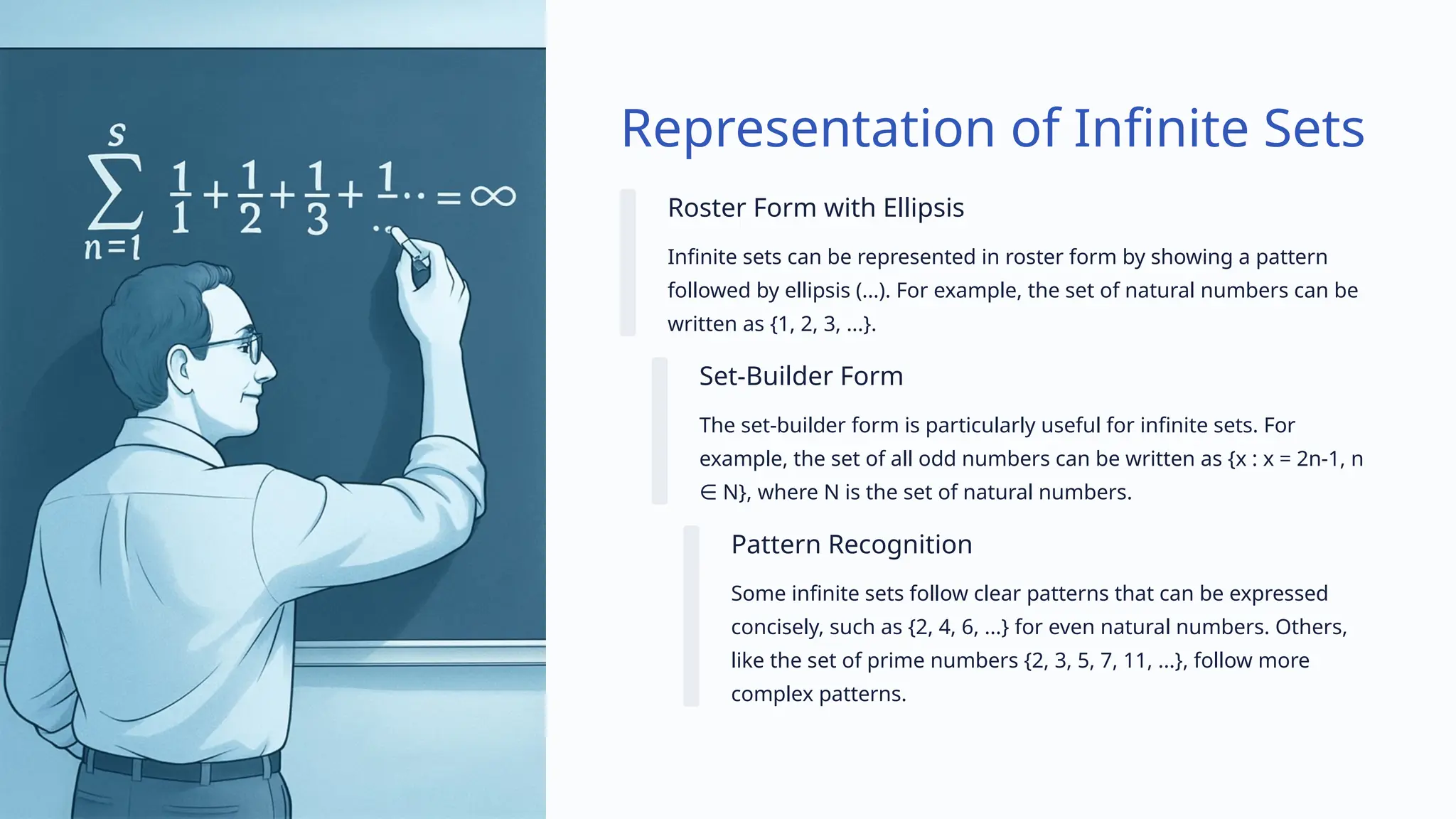
Representation of InfiniteSets
Roster Form with Ellipsis
Infinite sets can be represented in roster form by showing a pattern
followed by ellipsis (...). For example, the set of natural numbers can be
written as {1, 2, 3, ...}.
Set-Builder Form
The set-builder form is particularly useful for infinite sets. For
example, the set of all odd numbers can be written as {x : x = 2n-1, n
N}, where N is the set of natural numbers.
∈
Pattern Recognition
Some infinite sets follow clear patterns that can be expressed
concisely, such as {2, 4, 6, ...} for even natural numbers. Others,
like the set of prime numbers {2, 3, 5, 7, 11, ...}, follow more
complex patterns.
12.
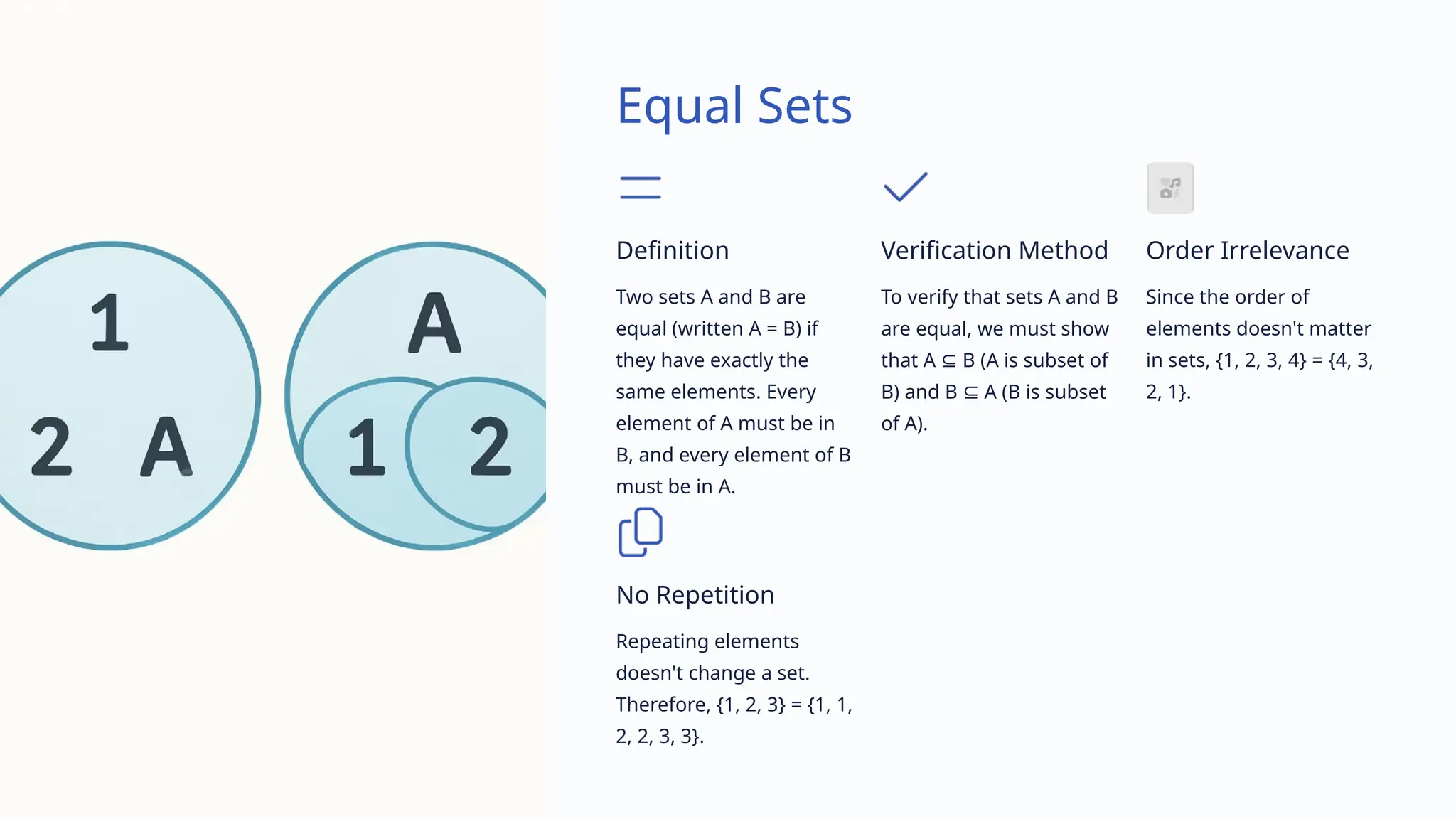
Equal Sets
Definition
Two setsA and B are
equal (written A = B) if
they have exactly the
same elements. Every
element of A must be in
B, and every element of B
must be in A.
Verification Method
To verify that sets A and B
are equal, we must show
that A B (A is subset of
⊆
B) and B A (B is subset
⊆
of A).
Order Irrelevance
Since the order of
elements doesn't matter
in sets, {1, 2, 3, 4} = {4, 3,
2, 1}.
No Repetition
Repeating elements
doesn't change a set.
Therefore, {1, 2, 3} = {1, 1,
2, 2, 3, 3}.
13.
Examples of EqualSets
Different Notations
The set {x : x² - 5x + 6 = 0} = {2, 3}, as
these are the solutions to the
equation.
Rearranged Letters
The set of letters in "ALLOY" equals
the set of letters in "LOYAL": {A, L, L,
O, Y} = {L, O, Y, A, L} = {A, L, O, Y}.
Set Definitions
The set of prime numbers less than 6
equals the set of prime factors of 30:
{2, 3, 5}.
Equal by Construction
If A = {1, 3, 5} and B = {x : x is an odd
natural number less than 6}, then A =
B.
14.
Subsets
Definition
A set Ais a subset of set B (written A B) if every element of A is also an element of B. In symbolic form: A B if for every x,
⊆ ⊆
if x A then x B.
∈ ∈
Proper Subset
If A B and A ≠ B, then A is called a proper subset of B, written as A B. This means A contains some but not all elements of B.
⊆ ⊂
Empty Set Property
The empty set is a subset of every set. This follows from the definition: there is no element in that is not also in any other set.
∅ ∅
Self-Subset
Every set is a subset of itself. That is, for any set A, A A. This is because every element of A is certainly an element of A.
⊆
15.
Examples of Subsets
NumberSystems
The set of natural numbers N is a subset of the set of integers Z, which is a subset of the set of rational numbers Q, which is a subset of the set of real numbers R.
We can write this as N Z Q R.
⊆ ⊆ ⊆
Prime Numbers
The set of prime numbers is a subset of the set of natural numbers. Since every prime number is a natural number, but not every natural number is prime.
Geometric Shapes
The set of all equilateral triangles is a subset of the set of all triangles, which is a subset of the set of all polygons. Every equilateral triangle is a triangle, and every
triangle is a polygon.
16.
Intervals as Subsetsof Real Numbers
Open Interval
An open interval (a,b) consists of all real numbers x such that a < x < b. The endpoints a
and b are not included.
Closed Interval
A closed interval [a,b] includes all real numbers x such that a x b. Both endpoints are
≤ ≤
included.
Half-Open Intervals
The intervals [a,b) and (a,b] include one endpoint but not the other. [a,b) includes a but
not b, while (a,b] includes b but not a.
Infinite Intervals
Intervals like [a, ), (- ,b], (a, ), and (- ,b) represent unbounded sets of real numbers,
∞ ∞ ∞ ∞
extending infinitely in one direction.
17.
Universal Set
Definition
The universalset is the set of all
elements under consideration in a
particular context. It is usually
denoted by U.
Relation to Other Sets
All other sets in the discussion are
subsets of the universal set. Every
set A satisfies A U.
⊆
2
Context Dependence
The universal set depends on the
context of the problem. For example,
when discussing natural numbers,
the universal set might be integers,
rational numbers, or real numbers.
Examples
In population studies, the universal
set might be all people in the world.
In geometry, it might be all points in
a plane.
18.
Venn Diagrams
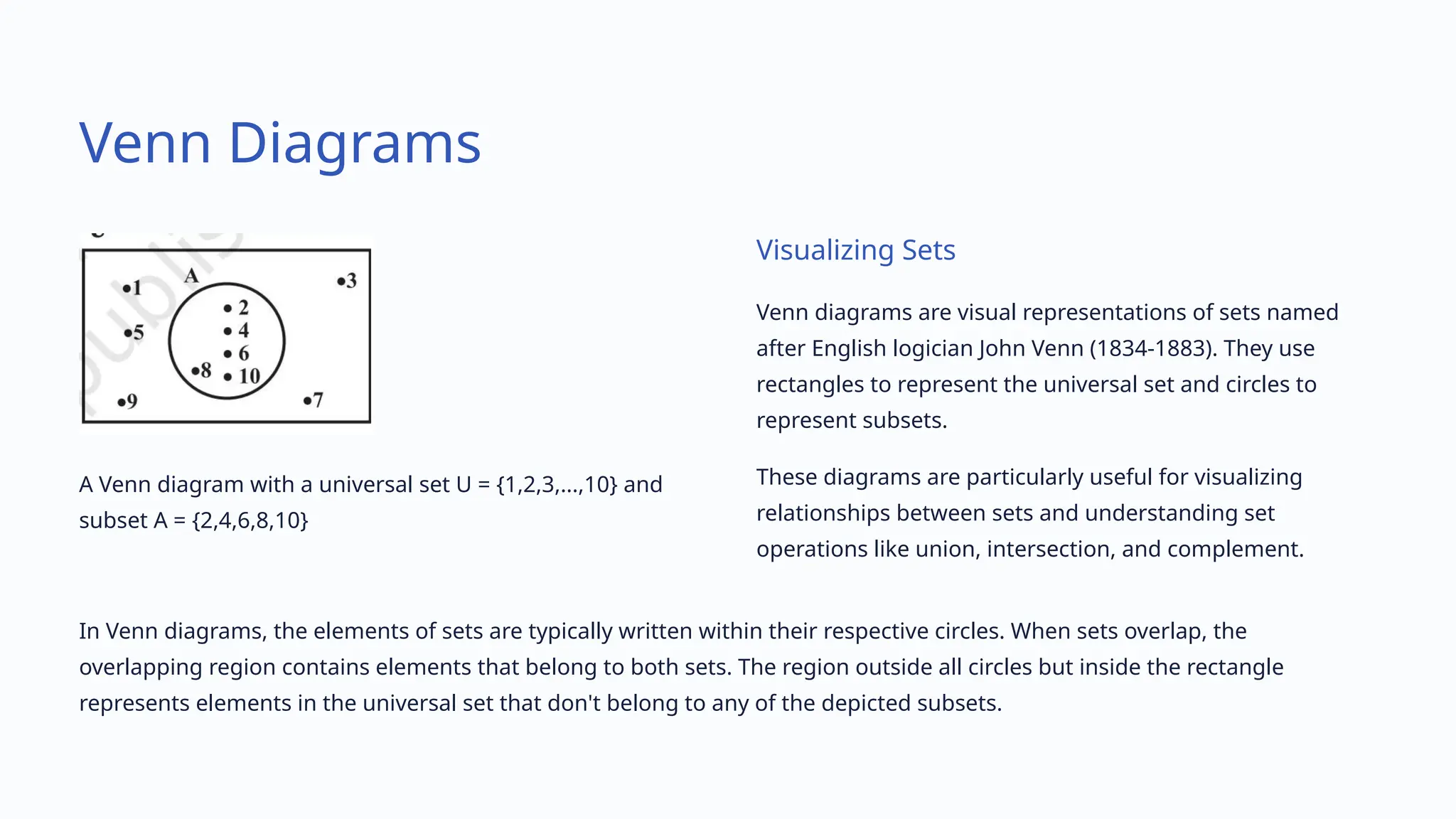
A Venndiagram with a universal set U = {1,2,3,...,10} and
subset A = {2,4,6,8,10}
Visualizing Sets
Venn diagrams are visual representations of sets named
after English logician John Venn (1834-1883). They use
rectangles to represent the universal set and circles to
represent subsets.
These diagrams are particularly useful for visualizing
relationships between sets and understanding set
operations like union, intersection, and complement.
In Venn diagrams, the elements of sets are typically written within their respective circles. When sets overlap, the
overlapping region contains elements that belong to both sets. The region outside all circles but inside the rectangle
represents elements in the universal set that don't belong to any of the depicted subsets.
19.
Examples of VennDiagrams
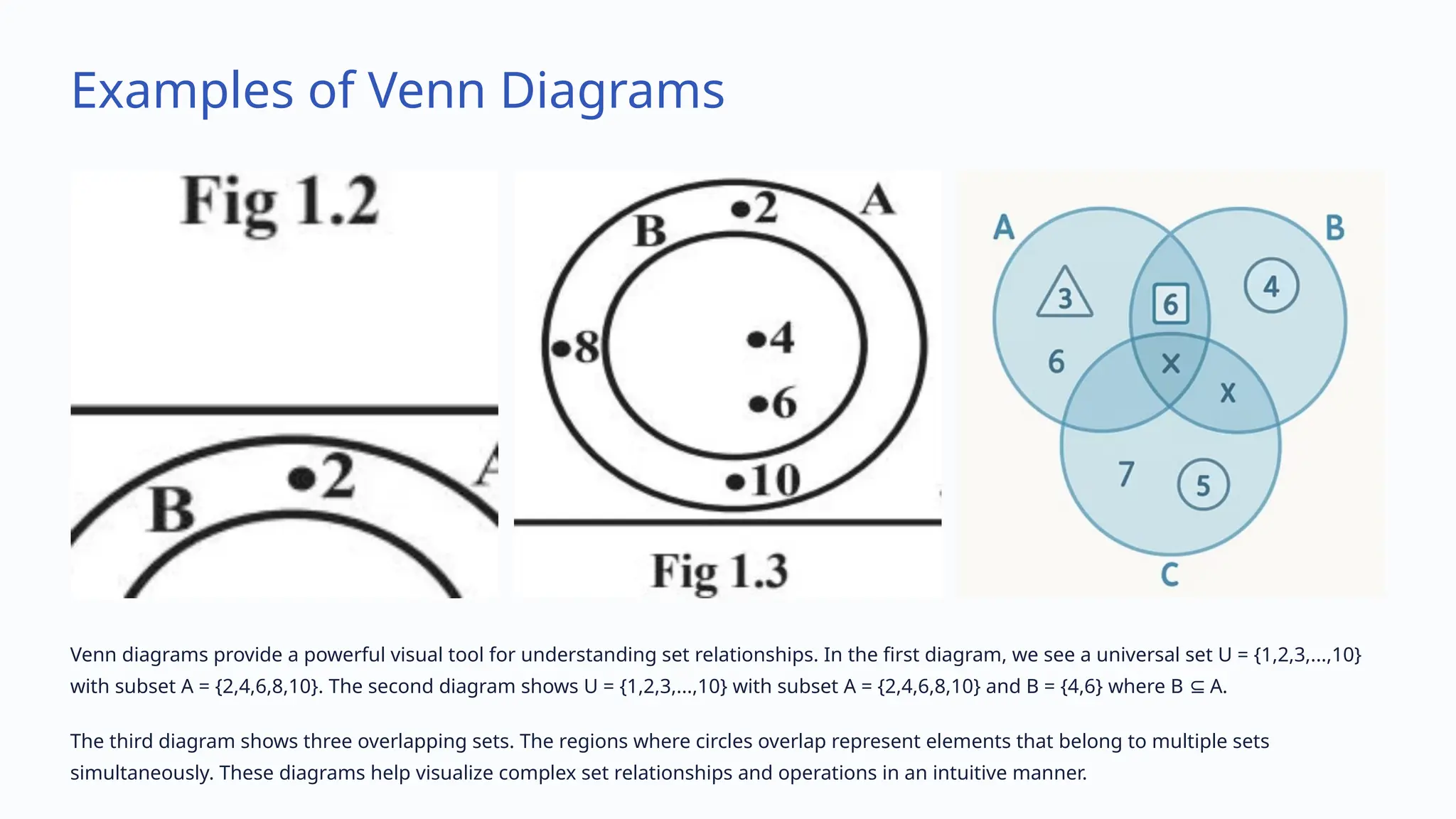
Venn diagrams provide a powerful visual tool for understanding set relationships. In the first diagram, we see a universal set U = {1,2,3,...,10}
with subset A = {2,4,6,8,10}. The second diagram shows U = {1,2,3,...,10} with subset A = {2,4,6,8,10} and B = {4,6} where B A.
⊆
The third diagram shows three overlapping sets. The regions where circles overlap represent elements that belong to multiple sets
simultaneously. These diagrams help visualize complex set relationships and operations in an intuitive manner.
20.
Operations on Sets:Union
Definition
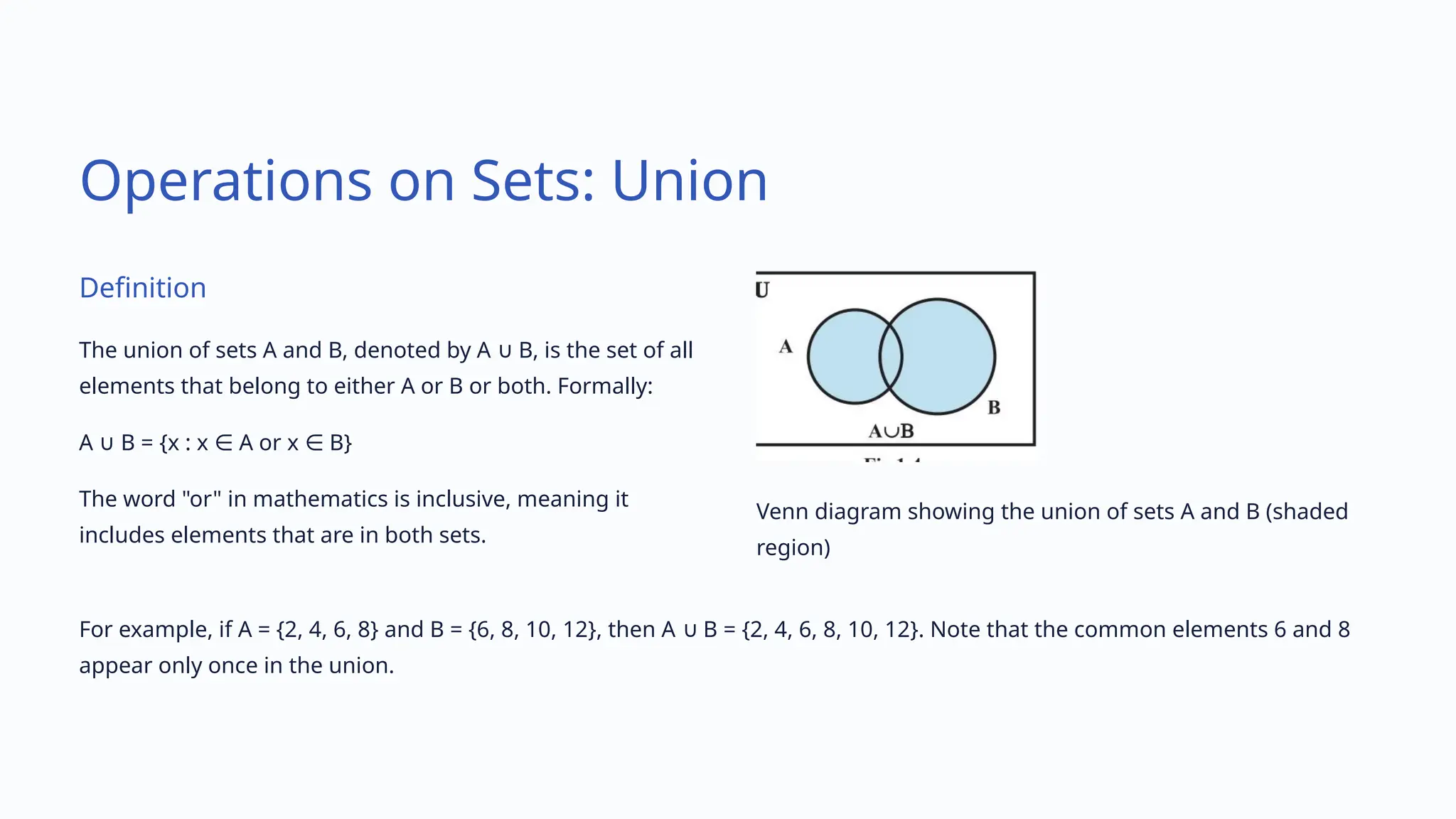
The union of sets A and B, denoted by A B, is the set of all
∪
elements that belong to either A or B or both. Formally:
A B = {x : x A or x B}
∪ ∈ ∈
The word "or" in mathematics is inclusive, meaning it
includes elements that are in both sets.
Venn diagram showing the union of sets A and B (shaded
region)
For example, if A = {2, 4, 6, 8} and B = {6, 8, 10, 12}, then A B = {2, 4, 6, 8, 10, 12}. Note that the common elements 6 and 8
∪
appear only once in the union.
21.
Properties of Union
CommutativeLaw
A B = B A
∪ ∪
The order of sets in a union doesn't matter. For
example, {1, 2} {2, 3, 4} = {2, 3, 4} {1, 2} = {1, 2, 3,
∪ ∪
4}.
Associative Law
(A B) C = A (B C)
∪ ∪ ∪ ∪
The grouping of sets in unions doesn't affect the
result. This allows us to write expressions like A B
∪ ∪
C without ambiguity.
Identity Law
A = A
∪ ∅
The empty set is the identity element for union.
Adding the empty set to any set leaves it unchanged.
Idempotent Law
A A = A
∪
Uniting a set with itself produces the same set, as
there are no new elements to add.
22.
Operations on Sets:Intersection
Definition
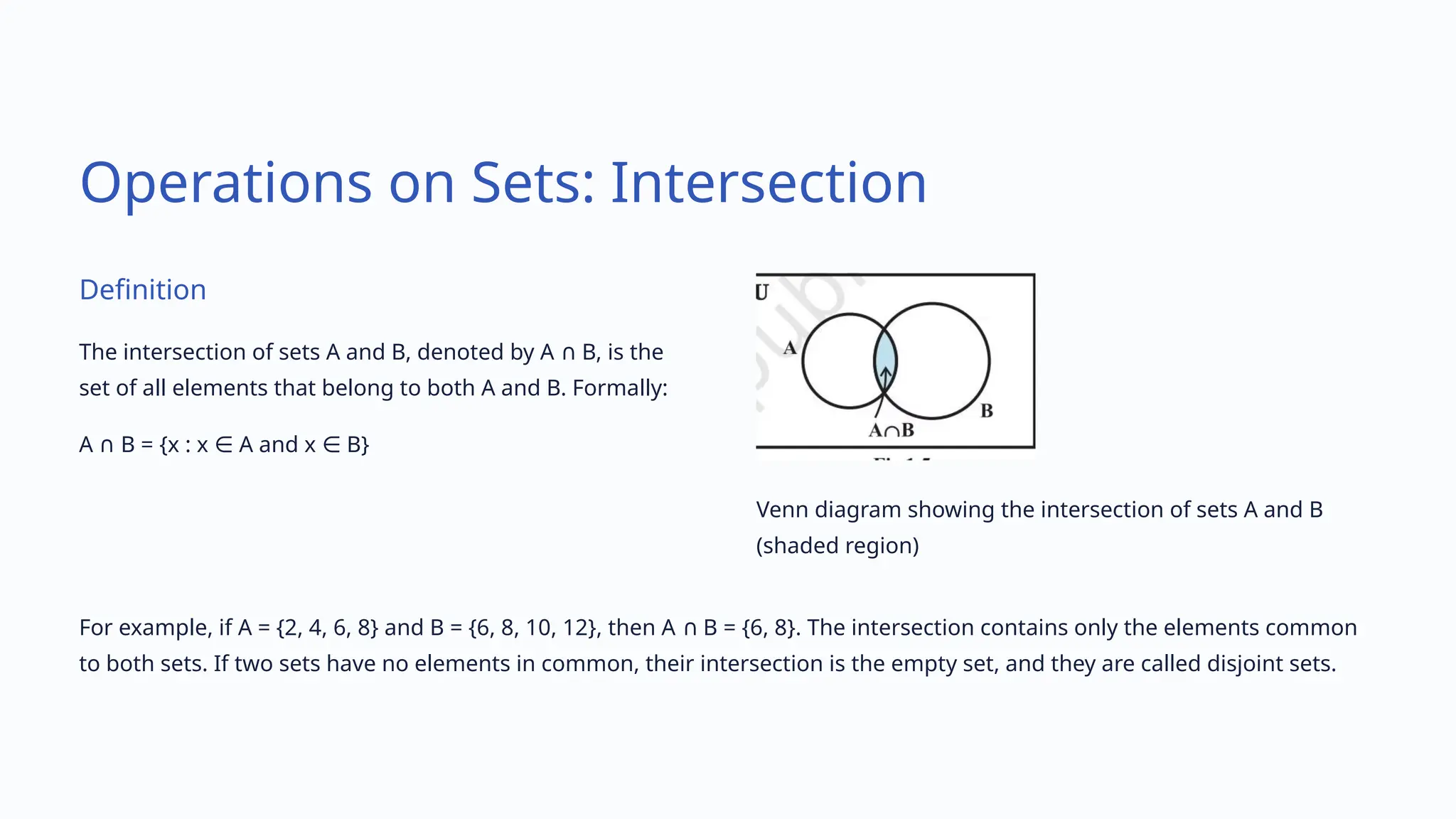
The intersection of sets A and B, denoted by A B, is the
∩
set of all elements that belong to both A and B. Formally:
A B = {x : x A and x B}
∩ ∈ ∈
Venn diagram showing the intersection of sets A and B
(shaded region)
For example, if A = {2, 4, 6, 8} and B = {6, 8, 10, 12}, then A B = {6, 8}. The intersection contains only the elements common
∩
to both sets. If two sets have no elements in common, their intersection is the empty set, and they are called disjoint sets.
23.
Properties of Intersection
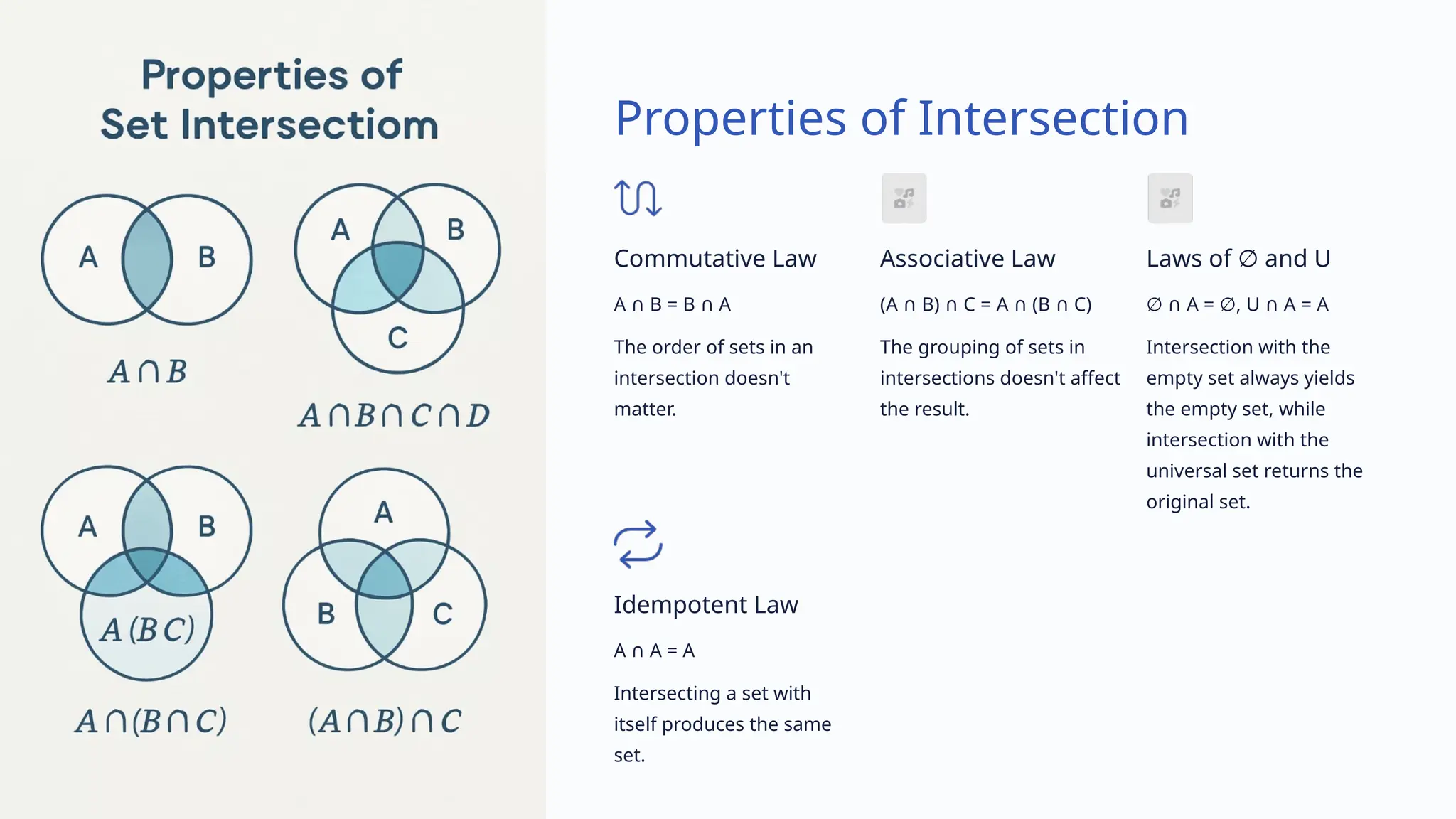
CommutativeLaw
A B = B A
∩ ∩
The order of sets in an
intersection doesn't
matter.
Associative Law
(A B) C = A (B C)
∩ ∩ ∩ ∩
The grouping of sets in
intersections doesn't affect
the result.
Laws of and U
∅
∅ ∩ A = , U A = A
∅ ∩
Intersection with the
empty set always yields
the empty set, while
intersection with the
universal set returns the
original set.
Idempotent Law
A A = A
∩
Intersecting a set with
itself produces the same
set.
24.
Disjoint Sets
Definition
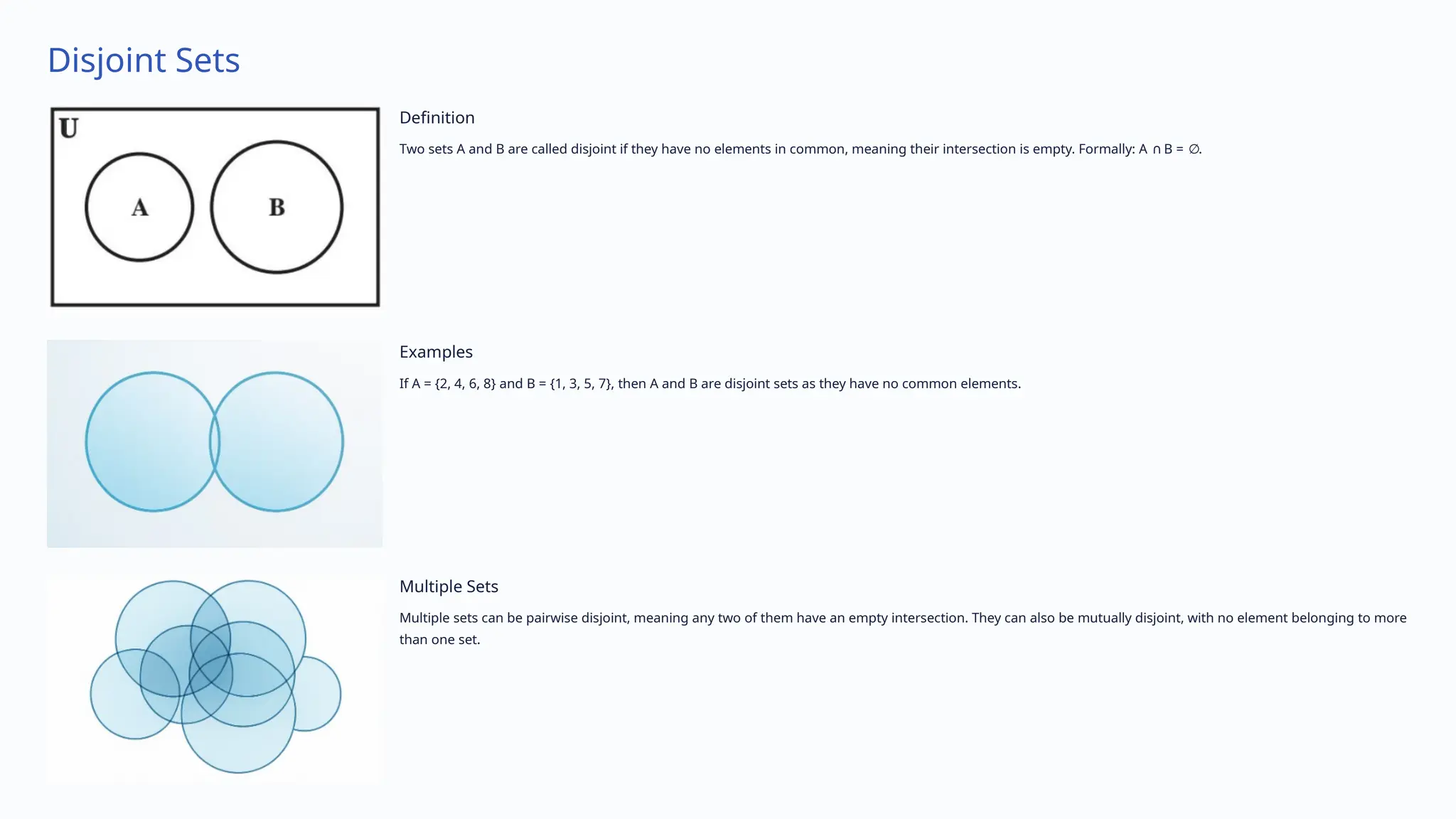
Two setsA and B are called disjoint if they have no elements in common, meaning their intersection is empty. Formally: A B = .
∩ ∅
Examples
If A = {2, 4, 6, 8} and B = {1, 3, 5, 7}, then A and B are disjoint sets as they have no common elements.
Multiple Sets
Multiple sets can be pairwise disjoint, meaning any two of them have an empty intersection. They can also be mutually disjoint, with no element belonging to more
than one set.
25.
Distributive Law ofSet Operations
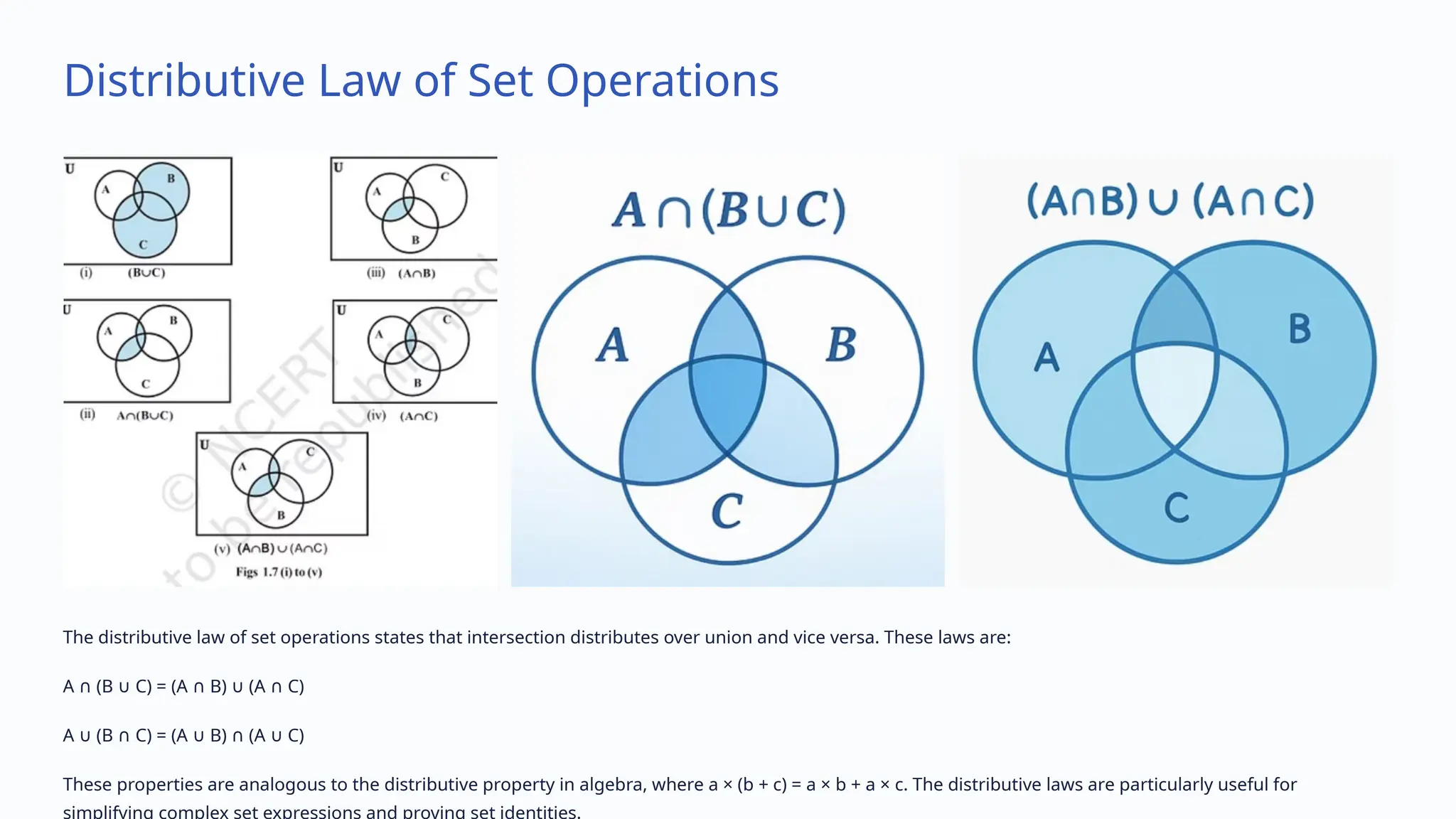
The distributive law of set operations states that intersection distributes over union and vice versa. These laws are:
A (B C) = (A B) (A C)
∩ ∪ ∩ ∪ ∩
A (B C) = (A B) (A C)
∪ ∩ ∪ ∩ ∪
These properties are analogous to the distributive property in algebra, where a × (b + c) = a × b + a × c. The distributive laws are particularly useful for
simplifying complex set expressions and proving set identities.
26.
Operations on Sets:Difference
Definition
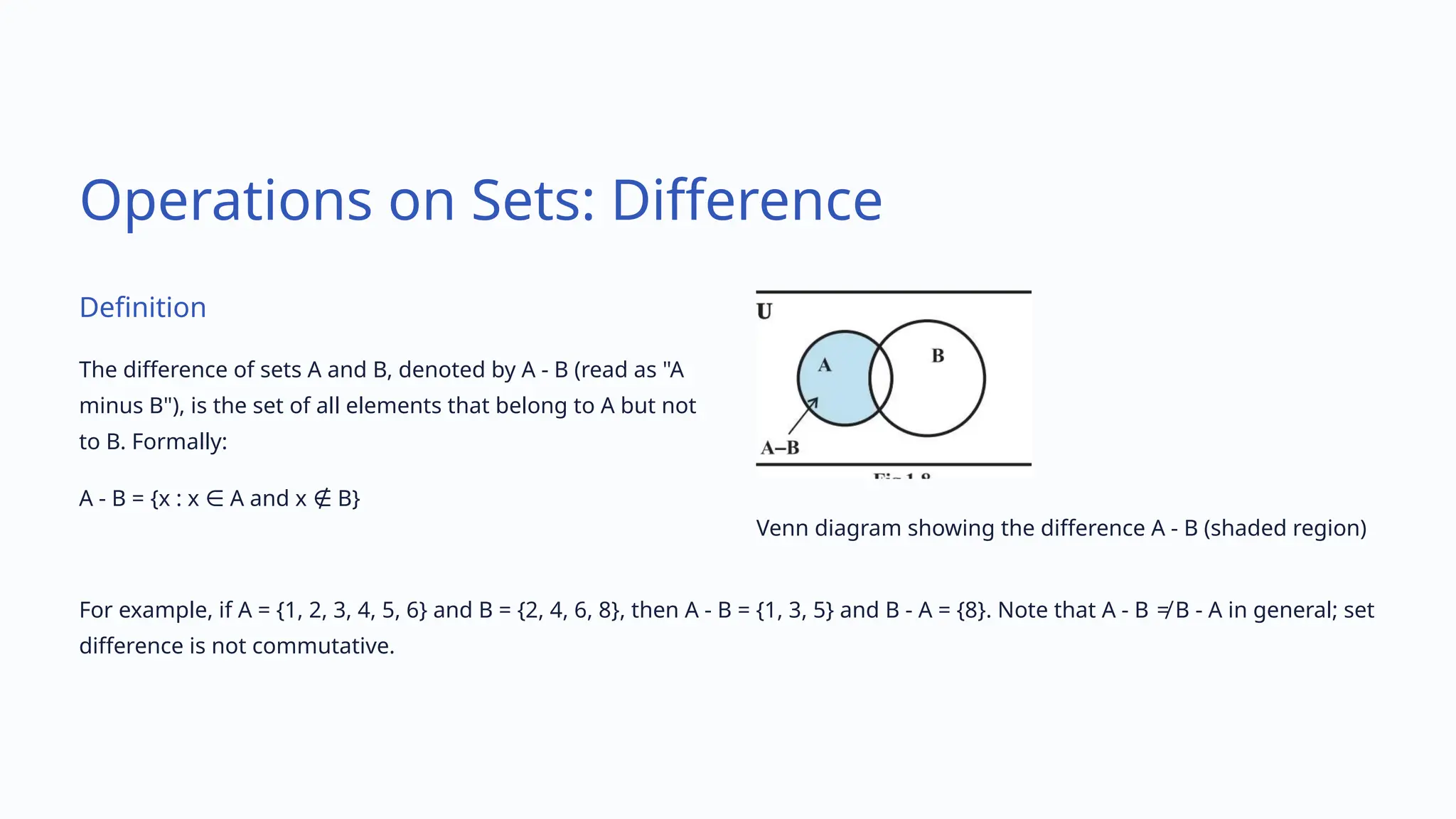
The difference of sets A and B, denoted by A - B (read as "A
minus B"), is the set of all elements that belong to A but not
to B. Formally:
A - B = {x : x A and x B}
∈ ∉
Venn diagram showing the difference A - B (shaded region)
For example, if A = {1, 2, 3, 4, 5, 6} and B = {2, 4, 6, 8}, then A - B = {1, 3, 5} and B - A = {8}. Note that A - B ≠ B - A in general; set
difference is not commutative.
27.
Examples of SetDifference
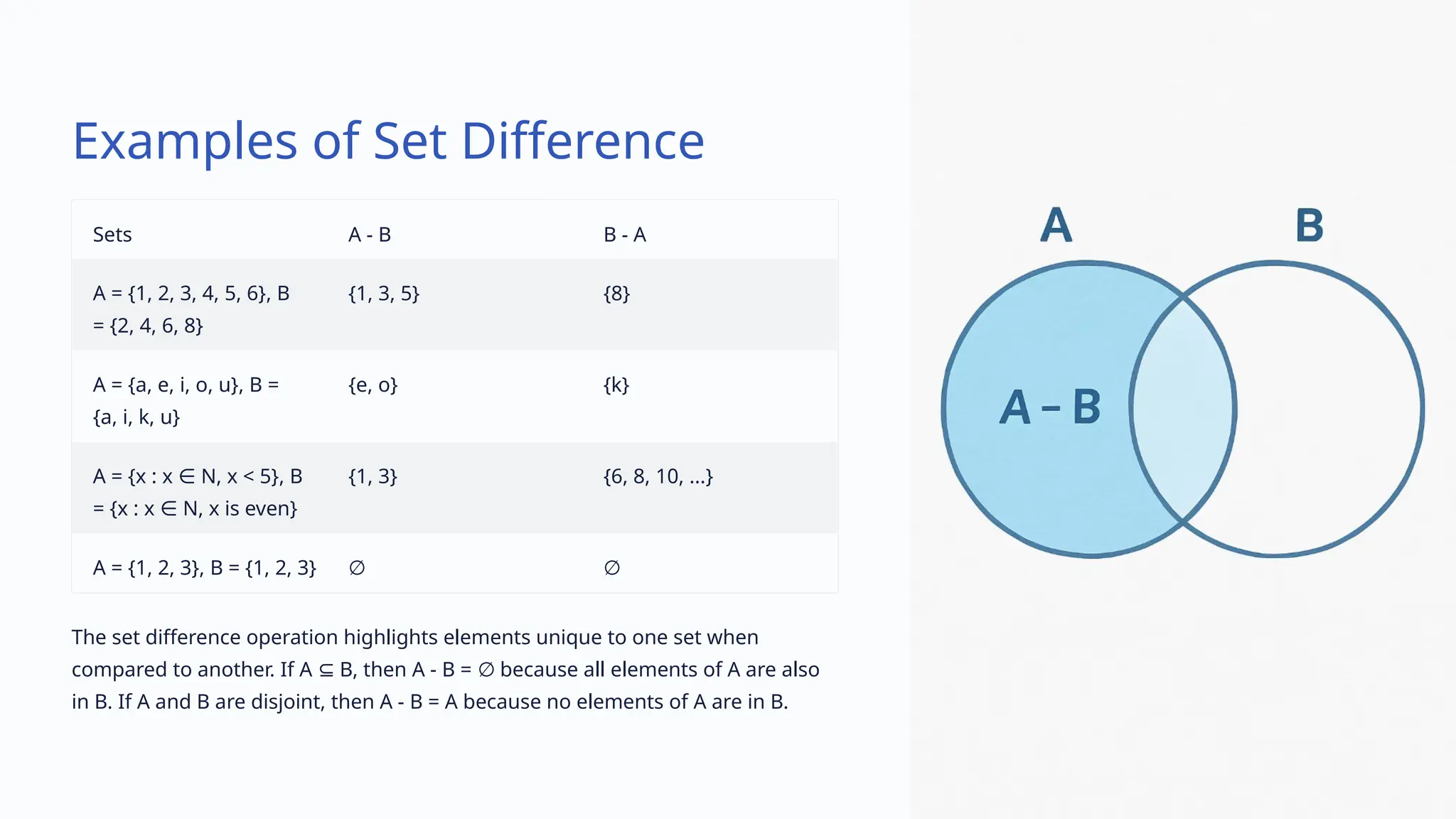
Sets A - B B - A
A = {1, 2, 3, 4, 5, 6}, B
= {2, 4, 6, 8}
{1, 3, 5} {8}
A = {a, e, i, o, u}, B =
{a, i, k, u}
{e, o} {k}
A = {x : x N, x < 5}, B
∈
= {x : x N, x is even}
∈
{1, 3} {6, 8, 10, ...}
A = {1, 2, 3}, B = {1, 2, 3} ∅ ∅
The set difference operation highlights elements unique to one set when
compared to another. If A B, then A - B = because all elements of A are also
⊆ ∅
in B. If A and B are disjoint, then A - B = A because no elements of A are in B.
28.
Mutually Disjoint Regionsin Sets
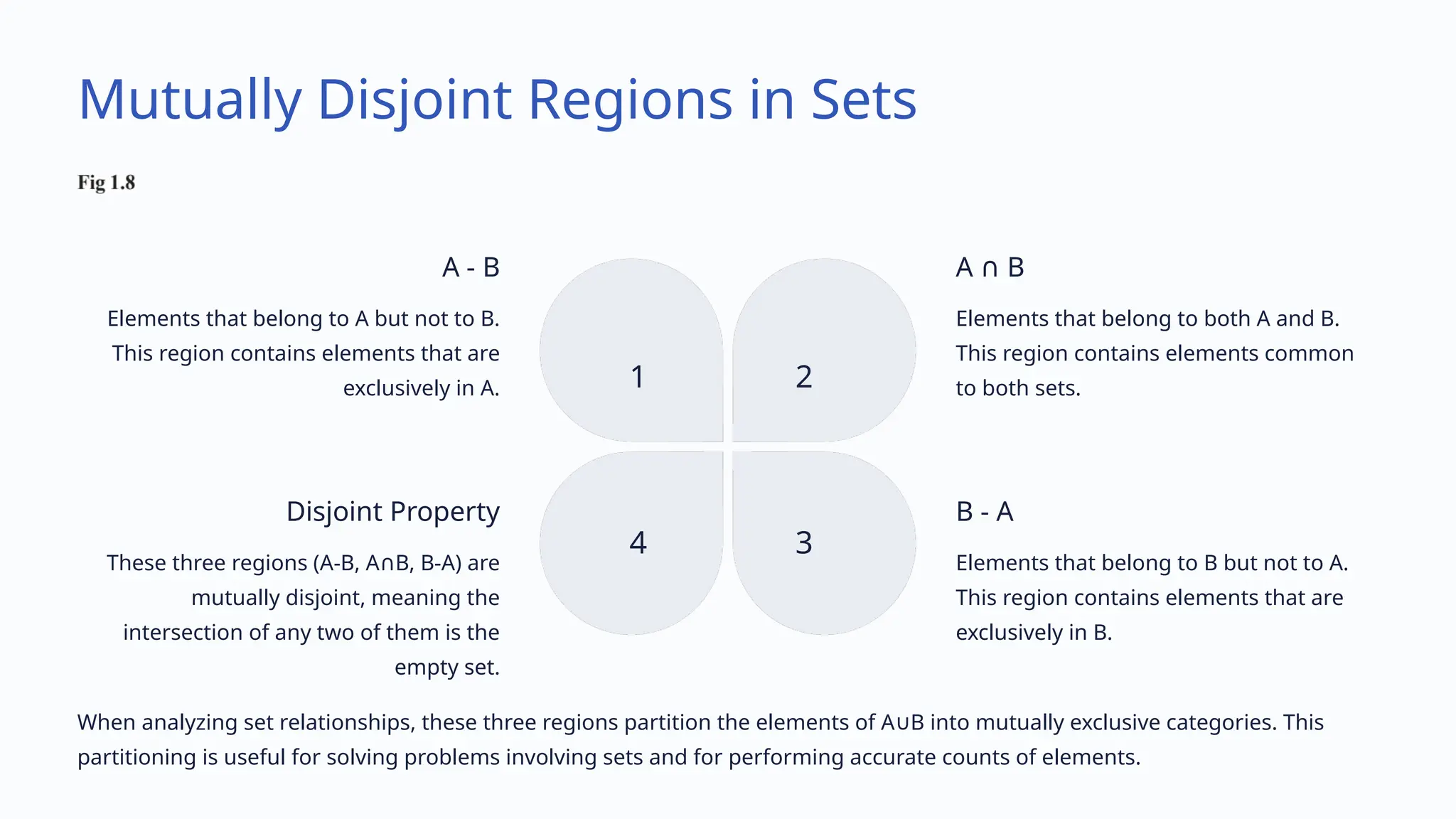
A - B
Elements that belong to A but not to B.
This region contains elements that are
exclusively in A. 1
A B
∩
Elements that belong to both A and B.
This region contains elements common
to both sets.
2
B - A
Elements that belong to B but not to A.
This region contains elements that are
exclusively in B.
3
Disjoint Property
These three regions (A-B, A B, B-A) are
∩
mutually disjoint, meaning the
intersection of any two of them is the
empty set.
4
When analyzing set relationships, these three regions partition the elements of A B into mutually exclusive categories. This
∪
partitioning is useful for solving problems involving sets and for performing accurate counts of elements.
29.
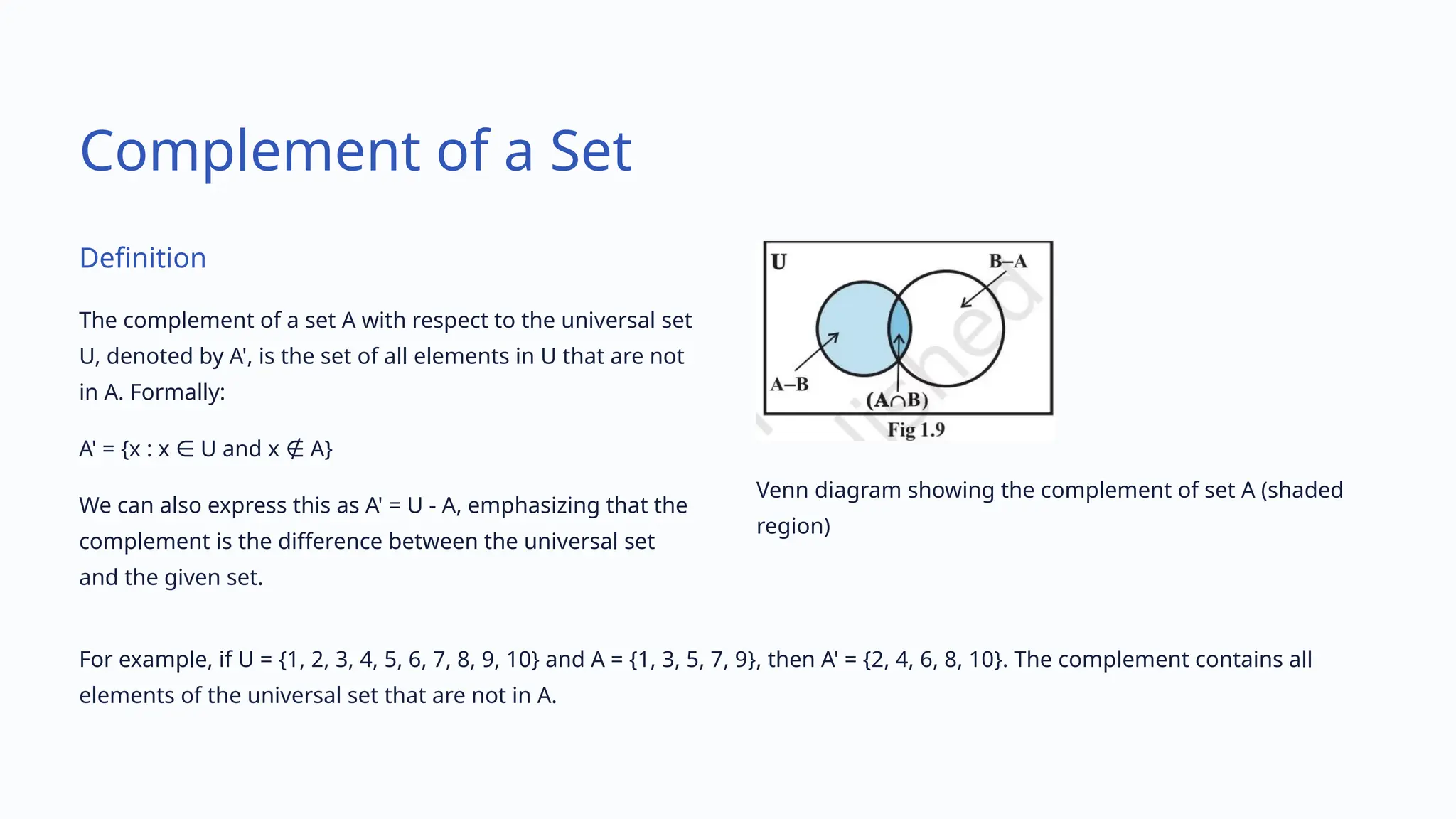
Complement of aSet
Definition
The complement of a set A with respect to the universal set
U, denoted by A', is the set of all elements in U that are not
in A. Formally:
A' = {x : x U and x A}
∈ ∉
We can also express this as A' = U - A, emphasizing that the
complement is the difference between the universal set
and the given set.
Venn diagram showing the complement of set A (shaded
region)
For example, if U = {1, 2, 3, 4, 5, 6, 7, 8, 9, 10} and A = {1, 3, 5, 7, 9}, then A' = {2, 4, 6, 8, 10}. The complement contains all
elements of the universal set that are not in A.
30.
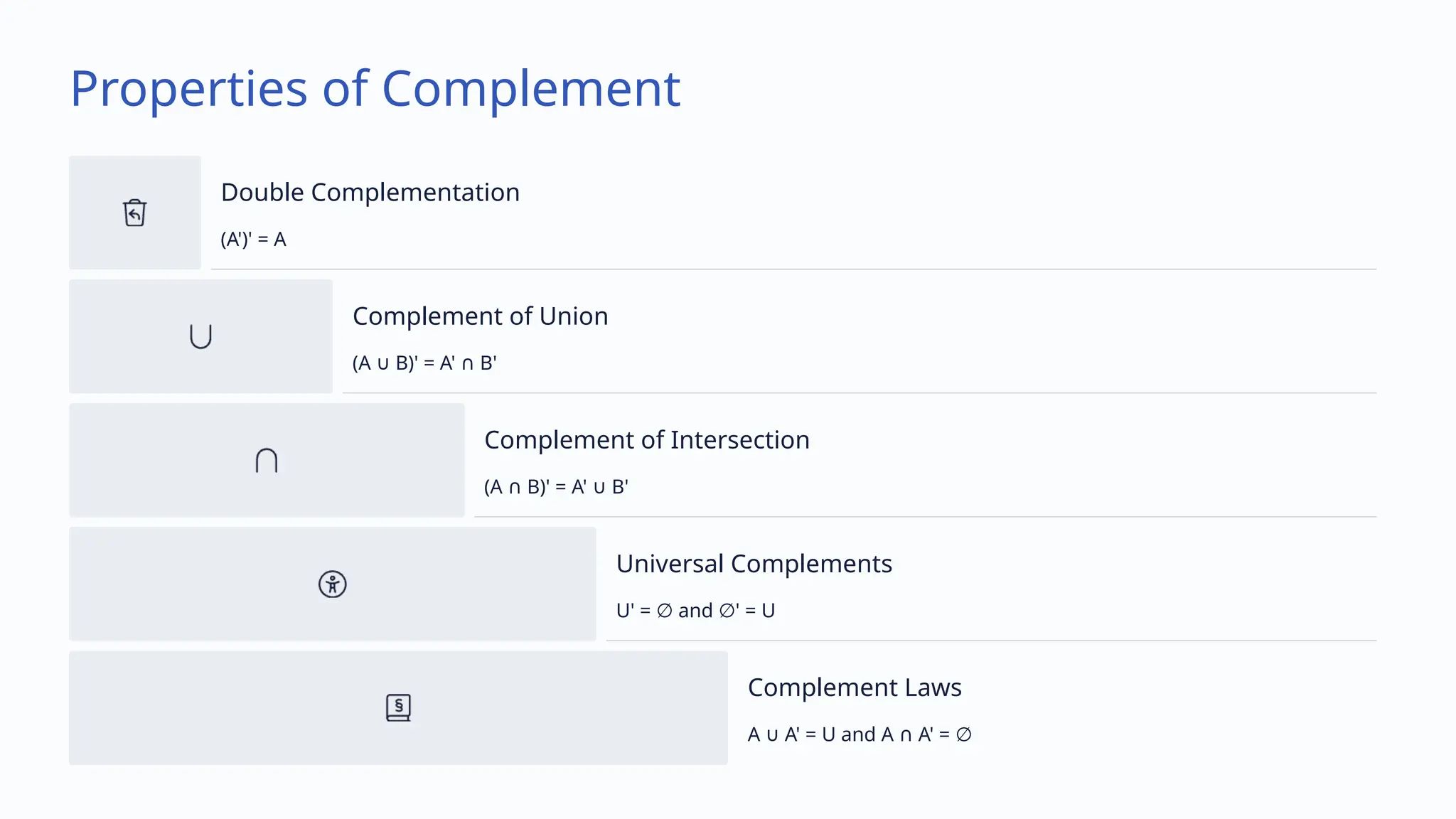
Properties of Complement
DoubleComplementation
(A')' = A
Complement of Union
(A B)' = A' B'
∪ ∩
Complement of Intersection
(A B)' = A' B'
∩ ∪
Universal Complements
U' = and ' = U
∅ ∅
Complement Laws
A A' = U and A A' =
∪ ∩ ∅
31.
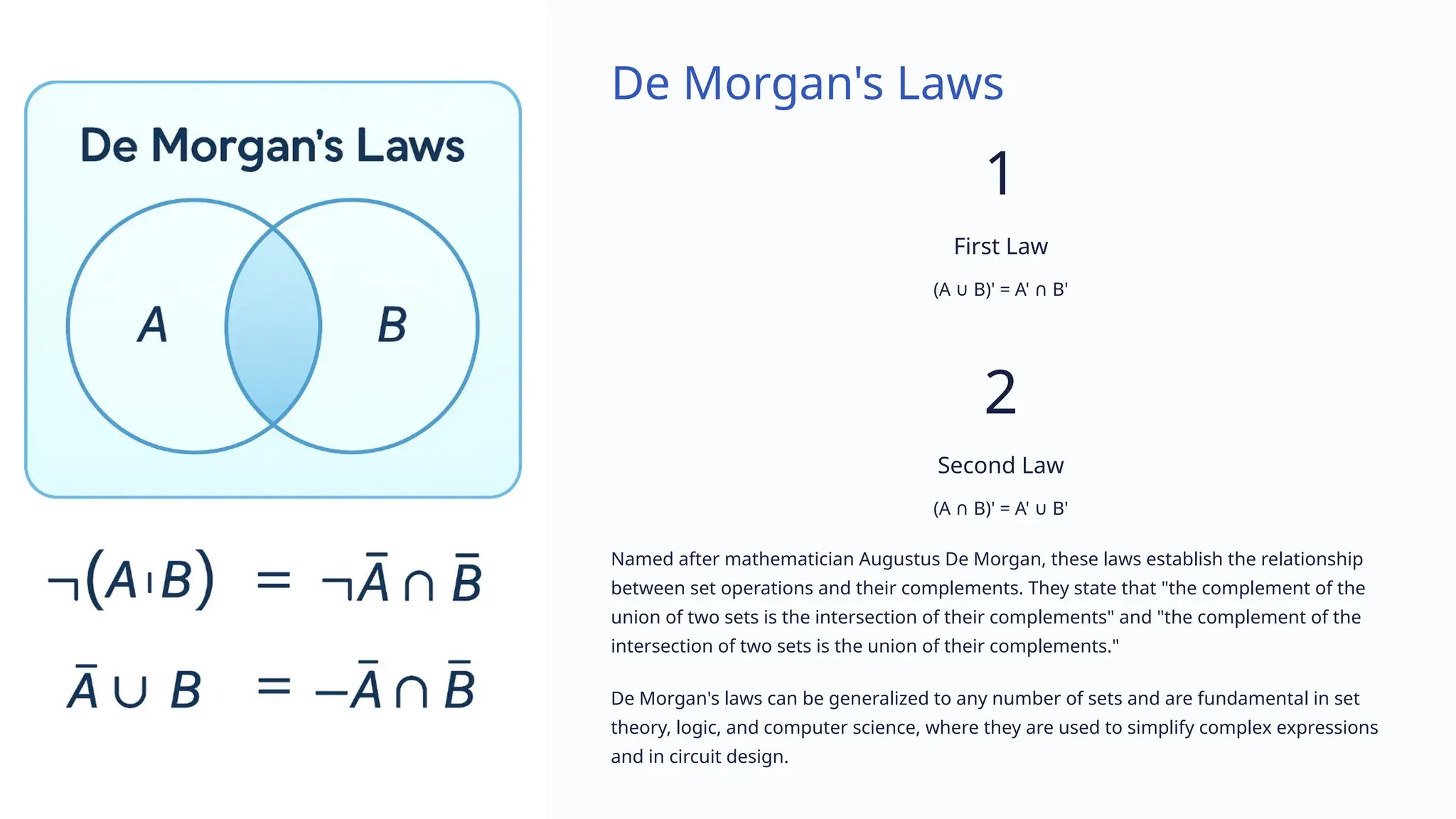
De Morgan's Laws
1
FirstLaw
(A B)' = A' B'
∪ ∩
2
Second Law
(A B)' = A' B'
∩ ∪
Named after mathematician Augustus De Morgan, these laws establish the relationship
between set operations and their complements. They state that "the complement of the
union of two sets is the intersection of their complements" and "the complement of the
intersection of two sets is the union of their complements."
De Morgan's laws can be generalized to any number of sets and are fundamental in set
theory, logic, and computer science, where they are used to simplify complex expressions
and in circuit design.
32.
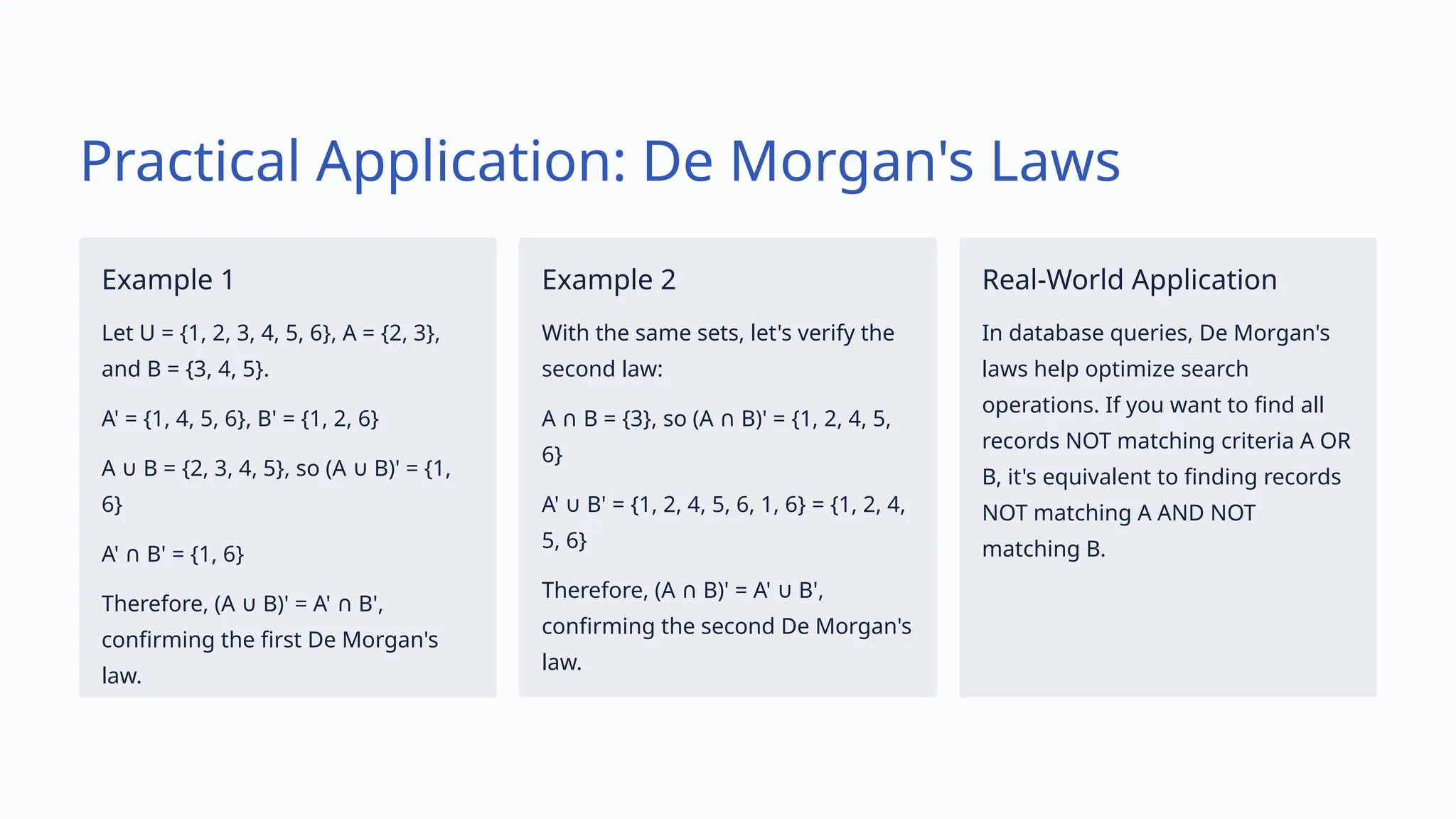
Practical Application: DeMorgan's Laws
Example 1
Let U = {1, 2, 3, 4, 5, 6}, A = {2, 3},
and B = {3, 4, 5}.
A' = {1, 4, 5, 6}, B' = {1, 2, 6}
A B = {2, 3, 4, 5}, so (A B)' = {1,
∪ ∪
6}
A' B' = {1, 6}
∩
Therefore, (A B)' = A' B',
∪ ∩
confirming the first De Morgan's
law.
Example 2
With the same sets, let's verify the
second law:
A B = {3}, so (A B)' = {1, 2, 4, 5,
∩ ∩
6}
A' B' = {1, 2, 4, 5, 6, 1, 6} = {1, 2, 4,
∪
5, 6}
Therefore, (A B)' = A' B',
∩ ∪
confirming the second De Morgan's
law.
Real-World Application
In database queries, De Morgan's
laws help optimize search
operations. If you want to find all
records NOT matching criteria A OR
B, it's equivalent to finding records
NOT matching A AND NOT
matching B.
33.
Power Set
Definition
The powerset of a set A, denoted by P(A) or 2^A, is the set
of all subsets of A, including the empty set and A itself.
For example, if A = {a, b}, then P(A) = { , {a}, {b}, {a, b}}.
∅
Properties
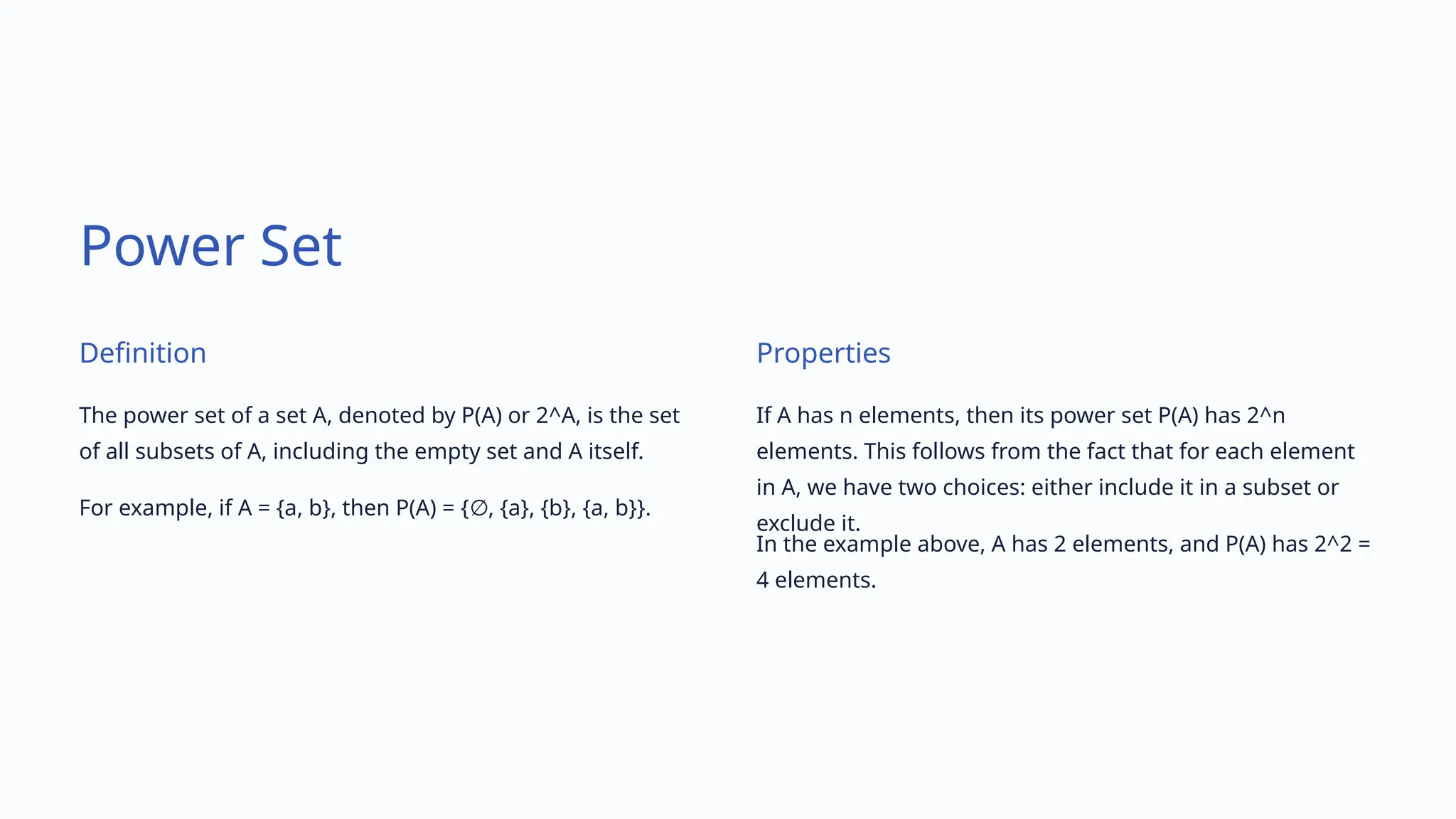
If A has n elements, then its power set P(A) has 2^n
elements. This follows from the fact that for each element
in A, we have two choices: either include it in a subset or
exclude it.
In the example above, A has 2 elements, and P(A) has 2^2 =
4 elements.
34.
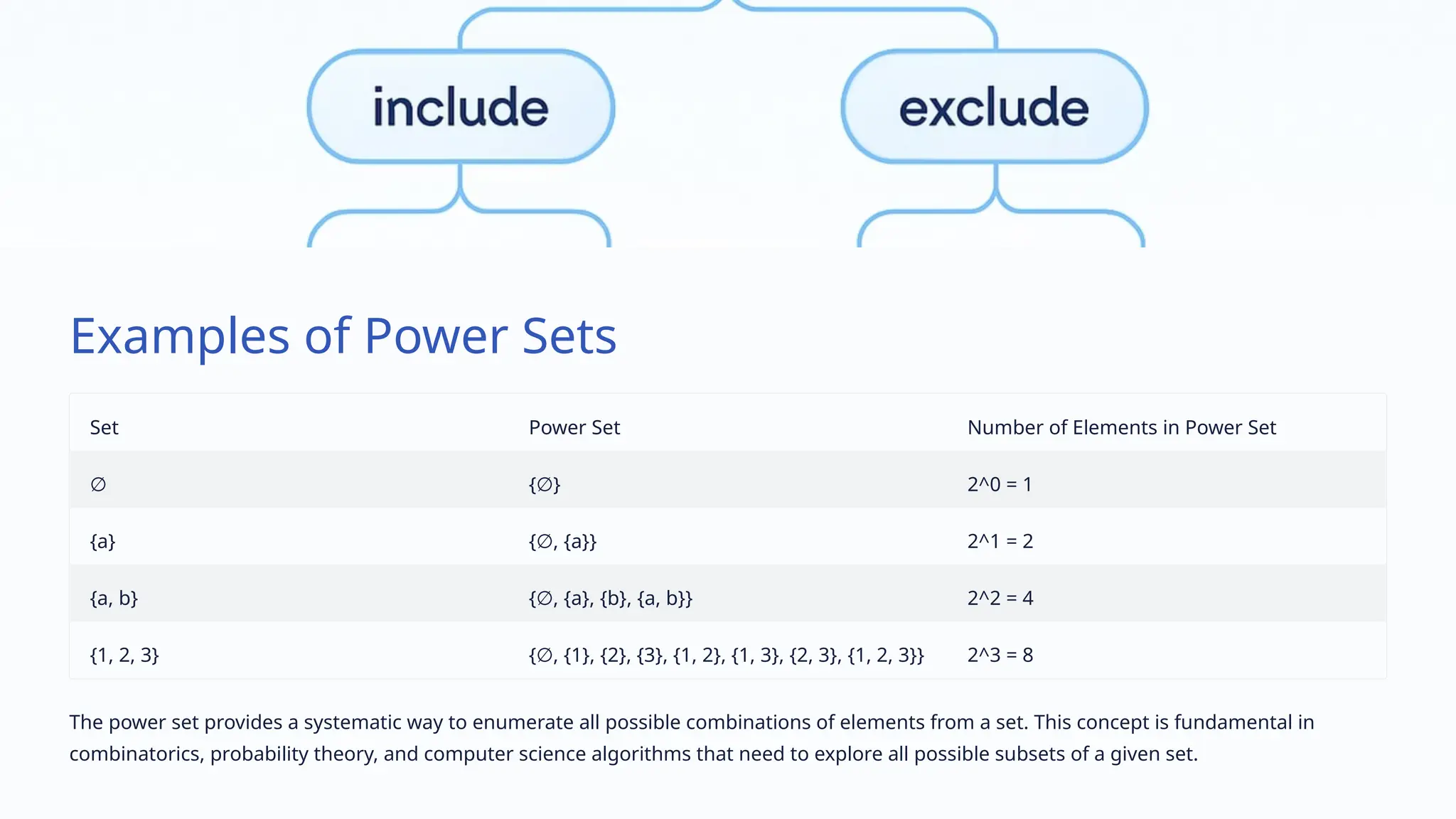
Examples of PowerSets
Set Power Set Number of Elements in Power Set
∅ { }
∅ 2^0 = 1
{a} { , {a}}
∅ 2^1 = 2
{a, b} { , {a}, {b}, {a, b}}
∅ 2^2 = 4
{1, 2, 3} { , {1}, {2}, {3}, {1, 2}, {1, 3}, {2, 3}, {1, 2, 3}}
∅ 2^3 = 8
The power set provides a systematic way to enumerate all possible combinations of elements from a set. This concept is fundamental in
combinatorics, probability theory, and computer science algorithms that need to explore all possible subsets of a given set.
35.
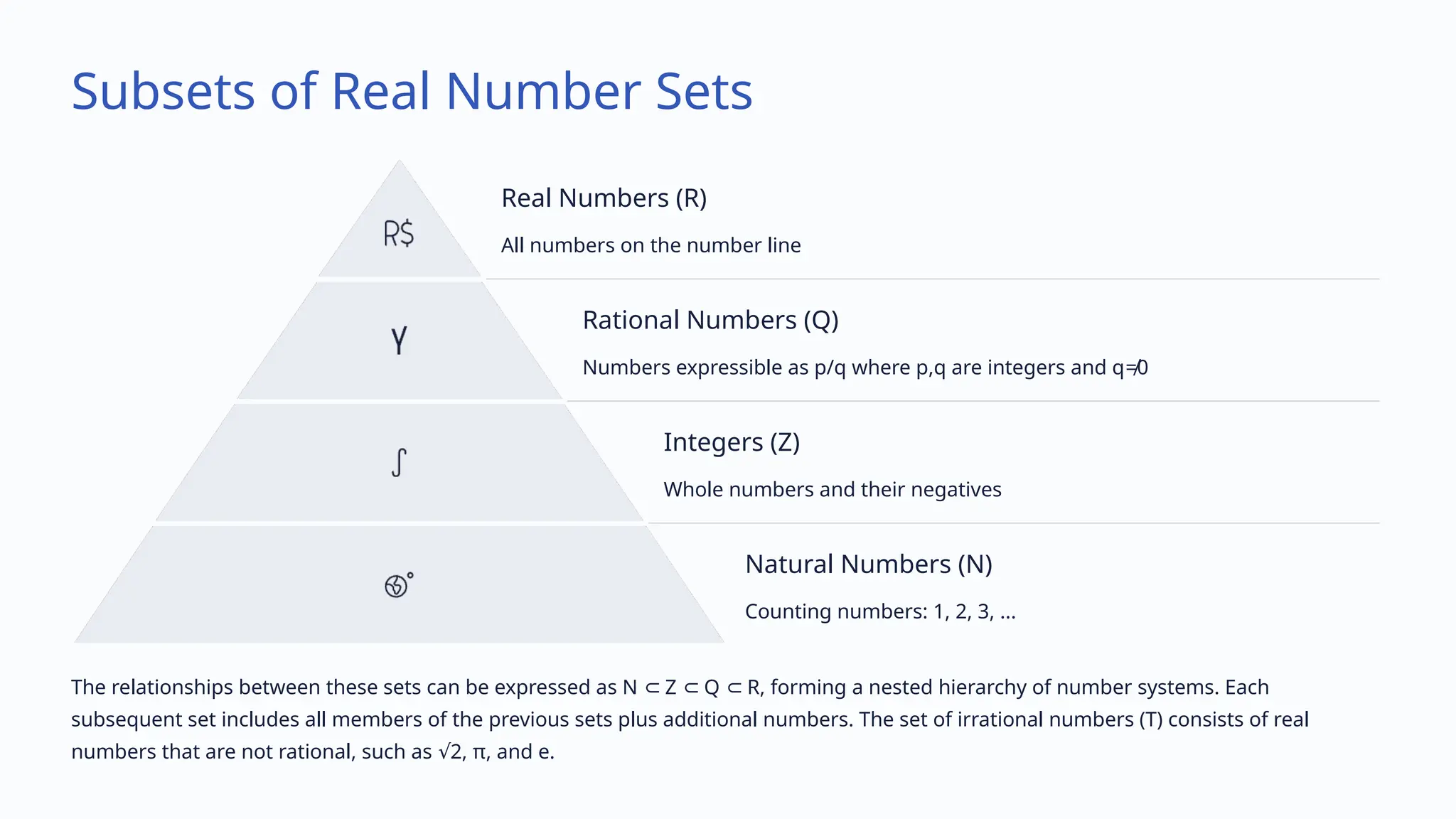
Subsets of RealNumber Sets
Real Numbers (R)
All numbers on the number line
Rational Numbers (Q)
Numbers expressible as p/q where p,q are integers and q≠0
Integers (Z)
Whole numbers and their negatives
Natural Numbers (N)
Counting numbers: 1, 2, 3, ...
The relationships between these sets can be expressed as N Z Q R, forming a nested hierarchy of number systems. Each
⊂ ⊂ ⊂
subsequent set includes all members of the previous sets plus additional numbers. The set of irrational numbers (T) consists of real
numbers that are not rational, such as 2, π, and e.
√
36.
Cardinality of aSet
Definition
The cardinality of a set A, denoted by n(A) or |A|, is the
number of distinct elements in the set.
Finite Sets
For finite sets, cardinality is simply the count of
elements. For example, if A = {2, 4, 6, 8}, then n(A) = 4.
Infinite Sets
For infinite sets, cardinality describes the "size" of
infinity. Cantor showed that not all infinite sets have the
same cardinality.
Set Operations and Cardinality
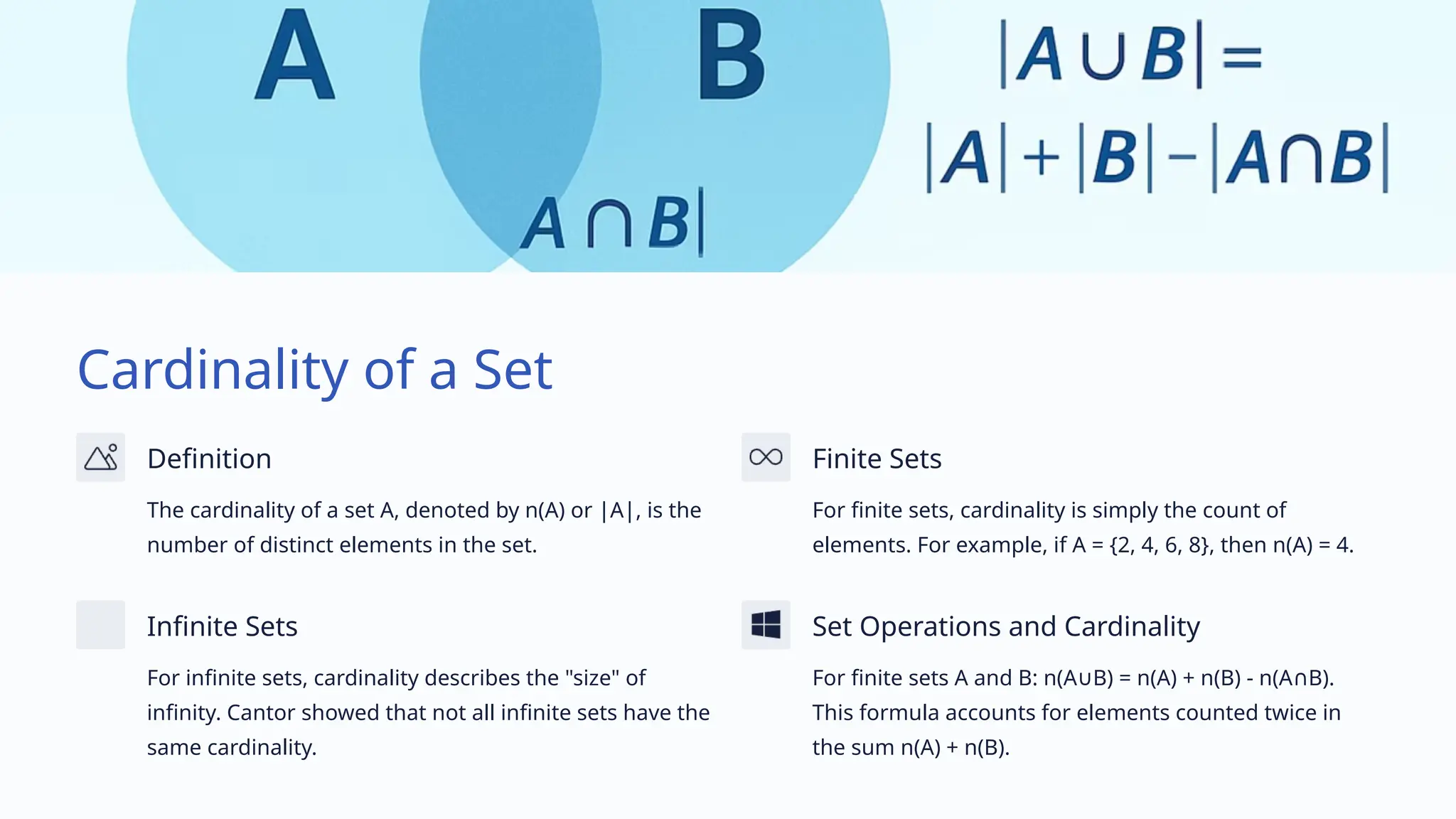
For finite sets A and B: n(A B) = n(A) + n(B) - n(A B).
∪ ∩
This formula accounts for elements counted twice in
the sum n(A) + n(B).
37.
Cardinality of InfiniteSets
Countable Infinity
Sets that can be put in one-to-one correspondence with the
natural numbers are said to have cardinality ℵ₀ (aleph-null).
Examples include:
• The set of integers Z
• The set of rational numbers Q
• The set of algebraic numbers
Uncountable Infinity
Sets that cannot be put in one-to-one correspondence with
the natural numbers have cardinality greater than ℵ₀.
Examples include:
• The set of real numbers R
• The set of points in a plane
• The set of all functions from N to N
Cantor's revolutionary discovery was that the cardinality of the real numbers is strictly greater than the cardinality of the
natural numbers. He proved this using his famous diagonal argument, showing that there can be no one-to-one
correspondence between these sets.
38.
Cartesian Product ofSets
Definition
The Cartesian product of sets A and
B, denoted A × B, is the set of all
ordered pairs (a,b) where a A and
∈
b B.
∈
Order Matters
In ordered pairs (a,b), the order of
elements matters. So, (a,b) ≠ (b,a)
unless a = b.
Cardinality
If A and B are finite sets with n(A) =
m and n(B) = n, then n(A × B) = m × n.
For example, if A = {1, 2} and B = {a, b, c}, then A × B = {(1,a), (1,b), (1,c), (2,a), (2,b), (2,c)}. Note that B × A = {(a,1), (a,2), (b,1),
(b,2), (c,1), (c,2)}, which is different from A × B, illustrating that the Cartesian product is not commutative.
39.
Relations and Functions
Relations
Arelation from set A to set B is any subset of the Cartesian
product A × B. It associates elements of A with elements of
B without restrictions.
For example, if A = {1, 2, 3} and B = {a, b}, a possible
relation R could be {(1,a), (2,b), (3,b)}.
Functions
A function f from set A to set B is a special relation where
each element of A is associated with exactly one element of
B. Formally, f A × B such that for each a A, there exists
⊆ ∈
exactly one b B where (a,b) f.
∈ ∈
We write f: A B and denote f(a) = b when (a,b) f.
→ ∈
40.
Types of Functions
Injective(One-to-One)
A function f: A B is injective if distinct
→
elements in A have distinct images in B.
Formally, if a₁ ≠ a₂, then f(a₁) ≠ f(a₂).
Alternatively, if f(a₁) = f(a₂), then a₁ = a₂.
Surjective (Onto)
A function f: A B is surjective if every
→
element in B is the image of at least
one element in A. Formally, for every b
B, there exists at least one a A
∈ ∈
such that f(a) = b.
Bijective
A function is bijective if it is both
injective and surjective. Each element in
A maps to exactly one element in B,
and every element in B has exactly one
pre-image in A, establishing a one-to-
one correspondence.
41.
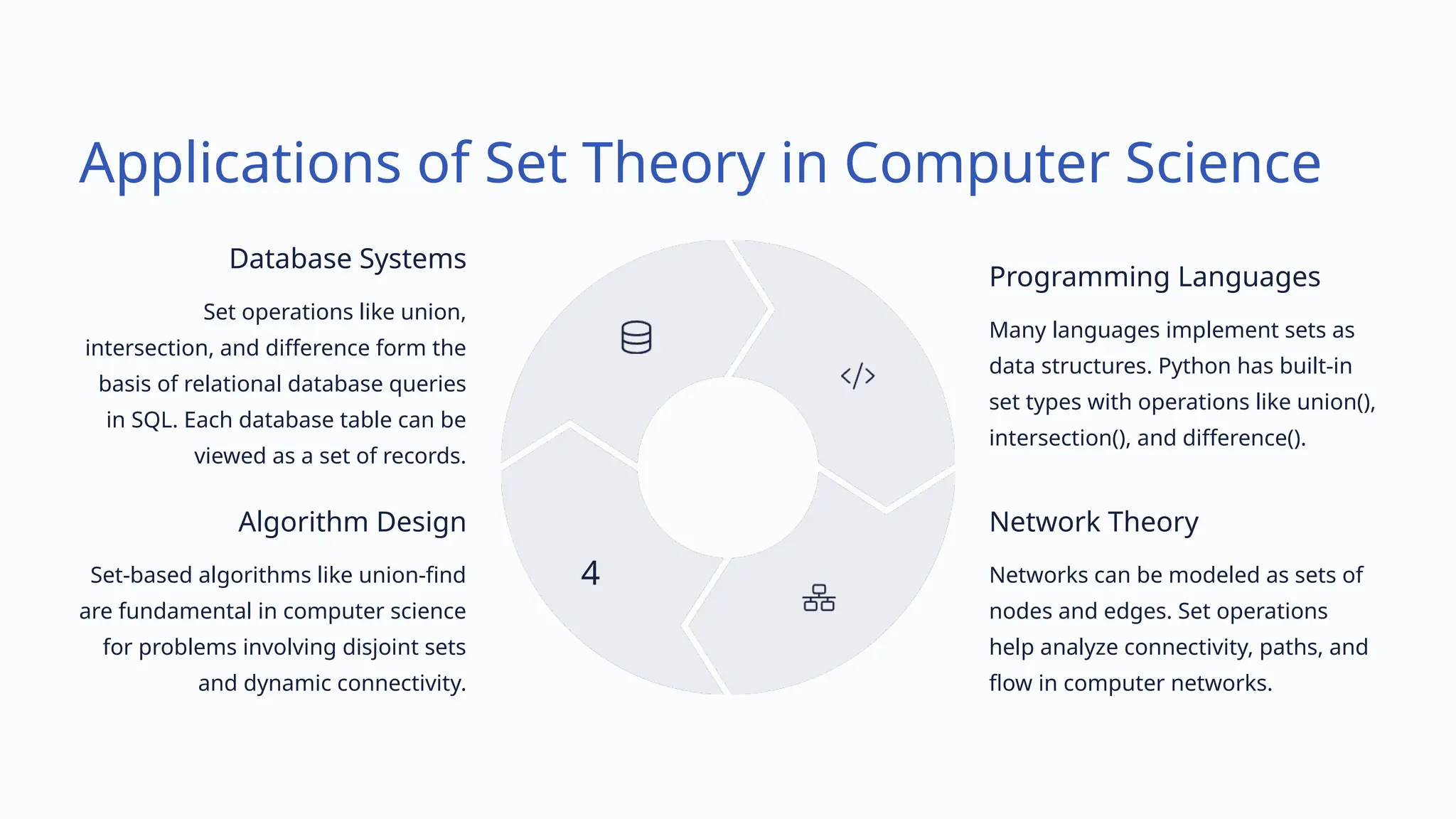
Applications of SetTheory in Computer Science
Database Systems
Set operations like union,
intersection, and difference form the
basis of relational database queries
in SQL. Each database table can be
viewed as a set of records.
Programming Languages
Many languages implement sets as
data structures. Python has built-in
set types with operations like union(),
intersection(), and difference().
Network Theory
Networks can be modeled as sets of
nodes and edges. Set operations
help analyze connectivity, paths, and
flow in computer networks.
Algorithm Design
Set-based algorithms like union-find
are fundamental in computer science
for problems involving disjoint sets
and dynamic connectivity.
4
42.
Applications of SetTheory in
Probability
1
Sample Space
The set of all possible outcomes in a probability
experiment
2
Events
Subsets of the sample space representing
collections of outcomes
3
Probability Calculation
Set operations provide the mathematical
foundation for probability calculations
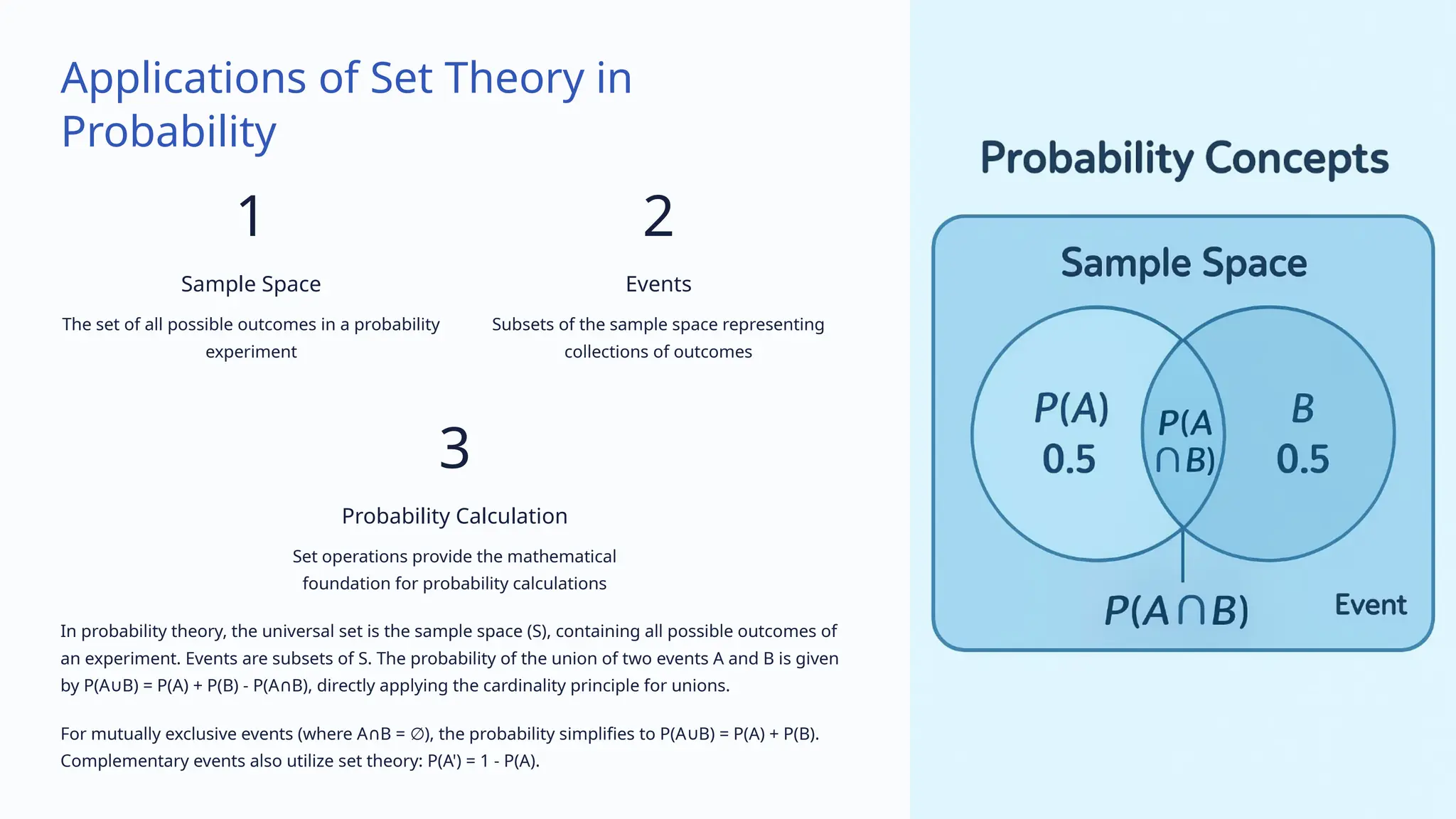
In probability theory, the universal set is the sample space (S), containing all possible outcomes of
an experiment. Events are subsets of S. The probability of the union of two events A and B is given
by P(A B) = P(A) + P(B) - P(A B), directly applying the cardinality principle for unions.
∪ ∩
For mutually exclusive events (where A B = ), the probability simplifies to P(A B) = P(A) + P(B).
∩ ∅ ∪
Complementary events also utilize set theory: P(A') = 1 - P(A).
43.
Applications of SetTheory in Logic
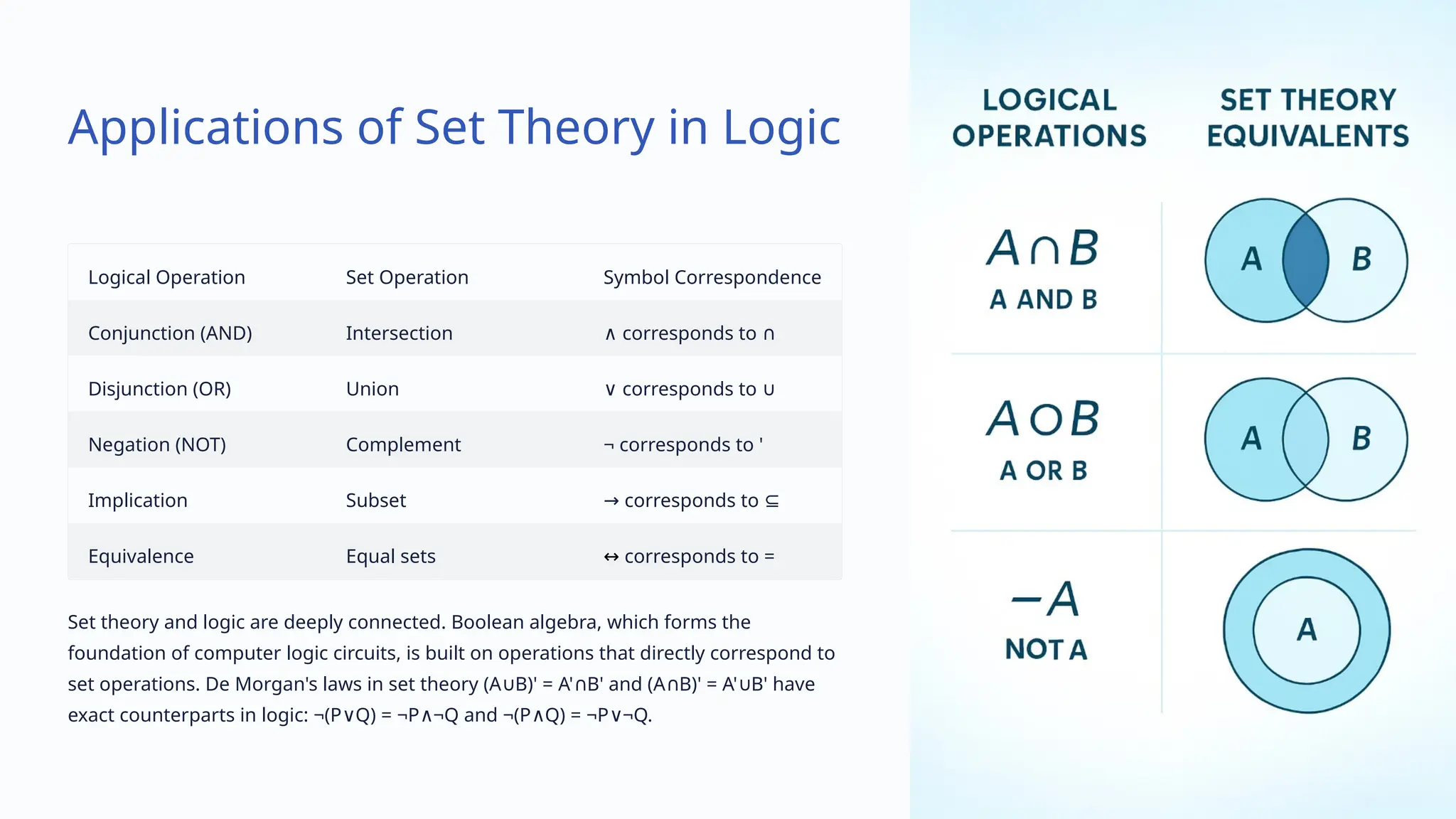
Logical Operation Set Operation Symbol Correspondence
Conjunction (AND) Intersection ∧ corresponds to ∩
Disjunction (OR) Union ∨ corresponds to ∪
Negation (NOT) Complement ¬ corresponds to '
Implication Subset → corresponds to ⊆
Equivalence Equal sets ↔ corresponds to =
Set theory and logic are deeply connected. Boolean algebra, which forms the
foundation of computer logic circuits, is built on operations that directly correspond to
set operations. De Morgan's laws in set theory (A B)' = A' B' and (A B)' = A' B' have
∪ ∩ ∩ ∪
exact counterparts in logic: ¬(P Q) = ¬P ¬Q and ¬(P Q) = ¬P ¬Q.
∨ ∧ ∧ ∨
44.
Set Theory Paradoxes
Russell'sParadox
Consider the set R = {x : x is a set and x x}. If R R, then R R by definition. If R R, then R R by
∉ ∈ ∉ ∉ ∈
definition. This contradiction revealed fundamental issues in naive set theory.
Cantor's Paradox
If there exists a set of all sets, its power set would have a larger cardinality. But as a set of all sets, it must
contain its power set, leading to a contradiction about cardinalities.
Barber Paradox
A version of Russell's paradox: In a village, the barber shaves all those who do not shave themselves. Does the
barber shave himself? If yes, then no; if no, then yes.
These paradoxes led to the development of axiomatic set theories like Zermelo-Fraenkel set theory with the Axiom of Choice
(ZFC), which impose restrictions to avoid such contradictions while preserving set theory's power.
45.
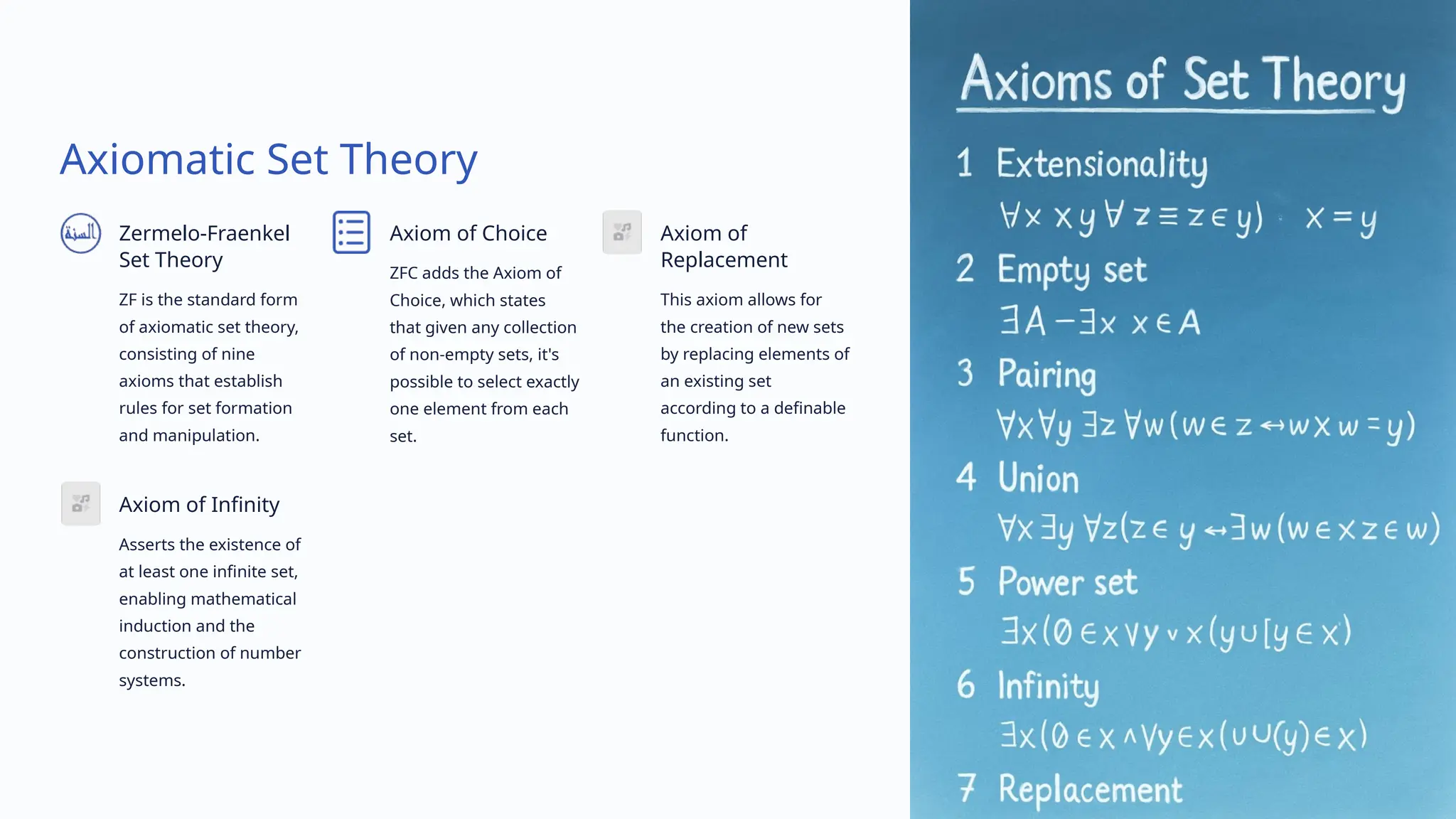
Axiomatic Set Theory
Zermelo-Fraenkel
SetTheory
ZF is the standard form
of axiomatic set theory,
consisting of nine
axioms that establish
rules for set formation
and manipulation.
Axiom of Choice
ZFC adds the Axiom of
Choice, which states
that given any collection
of non-empty sets, it's
possible to select exactly
one element from each
set.
Axiom of
Replacement
This axiom allows for
the creation of new sets
by replacing elements of
an existing set
according to a definable
function.
Axiom of Infinity
Asserts the existence of
at least one infinite set,
enabling mathematical
induction and the
construction of number
systems.
46.
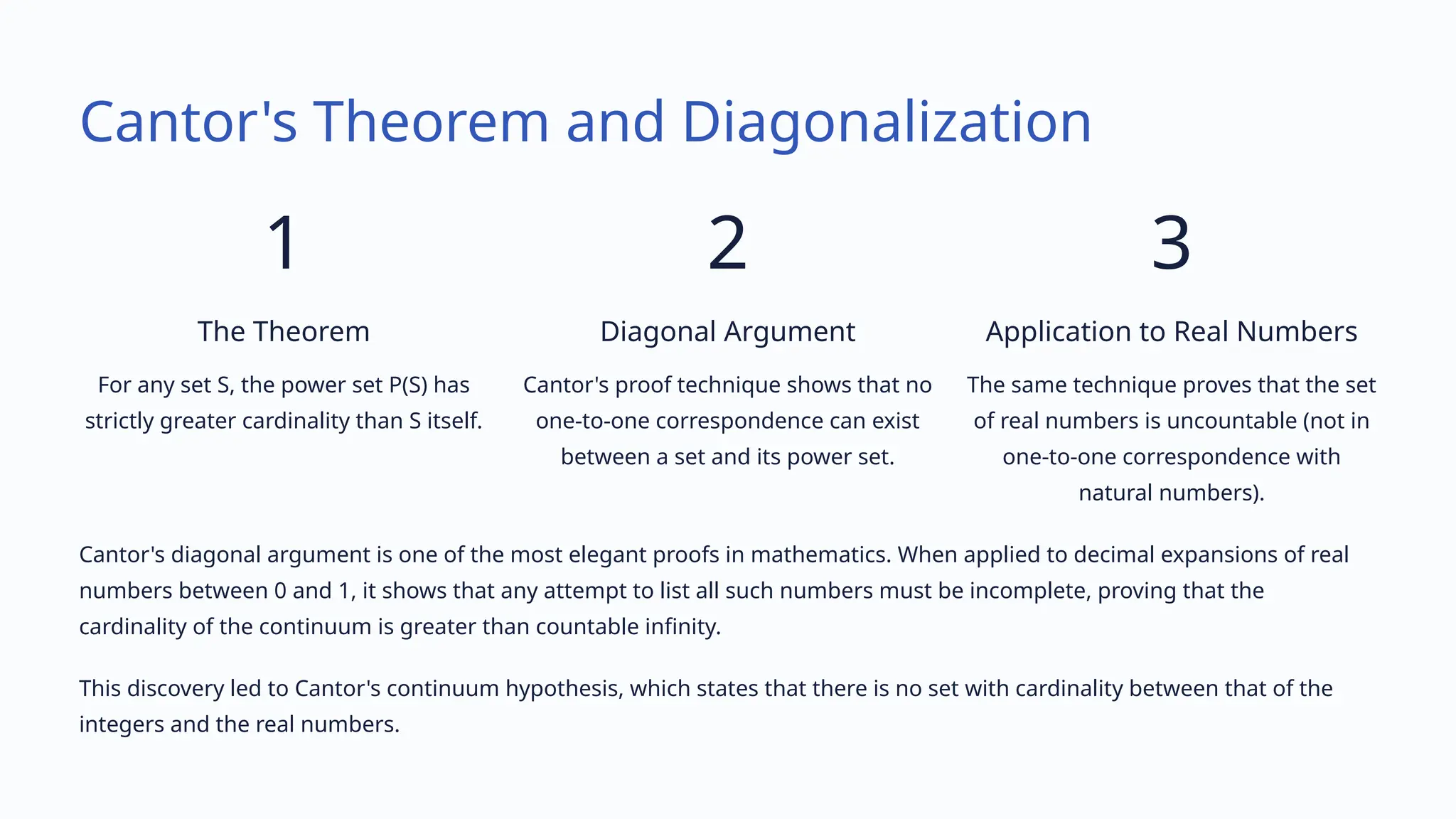
Cantor's Theorem andDiagonalization
1
The Theorem
For any set S, the power set P(S) has
strictly greater cardinality than S itself.
2
Diagonal Argument
Cantor's proof technique shows that no
one-to-one correspondence can exist
between a set and its power set.
3
Application to Real Numbers
The same technique proves that the set
of real numbers is uncountable (not in
one-to-one correspondence with
natural numbers).
Cantor's diagonal argument is one of the most elegant proofs in mathematics. When applied to decimal expansions of real
numbers between 0 and 1, it shows that any attempt to list all such numbers must be incomplete, proving that the
cardinality of the continuum is greater than countable infinity.
This discovery led to Cantor's continuum hypothesis, which states that there is no set with cardinality between that of the
integers and the real numbers.
47.
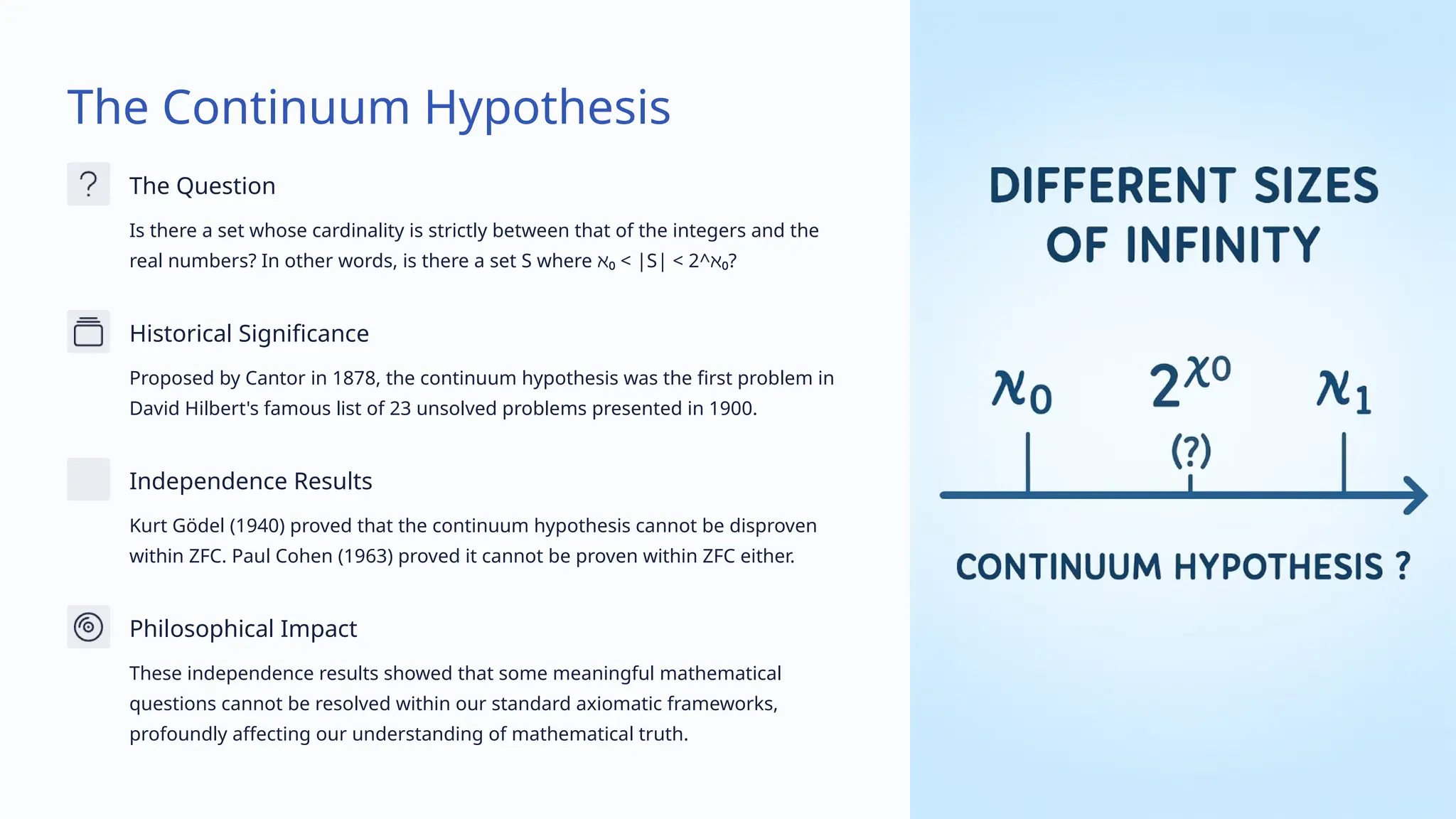
The Continuum Hypothesis
TheQuestion
Is there a set whose cardinality is strictly between that of the integers and the
real numbers? In other words, is there a set S where ℵ₀ < |S| < 2^ℵ₀?
Historical Significance
Proposed by Cantor in 1878, the continuum hypothesis was the first problem in
David Hilbert's famous list of 23 unsolved problems presented in 1900.
Independence Results
Kurt Gödel (1940) proved that the continuum hypothesis cannot be disproven
within ZFC. Paul Cohen (1963) proved it cannot be proven within ZFC either.
Philosophical Impact
These independence results showed that some meaningful mathematical
questions cannot be resolved within our standard axiomatic frameworks,
profoundly affecting our understanding of mathematical truth.
48.
Set Theory inModern Mathematics
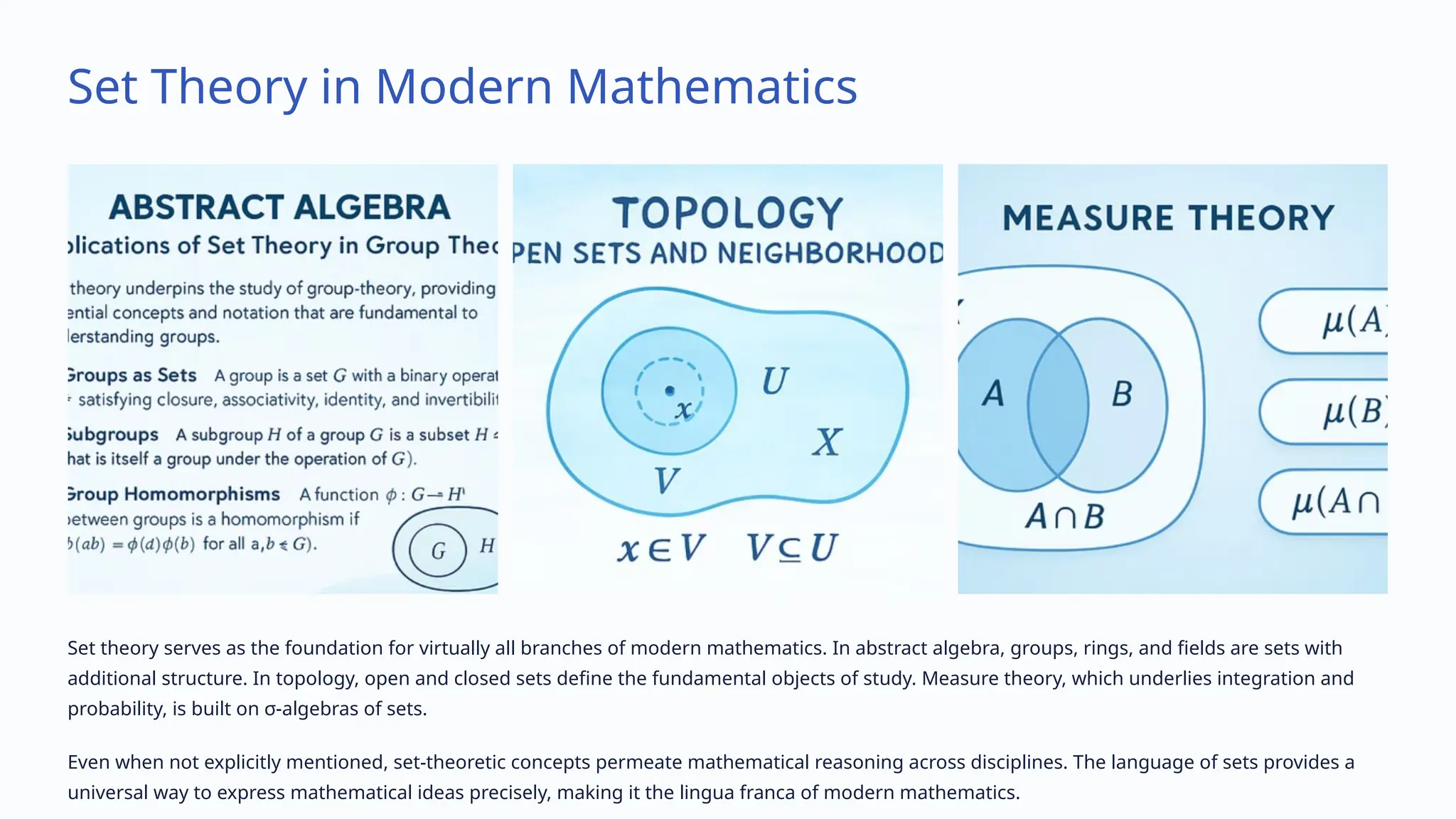
Set theory serves as the foundation for virtually all branches of modern mathematics. In abstract algebra, groups, rings, and fields are sets with
additional structure. In topology, open and closed sets define the fundamental objects of study. Measure theory, which underlies integration and
probability, is built on σ-algebras of sets.
Even when not explicitly mentioned, set-theoretic concepts permeate mathematical reasoning across disciplines. The language of sets provides a
universal way to express mathematical ideas precisely, making it the lingua franca of modern mathematics.
49.
Sets in Real-WorldProblem Solving
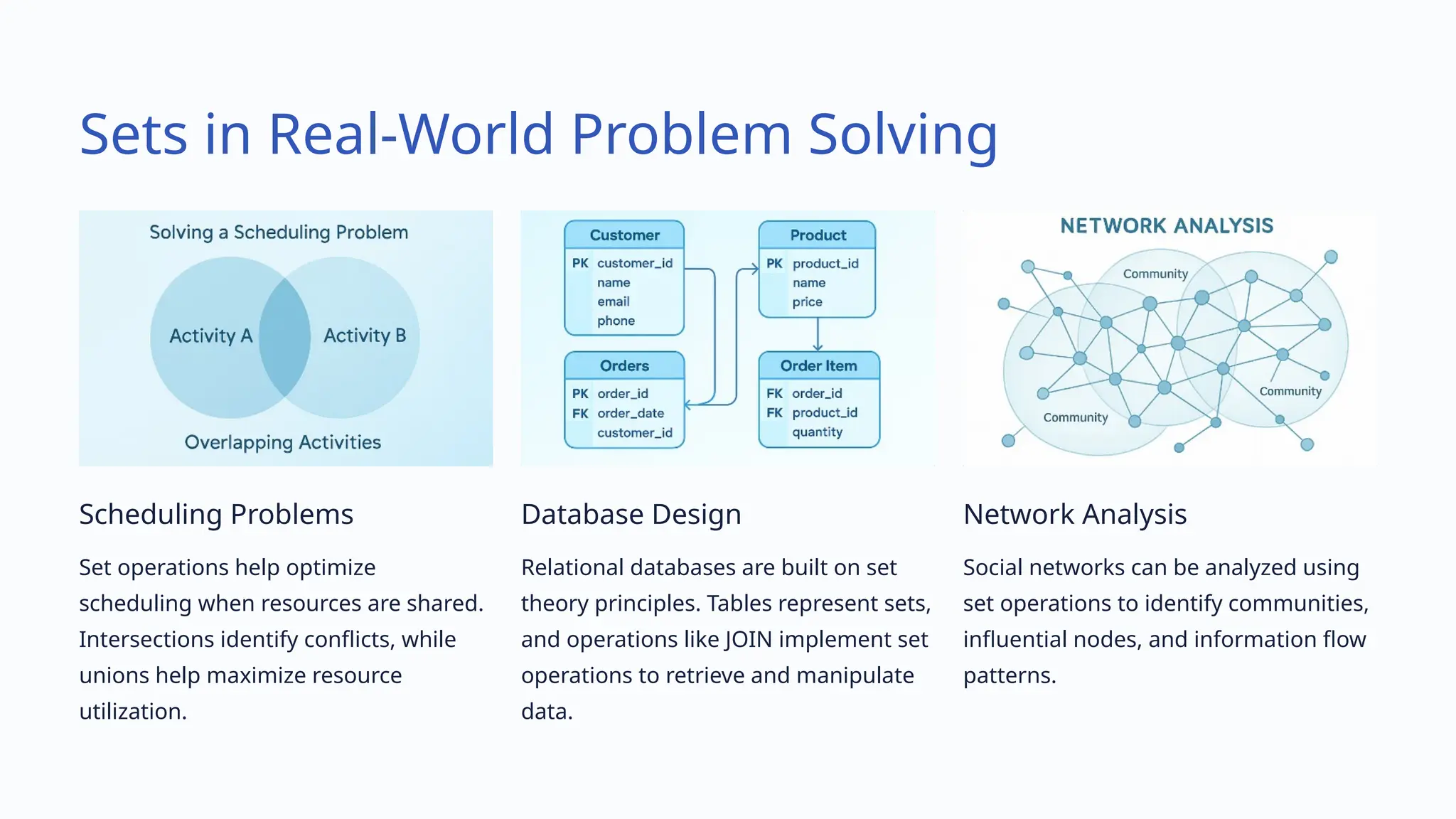
Scheduling Problems
Set operations help optimize
scheduling when resources are shared.
Intersections identify conflicts, while
unions help maximize resource
utilization.
Database Design
Relational databases are built on set
theory principles. Tables represent sets,
and operations like JOIN implement set
operations to retrieve and manipulate
data.
Network Analysis
Social networks can be analyzed using
set operations to identify communities,
influential nodes, and information flow
patterns.
50.
Fuzzy Sets
Extension ofClassical Sets
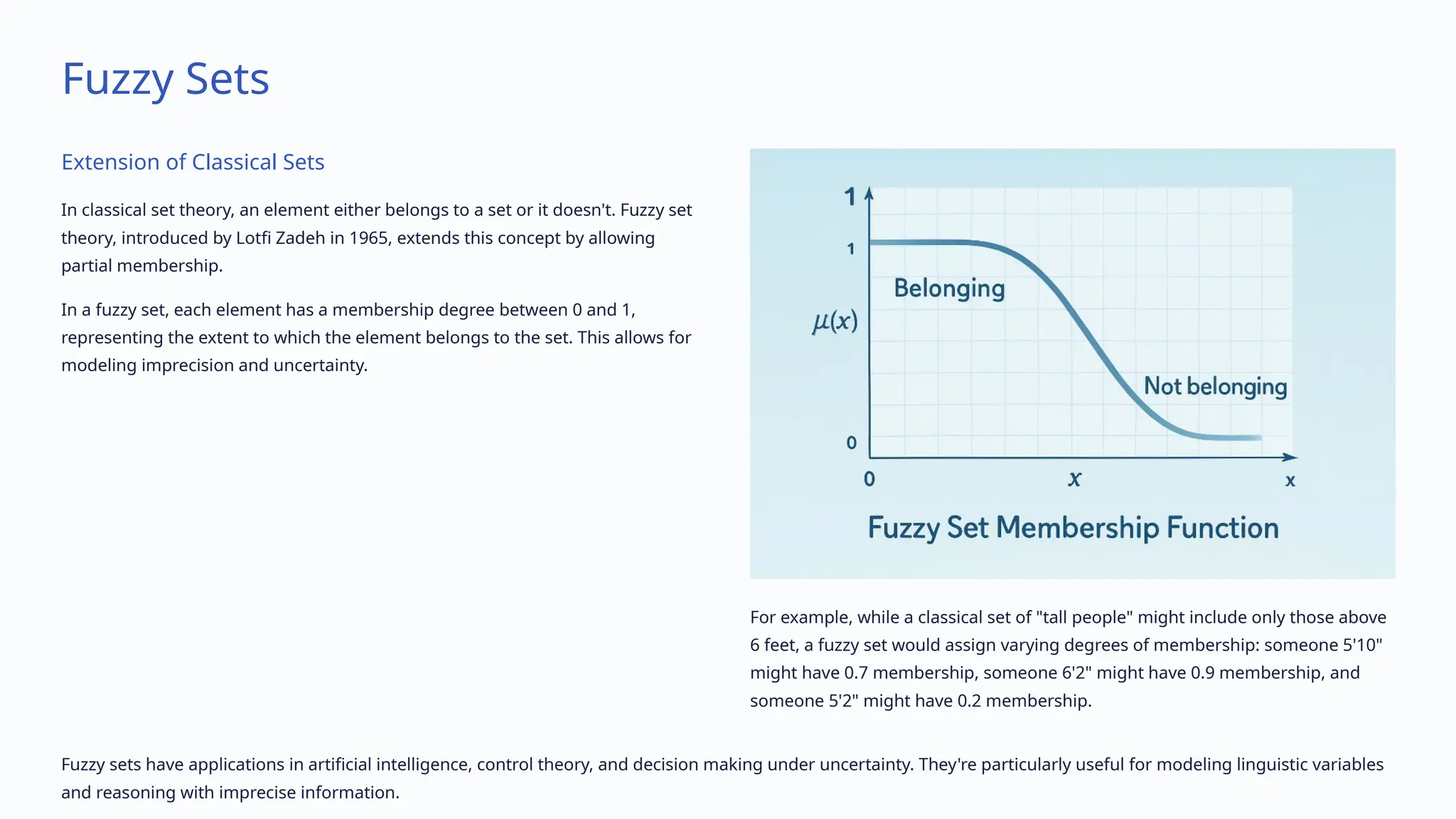
In classical set theory, an element either belongs to a set or it doesn't. Fuzzy set
theory, introduced by Lotfi Zadeh in 1965, extends this concept by allowing
partial membership.
In a fuzzy set, each element has a membership degree between 0 and 1,
representing the extent to which the element belongs to the set. This allows for
modeling imprecision and uncertainty.
For example, while a classical set of "tall people" might include only those above
6 feet, a fuzzy set would assign varying degrees of membership: someone 5'10"
might have 0.7 membership, someone 6'2" might have 0.9 membership, and
someone 5'2" might have 0.2 membership.
Fuzzy sets have applications in artificial intelligence, control theory, and decision making under uncertainty. They're particularly useful for modeling linguistic variables
and reasoning with imprecise information.
51.
Rough Sets
Basic Concept
Roughset theory, developed by Zdzisław Pawlak in 1982, deals with
vagueness and uncertainty in data analysis.
Approximations
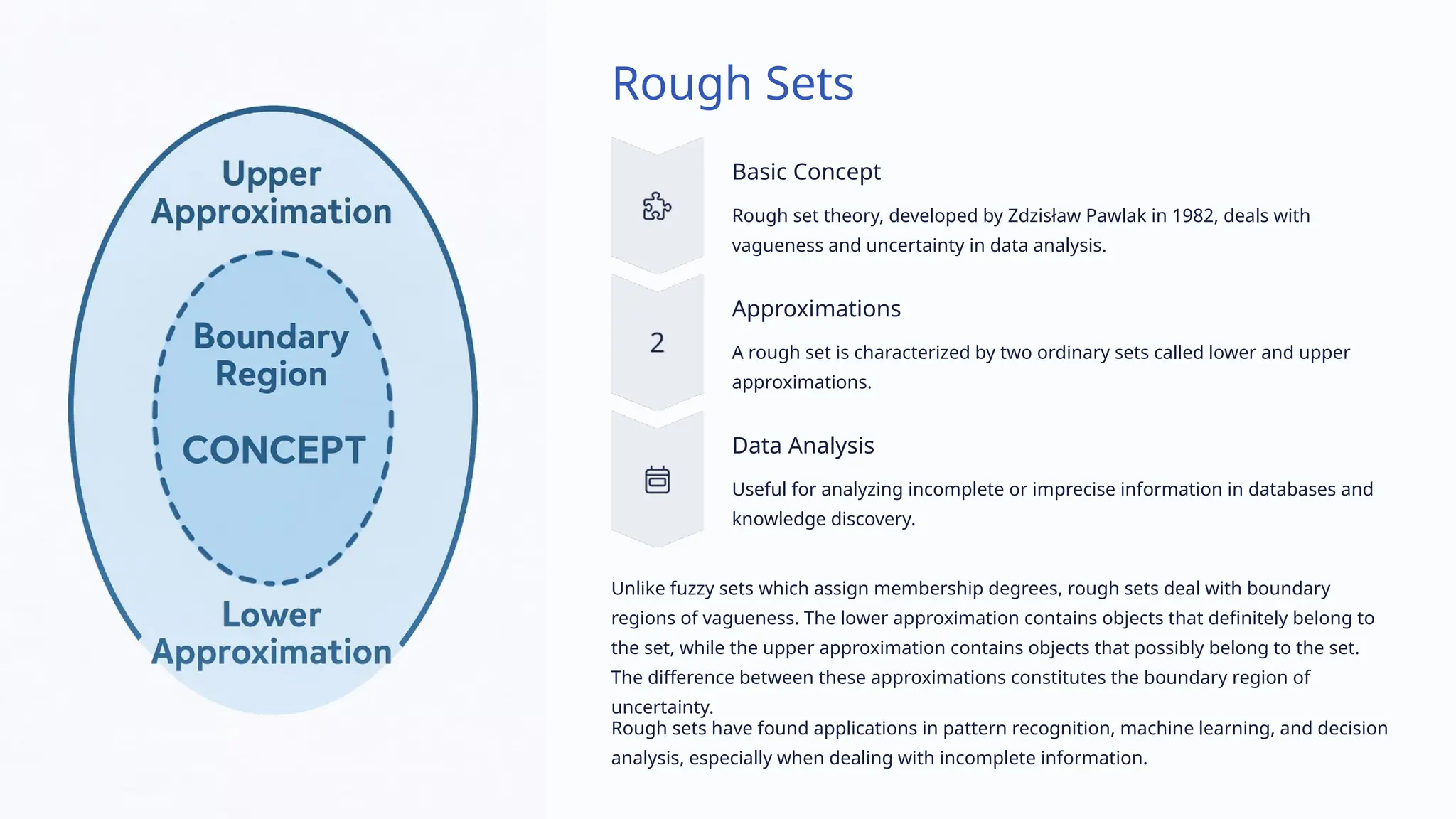
A rough set is characterized by two ordinary sets called lower and upper
approximations.
Data Analysis
Useful for analyzing incomplete or imprecise information in databases and
knowledge discovery.
Unlike fuzzy sets which assign membership degrees, rough sets deal with boundary
regions of vagueness. The lower approximation contains objects that definitely belong to
the set, while the upper approximation contains objects that possibly belong to the set.
The difference between these approximations constitutes the boundary region of
uncertainty.
Rough sets have found applications in pattern recognition, machine learning, and decision
analysis, especially when dealing with incomplete information.
52.
Multisets
Definition
A multiset (alsocalled a bag) is a generalization of a set that
allows multiple instances of its elements. Unlike in a set,
the multiplicity (number of occurrences) of each element
matters.
For example, the multiset {a, a, b, c, c, c} is different from
the set {a, b, c} because it accounts for the repeated
elements.
Applications
Multisets are useful in:
• Representing collections where repetition matters, such
as a hand of cards
• Database queries that return duplicate rows
• Counting problems in combinatorics
• Representing chemical compounds (multiple atoms of
the same element)
53.
Ordered Sets
Partially OrderedSets
A partially ordered set (poset) is a set with a binary relation that is reflexive, antisymmetric, and transitive.
Totally Ordered Sets
A totally ordered set has the additional property that any two elements are comparable.
Well-Ordered Sets
A well-ordered set is a totally ordered set where every non-
empty subset has a least element.
Ordered sets provide structure beyond mere membership. The set of integers with the "less than or equal" relation ( ) forms a totally
≤
ordered set. The set of subsets of a given set ordered by inclusion ( ) forms a partially ordered set. These structures are fundamental in
⊆
many areas of mathematics, including algebra, topology, and computer science.
54.
Ordinal Numbers
Definition
Ordinal numbersextend the natural
numbers to represent the order type of
well-ordered sets. They indicate
position or ordering rather than
quantity.
Finite vs. Transfinite
Finite ordinals correspond to natural
numbers. Transfinite ordinals like ω
represent the order type of infinite
well-ordered sets.
Successor and Limit Ordinals
Every ordinal has a successor (α+1).
Limit ordinals like ω are not the
successor of any ordinal.
Ordinal numbers provide a way to extend counting beyond finite sets. The first transfinite ordinal, ω, represents the order
type of the natural numbers. Unlike cardinal numbers that measure size, ordinals capture the notion of position and
sequence, even for infinite sets. Ordinals are foundational in set theory and provide a framework for mathematical induction
beyond finite sets.
55.
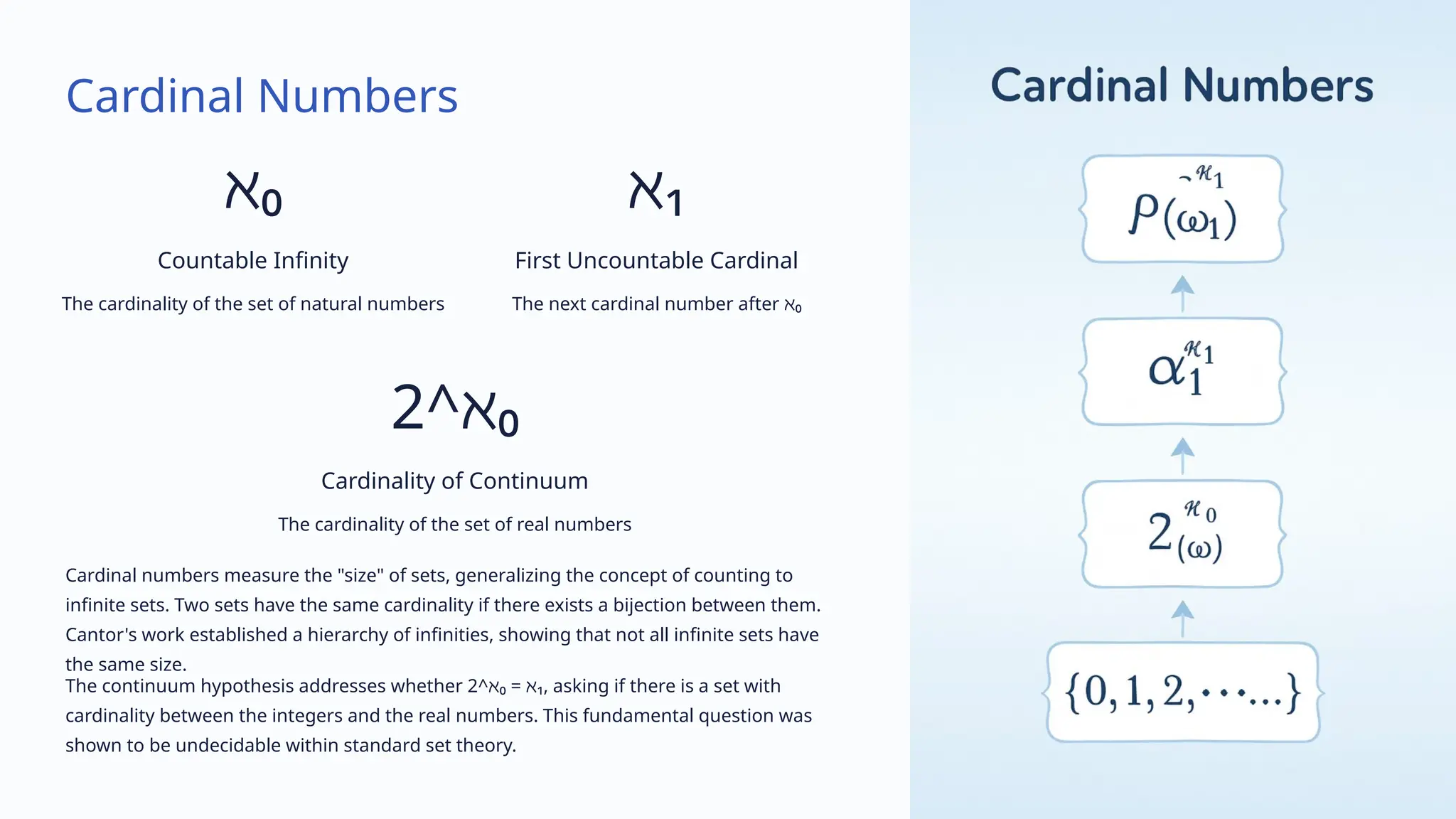
Cardinal Numbers
ℵ₀
Countable Infinity
Thecardinality of the set of natural numbers
ℵ₁
First Uncountable Cardinal
The next cardinal number after ℵ₀
2^ℵ₀
Cardinality of Continuum
The cardinality of the set of real numbers
Cardinal numbers measure the "size" of sets, generalizing the concept of counting to
infinite sets. Two sets have the same cardinality if there exists a bijection between them.
Cantor's work established a hierarchy of infinities, showing that not all infinite sets have
the same size.
The continuum hypothesis addresses whether 2^ℵ₀ = ℵ₁, asking if there is a set with
cardinality between the integers and the real numbers. This fundamental question was
shown to be undecidable within standard set theory.
56.
Set Theory inCategory Theory
Categories as Generalizations
Category theory generalizes set
theory, with categories consisting of
objects and morphisms between
them, rather than elements and
inclusion relationships.
Set Category
The category Set has sets as objects
and functions as morphisms,
forming one specific example of a
category.
2
Topoi
Topoi are categories that behave
much like the category of sets,
providing alternative foundations for
mathematics.
Universal Properties
Category theory often defines set
operations through universal
properties rather than element-wise
descriptions.
57.
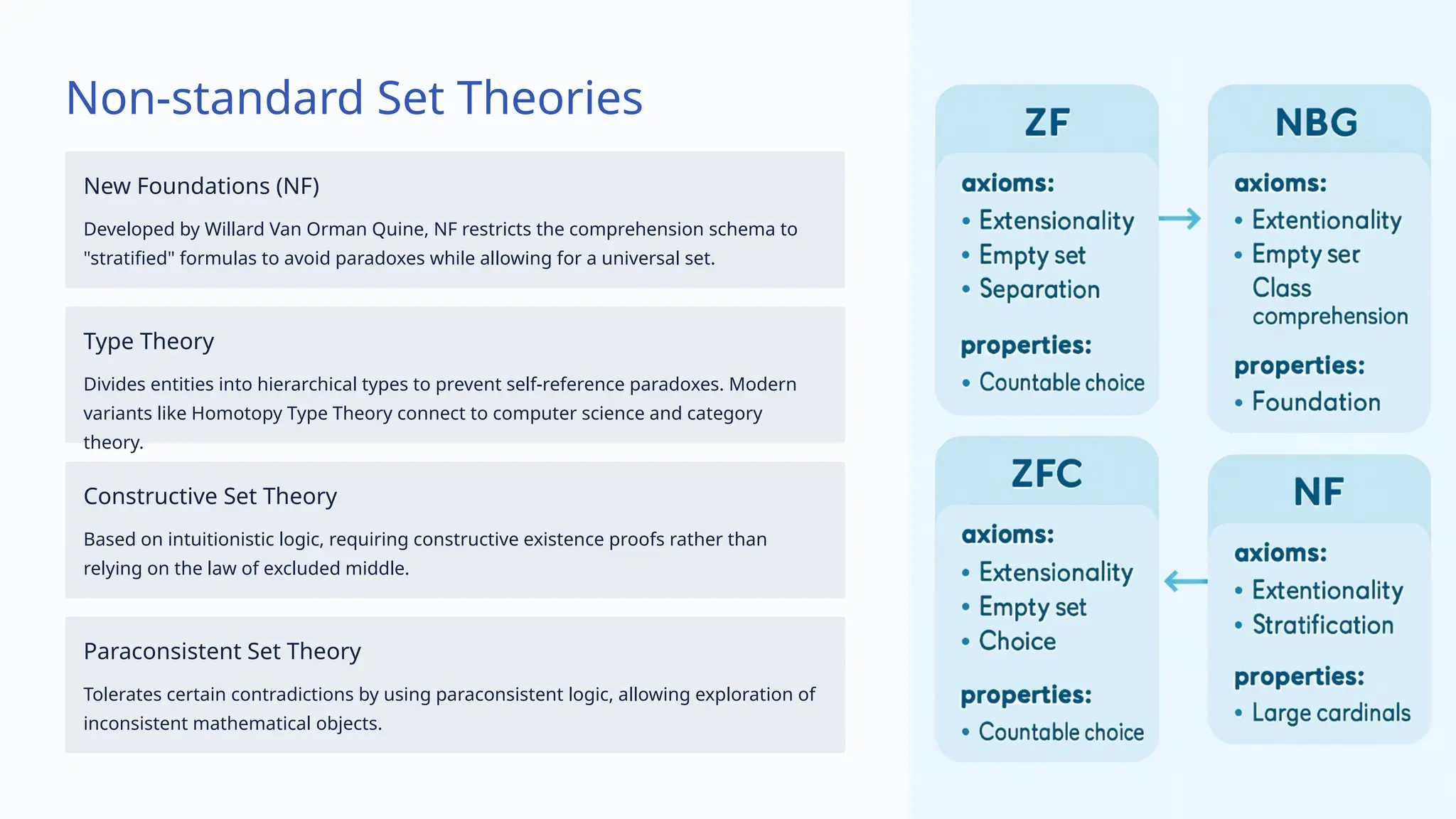
Non-standard Set Theories
NewFoundations (NF)
Developed by Willard Van Orman Quine, NF restricts the comprehension schema to
"stratified" formulas to avoid paradoxes while allowing for a universal set.
Type Theory
Divides entities into hierarchical types to prevent self-reference paradoxes. Modern
variants like Homotopy Type Theory connect to computer science and category
theory.
Constructive Set Theory
Based on intuitionistic logic, requiring constructive existence proofs rather than
relying on the law of excluded middle.
Paraconsistent Set Theory
Tolerates certain contradictions by using paraconsistent logic, allowing exploration of
inconsistent mathematical objects.
58.
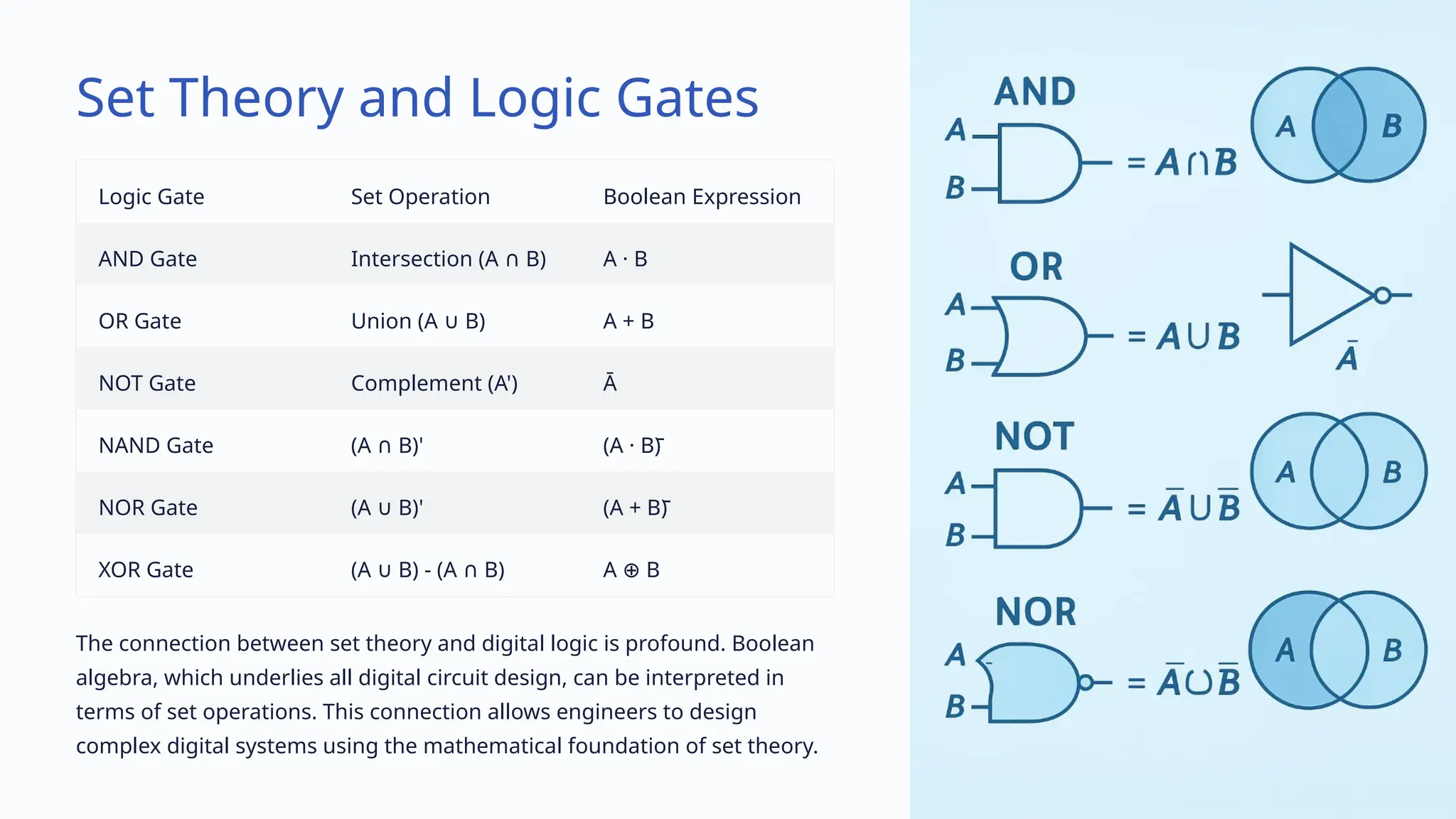
Set Theory andLogic Gates
Logic Gate Set Operation Boolean Expression
AND Gate Intersection (A B)
∩ A · B
OR Gate Union (A B)
∪ A + B
NOT Gate Complement (A') Ā
NAND Gate (A B)'
∩ (A · B)̄
NOR Gate (A B)'
∪ (A + B)̄
XOR Gate (A B) - (A B)
∪ ∩ A B
⊕
The connection between set theory and digital logic is profound. Boolean
algebra, which underlies all digital circuit design, can be interpreted in
terms of set operations. This connection allows engineers to design
complex digital systems using the mathematical foundation of set theory.
59.
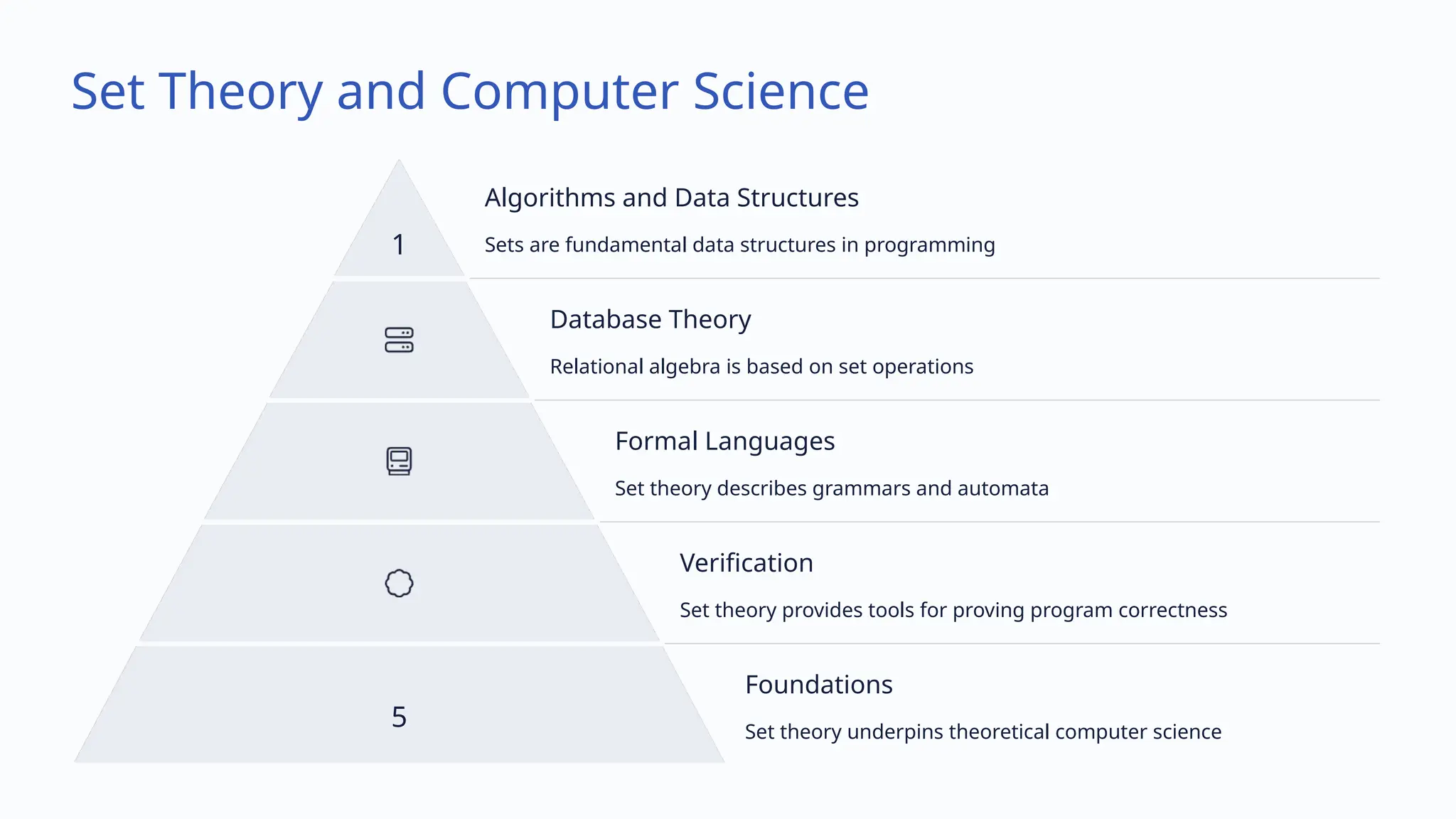
Set Theory andComputer Science
1
Algorithms and Data Structures
Sets are fundamental data structures in programming
Database Theory
Relational algebra is based on set operations
Formal Languages
Set theory describes grammars and automata
Verification
Set theory provides tools for proving program correctness
5
Foundations
Set theory underpins theoretical computer science
60.
The Continuing Legacyof Set Theory
Historical Impact
Georg Cantor's revolutionary ideas faced significant resistance initially but ultimately transformed mathematics. His work on infinite sets and cardinality opened entirely new fields of
mathematical inquiry.
Educational Foundation
Today, set theory is taught as a fundamental mathematical language, providing students with tools to precisely express complex mathematical ideas across all branches of the discipline.
Future Directions
Set theory continues to evolve, with applications in emerging fields like quantum computing, artificial intelligence, and data science. New theoretical developments also continue,
exploring alternative foundational systems and their implications.
As G.H. Hardy noted, set theory "did not begin with Pythagoras and will not end with Einstein." It remains a vibrant, essential area of mathematics that connects the ancient with the cutting edge, providing both practical tools and profound
philosophical insights into the nature of infinity and mathematical existence.
![Intervals as Subsets of Real Numbers
Open Interval
An open interval (a,b) consists of all real numbers x such that a < x < b. The endpoints a
and b are not included.
Closed Interval
A closed interval [a,b] includes all real numbers x such that a x b. Both endpoints are
≤ ≤
included.
Half-Open Intervals
The intervals [a,b) and (a,b] include one endpoint but not the other. [a,b) includes a but
not b, while (a,b] includes b but not a.
Infinite Intervals
Intervals like [a, ), (- ,b], (a, ), and (- ,b) represent unbounded sets of real numbers,
∞ ∞ ∞ ∞
extending infinitely in one direction.](https://image.slidesharecdn.com/class11mathspptchapter1set-theory-250812165352-6b393a1b/75/Class-11-Maths-PPT-Chapter-1-Set-Theory-pptx-16-2048.jpg)