Prepared By:
Mr. Prakash makasare; M.Sc. Nursing
Mrs. Nutan Makasare; M.Sc. Nursing
College of Nursing ; G.M.C. Nagpur
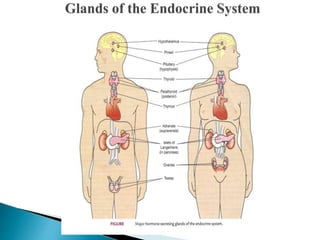
 The nervous system and the interconnected network of
glands known as the endocrine system control body
systems.
 Endocrine disorders are the consequences of hypo
function and hyper function of each endocrine gland.
 The chemical substances secreted by the endocrine glands
are called hormones.
 The endocrine glands are composed of secretory cells
arranged in minute clusters known as acini.
 Glands are ductless with a rich blood supply, so the
hormones they produce enter the bloodstream rapidly.
 Hormone concentration in the bloodstream is maintained at
a relatively constant level.
 When the hormone concentration increases, further
production of that hormone is inhibited & vice versa.
 Negative feedback.
 1.Steroid hormones (e.g., hydrocortisone),
 2. Peptide or protein hormones (e.g., insulin),
 3.Amine hormones (e.g., epinephrine),
 4. Fatty acid derivatives (e.g., retinoids).
 Widespread effects on the body and a wide variety of
signs and symptoms
 Changes in energy level and fatigue
 Tolerance of heat and cold as well as recent changes in
weight:
 Changes in sexual function and secondary sex
characteristics
 Changes in mood, memory, and ability to concentrate
and altered sleep patterns
 Changes in skin texture with both hypo function and
hyper-function
 Eye changes, such as exophthalmos,
 Changes in physical appearance (e.g., appearance of facial
hair in women, "moon face," "buffalo hump," thinning of
the skin, obesity of the trunk and thinness of the
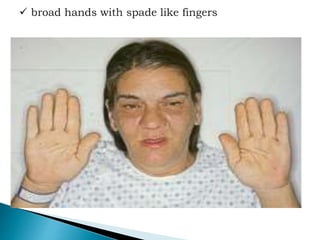
extremities, increased size of the feet and hands, edema)
 Vital signs Elevated B.P. may occur with hyper function of
the adrenal cortex or tumor of the adrenal medulla and
Decreased blood pressure may occur with hypo function of
the adrenal cortex.
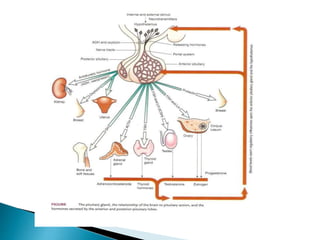
Anatomic and Physiologic Overview
 The pituitary gland, or hypophysis, about 1.27 cm in
diameter located on the inferior aspect of the brain.
 Commonly referred to as the master gland.
 Control the secretion of hormones by other endocrine
glands.
 The pituitary itself is controlled by the hypothalamus.
 The pituitary gland is divided into the anterior and
posterior lobes.
The major hormones
 Follicle-stimulating hormone (FSH),
 Luteinizing hormone (LH),
 Prolactin, ACTH,
 TSH,
 Growth hormone (somatotropin).
 Other hormones include melanocyte-stimulating
hormone and beta-lipotropin.
The important hormones
 Vasopressin, also called antidiuretic hormone or ADH,
 Oxytocin. (Oxytocin secretion is stimulated during
pregnancy and at childbirth. )
 disease of the pituitary gland itself or disease of the
hypothalamus,
 complication of radiation therapy to the head and neck
area,
 total destruction of the pituitary gland by trauma,
tumor, or vascular lesion.
The result is extreme weight loss, emaciation, atrophy of
all endocrine glands and organs, hair loss, impotence,
amenorrhea, hypo metabolism.
 Cushing's syndrome.( ACTH or growth hormone)
 Acromegaly
 Gigantism.
 Dwarfism.
 Panhypopituitarism.
 Hypopituitarism may result from destruction of the
anterior lobe of the pituitary gland.
 Postpartum pituitary necrosis (Sheehan's syndrome)
 The most common disorder related to posterior lobe
dysfunction is Diabetes insipidus.
 Pituitary Tumors
 Pituitary tumors are usually benign types of pituitary
tumors represent an overgrowth of
(1) eosinophilic cells,
(2) basophilic cells, or
(3) chromophobic cells (i.e., cells with no affinity for
either eosinophilic or basophilic stains).
 Definition
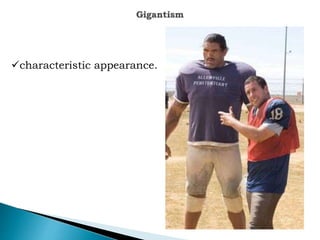
 Gigantism, an overgrowth of the long bones,
develops in children before the age when the
epiphyses of the bones close. Clients
suffering gigantism may grow to 9 feet tall.
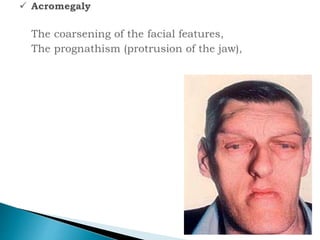
 Acromegaly is a disease of adults and
develops after closure of the epiphyses 'of the
long bones.i.e. increase in bone thickness
and hypertrophy of the soft tissues.
 Etiology
Gigantism and Acromegaly result from GH-
secreting adenomas of the anterior pituitary
gland.
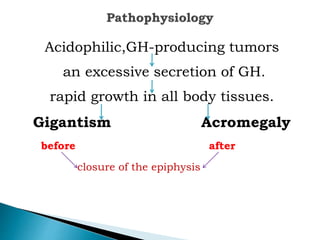
Acidophilic,GH-producing tumors
an excessive secretion of GH.
rapid growth in all body tissues.
Gigantism Acromegaly
before after
closure of the epiphysis
 Clients with gigantism: develop
hyperglycemia. About 10 per cent of the
clients develop full-blown diabetes mellitus.
 As the tumor grow, destruction of the entire
pituitary gland, leading to hypopituitarism.
 Pressure on the optic nerve, may lead to
blindness.
 Prognosis: depends on the age at which the
client develops an over secretion of GH and
seeks health intervention.
Clinical Manifestations
characteristic appearance.
In addition, clients with acromegaly develop
local manifestations such as,
 diplopia,
 headache
 blindness,
 and lethargy,
due to compression of brain tissue by the tumor.
In advanced cases, clients can suffer from
associated hormonal disturbances such as,
 diabetes mellitus,
 goiter,
 Cushing's disease,
 changes in libido and
 menstrual disorders.
 Irradiation of the pituitary gland to destroy
the tumor. This is usually performed through a
radiation implant via the transsphenoidal
approach.
 Sromocriptine (Parlodel) can reduce the levels
of growth hormone and decrease tumor size.
 This agent can be used if the levels of growth
hormone remain high after surgery or until the
effects of radiation occur.
 The treatment of choice for both gigantism
and acromegaly is a surgical
hypophysectomy.
 Partial or complete removal of the pituitary
gland.
 Following surgery, the need for cortisone
replacement may be permanent.
Nursing Diagnosis:
 Knowledge Deficit R/T surgery and possible
outcomes.
 High risk for injury R/T postoperative
complications.
 Knowledge Deficit R/T self administration of
pituitary replacement hormones.
Hypopituitarism
 Hypopituitarism is a deficiency of one or
more of the hormones produced by the
anterior lobe of the pituitary.
When both the anterior and posterior lobes
fail to secrete hormones, the condition is
called panhypopituitarism. (Simmond’s
disease)
Incidence
 Hypopituitarism and panhypopituitarism
(Simmond’s disease) are rare disorders.
Etiology/Pathophysiology
The five most important causes of hypopituitarism
 Hypophysectomy
 Nonsecreting Pituitary Tumors:
Nonfunctioning chromophobe adenoma and
craniopharyngioma.
 Decreased Growth Hormone
 Postpartum Pituitary Necrosis
 Functional Disorders: anorexia nervosa, severe
anemia, and GIT disorders.
 Short stature, stunted growth results from either:
- congenital lack of GH or
- the development of space-occupying intracranial tumors,
meningitis, or brain injury during early childhood.
 Secondary adrenocortical insufficiency due to
diminished synthesis of ACTH
 Hypothyroidism,(diminished TSH)
 Sexual and reproductive disorders r/t deficiencies
of the gonadotropins (LH and FSH) can produce
sterility, diminished sexual drive, and decreased
secondary sex characteristics,infertility and
amenorrhea, diminished spermatogenesis, and
testicular atrophy.
 ACTH: secondary adrenal insufficiency.
 Cortisol levels: are low in both primary and
secondary hypothyroidism.
 Thyroid hormone, TSH levels:
hypothyroidism.
 FSH and LH: Sexual and reproductive
disorders
Treatment for hypopituitarism involves:
 (1) removal, if possible of the causative factor
(e.g., tumors) and
 (2) permanent replacement of the hormones
secreted by the target organs.
 Injections of HGH successfully treat GH
deficiency
 Medications prescribed to replace hormones
include
 (1) corticosteroids for correction of secondary
adrenocortical insufficiency,
 (2) thyroid hormone for treatment of
myxedema, and
 (3) sex hormones to correct hypogonadism.
Nursing
Management
Posterior lobe (neurohypophyseal)
disorder:
 The major disorder of the posterior lobe is
 ADH deficiency (diabetes insipidus)
 Excessive ADH causes the syndrome of
inappropriate ADH secretion (SIADH).
DIBETES
INSIPIDUS
 Definition
Diabetes insipidus is a deficiency of ADH
resulting in a physiologic imbalance of water.
 Incidence
Diabetes insipidus is a rare disorder.
 Primary diabetes insipidus: Abnormalities in the
hypothalamus and pituitary gland from familial or idiopathic
causes.
 Secondary diabetes insipidus: Destruction of the gland by
tumors in the hypothalamic-pituitary region, trauma,
infectious processes, vascular accidents, or metastatic
tumors from the breast or lung.
 Medications such as phenytoin (Dilantin), alcohol, and
lithium carbonate, can interfere with the synthesis or release
of ADH in some clients.
 Nephrogenic diabetes insipidus: Owing to an inherited defect,
the kidney tubules cannot respond to ADH.
 Risk factors include
 head injuries,
 infections, and
 other factors that lead to destruction of the
gland.
 Certain medications also may lead to the
development of diabetes insipidus.
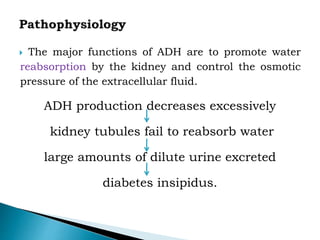
 The major functions of ADH are to promote water
reabsorption by the kidney and control the osmotic
pressure of the extracellular fluid.
ADH production decreases excessively
kidney tubules fail to reabsorb water
large amounts of dilute urine excreted
diabetes insipidus.
 Its two major manifestations are
 Polyuria (urine is dilute, with a specific
gravity of 1:001 to 1.005 (normal
specific gravity is 1.00 1 - 1.030).
 Polydipsia (The client can drink and
excrete 5 to 10 liters of fluid per day.)

 A water deprivation test.
Instruct the client not to drink water, to
concentrate the urine. Test results are
positive for diabetes insipidus if the urine
remains dilute.
 Pharmacologic Management
 Administration of the benzothiadiazine diuretics, either alone
or in combination with sylfonylurea clorpropamide.
 Injection of ADH or vasopressin (aqueous Pitressin) can
control the symptoms of diabetes insipidus.
 The synthetic polypeptide desmopressin acetate (DDA VP) can
be insufflated through the nose in the morning and at
bedtime.
 After administering vasopressin, clients need to be assessed
for signs and symptoms of water intoxication, which can lead to
fluid overload, cerebral edema, and seizures .
 Maintaining adequate hydration,
 Electrolyte balance, and
 Preventing complications.
 Assess the effectiveness of the medication.
 The client also must learn self-administration
of either the injections or the nasal spray.
 If the client undergoes hypophysectomy,
nursing care for the same.
SYNDROME OF INAPPROPRIATE ANTIDIURETIC HORMONE
(SIADH)
 Definition
SIADH is a disorder associated with excessive
amounts of ADH, resulting in a water
imbalance.
 Incidence
SIADH is one of the most common causes of
hyponatremia, although the exact incidence
of SIADH itself is not known.
 Etiology
 There are a wide variety of causes of SIADH, including
the stress of surgery and many disorders and
medications.
 Risk Factors
 Treatment of diabetes insipidus with vasopressin can
lead to SIADH if excessive amounts are administered.
 A variety of malignancies are risk factors for SIADH.
 SIADH is the opposite of diabetes insipidus.
 Instead of large fluid losses, clients with SIADH may have water
intoxication due to fluid retention.
 Under normal circumstances, ADH regulates serum osmolality.
 When serum osmolality falls, a feedback mechanism causes
inhibition of ADH.
 This, in turn, promotes increased water excretion by the kidneys to
raise serum osmolality to normal.
 When this feedback mechanism fails and ADH levels are sustained,
fluid retention results.
 Ultimately, serum sodium falls, resulting in hyponatremia and water
intoxication.
 CNS dysfunction, characterized by
alterations in level of consciousness,
seizures, and coma, can become evident
when serum sodium falls to 120 mEq/L or
less.
 Hyponatremia can result in diminished
gastrointestinal function, and this problem
is further complicated by the need for fluid
restriction.
 DIAGNOSTIC ASSESSMENT
 Diagnosis rests on the presence of
hyponatremia with a normal or expanded
plasma volume.
 fluid restriction,
 very careful replacement of sodium
chloride,
 administration of diuretics and
demeclocycline,
 and correction of the cause, if possible.
 Assessment:
 Fluid status and electrolytes should be closely monitored.
 cardiovascular status also should be assessed regularly so
any alterations are immediately noted.
 The client's weight should be recorded, and any gain of more
than 2 pounds should be reported to the physician.
 The client's neurologic status should be monitored so any
alterations related to the hyponatremia are immediately
diagnosed and treatment can be started.
 Injury, High Risk for R/T to the danger of
cerebral edema, water intoxication, and CNS
dysfunction.
 Fluid Volume Excess R/T excessive
secretion of ADH secondary to SIADH.

Endocrine disorders ppt

  • 1.
    Prepared By: Mr. Prakashmakasare; M.Sc. Nursing Mrs. Nutan Makasare; M.Sc. Nursing College of Nursing ; G.M.C. Nagpur
  • 2.
     The nervoussystem and the interconnected network of glands known as the endocrine system control body systems.  Endocrine disorders are the consequences of hypo function and hyper function of each endocrine gland.
  • 4.
     The chemicalsubstances secreted by the endocrine glands are called hormones.  The endocrine glands are composed of secretory cells arranged in minute clusters known as acini.  Glands are ductless with a rich blood supply, so the hormones they produce enter the bloodstream rapidly.  Hormone concentration in the bloodstream is maintained at a relatively constant level.  When the hormone concentration increases, further production of that hormone is inhibited & vice versa.  Negative feedback.
  • 5.
     1.Steroid hormones(e.g., hydrocortisone),  2. Peptide or protein hormones (e.g., insulin),  3.Amine hormones (e.g., epinephrine),  4. Fatty acid derivatives (e.g., retinoids).
  • 6.
     Widespread effectson the body and a wide variety of signs and symptoms  Changes in energy level and fatigue  Tolerance of heat and cold as well as recent changes in weight:  Changes in sexual function and secondary sex characteristics  Changes in mood, memory, and ability to concentrate and altered sleep patterns
  • 7.
     Changes inskin texture with both hypo function and hyper-function  Eye changes, such as exophthalmos,  Changes in physical appearance (e.g., appearance of facial hair in women, "moon face," "buffalo hump," thinning of the skin, obesity of the trunk and thinness of the extremities, increased size of the feet and hands, edema)  Vital signs Elevated B.P. may occur with hyper function of the adrenal cortex or tumor of the adrenal medulla and Decreased blood pressure may occur with hypo function of the adrenal cortex.
  • 8.
    Anatomic and PhysiologicOverview  The pituitary gland, or hypophysis, about 1.27 cm in diameter located on the inferior aspect of the brain.  Commonly referred to as the master gland.  Control the secretion of hormones by other endocrine glands.  The pituitary itself is controlled by the hypothalamus.  The pituitary gland is divided into the anterior and posterior lobes.
  • 9.
    The major hormones Follicle-stimulating hormone (FSH),  Luteinizing hormone (LH),  Prolactin, ACTH,  TSH,  Growth hormone (somatotropin).  Other hormones include melanocyte-stimulating hormone and beta-lipotropin.
  • 10.
    The important hormones Vasopressin, also called antidiuretic hormone or ADH,  Oxytocin. (Oxytocin secretion is stimulated during pregnancy and at childbirth. )
  • 12.
     disease ofthe pituitary gland itself or disease of the hypothalamus,  complication of radiation therapy to the head and neck area,  total destruction of the pituitary gland by trauma, tumor, or vascular lesion. The result is extreme weight loss, emaciation, atrophy of all endocrine glands and organs, hair loss, impotence, amenorrhea, hypo metabolism.
  • 13.
     Cushing's syndrome.(ACTH or growth hormone)  Acromegaly  Gigantism.  Dwarfism.  Panhypopituitarism.  Hypopituitarism may result from destruction of the anterior lobe of the pituitary gland.  Postpartum pituitary necrosis (Sheehan's syndrome)
  • 14.
     The mostcommon disorder related to posterior lobe dysfunction is Diabetes insipidus.
  • 15.
     Pituitary Tumors Pituitary tumors are usually benign types of pituitary tumors represent an overgrowth of (1) eosinophilic cells, (2) basophilic cells, or (3) chromophobic cells (i.e., cells with no affinity for either eosinophilic or basophilic stains).
  • 16.
     Definition  Gigantism,an overgrowth of the long bones, develops in children before the age when the epiphyses of the bones close. Clients suffering gigantism may grow to 9 feet tall.  Acromegaly is a disease of adults and develops after closure of the epiphyses 'of the long bones.i.e. increase in bone thickness and hypertrophy of the soft tissues.
  • 17.
     Etiology Gigantism andAcromegaly result from GH- secreting adenomas of the anterior pituitary gland.
  • 18.
    Acidophilic,GH-producing tumors an excessivesecretion of GH. rapid growth in all body tissues. Gigantism Acromegaly before after closure of the epiphysis
  • 19.
     Clients withgigantism: develop hyperglycemia. About 10 per cent of the clients develop full-blown diabetes mellitus.  As the tumor grow, destruction of the entire pituitary gland, leading to hypopituitarism.  Pressure on the optic nerve, may lead to blindness.
  • 20.
     Prognosis: dependson the age at which the client develops an over secretion of GH and seeks health intervention.
  • 21.
  • 22.
  • 26.
    In addition, clientswith acromegaly develop local manifestations such as,  diplopia,  headache  blindness,  and lethargy, due to compression of brain tissue by the tumor.
  • 27.
    In advanced cases,clients can suffer from associated hormonal disturbances such as,  diabetes mellitus,  goiter,  Cushing's disease,  changes in libido and  menstrual disorders.
  • 28.
     Irradiation ofthe pituitary gland to destroy the tumor. This is usually performed through a radiation implant via the transsphenoidal approach.
  • 29.
     Sromocriptine (Parlodel)can reduce the levels of growth hormone and decrease tumor size.  This agent can be used if the levels of growth hormone remain high after surgery or until the effects of radiation occur.
  • 30.
     The treatmentof choice for both gigantism and acromegaly is a surgical hypophysectomy.  Partial or complete removal of the pituitary gland.  Following surgery, the need for cortisone replacement may be permanent.
  • 31.
    Nursing Diagnosis:  KnowledgeDeficit R/T surgery and possible outcomes.  High risk for injury R/T postoperative complications.  Knowledge Deficit R/T self administration of pituitary replacement hormones.
  • 32.
  • 33.
     Hypopituitarism isa deficiency of one or more of the hormones produced by the anterior lobe of the pituitary. When both the anterior and posterior lobes fail to secrete hormones, the condition is called panhypopituitarism. (Simmond’s disease)
  • 34.
    Incidence  Hypopituitarism andpanhypopituitarism (Simmond’s disease) are rare disorders.
  • 35.
    Etiology/Pathophysiology The five mostimportant causes of hypopituitarism  Hypophysectomy  Nonsecreting Pituitary Tumors: Nonfunctioning chromophobe adenoma and craniopharyngioma.  Decreased Growth Hormone  Postpartum Pituitary Necrosis  Functional Disorders: anorexia nervosa, severe anemia, and GIT disorders.
  • 36.
     Short stature,stunted growth results from either: - congenital lack of GH or - the development of space-occupying intracranial tumors, meningitis, or brain injury during early childhood.  Secondary adrenocortical insufficiency due to diminished synthesis of ACTH  Hypothyroidism,(diminished TSH)  Sexual and reproductive disorders r/t deficiencies of the gonadotropins (LH and FSH) can produce sterility, diminished sexual drive, and decreased secondary sex characteristics,infertility and amenorrhea, diminished spermatogenesis, and testicular atrophy.
  • 37.
     ACTH: secondaryadrenal insufficiency.  Cortisol levels: are low in both primary and secondary hypothyroidism.  Thyroid hormone, TSH levels: hypothyroidism.  FSH and LH: Sexual and reproductive disorders
  • 38.
    Treatment for hypopituitarisminvolves:  (1) removal, if possible of the causative factor (e.g., tumors) and  (2) permanent replacement of the hormones secreted by the target organs.
  • 39.
     Injections ofHGH successfully treat GH deficiency  Medications prescribed to replace hormones include  (1) corticosteroids for correction of secondary adrenocortical insufficiency,  (2) thyroid hormone for treatment of myxedema, and  (3) sex hormones to correct hypogonadism.
  • 40.
  • 41.
  • 42.
     The majordisorder of the posterior lobe is  ADH deficiency (diabetes insipidus)  Excessive ADH causes the syndrome of inappropriate ADH secretion (SIADH).
  • 43.
  • 44.
     Definition Diabetes insipidusis a deficiency of ADH resulting in a physiologic imbalance of water.  Incidence Diabetes insipidus is a rare disorder.
  • 45.
     Primary diabetesinsipidus: Abnormalities in the hypothalamus and pituitary gland from familial or idiopathic causes.  Secondary diabetes insipidus: Destruction of the gland by tumors in the hypothalamic-pituitary region, trauma, infectious processes, vascular accidents, or metastatic tumors from the breast or lung.  Medications such as phenytoin (Dilantin), alcohol, and lithium carbonate, can interfere with the synthesis or release of ADH in some clients.  Nephrogenic diabetes insipidus: Owing to an inherited defect, the kidney tubules cannot respond to ADH.
  • 46.
     Risk factorsinclude  head injuries,  infections, and  other factors that lead to destruction of the gland.  Certain medications also may lead to the development of diabetes insipidus.
  • 47.
     The majorfunctions of ADH are to promote water reabsorption by the kidney and control the osmotic pressure of the extracellular fluid. ADH production decreases excessively kidney tubules fail to reabsorb water large amounts of dilute urine excreted diabetes insipidus.
  • 48.
     Its twomajor manifestations are  Polyuria (urine is dilute, with a specific gravity of 1:001 to 1.005 (normal specific gravity is 1.00 1 - 1.030).  Polydipsia (The client can drink and excrete 5 to 10 liters of fluid per day.) 
  • 49.
     A waterdeprivation test. Instruct the client not to drink water, to concentrate the urine. Test results are positive for diabetes insipidus if the urine remains dilute.
  • 50.
     Pharmacologic Management Administration of the benzothiadiazine diuretics, either alone or in combination with sylfonylurea clorpropamide.  Injection of ADH or vasopressin (aqueous Pitressin) can control the symptoms of diabetes insipidus.  The synthetic polypeptide desmopressin acetate (DDA VP) can be insufflated through the nose in the morning and at bedtime.  After administering vasopressin, clients need to be assessed for signs and symptoms of water intoxication, which can lead to fluid overload, cerebral edema, and seizures .
  • 52.
     Maintaining adequatehydration,  Electrolyte balance, and  Preventing complications.  Assess the effectiveness of the medication.  The client also must learn self-administration of either the injections or the nasal spray.  If the client undergoes hypophysectomy, nursing care for the same.
  • 53.
    SYNDROME OF INAPPROPRIATEANTIDIURETIC HORMONE (SIADH)
  • 54.
     Definition SIADH isa disorder associated with excessive amounts of ADH, resulting in a water imbalance.
  • 55.
     Incidence SIADH isone of the most common causes of hyponatremia, although the exact incidence of SIADH itself is not known.
  • 56.
     Etiology  Thereare a wide variety of causes of SIADH, including the stress of surgery and many disorders and medications.  Risk Factors  Treatment of diabetes insipidus with vasopressin can lead to SIADH if excessive amounts are administered.  A variety of malignancies are risk factors for SIADH.
  • 57.
     SIADH isthe opposite of diabetes insipidus.  Instead of large fluid losses, clients with SIADH may have water intoxication due to fluid retention.  Under normal circumstances, ADH regulates serum osmolality.  When serum osmolality falls, a feedback mechanism causes inhibition of ADH.  This, in turn, promotes increased water excretion by the kidneys to raise serum osmolality to normal.  When this feedback mechanism fails and ADH levels are sustained, fluid retention results.  Ultimately, serum sodium falls, resulting in hyponatremia and water intoxication.
  • 58.
     CNS dysfunction,characterized by alterations in level of consciousness, seizures, and coma, can become evident when serum sodium falls to 120 mEq/L or less.  Hyponatremia can result in diminished gastrointestinal function, and this problem is further complicated by the need for fluid restriction.
  • 59.
     DIAGNOSTIC ASSESSMENT Diagnosis rests on the presence of hyponatremia with a normal or expanded plasma volume.
  • 60.
     fluid restriction, very careful replacement of sodium chloride,  administration of diuretics and demeclocycline,  and correction of the cause, if possible.
  • 61.
     Assessment:  Fluidstatus and electrolytes should be closely monitored.  cardiovascular status also should be assessed regularly so any alterations are immediately noted.  The client's weight should be recorded, and any gain of more than 2 pounds should be reported to the physician.  The client's neurologic status should be monitored so any alterations related to the hyponatremia are immediately diagnosed and treatment can be started.
  • 62.
     Injury, HighRisk for R/T to the danger of cerebral edema, water intoxication, and CNS dysfunction.  Fluid Volume Excess R/T excessive secretion of ADH secondary to SIADH.