PROGRAMAÇÃO DE 
SISTEMAS 
DISTRIBUIDOS 
Paulo Gandra de Sousa 
pag@isep.ipp.pt
Disclaimer 
1 
ISEP/IPP 
 Parts of this presentation are from: 
 Paulo Sousa (PARS) 
 Ron Jacobs (ARC01) 
 Greg Young 
 Udi Dahn
Today’s lesson 
2 
 Design Patterns 
 Patterns for distributed Systems 
 Service Orientation patterns 
 CQRS
Design patterns
What is a Pattern? 
4 
ISEP/IPP 
Each pattern describes a problem that occurs 
over and over again in our environment and 
then describes the core of the solution to that 
problem in such a way that you can use this 
solution a million times over without ever 
doing it the same way twice. 
Christopher Alexander
What is a design Pattern? 
5 
ISEP/IPP 
A design pattern names, abstracts, and identifies 
the key aspects of a common design structure 
that make it useful for creating a reusable 
object-oriented design. 
Design Patterns-Elements of Reusable Object-oriented 
Software, Gamma et al. (Gang of 
Four)
What a pattern is not 
6 
ISEP/IPP 
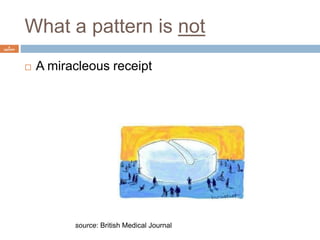
 A miracleous receipt 
source: British Medical Journal
What is a pattern 
7 
ISEP/IPP 
 A set of best-practices 
 A typified solution for a common problem in a giving 
context 
 Creates a common vocabulary 
 Patterns are discovered not invented 
 “Patterns are half-baked” 
 Martin Fowler
Anti-pattern 
8 
ISEP/IPP 
 An example of what not to do 
 Proven techniques that have shown bad 
results
Patterns for distributed 
applications
Architecture 
15 
ISEP/IPP 
“client” application 
Service 
Gateway 
“server” application 
Remote 
Façade 
Service 
Layer 
Business 
logic 
Data 
Transfer 
Object 
Service 
Locator 
contract
Service Gateway 
16 
ISEP/IPP 
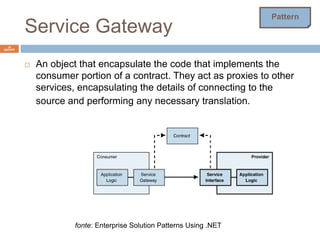
 An object that encapsulate the code that implements the 
consumer portion of a contract. They act as proxies to other 
services, encapsulating the details of connecting to the 
source and performing any necessary translation. 
fonte: Enterprise Solution Patterns Using .NET 
Pattern
Service Gateway 
17 
ISEP/IPP 
 Hides the details of accessing the service (ex., 
network protocol) 
 May be considered a data access component 
 Native support from most tools (e.g., Visual Studio, 
Netbeans, Rational software Architect) by web 
service proxies 
 See also Proxy and Broker pattern 
Pattern
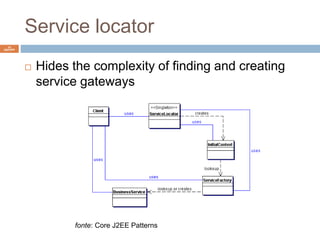
Service locator 
18 
ISEP/IPP 
 Hides the complexity of finding and creating 
service gateways 
fonte: Core J2EE Patterns
Remote Façade 
19 
ISEP/IPP 
 Provides a coarse-grained façade on fine-grained 
objects to improve efficiency over a 
network 
fonte: Patterns of Enterprise Application Architecture 
Pattern
Remote Facade 
20 
ISEP/IPP 
 Domain object interfaces are tipically fine grained 
 Inadequeate for remote operations 
 Create a surronding layer above domain objects 
 Local clients use the local interface 
 The facade may encapsulate the interface of one or more 
business objects 
 Domain objects: 
 Address.New 
 Address.Set 
 Person.AddAddress 
 Person.Update 
 Remote Facade: 
 AddressFacade.AddNewAddressToPerson 
Pattern
Data Transport Object 
21 
ISEP/IPP 
 An object that carries data between 
processes in order to reduce the number of 
method calls. 
fonte: Patterns of Enterprise Application Architecture 
Pattern
Data Transport Object 
22 
ISEP/IPP 
 Since XML is the de facto standard DTO should support serialization 
to/from XML 
 Should be independent of the underlying domain object 
 Should be implemented in accordance with the requiremnts of the 
remote application 
 CompleteCustomerInfoDTO 
 BasicCustomerInfoDTO 
 Should be independent of the underlying platform (e.g., programming 
language) 
 DataSet/DataTable .net 
 ResultSet JDBC 
 DateTime .net 
Pattern
Service Layer 
23 
ISEP/IPP 
 Defines an application's boundary with a layer of 
services that establishes a set of available operations 
and coordinates the application's response in each 
operation 
fonte: Patterns of Enterprise Application Architecture 
Pattern
Service Layer 
24 
ISEP/IPP 
Pattern 
 Domain logic pattern in the context of service 
orientation 
 May be implemented as a Remote Facade or 
may be called by a Remote Facade
Business Logic 
28 
ISEP/IPP 
 Outside of the scope 
 Excellent reference: Patterns of Enterprise 
Application Architecture 
 Table Module 
 Table Data Gateway 
 Domain Model 
 Active Record 
 Data Mapper 
 Optimistic Offline Lock 
 …
Service Orientation
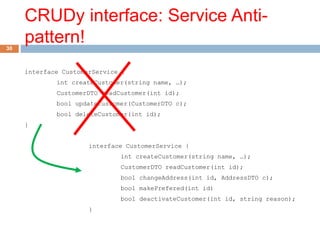
CRUDy interface: Service Anti-pattern! 
30 
interface CustomerService { 
int createCustomer(string name, …); 
CustomerDTO readCustomer(int id); 
bool updateCustomer(CustomerDTO c); 
bool deleteCustomer(int id); 
} 
interface CustomerService { 
int createCustomer(string name, …); 
CustomerDTO readCustomer(int id); 
bool changeAddress(int id, AddressDTO c); 
bool makePrefered(int id) 
bool deactivateCustomer(int id, string reason); 
}
Loosey-Goosey : Service Anti-pattern! 
31 
 Design highly flexible interface 
 E.g., Expose direct SQL access 
 In the intent to provide flexibility, there is no 
service contract 
interface CustomerService { 
CustomerDTO[] readCustomer(string where); 
}
Document Processor 
32 
 Provide a document centric contract, not an 
RPC-like contract
Idempotent operation 
33 
 Executing once or many times has the exact 
same side effects 
 Allows for repeated request 
 Ensures same outcome and only one end-state 
change 
 E.g., 
 setBalance() vs. addBalance() 
 delete() 
 read()
Reservation 
34 
 Allows for long running transactions without 
locking 
 Must have compensation procedure 
 ACID transactions are for databases not for 
distributed systems! 
 Look at the world around you, e.g., travel 
arrangements 
 Rent a car 
 Book the hotel 
 Buy the plane ticket
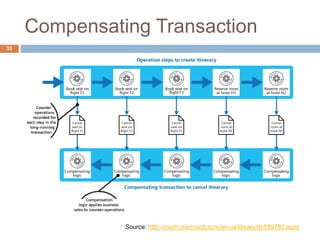
Compensating Transaction 
35 
Source: http://msdn.microsoft.com/en-us/library/dn589783.aspx
Queue-based load leveling 
36 
Source: http://msdn.microsoft.com/en-us/library/dn589783.aspx
Web/Worker roles 
37 
 Separate acepting requests from handling the 
requests 
Web role Queue Worker role 
 Both roles can scale independently
Scaling out 
38 
Web role Queue Worker role 
Thousands of 
instances 
Dozens or 
hundreds of 
instances 
 Queue must ensure reliability, transactionality 
and (possibly) single reader
Competing consumers 
39
Exercise 
 Remember the 
example DS you 
provided in the last 
session. 
 Define an 
hypothetical SOA for 
that system 
 Define contract 
 Identify where you 
would use the 
presented patterns 
40 
ISEP/IPP
41 CQRS
Stereotypical distributed system 
42 
Source: http://martinfowler.com/bliki/CQRS.html
Typical data flow 
43 
1. request data 
2. DTO is sent from the 
server 
UI Backend 
3. do some change to the 
data 
4. send updated DTO to the 
server 
5. ack/nack
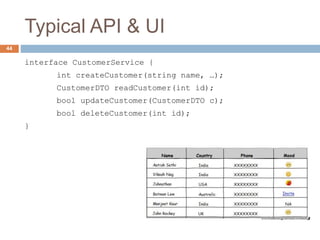
Typical API & UI 
44 
interface CustomerService { 
int createCustomer(string name, …); 
CustomerDTO readCustomer(int id); 
bool updateCustomer(CustomerDTO c); 
bool deleteCustomer(int id); 
}
Problems with Stereotypical 
distributed system 
 Read vs Write frequency 
 Read model vs Write model 
 Does not capture user intent 
Does not scale well
CQRS 
46 
 Command 
 Query 
 Responsibility 
 Segregation
Separating Commands from 
Queries 
47 
Source: http://martinfowler.com/bliki/CQRS.html
Two APIs 
48 
interface CustomerQueryService { 
CustomerDTO readCustomer(int id); 
} 
interface CustomerCommandService { 
int createCustomer(string name, …); 
bool updateCustomer(CustomerDTO c); 
bool deleteCustomer(int id); 
}
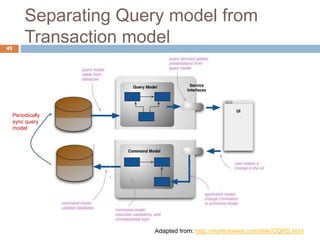
Separating Query model from 
Transaction model 
49 
Adapted from: http://martinfowler.com/bliki/CQRS.html 
Periodically 
sync query 
model
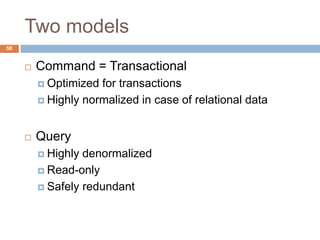
Two models 
50 
 Command = Transactional 
 Optimized for transactions 
 Highly normalized in case of relational data 
 Query 
 Highly denormalized 
 Read-only 
 Safely redundant
Capturing user intent 
51 
1. request data 
2. DTO is sent from the 
server 
UI Backend 
3. choose a task & fill in the 
task s data 
4. send command to the 
server 
5. ack/nack
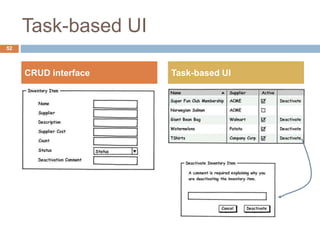
Task-based UI 
52 
CRUD interface Task-based UI
Task-based UI => Intentional 
API 
53 
interface CustomerQueryService { 
CustomerDTO readCustomer(int id); 
} 
interface CustomerCommandService { 
int createCustomer(string name, …); 
bool changeAddress(int id, Address a); 
bool makePrefered(int id); 
bool deactivateCustomer(int id, string reason); 
}
Exercise 
 Think about the 
system we have 
been discussing in 
the class and 
discuss if and how 
CQRS would be 
applicable and why. 
54
Patterns Bibliography 
55 
ISEP/IPP 
 Buschmann, F.; Henney, K. And Schmidt, D. (2007) Pattern- 
Oriented Software Architecture: A Pattern Language for Distributed 
Computing, Volume 4. Willey. 
 Patterns of Enterprise Application Architecture. Martin Fowler. 
Adisson-Wesley. 
 Core J2EE Patterns: Best Practices and Design Strategies. Deepak 
Alur, John Crupi and Dan Malks. Prentice Hall / Sun Microsystems 
Press. http://java.sun.com/blueprints/corej2eepatterns/index.html 
 Enterprise Solution Patterns Using Microsoft .NET. Microsoft Press. 
http://msdn.microsoft.com/architecture/patterns/default.aspx?pull=/li 
brary/en-us/dnpatterns/html/Esp.asp
Patterns Suggested readings 
56 
ISEP/IPP 
 Design patterns : elements of reusable object-oriented software. Erich 
Gamma, Richard Helm, Ralph Johnson, John Vissides. 
 Pattern-oriented Software Architecture: System of Patterns. Frank 
Buschmann, Regine Meunier, Hans Rohnert, Peter Sommerlad, 
Michael Stal 
 Principles of Service design: service patterns and anti-patterns. John 
Evdemon (2005) http://msdn.microsoft.com/en-us/ 
library/ms954638.aspx 
 Cloud Design Patterns. Microsoft Patterns & Practices. 
http://msdn.microsoft.com/en-us/library/dn568099.aspx 
 Designing Data Tier Components and Passing Data Through Tiers. 
Microsoft Patterns & Practices. 
http://msdn.microsoft.com/library/?url=/library/en-us/ 
dnbda/html/BOAGag.asp?frame=true
CQRS Bibliography 
57 
 Martin Fowler (2011) CQRS, 
http://martinfowler.com/bliki/CQRS.html 
 Greg Young, CQRS documents, 
http://cqrs.files.wordpress.com/2010/11/cqrs_documents.pdf 
 Microsoft Patterns & Practices (2012) Exploring CQRS and Event 
Sourcing, Microsoft Patterns & Practices. Available at 
http://msdn.microsoft.com/en-us/library/jj554200.aspx

Patterns for distributed systems

  • 1.
    PROGRAMAÇÃO DE SISTEMAS DISTRIBUIDOS Paulo Gandra de Sousa pag@isep.ipp.pt
  • 2.
    Disclaimer 1 ISEP/IPP  Parts of this presentation are from:  Paulo Sousa (PARS)  Ron Jacobs (ARC01)  Greg Young  Udi Dahn
  • 3.
    Today’s lesson 2  Design Patterns  Patterns for distributed Systems  Service Orientation patterns  CQRS
  • 4.
  • 5.
    What is aPattern? 4 ISEP/IPP Each pattern describes a problem that occurs over and over again in our environment and then describes the core of the solution to that problem in such a way that you can use this solution a million times over without ever doing it the same way twice. Christopher Alexander
  • 6.
    What is adesign Pattern? 5 ISEP/IPP A design pattern names, abstracts, and identifies the key aspects of a common design structure that make it useful for creating a reusable object-oriented design. Design Patterns-Elements of Reusable Object-oriented Software, Gamma et al. (Gang of Four)
  • 7.
    What a patternis not 6 ISEP/IPP  A miracleous receipt source: British Medical Journal
  • 8.
    What is apattern 7 ISEP/IPP  A set of best-practices  A typified solution for a common problem in a giving context  Creates a common vocabulary  Patterns are discovered not invented  “Patterns are half-baked”  Martin Fowler
  • 9.
    Anti-pattern 8 ISEP/IPP  An example of what not to do  Proven techniques that have shown bad results
  • 10.
  • 11.
    Architecture 15 ISEP/IPP “client” application Service Gateway “server” application Remote Façade Service Layer Business logic Data Transfer Object Service Locator contract
  • 12.
    Service Gateway 16 ISEP/IPP  An object that encapsulate the code that implements the consumer portion of a contract. They act as proxies to other services, encapsulating the details of connecting to the source and performing any necessary translation. fonte: Enterprise Solution Patterns Using .NET Pattern
  • 13.
    Service Gateway 17 ISEP/IPP  Hides the details of accessing the service (ex., network protocol)  May be considered a data access component  Native support from most tools (e.g., Visual Studio, Netbeans, Rational software Architect) by web service proxies  See also Proxy and Broker pattern Pattern
  • 14.
    Service locator 18 ISEP/IPP  Hides the complexity of finding and creating service gateways fonte: Core J2EE Patterns
  • 15.
    Remote Façade 19 ISEP/IPP  Provides a coarse-grained façade on fine-grained objects to improve efficiency over a network fonte: Patterns of Enterprise Application Architecture Pattern
  • 16.
    Remote Facade 20 ISEP/IPP  Domain object interfaces are tipically fine grained  Inadequeate for remote operations  Create a surronding layer above domain objects  Local clients use the local interface  The facade may encapsulate the interface of one or more business objects  Domain objects:  Address.New  Address.Set  Person.AddAddress  Person.Update  Remote Facade:  AddressFacade.AddNewAddressToPerson Pattern
  • 17.
    Data Transport Object 21 ISEP/IPP  An object that carries data between processes in order to reduce the number of method calls. fonte: Patterns of Enterprise Application Architecture Pattern
  • 18.
    Data Transport Object 22 ISEP/IPP  Since XML is the de facto standard DTO should support serialization to/from XML  Should be independent of the underlying domain object  Should be implemented in accordance with the requiremnts of the remote application  CompleteCustomerInfoDTO  BasicCustomerInfoDTO  Should be independent of the underlying platform (e.g., programming language)  DataSet/DataTable .net  ResultSet JDBC  DateTime .net Pattern
  • 19.
    Service Layer 23 ISEP/IPP  Defines an application's boundary with a layer of services that establishes a set of available operations and coordinates the application's response in each operation fonte: Patterns of Enterprise Application Architecture Pattern
  • 20.
    Service Layer 24 ISEP/IPP Pattern  Domain logic pattern in the context of service orientation  May be implemented as a Remote Facade or may be called by a Remote Facade
  • 21.
    Business Logic 28 ISEP/IPP  Outside of the scope  Excellent reference: Patterns of Enterprise Application Architecture  Table Module  Table Data Gateway  Domain Model  Active Record  Data Mapper  Optimistic Offline Lock  …
  • 22.
  • 23.
    CRUDy interface: ServiceAnti-pattern! 30 interface CustomerService { int createCustomer(string name, …); CustomerDTO readCustomer(int id); bool updateCustomer(CustomerDTO c); bool deleteCustomer(int id); } interface CustomerService { int createCustomer(string name, …); CustomerDTO readCustomer(int id); bool changeAddress(int id, AddressDTO c); bool makePrefered(int id) bool deactivateCustomer(int id, string reason); }
  • 24.
    Loosey-Goosey : ServiceAnti-pattern! 31  Design highly flexible interface  E.g., Expose direct SQL access  In the intent to provide flexibility, there is no service contract interface CustomerService { CustomerDTO[] readCustomer(string where); }
  • 25.
    Document Processor 32  Provide a document centric contract, not an RPC-like contract
  • 26.
    Idempotent operation 33  Executing once or many times has the exact same side effects  Allows for repeated request  Ensures same outcome and only one end-state change  E.g.,  setBalance() vs. addBalance()  delete()  read()
  • 27.
    Reservation 34 Allows for long running transactions without locking  Must have compensation procedure  ACID transactions are for databases not for distributed systems!  Look at the world around you, e.g., travel arrangements  Rent a car  Book the hotel  Buy the plane ticket
  • 28.
    Compensating Transaction 35 Source: http://msdn.microsoft.com/en-us/library/dn589783.aspx
  • 29.
    Queue-based load leveling 36 Source: http://msdn.microsoft.com/en-us/library/dn589783.aspx
  • 30.
    Web/Worker roles 37  Separate acepting requests from handling the requests Web role Queue Worker role  Both roles can scale independently
  • 31.
    Scaling out 38 Web role Queue Worker role Thousands of instances Dozens or hundreds of instances  Queue must ensure reliability, transactionality and (possibly) single reader
  • 32.
  • 33.
    Exercise  Rememberthe example DS you provided in the last session.  Define an hypothetical SOA for that system  Define contract  Identify where you would use the presented patterns 40 ISEP/IPP
  • 34.
  • 35.
    Stereotypical distributed system 42 Source: http://martinfowler.com/bliki/CQRS.html
  • 36.
    Typical data flow 43 1. request data 2. DTO is sent from the server UI Backend 3. do some change to the data 4. send updated DTO to the server 5. ack/nack
  • 37.
    Typical API &UI 44 interface CustomerService { int createCustomer(string name, …); CustomerDTO readCustomer(int id); bool updateCustomer(CustomerDTO c); bool deleteCustomer(int id); }
  • 38.
    Problems with Stereotypical distributed system  Read vs Write frequency  Read model vs Write model  Does not capture user intent Does not scale well
  • 39.
    CQRS 46 Command  Query  Responsibility  Segregation
  • 40.
    Separating Commands from Queries 47 Source: http://martinfowler.com/bliki/CQRS.html
  • 41.
    Two APIs 48 interface CustomerQueryService { CustomerDTO readCustomer(int id); } interface CustomerCommandService { int createCustomer(string name, …); bool updateCustomer(CustomerDTO c); bool deleteCustomer(int id); }
  • 42.
    Separating Query modelfrom Transaction model 49 Adapted from: http://martinfowler.com/bliki/CQRS.html Periodically sync query model
  • 43.
    Two models 50  Command = Transactional  Optimized for transactions  Highly normalized in case of relational data  Query  Highly denormalized  Read-only  Safely redundant
  • 44.
    Capturing user intent 51 1. request data 2. DTO is sent from the server UI Backend 3. choose a task & fill in the task s data 4. send command to the server 5. ack/nack
  • 45.
    Task-based UI 52 CRUD interface Task-based UI
  • 46.
    Task-based UI =>Intentional API 53 interface CustomerQueryService { CustomerDTO readCustomer(int id); } interface CustomerCommandService { int createCustomer(string name, …); bool changeAddress(int id, Address a); bool makePrefered(int id); bool deactivateCustomer(int id, string reason); }
  • 47.
    Exercise  Thinkabout the system we have been discussing in the class and discuss if and how CQRS would be applicable and why. 54
  • 48.
    Patterns Bibliography 55 ISEP/IPP  Buschmann, F.; Henney, K. And Schmidt, D. (2007) Pattern- Oriented Software Architecture: A Pattern Language for Distributed Computing, Volume 4. Willey.  Patterns of Enterprise Application Architecture. Martin Fowler. Adisson-Wesley.  Core J2EE Patterns: Best Practices and Design Strategies. Deepak Alur, John Crupi and Dan Malks. Prentice Hall / Sun Microsystems Press. http://java.sun.com/blueprints/corej2eepatterns/index.html  Enterprise Solution Patterns Using Microsoft .NET. Microsoft Press. http://msdn.microsoft.com/architecture/patterns/default.aspx?pull=/li brary/en-us/dnpatterns/html/Esp.asp
  • 49.
    Patterns Suggested readings 56 ISEP/IPP  Design patterns : elements of reusable object-oriented software. Erich Gamma, Richard Helm, Ralph Johnson, John Vissides.  Pattern-oriented Software Architecture: System of Patterns. Frank Buschmann, Regine Meunier, Hans Rohnert, Peter Sommerlad, Michael Stal  Principles of Service design: service patterns and anti-patterns. John Evdemon (2005) http://msdn.microsoft.com/en-us/ library/ms954638.aspx  Cloud Design Patterns. Microsoft Patterns & Practices. http://msdn.microsoft.com/en-us/library/dn568099.aspx  Designing Data Tier Components and Passing Data Through Tiers. Microsoft Patterns & Practices. http://msdn.microsoft.com/library/?url=/library/en-us/ dnbda/html/BOAGag.asp?frame=true
  • 50.
    CQRS Bibliography 57  Martin Fowler (2011) CQRS, http://martinfowler.com/bliki/CQRS.html  Greg Young, CQRS documents, http://cqrs.files.wordpress.com/2010/11/cqrs_documents.pdf  Microsoft Patterns & Practices (2012) Exploring CQRS and Event Sourcing, Microsoft Patterns & Practices. Available at http://msdn.microsoft.com/en-us/library/jj554200.aspx

Editor's Notes

  • #32 Design the same old CRUD interface Verbose