Session 89260
Simplifying IT Using a Disciplined
Portfolio Governance Approach
Eileen Ahles
Abstract
Learn how Salt River Project, one of Arizona's largest utilities, utilizes
Oracle's Primavera Portfolio Management software to help them improve
management of their organization's IT portfolios (business applications
and infrastructure technologies). By identifying cost reduction and risk
mitigation opportunities, a continuing trend of IT simplicity has resulted
in improved IT standardization and modernization across the enterprise.in improved IT standardization and modernization across the enterprise.
Objectives:
• Learn how SRP got started with IT portfolio management.
• Hear about the results from using portfolio management to reduce IT
complexity.
• Discover lessons learned along the portfolio management journey.
Agenda
1. Background & Challenges
2. Governance Framework
3. Enterprise IT Asset Portfolio3. Enterprise IT Asset Portfolio
4. Portfolio Rationalization
5. Simplifying Business Continuity & DR Planning
6. Lessons Learned
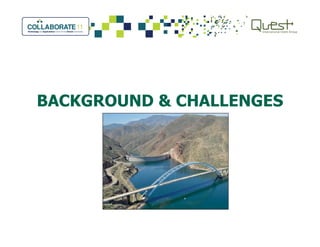
BACKGROUND & CHALLENGES
SRP-History
In 1903, Salt River Valley Water Users’ Association was formed by
Arizona landowners
The National Reclamation Act of 1902 provided funding for the
construction of Roosevelt Dam
In 1909, a hydroelectric generator at the Theodore Roosevelt Dam site
was built
In 1937, the Association created the Salt River Project Agricultural
Improvement and Power District to operate the power generation and
distribution system.
The Association and District later became known as Salt River Project.
SRP-Today
Two companies serving metropolitan Phoenix:
• Public Power Company
• Private Water Management Association
Employees = 4,461Employees = 4,461
Annual Revenues = $2.7 billion
SRP has been honored by JD Powers as the top-rated
large power company in residential customer
satisfaction in the West for 11 of the past 12 years.
Challenges
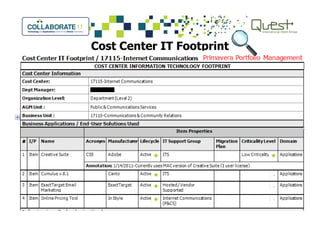
SRP uses a decentralized IT support model
• Multiple Business Unit IT groups – as well as Corporate IT –
all at various levels of sophistication
• Redundant application functionality and duplication of• Redundant application functionality and duplication of
technologies
• No process to manage or prioritize technology requests
• Existing systems did not inform executives of enterprise IT
spend, making cost containment challenging.
IT Governance
Realization: If SRP continues to progress without a solid IT
strategy and IT governance framework, we risk service, cost,
and security obstacles.
Solution:Solution:
• In 2004, SRP launched an IT governance program.
• Our governance model blends business unit flexibility with
centralized facilitation
GOVERNANCE FRAMEWORK
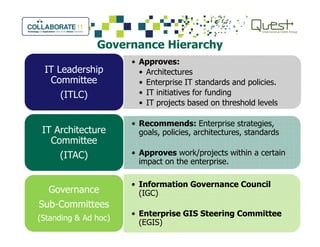
Governance Hierarchy
• Approves:
• Architectures
• Enterprise IT standards and policies.
• IT initiatives for funding
• IT projects based on threshold levels
IT Leadership
Committee
(ITLC)
• Recommends: Enterprise strategies,
IT Architecture
• Recommends: Enterprise strategies,
goals, policies, architectures, standards
• Approves work/projects within a certain
impact on the enterprise.
IT Architecture
Committee
(ITAC)
• Information Governance Council
(IGC)
• Enterprise GIS Steering Committee
(EGIS)
Governance
Sub-Committees
(Standing & Ad hoc)
Governance Goals
Manage an Enterprise IT Asset Portfolio
• Include methods for maintaining an IT asset inventory,
monitoring its performance and assessing its value.
• Reviewing performance and value indicators of the IT
portfolio will drive the launch of projects for adjustments.portfolio will drive the launch of projects for adjustments.
Manage Project Initiation & Prioritization
• Processes for evaluating all IT projects to ensure risks,
resources and funding are mapped against corporate
priorities.
Solution
Oracle’s Primavera Portfolio Management (PPM)
• Acquired in Summer of 2005
• Components:
• Fast Track for Application Portfolio Management• Fast Track for Application Portfolio Management
• Fast Track for Project Portfolio Management
• Utilized professional services consulting for support and
oversight of implementation process
• Primavera Propose and Primavera Bridge for Microsoft
Project Server added at a later date.
The Portfolio Management Cycle
New Projects
Identify
Asset
Retire
Assets
Adjust
Launch New
Project/
Initiative
Adjust
Program
Portfolio
Launch New
Project/
Initiative
Design &
Develop
Solution
Implement
Solution
Assess
Value
New Assets
Asset
Improvements
Manage
Asset Usage
Assess
Asset Value
Assets
Adjust
Program
Portfolio
Initiative
Design &
Develop
Solution
Implement
Solution
Assess
Value
IT Portfolio Management Program
Evaluating - - Prioritizing - - Planning - - Communicating
Adjust
Program
Portfolio
Launch New
Project/
Initiative
Design &
Develop
Solution
Implement
Solution
Assess
Value
IT ASSET PORTFOLIO
Enterprise IT Asset Portfolio
Provides transparency into current inventory of
assets and resource consumption
• Identify & eliminate redundant / overlapping functionality
• Assess the condition of technology assets• Assess the condition of technology assets
• Quantify assets’ business value
• Aid strategic planning efforts
• Diffuse Business / IT conflict
Enterprise IT Asset Portfolio: Domains
Business Applications / End-User Solutions:
Software used to automate & optimize business functions,
processes, tasks, and activities.
Infrastructure Technologies:
Foundational technologies used to create and operate
business solutions and store / transmit information.
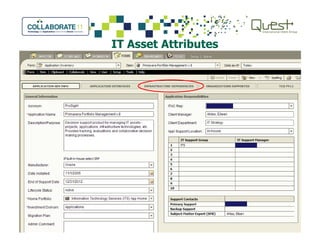
IT Asset Attributes
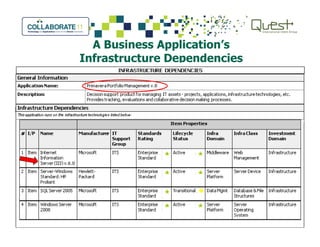
A Business Application’s
Infrastructure Dependencies
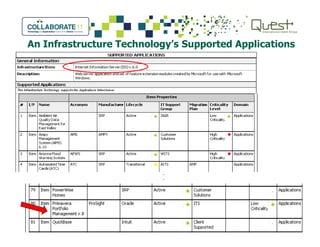
An Infrastructure Technology’s Supported Applications
.
.
.
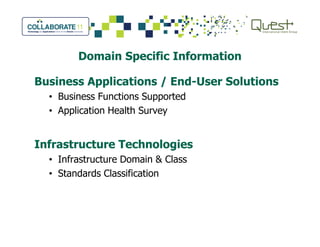
Domain Specific Information
Business Applications / End-User Solutions
• Business Functions Supported
• Application Health Survey
Infrastructure Technologies
• Infrastructure Domain & Class
• Standards Classification
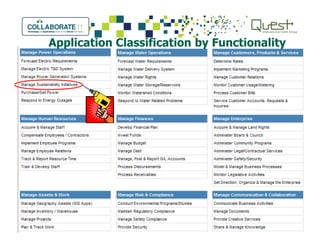
Application Classification by Functionality
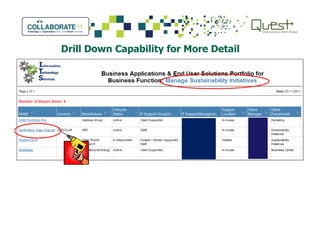
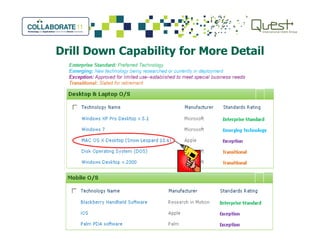
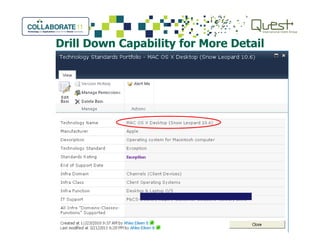
Drill Down Capability for More Detail
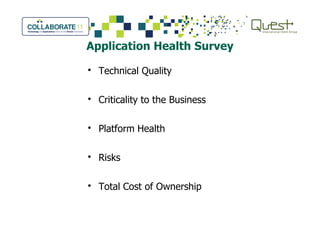
Application Health Survey
• Technical Quality
• Criticality to the Business
• Platform Health• Platform Health
• Risks
• Total Cost of Ownership
Data Visualization Capabilities
Scorecard
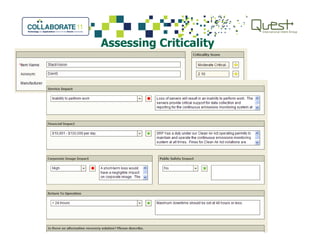
Assessing Criticality
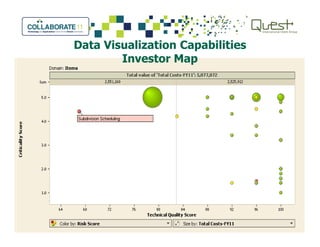
Data Visualization Capabilities
Investor Map
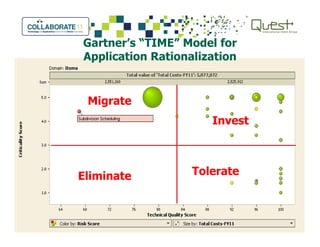
Gartner’s “TIME” Model for
Application Rationalization
Invest
Migrate
Tolerate
Invest
Eliminate
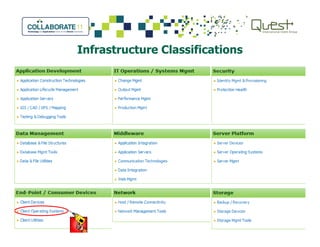
Infrastructure Classifications
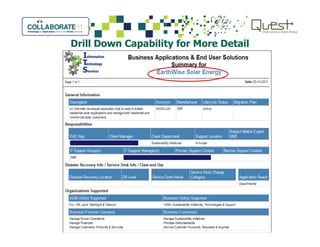
Drill Down Capability for More Detail
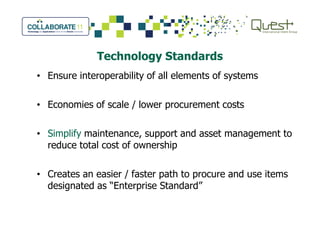
Technology Standards
• Ensure interoperability of all elements of systems
• Economies of scale / lower procurement costs
• Simplify maintenance, support and asset management to
reduce total cost of ownership
• Creates an easier / faster path to procure and use items
designated as “Enterprise Standard”
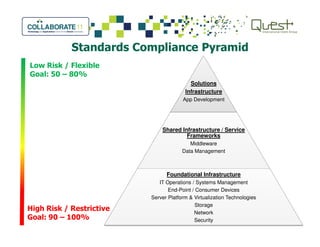
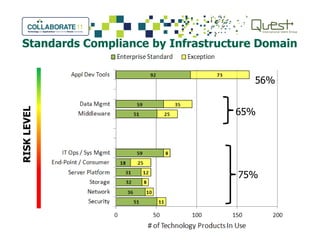
Standards Compliance Pyramid
Low Risk / Flexible
Goal: 50 – 80%
Solutions
Infrastructure
App Development
High Risk / Restrictive
Goal: 90 – 100%
Shared Infrastructure / Service
Frameworks
Middleware
Data Management
Foundational Infrastructure
IT Operations / Systems Management
End-Point / Consumer Devices
Server Platform & Virtualization Technologies
Storage
Network
Security
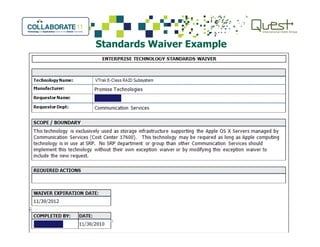
Standards Waiver Example
PORTFOLIO RATIONALIZATION
Portfolio Rationalization Process
Our goal for our first rationalization process was to analyze
SRP’s IT portfolio in order to identify opportunities that:
• Reduce maintenance & support costs through
consolidation and/or decommissioningconsolidation and/or decommissioning
• Increase manageability by reducing the number of
technologies in use
• Decrease the risk of running on unsupported
technologies
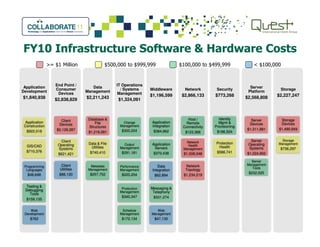
FY10 Infrastructure Software & Hardware Costs
Application
Development
$1,840,938
Application
Development
$1,840,938
Application
End Point /
Consumer
Devices
$2,838,829
End Point /
Consumer
Devices
$2,838,829
Client
Devices
Data
Management
$2,211,243
Data
Management
$2,211,243
Database &
File
IT Operations
/ Systems
Management
$1,324,091
IT Operations
/ Systems
Management
$1,324,091
Change
Middleware
$1,196,599
Middleware
$1,196,599
Application
Network
$2,866,133
Network
$2,866,133
Host /
Remote
Security
$773,268
Security
$773,268
Identity
Mgmt &
Server
Platform
$2,568,808
Server
Platform
$2,568,808
Server
Devices
Storage
$2,227,247
Storage
$2,227,247
Storage
Devices
>= $1 Million $500,000 to $999,999 $100,000 to $499,999 < $100,000
Application
Construction
$922,018
GIS/CAD
$710,376
Programming
Languages
$48,648
Testing &
Debugging
Tools
$159,135
Web
Development
$762
Devices
$2,129,287
Client
Operating
Systems
$621,421
Client
Utilities
$88,120
File
Structures
$1,216,081
Data & File
Utilities
$740,410
Metadata
Management
$257,752
Change
Management
$300,224
Output
Management
$291,181
Performance
Management
$220,204
Production
Management
$340,347
Schedule
Management
$172,134
Application
Integration
$384,862
Application
Servers
$370,438
Data
Integration
$62,894
Messaging &
Telephony
$331,274
Web
Management
$47,130
Remote
Connectivity
$123,366
Network
Health
Management
$1,508,548
Network
Topology
$1,234,219
Mgmt &
Provisioning
$186,524
Protection
Health
$586,741
Devices
$1,311,881
Server
Operating
Systems
$1,024,902
Server
Management
Tools
$232,025
Devices
$1,490,949
Storage
Management
$736,297
Standards Compliance by Infrastructure Domain
RISKLEVEL
65%
56%
RISKLEVEL
75%
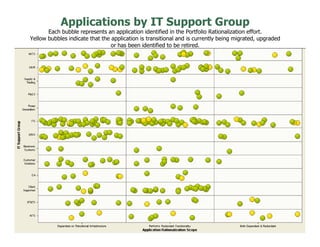
Applications by IT Support Group
Each bubble represents an application identified in the Portfolio Rationalization effort.
Yellow bubbles indicate that the application is transitional and is currently being migrated, upgraded
or has been identified to be retired.
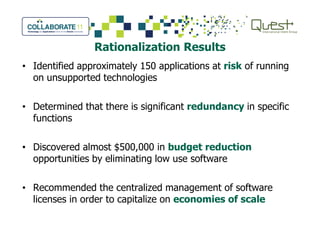
Rationalization Results
• Identified approximately 150 applications at risk of running
on unsupported technologies
• Determined that there is significant redundancy in specific
functions
• Discovered almost $500,000 in budget reduction
opportunities by eliminating low use software
• Recommended the centralized management of software
licenses in order to capitalize on economies of scale
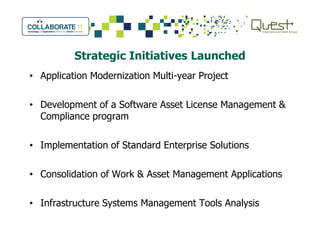
Strategic Initiatives Launched
• Application Modernization Multi-year Project
• Development of a Software Asset License Management &
Compliance program
• Implementation of Standard Enterprise Solutions
• Consolidation of Work & Asset Management Applications
• Infrastructure Systems Management Tools Analysis
SIMPLIFYING BUSINESS CONTINUITY &
DISASTER RECOVERY PLANNING
Simplifying Business Continuity &
Disaster Recovery Planning
• Partnered with SRP’s Business Continuity & Emergency
Management department
• Used Primavera Portfolio Management’s capabilities to link• Used Primavera Portfolio Management’s capabilities to link
Key Business Processes to Applications
• This information is used to define critical applications and
subsequent disaster recovery requirements
• Developed list of applications with a recommended tier of
recovery
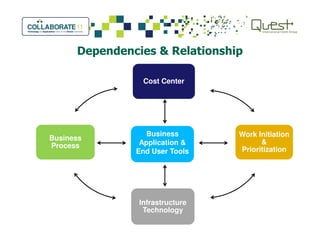
Cost Center
Dependencies & Relationship
Work Initiation
&
Prioritization
Infrastructure
Technology
Business
Process
Business
Application &
End User Tools
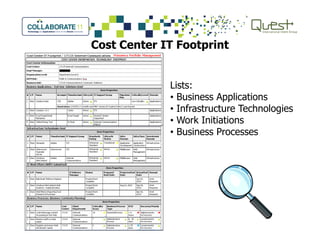
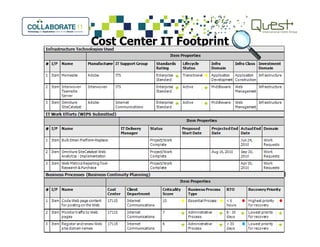
Cost Center IT Footprint
Lists:
• Business Applications
• Infrastructure Technologies
• Work Initiations• Work Initiations
• Business Processes
Cost Center IT Footprint
LESSONS LEARNED
Lessons Learned
• IT Portfolio Management data and analysis processes can be a
powerful tool for:
• Providing information for decision making
• Reducing risk by managing technology life-cycle, health, cost,
and value
• Management support is essential for championing the processes and
gaining buy-in.
• Communicating your efforts and analysis results is very important!
• SRP’s adoption has evolved over the years and continues to evolve.
• Be flexible!
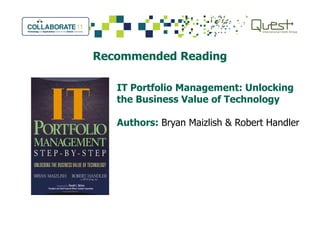
Recommended Reading
IT Portfolio Management: Unlocking
the Business Value of Technology
Authors: Bryan Maizlish & Robert HandlerAuthors: Bryan Maizlish & Robert Handler
They say the world has become too complex for
simple answers. They are wrong.
-Ronald Reagan

Simplifying it using a disciplined portfolio governance approach

  • 1.
    Session 89260 Simplifying ITUsing a Disciplined Portfolio Governance Approach Eileen Ahles
  • 2.
    Abstract Learn how SaltRiver Project, one of Arizona's largest utilities, utilizes Oracle's Primavera Portfolio Management software to help them improve management of their organization's IT portfolios (business applications and infrastructure technologies). By identifying cost reduction and risk mitigation opportunities, a continuing trend of IT simplicity has resulted in improved IT standardization and modernization across the enterprise.in improved IT standardization and modernization across the enterprise. Objectives: • Learn how SRP got started with IT portfolio management. • Hear about the results from using portfolio management to reduce IT complexity. • Discover lessons learned along the portfolio management journey.
  • 3.
    Agenda 1. Background &Challenges 2. Governance Framework 3. Enterprise IT Asset Portfolio3. Enterprise IT Asset Portfolio 4. Portfolio Rationalization 5. Simplifying Business Continuity & DR Planning 6. Lessons Learned
  • 4.
  • 5.
    SRP-History In 1903, SaltRiver Valley Water Users’ Association was formed by Arizona landowners The National Reclamation Act of 1902 provided funding for the construction of Roosevelt Dam In 1909, a hydroelectric generator at the Theodore Roosevelt Dam site was built In 1937, the Association created the Salt River Project Agricultural Improvement and Power District to operate the power generation and distribution system. The Association and District later became known as Salt River Project.
  • 6.
    SRP-Today Two companies servingmetropolitan Phoenix: • Public Power Company • Private Water Management Association Employees = 4,461Employees = 4,461 Annual Revenues = $2.7 billion SRP has been honored by JD Powers as the top-rated large power company in residential customer satisfaction in the West for 11 of the past 12 years.
  • 7.
    Challenges SRP uses adecentralized IT support model • Multiple Business Unit IT groups – as well as Corporate IT – all at various levels of sophistication • Redundant application functionality and duplication of• Redundant application functionality and duplication of technologies • No process to manage or prioritize technology requests • Existing systems did not inform executives of enterprise IT spend, making cost containment challenging.
  • 8.
    IT Governance Realization: IfSRP continues to progress without a solid IT strategy and IT governance framework, we risk service, cost, and security obstacles. Solution:Solution: • In 2004, SRP launched an IT governance program. • Our governance model blends business unit flexibility with centralized facilitation
  • 9.
  • 10.
    Governance Hierarchy • Approves: •Architectures • Enterprise IT standards and policies. • IT initiatives for funding • IT projects based on threshold levels IT Leadership Committee (ITLC) • Recommends: Enterprise strategies, IT Architecture • Recommends: Enterprise strategies, goals, policies, architectures, standards • Approves work/projects within a certain impact on the enterprise. IT Architecture Committee (ITAC) • Information Governance Council (IGC) • Enterprise GIS Steering Committee (EGIS) Governance Sub-Committees (Standing & Ad hoc)
  • 11.
    Governance Goals Manage anEnterprise IT Asset Portfolio • Include methods for maintaining an IT asset inventory, monitoring its performance and assessing its value. • Reviewing performance and value indicators of the IT portfolio will drive the launch of projects for adjustments.portfolio will drive the launch of projects for adjustments. Manage Project Initiation & Prioritization • Processes for evaluating all IT projects to ensure risks, resources and funding are mapped against corporate priorities.
  • 12.
    Solution Oracle’s Primavera PortfolioManagement (PPM) • Acquired in Summer of 2005 • Components: • Fast Track for Application Portfolio Management• Fast Track for Application Portfolio Management • Fast Track for Project Portfolio Management • Utilized professional services consulting for support and oversight of implementation process • Primavera Propose and Primavera Bridge for Microsoft Project Server added at a later date.
  • 13.
    The Portfolio ManagementCycle New Projects Identify Asset Retire Assets Adjust Launch New Project/ Initiative Adjust Program Portfolio Launch New Project/ Initiative Design & Develop Solution Implement Solution Assess Value New Assets Asset Improvements Manage Asset Usage Assess Asset Value Assets Adjust Program Portfolio Initiative Design & Develop Solution Implement Solution Assess Value IT Portfolio Management Program Evaluating - - Prioritizing - - Planning - - Communicating Adjust Program Portfolio Launch New Project/ Initiative Design & Develop Solution Implement Solution Assess Value
  • 14.
  • 15.
    Enterprise IT AssetPortfolio Provides transparency into current inventory of assets and resource consumption • Identify & eliminate redundant / overlapping functionality • Assess the condition of technology assets• Assess the condition of technology assets • Quantify assets’ business value • Aid strategic planning efforts • Diffuse Business / IT conflict
  • 16.
    Enterprise IT AssetPortfolio: Domains Business Applications / End-User Solutions: Software used to automate & optimize business functions, processes, tasks, and activities. Infrastructure Technologies: Foundational technologies used to create and operate business solutions and store / transmit information.
  • 17.
  • 18.
  • 19.
    An Infrastructure Technology’sSupported Applications . . .
  • 20.
    Domain Specific Information BusinessApplications / End-User Solutions • Business Functions Supported • Application Health Survey Infrastructure Technologies • Infrastructure Domain & Class • Standards Classification
  • 21.
  • 22.
    Drill Down Capabilityfor More Detail
  • 23.
    Drill Down Capabilityfor More Detail
  • 24.
    Application Health Survey •Technical Quality • Criticality to the Business • Platform Health• Platform Health • Risks • Total Cost of Ownership
  • 25.
  • 26.
  • 27.
  • 28.
    Gartner’s “TIME” Modelfor Application Rationalization Invest Migrate Tolerate Invest Eliminate
  • 29.
  • 30.
    Drill Down Capabilityfor More Detail
  • 31.
    Drill Down Capabilityfor More Detail
  • 32.
    Technology Standards • Ensureinteroperability of all elements of systems • Economies of scale / lower procurement costs • Simplify maintenance, support and asset management to reduce total cost of ownership • Creates an easier / faster path to procure and use items designated as “Enterprise Standard”
  • 33.
    Standards Compliance Pyramid LowRisk / Flexible Goal: 50 – 80% Solutions Infrastructure App Development High Risk / Restrictive Goal: 90 – 100% Shared Infrastructure / Service Frameworks Middleware Data Management Foundational Infrastructure IT Operations / Systems Management End-Point / Consumer Devices Server Platform & Virtualization Technologies Storage Network Security
  • 34.
  • 35.
  • 36.
    Portfolio Rationalization Process Ourgoal for our first rationalization process was to analyze SRP’s IT portfolio in order to identify opportunities that: • Reduce maintenance & support costs through consolidation and/or decommissioningconsolidation and/or decommissioning • Increase manageability by reducing the number of technologies in use • Decrease the risk of running on unsupported technologies
  • 37.
    FY10 Infrastructure Software& Hardware Costs Application Development $1,840,938 Application Development $1,840,938 Application End Point / Consumer Devices $2,838,829 End Point / Consumer Devices $2,838,829 Client Devices Data Management $2,211,243 Data Management $2,211,243 Database & File IT Operations / Systems Management $1,324,091 IT Operations / Systems Management $1,324,091 Change Middleware $1,196,599 Middleware $1,196,599 Application Network $2,866,133 Network $2,866,133 Host / Remote Security $773,268 Security $773,268 Identity Mgmt & Server Platform $2,568,808 Server Platform $2,568,808 Server Devices Storage $2,227,247 Storage $2,227,247 Storage Devices >= $1 Million $500,000 to $999,999 $100,000 to $499,999 < $100,000 Application Construction $922,018 GIS/CAD $710,376 Programming Languages $48,648 Testing & Debugging Tools $159,135 Web Development $762 Devices $2,129,287 Client Operating Systems $621,421 Client Utilities $88,120 File Structures $1,216,081 Data & File Utilities $740,410 Metadata Management $257,752 Change Management $300,224 Output Management $291,181 Performance Management $220,204 Production Management $340,347 Schedule Management $172,134 Application Integration $384,862 Application Servers $370,438 Data Integration $62,894 Messaging & Telephony $331,274 Web Management $47,130 Remote Connectivity $123,366 Network Health Management $1,508,548 Network Topology $1,234,219 Mgmt & Provisioning $186,524 Protection Health $586,741 Devices $1,311,881 Server Operating Systems $1,024,902 Server Management Tools $232,025 Devices $1,490,949 Storage Management $736,297
  • 38.
    Standards Compliance byInfrastructure Domain RISKLEVEL 65% 56% RISKLEVEL 75%
  • 39.
    Applications by ITSupport Group Each bubble represents an application identified in the Portfolio Rationalization effort. Yellow bubbles indicate that the application is transitional and is currently being migrated, upgraded or has been identified to be retired.
  • 40.
    Rationalization Results • Identifiedapproximately 150 applications at risk of running on unsupported technologies • Determined that there is significant redundancy in specific functions • Discovered almost $500,000 in budget reduction opportunities by eliminating low use software • Recommended the centralized management of software licenses in order to capitalize on economies of scale
  • 41.
    Strategic Initiatives Launched •Application Modernization Multi-year Project • Development of a Software Asset License Management & Compliance program • Implementation of Standard Enterprise Solutions • Consolidation of Work & Asset Management Applications • Infrastructure Systems Management Tools Analysis
  • 42.
    SIMPLIFYING BUSINESS CONTINUITY& DISASTER RECOVERY PLANNING
  • 43.
    Simplifying Business Continuity& Disaster Recovery Planning • Partnered with SRP’s Business Continuity & Emergency Management department • Used Primavera Portfolio Management’s capabilities to link• Used Primavera Portfolio Management’s capabilities to link Key Business Processes to Applications • This information is used to define critical applications and subsequent disaster recovery requirements • Developed list of applications with a recommended tier of recovery
  • 44.
    Cost Center Dependencies &Relationship Work Initiation & Prioritization Infrastructure Technology Business Process Business Application & End User Tools
  • 45.
    Cost Center ITFootprint Lists: • Business Applications • Infrastructure Technologies • Work Initiations• Work Initiations • Business Processes
  • 46.
    Cost Center ITFootprint
  • 47.
    Cost Center ITFootprint
  • 48.
  • 49.
    Lessons Learned • ITPortfolio Management data and analysis processes can be a powerful tool for: • Providing information for decision making • Reducing risk by managing technology life-cycle, health, cost, and value • Management support is essential for championing the processes and gaining buy-in. • Communicating your efforts and analysis results is very important! • SRP’s adoption has evolved over the years and continues to evolve. • Be flexible!
  • 50.
    Recommended Reading IT PortfolioManagement: Unlocking the Business Value of Technology Authors: Bryan Maizlish & Robert HandlerAuthors: Bryan Maizlish & Robert Handler
  • 51.
    They say theworld has become too complex for simple answers. They are wrong. -Ronald Reagan