OpenERP 8.0 Python API
Raphael Collet rco@openerp.com
MotivationFinal thoughts
Open Days 2013
1 of 23
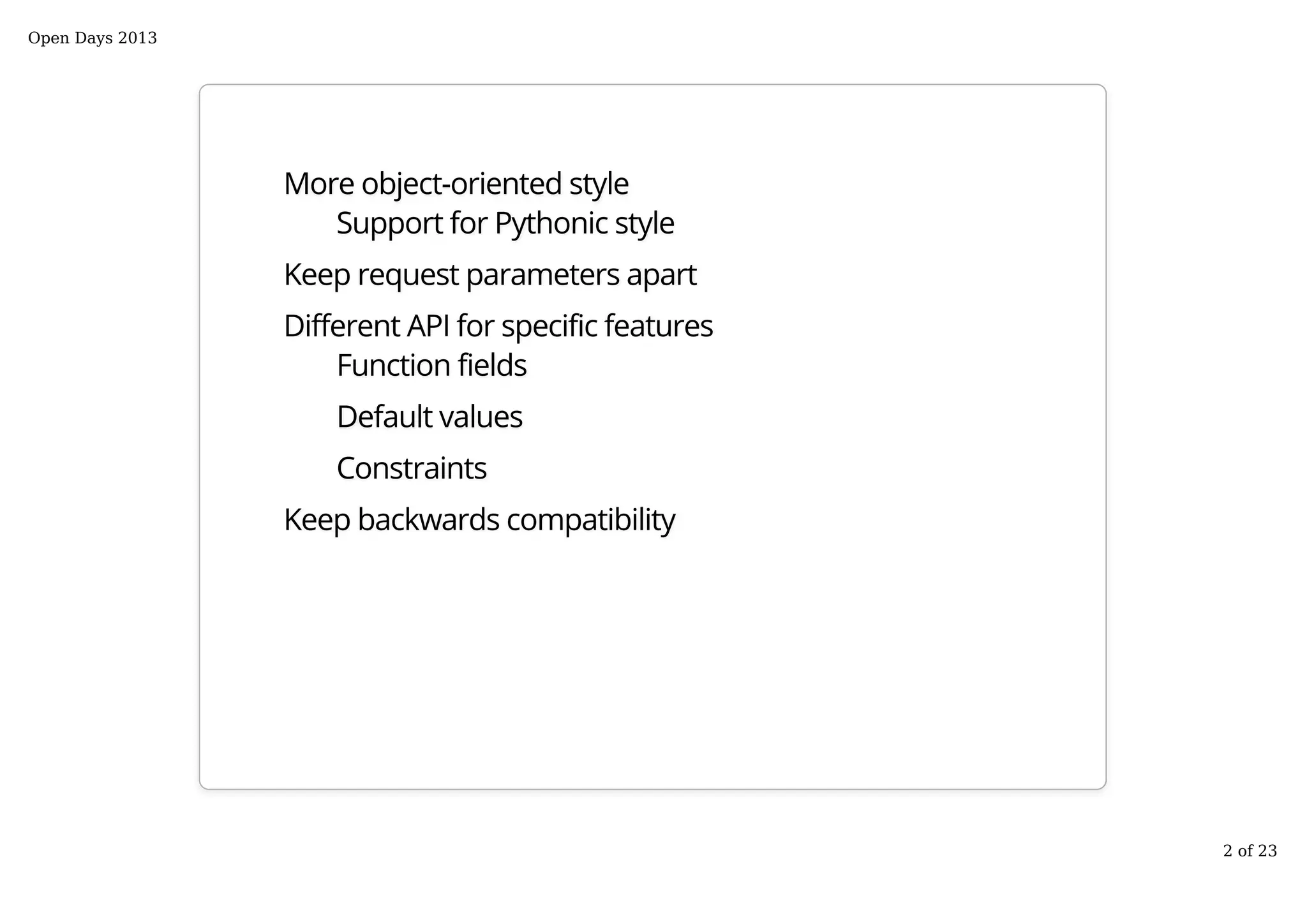
More object-oriented style
Support for Pythonic style
Keep request parameters apart
Different API for specific features
Function fields
Default values
Constraints
Keep backwards compatibility
Open Days 2013
2 of 23
Object-oriented style
def write(self, cr, uid, ids, values, context=None):
super(C, self).write(cr, uid, ids, values, context=context)
for record in self.browse(cr, uid, ids, context=context):
if record.increment:
self.write(cr, uid, [record.id], {
'count': record.count + 1,
}, context=context)
@multi
def write(self, values):
super(C, self).write(values)
for record in self:
if record.increment:
record.count += 1
Open Days 2013
3 of 23
Every class instance is a recordset
A recordset is a collection of records; it encapsulates a list of
record ids.
records = model.browse(ids) # return a recordset
assert isinstance(records, Model)
print bool(records) # test for emptyness
print len(records) # size of collection
records1 = records[:3] # slicing
records2 = records[-3] # selection
records = records1 + records2 # concatenation
for record in records: # iteration returns
assert isinstance(record, Model) # recordsets, too
assert len(record) == 1
Open Days 2013
4 of 23
Recordsets to access data
Get/set a field on a recordset: do it on its first record.
records = model.browse(ids)
for record in records:
value = record.name
record.name = (value or '') + '!'
for record in records:
value = record['name']
record['name'] = (value or '') + '!'
assert records.name == records[0].name
# relational fields return recordsets
assert isinstance(records.parent_id, Model)
Compatible with old browse records.
Open Days 2013
5 of 23
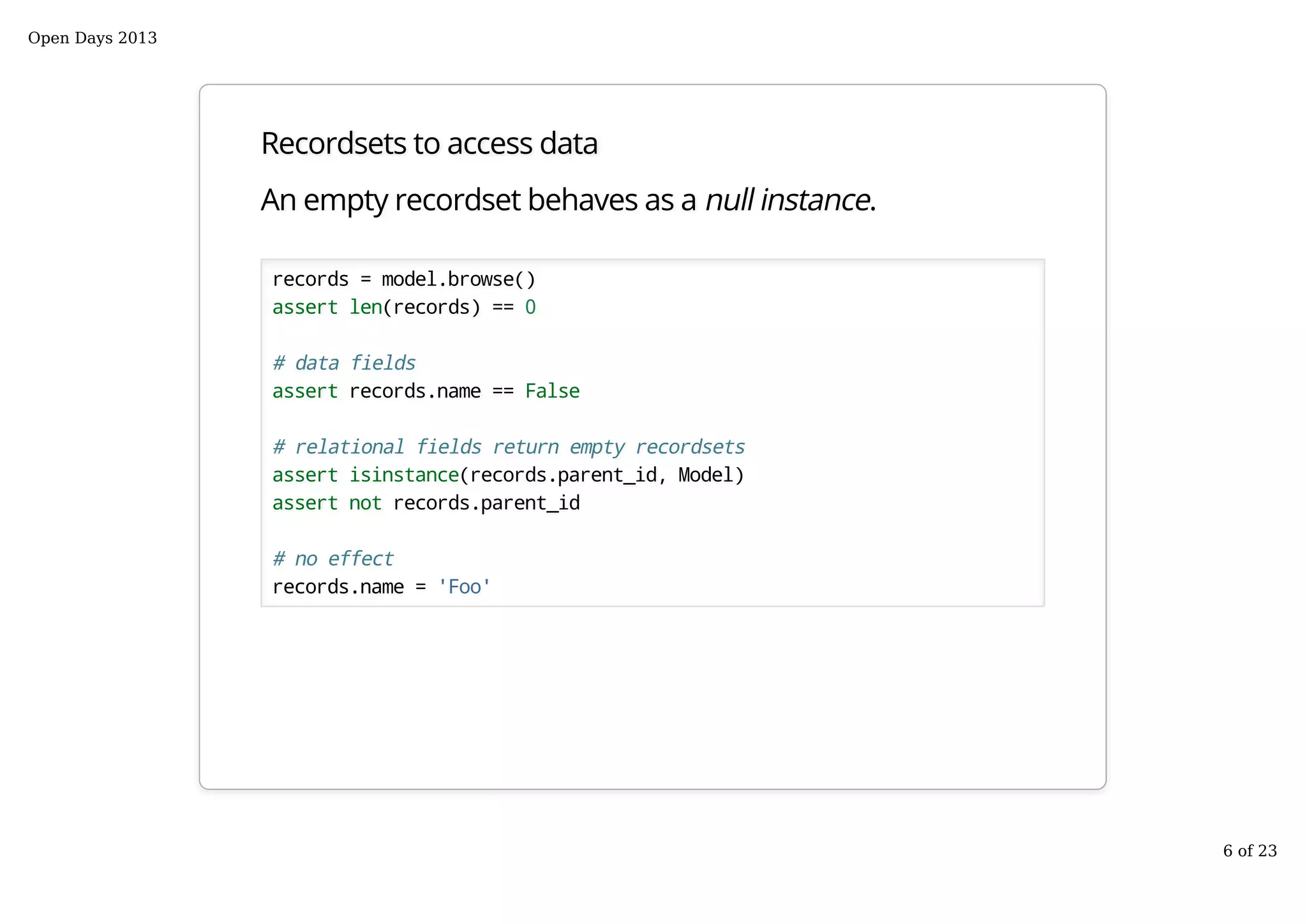
Recordsets to access data
An empty recordset behaves as a null instance.
records = model.browse()
assert len(records) == 0
# data fields
assert records.name == False
# relational fields return empty recordsets
assert isinstance(records.parent_id, Model)
assert not records.parent_id
# no effect
records.name = 'Foo'
Open Days 2013
6 of 23
Model methods are called on recordsets
model = registry['res.partner']
assert isinstance(model, Model)
# get a recordset
records = model.create(values)
records = model.search(domain)
# perform operation on records
records.write({'name': 'Foo'})
result = records.read()
# call model method
defaults = records.default_get(['name'])
Open Days 2013
7 of 23
Method decorators: @model
self represents the model, its contents is irrelevant.
@model
def default_get(self, field_names):
...
def default_get(self, cr, uid, field_names, context=None):
...
stuff = model.browse(ids)
stuff.default_get(['name'])
model.default_get(cr, uid, ['name'], context=context)
Backwards compatible!
Open Days 2013
8 of 23
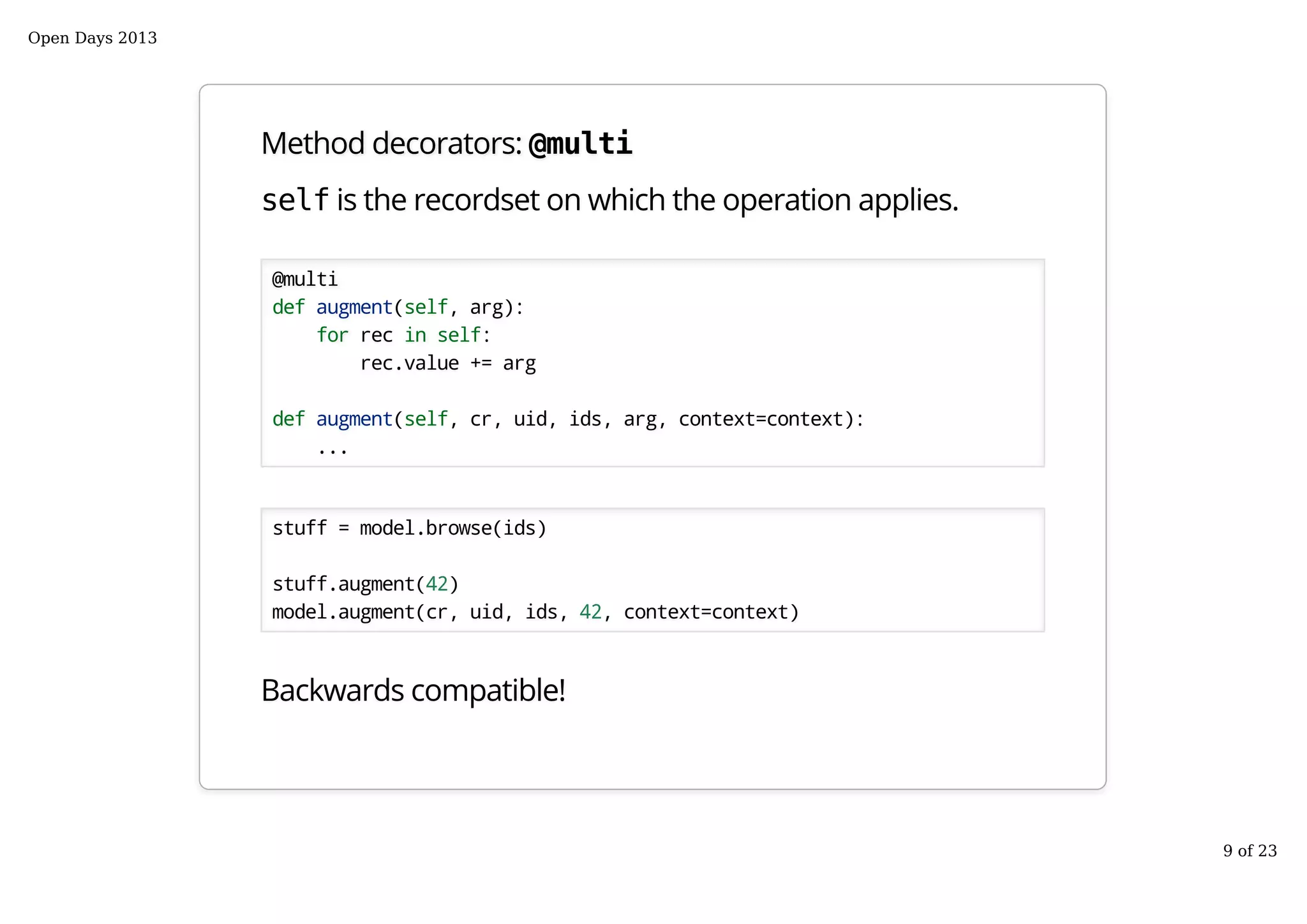
Method decorators: @multi
self is the recordset on which the operation applies.
@multi
def augment(self, arg):
for rec in self:
rec.value += arg
def augment(self, cr, uid, ids, arg, context=context):
...
stuff = model.browse(ids)
stuff.augment(42)
model.augment(cr, uid, ids, 42, context=context)
Backwards compatible!
Open Days 2013
9 of 23
Method decorators: @one
Automatic loop; self is a singleton.
@one
def name_get(self):
return (self.id, self.name)
def name_get(self, cr, uid, ids, context=None):
recs = self.browse(cr, uid, ids, context=context)
return [(rec.id, rec.name) for rec in recs]
stuff = model.browse(ids)
stuff.name_get()
model.name_get(cr, uid, ids, context=context)
Would become the default.
Open Days 2013
10 of 23
Method decorators: @returns
Automatic browse/unbrowse result.
@returns('res.partner')
def current_partner(self):
return registry['res.partner'].browse(42)
@returns('self')
def search(self, cr, uid, domain, ...):
return range(42)
# old-style calls return record ids
ids = model.current_partner(cr, uid, context=context)
ids = model.search(cr, uid, domain, context=context)
# new-style calls return a recordset
records = model.current_partner()
records = model.search(domain)
Open Days 2013
11 of 23
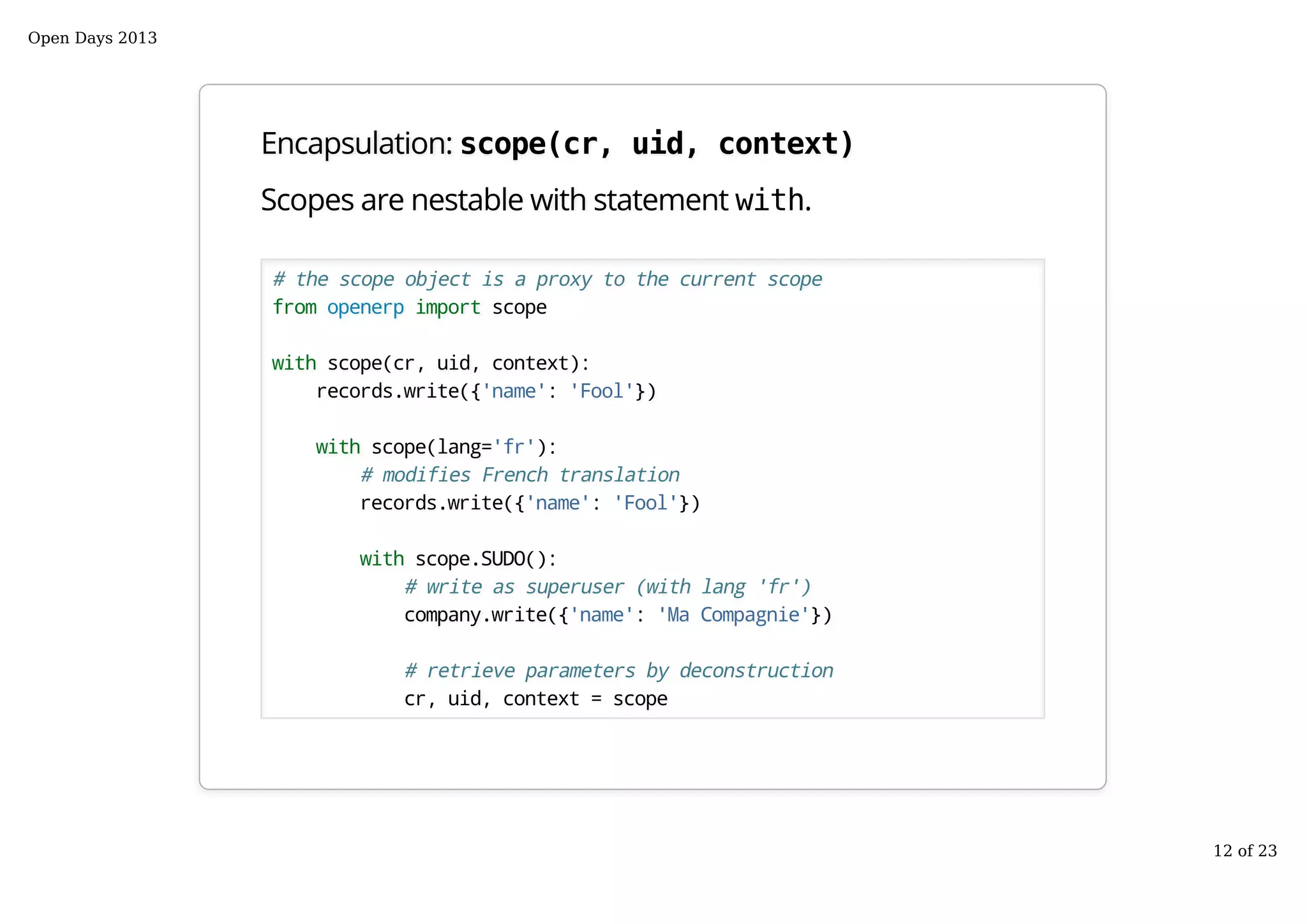
Encapsulation: scope(cr, uid, context)
Scopes are nestable with statement with.
# the scope object is a proxy to the current scope
from openerp import scope
with scope(cr, uid, context):
records.write({'name': 'Fool'})
with scope(lang='fr'):
# modifies French translation
records.write({'name': 'Fool'})
with scope.SUDO():
# write as superuser (with lang 'fr')
company.write({'name': 'Ma Compagnie'})
# retrieve parameters by deconstruction
cr, uid, context = scope
Open Days 2013
12 of 23
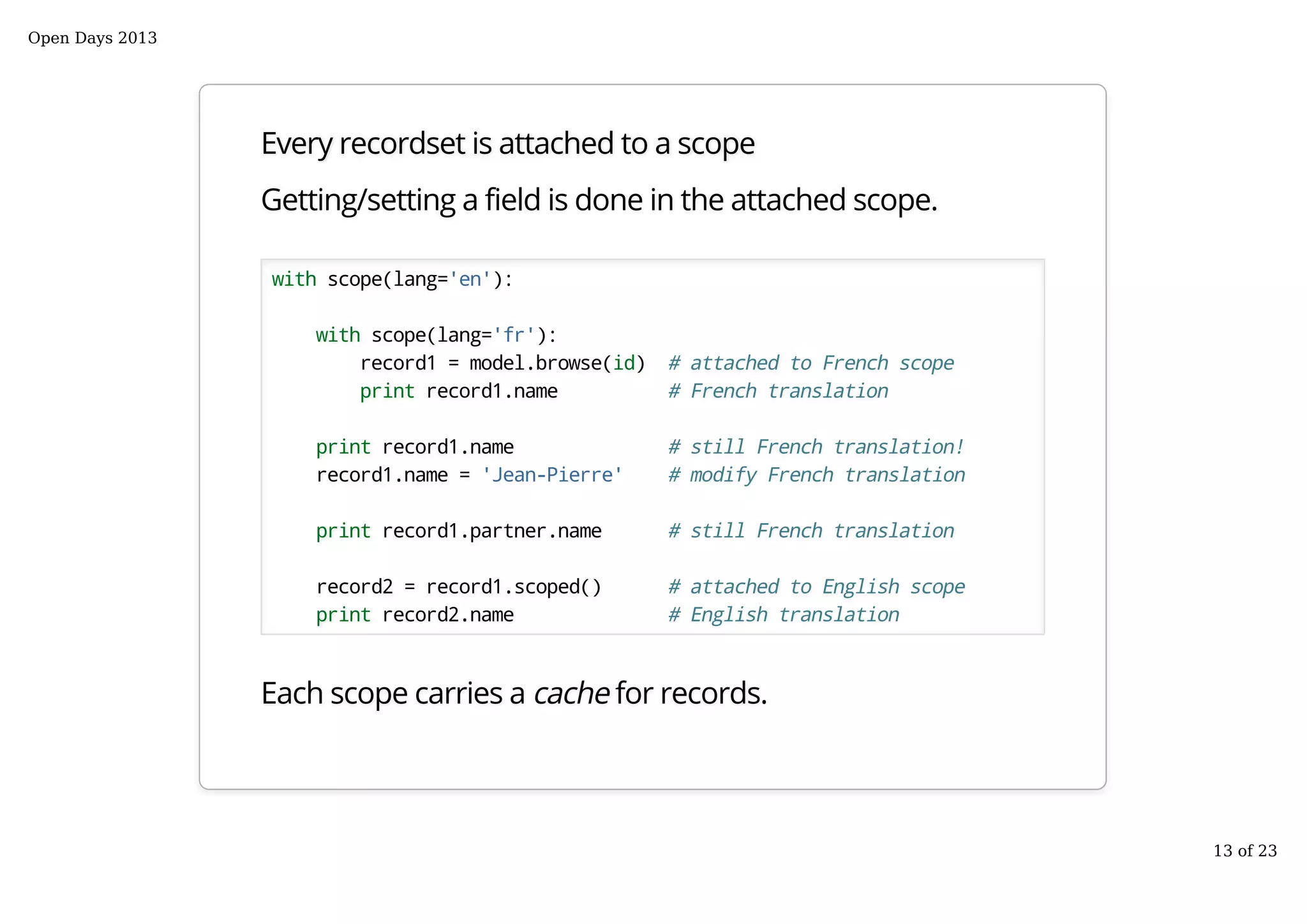
Every recordset is attached to a scope
Getting/setting a field is done in the attached scope.
with scope(lang='en'):
with scope(lang='fr'):
record1 = model.browse(id) # attached to French scope
print record1.name # French translation
print record1.name # still French translation!
record1.name = 'Jean-Pierre' # modify French translation
print record1.partner.name # still French translation
record2 = record1.scoped() # attached to English scope
print record2.name # English translation
Each scope carries a cache for records.
Open Days 2013
13 of 23
Automatic cache invalidation
No need to "rebrowse" records after an update.
record = model.browse(42)
assert record.name == 'Foo'
# simple update
record.write({'name': 'Bar'})
assert record.name == 'Bar'
# update of many2one field -> one2many invalidated
parent = record.parent_id
record.parent_id = another_record
assert record not in parent.child_ids
# explicit invalidation, in case you need it
record.invalidate_cache(['name', 'parent_id'], ids)
record.invalidate_cache(['name', 'parent_id'])
record.invalidate_cache()
Open Days 2013
14 of 23
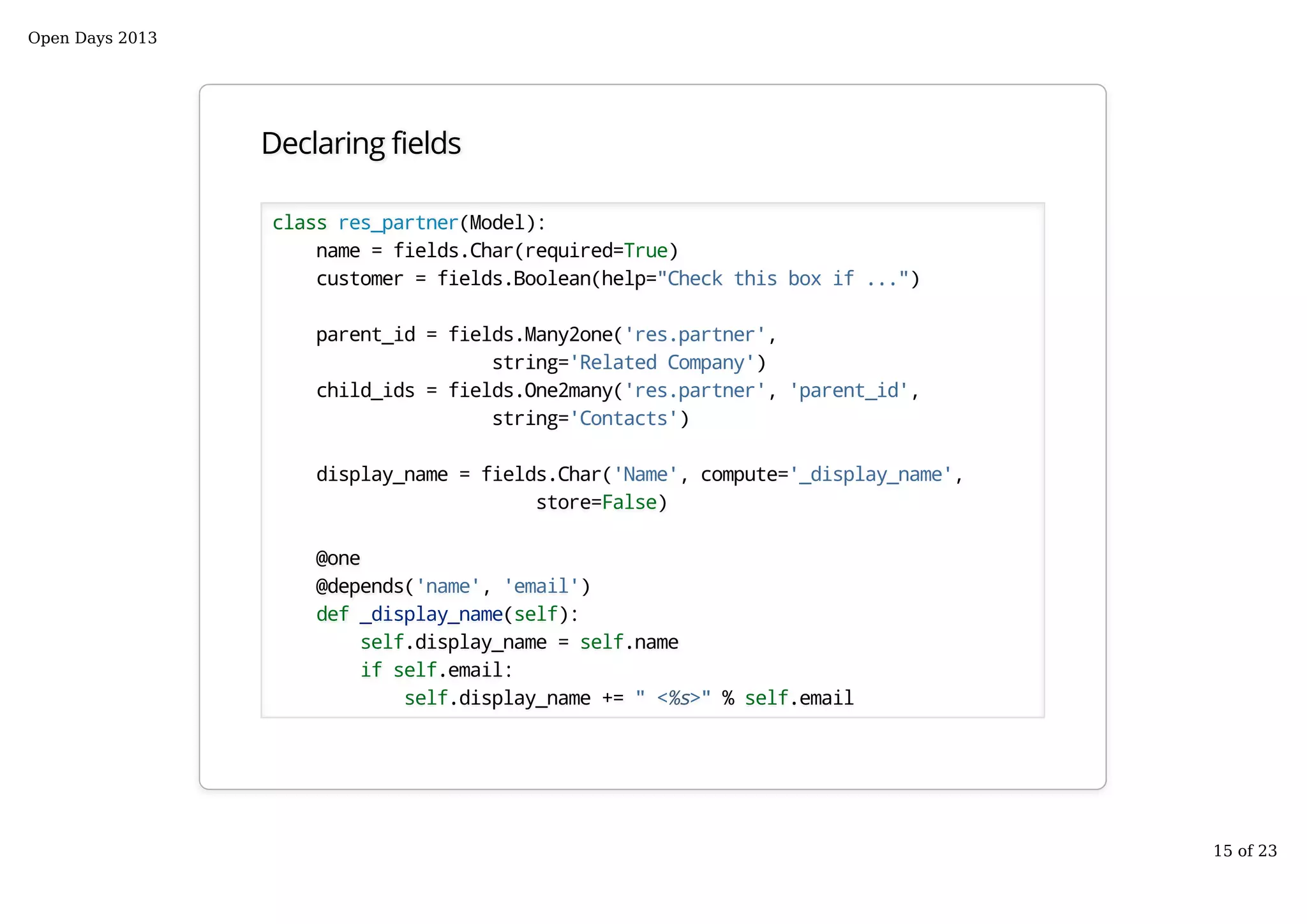
Declaring fields
class res_partner(Model):
name = fields.Char(required=True)
customer = fields.Boolean(help="Check this box if ...")
parent_id = fields.Many2one('res.partner',
string='Related Company')
child_ids = fields.One2many('res.partner', 'parent_id',
string='Contacts')
display_name = fields.Char('Name', compute='_display_name',
store=False)
@one
@depends('name', 'email')
def _display_name(self):
self.display_name = self.name
if self.email:
self.display_name += " <%s>" % self.email
Open Days 2013
15 of 23
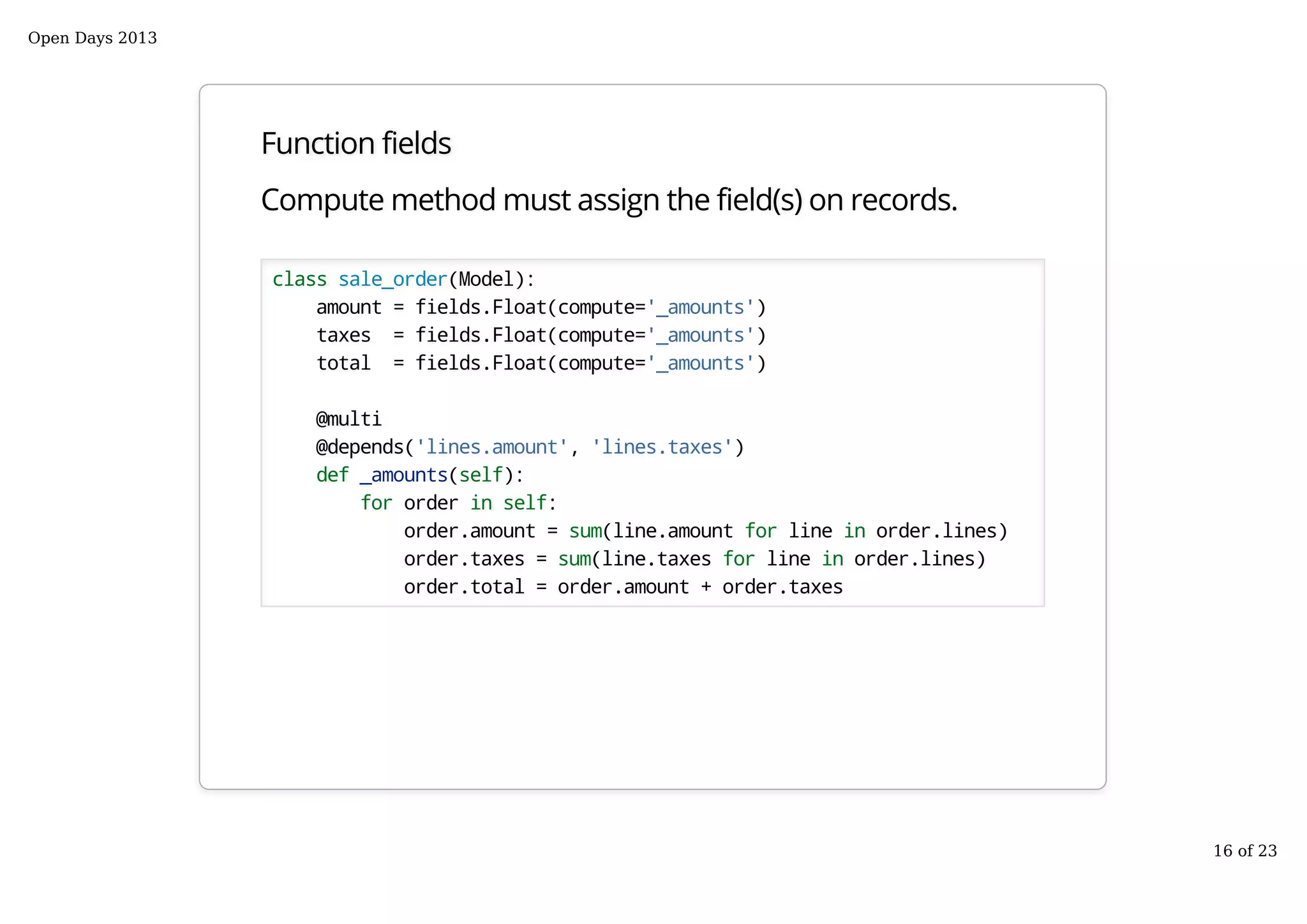
Function fields
Compute method must assign the field(s) on records.
class sale_order(Model):
amount = fields.Float(compute='_amounts')
taxes = fields.Float(compute='_amounts')
total = fields.Float(compute='_amounts')
@multi
@depends('lines.amount', 'lines.taxes')
def _amounts(self):
for order in self:
order.amount = sum(line.amount for line in order.lines)
order.taxes = sum(line.taxes for line in order.lines)
order.total = order.amount + order.taxes
Open Days 2013
16 of 23
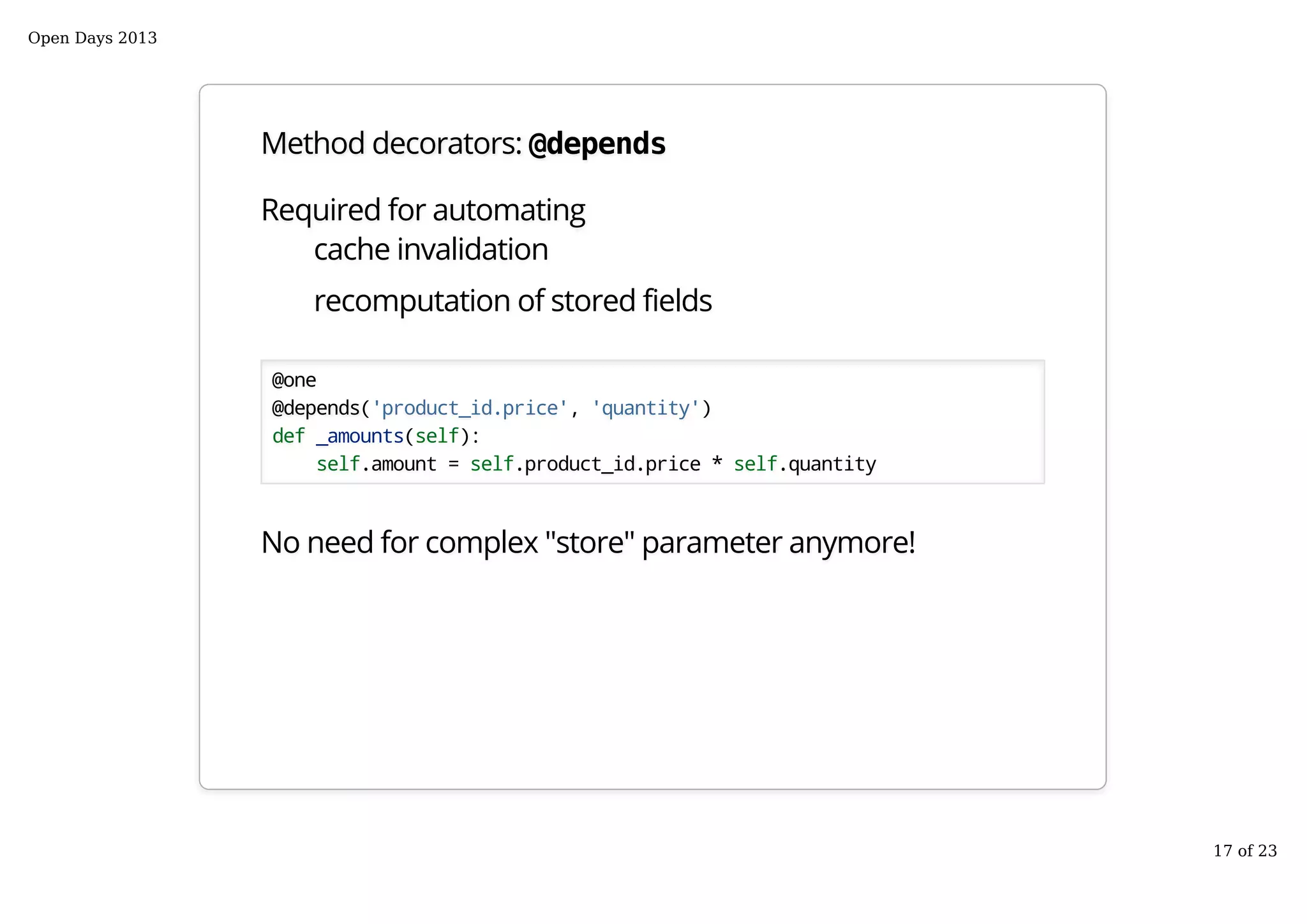
Method decorators: @depends
Required for automating
cache invalidation
recomputation of stored fields
@one
@depends('product_id.price', 'quantity')
def _amounts(self):
self.amount = self.product_id.price * self.quantity
No need for complex "store" parameter anymore!
Open Days 2013
17 of 23
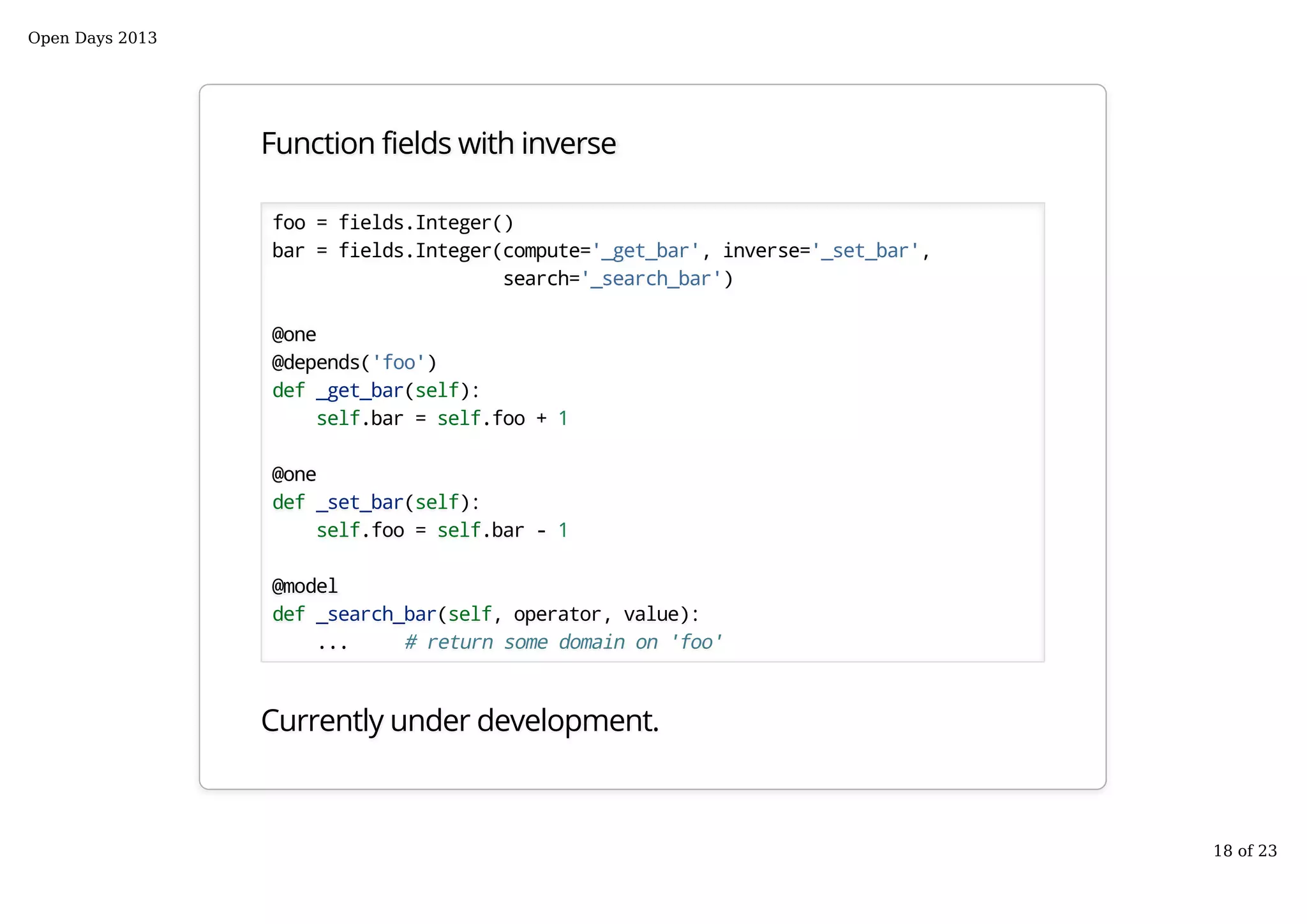
Function fields with inverse
foo = fields.Integer()
bar = fields.Integer(compute='_get_bar', inverse='_set_bar',
search='_search_bar')
@one
@depends('foo')
def _get_bar(self):
self.bar = self.foo + 1
@one
def _set_bar(self):
self.foo = self.bar - 1
@model
def _search_bar(self, operator, value):
... # return some domain on 'foo'
Currently under development.
Open Days 2013
18 of 23
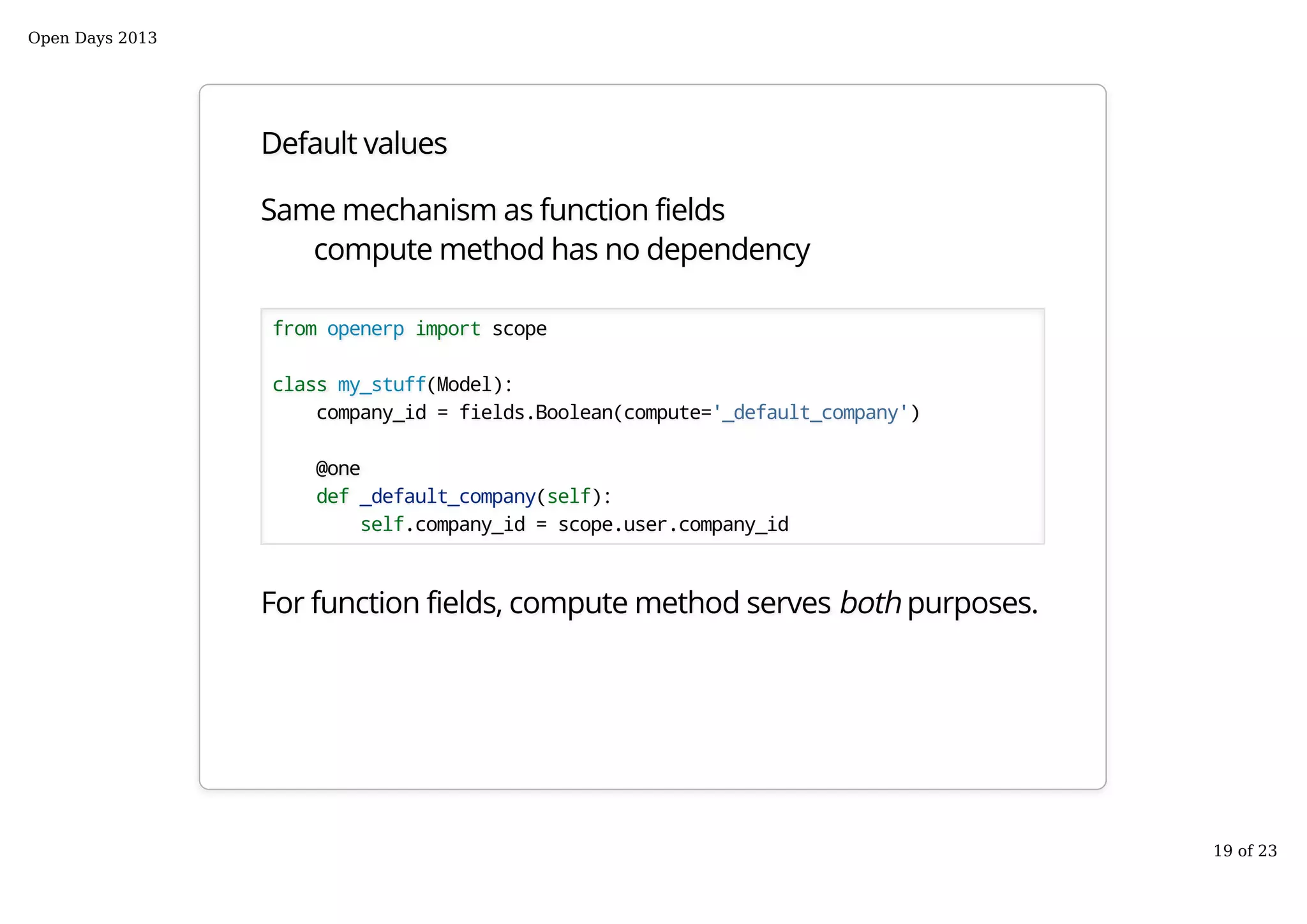
Default values
Same mechanism as function fields
compute method has no dependency
from openerp import scope
class my_stuff(Model):
company_id = fields.Boolean(compute='_default_company')
@one
def _default_company(self):
self.company_id = scope.user.company_id
For function fields, compute method serves both purposes.
Open Days 2013
19 of 23
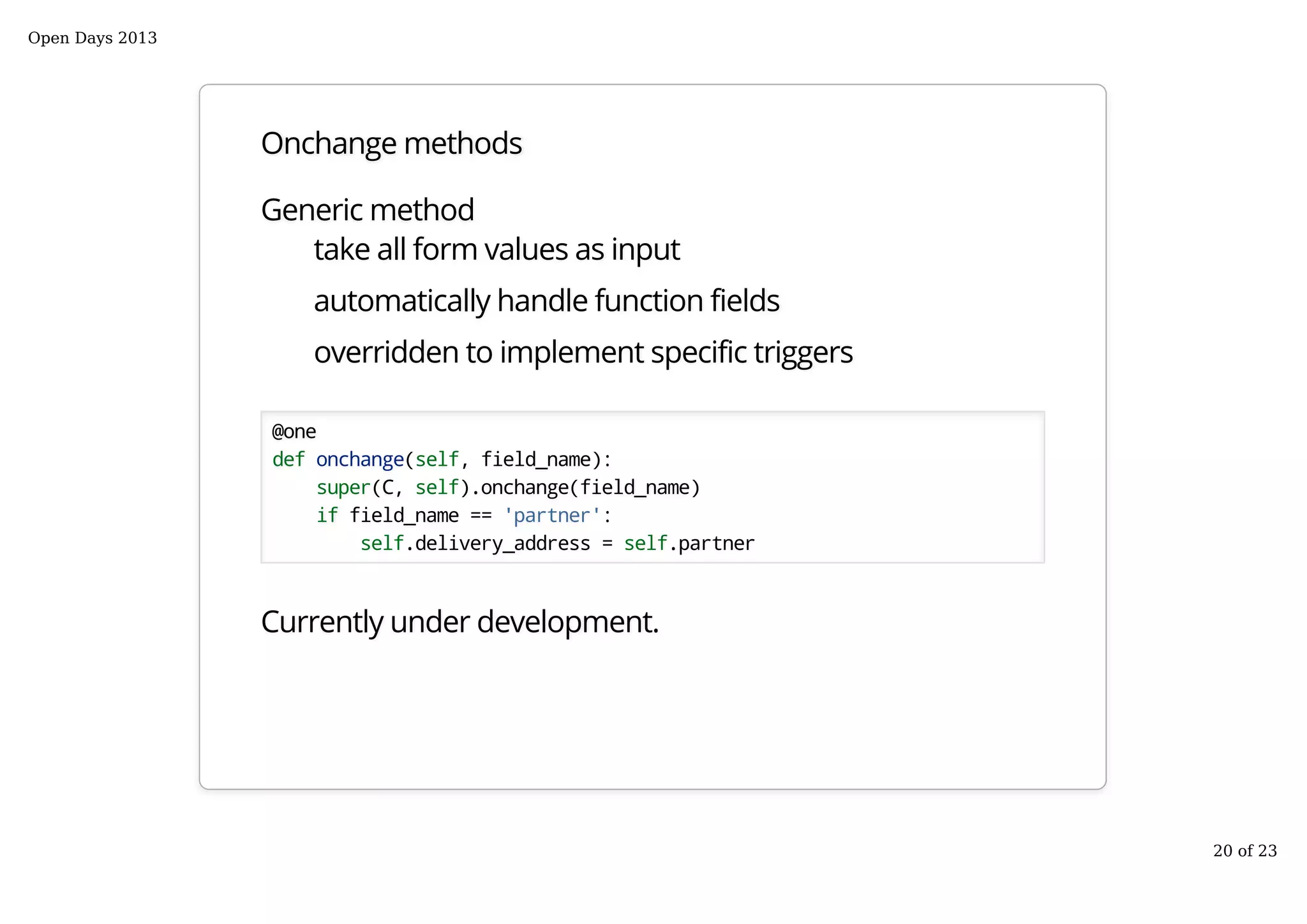
Onchange methods
Generic method
take all form values as input
automatically handle function fields
overridden to implement specific triggers
@one
def onchange(self, field_name):
super(C, self).onchange(field_name)
if field_name == 'partner':
self.delivery_address = self.partner
Currently under development.
Open Days 2013
20 of 23
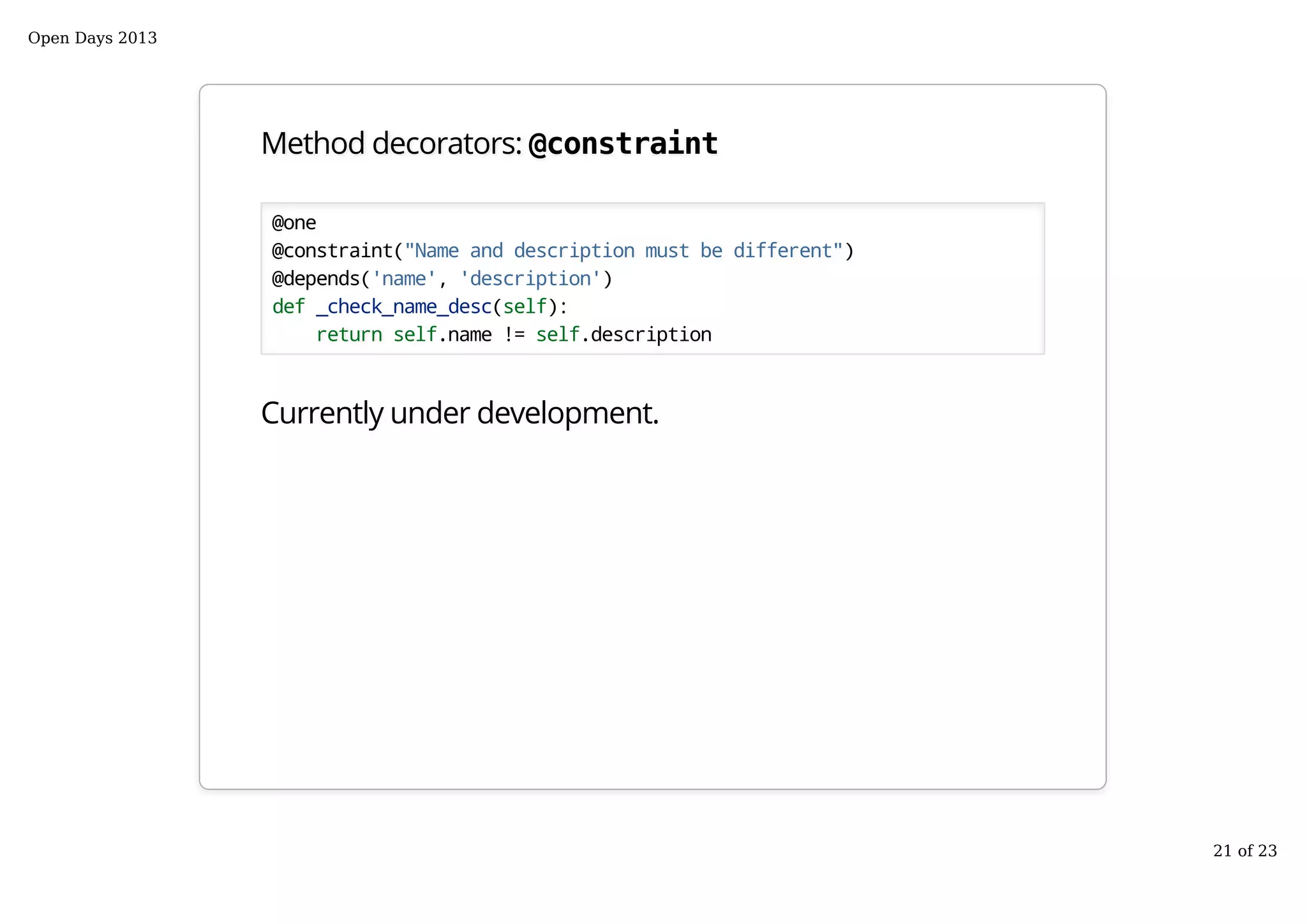
Method decorators: @constraint
@one
@constraint("Name and description must be different")
@depends('name', 'description')
def _check_name_desc(self):
return self.name != self.description
Currently under development.
Open Days 2013
21 of 23
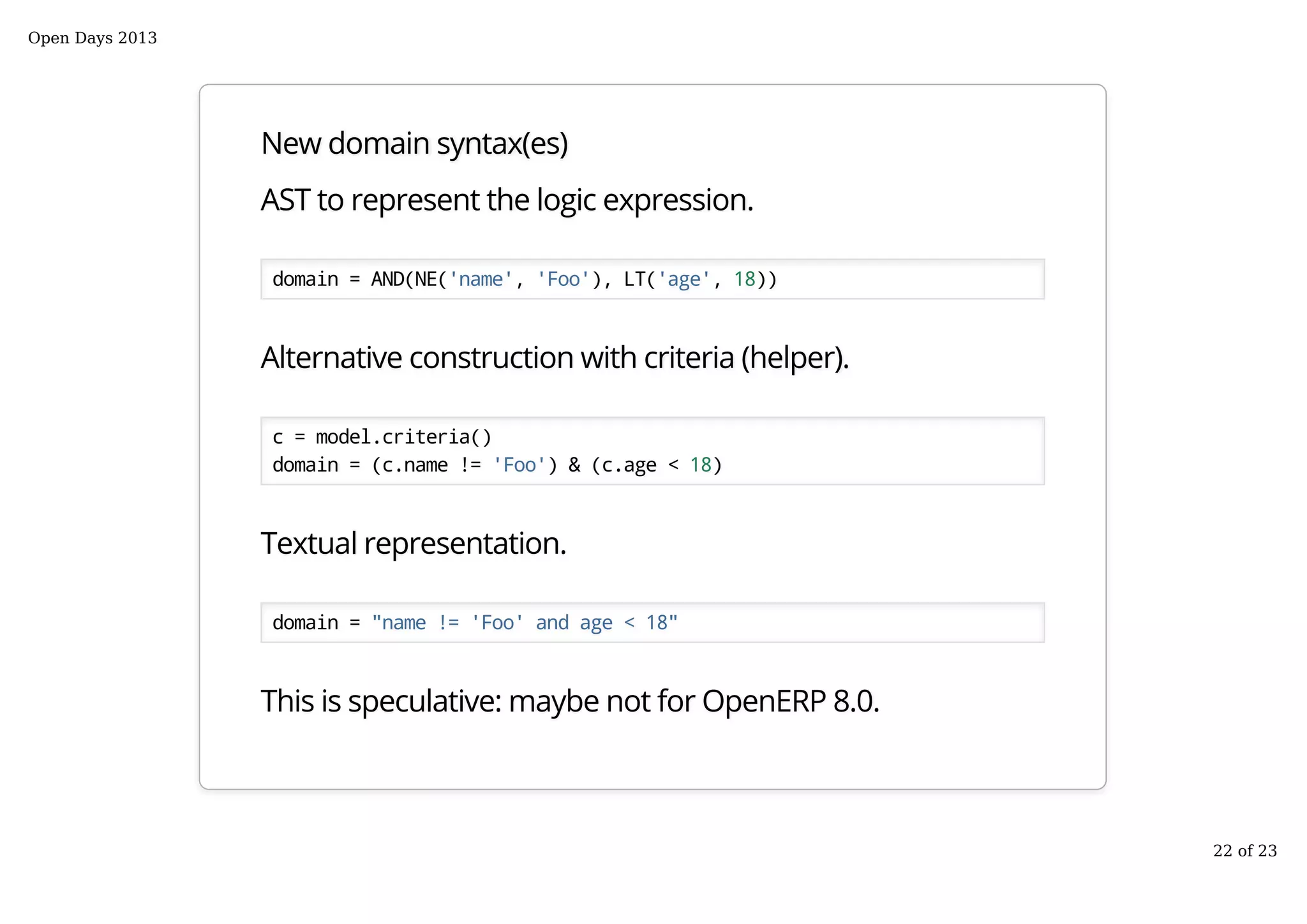
New domain syntax(es)
AST to represent the logic expression.
domain = AND(NE('name', 'Foo'), LT('age', 18))
Alternative construction with criteria (helper).
c = model.criteria()
domain = (c.name != 'Foo') & (c.age < 18)
Textual representation.
domain = "name != 'Foo' and age < 18"
This is speculative: maybe not for OpenERP 8.0.
Open Days 2013
22 of 23
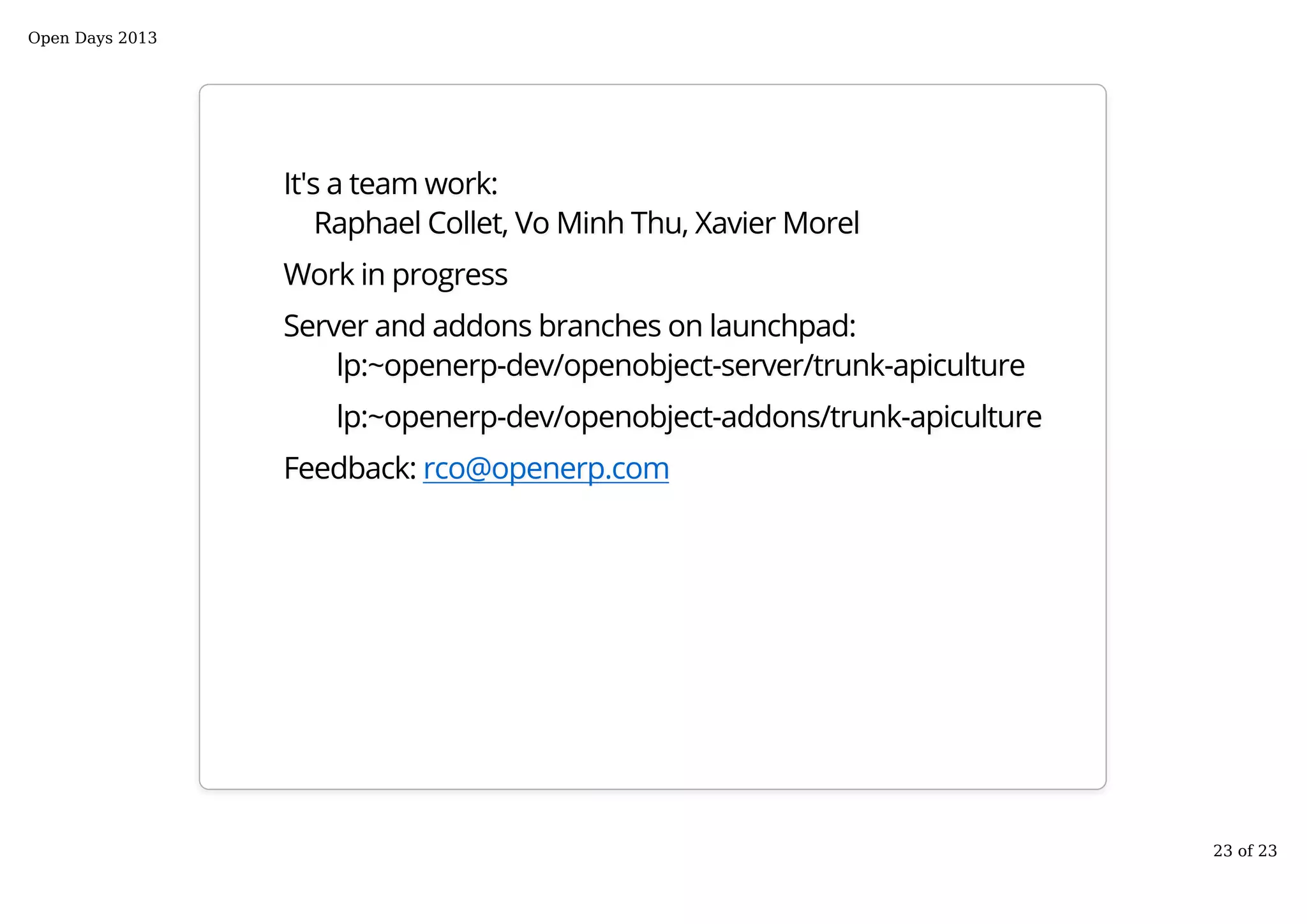
It's a team work:
Raphael Collet, Vo Minh Thu, Xavier Morel
Work in progress
Server and addons branches on launchpad:
lp:~openerp-dev/openobject-server/trunk-apiculture
lp:~openerp-dev/openobject-addons/trunk-apiculture
Feedback: rco@openerp.com
Open Days 2013
23 of 23

Presentation of the new OpenERP API. Raphael Collet, OpenERP

  • 1.
    OpenERP 8.0 PythonAPI Raphael Collet rco@openerp.com MotivationFinal thoughts Open Days 2013 1 of 23
  • 2.
    More object-oriented style Supportfor Pythonic style Keep request parameters apart Different API for specific features Function fields Default values Constraints Keep backwards compatibility Open Days 2013 2 of 23
  • 3.
    Object-oriented style def write(self,cr, uid, ids, values, context=None): super(C, self).write(cr, uid, ids, values, context=context) for record in self.browse(cr, uid, ids, context=context): if record.increment: self.write(cr, uid, [record.id], { 'count': record.count + 1, }, context=context) @multi def write(self, values): super(C, self).write(values) for record in self: if record.increment: record.count += 1 Open Days 2013 3 of 23
  • 4.
    Every class instanceis a recordset A recordset is a collection of records; it encapsulates a list of record ids. records = model.browse(ids) # return a recordset assert isinstance(records, Model) print bool(records) # test for emptyness print len(records) # size of collection records1 = records[:3] # slicing records2 = records[-3] # selection records = records1 + records2 # concatenation for record in records: # iteration returns assert isinstance(record, Model) # recordsets, too assert len(record) == 1 Open Days 2013 4 of 23
  • 5.
    Recordsets to accessdata Get/set a field on a recordset: do it on its first record. records = model.browse(ids) for record in records: value = record.name record.name = (value or '') + '!' for record in records: value = record['name'] record['name'] = (value or '') + '!' assert records.name == records[0].name # relational fields return recordsets assert isinstance(records.parent_id, Model) Compatible with old browse records. Open Days 2013 5 of 23
  • 6.
    Recordsets to accessdata An empty recordset behaves as a null instance. records = model.browse() assert len(records) == 0 # data fields assert records.name == False # relational fields return empty recordsets assert isinstance(records.parent_id, Model) assert not records.parent_id # no effect records.name = 'Foo' Open Days 2013 6 of 23
  • 7.
    Model methods arecalled on recordsets model = registry['res.partner'] assert isinstance(model, Model) # get a recordset records = model.create(values) records = model.search(domain) # perform operation on records records.write({'name': 'Foo'}) result = records.read() # call model method defaults = records.default_get(['name']) Open Days 2013 7 of 23
  • 8.
    Method decorators: @model selfrepresents the model, its contents is irrelevant. @model def default_get(self, field_names): ... def default_get(self, cr, uid, field_names, context=None): ... stuff = model.browse(ids) stuff.default_get(['name']) model.default_get(cr, uid, ['name'], context=context) Backwards compatible! Open Days 2013 8 of 23
  • 9.
    Method decorators: @multi selfis the recordset on which the operation applies. @multi def augment(self, arg): for rec in self: rec.value += arg def augment(self, cr, uid, ids, arg, context=context): ... stuff = model.browse(ids) stuff.augment(42) model.augment(cr, uid, ids, 42, context=context) Backwards compatible! Open Days 2013 9 of 23
  • 10.
    Method decorators: @one Automaticloop; self is a singleton. @one def name_get(self): return (self.id, self.name) def name_get(self, cr, uid, ids, context=None): recs = self.browse(cr, uid, ids, context=context) return [(rec.id, rec.name) for rec in recs] stuff = model.browse(ids) stuff.name_get() model.name_get(cr, uid, ids, context=context) Would become the default. Open Days 2013 10 of 23
  • 11.
    Method decorators: @returns Automaticbrowse/unbrowse result. @returns('res.partner') def current_partner(self): return registry['res.partner'].browse(42) @returns('self') def search(self, cr, uid, domain, ...): return range(42) # old-style calls return record ids ids = model.current_partner(cr, uid, context=context) ids = model.search(cr, uid, domain, context=context) # new-style calls return a recordset records = model.current_partner() records = model.search(domain) Open Days 2013 11 of 23
  • 12.
    Encapsulation: scope(cr, uid,context) Scopes are nestable with statement with. # the scope object is a proxy to the current scope from openerp import scope with scope(cr, uid, context): records.write({'name': 'Fool'}) with scope(lang='fr'): # modifies French translation records.write({'name': 'Fool'}) with scope.SUDO(): # write as superuser (with lang 'fr') company.write({'name': 'Ma Compagnie'}) # retrieve parameters by deconstruction cr, uid, context = scope Open Days 2013 12 of 23
  • 13.
    Every recordset isattached to a scope Getting/setting a field is done in the attached scope. with scope(lang='en'): with scope(lang='fr'): record1 = model.browse(id) # attached to French scope print record1.name # French translation print record1.name # still French translation! record1.name = 'Jean-Pierre' # modify French translation print record1.partner.name # still French translation record2 = record1.scoped() # attached to English scope print record2.name # English translation Each scope carries a cache for records. Open Days 2013 13 of 23
  • 14.
    Automatic cache invalidation Noneed to "rebrowse" records after an update. record = model.browse(42) assert record.name == 'Foo' # simple update record.write({'name': 'Bar'}) assert record.name == 'Bar' # update of many2one field -> one2many invalidated parent = record.parent_id record.parent_id = another_record assert record not in parent.child_ids # explicit invalidation, in case you need it record.invalidate_cache(['name', 'parent_id'], ids) record.invalidate_cache(['name', 'parent_id']) record.invalidate_cache() Open Days 2013 14 of 23
  • 15.
    Declaring fields class res_partner(Model): name= fields.Char(required=True) customer = fields.Boolean(help="Check this box if ...") parent_id = fields.Many2one('res.partner', string='Related Company') child_ids = fields.One2many('res.partner', 'parent_id', string='Contacts') display_name = fields.Char('Name', compute='_display_name', store=False) @one @depends('name', 'email') def _display_name(self): self.display_name = self.name if self.email: self.display_name += " <%s>" % self.email Open Days 2013 15 of 23
  • 16.
    Function fields Compute methodmust assign the field(s) on records. class sale_order(Model): amount = fields.Float(compute='_amounts') taxes = fields.Float(compute='_amounts') total = fields.Float(compute='_amounts') @multi @depends('lines.amount', 'lines.taxes') def _amounts(self): for order in self: order.amount = sum(line.amount for line in order.lines) order.taxes = sum(line.taxes for line in order.lines) order.total = order.amount + order.taxes Open Days 2013 16 of 23
  • 17.
    Method decorators: @depends Requiredfor automating cache invalidation recomputation of stored fields @one @depends('product_id.price', 'quantity') def _amounts(self): self.amount = self.product_id.price * self.quantity No need for complex "store" parameter anymore! Open Days 2013 17 of 23
  • 18.
    Function fields withinverse foo = fields.Integer() bar = fields.Integer(compute='_get_bar', inverse='_set_bar', search='_search_bar') @one @depends('foo') def _get_bar(self): self.bar = self.foo + 1 @one def _set_bar(self): self.foo = self.bar - 1 @model def _search_bar(self, operator, value): ... # return some domain on 'foo' Currently under development. Open Days 2013 18 of 23
  • 19.
    Default values Same mechanismas function fields compute method has no dependency from openerp import scope class my_stuff(Model): company_id = fields.Boolean(compute='_default_company') @one def _default_company(self): self.company_id = scope.user.company_id For function fields, compute method serves both purposes. Open Days 2013 19 of 23
  • 20.
    Onchange methods Generic method takeall form values as input automatically handle function fields overridden to implement specific triggers @one def onchange(self, field_name): super(C, self).onchange(field_name) if field_name == 'partner': self.delivery_address = self.partner Currently under development. Open Days 2013 20 of 23
  • 21.
    Method decorators: @constraint @one @constraint("Nameand description must be different") @depends('name', 'description') def _check_name_desc(self): return self.name != self.description Currently under development. Open Days 2013 21 of 23
  • 22.
    New domain syntax(es) ASTto represent the logic expression. domain = AND(NE('name', 'Foo'), LT('age', 18)) Alternative construction with criteria (helper). c = model.criteria() domain = (c.name != 'Foo') & (c.age < 18) Textual representation. domain = "name != 'Foo' and age < 18" This is speculative: maybe not for OpenERP 8.0. Open Days 2013 22 of 23
  • 23.
    It's a teamwork: Raphael Collet, Vo Minh Thu, Xavier Morel Work in progress Server and addons branches on launchpad: lp:~openerp-dev/openobject-server/trunk-apiculture lp:~openerp-dev/openobject-addons/trunk-apiculture Feedback: rco@openerp.com Open Days 2013 23 of 23