From V7 to V8: The New API
Raphael Collet (rco@odoo.com)
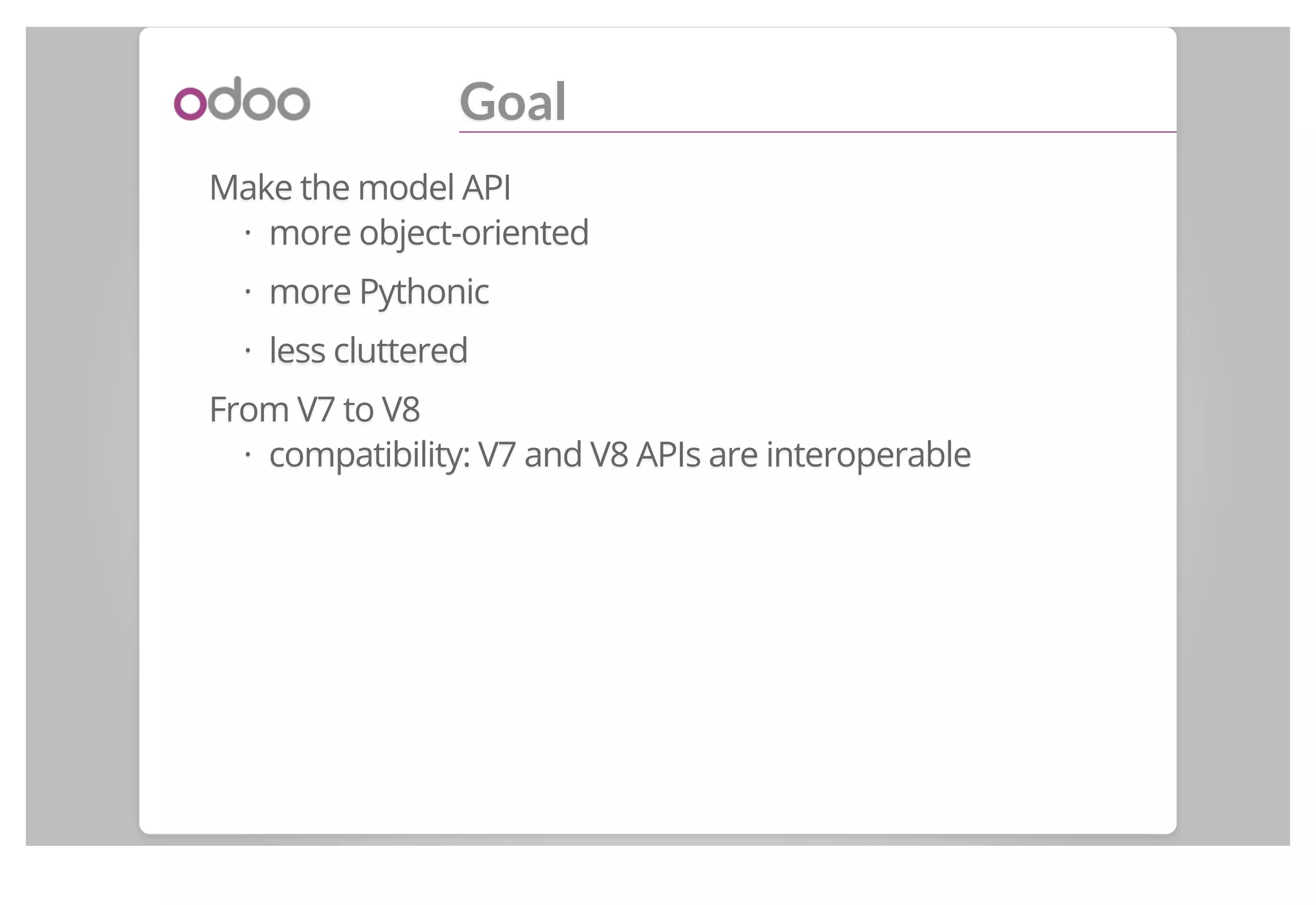
Goal
Make the model API
more object-oriented
more Pythonic
less cluttered
From V7 to V8
compatibility: V7 and V8 APIs are interoperable
·
·
·
·
Agenda
Recordsets
Methods
Environment
Fields
Migrating Modules
·
·
·
·
·
Recordsets
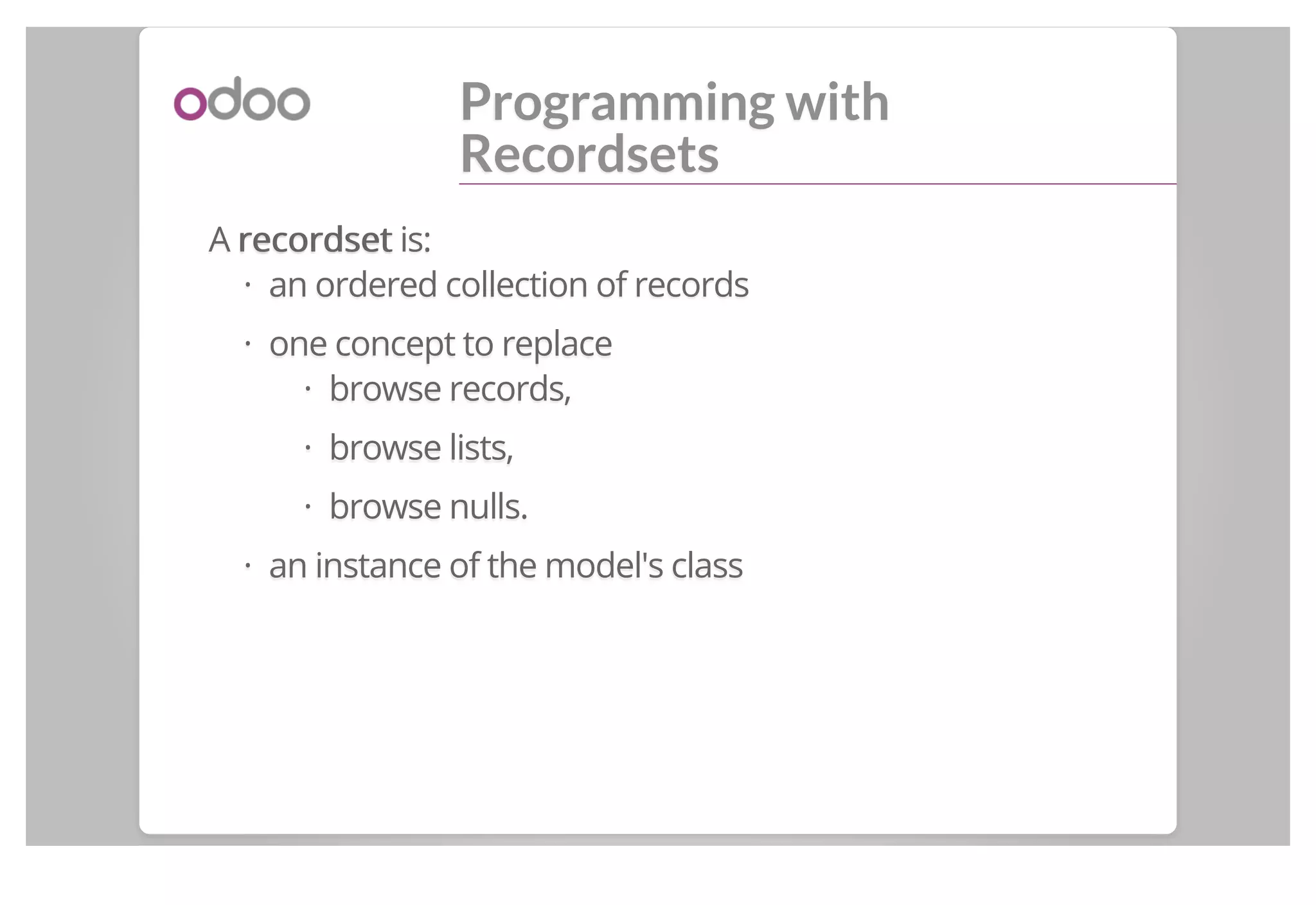
Programming with
Recordsets
A recordsetrecordset is:
an ordered collection of records
one concept to replace
browse records,
browse lists,
browse nulls.
an instance of the model's class
·
·
·
·
·
·
The recordset as a collection
It implements sequence and set operations:
partners == env[['res.partner']]..search([])([])
forfor partner inin partners::
assertassert partner inin partners
printprint partner..name
ifif len((partners)) >=>= 55::
fifth == partners[[44]]
extremes == partners[:[:1010]] ++ partners[[--1010:]:]
union == partners1 || partners2
intersection == partners1 && partners2
difference == partners1 -- partners2
The recordset as a record
It behaves just like former browse records:
printprint partner..name
printprint partner[['name']]
printprint partner..parent_id..company_id..name
Except that updates are written to database:
partner..name == 'Agrolait'
partner..email == 'info@agrolait.com'
partner..parent_id == ...... # another record
The recordset as a record
If len(partners) > 1, do it on the firstfirst record:
printprint partners..name # name of first partner
printprint partners[[00]]..name
partners..name == 'Agrolait' # assign first partner
partners[[00]]..name == 'Agrolait'
If len(partners) == 0, return the null value of the field:
printprint partners..name # False
printprint partners..parent_id # empty recordset
partners..name == 'Foo' # ERROR
The recordset as an instance
Methods of the model's class can be invoked on recordsets:
# calling convention: leave out cr, uid, ids, context
@api.multi@api.multi
defdef write((self,, values):):
result == super((C,, self))..write((values))
# search returns a recordset instead of a list of ids
domain == [([('id',, 'in',, self..ids),), (('parent_id',, '=',, False)])]
roots == self..search((domain))
# modify all records in roots
roots..write({({'modified':: True})})
returnreturn result
The missing parameters are hidden inside the recordset.
Methods
Method decorators
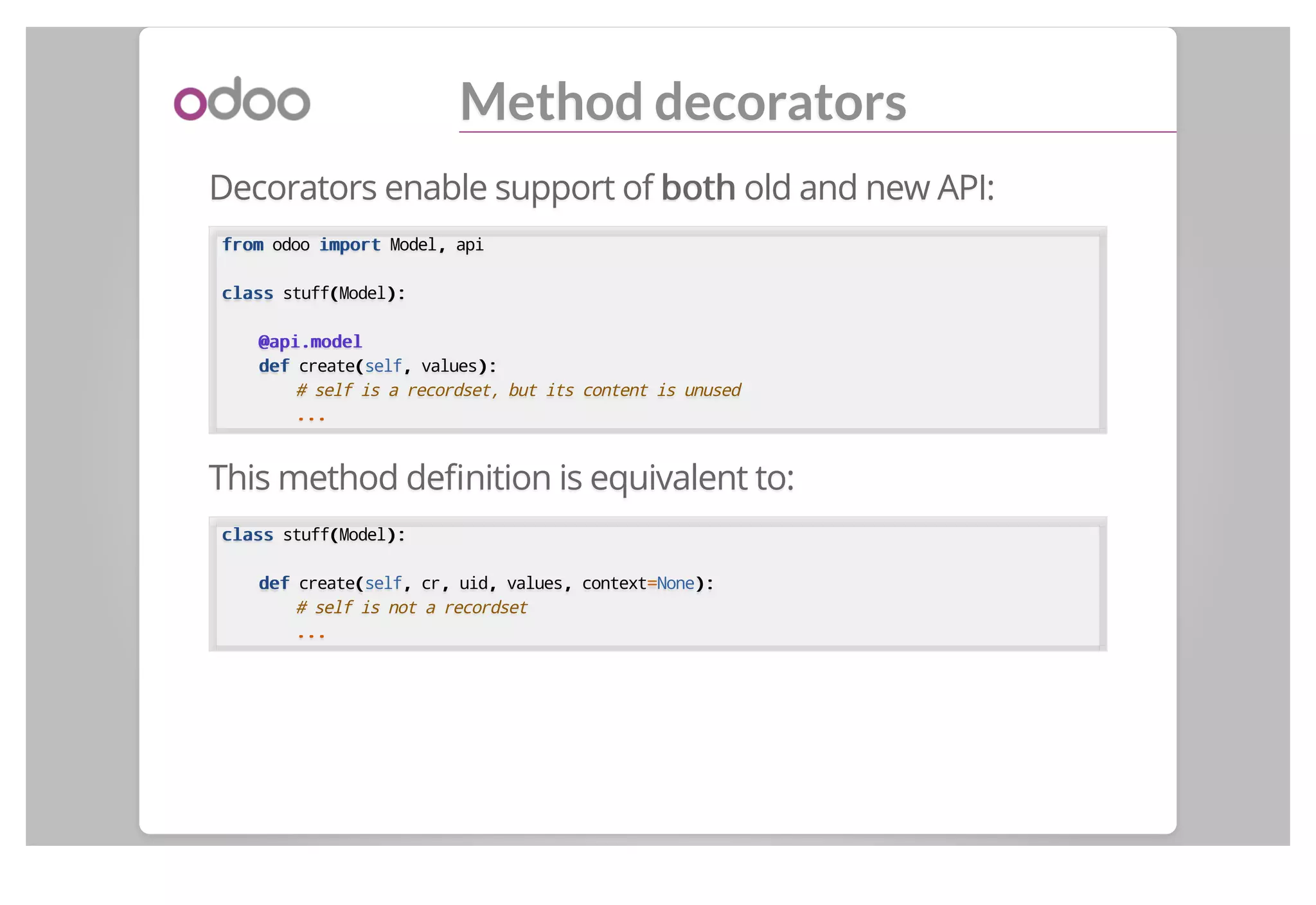
Decorators enable support of bothboth old and new API:
fromfrom odoo importimport Model,, api
classclass stuff((Model):):
@api.model@api.model
defdef create((self,, values):):
# self is a recordset, but its content is unused
......
This method definition is equivalent to:
classclass stuff((Model):):
defdef create((self,, cr,, uid,, values,, context==None):):
# self is not a recordset
......
Method decorators
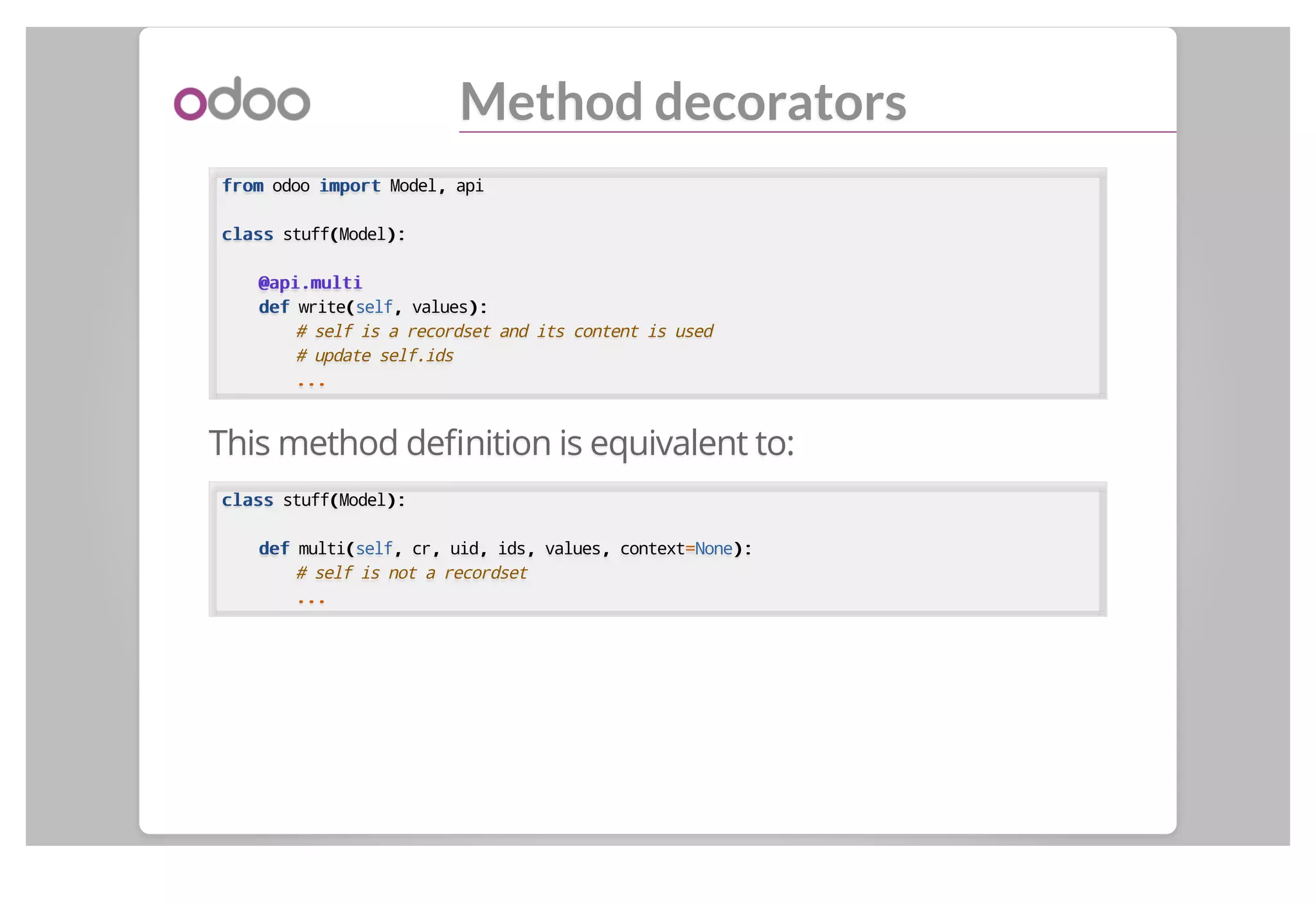
fromfrom odoo importimport Model,, api
classclass stuff((Model):):
@api.multi@api.multi
defdef write((self,, values):):
# self is a recordset and its content is used
# update self.ids
......
This method definition is equivalent to:
classclass stuff((Model):):
defdef multi((self,, cr,, uid,, ids,, values,, context==None):):
# self is not a recordset
......
Method decorators
One-by-one or "autoloop" decorator:
fromfrom odoo importimport Model,, api
classclass stuff((Model):):
@api.one@api.one
defdef cancel((self):):
self..state == 'cancel'
When invoked, the method is applied on every record:
recs..cancel()() # [rec.cancel() for rec in recs]
Method decorators
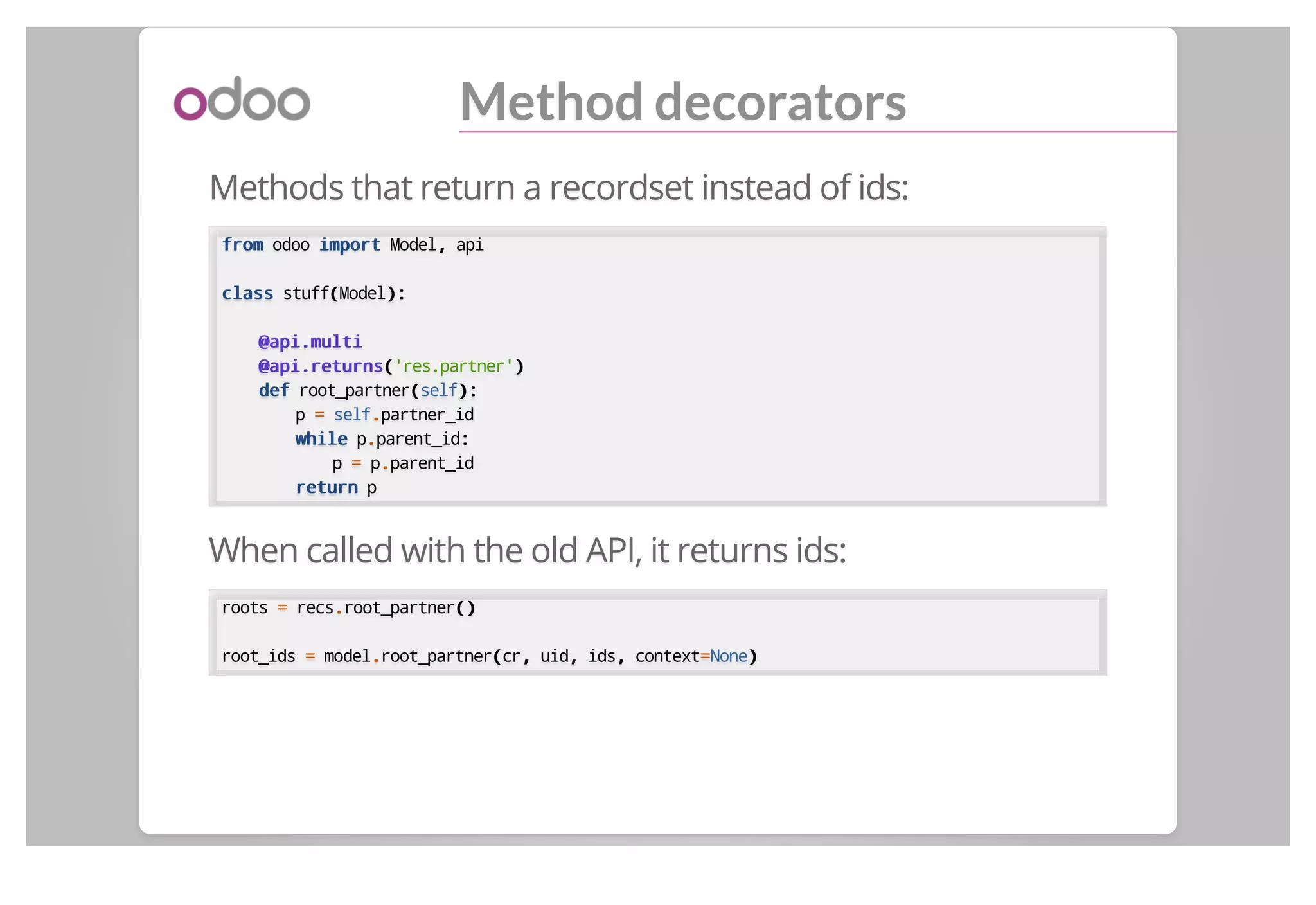
Methods that return a recordset instead of ids:
fromfrom odoo importimport Model,, api
classclass stuff((Model):):
@api.multi@api.multi
@api.returns@api.returns(('res.partner'))
defdef root_partner((self):):
p == self..partner_id
whilewhile p..parent_id::
p == p..parent_id
returnreturn p
When called with the old API, it returns ids:
roots == recs..root_partner()()
root_ids == model..root_partner((cr,, uid,, ids,, context==None))
Environment: cr, uid, context
The environment object
Encapsulates cr, uid, context:
# recs.env encapsulates cr, uid, context
recs..env..cr # shortcut: recs._cr
recs..env..uid # shortcut: recs._uid
recs..env..context # shortcut: recs._context
# recs.env also provides helpers
recs..env..user # uid as a record
recs..env..ref(('base.group_user')) # resolve xml id
recs..env[['res.partner']] # access to new-API model
The environment object
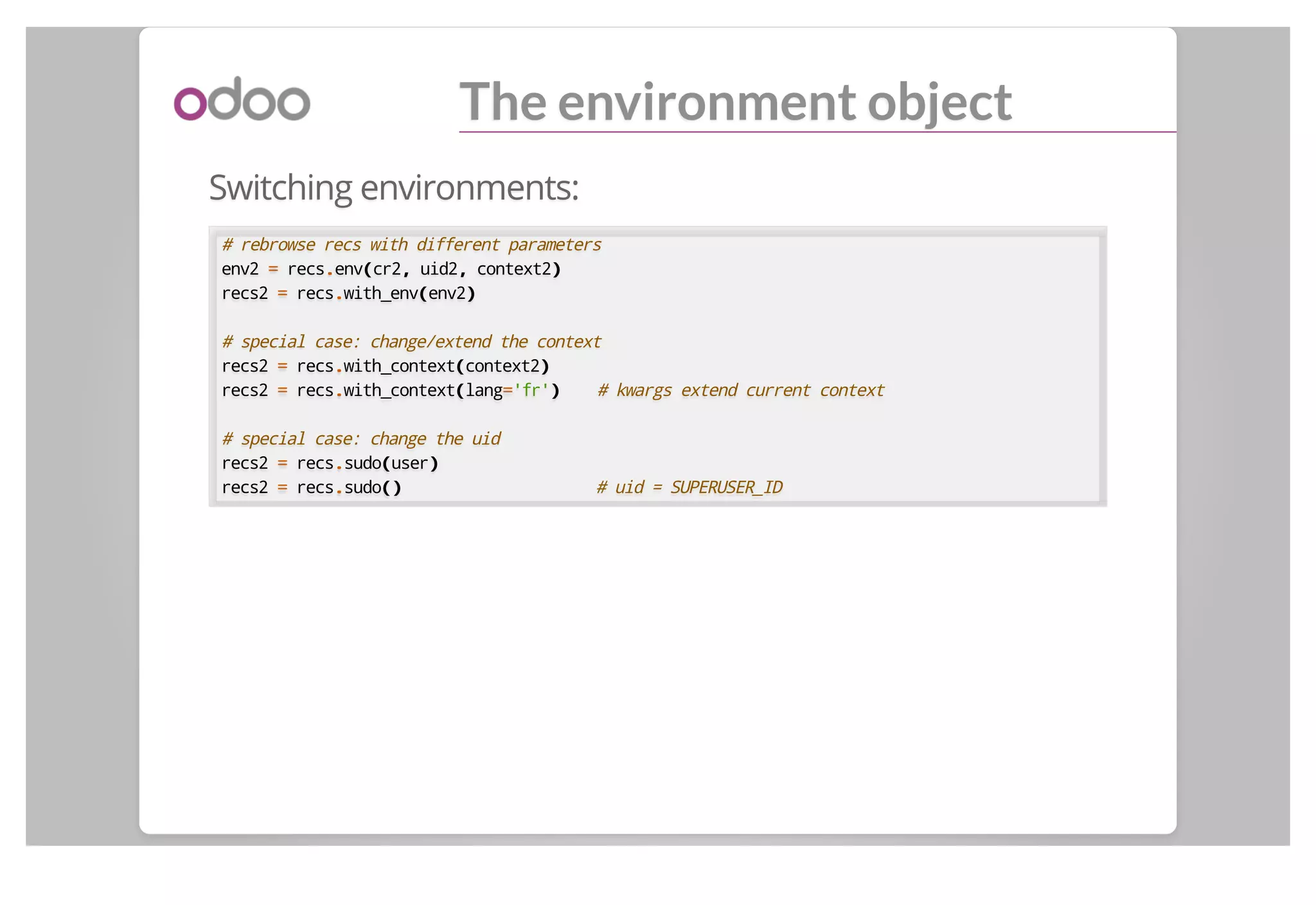
Switching environments:
# rebrowse recs with different parameters
env2 == recs..env((cr2,, uid2,, context2))
recs2 == recs..with_env((env2))
# special case: change/extend the context
recs2 == recs..with_context((context2))
recs2 == recs..with_context((lang=='fr')) # kwargs extend current context
# special case: change the uid
recs2 == recs..sudo((user))
recs2 == recs..sudo()() # uid = SUPERUSER_ID
Fields
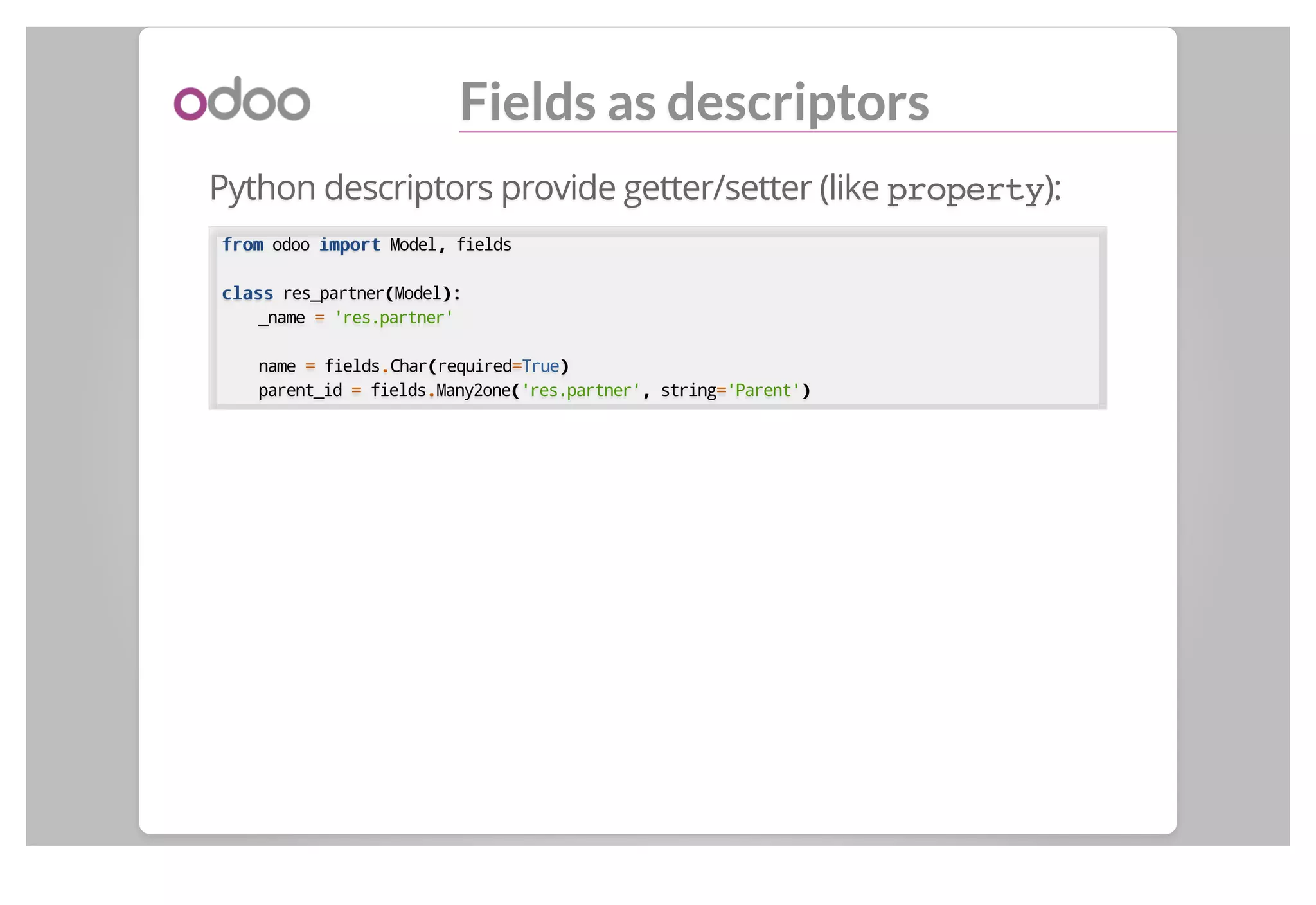
Fields as descriptors
Python descriptors provide getter/setter (like property):
fromfrom odoo importimport Model,, fields
classclass res_partner((Model):):
_name == 'res.partner'
name == fields..Char((required==True))
parent_id == fields..Many2one(('res.partner',, string=='Parent'))
Computed fields
Regular fields with the name of the compute method:
classclass res_partner((Model):):
......
display_name == fields..Char((
string=='Name',, compute=='_compute_display_name',,
))
@api.one@api.one
@api.depends@api.depends(('name',, 'parent_id.name'))
defdef _compute_display_name((self):):
names == [[self..parent_id..name,, self..name]]
self..display_name == ' / '..join((filter((None,, names))))
Computed fields
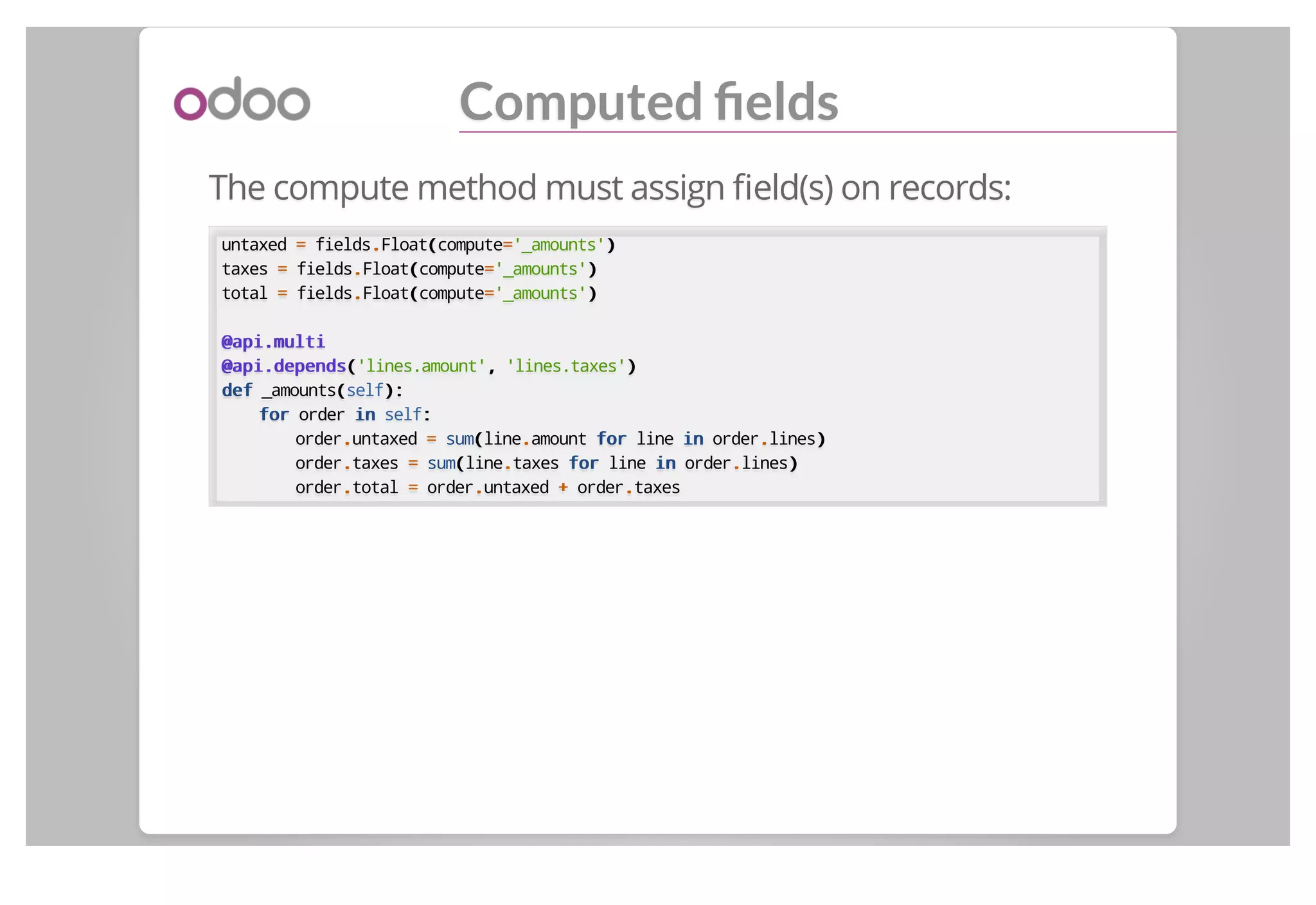
The compute method must assign field(s) on records:
untaxed == fields..Float((compute=='_amounts'))
taxes == fields..Float((compute=='_amounts'))
total == fields..Float((compute=='_amounts'))
@api.multi@api.multi
@api.depends@api.depends(('lines.amount',, 'lines.taxes'))
defdef _amounts((self):):
forfor order inin self::
order..untaxed == sum((line..amount forfor line inin order..lines))
order..taxes == sum((line..taxes forfor line inin order..lines))
order..total == order..untaxed ++ order..taxes
Computed fields
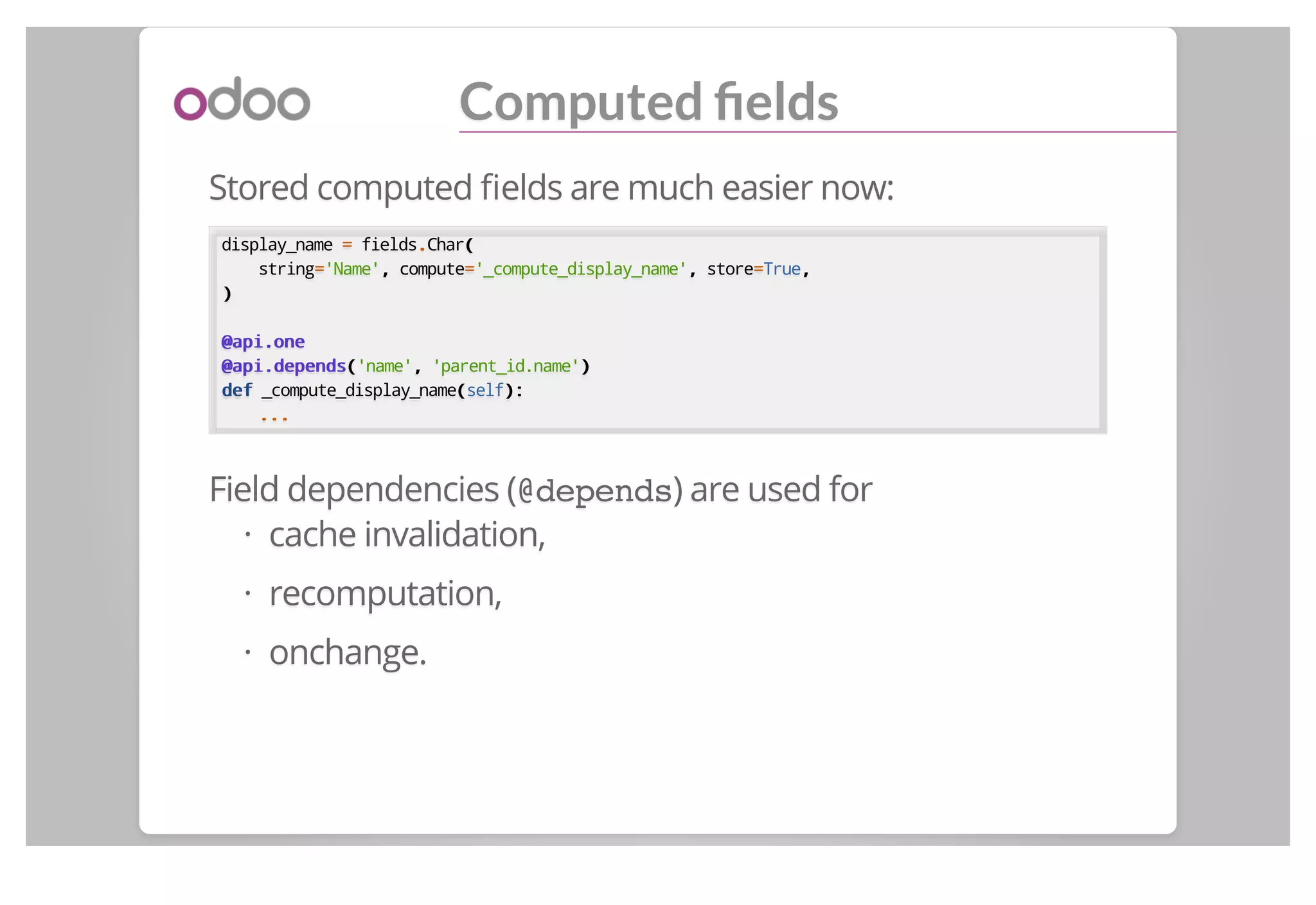
Stored computed fields are much easier now:
display_name == fields..Char((
string=='Name',, compute=='_compute_display_name',, store==True,,
))
@api.one@api.one
@api.depends@api.depends(('name',, 'parent_id.name'))
defdef _compute_display_name((self):):
......
Field dependencies (@depends) are used for
cache invalidation,
recomputation,
onchange.
·
·
·
Fields with inverse
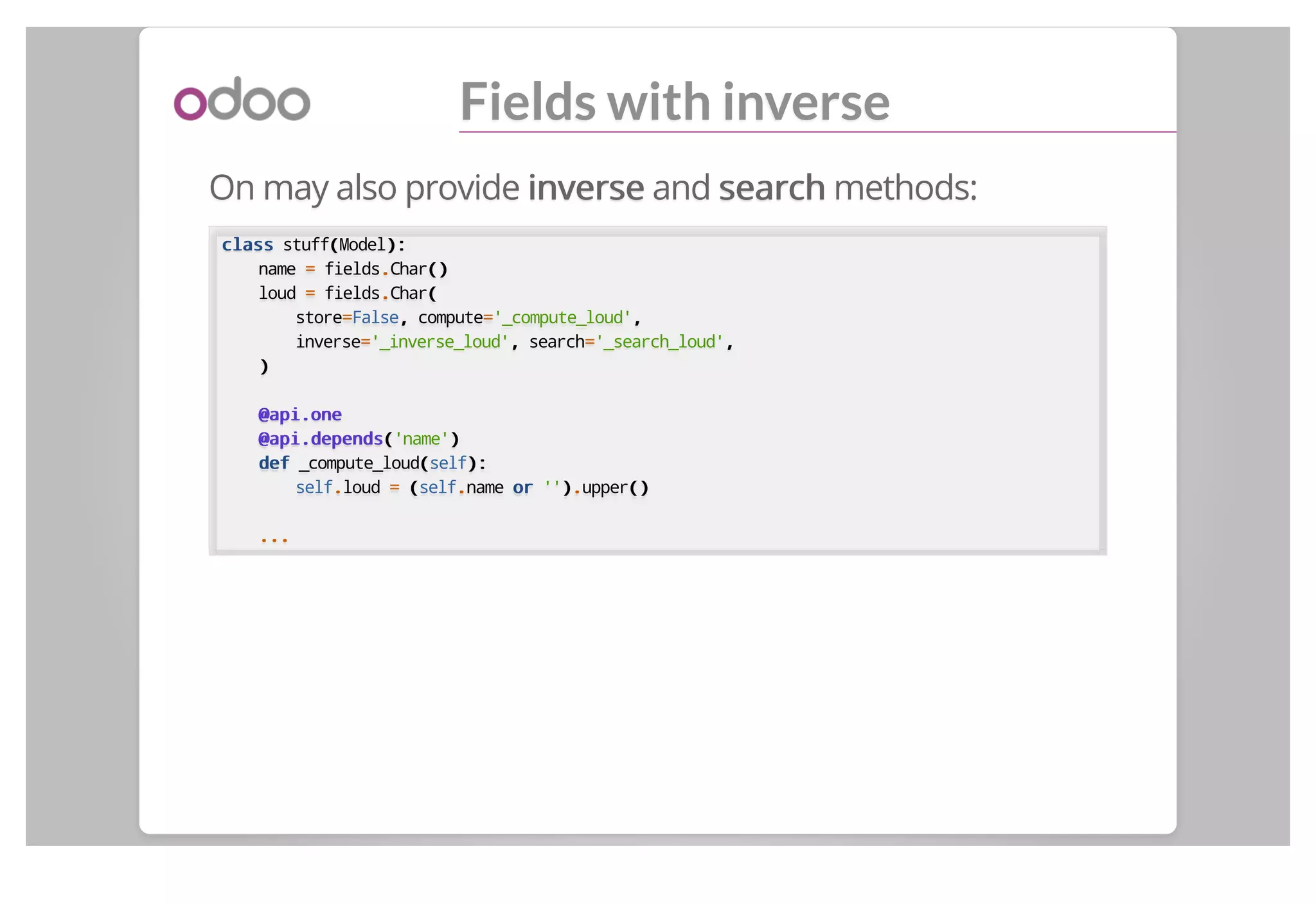
On may also provide inverseinverse and searchsearch methods:
classclass stuff((Model):):
name == fields..Char()()
loud == fields..Char((
store==False,, compute=='_compute_loud',,
inverse=='_inverse_loud',, search=='_search_loud',,
))
@api.one@api.one
@api.depends@api.depends(('name'))
defdef _compute_loud((self):):
self..loud == ((self..name oror ''))..upper()()
......
Fields with inverse
classclass stuff((Model):):
name == fields..Char()()
loud == fields..Char((
store==False,, compute=='_compute_loud',,
inverse=='_inverse_loud',, search=='_search_loud',,
))
......
@api.one@api.one
defdef _inverse_loud((self):):
self..name == ((self..loud oror ''))..lower()()
defdef _search_loud((self,, operator,, value):):
ifif value isis notnot False::
value == value..lower()()
returnreturn [([('name',, operator,, value)])]
Onchange methods
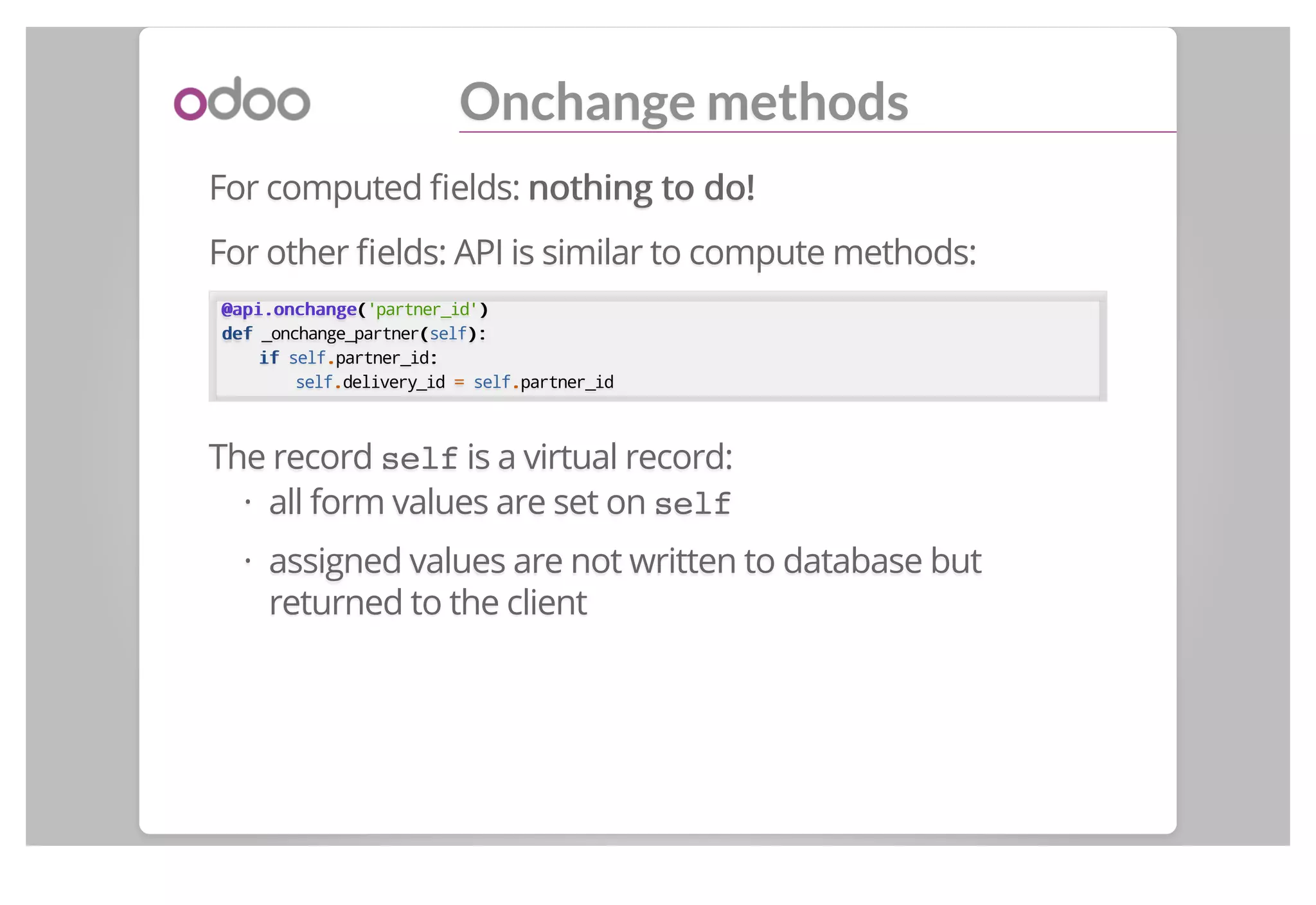
For computed fields: nothing to do!nothing to do!
For other fields: API is similar to compute methods:
@api.onchange@api.onchange(('partner_id'))
defdef _onchange_partner((self):):
ifif self..partner_id::
self..delivery_id == self..partner_id
The record self is a virtual record:
all form values are set on self
assigned values are not written to database but
returned to the client
·
·
Onchange methods
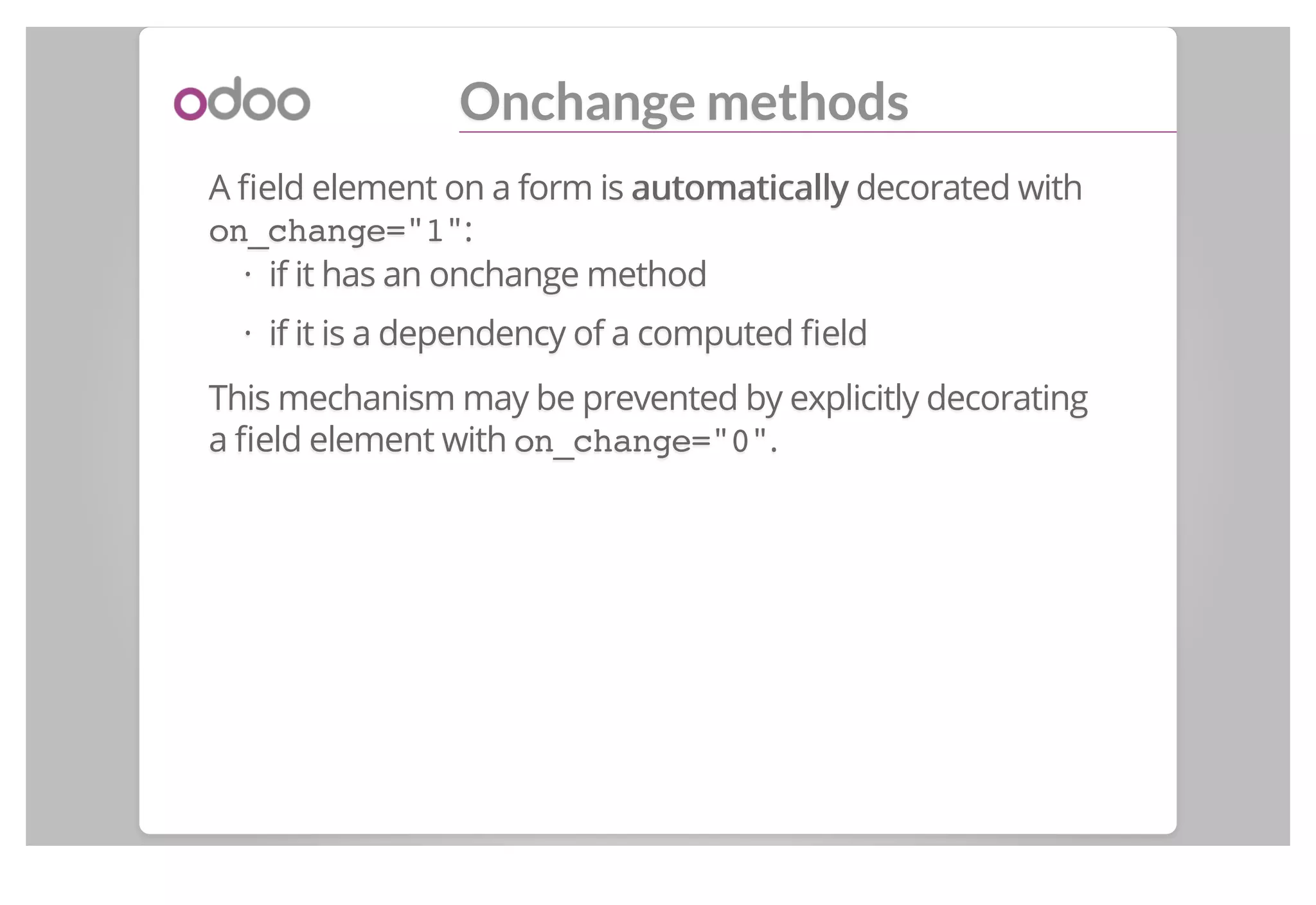
A field element on a form is automaticallyautomatically decorated with
on_change="1":
if it has an onchange method
if it is a dependency of a computed field
This mechanism may be prevented by explicitly decorating
a field element with on_change="0".
·
·
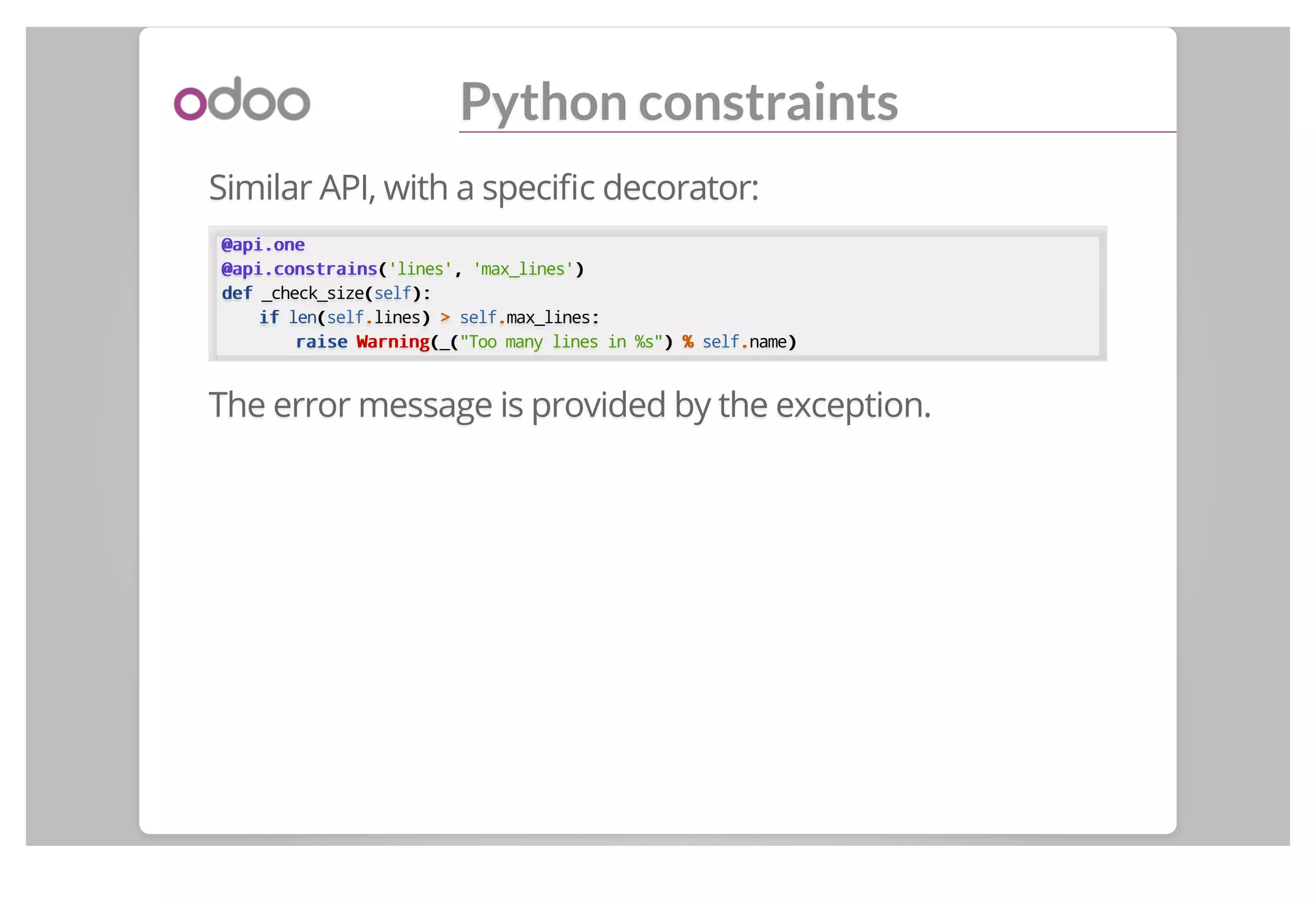
Python constraints
Similar API, with a specific decorator:
@api.one@api.one
@api.constrains@api.constrains(('lines',, 'max_lines'))
defdef _check_size((self):):
ifif len((self..lines)) >> self..max_lines::
raiseraise WarningWarning((_(("Too many lines in %s")) %% self..name))
The error message is provided by the exception.
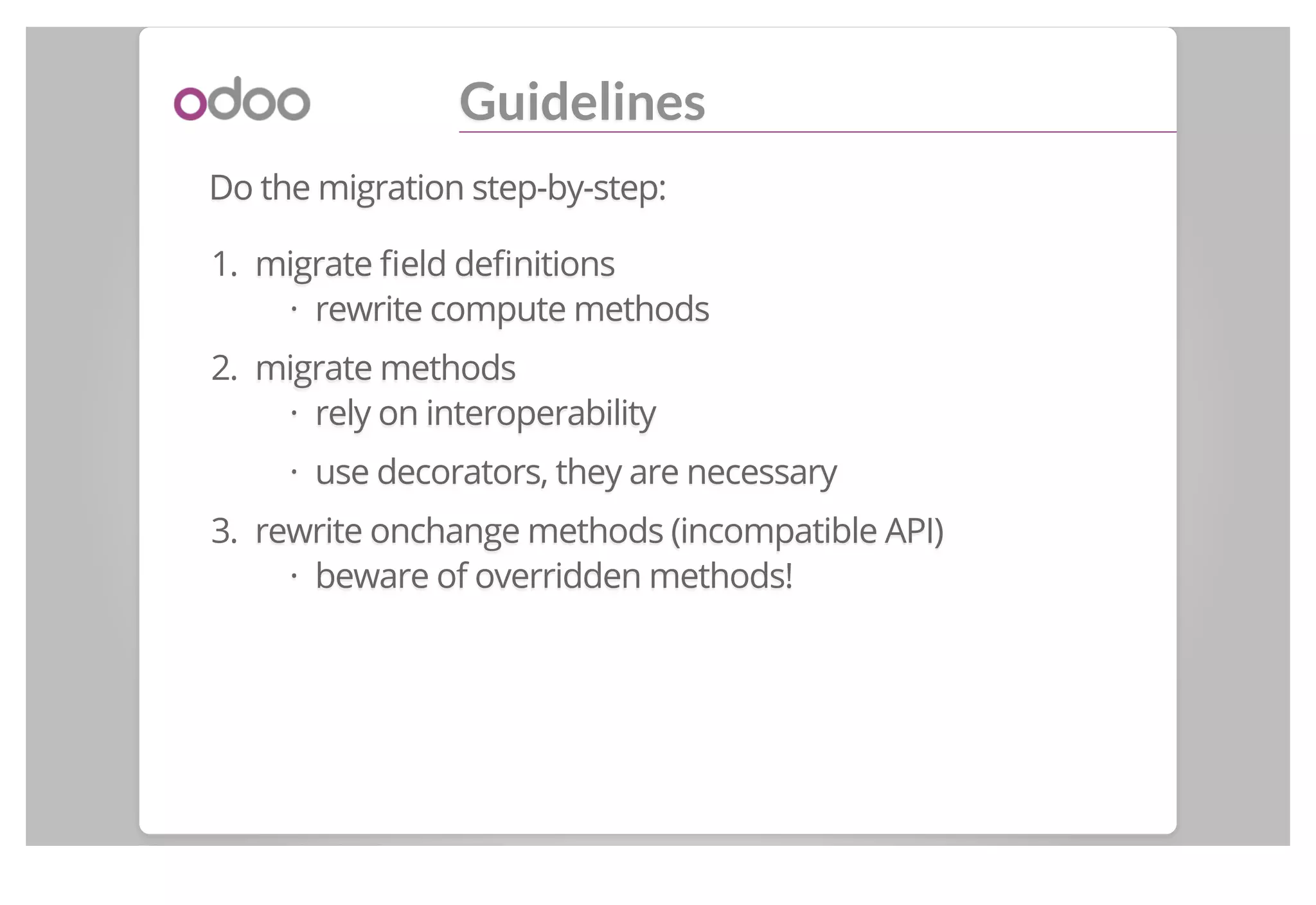
Migrating Modules
Guidelines
Do the migration step-by-step:
1. migrate field definitions
rewrite compute methods
2. migrate methods
rely on interoperability
use decorators, they are necessary
3. rewrite onchange methods (incompatible API)
beware of overridden methods!
·
·
·
·
From V7 to V8: The New API
Thanks!

Odoo from 7.0 to 8.0 API

  • 1.
    From V7 toV8: The New API Raphael Collet (rco@odoo.com)
  • 2.
    Goal Make the modelAPI more object-oriented more Pythonic less cluttered From V7 to V8 compatibility: V7 and V8 APIs are interoperable · · · ·
  • 3.
  • 4.
  • 5.
    Programming with Recordsets A recordsetrecordsetis: an ordered collection of records one concept to replace browse records, browse lists, browse nulls. an instance of the model's class · · · · · ·
  • 6.
    The recordset asa collection It implements sequence and set operations: partners == env[['res.partner']]..search([])([]) forfor partner inin partners:: assertassert partner inin partners printprint partner..name ifif len((partners)) >=>= 55:: fifth == partners[[44]] extremes == partners[:[:1010]] ++ partners[[--1010:]:] union == partners1 || partners2 intersection == partners1 && partners2 difference == partners1 -- partners2
  • 7.
    The recordset asa record It behaves just like former browse records: printprint partner..name printprint partner[['name']] printprint partner..parent_id..company_id..name Except that updates are written to database: partner..name == 'Agrolait' partner..email == 'info@agrolait.com' partner..parent_id == ...... # another record
  • 8.
    The recordset asa record If len(partners) > 1, do it on the firstfirst record: printprint partners..name # name of first partner printprint partners[[00]]..name partners..name == 'Agrolait' # assign first partner partners[[00]]..name == 'Agrolait' If len(partners) == 0, return the null value of the field: printprint partners..name # False printprint partners..parent_id # empty recordset partners..name == 'Foo' # ERROR
  • 9.
    The recordset asan instance Methods of the model's class can be invoked on recordsets: # calling convention: leave out cr, uid, ids, context @api.multi@api.multi defdef write((self,, values):): result == super((C,, self))..write((values)) # search returns a recordset instead of a list of ids domain == [([('id',, 'in',, self..ids),), (('parent_id',, '=',, False)])] roots == self..search((domain)) # modify all records in roots roots..write({({'modified':: True})}) returnreturn result The missing parameters are hidden inside the recordset.
  • 10.
  • 11.
    Method decorators Decorators enablesupport of bothboth old and new API: fromfrom odoo importimport Model,, api classclass stuff((Model):): @api.model@api.model defdef create((self,, values):): # self is a recordset, but its content is unused ...... This method definition is equivalent to: classclass stuff((Model):): defdef create((self,, cr,, uid,, values,, context==None):): # self is not a recordset ......
  • 12.
    Method decorators fromfrom odooimportimport Model,, api classclass stuff((Model):): @api.multi@api.multi defdef write((self,, values):): # self is a recordset and its content is used # update self.ids ...... This method definition is equivalent to: classclass stuff((Model):): defdef multi((self,, cr,, uid,, ids,, values,, context==None):): # self is not a recordset ......
  • 13.
    Method decorators One-by-one or"autoloop" decorator: fromfrom odoo importimport Model,, api classclass stuff((Model):): @api.one@api.one defdef cancel((self):): self..state == 'cancel' When invoked, the method is applied on every record: recs..cancel()() # [rec.cancel() for rec in recs]
  • 14.
    Method decorators Methods thatreturn a recordset instead of ids: fromfrom odoo importimport Model,, api classclass stuff((Model):): @api.multi@api.multi @api.returns@api.returns(('res.partner')) defdef root_partner((self):): p == self..partner_id whilewhile p..parent_id:: p == p..parent_id returnreturn p When called with the old API, it returns ids: roots == recs..root_partner()() root_ids == model..root_partner((cr,, uid,, ids,, context==None))
  • 15.
  • 16.
    The environment object Encapsulatescr, uid, context: # recs.env encapsulates cr, uid, context recs..env..cr # shortcut: recs._cr recs..env..uid # shortcut: recs._uid recs..env..context # shortcut: recs._context # recs.env also provides helpers recs..env..user # uid as a record recs..env..ref(('base.group_user')) # resolve xml id recs..env[['res.partner']] # access to new-API model
  • 17.
    The environment object Switchingenvironments: # rebrowse recs with different parameters env2 == recs..env((cr2,, uid2,, context2)) recs2 == recs..with_env((env2)) # special case: change/extend the context recs2 == recs..with_context((context2)) recs2 == recs..with_context((lang=='fr')) # kwargs extend current context # special case: change the uid recs2 == recs..sudo((user)) recs2 == recs..sudo()() # uid = SUPERUSER_ID
  • 18.
  • 19.
    Fields as descriptors Pythondescriptors provide getter/setter (like property): fromfrom odoo importimport Model,, fields classclass res_partner((Model):): _name == 'res.partner' name == fields..Char((required==True)) parent_id == fields..Many2one(('res.partner',, string=='Parent'))
  • 20.
    Computed fields Regular fieldswith the name of the compute method: classclass res_partner((Model):): ...... display_name == fields..Char(( string=='Name',, compute=='_compute_display_name',, )) @api.one@api.one @api.depends@api.depends(('name',, 'parent_id.name')) defdef _compute_display_name((self):): names == [[self..parent_id..name,, self..name]] self..display_name == ' / '..join((filter((None,, names))))
  • 21.
    Computed fields The computemethod must assign field(s) on records: untaxed == fields..Float((compute=='_amounts')) taxes == fields..Float((compute=='_amounts')) total == fields..Float((compute=='_amounts')) @api.multi@api.multi @api.depends@api.depends(('lines.amount',, 'lines.taxes')) defdef _amounts((self):): forfor order inin self:: order..untaxed == sum((line..amount forfor line inin order..lines)) order..taxes == sum((line..taxes forfor line inin order..lines)) order..total == order..untaxed ++ order..taxes
  • 22.
    Computed fields Stored computedfields are much easier now: display_name == fields..Char(( string=='Name',, compute=='_compute_display_name',, store==True,, )) @api.one@api.one @api.depends@api.depends(('name',, 'parent_id.name')) defdef _compute_display_name((self):): ...... Field dependencies (@depends) are used for cache invalidation, recomputation, onchange. · · ·
  • 23.
    Fields with inverse Onmay also provide inverseinverse and searchsearch methods: classclass stuff((Model):): name == fields..Char()() loud == fields..Char(( store==False,, compute=='_compute_loud',, inverse=='_inverse_loud',, search=='_search_loud',, )) @api.one@api.one @api.depends@api.depends(('name')) defdef _compute_loud((self):): self..loud == ((self..name oror ''))..upper()() ......
  • 24.
    Fields with inverse classclassstuff((Model):): name == fields..Char()() loud == fields..Char(( store==False,, compute=='_compute_loud',, inverse=='_inverse_loud',, search=='_search_loud',, )) ...... @api.one@api.one defdef _inverse_loud((self):): self..name == ((self..loud oror ''))..lower()() defdef _search_loud((self,, operator,, value):): ifif value isis notnot False:: value == value..lower()() returnreturn [([('name',, operator,, value)])]
  • 25.
    Onchange methods For computedfields: nothing to do!nothing to do! For other fields: API is similar to compute methods: @api.onchange@api.onchange(('partner_id')) defdef _onchange_partner((self):): ifif self..partner_id:: self..delivery_id == self..partner_id The record self is a virtual record: all form values are set on self assigned values are not written to database but returned to the client · ·
  • 26.
    Onchange methods A fieldelement on a form is automaticallyautomatically decorated with on_change="1": if it has an onchange method if it is a dependency of a computed field This mechanism may be prevented by explicitly decorating a field element with on_change="0". · ·
  • 27.
    Python constraints Similar API,with a specific decorator: @api.one@api.one @api.constrains@api.constrains(('lines',, 'max_lines')) defdef _check_size((self):): ifif len((self..lines)) >> self..max_lines:: raiseraise WarningWarning((_(("Too many lines in %s")) %% self..name)) The error message is provided by the exception.
  • 28.
  • 29.
    Guidelines Do the migrationstep-by-step: 1. migrate field definitions rewrite compute methods 2. migrate methods rely on interoperability use decorators, they are necessary 3. rewrite onchange methods (incompatible API) beware of overridden methods! · · · ·
  • 30.
    From V7 toV8: The New API Thanks!