Agile Requirements
GATHERING
Who am I?
• Onur Demir, PMP, PSM
• Beykent Uni Maths Computer Sc & MIS
Double Degree
• ITU Business & Technology Management
Master
• 7 years of Business Analyst Experience
• 1 year as SAP Consultant at Novigo
Agenda
• What is Requirement Gathering
and why is it important?
• Background for successful
requirements gathering
• Agile Modeling Techniques
• Interface prototype
• CRC
• UML
• User Stories
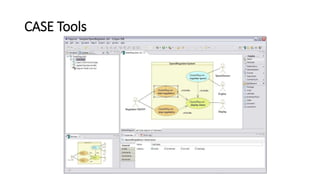
• CASE Tools
• Agile Documentation
It's difficult to build a solution if you don't know the requirements
3 types of requirement:
• Business
• Functional
• Technical
What is
REQUIREMENTS
GATHERING
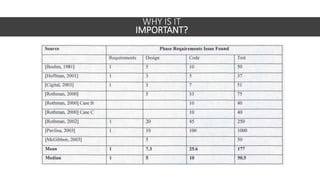
WHY IS IT
IMPORTANT?
What is a good
REQUIREMENT ?
• «We must be able to change
an employee’s profile
information»
• «System should be easy to
use»
• «We should be able to enter
the employee eye colour»
• «The system should
automatically be updated
when the government
changes the law»
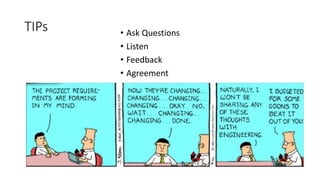
TIPs • Ask Questions
• Listen
• Feedback
• Agreement
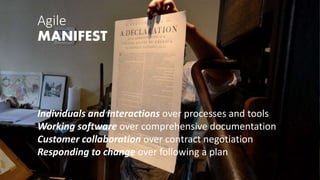
Agile
MANIFEST
Individuals and interactions over processes and tools
Working software over comprehensive documentation
Customer collaboration over contract negotiation
Responding to change over following a plan
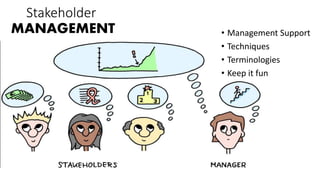
• Management Support
• Techniques
• Terminologies
• Keep it fun
Stakeholder
MANAGEMENT
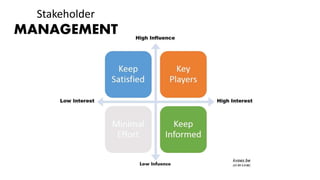
Stakeholder
MANAGEMENT
Breadth First
APPROACH
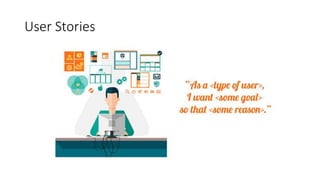
User Stories
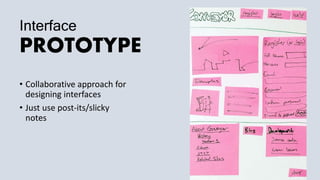
Interface
PROTOTYPE
• Collaborative approach for
designing interfaces
• Just use post-its/slicky
notes
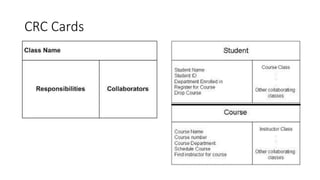
CRC Cards
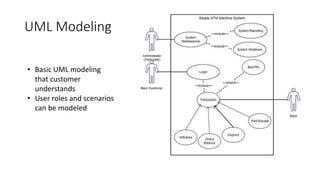
UML Modeling
• Basic UML modeling
that customer
understands
• User roles and scenarios
can be modeled
CASE Tools
MoSCoW
• Must have
• Should have
• Could have
• Would have
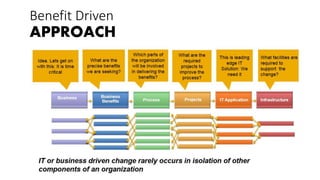
Benefit Driven
APPROACH
Scope
VALIDATION
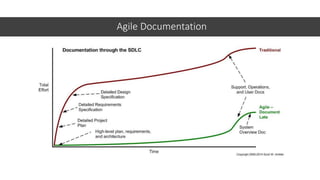
Agile Documentation
• “The Roman bridges of
antiquity were very
inefficient structures. By
modern standards, they used
too much stone, and as a
result, far too much labour to
build. Over the years we have
learned to build bridges more
efficiently, using fewer
materials and less labor to
perform the same task.”
Tom Clancy –
Sum of All Fears
Agile Requirements Gathering Techniques

Agile Requirements Gathering Techniques

Editor's Notes

  • #5 Concious Non concious Undreamed
  • #8 Doğru soruları sormak önemlidir. Açık uçlu sorular sorun Paraphrasing yapın kopyalamayın Hemfikir olun
  • #10 Explain techniques Adopt to terminology Obtain Management Support Keep it fun
  • #12 Many organizations prefer a "big modeling up front (BMUF)" approach to modeling where you invest significant time gathering and documenting requirements early in the project, review the requirements, accept and then baseline them before implementation commences. This sounds like a great idea, in theory, but the reality is that this approach is spectacularly ineffective. A 2001 study performed by M. Thomas in the U.K. of 1,027 projects showed that scope management related to attempting waterfall practices, including detailed, up-front requirements, was cited by 82 percent of failed projects as the number one cause of failure. This is backed up by other research - according to Jim Johnson of the Standish Group when requirements are specified early in the lifecycle that 80% of the functionality is relatively unwanted by the users. He reports that 45% of features are never used, 19% are rarely used, and 16% are sometimes used. Why does this happen? Two reasons: When project stakeholders are told that they need to get all of their requirements down on paper early in the project, they desperately try to define as many potential requirements (things they might need but really aren't sure about right now) as they can. They know if they don't do it now then it will be too hard to get them added later because of the change management/prevention process which will be put in place once the requirements document is baselined. Things change between the time the requirements are defined and when the software is actually delivered. The point is that you can do a little bit of initial, high-level requirements envisioning up front early in the project to understand the overall scope of your system without having to invest in mounds of documentation.
  • #21 Update documentation only when it hurts.