Logical Framework
  Approach (LFA) to
Settlement Services
   Rabindra Nath
       Sabat
Workshop Details
•   Introduction of participants
•   Introduction to LFA
•   LFA as a Project Planning Tool
•   LFA concept in brief
•   Break
•   Logic Model to Modernized
    Settlement Services
Introduction of participants
• Select a partner and introduce
  yourself to your partner: your
  name, name of your organization,
  the position you hold, your work in
  brief and your expectations out of
  this workshop
• Your partner should introduce you
  to the whole group
• You may adopt any innovative
  method to introduce each other
Introduction to LFA
Logical Framework Approach, is a Result
Oriented Planning Tool or Objective
Oriented Planning Tool.

First developed by in 1969 by USAID

Since 1969, LFA has been widely adopted
and adapted by the international donor
community and is used for participatory
project planning, as an analytic tool for
project approval, or as a monitoring and
evaluation framework.
Introduction to LFA Cont’d
LFA is best used in the development sector
The method may also be used for project
analysis, assessment, follow-up and
evaluation
As a planning tool, LFA has many different
elements in the process of change such as
problem analysis, objectives analysis,
stakeholders analysis and implementation
plan analysis.
BENEFITS OF LFA
Ensures that fundamental questions are
asked and weaknesses are analyzed

Guides systematic and logical analysis of
the inter-related key elements

Provides better basis for systematic
monitoring and analysis of the effects of
projects
LFA ENHANCES PLANNING, ANALYSIS
      AND COMMUNICATION.
Using LFA helps:
Clarify the purpose of, and the justification for a
project
Identify information requirements
Clearly define the key elements of a project
Analyze the project's setting at an early stage
Facilitate communication between all parties
involved
Identify how the success or failure of the
project should be measured
Elements of LFA
A development project is based on:
   Inputs or resources
   Implementation of certain activities
   Produce a number of outputs
   Contribute to the desired objectives.
   Inputs, activities and outputs are
   elements of a project; they are not in
   themselves a measure of success
   or failure.
Success factor in LFA
The success of a project depends upon
a number of factors that can be controlled
by the project management, as well as
upon a number of external assumptions.

During planning and implementation, it is
extremely important to identify, monitor
and analyze external assumptions, since
they may cause the project to fail even if
it is implemented as planned.
An introduction to
          Project Planning
What is planning ?
 In lay man’s language, planning is
 deciding the best way to do a thing.

 Planning is a process for accomplishing
 a purpose or set of purposes.
 It is a road map to development.
 It helps in deciding objectives both in
 quantitative and qualitative terms.
 Planning is setting of goals on the basis
 of objectives keeping in view of the
 resources.
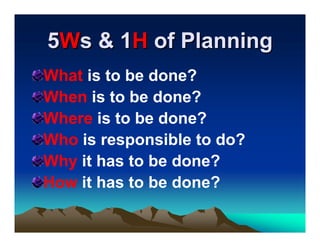
5Ws & 1H of Planning
What is to be done?
When is to be done?
Where is to be done?
Who is responsible to do?
Why it has to be done?
How it has to be done?
Project Planning cont’d
What is a plan?
A plan should be a realistic view of the
expectations.
Depending upon the activities, a plan can be
long range, intermediate range or short range.
It is the framework within which it must operate.
For management seeking external support, the
plan is the most important document and key to
growth.
Preparation of a comprehensive plan will not
guarantee success, but lack of a sound plan will
almost certainly ensure failure.
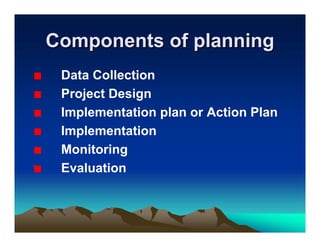
Components of planning
 Data Collection
 Project Design
 Implementation plan or Action Plan
 Implementation
 Monitoring
 Evaluation
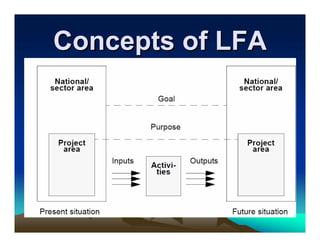
Concepts of LFA
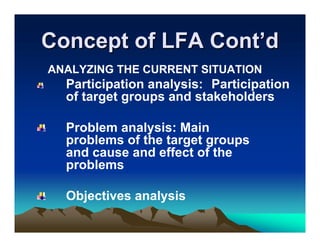
Concept of LFA Cont’d
ANALYZING THE CURRENT SITUATION
  Participation analysis: Participation
  of target groups and stakeholders

  Problem analysis: Main
  problems of the target groups
  and cause and effect of the
  problems

  Objectives analysis
Concept of LFA Cont’d
 Alternatives analysis
 Total cost (Budget)
 Benefits to priority
 groups
 Probability of achieving
 objectives (assumptions)
 Social risks
Main components of the Project
Goal
Objectives
Activities
Outputs
Inputs
Outcomes ( immediate/intermediate and
long term)
Indicators
Impacts
Assumptions
Main components of Project cont’d

 Goal: The goal describes the
anticipated long term objective towards
which the project will contribute
(project justification)

 Objectives (SMART/SMARTER)
Must reflect knowledge, awareness,
understanding, confidence, attitudes,
perceptions, accomplishments, societal
changes
Main components of Project cont’d

Activities: Activities are expressed as
processes. Action taken or work
performed within a project in order to
transform
Outputs :The outputs are products and
services which the project management
must achieve and sustain within the life
of the project.
Main components of Project cont’d

Inputs: Main inputs are expressed in
terms of funds, personnel and
goods.

 Outcomes: (immediate,
intermediate and strategic)
Outcomes are noun end based
results- Always related to the
objectives
Main components of Project cont’d
Indicators: Means of verification
An indicator defines the performance standard
to be reached in order to achieve the objective.
Several indicators are better than one. Single
indicators seldom convey a comprehensive
picture of change

Assumptions : Parameters of project success
Event, condition or decision which is
necessary for project success, but which are
largely or completely beyond the control of
project management

Impact- Positive and Negative impacts
Sequence of events
In Logical Framework Approach, a
development project is seen as a
causally linked sequence of events.
These are:
   Inputs
   Activities
   Outputs
   Purpose and
   Goal.
Sequence of events in LFA
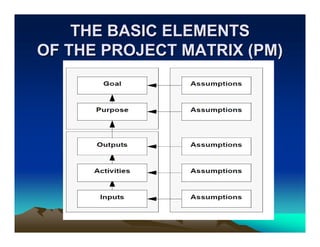
THE BASIC ELEMENTS
OF THE PROJECT MATRIX (PM)
PM with Indicators
Discussion
Select a project/activity related to
your work experience
Develop a project matrix based
on inputs, activities,
purpose/objectives, goal,
outcome, indicator and impact
Share your project plans with
others
Break
Break 15 minutes
Logic Model to Modernized
      Settlement Services
  From a Suite of Programs to a Single
  Program with a Suite of Activities to
  Achieve Results
  From a suit of programs such as:
• Language Instruction for Newcomers to
  Canada (LINC)
• Immigrant Settlement and Adaptation
  Program (ISAP)
• Host Program (Host)
Outcomes of Settlement
          Services
A. Orientation – Newcomers make
informed decisions about their settlement
and understand life in Canada

B. Language/Skills – Newcomers have
language/skills needed to function in
Canada

C. Labour Market Access – Newcomers
obtain Connections the required
assistance to find employment
commensurate with their skills and
education
Outcomes of Settlement
          Services
D. Welcoming Communities – Newcomers
receive help to establish social and professional
networks so they are engaged and feel
welcomed in their communities

E. Policy and Program Development – To
ensure effective delivery and achieve
comparable settlement outcomes across
Canada in Canada
Stream of Activities
Needs Assessment and Referrals:
Determines eligibility for services, and
assesses newcomers’ needs,
resources, strengths and barriers.

Initial and ongoing needs
assessments (including language
assessments)
Referrals to CIC funded and
community settlement services
Stream of Activities cont’d
Information & Awareness Services:
Provides newcomers and prospective
immigrants with access to accurate,
timely information about life in Canada

Information products
Orientation sessions
Promotion and outreach
Stream of Activities cont’d
Language Learning & Skills
Development: Provides access to
language training and soft skills in
different contexts to enable
newcomers to function

Language training
Other skills/ life-skills training
Stream of Activities cont’d
Employment-Related Services:
Supports employment related
programming for newcomers

Labour market bridging
Job search skills training
Labour market information
Workplace orientation
Stream of Activities cont’d
Community Connections: Supports newcomers
in their social engagement efforts, and engages
communities in supporting the full participation of
newcomers.

Individual and community-level bridging such as:
Host/ mentor matches
Volunteers engaged trained and supported
Cultural awareness, anti-racism, and welcoming
communities services
Stream of Activities cont’d
Support Services: Increases newcomers’
access to settlement services by providing
child minding, and/ or transportation
assistance

Childminding
Transportation assistance
Provisions for disabilities
Other support services:
POE reception services
Translation
Interpretation
Settlement/ crisis counselling
Outcome details of Policy Development

Policy & Program Development

Strategic plans
Policy, priorities, standards and
outcomes
Performance measurement strategy and
national reports
Horizontal coordination
Consultations
Research analysis
Outcome details of Policy Development
Program Implementation and Management

Operational plans
Program delivery materials and tools
Functional guidance & training
Data collection and regional/local/Service Providers’
reports
Regional, local and Service Providers coordination
Service delivery capacity building
Best practices and info sharing
Contribution agreement
Settlement Logic Model Example
Input       Activities   Output    Immediate     Intermediate   Long term        Indicators
                                   Outcomes      Outcomes       outcomes
Funding,    • Assess     Number of Clients are   Clients        Clients          Number of
Staff,        clients    clients   aware of      develop        maintain a       clients who
(Personnel)   needs      who       barriers      realistic      sense of well-   report that
Materials,    and        received  and option    goals and      being,           they have
Equipment     barriers initial                   plans          confidence       learned of a
            • Identify assessment                               and              situation i.e.
              appropri and                                      independence     employment,
              ate        developed                                               labour
              services settlement                                                market, that
            • Assist     plan                                                    might affect
              clients to                                                         their
              set goals                                                          settlement
              and                                                                and know of
              prioritie                                                          options that
              s and                                                              are open to
              develop                                                            them
              realistic
              plans
Thank you
• Any question?

Rabindra Nath Sabat
Program Director
South Asian Family Support Services
1200 Markham Road, Suite 214, Toronto, ON M1H 3C3
Phone: (416) 431-4847, Fax: (416) 431-7283
rsabat@safss.org

C8 logical framework approach (lfa)

  • 1.
    Logical Framework Approach (LFA) to Settlement Services Rabindra Nath Sabat
  • 2.
    Workshop Details • Introduction of participants • Introduction to LFA • LFA as a Project Planning Tool • LFA concept in brief • Break • Logic Model to Modernized Settlement Services
  • 3.
    Introduction of participants •Select a partner and introduce yourself to your partner: your name, name of your organization, the position you hold, your work in brief and your expectations out of this workshop • Your partner should introduce you to the whole group • You may adopt any innovative method to introduce each other
  • 4.
    Introduction to LFA LogicalFramework Approach, is a Result Oriented Planning Tool or Objective Oriented Planning Tool. First developed by in 1969 by USAID Since 1969, LFA has been widely adopted and adapted by the international donor community and is used for participatory project planning, as an analytic tool for project approval, or as a monitoring and evaluation framework.
  • 5.
    Introduction to LFACont’d LFA is best used in the development sector The method may also be used for project analysis, assessment, follow-up and evaluation As a planning tool, LFA has many different elements in the process of change such as problem analysis, objectives analysis, stakeholders analysis and implementation plan analysis.
  • 6.
    BENEFITS OF LFA Ensuresthat fundamental questions are asked and weaknesses are analyzed Guides systematic and logical analysis of the inter-related key elements Provides better basis for systematic monitoring and analysis of the effects of projects
  • 7.
    LFA ENHANCES PLANNING,ANALYSIS AND COMMUNICATION. Using LFA helps: Clarify the purpose of, and the justification for a project Identify information requirements Clearly define the key elements of a project Analyze the project's setting at an early stage Facilitate communication between all parties involved Identify how the success or failure of the project should be measured
  • 8.
    Elements of LFA Adevelopment project is based on: Inputs or resources Implementation of certain activities Produce a number of outputs Contribute to the desired objectives. Inputs, activities and outputs are elements of a project; they are not in themselves a measure of success or failure.
  • 9.
    Success factor inLFA The success of a project depends upon a number of factors that can be controlled by the project management, as well as upon a number of external assumptions. During planning and implementation, it is extremely important to identify, monitor and analyze external assumptions, since they may cause the project to fail even if it is implemented as planned.
  • 10.
    An introduction to Project Planning What is planning ? In lay man’s language, planning is deciding the best way to do a thing. Planning is a process for accomplishing a purpose or set of purposes. It is a road map to development. It helps in deciding objectives both in quantitative and qualitative terms. Planning is setting of goals on the basis of objectives keeping in view of the resources.
  • 11.
    5Ws & 1Hof Planning What is to be done? When is to be done? Where is to be done? Who is responsible to do? Why it has to be done? How it has to be done?
  • 12.
    Project Planning cont’d Whatis a plan? A plan should be a realistic view of the expectations. Depending upon the activities, a plan can be long range, intermediate range or short range. It is the framework within which it must operate. For management seeking external support, the plan is the most important document and key to growth. Preparation of a comprehensive plan will not guarantee success, but lack of a sound plan will almost certainly ensure failure.
  • 13.
    Components of planning Data Collection Project Design Implementation plan or Action Plan Implementation Monitoring Evaluation
  • 14.
  • 15.
    Concept of LFACont’d ANALYZING THE CURRENT SITUATION Participation analysis: Participation of target groups and stakeholders Problem analysis: Main problems of the target groups and cause and effect of the problems Objectives analysis
  • 16.
    Concept of LFACont’d Alternatives analysis Total cost (Budget) Benefits to priority groups Probability of achieving objectives (assumptions) Social risks
  • 17.
    Main components ofthe Project Goal Objectives Activities Outputs Inputs Outcomes ( immediate/intermediate and long term) Indicators Impacts Assumptions
  • 18.
    Main components ofProject cont’d Goal: The goal describes the anticipated long term objective towards which the project will contribute (project justification) Objectives (SMART/SMARTER) Must reflect knowledge, awareness, understanding, confidence, attitudes, perceptions, accomplishments, societal changes
  • 19.
    Main components ofProject cont’d Activities: Activities are expressed as processes. Action taken or work performed within a project in order to transform Outputs :The outputs are products and services which the project management must achieve and sustain within the life of the project.
  • 20.
    Main components ofProject cont’d Inputs: Main inputs are expressed in terms of funds, personnel and goods. Outcomes: (immediate, intermediate and strategic) Outcomes are noun end based results- Always related to the objectives
  • 21.
    Main components ofProject cont’d Indicators: Means of verification An indicator defines the performance standard to be reached in order to achieve the objective. Several indicators are better than one. Single indicators seldom convey a comprehensive picture of change Assumptions : Parameters of project success Event, condition or decision which is necessary for project success, but which are largely or completely beyond the control of project management Impact- Positive and Negative impacts
  • 22.
    Sequence of events InLogical Framework Approach, a development project is seen as a causally linked sequence of events. These are: Inputs Activities Outputs Purpose and Goal.
  • 23.
  • 24.
    THE BASIC ELEMENTS OFTHE PROJECT MATRIX (PM)
  • 25.
  • 26.
    Discussion Select a project/activityrelated to your work experience Develop a project matrix based on inputs, activities, purpose/objectives, goal, outcome, indicator and impact Share your project plans with others
  • 27.
  • 28.
    Logic Model toModernized Settlement Services From a Suite of Programs to a Single Program with a Suite of Activities to Achieve Results From a suit of programs such as: • Language Instruction for Newcomers to Canada (LINC) • Immigrant Settlement and Adaptation Program (ISAP) • Host Program (Host)
  • 29.
    Outcomes of Settlement Services A. Orientation – Newcomers make informed decisions about their settlement and understand life in Canada B. Language/Skills – Newcomers have language/skills needed to function in Canada C. Labour Market Access – Newcomers obtain Connections the required assistance to find employment commensurate with their skills and education
  • 30.
    Outcomes of Settlement Services D. Welcoming Communities – Newcomers receive help to establish social and professional networks so they are engaged and feel welcomed in their communities E. Policy and Program Development – To ensure effective delivery and achieve comparable settlement outcomes across Canada in Canada
  • 31.
    Stream of Activities NeedsAssessment and Referrals: Determines eligibility for services, and assesses newcomers’ needs, resources, strengths and barriers. Initial and ongoing needs assessments (including language assessments) Referrals to CIC funded and community settlement services
  • 32.
    Stream of Activitiescont’d Information & Awareness Services: Provides newcomers and prospective immigrants with access to accurate, timely information about life in Canada Information products Orientation sessions Promotion and outreach
  • 33.
    Stream of Activitiescont’d Language Learning & Skills Development: Provides access to language training and soft skills in different contexts to enable newcomers to function Language training Other skills/ life-skills training
  • 34.
    Stream of Activitiescont’d Employment-Related Services: Supports employment related programming for newcomers Labour market bridging Job search skills training Labour market information Workplace orientation
  • 35.
    Stream of Activitiescont’d Community Connections: Supports newcomers in their social engagement efforts, and engages communities in supporting the full participation of newcomers. Individual and community-level bridging such as: Host/ mentor matches Volunteers engaged trained and supported Cultural awareness, anti-racism, and welcoming communities services
  • 36.
    Stream of Activitiescont’d Support Services: Increases newcomers’ access to settlement services by providing child minding, and/ or transportation assistance Childminding Transportation assistance Provisions for disabilities Other support services: POE reception services Translation Interpretation Settlement/ crisis counselling
  • 37.
    Outcome details ofPolicy Development Policy & Program Development Strategic plans Policy, priorities, standards and outcomes Performance measurement strategy and national reports Horizontal coordination Consultations Research analysis
  • 38.
    Outcome details ofPolicy Development Program Implementation and Management Operational plans Program delivery materials and tools Functional guidance & training Data collection and regional/local/Service Providers’ reports Regional, local and Service Providers coordination Service delivery capacity building Best practices and info sharing Contribution agreement
  • 39.
    Settlement Logic ModelExample Input Activities Output Immediate Intermediate Long term Indicators Outcomes Outcomes outcomes Funding, • Assess Number of Clients are Clients Clients Number of Staff, clients clients aware of develop maintain a clients who (Personnel) needs who barriers realistic sense of well- report that Materials, and received and option goals and being, they have Equipment barriers initial plans confidence learned of a • Identify assessment and situation i.e. appropri and independence employment, ate developed labour services settlement market, that • Assist plan might affect clients to their set goals settlement and and know of prioritie options that s and are open to develop them realistic plans
  • 40.
    Thank you • Anyquestion? Rabindra Nath Sabat Program Director South Asian Family Support Services 1200 Markham Road, Suite 214, Toronto, ON M1H 3C3 Phone: (416) 431-4847, Fax: (416) 431-7283 rsabat@safss.org