CIC Presentation for 
OCASI Provincial 
Summit: Settlement 
Programs in Ontario
Presentation Outline 
Introduction 
• Settlement Priority Setting Cycle 
• What We Hope to Achieve From The Summits 
• The Four Pillars of Integration 
Settlement Services in Ontario 
• Settlement Services: Who is using them? 
• Trends In Usage And Funding 
• Results From Annual Project Performance Report (APPR) 
National Perspective 
• A Strategic Approach to Settlement Programming 
• Looking Forward 
• Next Steps 
2
Priority Setting Cycle 
• In order to make better informed decisions regarding priorities, CIC is using 
both existing and new means of information gathering. 
• Summits are a brand new means to consult with established and new 
stakeholders; increase our knowledge and understanding of the needs and 
challenges in providing settlement services; and inform priority setting for 
the future. 
• The input you provide during this summit will create part of the evidence 
base for our upcoming national Call for Proposals (CFP) priority setting, as 
well as future policy development. 
• Summits fit within a large, regular 5-year planning cycle associated with the 
CFP. 
3
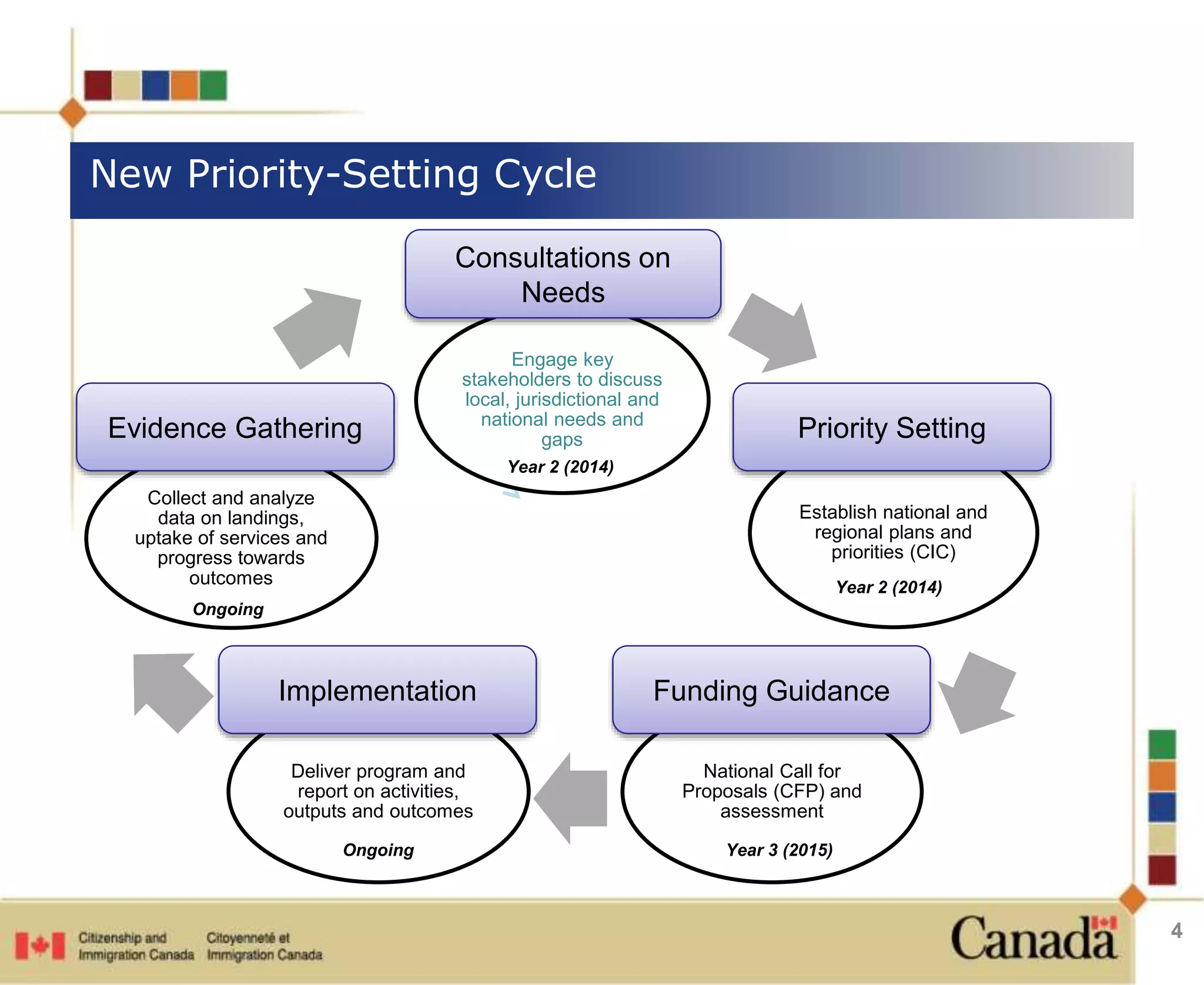
Consultations on 
Needs 
Engage key 
stakeholders to discuss 
local, jurisdictional and 
national needs and 
gaps 
Establish national and 
regional plans and 
priorities (CIC) 
National Call for 
Proposals (CFP) and 
assessment 
Evidence Gathering 
Collect and analyze 
data on landings, 
uptake of services and 
progress towards 
Deliver program and 
report on activities, 
outputs and outcomes 
outcomes 
Priority Setting 
Implementation Funding Guidance 
Ongoing 
Ongoing 
Year 2 (2014) 
Year 2 (2014) 
Year 3 (2015) 
New Priority-Setting Cycle 
4
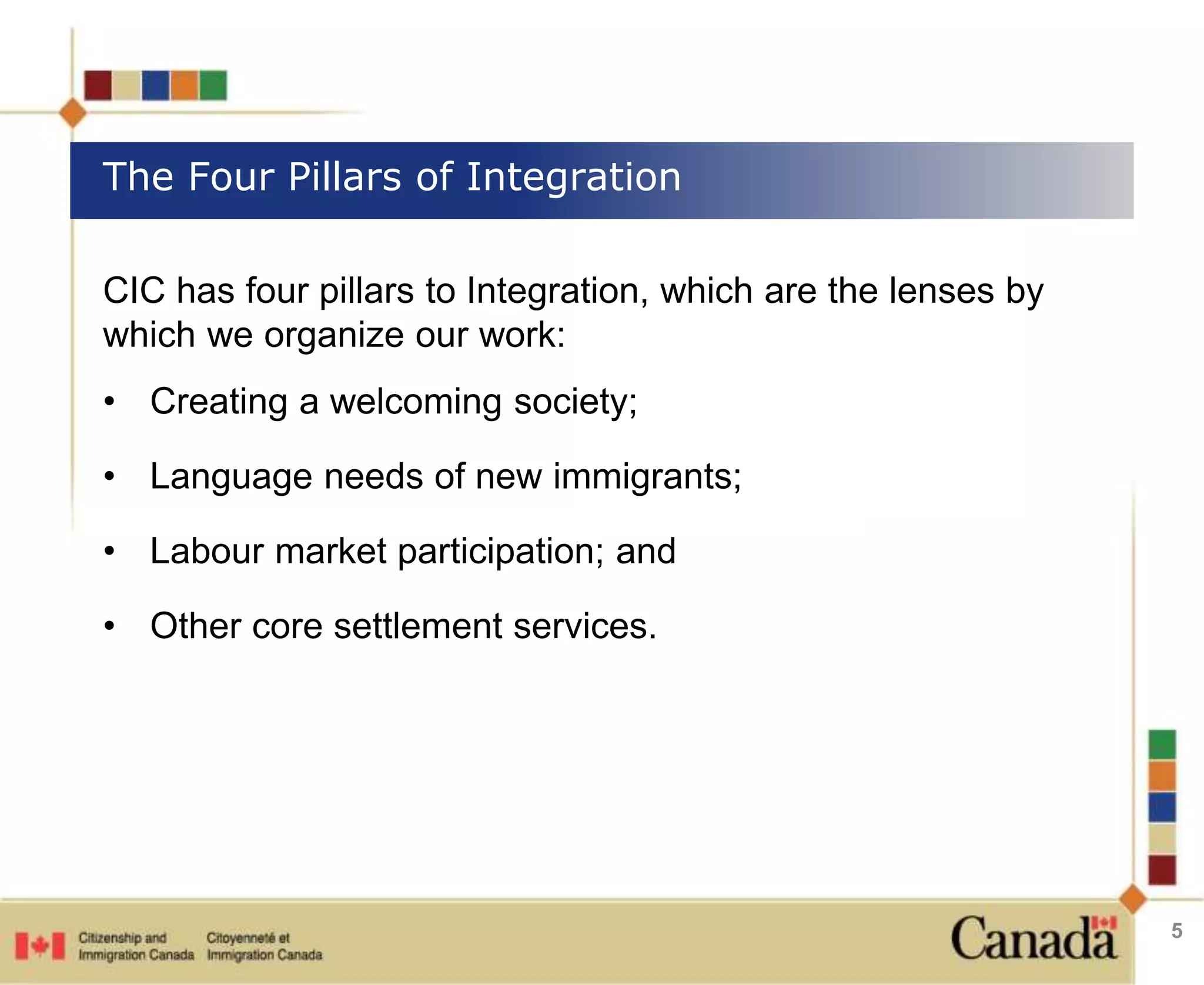
The Four Pillars of Integration 
CIC has four pillars to Integration, which are the lenses by 
which we organize our work: 
• Creating a welcoming society; 
• Language needs of new immigrants; 
• Labour market participation; and 
• Other core settlement services. 
5
Ontario at a glance 
6 
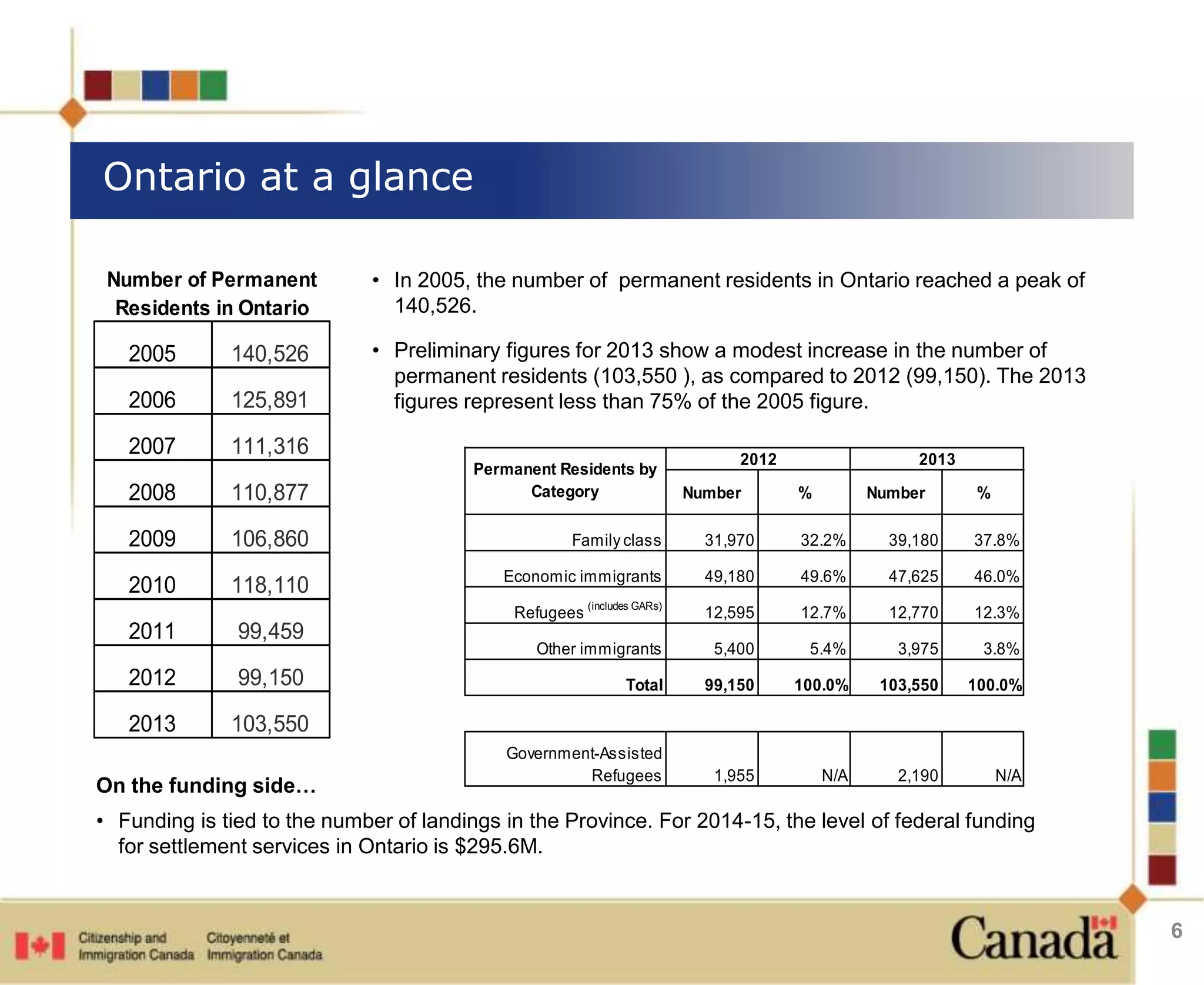
• In 2005, the number of permanent residents in Ontario reached a peak of 
140,526. 
• Preliminary figures for 2013 show a modest increase in the number of 
permanent residents (103,550 ), as compared to 2012 (99,150). The 2013 
figures represent less than 75% of the 2005 figure. 
Permanent Residents by 
Category 
Number of Permanent 
Residents in Ontario 
On the funding side… 
• Funding is tied to the number of landings in the Province. For 2014-15, the level of federal funding 
for settlement services in Ontario is $295.6M. 
2012 2013 
Number % Number % 
Family class 31,970 32.2% 39,180 37.8% 
Economic immigrants 49,180 49.6% 47,625 46.0% 
Refugees (includes GARs) 12,595 12.7% 12,770 12.3% 
Other immigrants 5,400 5.4% 3,975 3.8% 
Total 99,150 100.0% 103,550 100.0% 
Government-Assisted 
Refugees 1,955 N/A 2,190 N/A 
2005 140,526 
2006 125,891 
2007 111,316 
2008 110,877 
2009 106,860 
2010 118,110 
2011 99,459 
2012 99,150 
2013 103,550
Trends in the usage of Federal Settlement Services – 2005-06 
to 2012-13 
7 
160,000 
150,000 
140,000 
130,000 
120,000 
110,000 
100,000 
90,000 
80,000 
70,000 
60,000 
50,000 
40,000 
30,000 
20,000 
10,000 
0 
Ontario - Summary of Usage of Settlement services 
(2005-06 to 2012-13) 
Any Services 
43.9% Increase 
Info & Orientation 
103.6% Increase 
Language Training 
2.3% Increase 
Language Assessment 
11.2% Increase 
2005-06 2006-07 2007-08 2008-09 2009-10 2010-11 2011-12 2012-13 
Number of Unique Clients 
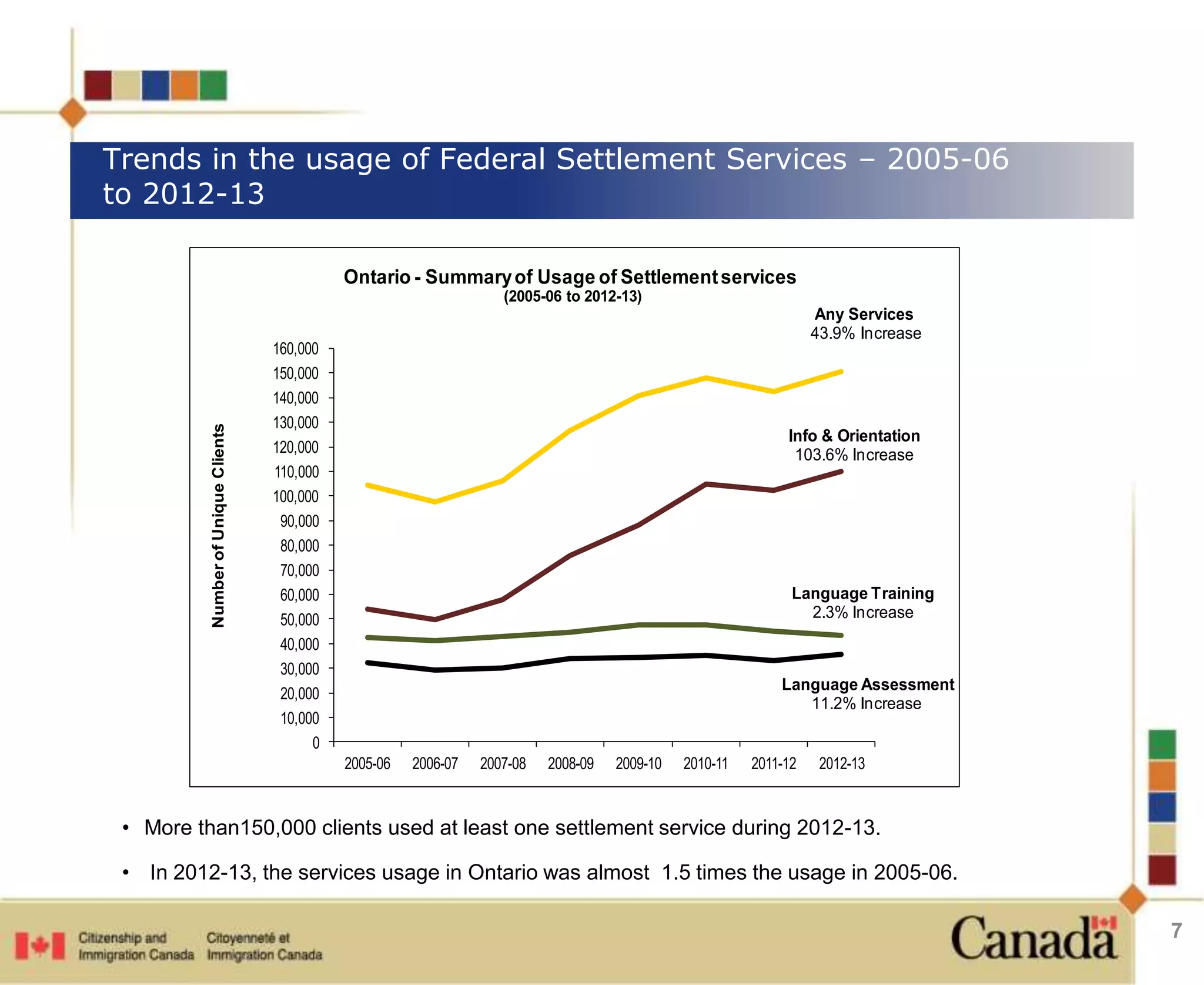
• More than150,000 clients used at least one settlement service during 2012-13. 
• In 2012-13, the services usage in Ontario was almost 1.5 times the usage in 2005-06.
Usage of Settlement Services 
8 
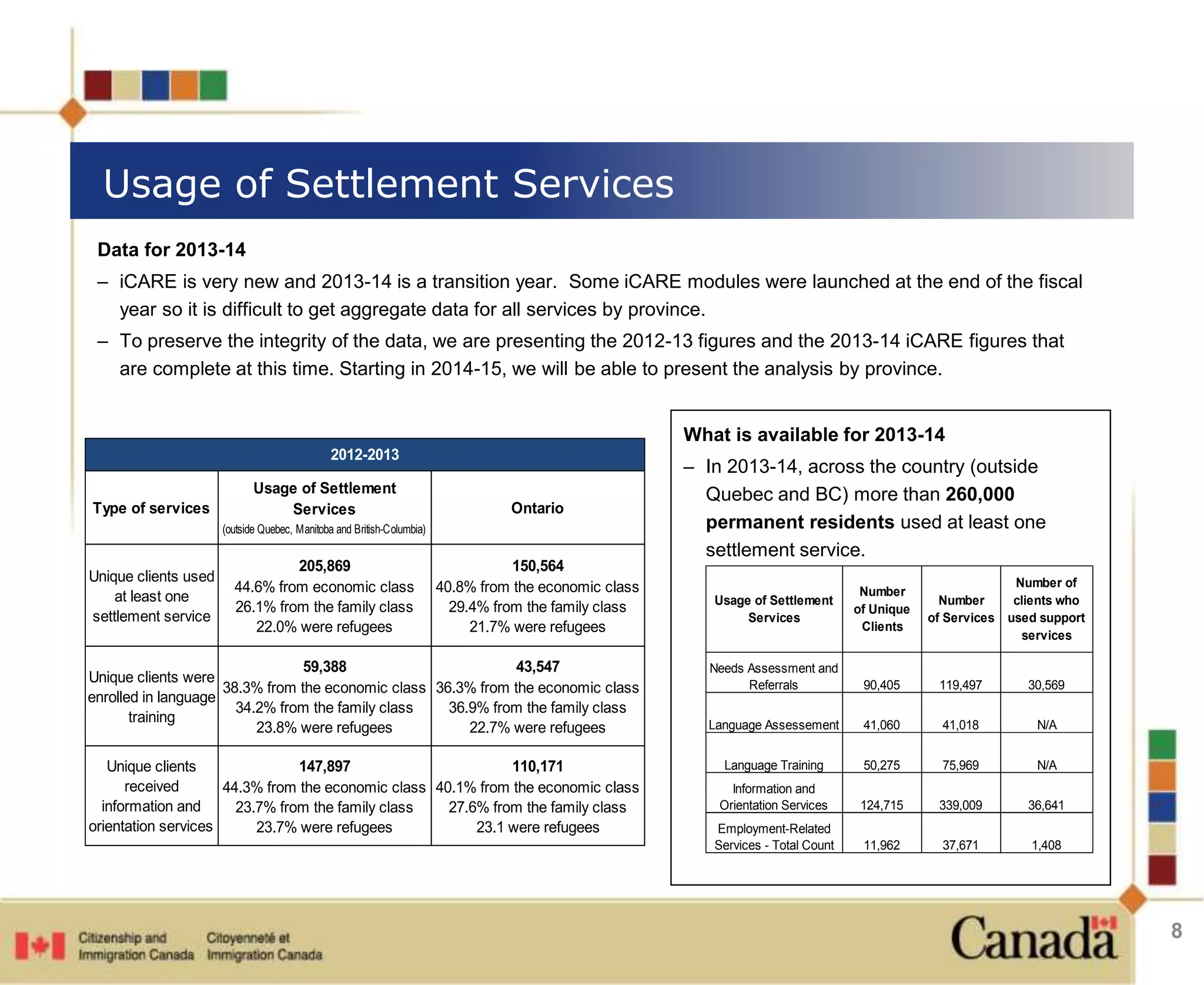
Data for 2013-14 
– iCARE is very new and 2013-14 is a transition year. Some iCARE modules were launched at the end of the fiscal 
year so it is difficult to get aggregate data for all services by province. 
– To preserve the integrity of the data, we are presenting the 2012-13 figures and the 2013-14 iCARE figures that 
are complete at this time. Starting in 2014-15, we will be able to present the analysis by province. 
Type of services 
Usage of Settlement 
Services 
(outside Quebec, Manitoba and British-Columbia) 
Ontario 
Unique clients used 
at least one 
settlement service 
205,869 
44.6% from economic class 
26.1% from the family class 
22.0% were refugees 
150,564 
40.8% from the economic class 
29.4% from the family class 
21.7% were refugees 
Unique clients were 
enrolled in language 
training 
59,388 
38.3% from the economic class 
34.2% from the family class 
23.8% were refugees 
43,547 
36.3% from the economic class 
36.9% from the family class 
22.7% were refugees 
Unique clients 
received 
information and 
orientation services 
147,897 
44.3% from the economic class 
23.7% from the family class 
23.7% were refugees 
110,171 
40.1% from the economic class 
27.6% from the family class 
23.1 were refugees 
2012-2013 
What is available for 2013-14 
– In 2013-14, across the country (outside 
Quebec and BC) more than 260,000 
permanent residents used at least one 
settlement service. 
Usage of Settlement 
Services 
Number 
of Unique 
Clients 
Number 
of Services 
Number of 
clients who 
used support 
services 
Needs Assessment and 
Referrals 90,405 119,497 30,569 
Language Assessement 41,060 41,018 N/A 
Language Training 50,275 75,969 N/A 
Information and 
Orientation Services 124,715 339,009 36,641 
Employment-Related 
Services - Total Count 11,962 37,671 1,408
General Information on Projects as Reported by Service Providers 
9 
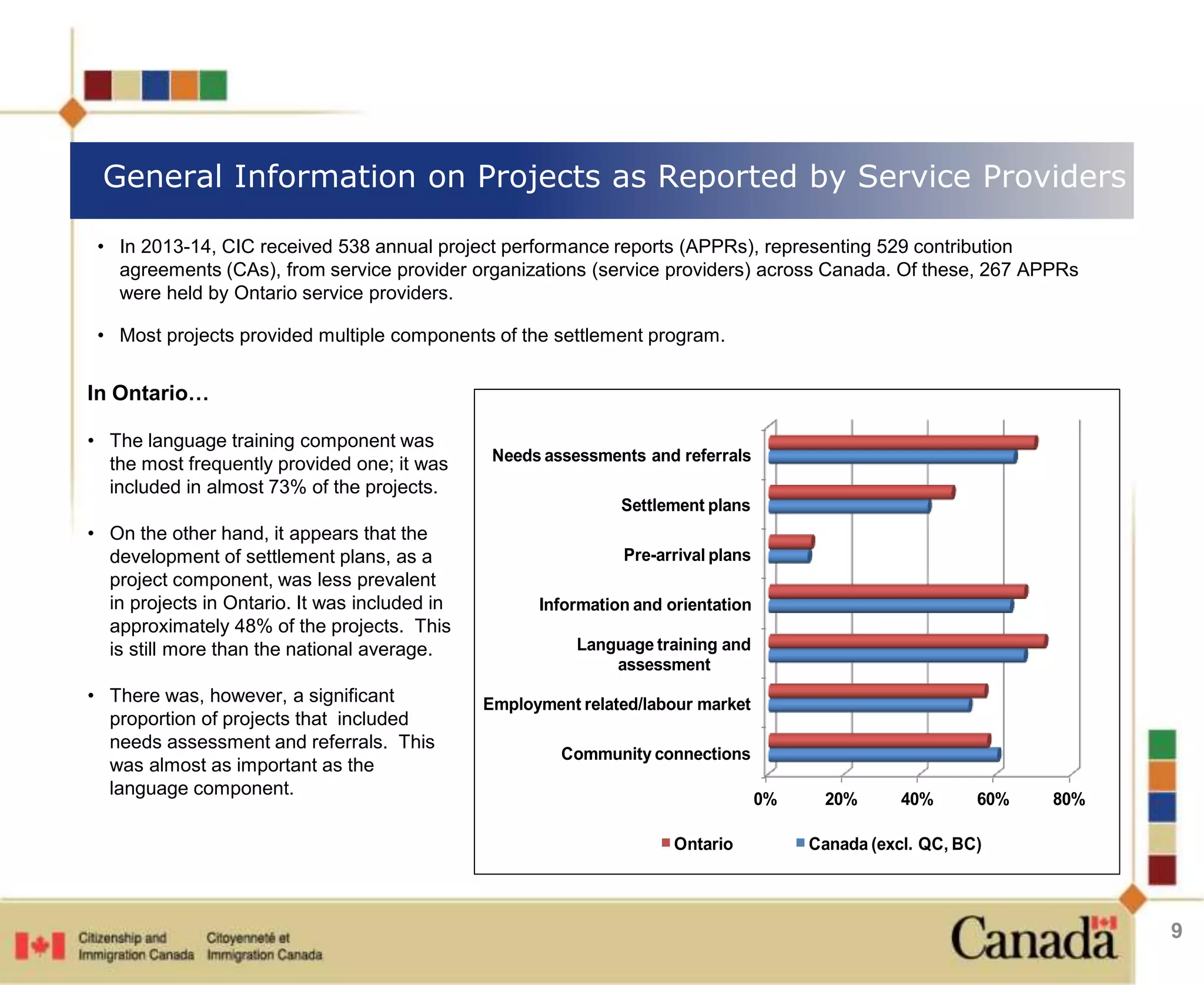
• In 2013-14, CIC received 538 annual project performance reports (APPRs), representing 529 contribution 
agreements (CAs), from service provider organizations (service providers) across Canada. Of these, 267 APPRs 
were held by Ontario service providers. 
• Most projects provided multiple components of the settlement program. 
In Ontario… 
• The language training component was 
the most frequently provided one; it was 
included in almost 73% of the projects. 
• On the other hand, it appears that the 
development of settlement plans, as a 
project component, was less prevalent 
in projects in Ontario. It was included in 
approximately 48% of the projects. This 
is still more than the national average. 
• There was, however, a significant 
proportion of projects that included 
needs assessment and referrals. This 
was almost as important as the 
language component. 
0% 20% 40% 60% 80% 
Needs assessments and referrals 
Settlement plans 
Pre-arrival plans 
Information and orientation 
Language training and 
assessment 
Employment related/labour market 
Community connections 
Ontario Canada (excl. QC, BC)
Partnerships 
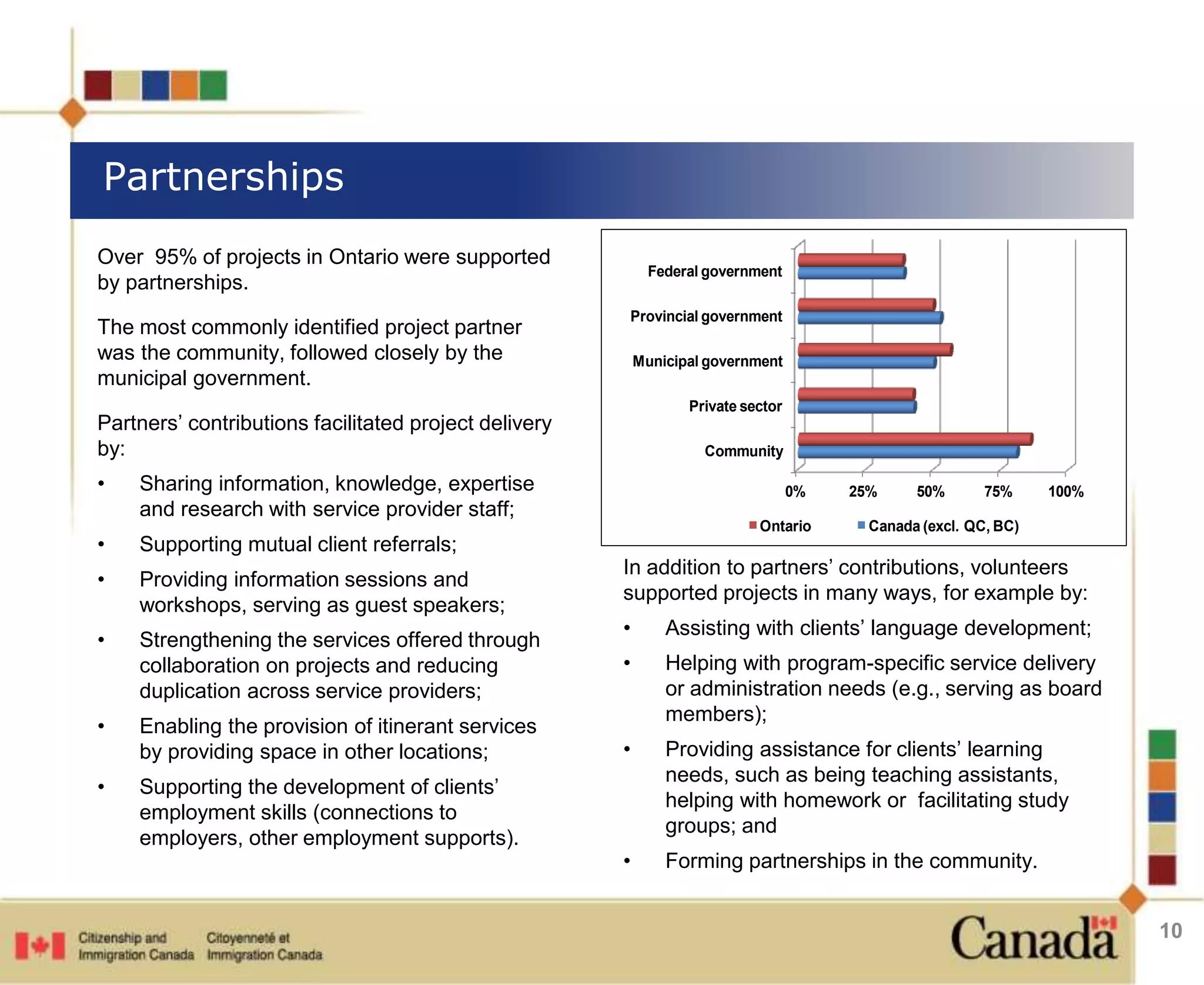
Over 95% of projects in Ontario were supported 
by partnerships. 
The most commonly identified project partner 
was the community, followed closely by the 
municipal government. 
Partners’ contributions facilitated project delivery 
by: 
• Sharing information, knowledge, expertise 
and research with service provider staff; 
• Supporting mutual client referrals; 
• Providing information sessions and 
workshops, serving as guest speakers; 
• Strengthening the services offered through 
collaboration on projects and reducing 
duplication across service providers; 
• Enabling the provision of itinerant services 
by providing space in other locations; 
• Supporting the development of clients’ 
employment skills (connections to 
employers, other employment supports). 
10 
0% 25% 50% 75% 100% 
Federal government 
Provincial government 
Municipal government 
Private sector 
Community 
Ontario Canada (excl. QC, BC) 
In addition to partners’ contributions, volunteers 
supported projects in many ways, for example by: 
• Assisting with clients’ language development; 
• Helping with program-specific service delivery 
or administration needs (e.g., serving as board 
members); 
• Providing assistance for clients’ learning 
needs, such as being teaching assistants, 
helping with homework or facilitating study 
groups; and 
• Forming partnerships in the community.
Enabling Factors and Promising Practices 
11 
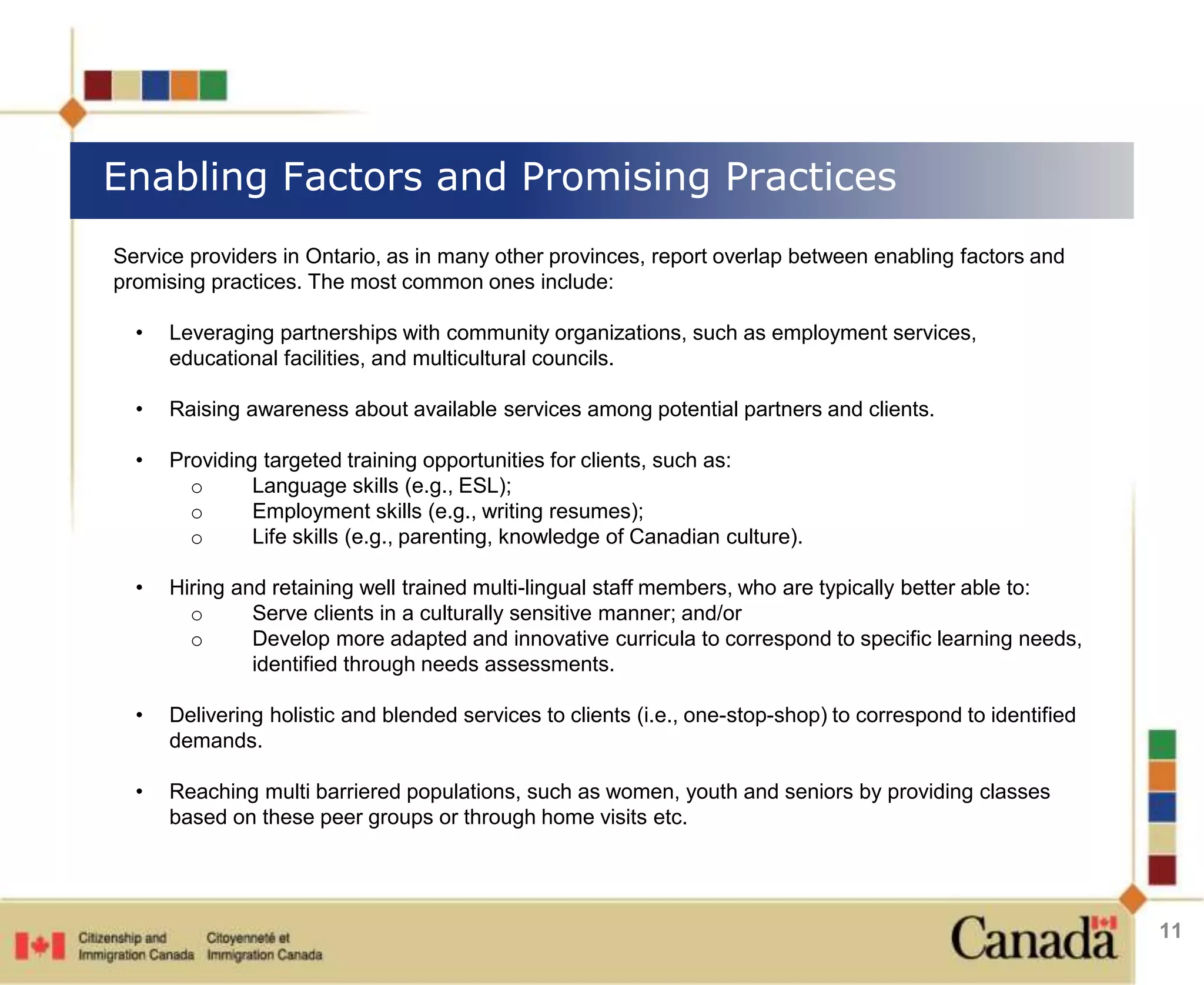
Service providers in Ontario, as in many other provinces, report overlap between enabling factors and 
promising practices. The most common ones include: 
• Leveraging partnerships with community organizations, such as employment services, 
educational facilities, and multicultural councils. 
• Raising awareness about available services among potential partners and clients. 
• Providing targeted training opportunities for clients, such as: 
o Language skills (e.g., ESL); 
o Employment skills (e.g., writing resumes); 
o Life skills (e.g., parenting, knowledge of Canadian culture). 
• Hiring and retaining well trained multi-lingual staff members, who are typically better able to: 
o Serve clients in a culturally sensitive manner; and/or 
o Develop more adapted and innovative curricula to correspond to specific learning needs, 
identified through needs assessments. 
• Delivering holistic and blended services to clients (i.e., one-stop-shop) to correspond to identified 
demands. 
• Reaching multi barriered populations, such as women, youth and seniors by providing classes 
based on these peer groups or through home visits etc.
Clients Needs 
12 
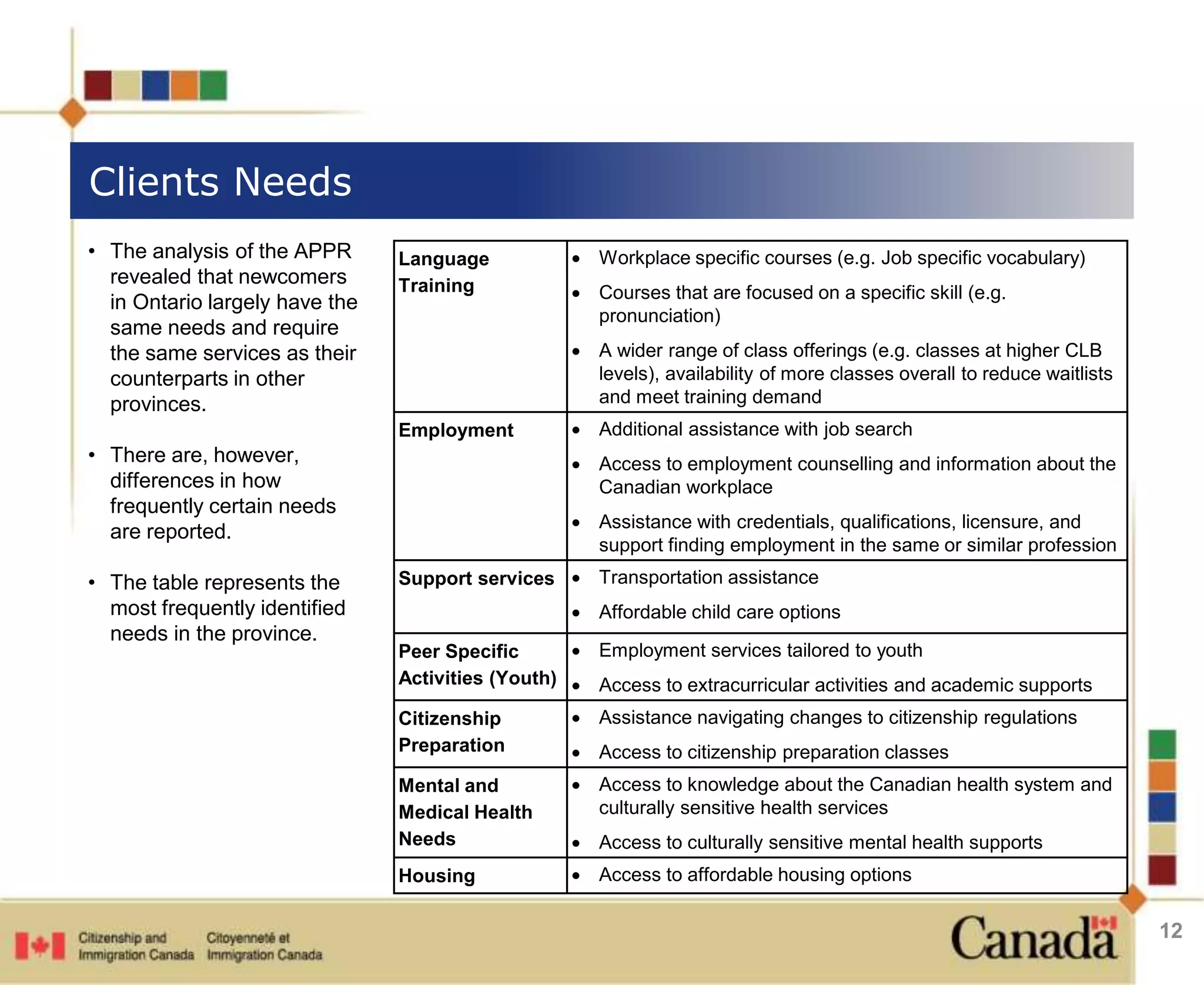
• The analysis of the APPR 
revealed that newcomers 
in Ontario largely have the 
same needs and require 
the same services as their 
counterparts in other 
provinces. 
• There are, however, 
differences in how 
frequently certain needs 
are reported. 
• The table represents the 
most frequently identified 
needs in the province. 
Language 
Training 
 Workplace specific courses (e.g. Job specific vocabulary) 
 Courses that are focused on a specific skill (e.g. 
pronunciation) 
 A wider range of class offerings (e.g. classes at higher CLB 
levels), availability of more classes overall to reduce waitlists 
and meet training demand 
Employment  Additional assistance with job search 
 Access to employment counselling and information about the 
Canadian workplace 
 Assistance with credentials, qualifications, licensure, and 
support finding employment in the same or similar profession 
Support services  Transportation assistance 
 Affordable child care options 
Peer Specific 
Activities (Youth) 
 Employment services tailored to youth 
 Access to extracurricular activities and academic supports 
Citizenship 
Preparation 
 Assistance navigating changes to citizenship regulations 
 Access to citizenship preparation classes 
Mental and 
Medical Health 
Needs 
 Access to knowledge about the Canadian health system and 
culturally sensitive health services 
 Access to culturally sensitive mental health supports 
Housing  Access to affordable housing options
Settlement in Canada 
• A Working Vision 
– Strategic Approach to Settlement 
– Focus on the future 
13
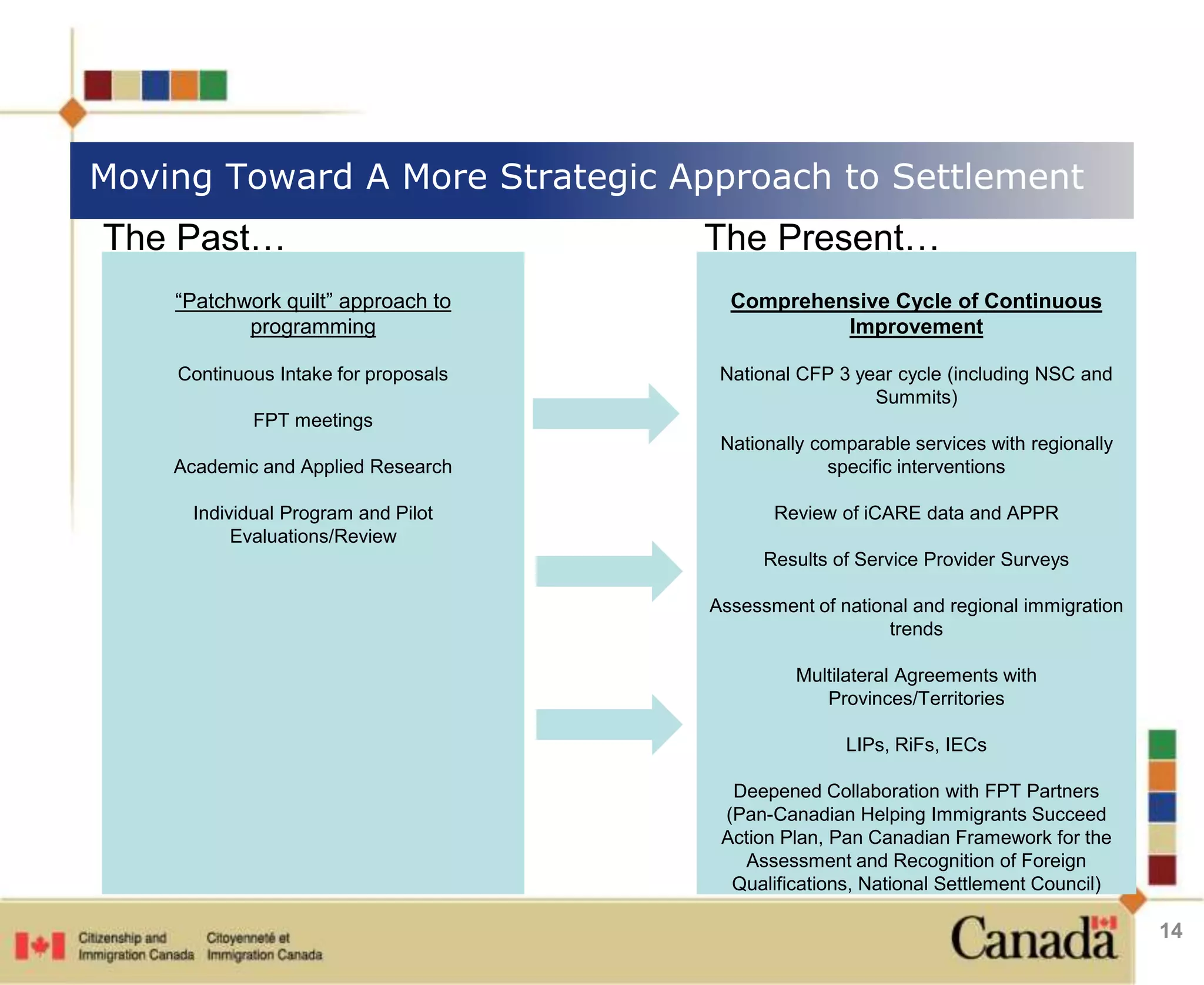
Moving Toward A More Strategic Approach to Settlement 
The Past… The Present… 
14 
“Patchwork quilt” approach to 
programming 
Continuous Intake for proposals 
FPT meetings 
Academic and Applied Research 
Individual Program and Pilot 
Evaluations/Review 
Comprehensive Cycle of Continuous 
Improvement 
National CFP 3 year cycle (including NSC and 
Summits) 
Nationally comparable services with regionally 
specific interventions 
Review of iCARE data and APPR 
Results of Service Provider Surveys 
Assessment of national and regional immigration 
trends 
Multilateral Agreements with 
Provinces/Territories 
LIPs, RiFs, IECs 
Deepened Collaboration with FPT Partners 
(Pan-Canadian Helping Immigrants Succeed 
Action Plan, Pan Canadian Framework for the 
Assessment and Recognition of Foreign 
Qualifications, National Settlement Council)
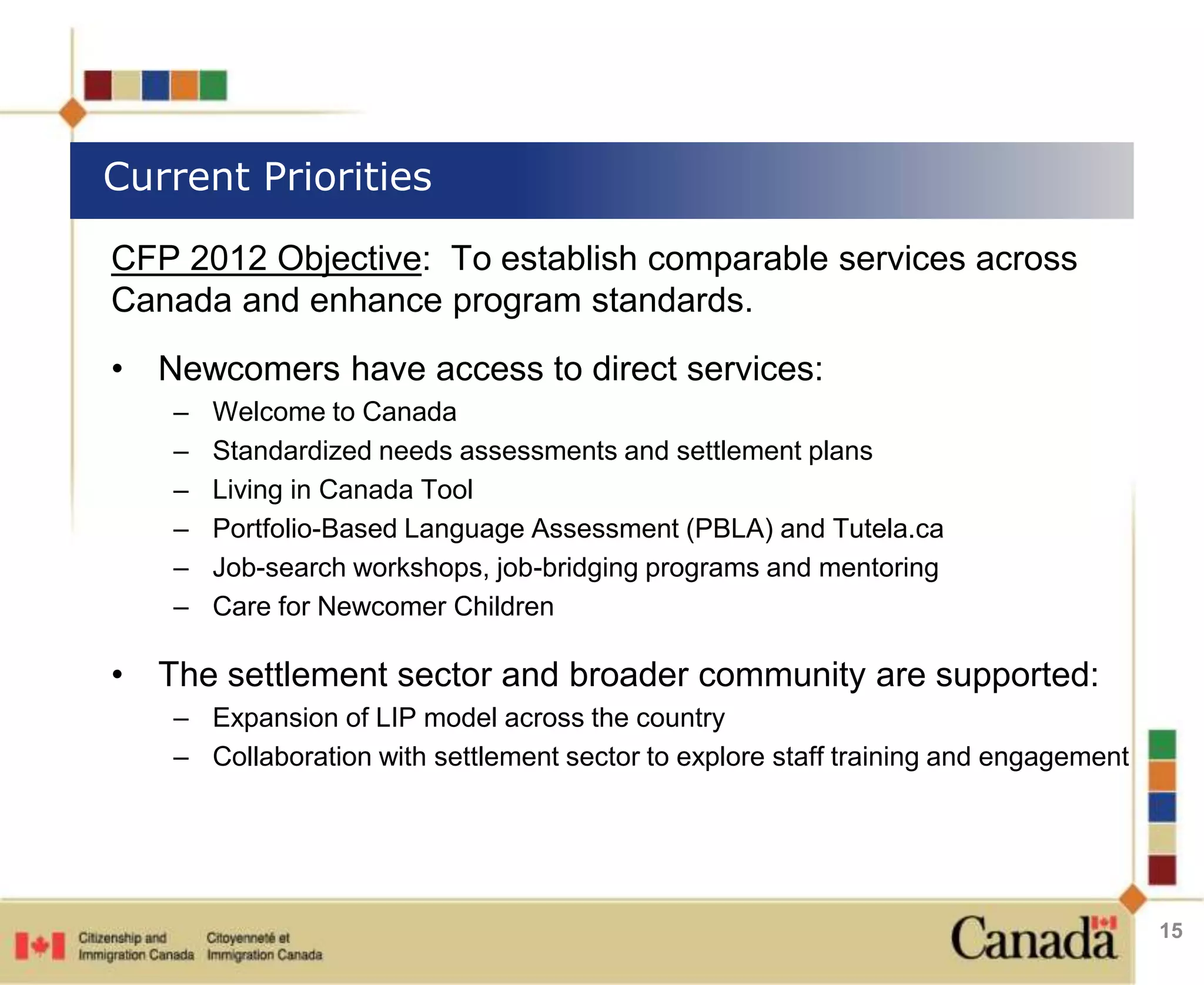
Current Priorities 
CFP 2012 Objective: To establish comparable services across 
Canada and enhance program standards. 
• Newcomers have access to direct services: 
– Welcome to Canada 
– Standardized needs assessments and settlement plans 
– Living in Canada Tool 
– Portfolio-Based Language Assessment (PBLA) and Tutela.ca 
– Job-search workshops, job-bridging programs and mentoring 
– Care for Newcomer Children 
• The settlement sector and broader community are supported: 
– Expansion of LIP model across the country 
– Collaboration with settlement sector to explore staff training and engagement 
15
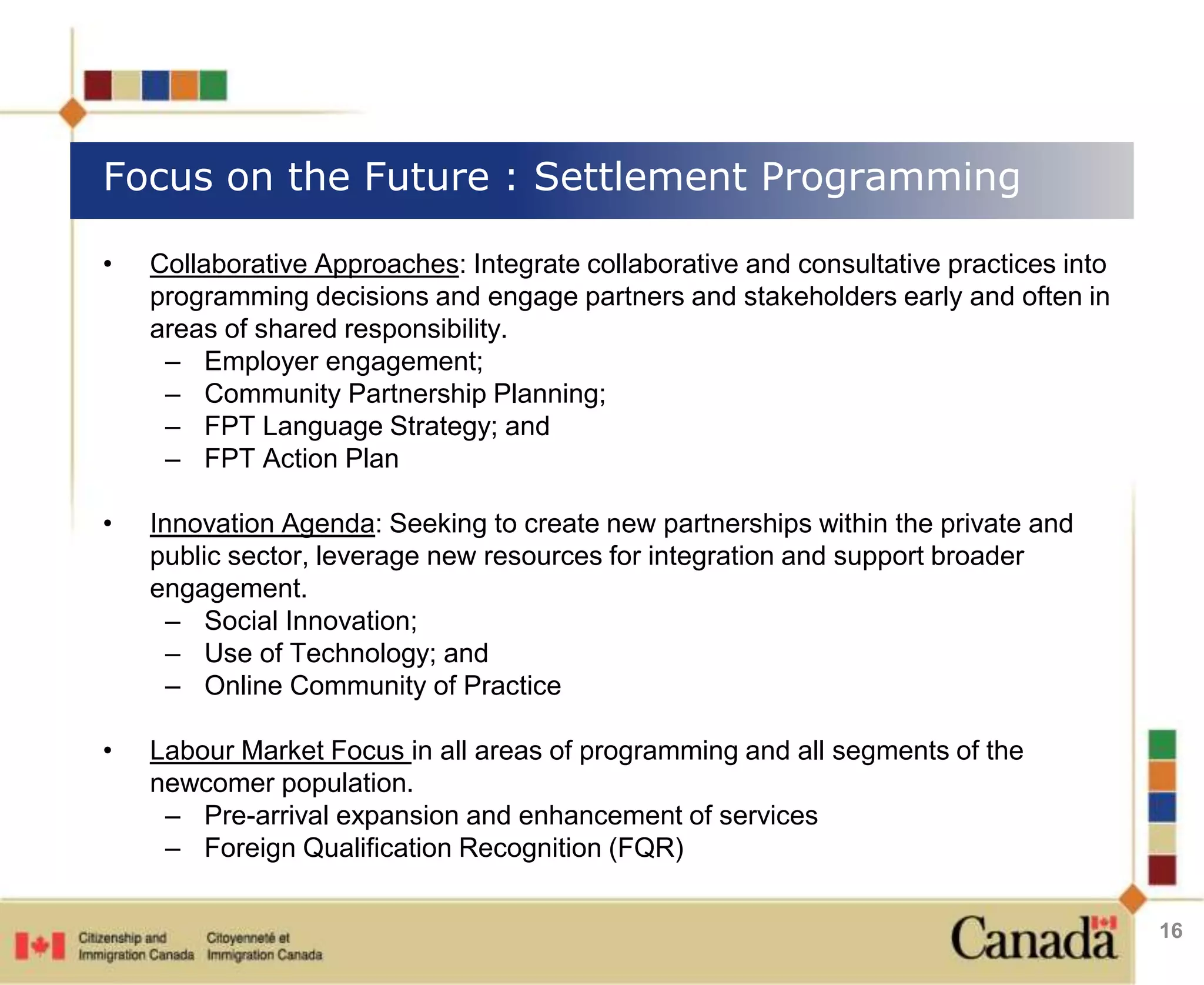
Focus on the Future : Settlement Programming 
• Collaborative Approaches: Integrate collaborative and consultative practices into 
programming decisions and engage partners and stakeholders early and often in 
areas of shared responsibility. 
– Employer engagement; 
– Community Partnership Planning; 
– FPT Language Strategy; and 
– FPT Action Plan 
• Innovation Agenda: Seeking to create new partnerships within the private and 
public sector, leverage new resources for integration and support broader 
engagement. 
– Social Innovation; 
– Use of Technology; and 
– Online Community of Practice 
• Labour Market Focus in all areas of programming and all segments of the 
newcomer population. 
– Pre-arrival expansion and enhancement of services 
– Foreign Qualification Recognition (FQR) 
16
Next Steps for Summit 
• Your engagement at this summit, and your willingness to share your 
experience and insight is vital to our understanding of the unique 
context of the settlement community in Ontario. 
• The results of these next few days will give us a deeper awareness of 
the gaps and needs of newcomers, as well as the challenges that you 
face in delivering settlement services. 
• We will also gain knowledge about opportunities and best practices, 
which will inform and influence our priority setting for the national Call 
for Proposals (CFP) along with our overall policy development for 
settlement and integration. 
17

Cic settlement summit presentation o nv8-day 2-no notes

  • 1.
    CIC Presentation for OCASI Provincial Summit: Settlement Programs in Ontario
  • 2.
    Presentation Outline Introduction • Settlement Priority Setting Cycle • What We Hope to Achieve From The Summits • The Four Pillars of Integration Settlement Services in Ontario • Settlement Services: Who is using them? • Trends In Usage And Funding • Results From Annual Project Performance Report (APPR) National Perspective • A Strategic Approach to Settlement Programming • Looking Forward • Next Steps 2
  • 3.
    Priority Setting Cycle • In order to make better informed decisions regarding priorities, CIC is using both existing and new means of information gathering. • Summits are a brand new means to consult with established and new stakeholders; increase our knowledge and understanding of the needs and challenges in providing settlement services; and inform priority setting for the future. • The input you provide during this summit will create part of the evidence base for our upcoming national Call for Proposals (CFP) priority setting, as well as future policy development. • Summits fit within a large, regular 5-year planning cycle associated with the CFP. 3
  • 4.
    Consultations on Needs Engage key stakeholders to discuss local, jurisdictional and national needs and gaps Establish national and regional plans and priorities (CIC) National Call for Proposals (CFP) and assessment Evidence Gathering Collect and analyze data on landings, uptake of services and progress towards Deliver program and report on activities, outputs and outcomes outcomes Priority Setting Implementation Funding Guidance Ongoing Ongoing Year 2 (2014) Year 2 (2014) Year 3 (2015) New Priority-Setting Cycle 4
  • 5.
    The Four Pillarsof Integration CIC has four pillars to Integration, which are the lenses by which we organize our work: • Creating a welcoming society; • Language needs of new immigrants; • Labour market participation; and • Other core settlement services. 5
  • 6.
    Ontario at aglance 6 • In 2005, the number of permanent residents in Ontario reached a peak of 140,526. • Preliminary figures for 2013 show a modest increase in the number of permanent residents (103,550 ), as compared to 2012 (99,150). The 2013 figures represent less than 75% of the 2005 figure. Permanent Residents by Category Number of Permanent Residents in Ontario On the funding side… • Funding is tied to the number of landings in the Province. For 2014-15, the level of federal funding for settlement services in Ontario is $295.6M. 2012 2013 Number % Number % Family class 31,970 32.2% 39,180 37.8% Economic immigrants 49,180 49.6% 47,625 46.0% Refugees (includes GARs) 12,595 12.7% 12,770 12.3% Other immigrants 5,400 5.4% 3,975 3.8% Total 99,150 100.0% 103,550 100.0% Government-Assisted Refugees 1,955 N/A 2,190 N/A 2005 140,526 2006 125,891 2007 111,316 2008 110,877 2009 106,860 2010 118,110 2011 99,459 2012 99,150 2013 103,550
  • 7.
    Trends in theusage of Federal Settlement Services – 2005-06 to 2012-13 7 160,000 150,000 140,000 130,000 120,000 110,000 100,000 90,000 80,000 70,000 60,000 50,000 40,000 30,000 20,000 10,000 0 Ontario - Summary of Usage of Settlement services (2005-06 to 2012-13) Any Services 43.9% Increase Info & Orientation 103.6% Increase Language Training 2.3% Increase Language Assessment 11.2% Increase 2005-06 2006-07 2007-08 2008-09 2009-10 2010-11 2011-12 2012-13 Number of Unique Clients • More than150,000 clients used at least one settlement service during 2012-13. • In 2012-13, the services usage in Ontario was almost 1.5 times the usage in 2005-06.
  • 8.
    Usage of SettlementServices 8 Data for 2013-14 – iCARE is very new and 2013-14 is a transition year. Some iCARE modules were launched at the end of the fiscal year so it is difficult to get aggregate data for all services by province. – To preserve the integrity of the data, we are presenting the 2012-13 figures and the 2013-14 iCARE figures that are complete at this time. Starting in 2014-15, we will be able to present the analysis by province. Type of services Usage of Settlement Services (outside Quebec, Manitoba and British-Columbia) Ontario Unique clients used at least one settlement service 205,869 44.6% from economic class 26.1% from the family class 22.0% were refugees 150,564 40.8% from the economic class 29.4% from the family class 21.7% were refugees Unique clients were enrolled in language training 59,388 38.3% from the economic class 34.2% from the family class 23.8% were refugees 43,547 36.3% from the economic class 36.9% from the family class 22.7% were refugees Unique clients received information and orientation services 147,897 44.3% from the economic class 23.7% from the family class 23.7% were refugees 110,171 40.1% from the economic class 27.6% from the family class 23.1 were refugees 2012-2013 What is available for 2013-14 – In 2013-14, across the country (outside Quebec and BC) more than 260,000 permanent residents used at least one settlement service. Usage of Settlement Services Number of Unique Clients Number of Services Number of clients who used support services Needs Assessment and Referrals 90,405 119,497 30,569 Language Assessement 41,060 41,018 N/A Language Training 50,275 75,969 N/A Information and Orientation Services 124,715 339,009 36,641 Employment-Related Services - Total Count 11,962 37,671 1,408
  • 9.
    General Information onProjects as Reported by Service Providers 9 • In 2013-14, CIC received 538 annual project performance reports (APPRs), representing 529 contribution agreements (CAs), from service provider organizations (service providers) across Canada. Of these, 267 APPRs were held by Ontario service providers. • Most projects provided multiple components of the settlement program. In Ontario… • The language training component was the most frequently provided one; it was included in almost 73% of the projects. • On the other hand, it appears that the development of settlement plans, as a project component, was less prevalent in projects in Ontario. It was included in approximately 48% of the projects. This is still more than the national average. • There was, however, a significant proportion of projects that included needs assessment and referrals. This was almost as important as the language component. 0% 20% 40% 60% 80% Needs assessments and referrals Settlement plans Pre-arrival plans Information and orientation Language training and assessment Employment related/labour market Community connections Ontario Canada (excl. QC, BC)
  • 10.
    Partnerships Over 95%of projects in Ontario were supported by partnerships. The most commonly identified project partner was the community, followed closely by the municipal government. Partners’ contributions facilitated project delivery by: • Sharing information, knowledge, expertise and research with service provider staff; • Supporting mutual client referrals; • Providing information sessions and workshops, serving as guest speakers; • Strengthening the services offered through collaboration on projects and reducing duplication across service providers; • Enabling the provision of itinerant services by providing space in other locations; • Supporting the development of clients’ employment skills (connections to employers, other employment supports). 10 0% 25% 50% 75% 100% Federal government Provincial government Municipal government Private sector Community Ontario Canada (excl. QC, BC) In addition to partners’ contributions, volunteers supported projects in many ways, for example by: • Assisting with clients’ language development; • Helping with program-specific service delivery or administration needs (e.g., serving as board members); • Providing assistance for clients’ learning needs, such as being teaching assistants, helping with homework or facilitating study groups; and • Forming partnerships in the community.
  • 11.
    Enabling Factors andPromising Practices 11 Service providers in Ontario, as in many other provinces, report overlap between enabling factors and promising practices. The most common ones include: • Leveraging partnerships with community organizations, such as employment services, educational facilities, and multicultural councils. • Raising awareness about available services among potential partners and clients. • Providing targeted training opportunities for clients, such as: o Language skills (e.g., ESL); o Employment skills (e.g., writing resumes); o Life skills (e.g., parenting, knowledge of Canadian culture). • Hiring and retaining well trained multi-lingual staff members, who are typically better able to: o Serve clients in a culturally sensitive manner; and/or o Develop more adapted and innovative curricula to correspond to specific learning needs, identified through needs assessments. • Delivering holistic and blended services to clients (i.e., one-stop-shop) to correspond to identified demands. • Reaching multi barriered populations, such as women, youth and seniors by providing classes based on these peer groups or through home visits etc.
  • 12.
    Clients Needs 12 • The analysis of the APPR revealed that newcomers in Ontario largely have the same needs and require the same services as their counterparts in other provinces. • There are, however, differences in how frequently certain needs are reported. • The table represents the most frequently identified needs in the province. Language Training  Workplace specific courses (e.g. Job specific vocabulary)  Courses that are focused on a specific skill (e.g. pronunciation)  A wider range of class offerings (e.g. classes at higher CLB levels), availability of more classes overall to reduce waitlists and meet training demand Employment  Additional assistance with job search  Access to employment counselling and information about the Canadian workplace  Assistance with credentials, qualifications, licensure, and support finding employment in the same or similar profession Support services  Transportation assistance  Affordable child care options Peer Specific Activities (Youth)  Employment services tailored to youth  Access to extracurricular activities and academic supports Citizenship Preparation  Assistance navigating changes to citizenship regulations  Access to citizenship preparation classes Mental and Medical Health Needs  Access to knowledge about the Canadian health system and culturally sensitive health services  Access to culturally sensitive mental health supports Housing  Access to affordable housing options
  • 13.
    Settlement in Canada • A Working Vision – Strategic Approach to Settlement – Focus on the future 13
  • 14.
    Moving Toward AMore Strategic Approach to Settlement The Past… The Present… 14 “Patchwork quilt” approach to programming Continuous Intake for proposals FPT meetings Academic and Applied Research Individual Program and Pilot Evaluations/Review Comprehensive Cycle of Continuous Improvement National CFP 3 year cycle (including NSC and Summits) Nationally comparable services with regionally specific interventions Review of iCARE data and APPR Results of Service Provider Surveys Assessment of national and regional immigration trends Multilateral Agreements with Provinces/Territories LIPs, RiFs, IECs Deepened Collaboration with FPT Partners (Pan-Canadian Helping Immigrants Succeed Action Plan, Pan Canadian Framework for the Assessment and Recognition of Foreign Qualifications, National Settlement Council)
  • 15.
    Current Priorities CFP2012 Objective: To establish comparable services across Canada and enhance program standards. • Newcomers have access to direct services: – Welcome to Canada – Standardized needs assessments and settlement plans – Living in Canada Tool – Portfolio-Based Language Assessment (PBLA) and Tutela.ca – Job-search workshops, job-bridging programs and mentoring – Care for Newcomer Children • The settlement sector and broader community are supported: – Expansion of LIP model across the country – Collaboration with settlement sector to explore staff training and engagement 15
  • 16.
    Focus on theFuture : Settlement Programming • Collaborative Approaches: Integrate collaborative and consultative practices into programming decisions and engage partners and stakeholders early and often in areas of shared responsibility. – Employer engagement; – Community Partnership Planning; – FPT Language Strategy; and – FPT Action Plan • Innovation Agenda: Seeking to create new partnerships within the private and public sector, leverage new resources for integration and support broader engagement. – Social Innovation; – Use of Technology; and – Online Community of Practice • Labour Market Focus in all areas of programming and all segments of the newcomer population. – Pre-arrival expansion and enhancement of services – Foreign Qualification Recognition (FQR) 16
  • 17.
    Next Steps forSummit • Your engagement at this summit, and your willingness to share your experience and insight is vital to our understanding of the unique context of the settlement community in Ontario. • The results of these next few days will give us a deeper awareness of the gaps and needs of newcomers, as well as the challenges that you face in delivering settlement services. • We will also gain knowledge about opportunities and best practices, which will inform and influence our priority setting for the national Call for Proposals (CFP) along with our overall policy development for settlement and integration. 17