Media, Multimedia
& Digital Media
B i C tBasic Concepts
Today’s Media
Messages aimed at mass audiences can beMessages aimed at mass audiences can be
delivered in many different forms. Here are
just a few forms of media seen today:
Print (books, newspapers, magazines, etc.)
Billb d b tBillboards, banners, posters
Direct mail
Electronic (radio television computer)Electronic (radio, television, computer)
Social media
What is ‘Media’
Carrying a Messagey g g
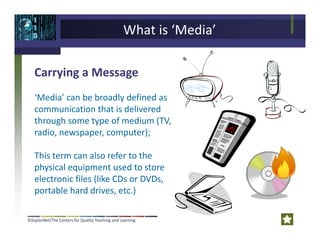
‘Media’ can be broadly defined as
communication that is deliveredcommunication that is delivered
through some type of medium (TV,
radio, newspaper, computer);
This term can also refer to the
physical equipment used to storephysical equipment used to store
electronic files (like CDs or DVDs,
portable hard drives, etc.)
The Evolution of Media
The Birth of Media
Some track the use of media all
the way to cave drawingsthe way to cave drawings.
But the birth of mass media is
generally placed with Johannes
Gutenberg’s invention of the
movable type printing press inmovable type printing press in
the mid-1400s.
The Evolution of Media
Early Evolutiony
By the early 1600s, the first
newspapers began to appear innewspapers began to appear in
Europe.
Printed media was enormously
important during the centuries
that followed. For instance,that followed. For instance,
Colonial publications played a
huge role in bringing about the
American RevolutionAmerican Revolution.
The Evolution of Media
The 20th Centuryy
The next major advance came during the
early 20th Century when radio brought theearly 20th Century, when radio brought the
spoken word to the masses.
By mid century television added pictures toBy mid-century, television added pictures to
the mix, and the mass media was
transformed.
By century’s end, cable TV brought hundreds
of channels into homes, making information
i l il blinstantly available.
The Evolution of Media
The 21st Centuryy
The last decade of the 20th Century and the
first decade of the 21st produced anotherfirst decade of the 21st produced another
transformation in the way we communicate.
The advent and increased public use of theThe advent and increased public use of the
Internet made all sorts of information
available on-demand.
During the 2000s, Web 2.0 and digital tools
have made communication ubiquitous – it’s
available almost anywhere, almost any time.
What is ‘Media’
‘Media’ is the plural form of ‘medium’ – meaning a
h l fchannel of communication to carry a message to a
mass audience or targeted group.
Let’s look at three types:
Traditional Media
yp
Multimedia
Digital Media
Types of Media
Traditional or “Old” Media
Traditional media is a term often used to
refer to channels of communication that
ll t bli h d b f th I t twere well-established before the Internet
Age, such as:
BooksBooks
Newspapers
Magazinesg
Radio
Television
Types of Media
Multimedia
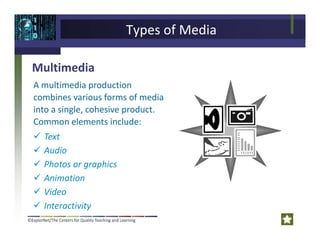
A multimedia production
combines various forms of media
i t i l h i d tinto a single, cohesive product.
Common elements include:
TextText
Audio
Photos or graphics
Animation
Video
Interactivity
Types of Media
Multimedia
The term ‘multimedia’ was first
used in the 1960s.
By the mid-90s, computers that
included CD-ROM drives were
being referred to as ‘multimediabeing referred to as multimedia
computers.’
Rapid development of betterRapid development of better
technology during the 90s and
2000s made multimedia titles
d i imore and more interactive.
Types of Media
Multimedia
Multimedia has numerous
applications in the modern world,
i l diincluding:
Presentations
C t b d t i iComputer-based training
courses
Computer gamesComputer games
Virtual Reality applications
What others can o name?What others can you name?
Different Types of Media
i i l diDigital Media
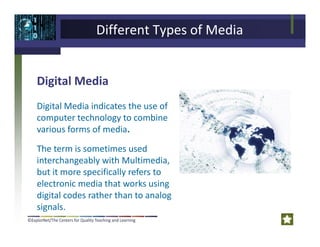
Digital Media indicates the use ofDigital Media indicates the use of
computer technology to combine
various forms of media.
The term is sometimes used
interchangeably with Multimedia,
b t it ifi ll f tbut it more specifically refers to
electronic media that works using
digital codes rather than to analog
signals.
Types of Media
Digital MediaDigital Media
Digital Media is electronic
di th t k i di it lmedia that works using digital
codes to create digital audio,
digital video or other digitalg g
content.
This is in contrast to analog
media, older technology
which uses a continuous
signalsignal.
Types of Media
Digital Media
Digital Media can be used to
produce a variety of end products,
i l diincluding:
Presentations
T t i lTutorials
Simulations
GamesGames
Web pages
h h ?What others can you name?
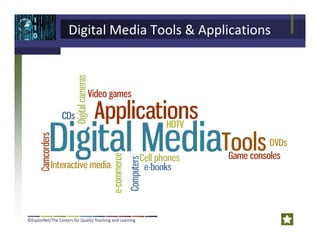
Digital Media Tools & Applications
About This Course
Digital Mediag ta ed a
This course will cover five major
elements of digital media:elements of digital media:
Audio
Video
Graphics
A i tiAnimation
Web Design

Media, Multimedia & Digital Media

  • 1.
    Media, Multimedia & DigitalMedia B i C tBasic Concepts
  • 2.
    Today’s Media Messages aimedat mass audiences can beMessages aimed at mass audiences can be delivered in many different forms. Here are just a few forms of media seen today: Print (books, newspapers, magazines, etc.) Billb d b tBillboards, banners, posters Direct mail Electronic (radio television computer)Electronic (radio, television, computer) Social media
  • 3.
    What is ‘Media’ Carryinga Messagey g g ‘Media’ can be broadly defined as communication that is deliveredcommunication that is delivered through some type of medium (TV, radio, newspaper, computer); This term can also refer to the physical equipment used to storephysical equipment used to store electronic files (like CDs or DVDs, portable hard drives, etc.)
  • 4.
    The Evolution ofMedia The Birth of Media Some track the use of media all the way to cave drawingsthe way to cave drawings. But the birth of mass media is generally placed with Johannes Gutenberg’s invention of the movable type printing press inmovable type printing press in the mid-1400s.
  • 5.
    The Evolution ofMedia Early Evolutiony By the early 1600s, the first newspapers began to appear innewspapers began to appear in Europe. Printed media was enormously important during the centuries that followed. For instance,that followed. For instance, Colonial publications played a huge role in bringing about the American RevolutionAmerican Revolution.
  • 6.
    The Evolution ofMedia The 20th Centuryy The next major advance came during the early 20th Century when radio brought theearly 20th Century, when radio brought the spoken word to the masses. By mid century television added pictures toBy mid-century, television added pictures to the mix, and the mass media was transformed. By century’s end, cable TV brought hundreds of channels into homes, making information i l il blinstantly available.
  • 7.
    The Evolution ofMedia The 21st Centuryy The last decade of the 20th Century and the first decade of the 21st produced anotherfirst decade of the 21st produced another transformation in the way we communicate. The advent and increased public use of theThe advent and increased public use of the Internet made all sorts of information available on-demand. During the 2000s, Web 2.0 and digital tools have made communication ubiquitous – it’s available almost anywhere, almost any time.
  • 8.
    What is ‘Media’ ‘Media’is the plural form of ‘medium’ – meaning a h l fchannel of communication to carry a message to a mass audience or targeted group. Let’s look at three types: Traditional Media yp Multimedia Digital Media
  • 9.
    Types of Media Traditionalor “Old” Media Traditional media is a term often used to refer to channels of communication that ll t bli h d b f th I t twere well-established before the Internet Age, such as: BooksBooks Newspapers Magazinesg Radio Television
  • 10.
    Types of Media Multimedia Amultimedia production combines various forms of media i t i l h i d tinto a single, cohesive product. Common elements include: TextText Audio Photos or graphics Animation Video Interactivity
  • 11.
    Types of Media Multimedia Theterm ‘multimedia’ was first used in the 1960s. By the mid-90s, computers that included CD-ROM drives were being referred to as ‘multimediabeing referred to as multimedia computers.’ Rapid development of betterRapid development of better technology during the 90s and 2000s made multimedia titles d i imore and more interactive.
  • 12.
    Types of Media Multimedia Multimediahas numerous applications in the modern world, i l diincluding: Presentations C t b d t i iComputer-based training courses Computer gamesComputer games Virtual Reality applications What others can o name?What others can you name?
  • 13.
    Different Types ofMedia i i l diDigital Media Digital Media indicates the use ofDigital Media indicates the use of computer technology to combine various forms of media. The term is sometimes used interchangeably with Multimedia, b t it ifi ll f tbut it more specifically refers to electronic media that works using digital codes rather than to analog signals.
  • 14.
    Types of Media DigitalMediaDigital Media Digital Media is electronic di th t k i di it lmedia that works using digital codes to create digital audio, digital video or other digitalg g content. This is in contrast to analog media, older technology which uses a continuous signalsignal.
  • 15.
    Types of Media DigitalMedia Digital Media can be used to produce a variety of end products, i l diincluding: Presentations T t i lTutorials Simulations GamesGames Web pages h h ?What others can you name?
  • 16.
    Digital Media Tools& Applications
  • 17.
    About This Course DigitalMediag ta ed a This course will cover five major elements of digital media:elements of digital media: Audio Video Graphics A i tiAnimation Web Design