‘THE CART BEFORE THE HORSE’ SYNDROME
- How legacy EEMSPs negatively impact EECPs at Mines -
Presenter: Bernard Gittins
Electrical Engineering Safety Seminar: 2018
ABOUT THE PRESENTER
A RETIRED INSPECTOR
OF ELECTRICAL
ENGINEERING AT
NSW MINES
With opinions which may or may
not represent the Department’s
position.
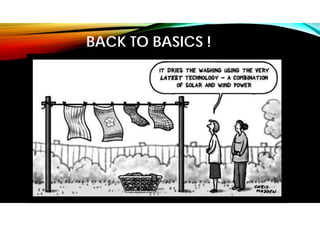
BACK TO BASICS !
BACKGROUND TO THIS PRESENTATION
EECPs assessed ranged in size:
from: a glossy published multi volumed document
to: a 4 page , double spaced, large font document
EECPs were variously written by:
- Mine Electrical Engineers
- Consultants who sometimes utilised a fairly generic plan across a number of sites
- Electrical contractors …. Who struggled somewhat
- To Quarry managers with no ‘formal’ electrical qualifications – (no polite description of quality available)
- last two examples come from a sample of small quarries
Consequently, the EECPs assessed ranged in quality:
from: plans solidly grounded in legislation with extensive risk based controls
to: “Really?”
But most EECPs were fairly good, although common ‘potential improvement areas’ were observed ….. Thus this
presentation.
Assessment of the EECPs at Metal Mines and large Quarries across NSW
2016-2018
SO WHAT DOSE A HIGH QUALITY EECP LOOK LIKE?
1. It complies with legislation
2. It identifies and controls the risk of the use of electricity at the mine utilising the HRC
& SFAIRP principles
3. It is accessible readily understandable for all the ‘stake holders’ – from Engineers
through to operators
Aside: EECP assessment interviews – electrician, welder & operator
• generally had a good understanding of electrical safety controls relevant to their work
• But also often were prepared to ignore those requirements
• Needs further investigation …. Human factors issues
SO WHAT DOES THE LEGISLATION SAY ABOUT EECPS ?
• WHS(MP)R Clause 26(5)(a)
The mine operator must:
‘prepare and implement an electrical engineering control plan for the mine or
petroleum site that sets out the means by which the operator will manage those risks in
accordance with clause 9’
This is where the ‘Back to basics ‘ principle come in ….
What is the risk? &
What are the controls?
Although when you start applying clause 9 of WHS(MP)R it becomes a little more
complex…
WHS(MP)R CLAUSE 9 (SUMMARISED)
1 Risks to be managed in accordance Part 3.1 of WHSR including:
• Duty to identify hazards
• Manage the risks
• Utilise Hierarch of Risk Control (HRC)
• Maintain the controls
• Review the control measures
2 Competent person to conduct the RA
3 Hazard, Likelihood, Severity
4 …. etc
5 …. etc
6 …. etc
7 RA record keeping
That is, it requires more than a basic BBRA.
Note:
The expression ‘So Far As Is Reasonably Practical’ (SFAIRP) does not appear
in Clause 9 but it does occur in the following Subdivision of the Regulation
IN THE OPINION OF THIS RETIRED INSPECTOR:
• EEMPs developed under the older legislations did not have the same rigor at the risk
assessment stage that is now becoming more common at mines.
• Indeed the older legislation even appeared to be less demanding:
‘A health and safety management system for an operation must provide:
• (a) the basis for the identification of hazards, and of the assessment of risks arising from
those hazards, by the operator of the operation, and
• (b) for the development of controls for those risks, and
• (c) for the reliable implementation of those controls.’
• The reality was that it was experience / mistakes & accidents which often provided the
impetus for the development of Safety Standards and Codes of Practice which in turn
formed the basis of many EEMPs at mines.
• Risk assessments were carried out, but the controls nominated largely consisted in
nominating a portion of standards
• The reality was, as an industry we were not developing effective risk assessments
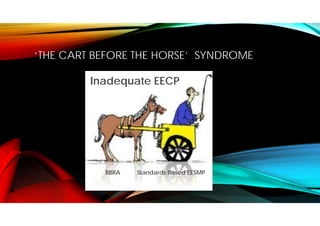
‘THE CART BEFORE THE HORSE’ SYNDROME
BBRA Standards Based EESMP
Inadequate EECP
THE LIMITATION OF UTILISING ENGINEERING
STANDARDS & COPS TO DEVELOP EESMPS
1. Do not necessarily apply the HRC
2. Do not necessarily apply SFAIRP
3. Sometimes just get it wrong
Note:
One Australian Standard that clearly applies systematic RA, the HRCs & SFAIRP principles
is the HV Standard AS2067:2016 ….
In my opinion, they got it right 
THE LIMITATION OF ENGINEERING STANDARDS
1. Do not necessarily apply the HRC
2. Do not necessarily apply SFAIRP
3. Sometimes just get it wrong
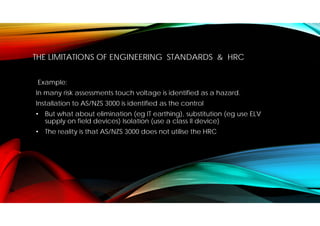
THE LIMITATIONS OF ENGINEERING STANDARDS & HRC
Example:
In many risk assessments touch voltage is identified as a hazard.
Installation to AS/NZS 3000 is identified as the control
• But what about elimination (eg IT earthing), substitution (eg use ELV
supply on field devices) Isolation (use a class II device)
• The reality is that AS/NZS 3000 does not utilise the HRC
THE LIMITATIONS OF ENGINEERING STANDARDS CNTD
Engineering standards:
1. Do not necessarily apply the HRC
2. Do not necessarily apply SFAIRP
3. Sometimes just get it wrong
THE LIMITATIONS OF ENGINEERING STANDARDS & SFAIRP
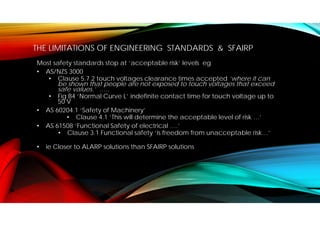
Most safety standards stop at ‘acceptable risk’ levels eg
• AS/NZS 3000
• Clause 5.7.2 touch voltages clearance times accepted ‘where it can
be shown that people are not exposed to touch voltages that exceed
safe values.’ …..
• Fig B4 ‘Normal Curve L’ indefinite contact time for touch voltage up to
50 V
• AS 60204.1 ‘Safety of Machinery’
• Clause 4.1 ’This will determine the acceptable level of risk …’
• AS 61508 ‘Functional Safety of electrical ….’
• Clause 3.1 Functional safety ‘is freedom from unacceptable risk…’
• ie Closer to ALARP solutions than SFAIRP solutions
THE LIMITATIONS OF ENGINEERING STANDARDS & SFAIRP CNTD
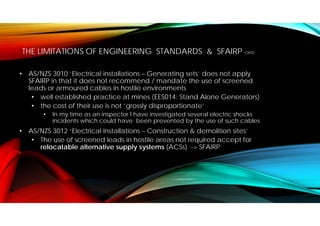
• AS/NZS 3010 ‘Electrical installations – Generating sets’ does not apply
SFAIRP in that it does not recommend / mandate the use of screened
leads or armoured cables in hostile environments
• well established practice at mines (EES014: Stand Alone Generators)
• the cost of their use is not ‘grossly disproportionate’
• In my time as an inspector I have investigated several electric shocks
incidents which could have been prevented by the use of such cables
• AS/NZS 3012 ‘Electrical Installations – Construction & demolition sites’
• The use of screened leads in hostile areas not required accept for
relocatable alternative supply systems (ACSs) -> SFAIRP
THE LIMITATION OF ENGINEERING STANDARDS CNTD
Engineering standards:
1. Do not necessarily apply the HRC
2. Do not necessarily apply SFAIRP
3. Sometimes just get it wrong (In my humble opinion)
STANDARDS SOMETIMES JUST GET IT WRONG
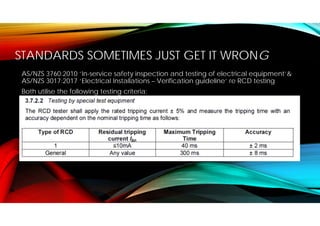
AS/NZS 3760:2010 ‘In-service safety inspection and testing of electrical equipment’&
AS/NZS 3017:2017 ‘Electrical Installations – Verification guideline’ re RCD testing
Both utilise the following testing criteria:
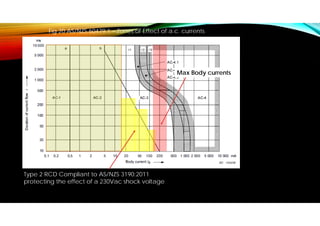
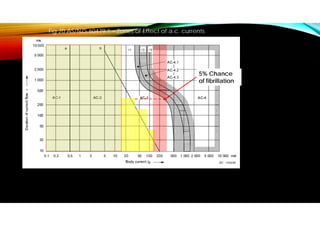
Fig 20 AS/NZS 60479.1 – Zones of Effect of a.c. currents
Type 2 RCD Compliant to AS/NZS 3190:2011
protecting the effect of a 230Vac shock voltage
Max Body currents
Fig 20 AS/NZS 60479.1 – Zones of Effect of a.c. currents
5% Chance
of fibrillation
5% Chance
of fibrillation
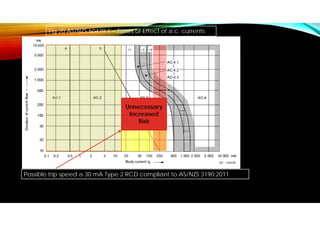
Permitted ‘Pass Level’
of AS/NZS 3017 & 3760
Unnecessary
Risk
Fig 20 AS/NZS 60479.1 – Zones of Effect of a.c. currents
Possible trip speed a 30 mA Type 2 RCD compliant to AS/NZS 3190:2011
Unnecessary
Increased
Risk
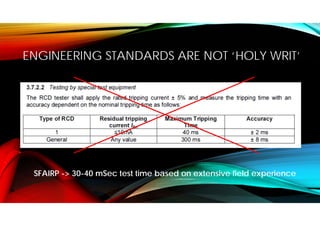
ENGINEERING STANDARDS ARE NOT ‘HOLY WRIT’
SFAIRP -> 30-40 mSec test time based on extensive field experience
THEREFORE
EECPs based primarily on legacy EESMPs with a prepended BRA….
1. May not adequately address risk identification and subsequent control
as specified in Legislation
2. Do not necessarily apply the HRC
3. Do not necessarily apply SFAIRP
4. Sometimes just get it wrong
This is my opinion based on many EECP assessments.
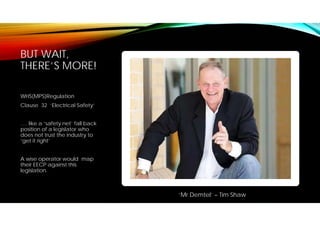
BUT WAIT,
THERE’S MORE!
WHS(MPS)Regulation
Clause 32 ‘Electrical Safety’
…. like a ‘safety net’ fall back
position of a legislator who
does not trust the industry to
‘get it right’
A wise operator would map
their EECP against this
legislation.
‘Mr Demtel’ – Tim Shaw
OTHER COMMON ISSUES
• LV Rescue kits?
• ‘live work’?
• time to death
• other controls higher in the HRC
• Use of powered hand-tools
• sometimes still the default expectation
• still being used in wet areas
• Use of AC welders
• more dangerous than DC welders
• Use of Isolated Power Supplies often poorly managed
• Particularly with isolated Generator and UPS sources
RECAP
From my assessment of many EECPs I have formed the following
opinions:
If your EECP was developed from your previous EEMSP with a
prepended RA than:
• You may have not complied with all of the requirements of
Legislation; specifically re having a risk based control plan to
satisfy Clause 26(5)(a) of the Regulation.
• You may not have identified and controlled all of the risks of the
use of electricity at the mine SFAIRP
• You may not have fully utilised the HRC in your controls
• You are vulnerable to excessive dependence on Engineering
Standards which may apply lesser safety criteria than legislation
Further…
• Clause 32 gives a good summary of the main controls which are
to be addressed in the EECP
• Isolated Supplies in Generators and UPS’s are often missed in
EECPs
RECOMENDATIONS
Put the horse in front of the cart…. If it not already there.
ie at your next EECP review….
Start with a rigorous risk assessments to WHS(MP)R Clause
26(5)(a) to develop your electrical safety controls. The HRC
& SFAIRP principles must be applied to each control.
Utilise recognised standards and codes of practice to
facilitate the selection of controls but do not assume they will
fully satisfy the full legislative requirements of your EECP.
Map your EECP against WHS(MP)R Clause 32 … it is legislated
and a good cross check.
DONE WELL, THIS WILL PRODUCE A SUPERIOR EECP
QUESTIONS NOT ALLOWED

EESS 2018 Day 2 - Bernard Gittins

  • 1.
    ‘THE CART BEFORETHE HORSE’ SYNDROME - How legacy EEMSPs negatively impact EECPs at Mines - Presenter: Bernard Gittins Electrical Engineering Safety Seminar: 2018
  • 2.
    ABOUT THE PRESENTER ARETIRED INSPECTOR OF ELECTRICAL ENGINEERING AT NSW MINES With opinions which may or may not represent the Department’s position.
  • 3.
  • 4.
    BACKGROUND TO THISPRESENTATION EECPs assessed ranged in size: from: a glossy published multi volumed document to: a 4 page , double spaced, large font document EECPs were variously written by: - Mine Electrical Engineers - Consultants who sometimes utilised a fairly generic plan across a number of sites - Electrical contractors …. Who struggled somewhat - To Quarry managers with no ‘formal’ electrical qualifications – (no polite description of quality available) - last two examples come from a sample of small quarries Consequently, the EECPs assessed ranged in quality: from: plans solidly grounded in legislation with extensive risk based controls to: “Really?” But most EECPs were fairly good, although common ‘potential improvement areas’ were observed ….. Thus this presentation. Assessment of the EECPs at Metal Mines and large Quarries across NSW 2016-2018
  • 5.
    SO WHAT DOSEA HIGH QUALITY EECP LOOK LIKE? 1. It complies with legislation 2. It identifies and controls the risk of the use of electricity at the mine utilising the HRC & SFAIRP principles 3. It is accessible readily understandable for all the ‘stake holders’ – from Engineers through to operators Aside: EECP assessment interviews – electrician, welder & operator • generally had a good understanding of electrical safety controls relevant to their work • But also often were prepared to ignore those requirements • Needs further investigation …. Human factors issues
  • 6.
    SO WHAT DOESTHE LEGISLATION SAY ABOUT EECPS ? • WHS(MP)R Clause 26(5)(a) The mine operator must: ‘prepare and implement an electrical engineering control plan for the mine or petroleum site that sets out the means by which the operator will manage those risks in accordance with clause 9’ This is where the ‘Back to basics ‘ principle come in …. What is the risk? & What are the controls? Although when you start applying clause 9 of WHS(MP)R it becomes a little more complex…
  • 7.
    WHS(MP)R CLAUSE 9(SUMMARISED) 1 Risks to be managed in accordance Part 3.1 of WHSR including: • Duty to identify hazards • Manage the risks • Utilise Hierarch of Risk Control (HRC) • Maintain the controls • Review the control measures 2 Competent person to conduct the RA 3 Hazard, Likelihood, Severity 4 …. etc 5 …. etc 6 …. etc 7 RA record keeping That is, it requires more than a basic BBRA. Note: The expression ‘So Far As Is Reasonably Practical’ (SFAIRP) does not appear in Clause 9 but it does occur in the following Subdivision of the Regulation
  • 8.
    IN THE OPINIONOF THIS RETIRED INSPECTOR: • EEMPs developed under the older legislations did not have the same rigor at the risk assessment stage that is now becoming more common at mines. • Indeed the older legislation even appeared to be less demanding: ‘A health and safety management system for an operation must provide: • (a) the basis for the identification of hazards, and of the assessment of risks arising from those hazards, by the operator of the operation, and • (b) for the development of controls for those risks, and • (c) for the reliable implementation of those controls.’ • The reality was that it was experience / mistakes & accidents which often provided the impetus for the development of Safety Standards and Codes of Practice which in turn formed the basis of many EEMPs at mines. • Risk assessments were carried out, but the controls nominated largely consisted in nominating a portion of standards • The reality was, as an industry we were not developing effective risk assessments
  • 9.
    ‘THE CART BEFORETHE HORSE’ SYNDROME BBRA Standards Based EESMP Inadequate EECP
  • 10.
    THE LIMITATION OFUTILISING ENGINEERING STANDARDS & COPS TO DEVELOP EESMPS 1. Do not necessarily apply the HRC 2. Do not necessarily apply SFAIRP 3. Sometimes just get it wrong Note: One Australian Standard that clearly applies systematic RA, the HRCs & SFAIRP principles is the HV Standard AS2067:2016 …. In my opinion, they got it right 
  • 11.
    THE LIMITATION OFENGINEERING STANDARDS 1. Do not necessarily apply the HRC 2. Do not necessarily apply SFAIRP 3. Sometimes just get it wrong
  • 12.
    THE LIMITATIONS OFENGINEERING STANDARDS & HRC Example: In many risk assessments touch voltage is identified as a hazard. Installation to AS/NZS 3000 is identified as the control • But what about elimination (eg IT earthing), substitution (eg use ELV supply on field devices) Isolation (use a class II device) • The reality is that AS/NZS 3000 does not utilise the HRC
  • 13.
    THE LIMITATIONS OFENGINEERING STANDARDS CNTD Engineering standards: 1. Do not necessarily apply the HRC 2. Do not necessarily apply SFAIRP 3. Sometimes just get it wrong
  • 14.
    THE LIMITATIONS OFENGINEERING STANDARDS & SFAIRP Most safety standards stop at ‘acceptable risk’ levels eg • AS/NZS 3000 • Clause 5.7.2 touch voltages clearance times accepted ‘where it can be shown that people are not exposed to touch voltages that exceed safe values.’ ….. • Fig B4 ‘Normal Curve L’ indefinite contact time for touch voltage up to 50 V • AS 60204.1 ‘Safety of Machinery’ • Clause 4.1 ’This will determine the acceptable level of risk …’ • AS 61508 ‘Functional Safety of electrical ….’ • Clause 3.1 Functional safety ‘is freedom from unacceptable risk…’ • ie Closer to ALARP solutions than SFAIRP solutions
  • 15.
    THE LIMITATIONS OFENGINEERING STANDARDS & SFAIRP CNTD • AS/NZS 3010 ‘Electrical installations – Generating sets’ does not apply SFAIRP in that it does not recommend / mandate the use of screened leads or armoured cables in hostile environments • well established practice at mines (EES014: Stand Alone Generators) • the cost of their use is not ‘grossly disproportionate’ • In my time as an inspector I have investigated several electric shocks incidents which could have been prevented by the use of such cables • AS/NZS 3012 ‘Electrical Installations – Construction & demolition sites’ • The use of screened leads in hostile areas not required accept for relocatable alternative supply systems (ACSs) -> SFAIRP
  • 16.
    THE LIMITATION OFENGINEERING STANDARDS CNTD Engineering standards: 1. Do not necessarily apply the HRC 2. Do not necessarily apply SFAIRP 3. Sometimes just get it wrong (In my humble opinion)
  • 17.
    STANDARDS SOMETIMES JUSTGET IT WRONG AS/NZS 3760:2010 ‘In-service safety inspection and testing of electrical equipment’& AS/NZS 3017:2017 ‘Electrical Installations – Verification guideline’ re RCD testing Both utilise the following testing criteria:
  • 18.
    Fig 20 AS/NZS60479.1 – Zones of Effect of a.c. currents Type 2 RCD Compliant to AS/NZS 3190:2011 protecting the effect of a 230Vac shock voltage Max Body currents
  • 19.
    Fig 20 AS/NZS60479.1 – Zones of Effect of a.c. currents 5% Chance of fibrillation
  • 20.
    5% Chance of fibrillation Permitted‘Pass Level’ of AS/NZS 3017 & 3760 Unnecessary Risk Fig 20 AS/NZS 60479.1 – Zones of Effect of a.c. currents Possible trip speed a 30 mA Type 2 RCD compliant to AS/NZS 3190:2011 Unnecessary Increased Risk
  • 21.
    ENGINEERING STANDARDS ARENOT ‘HOLY WRIT’ SFAIRP -> 30-40 mSec test time based on extensive field experience
  • 22.
    THEREFORE EECPs based primarilyon legacy EESMPs with a prepended BRA…. 1. May not adequately address risk identification and subsequent control as specified in Legislation 2. Do not necessarily apply the HRC 3. Do not necessarily apply SFAIRP 4. Sometimes just get it wrong This is my opinion based on many EECP assessments.
  • 23.
    BUT WAIT, THERE’S MORE! WHS(MPS)Regulation Clause32 ‘Electrical Safety’ …. like a ‘safety net’ fall back position of a legislator who does not trust the industry to ‘get it right’ A wise operator would map their EECP against this legislation. ‘Mr Demtel’ – Tim Shaw
  • 24.
    OTHER COMMON ISSUES •LV Rescue kits? • ‘live work’? • time to death • other controls higher in the HRC • Use of powered hand-tools • sometimes still the default expectation • still being used in wet areas • Use of AC welders • more dangerous than DC welders • Use of Isolated Power Supplies often poorly managed • Particularly with isolated Generator and UPS sources
  • 25.
    RECAP From my assessmentof many EECPs I have formed the following opinions: If your EECP was developed from your previous EEMSP with a prepended RA than: • You may have not complied with all of the requirements of Legislation; specifically re having a risk based control plan to satisfy Clause 26(5)(a) of the Regulation. • You may not have identified and controlled all of the risks of the use of electricity at the mine SFAIRP • You may not have fully utilised the HRC in your controls • You are vulnerable to excessive dependence on Engineering Standards which may apply lesser safety criteria than legislation Further… • Clause 32 gives a good summary of the main controls which are to be addressed in the EECP • Isolated Supplies in Generators and UPS’s are often missed in EECPs
  • 26.
    RECOMENDATIONS Put the horsein front of the cart…. If it not already there. ie at your next EECP review…. Start with a rigorous risk assessments to WHS(MP)R Clause 26(5)(a) to develop your electrical safety controls. The HRC & SFAIRP principles must be applied to each control. Utilise recognised standards and codes of practice to facilitate the selection of controls but do not assume they will fully satisfy the full legislative requirements of your EECP. Map your EECP against WHS(MP)R Clause 32 … it is legislated and a good cross check. DONE WELL, THIS WILL PRODUCE A SUPERIOR EECP
  • 27.