Software Testing Foundations #1.1
The Fundamental Testing Process
Nikita Knysh
nknysh@gmail.com
http://www.facebook.com/groups/istqb/
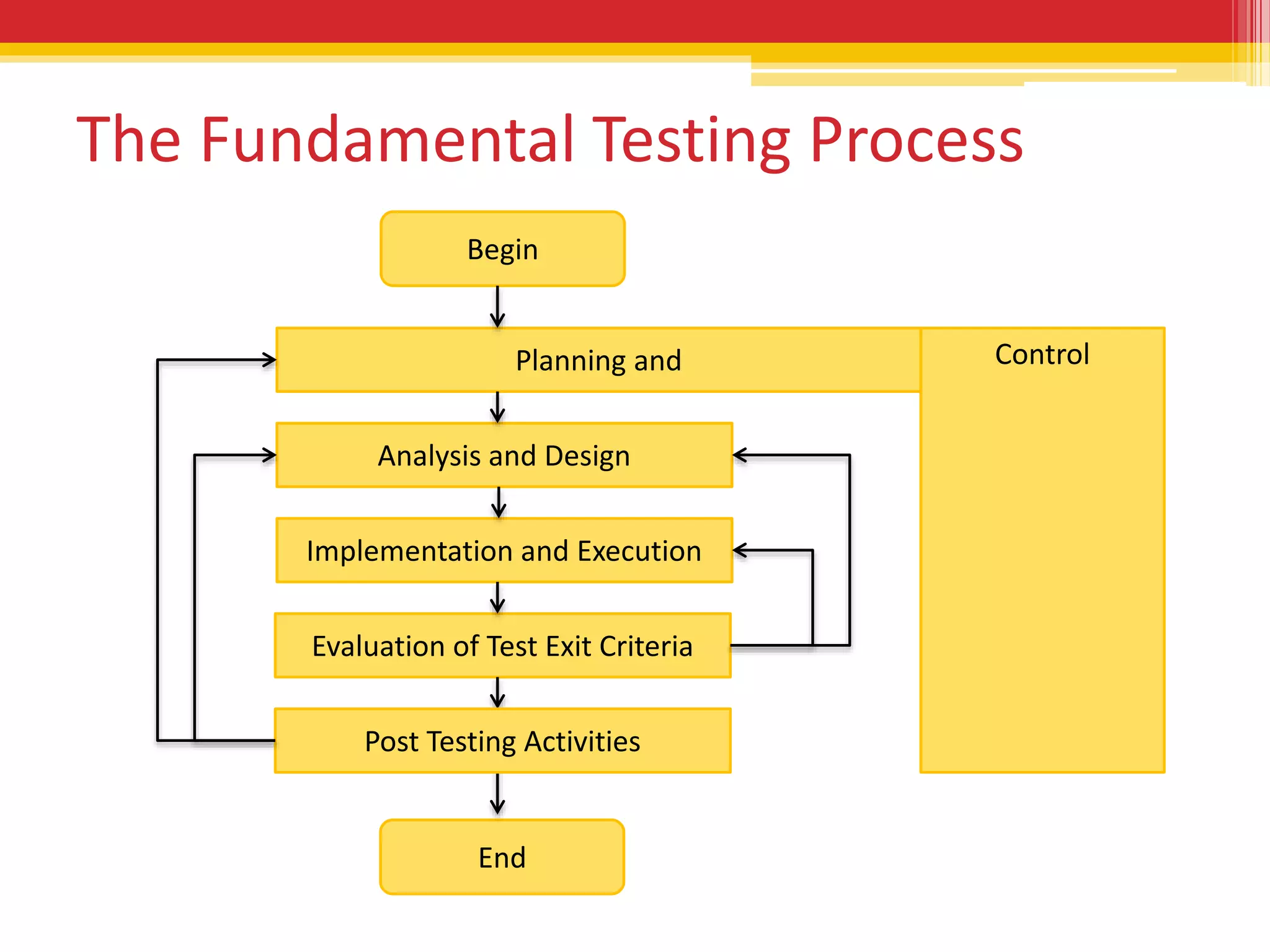
The Fundamental Testing Process
Begin

Planning and
Analysis and Design
Implementation and Execution
Evaluation of Test Exit Criteria
Post Testing Activities

End

Control
Planning and Control
• Planning:
▫ Test policy, Test strategy
▫ Test plan (test resources, test intensity for system parts
and characteristics, priorities of test, tool support).

• Control: compare actual situation with plan and
adjust the plan.
Complete testing is not possible. Faults can cause high
costs. Balance is to be kept by Test Manager.
Analysis & Design
• Creating logical test cases (positive and negative)
based on test basis.
• Test case explosion
Implementation & Execution
• Creating concrete (and easily reproducible!) test
cases out of logical ones, preparing test harness
(harnesses, drivers, simulators, etc.)
• Check test environment, execute test cases according
to priorities defined when planning
• Log results, and describe failures in reproducible
way.

• The pesticide paradox
Evaluation of Test Exit Criteria, Reporting
• All exit criteria should be met to stop testing. So
several (!) test cycles should be planned.
• Criteria: defect detection percentage (DDP) and
defect importance; in practice: time & cost.
• Write test summary report for stakeholders.
Post Testing Activities (Test Closure)
• Experiences from testing work should be analyzed
and made available for further projects.
▫
▫
▫
▫
▫

Planned vs achieved results
Analysis of unexpected events happened
Analysis of defects
Change requests: Still Open? Why not implemented?
How good was user acceptance before deploy?

Fundamental Test Process New

  • 1.
    Software Testing Foundations#1.1 The Fundamental Testing Process Nikita Knysh nknysh@gmail.com http://www.facebook.com/groups/istqb/
  • 2.
    The Fundamental TestingProcess Begin Planning and Analysis and Design Implementation and Execution Evaluation of Test Exit Criteria Post Testing Activities End Control
  • 3.
    Planning and Control •Planning: ▫ Test policy, Test strategy ▫ Test plan (test resources, test intensity for system parts and characteristics, priorities of test, tool support). • Control: compare actual situation with plan and adjust the plan. Complete testing is not possible. Faults can cause high costs. Balance is to be kept by Test Manager.
  • 4.
    Analysis & Design •Creating logical test cases (positive and negative) based on test basis. • Test case explosion
  • 5.
    Implementation & Execution •Creating concrete (and easily reproducible!) test cases out of logical ones, preparing test harness (harnesses, drivers, simulators, etc.) • Check test environment, execute test cases according to priorities defined when planning • Log results, and describe failures in reproducible way. • The pesticide paradox
  • 6.
    Evaluation of TestExit Criteria, Reporting • All exit criteria should be met to stop testing. So several (!) test cycles should be planned. • Criteria: defect detection percentage (DDP) and defect importance; in practice: time & cost. • Write test summary report for stakeholders.
  • 7.
    Post Testing Activities(Test Closure) • Experiences from testing work should be analyzed and made available for further projects. ▫ ▫ ▫ ▫ ▫ Planned vs achieved results Analysis of unexpected events happened Analysis of defects Change requests: Still Open? Why not implemented? How good was user acceptance before deploy?