9 XII – Maths
CHAPTER 1
RELATIONS AND FUNCTIONS
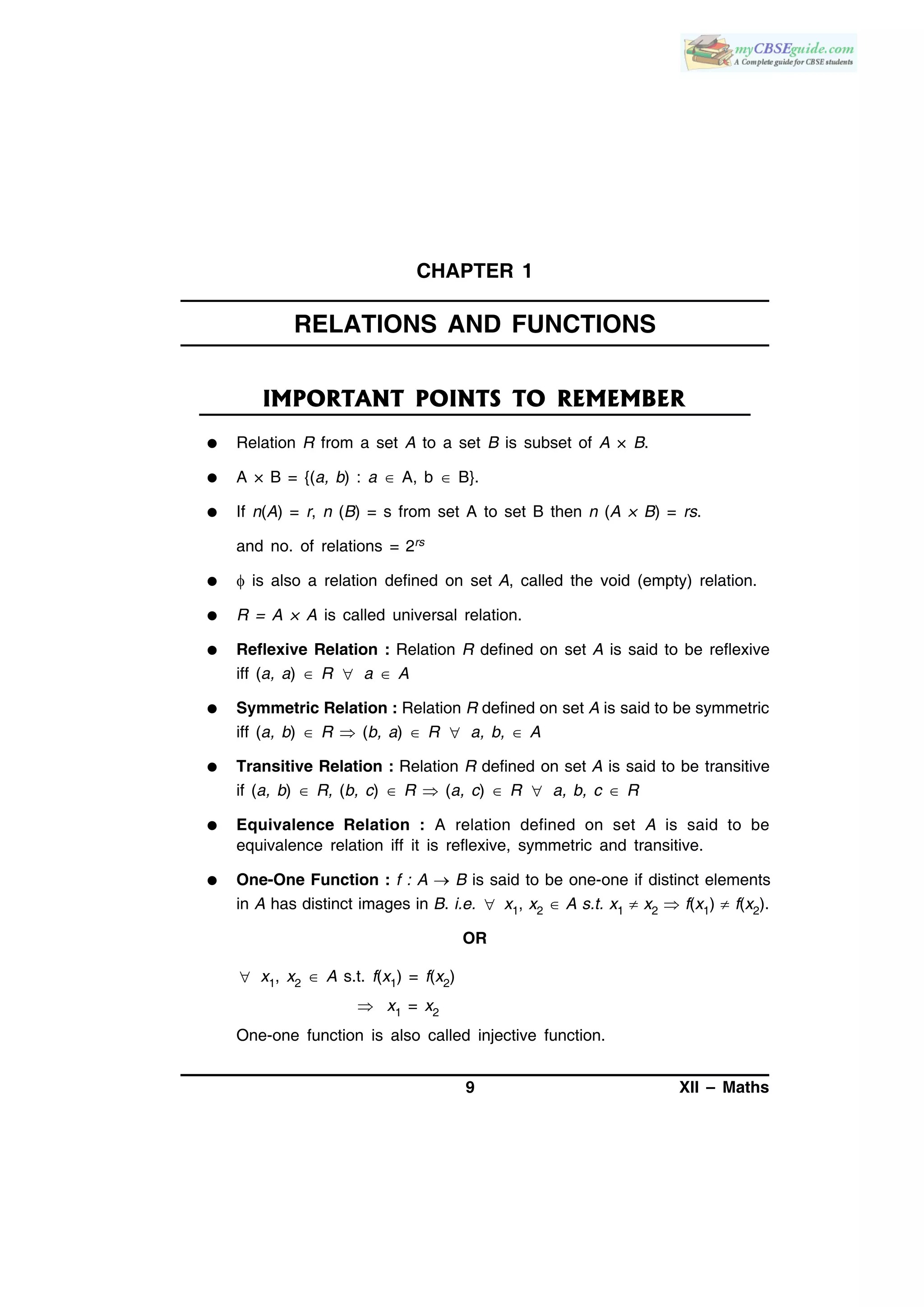
IMPORTANT POINTS TO REMEMBER
 Relation R from a set A to a set B is subset of A × B.
 A × B = {(a, b) : a  A, b  B}.
 If n(A) = r, n (B) = s from set A to set B then n (A × B) = rs.
and no. of relations = 2rs
  is also a relation defined on set A, called the void (empty) relation.
 R = A × A is called universal relation.
 Reflexive Relation : Relation R defined on set A is said to be reflexive
iff (a, a)  R  a  A
 Symmetric Relation : Relation R defined on set A is said to be symmetric
iff (a, b)  R  (b, a)  R  a, b,  A
 Transitive Relation : Relation R defined on set A is said to be transitive
if (a, b)  R, (b, c)  R  (a, c)  R  a, b, c  R
 Equivalence Relation : A relation defined on set A is said to be
equivalence relation iff it is reflexive, symmetric and transitive.
 One-One Function : f : A  B is said to be one-one if distinct elements
in A has distinct images in B. i.e.  x1, x2  A s.t. x1  x2  f(x1)  f(x2).
OR
 x1, x2  A s.t. f(x1) = f(x2)
 x1 = x2
One-one function is also called injective function.
XII – Maths 10
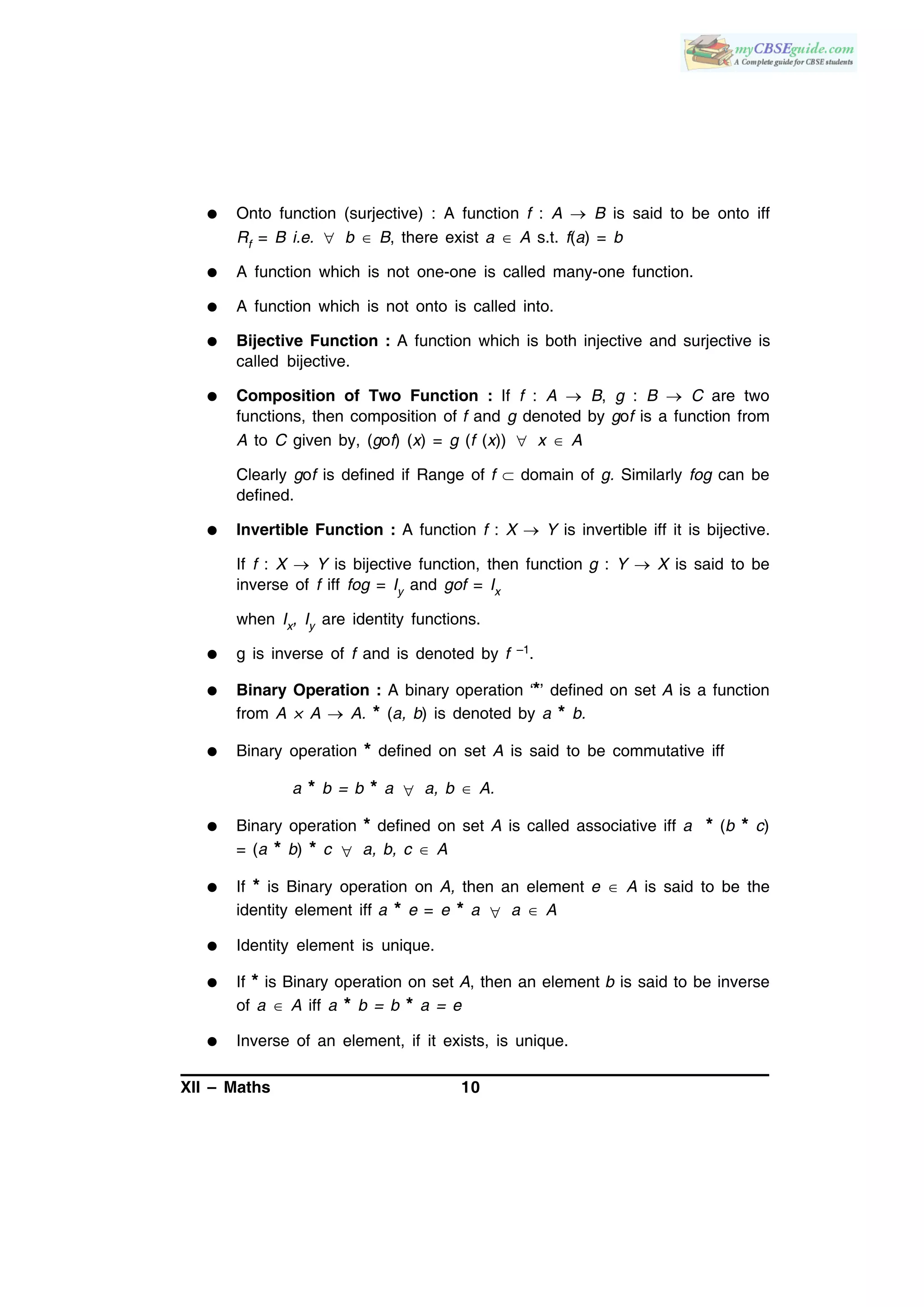
 Onto function (surjective) : A function f : A  B is said to be onto iff
Rf = B i.e.  b  B, there exist a  A s.t. f(a) = b
 A function which is not one-one is called many-one function.
 A function which is not onto is called into.
 Bijective Function : A function which is both injective and surjective is
called bijective.
 Composition of Two Function : If f : A  B, g : B  C are two
functions, then composition of f and g denoted by gof is a function from
A to C given by, (gof) (x) = g (f (x))  x  A
Clearly gof is defined if Range of f  domain of g. Similarly fog can be
defined.
 Invertible Function : A function f : X  Y is invertible iff it is bijective.
If f : X  Y is bijective function, then function g : Y  X is said to be
inverse of f iff fog = Iy and gof = Ix
when Ix, Iy are identity functions.
 g is inverse of f and is denoted by f –1.
 Binary Operation : A binary operation ‘*’ defined on set A is a function
from A × A  A. * (a, b) is denoted by a * b.
 Binary operation * defined on set A is said to be commutative iff
a * b = b * a  a, b  A.
 Binary operation * defined on set A is called associative iff a * (b * c)
= (a * b) * c  a, b, c  A
 If * is Binary operation on A, then an element e  A is said to be the
identity element iff a * e = e * a  a  A
 Identity element is unique.
 If * is Binary operation on set A, then an element b is said to be inverse
of a  A iff a * b = b * a = e
 Inverse of an element, if it exists, is unique.
11 XII – Maths
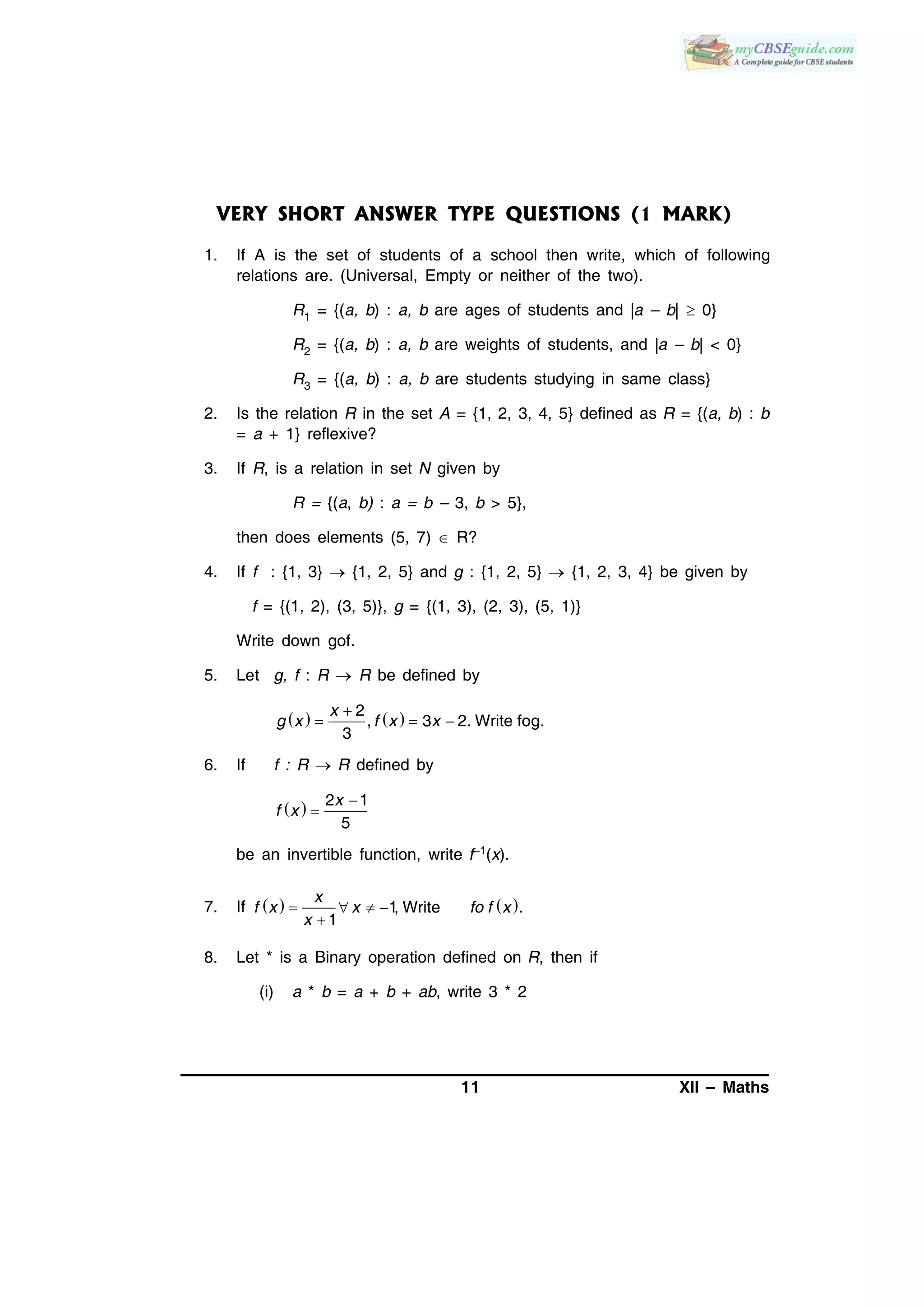
VERY SHORT ANSWER TYPE QUESTIONS (1 MARK)
1. If A is the set of students of a school then write, which of following
relations are. (Universal, Empty or neither of the two).
R1 = {(a, b) : a, b are ages of students and |a – b|  0}
R2 = {(a, b) : a, b are weights of students, and |a – b| < 0}
R3 = {(a, b) : a, b are students studying in same class}
2. Is the relation R in the set A = {1, 2, 3, 4, 5} defined as R = {(a, b) : b
= a + 1} reflexive?
3. If R, is a relation in set N given by
R = {(a, b) : a = b – 3, b > 5},
then does elements (5, 7)  R?
4. If f : {1, 3}  {1, 2, 5} and g : {1, 2, 5}  {1, 2, 3, 4} be given by
f = {(1, 2), (3, 5)}, g = {(1, 3), (2, 3), (5, 1)}
Write down gof.
5. Let g, f : R  R be defined by
   
  
2
, 3 2. Write fog.
3
x
g x f x x
6. If f : R R defined by
  

2 1
5
x
f x
be an invertible function, write f–1(x).
7. If    1, Write .
1
x
f x x fo f x
x
   

8. Let * is a Binary operation defined on R, then if
(i) a * b = a + b + ab, write 3 * 2
XII – Maths 12
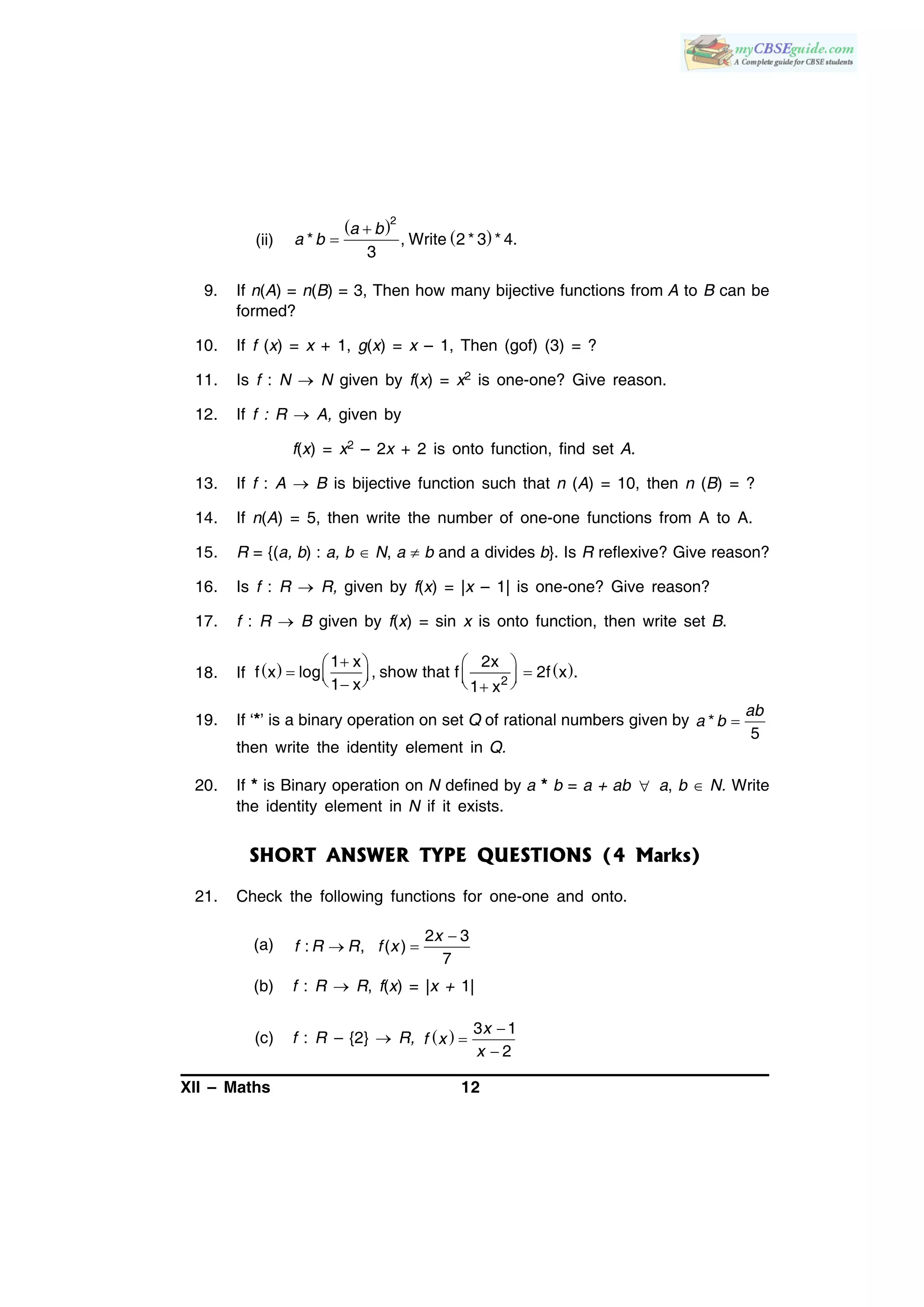
(ii)
 
 

2
* , Write 2 * 3 * 4.
3
a b
a b
9. If n(A) = n(B) = 3, Then how many bijective functions from A to B can be
formed?
10. If f (x) = x + 1, g(x) = x – 1, Then (gof) (3) = ?
11. Is f : N  N given by f(x) = x2 is one-one? Give reason.
12. If f : R  A, given by
f(x) = x2 – 2x + 2 is onto function, find set A.
13. If f : A  B is bijective function such that n (A) = 10, then n (B) = ?
14. If n(A) = 5, then write the number of one-one functions from A to A.
15. R = {(a, b) : a, b  N, a  b and a divides b}. Is R reflexive? Give reason?
16. Is f : R  R, given by f(x) = |x – 1| is one-one? Give reason?
17. f : R  B given by f(x) = sin x is onto function, then write set B.
18. If    
2
1 x 2x
f x log , show that f 2f x .
1 x 1 x
   
        
19. If ‘*’ is a binary operation on set Q of rational numbers given by *
5
ab
a b
then write the identity element in Q.
20. If * is Binary operation on N defined by a * b = a + ab  a, b  N. Write
the identity element in N if it exists.
SHORT ANSWER TYPE QUESTIONS (4 Marks)
21. Check the following functions for one-one and onto.
(a)

 
2 3
: , ( )
7
x
f R R f x
(b) f : R  R, f(x) = |x + 1|
(c) f : R – {2}  R,   


3 1
2
x
f x
x
13 XII – Maths
(d) f : R  [–1, 1], f(x) = sin2x
22. Consider the binary operation * on the set {1, 2, 3, 4, 5} defined by
a* b = H.C.F. of a and b. Write the operation table for the operation *.
23. Let    
  
4 4
:
3 3
f R R be a function given by   

4
.
3 4
x
f x
x
Show
that f is invertible with  


1 4
.
4 3
x
f x
x
24. Let R be the relation on set A = {x : x  Z, 0  x  10} given by
R = {(a, b) : (a – b) is multiple of 4}, is an equivalence relation. Also, write
all elements related to 4.
25. Show that function f : A  B defined as   3 4
5 7



x
f x
x
where
7 3
,
5 5
   
      
  
A R B R is invertible and hence find f –1.
26. Let * be a binary operation on Q. Such that a * b = a + b – ab.
(i) Prove that * is commutative and associative.
(ii) Find identify element of * in Q (if it exists).
27. If * is a binary operation defined on R – {0} defined by 2
2
* ,
a
a b
b
then
check * for commutativity and associativity.
28. If A = N × N and binary operation * is defined on A as
(a, b) * (c, d) = (ac, bd).
(i) Check * for commutativity and associativity.
(ii) Find the identity element for * in A (If it exists).
29. Show that the relation R defined by (a, b) R(c, d)  a + d = b + c on
the set N × N is an equivalence relation.
30. Let * be a binary operation on set Q defined by * ,
4

ab
a b show that
(i) 4 is the identity element of * on Q.
XII – Maths 14
(ii) Every non zero element of Q is invertible with
 1 16
, 0 .
  a a Q
a
31. Show that f : R+  R+ defined by   
1
2
f x
x
is bijective where R+ is the
set of all non-zero positive real numbers.
32. Consider f : R+  [–5, ) given by f(x) = 9x2 + 6x – 5 show that f is
invertible with
1 6 1
3
x
f   
 .
33. If ‘*’ is a binary operation on R defined by a * b = a + b + ab. Prove that
* is commutative and associative. Find the identify element. Also show
that every element of R is invertible except –1.
34. If f, g : R  R defined by f(x) = x2 – x and g(x) = x + 1 find (fog) (x) and
(gof) (x). Are they equal?
35.    11
: [1, ) [2, ) is given by , find .
    f f x x f x
x
36. f : R  R, g : R  R given by f(x) = [x], g(x) = |x| then find
   
    
      
2 2
and .
3 3
fog gof
ANSWERS
1. R1 : is universal relation.
R2 : is empty relation.
R3 : is neither universal nor empty.
2. No, R is not reflexive.
3. (5, 7)  R
4. gof = {(1, 3), (3, 1)}
5. (fog)(x) = x  x  R
15 XII – Maths
6.  1 5 1
2
x
f x
 

7.    1
,
2 1 2
x
fof x x
x
  

8. (i) 3 * 2 = 11
(ii)
1369
27
9. 6
10. 3
11. Yes, f is one-one 2 2
1 2 1 2,x x N x x    .
12. A = [1, ) because Rf = [1, )
13. n(B) = 10
14. 120.
15. No, R is not reflexive      ,a a R a N
16. f is not one-one functions
 f(3) = f (–1) = 2
3  – 1 i.e. distinct element has same images.
17. B = [–1, 1]
19. e = 5
20. Identity element does not exist.
21. (a) Bijective
(b) Neither one-one nor onto.
(c) One-one, but not onto.
(d) Neither one-one nor onto.
XII – Maths 16
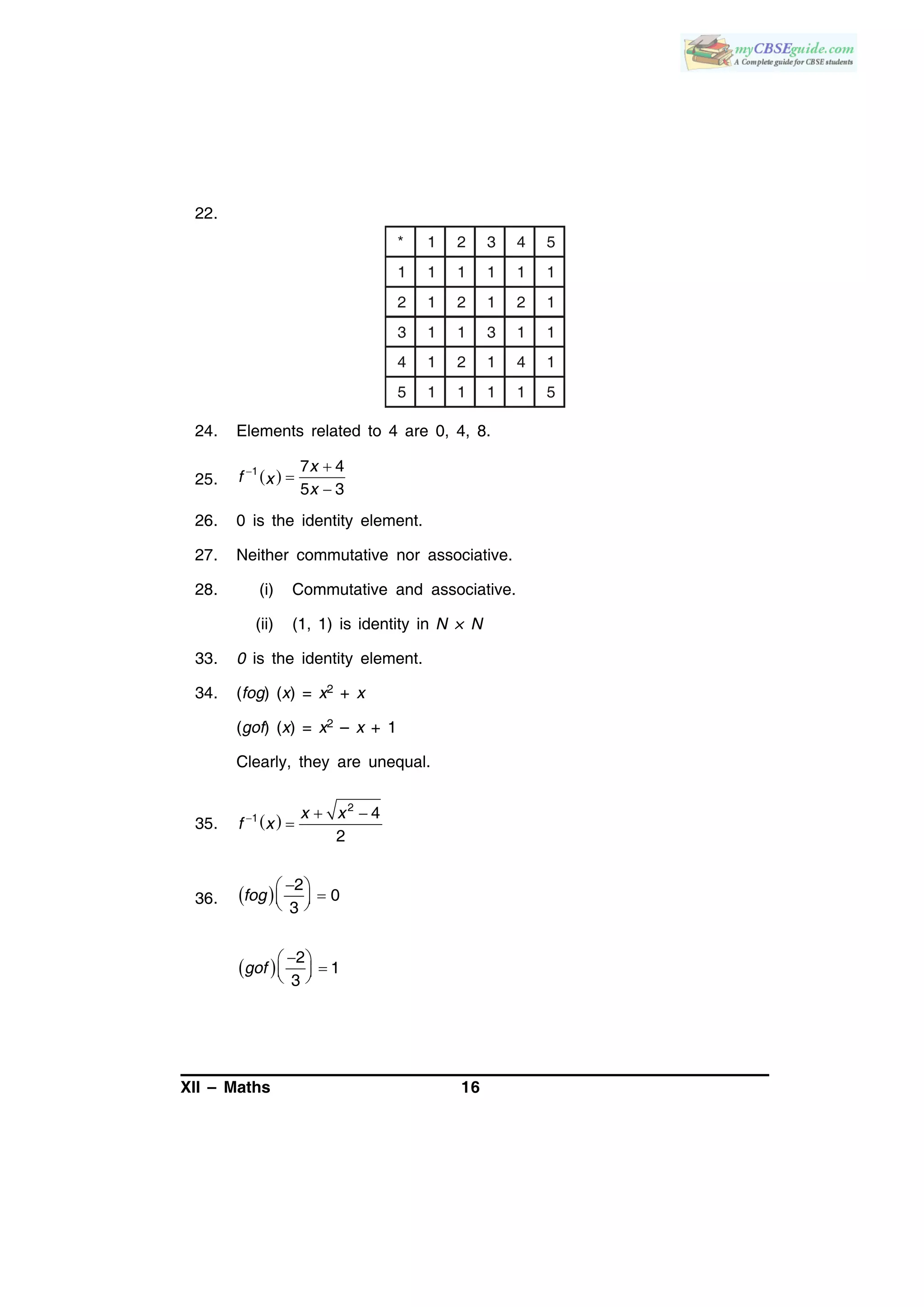
22.
* 1 2 3 4 5
1 1 1 1 1 1
2 1 2 1 2 1
3 1 1 3 1 1
4 1 2 1 4 1
5 1 1 1 1 5
24. Elements related to 4 are 0, 4, 8.
25.  1 7 4
5 3
x
f x
x
 


26. 0 is the identity element.
27. Neither commutative nor associative.
28. (i) Commutative and associative.
(ii) (1, 1) is identity in N × N
33. 0 is the identity element.
34. (fog) (x) = x2 + x
(gof) (x) = x2 – x + 1
Clearly, they are unequal.
35.  
2
1 4
2
  

x x
f x
36.  
 
  
2
0
3
fog
 
 
  
2
1
3
gof

Relations and functions

  • 1.
    9 XII –Maths CHAPTER 1 RELATIONS AND FUNCTIONS IMPORTANT POINTS TO REMEMBER  Relation R from a set A to a set B is subset of A × B.  A × B = {(a, b) : a  A, b  B}.  If n(A) = r, n (B) = s from set A to set B then n (A × B) = rs. and no. of relations = 2rs   is also a relation defined on set A, called the void (empty) relation.  R = A × A is called universal relation.  Reflexive Relation : Relation R defined on set A is said to be reflexive iff (a, a)  R  a  A  Symmetric Relation : Relation R defined on set A is said to be symmetric iff (a, b)  R  (b, a)  R  a, b,  A  Transitive Relation : Relation R defined on set A is said to be transitive if (a, b)  R, (b, c)  R  (a, c)  R  a, b, c  R  Equivalence Relation : A relation defined on set A is said to be equivalence relation iff it is reflexive, symmetric and transitive.  One-One Function : f : A  B is said to be one-one if distinct elements in A has distinct images in B. i.e.  x1, x2  A s.t. x1  x2  f(x1)  f(x2). OR  x1, x2  A s.t. f(x1) = f(x2)  x1 = x2 One-one function is also called injective function.
  • 2.
    XII – Maths10  Onto function (surjective) : A function f : A  B is said to be onto iff Rf = B i.e.  b  B, there exist a  A s.t. f(a) = b  A function which is not one-one is called many-one function.  A function which is not onto is called into.  Bijective Function : A function which is both injective and surjective is called bijective.  Composition of Two Function : If f : A  B, g : B  C are two functions, then composition of f and g denoted by gof is a function from A to C given by, (gof) (x) = g (f (x))  x  A Clearly gof is defined if Range of f  domain of g. Similarly fog can be defined.  Invertible Function : A function f : X  Y is invertible iff it is bijective. If f : X  Y is bijective function, then function g : Y  X is said to be inverse of f iff fog = Iy and gof = Ix when Ix, Iy are identity functions.  g is inverse of f and is denoted by f –1.  Binary Operation : A binary operation ‘*’ defined on set A is a function from A × A  A. * (a, b) is denoted by a * b.  Binary operation * defined on set A is said to be commutative iff a * b = b * a  a, b  A.  Binary operation * defined on set A is called associative iff a * (b * c) = (a * b) * c  a, b, c  A  If * is Binary operation on A, then an element e  A is said to be the identity element iff a * e = e * a  a  A  Identity element is unique.  If * is Binary operation on set A, then an element b is said to be inverse of a  A iff a * b = b * a = e  Inverse of an element, if it exists, is unique.
  • 3.
    11 XII –Maths VERY SHORT ANSWER TYPE QUESTIONS (1 MARK) 1. If A is the set of students of a school then write, which of following relations are. (Universal, Empty or neither of the two). R1 = {(a, b) : a, b are ages of students and |a – b|  0} R2 = {(a, b) : a, b are weights of students, and |a – b| < 0} R3 = {(a, b) : a, b are students studying in same class} 2. Is the relation R in the set A = {1, 2, 3, 4, 5} defined as R = {(a, b) : b = a + 1} reflexive? 3. If R, is a relation in set N given by R = {(a, b) : a = b – 3, b > 5}, then does elements (5, 7)  R? 4. If f : {1, 3}  {1, 2, 5} and g : {1, 2, 5}  {1, 2, 3, 4} be given by f = {(1, 2), (3, 5)}, g = {(1, 3), (2, 3), (5, 1)} Write down gof. 5. Let g, f : R  R be defined by        2 , 3 2. Write fog. 3 x g x f x x 6. If f : R R defined by     2 1 5 x f x be an invertible function, write f–1(x). 7. If    1, Write . 1 x f x x fo f x x      8. Let * is a Binary operation defined on R, then if (i) a * b = a + b + ab, write 3 * 2
  • 4.
    XII – Maths12 (ii)      2 * , Write 2 * 3 * 4. 3 a b a b 9. If n(A) = n(B) = 3, Then how many bijective functions from A to B can be formed? 10. If f (x) = x + 1, g(x) = x – 1, Then (gof) (3) = ? 11. Is f : N  N given by f(x) = x2 is one-one? Give reason. 12. If f : R  A, given by f(x) = x2 – 2x + 2 is onto function, find set A. 13. If f : A  B is bijective function such that n (A) = 10, then n (B) = ? 14. If n(A) = 5, then write the number of one-one functions from A to A. 15. R = {(a, b) : a, b  N, a  b and a divides b}. Is R reflexive? Give reason? 16. Is f : R  R, given by f(x) = |x – 1| is one-one? Give reason? 17. f : R  B given by f(x) = sin x is onto function, then write set B. 18. If     2 1 x 2x f x log , show that f 2f x . 1 x 1 x              19. If ‘*’ is a binary operation on set Q of rational numbers given by * 5 ab a b then write the identity element in Q. 20. If * is Binary operation on N defined by a * b = a + ab  a, b  N. Write the identity element in N if it exists. SHORT ANSWER TYPE QUESTIONS (4 Marks) 21. Check the following functions for one-one and onto. (a)    2 3 : , ( ) 7 x f R R f x (b) f : R  R, f(x) = |x + 1| (c) f : R – {2}  R,      3 1 2 x f x x
  • 5.
    13 XII –Maths (d) f : R  [–1, 1], f(x) = sin2x 22. Consider the binary operation * on the set {1, 2, 3, 4, 5} defined by a* b = H.C.F. of a and b. Write the operation table for the operation *. 23. Let        4 4 : 3 3 f R R be a function given by     4 . 3 4 x f x x Show that f is invertible with     1 4 . 4 3 x f x x 24. Let R be the relation on set A = {x : x  Z, 0  x  10} given by R = {(a, b) : (a – b) is multiple of 4}, is an equivalence relation. Also, write all elements related to 4. 25. Show that function f : A  B defined as   3 4 5 7    x f x x where 7 3 , 5 5               A R B R is invertible and hence find f –1. 26. Let * be a binary operation on Q. Such that a * b = a + b – ab. (i) Prove that * is commutative and associative. (ii) Find identify element of * in Q (if it exists). 27. If * is a binary operation defined on R – {0} defined by 2 2 * , a a b b then check * for commutativity and associativity. 28. If A = N × N and binary operation * is defined on A as (a, b) * (c, d) = (ac, bd). (i) Check * for commutativity and associativity. (ii) Find the identity element for * in A (If it exists). 29. Show that the relation R defined by (a, b) R(c, d)  a + d = b + c on the set N × N is an equivalence relation. 30. Let * be a binary operation on set Q defined by * , 4  ab a b show that (i) 4 is the identity element of * on Q.
  • 6.
    XII – Maths14 (ii) Every non zero element of Q is invertible with  1 16 , 0 .   a a Q a 31. Show that f : R+  R+ defined by    1 2 f x x is bijective where R+ is the set of all non-zero positive real numbers. 32. Consider f : R+  [–5, ) given by f(x) = 9x2 + 6x – 5 show that f is invertible with 1 6 1 3 x f     . 33. If ‘*’ is a binary operation on R defined by a * b = a + b + ab. Prove that * is commutative and associative. Find the identify element. Also show that every element of R is invertible except –1. 34. If f, g : R  R defined by f(x) = x2 – x and g(x) = x + 1 find (fog) (x) and (gof) (x). Are they equal? 35.    11 : [1, ) [2, ) is given by , find .     f f x x f x x 36. f : R  R, g : R  R given by f(x) = [x], g(x) = |x| then find                 2 2 and . 3 3 fog gof ANSWERS 1. R1 : is universal relation. R2 : is empty relation. R3 : is neither universal nor empty. 2. No, R is not reflexive. 3. (5, 7)  R 4. gof = {(1, 3), (3, 1)} 5. (fog)(x) = x  x  R
  • 7.
    15 XII –Maths 6.  1 5 1 2 x f x    7.    1 , 2 1 2 x fof x x x     8. (i) 3 * 2 = 11 (ii) 1369 27 9. 6 10. 3 11. Yes, f is one-one 2 2 1 2 1 2,x x N x x    . 12. A = [1, ) because Rf = [1, ) 13. n(B) = 10 14. 120. 15. No, R is not reflexive      ,a a R a N 16. f is not one-one functions  f(3) = f (–1) = 2 3  – 1 i.e. distinct element has same images. 17. B = [–1, 1] 19. e = 5 20. Identity element does not exist. 21. (a) Bijective (b) Neither one-one nor onto. (c) One-one, but not onto. (d) Neither one-one nor onto.
  • 8.
    XII – Maths16 22. * 1 2 3 4 5 1 1 1 1 1 1 2 1 2 1 2 1 3 1 1 3 1 1 4 1 2 1 4 1 5 1 1 1 1 5 24. Elements related to 4 are 0, 4, 8. 25.  1 7 4 5 3 x f x x     26. 0 is the identity element. 27. Neither commutative nor associative. 28. (i) Commutative and associative. (ii) (1, 1) is identity in N × N 33. 0 is the identity element. 34. (fog) (x) = x2 + x (gof) (x) = x2 – x + 1 Clearly, they are unequal. 35.   2 1 4 2     x x f x 36.        2 0 3 fog        2 1 3 gof