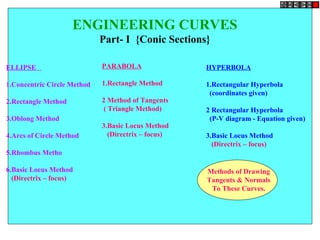
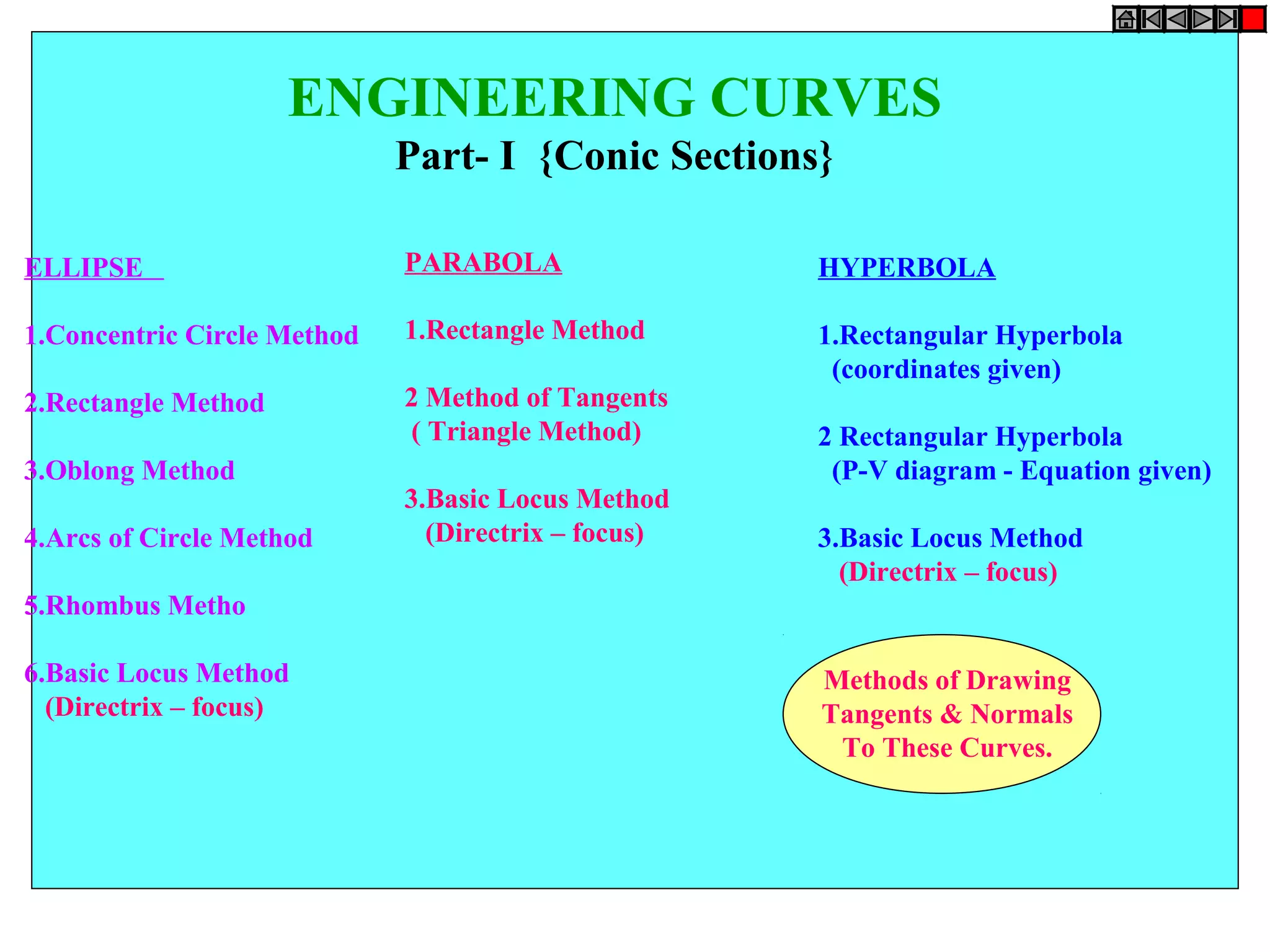
ENGINEERING CURVES
                             Part- I {Conic Sections}

ELLIPSE                      PARABOLA                HYPERBOLA

1.Concentric Circle Method   1.Rectangle Method      1.Rectangular Hyperbola
                                                      (coordinates given)
2.Rectangle Method           2 Method of Tangents
                             ( Triangle Method)      2 Rectangular Hyperbola
3.Oblong Method                                       (P-V diagram - Equation given)
                             3.Basic Locus Method
4.Arcs of Circle Method        (Directrix – focus)   3.Basic Locus Method
                                                       (Directrix – focus)
5.Rhombus Metho

6.Basic Locus Method                                 Methods of Drawing
  (Directrix – focus)                                Tangents & Normals
                                                      To These Curves.
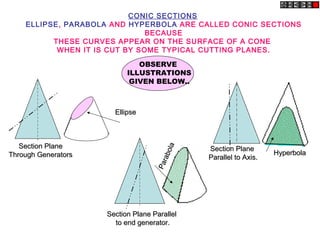
CONIC SECTIONS
    ELLIPSE, PARABOLA AND HYPERBOLA ARE CALLED CONIC SECTIONS
                               BECAUSE
          THESE CURVES APPEAR ON THE SURFACE OF A CONE
           WHEN IT IS CUT BY SOME TYPICAL CUTTING PLANES.

                              OBSERVE
                           ILLUSTRATIONS
                            GIVEN BELOW..


                       Ellipse


   Section Plane


                                          ola
                                                Section Plane
Through Generators                                                  Hyperbola
                                      rab
                                                Parallel to Axis.
                                    Pa


                     Section Plane Parallel
                       to end generator.
COMMON DEFINATION OF ELLIPSE, PARABOLA & HYPERBOLA:
 These are the loci of points moving in a plane such that the ratio of it’s distances
           from a fixed point And a fixed line always remains constant.
                    The Ratio is called ECCENTRICITY. (E)
                              A) For Ellipse      E<1
                              B) For Parabola E=1
                              C) For Hyperbola E>1


                    Refer Problem nos. 6. 9 & 12
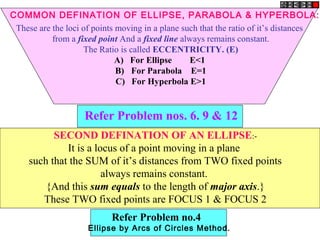
           SECOND DEFINATION OF AN ELLIPSE:-
              It is a locus of a point moving in a plane
     such that the SUM of it’s distances from TWO fixed points
                        always remains constant.
         {And this sum equals to the length of major axis.}
        These TWO fixed points are FOCUS 1 & FOCUS 2
                           Refer Problem no.4
                     Ellipse by Arcs of Circles Method.
ELLIPSE
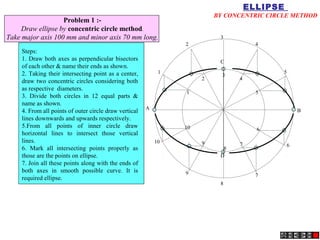
                                                                         BY CONCENTRIC CIRCLE METHOD
                   Problem 1 :-
     Draw ellipse by concentric circle method.
Take major axis 100 mm and minor axis 70 mm long.                         3
                                                                2                    4
    Steps:
    1. Draw both axes as perpendicular bisectors                          C
    of each other & name their ends as shown.
    2. Taking their intersecting point as a center,         1                                5
                                                                           3
                                                                     2         4
    draw two concentric circles considering both
    as respective diameters.
                                                                1                    5
    3. Divide both circles in 12 equal parts &
    name as shown.
                                                       A
    4. From all points of outer circle draw vertical                                             B
    lines downwards and upwards respectively.
    5.From all points of inner circle draw                      10                   6
    horizontal lines to intersect those vertical
    lines.                                                 10        9         7             6
    6. Mark all intersecting points properly as                            8
    those are the points on ellipse.                                      D
    7. Join all these points along with the ends of
    both axes in smooth possible curve. It is                   9                    7
    required ellipse.
                                                                          8
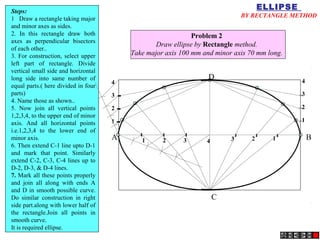
Steps:
                                                                                    ELLIPSE
                                                                             BY RECTANGLE METHOD
1 Draw a rectangle taking major
and minor axes as sides.
2. In this rectangle draw both                               Problem 2
axes as perpendicular bisectors
                                                 Draw ellipse by Rectangle method.
of each other..
3. For construction, select upper        Take major axis 100 mm and minor axis 70 mm long.
left part of rectangle. Divide
vertical small side and horizontal
long side into same number of                                     D                           4
                                     4
equal parts.( here divided in four
parts)                               3                                                        3
4. Name those as shown..
5. Now join all vertical points      2                                                        2
1,2,3,4, to the upper end of minor
axis. And all horizontal points      1                                                        1
i.e.1,2,3,4 to the lower end of
minor axis.                          A      1      2      3      4       3      2     1           B
6. Then extend C-1 line upto D-1
and mark that point. Similarly
extend C-2, C-3, C-4 lines up to
D-2, D-3, & D-4 lines.
7. Mark all these points properly
and join all along with ends A
and D in smooth possible curve.
Do similar construction in right                                     C
side part.along with lower half of
the rectangle.Join all points in
smooth curve.
It is required ellipse.
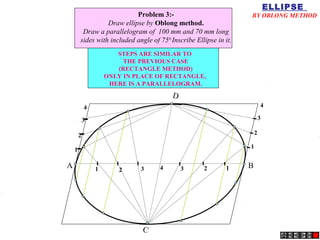
ELLIPSE
                            Problem 3:-                            BY OBLONG METHOD
                  Draw ellipse by Oblong method.
         Draw a parallelogram of 100 mm and 70 mm long
        sides with included angle of 750.Inscribe Ellipse in it.
                       STEPS ARE SIMILAR TO
                         THE PREVIOUS CASE
                       (RECTANGLE METHOD)
                    ONLY IN PLACE OF RECTANGLE,
                     HERE IS A PARALLELOGRAM.
                                          D
            4                                                              4

            3                                                              3

        2                                                              2

                                                                   1
    1

A               1      2      3      4        3      2       1     B


                               C
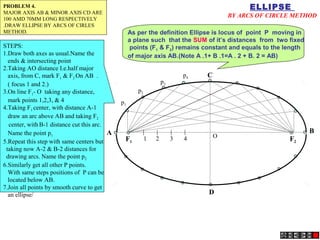
PROBLEM 4.                                                                                    ELLIPSE
MAJOR AXIS AB & MINOR AXIS CD ARE
                                                                                         BY ARCS OF CIRCLE METHOD
100 AMD 70MM LONG RESPECTIVELY
.DRAW ELLIPSE BY ARCS OF CIRLES
METHOD.                                            As per the definition Ellipse is locus of point P moving in
                                                   a plane such that the SUM of it’s distances from two fixed
STEPS:                                              points (F1 & F2) remains constant and equals to the length
1.Draw both axes as usual.Name the                 of major axis AB.(Note A .1+ B .1=A . 2 + B. 2 = AB)
  ends & intersecting point
2.Taking AO distance I.e.half major
  axis, from C, mark F1 & F2 On AB .                                        p4   C
  ( focus 1 and 2.)                                                p3
3.On line F1- O taking any distance,                  p2
  mark points 1,2,3, & 4                      p1
4.Taking F1 center, with distance A-1
  draw an arc above AB and taking F2
  center, with B-1 distance cut this arc.
  Name the point p1                       A                                                                      B
                                                                                     O
5.Repeat this step with same centers but       F1          1   2        3   4                            F2
 taking now A-2 & B-2 distances for
 drawing arcs. Name the point p2
6.Similarly get all other P points.
  With same steps positions of P can be
  located below AB.
7.Join all points by smooth curve to get
  an ellipse/                                                                    D
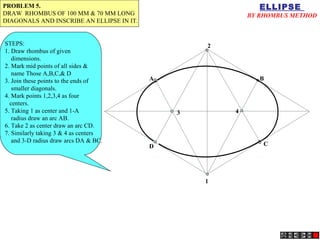
PROBLEM 5.                                                    ELLIPSE
DRAW RHOMBUS OF 100 MM & 70 MM LONG                        BY RHOMBUS METHOD
DIAGONALS AND INSCRIBE AN ELLIPSE IN IT.


STEPS:                                             2
1. Draw rhombus of given
   dimensions.
2. Mark mid points of all sides &
   name Those A,B,C,& D
3. Join these points to the ends of        A                  B
   smaller diagonals.
4. Mark points 1,2,3,4 as four
  centers.
5. Taking 1 as center and 1-A                  3       4
   radius draw an arc AB.
6. Take 2 as center draw an arc CD.
7. Similarly taking 3 & 4 as centers
   and 3-D radius draw arcs DA & BC.
                                           D                   C


                                                   1
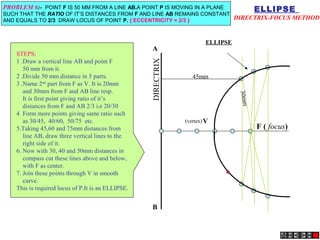
PROBLEM 6:- POINT F IS 50 MM FROM A LINE AB.A POINT P IS MOVING IN A PLANE
SUCH THAT THE RATIO OF IT’S DISTANCES FROM F AND LINE AB REMAINS CONSTANT
                                                                                         ELLIPSE
AND EQUALS TO 2/3 DRAW LOCUS OF POINT P. { ECCENTRICITY = 2/3 }           DIRECTRIX-FOCUS METHOD


                                                                        ELLIPSE
                                                    A
    STEPS:
    1 .Draw a vertical line AB and point F


                                                    DIRECTRIX
       50 mm from it.
    2 .Divide 50 mm distance in 5 parts.                           45mm
    3 .Name 2nd part from F as V. It is 20mm
       and 30mm from F and AB line resp.


                                                                                  30mm
       It is first point giving ratio of it’s
       distances from F and AB 2/3 i.e 20/30
    4 Form more points giving same ratio such
       as 30/45, 40/60, 50/75 etc.                              (vertex) V
    5.Taking 45,60 and 75mm distances from                                               F ( focus)
       line AB, draw three vertical lines to the
       right side of it.
    6. Now with 30, 40 and 50mm distances in
       compass cut these lines above and below,
       with F as center.
    7. Join these points through V in smooth
       curve.
    This is required locus of P.It is an ELLIPSE.


                                                    B
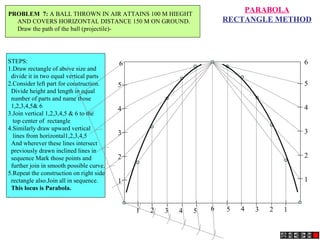
PROBLEM 7: A BALL THROWN IN AIR ATTAINS 100 M HIEGHT
                                                                           PARABOLA
  AND COVERS HORIZONTAL DISTANCE 150 M ON GROUND.                      RECTANGLE METHOD
  Draw the path of the ball (projectile)-


STEPS:                                     6                                               6
1.Draw rectangle of above size and
  divide it in two equal vertical parts
2.Consider left part for construction.     5                                               5
  Divide height and length in equal
  number of parts and name those
  1,2,3,4,5& 6                                                                             4
                                           4
3.Join vertical 1,2,3,4,5 & 6 to the
   top center of rectangle
4.Similarly draw upward vertical
                                           3                                               3
   lines from horizontal1,2,3,4,5
  And wherever these lines intersect
  previously drawn inclined lines in
  sequence Mark those points and           2                                               2
  further join in smooth possible curve.
5.Repeat the construction on right side
  rectangle also.Join all in sequence.     1                                               1
  This locus is Parabola.
.

                                               1   2   3   4   5   6   5   4   3   2   1
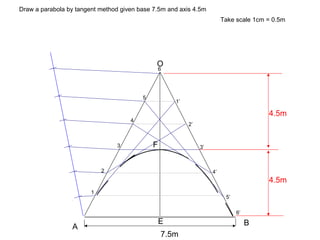
Draw a parabola by tangent method given base 7.5m and axis 4.5m
                                                                         Take scale 1cm = 0.5m


                                              O
                                                 6


                                         5
                                                     1’

                                                                                        4.5m
                                     4
                                                          2’


                                 3           F                 3’


                            2                                       4’
                                                                                        4.5m
                        1
                                                                          5’

                                                                               6’
                                                 E                                  B
                 A
                                                 7.5m
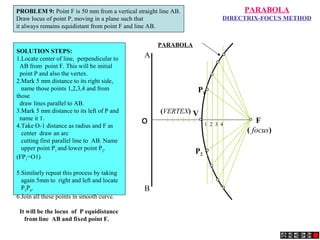
PROBLEM 9: Point F is 50 mm from a vertical straight line AB.                   PARABOLA
Draw locus of point P, moving in a plane such that                         DIRECTRIX-FOCUS METHOD
it always remains equidistant from point F and line AB.


                                                    PARABOLA
SOLUTION STEPS:
1.Locate center of line, perpendicular to      A
 AB from point F. This will be initial
 point P and also the vertex.
2.Mark 5 mm distance to its right side,
  name those points 1,2,3,4 and from                            P1
those
 draw lines parallel to AB.
3.Mark 5 mm distance to its left of P and            (VERTEX) V
 name it 1.                                                                         F
                                              O                      1 2 3 4
4.Take O-1 distance as radius and F as
  center draw an arc                                                             ( focus)
  cutting first parallel line to AB. Name
  upper point P1 and lower point P2.
                                                                P2
(FP1=O1)

5.Similarly repeat this process by taking
  again 5mm to right and left and locate
  P3 P4 .                                      B
6.Join all these points in smooth curve.

 It will be the locus of P equidistance
   from line AB and fixed point F.
Problem No.10: Point P is 40 mm and 30 mm from horizontal              HYPERBOLA
and vertical axes respectively.Draw Hyperbola through it.             THROUGH A POINT
                                                                   OF KNOWN CO-ORDINATES
   Solution Steps:
   1) Extend horizontal
   line from P to right side.                      2
   2) Extend vertical line
   from P upward.
   3) On horizontal line
   from P, mark some
   points taking any
   distance and name them
   after P-1, 2,3,4 etc.
   4) Join 1-2-3-4 points
   to pole O. Let them cut                         1
   part [P-B] also at 1,2,3,4
   points.
   5) From horizontal
   1,2,3,4 draw vertical                   2   1       P   1   2            3
   lines downwards and
   6) From vertical 1,2,3,4
   points [from P-B] draw                              1
   horizontal lines.
   7) Line from 1              40 mm                   2
   horizontal and line from
   1 vertical will meet at                             3
   P1.Similarly mark P2, P3,
   P4 points.                          O
   8) Repeat the procedure
   by marking four points                  30 mm
   on upward vertical line
   from P and joining all
   those to pole O. Name
   this points P6, P7, P8 etc.
   and join them by smooth
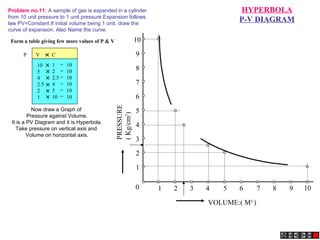
Problem no.11: A sample of gas is expanded in a cylinder                             HYPERBOLA
from 10 unit pressure to 1 unit pressure.Expansion follows
law PV=Constant.If initial volume being 1 unit, draw the
                                                                                     P-V DIAGRAM
curve of expansion. Also Name the curve.

 Form a table giving few more values of P & V               10

      P    V       = C                                      9
               +++ +++ +

            10             1 =     10
            5              2 =     10                       8
            4              2.5 =   10
            2.5            4 =     10                       7
            2              5 =     10
            1              10 =    10                       6


                                                PRESSURE
           Now draw a Graph of                              5

                                                ( Kg/cm2)
         Pressure against Volume.
 It is a PV Diagram and it is Hyperbola.
    Take pressure on vertical axis and
                                                            4
         Volume on horizontal axis.
                                                            3
                                                            2
                                                            1

                                                            0    1   2   3   4   5   6       7   8   9   10

                                                                             VOLUME:( M3 )
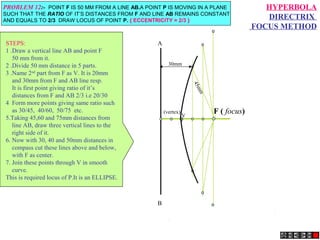
PROBLEM 12:- POINT F IS 50 MM FROM A LINE AB.A POINT P IS MOVING IN A PLANE                   HYPERBOLA
SUCH THAT THE RATIO OF IT’S DISTANCES FROM F AND LINE AB REMAINS CONSTANT
AND EQUALS TO 2/3 DRAW LOCUS OF POINT P. { ECCENTRICITY = 2/3 }
                                                                                              DIRECTRIX
                                                                                           FOCUS METHOD

STEPS:                                             A
1 .Draw a vertical line AB and point F
   50 mm from it.
2 .Divide 50 mm distance in 5 parts.                     30mm
3 .Name 2nd part from F as V. It is 20mm
   and 30mm from F and AB line resp.


                                                                      45m
   It is first point giving ratio of it’s


                                                                          m
   distances from F and AB 2/3 i.e 20/30
4 Form more points giving same ratio such
   as 30/45, 40/60, 50/75 etc.                         (vertex)
                                                                  V
                                                                              F ( focus)
5.Taking 45,60 and 75mm distances from
   line AB, draw three vertical lines to the
   right side of it.
6. Now with 30, 40 and 50mm distances in
   compass cut these lines above and below,
   with F as center.
7. Join these points through V in smooth
   curve.
This is required locus of P.It is an ELLIPSE.


                                                   B
ELLIPSE
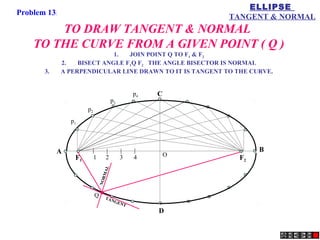
Problem 13:
                                                             TANGENT & NORMAL
        TO DRAW TANGENT & NORMAL
    TO THE CURVE FROM A GIVEN POINT ( Q )
                             1.  JOIN POINT Q TO F1 & F2
              2.   BISECT ANGLE F1Q F2 THE ANGLE BISECTOR IS NORMAL
       3.     A PERPENDICULAR LINE DRAWN TO IT IS TANGENT TO THE CURVE.


                                                p4   C
                                       p3
                      p2
                p1


            A                                                      B
                                                         O
                 F1        1       2        3   4             F2
                                 ALM
                               NOR


                           Q       TAN
                                      GE
                                        NT
                                                     D
ELLIPSE
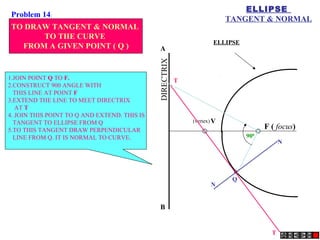
Problem 14:
                                                                           TANGENT & NORMAL
TO DRAW TANGENT & NORMAL
      TO THE CURVE
                                                                      ELLIPSE
  FROM A GIVEN POINT ( Q )                    A


                                              DIRECTRIX
1.JOIN POINT Q TO F.                                      T
2.CONSTRUCT 900 ANGLE WITH
  THIS LINE AT POINT F
3.EXTEND THE LINE TO MEET DIRECTRIX
   AT T
4. JOIN THIS POINT TO Q AND EXTEND. THIS IS
  TANGENT TO ELLIPSE FROM Q                                   (vertex) V
5.TO THIS TANGENT DRAW PERPENDICULAR                                                  F ( focus)
  LINE FROM Q. IT IS NORMAL TO CURVE.                                           900
                                                                                            N


                                                                            Q
                                                                     N


                                              B


                                                                                        T
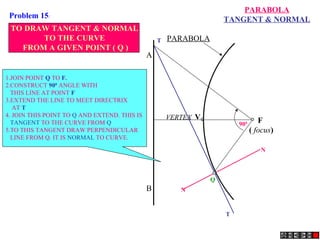
PARABOLA
 Problem 15:                                                         TANGENT & NORMAL
 TO DRAW TANGENT & NORMAL
       TO THE CURVE                               T   PARABOLA
   FROM A GIVEN POINT ( Q )
                                              A

1.JOIN POINT Q TO F.
2.CONSTRUCT 900 ANGLE WITH
  THIS LINE AT POINT F
3.EXTEND THE LINE TO MEET DIRECTRIX
   AT T
4. JOIN THIS POINT TO Q AND EXTEND. THIS IS           VERTEX V
  TANGENT TO THE CURVE FROM Q                                            900      F
5.TO THIS TANGENT DRAW PERPENDICULAR                                           ( focus)
  LINE FROM Q. IT IS NORMAL TO CURVE.
                                                                                  N


                                                                 Q
                                              B          N


                                                                     T
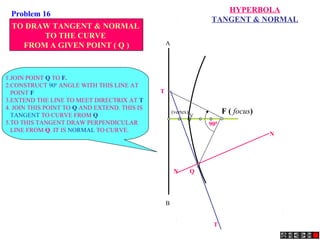
HYPERBOLA
 Problem 16
                                                                     TANGENT & NORMAL
 TO DRAW TANGENT & NORMAL
       TO THE CURVE
   FROM A GIVEN POINT ( Q )                       A


1.JOIN POINT Q TO F.
2.CONSTRUCT 900 ANGLE WITH THIS LINE AT
  POINT F                                     T
3.EXTEND THE LINE TO MEET DIRECTRIX AT T
4. JOIN THIS POINT TO Q AND EXTEND. THIS IS
  TANGENT TO CURVE FROM Q
                                                      (vertex)
                                                                 V
                                                                           F ( focus)
5.TO THIS TANGENT DRAW PERPENDICULAR                                 900
  LINE FROM Q. IT IS NORMAL TO CURVE.
                                                                                        N


                                                      N          Q


                                                  B


                                                                      T

Curves part one

  • 1.
    ENGINEERING CURVES Part- I {Conic Sections} ELLIPSE PARABOLA HYPERBOLA 1.Concentric Circle Method 1.Rectangle Method 1.Rectangular Hyperbola (coordinates given) 2.Rectangle Method 2 Method of Tangents ( Triangle Method) 2 Rectangular Hyperbola 3.Oblong Method (P-V diagram - Equation given) 3.Basic Locus Method 4.Arcs of Circle Method (Directrix – focus) 3.Basic Locus Method (Directrix – focus) 5.Rhombus Metho 6.Basic Locus Method Methods of Drawing (Directrix – focus) Tangents & Normals To These Curves.
  • 2.
    CONIC SECTIONS ELLIPSE, PARABOLA AND HYPERBOLA ARE CALLED CONIC SECTIONS BECAUSE THESE CURVES APPEAR ON THE SURFACE OF A CONE WHEN IT IS CUT BY SOME TYPICAL CUTTING PLANES. OBSERVE ILLUSTRATIONS GIVEN BELOW.. Ellipse Section Plane ola Section Plane Through Generators Hyperbola rab Parallel to Axis. Pa Section Plane Parallel to end generator.
  • 3.
    COMMON DEFINATION OFELLIPSE, PARABOLA & HYPERBOLA: These are the loci of points moving in a plane such that the ratio of it’s distances from a fixed point And a fixed line always remains constant. The Ratio is called ECCENTRICITY. (E) A) For Ellipse E<1 B) For Parabola E=1 C) For Hyperbola E>1 Refer Problem nos. 6. 9 & 12 SECOND DEFINATION OF AN ELLIPSE:- It is a locus of a point moving in a plane such that the SUM of it’s distances from TWO fixed points always remains constant. {And this sum equals to the length of major axis.} These TWO fixed points are FOCUS 1 & FOCUS 2 Refer Problem no.4 Ellipse by Arcs of Circles Method.
  • 4.
    ELLIPSE BY CONCENTRIC CIRCLE METHOD Problem 1 :- Draw ellipse by concentric circle method. Take major axis 100 mm and minor axis 70 mm long. 3 2 4 Steps: 1. Draw both axes as perpendicular bisectors C of each other & name their ends as shown. 2. Taking their intersecting point as a center, 1 5 3 2 4 draw two concentric circles considering both as respective diameters. 1 5 3. Divide both circles in 12 equal parts & name as shown. A 4. From all points of outer circle draw vertical B lines downwards and upwards respectively. 5.From all points of inner circle draw 10 6 horizontal lines to intersect those vertical lines. 10 9 7 6 6. Mark all intersecting points properly as 8 those are the points on ellipse. D 7. Join all these points along with the ends of both axes in smooth possible curve. It is 9 7 required ellipse. 8
  • 5.
    Steps: ELLIPSE BY RECTANGLE METHOD 1 Draw a rectangle taking major and minor axes as sides. 2. In this rectangle draw both Problem 2 axes as perpendicular bisectors Draw ellipse by Rectangle method. of each other.. 3. For construction, select upper Take major axis 100 mm and minor axis 70 mm long. left part of rectangle. Divide vertical small side and horizontal long side into same number of D 4 4 equal parts.( here divided in four parts) 3 3 4. Name those as shown.. 5. Now join all vertical points 2 2 1,2,3,4, to the upper end of minor axis. And all horizontal points 1 1 i.e.1,2,3,4 to the lower end of minor axis. A 1 2 3 4 3 2 1 B 6. Then extend C-1 line upto D-1 and mark that point. Similarly extend C-2, C-3, C-4 lines up to D-2, D-3, & D-4 lines. 7. Mark all these points properly and join all along with ends A and D in smooth possible curve. Do similar construction in right C side part.along with lower half of the rectangle.Join all points in smooth curve. It is required ellipse.
  • 6.
    ELLIPSE Problem 3:- BY OBLONG METHOD Draw ellipse by Oblong method. Draw a parallelogram of 100 mm and 70 mm long sides with included angle of 750.Inscribe Ellipse in it. STEPS ARE SIMILAR TO THE PREVIOUS CASE (RECTANGLE METHOD) ONLY IN PLACE OF RECTANGLE, HERE IS A PARALLELOGRAM. D 4 4 3 3 2 2 1 1 A 1 2 3 4 3 2 1 B C
  • 7.
    PROBLEM 4. ELLIPSE MAJOR AXIS AB & MINOR AXIS CD ARE BY ARCS OF CIRCLE METHOD 100 AMD 70MM LONG RESPECTIVELY .DRAW ELLIPSE BY ARCS OF CIRLES METHOD. As per the definition Ellipse is locus of point P moving in a plane such that the SUM of it’s distances from two fixed STEPS: points (F1 & F2) remains constant and equals to the length 1.Draw both axes as usual.Name the of major axis AB.(Note A .1+ B .1=A . 2 + B. 2 = AB) ends & intersecting point 2.Taking AO distance I.e.half major axis, from C, mark F1 & F2 On AB . p4 C ( focus 1 and 2.) p3 3.On line F1- O taking any distance, p2 mark points 1,2,3, & 4 p1 4.Taking F1 center, with distance A-1 draw an arc above AB and taking F2 center, with B-1 distance cut this arc. Name the point p1 A B O 5.Repeat this step with same centers but F1 1 2 3 4 F2 taking now A-2 & B-2 distances for drawing arcs. Name the point p2 6.Similarly get all other P points. With same steps positions of P can be located below AB. 7.Join all points by smooth curve to get an ellipse/ D
  • 8.
    PROBLEM 5. ELLIPSE DRAW RHOMBUS OF 100 MM & 70 MM LONG BY RHOMBUS METHOD DIAGONALS AND INSCRIBE AN ELLIPSE IN IT. STEPS: 2 1. Draw rhombus of given dimensions. 2. Mark mid points of all sides & name Those A,B,C,& D 3. Join these points to the ends of A B smaller diagonals. 4. Mark points 1,2,3,4 as four centers. 5. Taking 1 as center and 1-A 3 4 radius draw an arc AB. 6. Take 2 as center draw an arc CD. 7. Similarly taking 3 & 4 as centers and 3-D radius draw arcs DA & BC. D C 1
  • 9.
    PROBLEM 6:- POINTF IS 50 MM FROM A LINE AB.A POINT P IS MOVING IN A PLANE SUCH THAT THE RATIO OF IT’S DISTANCES FROM F AND LINE AB REMAINS CONSTANT ELLIPSE AND EQUALS TO 2/3 DRAW LOCUS OF POINT P. { ECCENTRICITY = 2/3 } DIRECTRIX-FOCUS METHOD ELLIPSE A STEPS: 1 .Draw a vertical line AB and point F DIRECTRIX 50 mm from it. 2 .Divide 50 mm distance in 5 parts. 45mm 3 .Name 2nd part from F as V. It is 20mm and 30mm from F and AB line resp. 30mm It is first point giving ratio of it’s distances from F and AB 2/3 i.e 20/30 4 Form more points giving same ratio such as 30/45, 40/60, 50/75 etc. (vertex) V 5.Taking 45,60 and 75mm distances from F ( focus) line AB, draw three vertical lines to the right side of it. 6. Now with 30, 40 and 50mm distances in compass cut these lines above and below, with F as center. 7. Join these points through V in smooth curve. This is required locus of P.It is an ELLIPSE. B
  • 10.
    PROBLEM 7: ABALL THROWN IN AIR ATTAINS 100 M HIEGHT PARABOLA AND COVERS HORIZONTAL DISTANCE 150 M ON GROUND. RECTANGLE METHOD Draw the path of the ball (projectile)- STEPS: 6 6 1.Draw rectangle of above size and divide it in two equal vertical parts 2.Consider left part for construction. 5 5 Divide height and length in equal number of parts and name those 1,2,3,4,5& 6 4 4 3.Join vertical 1,2,3,4,5 & 6 to the top center of rectangle 4.Similarly draw upward vertical 3 3 lines from horizontal1,2,3,4,5 And wherever these lines intersect previously drawn inclined lines in sequence Mark those points and 2 2 further join in smooth possible curve. 5.Repeat the construction on right side rectangle also.Join all in sequence. 1 1 This locus is Parabola. . 1 2 3 4 5 6 5 4 3 2 1
  • 11.
    Draw a parabolaby tangent method given base 7.5m and axis 4.5m Take scale 1cm = 0.5m O 6 5 1’ 4.5m 4 2’ 3 F 3’ 2 4’ 4.5m 1 5’ 6’ E B A 7.5m
  • 12.
    PROBLEM 9: PointF is 50 mm from a vertical straight line AB. PARABOLA Draw locus of point P, moving in a plane such that DIRECTRIX-FOCUS METHOD it always remains equidistant from point F and line AB. PARABOLA SOLUTION STEPS: 1.Locate center of line, perpendicular to A AB from point F. This will be initial point P and also the vertex. 2.Mark 5 mm distance to its right side, name those points 1,2,3,4 and from P1 those draw lines parallel to AB. 3.Mark 5 mm distance to its left of P and (VERTEX) V name it 1. F O 1 2 3 4 4.Take O-1 distance as radius and F as center draw an arc ( focus) cutting first parallel line to AB. Name upper point P1 and lower point P2. P2 (FP1=O1) 5.Similarly repeat this process by taking again 5mm to right and left and locate P3 P4 . B 6.Join all these points in smooth curve. It will be the locus of P equidistance from line AB and fixed point F.
  • 13.
    Problem No.10: PointP is 40 mm and 30 mm from horizontal HYPERBOLA and vertical axes respectively.Draw Hyperbola through it. THROUGH A POINT OF KNOWN CO-ORDINATES Solution Steps: 1) Extend horizontal line from P to right side. 2 2) Extend vertical line from P upward. 3) On horizontal line from P, mark some points taking any distance and name them after P-1, 2,3,4 etc. 4) Join 1-2-3-4 points to pole O. Let them cut 1 part [P-B] also at 1,2,3,4 points. 5) From horizontal 1,2,3,4 draw vertical 2 1 P 1 2 3 lines downwards and 6) From vertical 1,2,3,4 points [from P-B] draw 1 horizontal lines. 7) Line from 1 40 mm 2 horizontal and line from 1 vertical will meet at 3 P1.Similarly mark P2, P3, P4 points. O 8) Repeat the procedure by marking four points 30 mm on upward vertical line from P and joining all those to pole O. Name this points P6, P7, P8 etc. and join them by smooth
  • 14.
    Problem no.11: Asample of gas is expanded in a cylinder HYPERBOLA from 10 unit pressure to 1 unit pressure.Expansion follows law PV=Constant.If initial volume being 1 unit, draw the P-V DIAGRAM curve of expansion. Also Name the curve. Form a table giving few more values of P & V 10 P V = C 9 +++ +++ + 10 1 = 10 5 2 = 10 8 4 2.5 = 10 2.5 4 = 10 7 2 5 = 10 1 10 = 10 6 PRESSURE Now draw a Graph of 5 ( Kg/cm2) Pressure against Volume. It is a PV Diagram and it is Hyperbola. Take pressure on vertical axis and 4 Volume on horizontal axis. 3 2 1 0 1 2 3 4 5 6 7 8 9 10 VOLUME:( M3 )
  • 15.
    PROBLEM 12:- POINTF IS 50 MM FROM A LINE AB.A POINT P IS MOVING IN A PLANE HYPERBOLA SUCH THAT THE RATIO OF IT’S DISTANCES FROM F AND LINE AB REMAINS CONSTANT AND EQUALS TO 2/3 DRAW LOCUS OF POINT P. { ECCENTRICITY = 2/3 } DIRECTRIX FOCUS METHOD STEPS: A 1 .Draw a vertical line AB and point F 50 mm from it. 2 .Divide 50 mm distance in 5 parts. 30mm 3 .Name 2nd part from F as V. It is 20mm and 30mm from F and AB line resp. 45m It is first point giving ratio of it’s m distances from F and AB 2/3 i.e 20/30 4 Form more points giving same ratio such as 30/45, 40/60, 50/75 etc. (vertex) V F ( focus) 5.Taking 45,60 and 75mm distances from line AB, draw three vertical lines to the right side of it. 6. Now with 30, 40 and 50mm distances in compass cut these lines above and below, with F as center. 7. Join these points through V in smooth curve. This is required locus of P.It is an ELLIPSE. B
  • 16.
    ELLIPSE Problem 13: TANGENT & NORMAL TO DRAW TANGENT & NORMAL TO THE CURVE FROM A GIVEN POINT ( Q ) 1. JOIN POINT Q TO F1 & F2 2. BISECT ANGLE F1Q F2 THE ANGLE BISECTOR IS NORMAL 3. A PERPENDICULAR LINE DRAWN TO IT IS TANGENT TO THE CURVE. p4 C p3 p2 p1 A B O F1 1 2 3 4 F2 ALM NOR Q TAN GE NT D
  • 17.
    ELLIPSE Problem 14: TANGENT & NORMAL TO DRAW TANGENT & NORMAL TO THE CURVE ELLIPSE FROM A GIVEN POINT ( Q ) A DIRECTRIX 1.JOIN POINT Q TO F. T 2.CONSTRUCT 900 ANGLE WITH THIS LINE AT POINT F 3.EXTEND THE LINE TO MEET DIRECTRIX AT T 4. JOIN THIS POINT TO Q AND EXTEND. THIS IS TANGENT TO ELLIPSE FROM Q (vertex) V 5.TO THIS TANGENT DRAW PERPENDICULAR F ( focus) LINE FROM Q. IT IS NORMAL TO CURVE. 900 N Q N B T
  • 18.
    PARABOLA Problem 15: TANGENT & NORMAL TO DRAW TANGENT & NORMAL TO THE CURVE T PARABOLA FROM A GIVEN POINT ( Q ) A 1.JOIN POINT Q TO F. 2.CONSTRUCT 900 ANGLE WITH THIS LINE AT POINT F 3.EXTEND THE LINE TO MEET DIRECTRIX AT T 4. JOIN THIS POINT TO Q AND EXTEND. THIS IS VERTEX V TANGENT TO THE CURVE FROM Q 900 F 5.TO THIS TANGENT DRAW PERPENDICULAR ( focus) LINE FROM Q. IT IS NORMAL TO CURVE. N Q B N T
  • 19.
    HYPERBOLA Problem 16 TANGENT & NORMAL TO DRAW TANGENT & NORMAL TO THE CURVE FROM A GIVEN POINT ( Q ) A 1.JOIN POINT Q TO F. 2.CONSTRUCT 900 ANGLE WITH THIS LINE AT POINT F T 3.EXTEND THE LINE TO MEET DIRECTRIX AT T 4. JOIN THIS POINT TO Q AND EXTEND. THIS IS TANGENT TO CURVE FROM Q (vertex) V F ( focus) 5.TO THIS TANGENT DRAW PERPENDICULAR 900 LINE FROM Q. IT IS NORMAL TO CURVE. N N Q B T