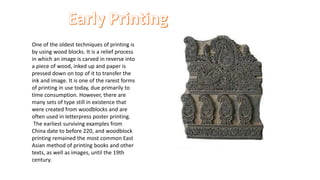
One of the oldest techniques of printing is
by using wood blocks. It is a relief process
in which an image is carved in reverse into
a piece of wood, inked up and paper is
pressed down on top of it to transfer the
ink and image. It is one of the rarest forms
of printing in use today, due primarily to
time consumption. However, there are
many sets of type still in existence that
were created from woodblocks and are
often used in letterpress poster printing.
The earliest surviving examples from
China date to before 220, and woodblock
printing remained the most common East
Asian method of printing books and other
texts, as well as images, until the 19th
century.
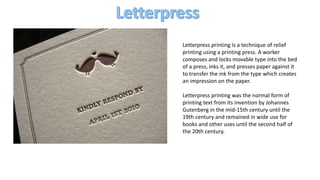
Letterpress printing is a technique of relief
printing using a printing press. A worker
composes and locks movable type into the bed
of a press, inks it, and presses paper against it
to transfer the ink from the type which creates
an impression on the paper.
Letterpress printing was the normal form of
printing text from its invention by Johannes
Gutenberg in the mid-15th century until the
19th century and remained in wide use for
books and other uses until the second half of
the 20th century.
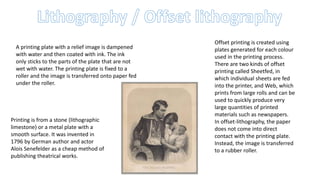
A printing plate with a relief image is dampened
with water and then coated with ink. The ink
only sticks to the parts of the plate that are not
wet with water. The printing plate is fixed to a
roller and the image is transferred onto paper fed
under the roller.
Offset printing is created using
plates generated for each colour
used in the printing process.
There are two kinds of offset
printing called Sheetfed, in
which individual sheets are fed
into the printer, and Web, which
prints from large rolls and can be
used to quickly produce very
large quantities of printed
materials such as newspapers.
In offset-lithography, the paper
does not come into direct
contact with the printing plate.
Instead, the image is transferred
to a rubber roller.
Printing is from a stone (lithographic
limestone) or a metal plate with a
smooth surface. It was invented in
1796 by German author and actor
Alois Senefelder as a cheap method of
publishing theatrical works.
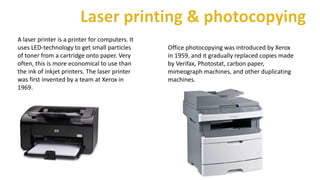
A laser printer is a printer for computers. It
uses LED-technology to get small particles
of toner from a cartridge onto paper. Very
often, this is more economical to use than
the ink of inkjet printers. The laser printer
was first invented by a team at Xerox in
1969.
Office photocopying was introduced by Xerox
in 1959, and it gradually replaced copies made
by Verifax, Photostat, carbon paper,
mimeograph machines, and other duplicating
machines.
Desktop publishing (abbreviated
DTP) is the creation of
documents using page layout
skills on a personal computer.
Desktop publishing software can
generate layouts and produce
typographic quality text and
images comparable to
traditional typography and
printing.
It was primarily the
introduction of both the
Apple LaserWriter, a
PostScript desktop printer,
and PageMaker for the
Mac that kicked off the
desktop publishing
revolution. The Apple
Macintosh was released in
1984.

Publishing

  • 2.
    One of theoldest techniques of printing is by using wood blocks. It is a relief process in which an image is carved in reverse into a piece of wood, inked up and paper is pressed down on top of it to transfer the ink and image. It is one of the rarest forms of printing in use today, due primarily to time consumption. However, there are many sets of type still in existence that were created from woodblocks and are often used in letterpress poster printing. The earliest surviving examples from China date to before 220, and woodblock printing remained the most common East Asian method of printing books and other texts, as well as images, until the 19th century.
  • 3.
    Letterpress printing isa technique of relief printing using a printing press. A worker composes and locks movable type into the bed of a press, inks it, and presses paper against it to transfer the ink from the type which creates an impression on the paper. Letterpress printing was the normal form of printing text from its invention by Johannes Gutenberg in the mid-15th century until the 19th century and remained in wide use for books and other uses until the second half of the 20th century.
  • 4.
    A printing platewith a relief image is dampened with water and then coated with ink. The ink only sticks to the parts of the plate that are not wet with water. The printing plate is fixed to a roller and the image is transferred onto paper fed under the roller. Offset printing is created using plates generated for each colour used in the printing process. There are two kinds of offset printing called Sheetfed, in which individual sheets are fed into the printer, and Web, which prints from large rolls and can be used to quickly produce very large quantities of printed materials such as newspapers. In offset-lithography, the paper does not come into direct contact with the printing plate. Instead, the image is transferred to a rubber roller. Printing is from a stone (lithographic limestone) or a metal plate with a smooth surface. It was invented in 1796 by German author and actor Alois Senefelder as a cheap method of publishing theatrical works.
  • 5.
    A laser printeris a printer for computers. It uses LED-technology to get small particles of toner from a cartridge onto paper. Very often, this is more economical to use than the ink of inkjet printers. The laser printer was first invented by a team at Xerox in 1969. Office photocopying was introduced by Xerox in 1959, and it gradually replaced copies made by Verifax, Photostat, carbon paper, mimeograph machines, and other duplicating machines.
  • 6.
    Desktop publishing (abbreviated DTP)is the creation of documents using page layout skills on a personal computer. Desktop publishing software can generate layouts and produce typographic quality text and images comparable to traditional typography and printing. It was primarily the introduction of both the Apple LaserWriter, a PostScript desktop printer, and PageMaker for the Mac that kicked off the desktop publishing revolution. The Apple Macintosh was released in 1984.