Knowledge Graphs:
The Power of Graph-Based Search
Petra Selmer
Query Languages Standards & Research Group
petra.selmer@neo4j.com
19 September 2018
The property graph data model
Introduction to Neo4j
Knowledge Graphs
Background
What is a Knowledge Graph?
How do they work in Neo4j?
Tools and techniques: a quick tour
Graph Search through Cypher
Outline
The property graph data
model
Underlying construct is a graph
Nodes: represent entities of interest (vertices)
Relationships: connections between nodes (edges)
• Relate nodes by type and direction
• Add structure to the graph
• Provide semantic context for nodes
Properties: key-value pairs (map) representing the data
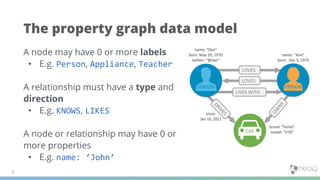
The property graph data model
A node may have 0 or more labels
• E.g. Person, Appliance, Teacher
A relationship must have a type and
direction
• E.g. KNOWS, LIKES
A node or relationship may have 0 or
more properties
• E.g. name: ‘John’
The property graph data model
The topology is as important as the data
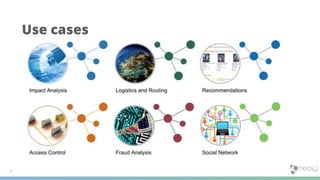
Use cases
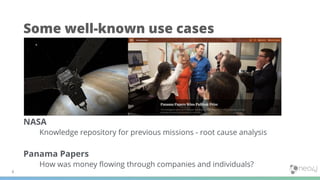
NASA
Knowledge repository for previous missions - root cause analysis
Panama Papers
How was money flowing through companies and individuals?
Some well-known use cases
Introduction to Neo4j
Neo4j is an enterprise-grade native graph platform enabling you to:
• Store, reveal and query connections within your data
• Traverse and analyze any level of depth in real time
• Add context and connect new data on the fly
Consumers of connected data
Neo4j graph platform
Knowledge Graphs
1. Background...
Relationship-driven applications
Organizations have difficulty maintaining their corporate memory
owing to a variety of reasons:
• Growth which drives need for new and continuous education
• Turnover where long-term knowledge is lost
• Ageing infrastructures and siloed information
The Knowledge Graph problem
Lack of knowledge sharing slows project progress, and creates
inconsistencies even among team members.
Organizations don’t know what they don’t know, nor do they know what
they know.
Data scientists, and therefore the organization, are slow to recognize or
react to changing market conditions, so they miss opportunities to
innovate
Bad information is spread inadvertently which erodes corporate trust
Negative consequences
The next wave of competitive advantage will be all about using
connections to identify and build knowledge
Knowledge Graphs in the Age of Connections
2. What is a Knowledge Graph?
Enriching graphs with more and more data (raw or derived) over time...
...resulting in a graph that has more detail, context, truth, intelligence
and semantics...
Enriching graphs with more and more data (raw or derived) over time...
...resulting in a graph that has more detail, context, truth, intelligence
and semantics…
...capturing the real world (your ecosystem) more precisely and more
comprehensively...
Enriching graphs with more and more data (raw or derived) over time...
...resulting in a graph that has more detail, context, truth, intelligence
and semantics…
...capturing the real world (your ecosystem) more precisely and more
comprehensively…
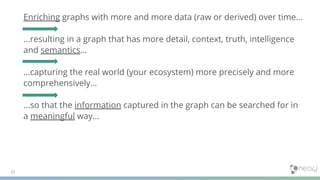
...so that the information captured in the graph can be searched for in
a meaningful way...
Enriching graphs with more and more data (raw or derived) over time...
...resulting in a graph that has more detail, context, truth, intelligence
and semantics…
...capturing the real world (your ecosystem) more precisely and more
comprehensively…
...so that the information captured in the graph can be searched for in
a meaningful way…
...yielding KNOWLEDGE, both directly and indirectly (new insights are
discovered)
A 360 degree-view of:
• any entity of interest,
• auxiliary entities,
• and the processes that surround these
Example:
• Customers
• Products, orders, reviews, delivery, …
• Purchasing, fulfilment, order management, shipping, …
Knowledge Graphs provide:
Give answers
about things it knows about
Explain why and how the answer was returned
from the context and structure within the graph
Knowledge Graphs can:
Knowledge Graphs must be searchable*
*more on this later
3. How do they work in Neo4j?
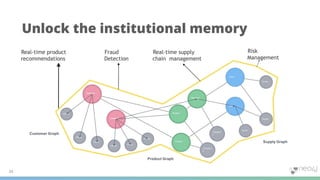
Connecting roles in the enterprise
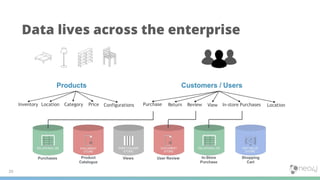
Data lives across the enterprise
Recommendations require an operational workload
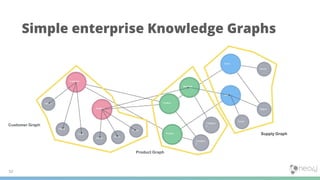
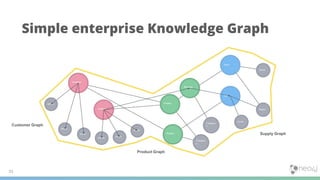
Simple enterprise Knowledge Graphs
Simple enterprise Knowledge Graph
Unlock the institutional memory
Information, especially in analytics, research departments and
customer service should have a searchable, consistent repository,
or representation of a repository, from which to store and draw
institutional knowledge.
Corporations who maintain a knowledge graph will develop higher
degrees of consistency across all areas of business.
The goals
Institutional memory requires a solution that can integrate diverse data sets, often in text
due to the legacy nature of that information and return “context” as a result
Connections and relationships, cause and effect correlation needs to be materialized
and persisted permanently
All information must be indexed, searchable and shareable
The solution must be agile, easily expandable and adaptable to changing business
conditions
The solution needs to be a combination of text-based NLP, ElasticSearch and Graphs.
Information must be easy to visualize and leverage in your processes and workflows
What’s required to get there
Graph-boosted Artificial Intelligence
4. Tools & techniques: a
whistle-stop tour
NLP (Natural Language Processing): understanding human
language (for the purposes of information extraction)
Parsing unstructured data (usually text) to extract entities, their
attributes or properties and the relationships between entities
Named entity recognition: identify entities and categorise them;
e.g. “Daniel Craig” is a Person and an Actor
Tools & techniques: enriching the data
NLP (Natural Language Processing): [continued…]
Entity disambiguation: how to determine which entity is being
referred to; e.g. “Amazon” can be the rainforest in South America,
or the online store
Sentiment analysis: identifying the mood/attitude/emotion of a
statement
Tools & techniques: enriching the data
Provenance and lineage of data:
• How/from where the data was derived or obtained
• This adds to data veracity and quality
Tools & techniques: enriching the data
Inferencing / deriving new facts from machine learning
APOC: ~450 procedures and user-defined functions helping with data integration,
graph algorithms, data conversions etc
https://github.com/neo4j-contrib/neo4j-apoc-procedures
Graph algorithms library (highly-parallelized & efficient): centralities (PageRank,
betweenness…), community detection, path finding etc
https://github.com/neo4j-contrib/neo4j-graph-algorithms
In constant development; links with academic institutions for cutting-edge
optimization techniques
Tools & techniques: enriching the data
Inferencing / deriving new facts: deductive method (from a
knowledge base, rules engine or ontology)
Rules:
If a node X has
(i) a :Person label and
(ii) there is an outgoing TEACHES relationship,
then add a :Teacher label to X
Tools & techniques: enriching the data
Inferencing / deriving new facts: deductive method [continued..]
Use external data sources to obtain new facts; e.g. hook into a
thesaurus to deduce/derive synonyms (ConceptNet, WordNet, ..)
Use the graph to deduce a set of rules (or begin with a seed set,
using ML) which enrich the graph, and subsequently enrich the
rules as more data gets added to the graph: feedback loop
Tools & techniques: enriching the data
Graph search through
Cypher
A declarative graph pattern matching language for property
graphs
SQL-like syntax
DQL for reading data (focus of this section)
DML for creating, updating and deleting data
DDL for creating constraints and indexes
Relationship-centric querying
Recursive querying
Variable-length relationship chains
Returning paths
Introducing Cypher
This is at the
heart of Cypher
http://www.opencypher.org/cips
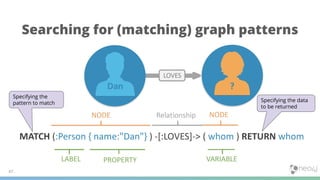
Searching for (matching) graph patterns
Specifying the
pattern to match Specifying the data
to be returned
// Pattern description (ASCII art)
MATCH (me:Person)-[:FRIEND]->(friend)
// Filtering with predicates
WHERE me.name = ‘Frank Black’ AND friend.age > me.age
// Projection of expressions
RETURN toUpper(friend.name) AS name, friend.title AS title
// Order results
ORDER BY name, title DESC
Variable-length relationship patterns
MATCH (me)-[:FRIEND*]-(foaf) // Traverse 1 or more FRIEND relationships
MATCH (me)-[:FRIEND*2..4]-(foaf) // Traverse 2 to 4 FRIEND relationships
// Path binding returns all paths (p)
MATCH p = (a)-[:ONE]-()-[:TWO]-()-[:THREE]-()
// Each path is a list containing the constituent nodes and relationships, in order
RETURN p
DQL: reading data
Input: a property graph
Output: a table
This tells you why the answer was returned (going
back to the context a Knowledge Graph provides)
Extension: Multiple graphs and
query composition
Cypher today: a single graph model
Graph Database System
(e.g. a cluster)
The (single) Graph
Application Server
Client 1
Client 2
Client 3
Cypher: multiple graphs model
Graph Database System
(e.g. a cluster)
Multiple Graphs
Application Server
Client 1
Client 2
Client 3
Accept multiple graphs and a table as input
Return multiple graphs and a table
Chain queries to form a query pipeline
Subquery support
Use cases: create new graphs (either from scratch or from existing
graphs), combining and transforming graphs from multiple
sources, views, access control, snapshot graphs, roll-up and
drill-down operations, ...
Multiple graphs & query composition
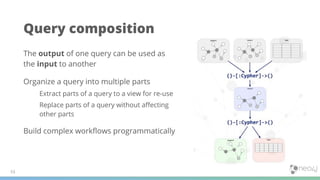
The output of one query can be used as
the input to another
Organize a query into multiple parts
Extract parts of a query to a view for re-use
Replace parts of a query without affecting
other parts
Build complex workflows programmatically
Query composition
Extension: Complex path
patterns
“Patterns of patterns”
Regular path queries (RPQs)
Long academic history
Can specify a path by means of a regular expression over the relationship types
(allowing for nesting of patterns)
X, knows.(likes.eats|drinks)+, Y
Find a path whose edge labels conform to the regular expression, starting at
node X and ending at node Y
Complex path patterns
Concatenation
a.b - a is followed by b
Alternation
a|b - either a or b
Transitive closure
* - 0 or more
+ - 1 or more
{m, n} - at least m, at most n
Optionality:
? - 0 or 1
Grouping/nesting
() - allows nesting/defines scope
Find complex connections
Increase in the need to express “nested patterns”; in particular:
(a.b)*
Property graph data model:
Properties need to be considered
Node labels need to be considered
Specifying a cost for paths (ordering and comparing)
Path Pattern Queries in Cypher
https://github.com/thobe/openCypher/blob/rpq/cip/1.accepted/CIP2017-02-06-Path-Patterns.adoc
PATH PATTERN
older_friends = (a)-[:FRIEND]-(b) WHERE b.age >
a.age
MATCH p=(me)-/~older_friends+/-(you)
WHERE me.name = $myName AND you.name = $yourName
RETURN p AS friendship
Path Pattern: example
Extension: Configurable
pattern-matching
semantics
MATCH (p:Person {name: Jack})-[r1:FRIEND]-()-[r2:FRIEND]-(friend_of_a_friend)
RETURN friend_of_a_friend.name AS fofName
+---------+
| fofName |
+---------+
| “Tom” |
+---------+
Cypher today
:Person
{ name : Jack }
:Person
{ name : Anne }
:Person
{ name : Tom }
:FRIEND :FRIEND
Usefulness proven in practice over
multiple industrial verticals
r1 and r2 may not be
bound to the same
relationship within the
same pattern
Rationale was to avoid potentially
returning infinite results for varlength
patterns when matching graphs
containing cycles (this would have been
different if we were just checking for the
existence of a path)
r1 r2
All the *morphisms
All forms are valid in different
scenarios
The user can configure which
semantics they wish to use at
a query level
Configurable pattern quantifiers controlling how many matches are returned
ANY At most one match (existence checking)
EACH All matches
Configurable pattern length restrictions limits the length and nature of
matches
SHORTEST Consider only shortest path (determined by length of path)
CHEAPEST Consider only cheapest path (determined by cost function in Path Pattern)
UNRESTRICTED
Pattern quantifiers and length restrictions
Extension: Schema
Principle of schema optionality
Extending the schema to ‘tighten up’ the data model
Some examples:
• Endpoint requirements; e.g. an :OWNS relationship may only end at a
node labelled with either :Vehicle or :Building
• Cardinality constraints; e.g. a :KNOWS relationship must occur no more
than 3 times between any two :Person-labelled nodes
Constraints
Thank you!
petra.selmer@neo4j.com

Knowledge Graphs - The Power of Graph-Based Search

  • 1.
    Knowledge Graphs: The Powerof Graph-Based Search Petra Selmer Query Languages Standards & Research Group petra.selmer@neo4j.com 19 September 2018
  • 2.
    The property graphdata model Introduction to Neo4j Knowledge Graphs Background What is a Knowledge Graph? How do they work in Neo4j? Tools and techniques: a quick tour Graph Search through Cypher Outline
  • 3.
  • 4.
    Underlying construct isa graph Nodes: represent entities of interest (vertices) Relationships: connections between nodes (edges) • Relate nodes by type and direction • Add structure to the graph • Provide semantic context for nodes Properties: key-value pairs (map) representing the data The property graph data model
  • 5.
    A node mayhave 0 or more labels • E.g. Person, Appliance, Teacher A relationship must have a type and direction • E.g. KNOWS, LIKES A node or relationship may have 0 or more properties • E.g. name: ‘John’ The property graph data model
  • 6.
    The topology isas important as the data
  • 7.
  • 8.
    NASA Knowledge repository forprevious missions - root cause analysis Panama Papers How was money flowing through companies and individuals? Some well-known use cases
  • 9.
  • 10.
    Neo4j is anenterprise-grade native graph platform enabling you to: • Store, reveal and query connections within your data • Traverse and analyze any level of depth in real time • Add context and connect new data on the fly Consumers of connected data
  • 11.
  • 12.
  • 13.
  • 14.
  • 15.
    Organizations have difficultymaintaining their corporate memory owing to a variety of reasons: • Growth which drives need for new and continuous education • Turnover where long-term knowledge is lost • Ageing infrastructures and siloed information The Knowledge Graph problem
  • 16.
    Lack of knowledgesharing slows project progress, and creates inconsistencies even among team members. Organizations don’t know what they don’t know, nor do they know what they know. Data scientists, and therefore the organization, are slow to recognize or react to changing market conditions, so they miss opportunities to innovate Bad information is spread inadvertently which erodes corporate trust Negative consequences
  • 17.
    The next waveof competitive advantage will be all about using connections to identify and build knowledge Knowledge Graphs in the Age of Connections
  • 18.
    2. What isa Knowledge Graph?
  • 19.
    Enriching graphs withmore and more data (raw or derived) over time...
  • 20.
    Enriching graphs withmore and more data (raw or derived) over time... ...resulting in a graph that has more detail, context, truth, intelligence and semantics...
  • 21.
    Enriching graphs withmore and more data (raw or derived) over time... ...resulting in a graph that has more detail, context, truth, intelligence and semantics… ...capturing the real world (your ecosystem) more precisely and more comprehensively...
  • 22.
    Enriching graphs withmore and more data (raw or derived) over time... ...resulting in a graph that has more detail, context, truth, intelligence and semantics… ...capturing the real world (your ecosystem) more precisely and more comprehensively… ...so that the information captured in the graph can be searched for in a meaningful way...
  • 23.
    Enriching graphs withmore and more data (raw or derived) over time... ...resulting in a graph that has more detail, context, truth, intelligence and semantics… ...capturing the real world (your ecosystem) more precisely and more comprehensively… ...so that the information captured in the graph can be searched for in a meaningful way… ...yielding KNOWLEDGE, both directly and indirectly (new insights are discovered)
  • 24.
    A 360 degree-viewof: • any entity of interest, • auxiliary entities, • and the processes that surround these Example: • Customers • Products, orders, reviews, delivery, … • Purchasing, fulfilment, order management, shipping, … Knowledge Graphs provide:
  • 25.
    Give answers about thingsit knows about Explain why and how the answer was returned from the context and structure within the graph Knowledge Graphs can:
  • 26.
    Knowledge Graphs mustbe searchable* *more on this later
  • 27.
    3. How dothey work in Neo4j?
  • 28.
    Connecting roles inthe enterprise
  • 29.
    Data lives acrossthe enterprise
  • 30.
    Recommendations require anoperational workload
  • 32.
  • 33.
  • 34.
  • 35.
    Information, especially inanalytics, research departments and customer service should have a searchable, consistent repository, or representation of a repository, from which to store and draw institutional knowledge. Corporations who maintain a knowledge graph will develop higher degrees of consistency across all areas of business. The goals
  • 36.
    Institutional memory requiresa solution that can integrate diverse data sets, often in text due to the legacy nature of that information and return “context” as a result Connections and relationships, cause and effect correlation needs to be materialized and persisted permanently All information must be indexed, searchable and shareable The solution must be agile, easily expandable and adaptable to changing business conditions The solution needs to be a combination of text-based NLP, ElasticSearch and Graphs. Information must be easy to visualize and leverage in your processes and workflows What’s required to get there
  • 37.
  • 38.
    4. Tools &techniques: a whistle-stop tour
  • 39.
    NLP (Natural LanguageProcessing): understanding human language (for the purposes of information extraction) Parsing unstructured data (usually text) to extract entities, their attributes or properties and the relationships between entities Named entity recognition: identify entities and categorise them; e.g. “Daniel Craig” is a Person and an Actor Tools & techniques: enriching the data
  • 40.
    NLP (Natural LanguageProcessing): [continued…] Entity disambiguation: how to determine which entity is being referred to; e.g. “Amazon” can be the rainforest in South America, or the online store Sentiment analysis: identifying the mood/attitude/emotion of a statement Tools & techniques: enriching the data
  • 41.
    Provenance and lineageof data: • How/from where the data was derived or obtained • This adds to data veracity and quality Tools & techniques: enriching the data
  • 42.
    Inferencing / derivingnew facts from machine learning APOC: ~450 procedures and user-defined functions helping with data integration, graph algorithms, data conversions etc https://github.com/neo4j-contrib/neo4j-apoc-procedures Graph algorithms library (highly-parallelized & efficient): centralities (PageRank, betweenness…), community detection, path finding etc https://github.com/neo4j-contrib/neo4j-graph-algorithms In constant development; links with academic institutions for cutting-edge optimization techniques Tools & techniques: enriching the data
  • 43.
    Inferencing / derivingnew facts: deductive method (from a knowledge base, rules engine or ontology) Rules: If a node X has (i) a :Person label and (ii) there is an outgoing TEACHES relationship, then add a :Teacher label to X Tools & techniques: enriching the data
  • 44.
    Inferencing / derivingnew facts: deductive method [continued..] Use external data sources to obtain new facts; e.g. hook into a thesaurus to deduce/derive synonyms (ConceptNet, WordNet, ..) Use the graph to deduce a set of rules (or begin with a seed set, using ML) which enrich the graph, and subsequently enrich the rules as more data gets added to the graph: feedback loop Tools & techniques: enriching the data
  • 45.
  • 46.
    A declarative graphpattern matching language for property graphs SQL-like syntax DQL for reading data (focus of this section) DML for creating, updating and deleting data DDL for creating constraints and indexes Relationship-centric querying Recursive querying Variable-length relationship chains Returning paths Introducing Cypher This is at the heart of Cypher http://www.opencypher.org/cips
  • 47.
    Searching for (matching)graph patterns Specifying the pattern to match Specifying the data to be returned
  • 48.
    // Pattern description(ASCII art) MATCH (me:Person)-[:FRIEND]->(friend) // Filtering with predicates WHERE me.name = ‘Frank Black’ AND friend.age > me.age // Projection of expressions RETURN toUpper(friend.name) AS name, friend.title AS title // Order results ORDER BY name, title DESC Variable-length relationship patterns MATCH (me)-[:FRIEND*]-(foaf) // Traverse 1 or more FRIEND relationships MATCH (me)-[:FRIEND*2..4]-(foaf) // Traverse 2 to 4 FRIEND relationships // Path binding returns all paths (p) MATCH p = (a)-[:ONE]-()-[:TWO]-()-[:THREE]-() // Each path is a list containing the constituent nodes and relationships, in order RETURN p DQL: reading data Input: a property graph Output: a table This tells you why the answer was returned (going back to the context a Knowledge Graph provides)
  • 49.
    Extension: Multiple graphsand query composition
  • 50.
    Cypher today: asingle graph model Graph Database System (e.g. a cluster) The (single) Graph Application Server Client 1 Client 2 Client 3
  • 51.
    Cypher: multiple graphsmodel Graph Database System (e.g. a cluster) Multiple Graphs Application Server Client 1 Client 2 Client 3
  • 52.
    Accept multiple graphsand a table as input Return multiple graphs and a table Chain queries to form a query pipeline Subquery support Use cases: create new graphs (either from scratch or from existing graphs), combining and transforming graphs from multiple sources, views, access control, snapshot graphs, roll-up and drill-down operations, ... Multiple graphs & query composition
  • 53.
    The output ofone query can be used as the input to another Organize a query into multiple parts Extract parts of a query to a view for re-use Replace parts of a query without affecting other parts Build complex workflows programmatically Query composition
  • 54.
  • 55.
    “Patterns of patterns” Regularpath queries (RPQs) Long academic history Can specify a path by means of a regular expression over the relationship types (allowing for nesting of patterns) X, knows.(likes.eats|drinks)+, Y Find a path whose edge labels conform to the regular expression, starting at node X and ending at node Y Complex path patterns Concatenation a.b - a is followed by b Alternation a|b - either a or b Transitive closure * - 0 or more + - 1 or more {m, n} - at least m, at most n Optionality: ? - 0 or 1 Grouping/nesting () - allows nesting/defines scope
  • 56.
    Find complex connections Increasein the need to express “nested patterns”; in particular: (a.b)* Property graph data model: Properties need to be considered Node labels need to be considered Specifying a cost for paths (ordering and comparing) Path Pattern Queries in Cypher https://github.com/thobe/openCypher/blob/rpq/cip/1.accepted/CIP2017-02-06-Path-Patterns.adoc
  • 57.
    PATH PATTERN older_friends =(a)-[:FRIEND]-(b) WHERE b.age > a.age MATCH p=(me)-/~older_friends+/-(you) WHERE me.name = $myName AND you.name = $yourName RETURN p AS friendship Path Pattern: example
  • 58.
  • 59.
    MATCH (p:Person {name:Jack})-[r1:FRIEND]-()-[r2:FRIEND]-(friend_of_a_friend) RETURN friend_of_a_friend.name AS fofName +---------+ | fofName | +---------+ | “Tom” | +---------+ Cypher today :Person { name : Jack } :Person { name : Anne } :Person { name : Tom } :FRIEND :FRIEND Usefulness proven in practice over multiple industrial verticals r1 and r2 may not be bound to the same relationship within the same pattern Rationale was to avoid potentially returning infinite results for varlength patterns when matching graphs containing cycles (this would have been different if we were just checking for the existence of a path) r1 r2
  • 60.
    All the *morphisms Allforms are valid in different scenarios The user can configure which semantics they wish to use at a query level
  • 61.
    Configurable pattern quantifierscontrolling how many matches are returned ANY At most one match (existence checking) EACH All matches Configurable pattern length restrictions limits the length and nature of matches SHORTEST Consider only shortest path (determined by length of path) CHEAPEST Consider only cheapest path (determined by cost function in Path Pattern) UNRESTRICTED Pattern quantifiers and length restrictions
  • 62.
  • 63.
    Principle of schemaoptionality Extending the schema to ‘tighten up’ the data model Some examples: • Endpoint requirements; e.g. an :OWNS relationship may only end at a node labelled with either :Vehicle or :Building • Cardinality constraints; e.g. a :KNOWS relationship must occur no more than 3 times between any two :Person-labelled nodes Constraints
  • 64.