Databricks on AWS
Unified Analytics Platform with Databricks &
Apache Spark
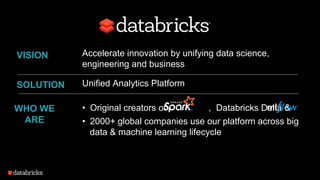
Accelerate innovation by unifying data science,
engineering and business
• Original creators of , Databricks Delta &
• 2000+ global companies use our platform across big
data & machine learning lifecycle
VISION
WHO WE
ARE
Unified Analytics Platform
SOLUTION
AI has huge promise
Transportation Healthcare and
Genomics
and many more...
Internet of Things Fraud Prevention Personalization
Huge disruptive innovations are affecting most enterprises on the planet
Through a Keystone Research study, companies in the top quartile that harness cloud,
data and AI vastly outperformed companies in the bottom quartile by nearly doubling
operating margins and realizing $100M in additional operating income.
Hardest Part of AI isn’t AI, it’s Data
ML
Code
Configuration
Data Collection
Data
Verification
Feature
Extraction
Machine
Resource
Management
Analysis Tools
Process
Management Tools
Serving
Infrastructure
Monitoring
“Hidden Technical Debt in Machine Learning Systems,” Google NIPS
2015
Figure 1: Only a small fraction of real-world ML systems is composed of the ML code, as shown by
the small green box in the middle. The required surrounding infrastructure is vast and complex.
Data & AI Technologies are in Silos
Great for Data, but not
AI
Great for AI, but not for data
x
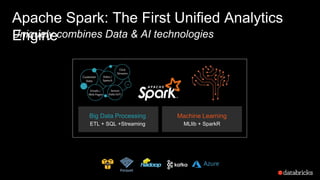
Apache Spark: The First Unified Analytics
Engine
Runtime
Delta
Spark Core Engine
Big Data Processing
ETL + SQL +Streaming
Machine Learning
MLlib + SparkR
Uniquely combines Data & AI technologies
Enterprises face challenges beyond Apache Spark
Scientists
Engineers
Disconnect
Unified Analytics Engine
Complex data pipelines and infrastructure
DATA
ENGINEERS
x
Data & AI People are in Silos
DATA
SCIENTISTS
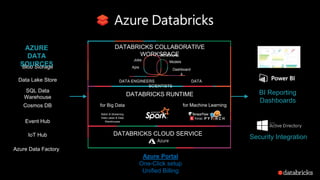
Blob Storage
Data Lake Store
AZURE
DATA
SOURCES
Event Hub
IoT Hub
SQL Data
Warehouse
Cosmos DB
Azure Data Factory
BI Reporting
Dashboards
Security Integration
Azure Portal
One-Click setup
Unified Billing
DATABRICKS COLLABORATIVE
WORKSPACE
DATABRICKS CLOUD SERVICE
Apis
Jobs Models
Notebooks
Dashboard
s
DATABRICKS RUNTIME
for Big Data for Machine Learning
DATA ENGINEERS DATA
SCIENTISTS
Batch & Streaming
Data Lakes & Data
Warehouses
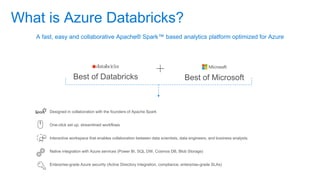
What is Azure Databricks?
A fast, easy and collaborative Apache® Spark™ based analytics platform optimized for Azure
Best of Databricks Best of Microsoft
Designed in collaboration with the founders of Apache Spark
One-click set up; streamlined workflows
Interactive workspace that enables collaboration between data scientists, data engineers, and business analysts.
Native integration with Azure services (Power BI, SQL DW, Cosmos DB, Blob Storage)
Enterprise-grade Azure security (Active Directory integration, compliance, enterprise-grade SLAs)
Get started quickly by launching
your new Spark environment with
one click.
Share your insights in powerful
ways through rich integration with
Power BI.
Improve collaboration amongst
your analytics team through a
unified workspace.
Innovate faster with native
integration with rest of Azure
platform
Simplify security and identity control
with built-in integration with Active
Directory.
Regulate access with fine-grained user
permissions to Azure Databricks’
notebooks, clusters, jobs and data.
Build with confidence on the trusted
cloud backed by unmatched support,
compliance and SLAs.
Operate at massive scale
without limits globally.
Accelerate data processing
with the fastest Spark engine.
ENHANCE
PRODUCTIVITY
BUILD ON THE MOST COMPLIANT
CLOUD
SCALE WITHOUT
LIMITS
Differentiated experience on Azure
Broad Customer Adoption
• Now generally available (as of March 2018)
• Over 500 customers took part in the preview of Azure Databricks
• Widely adopted in many industries (e.g. Retail, Media & Entertainment,
Healthcare)
13
Databricks Accelerating Innovation
1
4
Time required to process full exomes increases
non-linearly as the number of Exomes increases.
Able to leverage the elasticity of the cloud and
DBR
Necessity to ingest and transform and load a wide
variety of ever changing input streams. Traditional
ETL tools couldn’t scale in performance and keep up
with changes
Predictive maintenance and age of aircraft use
case based off of sensor and telemetry data
collected during operations.
Required a solution that was adept at ETL, Data
warehousing, and advanced analytics including NLP,
machine learning, that could interface with existing infr.
BUSINESS
DRIVER
CLIEN
T
DESCRIPTION
Genomic processing
takes too long and
costs too much
Customer receives
broad set of data
requiring ETL and
advanced analytics
Massive ETL process
with constantly
changing input formats
Generalized data
analytic solution for all
mission centers
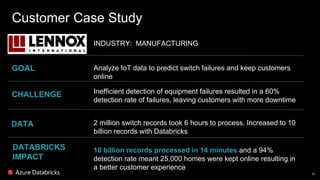
Customer Case Study
15
Analyze IoT data to predict switch failures and keep customers
online
2 million switch records took 6 hours to process. Increased to 10
billion records with Databricks
INDUSTRY: MANUFACTURING
10 billion records processed in 14 minutes and a 94%
detection rate meant 25,000 homes were kept online resulting in
a better customer experience
Inefficient detection of equipment failures resulted in a 60%
detection rate of failures, leaving customers with more downtime
CHALLENGE
GOAL
DATA
DATABRICKS
IMPACT
Information Security Risk - Example
Positive Business Outcomes
• Unification of Big Data Analytical Pipeline
• Data retention of 2 years
• Ingest a more comprehensive set of Data
• Move from Quantitative analytics with SQL to
Predictive analytics
Business Challenges
• Threat Response & Data Eng. Teams working on separate
Infrastructure
• Threat Response Team has access to 2 weeks of historical
data, which is insufficient to triage and investigate potential
breaches
• Unable to ingest and ETL a large number of data sources
• Only able to write SQL Queries – unable to develop more
advanced
Critical Capabilities Business Results
• Customer average 20% decrease of EC2 Cost
• Customer able to run investigations on 2 years of historical data
which significantly reduces the Risks of a breach
• Customer is able to automate investigations which reduces time
to decision
• Estimated Impact to Customer Business: $10M+ in savings
○ Cost Savings & Avoidance
○ Risk Mitigation
○ Impact Revenue and Productivity
• Ease of Use for cluster management: creation, auto-
scaling, tuning & shutdown
• Ability Threat response engineers to build predictive
models & leverage a distributed computation
framework without Eng. assistance
• Threat Response autonomously run full data sets
easily at scale
• Access to expertise on Spark & advance ML
concepts
MICROSOFT CONFIDENTIAL / FOR INTERNAL USE
ONLY
POC proves velocity and security.
The POC was geared toward proving
the solution can deliver the speed to
market Starbucks wanted while also
meeting their stringent security
compliance requirements. Azure
Databricks integration with Azure
Active Directory was a big help on the
security front. And after seeing Azure
Databricks in action, the marketing
team estimated it will drive $100M
annually in top-line revenue growth and
efficiencies.
Near-term ROI. Cost recovery from
Exadata would be slow, so Starbucks
needed to show near-term ROI. The
team got very creative, using $800K in
ECIF ($300K in HDI consumption credit
during migration and $500K in
services). Databricks also contributed
$1.4 million in services.
Walking in technical lock-step. Led
by Microsoft CSAs Jason Robey and
Ed Hagan and Databricks Solution
Architect Bilal Obeidat, the technical
teams for both companies worked like
a single unit to develop a new
reference architecture, implement the
POC, and triage feature requests.
Jointly navigating the business.
Romeo Bolibol, Sr. AE, Tony Clark,
Databricks AE, and Pouneh Partowkia,
Databricks Alliance Lead, used their
respective connections to build support
across cloud, BI, and LOB decision
makers, with Nate Shea-han, GBB,
serving as the catalyst between
Microsoft and Databricks.
Power sponsor a key factor.
Because the Director of Analytics
knew what the solution could do first
hand, the team didn’t need to spend
time on building credibility.
Unlocking the cloud. Starbucks
wanted to deprecate Oracle Exadata.
But after two years, they had only
enabled 15 (out of 300+) data
scientists and analysts on an HDI-
based cloud solution, so teams kept
falling back to old system. Microsoft
and Databricks started from scratch
with a new reference architecture that
would support all required use cases
and provide cloud efficiencies.
One advanced analytics solution for
all businesses and roles. Starbucks
wanted a single data lake that every
line of business could leverage. Azure
Databricks deployed with Azure Data
Lake Store provides the central
advanced analytics and data lake
platform. Starbucks data engineering,
data scientist, and data analyst teams
can all work in the same place,
decreasing time to market.
Internal sponsor changes the game.
Starbucks had been trying to move its
analytics platform to the cloud for two
years to support complex modeling
and analysis across its lines of
business (LOBs), which would allow
them to retire their on-premises Oracle
Exadata system. The problem was
that the HDI-based solution they were
trying to implement just didn’t work
despite a spiderweb of technologies
they had implemented to prop it up.
Then a new Director of Analytics came
on board, who had just finished
implementing Databricks at Nike. He
immediately reached out to Databricks
to see if it would work on Azure. Azure
Databricks was in public preview at the
time, so Databricks quickly pulled in
the Microsoft team. Together they
mapped out plans for a POC.
The anatomy of the win
Microsoft and Databricks unlock cloud analytics at Starbucks; sidelines Oracle Exadata
Key
Resources
Databricks
Key
Resources
Key
Resources
Key
Resources
CSAs
Databricks
Key
Resources
Azure Databricks is Starbucks’
Unified Analytics Platform. After 11
months of engagement, Starbucks
committed to Azure Databricks as their
advanced analytics platform.
Marketing analytics will be the first use
case deployed, with 9 additional use
cases planned, such as supply chain,
loyalty, and fraud detection. Starbucks
has committed to $5M in Databricks
licenses, driving $16M in Azure
consumption over 2.5 years. There is
opportunity for exponential growth as
new use cases are developed.
What’s next? One immediate
opportunity the team is pursuing is
how Azure Databricks could be rolled
out to China – Starbucks’ biggest
growth market.
1
Engage the
customer
2
Build
the team
3
Identify priorities and
challenges
4
Demonstrate
proof
5
Land and
expand
POC
ECIF
Databricks
Microsoft Overview
Results
Results
Q5 Pipeline Generation Targets
3
2
1
2
4
1 LMCO = Analytics (Baylor)/ Security (Gordon)
7
6
8
5
NGC = ESS Analytics (Vitek)/ Security (Raber/ Papay)
RTN = GBS Analytics (Lee)/ Security (Brown/ Costa)
MITRE = Analytics (Sorensen)/ Security (Finn)
ULA = Analytics / Security (IBM)
General Dynamics = Analytics (?) / Security (Baker/
Olmstead)
HII/ NNS = Analytics (Bharat) / Security (Forest (ret)
SAIC = Analytics (? not Chitra, Onstatt) / Security (Lynch/
)
Action Plan -
Here is my ask:
1 hour strategy session on each account
Who, what, where?
Specific Uses Cases for DB and the SSP/ PS team to target
Targeted plan to POC in each account/ multiple BUs or Divisions
Let’s get this party started!
Complete the above by 6/21
Report out to Yagy and Davis on the plan6/25 (e-mail)
Azure Databricks
23
For more information:
databricks.com/azure
Get Started with
Azure Databricks:
http://bit.ly/AzureDatabricks
End

Databricks on AWS.pptx

  • 1.
  • 2.
    Unified Analytics Platformwith Databricks & Apache Spark
  • 3.
    Accelerate innovation byunifying data science, engineering and business • Original creators of , Databricks Delta & • 2000+ global companies use our platform across big data & machine learning lifecycle VISION WHO WE ARE Unified Analytics Platform SOLUTION
  • 4.
    AI has hugepromise Transportation Healthcare and Genomics and many more... Internet of Things Fraud Prevention Personalization Huge disruptive innovations are affecting most enterprises on the planet Through a Keystone Research study, companies in the top quartile that harness cloud, data and AI vastly outperformed companies in the bottom quartile by nearly doubling operating margins and realizing $100M in additional operating income.
  • 5.
    Hardest Part ofAI isn’t AI, it’s Data ML Code Configuration Data Collection Data Verification Feature Extraction Machine Resource Management Analysis Tools Process Management Tools Serving Infrastructure Monitoring “Hidden Technical Debt in Machine Learning Systems,” Google NIPS 2015 Figure 1: Only a small fraction of real-world ML systems is composed of the ML code, as shown by the small green box in the middle. The required surrounding infrastructure is vast and complex.
  • 6.
    Data & AITechnologies are in Silos Great for Data, but not AI Great for AI, but not for data x
  • 7.
    Apache Spark: TheFirst Unified Analytics Engine Runtime Delta Spark Core Engine Big Data Processing ETL + SQL +Streaming Machine Learning MLlib + SparkR Uniquely combines Data & AI technologies
  • 8.
    Enterprises face challengesbeyond Apache Spark Scientists Engineers Disconnect Unified Analytics Engine Complex data pipelines and infrastructure
  • 9.
    DATA ENGINEERS x Data & AIPeople are in Silos DATA SCIENTISTS
  • 10.
    Blob Storage Data LakeStore AZURE DATA SOURCES Event Hub IoT Hub SQL Data Warehouse Cosmos DB Azure Data Factory BI Reporting Dashboards Security Integration Azure Portal One-Click setup Unified Billing DATABRICKS COLLABORATIVE WORKSPACE DATABRICKS CLOUD SERVICE Apis Jobs Models Notebooks Dashboard s DATABRICKS RUNTIME for Big Data for Machine Learning DATA ENGINEERS DATA SCIENTISTS Batch & Streaming Data Lakes & Data Warehouses
  • 11.
    What is AzureDatabricks? A fast, easy and collaborative Apache® Spark™ based analytics platform optimized for Azure Best of Databricks Best of Microsoft Designed in collaboration with the founders of Apache Spark One-click set up; streamlined workflows Interactive workspace that enables collaboration between data scientists, data engineers, and business analysts. Native integration with Azure services (Power BI, SQL DW, Cosmos DB, Blob Storage) Enterprise-grade Azure security (Active Directory integration, compliance, enterprise-grade SLAs)
  • 12.
    Get started quicklyby launching your new Spark environment with one click. Share your insights in powerful ways through rich integration with Power BI. Improve collaboration amongst your analytics team through a unified workspace. Innovate faster with native integration with rest of Azure platform Simplify security and identity control with built-in integration with Active Directory. Regulate access with fine-grained user permissions to Azure Databricks’ notebooks, clusters, jobs and data. Build with confidence on the trusted cloud backed by unmatched support, compliance and SLAs. Operate at massive scale without limits globally. Accelerate data processing with the fastest Spark engine. ENHANCE PRODUCTIVITY BUILD ON THE MOST COMPLIANT CLOUD SCALE WITHOUT LIMITS Differentiated experience on Azure
  • 13.
    Broad Customer Adoption •Now generally available (as of March 2018) • Over 500 customers took part in the preview of Azure Databricks • Widely adopted in many industries (e.g. Retail, Media & Entertainment, Healthcare) 13
  • 14.
    Databricks Accelerating Innovation 1 4 Timerequired to process full exomes increases non-linearly as the number of Exomes increases. Able to leverage the elasticity of the cloud and DBR Necessity to ingest and transform and load a wide variety of ever changing input streams. Traditional ETL tools couldn’t scale in performance and keep up with changes Predictive maintenance and age of aircraft use case based off of sensor and telemetry data collected during operations. Required a solution that was adept at ETL, Data warehousing, and advanced analytics including NLP, machine learning, that could interface with existing infr. BUSINESS DRIVER CLIEN T DESCRIPTION Genomic processing takes too long and costs too much Customer receives broad set of data requiring ETL and advanced analytics Massive ETL process with constantly changing input formats Generalized data analytic solution for all mission centers
  • 15.
    Customer Case Study 15 AnalyzeIoT data to predict switch failures and keep customers online 2 million switch records took 6 hours to process. Increased to 10 billion records with Databricks INDUSTRY: MANUFACTURING 10 billion records processed in 14 minutes and a 94% detection rate meant 25,000 homes were kept online resulting in a better customer experience Inefficient detection of equipment failures resulted in a 60% detection rate of failures, leaving customers with more downtime CHALLENGE GOAL DATA DATABRICKS IMPACT
  • 16.
    Information Security Risk- Example Positive Business Outcomes • Unification of Big Data Analytical Pipeline • Data retention of 2 years • Ingest a more comprehensive set of Data • Move from Quantitative analytics with SQL to Predictive analytics Business Challenges • Threat Response & Data Eng. Teams working on separate Infrastructure • Threat Response Team has access to 2 weeks of historical data, which is insufficient to triage and investigate potential breaches • Unable to ingest and ETL a large number of data sources • Only able to write SQL Queries – unable to develop more advanced Critical Capabilities Business Results • Customer average 20% decrease of EC2 Cost • Customer able to run investigations on 2 years of historical data which significantly reduces the Risks of a breach • Customer is able to automate investigations which reduces time to decision • Estimated Impact to Customer Business: $10M+ in savings ○ Cost Savings & Avoidance ○ Risk Mitigation ○ Impact Revenue and Productivity • Ease of Use for cluster management: creation, auto- scaling, tuning & shutdown • Ability Threat response engineers to build predictive models & leverage a distributed computation framework without Eng. assistance • Threat Response autonomously run full data sets easily at scale • Access to expertise on Spark & advance ML concepts
  • 17.
    MICROSOFT CONFIDENTIAL /FOR INTERNAL USE ONLY POC proves velocity and security. The POC was geared toward proving the solution can deliver the speed to market Starbucks wanted while also meeting their stringent security compliance requirements. Azure Databricks integration with Azure Active Directory was a big help on the security front. And after seeing Azure Databricks in action, the marketing team estimated it will drive $100M annually in top-line revenue growth and efficiencies. Near-term ROI. Cost recovery from Exadata would be slow, so Starbucks needed to show near-term ROI. The team got very creative, using $800K in ECIF ($300K in HDI consumption credit during migration and $500K in services). Databricks also contributed $1.4 million in services. Walking in technical lock-step. Led by Microsoft CSAs Jason Robey and Ed Hagan and Databricks Solution Architect Bilal Obeidat, the technical teams for both companies worked like a single unit to develop a new reference architecture, implement the POC, and triage feature requests. Jointly navigating the business. Romeo Bolibol, Sr. AE, Tony Clark, Databricks AE, and Pouneh Partowkia, Databricks Alliance Lead, used their respective connections to build support across cloud, BI, and LOB decision makers, with Nate Shea-han, GBB, serving as the catalyst between Microsoft and Databricks. Power sponsor a key factor. Because the Director of Analytics knew what the solution could do first hand, the team didn’t need to spend time on building credibility. Unlocking the cloud. Starbucks wanted to deprecate Oracle Exadata. But after two years, they had only enabled 15 (out of 300+) data scientists and analysts on an HDI- based cloud solution, so teams kept falling back to old system. Microsoft and Databricks started from scratch with a new reference architecture that would support all required use cases and provide cloud efficiencies. One advanced analytics solution for all businesses and roles. Starbucks wanted a single data lake that every line of business could leverage. Azure Databricks deployed with Azure Data Lake Store provides the central advanced analytics and data lake platform. Starbucks data engineering, data scientist, and data analyst teams can all work in the same place, decreasing time to market. Internal sponsor changes the game. Starbucks had been trying to move its analytics platform to the cloud for two years to support complex modeling and analysis across its lines of business (LOBs), which would allow them to retire their on-premises Oracle Exadata system. The problem was that the HDI-based solution they were trying to implement just didn’t work despite a spiderweb of technologies they had implemented to prop it up. Then a new Director of Analytics came on board, who had just finished implementing Databricks at Nike. He immediately reached out to Databricks to see if it would work on Azure. Azure Databricks was in public preview at the time, so Databricks quickly pulled in the Microsoft team. Together they mapped out plans for a POC. The anatomy of the win Microsoft and Databricks unlock cloud analytics at Starbucks; sidelines Oracle Exadata Key Resources Databricks Key Resources Key Resources Key Resources CSAs Databricks Key Resources Azure Databricks is Starbucks’ Unified Analytics Platform. After 11 months of engagement, Starbucks committed to Azure Databricks as their advanced analytics platform. Marketing analytics will be the first use case deployed, with 9 additional use cases planned, such as supply chain, loyalty, and fraud detection. Starbucks has committed to $5M in Databricks licenses, driving $16M in Azure consumption over 2.5 years. There is opportunity for exponential growth as new use cases are developed. What’s next? One immediate opportunity the team is pursuing is how Azure Databricks could be rolled out to China – Starbucks’ biggest growth market. 1 Engage the customer 2 Build the team 3 Identify priorities and challenges 4 Demonstrate proof 5 Land and expand POC ECIF Databricks
  • 18.
  • 19.
  • 20.
  • 21.
    Q5 Pipeline GenerationTargets 3 2 1 2 4 1 LMCO = Analytics (Baylor)/ Security (Gordon) 7 6 8 5 NGC = ESS Analytics (Vitek)/ Security (Raber/ Papay) RTN = GBS Analytics (Lee)/ Security (Brown/ Costa) MITRE = Analytics (Sorensen)/ Security (Finn) ULA = Analytics / Security (IBM) General Dynamics = Analytics (?) / Security (Baker/ Olmstead) HII/ NNS = Analytics (Bharat) / Security (Forest (ret) SAIC = Analytics (? not Chitra, Onstatt) / Security (Lynch/ )
  • 22.
    Action Plan - Hereis my ask: 1 hour strategy session on each account Who, what, where? Specific Uses Cases for DB and the SSP/ PS team to target Targeted plan to POC in each account/ multiple BUs or Divisions Let’s get this party started! Complete the above by 6/21 Report out to Yagy and Davis on the plan6/25 (e-mail)
  • 23.
    Azure Databricks 23 For moreinformation: databricks.com/azure Get Started with Azure Databricks: http://bit.ly/AzureDatabricks
  • 24.