A U G U S T 2 1 , 2 0 1 3
RDA BASICS
FOR NON-CATALOG LIBRARIANS
D R . S O N I A A R C H E R - C A P U Z Z O
U N I V E R S I T Y O F N O R T H C A R O L I N A A T G R E E N S B O R O
S M A R C H E R D M A @ G M A I L . C O M
WHAT WE’LL COVER
• Quick intro
• A bit about RDA
• What this change means for librarians outside the
catalog department
• What we see in a catalog record will change.
• New ways of searching will become possible.
• Changes you may need to talk to your systems vendors
about.
• Time for your questions
INTRODUCTION
• Why is a basic knowledge of RDA important?
• A few acronyms
• AACR2: Anglo-American Cataloguing Rules, 2nd edition
• MARC21: MAchine-Readable Cataloging
• ISBD: International Standard Bibliographic Description
• RDA: Resource Description and Access
RDA
SOME BASIC INFO
• A content standard
• Published 2010, still being revised
• Looking forward
• Meant to describe a variety of media (extensible)
• Designed for the digital environment
• Looking back
• Designed to play well with earlier standards, like AACR2
RDA USER TASKS
• Find
• Match search criteria to specific entities (via attributes
and/or relationships)
• Identify
• Confirm that the resource found corresponds to the
resource sought and distinguish between similar resources
• Select
• Choose entities that meet the patron’s needs and
determine which do not
• Obtain
• Access or acquire the entity sought
ELEMENTS OF RDA
• Entities
• Group 1: products of intellectual or artistic endeavor
• Work, Expression, Manifestation, Item (WEMI)
• Group 2: those who produce Group 1 entities
• Person, Corporate body, Family (PCbF)
• Group 3: subjects of Group 1 entities
• Concepts, Objects, Events, Places, and any Group 1 and 2 entities
• Attributes- collectively describe/name/define a single
entity
• This is what we’re used to
• Relationships- between 2 entities
• This is new
• Note the importance of relationships
CHANGES IN DESCRIPTION
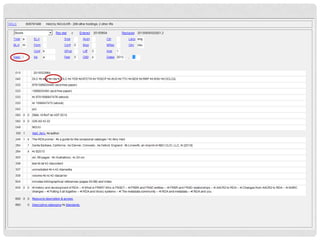
• What we see in a catalog record will change.
• The amount of information provided in a record will
increase.
• The amount of jargon used in a record will decrease.
CHANGES IN DESCRIPTION
“TAKE WHAT YOU SEE”
• More information can be included
• Example: no more rule of 3
• More cataloger’s judgment
• Example: catalogers can choose to only include a few
names or all of them
Imaginary book / by Jane Doe, John Doe, Jane Eyre, John
Hancock, and John Smith.
OR
Imaginary book / by Jane Doe [and four others].
CHANGES IN DESCRIPTION
• Easier-to-understand descriptions
• Example: no more abbreviations
• P. is now “page”
• Ed. is now “edition”
• But we still use cm (no period)
• Example: no more Latin terms
• S.l. is now “Place of publication not identified”
• Ca. is now “approximately”
• Et. al. is now “and # others”
EXAMPLE
EASIER-TO-UNDERSTAND DESCRIPTIONS
Hart, Amy, author
The RDA primer : a guide for the occasional cataloger /
Amy Hart.
Santa Barbara, California ; Denver, Colorado ; Oxford,
England : Linworth, an imprint of ABC-CLIO, LLC, [2010]
©2010.
xiii, 89 pages : illustrations ; 24 cm
EXAMPLE
EASIER-TO-UNDERSTAND DESCRIPTIONS
Hart, Amy, author
The RDA primer : a guide for the occasional cataloger /
Amy Hart.
Santa Barbara, California ; Denver, Colorado ; Oxford,
England : Linworth, an imprint of ABC-CLIO, LLC, [2010]
©2010.
xiii, 89 pages : illustrations ; 24 cm
NEW SEARCH CAPABILITIES
• New ways of searching will become possible.
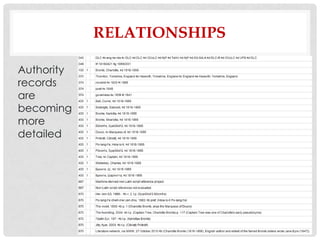
• Relationships are more important.
RELATIONSHIPS
Authority
records
are
becoming
more
detailed
RELATIONSHIPS
• Inclusion of more names
• All contributors can be included in the statement of
responsibility and in added entries
• Works contained in the main work can be included and
defined
• Relator terms tell you what the relationship is
• Examples:
• Author to work
• Part of a collected works set
• A parody of a work
• Very handy with more complex relationships
EXAMPLE OF RELATIONSHIPS
Beethoven, Ludwig van,
1770-1827.
Stutschewsky, Joachim,
1891-1982.
Image from www.orble.com
EXAMPLE OF RELATIONSHIPS
Beethoven, Ludwig van,
1770-1827, composer.
Stutschewsky, Joachim,
1891-1982, editor.
Image from www.orble.com
EXAMPLE OF RELATIONSHIPS
WITHOUT RELATOR TERMS
Beethoven, Ludwig van, 1770-1827. Variations sur un
thème de Händel.
Beethoven, Ludwig van, 1770-1827. Variations sur le
thème Ein Mädchen oder Weibchen.
Handel, George Frideric, 1685-1759. Judas
Maccabaeus.
Mozart, Wolfgang Amadeus, 1756-1791. Zauberflöte.
Mädchen oder Weibchen.
EXAMPLE OF RELATIONSHIPS
WITH RELATOR TERMS
Contains (work) : Beethoven, Ludwig van, 1770-1827.
Variations sur un thème de Händel.
Contains (work) : Beethoven, Ludwig van, 1770-1827.
Variations sur le thème Ein Mädchen oder
Weibchen.
Musical variations based on (work) : Handel, George
Frideric, 1685-1759. Judas Maccabaeus.
Musical variations based on (work) : Mozart,
Wolfgang Amadeus, 1756-1791. Zauberflöte.
Mädchen oder Weibchen.
CHANGES IN SEARCH AND DISPLAY
• Changes you may need to talk to your systems
vendors about.
• No more GMD, replaced by new fields
NO MORE GMD
(GENERAL MATERIAL DESIGNATION)
•GMD in AACR2
Adele [videorecording] : live at the Royal Albert Hall /
Done and Dusted, Family Values, XL Recordings,
Columbia Music Video ; producer, Cordelia Plunket ;
director, Paul Dugdale.
NO MORE GMD
•Replaced in RDA by: Content type, Media type, Carrier
type
• Content type: text, two-dimensional moving image, performed
music
• Media type: unmediated, computer, video, audio
• Carrier type: volume, sheet, computer disc, audio disc
Adele : live at the Royal Albert Hall / Done and Dusted,
Family Values, XL Recordings, Columbia Music Video ;
producer, Cordelia Plunket ; director, Paul Dugdale.
two-dimensional moving image (content type)
video (media type)
videodisc (carrier type)
YOUR CATALOG AND RDA
• Talk to your system vendor!
• Make sure all useful fields and subfields display…
• Or can be searched by your system
• Working with GMDs in old records and
content/media/carrier type in new records
• Be aware that some subject changes, especially to
do with the Bible, are sticky and need to be
addressed.
• Linking data
CONCLUSION
• RDA will change what we see in the catalog
• Some things will take some time to get used to
• Some changes in RDA still need to be made
• Potential for better searching is great
• You have time!
WORKS CITED
FRBR Cheat Sheet. Available at
http://guides.library.cornell.edu/content.php?pid=422336&sid=3452
947
Hart, Amy. The RDA Primer: A Guide for the Occasional Cataloger.
Santa Barbara, California: Linworth, 2010.
Hit the Ground Running! RDA Training for Music Catalogers. Available
at
http://guides.library.cornell.edu/content.php?pid=422336&sid=3452
843
Library of Congress (LC) RDA Training Materials. Available at
http://www.loc.gov/catworkshop/RDA%20training%20materials/LC%
20RDA%20Training/LC%20RDA%20course%20table.html
Oliver, Chris. Introducing RDA: A Guide to the Basics. Chicago:
American Library Association, 2010.
RDA Toolkit. Available at rdatoolkit.org
Tillett, Barbara. “What is FRBR? A Conceptual Model for the
Bibliographic Universe.” Library of Congress Cataloging Distribution
Service, 2004. Available at http://www.loc.gov/cds/FRBR.html
RDA BASICS
FOR NON-CATALOG LIBRARIANS
AUGUST 21, 2013
D R . S O N I A A R C H E R - C A P U Z Z O
U N I V E R S I T Y O F N O R T H C A R O L I N A A T G R E E N S B O R O
S M A R C H E R D M A @ G M A I L . C O M
THANK YOU
QUESTIONS?

RDA Basics for Non-Catalog Librarians

  • 1.
    A U GU S T 2 1 , 2 0 1 3 RDA BASICS FOR NON-CATALOG LIBRARIANS D R . S O N I A A R C H E R - C A P U Z Z O U N I V E R S I T Y O F N O R T H C A R O L I N A A T G R E E N S B O R O S M A R C H E R D M A @ G M A I L . C O M
  • 2.
    WHAT WE’LL COVER •Quick intro • A bit about RDA • What this change means for librarians outside the catalog department • What we see in a catalog record will change. • New ways of searching will become possible. • Changes you may need to talk to your systems vendors about. • Time for your questions
  • 3.
    INTRODUCTION • Why isa basic knowledge of RDA important? • A few acronyms • AACR2: Anglo-American Cataloguing Rules, 2nd edition • MARC21: MAchine-Readable Cataloging • ISBD: International Standard Bibliographic Description • RDA: Resource Description and Access
  • 6.
    RDA SOME BASIC INFO •A content standard • Published 2010, still being revised • Looking forward • Meant to describe a variety of media (extensible) • Designed for the digital environment • Looking back • Designed to play well with earlier standards, like AACR2
  • 7.
    RDA USER TASKS •Find • Match search criteria to specific entities (via attributes and/or relationships) • Identify • Confirm that the resource found corresponds to the resource sought and distinguish between similar resources • Select • Choose entities that meet the patron’s needs and determine which do not • Obtain • Access or acquire the entity sought
  • 8.
    ELEMENTS OF RDA •Entities • Group 1: products of intellectual or artistic endeavor • Work, Expression, Manifestation, Item (WEMI) • Group 2: those who produce Group 1 entities • Person, Corporate body, Family (PCbF) • Group 3: subjects of Group 1 entities • Concepts, Objects, Events, Places, and any Group 1 and 2 entities • Attributes- collectively describe/name/define a single entity • This is what we’re used to • Relationships- between 2 entities • This is new • Note the importance of relationships
  • 9.
    CHANGES IN DESCRIPTION •What we see in a catalog record will change. • The amount of information provided in a record will increase. • The amount of jargon used in a record will decrease.
  • 10.
    CHANGES IN DESCRIPTION “TAKEWHAT YOU SEE” • More information can be included • Example: no more rule of 3 • More cataloger’s judgment • Example: catalogers can choose to only include a few names or all of them Imaginary book / by Jane Doe, John Doe, Jane Eyre, John Hancock, and John Smith. OR Imaginary book / by Jane Doe [and four others].
  • 11.
    CHANGES IN DESCRIPTION •Easier-to-understand descriptions • Example: no more abbreviations • P. is now “page” • Ed. is now “edition” • But we still use cm (no period) • Example: no more Latin terms • S.l. is now “Place of publication not identified” • Ca. is now “approximately” • Et. al. is now “and # others”
  • 12.
    EXAMPLE EASIER-TO-UNDERSTAND DESCRIPTIONS Hart, Amy,author The RDA primer : a guide for the occasional cataloger / Amy Hart. Santa Barbara, California ; Denver, Colorado ; Oxford, England : Linworth, an imprint of ABC-CLIO, LLC, [2010] ©2010. xiii, 89 pages : illustrations ; 24 cm
  • 13.
    EXAMPLE EASIER-TO-UNDERSTAND DESCRIPTIONS Hart, Amy,author The RDA primer : a guide for the occasional cataloger / Amy Hart. Santa Barbara, California ; Denver, Colorado ; Oxford, England : Linworth, an imprint of ABC-CLIO, LLC, [2010] ©2010. xiii, 89 pages : illustrations ; 24 cm
  • 14.
    NEW SEARCH CAPABILITIES •New ways of searching will become possible. • Relationships are more important.
  • 15.
  • 16.
    RELATIONSHIPS • Inclusion ofmore names • All contributors can be included in the statement of responsibility and in added entries • Works contained in the main work can be included and defined • Relator terms tell you what the relationship is • Examples: • Author to work • Part of a collected works set • A parody of a work • Very handy with more complex relationships
  • 17.
    EXAMPLE OF RELATIONSHIPS Beethoven,Ludwig van, 1770-1827. Stutschewsky, Joachim, 1891-1982. Image from www.orble.com
  • 18.
    EXAMPLE OF RELATIONSHIPS Beethoven,Ludwig van, 1770-1827, composer. Stutschewsky, Joachim, 1891-1982, editor. Image from www.orble.com
  • 19.
    EXAMPLE OF RELATIONSHIPS WITHOUTRELATOR TERMS Beethoven, Ludwig van, 1770-1827. Variations sur un thème de Händel. Beethoven, Ludwig van, 1770-1827. Variations sur le thème Ein Mädchen oder Weibchen. Handel, George Frideric, 1685-1759. Judas Maccabaeus. Mozart, Wolfgang Amadeus, 1756-1791. Zauberflöte. Mädchen oder Weibchen.
  • 20.
    EXAMPLE OF RELATIONSHIPS WITHRELATOR TERMS Contains (work) : Beethoven, Ludwig van, 1770-1827. Variations sur un thème de Händel. Contains (work) : Beethoven, Ludwig van, 1770-1827. Variations sur le thème Ein Mädchen oder Weibchen. Musical variations based on (work) : Handel, George Frideric, 1685-1759. Judas Maccabaeus. Musical variations based on (work) : Mozart, Wolfgang Amadeus, 1756-1791. Zauberflöte. Mädchen oder Weibchen.
  • 21.
    CHANGES IN SEARCHAND DISPLAY • Changes you may need to talk to your systems vendors about. • No more GMD, replaced by new fields
  • 22.
    NO MORE GMD (GENERALMATERIAL DESIGNATION) •GMD in AACR2 Adele [videorecording] : live at the Royal Albert Hall / Done and Dusted, Family Values, XL Recordings, Columbia Music Video ; producer, Cordelia Plunket ; director, Paul Dugdale.
  • 23.
    NO MORE GMD •Replacedin RDA by: Content type, Media type, Carrier type • Content type: text, two-dimensional moving image, performed music • Media type: unmediated, computer, video, audio • Carrier type: volume, sheet, computer disc, audio disc Adele : live at the Royal Albert Hall / Done and Dusted, Family Values, XL Recordings, Columbia Music Video ; producer, Cordelia Plunket ; director, Paul Dugdale. two-dimensional moving image (content type) video (media type) videodisc (carrier type)
  • 24.
    YOUR CATALOG ANDRDA • Talk to your system vendor! • Make sure all useful fields and subfields display… • Or can be searched by your system • Working with GMDs in old records and content/media/carrier type in new records • Be aware that some subject changes, especially to do with the Bible, are sticky and need to be addressed. • Linking data
  • 25.
    CONCLUSION • RDA willchange what we see in the catalog • Some things will take some time to get used to • Some changes in RDA still need to be made • Potential for better searching is great • You have time!
  • 26.
    WORKS CITED FRBR CheatSheet. Available at http://guides.library.cornell.edu/content.php?pid=422336&sid=3452 947 Hart, Amy. The RDA Primer: A Guide for the Occasional Cataloger. Santa Barbara, California: Linworth, 2010. Hit the Ground Running! RDA Training for Music Catalogers. Available at http://guides.library.cornell.edu/content.php?pid=422336&sid=3452 843 Library of Congress (LC) RDA Training Materials. Available at http://www.loc.gov/catworkshop/RDA%20training%20materials/LC% 20RDA%20Training/LC%20RDA%20course%20table.html Oliver, Chris. Introducing RDA: A Guide to the Basics. Chicago: American Library Association, 2010. RDA Toolkit. Available at rdatoolkit.org Tillett, Barbara. “What is FRBR? A Conceptual Model for the Bibliographic Universe.” Library of Congress Cataloging Distribution Service, 2004. Available at http://www.loc.gov/cds/FRBR.html
  • 27.
    RDA BASICS FOR NON-CATALOGLIBRARIANS AUGUST 21, 2013 D R . S O N I A A R C H E R - C A P U Z Z O U N I V E R S I T Y O F N O R T H C A R O L I N A A T G R E E N S B O R O S M A R C H E R D M A @ G M A I L . C O M THANK YOU QUESTIONS?