International Social Work
NATIONAL ASSOCIATION OF SOCIAL WORKERS
Janlee Wong, MSW
San Francisco State University
International Education Week
November 12, 2013
INTERNATIONAL SOCIAL WORK
• International social work extends beyond the needs of the people in
our country and looks at people around the world that need help.
• International social work not only examines emergent need but also
evaluates everyday problems that people in other countries endure.
• International social work promotes social change where necessary,
helps to solve problems in human relationships and enhances the
well being of people's lives.
Tatsuru Akimoto, MSW, DSW, Japan College of
Social Work

The Meaning of International Social Work
The following are not necessarily international social work:
1. Practice or research on or in other countries,
2. Joint work with practitioners or professors of other countries,
3. International comparative research and analysis,
4. Assistance to the 2/3 World and research on South-North relations,
5. Cross cultural social work
6. Devotion to international social work organizations, and
7. Participation in an international conferences.
8. The internationalization of social work is not identical with international
social work
Tatsuru Akimoto, MSW, DSW, Japan College of Social
Work

The Meaning of International Social Work
“International social work is social work which deals with problems
caused between nations or across national boundaries or efforts
beyond national boundaries to solve those problems.
International social work thinks of and acts for the well-being of all
people on this earth, or 6.5 billion people in some 200 countries and
districts.
International social work does not attach any special meaning or
importance in value to any specific country or people.”
What human service providers should do to
strengthen global visions and
interconnections.
Akimoto:
• “The acquisition of the view not to see national boundaries gives an
opportunity to see matters by other indices such as class, gender,
race/ethnicity/tribe, and religion from the very beginning. Totally
different pictures may appear in front of you”
International Agendas
Emeritus Professor Jim Ife, Centre for Human Rights Education, Curtin
University, Perth, Western Australia, Past President International Social
Work Federation

The new international agendas: what is the role for social work?
• 20th Century: Poverty and inequality, peace, human rights, race,
HIV/AIDS and refugees, as well as more specific professional areas
such as inter-country adoption
• 21st Century: Terrorism and global warming
Jim Ife - Terrorism
• “The response to terrorism has, tragically, been largely tribal and
exclusive rather than multi-cultural and inclusive.”
• “So what does this mean for social work, and for social workers? I
believe social work has responses to make, at different levels. One of
these, which in the current climate is particularly courageous, is to
apply a classical social work systemic analysis to terrorism, refusing
simply to pathologise the individual, though of course strongly and
unreservedly condemning their violent actions, but seeking to
understand those actions in a wider context, just as a social worker
would do with any offender.”
How do you see these countries in this context? Africa, Afghanistan, Iraq, Palestine, North Caucasus,
Xinjiang, Tibet, Mexico, Columbia, Cuba
Jim Ife – Global Warming
• “Social workers need to understand how it affects the populations
they work with in different parts of the world, and should be engaged
in the debate about climate change, arguing forcefully for the
importance of social justice and human rights being at the forefront
of policies designed to cope with and ameliorate global warming. We
need to be looking at global warming not as a scientific problem, but
as a social problem”
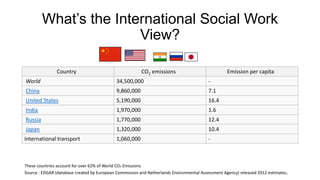
What’s the International Social Work
View?
Country

CO2 emissions

Emission per capita

World

34,500,000

-

China

9,860,000

7.1

United States

5,190,000

16.4

India

1,970,000

1.6

Russia

1,770,000

12.4

Japan

1,320,000

10.4

International transport

1,060,000

-

These countries account for over 62% of World CO2 Emissions
Source : EDGAR (database created by European Commission and Netherlands Environmental Assessment Agency) released 2012 estimates.
Jim Ife: “Let Go”
• “We need to let go of our preconceptions, our frameworks, our
models, our theories, our objectives, our intervention strategies, our
assumptions about knowledge and skills, our belief in enlightenment
progress, our materialism, our western hang-ups, and we need
instead to listen and learn, humbly and sincerely, from others, in the
genuine belief that our world view is not superior to any other, and
indeed that it is our western world view that is the cause of so much
suffering and oppression, and that ultimately endangers the entire
planet.”
Jim Ife: Social Work Education
• “Rather than arming students with an array of theories and models to
make them feel comfortable, secure and certain, we need, I would
suggest, to be helping them to be uncomfortable, insecure and
uncertain, and to accept that discomfort, insecurity and uncertainty
are characteristic of the human condition in the era of
postmodernity.”
• “I would suggest that if social work education is to equip social
workers to work internationally, a thorough study of poverty and
inequality, nationally and globally, and a rediscovery of our
profession’s historical commitment, is fundamental.”
Jim Ife: “Human Rights From Below”
• “So for social workers to embrace human rights, we need to develop
alternative understandings, which I suggest should concentrate on the idea
of ‘human rights from below’, and exploring understandings of the human
that extend beyond the bounds of modernity. This sees human rights, and
human responsibilities, as embedded within our lived experience, and as
enacted in our daily lives. Human rights as a participatory democratic
project, where we share different understandings of ‘the human’ and what
that means in terms of our rights and responsibilities, is a powerful basis
for dialogue, and progressive social work practice. This can provide a way
of relating to others through our shared humanity, rather than through
professional roles, and can be a major organising principle for an
international social work curriculum.”
Jim Ife: Curriculum – Postcolonial Studies
• The next curriculum area which is important for international social work is
the incorporation of postcolonial studies, so that students understand the
profound and insidious effects of colonialism. Further to that analysis,
there are a number of safeguards against colonialist practice, which apply
to all social work, but most particularly to international social work, and
these can be built into a curriculum. These include: the importance of
letting go; critical self-awareness; openness to critique from others;
sensitivity to the language we use, including such obviously colonial words
as ‘strategic’, ‘tactics’, ‘targets’, ‘campaigns’ and ‘intervention’; the need to
be wary of objectives, targets and outcomes, and instead to rediscover selfdetermination, broadly understood, as a basis for practice; understanding
our location in the dominant colonising culture; allowing people space and
time for validation of their own cultures and traditions; and the importance
of listening and learning before teaching and intervening.
Jim Ife: “Embrace the Process”
• “All this is nothing new for social work of course, though to work this
way we will need to reject much of the modern managerial approach
to social work. We need to be valuing process rather than outcomes
and objectives, in the interest of that often ignored social work ideal
of self-determination. We need to be perhaps more value-based than
evidence-based, and we need to be defining knowledge,
competencies and skills in such a way that deconstructs the privilege
built into both the discourse of professionalism, and the discourse of
the west. Social workers, in my experience, can do this well. It is what
I believe is at the basis of all social work, but especially of
international social work.”
Akimoto Ife Lens (test)
• Problems caused between, across and beyond nations and boundaries
• Thinks of acts that affect the well being of 6.5 billion people and over 200
countries
• No special meaning or importance in value to any special country or people
• A thorough study of poverty and inequality, nationally and globally
• Human rights from below
• Post-colonial studies
• More value based, than evidence based
• Deconstruct the privilege of the professional and the West
Costa Rica
• Academia Centroamericana de Espanol Program Studies at Academia
Centroamericana de Español an array of programs from 2-3 weeks
with home stays included for some. Opportunities to learn about
social problems, and health care. Topics of interest were immigration
issues, wife abuse, substance abuse, and other social concerns. There
were visits to social service agencies, service projects, as well as,
lectures by directors of social service programs
Problems caused between, across and beyond nations and boundaries
Thinks of acts that affect the well being of 6.5 billion people and over 200 countries
No special meaning or importance in value to any special country or people
A thorough study of poverty and inequality, nationally and globally
Human rights from below
Post-colonial studies
More value based, than evidence based
Deconstruct the privilege of the professional and the West
Costa Rica and Scotland

• Students did service work with the Humanitarian
Foundation. Studied the Spanish language in the afternoons and did
service work in the mornings. Course credit for language and culture
immersion.
• Students compared human services in Scotland and North Carolina
(unusual aspects given the strong influence of Scottish immigration
on NC in the 1700 and 1800's)
Problems caused between, across and beyond nations and boundaries
Thinks of acts that affect the well being of 6.5 billion people and over 200 countries
No special meaning or importance in value to any special country or people
A thorough study of poverty and inequality, nationally and globally
Human rights from below
Post-colonial studies
More value based, than evidence based
Deconstruct the privilege of the professional and the West
Nigeria
• The aims of the program were fostering a mutual relationship
between the University and institutions in Africa, promoting a global
perspective in students necessary in knowledge-based 21st century
competitive economy and engaging students and faculty in
collaborative research. Academic credit for the two courses; Yoruba
Language and Culture and African Society and Culture.
Problems caused between, across and beyond nations and boundaries
Thinks of acts that affect the well being of 6.5 billion people and over 200 countries
No special meaning or importance in value to any special country or people
A thorough study of poverty and inequality, nationally and globally
Human rights from below
Post-colonial studies
More value based, than evidence based
Deconstruct the privilege of the professional and the West
Lithuania
• Asset based community development workshop with social workers,
social work faculty, nurses and nursing faculty. Included participants
from Vytausas Magnus University School of Social Work and from
community based programs.
• Focus on assets rather than needs. Requires cultural unpacking to be
made relevant to this culture. And embrace a new set of ideas and
work with each other to move beyond their past.
Guatemala
• Met with women receiving micro loans through the Whole Planet
Foundation. These women had created or expanded their home
businesses, which included small stores on the front of their homes,
selling home-made ice cream on the weekends, selling clothes that
they were able to purchase in bulk from larger cities and many more.
South Africa
• Meet, serve orphanage children. Packed two buses with 26 suitcases
full of medical supplies, toys, clothes, shoes, and school supplies that
we had been gathering from friends, family and churches throughout
the semester. 200 children ranging from newborn and above. Children
expected to attend school and church as well as participate in chores.
Community center with visitors in and out. Feeds and clothes
community as well as children.
London

• Ten weeks in London. Seminar class including business and politics to
social welfare and the media. Internship organization provides
services and clinics in over forty countries. The clinics provide birth
control, family planning services, sexually transmitted infection
services, educational tools as well as psychological support. The
services provided by the clinics in other countries vary depending on
the laws of the particular country and the needs. Worked with the
Press Office as the voice of advocacy to clients.
Overview
• Working for equal opportunity in the U.S. and
internationally
• The struggle for human rights remains a vital priority for
the social work profession in the 21st century. Social
workers must promote greater education and awareness
of international human rights issues and seek
opportunities to actively address social justice issues
around the world.
The Human Rights &International Affairs Division Aims:
• Develop and maintain collaborative relationships with international development
agencies, foundations and other organizations to promote social development.
• Advocate and develop provider and public education materials on identified thematic
issue areas
• Showcase the social work profession in the international development arena through
NASW and its members.
• Further develop and identify funding for special projects and Social Workers Across
Nations (SWAN)
• Increase dialogue with and between NASW members to highlight good practices in
international social work
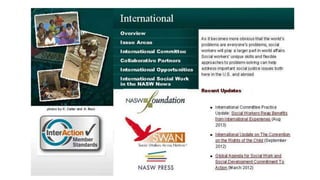
NASW International Committee
The International Committee interprets NASW policies and Delegate Assembly
priorities in developing guidance for the implementation of programs in the areas of
international social work education and practice and in advocating for the protection
of human rights in the global context. Purpose
The International Committee interprets NASW policies and Delegate Assembly
priorities in developing guidance for the implementation of programs in the areas of
international social work education and practice and in advocating for the protection
of human rights in the global context.
Specific Responsibilities
• Assist in the development of international program activities within the annual
program plan.
• Facilitate NASW’s participation in the International Federation of Social Workers
(IFSW) and with other international social work organizations.
• Serve as experts in interpreting NASW policy as it relates to international social work
practice and human rights.
• Promote member education and mobilization on international issues.
• Maintain liaison with allied organizations.
• Assist in identifying member experts to serve on specialized task groups.
Collaborative Partners - Issue Focused Groups
• Campaign for U.S. Ratification of the Convention on the Rights of
the Child
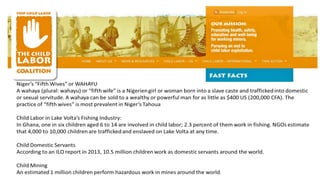
• Child Labor Coalition
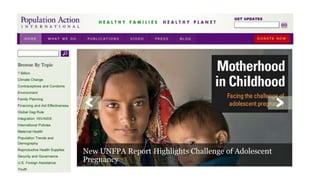
• International Family Planning Coalition
• ONE Campaign
• Working Group on Ratification of the U.N. Convention on the
Elimination of All Forms of Discrimination Against Women
(CEDAW)
• The CRC was adopted by the U.N. General Assembly in 1989. It is the
world's most widely accepted human rights treaty. Every nation has
ratified the CRC, except two: the United States and Somalia.
• Signed by the Clinton Administration but not submitted to the US
Senate. Concerns about world govt., states’ and parents’ rights
• Helped reduce child marriage, female genital mutilation
• Helped promote universal free elementary education for all children
• http://childrightscampaign.org/
GLOBAL AGENDA
• OUR ROLE IN PROMOTING SOCIAL AND ECONOMIC EQUALITIES
• OUR ROLE IN ENSURING THE DIGNITY AND WORTH OF THE PERSON
• OUR ROLE IN PROMOTING SUSTAINABLE COMMUNITIES AND
ENVIRONMENTALLY SENSITIVE DEVELOPMENT
• OUR ROLE IN PROMOTING WELLBEING THROUGH SUSTAINABLE
HUMAN RELATIONSHIPS
• ENSURING AN APPROPRIATE ENVIRONMENT FOR PRACTICE AND
EDUCATION
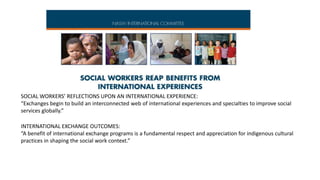
SOCIAL WORKERS’ REFLECTIONS UPON AN INTERNATIONAL EXPERIENCE:
“Exchanges begin to build an interconnected web of international experiences and specialties to improve social
services globally.”
INTERNATIONAL EXCHANGE OUTCOMES:
“A benefit of international exchange programs is a fundamental respect and appreciation for indigenous cultural
practices in shaping the social work context.”
• Council of International Fellowships:
• www.cif-netherlands.org
• Fulbright: http://eca.state.gov/fulbright
• Katherine Kendall Institute For International Social
• Work: www.cswe.org/CentersInitiatives/KAKI.aspx
• Social Workers Across Nations:
• http://socialworkers.org/nasw/swan/default.asp
• Social Workers Beyond Borders:
• www.socialworkersbeyondborders.org
NASW INTERNATIONAL SOCIAL WORK
CHAPTER
• Serving on US military bases providing education and clinical services
to military members, civilians and dependents working abroad.
• Facilitating international adoptions;
• Providing aid, relief services and counseling to persons in crisis such
as refugees or in disaster areas;
• Assisting in the development of social work education programs;
• Coordinating international service-delivery programs through nongovernmental organizations
• Researching international issues and developing social policy and
programs
References
• Akimoto, Tatsuru: http://www.ash-berlin.eu/100-JahreASH/symposium/doc/3_5_akimoto.pdf
• Ife, Jim: http://ifsw.org/statements/the-new-international-agendaswhat-role-for-social-work/
Resources
• International Disaster Response - RootCause
• Americans Overseas Domestic Violence Crisis Center
• Global Agenda on Social Work and Social Development
• Global Social Work Blog
• International Council on Social Welfare
• International Federation of Social Workers
• National Association of Puerto Rican and Hispanic Social Workers
• Polaris Project
• Social Work Blog (UK)
• Social Work & Society Online News Magazine (SocMag)
• UN Women Watch
Resources
•

•
•
•
•

Community organizing for post-disaster social development: Locating social work *NEW*
International Centre for Mental Health Social Research
Study Abroad Scout: Helpful information when going abroad
Child welfare experts from US, Israel share ideas at conference (September 2012)
Social Workers Across Nations NASW initiated the Social Workers Across Nations
(SWAN) Project to provide a mechanism for social workers to take part in international
social work programs to offer their expertise and skills to serve humanitarian needs within
the international community.

• (SAMHSA) announces the availability of two publications in Korean: Anger Management
for Substance Abuse and Mental Health Clients: A Cognitive Behaviorial Therapy Manual
and Anger Management for Substance Abuse and Mental Health Clients: Participant
Workgroup.
• Indonesian Social Worker Wins 'Asia's Nobel Prize' for Helping Poor
SFSU Burk Hall 337
• M International Contexts of Human Services Practice: How the
National Association of Social Workers Helps People Thrive in Global
Environments
• Presenters: Janlee Wong, Executive Director of the National
Association of Social Workers, California Chapter
• International contexts of human services practice. Mr. Wong will
discuss how the world’s largest membership organization of
professional social workers (with 150,000 members, 11,000 of whom
reside in California) brings international agendas forward and what
human service providers should do to strengthen global visions and
interconnections.

International social work

  • 1.
    International Social Work NATIONALASSOCIATION OF SOCIAL WORKERS Janlee Wong, MSW San Francisco State University International Education Week November 12, 2013
  • 2.
    INTERNATIONAL SOCIAL WORK •International social work extends beyond the needs of the people in our country and looks at people around the world that need help. • International social work not only examines emergent need but also evaluates everyday problems that people in other countries endure. • International social work promotes social change where necessary, helps to solve problems in human relationships and enhances the well being of people's lives.
  • 3.
    Tatsuru Akimoto, MSW,DSW, Japan College of Social Work The Meaning of International Social Work The following are not necessarily international social work: 1. Practice or research on or in other countries, 2. Joint work with practitioners or professors of other countries, 3. International comparative research and analysis, 4. Assistance to the 2/3 World and research on South-North relations, 5. Cross cultural social work 6. Devotion to international social work organizations, and 7. Participation in an international conferences. 8. The internationalization of social work is not identical with international social work
  • 4.
    Tatsuru Akimoto, MSW,DSW, Japan College of Social Work The Meaning of International Social Work “International social work is social work which deals with problems caused between nations or across national boundaries or efforts beyond national boundaries to solve those problems. International social work thinks of and acts for the well-being of all people on this earth, or 6.5 billion people in some 200 countries and districts. International social work does not attach any special meaning or importance in value to any specific country or people.”
  • 5.
    What human serviceproviders should do to strengthen global visions and interconnections. Akimoto: • “The acquisition of the view not to see national boundaries gives an opportunity to see matters by other indices such as class, gender, race/ethnicity/tribe, and religion from the very beginning. Totally different pictures may appear in front of you”
  • 6.
    International Agendas Emeritus ProfessorJim Ife, Centre for Human Rights Education, Curtin University, Perth, Western Australia, Past President International Social Work Federation The new international agendas: what is the role for social work? • 20th Century: Poverty and inequality, peace, human rights, race, HIV/AIDS and refugees, as well as more specific professional areas such as inter-country adoption • 21st Century: Terrorism and global warming
  • 7.
    Jim Ife -Terrorism • “The response to terrorism has, tragically, been largely tribal and exclusive rather than multi-cultural and inclusive.” • “So what does this mean for social work, and for social workers? I believe social work has responses to make, at different levels. One of these, which in the current climate is particularly courageous, is to apply a classical social work systemic analysis to terrorism, refusing simply to pathologise the individual, though of course strongly and unreservedly condemning their violent actions, but seeking to understand those actions in a wider context, just as a social worker would do with any offender.” How do you see these countries in this context? Africa, Afghanistan, Iraq, Palestine, North Caucasus, Xinjiang, Tibet, Mexico, Columbia, Cuba
  • 8.
    Jim Ife –Global Warming • “Social workers need to understand how it affects the populations they work with in different parts of the world, and should be engaged in the debate about climate change, arguing forcefully for the importance of social justice and human rights being at the forefront of policies designed to cope with and ameliorate global warming. We need to be looking at global warming not as a scientific problem, but as a social problem”
  • 9.
    What’s the InternationalSocial Work View? Country CO2 emissions Emission per capita World 34,500,000 - China 9,860,000 7.1 United States 5,190,000 16.4 India 1,970,000 1.6 Russia 1,770,000 12.4 Japan 1,320,000 10.4 International transport 1,060,000 - These countries account for over 62% of World CO2 Emissions Source : EDGAR (database created by European Commission and Netherlands Environmental Assessment Agency) released 2012 estimates.
  • 10.
    Jim Ife: “LetGo” • “We need to let go of our preconceptions, our frameworks, our models, our theories, our objectives, our intervention strategies, our assumptions about knowledge and skills, our belief in enlightenment progress, our materialism, our western hang-ups, and we need instead to listen and learn, humbly and sincerely, from others, in the genuine belief that our world view is not superior to any other, and indeed that it is our western world view that is the cause of so much suffering and oppression, and that ultimately endangers the entire planet.”
  • 11.
    Jim Ife: SocialWork Education • “Rather than arming students with an array of theories and models to make them feel comfortable, secure and certain, we need, I would suggest, to be helping them to be uncomfortable, insecure and uncertain, and to accept that discomfort, insecurity and uncertainty are characteristic of the human condition in the era of postmodernity.” • “I would suggest that if social work education is to equip social workers to work internationally, a thorough study of poverty and inequality, nationally and globally, and a rediscovery of our profession’s historical commitment, is fundamental.”
  • 12.
    Jim Ife: “HumanRights From Below” • “So for social workers to embrace human rights, we need to develop alternative understandings, which I suggest should concentrate on the idea of ‘human rights from below’, and exploring understandings of the human that extend beyond the bounds of modernity. This sees human rights, and human responsibilities, as embedded within our lived experience, and as enacted in our daily lives. Human rights as a participatory democratic project, where we share different understandings of ‘the human’ and what that means in terms of our rights and responsibilities, is a powerful basis for dialogue, and progressive social work practice. This can provide a way of relating to others through our shared humanity, rather than through professional roles, and can be a major organising principle for an international social work curriculum.”
  • 13.
    Jim Ife: Curriculum– Postcolonial Studies • The next curriculum area which is important for international social work is the incorporation of postcolonial studies, so that students understand the profound and insidious effects of colonialism. Further to that analysis, there are a number of safeguards against colonialist practice, which apply to all social work, but most particularly to international social work, and these can be built into a curriculum. These include: the importance of letting go; critical self-awareness; openness to critique from others; sensitivity to the language we use, including such obviously colonial words as ‘strategic’, ‘tactics’, ‘targets’, ‘campaigns’ and ‘intervention’; the need to be wary of objectives, targets and outcomes, and instead to rediscover selfdetermination, broadly understood, as a basis for practice; understanding our location in the dominant colonising culture; allowing people space and time for validation of their own cultures and traditions; and the importance of listening and learning before teaching and intervening.
  • 14.
    Jim Ife: “Embracethe Process” • “All this is nothing new for social work of course, though to work this way we will need to reject much of the modern managerial approach to social work. We need to be valuing process rather than outcomes and objectives, in the interest of that often ignored social work ideal of self-determination. We need to be perhaps more value-based than evidence-based, and we need to be defining knowledge, competencies and skills in such a way that deconstructs the privilege built into both the discourse of professionalism, and the discourse of the west. Social workers, in my experience, can do this well. It is what I believe is at the basis of all social work, but especially of international social work.”
  • 15.
    Akimoto Ife Lens(test) • Problems caused between, across and beyond nations and boundaries • Thinks of acts that affect the well being of 6.5 billion people and over 200 countries • No special meaning or importance in value to any special country or people • A thorough study of poverty and inequality, nationally and globally • Human rights from below • Post-colonial studies • More value based, than evidence based • Deconstruct the privilege of the professional and the West
  • 16.
    Costa Rica • AcademiaCentroamericana de Espanol Program Studies at Academia Centroamericana de Español an array of programs from 2-3 weeks with home stays included for some. Opportunities to learn about social problems, and health care. Topics of interest were immigration issues, wife abuse, substance abuse, and other social concerns. There were visits to social service agencies, service projects, as well as, lectures by directors of social service programs Problems caused between, across and beyond nations and boundaries Thinks of acts that affect the well being of 6.5 billion people and over 200 countries No special meaning or importance in value to any special country or people A thorough study of poverty and inequality, nationally and globally Human rights from below Post-colonial studies More value based, than evidence based Deconstruct the privilege of the professional and the West
  • 17.
    Costa Rica andScotland • Students did service work with the Humanitarian Foundation. Studied the Spanish language in the afternoons and did service work in the mornings. Course credit for language and culture immersion. • Students compared human services in Scotland and North Carolina (unusual aspects given the strong influence of Scottish immigration on NC in the 1700 and 1800's) Problems caused between, across and beyond nations and boundaries Thinks of acts that affect the well being of 6.5 billion people and over 200 countries No special meaning or importance in value to any special country or people A thorough study of poverty and inequality, nationally and globally Human rights from below Post-colonial studies More value based, than evidence based Deconstruct the privilege of the professional and the West
  • 18.
    Nigeria • The aimsof the program were fostering a mutual relationship between the University and institutions in Africa, promoting a global perspective in students necessary in knowledge-based 21st century competitive economy and engaging students and faculty in collaborative research. Academic credit for the two courses; Yoruba Language and Culture and African Society and Culture. Problems caused between, across and beyond nations and boundaries Thinks of acts that affect the well being of 6.5 billion people and over 200 countries No special meaning or importance in value to any special country or people A thorough study of poverty and inequality, nationally and globally Human rights from below Post-colonial studies More value based, than evidence based Deconstruct the privilege of the professional and the West
  • 19.
    Lithuania • Asset basedcommunity development workshop with social workers, social work faculty, nurses and nursing faculty. Included participants from Vytausas Magnus University School of Social Work and from community based programs. • Focus on assets rather than needs. Requires cultural unpacking to be made relevant to this culture. And embrace a new set of ideas and work with each other to move beyond their past.
  • 20.
    Guatemala • Met withwomen receiving micro loans through the Whole Planet Foundation. These women had created or expanded their home businesses, which included small stores on the front of their homes, selling home-made ice cream on the weekends, selling clothes that they were able to purchase in bulk from larger cities and many more.
  • 21.
    South Africa • Meet,serve orphanage children. Packed two buses with 26 suitcases full of medical supplies, toys, clothes, shoes, and school supplies that we had been gathering from friends, family and churches throughout the semester. 200 children ranging from newborn and above. Children expected to attend school and church as well as participate in chores. Community center with visitors in and out. Feeds and clothes community as well as children.
  • 22.
    London • Ten weeksin London. Seminar class including business and politics to social welfare and the media. Internship organization provides services and clinics in over forty countries. The clinics provide birth control, family planning services, sexually transmitted infection services, educational tools as well as psychological support. The services provided by the clinics in other countries vary depending on the laws of the particular country and the needs. Worked with the Press Office as the voice of advocacy to clients.
  • 24.
    Overview • Working forequal opportunity in the U.S. and internationally • The struggle for human rights remains a vital priority for the social work profession in the 21st century. Social workers must promote greater education and awareness of international human rights issues and seek opportunities to actively address social justice issues around the world.
  • 25.
    The Human Rights&International Affairs Division Aims: • Develop and maintain collaborative relationships with international development agencies, foundations and other organizations to promote social development. • Advocate and develop provider and public education materials on identified thematic issue areas • Showcase the social work profession in the international development arena through NASW and its members. • Further develop and identify funding for special projects and Social Workers Across Nations (SWAN) • Increase dialogue with and between NASW members to highlight good practices in international social work
  • 27.
    NASW International Committee TheInternational Committee interprets NASW policies and Delegate Assembly priorities in developing guidance for the implementation of programs in the areas of international social work education and practice and in advocating for the protection of human rights in the global context. Purpose The International Committee interprets NASW policies and Delegate Assembly priorities in developing guidance for the implementation of programs in the areas of international social work education and practice and in advocating for the protection of human rights in the global context.
  • 28.
    Specific Responsibilities • Assistin the development of international program activities within the annual program plan. • Facilitate NASW’s participation in the International Federation of Social Workers (IFSW) and with other international social work organizations. • Serve as experts in interpreting NASW policy as it relates to international social work practice and human rights. • Promote member education and mobilization on international issues. • Maintain liaison with allied organizations. • Assist in identifying member experts to serve on specialized task groups.
  • 29.
    Collaborative Partners -Issue Focused Groups • Campaign for U.S. Ratification of the Convention on the Rights of the Child • Child Labor Coalition • International Family Planning Coalition • ONE Campaign • Working Group on Ratification of the U.N. Convention on the Elimination of All Forms of Discrimination Against Women (CEDAW)
  • 30.
    • The CRCwas adopted by the U.N. General Assembly in 1989. It is the world's most widely accepted human rights treaty. Every nation has ratified the CRC, except two: the United States and Somalia. • Signed by the Clinton Administration but not submitted to the US Senate. Concerns about world govt., states’ and parents’ rights • Helped reduce child marriage, female genital mutilation • Helped promote universal free elementary education for all children • http://childrightscampaign.org/
  • 38.
    GLOBAL AGENDA • OURROLE IN PROMOTING SOCIAL AND ECONOMIC EQUALITIES • OUR ROLE IN ENSURING THE DIGNITY AND WORTH OF THE PERSON • OUR ROLE IN PROMOTING SUSTAINABLE COMMUNITIES AND ENVIRONMENTALLY SENSITIVE DEVELOPMENT • OUR ROLE IN PROMOTING WELLBEING THROUGH SUSTAINABLE HUMAN RELATIONSHIPS • ENSURING AN APPROPRIATE ENVIRONMENT FOR PRACTICE AND EDUCATION
  • 39.
    SOCIAL WORKERS’ REFLECTIONSUPON AN INTERNATIONAL EXPERIENCE: “Exchanges begin to build an interconnected web of international experiences and specialties to improve social services globally.” INTERNATIONAL EXCHANGE OUTCOMES: “A benefit of international exchange programs is a fundamental respect and appreciation for indigenous cultural practices in shaping the social work context.”
  • 40.
    • Council ofInternational Fellowships: • www.cif-netherlands.org • Fulbright: http://eca.state.gov/fulbright • Katherine Kendall Institute For International Social • Work: www.cswe.org/CentersInitiatives/KAKI.aspx • Social Workers Across Nations: • http://socialworkers.org/nasw/swan/default.asp • Social Workers Beyond Borders: • www.socialworkersbeyondborders.org
  • 42.
    NASW INTERNATIONAL SOCIALWORK CHAPTER • Serving on US military bases providing education and clinical services to military members, civilians and dependents working abroad. • Facilitating international adoptions; • Providing aid, relief services and counseling to persons in crisis such as refugees or in disaster areas; • Assisting in the development of social work education programs; • Coordinating international service-delivery programs through nongovernmental organizations • Researching international issues and developing social policy and programs
  • 43.
    References • Akimoto, Tatsuru:http://www.ash-berlin.eu/100-JahreASH/symposium/doc/3_5_akimoto.pdf • Ife, Jim: http://ifsw.org/statements/the-new-international-agendaswhat-role-for-social-work/
  • 44.
    Resources • International DisasterResponse - RootCause • Americans Overseas Domestic Violence Crisis Center • Global Agenda on Social Work and Social Development • Global Social Work Blog • International Council on Social Welfare • International Federation of Social Workers • National Association of Puerto Rican and Hispanic Social Workers • Polaris Project • Social Work Blog (UK) • Social Work & Society Online News Magazine (SocMag) • UN Women Watch
  • 45.
    Resources • • • • • Community organizing forpost-disaster social development: Locating social work *NEW* International Centre for Mental Health Social Research Study Abroad Scout: Helpful information when going abroad Child welfare experts from US, Israel share ideas at conference (September 2012) Social Workers Across Nations NASW initiated the Social Workers Across Nations (SWAN) Project to provide a mechanism for social workers to take part in international social work programs to offer their expertise and skills to serve humanitarian needs within the international community. • (SAMHSA) announces the availability of two publications in Korean: Anger Management for Substance Abuse and Mental Health Clients: A Cognitive Behaviorial Therapy Manual and Anger Management for Substance Abuse and Mental Health Clients: Participant Workgroup. • Indonesian Social Worker Wins 'Asia's Nobel Prize' for Helping Poor
  • 46.
    SFSU Burk Hall337 • M International Contexts of Human Services Practice: How the National Association of Social Workers Helps People Thrive in Global Environments • Presenters: Janlee Wong, Executive Director of the National Association of Social Workers, California Chapter • International contexts of human services practice. Mr. Wong will discuss how the world’s largest membership organization of professional social workers (with 150,000 members, 11,000 of whom reside in California) brings international agendas forward and what human service providers should do to strengthen global visions and interconnections.