Regional NAP Expo
7 November 2018
Libreville, Gabon
Latest developments in the process to formulate
and implement National Adaptation Plans
Mr. Aderito Santana, LEG Chair
Objectives of NAPs and the PA global goal on adaptation
q Objectives of the NAP process (decision 5/CP.17) are:
a) To reduce vulnerability to the impacts of climate change, by building
adaptive capacity and resilience;
b) To facilitate the integration of climate change adaptation, in a
coherent manner, into relevant new and existing policies, programmes
and activities, in particular development planning processes and
strategies, within all relevant sectors and at different levels, as
appropriate.
q Global goal on adaptation (Article 7 of the Paris Agreement)
Enhancing adaptive capacity, strengthening resilience and reducing
vulnerability to climate change, with a view to contributing to sustainable
development and ensuring an adequate adaptation response in the
context of the global temperature limit of less than 2°C.
Guiding principles for NAPs (decision 5/CP.17)
q Continuous planning process at
the national level with iterative
updates and outputs
q Country-owned, country-driven
q Not prescriptive, but flexible and
based on country needs
q Building on and not duplicating
existing adaptation efforts
q Participatory and transparent
q Enhancing coherence of
adaptation and development
planning
q Supported by comprehensive
monitoring and review
q Considering vulnerable groups,
communities and ecosystems
q Guided by best available science
q Taking into consideration
traditional and indigenous
knowledge
q Gender-sensitive
Progress made in National Adaptation Plans
Progress made by developing countries in the process to formulate and implement national
adaptation plans by element of the process from 2015 to 2018
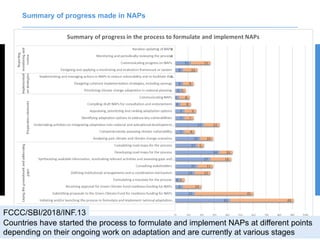
Summary of progress made in NAPs
Countries have started the process to formulate and implement NAPs at different points
depending on their ongoing work on adaptation and are currently at various stages
FCCC/SBI/2018/INF.13
Togo
Brazil
Sri Lanka
Sudan
Saint Lucia
Cameroon Kenya
Palestine
Burkina
Faso
Chile
Colombia
National Adaptation Plans as at 26 September 2018
http://www4.unfccc.int/nap/Pages/national-adaptation-plans.aspx
q The NAP is the main output
of the process
q It would provide the substance
of the adaptation ambition in
the NDCs and Adaptation
Communications under the
Paris Agreement
q Funding for the formulation
and implementation of NAPs
is well grounded in the GCF
Progress made by developing country Parties in the formulation of NAPs (09/18)
Funding for the formulation of NAPs under the GCF and the LDCF (09/2018)
Fund Region
Number of
submitted
proposals
Approved or
endorsed
proposals
Funds
disbursed
Green Climate
Fund (GCF)
Africa tbc 11 (6) 8 (2)
Asia and the Pacific tbc 5 (3) 4 (2)
Eastern Europe tbc 2 1
Latin America and
the Caribbean
tbc 8 6
Total (GCF) 60 26 (9) 20 (4)
Least
Developed
Countries
Fund (LDCF)
Africa 7 7 0
Asia and the Pacific 2 2 0
Latin America and
the Caribbean
0 0 0
Total (LDCF) 9 9 0
* Countries are also using other funding sources: domestic, bilateral and multilateral
Implementation of policies, projects and programmes identified in the NAPs
q SBI 47 (Nov 2017): the Adaptation Committee and the LEG to
consider ways to assist with the implementation of NAPs
q COP 21 (Dec 2015): requested the GCF to expedite support for the
LDCs and other developing country Parties for the formulation of
NAPs, consistent with decisions 1/CP.16 and 5/CP.17, and for the
subsequent implementation of policies, projects and programmes
identified by them
Guidelines
q Initial guidelines are contained in
decision 5/CP.17, annex
q Technical guidelines for the NAP
process, developed by the LEG in
response to decision 5/CP.17 paragraph
15 are available in multiple languages at
http://unfccc.int/7279
q Supplements to the guidelines are
available on NAP Central
http://www4.unfccc.int/nap/Guidelines/P
ages/Supplements.aspx
The guidelines provide the basis for the formulation and
implementation of NAPs
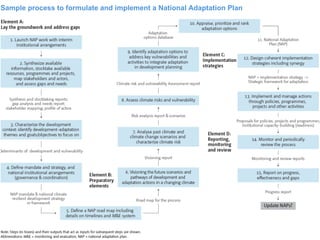
Sample process to formulate and implement a National Adaptation Plan
SDGs *
q SDG 1 – No poverty
q SDG 2 – Zero hunger
q SDG 6 – Clean water and sanitation
q SDG 7 – Affordable and clean energy
q Etc.
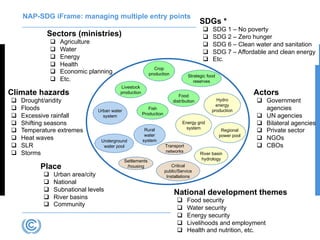
NAP-SDG iFrame: managing multiple entry points
Climate hazards
q Drought/aridity
q Floods
q Excessive rainfall
q Shifting seasons
q Temperature extremes
q Heat waves
q SLR
q Storms
Actors
q Government
agencies
q UN agencies
q Bilateral agencies
q Private sector
q NGOs
q CBOs
Place
q Urban area/city
q National
q Subnational levels
q River basins
q Community
Sectors (ministries)
q Agriculture
q Water
q Energy
q Health
q Economic planning
q Etc.
National development themes
q Food security
q Water security
q Energy security
q Livelihoods and employment
q Health and nutrition, etc.
Urban water
system
Rural
water
systemUnderground
water pool
Fish
Production
Food
distribution
Livestock
production
Crop
production
River basin
hydrology
Hydro
energy
production
Regional
power pool
Energy grid
system
Strategic food
reserves
Settlements
/housing Critical
public/Service
Installations
Transport
networks
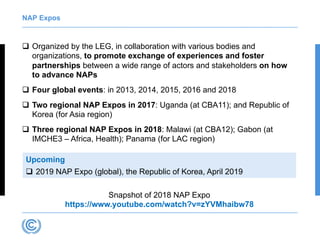
NAP Expos
q Organized by the LEG, in collaboration with various bodies and
organizations, to promote exchange of experiences and foster
partnerships between a wide range of actors and stakeholders on how
to advance NAPs
q Four global events: in 2013, 2014, 2015, 2016 and 2018
q Two regional NAP Expos in 2017: Uganda (at CBA11); and Republic of
Korea (for Asia region)
q Three regional NAP Expos in 2018: Malawi (at CBA12); Gabon (at
IMCHE3 – Africa, Health); Panama (for LAC region)
Upcoming
q 2019 NAP Expo (global), the Republic of Korea, April 2019
Snapshot of 2018 NAP Expo
https://www.youtube.com/watch?v=zYVMhaibw78
Open NAP Case studies (Open NAPs)
q Open collaboration by the LEG with experts and organizations to offer
advice and guidance to countries
q The concept is akin to crowdsourcing, mainly to scope and test the best
approach depending on specifics and uniqueness of the countries
q Each Open case looks at the details of a country and works towards a
NAP by working through specific steps, using the best available data and
methodologies, in collaboration with experts from the country, designed to
produce a prototype NAP that can then be expanded over time
q Earlier experimentation within the Open NAP initiative led to the
development of the NAP-SDG iFrame, which solves the problem of which
entry point to choose
NAP Central (http://unfccc.int/nap)
Highlights
q Main repository of information pertinent to NAPs
q NAP documents and other outputs from the countries
q Questionnaire to submit info on progress in NAPs
q Global NAP Calendar: to capture information on the different meetings,
training workshops and conferences related to NAPs from all partners
q Country profiles
q Partner profiles
q NAP Events online: NAP Expos, workshops
q NAP tracking tool: to capture progress made by each country
q Etc.
Information on progress made in NAPs
q To support the SBI assessment of progress made in NAPs (initiated at
SBI 48, to be continued at SBI 49)
q Helps the LEG and all partners to identify:
v Progress being made by the countries, and on support
v Best practices and lessons learned
v Gaps and needs
q Online questionnaire on NAPs enables countries to provide information
on a continuing basis
q Information will help assess achievement of the objectives of NAPs,
contribute to the global stocktake under the Paris Agreement
q Countries to share their NAPs and relevant outputs and outcomes via
NAP Central
Thank you

Latest developments in NAPs

  • 1.
    Regional NAP Expo 7November 2018 Libreville, Gabon Latest developments in the process to formulate and implement National Adaptation Plans Mr. Aderito Santana, LEG Chair
  • 2.
    Objectives of NAPsand the PA global goal on adaptation q Objectives of the NAP process (decision 5/CP.17) are: a) To reduce vulnerability to the impacts of climate change, by building adaptive capacity and resilience; b) To facilitate the integration of climate change adaptation, in a coherent manner, into relevant new and existing policies, programmes and activities, in particular development planning processes and strategies, within all relevant sectors and at different levels, as appropriate. q Global goal on adaptation (Article 7 of the Paris Agreement) Enhancing adaptive capacity, strengthening resilience and reducing vulnerability to climate change, with a view to contributing to sustainable development and ensuring an adequate adaptation response in the context of the global temperature limit of less than 2°C.
  • 3.
    Guiding principles forNAPs (decision 5/CP.17) q Continuous planning process at the national level with iterative updates and outputs q Country-owned, country-driven q Not prescriptive, but flexible and based on country needs q Building on and not duplicating existing adaptation efforts q Participatory and transparent q Enhancing coherence of adaptation and development planning q Supported by comprehensive monitoring and review q Considering vulnerable groups, communities and ecosystems q Guided by best available science q Taking into consideration traditional and indigenous knowledge q Gender-sensitive
  • 4.
    Progress made inNational Adaptation Plans Progress made by developing countries in the process to formulate and implement national adaptation plans by element of the process from 2015 to 2018
  • 5.
    Summary of progressmade in NAPs Countries have started the process to formulate and implement NAPs at different points depending on their ongoing work on adaptation and are currently at various stages FCCC/SBI/2018/INF.13
  • 6.
    Togo Brazil Sri Lanka Sudan Saint Lucia CameroonKenya Palestine Burkina Faso Chile Colombia National Adaptation Plans as at 26 September 2018 http://www4.unfccc.int/nap/Pages/national-adaptation-plans.aspx
  • 7.
    q The NAPis the main output of the process q It would provide the substance of the adaptation ambition in the NDCs and Adaptation Communications under the Paris Agreement q Funding for the formulation and implementation of NAPs is well grounded in the GCF Progress made by developing country Parties in the formulation of NAPs (09/18)
  • 8.
    Funding for theformulation of NAPs under the GCF and the LDCF (09/2018) Fund Region Number of submitted proposals Approved or endorsed proposals Funds disbursed Green Climate Fund (GCF) Africa tbc 11 (6) 8 (2) Asia and the Pacific tbc 5 (3) 4 (2) Eastern Europe tbc 2 1 Latin America and the Caribbean tbc 8 6 Total (GCF) 60 26 (9) 20 (4) Least Developed Countries Fund (LDCF) Africa 7 7 0 Asia and the Pacific 2 2 0 Latin America and the Caribbean 0 0 0 Total (LDCF) 9 9 0 * Countries are also using other funding sources: domestic, bilateral and multilateral
  • 9.
    Implementation of policies,projects and programmes identified in the NAPs q SBI 47 (Nov 2017): the Adaptation Committee and the LEG to consider ways to assist with the implementation of NAPs q COP 21 (Dec 2015): requested the GCF to expedite support for the LDCs and other developing country Parties for the formulation of NAPs, consistent with decisions 1/CP.16 and 5/CP.17, and for the subsequent implementation of policies, projects and programmes identified by them
  • 10.
    Guidelines q Initial guidelinesare contained in decision 5/CP.17, annex q Technical guidelines for the NAP process, developed by the LEG in response to decision 5/CP.17 paragraph 15 are available in multiple languages at http://unfccc.int/7279 q Supplements to the guidelines are available on NAP Central http://www4.unfccc.int/nap/Guidelines/P ages/Supplements.aspx The guidelines provide the basis for the formulation and implementation of NAPs
  • 11.
    Sample process toformulate and implement a National Adaptation Plan
  • 12.
    SDGs * q SDG1 – No poverty q SDG 2 – Zero hunger q SDG 6 – Clean water and sanitation q SDG 7 – Affordable and clean energy q Etc. NAP-SDG iFrame: managing multiple entry points Climate hazards q Drought/aridity q Floods q Excessive rainfall q Shifting seasons q Temperature extremes q Heat waves q SLR q Storms Actors q Government agencies q UN agencies q Bilateral agencies q Private sector q NGOs q CBOs Place q Urban area/city q National q Subnational levels q River basins q Community Sectors (ministries) q Agriculture q Water q Energy q Health q Economic planning q Etc. National development themes q Food security q Water security q Energy security q Livelihoods and employment q Health and nutrition, etc. Urban water system Rural water systemUnderground water pool Fish Production Food distribution Livestock production Crop production River basin hydrology Hydro energy production Regional power pool Energy grid system Strategic food reserves Settlements /housing Critical public/Service Installations Transport networks
  • 13.
    NAP Expos q Organizedby the LEG, in collaboration with various bodies and organizations, to promote exchange of experiences and foster partnerships between a wide range of actors and stakeholders on how to advance NAPs q Four global events: in 2013, 2014, 2015, 2016 and 2018 q Two regional NAP Expos in 2017: Uganda (at CBA11); and Republic of Korea (for Asia region) q Three regional NAP Expos in 2018: Malawi (at CBA12); Gabon (at IMCHE3 – Africa, Health); Panama (for LAC region) Upcoming q 2019 NAP Expo (global), the Republic of Korea, April 2019 Snapshot of 2018 NAP Expo https://www.youtube.com/watch?v=zYVMhaibw78
  • 14.
    Open NAP Casestudies (Open NAPs) q Open collaboration by the LEG with experts and organizations to offer advice and guidance to countries q The concept is akin to crowdsourcing, mainly to scope and test the best approach depending on specifics and uniqueness of the countries q Each Open case looks at the details of a country and works towards a NAP by working through specific steps, using the best available data and methodologies, in collaboration with experts from the country, designed to produce a prototype NAP that can then be expanded over time q Earlier experimentation within the Open NAP initiative led to the development of the NAP-SDG iFrame, which solves the problem of which entry point to choose
  • 15.
    NAP Central (http://unfccc.int/nap) Highlights qMain repository of information pertinent to NAPs q NAP documents and other outputs from the countries q Questionnaire to submit info on progress in NAPs q Global NAP Calendar: to capture information on the different meetings, training workshops and conferences related to NAPs from all partners q Country profiles q Partner profiles q NAP Events online: NAP Expos, workshops q NAP tracking tool: to capture progress made by each country q Etc.
  • 16.
    Information on progressmade in NAPs q To support the SBI assessment of progress made in NAPs (initiated at SBI 48, to be continued at SBI 49) q Helps the LEG and all partners to identify: v Progress being made by the countries, and on support v Best practices and lessons learned v Gaps and needs q Online questionnaire on NAPs enables countries to provide information on a continuing basis q Information will help assess achievement of the objectives of NAPs, contribute to the global stocktake under the Paris Agreement q Countries to share their NAPs and relevant outputs and outcomes via NAP Central
  • 17.