Mobile Phone Based Drunk Driving
Detection
BY
Nagaraj C
ISE
Under the guidance of:
Ms.Punitha rajkumari
B.E,M.Tech
Sr.Lecturer, Dept of ISE, SIET
Contents
•Introduction
•Acceleration-Based Drunk Driving Cues
•System Overview
•Design of Algorithm
•Acceleration Pattern Matching
•Conclusion
INTRODUCTION:
•Driving Under the In- fluence of alcohol, is a major cause of
traffic accidents throughout the world.
•We propose a highly efficient system aimed at early detection
and alert of dangerous maneuvers vehicle typically related to
drunk driving.
•The entire solution requires only a mobile phone placed in
vehicle and with accelerometer and orientation sensor.
•A program installed on the mobile phone computes
accelerations based on sensor readings.
•The mobile phone will automatically alert the driver or call the
police for help.
ACCELERATION BASED DRUNK DRIVING CUES:
The researchers have identified cues of typical driving behavior
for drunk drivers.
Three categories of behaviors as follows.
•Cues related to lane position maintenance problems.
•Cues related to speed control problems.
•Cues related to judgment and vigilance problems.
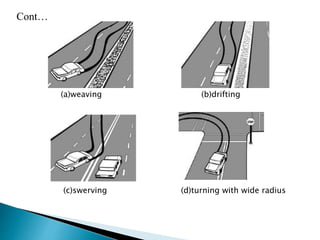
Lateral Acceleration and Lane Position
Maintenance:
•The lane position maintenance problems result in abnormal
curvilinear movements, including weaving, drifting, swerving
and turning with a wide radius.
Longitudinal Acceleration and Speed Control in
Driving:
•A drunk driver often experiences difficulty in keeping an
appropriate speed.
•Abrupt acceleration or deacceleration, erratic braking and jerky
stop are strong cues to show that the driver is under alcohol
impairment.
•They will all be reflected in the changes of longitudinal
acceleration.
(a)weaving (b)drifting
(c)swerving (d)turning with wide radius
Cont…
System Overview:
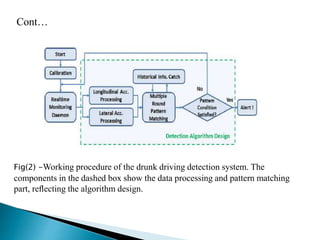
The drunk driving detection system is made up of four
components.They are
•Monitoring daemon module.
•Calibration module.
•Data processing and pattern matching module.
•Alert module.
SYSTEM DESIGN AND IMPLEMENTATION:
Fig(2) -Working procedure of the drunk driving detection system. The
components in the dashed box show the data processing and pattern matching
part, reflecting the algorithm design.
Cont…
Design of Algorithm:
•We design the detection algorithm based on accelerations.
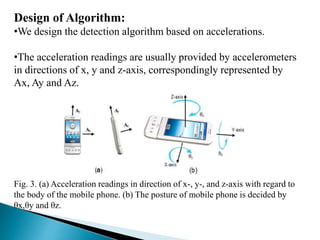
•The acceleration readings are usually provided by accelerometers
in directions of x, y and z-axis, correspondingly represented by
Ax, Ay and Az.
Fig. 3. (a) Acceleration readings in direction of x-, y-, and z-axis with regard to
the body of the mobile phone. (b) The posture of mobile phone is decided by
θx,θy and θz.
Cont…
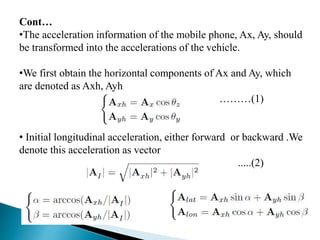
•The acceleration information of the mobile phone, Ax, Ay, should
be transformed into the accelerations of the vehicle.
•We first obtain the horizontal components of Ax and Ay, which
are denoted as Axh, Ayh
………(1)
• Initial longitudinal acceleration, either forward or backward .We
denote this acceleration as vector
.....(2)
Lateral Acceleration Pattern Matching:
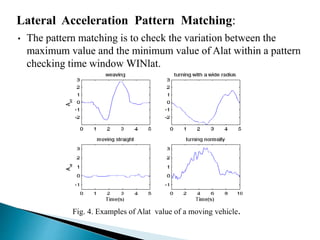
• The pattern matching is to check the variation between the
maximum value and the minimum value of Alat within a pattern
checking time window WINlat.
Fig. 4. Examples of Alat value of a moving vehicle.
Longitudinal Acceleration Pattern Matching:
•When the vehicle acts abnormally in either accelerating or
decelerating direction, result in a large absolute value of Alon,
making a salient convex or concave shape in its graph of curves.
•The system keeps checking the maximum or minimum value of
Alon. If the amplitude of value exceeds the threshold Thlon, a
speed control problem is considered detected.
•Set different thresholds for positive Alon and negative Alon.
Multiple Round Pattern Matching:
•Multiple round means that the matching process continues round
after round, and the trigger condition is satisfied when several
numbers of pattern are recognized.
•Multiple round pattern matching will increase the accuracy of
drunk driving detection.
•The historical information catch component is used for catching
and storing the previous pattern matching information which can
be used in the following round of pattern matching.
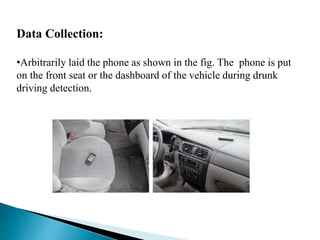
Data Collection:
•Arbitrarily laid the phone as shown in the fig. The phone is put
on the front seat or the dashboard of the vehicle during drunk
driving detection.
Conclusion:
•A highly efficient mobile phone based drunk driving detection
system.
•The mobile phone, which is placed in the vehicle, collects and
analyzes the data from its accelerometer and orientation sensor to
detect any abnormal driving.
•Needs to be integrated by all available sensing data on a mobile
phone, e.g., GPS data and camera image.
References:
[1] J. Faber, “Detection of Different Levels of Vigilance by
EEG Pseudo Spectra”, in Neural Network World, 14(3-4), pp.
285-290, 2004.
[2] U.S. NHTSA, “Traffic Safety”,
http://www.nrd.nhtsa.dot.gov/Pubs/ 811172.pdf
[3] U.S. NHTSA, “The Visual Detection of DWI Motorists”,
http://www.
nhtsa.dot.gov/people/injury/alcohol/dwi/dwi.html/index.htm
Mobile Phone Based Drunk driving detection

Mobile Phone Based Drunk driving detection

  • 1.
    Mobile Phone BasedDrunk Driving Detection BY Nagaraj C ISE Under the guidance of: Ms.Punitha rajkumari B.E,M.Tech Sr.Lecturer, Dept of ISE, SIET
  • 2.
    Contents •Introduction •Acceleration-Based Drunk DrivingCues •System Overview •Design of Algorithm •Acceleration Pattern Matching •Conclusion
  • 3.
    INTRODUCTION: •Driving Under theIn- fluence of alcohol, is a major cause of traffic accidents throughout the world. •We propose a highly efficient system aimed at early detection and alert of dangerous maneuvers vehicle typically related to drunk driving. •The entire solution requires only a mobile phone placed in vehicle and with accelerometer and orientation sensor. •A program installed on the mobile phone computes accelerations based on sensor readings. •The mobile phone will automatically alert the driver or call the police for help.
  • 4.
    ACCELERATION BASED DRUNKDRIVING CUES: The researchers have identified cues of typical driving behavior for drunk drivers. Three categories of behaviors as follows. •Cues related to lane position maintenance problems. •Cues related to speed control problems. •Cues related to judgment and vigilance problems.
  • 5.
    Lateral Acceleration andLane Position Maintenance: •The lane position maintenance problems result in abnormal curvilinear movements, including weaving, drifting, swerving and turning with a wide radius. Longitudinal Acceleration and Speed Control in Driving: •A drunk driver often experiences difficulty in keeping an appropriate speed. •Abrupt acceleration or deacceleration, erratic braking and jerky stop are strong cues to show that the driver is under alcohol impairment. •They will all be reflected in the changes of longitudinal acceleration.
  • 6.
  • 7.
    System Overview: The drunkdriving detection system is made up of four components.They are •Monitoring daemon module. •Calibration module. •Data processing and pattern matching module. •Alert module. SYSTEM DESIGN AND IMPLEMENTATION:
  • 8.
    Fig(2) -Working procedureof the drunk driving detection system. The components in the dashed box show the data processing and pattern matching part, reflecting the algorithm design. Cont…
  • 9.
    Design of Algorithm: •Wedesign the detection algorithm based on accelerations. •The acceleration readings are usually provided by accelerometers in directions of x, y and z-axis, correspondingly represented by Ax, Ay and Az. Fig. 3. (a) Acceleration readings in direction of x-, y-, and z-axis with regard to the body of the mobile phone. (b) The posture of mobile phone is decided by θx,θy and θz.
  • 10.
    Cont… •The acceleration informationof the mobile phone, Ax, Ay, should be transformed into the accelerations of the vehicle. •We first obtain the horizontal components of Ax and Ay, which are denoted as Axh, Ayh ………(1) • Initial longitudinal acceleration, either forward or backward .We denote this acceleration as vector .....(2)
  • 11.
    Lateral Acceleration PatternMatching: • The pattern matching is to check the variation between the maximum value and the minimum value of Alat within a pattern checking time window WINlat. Fig. 4. Examples of Alat value of a moving vehicle.
  • 12.
    Longitudinal Acceleration PatternMatching: •When the vehicle acts abnormally in either accelerating or decelerating direction, result in a large absolute value of Alon, making a salient convex or concave shape in its graph of curves. •The system keeps checking the maximum or minimum value of Alon. If the amplitude of value exceeds the threshold Thlon, a speed control problem is considered detected. •Set different thresholds for positive Alon and negative Alon.
  • 13.
    Multiple Round PatternMatching: •Multiple round means that the matching process continues round after round, and the trigger condition is satisfied when several numbers of pattern are recognized. •Multiple round pattern matching will increase the accuracy of drunk driving detection. •The historical information catch component is used for catching and storing the previous pattern matching information which can be used in the following round of pattern matching.
  • 14.
    Data Collection: •Arbitrarily laidthe phone as shown in the fig. The phone is put on the front seat or the dashboard of the vehicle during drunk driving detection.
  • 15.
    Conclusion: •A highly efficientmobile phone based drunk driving detection system. •The mobile phone, which is placed in the vehicle, collects and analyzes the data from its accelerometer and orientation sensor to detect any abnormal driving. •Needs to be integrated by all available sensing data on a mobile phone, e.g., GPS data and camera image.
  • 16.
    References: [1] J. Faber,“Detection of Different Levels of Vigilance by EEG Pseudo Spectra”, in Neural Network World, 14(3-4), pp. 285-290, 2004. [2] U.S. NHTSA, “Traffic Safety”, http://www.nrd.nhtsa.dot.gov/Pubs/ 811172.pdf [3] U.S. NHTSA, “The Visual Detection of DWI Motorists”, http://www. nhtsa.dot.gov/people/injury/alcohol/dwi/dwi.html/index.htm