HCMUS at Medico Automatic Polyp Segmentation Task 2020:
PraNet and ResUnet++ for Polyps Segmentation
Tien-Phat Nguyen, Tan-Cong Nguyen, Gia-Han Diep
Minh-Quan Le, Hoang-Phuc Nguyen-Dinh
Hai-Dang Nguyen, Minh-Triet Tran
MediaEval 2020 Medico Polyp Segmentation Task
{ntphat_student,ntcong, dghan, ndhphuc, lmquan, nhdang}@selab.hcmus.edu.vn, tmtriet@fit.hcmus.edu.vn
Dec.04,2020
1
Outline
❖ Overview
❖ Approach
❖ Result
❖ Conclusion
2
Overview
3
[1] Debesh Jha et al. “Medico Multimedia Task at MediaEval 2020: Auto-matic Polyp Segmentation”. MediaEval 2020 Workshop. 2020.
MEDICO TASK1
- Segment all types of polyps in colonoscopy images
Overview
4
TASK 1: Polyp Segmentation
- Data:
- Training set: Kvasir-SEG1
Dataset with 1.000 images
- Test set: 160 images
- Evaluated by Jaccard index
[1] Debesh Jha et al. “Kvasir-seg: A segmented polyp dataset.” In International Conference on Multimedia Modeling. 2020.
Overview
5
TASK 2: Algorithm efficiency
- Same as Task 1 but focus on the speed of the algorithm
- Participants are required to submit a Docker image
- Evaluated by frames per second rate and Jaccard index
- PraNet1
: We use Pranet with Res2net3
backbone as the main
segmentation algorithm.
- Training Signal Annealing2
: We apply TSA strategy to prevent
overfitting in training step.
- Pre/Post-processing methods: We use random rotation and
high-boost filtering for augmentation.
Approach 1: PraNet with Training Signal Annealing
6
[1] D.-P. Fan et al. “PraNet: Parallel Reverse Attention Network for Polyp Segmentation”. MICCAI 2020
[2] Xie, Qizhe, et al. “Unsupervised data augmentation for consistency training”. (2019)
[3] Gao, Shanghua, et al. “Res2net: A new multi-scale backbone architecture”. IEEE 2019
7
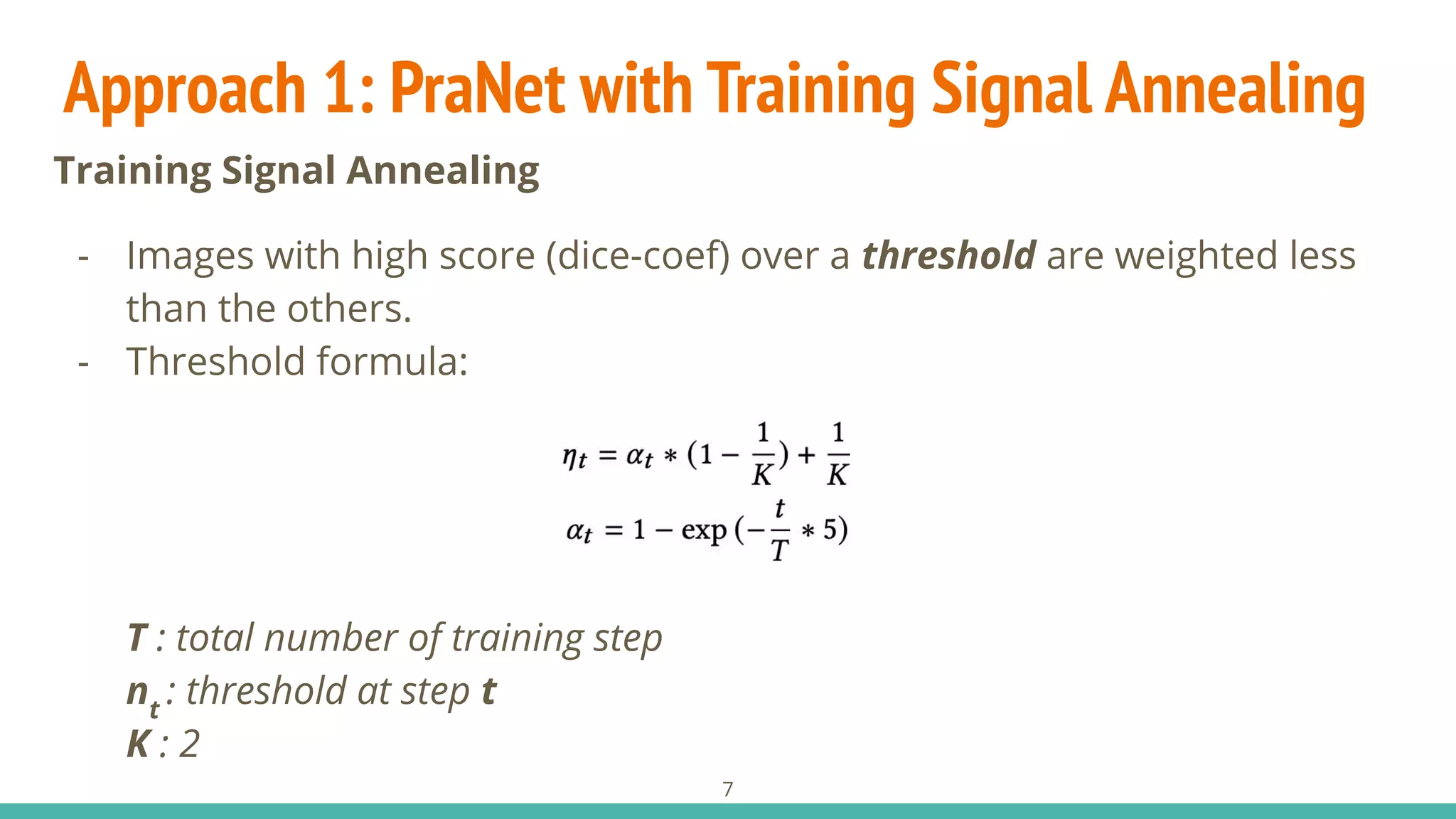
Training Signal Annealing
- Images with high score (dice-coef) over a threshold are weighted less
than the others.
- Threshold formula:
T : total number of training step
nt
: threshold at step t
K : 2
Approach 1: PraNet with Training Signal Annealing
8
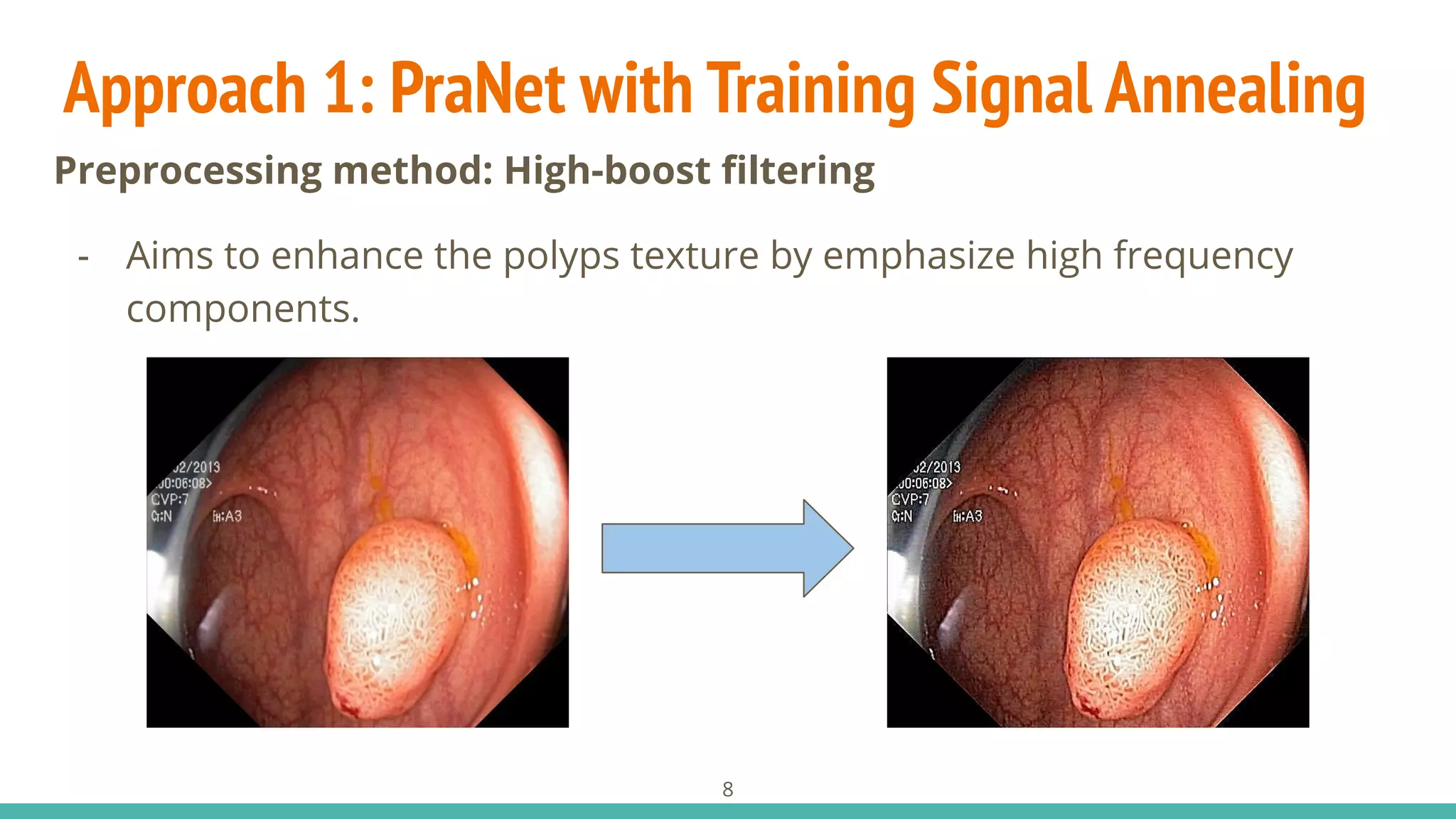
Preprocessing method: High-boost filtering
- Aims to enhance the polyps texture by emphasize high frequency
components.
Approach 1: PraNet with Training Signal Annealing
Approach 2: ResUnet++ with Triple-Path and Geodesic Distance
- Base architecture: use ResUnet++1
- Triple-path input: aggregate three
versions of the enhanced input
image
- Guide map: integrate a distance
map layer using Geodesic Distance
Transform2
as a guide mask
9
[1] Jha, Debesh, et al. “Resunet++: An advanced architecture for
medical image segmentation.” IEEE 2020
[2] G. Wang et al. “DeepIGeoS: A Deep Interactive Geodesic Framework
for Medical Image Segmentation.IEEE 2019
Approach 2: ResUnet++ with Triple-Path and Geodesic Distance
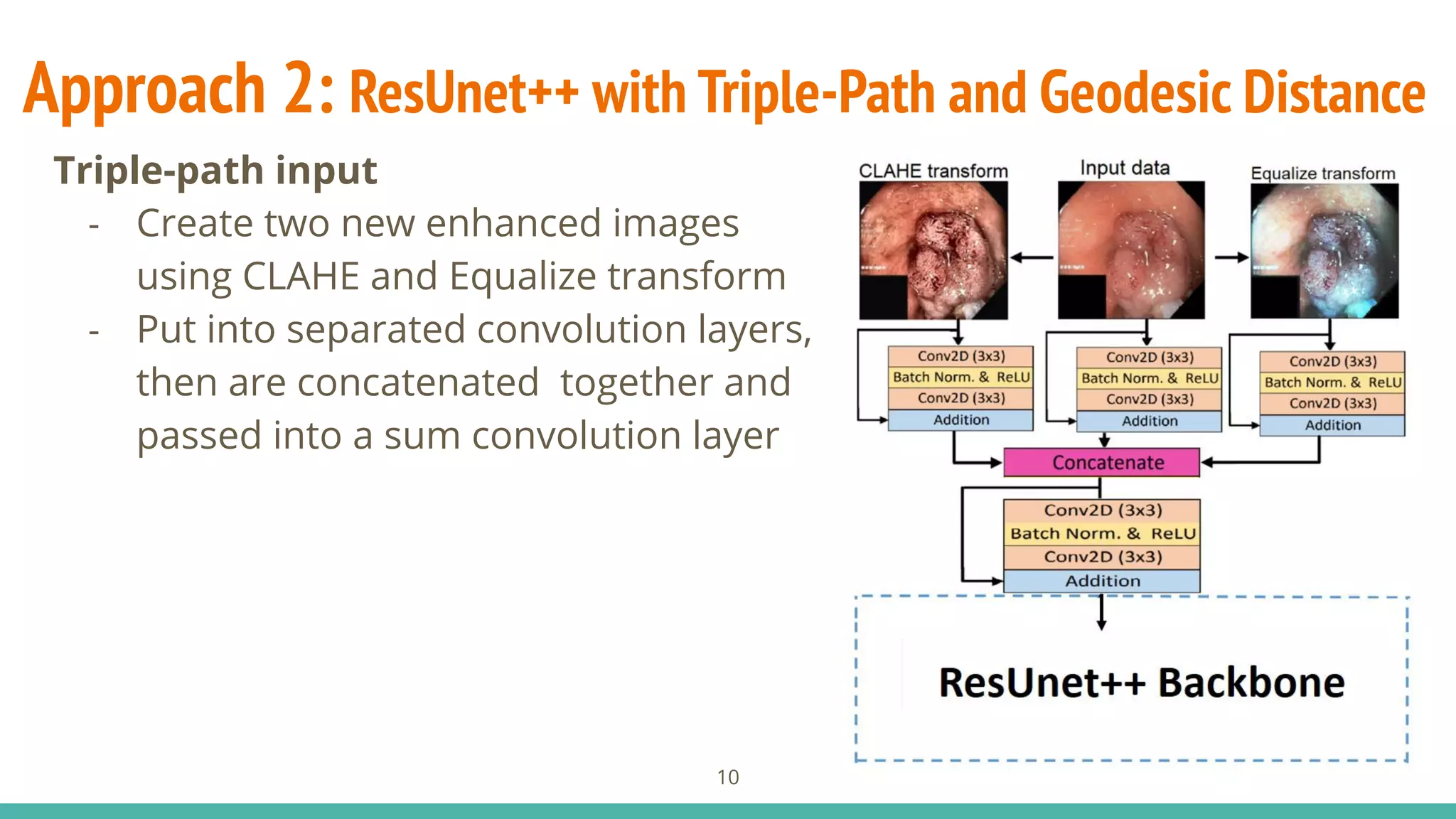
- Create two new enhanced images
using CLAHE and Equalize transform
- Put into separated convolution layers,
then are concatenated together and
passed into a sum convolution layer
10
Triple-path input
Approach 2: ResUnet++ with Triple-Path and Geodesic Distance
11
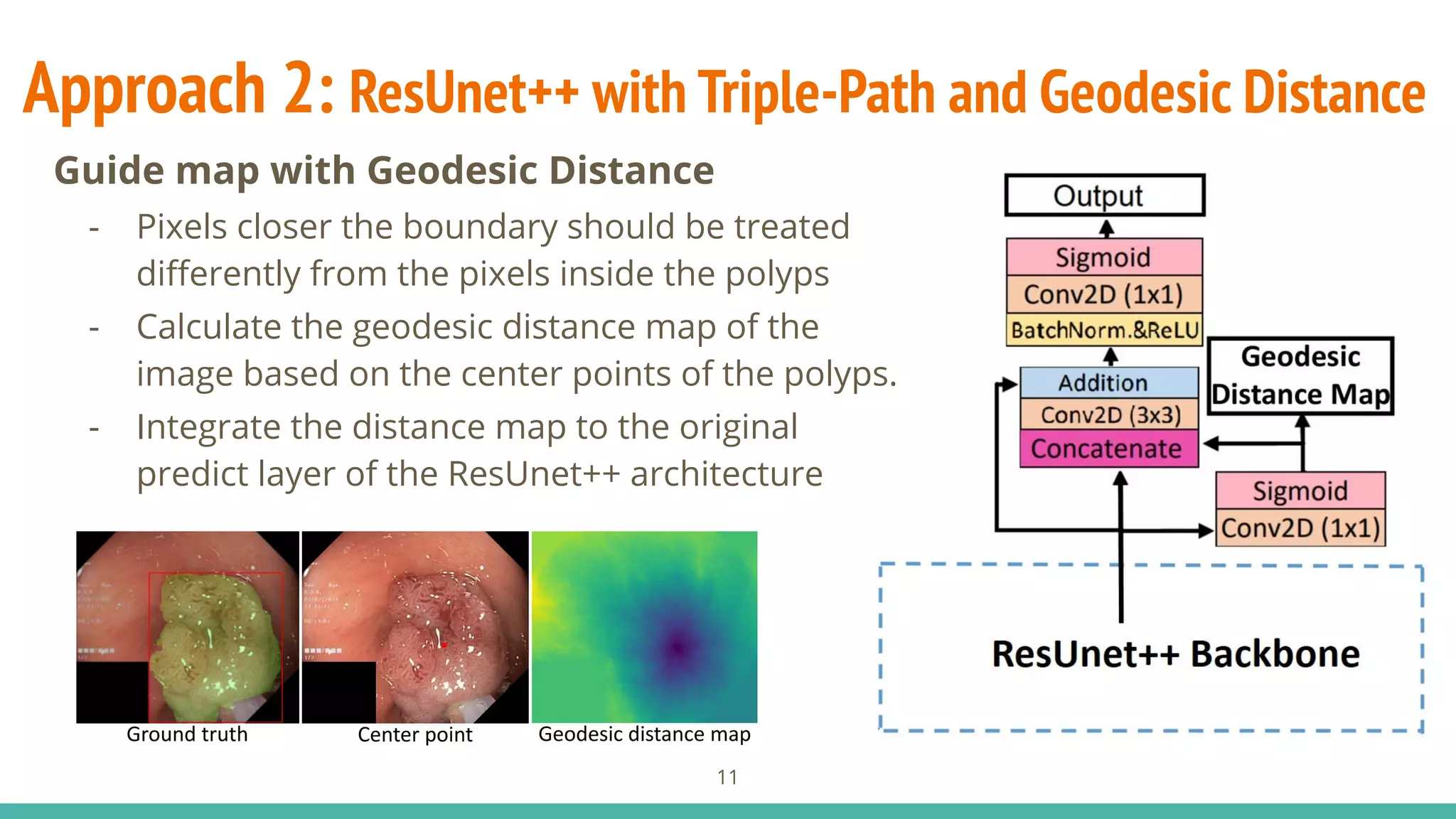
Guide map with Geodesic Distance
- Pixels closer the boundary should be treated
differently from the pixels inside the polyps
- Calculate the geodesic distance map of the
image based on the center points of the polyps.
- Integrate the distance map to the original
predict layer of the ResUnet++ architecture
Result
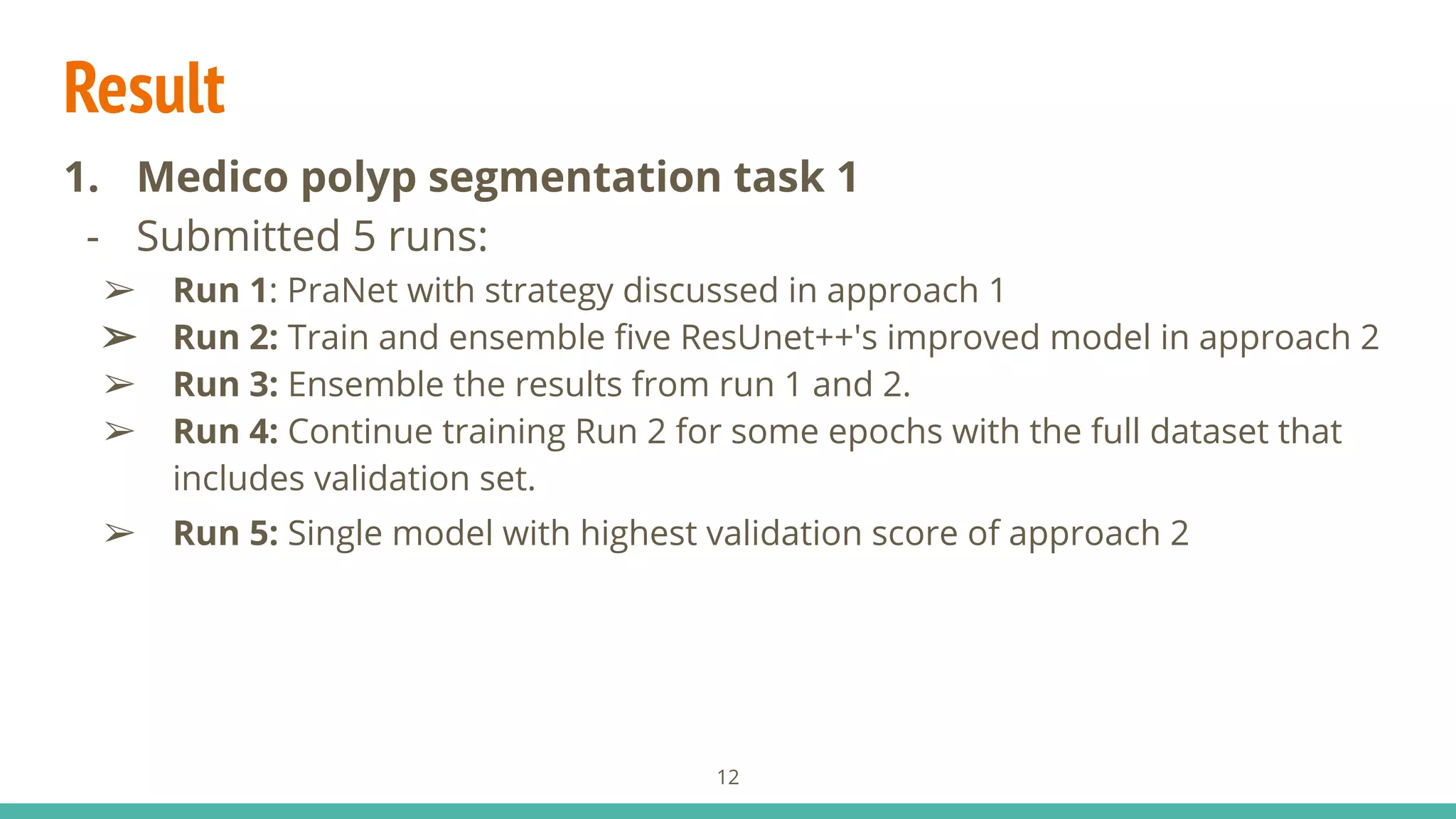
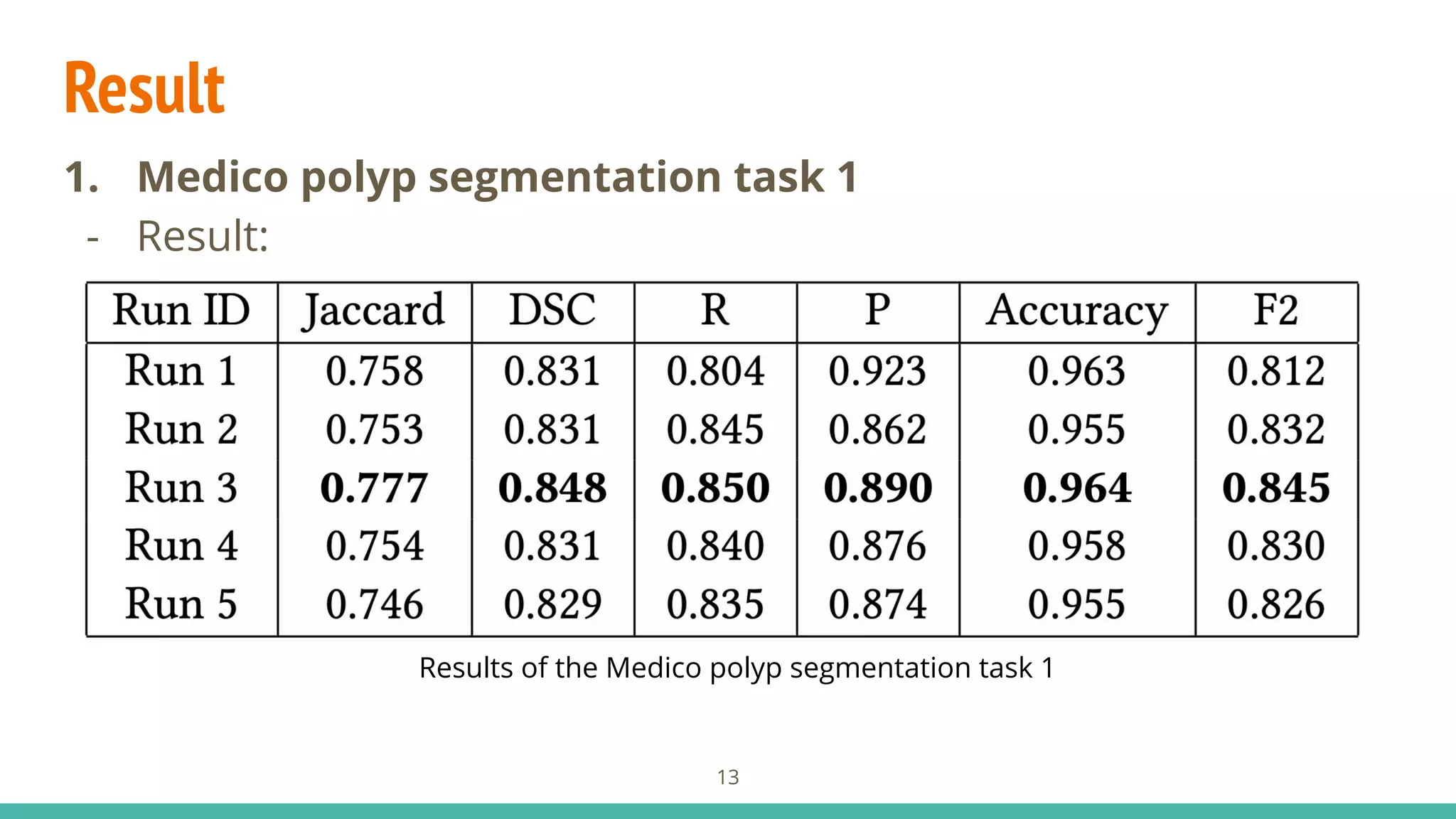
1. Medico polyp segmentation task 1
- Submitted 5 runs:
➢ Run 1: PraNet with strategy discussed in approach 1
➢ Run 2: Train and ensemble five ResUnet++'s improved model in approach 2
➢ Run 3: Ensemble the results from run 1 and 2.
➢ Run 4: Continue training Run 2 for some epochs with the full dataset that
includes validation set.
➢ Run 5: Single model with highest validation score of approach 2
12
Result
1. Medico polyp segmentation task 1
- Result:
13
Results of the Medico polyp segmentation task 1
Result
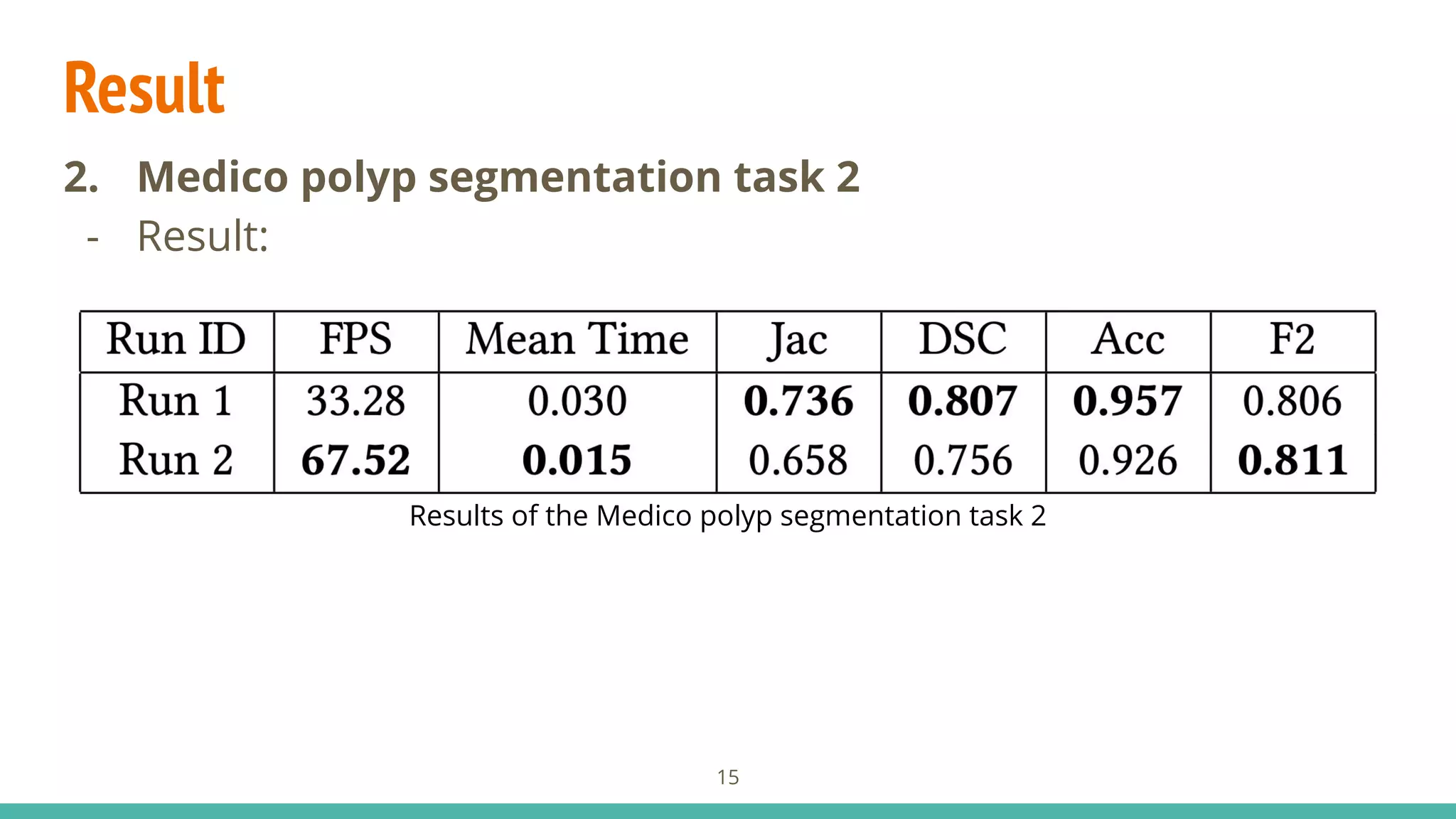
2. Medico polyp segmentation task 2
- Submitted 2 runs:
➢ Run 1: Choose best model which achieves best validation
result from approach 1
➢ Run 2 : Likewise, choose model with highest validation
score of approach 2
14
Result
2. Medico polyp segmentation task 2
- Result:
15
Results of the Medico polyp segmentation task 2
Conclusion
- We proposed different methods leveraging the advantages of
either ResUnet++ or PraNet model to efficiently segment polyps in
colonoscopy images.
- Our suggested approaches show significant improvements in the
results, for both accuracy and efficiency.
16
Q / A
Thank you!
17
17

HCMUS at Medico Automatic Polyp Segmentation Task 2020: PraNet and ResUnet++ for Polyps Segmentation

  • 1.
    HCMUS at MedicoAutomatic Polyp Segmentation Task 2020: PraNet and ResUnet++ for Polyps Segmentation Tien-Phat Nguyen, Tan-Cong Nguyen, Gia-Han Diep Minh-Quan Le, Hoang-Phuc Nguyen-Dinh Hai-Dang Nguyen, Minh-Triet Tran MediaEval 2020 Medico Polyp Segmentation Task {ntphat_student,ntcong, dghan, ndhphuc, lmquan, nhdang}@selab.hcmus.edu.vn, tmtriet@fit.hcmus.edu.vn Dec.04,2020 1
  • 2.
  • 3.
    Overview 3 [1] Debesh Jhaet al. “Medico Multimedia Task at MediaEval 2020: Auto-matic Polyp Segmentation”. MediaEval 2020 Workshop. 2020. MEDICO TASK1 - Segment all types of polyps in colonoscopy images
  • 4.
    Overview 4 TASK 1: PolypSegmentation - Data: - Training set: Kvasir-SEG1 Dataset with 1.000 images - Test set: 160 images - Evaluated by Jaccard index [1] Debesh Jha et al. “Kvasir-seg: A segmented polyp dataset.” In International Conference on Multimedia Modeling. 2020.
  • 5.
    Overview 5 TASK 2: Algorithmefficiency - Same as Task 1 but focus on the speed of the algorithm - Participants are required to submit a Docker image - Evaluated by frames per second rate and Jaccard index
  • 6.
    - PraNet1 : Weuse Pranet with Res2net3 backbone as the main segmentation algorithm. - Training Signal Annealing2 : We apply TSA strategy to prevent overfitting in training step. - Pre/Post-processing methods: We use random rotation and high-boost filtering for augmentation. Approach 1: PraNet with Training Signal Annealing 6 [1] D.-P. Fan et al. “PraNet: Parallel Reverse Attention Network for Polyp Segmentation”. MICCAI 2020 [2] Xie, Qizhe, et al. “Unsupervised data augmentation for consistency training”. (2019) [3] Gao, Shanghua, et al. “Res2net: A new multi-scale backbone architecture”. IEEE 2019
  • 7.
    7 Training Signal Annealing -Images with high score (dice-coef) over a threshold are weighted less than the others. - Threshold formula: T : total number of training step nt : threshold at step t K : 2 Approach 1: PraNet with Training Signal Annealing
  • 8.
    8 Preprocessing method: High-boostfiltering - Aims to enhance the polyps texture by emphasize high frequency components. Approach 1: PraNet with Training Signal Annealing
  • 9.
    Approach 2: ResUnet++with Triple-Path and Geodesic Distance - Base architecture: use ResUnet++1 - Triple-path input: aggregate three versions of the enhanced input image - Guide map: integrate a distance map layer using Geodesic Distance Transform2 as a guide mask 9 [1] Jha, Debesh, et al. “Resunet++: An advanced architecture for medical image segmentation.” IEEE 2020 [2] G. Wang et al. “DeepIGeoS: A Deep Interactive Geodesic Framework for Medical Image Segmentation.IEEE 2019
  • 10.
    Approach 2: ResUnet++with Triple-Path and Geodesic Distance - Create two new enhanced images using CLAHE and Equalize transform - Put into separated convolution layers, then are concatenated together and passed into a sum convolution layer 10 Triple-path input
  • 11.
    Approach 2: ResUnet++with Triple-Path and Geodesic Distance 11 Guide map with Geodesic Distance - Pixels closer the boundary should be treated differently from the pixels inside the polyps - Calculate the geodesic distance map of the image based on the center points of the polyps. - Integrate the distance map to the original predict layer of the ResUnet++ architecture
  • 12.
    Result 1. Medico polypsegmentation task 1 - Submitted 5 runs: ➢ Run 1: PraNet with strategy discussed in approach 1 ➢ Run 2: Train and ensemble five ResUnet++'s improved model in approach 2 ➢ Run 3: Ensemble the results from run 1 and 2. ➢ Run 4: Continue training Run 2 for some epochs with the full dataset that includes validation set. ➢ Run 5: Single model with highest validation score of approach 2 12
  • 13.
    Result 1. Medico polypsegmentation task 1 - Result: 13 Results of the Medico polyp segmentation task 1
  • 14.
    Result 2. Medico polypsegmentation task 2 - Submitted 2 runs: ➢ Run 1: Choose best model which achieves best validation result from approach 1 ➢ Run 2 : Likewise, choose model with highest validation score of approach 2 14
  • 15.
    Result 2. Medico polypsegmentation task 2 - Result: 15 Results of the Medico polyp segmentation task 2
  • 16.
    Conclusion - We proposeddifferent methods leveraging the advantages of either ResUnet++ or PraNet model to efficiently segment polyps in colonoscopy images. - Our suggested approaches show significant improvements in the results, for both accuracy and efficiency. 16
  • 17.
    Q / A Thankyou! 17 17