THE POSTPARTAL FAMILY

        Maybelle B. Animas
Postpartal Period
• Puerperium- “puer”- child, “parere” –to         bring
  forth
• 6-weeks period after childbirth
• Retrogressive- involution of the uterus
     and vagina
• Progressive-    production   of   milk    for   lactation,
     restoration of the normal menstrual cycle,
     and beginning of a parenting role
Psychological Changes of the
      Postpartal Period
PHASES OF PUERPERIUM
Taking-In Phase
  • 2- to 3-day period, a woman is largely
  passive
  • woman usually wants to talk about her
    pregnancy, especially about her labor
    and birth

• ***Main nursing is to listen and help the mother interpret
  events of the delivery to make them more meaningful and
  clarify and misconceptions
PHASES OF PUERPERIUM
Taking-Hold Phase
   – Occurs during day 1 - 3 following delivery.
   – Marked by a period of being dependent and passive
     behavior.
   – Mother’s primary needs are her own -- food
     and sleep
   – Mother is talkative about her labor and delivery
     experience


***It is the best time for teaching!
PHASES OF PUERPERIUM
Letting-Go Phase

• woman finally redefines her new role
• She gives up the fantasized image of her
  child and accepts the real one; she gives
  up her old role of being childless or the
  mother of only one or two
Development of Parental Love and
   Positive Family Relationship
1. En Face position -- eye-to-eye contact


                    2. Explore with finger-tips


3. Hand and Palmar contact


4. Whole arms --enfolds whole baby
              close to body
DPLPFR
• Claiming or Bonding

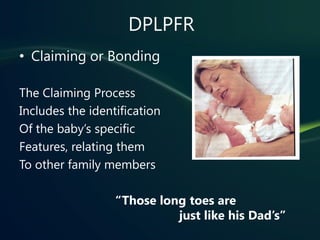
The Claiming Process
Includes the identification
Of the baby’s specific
Features, relating them
To other family members

                  “Those long toes are
                            just like his Dad’s”
Rooming-In

• Infant stays in the room rather than in the
  nursery.

• She can become better acquainted with
  her child and begin to feel more confident
  in her ability to care
Postpartal Blues
• 50% of women experience some feeling of
  overwhelming sadness for which they
  cannot account
• Hormonal changes- dec progesterone and
  estrogen
• Response to dependence and low self
  esteem caused by exhaustion, being away
  from home, physical discomfort and
  tension
Postpartal Blues
• Fearfulness, feeling of inadequacy, mood
  lability, anorexia and sleep disturbance

• Assurance and support
Physiologic Changes of the Postpartal
                  Period
• Involution
  – Reproductive organs
    return to their normal
    state
Physiologic Changes of the Postpartal
                   Period
• Uterus
• 2 process
   1.The area where the placenta is sealed off
   – Accomplished by rapid contraction of the uterus after
     the delivery of the placenta
   – Muscle fibers become shorter controlling the bleeding
     by compressing and sealing off blood vessels
2. The organ is reduced to its pregestational size
  through
– Autolytic process
   • Few cells of the uterine wall are broken down
     into their protein component which is then
     absorbed in the blood stream and excreted in
     the urine.
– Contraction

- Immediately after birth – 1000g
- At the end of 1st wk- 500g
- 6wks – 50g
Physiologic Changes of the Postpartal
                Period
- After placental delivery
  the uterus may be
  palpated through the
  abdominal wall halfway
  bet the umbilicus and
  the symphysis pubis
- 1hr after- level of
  umbilicus
- Decrease 1 fingerbreath
  per day
Assessment of the Uterus

 • Placement and Size (location)

             • Tone

            • Lochia
Nursing Care of Uterine Changes
• Assessment of the
  Uterus
  – Placement and size -- should
    be level with the umbilicus
    after delivery. The uterus
    then should decrease 1 FB /
    day. Should also be midline
    and the size of a grapefruit
Nursing Care of Uterine Changes

• Tone -- should be firm.
  Assess by supporting
  lower portion with one
  hand and palpate
  fundus with other.
• If found boggy, then
  massage. Do not
  overmassage.
Lochia
   TYPE        COLOR   DURATION      COMPOSITI
                                         ON
Lochia Rubra    Red     1-3 days       Blood,
                                    fragments of
                                      decidua,
                                       mucus
  Lochia       Pink    3-10 days       Blood,
  Serosa                             mucus and
                                     leukocytes
Lochia Alba    White   10-14 days      Largely
                                       mucus
Characteristics of Lochia
• Should not be excessive in amount
• Should not have an offensive odor
• Should not contain large pieces of tissue
  or blood clots
• Should not be absent during the first 3
  weeks
• Should proceed from rubra -- serosa --
  alba
Physiologic Changes of the
                Postpartal Period
• Cervix
  – After birth- soft and
    malleable, internal and
    external os is open
  – Pre-pregnant appearance
    is a dimpled area in the
    center -- post-pregnancy
    appears as a jagged slit.
Physiologic Changes of the
          Postpartal Period

• Vagina

  – May be edematous and bruised.
  – Rugae begin to appear when ovarian function
    returns.
  – May teach the mom to do Kegels exercises
Perineum
• May have tears, lacerations, or an episiotomy
• Assessment Procedure:
  – Turn patient to side-lying / sims position
  – Gently spread buttocks apart inspect with
      penlight
  Assessment:
  – Episiotomy/lacerations/edema/hemorrhoids
  – Assess for complications/hematoma
  Interventions:
  – Hygiene/ Peri-bottle filled with warm water
  – Wipe front to back; change pads frequently/snug fit
  – Sitz bath 3-4 x day
Breasts
• Teach to assess her own breasts -- similar
  to doing a self-breast exam (SBE)
• Assessment:
  – Breasts- nodules, lumps
  – Nipples - assess for eversion, flat, inverted, cracking,
    bleeding, pain, blisters


• Individualize teaching for breasts for
  breastfeeding and non-breastfeeding
  moms
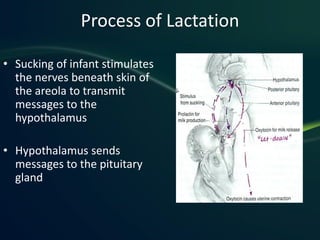
Process of Lactation

• Sucking of infant stimulates
  the nerves beneath skin of
  the areola to transmit
  messages to the
  hypothalamus

• Hypothalamus sends
  messages to the pituitary
  gland
Process of Lactation
– Anterior pituitary -- stimulates
  Prolactin to be released which is
  the ultimate stimulation for milk
  production
– Posterior pituitary -- releases
  Oxytocin which stimulates the
  contraction of the cells around
  the alveoli in the mammary
  glands. This causes milk to be
  propelled through the duct
  system to the infant. This is the
  “LET-DOWN” reflex. Felt as a
  tingling sensation
Breastfeeding Care
• No soap on the nipples, wash in water wear
  supportive bra
• Breastfeeding tips:
  – Most important is the “latch-on” Teach measures to
    assist with the infant getting the nipple and areola in
    the mouth
  – Teach different positions to hold the baby
  – No timing
  – Relax to allow for “let-down”
Suppression of Lactation
• Key: teach measures to decrease
  stimulation of the breasts
  – Tight-fitting bra or binder
  – Do not express milk from the breasts
  – Take shower with back to the warm water
  – Ice packs
Elimination Changes
              Urinary System

• Assess and measure first two voidings post-
  delivery.

• Important to attempt to void every 3 - 4 hours.
  If unable to void– catheterize based on
  assessment

• Diuresis is common -- loss of fluid of pregnancy

• Mild proteinuria is normal.
Elimination Changes
             Urinary System

• Patient Teaching:
  – increase fluids, fiber, and activity
  – stool softeners, anesthetic sprays, Tucks
  – **Do NOT give an enema or suppository to
    a person who has a 3rd or 4th degree
    laceration.
Regulatory Changes
• Most common problem is Sleep
  deprivation -- the excitement and
  exhilaration following the birth may make
  it difficult to sleep.

• Exercise – Should be individualized per
  patient. Use caution until involution is
  complete.
Postpartum Pain
– Perineal pain – result of trauma during delivery-
  episiotomy/lacerations/hemorrhoids.
  Interventions: Comfort measures: sitz, Tucks,
  sprays / Foams, oral analgesics.

– Afterbirth pain -- more common in multigravidas
  and breastfeeding moms. Interventions; Treat
  with mild analgesics (NSAIDS, Acetomenophen)
  heating pad, lie on abdomen, discontinue use of
  oxytocins, Norco for severe pain
Postpartum Pain

– Breast engorgement -- warm or cold packs, cabbage
  leaves, increase feedings if breastfeeding, decrease
  stimulation if not breastfeeding. Breast binder.

– Gas distention -- no ice chips or cold liquids, provide
  warm / hot fluids, increase walking, rocking chair,
  Simethicone.
Integumentary Changes
• Skin -- pigment changes will begin to
  disappear; diaphoresis is normal

• Striae - May have stretch marks over
  abdomen and legs

• diastasis recti- Can occur with
  overdistention of the uterus, caution with
  exercise
Integumentary Changes
• Episiotomy/lacerations – Important to
  treat as any other incision and maintain
  cleanliness

• C/S Incision – Maintain pressure dressing
  for 24 hours and then open to air, closure
  with staples/ steri strips/dermabond.
  Document and assess approximation, and
  signs of infection
Oxygenation Alterations
   Cardiovascular System Changes
• Plasma volume – body rids itself of excess by:
  – Diuresis – urinary output of 3000 cc / day is
    common
  – Diaphoresis
• Blood Volume
  – Increase for about 24-48 hours after delivery
  – Increase in blood flow back to the heart when blood
    from the placenta unit returns to central circulation
  – Extravascular interstitial fluid is moved into the
    vascular system / intravascular
  – Leads to increased cardiac output mainly RT increase
    stroke volume.
Oxygenation
• Vital Signs
   – Temperature -- may see a SLIGHT ~100. rise in temperature
     because of dehydration and exertion of labor in first 24 hrs


   – Pulse -- Bradycardia is common for 6 - 8 days postpartally.
     RT vagal response to increased sympathetic nervous system
     stimulation during labor and increase in stroke volume.

   – Respirations –begin to fall to normal pre-birth range.

   – B/P -- should remain steady. Not elevated or decreased
Oxygenation – Lab Assessment
           Pregnancy                                 Post Partum
WBC – elevated slightly to about 12,000    WBC – leukocytosis is common with
                                           values of 20,000 – 30,000 RT increassed
                                           neutrophils

RBC – increase slightly to about 10 milion. RBC – return to normal


Hemoglobin – stays about normal at ~ 12    Hgb. – normal to see a drop of about 1
g. Below 10 g = anemia                     gram


Hemotocrit – lowers 33-39% RT              Hct – normal to see a drop of about 4
hemodilution. If drops below 32- 35% =     points and then a rise RT > loss of plasma
anemia                                     than RBC death
• Assess for Thromboembolism

  – During pregnancy, plasma fibrinogen
    (coagulation) increases to prepare for delivery
    and prevention of excess blood loss
  – Plasminogen (lysis of clots) does not rise
  – Hypercoagulable state and the woman is at a
    greater risk for thrombus formation.
  – Assess for homan’s sign?
– Assess for Hemorrhage -- related to uterine
  atony
   • Normal for loss of up to 500 cc during vaginal
     delivery and 1000 cc in cesarean delivery.
   • Assessment of lochia: should be scant to small with
     no large clots.
   • Assessment of fundus: tone, location
   • If excess bleeding and decreased tone may
     administer Methergine. Assess B/P prior to giving--
     hold the dose if elevated >140 / 90. Other drugs to
     contract uterus
Nutritional Alterations
• Most moms are hungry and eager to eat. Progress
  slowly to avoid nausea and vomiting.

• Diet should include:
   – High in Protein, vitamin C, and fiber
   – Increase in fluids

• Lactating moms need about 500 extra calories for
  milk production

• Prenatal vitamins and iron supplements are often
  continued in the postpartum period.
“ Because the more a
 mother is cared for,
 the more easily she
 can care for her
 baby.”
     -    Shivam Rachana

Postpartum

  • 1.
    THE POSTPARTAL FAMILY Maybelle B. Animas
  • 2.
    Postpartal Period • Puerperium-“puer”- child, “parere” –to bring forth • 6-weeks period after childbirth • Retrogressive- involution of the uterus and vagina • Progressive- production of milk for lactation, restoration of the normal menstrual cycle, and beginning of a parenting role
  • 3.
    Psychological Changes ofthe Postpartal Period
  • 4.
    PHASES OF PUERPERIUM Taking-InPhase • 2- to 3-day period, a woman is largely passive • woman usually wants to talk about her pregnancy, especially about her labor and birth • ***Main nursing is to listen and help the mother interpret events of the delivery to make them more meaningful and clarify and misconceptions
  • 5.
    PHASES OF PUERPERIUM Taking-HoldPhase – Occurs during day 1 - 3 following delivery. – Marked by a period of being dependent and passive behavior. – Mother’s primary needs are her own -- food and sleep – Mother is talkative about her labor and delivery experience ***It is the best time for teaching!
  • 6.
    PHASES OF PUERPERIUM Letting-GoPhase • woman finally redefines her new role • She gives up the fantasized image of her child and accepts the real one; she gives up her old role of being childless or the mother of only one or two
  • 7.
    Development of ParentalLove and Positive Family Relationship 1. En Face position -- eye-to-eye contact 2. Explore with finger-tips 3. Hand and Palmar contact 4. Whole arms --enfolds whole baby close to body
  • 8.
    DPLPFR • Claiming orBonding The Claiming Process Includes the identification Of the baby’s specific Features, relating them To other family members “Those long toes are just like his Dad’s”
  • 9.
    Rooming-In • Infant staysin the room rather than in the nursery. • She can become better acquainted with her child and begin to feel more confident in her ability to care
  • 10.
    Postpartal Blues • 50%of women experience some feeling of overwhelming sadness for which they cannot account • Hormonal changes- dec progesterone and estrogen • Response to dependence and low self esteem caused by exhaustion, being away from home, physical discomfort and tension
  • 11.
    Postpartal Blues • Fearfulness,feeling of inadequacy, mood lability, anorexia and sleep disturbance • Assurance and support
  • 13.
    Physiologic Changes ofthe Postpartal Period • Involution – Reproductive organs return to their normal state
  • 14.
    Physiologic Changes ofthe Postpartal Period • Uterus • 2 process 1.The area where the placenta is sealed off – Accomplished by rapid contraction of the uterus after the delivery of the placenta – Muscle fibers become shorter controlling the bleeding by compressing and sealing off blood vessels
  • 15.
    2. The organis reduced to its pregestational size through – Autolytic process • Few cells of the uterine wall are broken down into their protein component which is then absorbed in the blood stream and excreted in the urine. – Contraction - Immediately after birth – 1000g - At the end of 1st wk- 500g - 6wks – 50g
  • 16.
    Physiologic Changes ofthe Postpartal Period - After placental delivery the uterus may be palpated through the abdominal wall halfway bet the umbilicus and the symphysis pubis - 1hr after- level of umbilicus - Decrease 1 fingerbreath per day
  • 17.
    Assessment of theUterus • Placement and Size (location) • Tone • Lochia
  • 18.
    Nursing Care ofUterine Changes • Assessment of the Uterus – Placement and size -- should be level with the umbilicus after delivery. The uterus then should decrease 1 FB / day. Should also be midline and the size of a grapefruit
  • 19.
    Nursing Care ofUterine Changes • Tone -- should be firm. Assess by supporting lower portion with one hand and palpate fundus with other. • If found boggy, then massage. Do not overmassage.
  • 20.
    Lochia TYPE COLOR DURATION COMPOSITI ON Lochia Rubra Red 1-3 days Blood, fragments of decidua, mucus Lochia Pink 3-10 days Blood, Serosa mucus and leukocytes Lochia Alba White 10-14 days Largely mucus
  • 21.
    Characteristics of Lochia •Should not be excessive in amount • Should not have an offensive odor • Should not contain large pieces of tissue or blood clots • Should not be absent during the first 3 weeks • Should proceed from rubra -- serosa -- alba
  • 22.
    Physiologic Changes ofthe Postpartal Period • Cervix – After birth- soft and malleable, internal and external os is open – Pre-pregnant appearance is a dimpled area in the center -- post-pregnancy appears as a jagged slit.
  • 23.
    Physiologic Changes ofthe Postpartal Period • Vagina – May be edematous and bruised. – Rugae begin to appear when ovarian function returns. – May teach the mom to do Kegels exercises
  • 24.
    Perineum • May havetears, lacerations, or an episiotomy • Assessment Procedure: – Turn patient to side-lying / sims position – Gently spread buttocks apart inspect with penlight Assessment: – Episiotomy/lacerations/edema/hemorrhoids – Assess for complications/hematoma Interventions: – Hygiene/ Peri-bottle filled with warm water – Wipe front to back; change pads frequently/snug fit – Sitz bath 3-4 x day
  • 25.
    Breasts • Teach toassess her own breasts -- similar to doing a self-breast exam (SBE) • Assessment: – Breasts- nodules, lumps – Nipples - assess for eversion, flat, inverted, cracking, bleeding, pain, blisters • Individualize teaching for breasts for breastfeeding and non-breastfeeding moms
  • 26.
    Process of Lactation •Sucking of infant stimulates the nerves beneath skin of the areola to transmit messages to the hypothalamus • Hypothalamus sends messages to the pituitary gland
  • 27.
    Process of Lactation –Anterior pituitary -- stimulates Prolactin to be released which is the ultimate stimulation for milk production – Posterior pituitary -- releases Oxytocin which stimulates the contraction of the cells around the alveoli in the mammary glands. This causes milk to be propelled through the duct system to the infant. This is the “LET-DOWN” reflex. Felt as a tingling sensation
  • 28.
    Breastfeeding Care • Nosoap on the nipples, wash in water wear supportive bra • Breastfeeding tips: – Most important is the “latch-on” Teach measures to assist with the infant getting the nipple and areola in the mouth – Teach different positions to hold the baby – No timing – Relax to allow for “let-down”
  • 29.
    Suppression of Lactation •Key: teach measures to decrease stimulation of the breasts – Tight-fitting bra or binder – Do not express milk from the breasts – Take shower with back to the warm water – Ice packs
  • 30.
    Elimination Changes Urinary System • Assess and measure first two voidings post- delivery. • Important to attempt to void every 3 - 4 hours. If unable to void– catheterize based on assessment • Diuresis is common -- loss of fluid of pregnancy • Mild proteinuria is normal.
  • 31.
    Elimination Changes Urinary System • Patient Teaching: – increase fluids, fiber, and activity – stool softeners, anesthetic sprays, Tucks – **Do NOT give an enema or suppository to a person who has a 3rd or 4th degree laceration.
  • 32.
    Regulatory Changes • Mostcommon problem is Sleep deprivation -- the excitement and exhilaration following the birth may make it difficult to sleep. • Exercise – Should be individualized per patient. Use caution until involution is complete.
  • 33.
    Postpartum Pain – Perinealpain – result of trauma during delivery- episiotomy/lacerations/hemorrhoids. Interventions: Comfort measures: sitz, Tucks, sprays / Foams, oral analgesics. – Afterbirth pain -- more common in multigravidas and breastfeeding moms. Interventions; Treat with mild analgesics (NSAIDS, Acetomenophen) heating pad, lie on abdomen, discontinue use of oxytocins, Norco for severe pain
  • 34.
    Postpartum Pain – Breastengorgement -- warm or cold packs, cabbage leaves, increase feedings if breastfeeding, decrease stimulation if not breastfeeding. Breast binder. – Gas distention -- no ice chips or cold liquids, provide warm / hot fluids, increase walking, rocking chair, Simethicone.
  • 35.
    Integumentary Changes • Skin-- pigment changes will begin to disappear; diaphoresis is normal • Striae - May have stretch marks over abdomen and legs • diastasis recti- Can occur with overdistention of the uterus, caution with exercise
  • 36.
    Integumentary Changes • Episiotomy/lacerations– Important to treat as any other incision and maintain cleanliness • C/S Incision – Maintain pressure dressing for 24 hours and then open to air, closure with staples/ steri strips/dermabond. Document and assess approximation, and signs of infection
  • 37.
    Oxygenation Alterations Cardiovascular System Changes • Plasma volume – body rids itself of excess by: – Diuresis – urinary output of 3000 cc / day is common – Diaphoresis • Blood Volume – Increase for about 24-48 hours after delivery – Increase in blood flow back to the heart when blood from the placenta unit returns to central circulation – Extravascular interstitial fluid is moved into the vascular system / intravascular – Leads to increased cardiac output mainly RT increase stroke volume.
  • 38.
    Oxygenation • Vital Signs – Temperature -- may see a SLIGHT ~100. rise in temperature because of dehydration and exertion of labor in first 24 hrs – Pulse -- Bradycardia is common for 6 - 8 days postpartally. RT vagal response to increased sympathetic nervous system stimulation during labor and increase in stroke volume. – Respirations –begin to fall to normal pre-birth range. – B/P -- should remain steady. Not elevated or decreased
  • 39.
    Oxygenation – LabAssessment Pregnancy Post Partum WBC – elevated slightly to about 12,000 WBC – leukocytosis is common with values of 20,000 – 30,000 RT increassed neutrophils RBC – increase slightly to about 10 milion. RBC – return to normal Hemoglobin – stays about normal at ~ 12 Hgb. – normal to see a drop of about 1 g. Below 10 g = anemia gram Hemotocrit – lowers 33-39% RT Hct – normal to see a drop of about 4 hemodilution. If drops below 32- 35% = points and then a rise RT > loss of plasma anemia than RBC death
  • 40.
    • Assess forThromboembolism – During pregnancy, plasma fibrinogen (coagulation) increases to prepare for delivery and prevention of excess blood loss – Plasminogen (lysis of clots) does not rise – Hypercoagulable state and the woman is at a greater risk for thrombus formation. – Assess for homan’s sign?
  • 41.
    – Assess forHemorrhage -- related to uterine atony • Normal for loss of up to 500 cc during vaginal delivery and 1000 cc in cesarean delivery. • Assessment of lochia: should be scant to small with no large clots. • Assessment of fundus: tone, location • If excess bleeding and decreased tone may administer Methergine. Assess B/P prior to giving-- hold the dose if elevated >140 / 90. Other drugs to contract uterus
  • 42.
    Nutritional Alterations • Mostmoms are hungry and eager to eat. Progress slowly to avoid nausea and vomiting. • Diet should include: – High in Protein, vitamin C, and fiber – Increase in fluids • Lactating moms need about 500 extra calories for milk production • Prenatal vitamins and iron supplements are often continued in the postpartum period.
  • 43.
    “ Because themore a mother is cared for, the more easily she can care for her baby.” - Shivam Rachana