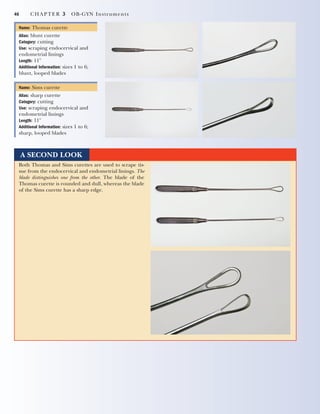
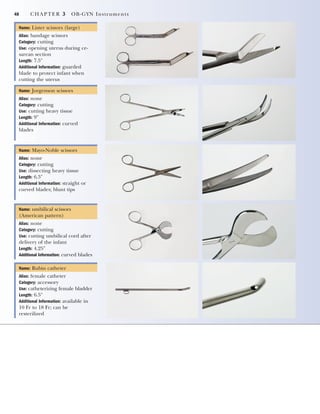
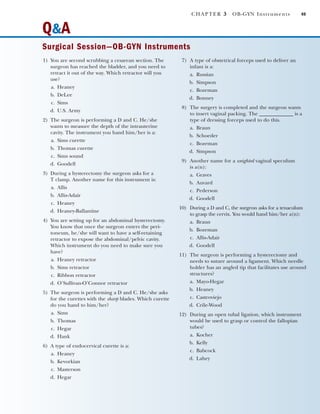
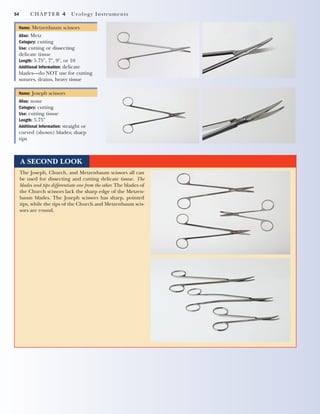
2545_FM_i-xvi 01/11/11 2:10 PM Page vi
2545_FM_i-xvi 01/11/11 2:10 PM Page i
2545_FM_i-xvi 01/11/11 2:10 PM Page ii
. . .
Online Resource Center
Visit http://davisplus.fadavis.com
Unlimited free access.
No password.
No registration.
No fee.
Students
Explore more online resources from f.a.davis...
Upon Adoption.
Password-protected library of
title-specific, online course content.
Instructors
DavisPlus is your online source for a wealth of learning resources and
teaching tools, as well as electronic and mobile versions of our products.
www.fadavis.com
www.drugguide.com
is Davis’s Drug Guide Online, the complete Davis’s Drug Guide for Nurses®
database of over 1,100 monographs on the web.
www.tabersonline.com
delivers the power of Taber’s Cyclopedic Medical Dictionary on the web. Find
more than 60,000 terms, 1,000 images, and more.
www.davisptnetwork.com
is the PT community’s source for online continuing education, social networking,
professional information, and more.
powered by
Unbound Medicine®
powered by
Unbound Medicine®
2545_FM_i-xvi 01/11/11 2:10 PM Page iii
F. A. Davis Company
1915 Arch Street
Philadelphia, PA 19103
www.fadavis.com
Copyright © 2012 by F. A. Davis Company
Copyright © 2012 by F. A. Davis Company. All rights reserved. This product is protected by copyright. No part of it may be reproduced,
stored in a retrieval system, or transmitted in any form or by any means, electronic, mechanical, photocopying, recording, or otherwise,
without written permission from the publisher.
Printed in the United States of America
Last digit indicates print number: 10 9 8 7 6 5 4 3 2 1
Senior Acquisitions Editor: Christa A. Fratantoro
Manager of Content Development: George W. Lang
Developmental Editor: Karen Williams
Art and Design Manager: Carolyn O’Brien
As new scientific information becomes available through basic and clinical research, recommended treatments and drug therapies undergo
changes. The author(s) and publisher have done everything possible to make this book accurate, up to date, and in accord with accepted
standards at the time of publication. The author(s), editors, and publisher are not responsible for errors or omissions or for consequences
from application of the book, and make no warranty, expressed or implied, in regard to the contents of the book. Any practice described
in this book should be applied by the reader in accordance with professional standards of care used in regard to the unique circumstances
that may apply in each situation. The reader is advised always to check product information (package inserts) for changes and new
information regarding dose and contraindications before administering any drug. Caution is especially urged when using new or
infrequently ordered drugs.
ISBN: 978-0-8036-2545-7
Authorization to photocopy items for internal or personal use, or the internal or personal use of specific clients, is granted by F. A. Davis
Company for users registered with the Copyright Clearance Center (CCC) Transactional Reporting Service, provided that the fee of $.25
per copy is paid directly to CCC, 222 Rosewood Drive, Danvers, MA 01923. For those organizations that have been granted a photocopy
license by CCC, a separate system of payment has been arranged. The fee code for users of the Transactional Reporting Service is:
978-0-8036-2545-7/12 0 + $.25.
2545_FM_i-xvi 01/11/11 2:10 PM Page iv
To the staff, students, anesthesia personnel, and surgeons in
operating rooms across the country
—your hard work makes the “miracle of modern
surgery” a reality for patients every day.
To the staff working in central sterile processing departments
across the country
—you provide an often-unheralded but critically
important service.
2545_FM_i-xvi 01/11/11 2:10 PM Page v
2545_FM_i-xvi 01/11/11 2:10 PM Page vi
vii
PREFACE TO THE
SECOND EDITION
Feedback about the first edition, several more years of
teaching experience, and new advances in surgical pro-
cedures led me to add three new features to this edition:
• A student-focused CD containing exercises and
games that reinforce important concepts from
the book. Photo IDs, flashcards, practice Mayo
stand setups, and other activities are included.
Additional activities can be found on the book’s
companion Davisplus website (http://davisplus.
fadavis.com/).
• A new “Second Look” feature that highlights sev-
eral instruments with similar characteristics but
small differences and points out the distinctive
features of each instrument.
• Further separation of instruments according to
type. Minimally invasive surgery is here to stay, so
laparoscopic instruments now have their own
chapter and arthroscopic and thoracoscopic
instruments now have their own sections. This
edition also includes a new chapter on robotic
instrumentation, something not included in
previous texts.
Whether you are a student, a new employee in the
surgical suite or central sterile supply area, or a seasoned
veteran wishing to review instrument names, I hope you
will find that this text and its CD are useful and valuable
resources.
—Colleen Rutherford
PREFACE TO THE FIRST EDITION
“Crile, Pean, Mosquito, Mixter” . . . To those who are new
to the operating room environment, the number of in-
struments one has to learn can seem overwhelming.
Learning is further complicated by the fact that many of
the instruments look similar. The purpose of this text is to
help you differentiate among the common surgical in-
struments. As an instructor for a Surgical Technology pro-
gram, I have seen students struggle to learn the surgical
instruments. The students (and I) felt the books that were
available did not do an adequate job of showing the tips
of the instruments, which is often the only way to differ-
entiate between them. That inadequacy is the reason I
decided to photograph and write this book. My goal was
to show the whole instrument as well as a close-up of the
tips to aid students and new operating room staff in
identifying instruments. A description is included with
each instrument to further aid in identification and
classification.
One of the most important methods used to identify
an instrument is to look at the tip. Is the jaw smooth or
serrated? If it is serrated, do the serrations run horizon-
tally or longitudinally? Does the jaw have teeth and what
do the teeth look like? In this text, you will find close-up
pictures of the jaws as well as a description and picture
of the whole instrument that will help you to differenti-
ate one instrument from another. I photographed each
instrument’s tip at an angle that I though best showed
what made it different from other similar instruments.
This should help those new to the operating room envi-
ronment decide which instrument they are looking at.
As an instructor, I felt it was important to place instru-
ments that look alike on the same page so that student
will be able to see the sometimes-subtle differences in
size or jaw serrations.
It would be impossible to include in any text all of the
surgical instruments used in every type of surgical proce-
dure. In this text, I have chosen to include the most
commonly used instruments and instrument types that
operating room personnel should be familiar with.
Instrument nicknames can vary from institution to
institution, even from surgeon to surgeon. I have en-
deavored to include the instrument nickname (“alias”)
only if it is referred to this way on a large regional or na-
tional basis. This text has been critiqued by reviewers
from different parts of the country to get feedback on
whether an “alias” was common enough to be included.
Instrument websites and catalogs were also consulted
for nickname information (see Acknowledgments).
This text is divided into chapters covering each
common specialty service, beginning with general sur-
gery instrumentation. You may see many of the gen-
eral surgical instruments used in specialty surgical pro-
2545_FM_i-xvi 01/11/11 2:10 PM Page vii
viii Preface to the Second Edition
cedures. In the interest of space, I have not repeated
those instruments in the specialty chapters unless I felt
they were used so frequently that they warranted being
included.
At the end of each section is a short “quiz” referred to
as a “Surgical Session.” These quizzes can be used by
students to reinforce their own learning, or if you are an
instructor, you may wish to assign these as in-class work
or homework and discuss the answers in class.
To assist educators in preparing their course materi-
als, I have developed an electronic test bank and a
searchable, digital image bank to accompany this text.
These ancillaries are provided on a CD-ROM and are
made available to educators who adopt this book.
Whether you are a student, a new employee of the op-
erating room or central supply area, or are a seasoned
veteran wishing to review instrument names, I hope you
will find this text a useful and valuable resource.
2545_FM_i-xvi 01/11/11 2:10 PM Page viii
ix
ACKNOWLEDGMENTS
No one writes a book alone. I would like to acknowl-
edge the following people and resources for their
support of this project:
First, I would like to thank the team who worked
with me to make this book a reality. Christa Fratantoro
and George Lang of F. A. Davis Publishing Company:
your support and encouragement made this process
run smoothly. Karen Williams, developmental editor:
your thoughtful feedback and edits make this book a
much better read for the audience. Jeff Adams and
Steve Fowler of Jeff Adams Photography: your pa-
tience, sense of humor, and hard work during the
photo shoots resulted in beautiful pictures for the
book and a few laughs during the sessions. You proba-
bly learned more about surgical instruments than you
ever wanted to know.
I would like to recognize and thank the following
personnel at Concord Hospital for allowing me to pho-
tograph the setups that appear in Chapter 13: Holly
Clark, Lynn Crispo, Shannon Dennis, Donna Dias, Lela
Holloran, Amy Ireland, Don King, and Brad Morrison. I
appreciate your willingness to allow me into your ORs.
To my family and friends: your support, caring, and
advice mean more than I can say. You truly bring joy to
me on a daily basis. I am a very lucky woman to have all
of you in my life.
I would also like to acknowledge the following surgi-
cal instrument company websites for helping me check
the facts that have gone into this book:
http://www.surgicaltools.com
http://www.codman.com
http://www.intuitivesurgical.com
http://www.karlstorz.com
http://www.orsupply.com
http://www.miltex.com
2545_FM_i-xvi 01/11/11 2:10 PM Page ix
2545_FM_i-xvi 01/11/11 2:10 PM Page x
xi
REVIEWERS
Dorann Lynne Brown, CST, B.A.
Director, Surgical Technology Program
Mt. Diablo Adult Education
Department of Career Technical Education
Concord, California
Sandra A. Carlson, RN, BSN, CNOR
Chair, Allied Health and Surgical Technology Department
Great Bay Community College
Portsmouth, New Hampshire
Rebecca M. Cuthbertson, RN, BSN
Director, School of Surgical Technology
Carolinas College of Health Sciences
Charlotte, North Carolina
Barbara Inkel, RN, CNOR
Director, Surgical Technology Program
Virginia College
Pensacola, Florida
Yvette M. Jackson, RN, MSN, CNOR
Instructor, Surgical Technology
Faulkner State Community College
Bay Minette, Alabama
Dorothy L. Nichols, BBA, R, CNOR
Director, Surgical Technology Program
Southern Union State Community College
Health Science Department
Opelika, Alabama
Kathy Patnaude, CS,AS
Director, Surgical Technology Program
Midlands Technical College
Health Science Department
Columbia, South Carolina
Karen Owen Powell, CSA
Faculty Instructor, Surgery and Health Professions
Eastern Virginia Medical School
Norfolk, Virginia
Beth D. Stokes, BFA,AAS, CST
Program Manager, Surgical Technology & Sterile
Processing
Cuyahoga Community College
Cleveland, Ohio
2545_FM_i-xvi 01/11/11 2:10 PM Page xi
2545_FM_i-xvi 01/11/11 2:10 PM Page xii
xiii
CONTENTS
A Few Words About Surgical Instruments xv
A general introduction of surgical instrument uses and materials.
CHAPTER 1
General Instruments/Staplers 1
This chapter is devoted to the instruments most commonly used in all types
of surgery. Included are pictures and descriptions of the most common
clamping, grasping, cutting, retracting, suturing, stapling, and miscellaneous
instruments.
CHAPTER 2
Laparoscopic Instruments 29
This chapter covers the most commonly used instruments for laparoscopic
surgeries.
CHAPTER 3
OB-GYN Instruments 39
This chapter covers specialty surgical instruments used in open and
laparoscopic, obstetrical, and gynecological surgery.
CHAPTER 4
Urology Instruments 51
Instruments used to perform open and cystoscopic urological procedures,
including cystoscopes and resectoscopes.
CHAPTER 5
Robotic Instruments 61
This chapter is devoted to robotics and robotic instruments, one of the newer
surgical technologies.
CHAPTER 6
Orthopedic Instruments 67
Specialty instruments and power tools used for orthopedic and arthroscopic
surgery are covered.
CHAPTER 7
Neurosurgical Instruments 83
Specialty instruments for procedures of the brain and spine are covered,
including transphenoidal instruments.
2545_FM_i-xvi 01/11/11 2:10 PM Page xiii
xiv Contents
CHAPTER 8
Ear,Nose,and Throat Instruments 101
Instruments for the most common procedures of the ear, nose, and throat are
covered, including microscopic and endoscopic instruments.
CHAPTER 9
Dental and Maxillofacial Instruments 121
Instruments commonly used for dental surgery and procedures of facial
repair.
CHAPTER 10
Ophthalmologic Instruments 129
Instruments used in common surgical procedures on the eye.
CHAPTER 11
Vascular,Thoracic,and Cardiac Instruments 145
Instruments used in common chest, vascular, and cardiac surgeries.
CHAPTER 12
Plastic Surgery Instruments 161
Instruments used in common plastic surgery procedures.
CHAPTER 13
Instrument Trays and Setups 167
Examples of common general and specialty instrument sets as well as general
and specialty Mayo and back table setups.
Appendix:Answers to Surgical Session Quizzes 181
Index 183
2545_FM_i-xvi 01/11/11 2:10 PM Page xiv
xv
A FEW WORDS ABOUT
SURGICAL INSTRUMENTS
Although there are hundreds of different surgical in-
struments, most of them have one thing in common:
they are made partially or wholly of metal. In the past,
instruments were made from a variety of metals, but to-
day most surgical instruments are made of stainless
steel. Most manufacturers choose stainless steel because
it combines several metals, including carbon (adding
strength) and chromium (increasing resistance to
corrosion that can occur with repeated cleaning and
sterilization).
A word of caution about metal: Although stainless
steel is the most common metal used in the manufacture
of surgical instruments, other metals (or alloys) such as
aluminum, brass, or copper are sometimes used. It is es-
pecially important to know which metal your instrument
contains when you are using an ultrasonic cleaner or a
washer decontaminator. Dissimilar metals (e.g., stainless
steel and bronze) that touch each other in a hot, wet
environment can cause one metal to plate to the other,
resulting in permanently damaged instruments.
All instruments are coated during the manufacturing
process. The coating can be shiny (polished), dull
(satin), or black (for use with lasers). The shiny finish
looks nice and it helps resist corrosion, but it also can re-
flect surgical lighting, causing glare and making it diffi-
cult for the operating team to see. The dull (satin) finish
reduces glare. Because shiny and dull finishes potentially
could deflect laser beams, caution is necessary when they
are used during a laser procedure. The black finish all
but eliminates glare and reflection, making it especially
useful for laser procedures because the laser beam can-
not deflect light from the instrument’s surface.
You may notice that some instruments have gold-
plated finger rings, also known as ring handles. This
finish indicates that the instrument has tungsten car-
bide tips, which increase durability. Importantly, cold or
chemical sterilization is not recommended for instru-
ments with tungsten carbide tips.
Black ring handles identify SuperCut scissors, which
have a razor-sharp upper blade that allows ease in cut-
ting tissue. Do not use SuperCut scissors to cut gauze,
tubing, or suture because those actions could dull and
damage the tips. This caveat applies only to tissue
scissors.
Utility scissors (also known as trauma shears) may
have black handles, but the caveat mentioned above
does not apply to them. Utility scissors are designed to
cut tubing, clothing, gauze, or other heavy material.
Scissors with one short and one long gold-plated ring
handle combine the SuperCut upper blade with tung-
sten carbide. According to the manufacturer, SuperCut
scissors have razor-sharp cutting surfaces and increased
durability.
PARTS OF THE SURGICAL INSTRUMENT
When discussing surgical instruments, people often re-
fer to the various parts of the instrument. Many ringed
surgical instruments have six parts—finger rings (ring
handle), ratchet, shanks, boxlocks, jaws, and tips. The
figure below labels the instrument parts. The text that
follows the picture describes how these various parts
function.
2545_FM_i-xvi 01/11/11 2:10 PM Page xv
xvi A Few Words About Surgical Instruments
Finger Ring
Ratchet
Shank Boxlock
Tip
Jaws
Functions of the instrument parts:
• Finger rings provide a place for the user to place
his/her fingers and grip the instrument securely.
• Ratchets allow the instrument to be locked in
place.
• Boxlocks (also known as hinge joints) control the
jaws of the instrument.
• Shanks connect the boxlock to the finger rings.
• Jaws combine with the tips as the “working” part
of an instrument. The jaws may be smooth, ser-
rated, or cross-hatched for grasping tissue or
suture. They can be straight or curved to various
degrees.
• Tips can be pointed or round, with or without
teeth (atraumatic). The intended use of the in-
strument determines the number of teeth on its
tips and also determines the design of the tip.
CARING FOR SURGICAL INSTRUMENTS
Surgical instruments are expensive, and like any expen-
sive piece of equipment, they require special care to
keep them in good working order. Listed below are
some general rules for the care of your instruments.
Prior to the start of the case:
• Check all instruments to ensure that they are
free of bioburden (tissue, blood, or other
debris). Any instrument found to contain
bioburden must be removed and replaced. In
some cases, it may be necessary to replace the
entire tray.
• Check all instruments to ensure that they are in
good working order. Inspect tips for malalign-
ment. Check scope shafts to ensure that they are
straight (not bent or warped), and inspect ratch-
ets for proper closure. If you find a damaged
instrument, remove it from the field immediately
and get a replacement that is in good working
order. Never use a damaged instrument on a
patient.
• Do not place heavy instruments on top of delicate
ones.
• Never place rigid endoscopes beneath other in-
struments as this could cause bending or warping
of the shaft. Separate rigid endoscopes into their
own tray, which has holders to keep the shafts
straight.
During the case:
• Do not use saline to wipe or soak instruments; it
can corrode or pit the metal. Wipe instruments
clean or place them in a soaking basin that
contains sterile water.
• Do not place a damaged instrument back on the
tray. Set it aside and get another one.
• Do not use an instrument for any function other
than the one for which it was designed (e.g.,
don’t use Metzenbaum scissors to cut dressings).
Such use can damage the instrument.
• Do not toss or drop instruments onto the table.
Handle them carefully.
At the end of the case:
• Tag damaged instruments according to institu-
tional policy. Set them aside for repair.
• Place heavy instruments on the bottom of the
tray, and place more delicate instruments on the
top.
• Separate rigid endoscopes from other instru-
ments and return them to their storage cases.
This action protects the endoscopes from
potential bending and damage.
• Clean and process all instruments according
to the manufacturer’s recommendations and
following institutional policy.
2545_FM_i-xvi 01/11/11 2:10 PM Page xvi
1
General Instruments/Staplers
1
Name: Backhaus towel clamp
Alias: perforating towel clamp
Category: accessory
Use: grasping tissue that will be
removed; securing towels or
drapes; holding or reducing
small bone fractures
Length: 3.5" or 5"
Additional Information: perforating tips
Name: Edna towel clamp
Alias: Lorna
Category: accessory
Use: securing drapes; securing
suction, ESU, or camera cords to
the drape
Length: 3.5" or 5"
Additional Information: nonperforat-
ing jaws
Name: Peers towel clamp
Alias: none
Category: accessory
Use: securing drapes; securing
suction, ESU, camera cords to
the drape
Length: 5"
Additional Information: nonperforat-
ing jaws
Name: Roeder towel clamp
Alias: none
Category: accessory
Use: grasping tissue that will be
removed; securing towels or
drapes; holding or reducing
small bone fractures
Length: 5.5"
Additional Information: perforating
tips; ball stops on tips
Additional resources available on the back-of-book CD-ROM and online at
http://davisplus.fadavis.com/.
2545_Ch01_001-028 18/10/11 11:42 AM Page 1
2 CHAPTER 1 General Instruments/Staplers
Name: Foerster sponge forceps
Alias: sponge stick; sponge-
holding forceps
Category: grasping
Use: grasping tissue; holding
Raytec sponges
Length: 7" or 9.5"
Additional Information: smooth or
serrated jaws; straight or curved
shank
Name: Frazier suction
Alias: nasal suction; ENT
suction; neurosuction
Category: suctioning
Use: suctioning small quantities
of fluid; suctioning in small areas
Length: 6.5"
Additional Information: short or long
tips; 6 Fr to 16 Fr diameter
(most common sizes are 7 Fr,
9 Fr, and 11 Fr); metal or dis-
posable; angled; thumb hole
controls suction on/off
Name: Poole (or Pool) suction
Alias: abdominal suction
Category: suctioning
Use: suctioning large quantities
of fluid/blood
Length: 8.25"
Additional Information: removable
sheath allows cannula to suc-
tion smaller areas; both pieces
must be accounted for in instru-
ment count
Name: Yankauer suction
Alias: tonsil suction
Category: suctioning
Use: suctioning fluid or blood;
may be used to suction smoke
Length: pediatric, 8.5"; adult,
11.75"
Additional Information: most com-
monly used suction; metal or
plastic (single-patient use) ver-
sions; if using two-piece metal
suction with removable tip,
both pieces must be accounted
for in instrument count
2545_Ch01_001-028 18/10/11 11:42 AM Page 2
CHAPTER 1 General Instruments/Staplers 3
Name: clip-applying forceps
Alias: hemoclip appliers
Category: accessory
Use: holding and applying
hemoclips
Length: 6.5", 7.75", or 9"
Additional Information: small,
medium, and large; straight or
angled jaws; finger rings may
be color coded to match clip
cartridges
Name: Crile-Wood needle holder
Alias: Crile-Wood needle driver
Category: suturing
Use: holding small or medium-
sized suture needles
Length: 5.5", 6", 7", 8", or 9"
Additional Information: used in delicate
suturing; some brands have tung-
sten carbide jaw inserts
Name: Mayo-Hegar needle holder
Alias: needle driver
Category: suturing
Use: holding heavy (large) suture
needles
Length: 5", 6", 7", 8", 9", 10", or 12"
Additional Information: widely used in
general surgery; some brands
have tungsten carbide jaw inserts;
MRI version available
Name: Baumgartner needle holder
Alias: none
Category: suturing
Use: holding suture needles
Length: 5.5"
Additional Information: jaws shorter
than Crile-Wood or Mayo-Hegar
Name: Ryder needle holder
Alias: French eye needle holder;
neurosurgical needle holder
Category: suturing
Use: holding small suture needles;
used mostly in vascular, intes-
tinal, plastic, or neurosurgery
Length: 5" to 10"
Additional Information: narrow jaws;
smooth or tungsten carbide jaws
2545_Ch01_001-028 18/10/11 11:43 AM Page 3
4 CHAPTER 1 General Instruments/Staplers
Name: DeBakey cardiovascular
needle holder
Alias: none
Category: suturing
Use: holding fine suture
needles for vascular or cardiac
procedures
Length: 7", 9", 10.5", or 11.75"
Additional Information: fine, straight
jaws
Name: Webster needle holder
Alias: none
Category: suturing
Use: holding fine suture needles;
used mostly in plastic or ENT
surgery
Length: 4.75" or 5.25"
Additional Information: smooth or
carbide insert jaws
Name: sternal wire twister
Alias: none
Category: suturing
Use: placing retention or wire
sutures; twisting wire
Length: 6" to 8"
Additional Information: extra-heavy
jaws
Name: probe and grooved director
Alias: Larry probe and grooved
director; fistula probe
Category: probing
Use: probing fistulas, ducts, etc.
Length: 6", 8", or 10" probes; 6"
grooved director
Additional Information: “ear”-shaped
end of the director referred to
as a tongue tie
Name: ruler
Alias: none
Category: accessory
Use: measuring
Length: 6"
Additional Information: measure-
ments marked in inches and
centimeters; paper (disposable)
or metal (reusable) rulers
2545_Ch01_001-028 18/10/11 11:43 AM Page 4
CHAPTER 1 General Instruments/Staplers 5
Name: electrosurgical pencil
Alias: active electrode; Bovie pencil
Category: cutting
Use: cauterizing blood vessels
and/or cutting tissue
Length: n/a
Additional Information: a variety of
tips to use with the pencil; tip
types include blades (spatulas),
points, extensions, and balls
Name: handheld cautery
Alias: none
Category: accessory
Use: cauterizing fine vessels or
tissue (e.g., hand surgery);
evacuating subungual hematoma
Length: 5" handle
Additional Information: single-patient
use; shelf life approximately
4 years
Name: Gerald bipolar forceps
Alias: none
Category: accessory
Use: cauterizing small blood
vessels
Length: 5.75"
Additional Information: delicate,
narrow tips; straight or bayonet-
shaped handle
Name: Malis mirror-finish bipolar
cautery forceps
Alias: none
Category: accessory
Use: cauterizing small blood
vessels or delicate tissue
Length: 7"
Additional Information: sharp or blunt
tips; straight, angled, or looped
tips; straight or bayonet-shaped
handle; available with special tip
for use with irrigating system
Name: bipolar cautery cord
Alias: none
Category: accessory
Use: attaching bipolar cautery
forceps to electrosurgical power
unit
Length: 12" long
Additional Information: use with
bipolar cautery forceps only
2545_Ch01_001-028 18/10/11 11:43 AM Page 5
6 CHAPTER 1 General Instruments/Staplers
Name: argon beam coagulator
Alias: none
Category: accessory
Use: hemostasis (cauterization of
blood vessels)
Length: n/a
Additional Information: uses argon
gas and electrocautery to
cauterize blood vessels
Name: harmonic scalpel
Alias: none
Category: cutting
Use: cutting and cauterizing tissue
Length: n/a
Additional Information: uses ultra-
sonic wave technology to cut
and cauterize tissue at lower
temperatures (50°C to 100°C)
Name: Desjardin gallstone scoop
Alias: none
Category: accessory
Use: removing gallstones
Length: 11"
Additional Information: 6 mm,
7 mm, 8 mm, or 9 mm
Name: Mayo common duct scoop
Alias: none
Category: accessory
Use: removing stones from the
common duct
Length: 11"
Additional Information: small,
medium, or large
Name: Bakes common bile duct
dilators
Alias: none
Category: dilating
Use: dilating the common bile
duct
Length: 9"
Additional Information: 3-mm to
11-mm tips
Name: sigmoidoscope
Alias: proctoscope
Category: viewing
Use: viewing inside of the anal
canal and sigmoid colon
Length: n/a
Additional Information: obturator is
placed inside the scope for in-
sertion and then removed
2545_Ch01_001-028 18/10/11 11:43 AM Page 6
CHAPTER 1 General Instruments/Staplers 7
Name: anoscope with obturator
Alias: none
Category: viewing
Use: retracting/viewing anal canal
Length: n/a
Additional Information: rounded
obturator used for insertion and
then removed
GENERAL GRASPING
Name: Adson dressing forceps
Alias: None
Category: grasping
Use: grasping tissue; applying
dressings
Length: 4.75"
Additional Information: serrated tips
Name: Adson tissue forceps
Alias: rat-tooth forceps
Category: grasping
Use: grasping skin layer during
wound closure
Length: 4.75"
Additional Information: 1 ϫ 2 teeth
Name: Brown-Adson forceps
Alias: Adson-Brown
Category: grasping
Use: grasping delicate tissue
Length: 4.75"
Additional Information: 7 ϫ 7 teeth
Name: Brown thumb forceps
Alias: Brown tissue forceps
Category: grasping
Use: grasping tissue
Length: 6"
Additional Information: 8 ϫ 8 teeth
Name: dressing forceps
Alias: smooth forceps
Category: grasping
Use: grasping tissue or applying
dressings
Length: 6", 8", or 10"
Additional Information: tips vary from
heavy to fine; atraumatic
2545_Ch01_001-028 18/10/11 11:43 AM Page 7
8 CHAPTER 1 General Instruments/Staplers
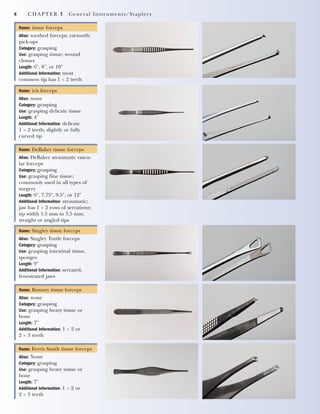
Name: tissue forceps
Alias: toothed forceps; rat-tooth;
pick-ups
Category: grasping
Use: grasping tissue; wound
closure
Length: 6", 8", or 10"
Additional Information: most
common tip has 1 ϫ 2 teeth
Name: iris forceps
Alias: none
Category: grasping
Use: grasping delicate tissue
Length: 4"
Additional Information: delicate
1 ϫ 2 teeth; slightly or fully
curved tip
Name: DeBakey tissue forceps
Alias: DeBakey atraumatic vascu-
lar forceps
Category: grasping
Use: grasping fine tissue;
commonly used in all types of
surgery
Length: 6", 7.75", 9.5", or 12"
Additional Information: atraumatic;
jaw has 1 ϫ 2 rows of serrations;
tip width 1.5 mm to 3.5 mm;
straight or angled tips
Name: Singley tissue forceps
Alias: Singley Tuttle forceps
Category: grasping
Use: grasping intestinal tissue,
sponges
Length: 9"
Additional Information: serrated,
fenestrated jaws
Name: Bonney tissue forceps
Alias: none
Category: grasping
Use: grasping heavy tissue or
bone
Length: 7"
Additional Information: 1 ϫ 2 or
2 ϫ 3 teeth
Name: Ferris Smith tissue forceps
Alias: None
Category: grasping
Use: grasping heavy tissue or
bone
Length: 7"
Additional Information: 1 ϫ 2 or
2 ϫ 3 teeth
2545_Ch01_001-028 18/10/11 11:43 AM Page 8
CHAPTER 1 General Instruments/Staplers 9
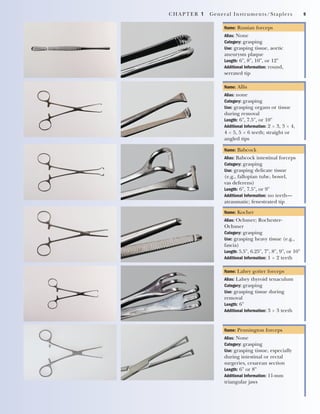
Name: Russian forceps
Alias: None
Category: grasping
Use: grasping tissue, aortic
aneurysm plaque
Length: 6", 8", 10", or 12"
Additional Information: round,
serrated tip
Name: Allis
Alias: none
Category: grasping
Use: grasping organs or tissue
during removal
Length: 6", 7.5", or 10"
Additional Information: 2 ϫ 3, 3 ϫ 4,
4 ϫ 5, 5 ϫ 6 teeth; straight or
angled tips
Name: Babcock
Alias: Babcock intestinal forceps
Category: grasping
Use: grasping delicate tissue
(e.g., fallopian tube, bowel,
vas deferens)
Length: 6", 7.5", or 9"
Additional Information: no teeth—
atraumatic; fenestrated tip
Name: Kocher
Alias: Ochsner; Rochester-
Ochsner
Category: grasping
Use: grasping heavy tissue (e.g.,
fascia)
Length: 5.5", 6.25", 7", 8", 9", or 10"
Additional Information: 1 ϫ 2 teeth
Name: Lahey goiter forceps
Alias: Lahey thyroid tenaculum
Category: grasping
Use: grasping tissue during
removal
Length: 6"
Additional Information: 3 ϫ 3 teeth
Name: Pennington forceps
Alias: None
Category: grasping
Use: grasping tissue, especially
during intestinal or rectal
surgeries, cesarean section
Length: 6" or 8"
Additional Information: 11-mm
triangular jaws
2545_Ch01_001-028 18/10/11 11:43 AM Page 9
10 CHAPTER 1 General Instruments/Staplers
Name: Magill catheter introduc-
ing forceps
Alias: intubating forceps
Category: grasping
Use: grasping endotracheal tube
during intubation; grasping and
removing foreign bodies from
the airway
Length: 6" (infant), 8"(child), or
9.75" (adult)
Additional Information: can be used
to grasp other types of catheters
during insertion
Name: Randall forceps
Alias: kidney stone forceps
Category: grasping
Use: grasping stones or polyps
Length: 7.5", 8", or 9"
Additional Information: jaws available
with 1
/4 curve, 1
/2 curve, 3
/4
curve, or full curve (about
120 degrees)
Name: Fletcher-Van Doren
sponge holding forceps
Alias: none
Category: grasping
Use: grasping uterine polyps;
holding Kittner sponges for
blunt dissection
Length: 9.5"
Additional Information: straight or
curved serrated tips
Name: Blake gallstone forceps
Alias: none
Category: grasping
Use: removing gallstones from
gallbladder
Length: 8.5"
Additional Information: straight or
curved jaws
GENERAL CLAMPS
Name: Rochester-Pean clamp
Alias: none
Category: clamping
Length: 10" to 12"
Use: clamping heavy tissue
Additional Information: fully serrated
jaws; straight or curved tips
2545_Ch01_001-028 18/10/11 11:43 AM Page 10
CHAPTER 1 General Instruments/Staplers 11
Name: Kelly hemostatic clamp
Alias: none
Category: clamping
Use: clamping large blood vessels
or tissue
Length: 5.5" or 7"
Additional Information: heavy blades;
not for delicate vessels or tissue;
straight or curved; looks like the
Pean clamp but jaws are serrated
only partway
Name: Pean
Alias: none
Category: clamping
Use: clamping tissue or vessels
Length: 5.5" to 9"
Additional Information: fully serrated
jaws; straight or curved jaws
Name: Crile hemostatic clamp
Alias: hemostat
Category: clamping
Use: clamping blood vessels or
tissue
Length: 5.5", 6.5", or 7.5"
Additional Information: most com-
monly used size of hemostatic
clamp; straight or curved tips
Name: Halstead mosquito clamp
Alias: mosquito
Category: clamping
Use: clamping delicate blood
vessels or tissue
Length: 5"
Additional Information: for delicate
use only; straight or curved tips
A SECOND LOOK
The Pean, Crile, and Halstead are all types of hemostatic
clamps. They all perform the same function: clamping tis-
sue or blood vessels. Size differentiates one from another. The
Pean is longer and thicker than the Crile or Halstead,
making it suitable for use on thicker tissues. The Hal-
stead is short and has very fine tips, making it suitable for
delicate tissue. The Crile is the in-between size, making it
suitable for many different tissues. It is the most com-
monly used size.
2545_Ch01_001-028 18/10/11 11:43 AM Page 11
12 CHAPTER 1 General Instruments/Staplers
Name: Pratt-Smith hemostatic
forceps
Alias: Pratt “T” forceps
Category: clamping
Use: clamping delicate tissue
Length: 6"
Additional Information: T-shaped,
concave, delicately serrated jaws
Name: Rochester mixter
Alias: Mixter thoracic forceps
Category: clamping
Use: clamping bowel; also used
in thoracic surgery
Length: 10" to 12"
Additional Information: right-angled,
curved jaws; longitudinal
serrations
Name: Mixter
Alias: right angle; Gemini
(delicate jawed)
Category: clamp
Use: clamping tissue or grasping
ligature around a curve (e.g., a
pedicle or blood vessel)
Length: 5.5", 7", 9", 10.5", or 12"
Additional Information: jaws vary
from fine to heavy
Name: Schnidt hemostat
Alias: tonsil snap; Schnidt-
Sawtell; Adson tonsil
Category: clamp
Use: clamping tissue; holding
tonsil sponge
Length: 7.25"
Additional Information: serrated only
about halfway up the jaw
Name: Best right-angle colon
clamp
Alias: none
Category: clamping
Use: clamping the colon during
intestinal surgery
Length: 11"
Additional Information: jaws form a
90-degree angle; jaw length
1.37" to 3"
2545_Ch01_001-028 18/10/11 11:43 AM Page 12
CHAPTER 1 General Instruments/Staplers 13
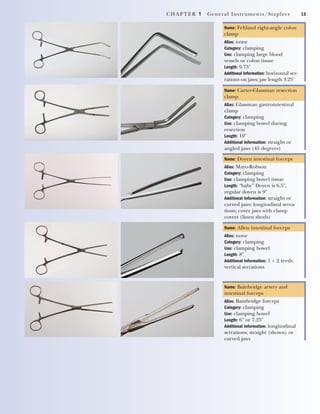
Name: Fehland right-angle colon
clamp
Alias: none
Category: clamping
Use: clamping large blood
vessels or colon tissue
Length: 9.75"
Additional Information: horizontal ser-
rations on jaws; jaw length 3.25"
Name: Carter-Glassman resection
clamp
Alias: Glassman gastrointestinal
clamp
Category: clamping
Use: clamping bowel during
resection
Length: 10"
Additional Information: straight or
angled jaws (45 degrees)
Name: Doyen intestinal forceps
Alias: Mayo-Robson
Category: clamping
Use: clamping bowel tissue
Length: “baby” Doyen is 6.5",
regular doyen is 9"
Additional Information: straight or
curved jaws; longitudinal serra-
tions; cover jaws with clamp
covers (linen shods)
Name: Allen intestinal forceps
Alias: none
Category: clamping
Use: clamping bowel
Length: 8"
Additional Information: 1 ϫ 2 teeth;
vertical serrations
Name: Bainbridge artery and
intestinal forceps
Alias: Bainbridge forceps
Category: clamping
Use: clamping bowel
Length: 6" or 7.25"
Additional Information: longitudinal
serrations; straight (shown) or
curved jaws
2545_Ch01_001-028 18/10/11 11:43 AM Page 13
14 CHAPTER 1 General Instruments/Staplers
GENERAL CUTTING
Name: operating room scissors
Alias: none
Category: cutting
Length: 4.5" to 6.5"
Use: cutting tissue, dressings,
drains, or suture
Additional Information: two sharp
tips, or one sharp and one
blunt tip; tips may be delicate
to heavy
A SECOND LOOK
The curved Mayo scissors and Metzenbaum scissors both
have curved blades. The size of the blades differentiates one from
another. Metzenbaum scissors have thinner, more delicate
blades designed to dissect and cut delicate tissue, whereas
the heavier blades of the Mayos are designed to dissect
and cut heavy tissue. Metzenbaum scissors should be used
only to cut tissue, never for drains or sutures; doing so
could ruin the blades.
Name: straight Mayo scissors
Alias: suture scissors
Category: cutting
Use: cutting suture, dressings,
drains
Length: 5.5", 6.75", or 9"
Additional Information: heavy blades
Name: curved Mayo scissors
Alias: dissecting scissors
Category: cutting
Use: cutting heavy tissue or mus-
cle; dissecting heavy tissue
Length: 5.5", 6.75", or 9"
Additional Information: heavy,
curved blades
Name: Metzenbaum scissors
Alias: Metz
Category: cutting
Use: cutting or dissecting
delicate tissue
Length: 5.75", 7", 9", or 10"
Additional Information: delicate
blades; NOT for cutting su-
tures, drains, heavy tissue
2545_Ch01_001-028 18/10/11 11:43 AM Page 14
CHAPTER 1 General Instruments/Staplers 15
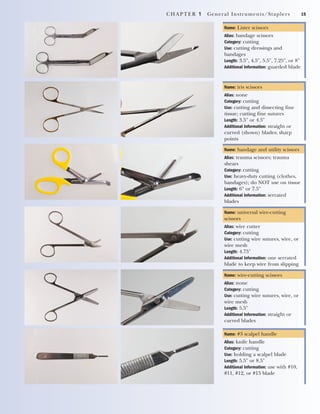
Name: Lister scissors
Alias: bandage scissors
Category: cutting
Use: cutting dressings and
bandages
Length: 3.5", 4.5", 5.5", 7.25", or 8"
Additional Information: guarded blade
Name: iris scissors
Alias: none
Category: cutting
Use: cutting and dissecting fine
tissue; cutting fine sutures
Length: 3.5" or 4.5"
Additional Information: straight or
curved (shown) blades; sharp
points
Name: bandage and utility scissors
Alias: trauma scissors; trauma
shears
Category: cutting
Use: heavy-duty cutting (clothes,
bandages); do NOT use on tissue
Length: 6" or 7.5"
Additional Information: serrated
blades
Name: universal wire-cutting
scissors
Alias: wire cutter
Category: cutting
Use: cutting wire sutures, wire, or
wire mesh
Length: 4.75"
Additional Information: one serrated
blade to keep wire from slipping
Name: wire-cutting scissors
Alias: none
Category: cutting
Use: cutting wire sutures, wire, or
wire mesh
Length: 5.5"
Additional Information: straight or
curved blades
Name: #3 scalpel handle
Alias: knife handle
Category: cutting
Use: holding a scalpel blade
Length: 5.5" or 8.5"
Additional Information: use with #10,
#11, #12, or #15 blade
2545_Ch01_001-028 18/10/11 11:43 AM Page 15
16 CHAPTER 1 General Instruments/Staplers
Name: #4 scalpel handle
Alias: knife handle
Category: cutting
Use: holding large-sized scalpel
blade for cutting heavy tissue or
bone
Length: 5.5"
Additional Information: use with #20,
#21, #22, #23 blades
Name: #7 scalpel handle
Alias: knife handle
Category: cutting
Use: holding a scalpel blade;
thinner handle fits in smaller
areas
Length: 6.5"
Additional Information: use with #10,
#11, #12, or #15 blade
#10 #11 #12 #15
#10 Blade: generally used for skin
incisions
#11 Blade: used for small “punc-
ture” incisions (e.g., hook
phlebectomy, arthroscopic, or
endoscopic procedure)
#12 Blade: curved, with cutting
surface on inside; used in
oropharyngeal surgery (tonsils,
UPPP)
#15 Blade: used for cutting small
vessels and tissue, plastic sur-
gery skin incisions, and hand
procedures
A SECOND LOOK
The #3 and #7 scalpel handles are smaller and thinner
than the #4 handle, making them suitable for holding
smaller blades (#10, #11, #12, or #15). The #4 handle is
used to hold #20 or larger blades. The longer, thinner
design of the #7 handle makes it suitable for cutting
inside the wound, generally with a #11 or #15 blade
attached.
BLADES
2545_Ch01_001-028 18/10/11 11:43 AM Page 16
CHAPTER 1 General Instruments/Staplers 17
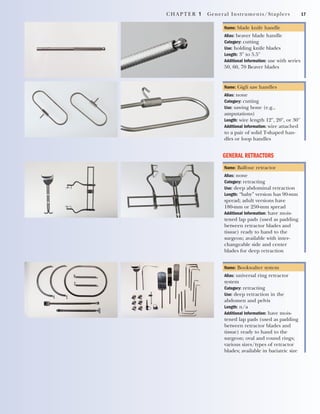
Name: blade knife handle
Alias: beaver blade handle
Category: cutting
Use: holding knife blades
Length: 3" to 5.5"
Additional Information: use with series
50, 60, 70 Beaver blades
Name: Gigli saw handles
Alias: none
Category: cutting
Use: sawing bone (e.g.,
amputations)
Length: wire length 12", 20", or 30"
Additional Information: wire attached
to a pair of solid T-shaped han-
dles or loop handles
GENERAL RETRACTORS
Name: Balfour retractor
Alias: none
Category: retracting
Use: deep abdominal retraction
Length: “baby” version has 90-mm
spread; adult versions have
180-mm or 250-mm spread
Additional Information: have mois-
tened lap pads (used as padding
between retractor blades and
tissue) ready to hand to the
surgeon; available with inter-
changeable side and center
blades for deep retraction
Name: Bookwalter system
Alias: universal ring retractor
system
Category: retracting
Use: deep retraction in the
abdomen and pelvis
Length: n/a
Additional Information: have mois-
tened lap pads (used as padding
between retractor blades and
tissue) ready to hand to the
surgeon; oval and round rings;
various sizes/types of retractor
blades; available in bariatric size
2545_Ch01_001-028 18/10/11 11:43 AM Page 17
18 CHAPTER 1 General Instruments/Staplers
Name: Omni retractor
Alias: Omni-tract system
Category: retracting
Use: exposing underlying struc-
tures during vascular procedures
Length: n/a
Additional Information: includes
long and short posts to adjust to
incision or patient size
Name: self-retaining abdominal
wall retractor
Alias: none
Category: retractor
Use: retracting abdominopelvic
contents during open procedures
Length: n/a
Additional Information: plastic sleeve
with self-retaining rings on
either end; single-patient use
Name: Weitlaner retractor
Alias: none
Category: retracting
Use: exposing superficial wound
Length: 4", 5.5", 6.5", 8", or 9.5"
Additional Information: self-retaining;
sharp or dull; 2 ϫ 3 prongs (4"),
3 ϫ 4 prongs (all other sizes)
Name: cerebellar retractor
Alias: Adson Cerebellar
Category: retracting
Use: exposing wound
Length: 8"
Additional Information: self-retaining;
4 ϫ 4 prongs; angled shanks
Name: Beckmann retractor
Alias: Weitlaner Beckmann
Category: retracting
Use: exposing wound
Length: 5.5", 6.5", or 11.75"
Additional Information: self-retaining;
3 ϫ 4 prongs; sharp or blunt
prongs; hinged arms
2545_Ch01_001-028 18/10/11 11:43 AM Page 18
CHAPTER 1 General Instruments/Staplers 19
Name: Gelpi perineal retractor
Alias: none
Category: retracting
Use: exposing superficial wound
exposure
Length: 3.5", 5.5", 7.5", or 10"
Additional Information: self-retaining;
single, sharp tines
Name: Joseph skin hook
Alias: none
Category: retracting
Use: retracting skin
Length: 6"
Additional Information: single
(shown) or double hook
Name: Gillies dura and skin hook
Alias: none
Category: retracting
Use: retracting skin or dura
Length: 7"
Additional Information: 3-mm or
4-mm hook
Name: Guthrie double skin hook
Alias: Guthrie retractor
Category: retracting
Use: retracting skin
Length: 5"
Additional Information: sharp, double
prongs
A SECOND LOOK
The Weitlaner, Cerebellar, and Beckmann are all self-
retaining wound retractors. The characteristics of the shanks
are what differentiate one from another. The Weitlaner has
straight shanks, the Cerebellar has angled shanks, and
the Beckmann has hinged shanks.
2545_Ch01_001-028 18/10/11 11:43 AM Page 19
20 CHAPTER 1 General Instruments/Staplers
Name: Kelly retractor
Alias: none
Category: retracting
Use: exposing wound
Length: 10.5"
Additional Information: handheld;
blade size 40 mm ϫ 50 mm to
75 mm ϫ 90 mm; resembles a
Richardson retractor, but blade
is larger
Name: Richardson retractor
Alias: none
Category: retracting
Use: wound
Length: 9.5"
Additional Information: handheld;
blade size 20 mm ϫ 25 mm to
20 mm ϫ 50 mm
Name: Richardson-Eastman
retractor
Alias: none
Category: retracting
Use: exposing wound
Additional Information: handheld;
double ended; small and large
sizes
Name: Parker retractor
Alias: none
Category: retracting
Use: exposing superficial wound
Length: 5" or 7"
Additional Information: handheld;
double ended; usually used in
pairs
Name: Goelet retractor
Alias: none
Category: retracting
Use: exposing superficial wound
Length: 7.5"
Additional Information: handheld;
double ended; usually used in
pairs
Name: U.S. Army retractor
Alias: Army-Navy
Category: retracting
Use: exposing superficial wound
Length: 8.5"
Additional Information: handheld;
double ended; usually used in
pairs
2545_Ch01_001-028 18/10/11 11:43 AM Page 20
CHAPTER 1 General Instruments/Staplers 21
Name: Senn retractor
Alias: none
Category: retracting
Use: exposing superficial wound
Length: 6"
Additional Information: handheld;
double ended; sharp or dull
prongs; usually used in pairs
Name: Hasson retractor
Alias: “S” retractor
Category: retracting
Use: exposing wound in
laparoscopic incisions
Length: n/a
Additional Information: handheld
Name: Cushing vein retractor
Alias: none
Category: retracting
Use: retracting blood vessels
Length: 8" or 12"
Additional Information: handheld;
blade 8-mm to 18-mm wide
Name: Green retractor
Alias: goiter retractor; loop
retractor
Category: retracting
Use: retracting soft tissue
Length: 8.5"
Additional Information: handheld;
fenestrated blade
Name: Dandy nerve hook
Alias: none
Category: retracting
Use: retracting nerves
Length: 9"
Additional Information: blunt tip; tip
can be pointed straight, left, or
right
Name: Volkmann retractor
Alias: rake
Category: retracting
Use: exposing superficial wound
Length: 8.5"
Additional Information: handheld;
sharp or blunt tips; can have two
to six teeth
2545_Ch01_001-028 18/10/11 11:43 AM Page 21
22 CHAPTER 1 General Instruments/Staplers
Name: Murphy retractor
Alias: rake
Category: retracting
Use: exposing superficial wound
Length: 7.5"
Additional Information: handheld;
similar to Volkmann retractor
but has finger grips (prongs)
on the handle
Name: Ollier retractor
Alias: none
Category: retracting
Use: retracting heavy tissue
Length: 9"
Additional Information: handheld;
2.25" ϫ 1.75" blades
Name: Israel retractor
Alias: none
Category: retracting
Use: retracting heavy tissue
Length: 8"
Additional Information: used mostly
in orthopedic surgery (shown
here for comparison with Ollier
retractor); handheld; rake can
have four to six prongs; blades
are 1.75" ϫ 1.75"
Name: Lahey goiter retractor
Alias: none
Category: retracting
Use: exposing wound; retracting
small tissue masses
Length: 8"
Additional Information: handheld;
right-angle blade; blade length 1"
Name: Deaver retractor
Alias: none
Category: retracting
Use: deep wound retraction
Length: 10", 12", or 14"
Additional Information: handheld;
blade width varies from 1" to 4"
Name: Harrington retractor
Alias: Harrington sweetheart
Category: retracting
Use: deep wound retraction
Length: 12"
Additional Information: handheld;
blade width 1" to 2.5"
2545_Ch01_001-028 18/10/11 11:43 AM Page 22
CHAPTER 1 General Instruments/Staplers 23
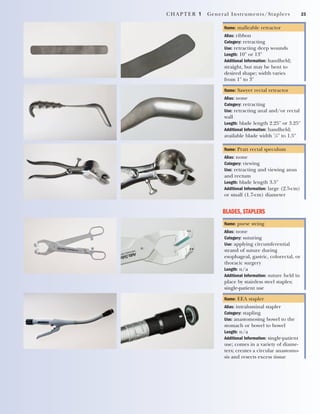
Name: malleable retractor
Alias: ribbon
Category: retracting
Use: retracting deep wounds
Length: 10" or 13"
Additional Information: handheld;
straight, but may be bent to
desired shape; width varies
from 1" to 3"
Name: Sawyer rectal retractor
Alias: none
Category: retracting
Use: retracting anal and/or rectal
wall
Length: blade length 2.25" or 3.25"
Additional Information: handheld;
available blade width 7
/8" to 1.5"
Name: Pratt rectal speculum
Alias: none
Category: viewing
Use: retracting and viewing anus
and rectum
Length: blade length 3.5"
Additional Information: large (2.5-cm)
or small (1.7-cm) diameter
BLADES, STAPLERS
Name: purse string
Alias: none
Category: suturing
Use: applying circumferential
strand of suture during
esophageal, gastric, colorectal, or
thoracic surgery
Length: n/a
Additional Information: suture held in
place by stainless steel staples;
single-patient use
Name: EEA stapler
Alias: intraluminal stapler
Category: stapling
Use: anastomosing bowel to the
stomach or bowel to bowel
Length: n/a
Additional Information: single-patient
use; comes in a variety of diame-
ters; creates a circular anastomo-
sis and resects excess tissue
2545_Ch01_001-028 18/10/11 11:43 AM Page 23
24 CHAPTER 1 General Instruments/Staplers
Name: skin stapler
Alias: none
Category: stapling
Use: closing skin incisions
Length: n/a
Additional Information: single-
patient use; regular or wide
width
Name: staple remover
Alias: none
Category: accessory
Use: removing skin staples
Length: n/a
Additional Information: single-
patient use
Name: ligaclip stapler
Alias: none
Category: stapling
Use: clipping off vessels or ducts
during open procedures
Length: n/a
Additional Information: applies one
clip at a time; single-patient use
Name: endoscopic ligaclip
applier
Alias: none
Category: stapling
Use: clipping off vessels or ducts
during endoscopic procedures
such as a laparoscopic
cholecystectomy
Length: n/a
Additional Information: single-
patient use; rotary handle al-
lows rotation of instrument tip
to needed position; applies one
clip at a time
Name: endoscopic GIA stapler
Alias: none
Category: stapling
Use: applying a whole row of
staples to tissue while knife
simultaneously cuts the tissue
Length: n/a
Additional Information: single-
patient use; reloads available;
30-mm, 45-mm, or 60-mm
staple lines
2545_Ch01_001-028 18/10/11 11:43 AM Page 24
CHAPTER 1 General Instruments/Staplers 25
Name: linear stapler
Alias: TA stapler
Category: stapling
Use: stapling across a large tissue
area (e.g., creating a gastric
pouch, anastomosing bowel, or
closing stomach/bowel incisions)
Length: n/a
Additional Information: single-patient
use; 30-mm, 45-mm, 60-mm, or
90-mm staple lines
Name: GIA stapler
Alias: linear cutter
Category: stapling/cutting
Use: places two double rows of
staples while simultaneously cut-
ting the tissue between rows
Length: n/a
Additional Information: single-patient
use; 60 mm, 80 mm, or 100 mm;
hand the surgeon both halves of
the stapler so he/she can place it
around the desired area of tissue
Name: Contour curved cutter/
stapler
Alias: none
Category: stapling
Use: used during low anterior
colon resection
Length: n/a
Additional Information: puts in four
rows of staples with a cut between
the second and third row
Q&A
Surgical Session—General Instruments
1) You have just handed the surgeon a heavy suture.
Which scissors should you have ready to hand to him/
her for cutting suture?
a. Curved Mayo
b. Metzenbaum
c. Iris
d. Straight Mayo
2) The surgeon is performing a colectomy. He/she
has just entered the peritoneal cavity and now
requests a large, self-retaining retractor. You would
hand him/her a:
a. Senn
b. Richardson
c. Bookwalter
d. Weitlaner
2545_Ch01_001-028 18/10/11 11:44 AM Page 25
26 CHAPTER 1 General Instruments/Staplers
3) You have a #20 knife blade on your field. What size
scalpel handle do you need for this blade?
a. #4
b. #3
c. #7
d. #2
4) The surgeon is getting ready to perform skin clo-
sure of an incision. Which of the following forceps
would generally be used during skin closure?
a. Russian
b. Bonney
c. Adson
d. DeBakey
5) The surgeon is about to irrigate the abdomen with
large amounts of normal saline. He/she asks for an
abdominal suction. What is the other name for this
instrument?
a. Frasier
b. Poole
c. Yankauer
d. Tonsil
6) A Mixter is another name for a:
a. Schnidt
b. Crile
c. right angle
d. Kelly
7) Mosquito is another name for a:
a. Kelly
b. Halstead
c. Pean
d. Schnidt
8) The surgeon is performing an inguinal herniorrha-
phy. He/she has made the skin incision and dis-
sected down a short way into the underlying tissue.
The assistant asks for a retractor. Which of the fol-
lowing would NOT be appropriate to hand
him/her?
a. U.S. Army
b. Volkmann
c. Bookwalter
d. Parker
9) Which of the following instruments does NOT have
sharp teeth?
a. Lahey
b. Kocher
c. Backhaus
d. Babcock
10) The nonperforating clip used to hold suction and
other cords to the drape is a(n):
a. Backhaus
b. Edna
c. Lahey
d. Kocher
11) A Foerster is a:
a. tonsil clamp
b. tissue clamp
c. sponge stick
d. suction tip
12) The surgeon inserts a Blake drain into the
incision. Which scissors would you hand him/her
to cut the drain?
a. Metzenbaum
b. Straight iris
c. Straight Mayo
d. Curved iris
13) Which of the following is NOT a type of
handheld retractor?
a. Senn
b. Volkmann
c. U.S. Army
d. Weitlaner
14) The surgeon needs to cut through a heavy muscle.
Which scissors would be the most
appropriate to hand him/her?
a. Metzenbaum
b. Curved Mayo
c. Curved iris
d. Straight iris
15) Which of the following would be the most appro-
priate instrument to hand a surgeon for clamping
off a very small blood vessel?
a. Halstead
b. Kelly
c. Kocher
d. Pean
16) All of the following are rake retractors
EXCEPT a(n):
a. Volkmann
b. Israel
c. Goelet
d. Murphy
2545_Ch01_001-028 18/10/11 11:44 AM Page 26
CHAPTER 1 General Instruments/Staplers 27
17) Which towel clamp has ball stops on the tips?
a. Edna
b. Peers
c. Backhaus
d. Roeder
18) A Sawyer retractor is used to retract ____________
tissue.
a. abdominal
b. pelvic
c. rectal
d. extremity
19) _____________ forceps may be used to grasp an
endotracheal tube or catheter for insertion.
a. Blake
b. Magill
c. Pennington
d. Allis
20) Which of the following forceps has triangular jaws?
a. Pennington
b. Kocher
c. Allis
d. Magill
2545_Ch01_001-028 18/10/11 11:44 AM Page 27
2545_Ch01_001-028 18/10/11 11:44 AM Page 28
Laparoscopic Instruments
2
Name: endoscopic camera
Alias: none
Category: viewing
Use: viewing inside the body dur-
ing endoscopic procedures
Length: n/a
Additional Information: many different
systems available; requires com-
patible light cord and light source
Care of Endoscopic Cameras
• Attach the camera and turn it on prior to surgery
to make sure it works. If the light cable is fiberop-
tic, it should be checked. Dark areas, places where
you cannot see light coming through, indicate
broken fibers and indicate that you should replace
the cable.
• NEVER place cameras at the bottom of an instru-
ment tray; the weight of the other instruments
could damage the camera.
• When you set up your table, NEVER place anything
on top of the camera, which is very delicate. Another
instrument or piece of equipment could easily
damage it.
• NEVER coil the camera cord tighter than the
diameter of a large soda bottle. Coiling the cord
too tightly can damage and/or break the fiberoptic
fibers.
• Follow manufacturer’s instructions for cleaning and
sterilizing cameras, cords, and couplers. After clean-
ing, inspect the components for cleanliness and
possible damage.
• NEVER use anything abrasive to clean the camera,
lens, or components.
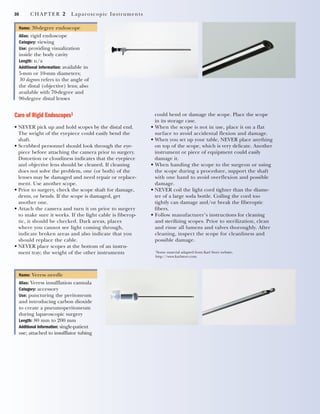
Name: 0-degree endoscope
Alias: rigid endoscope; straight
endoscope
Category: viewing
Use: providing visualization inside
the body cavity
Length: n/a
Additional Information: available in
5-mm or 10-mm diameters
Additional resources available on the back-of-book CD-ROM and online at
http://davisplus.fadavis.com/.
29
2545_Ch02_029-038 18/10/11 11:47 AM Page 29
30 CHAPTER 2 Laparoscopic Instruments
Name: 30-degree endoscope
Alias: rigid endoscope
Category: viewing
Use: providing visualization
inside the body cavity
Length: n/a
Additional Information: available in
5-mm or 10-mm diameters;
30 degrees refers to the angle of
the distal (objective) lens; also
available with 70-degree and
90-degree distal lenses
Care of Rigid Endoscopes1
• NEVER pick up and hold scopes by the distal end.
The weight of the eyepiece could easily bend the
shaft.
• Scrubbed personnel should look through the eye-
piece before attaching the camera prior to surgery.
Distortion or cloudiness indicates that the eyepiece
and objective lens should be cleaned. If cleaning
does not solve the problem, one (or both) of the
lenses may be damaged and need repair or replace-
ment. Use another scope.
• Prior to surgery, check the scope shaft for damage,
dents, or bends. If the scope is damaged, get
another one.
• Attach the camera and turn it on prior to surgery
to make sure it works. If the light cable is fiberop-
tic, it should be checked. Dark areas, places
where you cannot see light coming through,
indicate broken areas and also indicate that you
should replace the cable.
• NEVER place scopes at the bottom of an instru-
ment tray; the weight of the other instruments
could bend or damage the scope. Place the scope
in its storage case.
• When the scope is not in use, place it on a flat
surface to avoid accidental flexion and damage.
• When you set up your table, NEVER place anything
on top of the scope, which is very delicate. Another
instrument or piece of equipment could easily
damage it.
• When handing the scope to the surgeon or using
the scope during a procedure, support the shaft
with one hand to avoid overflexion and possible
damage.
• NEVER coil the light cord tighter than the diame-
ter of a large soda bottle. Coiling the cord too
tightly can damage and/or break the fiberoptic
fibers.
• Follow manufacturer’s instructions for cleaning
and sterilizing scopes. Prior to sterilization, clean
and rinse all lumens and valves thoroughly. After
cleaning, inspect the scope for cleanliness and
possible damage.
1Some material adapted from Karl Storz website,
http://www.karlstorz.com.
Name: Veress needle
Alias: Veress insufflation cannula
Category: accessory
Use: puncturing the peritoneum
and introducing carbon dioxide
to create a pneumoperitoneum
during laparoscopic surgery
Length: 80 mm to 200 mm
Additional Information: single-patient
use; attached to insufflator tubing
2545_Ch02_029-038 18/10/11 11:47 AM Page 30
CHAPTER 2 Laparoscopic Instruments 31
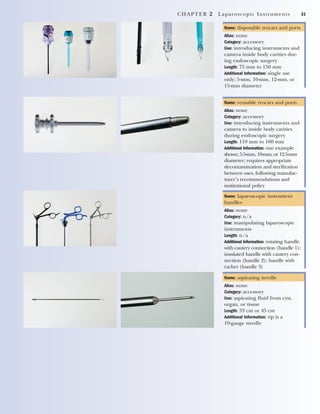
Name: disposable trocars and ports
Alias: none
Category: accessory
Use: introducing instruments and
camera inside body cavities dur-
ing endoscopic surgery
Length: 75 mm to 150 mm
Additional Information: single use
only; 5-mm, 10-mm, 12-mm, or
15-mm diameter
Name: reusable trocars and ports
Alias: none
Category: accessory
Use: introducing instruments and
camera to inside body cavities
during endoscopic surgery
Length: 110 mm to 160 mm
Additional Information: one example
shown; 5.5-mm, 10-mm, or 12.5-mm
diameter; requires appropriate
decontamination and sterilization
between uses, following manufac-
turer’s recommendations and
institutional policy
Name: laparoscopic instrument
handles
Alias: none
Category: n/a
Use: manipulating laparoscopic
instruments
Length: n/a
Additional Information: rotating handle
with cautery connection (handle 1);
insulated handle with cautery con-
nection (handle 2); handle with
rachet (handle 3)
Name: aspirating needle
Alias: none
Category: accessory
Use: aspirating fluid from cyst,
organ, or tissue
Length: 33 cm or 45 cm
Additional Information: tip is a
19-gauge needle
2545_Ch02_029-038 18/10/11 11:47 AM Page 31
32 CHAPTER 2 Laparoscopic Instruments
Name: suture passer
Alias: none
Category: suturing
Use: transmural suturing of
wound sites and fixation of
prosthetic device during laparo-
scopic surgery
Length: n/a
Additional Information: single-pa-
tient use; the nondisposable
metal suture passer is known as
a Gore suture passer
Name: suture hook
Alias: none
Category: suturing
Use: hooking sutures through
tissue during laparoscopic
surgery
Length: 32 cm
Additional Information: straight or
angled distal end
Name: 10-mm spoon
Alias: none
Category: grasping
Use: removing tissue or stones
Length: 33 cm or 45 cm
Additional Information: 5-mm laparo-
scopic spoons available
Name: Allis forceps
Alias: none
Category: grasping
Use: grasping or retracting tissue
Length: 35 cm
Additional Information: 5-mm jaws;
also available with 5-mm
atraumatic jaws
Name: Babcock
Alias: none
Category: grasping
Use: grasping/holding delicate
tissue
Length: 35 cm
Additional Information: atraumatic
jaws; 5-mm diameter
2545_Ch02_029-038 18/10/11 11:47 AM Page 32
CHAPTER 2 Laparoscopic Instruments 33
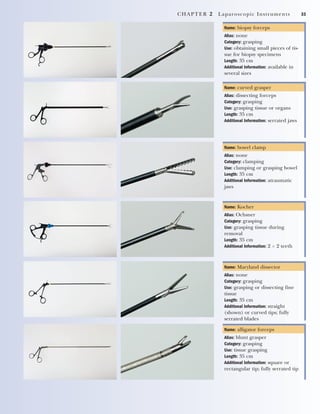
Name: biopsy forceps
Alias: none
Category: grasping
Use: obtaining small pieces of tis-
sue for biopsy specimens
Length: 35 cm
Additional Information: available in
several sizes
Name: curved grasper
Alias: dissecting forceps
Category: grasping
Use: grasping tissue or organs
Length: 35 cm
Additional Information: serrated jaws
Name: bowel clamp
Alias: none
Category: clamping
Use: clamping or grasping bowel
Length: 35 cm
Additional Information: atraumatic
jaws
Name: Kocher
Alias: Ochsner
Category: grasping
Use: grasping tissue during
removal
Length: 35 cm
Additional Information: 2 ϫ 2 teeth
Name: Maryland dissector
Alias: none
Category: grasping
Use: grasping or dissecting fine
tissue
Length: 35 cm
Additional Information: straight
(shown) or curved tips; fully
serrated blades
Name: alligator forceps
Alias: blunt grasper
Category: grasping
Use: tissue grasping
Length: 35 cm
Additional Information: square or
rectangular tip; fully serrated tip
2545_Ch02_029-038 18/10/11 11:47 AM Page 33
34 CHAPTER 2 Laparoscopic Instruments
Name: toothed grasper
Alias: claw grasper
Category: grasping
Use: grasping tissue to be
removed
Length: 35 cm
Additional Information: 2 ϫ 3 teeth;
5 mm or 10 mm
Name: Mixter
Alias: right angle
Category: grasping
Use: grasping tissue around or
under tissue and vessels
Length: 35 cm
Additional Information: angled jaws
Name: paddle grasper
Alias: none
Category: grasping
Use: grasping tissue
Length: 35 cm
Additional Information: atruamatic
jaws
Name: needle holder
Alias: none
Category: suturing
Use: holding suture needles
Length: 35 cm
Additional Information: straight,
right-curved, or left-curved jaws
Name: hook scissors
Alias: none
Category: cutting
Use: cutting tissue
Length: 35 cm
Additional Information: single-action
jaws
Name: micro scissors
Alias: none
Category: cutting
Use: cutting delicate tissue
Length: 35 cm
Additional Information: straight tip;
single-action jaws
2545_Ch02_029-038 18/10/11 11:47 AM Page 34
CHAPTER 2 Laparoscopic Instruments 35
Name: Metzenbaum scissors
Alias: none
Category: cutting
Use: cutting or dissecting
delicate tissue
Length: 35 cm
Additional Information: blunt tips
Name: Gyrus cautery instruments
Alias: none
Category: cutting; cauterizing
Length: n/a
Additional Information: single-patient
use; instruments attach to the
Gyrus machine
Name: Kleppinger bipolar forceps
Alias: none
Category: accessory
Use: bipolar cauterization of
tissue and vessels
Length: 32 cm or 45 cm
Additional Information: scissor- or
syringe-type handle
Name: bipolar cautery
Alias: none
Category: accessory
Use: bipolar cauterization of
tissue and vessels
Length: 32 cm or 45 cm
Additional Information: fenestrated
tips
Name: L hook
Alias: none
Category: accessory
Use: monopolar cauterization of
tissue
Length: 32 cm or 45 cm
Additional Information: insulated
around the tip to direct current
to desired tissue
Name: endoscopic Kittner
Alias: endoscopic dissector;
endoscopic pusher
Category: accessory
Use: dissecting blunt tissue
Length: 38 cm
Additional Information: available with
single or dual cotton tips
2545_Ch02_029-038 18/10/11 11:47 AM Page 35
36 CHAPTER 2 Laparoscopic Instruments
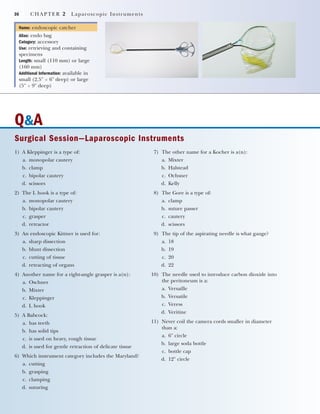
Name: endoscopic catcher
Alias: endo bag
Category: accessory
Use: retrieving and containing
specimens
Length: small (110 mm) or large
(160 mm)
Additional Information: available in
small (2.5" ϫ 6" deep) or large
(5" ϫ 9" deep)
Q&A
Surgical Session—Laparoscopic Instruments
1) A Kleppinger is a type of:
a. monopolar cautery
b. clamp
c. bipolar cautery
d. scissors
2) The L hook is a type of:
a. monopolar cautery
b. bipolar cautery
c. grasper
d. retractor
3) An endoscopic Kittner is used for:
a. sharp dissection
b. blunt dissection
c. cutting of tissue
d. retracting of organs
4) Another name for a right-angle grasper is a(n):
a. Oschner
b. Mixter
c. Kleppinger
d. L hook
5) A Babcock:
a. has teeth
b. has solid tips
c. is used on heavy, rough tissue
d. is used for gentle retraction of delicate tissue
6) Which instrument category includes the Maryland?
a. cutting
b. grasping
c. clamping
d. suturing
7) The other name for a Kocher is a(n):
a. Mixter
b. Halstead
c. Ochsner
d. Kelly
8) The Gore is a type of:
a. clamp
b. suture passer
c. cautery
d. scissors
9) The tip of the aspirating needle is what gauge?
a. 18
b. 19
c. 20
d. 22
10) The needle used to introduce carbon dioxide into
the peritoneum is a:
a. Versaille
b. Versatile
c. Veress
d. Veritine
11) Never coil the camera cords smaller in diameter
than a:
a. 6" circle
b. large soda bottle
c. bottle cap
d. 12" circle
2545_Ch02_029-038 18/10/11 11:47 AM Page 36
12) Which of the following is TRUE regarding the
care of endoscopic cameras?
a. Use an abrasive cleaner to clean the lens.
b. Place the camera at the bottom of the
instrument tray.
c. Attach the camera and turn it on prior to the
start of the procedure to make sure it works.
d. When checking a fiberoptic camera, dark spots
indicate fibers that are working.
13) If an endoscope is dented or damaged, you
should:
a. use it anyway
b. get a new one
c. have the circulator fix it prior to the procedure
d. try to fix the dent or damage yourself and then
use it
14) All of the following are true about the care of
rigid endoscopes except for one. Which is it?
a. Never place the scope at the bottom of an
instrument set.
b. When not in use, place the scope on a firm, flat
surface to avoid flexion.
c. Never place anything on top of the scope.
d. Pick up and hold scopes by the distal end.
CHAPTER 2 Laparoscopic Instruments 37
2545_Ch02_029-038 18/10/11 11:47 AM Page 37
2545_Ch02_029-038 18/10/11 11:47 AM Page 38
39
OB-GYN Instruments
3
Additional resources available on the back-of-book CD-ROM and online at
http://davisplus.fadavis.com/.
Name: Auvard weighted vaginal
speculum
Alias: weighted speculum
Category: retracting
Use: retracting the vaginal floor
Length: 24 cm
Additional Information: 2.75" ϫ 1.5" or
3" ϫ 1.5" blades; 2.5 lb
Name: DeLee bladder retractor
Alias: bladder blade
Category: retracting
Use: retracting the bladder
during cesarean section
Length: 9.25"
Additional Information: manual retrac-
tor; also available with blade
offset to left or right
Name: O’Sullivan-O’Connor
retractor
Alias: Irish; O’Connor-O’Sullivan
Category: retracting
Length: n/a
Use: retracting the abdominal or
pelvic wall
Additional Information: self-retaining;
interchangeable blades (45 mm
ϫ 80 mm and 70 mm ϫ 105 mm);
have moistened lap pads avail-
able to hand to the surgeon (to
use as padding between the
blades and tissue); all individual
pieces of the retractor must be
counted according to your insti-
tutional policy
2545_Ch03_039-050 18/10/11 12:04 PM Page 39
40 CHAPTER 3 OB-GYN Instruments
Name: Simpson delivery forceps
Alias: Simpson obstetrical forceps
Category: grasping
Use: forceps delivery of an infant
Length: 12" or 14"
Additional Information: forceps
come in two parts; hand to sur-
geon as two separate pieces
Name: Goodell uterine dilator
Alias: none
Category: dilating
Use: dilating the cervix
Length: 10" or 13"
Additional Information: self-retaining;
corrugated blades
Name: Sims retractor
Alias: Sims double-ended vaginal
speculum
Category: retracting
Use: retracting vaginal wall
Length: n/a
Additional Information: double ended;
blade width and length may vary
(available in size 1, 2, or 3)
Name: Heaney retractor
Alias: lateral retractor
Category: retracting
Use: retracting vaginal wall
Length: 10"
Additional Information: distal
blade 25 mm ϫ 45 mm, 28 mm
ϫ 65 mm, or 28 mm ϫ 82 mm
Name: Heaney-Simon retractor
Alias: none
Category: retracting
Use: retracting vaginal wall
Length: 11.5"
Additional Information: blade 1"
wide ϫ 4.5" long
2545_Ch03_039-050 18/10/11 12:04 PM Page 40
CHAPTER 3 OB-GYN Instruments 41
Name: Hulka tenaculum with
sound
Alias: none
Category: grasping
Use: measuring cervix/uterus
(sound); grasping cervix
(tanaculum)
Length: 11.5"
Additional Information: combines
uterine sound and single-tooth
tanaculum
Name: Graves vaginal speculum
Alias: duckbill speculum
Category: retracting
Use: retracting anterior and poste-
rior vaginal walls
Length: n/a
Additional width: small (75 mm
ϫ 20 mm), medium (100 mm ϫ
30 mm), or large (115 mm ϫ 35
mm); also available with angled
blade (45 degrees)
Name: Pederson vaginal speculum
Alias: none
Category: retracting
Use: retracting vaginal wall
(narrow); often used for
pediatric patients
Length: n/a
Additional Information: narrower
blades than the Graves speculum;
small (76 mm ϫ 13 mm),
medium (100 mm ϫ 22 mm),
and large (120 mm ϫ 25 mm);
also available in side-opening
style
Name: Hank dilators
Alias: none
Category: dilating
Use: dilating cervical os
Length: 10"
Additional Information: double ended;
solid; round “stop” on each end;
numbered (0.90 Fr to 0.94 Fr);
align on back table by diameter,
from smallest to largest
Name: side-opening vaginal
speculum
Alias: lateral speculum
Category: retracting
Use: retracting vaginal wall
Length: n/a
Additional Information: blade length
1.25" wide by 4"
2545_Ch03_039-050 18/10/11 12:04 PM Page 41
42 CHAPTER 3 OB-GYN Instruments
Name: Hegar dilators
Alias: none
Category: dilating
Use: dilating cervical os
Length: 7.5"
Additional Information: double
ended; hollow; numbered
(0.75 Fr to 0.94 Fr); align on
your back table by diameter,
from smallest to largest
Name: Allis clamp
Alias: none
Category: grasping
Use: grasping organs or tissue
during removal
Length: 6", 7.5", or 10"
Additional Information: 2 ϫ 3, 3 ϫ 4,
4 ϫ 5, 5 ϫ 6 teeth; straight or
angled tips
A SECOND LOOK
Hank and Hegar dilators are both double ended; they
are used for cervical dilation. Their construction differenti-
ates one from the other. The Hank dilator is solid and fea-
tures a stop on each end. The Hegar dilator is hollow,
and its smooth shafts have no end stops.
2545_Ch03_039-050 18/10/11 12:04 PM Page 42
CHAPTER 3 OB-GYN Instruments 43
Name: Allis-Adair clamp
Alias: T clamp
Category: grasping
Length: 6.5"
Use: grasping tissue
Additional Information: 9 ϫ 10 teeth
Name: Babcock
Alias: none
Category: grasping
Use: grasping delicate tissue
(e.g., fallopian tube, bowel, vas
deferens)
Length: 6", 7.5", or 9"
Additional Information: atraumatic,
fenestrated tips
A SECOND LOOK
The Allis clamp and Allis-Adair clamp are both for-
ceps, used for grasping and holding tissue. The width
and number of teeth in the jaws differentiate one from the
other. The widest of the Allis forceps has only 5 ϫ 6
teeth, whereas the jaws of the Allis-Adair forceps are
even wider. The Allis-Adair can hold heavier tissue.
2545_Ch03_039-050 18/10/11 12:04 PM Page 43
44 CHAPTER 3 OB-GYN Instruments
Name: Bozeman dressing forceps
Alias: packing forceps
Category: grasping
Use: applying dressing or insert-
ing vaginal packing
Length: 10.5"
Additional Information: straight or
double-curved jaws
Name: Heaney hysterectomy
forceps
Alias: none
Category: clamping
Use: occluding heavy tissue
Length: 8.25"
Additional Information: longitudinal
serrations; single- or double-
toothed blade; straight or
curved blades
Name: Heaney-Ballantine
hysterectomy forceps
Alias: none
Category: clamping
Use: occluding heavy tissue
Length: 8.25"
Additional Information: curved jaws;
1 ϫ 2 teeth; vertical serrations
A SECOND LOOK
Heaney and Heaney-Ballantine hysterectomy forceps
are both used to grasp and hold heavy tissue. The direc-
tion of the jaw serrations differentiates one from the other. The
jaw serrations of the Heaney forceps are horizontal,
whereas the jaw serrations of the Heaney-Ballantine
forceps are vertical.
2545_Ch03_039-050 18/10/11 12:04 PM Page 44
CHAPTER 3 OB-GYN Instruments 45
Name: Kocher
Alias: Ochsner; Rochester-
Ochsner
Category: grasping
Use: grasping heavy tissue (e.g.,
fascia)
Length: 5.5", 6.25", 7", 8", 9",
or 10"
Additional Information: 1 ϫ 2 teeth
Name: Thomas-Gaylor biopsy
punch
Alias: Gaylor biopsy punch
Category: cutting
Length: 8.5" or 9.5"
Use: obtaining biopsy specimens
from uterus
Additional Information: angled, sharp
jaws; 5-mm bite
Name: Lahey traction forceps
Alias: tenaculum; Lahey thyroid
clamp
Category: grasping
Use: grasping tissue during
removal (e.g., uterus)
Length: 6"
Additional Information: 3 ϫ 3 teeth
Name: Braun tenaculum
Alias: tenaculum; Schoeder
Category: grasping
Use: grasping cervix; applying
traction to uterus
Length: 9.5" or 10"
Additional Information: single or dou-
ble toothed; straight or curved
Name: Barrett tenaculum
Alias: Barrett uterine tenaculum
Category: grasping
Use: grasping cervix
Length: 7"
Additional Information: looks like a
shorter version of the Braun
tenaculum
Name: Sims uterine sound
Alias: none
Category: probing and dilating
Use: measuring depth of in-
trauterine cavity
Length: 13.5"
Additional Information: graduated in
centimeters; malleable
2545_Ch03_039-050 18/10/11 12:04 PM Page 45
46 CHAPTER 3 OB-GYN Instruments
Name: Thomas curette
Alias: blunt curette
Category: cutting
Use: scraping endocervical and
endometrial linings
Length: 11"
Additional Information: sizes 1 to 6;
blunt, looped blades
Name: Sims curette
Alias: sharp curette
Category: cutting
Use: scraping endocervical and
endometrial linings
Length: 11"
Additional Information: sizes 1 to 6;
sharp, looped blades
A SECOND LOOK
Both Thomas and Sims curettes are used to scrape tis-
sue from the endocervical and endometrial linings. The
blade distinguishes one from the other. The blade of the
Thomas curette is rounded and dull, whereas the blade
of the Sims curette has a sharp edge.
2545_Ch03_039-050 18/10/11 12:04 PM Page 46
CHAPTER 3 OB-GYN Instruments 47
Name: Kevorkian-Younge endocer-
vical biopsy curette
Alias: endocervical curette
Category: cutting
Use: obtaining endometrial or
cervical tissue samples
Length: 12"
Additional Information: available with
or without a basket tip
Name: Russian forceps
Alias: none
Category: grasping
Use: grasping heavy tissue
Length: 6", 8", or 10"
Additional Information: rounded tips
Name: Bonney tissue forceps
Alias: Cowan; Victor Bonney
Category: grasping
Use: grasping heavy tissue or bone
Length: 6.25", 7.75", or 9"
Additional Information: 1 ϫ 2 or
2 ϫ 3 teeth
Name: Heaney needle holder
Alias: Heaney needle driver;
curved needle holder
Category: suturing
Use: suturing around curved
structures
Length: 8.5"
Additional Information: curved jaw
Name: Foerster sponge forceps
Alias: sponge stick
Category: grasping
Use: grasping tissue or holding
Raytec sponges
Length: 9.5"
Additional Information: smooth or
serrated jaws
Name: Overstreet endometrial
polyp forceps
Alias: polyp forceps
Category: grasping
Use: grasping uterine polyps
Length: 9.25"
Additional Information: hollow,
fenestrated jaw
2545_Ch03_039-050 18/10/11 12:04 PM Page 47
48 CHAPTER 3 OB-GYN Instruments
Name: Lister scissors (large)
Alias: bandage scissors
Category: cutting
Use: opening uterus during ce-
sarean section
Length: 7.5"
Additional Information: guarded
blade to protect infant when
cutting the uterus
Name: Jorgenson scissors
Alias: none
Category: cutting
Use: cutting heavy tissue
Length: 9"
Additional Information: curved
blades
Name: Mayo-Noble scissors
Alias: none
Category: cutting
Use: dissecting heavy tissue
Length: 6.5"
Additional Information: straight or
curved blades; blunt tips
Name: umbilical scissors
(American pattern)
Alias: none
Category: cutting
Use: cutting umbilical cord after
delivery of the infant
Length: 4.25"
Additional Information: curved blades
Name: Rubin catheter
Alias: female catheter
Category: accessory
Use: catheterizing female bladder
Length: 6.5"
Additional Information: available in
10 Fr to 18 Fr; can be
resterilized
2545_Ch03_039-050 18/10/11 12:04 PM Page 48
CHAPTER 3 OB-GYN Instruments 49
Q&A
Surgical Session—OB-GYN Instruments
1) You are second scrubbing a cesarean section. The
surgeon has reached the bladder, and you need to
retract it out of the way. Which retractor will you
use?
a. Heaney
b. DeLee
c. Sims
d. U.S. Army
2) The surgeon is performing a D and C. He/she
wants to measure the depth of the intrauterine
cavity. The instrument you hand him/her is a:
a. Sims curette
b. Thomas curette
c. Sims sound
d. Goodell
3) During a hysterectomy the surgeon asks for a
T clamp. Another name for this instrument is:
a. Allis
b. Allis-Adair
c. Heaney
d. Heaney-Ballantine
4) You are setting up for an abdominal hysterectomy.
You know that once the surgeon enters the peri-
toneum, he/she will want to have a self-retaining
retractor to expose the abdominal/pelvic cavity.
Which instrument do you need to make sure you
have?
a. Heaney retractor
b. Sims retractor
c. Ribbon retractor
d. O’Sullivan-O’Connor retractor
5) The surgeon is performing a D and C. He/she asks
for the curettes with the sharp blades. Which curette
do you hand to him/her?
a. Sims
b. Thomas
c. Hegar
d. Hank
6) A type of endocervical curette is a:
a. Heaney
b. Kevorkian
c. Masterson
d. Hegar
7) A type of obstetrical forceps used to deliver an
infant is a:
a. Russian
b. Simpson
c. Bozeman
d. Bonney
8) The surgery is completed and the surgeon wants
to insert vaginal packing. The _____________ is a
type of dressing forceps used to do this.
a. Braun
b. Schoeder
c. Bozeman
d. Simpson
9) Another name for a weighted vaginal speculum
is a(n):
a. Graves
b. Auvard
c. Pederson
d. Goodell
10) During a D and C, the surgeon asks for a tenaculum
to grasp the cervix. You would hand him/her a(n):
a. Braun
b. Bozeman
c. Allis-Adair
d. Goodell
11) The surgeon is performing a hysterectomy and
needs to suture around a ligament. Which needle
holder has an angled tip that facilitates use around
structures?
a. Mayo-Hegar
b. Heaney
c. Castroviejo
d. Crile-Wood
12) During an open tubal ligation, which instrument
would be used to grasp or control the fallopian
tubes?
a. Kocher
b. Kelly
c. Babcock
d. Lahey
2545_Ch03_039-050 18/10/11 12:04 PM Page 49
50 CHAPTER 3 OB-GYN Instruments
13) During a vaginal hysterectomy, all of the following
are handheld retractors that could be used
a(n):
a. Sims
b. Heaney
c. Heaney Simon
d. O’Sullivan-O’Connor
14) The scissors that has a guard on it, used to open
the uterus during a cesarean section, is a:
a. Lister
b. Rubin
c. Jorgenson
d. Mayo-Noble
15) A Graves is a type of:
a. weighted vaginal speculum
b. nonweighted vaginal speculum
c. endocervical curette
d. hysterectomy clamp
16) The cervical dilator that has a “stop” on either
end is a:
a. Heaney
b. Ballantine
c. Hegar
d. Hank
17) A Rubin is a type of:
a. clamp
b. forceps
c. catheter
d. curette
18) A Bonney tissue forceps is used to:
a. grasp delicate tissue
b. grasp blood vessels
c. grasp heavy tissue or bone
d. grasp fallopian tubes
19) A ___________ is a type of sponge stick.
a. Heaney
b. Foerster
c. Overstreet
d. Russian
20) The surgeon requests the biopsy punch. You
would hand him/her a(n):
a. Lahey
b. Phaneuf
c. Thomas-Gaylor
d. Allis
2545_Ch03_039-050 18/10/11 12:04 PM Page 50
51
Urology Instruments
4
Additional resources available on the back-of-book CD-ROM and online at
http://davisplus.fadavis.com/.
Name: Randall forceps
Alias: kidney stone forceps
Category: grasping
Use: grasping stones or polyps
Length: 9"
Additional Information: standard or
long; 1
/4, 1
/2, 3
/4, or full-curve jaws
Name: Mayo-Guyon clamp
Alias: Guyon-Mayo vessel clamp
Category: clamping
Use: clamping heavy tissue or
organs
Length: 9.25"
Additional Information: heavy jaws;
double curve
Name: McDougal pedicle clamp
Alias: none
Category: clamping
Use: clamping heavy tissue or
pedicles
Length: 10"
Additional Information: full double
curve
Name: Cushing vein retractor
Alias: none
Category: retracting
Use: retracting blood vessels
Length: 8" or 12"
Additional Information: solid or ring
(open) handle; blade width
8 mm to 18 mm
2545_Ch04_051-060 18/10/11 11:52 AM Page 51
52 CHAPTER 4 Urology Instruments
Name: Dandy nerve hook
Alias: none
Category: retracting
Use: retraction of nerves
Length: 8.5"
Additional Information: blunt tip; tip
can be angled straight, left, or
right
Name: malleable catheter stylet
Alias: none
Category: accessory
Use: stylet for catheter insertion
Length: n/a
Additional Information: blunt tip;
malleable; 4-Fr or 6-Fr diameter
Name: Malis-Jensen bipolar
forceps
Alias: none
Category: accessory
Use: coagulating fine vessels
Length: 7.5"
Additional Information: bayonet-
shaped handle also available
Name: Gerald bipolar forceps
Alias: none
Category: accessory
Use: coagulating small blood
vessels
Length: 5.75"
Additional Information: delicate, nar-
row tips; bayonet-shaped handle
Name: Gerald tissue forceps
Alias: none
Category: grasping
Use: grasping delicate tissue
Length: 7"
Additional Information: 1 ϫ 2 teeth;
delicate jaws
2545_Ch04_051-060 18/10/11 11:52 AM Page 52
CHAPTER 4 Urology Instruments 53
Name: Bishop-Harmon forceps
Alias: none
Category: grasping
Use: grasping fine tissue
Length: 3.5"
Additional Information: 1 ϫ 2 teeth (tis-
sue forceps) or serrated tips (dress-
ing forceps); delicate (0.3-mm) or
standard (0.5-mm) tip
Name: tying forceps
Alias: none
Category: grasping
Use: tying small sutures
Length: 4"
Additional Information: straight or
curved jaws; some have 1 ϫ 2
teeth
Name: Church scissors
Alias: none
Category: cutting
Use: blunt tissue dissection
Length: 7"
Additional Information: no edge on
blades; duller blades
Name: jeweler’s forceps
Alias: none
Category: grasping
Use: grasping very fine tissue
Length: 4.75" to 5.25"
Additional Information: delicate or
very delicate (for microsurgery)
pointed tips; straight or
curved tips
A SECOND LOOK
The Gerald tissue forceps is a grasping instrument
used to catch and hold delicate tissue. The Gerald
bipolar forceps is a cauterizing instrument used to
burn, sear, or destroy small vessels. Although they may
look similar at first glance, a plug on the proximal end of
the bipolar forceps differentiates one from the other. This plug
is used to attach the forceps to a bipolar cautery cord.
2545_Ch04_051-060 18/10/11 11:52 AM Page 53
54 CHAPTER 4 Urology Instruments
Name: Metzenbaum scissors
Alias: Metz
Category: cutting
Use: cutting or dissecting
delicate tissue
Length: 5.75", 7", 9", or 10
Additional Information: delicate
blades—do NOT use for cutting
sutures, drains, heavy tissue
Name: Joseph scissors
Alias: none
Category: cutting
Use: cutting tissue
Length: 5.75"
Additional Information: straight or
curved (shown) blades; sharp
tips
A SECOND LOOK
The Joseph, Church, and Metzenbaum scissors all can
be used for dissecting and cutting delicate tissue. The
blades and tips differentiate one from the other. The blades of
the Church scissors lack the sharp edge of the Metzen-
baum blades. The Joseph scissors has sharp, pointed
tips, while the tips of the Church and Metzenbaum scis-
sors are round.
2545_Ch04_051-060 18/10/11 11:52 AM Page 54
CHAPTER 4 Urology Instruments 55
Name: Jorgensen scissors
Alias: none
Category: cutting
Use: cutting heavy tissue
Length: 9"
Additional Information: curved blades
Name: Mayo-Noble scissors
Alias: none
Category: cutting
Use: dissecting heavy tissue
Length: 6.5"
Additional Information: straight or
curved blades; blunt tips
Name: Potts-Smith scissors
Alias: none
Category: cutting
Use: cutting blood vessels
Length: 5.25" to 7"
Additional Information: 25-degree,
40-degree, or 60-degree angled
blades; delicate or standard
blades
Name: Westcott utility scissors
Alias: none
Category: cutting
Use: cutting and dissecting fine
tissue; cutting fine sutures
Length: 5"
Additional Information: 25 mm from
midscrew to tip
Name: Van Buren urethral sounds
Alias: Van Buren dilators
Category: dilating
Use: dilating the urethra
Length: 10.5"
Additional Information: 8-Fr to 40-Fr
diameters; arrange on back table
according to size, starting with
the smallest
Name: Lowsley prostatic retractor
Alias: none
Category: retracting
Use: inserted through bladder;
pushes prostate down toward
perineum
Length: 13"
Additional Information: curved or
straight
2545_Ch04_051-060 18/10/11 11:52 AM Page 55
56 CHAPTER 4 Urology Instruments
Name: Young bulb retractor
Alias: none
Category: retracting
Use: retracting prostate
Length: 8.5"
Additional Information: notched to
fit around urethra
Name: Young bifid retractor
Alias: none
Category: retracting
Use: retracting prostate
Length: 8"
Additional Information: notched to
fit around urethra
Name: Ellik evacuator
Alias: none
Category: suctioning
Use: removing fluid, blood clots,
tissue, and calculi from bladder
during procedures such as
TURP or bladder biopsy
Length: n/a
Additional Information: glass body
with rubber bulb and tubing;
before using, remove air by
filling bulb and glass bowl with
saline
Name: microinvasive evacuator
Alias: none
Category: suctioning
Use: removing fluid, blood clots,
tissue, and calculi from bladder
during procedures such as
TURP or bladder biopsy
Length: n/a
Additional Information: single-
patient style; before using, fill
evacuator with saline; filter
traps tissue specimen
2545_Ch04_051-060 18/10/11 11:52 AM Page 56
CHAPTER 4 Urology Instruments 57
Name: cystoscope
Alias: none
Category: viewing
Use: viewing into bladder during
transurethral procedures
Length: n/a
Additional Information: use with vari-
ous scopes (0 degree, 30 degree,
or 70 degree), depending on
procedure
Name: resectoscope
Alias: none
Category: cutting
Use: cutting and coagulating
tissue during TURP or TURB
Length: n/a
Additional Information: used with
various styles of cutting loops,
depending on procedure
Name: loop electrode
Alias: none
Category: accessory
Use: resecting tissue during TURP
or TURB
Length: n/a
Additional Information: fits various
makes of resectoscopes
Name: roller ball electrode
Alias: none
Category: accessory
Use: ablating and coagulating
tissue
Length: n/a
Additional Information: ball style or
barrel style (flattened sides);
3-mm or 5-mm tip
Name: filiforms and followers
Alias: none
Category: accessory (filiforms);
dilating (followers)
Use: filiforms get past difficult
strictures; followers dilate and
drain
Length: 12.5" or 18"
Additional Information: Filiforms are
used to get past the stricture
and then the followers are
passed to dilate urethra and
drain bladder; filiforms range
from 2 Fr to 6 Fr and are avail-
able with a straight, spiral, or
coudé tip; followers range from
10 Fr to 24 Fr and are available
with straight or coudé tips
2545_Ch04_051-060 18/10/11 11:52 AM Page 57
58 CHAPTER 4 Urology Instruments
Name: Bugbee electrode
Alias: none
Category: accessory
Use: monopolar coagulation of
small vessels or areas of tissue
Length: n/a
Additional Information: monopolar
cautery requires patient to have
a grounding pad in place prior
to use; most commonly used
size is 3 Fr
Name: urethral guidewire
Alias: none
Category: accessory
Use: accessing and identifying
ureters during transurethral
procedures; guiding
instruments
Length: 145 cm to 150 cm
Additional Information: many styles,
including J tip and fixed or
movable core
Name: laser fiber
Alias: none
Category: accessory
Use: laser ablation or cauteriza-
tion of tissue; transurethral
lithotripsy of stones
Length: n/a
Additional Information: inspect
closely before use for any dam-
age to tip or insulation; test
beam to ensure proper aim;
follow institutional safety poli-
cies regarding laser use; 150 ␮m
to 940 ␮m tips
Name: stone retrieval basket
Alias: none
Category: grasping
Use: retrieving and removing
urinary stones
Length: 90 cm or 115 cm
Additional Information: several styles,
all performing the same func-
tion; shaft diameter is 3 Fr in
most styles
Name: stone grasping forceps
Alias: none
Category: grasping
Use: grasping and removing uri-
nary stones
Length: 65 cm or 115 cm
Additional Information: three wires
at tip used to grasp stone; shaft
diameter 3.0 Fr or 4.5 Fr
2545_Ch04_051-060 18/10/11 11:52 AM Page 58
CHAPTER 4 Urology Instruments 59
Name: collagen injection system
Alias: none
Category: accessory
Use: injecting collagen to treat
incontinence
Length: n/a
Additional Information: collagen
injection adds bulk to surround-
ing urethral tissue, aiding
internal sphincter function
Name: semirigid ureteroscope
Alias: none
Category: viewing
Use: viewing into ureter during
transurethral procedures; used
most commonly for stone removal
Length: n/a
Additional Information: long, thin shaft;
to avoid damage, never place
other instruments on top of it or
hold it by the end of the shaft
Care of Urologic Scopes
• Read manufacturer’s instructions for cleaning and
sterilizing the cystoscope—some cystoscopes and
attachments can be autoclaved (steam sterilized)
and some cannot. Make sure you know whether the
scope, camera, cords, and so on can be autoclaved
prior to the sterilization process.
• Handle the scope by the middle of the shaft; han-
dling it by the ends could cause it to bend.
• Do not place anything on top of the scope or place
it at the bottom of a pan of instruments. It should
be placed in the storage container that it comes for
transport.
• Coiling the cord too tightly could damage or break
the fiberoptic bundles.
• When setting up your sterile field prior to the
procedure, check all scopes and accessories for
damage (bending, cracks in the cord casing, etc.).
Assemble the scope, making sure you have all the
pieces (sheath, telescope, obturator, bridge, and
instruments). Make sure all instruments function
properly.
Q&A
1) The surgeon needs to dilate the patient’s urethra.
You would hand her/him a:
a. Van Dyne
b. Van Buren
c. Randall
d. Cushing
2) All of the following are scissors EXCEPT:
a. Potts-Smith
b. Jorgensen
c. Westcott
d. Randall
3) A ________________ is used to cut and coagulate
prostate tissue during a TURP.
a. cystoscope
b. resectoscope
c. ureteroscope
d. Malis-Jensen bipolar
4) Which instrument is used to collect fluid and re-
sected tissue during a TURP?
a. Ellik evacuator
b. Roth
c. Jorgensen
d. Randall
Surgical Session—Urology Instruments
2545_Ch04_051-060 18/10/11 11:52 AM Page 59
60 CHAPTER 4 Urology Instruments
5) A _____________ is a type of stone forceps.
a. Roth
b. Randall
c. Ripstein
d. Rochester
6)_____________ scissors would be used on heavy tissue.
a. Westcott utility
b. Metzenbaum
c. Potts-Smith
d. Mayo-Noble
7) A double-curved clamp used on heavy tissue is a:
a. Mayo-Guyon
b. Randall
c. Rochester Mixter
d. Ripstein
8) All of the following are forceps EXCEPT:
a. Bishop-Harmon
b. jeweler’s
c. Church
d. Gerald
9) ________________ is a type of bipolar forceps.
a. Ripstein
b. Malis-Jensen
c. Mayo-Guyon
d. Van Buren
10) All of the following could be used during a
transurethral procedure EXCEPT a(n):
a. cystoscope
b. resectoscope
c. Ellik evacuator
d. Jorgensen scissors
11) During a radical nephrectomy, the surgeon
requests a vein retractor. You hand him/her a:
a. Mayo-Guyon
b. Young
c. Cushing
d. Ripstein
12) A Bugbee is a type of:
a. bipolar cautery
b. clamp
c. roller ball
d. monopolar cautery
13) A Young bifid is a type of:
a. handheld (manual) retractor
b. scissors
c. suture guide
d. laser fiber
14) Filiforms are used to:
a. drain the bladder
b. get past difficult strictures
c. dilate the urethra
d. continuously irrigate the bladder
15) Which of the following might be used to dilate the
urethra and drain the bladder?
a. followers
b. filiforms
c. Maguire
d. Westcott
16) Which of the following is TRUE about the care of
urological scopes?
a. You should hold it by the end of the shaft.
b. You should hold it in the middle of the shaft.
c. It should be placed at the bottom of the
instrument pan.
d. It is safe to autoclave any scope, regardless of
manufacturer’s recommendations.
17) The purpose of a collagen injection for urinary
incontinence is to:
a. cauterize tissue
b. dissolve tissue
c. add bulk to tissue
d. determine if the tissue is cancerous
18) A ______________ is a type of pedicle clamp.
a. Westcott
b. McDougal
c. Randall
d. Maguire
19) A Lowsley is a prostatic _______________.
a. retractor
b. clamp
c. scissors
d. forceps
2545_Ch04_051-060 18/10/11 11:52 AM Page 60
61
Robotic Instruments
5
Insert opening
Flush port (#2)
Main flush port (#1)
Instrument housing
(cartridge)
Instrument shaft
PARTS OF A ROBOTIC INSTRUMENT
CARE AND CLEANING OF ROBOTIC INSTRUMENTS1
The following general guidelines for the care, cleaning,
and handling of robotic instruments are not meant to
replace the manufacturer’s instructions. Please be sure
to read and follow all of the manufacturer’s instructions
regarding instrument use and care.
General Care
• Examine each instrument before and after use.
If you observe any abnormalities, do not use the
instrument.
• Do NOT hold robotic instruments by the shaft.
Doing so could bend or damage an instrument.
• Do NOT place other instruments on top of robotic
instruments.
• Insert instruments into the robotic arms according
to manufacturer’s instructions.
• Never try to force an instrument into a robotic
arm.
Cleaning Robotic Instruments
• Follow manufacturer’s instructions for cleaning,
disinfecting, and sterilizing the instruments.
• Use only pH-neutral cleaning agents to clean robotic
instruments.
• Clean all instruments thoroughly prior to disinfec-
tion and sterilization.
• Disinfection is an additional step to cleaning, NOT
a substitute for it.
Sterilization Guidelines
• Temperature setting for prevacuuming is 270°F to
272°F (132°C to 134° C).
• Minimum exposure time is 4 minutes.
• Average drying time is 20 minutes
Storing Robotic Instruments
• Store instruments in a clean, dry area.
• Avoid storing robotic instruments in direct
sunlight.
• Avoid areas with high
humidity or high temperature.
1 Some information adapted from Intuitive Surgical website,
www.intuitivesurgical.com.
Additional resources available on the back-of-book CD-ROM and online at
http://davisplus.fadavis.com/.
2545_Ch05_061-066 18/10/11 11:55 AM Page 61
62 CHAPTER 5 Robotic Instruments
Name: hand controls
Alias: none
Category: accessory
Use: controlling movement of
robotic instrument
Length: n/a
Additional Information: located on
surgeon’s console
(From Rutherford, CJ. Differen-
tiating Surgical Equipment
and Supplies. FA Davis,
Philadelphia, 2010, p 167,
with permission.)
Name: cannula
Alias: none
Category: accessory
Use: providing a port to pass in-
struments inside the body cavity
Length: n/a
Additional Information: 8 mm avail-
able in long or standard length,
with blunt or bladeless obtura-
tors; 5 mm available in standard
length, with sharp or blunt
obturator
Name: robotic endoscope
Alias: none
Category: viewing
Use: viewing inside body cavity
Length: n/a
Additional Information: used with
system’s imaging processing
equipment to give surgeon 3-D
pictures of surgical field
Name: Potts scissors
Alias: none
Category: cutting
Use: cutting blood vessels or fine
tissue
Length: n/a
Additional Information: straight or
angled tips
Name: meganeedle holder
Alias: none
Category: suturing
Use: suturing heavy tissue or
large blood vessels
Length: n/a
Additional Information: also available
with a built-in suture cutter
2545_Ch05_061-066 18/10/11 11:55 AM Page 62
CHAPTER 5 Robotic Instruments 63
Name: large needle holder
Alias: none
Category: suturing
Use: suturing tissue or blood
vessels
Length: n/a
Additional Information: 8-mm or
5-mm diameter; finer tips than
the megadriver, but not as fine
as the microforceps
Name: clip appliers
Alias: none
Category: accessory
Use: applying hemoclips to
blood vessels
Length: n/a
Additional Information: available in
two sizes to apply small or large
clips
Name: round tip scissors
Alias: none
Category: cutting
Use: dissecting and cutting tissue
Length: n/a
Additional Information: rounded
(blunt) tips; straight or curved
tips; 5-mm and 8-mm diameter
Name: dissecting forceps
Alias: none
Category: grasping
Use: grasping, retracting, or
blunt dissection of tissue
Length: n/a
Additional Information: serrated tips
Name: Cobra grasper
Alias: none
Category: grasping
Use: grasping or retracting tissue
during removal
Length: n/a
Additional Information: sharp
(penetrating) 3 ϫ 4 teeth
2545_Ch05_061-066 18/10/11 11:55 AM Page 63
64 CHAPTER 5 Robotic Instruments
Name: tenaculum forceps
Alias: none
Category: grasping
Use: grasping and retracting
tissue
Length: none
Additional Information: single-tooth
jaws
Name: harmonic shears
Alias: none
Category: cutting
Use: cutting and cauterizing
tissue using ultrasonic energy
Length: n/a
Additional Information: tip is
separate insert that is placed
on the instrument
Name: cautery hook
Alias: none
Category: cutting
Use: cauterizing tissue
Length: n/a
Additional Information: also available
with spatula tip; monopolar
cautery requires patient to have
a grounding pad
Name: grasper
Alias: none
Category: grasping
Use: grasping and retracting
bowel or other soft tissue
Length: n/a
Additional Information: atraumatic,
serrated jaws
2545_Ch05_061-066 18/10/11 11:55 AM Page 64
CHAPTER 5 Robotic Instruments 65
Q&A
Surgical Session—Robotic Instruments
1) A _________________ should be used only on tissue
that will be removed.
a. Cobra
b. Rosano
c. DeBakey
d. dissecting forceps
2) All of the following statements about storage of
robotic instruments are true EXCEPT:
a. They should be stored in a clean, dry area.
b. Do not store in direct sunlight.
c. After sterilization, store them in the shipping
box they came in.
d. Do not store in an area with high humidity or
high temperature.
3) Do not sterilize robotic instruments at temperatures
above ____________.
a. 240°F
b. 210°F
c. 260°F
d. 285°F
4) The minimum exposure time for pre-vac steriliza-
tion of robotic instruments is __________ minutes.
a. 2
b. 3
c. 4
d. 5
5) A ___________ is a type of scissors.
a. Rosano
b. Potts
c. DeBakey
d. snap-fit
6) All of the following are grasping instruments
EXCEPT the:
a. tenaculum
b. Cobra
c. Rosano
d. Potts
7) All of the following are categorized as accessory
instruments EXCEPT the:
a. endoscope
b. hand controls
c. clip applier
d. cannula
2545_Ch05_061-066 18/10/11 11:55 AM Page 65
2545_Ch05_061-066 18/10/11 11:55 AM Page 66
Orthopedic Instruments
6
Name: bone file
Alias: none
Category: cutting
Use: smoothing bone surfaces
Length: 9.5"
Additional Information: half-round
blade; fine teeth
Name: Putti rasp
Alias: Putti-Platt
Category: cutting
Use: smoothing bone surface
Length: 10.5" or 12"
Additional Information: double
ended; one straight end and
one curved end
Name: Strully scissors
Alias: none
Category: cutting
Use: dissecting tissue
Length: 8.75"
Additional Information: curved tips
with probe on the end
Name: tenotomy scissors
Alias: Stevens tenotomy scissors
Category: cutting
Use: dissecting fine tissue
Length: 3.5" to 4.5"
Additional Information: tapered tips
Additional resources available on the back-of-book CD-ROM and online at
http://davisplus.fadavis.com/.
67
2545_Ch06_067-082 18/10/11 12:01 PM Page 67
68 CHAPTER 6 Orthopedic Instruments
Name: Dingman zygoma hook
Alias: bone hook
Category: retracting
Use: retracting bone
Length: 6.5" or 7.5"
Additional Information: single sharp
hook
Name: femoral bone hook
Alias: none
Category: retracting
Use: grasping femur to retract it
out of the way
Length: n/a
Additional Information: blunt tip
Name: Cushing Little Joker
periosteal elevator
Alias: Little Joker
Category: cutting
Use: removing periosteum from
bone
Length: 6" or 7.5"
Additional Information: solid or
hollow handle
Name: Penfield #4
Alias: #4
Category: dissecting
Use: blunt dissecting of tissue
Length: 8.5"
Additional Information: single
ended; slightly curved tip
Name: Key periosteal elevator
Alias: none
Category: cutting
Use: removing periosteum from
bone
Length: 6"
Additional Information: blade width
0.12" to 1"
Name: Cobb elevator
Alias: none
Category: cutting
Use: removing periosteum from
bone
Length: 11"
Additional Information: blade width
13 mm, 19 mm, 25 mm, or
32 mm; round or hexagonal
handle
2545_Ch06_067-082 18/10/11 12:01 PM Page 68
CHAPTER 6 Orthopedic Instruments 69
Name: Molt elevator
Alias: none
Category: cutting
Use: removing periosteum from
bone
Length: 7"
Additional Information: double ended,
round ends; slightly curved
Name: Ruskin mini-bone rongeur
Alias: none
Category: cutting
Use: cutting away small pieces
of bone
Length: 6"
Additional Information: 2-mm or
3-mm bite; straight or curved
Name: Leksell rongeur
Alias: Leksell duckbill rongeur
Category: cutting
Use: cutting off bites of bone
Length: 9.5"
Additional Information: 3-mm, 5-mm,
8-mm bite
Name: Kleinert-Kutz rongeur
Alias: none
Category: cutting
Use: cutting off small bites of
bone
Length: 6"
Additional Information: double action;
slightly or strongly curved jaws;
2-mm bite
Name: Horsley bone-cutting forceps
Alias: none
Category: cutting
Use: cutting bone
Length: 7.5"
Additional Information: straight tips
Name: mini-Liston bone-cutting
forceps
Alias: none
Category: cutting
Use: cutting bone
Length: 6"
Additional Information: forward- or
backward-angled blades
2545_Ch06_067-082 18/10/11 12:01 PM Page 69
70 CHAPTER 6 Orthopedic Instruments
Name: needlenose pliers/wire
cutter
Alias: none
Category: cutting
Use: cutting or twisting wires;
removing hardware or pins
Length: 6.5"
Additional Information: jaws have
built-in wire cutter
Name: K-wire flat nose pliers
Alias: flat nose pliers
Category: grasping
Use: pulling or bending wires;
removing hardware or pins
Length: 6.75"
Additional Information: smooth
(shown) or serrated jaws
Name: depth gauge
Alias: none
Category: accessory
Use: measuring depth of drill
holes
Length: 6.5"
Additional Information: callibrated in
millimeters (mm)
Name: box osteotome
Alias: none
Category: cutting
Use: inserted into the femoral
canal to create a pilot hole for
femoral reaming
Length: n/a
Additional Information: surgeon will
need a mallet for striking the
head of the osteotome
Name: Hibbs osteotome
Alias: none
Category: cutting
Use: cutting bone
Length: 9.5"
Additional Information: straight or
curved; blade 0.25" to 1.5";
surgeon will need a mallet
for striking the head of the
osteome
2545_Ch06_067-082 18/10/11 12:01 PM Page 70
CHAPTER 6 Orthopedic Instruments 71
Name: Lambotte osteotomes
Alias: none
Category: cutting
Use: scoring or cutting bone
Length: straight, 5" (mini) or 9";
curved, 9"
Additional Information: mini os-
teotomes (blade width 4 mm to
20 mm); straight or curved 9"
Lambotte tips (blade width
0.25" to 1.5"); surgeon will need
a mallet for striking the head of
the osteotome
Name: Cushing pituitary rongeur
Alias: none
Category: cutting
Length: 6", 7", or 8" shaft
Use: removing pieces of interver-
tebral disc or bone
Additional Information: straight,
angled-up, or angled-down jaws;
1.5-mm or 2-mm jaw bite
Name: cannulated pin cutter
Alias: none
Category: cutting
Use: cutting wires, pins
Length: 7.25"
Additional Information: 1.6-mm
capacity; end cutting; designed
to slide over inserted wire; cut
piece remains inside the channel
Name: Martin diamond wire cutter
Alias: none
Category: cutting
Use: cutting wires
Length: 6.5"
Additional Information: maximum
capacity 1.25 mm
Name: Brun bone curette
Alias: none
Category: cutting
Use: scraping away pieces of bone
Length: 9"
Additional Information: sizes 0000 to
6; straight or angled tip
2545_Ch06_067-082 18/10/11 12:01 PM Page 71
72 CHAPTER 6 Orthopedic Instruments
Name: Cobb bone curette
Alias: Dawson-Yuhl curette
Category: cutting
Use: scraping away pieces of bone
Length: 11"
Additional Information: 2-mm to
8-mm cup (two examples
shown)
Name: bone tamp
Alias: none
Category: accessory
Use: tamping bone
Length: 6"
Additional Information: 2 mm to
10 mm
Name: orthopedic mallet
Alias: none
Category: accessory
Use: tapping on osteotomes or
chisels; inserting pins
Length: 7.25" or 7.5"
Additional Information: 1.5" head
diameter; 1 lb or 2 lb
Name: bone mallet
Alias: none
Category: accessory
Use: tapping on osteotomes or
chisels; inserting pins
Length: 7.5"
Additional Information: many styles
Name: Townley caliper
Alias: slide calipers
Category: accessory
Use: measuring
Length: 4"
Additional Information: marked in
mm and inches for measuring
Name: Lewin bone clamp
Alias: Lewin spinal perforating
forceps
Category: clamping
Use: temporary clamping of
bone fragments
Length: 7"
Additional Information: jaws extend
in a curve
2545_Ch06_067-082 18/10/11 12:01 PM Page 72
CHAPTER 6 Orthopedic Instruments 73
Name: Lowman bone-holding
clamp
Alias: none
Category: clamping
Use: holding bone in place
Length: 4.75", 7.25", or 8"
Additional Information: 1 ϫ 2 jaws
Name: meniscus clamp
Alias: none
Category: clamping
Use: clamping meniscus tissue
Length: 7"
Additional Information: 1 ϫ 2 teeth at
tips of the jaw
Name: cement system
Alias: cement mixer
Category: accessory
Use: mixing bone cement powder
and liquid
Length: n/a
Additional Information: closed system;
make sure system is assembled
correctly, according to manufac-
turer’s instructions
Name: cement gun
Alias: none
Category: accessory
Use: holding bone cement appli-
cator; applying bone cement
Length: n/a
Additional Information: insert tube of
bone cement into the gun for
application during surgery
Name: Malis mirror-finish bipolar
cautery forceps
Alias: none
Category: accessory
Use: cauterizing small blood
vessels or delicate tissue
Length: 7"
Additional Information: sharp or blunt
tips; bayonet style
Name: plate press
Alias: none
Category: accessory
Use: recontouring plates to
desired shape
Length: n/a
Additional Information: none
2545_Ch06_067-082 18/10/11 12:02 PM Page 73
74 CHAPTER 6 Orthopedic Instruments
Name: Stryker power system
Alias: none
Category: accessory
Use: providing power for
drilling, sawing, or reaming
Length: n/a
Additional Information: adapters
enable use as a drill, saggital
saw; reamers; battery operated
ORTHOPEDIC RETRACTORS
Name: Beckmann retractor
Alias: none
Category: retracting
Use: retracting soft tissue
Length: 5.5" or 6.5"
Additional Information: 3 ϫ 4 sharp
or blunt prongs; hinged arms
Name: cerebellar retractor
Alias: Adson retractor
Category: retracting
Use: exposing wound
Length: 8"
Additional Information: 4 ϫ 4 prongs;
angled shanks
Name: Weitlaner retractor
Alias: none
Category: retracting
Use: exposing superficial wound
Length: 4", 5.5", 6.5", 8", or 9.5"
Additional Information: self-retain-
ing; sharp or dull prongs; 2 ϫ 3
prongs (4"), 3 ϫ 4 prongs (all
other sizes)
Name: Heiss skin retractor
Alias: none
Category: retracting
Use: retracting skin during hand
surgery
Length: 4"
Additional Information: 4 ϫ 4 prongs
2545_Ch06_067-082 18/10/11 12:02 PM Page 74
CHAPTER 6 Orthopedic Instruments 75
Name: Cushing vein retractor
Alias: none
Category: retracting
Use: retraction of blood vessels
Length: 8" or 12"
Additional Information: open handle
Name: Volkmann retractor
Alias: rake
Category: retracting
Use: exposing superficial wound
Length: 8.5"
Other: sharp or blunt tips; two to
six teeth
Name: Senn retractor
Alias: none
Category: retracting
Use: exposing superficial wound
(hand or foot surgery)
Length: 6"
Additional Information: handheld;
double ended; sharp or dull
prongs; usually used in pairs
Name: Ragnell retractor
Alias: none
Category: retracting
Use: exposing superficial wound
Length: 6"
Additional Information: double ended;
blunt on both ends
Name: Dandy nerve hook
Alias: none
Category: retracting
Use: retracting nerves
Length: 8.5"
Additional Information: blunt tip;
pointed straight, left, or right
Name: Hohmann retractor
Alias: none
Category: retracting
Use: exposing wound during hip
or knee surgery
Length: 9.5" to 11"
Additional Information: pointed blade;
blade width varies
2545_Ch06_067-082 18/10/11 12:02 PM Page 75
76 CHAPTER 6 Orthopedic Instruments
Name: blunt Hohmann retractor
Alias: none
Category: retracting
Use: exposing wound during hip
or knee surgery
Length: 9.5" to 11"
Additional Information: blunt blade;
blade width varies
Name: Sauerbruch retractor
Alias: none
Category: retracting
Use: retracting soft tissue
Length: 9.5"
Additional Information: blade end
slightly curved; blade width
1.75" to 3"
Name: Israel retractor
Alias: none
Category: retracting
Use: retracting heavy tissue
Length: 8"
Additional Information: rake has four
or five prongs; 1.75" ϫ 1.75"
blades
Name: Aufranc retractor
Alias: Cobra
Category: retracting
Use: exposing wound during
knee or hip surgery
Length: 8.5"
Additional Information: hollow
handle; three tip styles
Name: Bennett retractor
Alias: none
Category: retracting
Use: tibial retraction
Length: 10"
Additional Information: blade width
1.75" or 2.5"
Name: Blount knee retractor
Alias: none
Category: retracting
Use: exposing wound during
knee surgery
Length: 8.75"
Additional Information: notched
blade
2545_Ch06_067-082 18/10/11 12:02 PM Page 76
CHAPTER 6 Orthopedic Instruments 77
Name: Blount double-prong knee
retractor
Alias: none
Category: retracting
Use: exposing wound during knee
surgery
Length: 8.75"
Additional Information: notched blade
Name: Taylor spinal retractor
Alias: none
Category: retracting
Use: retracting tissue during spine
surgery
Length: 8"
Additional Information: blade length
3" or 4"
Name: Hibbs retractor
Alias: none
Category: retracting
Use: exposing wound
Length: 9.5"
Additional Information: sawtooth
blade edge; 1" ϫ 3" blade
ARTHROSCOPIC INSTRUMENTS
Name: shaver
Alias: none
Category: cutting
Use: removing or trimming bone
or tissue
Length: n/a
Additional Information: various burrs
and blades attach to the hand
piece; activated by foot pedal
(newer systems have wireless foot
pedals)
Name: sheath and obturator
Alias: none
Category: accessory
Use: allowing introduction of
instruments into joint cavity
Length: n/a
Additional Information: obturator
available with sharp or blunt tip
2545_Ch06_067-082 18/10/11 12:02 PM Page 77
78 CHAPTER 6 Orthopedic Instruments
Name: fluid pump and tubing
Alias: none
Category: accessory
Use: controlling fluid flow in
and out of joint space during
arthroscopic surgery
Length: n/a
Additional Information: one example
of a variety of systems available
(From Rutherford, CJ: Differentiating Surgical Equipment
and Supplies. FA Davis, Philadelphia, 2010, p 135, with
permission.)
Name: camera system
Alias: none
Category: viewing
Use: viewing inside joint
Length: n/a
Additional Information: many
systems available; handling
precautions the same as for any
endoscope camera system (see
Chapter 2)
Name: arthroscope
Alias: none
Category: viewing
Use: viewing inside joint
Length: n/a
Additional Information: 4-mm stan-
dard diameter, with 25-degree
lens; available in small joint size
(1.9 mm or 2.3 mm), with
30-degree or 70-degree lens
(From Rutherford, CJ: Differentiating Surgical Equipment
and Supplies. FA Davis, Philadelphia, 2010, p 142.)
Name: arthroscopic probe
Alias: none
Category: probing and dilating
Use: probing and retracting
tissue
Length: 115 mm
Additional Information: blunt tip
2545_Ch06_067-082 18/10/11 12:02 PM Page 78
CHAPTER 6 Orthopedic Instruments 79
Name: duckbill straight biter
Alias: none
Category: cutting
Use: cutting tissue
Length: n/a
Additional Information: cutting away
small pieces of tissue
Name: banana knife
Alias: none
Category: cutting
Use: cutting tissue during meni-
sectomy or knee arthroscopy
Length: n/a
Additional Information: double-edged
or serrated tip
Name: arthroscopic scissors
Alias: none
Category: cutting and dissecting
Use: cutting tissue or suture
Length:
Additional Information: available with
straight tip or tip that is angled
30 degrees right or left
Name: arthroscopic graspers
Alias: none
Category: grasping
Use: grasping tissue or suture
Length: n/a
Additional Information: various sizes
and styles
Name: arthroscopic punches
Alias: none
Category: cutting and dissecting
Use: cutting cartilage or tissue
Length: n/a
Additional Information: various sizes
2545_Ch06_067-082 18/10/11 12:02 PM Page 79
80 CHAPTER 6 Orthopedic Instruments
Q&A
Surgical Session—Orthopedic Instruments
1) You are scrubbed on an open shoulder surgery. The
surgeon asks for a rasp to smooth the bone. You
would hand him/ her a:
a. Putti
b. Penfield
c. Molt
d. Bennett
2) All of the following are handheld (manual) retrac-
tors EXCEPT the:
a. Hohmann
b. Blount
c. Beckmann
d. Israel
3) A small self-retaining skin retractor used in hand
surgery is a:
a. Heiss
b. Beckmann
c. Senn
d. Ragnell
4) You hand the surgeon a Hibbs osteotome. The next
instrument you need to have ready to hand is a:
a. pin cutter
b. mallet
c. curette
d. pliers
5) Dawson-Yuhl bone curettes are more commonly
known as a:
a. Cobb
b. Brun
c. Hibbs
d. Lambotte
6) All of the following are rongeurs EXCEPT the:
a. Ruskin
b. Kleinert-Kutz
c. Molt
d. Leskell
7) A Stevens scissors is also known as a _____________
scissors.
a. Mayo
b. Metzenbaum
c. tenotomy
d. Strully
8) The surgeon wishes to measure the femoral head.
You hand him/her a:
a. Hibbs
b. Townley
c. Molt
d. Key
9) The instrument used to create a pilot hole for
femoral reaming is a:
a. Senn
b. Lambotte
c. box osteotome
d. Brun
10) A type of self-retaining retractor with hinged
arms is a:
a. Weitlaner
b. cerebellar
c. Beckmann
d. Farabeuf
11) You are scrubbed on a total knee replacement.
The surgeon asks for a tibial retractor. You would
hand him/her a:
a. Senn
b. Bennett
c. Farabeuf
d. Taylor
12) All of the following are periosteal elevators
EXCEPT a:
a. Molt
b. Key
c. Cushing “Little Joker”
d. Putti
13) A banana knife is generally used for which type of
procedures?
a. total knee arthroplasty
b. spinal decompression
c. arthroscopic surgery
d. tibial nailing
14) A Lewin is a type of:
a. curette
b. elevator
c. rasp
d. bone clamp
2545_Ch06_067-082 18/10/11 12:02 PM Page 80
CHAPTER 6 Orthopedic Instruments 81
15) A Taylor retractor would most likely be used in
__________ surgery.
a. knee
b. shoulder
c. spinal
d. foot
16) A fluid pump, camera, and duckbill straight
biter would most likely be used in which type of
surgery?
a. open rotator cuff repair
b. total knee replacement
c. arthroscopic knee surgery
d. open carpal tunnel surgery
17) The surgeon requests a nerve hook. You would
hand him/her a:
a. Cushing
b. Dandy
c. Blount
d. Hohmann
18) The surgery you are scrubbed on requires the use
of a vein retractor. You would have a
______________ on your table.
a. Cushing
b. Dandy
c. Bennett
d. Cobb
19) Ragnell, Senn, and Volkmann are all types of:
a. self-retaining retractors
b. elevators
c. curettes
d. handheld (manual) retractors
2545_Ch06_067-082 18/10/11 12:02 PM Page 81
2545_Ch06_067-082 18/10/11 12:02 PM Page 82
83
Neurosurgical Instruments
7
Name: Adson cranial rongeur
Alias: none
Category: cutting
Use: removing pieces of cranial
bone and soft tissue
Length: 8"
Additional Information: straight tip;
8-mm bite
Name: Beyer rongeur
Alias: Lamprey rongeur
Category: cutting
Use: removing small pieces of
bone and soft tissue
Length: 6"
Additional Information: 2-mm bite
Name: Stookey cranial rongeur
Alias: none
Category: cutting
Use: removing pieces of cranial
bone and soft tissue
Length: 7.5"
Additional Information: angled jaw;
3-mm bite
Name: Leksell rongeur
Alias: none
Category: cutting
Use: removing small bites of bone
and soft tissue
Length: 9.5"
Additional Information: 3-mm, 4-mm,
6-mm bite
Additional resources available on the back-of-book CD-ROM and online at
http://davisplus.fadavis.com/.
2545_Ch07_083-100 18/10/11 12:14 PM Page 83
84 CHAPTER 7 Neurosurgical Instruments
Name: Kerrison cervical rongeur
Alias: Kerrison
Category: cutting
Use: removing pieces of verte-
bral disc or bone
Length: 6", 7", or 8"
Additional Information: 2-mm to
5-mm bite; 40-degree or
90-degree plate, up or down
Name: Cushing pituitary rongeur
Alias: upbiter (jaws angled up);
downbiter (jaws angled down)
Category: cutting
Length: 6", 7", or 8"
Use: removing pieces of
vertebral disc or bone
Additional Information: straight,
angled-up, or angled-down jaws;
1.5-mm or 2-mm bite
Name: Spurling rongeur
Alias: Spurling intervertebral
disc rongeur
Category: cutting
Use: removing bits of vertebral
disc
Length: 6" or 7"
Additional Information: straight,
angled-up, or angled-down jaws;
4-mm ϫ 10-mm bite
Name: Penfield dissector #1
Alias: #1
Category: dissecting
Use: dissecting and manipulat-
ing tissue, bone, or nerves
Length: 7.5"
Additional Information: broad
curved dissector at one end,
and sharp round spoon at
other end
Name: Penfield dissector #2
Alias: #2
Category: dissecting
Use: dissecting and manipulat-
ing tissue, bone, or nerves
Length: 7.5"
Additional Information: slightly
curved dissector at one end,
and bone wax packer at other
end
2545_Ch07_083-100 18/10/11 12:14 PM Page 84
CHAPTER 7 Neurosurgical Instruments 85
Name: Penfield dissector #3
Alias: #3
Category: dissecting
Use: dissecting and manipulating
tissue, bone, or nerves
Length: 7.25"
Additional Information: fully curved
dissector at one end, and bone
wax packer at other end
Name: Penfield dissector #4
Alias: #4
Category: dissecting
Use: dissecting and manipulating
tissue, bone, or nerves
Length: 8.5"
Additional Information: single ended;
slightly curved tip
Name: Penfield dissector #5
Alias: #5
Category: dissecting
Use: dissecting and manipulating
tissue, bone, or nerves
Length: 11.5"
Additional Information: fully curved
dissector at one end, and slightly
curved dissector at the other end
A SECOND LOOK
#1 #2 #3 #4 #5
All of the Penfields are used for tissue dissection, and
each has a curved dissecting tip on one end. What is on
the other end distinguishes each Penfield from the others. Pen-
field #2 and #3 have a bone wax packer on the other
end; #1 has a sharp, rounded spoon curette tip; and #5
has another curve dissector. Penfield #4 is a single-
ended instrument, with only a curved dissector.
2545_Ch07_083-100 18/10/11 12:14 PM Page 85
86 CHAPTER 7 Neurosurgical Instruments
Name: Woodson elevator and
spatula
Alias: Woodson dural separator
and packer
Category: cutting
Use: separating (lifting) the
dura from the disk
Length: 7" or 10"
Additional Information: double
ended; one end slightly wider
than the other
Name: Adson periosteal elevator
Alias: Joker
Category: cutting
Use: removing periosteum from
the bone; elevating skull off the
dura
Length: 6.5"
Additional Information: straight or
curved; round or square end
Name: Cushing periosteal elevator
Alias: none
Category: cutting
Use: removing periosteum from
the bone
Length: 7.5"
Additional Information: narrow or
wide blade; sharp or blunt
blade
Name: Cobb elevator
Alias: none
Category: cutting
Use: removing periosteum from
the bone
Length: 11"
Additional Information: blade
width 13 mm, 19 mm, 25 mm,
or 32 mm; round or hexagonal
handle
Name: ball tip probe
Alias: none
Category: probing
Use: manipulating and probing
tissue and vessels
Length: 9.5"
Additional Information: none
2545_Ch07_083-100 18/10/11 12:14 PM Page 86
CHAPTER 7 Neurosurgical Instruments 87
Name: Greenberg retractor
Alias: none
Category: retracting
Use: retracting cranial tissue; used
during a craniotomy
Length: n/a
Additional Information: self-retaining;
mounts on side of OR table
Name: Beckmann-Adson laminec-
tomy retractor
Alias: Beckmann goiter retractor
Category: retracting
Use: exposing wound
Length: 12"
Additional Information: hinged
shanks; 4 ϫ 4 sharp prongs
Name: cerebellar retractor
Alias: Adson retractor
Category: retracting
Use: exposing wound
Length: 8"
Additional Information: 4 ϫ 4 prongs;
angled shanks
Name: Jansen retractor
Alias: Gifford; Allport; mastoid
Category: retracting
Use: retracting the mastoid or
scalp
Length: 4" or 4.5"
Additional Information: blunt; 3 ϫ 3 or
4 ϫ 4 prongs; self-retaining
Name: Taylor spinal retractor
Alias: none
Category: retracting
Use: retracting tissue during
spinal surgery
Length: 8"
Additional Information: blade length
3" or 4"
Name: Williams retractor
Alias: none
Category: retracting
Use: exposing deep wound during
spinal surgery
Length: 7"
Additional Information: blade width
1 cm or 2 cm; blade length 5 cm
or 7 cm
2545_Ch07_083-100 18/10/11 12:14 PM Page 87
88 CHAPTER 7 Neurosurgical Instruments
Name: Scoville hemilaminectomy
retractor
Alias: Scoville-Haverfield
Category: retracting
Use: deep retraction of tissue
during laminectomy
Length: arms 8" long
Additional Information: flat or four-
prong blades
Name: Meyerding retractor
Alias: none
Category: retracting
Use: exposing wound; used
widely in spinal surgery
Length: 9" or 10"
Additional Information: blade width
0.75" to 2"; saw-toothed edge
Name: Scoville brain spatula
Alias: none
Category: retracting
Use: retracting brain tissue
Length: 8"
Additional Information: double-
ended; blade width 0.77 mm or
0.84 mm; malleable; moisten
with saline before handing to
surgeon
Name: Davis brain spatula
Alias: none
Category: retracting
Use: retracting brain tissue
Length: 7"
Additional Information: double-
ended blade widths 0.25"
to 1.5"; malleable; moisten
with saline before handing to
surgeon
Name: Adson dural scissors
Alias: none
Category: cutting
Use: cutting or dissecting dura
Length: 7"
Additional Information: curved,
blunt blades
2545_Ch07_083-100 18/10/11 12:14 PM Page 88
CHAPTER 7 Neurosurgical Instruments 89
Name: Strully scissors
Alias: none
Category: cutting
Use: dissecting tissue
Length: 8.75"
Additional Information: ball tip
(probe) on points; curved blades
Name: Liston-Stille bone cutter
Alias: none
Category: cutting
Use: cutting bone
Length: 10.5"
Additional Information: straight or
angled blades
Name: Brun bone curettes
Alias: spinal curettes
Category: cutting
Use: scraping bone and tissue
Length: 9"
Additional Information: sizes 0000 to
6; straight or angled tip
Name: corkscrew dural hook
Alias: dural hook
Category: accessory
Use: hooking and lifting dura
Length: 6.5"; hook storage inside
handle
Name: Frazier suction
Alias: nasal suction; neurosuction
Category: suctioning
Use: suctioning small quantities of
fluid; used in small spaces
Length: 6.5"
Additional Information: short or long
tips; 6-Fr to 16-Fr diameter; metal
or disposable; angled
Name: Adson suction
Alias: none
Category: suctioning
Use: fine suctioning during
neuro- or spinal surgery
Length: 6"
Additional Information: 7 Fr, 9 Fr, 11
Fr, or 15 Fr; straight or curved
blade (two examples shown)
2545_Ch07_083-100 18/10/11 12:14 PM Page 89
90 CHAPTER 7 Neurosurgical Instruments
Name: Raney scalp clip-applying
forceps
Alias: Raney clip appliers
Category: accessory
Use: applying Raney retracting
clips
Length: 6.25"
Additional Information: stainless
steel; or plastic clips
Name: Dandy clamp
Alias: Cairn clamp
Category: clamping
Use: retracting dura out of the
way; scalp hemostasis
Length: 5.5"
Additional Information: jaw curved
on the side; serrated tips or
1 ϫ 2 teeth
A SECOND LOOK
Adson and Frazier are both used to suction small
amounts of fluid from delicate areas of the body. The
shape of the thumb suction control distinguishes one from the
other. The Adson suction has a thin, flat, oval-shaped
control, whereas the Frazier’s thumb control is thicker
and more square.
2545_Ch07_083-100 18/10/11 12:14 PM Page 90
CHAPTER 7 Neurosurgical Instruments 91
Name: Greene tubing clamp
Alias: none
Category: grasping
Use: attaching tubing to surgical
drapes
Length: 6.5"
Additional Information: tubing fed
through rings on top of clamp
Name: Cushing bayonet forceps
Alias: none
Category: grasping
Use: grasping tissue or inserting
packing into nose or ears
Length: 7"
Additional Information: serrated tips
or 1 ϫ 2 teeth
Name: ring forceps
Alias: tumor forceps
Category: grasping
Use: grasping tissue or tumors
Length: 6" to 9"
Additional Information: 1-mm or
2-mm tips
A SECOND LOOK
At first glance, the Dandy and Crile clamps may look
similar. The jaws and serrations differentiate one from the
other. The jaws of the Dandy are serrated only halfway
down, whereas the jaws of the Crile are fully serrated.
2545_Ch07_083-100 18/10/11 12:14 PM Page 91
92 CHAPTER 7 Neurosurgical Instruments
Name: Gerald bipolar forceps
Alias: none
Category: accessory
Use: coagulating small blood
vessels
Length: 5.75"
Additional Information: delicate, nar-
row tips; bayonet-shaped handle
Name: Cushing tissue forceps
Alias: none
Category: grasping
Use: grasping fine tissue
Length: 7"
Additional Information: smooth or
1 ϫ 2 teeth; tips are slightly
finer than regular tissue forceps
Name: Vienna nasal speculum
Alias: none
Category: retracting
Use: retracting nasal walls
Length: 5.5"
Additional Information: small
(9.5 mm ϫ 27 mm), medium
(11 mm ϫ 30 mm), or large
(13 mm ϫ 32mm) blades
Name: Gerzog mallet
Alias: none
Category: accessory
Use: pounding instruments (like
osteotomes) or driving in pins
Length: 6.75"
Additional Information: 1" head
diameter; lead-filled head
Name: screwdriver with sleeve
Alias: none
Category: grasping
Use: holding and inserting
screws during instrumentation
Length: n/a
Additional Information: none
Name: locking cap screwdriver
Alias: none
Category: accessory
Use: tightens locking caps
during rod insertion
Length: n/a
Additional Information: none
2545_Ch07_083-100 18/10/11 12:14 PM Page 92
CHAPTER 7 Neurosurgical Instruments 93
Name: bar-holding forceps
Alias: none
Category: grasping
Use: holding spinal rods
Length: n/a
Additional Information: none
Name: bending iron
Alias: none
Category: accessory
Use: contouring rods during
spinal procedures
Length: n/a
Additional Information: left and right
sided
Name: rod bender
Alias: none
Category: accessory
Use: contouring rods during
spinal procedures
Length: n/a
Additional Information: none
Name: extraction pliers
Alias: none
Category: grasping
Use: removing screws during
spinal surgery
Length: n/a
Additional Information: none
Name: cannulated tap and handle
Alias: tap
Category: accessory
Use: tapping insertion hole for
cannulated screws
Length: n/a
Additional Information: none
Name: hexagonal screwdriver
Alias: none
Category: accessory
Use: inserting/removing screws
with hexagonal heads
Length: n/a
Additional Information: none
2545_Ch07_083-100 18/10/11 12:14 PM Page 93
94 CHAPTER 7 Neurosurgical Instruments
Name: pedicle probe
Alias: none
Category: probing
Use: probing and manipulating
tissue during spinal surgery
Length: n/a
Additional Information: none
Name: pedicle screw reamer
Alias: none
Category: cutting
Use: reaming hole prior to
inserting pedicle screw
Length: n/a
Additional Information: none
Name: trial spacer handle
Alias: none
Category: accessory
Use: holding trial sizers used to
size bone graft implant
Length: n/a
Additional Information: used only
to hold trial spacers, not the
implant
Name: spacer implant holder
Alias: none
Category: grasping
Use: holding implant for inser-
tion during spinal procedures
Length: n/a
Additional Information: none
Name: rod pusher
Alias: none
Category: accessory
Use: maneuvering rods during
spinal surgery
Length: n/a
Additional Information: none
Name: impactor
Alias: none
Category: accessory
Use: impacting bone graft in
place
Length: n/a
Additional Information: none
2545_Ch07_083-100 18/10/11 12:14 PM Page 94
CHAPTER 7 Neurosurgical Instruments 95
Name: graft rasp
Alias: none
Category: cutting
Use: scraping bone to make graft
fit properly
Length: n/a
Additional Information: none
Name: graft shaver
Alias: none
Category: cutting
Use: shaving bits of bone to make
graft fit properly
Length: n/a
Additional Information: none
Name: graft packer
Alias: none
Category: accessory
Use: packing bone graft into
place
Length: n/a
Additional Information: none
Name: neuro pattie tray
Alias: none
Category: accessory
Length: n/a
Use: holding moistened neuro
patties
Additional Information: moisten
patties with normal saline before
applying to tray; separate patties
by size
Name: Love nerve root retractor
Alias: none
Category: retracting
Use: retracting nerve root
Length: 8"
Additional Information: straight,
45 degree, or 90 degree
Name: lamina spreader
Alias: none
Category: retracting
Use: retracting lamina during
spinal surgery
Length: 6.5" or 9.5"
Additional Information: self-retaining
2545_Ch07_083-100 18/10/11 12:14 PM Page 95
96 CHAPTER 7 Neurosurgical Instruments
Name: Cloward vertebra spreader
Alias: none
Category: retracting
Use: opening the vertebral space
during spinal surgery
Length: 7"
Additional Information: square tips;
downward-angling shanks
Name: Midas Rex drill
Alias: none
Category: cutting
Use: cutting cranial bone flap;
creating burr holes; cutting
bone during spinal surgery
Length: n/a
Additional Information: operated
with foot pedal; many burr and
blade sizes available; burrs and
blades attach to the hand piece
TRANSPHENOIDAL INSTRUMENTS
Name: Frazier suction and
obturator
Alias: none
Category: suctioning
Use: removing fluids and tissue
from wound
Length: 7.5"
Additional Information: various
diameters available
Name: mirror
Alias: none
Category: visualizing
Use: visualizing inside the
wound
Length: 9.5"
Additional Information: none
Name: Cushing-Landolt
transphenoidal speculum
Alias: none
Category: retracting
Use: visualizing inside nose dur-
ing transphenoidal surgery
Length: 3" or 3.5" blades
Additional Information: self-retaining
2545_Ch07_083-100 18/10/11 12:14 PM Page 96
CHAPTER 7 Neurosurgical Instruments 97
Name: transphenoidal knife handle
Alias: none
Category: cutting
Use: holding scalpel blade
Length: 9.5"
Additional Information: usually used
with #11 or #15 blade
Name: transphenoidal osteotome
Alias: none
Category: cutting
Use: entering the sella floor
Length: n/a
Additional Information: tap with a
mallet before cutting
Name: transphenoidal Kerrison
rongeur
Alias: sella punch
Category: cutting
Use: puncturing the sella turcica
Length: n/a
Additional Information: none
Name: Rhoton pituitary curettes
Alias: none
Category: cutting
Use: removing pieces of tumor
Length: 9.5"
Additional Information: bayonet
handle; ring diameter 5 mm
Name: half-ring curette
Alias: none
Category: cutting
Use: removing pieces of tumor
Length: 9.5"
Additional Information: bayonet
handle
Name: transphenoidal enucleator
Alias: none
Category: cutting
Use: removing pieces of tumor
Length: 9.5"
Additional Information: tip can be
angled left or right, or reverse
curve
2545_Ch07_083-100 18/10/11 12:14 PM Page 97
98 CHAPTER 7 Neurosurgical Instruments
Name: probes
Alias: none
Category: probing
Use: probing inside the wound
Length: n/a
Additional Information: angled or
straight tip
Name: pituitary spoon
Alias: pituitary scoop
Category: accessory
Use: removing tumor tissue
Length: 9.5"
Additional Information: bayonet
handle
Name: three-prong fork
Alias: none
Category: grasping
Use: applying tissue for recon-
struction of the sella floor
Length: 9"
Additional Information: none
Name: Adson hydrophyseal forceps
Alias: none
Category: grasping
Use: grasping and removing
tumor tissue
Length: 9"
Additional Information: straight,
curved up, or curved down
Q&A
Surgical Session—Neurosurgical Instruments
1) While performing a craniotomy, the neurosurgeon
asks for the clamps used to retract the dura and
hold it out of the way. You would hand him/her:
a. Kelley clamps
b. Cairn (Dandy) clamps
c. Peans
d. Laheys
2) While performing a craniotomy, the neurosurgeon
asks for a “brain spatula.” You would hand him/
her a:
a. ribbon
b. Scoville
c. Green
d. Beckman
2545_Ch07_083-100 18/10/11 12:14 PM Page 98
CHAPTER 7 Neurosurgical Instruments 99
3) Before handing the neurosurgeon the brain
spatula, you first need to moisten it with:
a. sterile water
b. alcohol
c. normal saline
d. betadine
4) While performing a lumbar discectomy, the sur-
geon asks for a Leksell. You hand him/her a:
a. retractor
b. rongeur
c. clamp
d. periosteal elevator
5) Which of the following instruments is NOT a
cranial rongeur?
a. Stookey
b. Adson
c. Beyer
d. Gerzog
6) All of the following are self-retaining retractors
EXCEPT the:
a. Williams
b. Beckman-Adson
c. cerebellar
d. Taylor
7) You hand the surgeon the scissors with a ball tip
on them. You just handed the ___________
scissors.
a. Potts
b. Adson
c. Strully
d. Mayo
8) The surgeon needs to shave a small amount of bone
from the graft. You would hand a graft
____________.
a. packer
b. rasp
c. sizer
d. impactor
9) You are first scrubbing a lumbar laminectomy. The
surgeon needs a large hinged self-retaining retrac-
tor. What would you hand to him/her?
a. Jansen
b. cerebellar
c. Taylor
d. Beckmann-Adson
10) During neurosurgery the surgeon requests the
ring forceps. The other name for this is
___________________.
a. tumor forceps
b. Cushing forceps
c. Gerald forceps
d. grasper forceps
11) The name for the tubing holding forceps is
a. Cushing
b. Greene
c. ring
d. grasper
12) Which cranial rongeur has the largest bite size?
a. Adson
b. Bacon
c. Beyer
d. Stookey
13) The cranial rongeur with a 2-mm bite size is a(n):
a. Adson
b. Bacon
c. Beyer
d. Stookey
14) Which Penfield dissector is single ended?
a. #1
b. #2
c. #3
d. #4
15) The surgeon is placing a pin. After handing the
pin, the next instrument you have ready is the
__________________.
a. Gerzog
b. Taylor
c. Cushing
d. Jansen
16) All of the following are jaw types for the Cushing
pituitary EXCEPT the:
a. straight
b. left
c. up-biting
d. down-biting
2545_Ch07_083-100 18/10/11 12:14 PM Page 99
100 CHAPTER 7 Neurosurgical Instruments
17) Which of the following is a self-retaining retractor
that mounts on the side of the OR bed?
a. ACF
b. Greenberg
c. Jansen
d. Williams
18) The Cushing-Landolt speculum is used for which
type of surgery?
a. open cranial
b. spinal
c. transphenoidal
d. spinal cord
19) All of the following are transphenoidal
instruments EXCEPT:
a. Rhoton pituitary curettes
b. straight point needles
c. three-prong forks
d. Dandy clamps
20) A Love retractor is used to retract the:
a. cranial flap
b. cranial tissue
c. nerve root
d. spinal cord
2545_Ch07_083-100 18/10/11 12:14 PM Page 100
Ear, Nose, and Throat Instruments
8
MICRO-EAR INSTRUMENTS
Name: Spratt curette
Alias: Brun mastoid curette
Category: cutting
Use: removing pieces of mastoid
bone
Length: 6.5"
Additional Information: cup sizes from
3.2 mm to 10.2 mm
Name: Wullstein micro-ear forceps
Alias: none
Category: grasping
Use: inserting prostheses or tubes;
grasping delicate tissue or remov-
ing ossicles
Length: working length 3"
Additional Information: 0.5-mm
serrated jaws
Name: McGee wire-crimping forceps
Alias: none
Category: accessory
Use: crimping the wire on the
stapes prosthesis
Length: working length 3"
Additional Information: jaws curve
slightly downward
Name: House-Wullstein oval cup
forceps
Alias: none
Category: cutting
Use: removing ossicles
Length: working length 3.25"
Additional Information: straight jaws,
or angled left or right
Additional resources available on the back-of-book CD-ROM and online at
http://davisplus.fadavis.com/.
101
2545_Ch08_101-120 18/10/11 12:18 PM Page 101
102 CHAPTER 8 Ear, Nose, and Throat Instruments
Name: round cup forceps
Alias: none
Category: cutting
Use: removing the ossicles
Length: working length 4"
Additional Information: cup diameter
1 mm to 3 mm
Name: House-Dieter malleus nipper
Alias: none
Category: cutting
Use: reshaping the malleous
Length: working length 5"
Additional Information: guillotine
cutting tip
Name: House-Bellucci alligator
scissors
Alias: none
Category: cutting
Use: extra-delicate cutting in the
ear (e.g., severing stapedial
tendon)
Length: working length 3"
Additional Information: straight tips
or angled to the right or left
Name: House measuring rod
Alias: none
Category: accessory
Use: measuring distance between
incus and footplate for sizing
prosthesis
Length: 6.5"
Additional Information: individual
instruments come with the rod
3.5 mm, 4 mm, 4.5 mm, or 5
mm from the tip
Name: House stapes curette
Alias: none
Category: cutting
Use: removing tiny pieces of
bone
Length: 6.25"
Additional Information: double
ended; oval-shaped cups
Name: Jordan-Rosen curette
Alias: none
Category: cutting
Use: removing small pieces of
bone or debris
Length: 6.5"
Additional Information: angled,
round blade
2545_Ch08_101-120 18/10/11 12:18 PM Page 102
CHAPTER 8 Ear, Nose, and Throat Instruments 103
Name: Derlacki mobilizer
Alias: none
Category: cutting
Use: mobilizing the stapes
Length: 6"
Additional Information: none
Name: Shambaugh-Derlacki elevator
Alias: none
Category: cutting
Use: elevating periosteum from
bone
Length: 5.5"
Additional Information: blunt, 1.5-mm
tip
Name: Lempert heavy elevator
Alias: none
Category: cutting
Use: elevating periosteum from
bone
Length: 7.5"
Additional Information: blade width
5 mm
Name: Lillie attic hook
Alias: none
Category: probing
Use: probing the mastoid
Length: 7"
Additional Information: tip angled
50 or 90 degrees; tip length
4 mm
Name: House-Crabtree dissector
Alias: Jimmy
Category: cutting
Use: dissecting tissue and ossicles
in middle ear
Length: 6.5"
Additional Information: malleable
shaft; 1.3-mm or 2-mm tip; tip
angled 90 degrees
Name: House strut hook
Alias: none
Category: accessory
Use: removing ossicle fragments
Length: 6.5"
Additional Information: malleable
shaft; sharp, 0.75-mm to 3-mm
tip; angled 90 degrees
2545_Ch08_101-120 18/10/11 12:18 PM Page 103
104 CHAPTER 8 Ear, Nose, and Throat Instruments
Name: House oval window hook
Alias: none
Category: accessory
Use: positioning soft tissue graft
over the oval window
Length: 6.5"
Additional Information: malleable
shaft; 0.3-mm, 90-degree tip
Name: Jordan hook
Alias: none
Category: accessory
Use: removing remainder of the
footplate
Length: 6.5"
Additional Information: tip angled
up, down, right, or left
Name: Hough-Sanders hoe
excavator
Alias: none
Category: cutting
Use: removing ossicle fragments
Length: 6.5"
Additional Information: malleable
shaft; 90-degree tip
Name: Hough excavator
Alias: none
Category: accessory
Use: removing ossicle fragments
Length: 6"
Additional Information: angled shaft;
blade width 0.5 mm or 0.25 mm
Name: Rosen needle
Alias: House-Rosen needle
Category: cutting
Use: fracturing the crura from
the footplate; elevating tissue
Length: 6.5"
Additional Information: blunt point
Name: House-Barbara shattering
needle
Alias: none
Category: cutting
Use: fracturing the crura from
the footplate
Length: 6.5"
Additional Information: malleable
shaft; sharp point
2545_Ch08_101-120 18/10/11 12:18 PM Page 104
CHAPTER 8 Ear, Nose, and Throat Instruments 105
Name: Billeau ear loop
Alias: none
Category: accessory
Use: removing cerumen or foreign
bodies from external ear canal
Length: 7"
Additional Information: metal or
Teflon-coated loop; various sizes
Name: Buck ear curette
Alias: none
Category: accessory
Use: removing cerumen or foreign
bodies from external ear canal
Length: 6"
Additional Information: sizes 00 to
3; sharp or blunt loop
Name: Baron suction tube
Alias: none
Category: suctioning
Use: suctioning within narrow
spaces (e.g., inside the ear)
Length: working length varies from
3" to 4"
Additional Information: sizes 3 Fr, 5 Fr,
or 7 Fr; metal stylet; increase
suction by covering thumb hole
Name: Schuknecht roller knife
Alias: none
Category: cutting
Use: creating tympanomeatal flap
Length: 6.5"
Additional Information: vertical or
horizontal blade
Name: flap knife
Alias: none
Category: cutting
Use: creating tympanomeatal flap
Length: 6.5"
Additional Information: rounded tip
Name: House incudostapedial
joint knife
Alias: IS joint knife
Category: cutting
Use: separating incus from stapes;
incising and dissecting tissue
Length: 6.5"
Additional Information: 45-degree
blade; sharp tip
2545_Ch08_101-120 18/10/11 12:18 PM Page 105
106 CHAPTER 8 Ear, Nose, and Throat Instruments
Name: House sickle knife
Alias: none
Category: cutting
Use: creating tympanomeatal
flap
Length: 6.5"
Additional Information: sickle-shaped
cutting edge
Name: Hough drum scraper
Alias: none
Category: accessory
Use: removing epithelium from
drum surrounding a perforation
Length: 5.75"
Additional Information: angled shaft;
90-degree blade
Name: Beckman speculum
Alias: none
Category: retracting
Use: retracting tissue for viewing
within the ear or nose
Length: 5"
Additional Information: sizes 0 to 3
EAR,NOSE,ANDTHROAT INSTRUMENTS
Name: Caplan septal scissors
Alias: none
Category: cutting
Use: cutting nasal tissue
Length: 8"
Additional Information: double action;
straight or angled; blunt tip
Name: Cottle angular scissors
Alias: turbinate scissors
Category: cutting
Use: cutting nasal tissue
Length: 6.5"
Additional Information: heavy, narrow,
rounded blades
Name: Fomon dorsal angular
scissors
Alias: none
Category: cutting
Use: cutting nasal tissue
Length: 5.25"
Additional Information: angled
shank; blunt tip
2545_Ch08_101-120 18/10/11 12:18 PM Page 106
CHAPTER 8 Ear, Nose, and Throat Instruments 107
Name: Heymann-Knight angular
scissors
Alias: Knight angular scissors
Category: cutting
Use: cutting nasal tissue
Length: 7"
Additional Information: angled, blunt
blades
Name: Boettcher tonsil scissors
Alias: Boettcher dissecting scissors
Category: cutting
Use: cutting tonsil tissue
Length: 7.25"
Additional Information: curved,
double-edged blades
Name: Peck-Joseph scissors
Alias: none
Category: cutting
Use: cutting fine tissue or mucous
membrane
Length: 5.5"
Additional Information: blades sharp
or blunt, straight or curved
Name: Foman nasal rasp
Alias: none
Category: cutting
Use: cutting, smoothing nasal
bone
Length: 8.5"
Additional Information: double ended;
both blades down cutting
Name: Kleinert-Kutz rasp
Alias: none
Category: cutting
Use: cutting, smoothing nasal
bone
Length: 8.5"
Additional Information: double ended
Name: Maltz-Lipsett rasp
Alias: none
Category: cutting
Use: cutting, smoothing nasal
bone
Length: 7.5"
Additional Information: straight down-
cutting blade; horizontal and
vertical ridges
2545_Ch08_101-120 18/10/11 12:18 PM Page 107
108 CHAPTER 8 Ear, Nose, and Throat Instruments
Name: Miller bone file
Alias: none
Category: cutting
Use: filing nasal bone
Length: 7"
Additional Information: single-cut or
crosscut blade pattern
Name: Anderson-Nievert osteotome
Alias: none
Category: cutting
Use: cutting nasal bone
Length: 8"
Additional Information: blade has
single guard; straight or curved,
right or left
Name: Cottle chisel-osteotome
Alias: none
Category: cutting
Use: cutting nasal cartilage or
bone
Length: 7"
Additional Information: round corners;
blade width 4 mm to 12 mm;
depth markings on blade
Name: Ballenger knife
Alias: swivel knife
Category: cutting
Use: blade on a swivel for
cutting nasal tissue
Length: 8"
Additional Information: 3-mm to
5-mm swivel blade; straight or
bayonet style
Name: Cottle nasal knife
Alias: none
Category: cutting
Use: cutting periosteum from
bone
Length: 5.5"
Additional Information: stiff blade
Name: Pierce submucous dissector
Alias: none
Category: cutting
Use: dissecting nasal mucous
membrane
Length: 7.5"
Additional Information: double
ended; right- and left-side blades
2545_Ch08_101-120 18/10/11 12:18 PM Page 108
CHAPTER 8 Ear, Nose, and Throat Instruments 109
Name: myringotomy knife
Alias: tympanostomy knife
Category: cutting
Use: making incision into tympanic
membrane for release of fluid
and insertion of tube
Length: 7"
Additional Information: angled shaft
Name: Barnhill curette
Alias: none
Category: cutting
Use: scraping away adenoid tissue
Length: 8.5"
Additional Information: sizes 0 to 4;
11-mm to 19-mm blades
Name: Rosenmueller fossea curette
Alias: none
Category: cutting
Use: scraping away adenoid tissue
Length: 9"
Additional Information: narrow,
curved loop end
Name: Key periosteal elevator
Alias: none
Category: cutting
Use: removing periosteum from
bone
Length: 6.5"
Additional Information: blade widths
3 mm to 2.5 cm; single ended;
curved or straight
Name: Freer elevator
Alias: none
Category: cutting
Use: dissecting tissue from septum
Length: 8"
Additional Information: double ended;
sharp tips
Name: MacKenty septal elevator
Alias: none
Category: cutting
Use: dissecting tissue from septum
Length: 5.75"
Additional Information: flat, curved
blade
2545_Ch08_101-120 18/10/11 12:18 PM Page 109
110 CHAPTER 8 Ear, Nose, and Throat Instruments
Name: Cottle septal elevator
Alias: none
Category: cutting
Use: measuring depth; removing
periosteum from septal bone
Length: 9"
Additional Information: double
ended; graduated in centimeters
Name: McIvor mouth gag
Alias: none
Category: retracting
Use: retracting walls of the
mouth
Length: n/a
Additional Information: interchange-
able blade width 2.5" to 4";
self-retaining
Name: Sludder-Jansen mouth gag
Alias: none
Category: retracting
Use: retracting walls of the mouth
Length: 5"
Additional Information: self-retaining;
arms curved to fit the face
Name: Green retractor
Alias: loop retractor; Green goiter
Category: retracting
Use: retracting soft tissue/thyroid
during neck surgery
Length: 8.5"
Additional Information: solid or
open handle
Name: Jansen retractor
Alias: mastoid retractror
Category: retracting
Use: retracting tissue covering
the mastoid
Length: 4" or 4.5"
Additional Information: blunt; 3 ϫ 3
or 4 ϫ 4 prongs; self-retaining
Name: Love nasopharyngeal
retractor
Alias: none
Category: retracting
Use: retracting soft tissue in
nasopharyngeal area
Length: n/a
Additional Information: blade width
18 mm to 25 mm; angled
2545_Ch08_101-120 18/10/11 12:18 PM Page 110
CHAPTER 8 Ear, Nose, and Throat Instruments 111
Name: Weder tongue blade
Alias: none
Category: retracting tongue
downward
Length: n/a
Additional Information: small (2.8 cm
wide) or large (3.5 cm wide)
Name: Trousseau tracheal dilator
Alias: none
Category: dilating
Use: dilating tracheal stoma
Length: 5.5"
Additional Information: jaw width 3 mm
or 6 mm
Name: Boucheron ear speculum
Alias: none
Category: viewing
Use: allows visualization of ear
canal
Length: n/a
Additional Information: eight sizes
(two examples shown)
Name: Gruber ear speculum
Alias: none
Category: viewing
Use: allows visualization of ear
canal
Length: n/a
Additional Information: eight sizes (two
examples shown); narrower body
Name: microscope handle covers
Alias: none
Category: accessory
Use: placed on microscope handles
to allow surgeon to manipulate
and adjust the microscope
Length: n/a
Additional Information: none
Name: Cottle speculum
Alias: none
Category: retracting
Use: retracting nasal walls to allow
visualization of nasal passage
Length: 5.75"
Additional Information: thin, narrow
blades
2545_Ch08_101-120 18/10/11 12:18 PM Page 111
112 CHAPTER 8 Ear, Nose, and Throat Instruments
Name: Cottle nasal speculum
Alias: none
Category: retracting
Use: retracting nasal walls to allow
visualization of nasal passage
Length: 5.25"
Additional Information: short,
medium, long, and extra-long
blades; tapered blade
Name: Vienna nasal speculum
Alias: none
Category: retracting
Use: retracting nasal walls to allow
visualization of nasal passage
Length: 5.5"
Additional Information: small
(9.5 mm ϫ 27 mm), medium
(11 mm ϫ 30 mm), or large
(13 mm ϫ 32 mm) blades
Name: Cushing bayonet forceps
Alias: none
Category: grasping
Use: grasping tissue or inserting
packing into nose or ears
Length: 7"
Additional Information: serrated tips
Name: Brown bayonet forceps
Alias: none
Category: grasping
Use: grasping tissue
Length: 6" or 8"
Additional Information: 7 ϫ 7 teeth
2545_Ch08_101-120 18/10/11 12:18 PM Page 112
CHAPTER 8 Ear, Nose, and Throat Instruments 113
Name: Brown-Adson forceps
Alias: Adson-Brown
Category: grasping
Use: grasping delicate tissue
Length: 4.75"
Additional Information: 6 ϫ 7 teeth
Name: Cottle columella clamp
Alias: none
Category: retracting
Use: retracting anterior septum
Length: 4.25"
Additional Information: fenestrated
11-mm jaws
A SECOND LOOK
The Cushing and Brown are both bayonet-shaped for-
ceps used for grasping and holding tissue. The characteris-
tics of their tips distinguish one from the other. The Cushing
has a horizontally serrated tip, whereas the tip of the
Brown has 7 ϫ 7 teeth.
2545_Ch08_101-120 18/10/11 12:18 PM Page 113
114 CHAPTER 8 Ear, Nose, and Throat Instruments
Name: Bishop-Harmon forceps
Alias: none
Category: grasping
Use: grasping fine tissue; applying
small dressings
Length: 3.5"
Additional Information: 1 ϫ 2 teeth
(tissue forceps) or serrated tips
(dressing forceps); delicate
(0.3-mm) or standard
(0.5-mm) tip
Name: Hurd dissector and pillar
retractor
Alias: none
Category: retractor
Use: retracting and dissecting
pillae
Length: 9"
Additional Information: double
ended; retractor at one end, and
dissector tip at the other end
Name: Bruening ethmoid
exenteration forceps
Alias: none
Category: cutting
Use: cutting and removing
ethmoid bone
Length: 2" working length
Additional Information: sharp,
fenestrated jaws
Name: Jansen-Middleton septum
forceps
Alias: none
Category: cutting
Use: cutting and removing
pieces of septal bone
Length: 8"
Additional Information: double action;
spoon-shaped blades
Name: Jansen-Struycken septum
forceps
Alias: none
Category: cutting
Use: cutting and removing
pieces of septal bone
Length: 7.75"
Additional Information: double action;
through-cutting blades
2545_Ch08_101-120 18/10/11 12:18 PM Page 114
CHAPTER 8 Ear, Nose, and Throat Instruments 115
Name: Knight polypus and
turbinate forceps
Alias: none
Category: cutting
Use: cutting and removing nasal
polyps or turbinate bone
Length: 6.75"
Additional Information: also available
with serrated jaws; serrated style
used as nasal dressing forceps
Name: laryngeal mirror
Alias: dental mirror
Category: viewing
Use: visualizing the mouth,
pharynx, and larynx
Length: n/a
Additional Information: mirror diameter
14 mm to 24 mm
Name: Joseph skin hook
Alias: Sharp skin hook
Category: retracting
Use: retracting skin
Length: 6"
Additional Information: single or
double hook; rounded handle
Name: Frazier suction
Alias: nasal suction; neurosuction
Category: suctioning
Use: suctioning small quantities of
fluid from nose or ears; suctioning
in small areas
Length: 6.5"
Additional Information: short or long
tips; diameter 6 Fr to 16 Fr;
metal or disposable; angled
Name: Webster needle holder
Alias: none
Category: suturing
Use: holding delicate suture needles
Length: 5"
Additional Information: smooth or
serrated jaws
Name: Wullstein ear curette
Alias: none
Category: accessory
Use: removing wax or foreign
bodies from ear
Length: 5.75"
Additional Information: ring tip
diameter 1.3 mm to 2.3 mm
2545_Ch08_101-120 18/10/11 12:18 PM Page 115
116 CHAPTER 8 Ear, Nose, and Throat Instruments
Name: Cottle mallet
Alias: none
Category: accessory
Use: exerting force on another
instrument (e.g., osteotome or
chisel)
Length: 7.5"
Additional Information: flat face used
with chisels or osteotomes;
round face used with Cottle
bone crusher to prepare
cartilage implant material
Name: cartilage cutting board
Alias: none
Category: accessory
Use: providing flat, hard surface
to reshape cartilage or grafts
Length: 3" ϫ 5"
Additional Information: Teflon
coated
Name: Takahashi
Alias: pituitary forceps
Category: cutting
Use: removing small tissue
fragments and polyps
Length: 5"
Additional Information: bite size
2 mm or 3 mm
Name: House gelfoam pressure
forceps
Alias: none
Category: clamping
Use: compressing gelfoam;
thinning fascia grafts
Length: 6"
Additional Information: flat blades
Name: Rubin morselizer
Alias: none
Category: cutting
Use: crushes nasal cartilage,
enabling repositioning of the
septum to midline
Length: 10"
Additional Information: 15-mm
ϫ 5.5-mm jaws
2545_Ch08_101-120 18/10/11 12:18 PM Page 116
CHAPTER 8 Ear, Nose, and Throat Instruments 117
Name: Hajek septum chisel
Alias: none
Category: cutting
Use: chiseling away pieces of nasal
bone
Length: 6"
Additional Information: v-shaped
cutting blade; blade width 4 mm,
6 mm, or 8 mm
Name: Latrobe soft palate retractor
Alias: none
Category: retracting
Use: retracting soft palate
Length: 5.5" working length
Additional Information: open handle
Name: Jako microlaryngeal
grasping forceps
Alias: none
Category: grasping
Use: grasping very delicate or
small pieces of tissue during
layngoscopy
Length: 9.5" working length
Additional Information: straight,
left-angled, or right-angled jaws
Name: Jackson velvet eye aspirat-
ing tube
Alias: none
Category: suctioning
Use: suctioning larynx during
laryngoscopy
Length 10" to 26"
Additional Information: 4-mm diameter
Name: rigid laryngoscope
Alias: none
Category: viewing
Use: visualizing adult larynx, often
looking for tumors or masses
Length: n/a
Additional Information: one example of
many types of rigid laryngoscopes
Name: rigid pediatric laryngoscope
Alias: none
Category: viewing
Use: visualizing pediatric (child)
larynx
Length: n/a
Additional Information: one example of
many types of rigid laryngoscopes
2545_Ch08_101-120 18/10/11 12:18 PM Page 117
118 CHAPTER 8 Ear, Nose, and Throat Instruments
Name: laryngoscope (intubating)
Alias: none
Category: viewing
Use: visualizing vocal cords and
glottic opening for endotra-
cheal intubation
Length: n/a
Additional Information: adult or
pediatric sizes; comes in various
sizes of interchangeable blades;
straight (Miller) or curved
(Mac) blades
Name: Walshem septal straightener
Alias: none
Category: grasping
Use: straightening displaced
nasal fracture
Length: n/a
Additional Information: rounded tips
Name: coblation machine
Alias: none
Category: accessory
Use: used with coblation machine
during removal of tonsils and
adenoids
Length: n/a
Additional Information: radio-
frequency technology can target
tissue with minimal damage to
surrounding structures
(From Rutherford, CJ: Differentiating Surgical Equipment
and Supplies. FA Davis, Philadelphia, 2010, p 163, with
permission.)
Name: Tivnen tonsil-seizing forceps
Alias: none
Category: grasping
Use: grasping tonsil tissue for
removal
Length: 8.5"
Other: jaws have 3 ϫ 3 prongs
Name: Yankauer suction
Alias: tonsil suction
Category: suctioning
Use: suctioning fluid and blood
Length: n/a
Additional Information: nondisposable;
removable tip for cleaning; make
sure you have both pieces and
that tip is on tight
2545_Ch08_101-120 18/10/11 12:19 PM Page 118
CHAPTER 8 Ear, Nose, and Throat Instruments 119
Name: Xomed XPS microdissector
Alias: straight shot
Category: cutting
Use: removing nasal polyps
Length: n/a
Additional Information: a rotating
blade at the tip of the hand
piece does the cutting; newer
versions have option of running
a high-speed otologic drill
(From Rutherford, CJ: Differentiating Surgical Equipment
and Supplies. FA Davis, Philadelphia, 2010, p 163, with
permission.)
Name: Stealth machine
Alias: image guidance system
Category: viewing
Use: transforms CT scans, ultra-
sound, MRI, or plain radiographs
into 3-D images, allowing the
surgeon to determine the exact
location of his/her instrument
during the procedure
Length: n/a
Additional Information: also used
for other types of surgeries (e.g.,
surgery of the brain)
(From Rutherford, CJ: Differentiating Surgical Equipment
and Supplies. FA Davis, Philadelphia, 2010, p 158, with
permission.)
Q&A
Surgical Session—Ear, Nose, and Throat Instruments
1) Prior to performing a septoplasty, the surgeon
needs to remove the preoperative packing and
visualize the nasal passage. You would hand
him/her bayonet forceps and a:
a. Vienna nasal speculum
b. Freer elevator
c. Cottle nasal knife
d. Cottle angular scissor
2) Which of the following could be used to remove
wax or foreign bodies from the ear?
a. Knight
b. Wullstein
c. Weder
d. Latrobe
2545_Ch08_101-120 18/10/11 12:19 PM Page 119
120 CHAPTER 8 Ear, Nose, and Throat Instruments
3) You are scrubbed on a tracheotomy. The surgeon
asks for a tracheal dilator. You would hand
him/her a:
a. Knight
b. Weder
c. Peck-Joseph
d. Trousseau
4) All of the following are grasping instruments
EXCEPT a:
a. Bishop-Harmon
b. Frasier
c. Brown-Adson
d. Cushing bayonet
5) Prior to performing a tonsillectomy, the surgeon
asks for a mouth gag. You could hand him/her a:
a. Cottle
b. Hurd
c. McIver
d. Joseph
6) The surgeon is performing a myringotomy. You an-
ticipate needing suction once the incision is made.
Which of the following would you have ready to
hand him/her?
a. Frasier
b. Hurd
c. Brown-Adson
d. Jansen
7) All of the following are cutting instruments
EXCEPT a:
a. Maltz nasal rasp
b. Takahashi
c. Rubin morselizer
d. McIvor
8) All of the following are scissors EXCEPT a:
a. Foman
b. Barnhill
c. Cottle angular
d. Caplan
9) When the surgeon needs to retract the tongue
downward, you hand a:
a. Weder
b. Jansen
c. Gruber
d. Wullstein
10) A ________________ is a morselizer.
a. Hurd
b. Jennings
c. Rubin
d. Peck-Joseph
11) _________________ is a type of soft palate
retractor.
a. Carmalt
b. Latrobe
c. Brown
d. House
12) The surgeon needs to mobilize the stapes. A
_______________ is a stapes mobilizer.
a. Derlacki
b. Crabtree
c. Rosen
d. Jordan
13) The image-guided system (stealth) can
transform which of the following types of images
into 3-D images?
a. plain x-rays
b. CT scan
c. MRI scan
d. all of the above
14) A ________________ is a wire-crimping forceps.
a. Maguire
b. McIntosh
c. McGee
d. Miller
15) All of the following are micro-ear instruments
EXCEPT a:
a. House measuring rod
b. House stapes curette
c. Lillie attic hook
d. Takahashi
16) The coblator uses ______________ to destroy
tissue.
a. heat
b. radio frequency
c. laser
d. argon beam
2545_Ch08_101-120 18/10/11 12:19 PM Page 120
121
Dental and Maxillofacial
Instruments 9
Name: bone reduction forceps
Alias: maxillofacial repositioning
forceps
Category: grasping
Use: holding fractured bone
segments together
Length: 5" or 6.75"
Additional Information: pointed tips
Name: plate and bone holding
forceps
Alias: plate-introducing forceps
Category: grasping
Use: holding plate and fracture
site intact until it can be screwed
into place
Length: n/a
Additional Information: ball tip end
fits into the screw hole, holding
plate in place
Additional resources available on the back-of-book CD-ROM and online at
http://davisplus.fadavis.com/.
2545_Ch09_121-128 18/10/11 12:20 PM Page 121
122 CHAPTER 9 Dental and Maxillofacial Instruments
Name: depth gauge
Alias: none
Category: accessory
Use: measuring depth of drill
holes to determine screw size
Length: 6.5"
Additional Information: calibrated in
millimeters (mm)
Name: bone tap
Alias: none
Category: accessory
Use: tapping bone to start a
screw hole
Length: n/a
Additional Information: used with a
mallet
A SECOND LOOK
At first glance, the bone reduction and plate holding
forceps look similar. What differentiates one from the other
is located at the tip of the instrument. The ball on one of
the plate holder’s tips holds the plate while the sharp
tip is clamped into the bone, preventing damage to the
plate. The bone reduction forceps has two sharp tips
because it is used to clamp bone to bone.
2545_Ch09_121-128 18/10/11 12:20 PM Page 122
CHAPTER 9 Dental and Maxillofacial Instruments 123
Name: quick coupling handle
Alias: none
Category: accessory
Use: holding drill bits
Length: n/a
Additional Information: end sleeve
pulls back to allow bit insertion
Name: drill bits
Alias: none
Category: accessory
Use: drilling holes for screw
placement
Length: varies
Additional Information: various sizes
Name: drill guide
Alias: none
Category: accessory
Use: guiding drill bit to avoid
damage to surrounding tissue
Length: n/a
Additional Information: drill bit inserts
through center hole; double
ended
Name: trocar drill bit
Alias: none
Category: accessory
Use: drilling holes for screw
placement
Length: n/a
Additional Information: various sizes
Name: McKesson mouth prop
Alias: mouth prop
Category: retracting
Use: keeping patient’s mouth
open during surgery
Length: n/a
Additional Information: adult and
pediatric sizes; most institutions
require inclusion in the count
Name: dental syringe
Alias: none
Category: accessory
Use: injecting prefilled cartridges
of local anesthetic
Length: n/a
Additional Information: various styles
available
2545_Ch09_121-128 18/10/11 12:20 PM Page 123
124 CHAPTER 9 Dental and Maxillofacial Instruments
Name: laryngeal mirror
Alias: dental mirror
Category: accessory
Use: visualizing mouth or larynx
Length: n/a
Additional Information: sizes 1 to
6 (mirror diameters 14 mm to
24 mm)
Name: periosteal elevator
Alias: none
Category: cutting
Use: removing periosteum from
bone
Length: 6"
Additional Information: angled right
or left
Name: Cogswell elevator
Alias: none
Category: cutting
Use: removing periosteum from
the bone
Length: 6"
Additional Information: blunt tip
Name: Crane pick elevator
Alias: none
Category: cutting
Use: removing periosteum from
bone
Length: 6"
Additional Information: angled tip
Name: reverse elevator
Alias: none
Category: cutting
Use: removing periosteum from
bone
Length: 6"
Additional Information:
blunt tip
Name: Sedillot periosteal elevator
Alias: none
Category: cutting
Use: removing periosteum from
bone
Length: 7" or 7.5"
Additional Information: curved,
sharp blade; solid or ring
handle
2545_Ch09_121-128 18/10/11 12:20 PM Page 124
CHAPTER 9 Dental and Maxillofacial Instruments 125
Name: Lucas curette
Alias: none
Category: cutting
Use: removing pieces of bone
Length: 7"
Additional Information: double ended
(left and right)
Name: molar extracting forceps
Alias: none
Category: grasping
Use: extracting molars
Length: 6"
Additional Information: English-style
jaw pattern
Name: extracting forceps
Alias: none
Category: grasping
Use: extracting upper or lower
teeth
Length: 6.5"
Additional Information: types differ
according to teeth being extracted
Name: Bane rongeur
Alias: none
Category: cutting
Use: cutting away pieces of bone
Length: 7"
Additional Information: curved,
tapered jaws
Name: Gillies bone and zygoma
hook
Alias: Dingman zygoma hook
Category: retracting
Use: retracting zygoma (also used
for other bones)
Length: 6.5" or 7.5"
Additional Information: single, sharp
hook
Name: Mead mallet
Alias: none
Category: accessory
Use: exerting force on an object
(e.g., chisel or osteotome)
Length: 7.5"
Additional Information: 1" head
diameter
2545_Ch09_121-128 18/10/11 12:20 PM Page 125
126 CHAPTER 9 Dental and Maxillofacial Instruments
Name: McKesson suction
Alias: none
Category: suction
Use: suctioning blood and fluid
Length: 7"
Additional Information: tip diameter
2 mm, 3 mm, or 4 mm
Name: Dean scissors
Alias: none
Category: cutting
Use: cutting or dissecting tissue
Length: 6.75"
Additional Information: angled
blades; curved handles
Name: Castroviejo locking forceps
Alias: none
Category: grasping
Use: grasping screws or other
small objects
Length: 4.75"
Additional Information: locking
mechanism holds object in
place
Name: 90-degree plate bender
Alias: none
Category: accessory
Use: contouring plates hold
fractures in place
Length: n/a
Additional Information: used like
pliers to contour plate for
precise right-angle bends
Name: large plate bender
Alias: none
Category: accessory
Use: contouring larger plates
used to hold the fractures in
place
Length: n/a
Additional Information: tightened
handle screw holds plate in
place
2545_Ch09_121-128 18/10/11 12:20 PM Page 126
CHAPTER 9 Dental and Maxillofacial Instruments 127
Name: combination bending and
cutting pliers
Alias: none
Category: cutting
Use: bending and cutting plates
used to fix facial fractures
Length: n/a
Additional Information: performs
the job of three instruments
(bending, right-angle bending,
and cutting); used with 1.0-mm
to 2.0-mm plates
Name: screws and plates for facial
fractures
Alias: none
Category: accessory
Use: repairing facial/mandibular
fractures
Length: n/a
Additional Information: various sized
plates and screws that can be
contoured to repair most
fractures
Q&A
Surgical Session—Dental and Maxillofacial
Instruments
1) The surgeon requests an elevator. All of the follow-
ing are elevators EXCEPT the:
a. Cogswell
b. Crane
c. Lucas
d. Sedillot
2) Extracting forceps are used to remove:
a. periosteum
b. teeth
c. bone
d. grafts
3) You hand the surgeon an osteotome. The next
instrument to hand is a ______________.
a. Mead
b. McKesson
c. Crane
d. Lucas
4) Which of the following is a type of suction?
a. Mead
b. McKesson
c. Gillies
d. Cottle
5) The surgeon requests a bone hook. You hand
him/her a _________________.
a. Mead
b. Castroviejo
c. Brown
d. Gillies
6) The surgeon needs to hold two fragments of a frac-
ture together. The instrument used for this is a:
a. rongeur
b. bending iron
c. tamp
d. bone reduction forceps
2545_Ch09_121-128 18/10/11 12:21 PM Page 127
128 CHAPTER 9 Dental and Maxillofacial Instruments
7) The instrument used to measure the hole for screw
length is a:
a. tamp
b. depth gauge
c. trocar guide
d. countersink
8) A ________________ is a type of rongeur.
a. Blair
b. Bane
c. Cogswell
d. Clodius
9) A Dean is a type of:
a. clamp
b. scissors
c. suction
d. rongeur
2545_Ch09_121-128 18/10/11 12:21 PM Page 128
Ophthalmologic Instruments
10
Name: Barraquer eye speculum
Alias: none
Category: retracting
Use: retracting eyelids during
surgery
Length: 1.3" or 1.6"
Additional Information: solid or
fenestrated blades
Name: Kratz-Barraquer eye
speculum
Alias: none
Category: retracting
Use: retracting eyelids during
surgery
Length: 1.6"
Additional Information: fenestrated
blades
Name: Williams eye speculum
Alias: none
Category: retracting
Use: retracting eyelids during
surgery
Length: 2.7" (pediatric) or
3.4" (adult)
Additional Information: fenestrated
blades; 11-mm blades (pediatric),
14-mm blades (adult)
Additional resources available on the back-of-book CD-ROM and online at
http://davisplus.fadavis.com/.
129
2545_Ch10_129-144 18/10/11 12:23 PM Page 129
130 CHAPTER 10 Ophthalmologic Instruments
Name: Bowman lacrimal probes
Alias: none
Category: probing
Use: probing lacrimal ducts
Length: 5.9"
Additional Information: sizes
0000 to 8
Name: strabismus retractor
Alias: none
Category: retracting
Use: retracting conjunctiva
during strabismus surgery
Length: 5.5"
Additional Information: curved blade
Name: Schepens orbital retractor
Alias: none
Category: retracting
Use: retracting tissue during
orbital or retinal surgery
Length: 5.75"
Additional Information: 4.5-mm
notch in blade
Name: Desmarres lid retractor
Alias: none
Category: retracting
Use: retracting eyelid
Length: 5.4" to 5.7"
Additional Information: size 0
(11-mm blade width), size 1
(13-mm blade width), size 2
(15-mm blade width), and
size 3 (17-mm blade width)
Name: Knapp lacrimal sac retractor
Alias: none
Category: retracting
Use: retracting lacrimal sac
Length: 5.3"
Additional Information: blunt blade
with four prongs
Name: iris retractor
Alias: none
Category: retracting
Use: retracting the iris
Length: 4"
Additional Information: single-
patient use
2545_Ch10_129-144 18/10/11 12:23 PM Page 130
CHAPTER 10 Ophthalmologic Instruments 131
Name: vitrectomy suction/
suctioning probe
Alias: none
Category: cutting
Use: cutting and suctioning tissue
from eye during vitrectomy
Length: n/a
Additional Information: one example
of many different systems
Name: McPherson bipolar forceps
Alias: none
Category: accessory
Use: coagulating fine blood
vessels
Length: 3.5"
Additional Information: angled tips
Name: microsurgery bipolar
forceps
Alias: none
Category: accessory
Use: coagulating small blood
vessels of the eye
Length: n/a
Additional Information: single-
patient use
Name: Adson suction
Alias: none
Category: suctioning
Use: fine suctioning during eye
surgery
Length: 6"
Additional Information: 5 Fr, 7 Fr, 9 Fr,
11 Fr, or 15 Fr; straight or curved
blade; opening for obturator
insertion
Name: Castroviejo caliper
Alias: none
Category: accessory
Length: 3.5"
Use: measuring
Additional Information: measures in
mm; straight or curved; thumb-
screw holds tips apart
Name: Serrefine clamp
Alias: none
Category: clamping
Use: holding sutures out of
surgical field
Length: 1.5"
Additional Information: serrated jaws
2545_Ch10_129-144 18/10/11 12:23 PM Page 131
132 CHAPTER 10 Ophthalmologic Instruments
Name: Hanna trephine system
(donor cornea)
Alias: none
Category: cutting
Use: cutting graft from donor
cornea
Length: n/a
Additional Information: requires in-
sertion of single-use trephine
blade
Name: Hanna trephine system
(recipient cornea)
Alias: none
Category: cutting
Use: cutting patient’s diseased
cornea for removal
Length: n/a
Additional Information: requires in-
sertion of single-use trephine
blade
Name: microkeratome
Alias: none
Category: cutting
Use: making incisions during eye
surgery
Length: 4.5"
Additional Information: single-
patient use
Name: Desmarres chalazion
forceps
Alias: none
Category: grasping
Use: everting eyelid to expose
chalazion
Length: 3.75"
Additional Information: solid,
oval-shaped lower plate
Name: Francis chalazion forceps
Alias: none
Category: grasping
Use: everting eyelid to expose
chalazion
Length: 4"
Additional Information: solid, round
lower plate
2545_Ch10_129-144 18/10/11 12:23 PM Page 132
CHAPTER 10 Ophthalmologic Instruments 133
Name: Meyerhoeffer chalazion
curette
Alias: none
Category: cutting
Use: removing chalazion
Length: 5"
Additional Information: 1.5-mm to
3.5-mm cups
Name: Vannas capsulotomy scissors
Alias: Gills Welsh Vannas
capulotomy scissors
Category: cutting
Use: making an incision into the
capsule
Length: 3.3"
Additional Information: sharp tips
A SECOND LOOK
The Desmarres and Francis forceps are both used to
evert the eyelid and expose the chalazion. The shape of
the tips differentiates one from the other. The shape of the
Desmarres tips is more oval, whereas the shape of the
Francis tips is more circular.
2545_Ch10_129-144 18/10/11 12:23 PM Page 133
134 CHAPTER 10 Ophthalmologic Instruments
Name: Castroviejo corneal
section scissors
Alias: none
Category: cutting
Use: making corneal incisions or
completing corneal trephination
Length: 4.2"
Additional Information: micro blades
for very delicate cutting; angled
blades
Name: Manson-Aebri corneal
scissors
Alias: none
Category: cutting
Use: making corneal incisions or
completing corneal trephination
Length: 4.75"
Additional Information: one blade
slightly shorter than the other
Name: Knapp strabismus scissors
Alias: none
Category: cutting
Use: cutting eye muscles
Length: 4.6"
Additional Information: curved,
blunt blades
Name: enucleation scissors
Alias: none
Category: cutting
Use: freeing the globe and tran-
secting the optic nerve during
enucleation procedure
Length: 5.5"
Additional Information: blunt tip;
lightly, moderately, or strongly
curved blades
Name: iris scissors
Alias: none
Category: cutting
Use: incising the iris
Length: 4"
Additional Information: sharp,
pointed tips; locking handle
2545_Ch10_129-144 18/10/11 12:23 PM Page 134
CHAPTER 10 Ophthalmologic Instruments 135
Name: air injection cannula
Alias: none
Category: accessory
Use: injecting air during retinal
surgery
Length: 0.75" (excluding hub)
Additional Information: 27 gauge
or 30 gauge; shaft angled
45 degrees
Name: Jensen capsule polisher
Alias: none
Category: accessory
Use: polishing the posterior
capsule
Length: 1"
Additional Information: 27-gauge
cannula
Name: Thornton aspirating
capsule polisher
Alias: none
Category: suctioning
Use: aspirating the cortex
Length: 0.9" (excluding the hub)
Additional Information: 27-gauge
cannula
Name: Nichamin side-port cannula
Alias: none
Category: accessory
Use: maintaining the anterior
chamber
Length: 2.75"
Additional Information: 21-gauge or
23-gauge needle
Name: Simcoe irrigating/aspirating
unit
Alias: none
Category: suctioning
Use: irrigating and aspirating the
cornea
Length: 12.6" of silicon tubing; 0.6"
tip (excluding hub)
Additional Information: 23-gauge
cannula; aspiration through top
port, irrigation through hub
2545_Ch10_129-144 18/10/11 12:23 PM Page 135
136 CHAPTER 10 Ophthalmologic Instruments
Name: Castroviejo locking needle
holder
Alias: none
Category: suturing
Use: holding fine suture
material for suturing in the eye
Length: 5.4"
Additional Information: straight or
curved jaws; fine (for more
delicate sutures) or medium
Name: Lewis lens loop
Alias: none
Category: accessory
Use: positioning implanted lens
Length: 5.3"
Additional Information: loop length
6 mm ϫ 7 mm
Name: Stone lens nucleus
prolapser
Alias: none
Category: cutting
Use: loosening the lens nucleus
during cataract surgery
Length: 4.5"
Additional Information: curved tip
Name: Bechert lens forceps
Alias: none
Category: grasping
Use: grasping intraocular lens
for implantation; also used as a
tying forceps
Length: 3.5"
Additional Information: angled tip
Name: Colibri forceps
Alias: none
Category: grasping
Use: holding edges of scleral or
corneal incisions
Length: 3.3"
Additional Information: 1 ϫ 2 teeth
Name: folding forceps
Alias: none
Category: grasping
Use: grasping and folding
intraocular lens implant
Length: 4.25"
Additional Information: curved tips
2545_Ch10_129-144 18/10/11 12:24 PM Page 136
CHAPTER 10 Ophthalmologic Instruments 137
Name: insertion forceps
Alias: none
Category: grasping
Use: inserting intraocular lens
Length: 4.5"
Additional Information: 30-degree
angled tip
Name: lens forceps
Alias: none
Category: grasping
Use: grasping intraocular lens
Length: 4.5"
Additional Information: angled tips;
locking handle
Name: McPherson micro tying and
suture forceps
Alias: none
Category: suturing
Use: grasping and tying fine
suture
Length: 3.3"
Additional Information: straight blades
with 4-mm tying platform
Name: Landers vitrectomy lens
forceps
Alias: none
Category: grasping
Use: holding lens implants
Length: 4"
Additional Information: curved,
grooved blades
Name: Kelman-McPherson micro
tying and tissue forceps
Alias: none
Category: grasping
Use: grasping fine tissue and fine
sutures
Length: 3.25"
Additional Information: 45-degree
angled tips; 5-mm tying platform
Name: O’Gawa-Castroviejo tying
forceps
Alias: none
Category: suturing
Use: tying fine sutures
Length: 4.25"
Additional Information: straight
blades; 6-mm tying platform
2545_Ch10_129-144 18/10/11 12:24 PM Page 137
138 CHAPTER 10 Ophthalmologic Instruments
Name: O’Gawa-Utrata capsu-
lorhexis forceps
Alias: none
Category: grasping
Use: opening the lens capsule
Length: 4"
Additional Information: fine,
angled tips
Name: Simcoe lens implantation
forceps
Alias: none
Category: grasping
Use: implanting the lens
Length: 4.75"
Additional Information: upper tip fits
into positioning hole; lower tip
stabilizes lens
Name: iris forceps (smooth)
Alias: none
Category: grasping
Use: grasping delicate tissue;
applying dressings
Length: 4"
Additional Information: serrated tip
Name: iris forceps (toothed)
Alias: none
Category: grasping
Use: grasping delicate tissue
Length: 4"
Additional Information: delicate
1 ϫ 2 teeth
Name: Nugent utility forceps
Alias: none
Category: grasping
Use: applying dressings; grasping
tissue
Length: 4.25"
Additional Information: smooth jaws
or crisscross serrations
Name: Moody curved fixation
forceps
Alias: none
Category: grasping
Use: lifting edges of the
conjunctiva
Length: 4.25"
Additional Information: curved tips
2545_Ch10_129-144 18/10/11 12:24 PM Page 138
CHAPTER 10 Ophthalmologic Instruments 139
Name: VanRens sleeve-spreading
forceps
Alias: none
Category: grasping
Use: spreading the sleeve used to
secure silicone band during a
scleral buckle procedure
Length: 4.5"
Additional Information: cross-action
handle
Name: micro lens hook
Alias: none
Category: retracting
Use: manipulating the lens
Length: 4.5"
Additional Information: blunt tip
Name: Osher Y hook
Alias: none
Category: accessory
Use: manipulating and centering
one-piece lenses
Length: 4.9"
Additional Information: Y-shaped,
two-prong tip
Name: Drysdale nucleus
manipulator
Alias: none
Category: accessory
Use: rotating and cracking the
nucleus; manipulating tissue
Length: 4.3"
Additional Information: flattened
paddle tip; angled arm
Name: Osher nucleus manipulator
Alias: none
Category: grasping
Use: grasping or lifting the
nucleus
Length: 4.5"
Additional Information: blunt,
two-prong tip
2545_Ch10_129-144 18/10/11 12:24 PM Page 139
140 CHAPTER 10 Ophthalmologic Instruments
Name: Gass retinal detachment
hook
Alias: none
Category: cutting
Use: dissecting, peeling, and
removing membranes
Length: 5.6"
Additional Information: eye opening
located at the tip
Name: Graefe strabismus hook
Alias: none
Category: cutting
Use: dissecting and freeing
muscle from the sclera
Length: 5.3" to 5.6"
Additional Information: size 1, 2, or
3; flat hook
A SECOND LOOK
The Drysdale and Osher are both used to manipulate tis-
sue during ophthamologic surgery. The tip and the angle
of the arm differentiate one from the other. The angled arm of
the Drysdale has a rounded half circle at the tip. The
Osher has a straight arm with a blunt, two-prong tip.
2545_Ch10_129-144 18/10/11 12:24 PM Page 140
CHAPTER 10 Ophthalmologic Instruments 141
Name: Jameson muscle hook
Alias: none
Category: retracting
Use: lifting and retracting eye
muscles
Length: 5"
Additional Information: angled tip
Name: Green strabismus hook
Alias: none
Category: retracting
Use: lifting and retracting eye
muscles
Length: 5"
Additional Information: right-angled
tip
Name: Troutman-Barraquer iris
spatula
Alias: none
Category: accessory
Use: repositioning the iris
Length: 3.75"
Additional Information: angled tip
Name: Barraquer iris spatula
Alias: none
Category: accessory
Use: repositioning the iris
Length: 3.5"
Additional Information: gently curved
blade
Name: Schocket double-ended
scleral depressor
Alias: none
Category: accessory
Use: marker end designed for
reaching behind the globe;
rounded end used for depressing
sclera
Length: 5.3"
Additional Information: n/a
Name: Urretts-Zavalia depressor
and fixation pick
Alias: none
Category: accessory
Use: rotating the globe to allow
examination
Length: 4.8"
Additional Information: square tip
2545_Ch10_129-144 18/10/11 12:24 PM Page 141
142 CHAPTER 10 Ophthalmologic Instruments
Name: straight and curved
needle holders
Alias: none
Category: suturing
Use: holding very fine suture
material for suturing in the eye
Length: 4.3"
Additional Information: locking
handle
Q&A
Surgical Session—Ophthalmologic Instruments
1) The surgeon asks for an eye speculum. You could
hand him/her any of the following EXCEPT the:
a. Williams
b. Barraquer
c. Schepens
d. Kratz Berraquer
2) The next step in the surgery requires the use of
lacrimal probes. You need to have the
_______________ probes ready.
a. Bowman
b. Adson
c. Gills-Welsh
d. Peyman
3) The Y-hook used to manipulate and center lenses is
a(n):
a. Gass
b. Osher
c. Williams
d. Green
4) A ______________ is a type of strabismus hook.
a. Graefe
b. Barraquer
c. Adson
d. Castroviejo
5) You are scrubbed on a corneal transplant. The sur-
geon is preparing to cut the donor cornea. You
need to have the ______________ trephine ready.
a. Williams
b. DeMerres
c. Francis
d. Hanna
6) Which of the following instruments is likely NOT
to be found on the setup for chalazion surgery?
a. Francis forceps
b. Desmarres forceps
c. Meyerhoeffer curette
d. Knapp scissors
7) A _____________ is a type of lens loop.
a. Lewis
b. Bechert
c. McPherson
d. Landers
8) Many different lens forceps may be used during
eye surgery. Which of the following is NOT a lens
forceps?
a. Landers
b. Simcoe
c. Kelly Decemet
d. Bechert
9) You are scrubbed on a scleral buckle procedure.
The surgeon requests a sleeve-spreading forceps to
aid in securing the silicone sleeve. You would hand
him/her a(n):
a. Nugent
b. VanRens
c. iris
d. Drysdale
10) A ___________ is a retractor with a notched end,
used mainly during orbital surgery.
a. Bowman
b. Schepens
c. Serrefine
d. DeMerres
2545_Ch10_129-144 18/10/11 12:24 PM Page 142
CHAPTER 10 Ophthalmologic Instruments 143
11) The surgeon requests a lacrimal sac retractor. You
would hand him/her a(n):
a. Arruga
b. Moody
c. Nugent
d. Knapp
12) The surgeon is suturing and requests a tying for-
ceps. You could hand him/her any of the follow-
ing EXCEPT a(n):
a. McPherson
b. Jameson
c. Kelman-McPherson
d. O’Gawa-Castroviejo
13) You are scrubbed on cataract surgery. You know
that the surgeon will need a lens nucleus pro-
lapser next. In anticipation, you have the
_______________ ready to hand to him/her.
a. Stone
b. Lewis
c. Colibri
d. Schocket
14) A(n) ___________________ is a type of capsu-
lorhexis forceps.
a. Simcoe
b. O’Gawa-Castroviejo
c. O’Gawa-Utrata
d. Bracken-Farkas
15) The surgeon requests a capsule polisher. You
would hand him/her a(n):
a. Colibri
b. Thornton
c. Arruga
d. Gills-Welsh
16) A __________________ is a type of muscle hook.
a. Troutman
b. Gass
c. Drysdale
d. Jameson
17) _______________ are small clamps that keep sutures
out of the field where the surgeon is working.
a. Serrefines
b. McPhersons
c. Peans
d. Kellys
18) Francis and Desmarres are types of
_______________ forceps.
a. muscle
b. corneal
c. chalazion
d. strabismus
2545_Ch10_129-144 18/10/11 12:24 PM Page 143
2545_Ch10_129-144 18/10/11 12:24 PM Page 144
145
Vascular,Thoracic, and Cardiac
Instruments 11
Name: DeBakey bulldog clamp
Alias: none
Category: clamping
Use: temporary occlusion of
peripheral blood vessels
Length: 3" to 4.5"
Additional Information: atraumatic
jaws; jaw length 20 mm, 30 mm,
45 mm, or 60 mm; reusable or
disposable
Name: Diethrich bulldog clamp
Alias: none
Category: clamping
Use: temporary occlusion of small
peripheral blood vessels; can be
used as a suture tag
Length: 2"
Additional Information: straight or
curved (shown) jaws; jaw length
8 mm, 12 mm, or 20 mm
Name: Glover bulldog clamp
Alias: none
Category: clamping
Use: temporary occlusion of
peripheral blood vessels
Length: 2" to 4.75"
Additional Information: straight
(shown) or curved jaws; jaw
length 1.8 cm to 6 cm
Additional resources available on the back-of-book CD-ROM and online at
http://davisplus.fadavis.com/.
2545_Ch11_145-160 18/10/11 2:11 PM Page 145
146 CHAPTER 11 Vascular, Thoracic, and Cardiac Instruments
Name: Fogarty spring clip applier
Alias: bulldog applier
Category: accessory
Use: applying single-use spring
clips (bulldogs)
Length: 7"
Additional Information: two sizes;
applies 6-mm or 12-mm clips
Name: bulldog applying forceps
Alias: none
Category: accessory
Use: applying bulldog clamps
during cardiac/vascular
procedures
Length: 9"
Additional Information: angled tips
Name: Javid carotid graft clamp
Alias: carotid shunt clamp
Category: grasping
Use: holding temporary bypass
graft in place
Length: 6.25" or 7"
Additional Information: 4-mm or
6-mm angled jaws
Name: Fogarty hydragrip clamp
Alias: none
Category: clamping
Use: occlusion of arteries
Length: 4.5" (curved); 6.5"
(straight)
Additional Information: replaceable
jaw inserts permit occlusion
with minimal trauma to blood
vessel
Name: Fogarty aortic cross-clamp
Alias: none
Category: clamping
Use: cross-clamping the aorta
Length: 8.5"
Additional Information: jaws use
61-mm inserts
Name: DeBakey aorta clamp
Alias: none
Category: clamping
Use: total occlusion of blood
flow in the aorta
Length: 7.25"
Additional Information: curved
shanks; atraumatic jaws
2545_Ch11_145-160 18/10/11 2:11 PM Page 146
CHAPTER 11 Vascular, Thoracic, and Cardiac Instruments 147
Name: Cosgrove flex clamp
Alias: none
Category: clamping
Use: clamping aorta during mini-
mally invasive heart procedures
Length: n/a
Additional Information: jaw length
33 mm, 61 mm, or 86 mm; thin
flexible shaft allows it to be
passed through small incisions
Name: DeBakey peripheral
vascular clamp
Alias: DeBakey multipurpose
clamp
Category: clamping
Use: occluding blood vessels
Length: 8.25", 9", or 12"
Additional Information: atraumatic
DeBakey-style serrated jaws;
angled 60 degrees
Name: DeBakey coarctation and
peripheral vascular clamp
Alias: none
Category: clamping
Use: clamping large vessels; may
be used to occlude more than
one vessel at a time
Length: 9"
Additional Information: DeBakey-style
atraumatic jaws
Name: DeBakey sidewinder clamp
Alias: none
Category: clamping
Use: clamping the aorta
Length: 9" to 10.5"
Additional Information: jaw length
1.75" or 2.5"
Name: DeBakey coarctation clamp
Alias: none
Category: clamping
Use: clamping large blood vessels
such as the femoral or iliac arter-
ies; may be used to occlude more
than one vessel at a time
Length: 9"
Additional Information: DeBakey-style
atraumatic jaws; straight or angled
(shown) shanks
2545_Ch11_145-160 18/10/11 2:11 PM Page 147
148 CHAPTER 11 Vascular, Thoracic, and Cardiac Instruments
Name: DeBakey multipurpose
clamp
Alias: none
Category: clamping
Use: clamping large blood
vessels
Length: 8 or 8.5"
Additional Information: DeBakey-style
atraumatic jaws; jaw length
2" or 2.5"
Name: peripheral vascular clamp
Alias: none
Category: clamping
Use: clamping blood vessels
Length: 8.5"
Additional Information: longitudinal
serrations
Name: Cooley cardiovascular clamp
Alias: none
Category: clamping
Use: temporary occlusion of the
iliac artery during aortic
aneurysm repair
Length: 10.75"
Additional Information: jaw length
7 cm or 7.3 cm; Cooley
patterned jaws
Name: Cooley coarctation clamp
Alias: none
Category: clamping
Use: clamping large blood vessels
such as the femoral or iliac
arteries; may be used to occlude
more than one vessel at a time
Length: 7"
Additional Information: Cooley
patterned jaws
A SECOND LOOK
The DeBakey and Cooley tips are the two most common
types of atraumatic instrument tip patterns in vascular
instrumentation. The configuration of the teeth differentiates
one type from the other. The DeBakey tips have longitudinal
rows of atraumatic teeth in a 1 ϫ 2 configuration along
the entire length of the jaw. The Cooley tips have longi-
tudinal rows of atraumatic teeth in a 2 ϫ 3 configuration
along the entire length of the jaw.
2545_Ch11_145-160 18/10/11 2:11 PM Page 148
CHAPTER 11 Vascular, Thoracic, and Cardiac Instruments 149
Name: Satinsky clamp
Alias: Satinsky vena cava clamp
Category: clamping
Use: partial occlusion of blood
vessel; occludes blood flow to
clamped-off area but allows flow
to continue through the rest of
the vessel
Length: 9.5" or 10"
Additional Information: atraumatic
jaws; jaw length 3.5 cm to 7.5 cm
Name: Gemini artery forceps
Alias: right angle; Mixter
Category: clamping
Use: clamping of fine peripheral
arteries; passing tie or loop
underneath a vessel
Length: 5.5" to 11"
Additional Information: fully serrated
jaws; jaws have fine J curve
Name: Vorse-Webster tube-occluding
forceps
Alias: tube-occluding forceps
Category: clamping
Use: clamping chest tubes, bypass
machine tubing, or other large
tubes
Length: 7" to 8"
Additional Information: heavy jaws
Name: Duval lung-grasping forceps
Alias: Duval grasping forceps
Category: grasping
Use: grasping lung tissue or
intestinal tissue
Length: 8"
Additional Information: triangular jaws
Name: Sarot bronchus clamp
Alias: none
Category: clamping
Use: clamping bronchus during
lung surgery
Length: 9"
Additional Information: jaws curved
for right or left side; jaws have
teeth on one side and holes on
the other
2545_Ch11_145-160 18/10/11 2:11 PM Page 149
150 CHAPTER 11 Vascular, Thoracic, and Cardiac Instruments
Name: DeBakey cardiovascular
needle holder
Alias: none
Category: suturing
Use: holding fine suture needles
for vascular suturing
Length: 7", 9", 10.5", or 11.75"
Additional Information: straight
serrated DeBakey-style jaws
Name: Castroviejo needle holder
Alias: none
Category: suturing
Use: holding fine suture needles
(microsurgery)
Length: 5.5"
Additional Information: straight or
curved, smooth or serrated
jaws; handle has lock
Name: Barry sternal needle holder
Alias: none
Category: suturing
Use: holding wire sternal sutures
Length: 7"
Additional Information: blunt ended
Name: wire-twisting forceps
Alias: none
Category: grasping
Use: twisting short lengths of wire
or stainless steel suture together
(e.g., when closing the sternum)
Length: 5"
Additional Information: shorter jaws
than the Barry needle holder
Name: Rumel stylet
Alias: Rumel vascular tourniquet;
Rumel tourniquet hook
Category: accessory
Use: pulling umbilical tape or
vessel loop through a tubing
tourniquet; holding aortic and
venous cannulas or blood vessels
in place
Length: 8"
Additional Information: hook on
distal end
2545_Ch11_145-160 18/10/11 2:11 PM Page 150
CHAPTER 11 Vascular, Thoracic, and Cardiac Instruments 151
Name: Lawrie scissors
Alias: none
Category: cutting
Use: cutting fine blood vessels to
extend an opening
Length: 7"
Additional Information: circumflex jaws
Name: Potts-Smith scissors
Alias: none
Category: cutting
Use: cutting fine blood vessels to
extend an opening
Length: 5.25" to 7"
Additional Information: blades can
have 25-degree, 45-degree, or
60-degree angle; delicate or
standard blades; essential for
arteriotomy
A SECOND LOOK
Both the Lawrie and Potts-Smith scissors are delicate,
used for extending an opening in a vessel. The angle of
the blades differentiates one from the other. The blades of the
Potts-Smith scissors can be angled 25 to 60 degrees.
The Lawrie scissors have 125-degree circumflex blades.
2545_Ch11_145-160 18/10/11 2:11 PM Page 151
152 CHAPTER 11 Vascular, Thoracic, and Cardiac Instruments
Name: Stevens tenotomy scissors
Alias: tenotomy scissors
Category: cutting
Use: cutting or dissecting fine
tissue or blood vessels
Length: 3.5" to 4.5"
Additional Information: straight or
curved (shown) blades; tips
narrow to a blunt end
Name: microscissors
Alias: none
Category: cutting
Length: 4"
Use: cutting fine blood vessels
Additional Information: ultrafine
curved blades
Name: Jameson scissors
Alias: none
Category: cutting
Use: dissecting or cutting fine
tissue; dissecting plaque from
an artery
Length: 5.5" or 7"
Additional Information: curved
blades; sharp points
Name: Giertz-Shoemaker rib shears
Alias: Stille-Giertz rib shears
Category: cutting
Use: cutting the ribs
Length: 9.75"
Additional Information: double-action
handle; guillotine blade
Name: pin and wire cutter
Alias: none
Category: cutting
Use: cutting wire or stainless
steel suture
Length: 7"
Additional Information: double-action
handle
Name: sternal saw
Alias: none
Category: cutting
Use: cutting through the sternum
Length: n/a
Additional Information: attaches to a
nitrogen source for power
2545_Ch11_145-160 18/10/11 2:11 PM Page 152
CHAPTER 11 Vascular, Thoracic, and Cardiac Instruments 153
Name: Alexander-Farabeuf raspatory
Alias: Alexander double-ended
costal periosteotome
Category: cutting
Use: removing cartilage and tissue
from bone
Length: 8.5"
Additional Information: double ended
Name: Doyen rib raspatory
Alias: Doyen coastal elevators
Category: cutting
Use: removing tissue and cartilage
from the ribs
Length: 7"
Additional Information: left or right
blade
Name: Semb raspatory
Alias: none
Category: cutting
Use: removing periosteum from
bone
Length: 8"
Additional Information: angled tip
Name: Bailey-Gibbon rib contractor
Alias: Bailey rib approximator
Category: grasping
Use: approximating ribs back
together
Length: 7"
Additional Information: 0.5" or
1.37" arms
Name: Beckmann retractor
Alias: none
Category: retracting
Use: retracting tissue
Length: 6.75"
Additional Information: hinged
shanks; 3 ϫ 4 prongs
Name: Allison lung retractor
Alias: none
Category: retracting
Use: retracting lung
Length: 10.5" or 12.5"
Additional Information: blade width
1.5" or 2.5"
2545_Ch11_145-160 18/10/11 2:11 PM Page 153
154 CHAPTER 11 Vascular, Thoracic, and Cardiac Instruments
Name: Cosgrove mitral valve
retractor
Alias: none
Category: retracting
Use: retraction during mitral
valve surgery
Length: 8"
Additional Information: self-retaining;
provides right and left atrium
and mitral valve exposure
Name: Cooley atrial retractor
Alias: none
Category: retracting
Use: retracting atria during mitral
valve surgery
Length: 8"
Additional Information: left- or
right-side blade
Name: Burford-Finochietto rib
spreader
Alias: none
Category: retracting
Length: 6" (child) or 10" (adult)
spread
Use: retracting ribs
Length: n/a
Additional Information: interchange-
able blades (shallow or deep)
Name: Tuffier rib spreader
Alias: none
Category: retracting
Use: retracting ribs
Length: 7" spread
Additional Information: 2" blade
Name: epicardial retractor
Alias: Parsonnet
Category: retracting
Use: retracting epicardial fat to
expose the coronary arteries
Length: 1.5" to 3"
Additional Information: self-retaining
Name: Dandy nerve hook
Alias: none
Category: retracting
Use: retracting nerves
Length: 8.5"
Additional Information: blunt tip; tip
points straight, left, or right
2545_Ch11_145-160 18/10/11 2:11 PM Page 154
CHAPTER 11 Vascular, Thoracic, and Cardiac Instruments 155
Name: Cushing vein retractor
Alias: none
Category: retracting
Use: retracting blood vessels
Length: 8" or 12"
Additional Information: open or solid
handle; blade width 8 mm to
18 mm
Name: Mills/Dennis micro-ring
forceps
Alias: none
Category: grasping
Use: grasping very fine tissue or
vessels
Length: 6" to 9"
Additional Information: 1-mm or
2-mm ring
Name: Gerald tissue forceps
Alias: none
Category: grasping
Use: grasping fine tissue
Length: 7"
Additional Information: 1 ϫ 2 teeth or
serrated jaws
Name: Rosano forceps
Alias: none
Category: grasping
Use: grasping tissue
Length: 6"
Additional Information: jaws have
double rows of blunt teeth
Name: DeBakey tissue forceps
Alias: none
Category: grasping
Use: grasping tissue or blood vessels
Length: 6" to 12"
Additional Information: atraumatic
jaws in 1 ϫ 2 row; micro, delicate,
or standard jaws; straight or
angled jaws
Name: heparin needle
Alias: none
Category: accessory
Use: injecting heparinized saline
into blood vessel lumen
Length: 2" or 3"
Additional Information: 3-mm, 3.7-mm,
or 5-mm tip
2545_Ch11_145-160 18/10/11 2:11 PM Page 155
156 CHAPTER 11 Vascular, Thoracic, and Cardiac Instruments
Name: Hardy dissector
Alias: none
Category: cutting
Use: dissecting tissue
Length: 7" or 9.5"
Additional Information: left or right
sided; sharp inner edge
Name: Garrett dilators
Alias: vascular dilators
Category: dilating
Use: dilating blood vessels
Length: 8"
Additional Information: thin shaft,
elongated tip; set includes sizes
1-mm to 5-mm tips; tip size
increases in 0.5-mm increments
Name: vascular tunneling set
Alias: none
Category: dilating
Use: placing vascular grafts
Length: n/a
Additional Information: set includes
various lengths and diameters
Name: Castroviejo caliper
Alias: none
Category: accessory
Length: 3.5"
Use: measuring and marking
Additional Information: measures in
mm; straight or curved; thumb-
screw holds tips apart
Name: aortic punch
Alias: none
Category: cutting
Use: punching hole in aorta for
joining cardiac bypass grafts
Length: n/a
Additional Information: 2.7-mm to
5.6-mm blade diameter; single-
patient use
2545_Ch11_145-160 18/10/11 2:11 PM Page 156
CHAPTER 11 Vascular, Thoracic, and Cardiac Instruments 157
Name: internal defibrillator paddles
Alias: none
Category: accessory
Use: shocking heart muscle back
into an organized rhythm
Length: n/a
Additional Information: interchange-
able paddles for adult, pediatric,
and infant; some sets have button
on the handle to discharge the
paddles and some do not; plug
end of the cord passes off the field
to be hooked into defibrillator
THORACOSCOPY INSTRUMENTS
The following instruments are spe-
cific to thoracoscopy, but other gen-
eral endoscopic instruments may also
be used. Please refer to Chapter 2,
Laparoscopic Instruments, for de-
scriptions of those instruments.
Name: 0-degree scope
Alias: none
Category: viewing
Use: viewing inside the chest cavity
Length: n/a
Additional Information: lens angle
0 degrees
Name: 30-degree scope
Alias: none
Category: viewing
Use: viewing inside the chest cavity
Length: n/a
Additional Information: 30-degree lens
angle allows looking in various
directions
Name: clip-applying forceps
Alias: hemoclip appliers
Category: accessory
Use: holding and applying
hemoclips
Length: 6.5", 7.75", or 9"
Additional Information: small,
medium, and large sizes; straight
or angled jaws; finger rings may
be color coded to match clip
cartridges
2545_Ch11_145-160 18/10/11 2:11 PM Page 157
158 CHAPTER 11 Vascular, Thoracic, and Cardiac Instruments
Name: Metzenbaum scissors
Alias: dissecting scissors
Category: cutting
Use: dissecting and cutting tissue
Length: n/a
Additional Information: use on tissue
only; do not use to cut suture
or drains
Name: DeBakey grasping forceps
Alias: none
Category: grasping
Use: grasping tissue
Length: 11"
Additional Information: atraumatic
DeBakey-style jaws; spring or
ratchet handle
Name: needle holder
Alias: none
Category: suturing
Use: holding suture needles for
suturing
Length: 9"
Additional Information: spring handle
Trocars
Name: trocars
Alias: none
Category: accessory
Use: allows introduction of instru-
ments and camera to the inside
of body cavities for endoscopic
thoracic surgery
Length: n/a
Additional Information: reusable;
requires appropriate decontam-
ination and sterilization between
uses, following manufacturer’s
recommendations and institu-
tional policy; 5.5-mm, 7.0-mm,
or 11.0-mm diameter
(From Rutherford, CJ: Differentiating Surgical Equipment
and Supplies. FA Davis, 2010, p 142, with permission.)
Name: mediastinoscope
Alias: none
Category: viewing
Use: viewing inside the
mediastinal space
Length: n/a
Additional Information: needs light
source and video source
2545_Ch11_145-160 18/10/11 2:11 PM Page 158
CHAPTER 11 Vascular, Thoracic, and Cardiac Instruments 159
Q&A
Surgical Session—Vascular, Thoracic, and Cardiac Instruments
1) The surgeon asks for a bulldog clamp. You could
hand him/her any of the following EXCEPT a:
a. Glover
b. DeBakey
c. Diethrich
d. Lawrie
2) A Gemini is what type of a clamp?
a. aortic cross clamp
b. right angle
c. peripheral occlusion
d. bulldog
3) Replaceable jaw inserts are used on which clamp?
a. Fogarty
b. DeBakey
c. Satinsky
d. Javid
4) The surgeon needs to contract the ribs back
together prior to closing the chest. You anticipate
this and have a __________________ ready to hand
him/her.
a. Giertz-Stille
b. Bailey-Gibbon
c. Garrett
d. Gerald
5) The surgeon asks for a lung retractor. You would
hand him/her a(n)
a. Allison
b. Davidson
c. Duval
d. DeBakey
6) During a carotid endarterectomy, the surgeon
requests a carotid artery bypass shunt clamp. You
hand him/her a
a. Fogarty
b. Javid
c. Cooley
d. Glover
7) Potts scissors tips can be angled at all of the
following degrees EXCEPT:
a. 25
b. 45
c. 50
d. 60
8) A ________________ is a type of rib raspatory.
a. Barry
b. Satinsky
c. DeBakey
d. Doyen
9) You are scrubbed on a lung lobectomy. You know
this surgeon uses a bronchus clamp with teeth.
You have a(n) _______________ clamp ready to
hand him/her.
a. Sarot
b. Allison
c. Glover
d. Collin
10) The CABG surgery is almost complete, and the
surgeon is ready to place the stainless steel sutures
in the sternum. You would use a _____________
needle holder to pass the wire sutures on.
a. DeBakey
b. coronary
c. Barry
d. Castroviejo
11) All of the following are types of scissors
EXCEPT a:
a. Lawrie
b. tenotomy
c. Jameson
d. Rummel
12) During a thoracotomy, the surgeon needs to
remove a rib. Which instrument would be used
to cut the rib?
a. Giertz-Shoemaker
b. Doyen
c. Alexander-Farabeuf
d. Matson
13) All of the following can be types of DeBakey
clamps EXCEPT a(n):
a. sidewinder
b. coarctation
c. aorta
d. carotid artery bypass shunt
2545_Ch11_145-160 18/10/11 2:11 PM Page 159
14) Which of the following is NOT a raspatory?
a. Bailey
b. Doyen
c. Semb
d. Matson
15) During coronary valve surgery, the surgeon
requests a handheld atrial retractor. You would
hand him/her a
a. Tuffier
b. Buford-Finochietto
c. Charpentier
d. Cooley
16) During vascular surgery, the surgeon needs to
dilate a blood vessel. You would have the
________________ dilators ready.
a. Crane
b. Cogswell
c. Garrett
d. Javid
17) A ______________ is a type of flexible aortic clamp
that is used during minimally invasive surgery.
a. Caldwell
b. Cosgrove
c. Cogswell
d. Costgove
18) A _______________ is a lung tissue grasping
forceps with triangular jaws.
a. Duval
b. DeBakey
c. Barry
d. Cooley
19) A self-retaining retractor used to retract epicardial
fat is a(n):
a. Allison
b. Dandy
c. Parsonnet
d. Cushing
20) A Hardy is a type of
a. scissors
b. clamp
c. rib retractor
d. dissector
160 CHAPTER 11 Vascular, Thoracic, and Cardiac Instruments
2545_Ch11_145-160 18/10/11 2:11 PM Page 160
161
Plastic Surgery Instruments
12
Name: Ryder slim-needle holder
Alias: none
Category: suturing
Use: holding delicate suture
needles
Length: 5" or 6"
Additional Information: smooth
(shown) or cross-serrated jaws
Name: Crile-Wood needle holder
Alias: fine-needle driver; plastic
needle driver
Category: suturing
Use: holding small or medium-
size suture needles
Length: 5.5", 6", 7", 8", or 9"
Additional Information: used during
delicate surgery
Name: Castroviejo micro-needle
holder
Alias: micro-needle holder
Category: suturing
Use: holding fine suture material
for suturing
Length: 5.4"
Additional Information: straight
(shown) or curved jaws
Name: Bishop-Harmon forceps
Alias: none
Category: grasping
Use: grasping fine tissue; applying
dressings
Length: 3.5"
Additional Information: 1 ϫ 2 teeth
(tissue forceps) or serrated tips
(dressing forceps); delicate
(0.3-mm) or standard (0.5-mm) tip
Additional resources available on the back-of-book CD-ROM and online at
http://davisplus.fadavis.com/.
2545_Ch12_161-166 18/10/11 2:14 PM Page 161
162 CHAPTER 12 Plastic Surgery Instruments
Name: Blair elevator
Alias: none
Category: cutting
Use: removing periosteum from
the bone
Length: 7.5" to 8"
Additional Information: sharp or dull
(shown) tip
Name: Clodius elevator
Alias: none
Category: cutting
Use: removing periosteum from
the bone
Length: 7.5"
Additional Information: useful in
limited-access areas
Name: Cottle double hook
Alias: none
Category: retracting
Use: retracting skin
Length: 6"
Additional Information: 3 mm
between prongs
Name: Joseph skin hook
Alias: none
Category: retracting
Use: retracting skin
Length: 6"
Additional Information: single
(shown) or double hook
Name: Freeman face-lift retractor
Alias: Walter retractor
Category: retracting
Use: retracting skin and tissue
during plastic surgery procedures
Length: 6.5"
Additional Information: sharp prongs
Name: Tebbetts retractor
Alias: lighted breast retractor
Category: retracting
Use: retracting breast tissue;
visualizing underlying struc-
tures; suctioning fluid
Length: 90-mm, 115-mm,
150-mm, or 190-mm blade
Additional Information: fiberoptic
illumination; handle includes
connector for suction tuning
2545_Ch12_161-166 18/10/11 2:14 PM Page 162
CHAPTER 12 Plastic Surgery Instruments 163
Name: liposuction cannulas
Alias: none
Category: suctioning
Use: suctioning fat from under
the skin during liposuction
procedures
Length: various sizes and lengths
for different areas of the body
Additional Information: n/a
Name: laryngeal mirror
Alias: dental mirror
Category: accessory
Use: visualizing mouth or larynx
Length: n/a
Additional Information: sizes 1 to
6; mirror diameter 14 mm to
24 mm
Name: Dingman mouth gag
Alias: none
Category: retracting
Use: holding mouth open during
surgery
Length: 5.25"
Additional Information: self-retaining;
interchangeable blades
Name: dermatome
Alias: none
Category: cutting
Use: cutting skin grafts of uniform
thickness
Length: n/a
Additional Information: have sterile
mineral oil available to lubricate
skin prior to cutting skin graft;
skin must be held taut while cut-
ting the graft; various blade sizes
available
Name: hand grafting knife
Alias: none
Category: cutting
Use: cutting skin grafts; débriding
wound
Length: n/a
Additional Information: single-use
blade attaches to knife handle
2545_Ch12_161-166 18/10/11 2:14 PM Page 163
164 CHAPTER 12 Plastic Surgery Instruments
Name: dermamesher
Alias: skin mesher
Category: cutting
Use: creating cuts in the skin
graft, making a "mesh" that
allows the graft to cover a
larger area
Length: n/a
Additional Information: read manu-
facturer’s instructions; some
meshers use a skin carrier
Name: Freeman nipple-marking
template
Alias: areola marker
Category: accessory
Use: marking areola for breast
surgery
Length: n/a
Additional Information: 24 mm to
50 mm
Name: McKissock keyhole
Alias: none
Category: accessory
Use: marking breast incisions for
reduction mammoplasty
Length: n/a
Additional Information: n/a
Name: iris scissors
Alias: none
Category: cutting
Use: cutting fine tissue
Length: 3.5" or 4.5"
Additional Information: curved
(shown) or straight blades;
sharp points
Name: Littler plastic surgery
scissors
Alias: Littler suture carrying
scissors
Category: cutting
Use: dissecting fine tissue
Length: 4.5"
Additional Information: blade holes
act as suture carriers
2545_Ch12_161-166 18/10/11 2:14 PM Page 164
CHAPTER 12 Plastic Surgery Instruments 165
Name: Stevens tenotomy scissors
Alias: tenotomy scissors
Category: cutting
Use: dissecting fine tissue
Length: 4"
Additional Information: straight or
slightly curved wedge-shaped
(shown) blades
Name: Kaye face-lift scissors
Alias: none
Category: cutting
Use: dissecting fine tissue during
facelift
Length: 4"
Additional Information: curved,
blunt tips
Q&A
Surgical Session—Plastic Surgery Instruments
1) At the beginning of breast reduction surgery, the
surgeon requests an instrument to mark the areola.
You hand him/her a:
a. Blair
b. Crile-Wood
c. Clodius
d. Freeman
2) A _____________ is a type of self-retaining mouth
gag.
a. Cottle
b. Blair
c. Dingman
d. Clodius
3) You are scrubbed in on a skin graft. The surgeon is
ready to cut the graft from the thigh. The instru-
ment he/she may use is a:
a. Lucas
b. McKesson
c. dermatome
d. Crane
4) Which of the following is FALSE concerning
Bishop-Harmon tissue forceps?
a. The tips can have teeth.
b. The tips can be serrated.
c. They are used on heavy tissue.
d. Tips are 0.3 mm or 0.5 mm in diameter.
5) Cannulas of various sizes (depending on the body
site) are used in what type of procedure?
a. skin graft
b. breast augmentation
c. liposuction
d. blephroplasty
6) Which procedure is most likely to use a McKissock?
a. breast augmentation
b. mastectomy
c. breast reduction
d. liposuction
2545_Ch12_161-166 18/10/11 2:14 PM Page 165
7) A Ryder is a type of:
a. needle holder
b. clamp
c. scissors
d. suction
8) Kaye scissors would most likely be used during
which procedure?
a. breast augmentation
b. breast reduction
c. face-lift
d. rhinoplasty
9) A Tebbetts is categorized as a _________________
instrument.
a. clamping
b. grasping
c. cutting
d. retracting
10) A Freeman is a type of:
a. clamp
b. retractor
c. forceps
d. scissors
166 CHAPTER 12 Plastic Surgery Instruments
2545_Ch12_161-166 18/10/11 2:14 PM Page 166
167
Instrument Trays and Setups
13
This chapter provides an introduction to the contents of
some common instrument trays and illustrates pointers
for setting up your Mayo and back table. The content
presented here is not exhaustive but rather provides ex-
amples that show instruments in their context of surgical
practice. The first part of the chapter illustrates examples
of the setup guidelines presented below, whereas the sec-
ond half shows examples of various instrument trays.
Most important, every institution has its own defini-
tion of what individual trays should contain, and every
setup differs according to the surgeon and the person
who sets up for the procedure. My intention here is to
provide examples of the types of instruments that can be
included in trays as well as some examples of how these
instruments can be set up for surgery. My hope is that
you will use these photographs as a guide, not as a rigid
view of what a particular tray or setup should or should
not contain.
The following list provides some general guidelines
for setting up your Mayo and back table:
• Set up the sterile field as close as possible to the
time the procedure begins. NEVER set up far in
advance or cover the sterile field with a drape.
Additional resources available on the back-of-book CD-ROM and online at
http://davisplus.fadavis.com/.
• Develop a logical, organized,
and efficient approach to set-
ting up, with little wasted mo-
tion. Items should be handled
only once. After you place an
item, leave it where you placed
it; do not rearrange items.
2545_Ch13_167-180 18/10/11 2:16 PM Page 167
168 CHAPTER 13 Instrument Trays and Setups
• Instruments on the Mayo vary
according to the surgical proce-
dure, but keep the number of
instruments to a minimum.
Avoid disorganization and
wasted time while hunting for
needed items.
• Space on the top of the Mayo is
limited. Therefore, place there
only the items needed to start
the procedure (such as scalpels
and superficial retractors) and
those that will be used repeat-
edly (common rings such as
Kochers, Allis, or hemostats;
Mayo and Metzenbaum scissors;
smooth and tissue forceps).
• Remove and replace instru-
ments (e.g., deep retractors)
as necessary as the surgery
progresses. Organize all other
instruments on the back table.
2545_Ch13_167-180 18/10/11 2:16 PM Page 168
CHAPTER 13 Instrument Trays and Setups 169
• Place instrument rings on a
rolled towel. Do not hang in-
struments over the edge of
the Mayo.
• To facilitate quick opening by the surgeon, close
instruments only to the first ratchet.
• Check instruments for damage before placing
them on the Mayo or back table.
• Place sharps in an organized manner to allow them
to be passed safely and efficiently (or placed in the
neutral zone safely) and to facilitate the instrument
count. Know where your sharps are at all times.
After sharps are returned to you, return them to
their original place on the Mayo or back table.
• Minimize your motion around the Mayo and back
table.
• Mentally divide your back table into sections and
work on one section at a time.
• Arrange basins and medicine
cups so that the circulator can
easily use proper aseptic tech-
nique when pouring fluids or
medication.
• Group all like sponges together
(e.g., all Raytecs together, all lap
pads together). Do not place
differing sponges on top of one
another (e.g., do not place the
sponges under the lap pads).
• To avoid confusion, ask for your
dressings at the end of the proce-
dure so they do not get mixed up
with the counted sponges (e.g.,
Raytecs and 4 ϫ 4 dressing sponges
look alike and could easily get
mixed, throwing off your count).
2545_Ch13_167-180 18/10/11 2:16 PM Page 169
170 CHAPTER 13 Instrument Trays and Setups
EXAMPLES OF SURGICAL
EQUIPMENT AND SETUPS
Major General Trays
Laparoscopic Cholecystectomy Trays
2545_Ch13_167-180 18/10/11 2:16 PM Page 170
CHAPTER 13 Instrument Trays and Setups 171
Laparoscopic Bowel Trays
D and C Setups
2545_Ch13_167-180 18/10/11 2:16 PM Page 171
172 CHAPTER 13 Instrument Trays and Setups
C-section Setups
Cytoscope Setups
2545_Ch13_167-180 18/10/11 2:16 PM Page 172
CHAPTER 13 Instrument Trays and Setups 173
Ureteroscope
Orthopedic Trays
2545_Ch13_167-180 18/10/11 2:16 PM Page 173
174 CHAPTER 13 Instrument Trays and Setups
Power Instrument Tray
Small and Large Fragment Sets
2545_Ch13_167-180 18/10/11 2:16 PM Page 174
CHAPTER 13 Instrument Trays and Setups 175
Hip Arthroscopy Tray
M & T Tray
Dental Trays
2545_Ch13_167-180 18/10/11 2:16 PM Page 175
176 CHAPTER 13 Instrument Trays and Setups
Craniofacial Trays
2545_Ch13_167-180 18/10/11 2:16 PM Page 176
CHAPTER 13 Instrument Trays and Setups 177
Retinal Tray
Cataract Trays
2545_Ch13_167-180 18/10/11 2:16 PM Page 177
178 CHAPTER 13 Instrument Trays and Setups
Corneal Tray
Open Heart Trays
Mediastinoscopy Trays
2545_Ch13_167-180 18/10/11 2:16 PM Page 178
CHAPTER 13 Instrument Trays and Setups 179
Liposuction Trays
2545_Ch13_167-180 18/10/11 2:16 PM Page 179
2545_Ch13_167-180 18/10/11 2:16 PM Page 180
181
Appendix: Answers to Surgical
Session Quizzes
CHAPTER 1
General Instruments
1. d 2. c 3. a 4. c 5. b 6. c 7. b
8. c 9. d 10. b 11. c 12. c 13. d 14. c
15. a 16. c 17. d 18. c 19. b 20. a
CHAPTER 2
Laparoscopic Instruments
1. c 2. a 3. b 4. d 5. b 6. d 7. c
8. b 9. b 10. c 11. b 12. c 13. b 14. d
CHAPTER 3
OB-GYN Instruments
1. b 2. c 3. b 4. d 5. a 6. b 7. b
8. c 9. b 10. a 11. b 12. c 13. d 14. a
15. b 16. d 17. c 18. c 19. b 20. c
CHAPTER 4
Urology Instruments
1. b 2. d 3. b 4. a 5. b 6. d 7. a
8. c 9. b 10. d 11. c 12. d 13. a 14. d
15. b 16. a 17. b 18. c 19. b
CHAPTER 5
Robotic Instruments
1. a 2. c 3. d 4. c 5. b 6. d 7. a
CHAPTER 6
Orthopedic Instruments
1. a 2. c 3. a 4. b 5. a 6. c 7. c
8. b 9. c 10. c 11. b 12. d 13. c 14. d
15. c 16. c 17. b 18. a 19. d
CHAPTER 7
Neurosurgical Instruments
1. b 2. b 3. c 4. b 5. d 6. d 7. c
8. b 9. d 10. a 11. b 12. a 13. c 14. d
15. a 16. b 17. b 18. c 19. d 20.c
CHAPTER 8
Ear, Nose, and Throat Instruments
1. a 2. b 3. d 4. b 5. c 6. a 7. d
8. b 9. a 10. c 11. b 12. a 13. d 14. c
15. d 16. b
CHAPTER 9
Dental and Maxillofacial Instruments
1. c 2. b 3. a 4. b 5. d 6. d 7. b
8. b 9. b
CHAPTER 10
Ophthalmologic Instruments
1. c 2. a 3. b 4. a 5. d 6. d 7. a
8. c 9. b 10. b 11. d 12. b 13. a 14. c
15. b 16. d 17. a 18. b 19. c
CHAPTER 11
Vascular,Thoracic, and Cardiac Instruments
1. d 2. b 3. a 4. b 5. a 6. b 7. c
8. d 9. a 10. c 11. d 12. a 13. d 14. a
15. d 16. c 17. b 18. a 19. c 20. d
CHAPTER 12
Plastic Surgery Instruments
1. d 2. a 3. c 4. c 5. c 6. c 7. c
8. a 9. c 10. b
2545_App_181-182 18/10/11 2:47 PM Page 181
2545_App_181-182 18/10/11 2:47 PM Page 182
183
A
Abdominal suction. See Poole (or Pool)
suction
Active electrode. See Electrosurgical pencil
Adson cranial rongeur, 83
Adson dressing forceps, 7
Adson dural scissors, 88
Adson hydrophyseal forceps, 98
Adson periosteal elevator, 86
Adson retractor. See Cerebellar retractor
Adson suction, 89-90, 131
Adson tissue forceps, 7
Adson tonsil clamp. See Schnidt hemostat
Adson-Brown forceps. See Brown-Adson
forceps
Air injection cannula, 135
Alexander double-end costal periosteotome.
See Alexander-Farabeuf raspatory
Alexander-Farabeuf raspatory, 153
Allen intestinal forceps, 13
Alligator forceps
laparoscopic, 33
Allis clamp, 42-43
Allis forceps, 9
laparoscopic, 32
Allis-Adair clamp, 43
Allison lung retractor, 153
Allport retractor. See Jansen retractor
Anderson-Nievert osteotome, 108
Anoscope with obturator, 7
Aortic punch
Argon beam coagulator, 6
Army-Navy retractor. See U.S. Army retractor
Arthroscope, 78
Arthroscopic instruments
arthroscope, 78
banana knife, 79
camera system, 78
duckbill straight biter, 79
fluid pump and tubing, 78
graspers, 79
probe, 78
punches, 79
scissors, 79
setup for, 175
shaver, 77
sheath and obturator, 77
Aspirating needle, 31
Aspirating tubes
Jackson velvet eye, 117
Aufranc retractor, 76
Auvard weighted vaginal speculum, 39
B
Babcock forceps, 9, 43
laparoscopic, 32
Babcock intestinal forceps. See Babcock
forceps
Backhaus towel clamp, 1
Bailey rib approximator. See Bailey-Gibbon rib
contractor
Bailey-Gibbon rib contractor, 153
Bainbridge artery and intestinal forceps, 13
Bainbridge forceps. See Bainbridge artery and
intestinal forceps
Bakes common bile duct dilator, 6
Balfour retractor, 17
Ball tip probe, 86
Ballenger knife, 108
Bandage and utility scissors, 15
Bandage scissors. See Lister scissors
Bane rongeur, 125
Bar-holding forceps, 93
Barnhill curette, 109
Baron suction tube, 105
Barraquer eye speculum, 129
Barraquer iris spatula, 141
Barrett tenaculum, 44
Barrett uterine tenaculum. See Barrett
tenaculum
Barry sternal needle holder, 150
Baskets
stone retrieval, 58
Baumgartner needle holder, 3
Beaver blade handle. See Blade knife handle
Bechert lens forceps, 136
Beckman speculum, 106
Beckmann goiter retractor. See Beckmann-Adson
laminectomy retractor
Beckmann retractor, 18-19, 74, 153
Beckmann-Adson laminectomy retractor, 87
Bending iron, 93
Bennett retractor, 76
Best right-angle colon clamp, 12
Beyer rongeur, 83
Billeau ear loop, 105
Biopsy forceps
laparoscopic, 33
Biopsy punches
Thomas-Gaylor, 45
Bipolar cautery
laparoscopic, 35
Bipolar cautery cord, 5
Bishop-Harmon forceps, 53, 114, 161
Bladder blade. See DeLee bladder retractor
Blade knife handle, 17
Blades
No. 10, 16
No. 11, 16
No. 12, 16
No. 15, 16
Blair elevator, 162
Blake gallstone forceps, 10
Blount knee retractor, 76
double-prong, 77
Blunt curette, Thomas curette
Blunt grasper. See Alligator forceps
Blunt Hohmann retractor, 76
Boettcher dissecting scissors. See Boettcher tonsil
scissors
Boettcher tonsil scissors, 107
Bone cutter
Liston-Stille, 89
Bone file, 67
Bone hook. See Dingman zygoma hook
Bone mallet, 72
Bone reduction forceps, 121-122
Bone tamp, 72
Bone tap, 122
Bonney tissue forceps, 8, 47
Bookwalter system retractors, 17
Boucheron ear speculum, 111
Bovie pencil. See Electrosurgical pencil
Bowel clamp
laparoscopic, 33
Bowman lacrimal probe, 130
Box osteotome, 70
Bozeman dressing forceps, 44
Braun tenaculum, 44
Brown bayonet forceps, 112-113
Brown thumb forceps, 7
Brown tissue forceps. See Brown thumb forceps
Brown-Adson forceps, 7, 113
Bruening ethmoid exenteration forceps, 114
Brun bone curette, 71, 89
Brun mastoid curette. See Spratt curette
Buck ear curette, 105
Bugbee electrode, 58
Bulldog applier. See Fogarty spring clip applier
Bulldog applying forceps, 146
Burford-Finochietto rib spreader, 154
C
Cairn clamp. See Dandy clamp
Calipers
Castroviejo, 131, 156
Townley, 72
Camera
arthroscopic, 78
endoscopic, 29
Cannulas
air injection, 135
liposuction, 163
Nichamin side-port, 135
for robotic instruments, 62
Cannulated pin cutter, 71
Cannulated tap and handle, 93
Caplan septal scissors, 106
Capsule polishers
Jensen, 135
Thornton aspirating, 135
Carotid shunt clamp. See Javid carotid artery
graft clamp
Carter-Glassman resection clamp, 13
Cartilage cutting board, 116
Castroviejo calipers, 131, 156
Castroviejo corneal section scissors, 134
Castroviejo locking forceps, 126
Castroviejo needle holders, 150
locking, 136
micro, 161
Catheter stylets
malleable, 52
Catheters
Rubin, 48
Cautery
bipolar, 35
cord for, 5
Gyrus, 35
handheld, 5
L hook for, 35
laparoscopic instruments for, 35
robotic hook for, 64
Cement gun, 73
Cement mixer. See Cement system
Cement system, 73
INDEX
2545_Index_183-195 28/10/11 12:02 PM Page 183
184 Index
Cerebellar retractor, 18-19, 74, 87
Chisel-osteotomes
Cottle, 108
Chisels
Hajek septum, 117
Church scissors, 53-54
Clamps
Allis, 42-43
Allis-Adair, 43
Backhaus towel, 1
Best right-angle colon, 12
bowel
laparoscopic, 33
bulldog
DeBakey, 145
Diethrich, 145
Glover, 145
Carter-Glassman resection, 13
Cooley cardiovascular, 148
Cooley coarctation, 148
Cosgrove flex, 147
Cottle columella, 113
Crile hemostatic, 11
Dandy, 90-91
DeBakey aorta, 146
DeBakey coarctation, 147
DeBakey coarctation and peripheral vascular, 147
DeBakey multipurpose, 148
DeBakey peripheral vascular, 147
DeBakey sidewinder, 147
Edna towel, 25
Fehland right-angle colon, 13
Fogarty aortic cross-clamp, 146
Fogarty hydragrip, 146
Greene tubing, 91
Halstead mosquito, 11
Javid carotid graft, 146
Kelly hemostatic, 11
Lewin bone, 72
Lowman bone-holding, 73
Mayo-Guyon, 51
McDougal pedicle, 51
meniscus, 73
Mixter, 12
Pean, 11
Peers towel, 25
peripheral vascular, 148
Rochester Mixter, 12
Rochester-Pean, 10
Roeder towel, 25
Sarot bronchus, 149
Satinsky, 149
Schnidt hemostat, 12
Serrefine, 131
towel, 25
Claw grasper. See Toothed grasper
Clip appliers
Fogarty spring, 146
robotic, 63
Clip-applying forceps, 3
for thoracoscopy, 157
Clodius elevator, 162
Cloward vertebra spreader, 96
Coagulators
argon beam, 6
Cobb bone curette, 72
Cobb elevator, 68, 86
Coblation machine, 118
Cobra grasper
robotic, 63
Cobra retractor. See Aufranc retractor
Cogswell elevator, 124
Colibri forceps, 136
Collagen injection system, 59
Combination bending and cutting pliers, 127
Contour curved cutter/stapler, 25
Cooley atrial retractor, 154
Cooley cardiovascular clamp, 148
Cooley coarctation clamp, 148
Corkscrew dural hook, 89
Cosgrove flex clamp, 147
Cosgrove mitral valve retractor, 154
Cottle angular scissors, 106
Cottle chisel-osteotome, 108
Cottle columella clamp, 113
Cottle double hook, 162
Cottle mallet, 116
Cottle nasal knife, 108
Cottle nasal speculum, 112
Cottle septal elevator, 110
Cottle speculum, 111
Coupling handle
quick, 123
Cowan forceps. See Bonney tissue forceps
Crane pick elevator, 124
Crile hemostatic clamp, 11
Crile-Wood needle driver. See Crile-Wood needle
holder
Crile-Wood needle holder, 3, 161
Curettes
Barnhill, 109
Brun bone, 71, 89
Buck ear, 105
Cobb bone, 72
House stapes, 102
Jordan-Rosen, 102
Kevorkian-Younge endocervical biopsy, 47
Lucas, 125
Meyerhoeffer chalazion, 133
Rhoton pituitary, 97
Rosenmueller fossea, 109
Sims, 46
Spratt, 101
Thomas, 46
Wullstein ear, 115
Curved grasper
laparoscopic, 33
Curved Mayo scissors, 14
Curved needle holders, 142. See also Heaney
needle holder
Cushing bayonet forceps, 91, 112-113
Cushing Little Joker periosteal elevator, 68
Cushing periosteal elevator, 86
Cushing pituitary rongeur, 71, 84
Cushing tissue forceps, 92
Cushing vein retractor, 21, 51, 75, 155
Cushing-Landolt transsphenoidal
speculum, 96
Cutting board
cartilage, 116
Cystoscope, 57
D
Dandy clamp, 90-91
Dandy nerve hook, 21, 52, 75, 154
Davis brain spatula, 88
Dawson-Yuhl curette. See Cobb bone curette
Dean scissors, 126
Deaver retractor, 22
DeBakey aorta clamp, 146
DeBakey atraumatic vascular forceps. See
DeBakey tissue forceps
DeBakey bulldog clamp, 145
DeBakey cardiovascular needle holder, 4, 150
DeBakey coarctation clamp, 147
peripheral vascular and, 147
DeBakey grasping forceps
for thoracoscopy, 158
DeBakey multipurpose clamp, 148. See also
DeBakey peripheral vascular clamp
DeBakey peripheral vascular clamp, 147
DeBakey sidewinder clamp, 147
DeBakey tissue forceps, 155
DeBakey tissue forceps, 8
Defibrillator paddles
internal, 157
0-degree endoscope, 29
30-degree endoscope, 30
90-degree plate bender, 126
0-degree scope
for thoracoscopy, 157
30-degree scope
for thoracoscopy
DeLee bladder retractor, 39
Dental and maxillofacial instruments, 121-127
bone tap, 122
curettes
Lucas, 125
dental syringe, 123
depth gauge, 122
drill bits, 123
trocar, 123
drill guide, 123
elevators
Cogswell, 124
Crane pick, 124
periosteal, 124
reverse, 124
Sedillot periosteal, 124
forceps
bone reduction, 121-122
Castroviejo locking, 126
extracting, 125
molar extracting, 125
plate and bone holding, 121-122
hooks
Gillis bone and zygoma, 125
laryngeal mirror, 124
mallets
Mead, 125
McKesson mouth prop, 123
plate benders
90-degree, 126
large, 126
pliers
combination bending and cutting, 127
quick coupling handle, 123
rongeurs
Bane, 125
scissors
Dean, 126
screws and plates
for facial fractures, 127
setup of, 175-176
suction
McKesson, 126
Dental mirror. See Laryngeal mirror
Dental syringe, 123
Depressors
Schocket double-ended scleral, 141
2545_Index_183-195 28/10/11 12:02 PM Page 184
Index 185
Urretts-Zavalia depressor and fixation pick,
141
Depth gauge, 70, 122
Derlacki mobilizer, 103
Dermamesher, 164
Dermatome, 163
Desjardin gallstone scoop, 6
Desmarres chalazion forceps, 132-133
Desmarres lid retractor, 130
Diethrich bulldog clamp, 145
Dilators
Bakes common bile duct, 6
Garrett, 156
Goodell uterine, 40
Hank, 41
Hegar, 42
Trousseau tracheal, 111
Dingman mouth gag, 163
Dingman zygoma hook, 68. See also Gillies bone
and zygoma hook
Disposable trocars and ports, 31
Dissecting forceps. See also Curved grasper
robotic, 63
Dissecting scissors. See Curved Mayo scissors;
Metzenbaum scissors
Dissectors
endoscopic Kittner, 35
Hardy, 156
House-Crabtree, 103
Hurd dissector and pillar retractor, 114
Maryland
laparoscopic, 33
Penfield No. 1, 84-85
Penfield No. 2, 84-85
Penfield No. 3, 85
Penfield No. 4, 68, 85
Penfield No. 5, 85
Pierce submucous, 108
Down biter. See Cushing pituitary rongeur
Doyen costal elevators. See Doyen rib
raspatory
Doyen intestinal forceps, 13
Doyen rib raspatory, 153
Dressing forceps, 7, 44
Drill bits, 123
trocar, 123
Drill guide, 123
Drills
Midas Rex, 96
Drysdale nucleus manipulator, 139-140
Duckbill speculum. See Graves vaginal
speculum
Dural hook. See Corkscrew dural hook
Duval grasping forceps. See Duval lung-grasping
forceps
Duval lung-grasping forceps, 149
E
Ear, nose, and throat instruments, 101-119
aspirating tube
Jackson velvet eye, 117
chisel
Hajek, 117
chisel-osteotome
Cottle, 108
clamp
Cottle columella, 113
Coblation machine in, 118
curettes
Barnhill, 109
Buck ear, 105
House stapes, 102
Jordan-Rosen, 102
Rosenmueller fossea, 109
Spratt, 101
Wullstein, 115
cutting board
cartilage, 116
dilator
Trousseau tracheal, 111
dissectors
House-Crabtree, 103
Hurd dissector and pillar retractor,
114
Pierce submucous, 108
elevators
Cottle septal, 110
Freer, 109
Key periosteal, 109
Lempert heavy, 103
MacKenty septal, 109
Shambaugh-Derlacki, 103
excavators
Hough, 104
Hough-Sanders hoe, 104
files
Miller bone, 108
forceps
Bishop-Harmon, 114
Brown bayonet, 112-113
Brown-Adson, 113
Bruening ethmoid exenteration, 114
Cushing bayonet, 112-113
House gelfoam pressure, 116
House-Wullstein oval cup, 101
Jako microlaryngeal grasping, 117
Jansen-Middleton septum, 114
Jansen-Struycken septum, 114
Knight polypus and turbinate, 115
McGee wire-crimping, 101
round cup, 102
Takahashi, 116
Tivnen tonsil-seizing, 118
Wullstein, 101
hooks
House oval window, 104
House strut, 103
Jordan, 104
Joseph skin, 115
Lillie attic, 103
knives
Ballenger, 108
Cottle nasal, 108
flap, 105
House incudostapedial joint, 105
House sickle, 106
myringotomy, 109
Schuknecht roller, 105
laryngoscopes
intubating, 118
rigid, 117
rigid pediatric, 117
loop
Billeau ear, 105
mallets
Cottle, 116
measuring rod
House, 102
microdissector
Xomed XPS, 119
micro-ear, 101-106
microscope handle cover, 111
mirror
laryngeal, 115
mobilizer
Derlacki, 103
morselizer
Rubin, 116
mouth gags
McIvor, 110
Sludder-Jansen, 110
needle holder
Webster, 115
needles
House-Barbara shattering, 104
Rosen, 104
nipper
House-Dieter malleus, 102
osteotomes
Anderson-Nievert, 108
rasps
Fomon nasal, 107
Kleinhert-Kutz, 107
Maltz-Lipsett, 107
retractors
Green, 110
Hurd dissector and pillar retractor, 114
Jansen, 110
Latrobe soft palate, 117
Love nasopharyngeal, 110
scissors
Boettcher tonsil, 107
Caplan septal, 106
Cottle angular, 106
Fomon dorsal angular, 106
Heymann-Knight angular, 107
House-Bellucci alligator, 102
Peck-Joseph, 107
scraper
Hough drum, 106
specula
Beckman, 106
Boucheron ear, 111
Cottle, 111
Cottle nasal, 112
Gruber ear, 111
Vienna nasal, 112
Stealth machine in, 119
straightener
Walshem septal, 118
suction
Frazier, 115
Yankauer, 118
suction tubes
Baron, 105
tongue blade
Weder, 111
Edna towel clamp, 1
EEA stapler, 23
Electrodes
Bugbee, 58
loop, 57
roller ball, 57
Electrosurgical pencil, 5
Elevators
Blair, 162
Clodius, 162
Cobb, 68, 86
Cogswell, 124
Cottle septal, 110
2545_Index_183-195 28/10/11 12:02 PM Page 185
186 Index
Crane pick, 124
Freer, 109
Lempert heavy, 103
MacKenty septal, 109
Molt, 69
periosteal, 124
Adson, 86
Cushing, 86
Cushing Little Joker, 68
Key, 68, 109
Sedillot, 124
reverse, 124
Shambaugh-Derlacki, 103
Woodson elevator and spatula, 86
Ellik evacuator, 56
Endo bag. See Endoscopic catcher
Endocervical curette. See Kevorkian-Younge
endocervical biopsy curette
Endoscopes. See also specific types
anoscope with obturator, 7
care of rigid, 30
0-degree, 29
30-degree, 30
robotic, 62
semirigid ureteroscope, 59
sigmoidoscope, 6
Endoscopic camera, 29
Endoscopic catcher, 36
Endoscopic dissector. See Endoscopic Kittner
dissector
Endoscopic GIA stapler, 24
Endoscopic instruments. See Laparoscopic
instruments; specific instruments
Endoscopic Kittner dissector, 35
Endoscopic ligaclip applier, 24
Endoscopic pusher. See Endoscopic Kittner
dissector
ENT suction. See Frazier suction
Enucleation scissors, 134
Enucleators
transsphenoidal, 97
Epicardial retractor, 154
Evacuators
Ellik, 56
microinvasive, 56
Excavators
Hough, 104
Hough-Sanders hoe, 104
Extracting forceps, 125
Extraction pliers, 93
F
Fehland right-angle colon clamp, 13
Female catheter. See Rubin catheter
Femoral bone hook, 68
Ferris Smith tissue forceps, 8
Fibers
laser, 58
Files
bone, 67
Miller bone, 108
Filiforms, 57
Fistula probe. See Probe and grooved director
Flap knife, 105
Flat nose pliers. See K-wire flat nose pliers
Fletcher-Van Doren sponge holding
forceps, 10
Foerster sponge forceps, 2, 47
Fogarty aortic cross-clamp, 146
Fogarty hydragrip clamp, 146
Fogarty spring clip applier, 146
Folding forceps, 136
Followers, 57
Fomon dorsal angular scissors, 106
Fomon nasal rasp, 107
Forceps
Adson dressing, 7
Adson hydrophyseal, 98
Adson tissue, 7
Allen intestinal, 13
alligator
laparoscopic, 33
Allis, 9
laparoscopic, 32
Babcock, 9, 43
laparoscopic, 32
Bainbridge artery and intestinal, 13
bar-holding, 93
biopsy
laparoscopic, 33
Bishop-Harmon, 53, 114, 161
Blake gallstone, 10
bone reduction, 121-122
Bonney tissue, 8, 47
Bozeman dressing, 44
Brown bayonet, 112-113
Brown thumb, 7
Brown-Adson, 7, 113
Bruening ethmoid exenteration, 114
bulldog applying, 146
Castroviejo locking, 126
Colibri, 136
Cushing bayonet, 91, 112-113
Cushing tissue, 92
DeBakey tissue, 8, 155
Desmarres chalazion, 132-133
Doyen intestinal, 13
dressing, 7
Duval lung-grasping, 149
extracting, 125
Ferris Smith tissue, 8
Fletcher-Van Doren sponge holding, 10
Foerster sponge, 2, 47
folding, 136
Francis chalazion, 132-133
Gemini artery, 149
Gerald bipolar, 5, 52, 92
Gerald tissue, 52-53, 155
Heaney hysterectomy, 44
Heaney-Ballantine hysterectomy, 44
Horsley bone-cutting, 69
House gelfoam pressure, 116
House-Wullstein oval cup, 101
insertion, 137
iris, 8
smooth, 138
toothed, 138
Jako microlaryngeal grasping, 117
Jansen-Middleton septum, 114
Jansen-Struycken septum, 114
jeweler’s, 53
Kelman-McPherson micro tying and tissue,
137
kidney stone. See Randall forceps
Kleppinger bipolar
laparoscopic, 35
Knight polypus and turbinate, 115
Kocher, 9, 45
laparoscopic, 33
Lahey goiter, 9
Lahey traction, 45
lens, 137
Bechert, 136
Landers vitrectomy, 137
Magill catheter introducing, 10
Malis mirror-finish bipolar
cautery, 5, 73
Malis-Jensen bipolar, 52
McGee wire-crimping, 101
McPherson bipolar, 131
McPherson micro tying and suture, 137
microsurgery bipolar, 131
Mills/Dennis micro-ring, 155
mini-Liston bone-cutting, 69
molar extracting, 125
Moody curved fixation, 138
Nugent utility, 138
O’Gawa-Castroviejo tying, 137
O’Gawa-Utrata capsulorhexis, 138
Overstreet endometrial polyp, 47
Pennington, 9
plate and bone holding, 121-122
Pratt-Smith hemostatic, 12
Randall, 10, 51
Raney scalp clip-applying, 90
ring, 91
robotic
dissecting, 63
tenaculum, 64
Rosano, 155
round cup, 102
Russian, 9, 47
Simcoe lens implantation, 138
Simpson delivery, 40
Singley tissue, 8
slip-applying, 3
stone grasping, 58
Takahashi, 116
tissue, 8, 47
Tivnen tonsil-seizing, 118
tying, 53
Van Rens sleeve-spreading, 139
Vorse-Webster tube-occluding, 149
wire-twisting, 150
Wullstein micro-ear, 101
Fork
three-prong, 98
Francis chalazion forceps, 132-133
Frazier suction, 2, 89-90, 115
obturator and, 96
Freeman face-lift retractor, 162
Freeman nipple-marking template, 164
Freer elevator, 109
French eye needle holder. See Ryder needle
holder
G
Garrett dilator, 156
Gaspers
curved laparoscopic, 33
Gass retinal detachment hook, 140
Gauge
depth, 70, 122
Gaylor biopsy punch. See Thomas-Gaylor biopsy
punch
Gelpi perineal retractor, 19
Gemini artery forceps, 149
Gemini (delicate jawed) clamp. See Mixter clamp
General instruments, 1-25
argon beam coagulator, 6
2545_Index_183-195 28/10/11 12:02 PM Page 186
Index 187
bipolar cautery cord, 5
blade knife handle, 17
blades as
No. 10, 16
No. 11, 16
No. 12, 16
No. 15, 16
clamps
Backhaus towel, 1
Best right-angle colon, 12
Carter-Glassman resection, 13
Crile hemostatic, 11
Edna towel, 1
Fehland right-angle colon, 13
Halstead mosquito, 11
Kelly hemostatic, 11
Mixter, 12
Pean, 11
Peers towel, 1
Rochester Mixter, 12
Rochester-Penn, 10
Roeder towel, 1
Schnidt hemostat, 12
dilator
Bakes common bile duct, 6
electrosurgical pencil, 5
forceps
Adson dressing, 7
Adson tissue, 7
Allen intestinal, 13
Allis, 9
Babcock, 9
Bainbridge artery and intestinal, 13
Blake gallstone, 10
Bonney tissue, 8
Brown thumb, 7
Brown-Adson, 7
clip-applying, 3
DeBakey tissue, 8
Doyen intestinal, 13
dressing, 7
Ferris Smith tissue, 8
Fletcher-Van Doren sponge
holding, 10
Foerster sponge, 2
Gerald bipolar, 5
iris, 8
Kocher, 9
Lahey goiter, 9
Magill catheter introducing, 10
Malis mirror-finish bipolar cautery, 5
Pennington, 9
Pratt-Smith hemostatic, 12
Randall, 10
Russian, 9
Singley tissue, 8
tissue, 8
Gigli saw handle, 17
handheld cautery, 5
needle holders
Baumgartner, 3
Crile-Wood, 3
DeBakey cardiovascular, 4
Mayo-Hegar, 3
Ryder, 3
Webster, 4
probe and grooved director, 4
retractors
Balfour, 17
Beckmann, 18-19
Bookwalter system, 17
cerebellar, 18-19
Cushing vein, 21
Dandy nerve hook, 21
Deaver, 22
Gelpi perineal, 19
Gillies dura and skin hook, 19
Goelet, 20
Green, 21
Guthrie double skin hook, 19
Harrington, 22
Hasson, 21
Israel, 22
Joseph skin hook, 19
Kelly, 20
Lahey goiter, 22
malleable, 23
Murphy, 22
Ollier, 22
Omni, 18
Parker, 20
Richardson, 20
Richardson-Eastman, 20
Sawyer rectal, 23
self-retaining abdominal wall, 18
Senn, 21
U.S. Army, 20
Volkmann, 21
Weitlaner, 18-19
ruler, 4
scalpel
harmonic, 6
scalpel handles
No. 3, 15-16
No. 4, 16
No. 7, 16
scissors
bandage and utility, 15
curved Mayo, 14
iris, 15
Lister, 15
Metzenbaum, 14
operating room, 14
straight Mayo, 14
universal wire-cutting, 15
wire-cutting, 15
scoops
Desjardin gallstone, 6
Mayo common duct, 6
scopes
anoscope with obturator, 7
sigmoidoscope, 6
setup of, 167-170
speculum
Pratt rectal, 23
staple remover, 24
staplers
Contour curved cutter/stapler, 25
EEA, 23
endoscopic GIA, 24
endoscopic ligaclip applier, 24
GIA, 25
ligaclip, 24
linear, 25
purse string, 23
skin, 24
suctioning
Frazier, 2
Poole (or Pool), 2
Yankauer, 2
wire twister
sternal, 4
Gerald bipolar forceps, 5, 52, 92
Gerald tissue forceps, 52-53, 155
Gerzog mallet, 92
GIA stapler, 25
Giertz-Shoemaker rib shears, 152
Gifford retractor. See Jansen retractor
Gigli saw handle, 17
Gillies bone and zygoma hook, 125
Gillies dura and skin hook, 19
Gills Welsh Vannas capsulotomy scissors. See
Vannas capsulotomy scissors
Glassman gastrointestinal clamp. See Carter-
Glassman resection clamp
Glover bulldog clamp, 145
Goelet retractor, 20
Goiter retractor. See Green retractor
Goodell uterine dilator, 40
Graefe strabismus hook, 140
Graft packer, 95
Graft rasp, 95
Graft shaver, 95
Graspers
arthroscopic, 79
Mixter
laparoscopic, 34
paddle
laparoscopic, 34
robotic, 64
Cobra, 63
toothed
laparoscopic, 34
Graves vaginal speculum, 41
Green goiter retractor. See Green retractor
Green retractor, 21, 110
Green strabismus hook, 141
Greenberg retractor, 87
Greene tubing clamp, 91
Gruber ear speculum, 111
Guidewires
urethral, 58
Guthrie double skin hook, 19
Guthrie retractor. See Guthrie double
skin hook
Guyon-Mayo vessel clamp. See Mayo-Guyon
clamp
Gyrus cautery instruments
laparoscopic, 35
H
Hajek septum chisel, 117
Half-ring curette, 97
Halstead mosquito clamp, 11
Hand controls
for robotic instruments, 62
Hand grafting knife, 163
Handheld cautery, 5
Handles
knife. See No. 3 scalpel handle, No. 4 scalpel
handle, No. 7 scalpel handle
quick coupling, 123
Hank dilator, 41-42
Hanna trephine system
for donor cornea, 132
for recipient cornea, 132
Hardy dissector, 156
Harmonic scalpel, 6
Harmonic shears
robotic, 64
2545_Index_183-195 28/10/11 12:02 PM Page 187
188 Index
Harrington retractor, 22
Harrington sweetheart retractor. See Harrington
retractor
Hasson retractor, 21
Heaney hysterectomy forceps, 44
Heaney needle driver. See Heaney needle
holder
Heaney needle holder, 47
Heaney retractor, 40
Heaney-Ballantine hysterectomy forceps, 44
Heaney-Simon retractor, 40
Hegar dilator, 42
Heiss skin retractor, 74
Hemoclip appliers. See Clip-applying forceps
Hemostat. See Crile hemostatic clamp
Heparin needle, 155
Hexagonal screwdriver, 93
Heymann-Knight angular scissors, 107
Hibbs osteotome, 70
Hibbs retractor, 77
Hohmann retractor, 75
Hook scissors
laparoscopic, 34
Hooks
corkscrew dural, 89
Cottle double, 162
Dandy nerve, 21, 52, 75, 154
Dingman zygoma, 68
femoral bone, 68
Gass retinal detachment, 140
Gillies bone and zygoma, 125
House oval window, 104
House strut, 103
Jameson muscle, 141
Jordan, 104
Joseph skin, 19, 115, 162
Lillie attic, 103
micro lens, 139
Osher Y, 139
strabismus
Graefe, 140
Green, 141
Horsley bone-cutting forceps
Hough drum scraper, 106
Hough excavator, 104
Hough-Sanders hoe excavator, 104
House gelfoam pressure forceps, 116
House incudostapedial joint knife, 105
House measuring rod, 102
House oval window hook, 104
House sickle knife, 106
House stapes curette, 102
House strut hook, 103
House-Barbara shattering needle, 104
House-Bellucci alligator scissors, 102
House-Crabtree dissector, 103
House-Dieter malleus nipper, 102
House-Rosen needle. See Rosen needle
House-Wullstein oval cup forceps, 101
Hulka tenaculum with sound, 41
Hurd dissector and pillar retractor, 114
I
Image guidance system. See Stealth machine
Impactor, 94
Injection system
collagen, 59
Insertion forceps, 137
Instrument handles
laparoscopic, 31
Instrument trays and setups, 167-179
for back table, 167-169
for cataract procedures, 177
for corneal procedures, 178
for craniofacial procedures, 176
for C-section, 172
for cystoscopy, 172173
for D and C, 171-172
for dental procedures, 175-176
general principles of, 167-169
for laparoscopic bowel procedures, 171
for laparoscopic cholecystectomy,
170-171
for liposuction, 179
for M and T, 175
for major general surgery, 170
for Mayo table, 167-169
for mediastinoscopy, 178-179
for open heart procedures, 178
for orthopedic procedures, 173-174
hip arthroscopy, 175
power instruments in, 174
small and large fragments sets in, 174
for retinal procedures, 177
for ureteroscopy, 173
Internal defibrillator paddles, 157
Intraluminal stapler. See EEA stapler
Intubating forceps. See Magill catheter
introducing forceps
Iris forceps, 8
smooth, 138
toothed, 138
Iris retractor, 130
Iris scissors, 15, 134, 164
Irish retractor. See O’Sullivan-O’Connell
retractor
Irrigating/aspirating unit
Simcoe, 135
IS joint knife. See House incudostapedial joint
knife
Israel retractor, 22, 76
J
Jackson velvet eye aspirating tube, 117
Jako microlaryngeal grasping forceps, 117
Jameson muscle hook, 141
Jameson scissors, 152
Jansen retractor, 87, 110
Jansen-Middleton septum forceps, 114
Jansen-Struycken septum forceps, 114
Javid carotid artery graft clamp, 146
Jensen capsule polisher, 135
Jeweler’s forceps, 53
Jimmy. See House-Crabtree dissector
Joker. See Adson periosteal elevator
Jordan hook, 104
Jordan-Rosen curette, 102
Jorgensen scissors, 48, 55
Joseph scissors, 54
Joseph skin hook, 19, 115, 162
K
Kaye face-lift scissors, 164
Kelly hemostatic clamp, 11
Kelman-McPherson micro tying and tissue
forceps, 137
Kerrison cervical rongeur, 84
Kerrison rongeur. See Kerrison cervical
rongeur
Kevorkian-Younge endocervical biopsy curette,
47
Key periosteal elevator, 68, 109
Keyholes
McKissock, 164
Key retractor, 20
Kidney stone forceps. See Randall forceps
Kleinert-Kutz rasp, 107
Kleinert-Kutz rongeur, 69
Kleppinger bipolar forceps
laparoscopic, 35
Knapp lacrimal sac retractor, 130
Knapp strabismus scissors, 134
Knife handles. See also No. 3 scalpel handle; No.
4 scalpel handle, No. 7 scalpel handle
blade, 17
transsphenoidal, 97
Knight angular scissors. See Heymann-Knight
angular scissors
Knight polypus and turbinate forceps, 115
Knives
arthroscopic banana, 79
Ballenger, 108
Cottle nasal, 108
flap, 105
hand grafting, 163
House incudostapedial joint, 105
House sickle, 106
myringotomy, 109
Schuknecht roller, 105
Kocher forceps, 9, 45
laparoscopic, 33
Kratz-Barraquer eye speculum, 129
K-wire flat nose pliers, 70
L
L hook
laparoscopic, 35
Lahey goiter forceps, 9
Lahey goiter retractor, 22
Lahey thyroid clamp. See Lahey traction
forceps
Lahey thyroid tenaculum. See Lahey goiter
forceps
Lahey traction forceps, 44
Lambotte osteotome, 71
Lamina spreader, 95
Lamprey rongeur. See Beyer rongeur
Landers vitrectomy lens forceps, 137
Laparoscopic instruments, 29-36
bowel clamp, 33
cautery
bipolar, 35
Gyrus instruments for, 35
dissectors
endoscopic Kittner, 35
Maryland, 33
endoscopes
care of, 30
0-degree, 29
30-degree, 30
endoscopic camera, 29
endoscopic catcher, 36
forceps
alligator, 33
Allis, 32
Babcock, 32
biopsy, 33
Kleppinger bipolar, 35
Kocher, 33
2545_Index_183-195 28/10/11 12:02 PM Page 188
Index 189
graspers
curved, 33
Mixter, 34
paddle, 34
toothed, 34
handles for, 31
L hook, 35
10-mm spoon, 32
needle holder, 34
needles
aspirating, 31
Veress, 30
scissors
hook, 34
Metzenbaum, 35
micro, 34
setup of, 170-171
suture hook, 32
suture passer, 32
trocars and ports
disposable, 31
reusable, 31
Laparoscopic instruments handles
for, 31
Large needle holder
robotic, 63
Large plate bender, 126
Larry probe and grooved director. See Probe and
grooved director
Laryngeal mirror, 115, 124, 163
Laryngoscopes
intubating, 118
rigid, 117
rigid pediatric, 117
Laser fiber, 58
Lateral retractor. See Heaney retractor
Lateral speculum. See Side-opening vaginal
speculum
Latrobe soft palate retractor, 117
Lawrie scissors, 151
Leksell duckbill rongeur. See Leksell rongeur
Leksell rongeur, 69, 83
Lempert heavy elevator, 103
Lens forceps, 137
Bechert, 136
Landers vitrectomy, 137
Lewin bone clamp, 72
Lewin spinal perforating forceps, See Lewin bone
clamp
Lewis lens loop, 136
Ligaclip stapler, 24
Lillie attic hook, 103
Linear cutter. See GIA stapler
Linear stapler, 25
Liposuction cannulas, 163
Lister scissors, 15, 48
Liston-Stille bone cutter, 89
Little Joker. See Cushing Little Joker periosteal
elevator
Littler plastic surgery scissors, 164
Locking cap screwdriver, 92
Loop electrode, 57
Loop retractor. See Green retractor
Loops
Billeau ear, 105
Lewis lens, 136
Lorna. See Edna towel clamp
Love nasopharyngeal retractor, 110
Love nerve root retractor, 95
Lowman bone-holding clamp, 73
Lowsley prostatic retractor, 55
Lucas curette, 125
M
MacKenty septal elevator, 109
Magill catheter introducing forceps, 10
Malis mirror-finish bipolar cautery
forceps, 5, 73
Malis-Jensen bipolar forceps, 52
Malleable catheter stylet, 52
Malleable retractor, 23
Mallets
bone, 72
Cottle, 116
Gerzog, 92
Mead, 125
orthopedic, 72
Maltz-Lipsett rasp, 107
Manipulators
Drysdale nucleus, 139-140
Osher nucleus, 139-140
Manson-Aebri corneal scissors, 134
Martin diamond wire cutter, 71
Maryland dissector
laparoscopic, 33
Mastoid retractor. See Jansen retractor
Maxillofacial repositioning forceps. See Bone
reduction forceps
Mayo common duct scoop, 6
Mayo scissors, 14
Mayo-Guyon clamp, 51
Mayo-Hegar needle holder, 3
Mayo-Noble scissors, 48, 55
Mayo-Robson forceps. See Doyen intestinal
forceps
McDougal pedicle clamp, 51
McGee wire-crimping forceps, 101
McIvor mouth gag, 110
McKesson mouth prop, 123
McKesson suction, 126
McKissock keyhole, 164
McPherson bipolar forceps, 131
McPherson micro tying and suture
forceps, 137
Mead mallet, 125
Measuring rod
House, 102
Mediastinoscope, 158
Mediastinoscopy trays, 178
Meganeedle holder
robotic, 62
Meniscus clamp, 73
Metz scissors. See Metzenbaum scissors
Metzenbaum scissors, 14, 54
laparoscopic, 35
for thoracoscopy, 158
Meyerding retractor, 88
Meyerhoeffer chalazion curette, 133
Micro lens hook, 139
Micro scissors
laparoscopic, 34
Microinvasive evacuator, 56
Microkeratome, 132
Microscissors, 152
Microscope handle covers, 111
Microsurgery bipolar forceps, 131
Midas Rex drill, 96
Miller bone file, 108
Mills/Dennis micro-ring forceps, 155
Mini-Liston bone-cutting forceps, 69
Mirrors
laryngeal, 115, 124, 163
neurosurgical, 96
Mixter clamp, 12. See also Gemini artery forceps
Mixter grasper
laparoscopic, 34
Mixter thoracic forceps. See Rochester Mixter
10-mm spoon
laparoscopic, 32
Mobilizers
Derlacki, 103
Molar extracting forceps, 125
Molt elevator, 69
Moody curved fixation forceps, 138
Morselizers
Rubin, 116
Mosquito. See Halstead mosquito clamp
Mouth gags
Dingman, 163
McIvor, 110
Sludder-Jansen, 110
Mouth prop. See McKesson mouth prop
Murphy retractor, 22
Myringotomy knife, 109
N
Nasal suction. See Frazier suction
Needle drivers
Crile-Wood. See Crile-Wood needle
holder
Mayo Hegar. See Mayo-Hegar needle
holder
Needle holders
Barry sternal, 150
Baumgartner, 3
Castroviejo, 150
locking, 136
micro, 161
Crile-Wood, 3, 161
curved, 142
DeBakey cardiovascular, 4, 150
French eye. See Ryder needle holder
Heaney, 47
laparoscopic, 34
Mayo-Hegar, 3
neurosurgical. See Ryder needle holder
robotic
large, 63
meganeedle, 62
Ryder, 3
Ryder slim-needle holder, 161
straight, 142
for thoracoscopy, 158
Webster, 4, 115
Needlenose pliers/wirecutters, 70
Needles
aspirating, 31
heparin, 155
House-Barbara shattering, 104
Rosen, 104
Veress, 30
Neuro pattie tray, 95
Neurosuction. See Frazier suction
Neurosurgical instruments, 83-98
bending iron, 93
bone cutters
Liston-Stille, 89
clamps
Dandy, 90-91
Greene tubing, 91
2545_Index_183-195 28/10/11 12:02 PM Page 189
190 Index
curettes
Brun bone, 89
half-ring, 97
Rhoton pituitary, 97
dissectors
Penfield No. 1, 84-85
Penfield No. 2, 84-85
Penfield No. 3, 85
Penfield No. 4, 85
Penfield No. 5, 85
drills
Midas Rex, 96
dural hooks
corkscrew, 89
elevators
Adson periosteal, 86
Cobb, 86
Cushing periosteal, 86
Woodson elevator and spatula, 86
enucleator
transsphenoidal, 97
forceps
Adson hydrophyseal, 98
bar-holding, 93
Cushing bayonet, 91
Cushing tissue, 92
Gerald bipolar, 92
Raney scalp clip-applying, 90
ring, 91
graft packers, 95
graft rasps, 95
graft shavers, 95
impactor, 94
knife handles
transsphenoidal, 97
mallets
Gerzog, 92
mirror, 96
neuro pattie tray, 95
osteotomes
transsphenoidal, 97
pituitary spoon, 98
pliers
extraction, 93
probes, 98
ball tip, 86
pedicle, 94
reamers
pedicle screw, 94
retractors
Beckmann-Adson laminectomy, 87
cerebellar, 87
Greenberg, 87
Jansen, 87
Love nerve root, 95
Meyerding, 88
Scoville hemilaminectomy, 88
Taylor spinal, 87
Williams, 87
rod bender, 93
rod pusher, 94
rongeurs
Adson cranial, 83
Beyer, 83
Cushing pituitary, 84
Kerrison cervical, 84
Kerrison transsphenoidal, 97
Leksell, 83
Spurling, 84
Stookey cranial, 83
scissors
Adson dural, 88
Strully, 89
screwdrivers
hexagonal, 93
locking cap, 92
screwdriver with sleeve, 92
spacer handles
trial, 94
spacer implant holder, 94
spatulas
Davis brain, 88
Scoville brain, 88
Woodson elevator and spatula, 86
specula
Cushing-Landolt transsphenoidal, 96
Vienna nasal, 92
spreaders
Cloward vertebra, 96
lamina, 95
suction
Adson, 89-90
Frazier, 89-90
Frazier with obturator, 96
tap and handle
cannulated, 93
three-prong fork, 98
transsphenoidal, 96-98
Neurosurgical needle holder. See Ryder needle
holder
Nichamin side-port cannula, 135
Nippers
House-Dieter malleus, 102
Nipple-marking template
Freeman, 164
No. 1. See Penfield No. 1 dissector
No. 2. See Penfield No. 2 dissector
No. 3. See Penfield No. 3 dissector
No. 4. See Penfield No. 4 dissector
No. 5. See Penfield No. 5 dissector
No. 10 blade, 16
No. 11 blade, 16
No. 12 blade, 16
No. 15 blade, 16
No. 3 scalpel handle, 15-16
No. 4 scalpel handle, 16
No. 7 scalpel handle, 16
Nugent utility forceps, 138
O
OB-GYN instruments, 39-48
biopsy punch
Thomas-Gaylor, 45
catheter
Rubin, 48
clamps
Allis, 42-43
Allis-Adair, 43
curettes
Kevorkian-Younge endocervical biopsy, 47
Sims, 46
Thomas, 46
dilators
Goodell uterine, 40
Hank, 41-42
Hegar, 42
forceps
Babcock, 43
Bonney tissue, 47
Bozeman dressing, 44
Foerster sponge, 47
Heaney hysterectomy, 44
Heaney-Ballantine hysterectomy, 44
Kocher, 45
Lahey traction, 45
Overstreet endometrial polyp, 47
Russian, 47
Simpson delivery, 40
needle holders
Heaney, 47
retractors
DeLee bladder, 39
Heaney, 40
Heaney-Simon, 40
O’Sullivan-O’Connell, 39
Sims, 40
scissors
Jorgensen, 48
Lister, 48
Mayo-Noble, 48
umbilical (American pattern), 48
setup of, 171-172
sound
Sims uterine, 45
specula
Auvard weighted vaginal, 39
Graves vaginal, 41
Pederson vaginal, 41
side-opening vaginal, 41
tenacula
Barrett, 45
Braun, 45
Hulka with sound, 41
Obturators
anoscope with, 7
Ochsner forceps. See Kocher forceps
Ochsner-Rochester forceps. See Kocher forceps
O’Connell-O’Sullivan retractor. See O’Sullivan-
O’Connell retractor
O’Gawa-Castroviejo tying forceps, 137
O’Gawa-Utrata capsulorhexis forceps, 138
Ollier retractor, 22
Omni retractor, 18
Omni-tract system. See Omni retractor
Operating room scissors, 14
Ophthalmologic instruments, 129-142
calipers
Castroviejo, 131
cannulas
air injection, 135
cannulas as Nichamin side-port, 135
capsule polishers
Jensen, 135
Thornton aspirating, 135
clamps
Serrefine, 131
curettes
Meyerhoeffer chalazion, 133
depressors
Schocket double-ended scleral, 141
Urretts-Zavalia depressor and fixation pick,
141
forceps
Bechert lens, 136
Colibri, 136
Desmarres chalazion, 132-133
folding, 136
Francis chalazion, 132-133
insertion, 137
iris (smooth), 138
2545_Index_183-195 28/10/11 12:02 PM Page 190
Index 191
iris (toothed), 138
Kelman-McPherson micro tying and tissue,
137
Landers vitrectomy lens, 137
lens, 137
McPherson bipolar, 131
McPherson micro tying and
suture, 137
microsurgery bipolar, 131
Moody curved fixation, 138
Nugent utility, 138
O’Gawa-Castroviejo tying, 137
O’Gawa-Utrata capsulorhexis, 138
Simcoe lens implantation, 138
Van Rens sleeve-spreading, 139
Hanna trephine system
for donor cornea, 132
for recipient cornea, 132
hooks
Gass retinal detachment, 140
Graefe strabismus, 140
Green strabismus, 141
Jameson muscle, 141
micro lens, 139
Osher Y, 139
irrigating/aspirating unit
Simcoe, 135
loops
Lewis lens, 136
manipulators
Drysdale nucleus, 139-140
Osher nucleus, 139-140
microkeratome, 132
needle holders
Castroviejo locking, 136
straight and curved, 142
probes
Bowman lacrimal, 130
vitrectomy suction/suctioning, 131
prolapsers
Stone lens nucleus, 136
retractors
Desmarres lid, 130
iris, 130
Knapp lacrimal sac, 130
Schepens orbital, 130
strabismus, 130
scissors
Castroviejo corneal section, 134
enucleation, 134
iris, 134
Knapp strabismus, 134
Manson-Aebri corneal, 134
Vannas capsulotomy, 133
setup of, 177-178
spatulas
Barraquer iris, 141
Troutman-Barraquer iris, 141
specula
Barraquer eye, 129
Kratz-Barraquer eye, 129
Williams eye, 129
suction
Adson, 131
Orthopedic instruments, 67-79
arthroscopic
arthroscope, 78
arthroscopic graspers, 79
arthroscopic probe, 78
arthroscopic punches, 79
arthroscopic scissors, 79
banana knife, 79
camera system, 78
duckbill straight biter, 79
fluid pump and tubing, 78
shaver, 77
sheath and obturator, 77
bone tamp, 72
calipers
Townley, 72
cement system, 73
cement gun in, 73
clamps
Lewin bone, 72
Lowman bone-holding, 73
meniscus, 73
curettes
Brun bone, 71
Cobb bone, 72
depth gauge, 70
elevators
Cobb, 68
Cushing Little Joker periosteal, 68
Key periosteal, 68
Molt, 69
Penfield No. 4, 68
file
bone, 67
forceps
Horsley bone-cutting, 69
Malis mirror-finish bipolar cautery, 73
mini-Liston bone-cutting, 69
plate press, 73
hooks
Dingman zygoma, 68
femoral bone, 68
mallets
bone, 72
orthopedic, 72
osteotomes
box, 70
Hibbs, 70
Lambotte, 71
pin cutters
cannulated, 71
pliers
K-wire flat nose, 70
needlenose pliers/wirecutters, 70
rasp
Putti, 67
retractors
Aufranc, 76
Beckmann, 74
Bennett, 76
Blount double-prong knee, 77
Blount knee, 76
blunt Hohmann, 76
cerebellar, 74
Cushing vein, 75
Dandy nerve hook, 75
Heiss skin, 74
Hibbs, 77
Hohmann, 75
Israel, 76
Ragnell, 75
Sauerbruch, 76
Senn, 75
Taylor spinal, 77
Volkmann, 75
Weitlaner, 74
rongeurs
Cushing pituitary, 71
Kleinert-Kutz, 69
Leksell, 69
Ruskin mini-bone, 69
scissors
Strully, 67
Stryker power system, 74
tenotomy, 67
wire cutters
Martin diamond, 71
needlenose pliers/wirecutters, 70
Orthopedic mallet, 72
Osher nucleus manipulator, 139-140
Osher Y hook, 139
Osteotomes
Anderson-Nievert, 108
box, 70
Hibbs, 70
Lambotte, 71
transsphenoidal, 97
O’Sullivan-O’Connell retractor, 39
Overstreet endometrial polyp forceps, 47
P
Packers
graft, 95
Packing forceps. See Bozeman dressing
forceps
Paddle grasper
laparoscopic, 34
Parker retractor, 20
Parsonnet retractor. See Epicardial retractor
Pean clamp, 11
Peck-Joseph scissors, 107
Pederson vaginal speculum, 41
Pedicle probe, 94
Pedicle screw reamer, 94
Peers towel clamp, 1
Pencil
Bovie. See Electrosurgical pencil
Pencils
electrosurgical, 5
Penfield No. 1 dissector, 84-85
Penfield No. 2 dissector, 84-85
Penfield No. 3 dissector, 85
Penfield No. 4 dissector, 68, 85
Penfield No. 5 dissector, 85
Pennington forceps, 9
Perforating towel clamp. See Backhaus towel
clamp
Periosteal elevator, 124. See also Elevators
Peripheral vascular clamp, 148
Pickups. See Tissue forceps
Pierce submucous dissector, 108
Pin cutters
cannulated, 71
wire and, 152
Pituitary forceps. See Takahashi forceps
Pituitary spoon, 98
Plastic surgery instruments, 161-165
cannulas
liposuction, 163
dermamesher, 164
dermatome, 163
elevators
Blair, 162
Clodius, 162
forceps
Bishop-Harmon, 161
2545_Index_183-195 28/10/11 12:02 PM Page 191
192 Index
Freeman nipple-marking template,
164
hooks
Cottle double, 162
Joseph skin, 162
knives
hand grafting, 163
liposuction setup of, 179
McKissock keyhole, 164
mirrors
laryngeal, 163
mouth gags
Dingman, 163
needle holders
Castroviejo micro-needle holder,
161
Crile-Wood, 161
Ryder slim-needle holder, 161
retractors
Freeman face-lift, 162
Tebbetts, 162
scissors
iris, 164
Kaye face-lift, 164
Littler plastic surgery, 164
Stevens tenotomy, 164
Plate and bone holding forceps,
121-122
Plate benders
90-degree, 126
large, 126
Plate introducing forceps. See Plate and bone
holding forceps
Plate press, 73
Plates and screws
for facial fractures, 127
Pliers
combination bending and
cutting, 127
extraction, 93
K-wire flat nose, 70
needlenose pliers/wirecutters, 70
Polyp forceps. See Overstreet endometrial polyp
forceps
Poole (or Pool) suction, 2
Potts scissors
robotic, 62
Potts-Smith scissors, 55, 151
Pratt rectal speculum, 23
Pratt “T” forceps. See Pratt-Smith hemostatic
forceps
Pratt-Smith hemostatic forceps, 12
Probe and grooved director, 4
Probes
arthroscopic, 78
ball tip, 86
Bowman lacrimal, 130
neurosurgical, 98
pedicle, 94
probe and grooved director, 4
vitrectomy suction/suctioning, 131
Proctoscope. See Sigmoidoscope
Prolapser
Stone lens nucleus, 136
Punches
aortic, 156
arthroscopic, 79
Purse string stapler, 23
Putti rasp, 67
Putti-Plant rasp. See Putti rasp
Q
Quick coupling handle, 123
R
Ragnell retractor, 75
Rake. See Murphy retractor; Volkmann retractor
Randall forceps, 10, 51
Raney clip appliers. See Raney scalp clip-applying
forceps
Raney scalp clip-applying forceps, 90
Raspatories
Alexander-Farabeuf, 153
Doyen rib, 153
Semb, 153
Rasps
Fomon nasal, 107
graft, 95
Kleinert-Kutz, 107
Maltz-Lipsett, 107
Putti, 67
Rat-tooth forceps. See Adson tissue forceps;
Tissue forceps
Reamers
pedicle screw, 94
Rectoscope, 57
Retractors
Adson cerebellar. See Cerebellar retractor
Allison lung, 153
Aufranc, 76
Balfour, 17
Beckmann, 18-19, 74, 153
Beckmann-Adson laminectomy, 87
Bennett, 76
Blount knee, 76, 77
blunt Hohmann, 76
Bookwalter system, 17
cerebellar, 18-19, 74, 87
Cooley atrial, 154
Cosgrove mitral valve, 154
Cushing vein, 21, 51, 75, 155
Dandy nerve hook, 21, 52, 75, 154
Deaver, 22
DeLee bladder, 39
Desmarres lid, 130
epicardial, 154
Freeman face-lift, 162
Gelpi perineal, 19
Gillies dura and skin hook, 19
Goelet, 20
Green, 21, 110
Greenberg, 87
Guthrie double skin hook, 19
Harrington, 22
Hasson, 21
Heaney, 40
Heaney-Simon, 40
Heiss skin, 74
Hibbs, 77
Hohmann, 75
Hurd dissector and pillar retractor, 114
iris, 130
Israel, 22, 76
Jansen, 87, 110
Joseph skin hook, 19
Kelly, 20
Knapp lacrimal sac, 130
Lahey goiter, 22
Latrobe soft palate, 117
Love nasopharyngeal, 110
Love nerve root, 95
Lowsley prostatic, 55
malleable, 23
Meyerding, 88
Murphy, 22
Ollier, 22
Omni, 18
O’Sullivan-O’Connell, 39
Parker, 20
Ragnell, 75
Richardson, 20
Richardson-Eastman, 20
Sauerbruch, 76
Sawyer rectal, 23
Schepens orbital, 130
Scoville hemilaminectomy, 88
self-retaining abdominal wall, 18
Senn, 21, 75
Sims, 40
strabismus, 130
Taylor spinal, 77, 87
Tebbetts, 162
U.S. Army, 20
Volkmann, 21, 75
Weitlaner, 18-19, 74
Williams, 87
Yong bulb, 56
Young bifid, 56
Reusable trocars and ports, 31
Reverse elevator, 124
Rhoton pituitary curette, 97
Rib contractors
Bailey-Gibbon, 153
Rib shears
Giertz-Shoemaker, 152
Rib spreaders
Burford-Finochietto, 154
Tuffier, 154
Ribbon. See Malleable retractor
Richardson retractor, 20
Richardson-Eastman retractor, 20
Right-angle clamp. See Mixter clamp
Right-angle forceps. See Gemini artery forceps
Right-angle grasper. See Mixter grasper
Rigid endoscope. See 0-degree endoscope;
30-degree endoscope
Rigid laryngoscope, 117
pediatric, 117
Ring forceps, 91
Robotic endoscope, 62
Robotic instruments, 61-64
basic parts of, 61
cannula, 62
care and cleaning of, 61
cautery hook, 64
clip appliers, 63
endoscope, 62
forceps
dissecting, 63
tenaculum, 64
grasper, 64
Cobra, 63
hand controls of, 62
harmonic shears, 64
large needle holder, 63
meganeedle holder, 62
scissors
Potts, 62
round tip, 63
sterilization and storing of, 61
2545_Index_183-195 28/10/11 12:02 PM Page 192
Index 193
Rochester Mixter clamp, 12
Rochester-Ochsner forceps. See Kocher forceps
Rochester-Pean clamp, 10
Rod bender, 93
Rod pusher, 94
Roeder towel clamp, 1
Roller ball electrode, 57
Rongeurs
Adson cranial, 83
Bane, 125
Beyer, 83
Cushing pituitary, 71, 84
Kerrison cervical, 84
Kleinert-Kutz, 69
Leksell, 69, 83
Ruskin mini-bone, 69
Spurling, 84
Stookey cranial, 83
transsphenoidal Kerrison, 97
Rosano forceps, 155
Rosen needle, 104
Rosenmueller fossea curette, 109
Round cup forceps, 102
Round tip scissors
robotic, 63
Rubin catheter, 48
Rubin morselizer, 116
Ruler, 4
Rumel stylet, 150
Rumel tourniquet hook. See Rumel stylet
Rumel vascular tourniquet. See Rumel stylet
Ruskin mini-bone rongeur, 69
Russian forceps, 9, 47
Ryder needle holder, 3
Ryder slim-needle holder, 161
S
S retractor. See Hasson retractor
Sarot bronchus clamp, 149
Satinsky clamp, 149
Satinsky vena cava clamp. See Satinsky clamp
Sauerbruch retractor, 76
Saw handles
Gigli, 17
Saws
sternal, 152
Sawyer rectal retractor, 23
Scalpel handles
No. 3, 15-16
No. 4, 16
No. 7, 16
Scalpels
harmonic, 6
Schepens orbital retractor, 130
Schnidt hemostat, 12
Schnidt-Sawtell clamp. See Schnidt hemostat
Schocket double-ended scleral depressor, 141
Schoeder tenaculum. See Braun tenaculum
Schuknecht roller knife, 105
Scissors
Adson dural, 88
arthroscopic, 79
bandage. See Lister scissors
bandage and utility, 15
Boettcher tonsil, 107
Caplan septal, 106
Castroviejo corneal section, 134
Church, 53-54
Cottle angular, 106
curved Mayo, 14
Dean, 126
dissecting. See Curved Mayo scissors
enucleation, 134
Fomon dorsal angular, 106
Heymann-Knight angular, 107
hook
laparoscopic, 34
House-Bellucci alligator, 102
iris, 15, 134, 164
Jameson, 152
Jorgensen, 48, 55
Joseph, 54
Kaye face-lift, 165
Knapp strabismus, 134
laparoscopic, 34-35
Lawrie, 151
Lister, 15, 48
Littler plastic surgery, 164
Manson-Aebri corneal, 134
Mayo-Noble, 48, 55
Metzenbaum, 14, 54
laparoscopic, 35
micro
laparoscopic, 34
operating room, 14
Peck-Joseph, 107
Potts-Smith, 55, 151
robotic
Potts, 62
round tip, 63
straight Mayo, 14
Strully, 67, 89
suture. See Straight Mayo scissors
tenotomy, 67
trauma. See Bandage and utility scissors
umbilical (American pattern), 48
universal wire-cutting, 15
Vannas capsulotomy, 133
Westcott utility, 55
wire-cutting, 15
Scoops
Desjardin gallstone, 6
Mayo common duct, 6
Scoville brain spatula, 88
Scoville hemilaminectomy retractor, 88
Scoville-Haverfield retractor. See Scoville
hemilaminectomy retractor
Scrapers
Hough drum, 106
Screwdrivers
hexagonal, 93
locking cap, 92
with sleeve, 92
Screws and plates
for facial fractures, 127
Sedillot periosteal elevator, 124
Self-retaining abdominal wall retractor, 18
Sella punch. See Transsphenoidal Kerrison
rongeur
Semb raspatory, 153
Semirigid ureteroscope, 59
Senn retractor, 21, 75
Serrefine clamp, 131
Shambaugh-Derlacki elevator, 103
Sharp curette. See Sims curette
Sharp skin hook. See Joseph skin hook
Shaver
arthroscopic, 77
Shavers
graft, 95
Shears
robotic harmonic, 64
trauma. See Bandage and utility scissors
Sheath and obturator
arthroscopic, 77
Side-opening vaginal speculum, 41
Sigmoidoscope, 6
Simcoe irrigating/aspirating unit, 135
Simcoe lens implantation forceps, 138
Simpson delivery forceps, 40
Simpson obstetrical forceps. See Simpson delivery
forceps
Sims curette, 46
Sims double-edged vaginal speculum. See Sims
retractor
Sims retractor, 40
Sims uterine sound, 44
Singley tissue forceps, 8
Singley Tuttle forceps. See Singley tissue forceps
Skin stapler, 24
Slide calipers. See Townley caliper
Sludder-Jansen mouth gag, 110
Sounds
Sims uterine, 45
Van Buren urethral, 55
Spacer handle
trial, 94
Spacer implant holder, 94
Spatulas
Davis brain, 88
iris
Barraquer, 141
Troutman-Barraquer, 141
Scoville brain, 88
Woodson elevator and spatula, 86
Specula
Auvard weighted vaginal, 39
Barraquer eye, 129
Beckman, 106
Boucheron ear, 111
Cottle, 111
Cottle nasal, 112
Cushing-Landolt transsphenoidal, 96
Graves vaginal, 41
Gruber ear, 111
Kratz-Barraquer eye, 129
Pederson vaginal, 41
Pratt rectal, 23
side-opening vaginal, 41
Vienna nasal, 92, 112
Williams eye, 129
Spinal curette. See Brun bone curette
Sponge holding forceps. See Fletcher-Van Doren
sponge holding forceps; Foerster sponge
forceps
Sponge stick. See Foerster sponge forceps
Spoons
10-mm laparoscopic, 32
pituitary, 98
Spratt curette, 101
Spreaders
Cloward vertebra, 96
lamina, 95
Spurling intervertebral disc rongeur. See Spurling
rongeur
Spurling rongeur, 84
Staple remover, 24
Staplers
Contour curved cutter/stapler, 25
EEA, 23
2545_Index_183-195 28/10/11 12:02 PM Page 193
194 Index
endoscopic GIA, 24
endoscopic ligaclip applier, 24
GIA, 25
intraluminal. See EEA stapler
ligaclip, 24
linear, 25
purse string, 23
skin, 24
TA. See Linear stapler
Stealth machine, 119
Sternal saw, 152
Sternal wire twister, 4
Stevens tenotomy scissors, 67, 152, 165
Stille-Giertz rib shears. See Giertz-Shoemaker rib
shears
Stone grasping forceps, 58
Stone lens nucleus prolapser, 136
Stone retrieval basket, 58
Stookey cranial rongeur, 83
Strabismus retractor, 130
Straight endoscope. See 0-degree endoscope
Straight Mayo scissors, 14
Straight needle holders, 142
Straight shot. See Xomed XPS microdissector
Straighteners
Walshem septal, 118
Strully scissors, 67, 89
Stryker power system, 74
Stylets
Rumel, 150
Suction
Adson, 89-90, 131
Frazier, 2, 89-90, 115
obturator and, 96
McKesson, 126
Poole (or Pool), 2
Yankauer, 2, 118
Suction tubes
Baron, 105
Suture hook
laparoscopic, 32
Suture passer
laparoscopic, 32
Suture scissors. See Straight Mayo scissors
Swivel knife. See Ballenger knife
Syringes
dental, 123
T
T clamp. See Allis-Adair clamp
TA stapler. See Linear stapler
Takahashi forceps, 116
Tamps
bone, 72
Tap and handle
cannulated, 93
Taps. See also Cannulated tap and handle
bone, 122
Taylor spinal retractor, 77, 87
Tebbetts retractor, 162
Tenacula. See also Braun tenaculum; Lahey
traction forceps
Barrett, 45
Braun, 45
Hulka with sound, 41
Tenaculum forceps
robotic, 64
Tenotomy scissors, 67, 152, 165
Thomas curette, 46
Thomas-Gaylor biopsy punch, 44
Thoracoscopy instruments, 157-158
clip-applying forceps, 157
DeBakey grasping forceps, 158
0-degree scope, 157
30-degree scope, 157
mediastinoscope, 158
mediastinoscopy setup of, 178
Metzenbaum scissors, 158
needle holder, 158
trocars, 158
Thornton aspirating capsule polisher, 135
Three-prong fork, 98
Tissue forceps, 7-8. See also specific types
Tivnen tonsil-seizing forceps, 118
Tongue blades
Weder, 111
Tonsil snap. See Schnidt hemostat
Tonsil suction. See Yankauer suction
Toothed forceps. See Tissue forceps
Toothed grasper
laparoscopic, 34
Towel clamps, 1
Lorna. See Edna towel clamp
perforating. See Backhaus towel clamp
Townley caliper, 72
Transsphenoidal enucleator, 97
Transsphenoidal Kerrison rongeur, 97
Transsphenoidal knife handle, 97
Transsphenoidal neurosurgical instruments,
96-98. See also specific instruments
Transsphenoidal osteotome, 97
Trauma scissors. See Bandage and utility scissors
Trauma shears. See Bandage and utility
scissors
Trays, setup of, 173-175
Trephine systems
Hanna
for donor cornea, 132
for recipient cornea, 132
Trial space handle, 94
Trocar drill bit, 123
Trocars
ports and
disposable, 31
reusable, 31
for thoracoscopy, 158
Trousseau tracheal dilator, 111
Troutman-Barraquer iris spatula, 141
Tube-occluding forceps. See Vorse-Webster tube-
occluding forceps
Tuffier rib spreader, 154
Tumor forceps. See Ring forceps
Turbinate scissors. See Cottle angular scissors
Tying forceps, 53
Tympanostomy knife. See Myringotomy knife
U
Umbilical scissors (American pattern), 48
Universal ring retracting system. See Bookwalter
system
Universal wire-cutting scissors, 15
Upbiter. See Cushing pituitary rongeur
Ureteroscope
semirigid, 59
Urethral guidewire, 58
Urology instruments, 51-59
clamps as
Mayo-Guyon, 51
McDougal pedicle, 51
collagen injection system, 59
electrodes
Bugbee, 58
loop, 57
roller ball, 57
evacuators
Ellik, 56
microinvasive, 56
filiforms and followers, 57
forceps
Bishop-Harmon, 53
Gerald bipolar, 52
Gerald tissue, 52-53
jeweler’s, 53
Malis-Jensen bipolar, 52
Randall, 51
stone grasping, 58
tying, 53
guidewires in
urethral, 58
laser fiber, 58
malleable catheter stylet, 52
retractors
Cushing vein, 51
Dandy nerve hook, 52
Lowsley prostatic, 55
Young bifid, 56
Young bulb, 56
scissors
Church, 53-54
Jorgensen, 55
Joseph, 54
Mayo-Noble, 55
Metzenbaum, 54
Potts-Smith, 55
Westcott utility, 55
scopes
cystoscope, 57
rectoscope, 57
semirigid ureteroscope, 59
setup of, 172-173
sounds in
Van Buren urethral, 55
stone retrieval basket, 58
Urretts-Zavalia depressor and fixation pick, 141
U.S. Army retractor, 20
V
Van Buren dilator. See Van Buren urethral sound
Van Buren urethral sound, 55
Van Rens sleeve-spreading forceps, 139
Vannas capsulotomy scissors, 133
Vascular dilator. See Garrett dilator
Vascular tunneling set, 156
Vascular, thoracic, and cardiac instruments,
145-158
calipers
Castroviejo, 156
clamps
Cooley cardiovascular, 148
Cooley coarctation, 148
Cosgrove flex, 147
DeBakey aorta, 146
DeBakey bulldog, 145
DeBakey coarctation, 147
DeBakey coarctation/peripheral vascular,
147
DeBakey multipurpose, 148
DeBakey peripheral vascular, 147
DeBakey sidewinder, 147
Diethrich bulldog, 145
2545_Index_183-195 28/10/11 12:02 PM Page 194
Index 195
Fogarty aortic cross-clamp, 146
Fogarty hydragrip, 146
Glover, 145
Javid carotid graft, 146
peripheral vascular, 148
Sarot bronchus, 149
Satinsky, 149
clip appliers
Fogarty spring, 146
dilators
Garrett, 156
dissectors
Hardy, 156
forceps
bulldog applying, 146
DeBakey tissue, 155
Duval lung-grasping, 149
Gemini artery, 149
Gerald tissue, 155
Mills/Dennis, 155
Rosano, 155
Vorse-Webster tube-occluding, 149
wire-twisting, 150
internal defibrillator paddles, 157
needle holders
Barry sternal, 150
Castroviejo, 150
DeBakey cardiovascular, 150
needles
heparin, 155
pin and wire cutter, 152
punches
aortic, 156
raspatories
Alexander-Farabeuf, 153
Doyen rib, 153
Semb, 153
retractors
Allison lung, 153
Beckmann, 153
Cooley atrial, 154
Cosgrove mitral valve, 154
Cushing vein, 155
Dandy nerve hook, 154
epicardial, 154
rib contractors
Bailey-Gibbon, 153
rib shears
Giertz-Shoemaker, 152
rib spreaders
Burford-Finochietto, 154
Tuffier, 154
scissors
Jameson, 152
Lawrie, 151
microscissors, 152
Potts-Smith, 151
Stevens tenotomy, 152
setup of, 178
sternal saw, 152
stylets
Rumel, 150
for thoracoscopy, 157-158
clip-applying forceps, 157
DeBakey grasping forceps, 158
0-degree scope, 157
30-degree scope, 157
mediastinoscope, 158
Metzenbaum scissors, 158
needle holder, 158
trocars, 158
vascular tunneling set, 156
Veress insufflation cannula. See Veress needle
Veress needle, 30
Victor Bonney forceps. See Bonney tissue forceps
Vienna nasal speculum, 92, 112
Vitrectomy suction/suctioning probe, 131
Volkmann retractor, 21, 75
Vorse-Webster tube-occluding forceps, 149
W
Walshem septal straightener, 118
Webster needle holder, 4, 115
Weder tongue blade, 111
Weighted speculum. See Auvard weighted vaginal
speculum
Weitlaner Beckmann retractor. See Beckmann
retractor
Weitlaner retractor, 18-19, 74
Westcott utility scissors, 55
Williams eye speculum, 129
Williams retractor, 87
Wire cutter. See Universal wire-cutting scissors
Wire cutters
Martin diamond, 71
needlenose pliers/wire cutters, 70
Wire twisters
sternal, 4
Wire-cutting scissors, 15
Wire-twisting forceps, 150
Woodson dural separator and packer. See
Woodson elevator and spatula
Woodson elevator and spatula, 86
Wullstein ear curette, 115
Wullstein micro-ear forceps, 101
X
Xomed XPS microdissector, 119
Y
Yankauer suction, 2, 118
Young bifid retractor, 56
Young bulb retractor, 56
2545_Index_183-195 28/10/11 12:02 PM Page 195

Differentiation surgical instruments

  • 2.
  • 3.
  • 4.
    2545_FM_i-xvi 01/11/11 2:10PM Page ii . . . Online Resource Center Visit http://davisplus.fadavis.com Unlimited free access. No password. No registration. No fee. Students Explore more online resources from f.a.davis... Upon Adoption. Password-protected library of title-specific, online course content. Instructors DavisPlus is your online source for a wealth of learning resources and teaching tools, as well as electronic and mobile versions of our products. www.fadavis.com www.drugguide.com is Davis’s Drug Guide Online, the complete Davis’s Drug Guide for Nurses® database of over 1,100 monographs on the web. www.tabersonline.com delivers the power of Taber’s Cyclopedic Medical Dictionary on the web. Find more than 60,000 terms, 1,000 images, and more. www.davisptnetwork.com is the PT community’s source for online continuing education, social networking, professional information, and more. powered by Unbound Medicine® powered by Unbound Medicine®
  • 5.
  • 6.
    F. A. DavisCompany 1915 Arch Street Philadelphia, PA 19103 www.fadavis.com Copyright © 2012 by F. A. Davis Company Copyright © 2012 by F. A. Davis Company. All rights reserved. This product is protected by copyright. No part of it may be reproduced, stored in a retrieval system, or transmitted in any form or by any means, electronic, mechanical, photocopying, recording, or otherwise, without written permission from the publisher. Printed in the United States of America Last digit indicates print number: 10 9 8 7 6 5 4 3 2 1 Senior Acquisitions Editor: Christa A. Fratantoro Manager of Content Development: George W. Lang Developmental Editor: Karen Williams Art and Design Manager: Carolyn O’Brien As new scientific information becomes available through basic and clinical research, recommended treatments and drug therapies undergo changes. The author(s) and publisher have done everything possible to make this book accurate, up to date, and in accord with accepted standards at the time of publication. The author(s), editors, and publisher are not responsible for errors or omissions or for consequences from application of the book, and make no warranty, expressed or implied, in regard to the contents of the book. Any practice described in this book should be applied by the reader in accordance with professional standards of care used in regard to the unique circumstances that may apply in each situation. The reader is advised always to check product information (package inserts) for changes and new information regarding dose and contraindications before administering any drug. Caution is especially urged when using new or infrequently ordered drugs. ISBN: 978-0-8036-2545-7 Authorization to photocopy items for internal or personal use, or the internal or personal use of specific clients, is granted by F. A. Davis Company for users registered with the Copyright Clearance Center (CCC) Transactional Reporting Service, provided that the fee of $.25 per copy is paid directly to CCC, 222 Rosewood Drive, Danvers, MA 01923. For those organizations that have been granted a photocopy license by CCC, a separate system of payment has been arranged. The fee code for users of the Transactional Reporting Service is: 978-0-8036-2545-7/12 0 + $.25. 2545_FM_i-xvi 01/11/11 2:10 PM Page iv
  • 7.
    To the staff,students, anesthesia personnel, and surgeons in operating rooms across the country —your hard work makes the “miracle of modern surgery” a reality for patients every day. To the staff working in central sterile processing departments across the country —you provide an often-unheralded but critically important service. 2545_FM_i-xvi 01/11/11 2:10 PM Page v
  • 8.
  • 9.
    vii PREFACE TO THE SECONDEDITION Feedback about the first edition, several more years of teaching experience, and new advances in surgical pro- cedures led me to add three new features to this edition: • A student-focused CD containing exercises and games that reinforce important concepts from the book. Photo IDs, flashcards, practice Mayo stand setups, and other activities are included. Additional activities can be found on the book’s companion Davisplus website (http://davisplus. fadavis.com/). • A new “Second Look” feature that highlights sev- eral instruments with similar characteristics but small differences and points out the distinctive features of each instrument. • Further separation of instruments according to type. Minimally invasive surgery is here to stay, so laparoscopic instruments now have their own chapter and arthroscopic and thoracoscopic instruments now have their own sections. This edition also includes a new chapter on robotic instrumentation, something not included in previous texts. Whether you are a student, a new employee in the surgical suite or central sterile supply area, or a seasoned veteran wishing to review instrument names, I hope you will find that this text and its CD are useful and valuable resources. —Colleen Rutherford PREFACE TO THE FIRST EDITION “Crile, Pean, Mosquito, Mixter” . . . To those who are new to the operating room environment, the number of in- struments one has to learn can seem overwhelming. Learning is further complicated by the fact that many of the instruments look similar. The purpose of this text is to help you differentiate among the common surgical in- struments. As an instructor for a Surgical Technology pro- gram, I have seen students struggle to learn the surgical instruments. The students (and I) felt the books that were available did not do an adequate job of showing the tips of the instruments, which is often the only way to differ- entiate between them. That inadequacy is the reason I decided to photograph and write this book. My goal was to show the whole instrument as well as a close-up of the tips to aid students and new operating room staff in identifying instruments. A description is included with each instrument to further aid in identification and classification. One of the most important methods used to identify an instrument is to look at the tip. Is the jaw smooth or serrated? If it is serrated, do the serrations run horizon- tally or longitudinally? Does the jaw have teeth and what do the teeth look like? In this text, you will find close-up pictures of the jaws as well as a description and picture of the whole instrument that will help you to differenti- ate one instrument from another. I photographed each instrument’s tip at an angle that I though best showed what made it different from other similar instruments. This should help those new to the operating room envi- ronment decide which instrument they are looking at. As an instructor, I felt it was important to place instru- ments that look alike on the same page so that student will be able to see the sometimes-subtle differences in size or jaw serrations. It would be impossible to include in any text all of the surgical instruments used in every type of surgical proce- dure. In this text, I have chosen to include the most commonly used instruments and instrument types that operating room personnel should be familiar with. Instrument nicknames can vary from institution to institution, even from surgeon to surgeon. I have en- deavored to include the instrument nickname (“alias”) only if it is referred to this way on a large regional or na- tional basis. This text has been critiqued by reviewers from different parts of the country to get feedback on whether an “alias” was common enough to be included. Instrument websites and catalogs were also consulted for nickname information (see Acknowledgments). This text is divided into chapters covering each common specialty service, beginning with general sur- gery instrumentation. You may see many of the gen- eral surgical instruments used in specialty surgical pro- 2545_FM_i-xvi 01/11/11 2:10 PM Page vii
  • 10.
    viii Preface tothe Second Edition cedures. In the interest of space, I have not repeated those instruments in the specialty chapters unless I felt they were used so frequently that they warranted being included. At the end of each section is a short “quiz” referred to as a “Surgical Session.” These quizzes can be used by students to reinforce their own learning, or if you are an instructor, you may wish to assign these as in-class work or homework and discuss the answers in class. To assist educators in preparing their course materi- als, I have developed an electronic test bank and a searchable, digital image bank to accompany this text. These ancillaries are provided on a CD-ROM and are made available to educators who adopt this book. Whether you are a student, a new employee of the op- erating room or central supply area, or are a seasoned veteran wishing to review instrument names, I hope you will find this text a useful and valuable resource. 2545_FM_i-xvi 01/11/11 2:10 PM Page viii
  • 11.
    ix ACKNOWLEDGMENTS No one writesa book alone. I would like to acknowl- edge the following people and resources for their support of this project: First, I would like to thank the team who worked with me to make this book a reality. Christa Fratantoro and George Lang of F. A. Davis Publishing Company: your support and encouragement made this process run smoothly. Karen Williams, developmental editor: your thoughtful feedback and edits make this book a much better read for the audience. Jeff Adams and Steve Fowler of Jeff Adams Photography: your pa- tience, sense of humor, and hard work during the photo shoots resulted in beautiful pictures for the book and a few laughs during the sessions. You proba- bly learned more about surgical instruments than you ever wanted to know. I would like to recognize and thank the following personnel at Concord Hospital for allowing me to pho- tograph the setups that appear in Chapter 13: Holly Clark, Lynn Crispo, Shannon Dennis, Donna Dias, Lela Holloran, Amy Ireland, Don King, and Brad Morrison. I appreciate your willingness to allow me into your ORs. To my family and friends: your support, caring, and advice mean more than I can say. You truly bring joy to me on a daily basis. I am a very lucky woman to have all of you in my life. I would also like to acknowledge the following surgi- cal instrument company websites for helping me check the facts that have gone into this book: http://www.surgicaltools.com http://www.codman.com http://www.intuitivesurgical.com http://www.karlstorz.com http://www.orsupply.com http://www.miltex.com 2545_FM_i-xvi 01/11/11 2:10 PM Page ix
  • 12.
  • 13.
    xi REVIEWERS Dorann Lynne Brown,CST, B.A. Director, Surgical Technology Program Mt. Diablo Adult Education Department of Career Technical Education Concord, California Sandra A. Carlson, RN, BSN, CNOR Chair, Allied Health and Surgical Technology Department Great Bay Community College Portsmouth, New Hampshire Rebecca M. Cuthbertson, RN, BSN Director, School of Surgical Technology Carolinas College of Health Sciences Charlotte, North Carolina Barbara Inkel, RN, CNOR Director, Surgical Technology Program Virginia College Pensacola, Florida Yvette M. Jackson, RN, MSN, CNOR Instructor, Surgical Technology Faulkner State Community College Bay Minette, Alabama Dorothy L. Nichols, BBA, R, CNOR Director, Surgical Technology Program Southern Union State Community College Health Science Department Opelika, Alabama Kathy Patnaude, CS,AS Director, Surgical Technology Program Midlands Technical College Health Science Department Columbia, South Carolina Karen Owen Powell, CSA Faculty Instructor, Surgery and Health Professions Eastern Virginia Medical School Norfolk, Virginia Beth D. Stokes, BFA,AAS, CST Program Manager, Surgical Technology & Sterile Processing Cuyahoga Community College Cleveland, Ohio 2545_FM_i-xvi 01/11/11 2:10 PM Page xi
  • 14.
  • 15.
    xiii CONTENTS A Few WordsAbout Surgical Instruments xv A general introduction of surgical instrument uses and materials. CHAPTER 1 General Instruments/Staplers 1 This chapter is devoted to the instruments most commonly used in all types of surgery. Included are pictures and descriptions of the most common clamping, grasping, cutting, retracting, suturing, stapling, and miscellaneous instruments. CHAPTER 2 Laparoscopic Instruments 29 This chapter covers the most commonly used instruments for laparoscopic surgeries. CHAPTER 3 OB-GYN Instruments 39 This chapter covers specialty surgical instruments used in open and laparoscopic, obstetrical, and gynecological surgery. CHAPTER 4 Urology Instruments 51 Instruments used to perform open and cystoscopic urological procedures, including cystoscopes and resectoscopes. CHAPTER 5 Robotic Instruments 61 This chapter is devoted to robotics and robotic instruments, one of the newer surgical technologies. CHAPTER 6 Orthopedic Instruments 67 Specialty instruments and power tools used for orthopedic and arthroscopic surgery are covered. CHAPTER 7 Neurosurgical Instruments 83 Specialty instruments for procedures of the brain and spine are covered, including transphenoidal instruments. 2545_FM_i-xvi 01/11/11 2:10 PM Page xiii
  • 16.
    xiv Contents CHAPTER 8 Ear,Nose,andThroat Instruments 101 Instruments for the most common procedures of the ear, nose, and throat are covered, including microscopic and endoscopic instruments. CHAPTER 9 Dental and Maxillofacial Instruments 121 Instruments commonly used for dental surgery and procedures of facial repair. CHAPTER 10 Ophthalmologic Instruments 129 Instruments used in common surgical procedures on the eye. CHAPTER 11 Vascular,Thoracic,and Cardiac Instruments 145 Instruments used in common chest, vascular, and cardiac surgeries. CHAPTER 12 Plastic Surgery Instruments 161 Instruments used in common plastic surgery procedures. CHAPTER 13 Instrument Trays and Setups 167 Examples of common general and specialty instrument sets as well as general and specialty Mayo and back table setups. Appendix:Answers to Surgical Session Quizzes 181 Index 183 2545_FM_i-xvi 01/11/11 2:10 PM Page xiv
  • 17.
    xv A FEW WORDSABOUT SURGICAL INSTRUMENTS Although there are hundreds of different surgical in- struments, most of them have one thing in common: they are made partially or wholly of metal. In the past, instruments were made from a variety of metals, but to- day most surgical instruments are made of stainless steel. Most manufacturers choose stainless steel because it combines several metals, including carbon (adding strength) and chromium (increasing resistance to corrosion that can occur with repeated cleaning and sterilization). A word of caution about metal: Although stainless steel is the most common metal used in the manufacture of surgical instruments, other metals (or alloys) such as aluminum, brass, or copper are sometimes used. It is es- pecially important to know which metal your instrument contains when you are using an ultrasonic cleaner or a washer decontaminator. Dissimilar metals (e.g., stainless steel and bronze) that touch each other in a hot, wet environment can cause one metal to plate to the other, resulting in permanently damaged instruments. All instruments are coated during the manufacturing process. The coating can be shiny (polished), dull (satin), or black (for use with lasers). The shiny finish looks nice and it helps resist corrosion, but it also can re- flect surgical lighting, causing glare and making it diffi- cult for the operating team to see. The dull (satin) finish reduces glare. Because shiny and dull finishes potentially could deflect laser beams, caution is necessary when they are used during a laser procedure. The black finish all but eliminates glare and reflection, making it especially useful for laser procedures because the laser beam can- not deflect light from the instrument’s surface. You may notice that some instruments have gold- plated finger rings, also known as ring handles. This finish indicates that the instrument has tungsten car- bide tips, which increase durability. Importantly, cold or chemical sterilization is not recommended for instru- ments with tungsten carbide tips. Black ring handles identify SuperCut scissors, which have a razor-sharp upper blade that allows ease in cut- ting tissue. Do not use SuperCut scissors to cut gauze, tubing, or suture because those actions could dull and damage the tips. This caveat applies only to tissue scissors. Utility scissors (also known as trauma shears) may have black handles, but the caveat mentioned above does not apply to them. Utility scissors are designed to cut tubing, clothing, gauze, or other heavy material. Scissors with one short and one long gold-plated ring handle combine the SuperCut upper blade with tung- sten carbide. According to the manufacturer, SuperCut scissors have razor-sharp cutting surfaces and increased durability. PARTS OF THE SURGICAL INSTRUMENT When discussing surgical instruments, people often re- fer to the various parts of the instrument. Many ringed surgical instruments have six parts—finger rings (ring handle), ratchet, shanks, boxlocks, jaws, and tips. The figure below labels the instrument parts. The text that follows the picture describes how these various parts function. 2545_FM_i-xvi 01/11/11 2:10 PM Page xv
  • 18.
    xvi A FewWords About Surgical Instruments Finger Ring Ratchet Shank Boxlock Tip Jaws Functions of the instrument parts: • Finger rings provide a place for the user to place his/her fingers and grip the instrument securely. • Ratchets allow the instrument to be locked in place. • Boxlocks (also known as hinge joints) control the jaws of the instrument. • Shanks connect the boxlock to the finger rings. • Jaws combine with the tips as the “working” part of an instrument. The jaws may be smooth, ser- rated, or cross-hatched for grasping tissue or suture. They can be straight or curved to various degrees. • Tips can be pointed or round, with or without teeth (atraumatic). The intended use of the in- strument determines the number of teeth on its tips and also determines the design of the tip. CARING FOR SURGICAL INSTRUMENTS Surgical instruments are expensive, and like any expen- sive piece of equipment, they require special care to keep them in good working order. Listed below are some general rules for the care of your instruments. Prior to the start of the case: • Check all instruments to ensure that they are free of bioburden (tissue, blood, or other debris). Any instrument found to contain bioburden must be removed and replaced. In some cases, it may be necessary to replace the entire tray. • Check all instruments to ensure that they are in good working order. Inspect tips for malalign- ment. Check scope shafts to ensure that they are straight (not bent or warped), and inspect ratch- ets for proper closure. If you find a damaged instrument, remove it from the field immediately and get a replacement that is in good working order. Never use a damaged instrument on a patient. • Do not place heavy instruments on top of delicate ones. • Never place rigid endoscopes beneath other in- struments as this could cause bending or warping of the shaft. Separate rigid endoscopes into their own tray, which has holders to keep the shafts straight. During the case: • Do not use saline to wipe or soak instruments; it can corrode or pit the metal. Wipe instruments clean or place them in a soaking basin that contains sterile water. • Do not place a damaged instrument back on the tray. Set it aside and get another one. • Do not use an instrument for any function other than the one for which it was designed (e.g., don’t use Metzenbaum scissors to cut dressings). Such use can damage the instrument. • Do not toss or drop instruments onto the table. Handle them carefully. At the end of the case: • Tag damaged instruments according to institu- tional policy. Set them aside for repair. • Place heavy instruments on the bottom of the tray, and place more delicate instruments on the top. • Separate rigid endoscopes from other instru- ments and return them to their storage cases. This action protects the endoscopes from potential bending and damage. • Clean and process all instruments according to the manufacturer’s recommendations and following institutional policy. 2545_FM_i-xvi 01/11/11 2:10 PM Page xvi
  • 19.
    1 General Instruments/Staplers 1 Name: Backhaustowel clamp Alias: perforating towel clamp Category: accessory Use: grasping tissue that will be removed; securing towels or drapes; holding or reducing small bone fractures Length: 3.5" or 5" Additional Information: perforating tips Name: Edna towel clamp Alias: Lorna Category: accessory Use: securing drapes; securing suction, ESU, or camera cords to the drape Length: 3.5" or 5" Additional Information: nonperforat- ing jaws Name: Peers towel clamp Alias: none Category: accessory Use: securing drapes; securing suction, ESU, camera cords to the drape Length: 5" Additional Information: nonperforat- ing jaws Name: Roeder towel clamp Alias: none Category: accessory Use: grasping tissue that will be removed; securing towels or drapes; holding or reducing small bone fractures Length: 5.5" Additional Information: perforating tips; ball stops on tips Additional resources available on the back-of-book CD-ROM and online at http://davisplus.fadavis.com/. 2545_Ch01_001-028 18/10/11 11:42 AM Page 1
  • 20.
    2 CHAPTER 1General Instruments/Staplers Name: Foerster sponge forceps Alias: sponge stick; sponge- holding forceps Category: grasping Use: grasping tissue; holding Raytec sponges Length: 7" or 9.5" Additional Information: smooth or serrated jaws; straight or curved shank Name: Frazier suction Alias: nasal suction; ENT suction; neurosuction Category: suctioning Use: suctioning small quantities of fluid; suctioning in small areas Length: 6.5" Additional Information: short or long tips; 6 Fr to 16 Fr diameter (most common sizes are 7 Fr, 9 Fr, and 11 Fr); metal or dis- posable; angled; thumb hole controls suction on/off Name: Poole (or Pool) suction Alias: abdominal suction Category: suctioning Use: suctioning large quantities of fluid/blood Length: 8.25" Additional Information: removable sheath allows cannula to suc- tion smaller areas; both pieces must be accounted for in instru- ment count Name: Yankauer suction Alias: tonsil suction Category: suctioning Use: suctioning fluid or blood; may be used to suction smoke Length: pediatric, 8.5"; adult, 11.75" Additional Information: most com- monly used suction; metal or plastic (single-patient use) ver- sions; if using two-piece metal suction with removable tip, both pieces must be accounted for in instrument count 2545_Ch01_001-028 18/10/11 11:42 AM Page 2
  • 21.
    CHAPTER 1 GeneralInstruments/Staplers 3 Name: clip-applying forceps Alias: hemoclip appliers Category: accessory Use: holding and applying hemoclips Length: 6.5", 7.75", or 9" Additional Information: small, medium, and large; straight or angled jaws; finger rings may be color coded to match clip cartridges Name: Crile-Wood needle holder Alias: Crile-Wood needle driver Category: suturing Use: holding small or medium- sized suture needles Length: 5.5", 6", 7", 8", or 9" Additional Information: used in delicate suturing; some brands have tung- sten carbide jaw inserts Name: Mayo-Hegar needle holder Alias: needle driver Category: suturing Use: holding heavy (large) suture needles Length: 5", 6", 7", 8", 9", 10", or 12" Additional Information: widely used in general surgery; some brands have tungsten carbide jaw inserts; MRI version available Name: Baumgartner needle holder Alias: none Category: suturing Use: holding suture needles Length: 5.5" Additional Information: jaws shorter than Crile-Wood or Mayo-Hegar Name: Ryder needle holder Alias: French eye needle holder; neurosurgical needle holder Category: suturing Use: holding small suture needles; used mostly in vascular, intes- tinal, plastic, or neurosurgery Length: 5" to 10" Additional Information: narrow jaws; smooth or tungsten carbide jaws 2545_Ch01_001-028 18/10/11 11:43 AM Page 3
  • 22.
    4 CHAPTER 1General Instruments/Staplers Name: DeBakey cardiovascular needle holder Alias: none Category: suturing Use: holding fine suture needles for vascular or cardiac procedures Length: 7", 9", 10.5", or 11.75" Additional Information: fine, straight jaws Name: Webster needle holder Alias: none Category: suturing Use: holding fine suture needles; used mostly in plastic or ENT surgery Length: 4.75" or 5.25" Additional Information: smooth or carbide insert jaws Name: sternal wire twister Alias: none Category: suturing Use: placing retention or wire sutures; twisting wire Length: 6" to 8" Additional Information: extra-heavy jaws Name: probe and grooved director Alias: Larry probe and grooved director; fistula probe Category: probing Use: probing fistulas, ducts, etc. Length: 6", 8", or 10" probes; 6" grooved director Additional Information: “ear”-shaped end of the director referred to as a tongue tie Name: ruler Alias: none Category: accessory Use: measuring Length: 6" Additional Information: measure- ments marked in inches and centimeters; paper (disposable) or metal (reusable) rulers 2545_Ch01_001-028 18/10/11 11:43 AM Page 4
  • 23.
    CHAPTER 1 GeneralInstruments/Staplers 5 Name: electrosurgical pencil Alias: active electrode; Bovie pencil Category: cutting Use: cauterizing blood vessels and/or cutting tissue Length: n/a Additional Information: a variety of tips to use with the pencil; tip types include blades (spatulas), points, extensions, and balls Name: handheld cautery Alias: none Category: accessory Use: cauterizing fine vessels or tissue (e.g., hand surgery); evacuating subungual hematoma Length: 5" handle Additional Information: single-patient use; shelf life approximately 4 years Name: Gerald bipolar forceps Alias: none Category: accessory Use: cauterizing small blood vessels Length: 5.75" Additional Information: delicate, narrow tips; straight or bayonet- shaped handle Name: Malis mirror-finish bipolar cautery forceps Alias: none Category: accessory Use: cauterizing small blood vessels or delicate tissue Length: 7" Additional Information: sharp or blunt tips; straight, angled, or looped tips; straight or bayonet-shaped handle; available with special tip for use with irrigating system Name: bipolar cautery cord Alias: none Category: accessory Use: attaching bipolar cautery forceps to electrosurgical power unit Length: 12" long Additional Information: use with bipolar cautery forceps only 2545_Ch01_001-028 18/10/11 11:43 AM Page 5
  • 24.
    6 CHAPTER 1General Instruments/Staplers Name: argon beam coagulator Alias: none Category: accessory Use: hemostasis (cauterization of blood vessels) Length: n/a Additional Information: uses argon gas and electrocautery to cauterize blood vessels Name: harmonic scalpel Alias: none Category: cutting Use: cutting and cauterizing tissue Length: n/a Additional Information: uses ultra- sonic wave technology to cut and cauterize tissue at lower temperatures (50°C to 100°C) Name: Desjardin gallstone scoop Alias: none Category: accessory Use: removing gallstones Length: 11" Additional Information: 6 mm, 7 mm, 8 mm, or 9 mm Name: Mayo common duct scoop Alias: none Category: accessory Use: removing stones from the common duct Length: 11" Additional Information: small, medium, or large Name: Bakes common bile duct dilators Alias: none Category: dilating Use: dilating the common bile duct Length: 9" Additional Information: 3-mm to 11-mm tips Name: sigmoidoscope Alias: proctoscope Category: viewing Use: viewing inside of the anal canal and sigmoid colon Length: n/a Additional Information: obturator is placed inside the scope for in- sertion and then removed 2545_Ch01_001-028 18/10/11 11:43 AM Page 6
  • 25.
    CHAPTER 1 GeneralInstruments/Staplers 7 Name: anoscope with obturator Alias: none Category: viewing Use: retracting/viewing anal canal Length: n/a Additional Information: rounded obturator used for insertion and then removed GENERAL GRASPING Name: Adson dressing forceps Alias: None Category: grasping Use: grasping tissue; applying dressings Length: 4.75" Additional Information: serrated tips Name: Adson tissue forceps Alias: rat-tooth forceps Category: grasping Use: grasping skin layer during wound closure Length: 4.75" Additional Information: 1 ϫ 2 teeth Name: Brown-Adson forceps Alias: Adson-Brown Category: grasping Use: grasping delicate tissue Length: 4.75" Additional Information: 7 ϫ 7 teeth Name: Brown thumb forceps Alias: Brown tissue forceps Category: grasping Use: grasping tissue Length: 6" Additional Information: 8 ϫ 8 teeth Name: dressing forceps Alias: smooth forceps Category: grasping Use: grasping tissue or applying dressings Length: 6", 8", or 10" Additional Information: tips vary from heavy to fine; atraumatic 2545_Ch01_001-028 18/10/11 11:43 AM Page 7
  • 26.
    8 CHAPTER 1General Instruments/Staplers Name: tissue forceps Alias: toothed forceps; rat-tooth; pick-ups Category: grasping Use: grasping tissue; wound closure Length: 6", 8", or 10" Additional Information: most common tip has 1 ϫ 2 teeth Name: iris forceps Alias: none Category: grasping Use: grasping delicate tissue Length: 4" Additional Information: delicate 1 ϫ 2 teeth; slightly or fully curved tip Name: DeBakey tissue forceps Alias: DeBakey atraumatic vascu- lar forceps Category: grasping Use: grasping fine tissue; commonly used in all types of surgery Length: 6", 7.75", 9.5", or 12" Additional Information: atraumatic; jaw has 1 ϫ 2 rows of serrations; tip width 1.5 mm to 3.5 mm; straight or angled tips Name: Singley tissue forceps Alias: Singley Tuttle forceps Category: grasping Use: grasping intestinal tissue, sponges Length: 9" Additional Information: serrated, fenestrated jaws Name: Bonney tissue forceps Alias: none Category: grasping Use: grasping heavy tissue or bone Length: 7" Additional Information: 1 ϫ 2 or 2 ϫ 3 teeth Name: Ferris Smith tissue forceps Alias: None Category: grasping Use: grasping heavy tissue or bone Length: 7" Additional Information: 1 ϫ 2 or 2 ϫ 3 teeth 2545_Ch01_001-028 18/10/11 11:43 AM Page 8
  • 27.
    CHAPTER 1 GeneralInstruments/Staplers 9 Name: Russian forceps Alias: None Category: grasping Use: grasping tissue, aortic aneurysm plaque Length: 6", 8", 10", or 12" Additional Information: round, serrated tip Name: Allis Alias: none Category: grasping Use: grasping organs or tissue during removal Length: 6", 7.5", or 10" Additional Information: 2 ϫ 3, 3 ϫ 4, 4 ϫ 5, 5 ϫ 6 teeth; straight or angled tips Name: Babcock Alias: Babcock intestinal forceps Category: grasping Use: grasping delicate tissue (e.g., fallopian tube, bowel, vas deferens) Length: 6", 7.5", or 9" Additional Information: no teeth— atraumatic; fenestrated tip Name: Kocher Alias: Ochsner; Rochester- Ochsner Category: grasping Use: grasping heavy tissue (e.g., fascia) Length: 5.5", 6.25", 7", 8", 9", or 10" Additional Information: 1 ϫ 2 teeth Name: Lahey goiter forceps Alias: Lahey thyroid tenaculum Category: grasping Use: grasping tissue during removal Length: 6" Additional Information: 3 ϫ 3 teeth Name: Pennington forceps Alias: None Category: grasping Use: grasping tissue, especially during intestinal or rectal surgeries, cesarean section Length: 6" or 8" Additional Information: 11-mm triangular jaws 2545_Ch01_001-028 18/10/11 11:43 AM Page 9
  • 28.
    10 CHAPTER 1General Instruments/Staplers Name: Magill catheter introduc- ing forceps Alias: intubating forceps Category: grasping Use: grasping endotracheal tube during intubation; grasping and removing foreign bodies from the airway Length: 6" (infant), 8"(child), or 9.75" (adult) Additional Information: can be used to grasp other types of catheters during insertion Name: Randall forceps Alias: kidney stone forceps Category: grasping Use: grasping stones or polyps Length: 7.5", 8", or 9" Additional Information: jaws available with 1 /4 curve, 1 /2 curve, 3 /4 curve, or full curve (about 120 degrees) Name: Fletcher-Van Doren sponge holding forceps Alias: none Category: grasping Use: grasping uterine polyps; holding Kittner sponges for blunt dissection Length: 9.5" Additional Information: straight or curved serrated tips Name: Blake gallstone forceps Alias: none Category: grasping Use: removing gallstones from gallbladder Length: 8.5" Additional Information: straight or curved jaws GENERAL CLAMPS Name: Rochester-Pean clamp Alias: none Category: clamping Length: 10" to 12" Use: clamping heavy tissue Additional Information: fully serrated jaws; straight or curved tips 2545_Ch01_001-028 18/10/11 11:43 AM Page 10
  • 29.
    CHAPTER 1 GeneralInstruments/Staplers 11 Name: Kelly hemostatic clamp Alias: none Category: clamping Use: clamping large blood vessels or tissue Length: 5.5" or 7" Additional Information: heavy blades; not for delicate vessels or tissue; straight or curved; looks like the Pean clamp but jaws are serrated only partway Name: Pean Alias: none Category: clamping Use: clamping tissue or vessels Length: 5.5" to 9" Additional Information: fully serrated jaws; straight or curved jaws Name: Crile hemostatic clamp Alias: hemostat Category: clamping Use: clamping blood vessels or tissue Length: 5.5", 6.5", or 7.5" Additional Information: most com- monly used size of hemostatic clamp; straight or curved tips Name: Halstead mosquito clamp Alias: mosquito Category: clamping Use: clamping delicate blood vessels or tissue Length: 5" Additional Information: for delicate use only; straight or curved tips A SECOND LOOK The Pean, Crile, and Halstead are all types of hemostatic clamps. They all perform the same function: clamping tis- sue or blood vessels. Size differentiates one from another. The Pean is longer and thicker than the Crile or Halstead, making it suitable for use on thicker tissues. The Hal- stead is short and has very fine tips, making it suitable for delicate tissue. The Crile is the in-between size, making it suitable for many different tissues. It is the most com- monly used size. 2545_Ch01_001-028 18/10/11 11:43 AM Page 11
  • 30.
    12 CHAPTER 1General Instruments/Staplers Name: Pratt-Smith hemostatic forceps Alias: Pratt “T” forceps Category: clamping Use: clamping delicate tissue Length: 6" Additional Information: T-shaped, concave, delicately serrated jaws Name: Rochester mixter Alias: Mixter thoracic forceps Category: clamping Use: clamping bowel; also used in thoracic surgery Length: 10" to 12" Additional Information: right-angled, curved jaws; longitudinal serrations Name: Mixter Alias: right angle; Gemini (delicate jawed) Category: clamp Use: clamping tissue or grasping ligature around a curve (e.g., a pedicle or blood vessel) Length: 5.5", 7", 9", 10.5", or 12" Additional Information: jaws vary from fine to heavy Name: Schnidt hemostat Alias: tonsil snap; Schnidt- Sawtell; Adson tonsil Category: clamp Use: clamping tissue; holding tonsil sponge Length: 7.25" Additional Information: serrated only about halfway up the jaw Name: Best right-angle colon clamp Alias: none Category: clamping Use: clamping the colon during intestinal surgery Length: 11" Additional Information: jaws form a 90-degree angle; jaw length 1.37" to 3" 2545_Ch01_001-028 18/10/11 11:43 AM Page 12
  • 31.
    CHAPTER 1 GeneralInstruments/Staplers 13 Name: Fehland right-angle colon clamp Alias: none Category: clamping Use: clamping large blood vessels or colon tissue Length: 9.75" Additional Information: horizontal ser- rations on jaws; jaw length 3.25" Name: Carter-Glassman resection clamp Alias: Glassman gastrointestinal clamp Category: clamping Use: clamping bowel during resection Length: 10" Additional Information: straight or angled jaws (45 degrees) Name: Doyen intestinal forceps Alias: Mayo-Robson Category: clamping Use: clamping bowel tissue Length: “baby” Doyen is 6.5", regular doyen is 9" Additional Information: straight or curved jaws; longitudinal serra- tions; cover jaws with clamp covers (linen shods) Name: Allen intestinal forceps Alias: none Category: clamping Use: clamping bowel Length: 8" Additional Information: 1 ϫ 2 teeth; vertical serrations Name: Bainbridge artery and intestinal forceps Alias: Bainbridge forceps Category: clamping Use: clamping bowel Length: 6" or 7.25" Additional Information: longitudinal serrations; straight (shown) or curved jaws 2545_Ch01_001-028 18/10/11 11:43 AM Page 13
  • 32.
    14 CHAPTER 1General Instruments/Staplers GENERAL CUTTING Name: operating room scissors Alias: none Category: cutting Length: 4.5" to 6.5" Use: cutting tissue, dressings, drains, or suture Additional Information: two sharp tips, or one sharp and one blunt tip; tips may be delicate to heavy A SECOND LOOK The curved Mayo scissors and Metzenbaum scissors both have curved blades. The size of the blades differentiates one from another. Metzenbaum scissors have thinner, more delicate blades designed to dissect and cut delicate tissue, whereas the heavier blades of the Mayos are designed to dissect and cut heavy tissue. Metzenbaum scissors should be used only to cut tissue, never for drains or sutures; doing so could ruin the blades. Name: straight Mayo scissors Alias: suture scissors Category: cutting Use: cutting suture, dressings, drains Length: 5.5", 6.75", or 9" Additional Information: heavy blades Name: curved Mayo scissors Alias: dissecting scissors Category: cutting Use: cutting heavy tissue or mus- cle; dissecting heavy tissue Length: 5.5", 6.75", or 9" Additional Information: heavy, curved blades Name: Metzenbaum scissors Alias: Metz Category: cutting Use: cutting or dissecting delicate tissue Length: 5.75", 7", 9", or 10" Additional Information: delicate blades; NOT for cutting su- tures, drains, heavy tissue 2545_Ch01_001-028 18/10/11 11:43 AM Page 14
  • 33.
    CHAPTER 1 GeneralInstruments/Staplers 15 Name: Lister scissors Alias: bandage scissors Category: cutting Use: cutting dressings and bandages Length: 3.5", 4.5", 5.5", 7.25", or 8" Additional Information: guarded blade Name: iris scissors Alias: none Category: cutting Use: cutting and dissecting fine tissue; cutting fine sutures Length: 3.5" or 4.5" Additional Information: straight or curved (shown) blades; sharp points Name: bandage and utility scissors Alias: trauma scissors; trauma shears Category: cutting Use: heavy-duty cutting (clothes, bandages); do NOT use on tissue Length: 6" or 7.5" Additional Information: serrated blades Name: universal wire-cutting scissors Alias: wire cutter Category: cutting Use: cutting wire sutures, wire, or wire mesh Length: 4.75" Additional Information: one serrated blade to keep wire from slipping Name: wire-cutting scissors Alias: none Category: cutting Use: cutting wire sutures, wire, or wire mesh Length: 5.5" Additional Information: straight or curved blades Name: #3 scalpel handle Alias: knife handle Category: cutting Use: holding a scalpel blade Length: 5.5" or 8.5" Additional Information: use with #10, #11, #12, or #15 blade 2545_Ch01_001-028 18/10/11 11:43 AM Page 15
  • 34.
    16 CHAPTER 1General Instruments/Staplers Name: #4 scalpel handle Alias: knife handle Category: cutting Use: holding large-sized scalpel blade for cutting heavy tissue or bone Length: 5.5" Additional Information: use with #20, #21, #22, #23 blades Name: #7 scalpel handle Alias: knife handle Category: cutting Use: holding a scalpel blade; thinner handle fits in smaller areas Length: 6.5" Additional Information: use with #10, #11, #12, or #15 blade #10 #11 #12 #15 #10 Blade: generally used for skin incisions #11 Blade: used for small “punc- ture” incisions (e.g., hook phlebectomy, arthroscopic, or endoscopic procedure) #12 Blade: curved, with cutting surface on inside; used in oropharyngeal surgery (tonsils, UPPP) #15 Blade: used for cutting small vessels and tissue, plastic sur- gery skin incisions, and hand procedures A SECOND LOOK The #3 and #7 scalpel handles are smaller and thinner than the #4 handle, making them suitable for holding smaller blades (#10, #11, #12, or #15). The #4 handle is used to hold #20 or larger blades. The longer, thinner design of the #7 handle makes it suitable for cutting inside the wound, generally with a #11 or #15 blade attached. BLADES 2545_Ch01_001-028 18/10/11 11:43 AM Page 16
  • 35.
    CHAPTER 1 GeneralInstruments/Staplers 17 Name: blade knife handle Alias: beaver blade handle Category: cutting Use: holding knife blades Length: 3" to 5.5" Additional Information: use with series 50, 60, 70 Beaver blades Name: Gigli saw handles Alias: none Category: cutting Use: sawing bone (e.g., amputations) Length: wire length 12", 20", or 30" Additional Information: wire attached to a pair of solid T-shaped han- dles or loop handles GENERAL RETRACTORS Name: Balfour retractor Alias: none Category: retracting Use: deep abdominal retraction Length: “baby” version has 90-mm spread; adult versions have 180-mm or 250-mm spread Additional Information: have mois- tened lap pads (used as padding between retractor blades and tissue) ready to hand to the surgeon; available with inter- changeable side and center blades for deep retraction Name: Bookwalter system Alias: universal ring retractor system Category: retracting Use: deep retraction in the abdomen and pelvis Length: n/a Additional Information: have mois- tened lap pads (used as padding between retractor blades and tissue) ready to hand to the surgeon; oval and round rings; various sizes/types of retractor blades; available in bariatric size 2545_Ch01_001-028 18/10/11 11:43 AM Page 17
  • 36.
    18 CHAPTER 1General Instruments/Staplers Name: Omni retractor Alias: Omni-tract system Category: retracting Use: exposing underlying struc- tures during vascular procedures Length: n/a Additional Information: includes long and short posts to adjust to incision or patient size Name: self-retaining abdominal wall retractor Alias: none Category: retractor Use: retracting abdominopelvic contents during open procedures Length: n/a Additional Information: plastic sleeve with self-retaining rings on either end; single-patient use Name: Weitlaner retractor Alias: none Category: retracting Use: exposing superficial wound Length: 4", 5.5", 6.5", 8", or 9.5" Additional Information: self-retaining; sharp or dull; 2 ϫ 3 prongs (4"), 3 ϫ 4 prongs (all other sizes) Name: cerebellar retractor Alias: Adson Cerebellar Category: retracting Use: exposing wound Length: 8" Additional Information: self-retaining; 4 ϫ 4 prongs; angled shanks Name: Beckmann retractor Alias: Weitlaner Beckmann Category: retracting Use: exposing wound Length: 5.5", 6.5", or 11.75" Additional Information: self-retaining; 3 ϫ 4 prongs; sharp or blunt prongs; hinged arms 2545_Ch01_001-028 18/10/11 11:43 AM Page 18
  • 37.
    CHAPTER 1 GeneralInstruments/Staplers 19 Name: Gelpi perineal retractor Alias: none Category: retracting Use: exposing superficial wound exposure Length: 3.5", 5.5", 7.5", or 10" Additional Information: self-retaining; single, sharp tines Name: Joseph skin hook Alias: none Category: retracting Use: retracting skin Length: 6" Additional Information: single (shown) or double hook Name: Gillies dura and skin hook Alias: none Category: retracting Use: retracting skin or dura Length: 7" Additional Information: 3-mm or 4-mm hook Name: Guthrie double skin hook Alias: Guthrie retractor Category: retracting Use: retracting skin Length: 5" Additional Information: sharp, double prongs A SECOND LOOK The Weitlaner, Cerebellar, and Beckmann are all self- retaining wound retractors. The characteristics of the shanks are what differentiate one from another. The Weitlaner has straight shanks, the Cerebellar has angled shanks, and the Beckmann has hinged shanks. 2545_Ch01_001-028 18/10/11 11:43 AM Page 19
  • 38.
    20 CHAPTER 1General Instruments/Staplers Name: Kelly retractor Alias: none Category: retracting Use: exposing wound Length: 10.5" Additional Information: handheld; blade size 40 mm ϫ 50 mm to 75 mm ϫ 90 mm; resembles a Richardson retractor, but blade is larger Name: Richardson retractor Alias: none Category: retracting Use: wound Length: 9.5" Additional Information: handheld; blade size 20 mm ϫ 25 mm to 20 mm ϫ 50 mm Name: Richardson-Eastman retractor Alias: none Category: retracting Use: exposing wound Additional Information: handheld; double ended; small and large sizes Name: Parker retractor Alias: none Category: retracting Use: exposing superficial wound Length: 5" or 7" Additional Information: handheld; double ended; usually used in pairs Name: Goelet retractor Alias: none Category: retracting Use: exposing superficial wound Length: 7.5" Additional Information: handheld; double ended; usually used in pairs Name: U.S. Army retractor Alias: Army-Navy Category: retracting Use: exposing superficial wound Length: 8.5" Additional Information: handheld; double ended; usually used in pairs 2545_Ch01_001-028 18/10/11 11:43 AM Page 20
  • 39.
    CHAPTER 1 GeneralInstruments/Staplers 21 Name: Senn retractor Alias: none Category: retracting Use: exposing superficial wound Length: 6" Additional Information: handheld; double ended; sharp or dull prongs; usually used in pairs Name: Hasson retractor Alias: “S” retractor Category: retracting Use: exposing wound in laparoscopic incisions Length: n/a Additional Information: handheld Name: Cushing vein retractor Alias: none Category: retracting Use: retracting blood vessels Length: 8" or 12" Additional Information: handheld; blade 8-mm to 18-mm wide Name: Green retractor Alias: goiter retractor; loop retractor Category: retracting Use: retracting soft tissue Length: 8.5" Additional Information: handheld; fenestrated blade Name: Dandy nerve hook Alias: none Category: retracting Use: retracting nerves Length: 9" Additional Information: blunt tip; tip can be pointed straight, left, or right Name: Volkmann retractor Alias: rake Category: retracting Use: exposing superficial wound Length: 8.5" Additional Information: handheld; sharp or blunt tips; can have two to six teeth 2545_Ch01_001-028 18/10/11 11:43 AM Page 21
  • 40.
    22 CHAPTER 1General Instruments/Staplers Name: Murphy retractor Alias: rake Category: retracting Use: exposing superficial wound Length: 7.5" Additional Information: handheld; similar to Volkmann retractor but has finger grips (prongs) on the handle Name: Ollier retractor Alias: none Category: retracting Use: retracting heavy tissue Length: 9" Additional Information: handheld; 2.25" ϫ 1.75" blades Name: Israel retractor Alias: none Category: retracting Use: retracting heavy tissue Length: 8" Additional Information: used mostly in orthopedic surgery (shown here for comparison with Ollier retractor); handheld; rake can have four to six prongs; blades are 1.75" ϫ 1.75" Name: Lahey goiter retractor Alias: none Category: retracting Use: exposing wound; retracting small tissue masses Length: 8" Additional Information: handheld; right-angle blade; blade length 1" Name: Deaver retractor Alias: none Category: retracting Use: deep wound retraction Length: 10", 12", or 14" Additional Information: handheld; blade width varies from 1" to 4" Name: Harrington retractor Alias: Harrington sweetheart Category: retracting Use: deep wound retraction Length: 12" Additional Information: handheld; blade width 1" to 2.5" 2545_Ch01_001-028 18/10/11 11:43 AM Page 22
  • 41.
    CHAPTER 1 GeneralInstruments/Staplers 23 Name: malleable retractor Alias: ribbon Category: retracting Use: retracting deep wounds Length: 10" or 13" Additional Information: handheld; straight, but may be bent to desired shape; width varies from 1" to 3" Name: Sawyer rectal retractor Alias: none Category: retracting Use: retracting anal and/or rectal wall Length: blade length 2.25" or 3.25" Additional Information: handheld; available blade width 7 /8" to 1.5" Name: Pratt rectal speculum Alias: none Category: viewing Use: retracting and viewing anus and rectum Length: blade length 3.5" Additional Information: large (2.5-cm) or small (1.7-cm) diameter BLADES, STAPLERS Name: purse string Alias: none Category: suturing Use: applying circumferential strand of suture during esophageal, gastric, colorectal, or thoracic surgery Length: n/a Additional Information: suture held in place by stainless steel staples; single-patient use Name: EEA stapler Alias: intraluminal stapler Category: stapling Use: anastomosing bowel to the stomach or bowel to bowel Length: n/a Additional Information: single-patient use; comes in a variety of diame- ters; creates a circular anastomo- sis and resects excess tissue 2545_Ch01_001-028 18/10/11 11:43 AM Page 23
  • 42.
    24 CHAPTER 1General Instruments/Staplers Name: skin stapler Alias: none Category: stapling Use: closing skin incisions Length: n/a Additional Information: single- patient use; regular or wide width Name: staple remover Alias: none Category: accessory Use: removing skin staples Length: n/a Additional Information: single- patient use Name: ligaclip stapler Alias: none Category: stapling Use: clipping off vessels or ducts during open procedures Length: n/a Additional Information: applies one clip at a time; single-patient use Name: endoscopic ligaclip applier Alias: none Category: stapling Use: clipping off vessels or ducts during endoscopic procedures such as a laparoscopic cholecystectomy Length: n/a Additional Information: single- patient use; rotary handle al- lows rotation of instrument tip to needed position; applies one clip at a time Name: endoscopic GIA stapler Alias: none Category: stapling Use: applying a whole row of staples to tissue while knife simultaneously cuts the tissue Length: n/a Additional Information: single- patient use; reloads available; 30-mm, 45-mm, or 60-mm staple lines 2545_Ch01_001-028 18/10/11 11:43 AM Page 24
  • 43.
    CHAPTER 1 GeneralInstruments/Staplers 25 Name: linear stapler Alias: TA stapler Category: stapling Use: stapling across a large tissue area (e.g., creating a gastric pouch, anastomosing bowel, or closing stomach/bowel incisions) Length: n/a Additional Information: single-patient use; 30-mm, 45-mm, 60-mm, or 90-mm staple lines Name: GIA stapler Alias: linear cutter Category: stapling/cutting Use: places two double rows of staples while simultaneously cut- ting the tissue between rows Length: n/a Additional Information: single-patient use; 60 mm, 80 mm, or 100 mm; hand the surgeon both halves of the stapler so he/she can place it around the desired area of tissue Name: Contour curved cutter/ stapler Alias: none Category: stapling Use: used during low anterior colon resection Length: n/a Additional Information: puts in four rows of staples with a cut between the second and third row Q&A Surgical Session—General Instruments 1) You have just handed the surgeon a heavy suture. Which scissors should you have ready to hand to him/ her for cutting suture? a. Curved Mayo b. Metzenbaum c. Iris d. Straight Mayo 2) The surgeon is performing a colectomy. He/she has just entered the peritoneal cavity and now requests a large, self-retaining retractor. You would hand him/her a: a. Senn b. Richardson c. Bookwalter d. Weitlaner 2545_Ch01_001-028 18/10/11 11:44 AM Page 25
  • 44.
    26 CHAPTER 1General Instruments/Staplers 3) You have a #20 knife blade on your field. What size scalpel handle do you need for this blade? a. #4 b. #3 c. #7 d. #2 4) The surgeon is getting ready to perform skin clo- sure of an incision. Which of the following forceps would generally be used during skin closure? a. Russian b. Bonney c. Adson d. DeBakey 5) The surgeon is about to irrigate the abdomen with large amounts of normal saline. He/she asks for an abdominal suction. What is the other name for this instrument? a. Frasier b. Poole c. Yankauer d. Tonsil 6) A Mixter is another name for a: a. Schnidt b. Crile c. right angle d. Kelly 7) Mosquito is another name for a: a. Kelly b. Halstead c. Pean d. Schnidt 8) The surgeon is performing an inguinal herniorrha- phy. He/she has made the skin incision and dis- sected down a short way into the underlying tissue. The assistant asks for a retractor. Which of the fol- lowing would NOT be appropriate to hand him/her? a. U.S. Army b. Volkmann c. Bookwalter d. Parker 9) Which of the following instruments does NOT have sharp teeth? a. Lahey b. Kocher c. Backhaus d. Babcock 10) The nonperforating clip used to hold suction and other cords to the drape is a(n): a. Backhaus b. Edna c. Lahey d. Kocher 11) A Foerster is a: a. tonsil clamp b. tissue clamp c. sponge stick d. suction tip 12) The surgeon inserts a Blake drain into the incision. Which scissors would you hand him/her to cut the drain? a. Metzenbaum b. Straight iris c. Straight Mayo d. Curved iris 13) Which of the following is NOT a type of handheld retractor? a. Senn b. Volkmann c. U.S. Army d. Weitlaner 14) The surgeon needs to cut through a heavy muscle. Which scissors would be the most appropriate to hand him/her? a. Metzenbaum b. Curved Mayo c. Curved iris d. Straight iris 15) Which of the following would be the most appro- priate instrument to hand a surgeon for clamping off a very small blood vessel? a. Halstead b. Kelly c. Kocher d. Pean 16) All of the following are rake retractors EXCEPT a(n): a. Volkmann b. Israel c. Goelet d. Murphy 2545_Ch01_001-028 18/10/11 11:44 AM Page 26
  • 45.
    CHAPTER 1 GeneralInstruments/Staplers 27 17) Which towel clamp has ball stops on the tips? a. Edna b. Peers c. Backhaus d. Roeder 18) A Sawyer retractor is used to retract ____________ tissue. a. abdominal b. pelvic c. rectal d. extremity 19) _____________ forceps may be used to grasp an endotracheal tube or catheter for insertion. a. Blake b. Magill c. Pennington d. Allis 20) Which of the following forceps has triangular jaws? a. Pennington b. Kocher c. Allis d. Magill 2545_Ch01_001-028 18/10/11 11:44 AM Page 27
  • 46.
  • 47.
    Laparoscopic Instruments 2 Name: endoscopiccamera Alias: none Category: viewing Use: viewing inside the body dur- ing endoscopic procedures Length: n/a Additional Information: many different systems available; requires com- patible light cord and light source Care of Endoscopic Cameras • Attach the camera and turn it on prior to surgery to make sure it works. If the light cable is fiberop- tic, it should be checked. Dark areas, places where you cannot see light coming through, indicate broken fibers and indicate that you should replace the cable. • NEVER place cameras at the bottom of an instru- ment tray; the weight of the other instruments could damage the camera. • When you set up your table, NEVER place anything on top of the camera, which is very delicate. Another instrument or piece of equipment could easily damage it. • NEVER coil the camera cord tighter than the diameter of a large soda bottle. Coiling the cord too tightly can damage and/or break the fiberoptic fibers. • Follow manufacturer’s instructions for cleaning and sterilizing cameras, cords, and couplers. After clean- ing, inspect the components for cleanliness and possible damage. • NEVER use anything abrasive to clean the camera, lens, or components. Name: 0-degree endoscope Alias: rigid endoscope; straight endoscope Category: viewing Use: providing visualization inside the body cavity Length: n/a Additional Information: available in 5-mm or 10-mm diameters Additional resources available on the back-of-book CD-ROM and online at http://davisplus.fadavis.com/. 29 2545_Ch02_029-038 18/10/11 11:47 AM Page 29
  • 48.
    30 CHAPTER 2Laparoscopic Instruments Name: 30-degree endoscope Alias: rigid endoscope Category: viewing Use: providing visualization inside the body cavity Length: n/a Additional Information: available in 5-mm or 10-mm diameters; 30 degrees refers to the angle of the distal (objective) lens; also available with 70-degree and 90-degree distal lenses Care of Rigid Endoscopes1 • NEVER pick up and hold scopes by the distal end. The weight of the eyepiece could easily bend the shaft. • Scrubbed personnel should look through the eye- piece before attaching the camera prior to surgery. Distortion or cloudiness indicates that the eyepiece and objective lens should be cleaned. If cleaning does not solve the problem, one (or both) of the lenses may be damaged and need repair or replace- ment. Use another scope. • Prior to surgery, check the scope shaft for damage, dents, or bends. If the scope is damaged, get another one. • Attach the camera and turn it on prior to surgery to make sure it works. If the light cable is fiberop- tic, it should be checked. Dark areas, places where you cannot see light coming through, indicate broken areas and also indicate that you should replace the cable. • NEVER place scopes at the bottom of an instru- ment tray; the weight of the other instruments could bend or damage the scope. Place the scope in its storage case. • When the scope is not in use, place it on a flat surface to avoid accidental flexion and damage. • When you set up your table, NEVER place anything on top of the scope, which is very delicate. Another instrument or piece of equipment could easily damage it. • When handing the scope to the surgeon or using the scope during a procedure, support the shaft with one hand to avoid overflexion and possible damage. • NEVER coil the light cord tighter than the diame- ter of a large soda bottle. Coiling the cord too tightly can damage and/or break the fiberoptic fibers. • Follow manufacturer’s instructions for cleaning and sterilizing scopes. Prior to sterilization, clean and rinse all lumens and valves thoroughly. After cleaning, inspect the scope for cleanliness and possible damage. 1Some material adapted from Karl Storz website, http://www.karlstorz.com. Name: Veress needle Alias: Veress insufflation cannula Category: accessory Use: puncturing the peritoneum and introducing carbon dioxide to create a pneumoperitoneum during laparoscopic surgery Length: 80 mm to 200 mm Additional Information: single-patient use; attached to insufflator tubing 2545_Ch02_029-038 18/10/11 11:47 AM Page 30
  • 49.
    CHAPTER 2 LaparoscopicInstruments 31 Name: disposable trocars and ports Alias: none Category: accessory Use: introducing instruments and camera inside body cavities dur- ing endoscopic surgery Length: 75 mm to 150 mm Additional Information: single use only; 5-mm, 10-mm, 12-mm, or 15-mm diameter Name: reusable trocars and ports Alias: none Category: accessory Use: introducing instruments and camera to inside body cavities during endoscopic surgery Length: 110 mm to 160 mm Additional Information: one example shown; 5.5-mm, 10-mm, or 12.5-mm diameter; requires appropriate decontamination and sterilization between uses, following manufac- turer’s recommendations and institutional policy Name: laparoscopic instrument handles Alias: none Category: n/a Use: manipulating laparoscopic instruments Length: n/a Additional Information: rotating handle with cautery connection (handle 1); insulated handle with cautery con- nection (handle 2); handle with rachet (handle 3) Name: aspirating needle Alias: none Category: accessory Use: aspirating fluid from cyst, organ, or tissue Length: 33 cm or 45 cm Additional Information: tip is a 19-gauge needle 2545_Ch02_029-038 18/10/11 11:47 AM Page 31
  • 50.
    32 CHAPTER 2Laparoscopic Instruments Name: suture passer Alias: none Category: suturing Use: transmural suturing of wound sites and fixation of prosthetic device during laparo- scopic surgery Length: n/a Additional Information: single-pa- tient use; the nondisposable metal suture passer is known as a Gore suture passer Name: suture hook Alias: none Category: suturing Use: hooking sutures through tissue during laparoscopic surgery Length: 32 cm Additional Information: straight or angled distal end Name: 10-mm spoon Alias: none Category: grasping Use: removing tissue or stones Length: 33 cm or 45 cm Additional Information: 5-mm laparo- scopic spoons available Name: Allis forceps Alias: none Category: grasping Use: grasping or retracting tissue Length: 35 cm Additional Information: 5-mm jaws; also available with 5-mm atraumatic jaws Name: Babcock Alias: none Category: grasping Use: grasping/holding delicate tissue Length: 35 cm Additional Information: atraumatic jaws; 5-mm diameter 2545_Ch02_029-038 18/10/11 11:47 AM Page 32
  • 51.
    CHAPTER 2 LaparoscopicInstruments 33 Name: biopsy forceps Alias: none Category: grasping Use: obtaining small pieces of tis- sue for biopsy specimens Length: 35 cm Additional Information: available in several sizes Name: curved grasper Alias: dissecting forceps Category: grasping Use: grasping tissue or organs Length: 35 cm Additional Information: serrated jaws Name: bowel clamp Alias: none Category: clamping Use: clamping or grasping bowel Length: 35 cm Additional Information: atraumatic jaws Name: Kocher Alias: Ochsner Category: grasping Use: grasping tissue during removal Length: 35 cm Additional Information: 2 ϫ 2 teeth Name: Maryland dissector Alias: none Category: grasping Use: grasping or dissecting fine tissue Length: 35 cm Additional Information: straight (shown) or curved tips; fully serrated blades Name: alligator forceps Alias: blunt grasper Category: grasping Use: tissue grasping Length: 35 cm Additional Information: square or rectangular tip; fully serrated tip 2545_Ch02_029-038 18/10/11 11:47 AM Page 33
  • 52.
    34 CHAPTER 2Laparoscopic Instruments Name: toothed grasper Alias: claw grasper Category: grasping Use: grasping tissue to be removed Length: 35 cm Additional Information: 2 ϫ 3 teeth; 5 mm or 10 mm Name: Mixter Alias: right angle Category: grasping Use: grasping tissue around or under tissue and vessels Length: 35 cm Additional Information: angled jaws Name: paddle grasper Alias: none Category: grasping Use: grasping tissue Length: 35 cm Additional Information: atruamatic jaws Name: needle holder Alias: none Category: suturing Use: holding suture needles Length: 35 cm Additional Information: straight, right-curved, or left-curved jaws Name: hook scissors Alias: none Category: cutting Use: cutting tissue Length: 35 cm Additional Information: single-action jaws Name: micro scissors Alias: none Category: cutting Use: cutting delicate tissue Length: 35 cm Additional Information: straight tip; single-action jaws 2545_Ch02_029-038 18/10/11 11:47 AM Page 34
  • 53.
    CHAPTER 2 LaparoscopicInstruments 35 Name: Metzenbaum scissors Alias: none Category: cutting Use: cutting or dissecting delicate tissue Length: 35 cm Additional Information: blunt tips Name: Gyrus cautery instruments Alias: none Category: cutting; cauterizing Length: n/a Additional Information: single-patient use; instruments attach to the Gyrus machine Name: Kleppinger bipolar forceps Alias: none Category: accessory Use: bipolar cauterization of tissue and vessels Length: 32 cm or 45 cm Additional Information: scissor- or syringe-type handle Name: bipolar cautery Alias: none Category: accessory Use: bipolar cauterization of tissue and vessels Length: 32 cm or 45 cm Additional Information: fenestrated tips Name: L hook Alias: none Category: accessory Use: monopolar cauterization of tissue Length: 32 cm or 45 cm Additional Information: insulated around the tip to direct current to desired tissue Name: endoscopic Kittner Alias: endoscopic dissector; endoscopic pusher Category: accessory Use: dissecting blunt tissue Length: 38 cm Additional Information: available with single or dual cotton tips 2545_Ch02_029-038 18/10/11 11:47 AM Page 35
  • 54.
    36 CHAPTER 2Laparoscopic Instruments Name: endoscopic catcher Alias: endo bag Category: accessory Use: retrieving and containing specimens Length: small (110 mm) or large (160 mm) Additional Information: available in small (2.5" ϫ 6" deep) or large (5" ϫ 9" deep) Q&A Surgical Session—Laparoscopic Instruments 1) A Kleppinger is a type of: a. monopolar cautery b. clamp c. bipolar cautery d. scissors 2) The L hook is a type of: a. monopolar cautery b. bipolar cautery c. grasper d. retractor 3) An endoscopic Kittner is used for: a. sharp dissection b. blunt dissection c. cutting of tissue d. retracting of organs 4) Another name for a right-angle grasper is a(n): a. Oschner b. Mixter c. Kleppinger d. L hook 5) A Babcock: a. has teeth b. has solid tips c. is used on heavy, rough tissue d. is used for gentle retraction of delicate tissue 6) Which instrument category includes the Maryland? a. cutting b. grasping c. clamping d. suturing 7) The other name for a Kocher is a(n): a. Mixter b. Halstead c. Ochsner d. Kelly 8) The Gore is a type of: a. clamp b. suture passer c. cautery d. scissors 9) The tip of the aspirating needle is what gauge? a. 18 b. 19 c. 20 d. 22 10) The needle used to introduce carbon dioxide into the peritoneum is a: a. Versaille b. Versatile c. Veress d. Veritine 11) Never coil the camera cords smaller in diameter than a: a. 6" circle b. large soda bottle c. bottle cap d. 12" circle 2545_Ch02_029-038 18/10/11 11:47 AM Page 36
  • 55.
    12) Which ofthe following is TRUE regarding the care of endoscopic cameras? a. Use an abrasive cleaner to clean the lens. b. Place the camera at the bottom of the instrument tray. c. Attach the camera and turn it on prior to the start of the procedure to make sure it works. d. When checking a fiberoptic camera, dark spots indicate fibers that are working. 13) If an endoscope is dented or damaged, you should: a. use it anyway b. get a new one c. have the circulator fix it prior to the procedure d. try to fix the dent or damage yourself and then use it 14) All of the following are true about the care of rigid endoscopes except for one. Which is it? a. Never place the scope at the bottom of an instrument set. b. When not in use, place the scope on a firm, flat surface to avoid flexion. c. Never place anything on top of the scope. d. Pick up and hold scopes by the distal end. CHAPTER 2 Laparoscopic Instruments 37 2545_Ch02_029-038 18/10/11 11:47 AM Page 37
  • 56.
  • 57.
    39 OB-GYN Instruments 3 Additional resourcesavailable on the back-of-book CD-ROM and online at http://davisplus.fadavis.com/. Name: Auvard weighted vaginal speculum Alias: weighted speculum Category: retracting Use: retracting the vaginal floor Length: 24 cm Additional Information: 2.75" ϫ 1.5" or 3" ϫ 1.5" blades; 2.5 lb Name: DeLee bladder retractor Alias: bladder blade Category: retracting Use: retracting the bladder during cesarean section Length: 9.25" Additional Information: manual retrac- tor; also available with blade offset to left or right Name: O’Sullivan-O’Connor retractor Alias: Irish; O’Connor-O’Sullivan Category: retracting Length: n/a Use: retracting the abdominal or pelvic wall Additional Information: self-retaining; interchangeable blades (45 mm ϫ 80 mm and 70 mm ϫ 105 mm); have moistened lap pads avail- able to hand to the surgeon (to use as padding between the blades and tissue); all individual pieces of the retractor must be counted according to your insti- tutional policy 2545_Ch03_039-050 18/10/11 12:04 PM Page 39
  • 58.
    40 CHAPTER 3OB-GYN Instruments Name: Simpson delivery forceps Alias: Simpson obstetrical forceps Category: grasping Use: forceps delivery of an infant Length: 12" or 14" Additional Information: forceps come in two parts; hand to sur- geon as two separate pieces Name: Goodell uterine dilator Alias: none Category: dilating Use: dilating the cervix Length: 10" or 13" Additional Information: self-retaining; corrugated blades Name: Sims retractor Alias: Sims double-ended vaginal speculum Category: retracting Use: retracting vaginal wall Length: n/a Additional Information: double ended; blade width and length may vary (available in size 1, 2, or 3) Name: Heaney retractor Alias: lateral retractor Category: retracting Use: retracting vaginal wall Length: 10" Additional Information: distal blade 25 mm ϫ 45 mm, 28 mm ϫ 65 mm, or 28 mm ϫ 82 mm Name: Heaney-Simon retractor Alias: none Category: retracting Use: retracting vaginal wall Length: 11.5" Additional Information: blade 1" wide ϫ 4.5" long 2545_Ch03_039-050 18/10/11 12:04 PM Page 40
  • 59.
    CHAPTER 3 OB-GYNInstruments 41 Name: Hulka tenaculum with sound Alias: none Category: grasping Use: measuring cervix/uterus (sound); grasping cervix (tanaculum) Length: 11.5" Additional Information: combines uterine sound and single-tooth tanaculum Name: Graves vaginal speculum Alias: duckbill speculum Category: retracting Use: retracting anterior and poste- rior vaginal walls Length: n/a Additional width: small (75 mm ϫ 20 mm), medium (100 mm ϫ 30 mm), or large (115 mm ϫ 35 mm); also available with angled blade (45 degrees) Name: Pederson vaginal speculum Alias: none Category: retracting Use: retracting vaginal wall (narrow); often used for pediatric patients Length: n/a Additional Information: narrower blades than the Graves speculum; small (76 mm ϫ 13 mm), medium (100 mm ϫ 22 mm), and large (120 mm ϫ 25 mm); also available in side-opening style Name: Hank dilators Alias: none Category: dilating Use: dilating cervical os Length: 10" Additional Information: double ended; solid; round “stop” on each end; numbered (0.90 Fr to 0.94 Fr); align on back table by diameter, from smallest to largest Name: side-opening vaginal speculum Alias: lateral speculum Category: retracting Use: retracting vaginal wall Length: n/a Additional Information: blade length 1.25" wide by 4" 2545_Ch03_039-050 18/10/11 12:04 PM Page 41
  • 60.
    42 CHAPTER 3OB-GYN Instruments Name: Hegar dilators Alias: none Category: dilating Use: dilating cervical os Length: 7.5" Additional Information: double ended; hollow; numbered (0.75 Fr to 0.94 Fr); align on your back table by diameter, from smallest to largest Name: Allis clamp Alias: none Category: grasping Use: grasping organs or tissue during removal Length: 6", 7.5", or 10" Additional Information: 2 ϫ 3, 3 ϫ 4, 4 ϫ 5, 5 ϫ 6 teeth; straight or angled tips A SECOND LOOK Hank and Hegar dilators are both double ended; they are used for cervical dilation. Their construction differenti- ates one from the other. The Hank dilator is solid and fea- tures a stop on each end. The Hegar dilator is hollow, and its smooth shafts have no end stops. 2545_Ch03_039-050 18/10/11 12:04 PM Page 42
  • 61.
    CHAPTER 3 OB-GYNInstruments 43 Name: Allis-Adair clamp Alias: T clamp Category: grasping Length: 6.5" Use: grasping tissue Additional Information: 9 ϫ 10 teeth Name: Babcock Alias: none Category: grasping Use: grasping delicate tissue (e.g., fallopian tube, bowel, vas deferens) Length: 6", 7.5", or 9" Additional Information: atraumatic, fenestrated tips A SECOND LOOK The Allis clamp and Allis-Adair clamp are both for- ceps, used for grasping and holding tissue. The width and number of teeth in the jaws differentiate one from the other. The widest of the Allis forceps has only 5 ϫ 6 teeth, whereas the jaws of the Allis-Adair forceps are even wider. The Allis-Adair can hold heavier tissue. 2545_Ch03_039-050 18/10/11 12:04 PM Page 43
  • 62.
    44 CHAPTER 3OB-GYN Instruments Name: Bozeman dressing forceps Alias: packing forceps Category: grasping Use: applying dressing or insert- ing vaginal packing Length: 10.5" Additional Information: straight or double-curved jaws Name: Heaney hysterectomy forceps Alias: none Category: clamping Use: occluding heavy tissue Length: 8.25" Additional Information: longitudinal serrations; single- or double- toothed blade; straight or curved blades Name: Heaney-Ballantine hysterectomy forceps Alias: none Category: clamping Use: occluding heavy tissue Length: 8.25" Additional Information: curved jaws; 1 ϫ 2 teeth; vertical serrations A SECOND LOOK Heaney and Heaney-Ballantine hysterectomy forceps are both used to grasp and hold heavy tissue. The direc- tion of the jaw serrations differentiates one from the other. The jaw serrations of the Heaney forceps are horizontal, whereas the jaw serrations of the Heaney-Ballantine forceps are vertical. 2545_Ch03_039-050 18/10/11 12:04 PM Page 44
  • 63.
    CHAPTER 3 OB-GYNInstruments 45 Name: Kocher Alias: Ochsner; Rochester- Ochsner Category: grasping Use: grasping heavy tissue (e.g., fascia) Length: 5.5", 6.25", 7", 8", 9", or 10" Additional Information: 1 ϫ 2 teeth Name: Thomas-Gaylor biopsy punch Alias: Gaylor biopsy punch Category: cutting Length: 8.5" or 9.5" Use: obtaining biopsy specimens from uterus Additional Information: angled, sharp jaws; 5-mm bite Name: Lahey traction forceps Alias: tenaculum; Lahey thyroid clamp Category: grasping Use: grasping tissue during removal (e.g., uterus) Length: 6" Additional Information: 3 ϫ 3 teeth Name: Braun tenaculum Alias: tenaculum; Schoeder Category: grasping Use: grasping cervix; applying traction to uterus Length: 9.5" or 10" Additional Information: single or dou- ble toothed; straight or curved Name: Barrett tenaculum Alias: Barrett uterine tenaculum Category: grasping Use: grasping cervix Length: 7" Additional Information: looks like a shorter version of the Braun tenaculum Name: Sims uterine sound Alias: none Category: probing and dilating Use: measuring depth of in- trauterine cavity Length: 13.5" Additional Information: graduated in centimeters; malleable 2545_Ch03_039-050 18/10/11 12:04 PM Page 45
  • 64.
    46 CHAPTER 3OB-GYN Instruments Name: Thomas curette Alias: blunt curette Category: cutting Use: scraping endocervical and endometrial linings Length: 11" Additional Information: sizes 1 to 6; blunt, looped blades Name: Sims curette Alias: sharp curette Category: cutting Use: scraping endocervical and endometrial linings Length: 11" Additional Information: sizes 1 to 6; sharp, looped blades A SECOND LOOK Both Thomas and Sims curettes are used to scrape tis- sue from the endocervical and endometrial linings. The blade distinguishes one from the other. The blade of the Thomas curette is rounded and dull, whereas the blade of the Sims curette has a sharp edge. 2545_Ch03_039-050 18/10/11 12:04 PM Page 46
  • 65.
    CHAPTER 3 OB-GYNInstruments 47 Name: Kevorkian-Younge endocer- vical biopsy curette Alias: endocervical curette Category: cutting Use: obtaining endometrial or cervical tissue samples Length: 12" Additional Information: available with or without a basket tip Name: Russian forceps Alias: none Category: grasping Use: grasping heavy tissue Length: 6", 8", or 10" Additional Information: rounded tips Name: Bonney tissue forceps Alias: Cowan; Victor Bonney Category: grasping Use: grasping heavy tissue or bone Length: 6.25", 7.75", or 9" Additional Information: 1 ϫ 2 or 2 ϫ 3 teeth Name: Heaney needle holder Alias: Heaney needle driver; curved needle holder Category: suturing Use: suturing around curved structures Length: 8.5" Additional Information: curved jaw Name: Foerster sponge forceps Alias: sponge stick Category: grasping Use: grasping tissue or holding Raytec sponges Length: 9.5" Additional Information: smooth or serrated jaws Name: Overstreet endometrial polyp forceps Alias: polyp forceps Category: grasping Use: grasping uterine polyps Length: 9.25" Additional Information: hollow, fenestrated jaw 2545_Ch03_039-050 18/10/11 12:04 PM Page 47
  • 66.
    48 CHAPTER 3OB-GYN Instruments Name: Lister scissors (large) Alias: bandage scissors Category: cutting Use: opening uterus during ce- sarean section Length: 7.5" Additional Information: guarded blade to protect infant when cutting the uterus Name: Jorgenson scissors Alias: none Category: cutting Use: cutting heavy tissue Length: 9" Additional Information: curved blades Name: Mayo-Noble scissors Alias: none Category: cutting Use: dissecting heavy tissue Length: 6.5" Additional Information: straight or curved blades; blunt tips Name: umbilical scissors (American pattern) Alias: none Category: cutting Use: cutting umbilical cord after delivery of the infant Length: 4.25" Additional Information: curved blades Name: Rubin catheter Alias: female catheter Category: accessory Use: catheterizing female bladder Length: 6.5" Additional Information: available in 10 Fr to 18 Fr; can be resterilized 2545_Ch03_039-050 18/10/11 12:04 PM Page 48
  • 67.
    CHAPTER 3 OB-GYNInstruments 49 Q&A Surgical Session—OB-GYN Instruments 1) You are second scrubbing a cesarean section. The surgeon has reached the bladder, and you need to retract it out of the way. Which retractor will you use? a. Heaney b. DeLee c. Sims d. U.S. Army 2) The surgeon is performing a D and C. He/she wants to measure the depth of the intrauterine cavity. The instrument you hand him/her is a: a. Sims curette b. Thomas curette c. Sims sound d. Goodell 3) During a hysterectomy the surgeon asks for a T clamp. Another name for this instrument is: a. Allis b. Allis-Adair c. Heaney d. Heaney-Ballantine 4) You are setting up for an abdominal hysterectomy. You know that once the surgeon enters the peri- toneum, he/she will want to have a self-retaining retractor to expose the abdominal/pelvic cavity. Which instrument do you need to make sure you have? a. Heaney retractor b. Sims retractor c. Ribbon retractor d. O’Sullivan-O’Connor retractor 5) The surgeon is performing a D and C. He/she asks for the curettes with the sharp blades. Which curette do you hand to him/her? a. Sims b. Thomas c. Hegar d. Hank 6) A type of endocervical curette is a: a. Heaney b. Kevorkian c. Masterson d. Hegar 7) A type of obstetrical forceps used to deliver an infant is a: a. Russian b. Simpson c. Bozeman d. Bonney 8) The surgery is completed and the surgeon wants to insert vaginal packing. The _____________ is a type of dressing forceps used to do this. a. Braun b. Schoeder c. Bozeman d. Simpson 9) Another name for a weighted vaginal speculum is a(n): a. Graves b. Auvard c. Pederson d. Goodell 10) During a D and C, the surgeon asks for a tenaculum to grasp the cervix. You would hand him/her a(n): a. Braun b. Bozeman c. Allis-Adair d. Goodell 11) The surgeon is performing a hysterectomy and needs to suture around a ligament. Which needle holder has an angled tip that facilitates use around structures? a. Mayo-Hegar b. Heaney c. Castroviejo d. Crile-Wood 12) During an open tubal ligation, which instrument would be used to grasp or control the fallopian tubes? a. Kocher b. Kelly c. Babcock d. Lahey 2545_Ch03_039-050 18/10/11 12:04 PM Page 49
  • 68.
    50 CHAPTER 3OB-GYN Instruments 13) During a vaginal hysterectomy, all of the following are handheld retractors that could be used a(n): a. Sims b. Heaney c. Heaney Simon d. O’Sullivan-O’Connor 14) The scissors that has a guard on it, used to open the uterus during a cesarean section, is a: a. Lister b. Rubin c. Jorgenson d. Mayo-Noble 15) A Graves is a type of: a. weighted vaginal speculum b. nonweighted vaginal speculum c. endocervical curette d. hysterectomy clamp 16) The cervical dilator that has a “stop” on either end is a: a. Heaney b. Ballantine c. Hegar d. Hank 17) A Rubin is a type of: a. clamp b. forceps c. catheter d. curette 18) A Bonney tissue forceps is used to: a. grasp delicate tissue b. grasp blood vessels c. grasp heavy tissue or bone d. grasp fallopian tubes 19) A ___________ is a type of sponge stick. a. Heaney b. Foerster c. Overstreet d. Russian 20) The surgeon requests the biopsy punch. You would hand him/her a(n): a. Lahey b. Phaneuf c. Thomas-Gaylor d. Allis 2545_Ch03_039-050 18/10/11 12:04 PM Page 50
  • 69.
    51 Urology Instruments 4 Additional resourcesavailable on the back-of-book CD-ROM and online at http://davisplus.fadavis.com/. Name: Randall forceps Alias: kidney stone forceps Category: grasping Use: grasping stones or polyps Length: 9" Additional Information: standard or long; 1 /4, 1 /2, 3 /4, or full-curve jaws Name: Mayo-Guyon clamp Alias: Guyon-Mayo vessel clamp Category: clamping Use: clamping heavy tissue or organs Length: 9.25" Additional Information: heavy jaws; double curve Name: McDougal pedicle clamp Alias: none Category: clamping Use: clamping heavy tissue or pedicles Length: 10" Additional Information: full double curve Name: Cushing vein retractor Alias: none Category: retracting Use: retracting blood vessels Length: 8" or 12" Additional Information: solid or ring (open) handle; blade width 8 mm to 18 mm 2545_Ch04_051-060 18/10/11 11:52 AM Page 51
  • 70.
    52 CHAPTER 4Urology Instruments Name: Dandy nerve hook Alias: none Category: retracting Use: retraction of nerves Length: 8.5" Additional Information: blunt tip; tip can be angled straight, left, or right Name: malleable catheter stylet Alias: none Category: accessory Use: stylet for catheter insertion Length: n/a Additional Information: blunt tip; malleable; 4-Fr or 6-Fr diameter Name: Malis-Jensen bipolar forceps Alias: none Category: accessory Use: coagulating fine vessels Length: 7.5" Additional Information: bayonet- shaped handle also available Name: Gerald bipolar forceps Alias: none Category: accessory Use: coagulating small blood vessels Length: 5.75" Additional Information: delicate, nar- row tips; bayonet-shaped handle Name: Gerald tissue forceps Alias: none Category: grasping Use: grasping delicate tissue Length: 7" Additional Information: 1 ϫ 2 teeth; delicate jaws 2545_Ch04_051-060 18/10/11 11:52 AM Page 52
  • 71.
    CHAPTER 4 UrologyInstruments 53 Name: Bishop-Harmon forceps Alias: none Category: grasping Use: grasping fine tissue Length: 3.5" Additional Information: 1 ϫ 2 teeth (tis- sue forceps) or serrated tips (dress- ing forceps); delicate (0.3-mm) or standard (0.5-mm) tip Name: tying forceps Alias: none Category: grasping Use: tying small sutures Length: 4" Additional Information: straight or curved jaws; some have 1 ϫ 2 teeth Name: Church scissors Alias: none Category: cutting Use: blunt tissue dissection Length: 7" Additional Information: no edge on blades; duller blades Name: jeweler’s forceps Alias: none Category: grasping Use: grasping very fine tissue Length: 4.75" to 5.25" Additional Information: delicate or very delicate (for microsurgery) pointed tips; straight or curved tips A SECOND LOOK The Gerald tissue forceps is a grasping instrument used to catch and hold delicate tissue. The Gerald bipolar forceps is a cauterizing instrument used to burn, sear, or destroy small vessels. Although they may look similar at first glance, a plug on the proximal end of the bipolar forceps differentiates one from the other. This plug is used to attach the forceps to a bipolar cautery cord. 2545_Ch04_051-060 18/10/11 11:52 AM Page 53
  • 72.
    54 CHAPTER 4Urology Instruments Name: Metzenbaum scissors Alias: Metz Category: cutting Use: cutting or dissecting delicate tissue Length: 5.75", 7", 9", or 10 Additional Information: delicate blades—do NOT use for cutting sutures, drains, heavy tissue Name: Joseph scissors Alias: none Category: cutting Use: cutting tissue Length: 5.75" Additional Information: straight or curved (shown) blades; sharp tips A SECOND LOOK The Joseph, Church, and Metzenbaum scissors all can be used for dissecting and cutting delicate tissue. The blades and tips differentiate one from the other. The blades of the Church scissors lack the sharp edge of the Metzen- baum blades. The Joseph scissors has sharp, pointed tips, while the tips of the Church and Metzenbaum scis- sors are round. 2545_Ch04_051-060 18/10/11 11:52 AM Page 54
  • 73.
    CHAPTER 4 UrologyInstruments 55 Name: Jorgensen scissors Alias: none Category: cutting Use: cutting heavy tissue Length: 9" Additional Information: curved blades Name: Mayo-Noble scissors Alias: none Category: cutting Use: dissecting heavy tissue Length: 6.5" Additional Information: straight or curved blades; blunt tips Name: Potts-Smith scissors Alias: none Category: cutting Use: cutting blood vessels Length: 5.25" to 7" Additional Information: 25-degree, 40-degree, or 60-degree angled blades; delicate or standard blades Name: Westcott utility scissors Alias: none Category: cutting Use: cutting and dissecting fine tissue; cutting fine sutures Length: 5" Additional Information: 25 mm from midscrew to tip Name: Van Buren urethral sounds Alias: Van Buren dilators Category: dilating Use: dilating the urethra Length: 10.5" Additional Information: 8-Fr to 40-Fr diameters; arrange on back table according to size, starting with the smallest Name: Lowsley prostatic retractor Alias: none Category: retracting Use: inserted through bladder; pushes prostate down toward perineum Length: 13" Additional Information: curved or straight 2545_Ch04_051-060 18/10/11 11:52 AM Page 55
  • 74.
    56 CHAPTER 4Urology Instruments Name: Young bulb retractor Alias: none Category: retracting Use: retracting prostate Length: 8.5" Additional Information: notched to fit around urethra Name: Young bifid retractor Alias: none Category: retracting Use: retracting prostate Length: 8" Additional Information: notched to fit around urethra Name: Ellik evacuator Alias: none Category: suctioning Use: removing fluid, blood clots, tissue, and calculi from bladder during procedures such as TURP or bladder biopsy Length: n/a Additional Information: glass body with rubber bulb and tubing; before using, remove air by filling bulb and glass bowl with saline Name: microinvasive evacuator Alias: none Category: suctioning Use: removing fluid, blood clots, tissue, and calculi from bladder during procedures such as TURP or bladder biopsy Length: n/a Additional Information: single- patient style; before using, fill evacuator with saline; filter traps tissue specimen 2545_Ch04_051-060 18/10/11 11:52 AM Page 56
  • 75.
    CHAPTER 4 UrologyInstruments 57 Name: cystoscope Alias: none Category: viewing Use: viewing into bladder during transurethral procedures Length: n/a Additional Information: use with vari- ous scopes (0 degree, 30 degree, or 70 degree), depending on procedure Name: resectoscope Alias: none Category: cutting Use: cutting and coagulating tissue during TURP or TURB Length: n/a Additional Information: used with various styles of cutting loops, depending on procedure Name: loop electrode Alias: none Category: accessory Use: resecting tissue during TURP or TURB Length: n/a Additional Information: fits various makes of resectoscopes Name: roller ball electrode Alias: none Category: accessory Use: ablating and coagulating tissue Length: n/a Additional Information: ball style or barrel style (flattened sides); 3-mm or 5-mm tip Name: filiforms and followers Alias: none Category: accessory (filiforms); dilating (followers) Use: filiforms get past difficult strictures; followers dilate and drain Length: 12.5" or 18" Additional Information: Filiforms are used to get past the stricture and then the followers are passed to dilate urethra and drain bladder; filiforms range from 2 Fr to 6 Fr and are avail- able with a straight, spiral, or coudé tip; followers range from 10 Fr to 24 Fr and are available with straight or coudé tips 2545_Ch04_051-060 18/10/11 11:52 AM Page 57
  • 76.
    58 CHAPTER 4Urology Instruments Name: Bugbee electrode Alias: none Category: accessory Use: monopolar coagulation of small vessels or areas of tissue Length: n/a Additional Information: monopolar cautery requires patient to have a grounding pad in place prior to use; most commonly used size is 3 Fr Name: urethral guidewire Alias: none Category: accessory Use: accessing and identifying ureters during transurethral procedures; guiding instruments Length: 145 cm to 150 cm Additional Information: many styles, including J tip and fixed or movable core Name: laser fiber Alias: none Category: accessory Use: laser ablation or cauteriza- tion of tissue; transurethral lithotripsy of stones Length: n/a Additional Information: inspect closely before use for any dam- age to tip or insulation; test beam to ensure proper aim; follow institutional safety poli- cies regarding laser use; 150 ␮m to 940 ␮m tips Name: stone retrieval basket Alias: none Category: grasping Use: retrieving and removing urinary stones Length: 90 cm or 115 cm Additional Information: several styles, all performing the same func- tion; shaft diameter is 3 Fr in most styles Name: stone grasping forceps Alias: none Category: grasping Use: grasping and removing uri- nary stones Length: 65 cm or 115 cm Additional Information: three wires at tip used to grasp stone; shaft diameter 3.0 Fr or 4.5 Fr 2545_Ch04_051-060 18/10/11 11:52 AM Page 58
  • 77.
    CHAPTER 4 UrologyInstruments 59 Name: collagen injection system Alias: none Category: accessory Use: injecting collagen to treat incontinence Length: n/a Additional Information: collagen injection adds bulk to surround- ing urethral tissue, aiding internal sphincter function Name: semirigid ureteroscope Alias: none Category: viewing Use: viewing into ureter during transurethral procedures; used most commonly for stone removal Length: n/a Additional Information: long, thin shaft; to avoid damage, never place other instruments on top of it or hold it by the end of the shaft Care of Urologic Scopes • Read manufacturer’s instructions for cleaning and sterilizing the cystoscope—some cystoscopes and attachments can be autoclaved (steam sterilized) and some cannot. Make sure you know whether the scope, camera, cords, and so on can be autoclaved prior to the sterilization process. • Handle the scope by the middle of the shaft; han- dling it by the ends could cause it to bend. • Do not place anything on top of the scope or place it at the bottom of a pan of instruments. It should be placed in the storage container that it comes for transport. • Coiling the cord too tightly could damage or break the fiberoptic bundles. • When setting up your sterile field prior to the procedure, check all scopes and accessories for damage (bending, cracks in the cord casing, etc.). Assemble the scope, making sure you have all the pieces (sheath, telescope, obturator, bridge, and instruments). Make sure all instruments function properly. Q&A 1) The surgeon needs to dilate the patient’s urethra. You would hand her/him a: a. Van Dyne b. Van Buren c. Randall d. Cushing 2) All of the following are scissors EXCEPT: a. Potts-Smith b. Jorgensen c. Westcott d. Randall 3) A ________________ is used to cut and coagulate prostate tissue during a TURP. a. cystoscope b. resectoscope c. ureteroscope d. Malis-Jensen bipolar 4) Which instrument is used to collect fluid and re- sected tissue during a TURP? a. Ellik evacuator b. Roth c. Jorgensen d. Randall Surgical Session—Urology Instruments 2545_Ch04_051-060 18/10/11 11:52 AM Page 59
  • 78.
    60 CHAPTER 4Urology Instruments 5) A _____________ is a type of stone forceps. a. Roth b. Randall c. Ripstein d. Rochester 6)_____________ scissors would be used on heavy tissue. a. Westcott utility b. Metzenbaum c. Potts-Smith d. Mayo-Noble 7) A double-curved clamp used on heavy tissue is a: a. Mayo-Guyon b. Randall c. Rochester Mixter d. Ripstein 8) All of the following are forceps EXCEPT: a. Bishop-Harmon b. jeweler’s c. Church d. Gerald 9) ________________ is a type of bipolar forceps. a. Ripstein b. Malis-Jensen c. Mayo-Guyon d. Van Buren 10) All of the following could be used during a transurethral procedure EXCEPT a(n): a. cystoscope b. resectoscope c. Ellik evacuator d. Jorgensen scissors 11) During a radical nephrectomy, the surgeon requests a vein retractor. You hand him/her a: a. Mayo-Guyon b. Young c. Cushing d. Ripstein 12) A Bugbee is a type of: a. bipolar cautery b. clamp c. roller ball d. monopolar cautery 13) A Young bifid is a type of: a. handheld (manual) retractor b. scissors c. suture guide d. laser fiber 14) Filiforms are used to: a. drain the bladder b. get past difficult strictures c. dilate the urethra d. continuously irrigate the bladder 15) Which of the following might be used to dilate the urethra and drain the bladder? a. followers b. filiforms c. Maguire d. Westcott 16) Which of the following is TRUE about the care of urological scopes? a. You should hold it by the end of the shaft. b. You should hold it in the middle of the shaft. c. It should be placed at the bottom of the instrument pan. d. It is safe to autoclave any scope, regardless of manufacturer’s recommendations. 17) The purpose of a collagen injection for urinary incontinence is to: a. cauterize tissue b. dissolve tissue c. add bulk to tissue d. determine if the tissue is cancerous 18) A ______________ is a type of pedicle clamp. a. Westcott b. McDougal c. Randall d. Maguire 19) A Lowsley is a prostatic _______________. a. retractor b. clamp c. scissors d. forceps 2545_Ch04_051-060 18/10/11 11:52 AM Page 60
  • 79.
    61 Robotic Instruments 5 Insert opening Flushport (#2) Main flush port (#1) Instrument housing (cartridge) Instrument shaft PARTS OF A ROBOTIC INSTRUMENT CARE AND CLEANING OF ROBOTIC INSTRUMENTS1 The following general guidelines for the care, cleaning, and handling of robotic instruments are not meant to replace the manufacturer’s instructions. Please be sure to read and follow all of the manufacturer’s instructions regarding instrument use and care. General Care • Examine each instrument before and after use. If you observe any abnormalities, do not use the instrument. • Do NOT hold robotic instruments by the shaft. Doing so could bend or damage an instrument. • Do NOT place other instruments on top of robotic instruments. • Insert instruments into the robotic arms according to manufacturer’s instructions. • Never try to force an instrument into a robotic arm. Cleaning Robotic Instruments • Follow manufacturer’s instructions for cleaning, disinfecting, and sterilizing the instruments. • Use only pH-neutral cleaning agents to clean robotic instruments. • Clean all instruments thoroughly prior to disinfec- tion and sterilization. • Disinfection is an additional step to cleaning, NOT a substitute for it. Sterilization Guidelines • Temperature setting for prevacuuming is 270°F to 272°F (132°C to 134° C). • Minimum exposure time is 4 minutes. • Average drying time is 20 minutes Storing Robotic Instruments • Store instruments in a clean, dry area. • Avoid storing robotic instruments in direct sunlight. • Avoid areas with high humidity or high temperature. 1 Some information adapted from Intuitive Surgical website, www.intuitivesurgical.com. Additional resources available on the back-of-book CD-ROM and online at http://davisplus.fadavis.com/. 2545_Ch05_061-066 18/10/11 11:55 AM Page 61
  • 80.
    62 CHAPTER 5Robotic Instruments Name: hand controls Alias: none Category: accessory Use: controlling movement of robotic instrument Length: n/a Additional Information: located on surgeon’s console (From Rutherford, CJ. Differen- tiating Surgical Equipment and Supplies. FA Davis, Philadelphia, 2010, p 167, with permission.) Name: cannula Alias: none Category: accessory Use: providing a port to pass in- struments inside the body cavity Length: n/a Additional Information: 8 mm avail- able in long or standard length, with blunt or bladeless obtura- tors; 5 mm available in standard length, with sharp or blunt obturator Name: robotic endoscope Alias: none Category: viewing Use: viewing inside body cavity Length: n/a Additional Information: used with system’s imaging processing equipment to give surgeon 3-D pictures of surgical field Name: Potts scissors Alias: none Category: cutting Use: cutting blood vessels or fine tissue Length: n/a Additional Information: straight or angled tips Name: meganeedle holder Alias: none Category: suturing Use: suturing heavy tissue or large blood vessels Length: n/a Additional Information: also available with a built-in suture cutter 2545_Ch05_061-066 18/10/11 11:55 AM Page 62
  • 81.
    CHAPTER 5 RoboticInstruments 63 Name: large needle holder Alias: none Category: suturing Use: suturing tissue or blood vessels Length: n/a Additional Information: 8-mm or 5-mm diameter; finer tips than the megadriver, but not as fine as the microforceps Name: clip appliers Alias: none Category: accessory Use: applying hemoclips to blood vessels Length: n/a Additional Information: available in two sizes to apply small or large clips Name: round tip scissors Alias: none Category: cutting Use: dissecting and cutting tissue Length: n/a Additional Information: rounded (blunt) tips; straight or curved tips; 5-mm and 8-mm diameter Name: dissecting forceps Alias: none Category: grasping Use: grasping, retracting, or blunt dissection of tissue Length: n/a Additional Information: serrated tips Name: Cobra grasper Alias: none Category: grasping Use: grasping or retracting tissue during removal Length: n/a Additional Information: sharp (penetrating) 3 ϫ 4 teeth 2545_Ch05_061-066 18/10/11 11:55 AM Page 63
  • 82.
    64 CHAPTER 5Robotic Instruments Name: tenaculum forceps Alias: none Category: grasping Use: grasping and retracting tissue Length: none Additional Information: single-tooth jaws Name: harmonic shears Alias: none Category: cutting Use: cutting and cauterizing tissue using ultrasonic energy Length: n/a Additional Information: tip is separate insert that is placed on the instrument Name: cautery hook Alias: none Category: cutting Use: cauterizing tissue Length: n/a Additional Information: also available with spatula tip; monopolar cautery requires patient to have a grounding pad Name: grasper Alias: none Category: grasping Use: grasping and retracting bowel or other soft tissue Length: n/a Additional Information: atraumatic, serrated jaws 2545_Ch05_061-066 18/10/11 11:55 AM Page 64
  • 83.
    CHAPTER 5 RoboticInstruments 65 Q&A Surgical Session—Robotic Instruments 1) A _________________ should be used only on tissue that will be removed. a. Cobra b. Rosano c. DeBakey d. dissecting forceps 2) All of the following statements about storage of robotic instruments are true EXCEPT: a. They should be stored in a clean, dry area. b. Do not store in direct sunlight. c. After sterilization, store them in the shipping box they came in. d. Do not store in an area with high humidity or high temperature. 3) Do not sterilize robotic instruments at temperatures above ____________. a. 240°F b. 210°F c. 260°F d. 285°F 4) The minimum exposure time for pre-vac steriliza- tion of robotic instruments is __________ minutes. a. 2 b. 3 c. 4 d. 5 5) A ___________ is a type of scissors. a. Rosano b. Potts c. DeBakey d. snap-fit 6) All of the following are grasping instruments EXCEPT the: a. tenaculum b. Cobra c. Rosano d. Potts 7) All of the following are categorized as accessory instruments EXCEPT the: a. endoscope b. hand controls c. clip applier d. cannula 2545_Ch05_061-066 18/10/11 11:55 AM Page 65
  • 84.
  • 85.
    Orthopedic Instruments 6 Name: bonefile Alias: none Category: cutting Use: smoothing bone surfaces Length: 9.5" Additional Information: half-round blade; fine teeth Name: Putti rasp Alias: Putti-Platt Category: cutting Use: smoothing bone surface Length: 10.5" or 12" Additional Information: double ended; one straight end and one curved end Name: Strully scissors Alias: none Category: cutting Use: dissecting tissue Length: 8.75" Additional Information: curved tips with probe on the end Name: tenotomy scissors Alias: Stevens tenotomy scissors Category: cutting Use: dissecting fine tissue Length: 3.5" to 4.5" Additional Information: tapered tips Additional resources available on the back-of-book CD-ROM and online at http://davisplus.fadavis.com/. 67 2545_Ch06_067-082 18/10/11 12:01 PM Page 67
  • 86.
    68 CHAPTER 6Orthopedic Instruments Name: Dingman zygoma hook Alias: bone hook Category: retracting Use: retracting bone Length: 6.5" or 7.5" Additional Information: single sharp hook Name: femoral bone hook Alias: none Category: retracting Use: grasping femur to retract it out of the way Length: n/a Additional Information: blunt tip Name: Cushing Little Joker periosteal elevator Alias: Little Joker Category: cutting Use: removing periosteum from bone Length: 6" or 7.5" Additional Information: solid or hollow handle Name: Penfield #4 Alias: #4 Category: dissecting Use: blunt dissecting of tissue Length: 8.5" Additional Information: single ended; slightly curved tip Name: Key periosteal elevator Alias: none Category: cutting Use: removing periosteum from bone Length: 6" Additional Information: blade width 0.12" to 1" Name: Cobb elevator Alias: none Category: cutting Use: removing periosteum from bone Length: 11" Additional Information: blade width 13 mm, 19 mm, 25 mm, or 32 mm; round or hexagonal handle 2545_Ch06_067-082 18/10/11 12:01 PM Page 68
  • 87.
    CHAPTER 6 OrthopedicInstruments 69 Name: Molt elevator Alias: none Category: cutting Use: removing periosteum from bone Length: 7" Additional Information: double ended, round ends; slightly curved Name: Ruskin mini-bone rongeur Alias: none Category: cutting Use: cutting away small pieces of bone Length: 6" Additional Information: 2-mm or 3-mm bite; straight or curved Name: Leksell rongeur Alias: Leksell duckbill rongeur Category: cutting Use: cutting off bites of bone Length: 9.5" Additional Information: 3-mm, 5-mm, 8-mm bite Name: Kleinert-Kutz rongeur Alias: none Category: cutting Use: cutting off small bites of bone Length: 6" Additional Information: double action; slightly or strongly curved jaws; 2-mm bite Name: Horsley bone-cutting forceps Alias: none Category: cutting Use: cutting bone Length: 7.5" Additional Information: straight tips Name: mini-Liston bone-cutting forceps Alias: none Category: cutting Use: cutting bone Length: 6" Additional Information: forward- or backward-angled blades 2545_Ch06_067-082 18/10/11 12:01 PM Page 69
  • 88.
    70 CHAPTER 6Orthopedic Instruments Name: needlenose pliers/wire cutter Alias: none Category: cutting Use: cutting or twisting wires; removing hardware or pins Length: 6.5" Additional Information: jaws have built-in wire cutter Name: K-wire flat nose pliers Alias: flat nose pliers Category: grasping Use: pulling or bending wires; removing hardware or pins Length: 6.75" Additional Information: smooth (shown) or serrated jaws Name: depth gauge Alias: none Category: accessory Use: measuring depth of drill holes Length: 6.5" Additional Information: callibrated in millimeters (mm) Name: box osteotome Alias: none Category: cutting Use: inserted into the femoral canal to create a pilot hole for femoral reaming Length: n/a Additional Information: surgeon will need a mallet for striking the head of the osteotome Name: Hibbs osteotome Alias: none Category: cutting Use: cutting bone Length: 9.5" Additional Information: straight or curved; blade 0.25" to 1.5"; surgeon will need a mallet for striking the head of the osteome 2545_Ch06_067-082 18/10/11 12:01 PM Page 70
  • 89.
    CHAPTER 6 OrthopedicInstruments 71 Name: Lambotte osteotomes Alias: none Category: cutting Use: scoring or cutting bone Length: straight, 5" (mini) or 9"; curved, 9" Additional Information: mini os- teotomes (blade width 4 mm to 20 mm); straight or curved 9" Lambotte tips (blade width 0.25" to 1.5"); surgeon will need a mallet for striking the head of the osteotome Name: Cushing pituitary rongeur Alias: none Category: cutting Length: 6", 7", or 8" shaft Use: removing pieces of interver- tebral disc or bone Additional Information: straight, angled-up, or angled-down jaws; 1.5-mm or 2-mm jaw bite Name: cannulated pin cutter Alias: none Category: cutting Use: cutting wires, pins Length: 7.25" Additional Information: 1.6-mm capacity; end cutting; designed to slide over inserted wire; cut piece remains inside the channel Name: Martin diamond wire cutter Alias: none Category: cutting Use: cutting wires Length: 6.5" Additional Information: maximum capacity 1.25 mm Name: Brun bone curette Alias: none Category: cutting Use: scraping away pieces of bone Length: 9" Additional Information: sizes 0000 to 6; straight or angled tip 2545_Ch06_067-082 18/10/11 12:01 PM Page 71
  • 90.
    72 CHAPTER 6Orthopedic Instruments Name: Cobb bone curette Alias: Dawson-Yuhl curette Category: cutting Use: scraping away pieces of bone Length: 11" Additional Information: 2-mm to 8-mm cup (two examples shown) Name: bone tamp Alias: none Category: accessory Use: tamping bone Length: 6" Additional Information: 2 mm to 10 mm Name: orthopedic mallet Alias: none Category: accessory Use: tapping on osteotomes or chisels; inserting pins Length: 7.25" or 7.5" Additional Information: 1.5" head diameter; 1 lb or 2 lb Name: bone mallet Alias: none Category: accessory Use: tapping on osteotomes or chisels; inserting pins Length: 7.5" Additional Information: many styles Name: Townley caliper Alias: slide calipers Category: accessory Use: measuring Length: 4" Additional Information: marked in mm and inches for measuring Name: Lewin bone clamp Alias: Lewin spinal perforating forceps Category: clamping Use: temporary clamping of bone fragments Length: 7" Additional Information: jaws extend in a curve 2545_Ch06_067-082 18/10/11 12:01 PM Page 72
  • 91.
    CHAPTER 6 OrthopedicInstruments 73 Name: Lowman bone-holding clamp Alias: none Category: clamping Use: holding bone in place Length: 4.75", 7.25", or 8" Additional Information: 1 ϫ 2 jaws Name: meniscus clamp Alias: none Category: clamping Use: clamping meniscus tissue Length: 7" Additional Information: 1 ϫ 2 teeth at tips of the jaw Name: cement system Alias: cement mixer Category: accessory Use: mixing bone cement powder and liquid Length: n/a Additional Information: closed system; make sure system is assembled correctly, according to manufac- turer’s instructions Name: cement gun Alias: none Category: accessory Use: holding bone cement appli- cator; applying bone cement Length: n/a Additional Information: insert tube of bone cement into the gun for application during surgery Name: Malis mirror-finish bipolar cautery forceps Alias: none Category: accessory Use: cauterizing small blood vessels or delicate tissue Length: 7" Additional Information: sharp or blunt tips; bayonet style Name: plate press Alias: none Category: accessory Use: recontouring plates to desired shape Length: n/a Additional Information: none 2545_Ch06_067-082 18/10/11 12:02 PM Page 73
  • 92.
    74 CHAPTER 6Orthopedic Instruments Name: Stryker power system Alias: none Category: accessory Use: providing power for drilling, sawing, or reaming Length: n/a Additional Information: adapters enable use as a drill, saggital saw; reamers; battery operated ORTHOPEDIC RETRACTORS Name: Beckmann retractor Alias: none Category: retracting Use: retracting soft tissue Length: 5.5" or 6.5" Additional Information: 3 ϫ 4 sharp or blunt prongs; hinged arms Name: cerebellar retractor Alias: Adson retractor Category: retracting Use: exposing wound Length: 8" Additional Information: 4 ϫ 4 prongs; angled shanks Name: Weitlaner retractor Alias: none Category: retracting Use: exposing superficial wound Length: 4", 5.5", 6.5", 8", or 9.5" Additional Information: self-retain- ing; sharp or dull prongs; 2 ϫ 3 prongs (4"), 3 ϫ 4 prongs (all other sizes) Name: Heiss skin retractor Alias: none Category: retracting Use: retracting skin during hand surgery Length: 4" Additional Information: 4 ϫ 4 prongs 2545_Ch06_067-082 18/10/11 12:02 PM Page 74
  • 93.
    CHAPTER 6 OrthopedicInstruments 75 Name: Cushing vein retractor Alias: none Category: retracting Use: retraction of blood vessels Length: 8" or 12" Additional Information: open handle Name: Volkmann retractor Alias: rake Category: retracting Use: exposing superficial wound Length: 8.5" Other: sharp or blunt tips; two to six teeth Name: Senn retractor Alias: none Category: retracting Use: exposing superficial wound (hand or foot surgery) Length: 6" Additional Information: handheld; double ended; sharp or dull prongs; usually used in pairs Name: Ragnell retractor Alias: none Category: retracting Use: exposing superficial wound Length: 6" Additional Information: double ended; blunt on both ends Name: Dandy nerve hook Alias: none Category: retracting Use: retracting nerves Length: 8.5" Additional Information: blunt tip; pointed straight, left, or right Name: Hohmann retractor Alias: none Category: retracting Use: exposing wound during hip or knee surgery Length: 9.5" to 11" Additional Information: pointed blade; blade width varies 2545_Ch06_067-082 18/10/11 12:02 PM Page 75
  • 94.
    76 CHAPTER 6Orthopedic Instruments Name: blunt Hohmann retractor Alias: none Category: retracting Use: exposing wound during hip or knee surgery Length: 9.5" to 11" Additional Information: blunt blade; blade width varies Name: Sauerbruch retractor Alias: none Category: retracting Use: retracting soft tissue Length: 9.5" Additional Information: blade end slightly curved; blade width 1.75" to 3" Name: Israel retractor Alias: none Category: retracting Use: retracting heavy tissue Length: 8" Additional Information: rake has four or five prongs; 1.75" ϫ 1.75" blades Name: Aufranc retractor Alias: Cobra Category: retracting Use: exposing wound during knee or hip surgery Length: 8.5" Additional Information: hollow handle; three tip styles Name: Bennett retractor Alias: none Category: retracting Use: tibial retraction Length: 10" Additional Information: blade width 1.75" or 2.5" Name: Blount knee retractor Alias: none Category: retracting Use: exposing wound during knee surgery Length: 8.75" Additional Information: notched blade 2545_Ch06_067-082 18/10/11 12:02 PM Page 76
  • 95.
    CHAPTER 6 OrthopedicInstruments 77 Name: Blount double-prong knee retractor Alias: none Category: retracting Use: exposing wound during knee surgery Length: 8.75" Additional Information: notched blade Name: Taylor spinal retractor Alias: none Category: retracting Use: retracting tissue during spine surgery Length: 8" Additional Information: blade length 3" or 4" Name: Hibbs retractor Alias: none Category: retracting Use: exposing wound Length: 9.5" Additional Information: sawtooth blade edge; 1" ϫ 3" blade ARTHROSCOPIC INSTRUMENTS Name: shaver Alias: none Category: cutting Use: removing or trimming bone or tissue Length: n/a Additional Information: various burrs and blades attach to the hand piece; activated by foot pedal (newer systems have wireless foot pedals) Name: sheath and obturator Alias: none Category: accessory Use: allowing introduction of instruments into joint cavity Length: n/a Additional Information: obturator available with sharp or blunt tip 2545_Ch06_067-082 18/10/11 12:02 PM Page 77
  • 96.
    78 CHAPTER 6Orthopedic Instruments Name: fluid pump and tubing Alias: none Category: accessory Use: controlling fluid flow in and out of joint space during arthroscopic surgery Length: n/a Additional Information: one example of a variety of systems available (From Rutherford, CJ: Differentiating Surgical Equipment and Supplies. FA Davis, Philadelphia, 2010, p 135, with permission.) Name: camera system Alias: none Category: viewing Use: viewing inside joint Length: n/a Additional Information: many systems available; handling precautions the same as for any endoscope camera system (see Chapter 2) Name: arthroscope Alias: none Category: viewing Use: viewing inside joint Length: n/a Additional Information: 4-mm stan- dard diameter, with 25-degree lens; available in small joint size (1.9 mm or 2.3 mm), with 30-degree or 70-degree lens (From Rutherford, CJ: Differentiating Surgical Equipment and Supplies. FA Davis, Philadelphia, 2010, p 142.) Name: arthroscopic probe Alias: none Category: probing and dilating Use: probing and retracting tissue Length: 115 mm Additional Information: blunt tip 2545_Ch06_067-082 18/10/11 12:02 PM Page 78
  • 97.
    CHAPTER 6 OrthopedicInstruments 79 Name: duckbill straight biter Alias: none Category: cutting Use: cutting tissue Length: n/a Additional Information: cutting away small pieces of tissue Name: banana knife Alias: none Category: cutting Use: cutting tissue during meni- sectomy or knee arthroscopy Length: n/a Additional Information: double-edged or serrated tip Name: arthroscopic scissors Alias: none Category: cutting and dissecting Use: cutting tissue or suture Length: Additional Information: available with straight tip or tip that is angled 30 degrees right or left Name: arthroscopic graspers Alias: none Category: grasping Use: grasping tissue or suture Length: n/a Additional Information: various sizes and styles Name: arthroscopic punches Alias: none Category: cutting and dissecting Use: cutting cartilage or tissue Length: n/a Additional Information: various sizes 2545_Ch06_067-082 18/10/11 12:02 PM Page 79
  • 98.
    80 CHAPTER 6Orthopedic Instruments Q&A Surgical Session—Orthopedic Instruments 1) You are scrubbed on an open shoulder surgery. The surgeon asks for a rasp to smooth the bone. You would hand him/ her a: a. Putti b. Penfield c. Molt d. Bennett 2) All of the following are handheld (manual) retrac- tors EXCEPT the: a. Hohmann b. Blount c. Beckmann d. Israel 3) A small self-retaining skin retractor used in hand surgery is a: a. Heiss b. Beckmann c. Senn d. Ragnell 4) You hand the surgeon a Hibbs osteotome. The next instrument you need to have ready to hand is a: a. pin cutter b. mallet c. curette d. pliers 5) Dawson-Yuhl bone curettes are more commonly known as a: a. Cobb b. Brun c. Hibbs d. Lambotte 6) All of the following are rongeurs EXCEPT the: a. Ruskin b. Kleinert-Kutz c. Molt d. Leskell 7) A Stevens scissors is also known as a _____________ scissors. a. Mayo b. Metzenbaum c. tenotomy d. Strully 8) The surgeon wishes to measure the femoral head. You hand him/her a: a. Hibbs b. Townley c. Molt d. Key 9) The instrument used to create a pilot hole for femoral reaming is a: a. Senn b. Lambotte c. box osteotome d. Brun 10) A type of self-retaining retractor with hinged arms is a: a. Weitlaner b. cerebellar c. Beckmann d. Farabeuf 11) You are scrubbed on a total knee replacement. The surgeon asks for a tibial retractor. You would hand him/her a: a. Senn b. Bennett c. Farabeuf d. Taylor 12) All of the following are periosteal elevators EXCEPT a: a. Molt b. Key c. Cushing “Little Joker” d. Putti 13) A banana knife is generally used for which type of procedures? a. total knee arthroplasty b. spinal decompression c. arthroscopic surgery d. tibial nailing 14) A Lewin is a type of: a. curette b. elevator c. rasp d. bone clamp 2545_Ch06_067-082 18/10/11 12:02 PM Page 80
  • 99.
    CHAPTER 6 OrthopedicInstruments 81 15) A Taylor retractor would most likely be used in __________ surgery. a. knee b. shoulder c. spinal d. foot 16) A fluid pump, camera, and duckbill straight biter would most likely be used in which type of surgery? a. open rotator cuff repair b. total knee replacement c. arthroscopic knee surgery d. open carpal tunnel surgery 17) The surgeon requests a nerve hook. You would hand him/her a: a. Cushing b. Dandy c. Blount d. Hohmann 18) The surgery you are scrubbed on requires the use of a vein retractor. You would have a ______________ on your table. a. Cushing b. Dandy c. Bennett d. Cobb 19) Ragnell, Senn, and Volkmann are all types of: a. self-retaining retractors b. elevators c. curettes d. handheld (manual) retractors 2545_Ch06_067-082 18/10/11 12:02 PM Page 81
  • 100.
  • 101.
    83 Neurosurgical Instruments 7 Name: Adsoncranial rongeur Alias: none Category: cutting Use: removing pieces of cranial bone and soft tissue Length: 8" Additional Information: straight tip; 8-mm bite Name: Beyer rongeur Alias: Lamprey rongeur Category: cutting Use: removing small pieces of bone and soft tissue Length: 6" Additional Information: 2-mm bite Name: Stookey cranial rongeur Alias: none Category: cutting Use: removing pieces of cranial bone and soft tissue Length: 7.5" Additional Information: angled jaw; 3-mm bite Name: Leksell rongeur Alias: none Category: cutting Use: removing small bites of bone and soft tissue Length: 9.5" Additional Information: 3-mm, 4-mm, 6-mm bite Additional resources available on the back-of-book CD-ROM and online at http://davisplus.fadavis.com/. 2545_Ch07_083-100 18/10/11 12:14 PM Page 83
  • 102.
    84 CHAPTER 7Neurosurgical Instruments Name: Kerrison cervical rongeur Alias: Kerrison Category: cutting Use: removing pieces of verte- bral disc or bone Length: 6", 7", or 8" Additional Information: 2-mm to 5-mm bite; 40-degree or 90-degree plate, up or down Name: Cushing pituitary rongeur Alias: upbiter (jaws angled up); downbiter (jaws angled down) Category: cutting Length: 6", 7", or 8" Use: removing pieces of vertebral disc or bone Additional Information: straight, angled-up, or angled-down jaws; 1.5-mm or 2-mm bite Name: Spurling rongeur Alias: Spurling intervertebral disc rongeur Category: cutting Use: removing bits of vertebral disc Length: 6" or 7" Additional Information: straight, angled-up, or angled-down jaws; 4-mm ϫ 10-mm bite Name: Penfield dissector #1 Alias: #1 Category: dissecting Use: dissecting and manipulat- ing tissue, bone, or nerves Length: 7.5" Additional Information: broad curved dissector at one end, and sharp round spoon at other end Name: Penfield dissector #2 Alias: #2 Category: dissecting Use: dissecting and manipulat- ing tissue, bone, or nerves Length: 7.5" Additional Information: slightly curved dissector at one end, and bone wax packer at other end 2545_Ch07_083-100 18/10/11 12:14 PM Page 84
  • 103.
    CHAPTER 7 NeurosurgicalInstruments 85 Name: Penfield dissector #3 Alias: #3 Category: dissecting Use: dissecting and manipulating tissue, bone, or nerves Length: 7.25" Additional Information: fully curved dissector at one end, and bone wax packer at other end Name: Penfield dissector #4 Alias: #4 Category: dissecting Use: dissecting and manipulating tissue, bone, or nerves Length: 8.5" Additional Information: single ended; slightly curved tip Name: Penfield dissector #5 Alias: #5 Category: dissecting Use: dissecting and manipulating tissue, bone, or nerves Length: 11.5" Additional Information: fully curved dissector at one end, and slightly curved dissector at the other end A SECOND LOOK #1 #2 #3 #4 #5 All of the Penfields are used for tissue dissection, and each has a curved dissecting tip on one end. What is on the other end distinguishes each Penfield from the others. Pen- field #2 and #3 have a bone wax packer on the other end; #1 has a sharp, rounded spoon curette tip; and #5 has another curve dissector. Penfield #4 is a single- ended instrument, with only a curved dissector. 2545_Ch07_083-100 18/10/11 12:14 PM Page 85
  • 104.
    86 CHAPTER 7Neurosurgical Instruments Name: Woodson elevator and spatula Alias: Woodson dural separator and packer Category: cutting Use: separating (lifting) the dura from the disk Length: 7" or 10" Additional Information: double ended; one end slightly wider than the other Name: Adson periosteal elevator Alias: Joker Category: cutting Use: removing periosteum from the bone; elevating skull off the dura Length: 6.5" Additional Information: straight or curved; round or square end Name: Cushing periosteal elevator Alias: none Category: cutting Use: removing periosteum from the bone Length: 7.5" Additional Information: narrow or wide blade; sharp or blunt blade Name: Cobb elevator Alias: none Category: cutting Use: removing periosteum from the bone Length: 11" Additional Information: blade width 13 mm, 19 mm, 25 mm, or 32 mm; round or hexagonal handle Name: ball tip probe Alias: none Category: probing Use: manipulating and probing tissue and vessels Length: 9.5" Additional Information: none 2545_Ch07_083-100 18/10/11 12:14 PM Page 86
  • 105.
    CHAPTER 7 NeurosurgicalInstruments 87 Name: Greenberg retractor Alias: none Category: retracting Use: retracting cranial tissue; used during a craniotomy Length: n/a Additional Information: self-retaining; mounts on side of OR table Name: Beckmann-Adson laminec- tomy retractor Alias: Beckmann goiter retractor Category: retracting Use: exposing wound Length: 12" Additional Information: hinged shanks; 4 ϫ 4 sharp prongs Name: cerebellar retractor Alias: Adson retractor Category: retracting Use: exposing wound Length: 8" Additional Information: 4 ϫ 4 prongs; angled shanks Name: Jansen retractor Alias: Gifford; Allport; mastoid Category: retracting Use: retracting the mastoid or scalp Length: 4" or 4.5" Additional Information: blunt; 3 ϫ 3 or 4 ϫ 4 prongs; self-retaining Name: Taylor spinal retractor Alias: none Category: retracting Use: retracting tissue during spinal surgery Length: 8" Additional Information: blade length 3" or 4" Name: Williams retractor Alias: none Category: retracting Use: exposing deep wound during spinal surgery Length: 7" Additional Information: blade width 1 cm or 2 cm; blade length 5 cm or 7 cm 2545_Ch07_083-100 18/10/11 12:14 PM Page 87
  • 106.
    88 CHAPTER 7Neurosurgical Instruments Name: Scoville hemilaminectomy retractor Alias: Scoville-Haverfield Category: retracting Use: deep retraction of tissue during laminectomy Length: arms 8" long Additional Information: flat or four- prong blades Name: Meyerding retractor Alias: none Category: retracting Use: exposing wound; used widely in spinal surgery Length: 9" or 10" Additional Information: blade width 0.75" to 2"; saw-toothed edge Name: Scoville brain spatula Alias: none Category: retracting Use: retracting brain tissue Length: 8" Additional Information: double- ended; blade width 0.77 mm or 0.84 mm; malleable; moisten with saline before handing to surgeon Name: Davis brain spatula Alias: none Category: retracting Use: retracting brain tissue Length: 7" Additional Information: double- ended blade widths 0.25" to 1.5"; malleable; moisten with saline before handing to surgeon Name: Adson dural scissors Alias: none Category: cutting Use: cutting or dissecting dura Length: 7" Additional Information: curved, blunt blades 2545_Ch07_083-100 18/10/11 12:14 PM Page 88
  • 107.
    CHAPTER 7 NeurosurgicalInstruments 89 Name: Strully scissors Alias: none Category: cutting Use: dissecting tissue Length: 8.75" Additional Information: ball tip (probe) on points; curved blades Name: Liston-Stille bone cutter Alias: none Category: cutting Use: cutting bone Length: 10.5" Additional Information: straight or angled blades Name: Brun bone curettes Alias: spinal curettes Category: cutting Use: scraping bone and tissue Length: 9" Additional Information: sizes 0000 to 6; straight or angled tip Name: corkscrew dural hook Alias: dural hook Category: accessory Use: hooking and lifting dura Length: 6.5"; hook storage inside handle Name: Frazier suction Alias: nasal suction; neurosuction Category: suctioning Use: suctioning small quantities of fluid; used in small spaces Length: 6.5" Additional Information: short or long tips; 6-Fr to 16-Fr diameter; metal or disposable; angled Name: Adson suction Alias: none Category: suctioning Use: fine suctioning during neuro- or spinal surgery Length: 6" Additional Information: 7 Fr, 9 Fr, 11 Fr, or 15 Fr; straight or curved blade (two examples shown) 2545_Ch07_083-100 18/10/11 12:14 PM Page 89
  • 108.
    90 CHAPTER 7Neurosurgical Instruments Name: Raney scalp clip-applying forceps Alias: Raney clip appliers Category: accessory Use: applying Raney retracting clips Length: 6.25" Additional Information: stainless steel; or plastic clips Name: Dandy clamp Alias: Cairn clamp Category: clamping Use: retracting dura out of the way; scalp hemostasis Length: 5.5" Additional Information: jaw curved on the side; serrated tips or 1 ϫ 2 teeth A SECOND LOOK Adson and Frazier are both used to suction small amounts of fluid from delicate areas of the body. The shape of the thumb suction control distinguishes one from the other. The Adson suction has a thin, flat, oval-shaped control, whereas the Frazier’s thumb control is thicker and more square. 2545_Ch07_083-100 18/10/11 12:14 PM Page 90
  • 109.
    CHAPTER 7 NeurosurgicalInstruments 91 Name: Greene tubing clamp Alias: none Category: grasping Use: attaching tubing to surgical drapes Length: 6.5" Additional Information: tubing fed through rings on top of clamp Name: Cushing bayonet forceps Alias: none Category: grasping Use: grasping tissue or inserting packing into nose or ears Length: 7" Additional Information: serrated tips or 1 ϫ 2 teeth Name: ring forceps Alias: tumor forceps Category: grasping Use: grasping tissue or tumors Length: 6" to 9" Additional Information: 1-mm or 2-mm tips A SECOND LOOK At first glance, the Dandy and Crile clamps may look similar. The jaws and serrations differentiate one from the other. The jaws of the Dandy are serrated only halfway down, whereas the jaws of the Crile are fully serrated. 2545_Ch07_083-100 18/10/11 12:14 PM Page 91
  • 110.
    92 CHAPTER 7Neurosurgical Instruments Name: Gerald bipolar forceps Alias: none Category: accessory Use: coagulating small blood vessels Length: 5.75" Additional Information: delicate, nar- row tips; bayonet-shaped handle Name: Cushing tissue forceps Alias: none Category: grasping Use: grasping fine tissue Length: 7" Additional Information: smooth or 1 ϫ 2 teeth; tips are slightly finer than regular tissue forceps Name: Vienna nasal speculum Alias: none Category: retracting Use: retracting nasal walls Length: 5.5" Additional Information: small (9.5 mm ϫ 27 mm), medium (11 mm ϫ 30 mm), or large (13 mm ϫ 32mm) blades Name: Gerzog mallet Alias: none Category: accessory Use: pounding instruments (like osteotomes) or driving in pins Length: 6.75" Additional Information: 1" head diameter; lead-filled head Name: screwdriver with sleeve Alias: none Category: grasping Use: holding and inserting screws during instrumentation Length: n/a Additional Information: none Name: locking cap screwdriver Alias: none Category: accessory Use: tightens locking caps during rod insertion Length: n/a Additional Information: none 2545_Ch07_083-100 18/10/11 12:14 PM Page 92
  • 111.
    CHAPTER 7 NeurosurgicalInstruments 93 Name: bar-holding forceps Alias: none Category: grasping Use: holding spinal rods Length: n/a Additional Information: none Name: bending iron Alias: none Category: accessory Use: contouring rods during spinal procedures Length: n/a Additional Information: left and right sided Name: rod bender Alias: none Category: accessory Use: contouring rods during spinal procedures Length: n/a Additional Information: none Name: extraction pliers Alias: none Category: grasping Use: removing screws during spinal surgery Length: n/a Additional Information: none Name: cannulated tap and handle Alias: tap Category: accessory Use: tapping insertion hole for cannulated screws Length: n/a Additional Information: none Name: hexagonal screwdriver Alias: none Category: accessory Use: inserting/removing screws with hexagonal heads Length: n/a Additional Information: none 2545_Ch07_083-100 18/10/11 12:14 PM Page 93
  • 112.
    94 CHAPTER 7Neurosurgical Instruments Name: pedicle probe Alias: none Category: probing Use: probing and manipulating tissue during spinal surgery Length: n/a Additional Information: none Name: pedicle screw reamer Alias: none Category: cutting Use: reaming hole prior to inserting pedicle screw Length: n/a Additional Information: none Name: trial spacer handle Alias: none Category: accessory Use: holding trial sizers used to size bone graft implant Length: n/a Additional Information: used only to hold trial spacers, not the implant Name: spacer implant holder Alias: none Category: grasping Use: holding implant for inser- tion during spinal procedures Length: n/a Additional Information: none Name: rod pusher Alias: none Category: accessory Use: maneuvering rods during spinal surgery Length: n/a Additional Information: none Name: impactor Alias: none Category: accessory Use: impacting bone graft in place Length: n/a Additional Information: none 2545_Ch07_083-100 18/10/11 12:14 PM Page 94
  • 113.
    CHAPTER 7 NeurosurgicalInstruments 95 Name: graft rasp Alias: none Category: cutting Use: scraping bone to make graft fit properly Length: n/a Additional Information: none Name: graft shaver Alias: none Category: cutting Use: shaving bits of bone to make graft fit properly Length: n/a Additional Information: none Name: graft packer Alias: none Category: accessory Use: packing bone graft into place Length: n/a Additional Information: none Name: neuro pattie tray Alias: none Category: accessory Length: n/a Use: holding moistened neuro patties Additional Information: moisten patties with normal saline before applying to tray; separate patties by size Name: Love nerve root retractor Alias: none Category: retracting Use: retracting nerve root Length: 8" Additional Information: straight, 45 degree, or 90 degree Name: lamina spreader Alias: none Category: retracting Use: retracting lamina during spinal surgery Length: 6.5" or 9.5" Additional Information: self-retaining 2545_Ch07_083-100 18/10/11 12:14 PM Page 95
  • 114.
    96 CHAPTER 7Neurosurgical Instruments Name: Cloward vertebra spreader Alias: none Category: retracting Use: opening the vertebral space during spinal surgery Length: 7" Additional Information: square tips; downward-angling shanks Name: Midas Rex drill Alias: none Category: cutting Use: cutting cranial bone flap; creating burr holes; cutting bone during spinal surgery Length: n/a Additional Information: operated with foot pedal; many burr and blade sizes available; burrs and blades attach to the hand piece TRANSPHENOIDAL INSTRUMENTS Name: Frazier suction and obturator Alias: none Category: suctioning Use: removing fluids and tissue from wound Length: 7.5" Additional Information: various diameters available Name: mirror Alias: none Category: visualizing Use: visualizing inside the wound Length: 9.5" Additional Information: none Name: Cushing-Landolt transphenoidal speculum Alias: none Category: retracting Use: visualizing inside nose dur- ing transphenoidal surgery Length: 3" or 3.5" blades Additional Information: self-retaining 2545_Ch07_083-100 18/10/11 12:14 PM Page 96
  • 115.
    CHAPTER 7 NeurosurgicalInstruments 97 Name: transphenoidal knife handle Alias: none Category: cutting Use: holding scalpel blade Length: 9.5" Additional Information: usually used with #11 or #15 blade Name: transphenoidal osteotome Alias: none Category: cutting Use: entering the sella floor Length: n/a Additional Information: tap with a mallet before cutting Name: transphenoidal Kerrison rongeur Alias: sella punch Category: cutting Use: puncturing the sella turcica Length: n/a Additional Information: none Name: Rhoton pituitary curettes Alias: none Category: cutting Use: removing pieces of tumor Length: 9.5" Additional Information: bayonet handle; ring diameter 5 mm Name: half-ring curette Alias: none Category: cutting Use: removing pieces of tumor Length: 9.5" Additional Information: bayonet handle Name: transphenoidal enucleator Alias: none Category: cutting Use: removing pieces of tumor Length: 9.5" Additional Information: tip can be angled left or right, or reverse curve 2545_Ch07_083-100 18/10/11 12:14 PM Page 97
  • 116.
    98 CHAPTER 7Neurosurgical Instruments Name: probes Alias: none Category: probing Use: probing inside the wound Length: n/a Additional Information: angled or straight tip Name: pituitary spoon Alias: pituitary scoop Category: accessory Use: removing tumor tissue Length: 9.5" Additional Information: bayonet handle Name: three-prong fork Alias: none Category: grasping Use: applying tissue for recon- struction of the sella floor Length: 9" Additional Information: none Name: Adson hydrophyseal forceps Alias: none Category: grasping Use: grasping and removing tumor tissue Length: 9" Additional Information: straight, curved up, or curved down Q&A Surgical Session—Neurosurgical Instruments 1) While performing a craniotomy, the neurosurgeon asks for the clamps used to retract the dura and hold it out of the way. You would hand him/her: a. Kelley clamps b. Cairn (Dandy) clamps c. Peans d. Laheys 2) While performing a craniotomy, the neurosurgeon asks for a “brain spatula.” You would hand him/ her a: a. ribbon b. Scoville c. Green d. Beckman 2545_Ch07_083-100 18/10/11 12:14 PM Page 98
  • 117.
    CHAPTER 7 NeurosurgicalInstruments 99 3) Before handing the neurosurgeon the brain spatula, you first need to moisten it with: a. sterile water b. alcohol c. normal saline d. betadine 4) While performing a lumbar discectomy, the sur- geon asks for a Leksell. You hand him/her a: a. retractor b. rongeur c. clamp d. periosteal elevator 5) Which of the following instruments is NOT a cranial rongeur? a. Stookey b. Adson c. Beyer d. Gerzog 6) All of the following are self-retaining retractors EXCEPT the: a. Williams b. Beckman-Adson c. cerebellar d. Taylor 7) You hand the surgeon the scissors with a ball tip on them. You just handed the ___________ scissors. a. Potts b. Adson c. Strully d. Mayo 8) The surgeon needs to shave a small amount of bone from the graft. You would hand a graft ____________. a. packer b. rasp c. sizer d. impactor 9) You are first scrubbing a lumbar laminectomy. The surgeon needs a large hinged self-retaining retrac- tor. What would you hand to him/her? a. Jansen b. cerebellar c. Taylor d. Beckmann-Adson 10) During neurosurgery the surgeon requests the ring forceps. The other name for this is ___________________. a. tumor forceps b. Cushing forceps c. Gerald forceps d. grasper forceps 11) The name for the tubing holding forceps is a. Cushing b. Greene c. ring d. grasper 12) Which cranial rongeur has the largest bite size? a. Adson b. Bacon c. Beyer d. Stookey 13) The cranial rongeur with a 2-mm bite size is a(n): a. Adson b. Bacon c. Beyer d. Stookey 14) Which Penfield dissector is single ended? a. #1 b. #2 c. #3 d. #4 15) The surgeon is placing a pin. After handing the pin, the next instrument you have ready is the __________________. a. Gerzog b. Taylor c. Cushing d. Jansen 16) All of the following are jaw types for the Cushing pituitary EXCEPT the: a. straight b. left c. up-biting d. down-biting 2545_Ch07_083-100 18/10/11 12:14 PM Page 99
  • 118.
    100 CHAPTER 7Neurosurgical Instruments 17) Which of the following is a self-retaining retractor that mounts on the side of the OR bed? a. ACF b. Greenberg c. Jansen d. Williams 18) The Cushing-Landolt speculum is used for which type of surgery? a. open cranial b. spinal c. transphenoidal d. spinal cord 19) All of the following are transphenoidal instruments EXCEPT: a. Rhoton pituitary curettes b. straight point needles c. three-prong forks d. Dandy clamps 20) A Love retractor is used to retract the: a. cranial flap b. cranial tissue c. nerve root d. spinal cord 2545_Ch07_083-100 18/10/11 12:14 PM Page 100
  • 119.
    Ear, Nose, andThroat Instruments 8 MICRO-EAR INSTRUMENTS Name: Spratt curette Alias: Brun mastoid curette Category: cutting Use: removing pieces of mastoid bone Length: 6.5" Additional Information: cup sizes from 3.2 mm to 10.2 mm Name: Wullstein micro-ear forceps Alias: none Category: grasping Use: inserting prostheses or tubes; grasping delicate tissue or remov- ing ossicles Length: working length 3" Additional Information: 0.5-mm serrated jaws Name: McGee wire-crimping forceps Alias: none Category: accessory Use: crimping the wire on the stapes prosthesis Length: working length 3" Additional Information: jaws curve slightly downward Name: House-Wullstein oval cup forceps Alias: none Category: cutting Use: removing ossicles Length: working length 3.25" Additional Information: straight jaws, or angled left or right Additional resources available on the back-of-book CD-ROM and online at http://davisplus.fadavis.com/. 101 2545_Ch08_101-120 18/10/11 12:18 PM Page 101
  • 120.
    102 CHAPTER 8Ear, Nose, and Throat Instruments Name: round cup forceps Alias: none Category: cutting Use: removing the ossicles Length: working length 4" Additional Information: cup diameter 1 mm to 3 mm Name: House-Dieter malleus nipper Alias: none Category: cutting Use: reshaping the malleous Length: working length 5" Additional Information: guillotine cutting tip Name: House-Bellucci alligator scissors Alias: none Category: cutting Use: extra-delicate cutting in the ear (e.g., severing stapedial tendon) Length: working length 3" Additional Information: straight tips or angled to the right or left Name: House measuring rod Alias: none Category: accessory Use: measuring distance between incus and footplate for sizing prosthesis Length: 6.5" Additional Information: individual instruments come with the rod 3.5 mm, 4 mm, 4.5 mm, or 5 mm from the tip Name: House stapes curette Alias: none Category: cutting Use: removing tiny pieces of bone Length: 6.25" Additional Information: double ended; oval-shaped cups Name: Jordan-Rosen curette Alias: none Category: cutting Use: removing small pieces of bone or debris Length: 6.5" Additional Information: angled, round blade 2545_Ch08_101-120 18/10/11 12:18 PM Page 102
  • 121.
    CHAPTER 8 Ear,Nose, and Throat Instruments 103 Name: Derlacki mobilizer Alias: none Category: cutting Use: mobilizing the stapes Length: 6" Additional Information: none Name: Shambaugh-Derlacki elevator Alias: none Category: cutting Use: elevating periosteum from bone Length: 5.5" Additional Information: blunt, 1.5-mm tip Name: Lempert heavy elevator Alias: none Category: cutting Use: elevating periosteum from bone Length: 7.5" Additional Information: blade width 5 mm Name: Lillie attic hook Alias: none Category: probing Use: probing the mastoid Length: 7" Additional Information: tip angled 50 or 90 degrees; tip length 4 mm Name: House-Crabtree dissector Alias: Jimmy Category: cutting Use: dissecting tissue and ossicles in middle ear Length: 6.5" Additional Information: malleable shaft; 1.3-mm or 2-mm tip; tip angled 90 degrees Name: House strut hook Alias: none Category: accessory Use: removing ossicle fragments Length: 6.5" Additional Information: malleable shaft; sharp, 0.75-mm to 3-mm tip; angled 90 degrees 2545_Ch08_101-120 18/10/11 12:18 PM Page 103
  • 122.
    104 CHAPTER 8Ear, Nose, and Throat Instruments Name: House oval window hook Alias: none Category: accessory Use: positioning soft tissue graft over the oval window Length: 6.5" Additional Information: malleable shaft; 0.3-mm, 90-degree tip Name: Jordan hook Alias: none Category: accessory Use: removing remainder of the footplate Length: 6.5" Additional Information: tip angled up, down, right, or left Name: Hough-Sanders hoe excavator Alias: none Category: cutting Use: removing ossicle fragments Length: 6.5" Additional Information: malleable shaft; 90-degree tip Name: Hough excavator Alias: none Category: accessory Use: removing ossicle fragments Length: 6" Additional Information: angled shaft; blade width 0.5 mm or 0.25 mm Name: Rosen needle Alias: House-Rosen needle Category: cutting Use: fracturing the crura from the footplate; elevating tissue Length: 6.5" Additional Information: blunt point Name: House-Barbara shattering needle Alias: none Category: cutting Use: fracturing the crura from the footplate Length: 6.5" Additional Information: malleable shaft; sharp point 2545_Ch08_101-120 18/10/11 12:18 PM Page 104
  • 123.
    CHAPTER 8 Ear,Nose, and Throat Instruments 105 Name: Billeau ear loop Alias: none Category: accessory Use: removing cerumen or foreign bodies from external ear canal Length: 7" Additional Information: metal or Teflon-coated loop; various sizes Name: Buck ear curette Alias: none Category: accessory Use: removing cerumen or foreign bodies from external ear canal Length: 6" Additional Information: sizes 00 to 3; sharp or blunt loop Name: Baron suction tube Alias: none Category: suctioning Use: suctioning within narrow spaces (e.g., inside the ear) Length: working length varies from 3" to 4" Additional Information: sizes 3 Fr, 5 Fr, or 7 Fr; metal stylet; increase suction by covering thumb hole Name: Schuknecht roller knife Alias: none Category: cutting Use: creating tympanomeatal flap Length: 6.5" Additional Information: vertical or horizontal blade Name: flap knife Alias: none Category: cutting Use: creating tympanomeatal flap Length: 6.5" Additional Information: rounded tip Name: House incudostapedial joint knife Alias: IS joint knife Category: cutting Use: separating incus from stapes; incising and dissecting tissue Length: 6.5" Additional Information: 45-degree blade; sharp tip 2545_Ch08_101-120 18/10/11 12:18 PM Page 105
  • 124.
    106 CHAPTER 8Ear, Nose, and Throat Instruments Name: House sickle knife Alias: none Category: cutting Use: creating tympanomeatal flap Length: 6.5" Additional Information: sickle-shaped cutting edge Name: Hough drum scraper Alias: none Category: accessory Use: removing epithelium from drum surrounding a perforation Length: 5.75" Additional Information: angled shaft; 90-degree blade Name: Beckman speculum Alias: none Category: retracting Use: retracting tissue for viewing within the ear or nose Length: 5" Additional Information: sizes 0 to 3 EAR,NOSE,ANDTHROAT INSTRUMENTS Name: Caplan septal scissors Alias: none Category: cutting Use: cutting nasal tissue Length: 8" Additional Information: double action; straight or angled; blunt tip Name: Cottle angular scissors Alias: turbinate scissors Category: cutting Use: cutting nasal tissue Length: 6.5" Additional Information: heavy, narrow, rounded blades Name: Fomon dorsal angular scissors Alias: none Category: cutting Use: cutting nasal tissue Length: 5.25" Additional Information: angled shank; blunt tip 2545_Ch08_101-120 18/10/11 12:18 PM Page 106
  • 125.
    CHAPTER 8 Ear,Nose, and Throat Instruments 107 Name: Heymann-Knight angular scissors Alias: Knight angular scissors Category: cutting Use: cutting nasal tissue Length: 7" Additional Information: angled, blunt blades Name: Boettcher tonsil scissors Alias: Boettcher dissecting scissors Category: cutting Use: cutting tonsil tissue Length: 7.25" Additional Information: curved, double-edged blades Name: Peck-Joseph scissors Alias: none Category: cutting Use: cutting fine tissue or mucous membrane Length: 5.5" Additional Information: blades sharp or blunt, straight or curved Name: Foman nasal rasp Alias: none Category: cutting Use: cutting, smoothing nasal bone Length: 8.5" Additional Information: double ended; both blades down cutting Name: Kleinert-Kutz rasp Alias: none Category: cutting Use: cutting, smoothing nasal bone Length: 8.5" Additional Information: double ended Name: Maltz-Lipsett rasp Alias: none Category: cutting Use: cutting, smoothing nasal bone Length: 7.5" Additional Information: straight down- cutting blade; horizontal and vertical ridges 2545_Ch08_101-120 18/10/11 12:18 PM Page 107
  • 126.
    108 CHAPTER 8Ear, Nose, and Throat Instruments Name: Miller bone file Alias: none Category: cutting Use: filing nasal bone Length: 7" Additional Information: single-cut or crosscut blade pattern Name: Anderson-Nievert osteotome Alias: none Category: cutting Use: cutting nasal bone Length: 8" Additional Information: blade has single guard; straight or curved, right or left Name: Cottle chisel-osteotome Alias: none Category: cutting Use: cutting nasal cartilage or bone Length: 7" Additional Information: round corners; blade width 4 mm to 12 mm; depth markings on blade Name: Ballenger knife Alias: swivel knife Category: cutting Use: blade on a swivel for cutting nasal tissue Length: 8" Additional Information: 3-mm to 5-mm swivel blade; straight or bayonet style Name: Cottle nasal knife Alias: none Category: cutting Use: cutting periosteum from bone Length: 5.5" Additional Information: stiff blade Name: Pierce submucous dissector Alias: none Category: cutting Use: dissecting nasal mucous membrane Length: 7.5" Additional Information: double ended; right- and left-side blades 2545_Ch08_101-120 18/10/11 12:18 PM Page 108
  • 127.
    CHAPTER 8 Ear,Nose, and Throat Instruments 109 Name: myringotomy knife Alias: tympanostomy knife Category: cutting Use: making incision into tympanic membrane for release of fluid and insertion of tube Length: 7" Additional Information: angled shaft Name: Barnhill curette Alias: none Category: cutting Use: scraping away adenoid tissue Length: 8.5" Additional Information: sizes 0 to 4; 11-mm to 19-mm blades Name: Rosenmueller fossea curette Alias: none Category: cutting Use: scraping away adenoid tissue Length: 9" Additional Information: narrow, curved loop end Name: Key periosteal elevator Alias: none Category: cutting Use: removing periosteum from bone Length: 6.5" Additional Information: blade widths 3 mm to 2.5 cm; single ended; curved or straight Name: Freer elevator Alias: none Category: cutting Use: dissecting tissue from septum Length: 8" Additional Information: double ended; sharp tips Name: MacKenty septal elevator Alias: none Category: cutting Use: dissecting tissue from septum Length: 5.75" Additional Information: flat, curved blade 2545_Ch08_101-120 18/10/11 12:18 PM Page 109
  • 128.
    110 CHAPTER 8Ear, Nose, and Throat Instruments Name: Cottle septal elevator Alias: none Category: cutting Use: measuring depth; removing periosteum from septal bone Length: 9" Additional Information: double ended; graduated in centimeters Name: McIvor mouth gag Alias: none Category: retracting Use: retracting walls of the mouth Length: n/a Additional Information: interchange- able blade width 2.5" to 4"; self-retaining Name: Sludder-Jansen mouth gag Alias: none Category: retracting Use: retracting walls of the mouth Length: 5" Additional Information: self-retaining; arms curved to fit the face Name: Green retractor Alias: loop retractor; Green goiter Category: retracting Use: retracting soft tissue/thyroid during neck surgery Length: 8.5" Additional Information: solid or open handle Name: Jansen retractor Alias: mastoid retractror Category: retracting Use: retracting tissue covering the mastoid Length: 4" or 4.5" Additional Information: blunt; 3 ϫ 3 or 4 ϫ 4 prongs; self-retaining Name: Love nasopharyngeal retractor Alias: none Category: retracting Use: retracting soft tissue in nasopharyngeal area Length: n/a Additional Information: blade width 18 mm to 25 mm; angled 2545_Ch08_101-120 18/10/11 12:18 PM Page 110
  • 129.
    CHAPTER 8 Ear,Nose, and Throat Instruments 111 Name: Weder tongue blade Alias: none Category: retracting tongue downward Length: n/a Additional Information: small (2.8 cm wide) or large (3.5 cm wide) Name: Trousseau tracheal dilator Alias: none Category: dilating Use: dilating tracheal stoma Length: 5.5" Additional Information: jaw width 3 mm or 6 mm Name: Boucheron ear speculum Alias: none Category: viewing Use: allows visualization of ear canal Length: n/a Additional Information: eight sizes (two examples shown) Name: Gruber ear speculum Alias: none Category: viewing Use: allows visualization of ear canal Length: n/a Additional Information: eight sizes (two examples shown); narrower body Name: microscope handle covers Alias: none Category: accessory Use: placed on microscope handles to allow surgeon to manipulate and adjust the microscope Length: n/a Additional Information: none Name: Cottle speculum Alias: none Category: retracting Use: retracting nasal walls to allow visualization of nasal passage Length: 5.75" Additional Information: thin, narrow blades 2545_Ch08_101-120 18/10/11 12:18 PM Page 111
  • 130.
    112 CHAPTER 8Ear, Nose, and Throat Instruments Name: Cottle nasal speculum Alias: none Category: retracting Use: retracting nasal walls to allow visualization of nasal passage Length: 5.25" Additional Information: short, medium, long, and extra-long blades; tapered blade Name: Vienna nasal speculum Alias: none Category: retracting Use: retracting nasal walls to allow visualization of nasal passage Length: 5.5" Additional Information: small (9.5 mm ϫ 27 mm), medium (11 mm ϫ 30 mm), or large (13 mm ϫ 32 mm) blades Name: Cushing bayonet forceps Alias: none Category: grasping Use: grasping tissue or inserting packing into nose or ears Length: 7" Additional Information: serrated tips Name: Brown bayonet forceps Alias: none Category: grasping Use: grasping tissue Length: 6" or 8" Additional Information: 7 ϫ 7 teeth 2545_Ch08_101-120 18/10/11 12:18 PM Page 112
  • 131.
    CHAPTER 8 Ear,Nose, and Throat Instruments 113 Name: Brown-Adson forceps Alias: Adson-Brown Category: grasping Use: grasping delicate tissue Length: 4.75" Additional Information: 6 ϫ 7 teeth Name: Cottle columella clamp Alias: none Category: retracting Use: retracting anterior septum Length: 4.25" Additional Information: fenestrated 11-mm jaws A SECOND LOOK The Cushing and Brown are both bayonet-shaped for- ceps used for grasping and holding tissue. The characteris- tics of their tips distinguish one from the other. The Cushing has a horizontally serrated tip, whereas the tip of the Brown has 7 ϫ 7 teeth. 2545_Ch08_101-120 18/10/11 12:18 PM Page 113
  • 132.
    114 CHAPTER 8Ear, Nose, and Throat Instruments Name: Bishop-Harmon forceps Alias: none Category: grasping Use: grasping fine tissue; applying small dressings Length: 3.5" Additional Information: 1 ϫ 2 teeth (tissue forceps) or serrated tips (dressing forceps); delicate (0.3-mm) or standard (0.5-mm) tip Name: Hurd dissector and pillar retractor Alias: none Category: retractor Use: retracting and dissecting pillae Length: 9" Additional Information: double ended; retractor at one end, and dissector tip at the other end Name: Bruening ethmoid exenteration forceps Alias: none Category: cutting Use: cutting and removing ethmoid bone Length: 2" working length Additional Information: sharp, fenestrated jaws Name: Jansen-Middleton septum forceps Alias: none Category: cutting Use: cutting and removing pieces of septal bone Length: 8" Additional Information: double action; spoon-shaped blades Name: Jansen-Struycken septum forceps Alias: none Category: cutting Use: cutting and removing pieces of septal bone Length: 7.75" Additional Information: double action; through-cutting blades 2545_Ch08_101-120 18/10/11 12:18 PM Page 114
  • 133.
    CHAPTER 8 Ear,Nose, and Throat Instruments 115 Name: Knight polypus and turbinate forceps Alias: none Category: cutting Use: cutting and removing nasal polyps or turbinate bone Length: 6.75" Additional Information: also available with serrated jaws; serrated style used as nasal dressing forceps Name: laryngeal mirror Alias: dental mirror Category: viewing Use: visualizing the mouth, pharynx, and larynx Length: n/a Additional Information: mirror diameter 14 mm to 24 mm Name: Joseph skin hook Alias: Sharp skin hook Category: retracting Use: retracting skin Length: 6" Additional Information: single or double hook; rounded handle Name: Frazier suction Alias: nasal suction; neurosuction Category: suctioning Use: suctioning small quantities of fluid from nose or ears; suctioning in small areas Length: 6.5" Additional Information: short or long tips; diameter 6 Fr to 16 Fr; metal or disposable; angled Name: Webster needle holder Alias: none Category: suturing Use: holding delicate suture needles Length: 5" Additional Information: smooth or serrated jaws Name: Wullstein ear curette Alias: none Category: accessory Use: removing wax or foreign bodies from ear Length: 5.75" Additional Information: ring tip diameter 1.3 mm to 2.3 mm 2545_Ch08_101-120 18/10/11 12:18 PM Page 115
  • 134.
    116 CHAPTER 8Ear, Nose, and Throat Instruments Name: Cottle mallet Alias: none Category: accessory Use: exerting force on another instrument (e.g., osteotome or chisel) Length: 7.5" Additional Information: flat face used with chisels or osteotomes; round face used with Cottle bone crusher to prepare cartilage implant material Name: cartilage cutting board Alias: none Category: accessory Use: providing flat, hard surface to reshape cartilage or grafts Length: 3" ϫ 5" Additional Information: Teflon coated Name: Takahashi Alias: pituitary forceps Category: cutting Use: removing small tissue fragments and polyps Length: 5" Additional Information: bite size 2 mm or 3 mm Name: House gelfoam pressure forceps Alias: none Category: clamping Use: compressing gelfoam; thinning fascia grafts Length: 6" Additional Information: flat blades Name: Rubin morselizer Alias: none Category: cutting Use: crushes nasal cartilage, enabling repositioning of the septum to midline Length: 10" Additional Information: 15-mm ϫ 5.5-mm jaws 2545_Ch08_101-120 18/10/11 12:18 PM Page 116
  • 135.
    CHAPTER 8 Ear,Nose, and Throat Instruments 117 Name: Hajek septum chisel Alias: none Category: cutting Use: chiseling away pieces of nasal bone Length: 6" Additional Information: v-shaped cutting blade; blade width 4 mm, 6 mm, or 8 mm Name: Latrobe soft palate retractor Alias: none Category: retracting Use: retracting soft palate Length: 5.5" working length Additional Information: open handle Name: Jako microlaryngeal grasping forceps Alias: none Category: grasping Use: grasping very delicate or small pieces of tissue during layngoscopy Length: 9.5" working length Additional Information: straight, left-angled, or right-angled jaws Name: Jackson velvet eye aspirat- ing tube Alias: none Category: suctioning Use: suctioning larynx during laryngoscopy Length 10" to 26" Additional Information: 4-mm diameter Name: rigid laryngoscope Alias: none Category: viewing Use: visualizing adult larynx, often looking for tumors or masses Length: n/a Additional Information: one example of many types of rigid laryngoscopes Name: rigid pediatric laryngoscope Alias: none Category: viewing Use: visualizing pediatric (child) larynx Length: n/a Additional Information: one example of many types of rigid laryngoscopes 2545_Ch08_101-120 18/10/11 12:18 PM Page 117
  • 136.
    118 CHAPTER 8Ear, Nose, and Throat Instruments Name: laryngoscope (intubating) Alias: none Category: viewing Use: visualizing vocal cords and glottic opening for endotra- cheal intubation Length: n/a Additional Information: adult or pediatric sizes; comes in various sizes of interchangeable blades; straight (Miller) or curved (Mac) blades Name: Walshem septal straightener Alias: none Category: grasping Use: straightening displaced nasal fracture Length: n/a Additional Information: rounded tips Name: coblation machine Alias: none Category: accessory Use: used with coblation machine during removal of tonsils and adenoids Length: n/a Additional Information: radio- frequency technology can target tissue with minimal damage to surrounding structures (From Rutherford, CJ: Differentiating Surgical Equipment and Supplies. FA Davis, Philadelphia, 2010, p 163, with permission.) Name: Tivnen tonsil-seizing forceps Alias: none Category: grasping Use: grasping tonsil tissue for removal Length: 8.5" Other: jaws have 3 ϫ 3 prongs Name: Yankauer suction Alias: tonsil suction Category: suctioning Use: suctioning fluid and blood Length: n/a Additional Information: nondisposable; removable tip for cleaning; make sure you have both pieces and that tip is on tight 2545_Ch08_101-120 18/10/11 12:19 PM Page 118
  • 137.
    CHAPTER 8 Ear,Nose, and Throat Instruments 119 Name: Xomed XPS microdissector Alias: straight shot Category: cutting Use: removing nasal polyps Length: n/a Additional Information: a rotating blade at the tip of the hand piece does the cutting; newer versions have option of running a high-speed otologic drill (From Rutherford, CJ: Differentiating Surgical Equipment and Supplies. FA Davis, Philadelphia, 2010, p 163, with permission.) Name: Stealth machine Alias: image guidance system Category: viewing Use: transforms CT scans, ultra- sound, MRI, or plain radiographs into 3-D images, allowing the surgeon to determine the exact location of his/her instrument during the procedure Length: n/a Additional Information: also used for other types of surgeries (e.g., surgery of the brain) (From Rutherford, CJ: Differentiating Surgical Equipment and Supplies. FA Davis, Philadelphia, 2010, p 158, with permission.) Q&A Surgical Session—Ear, Nose, and Throat Instruments 1) Prior to performing a septoplasty, the surgeon needs to remove the preoperative packing and visualize the nasal passage. You would hand him/her bayonet forceps and a: a. Vienna nasal speculum b. Freer elevator c. Cottle nasal knife d. Cottle angular scissor 2) Which of the following could be used to remove wax or foreign bodies from the ear? a. Knight b. Wullstein c. Weder d. Latrobe 2545_Ch08_101-120 18/10/11 12:19 PM Page 119
  • 138.
    120 CHAPTER 8Ear, Nose, and Throat Instruments 3) You are scrubbed on a tracheotomy. The surgeon asks for a tracheal dilator. You would hand him/her a: a. Knight b. Weder c. Peck-Joseph d. Trousseau 4) All of the following are grasping instruments EXCEPT a: a. Bishop-Harmon b. Frasier c. Brown-Adson d. Cushing bayonet 5) Prior to performing a tonsillectomy, the surgeon asks for a mouth gag. You could hand him/her a: a. Cottle b. Hurd c. McIver d. Joseph 6) The surgeon is performing a myringotomy. You an- ticipate needing suction once the incision is made. Which of the following would you have ready to hand him/her? a. Frasier b. Hurd c. Brown-Adson d. Jansen 7) All of the following are cutting instruments EXCEPT a: a. Maltz nasal rasp b. Takahashi c. Rubin morselizer d. McIvor 8) All of the following are scissors EXCEPT a: a. Foman b. Barnhill c. Cottle angular d. Caplan 9) When the surgeon needs to retract the tongue downward, you hand a: a. Weder b. Jansen c. Gruber d. Wullstein 10) A ________________ is a morselizer. a. Hurd b. Jennings c. Rubin d. Peck-Joseph 11) _________________ is a type of soft palate retractor. a. Carmalt b. Latrobe c. Brown d. House 12) The surgeon needs to mobilize the stapes. A _______________ is a stapes mobilizer. a. Derlacki b. Crabtree c. Rosen d. Jordan 13) The image-guided system (stealth) can transform which of the following types of images into 3-D images? a. plain x-rays b. CT scan c. MRI scan d. all of the above 14) A ________________ is a wire-crimping forceps. a. Maguire b. McIntosh c. McGee d. Miller 15) All of the following are micro-ear instruments EXCEPT a: a. House measuring rod b. House stapes curette c. Lillie attic hook d. Takahashi 16) The coblator uses ______________ to destroy tissue. a. heat b. radio frequency c. laser d. argon beam 2545_Ch08_101-120 18/10/11 12:19 PM Page 120
  • 139.
    121 Dental and Maxillofacial Instruments9 Name: bone reduction forceps Alias: maxillofacial repositioning forceps Category: grasping Use: holding fractured bone segments together Length: 5" or 6.75" Additional Information: pointed tips Name: plate and bone holding forceps Alias: plate-introducing forceps Category: grasping Use: holding plate and fracture site intact until it can be screwed into place Length: n/a Additional Information: ball tip end fits into the screw hole, holding plate in place Additional resources available on the back-of-book CD-ROM and online at http://davisplus.fadavis.com/. 2545_Ch09_121-128 18/10/11 12:20 PM Page 121
  • 140.
    122 CHAPTER 9Dental and Maxillofacial Instruments Name: depth gauge Alias: none Category: accessory Use: measuring depth of drill holes to determine screw size Length: 6.5" Additional Information: calibrated in millimeters (mm) Name: bone tap Alias: none Category: accessory Use: tapping bone to start a screw hole Length: n/a Additional Information: used with a mallet A SECOND LOOK At first glance, the bone reduction and plate holding forceps look similar. What differentiates one from the other is located at the tip of the instrument. The ball on one of the plate holder’s tips holds the plate while the sharp tip is clamped into the bone, preventing damage to the plate. The bone reduction forceps has two sharp tips because it is used to clamp bone to bone. 2545_Ch09_121-128 18/10/11 12:20 PM Page 122
  • 141.
    CHAPTER 9 Dentaland Maxillofacial Instruments 123 Name: quick coupling handle Alias: none Category: accessory Use: holding drill bits Length: n/a Additional Information: end sleeve pulls back to allow bit insertion Name: drill bits Alias: none Category: accessory Use: drilling holes for screw placement Length: varies Additional Information: various sizes Name: drill guide Alias: none Category: accessory Use: guiding drill bit to avoid damage to surrounding tissue Length: n/a Additional Information: drill bit inserts through center hole; double ended Name: trocar drill bit Alias: none Category: accessory Use: drilling holes for screw placement Length: n/a Additional Information: various sizes Name: McKesson mouth prop Alias: mouth prop Category: retracting Use: keeping patient’s mouth open during surgery Length: n/a Additional Information: adult and pediatric sizes; most institutions require inclusion in the count Name: dental syringe Alias: none Category: accessory Use: injecting prefilled cartridges of local anesthetic Length: n/a Additional Information: various styles available 2545_Ch09_121-128 18/10/11 12:20 PM Page 123
  • 142.
    124 CHAPTER 9Dental and Maxillofacial Instruments Name: laryngeal mirror Alias: dental mirror Category: accessory Use: visualizing mouth or larynx Length: n/a Additional Information: sizes 1 to 6 (mirror diameters 14 mm to 24 mm) Name: periosteal elevator Alias: none Category: cutting Use: removing periosteum from bone Length: 6" Additional Information: angled right or left Name: Cogswell elevator Alias: none Category: cutting Use: removing periosteum from the bone Length: 6" Additional Information: blunt tip Name: Crane pick elevator Alias: none Category: cutting Use: removing periosteum from bone Length: 6" Additional Information: angled tip Name: reverse elevator Alias: none Category: cutting Use: removing periosteum from bone Length: 6" Additional Information: blunt tip Name: Sedillot periosteal elevator Alias: none Category: cutting Use: removing periosteum from bone Length: 7" or 7.5" Additional Information: curved, sharp blade; solid or ring handle 2545_Ch09_121-128 18/10/11 12:20 PM Page 124
  • 143.
    CHAPTER 9 Dentaland Maxillofacial Instruments 125 Name: Lucas curette Alias: none Category: cutting Use: removing pieces of bone Length: 7" Additional Information: double ended (left and right) Name: molar extracting forceps Alias: none Category: grasping Use: extracting molars Length: 6" Additional Information: English-style jaw pattern Name: extracting forceps Alias: none Category: grasping Use: extracting upper or lower teeth Length: 6.5" Additional Information: types differ according to teeth being extracted Name: Bane rongeur Alias: none Category: cutting Use: cutting away pieces of bone Length: 7" Additional Information: curved, tapered jaws Name: Gillies bone and zygoma hook Alias: Dingman zygoma hook Category: retracting Use: retracting zygoma (also used for other bones) Length: 6.5" or 7.5" Additional Information: single, sharp hook Name: Mead mallet Alias: none Category: accessory Use: exerting force on an object (e.g., chisel or osteotome) Length: 7.5" Additional Information: 1" head diameter 2545_Ch09_121-128 18/10/11 12:20 PM Page 125
  • 144.
    126 CHAPTER 9Dental and Maxillofacial Instruments Name: McKesson suction Alias: none Category: suction Use: suctioning blood and fluid Length: 7" Additional Information: tip diameter 2 mm, 3 mm, or 4 mm Name: Dean scissors Alias: none Category: cutting Use: cutting or dissecting tissue Length: 6.75" Additional Information: angled blades; curved handles Name: Castroviejo locking forceps Alias: none Category: grasping Use: grasping screws or other small objects Length: 4.75" Additional Information: locking mechanism holds object in place Name: 90-degree plate bender Alias: none Category: accessory Use: contouring plates hold fractures in place Length: n/a Additional Information: used like pliers to contour plate for precise right-angle bends Name: large plate bender Alias: none Category: accessory Use: contouring larger plates used to hold the fractures in place Length: n/a Additional Information: tightened handle screw holds plate in place 2545_Ch09_121-128 18/10/11 12:20 PM Page 126
  • 145.
    CHAPTER 9 Dentaland Maxillofacial Instruments 127 Name: combination bending and cutting pliers Alias: none Category: cutting Use: bending and cutting plates used to fix facial fractures Length: n/a Additional Information: performs the job of three instruments (bending, right-angle bending, and cutting); used with 1.0-mm to 2.0-mm plates Name: screws and plates for facial fractures Alias: none Category: accessory Use: repairing facial/mandibular fractures Length: n/a Additional Information: various sized plates and screws that can be contoured to repair most fractures Q&A Surgical Session—Dental and Maxillofacial Instruments 1) The surgeon requests an elevator. All of the follow- ing are elevators EXCEPT the: a. Cogswell b. Crane c. Lucas d. Sedillot 2) Extracting forceps are used to remove: a. periosteum b. teeth c. bone d. grafts 3) You hand the surgeon an osteotome. The next instrument to hand is a ______________. a. Mead b. McKesson c. Crane d. Lucas 4) Which of the following is a type of suction? a. Mead b. McKesson c. Gillies d. Cottle 5) The surgeon requests a bone hook. You hand him/her a _________________. a. Mead b. Castroviejo c. Brown d. Gillies 6) The surgeon needs to hold two fragments of a frac- ture together. The instrument used for this is a: a. rongeur b. bending iron c. tamp d. bone reduction forceps 2545_Ch09_121-128 18/10/11 12:21 PM Page 127
  • 146.
    128 CHAPTER 9Dental and Maxillofacial Instruments 7) The instrument used to measure the hole for screw length is a: a. tamp b. depth gauge c. trocar guide d. countersink 8) A ________________ is a type of rongeur. a. Blair b. Bane c. Cogswell d. Clodius 9) A Dean is a type of: a. clamp b. scissors c. suction d. rongeur 2545_Ch09_121-128 18/10/11 12:21 PM Page 128
  • 147.
    Ophthalmologic Instruments 10 Name: Barraquereye speculum Alias: none Category: retracting Use: retracting eyelids during surgery Length: 1.3" or 1.6" Additional Information: solid or fenestrated blades Name: Kratz-Barraquer eye speculum Alias: none Category: retracting Use: retracting eyelids during surgery Length: 1.6" Additional Information: fenestrated blades Name: Williams eye speculum Alias: none Category: retracting Use: retracting eyelids during surgery Length: 2.7" (pediatric) or 3.4" (adult) Additional Information: fenestrated blades; 11-mm blades (pediatric), 14-mm blades (adult) Additional resources available on the back-of-book CD-ROM and online at http://davisplus.fadavis.com/. 129 2545_Ch10_129-144 18/10/11 12:23 PM Page 129
  • 148.
    130 CHAPTER 10Ophthalmologic Instruments Name: Bowman lacrimal probes Alias: none Category: probing Use: probing lacrimal ducts Length: 5.9" Additional Information: sizes 0000 to 8 Name: strabismus retractor Alias: none Category: retracting Use: retracting conjunctiva during strabismus surgery Length: 5.5" Additional Information: curved blade Name: Schepens orbital retractor Alias: none Category: retracting Use: retracting tissue during orbital or retinal surgery Length: 5.75" Additional Information: 4.5-mm notch in blade Name: Desmarres lid retractor Alias: none Category: retracting Use: retracting eyelid Length: 5.4" to 5.7" Additional Information: size 0 (11-mm blade width), size 1 (13-mm blade width), size 2 (15-mm blade width), and size 3 (17-mm blade width) Name: Knapp lacrimal sac retractor Alias: none Category: retracting Use: retracting lacrimal sac Length: 5.3" Additional Information: blunt blade with four prongs Name: iris retractor Alias: none Category: retracting Use: retracting the iris Length: 4" Additional Information: single- patient use 2545_Ch10_129-144 18/10/11 12:23 PM Page 130
  • 149.
    CHAPTER 10 OphthalmologicInstruments 131 Name: vitrectomy suction/ suctioning probe Alias: none Category: cutting Use: cutting and suctioning tissue from eye during vitrectomy Length: n/a Additional Information: one example of many different systems Name: McPherson bipolar forceps Alias: none Category: accessory Use: coagulating fine blood vessels Length: 3.5" Additional Information: angled tips Name: microsurgery bipolar forceps Alias: none Category: accessory Use: coagulating small blood vessels of the eye Length: n/a Additional Information: single- patient use Name: Adson suction Alias: none Category: suctioning Use: fine suctioning during eye surgery Length: 6" Additional Information: 5 Fr, 7 Fr, 9 Fr, 11 Fr, or 15 Fr; straight or curved blade; opening for obturator insertion Name: Castroviejo caliper Alias: none Category: accessory Length: 3.5" Use: measuring Additional Information: measures in mm; straight or curved; thumb- screw holds tips apart Name: Serrefine clamp Alias: none Category: clamping Use: holding sutures out of surgical field Length: 1.5" Additional Information: serrated jaws 2545_Ch10_129-144 18/10/11 12:23 PM Page 131
  • 150.
    132 CHAPTER 10Ophthalmologic Instruments Name: Hanna trephine system (donor cornea) Alias: none Category: cutting Use: cutting graft from donor cornea Length: n/a Additional Information: requires in- sertion of single-use trephine blade Name: Hanna trephine system (recipient cornea) Alias: none Category: cutting Use: cutting patient’s diseased cornea for removal Length: n/a Additional Information: requires in- sertion of single-use trephine blade Name: microkeratome Alias: none Category: cutting Use: making incisions during eye surgery Length: 4.5" Additional Information: single- patient use Name: Desmarres chalazion forceps Alias: none Category: grasping Use: everting eyelid to expose chalazion Length: 3.75" Additional Information: solid, oval-shaped lower plate Name: Francis chalazion forceps Alias: none Category: grasping Use: everting eyelid to expose chalazion Length: 4" Additional Information: solid, round lower plate 2545_Ch10_129-144 18/10/11 12:23 PM Page 132
  • 151.
    CHAPTER 10 OphthalmologicInstruments 133 Name: Meyerhoeffer chalazion curette Alias: none Category: cutting Use: removing chalazion Length: 5" Additional Information: 1.5-mm to 3.5-mm cups Name: Vannas capsulotomy scissors Alias: Gills Welsh Vannas capulotomy scissors Category: cutting Use: making an incision into the capsule Length: 3.3" Additional Information: sharp tips A SECOND LOOK The Desmarres and Francis forceps are both used to evert the eyelid and expose the chalazion. The shape of the tips differentiates one from the other. The shape of the Desmarres tips is more oval, whereas the shape of the Francis tips is more circular. 2545_Ch10_129-144 18/10/11 12:23 PM Page 133
  • 152.
    134 CHAPTER 10Ophthalmologic Instruments Name: Castroviejo corneal section scissors Alias: none Category: cutting Use: making corneal incisions or completing corneal trephination Length: 4.2" Additional Information: micro blades for very delicate cutting; angled blades Name: Manson-Aebri corneal scissors Alias: none Category: cutting Use: making corneal incisions or completing corneal trephination Length: 4.75" Additional Information: one blade slightly shorter than the other Name: Knapp strabismus scissors Alias: none Category: cutting Use: cutting eye muscles Length: 4.6" Additional Information: curved, blunt blades Name: enucleation scissors Alias: none Category: cutting Use: freeing the globe and tran- secting the optic nerve during enucleation procedure Length: 5.5" Additional Information: blunt tip; lightly, moderately, or strongly curved blades Name: iris scissors Alias: none Category: cutting Use: incising the iris Length: 4" Additional Information: sharp, pointed tips; locking handle 2545_Ch10_129-144 18/10/11 12:23 PM Page 134
  • 153.
    CHAPTER 10 OphthalmologicInstruments 135 Name: air injection cannula Alias: none Category: accessory Use: injecting air during retinal surgery Length: 0.75" (excluding hub) Additional Information: 27 gauge or 30 gauge; shaft angled 45 degrees Name: Jensen capsule polisher Alias: none Category: accessory Use: polishing the posterior capsule Length: 1" Additional Information: 27-gauge cannula Name: Thornton aspirating capsule polisher Alias: none Category: suctioning Use: aspirating the cortex Length: 0.9" (excluding the hub) Additional Information: 27-gauge cannula Name: Nichamin side-port cannula Alias: none Category: accessory Use: maintaining the anterior chamber Length: 2.75" Additional Information: 21-gauge or 23-gauge needle Name: Simcoe irrigating/aspirating unit Alias: none Category: suctioning Use: irrigating and aspirating the cornea Length: 12.6" of silicon tubing; 0.6" tip (excluding hub) Additional Information: 23-gauge cannula; aspiration through top port, irrigation through hub 2545_Ch10_129-144 18/10/11 12:23 PM Page 135
  • 154.
    136 CHAPTER 10Ophthalmologic Instruments Name: Castroviejo locking needle holder Alias: none Category: suturing Use: holding fine suture material for suturing in the eye Length: 5.4" Additional Information: straight or curved jaws; fine (for more delicate sutures) or medium Name: Lewis lens loop Alias: none Category: accessory Use: positioning implanted lens Length: 5.3" Additional Information: loop length 6 mm ϫ 7 mm Name: Stone lens nucleus prolapser Alias: none Category: cutting Use: loosening the lens nucleus during cataract surgery Length: 4.5" Additional Information: curved tip Name: Bechert lens forceps Alias: none Category: grasping Use: grasping intraocular lens for implantation; also used as a tying forceps Length: 3.5" Additional Information: angled tip Name: Colibri forceps Alias: none Category: grasping Use: holding edges of scleral or corneal incisions Length: 3.3" Additional Information: 1 ϫ 2 teeth Name: folding forceps Alias: none Category: grasping Use: grasping and folding intraocular lens implant Length: 4.25" Additional Information: curved tips 2545_Ch10_129-144 18/10/11 12:24 PM Page 136
  • 155.
    CHAPTER 10 OphthalmologicInstruments 137 Name: insertion forceps Alias: none Category: grasping Use: inserting intraocular lens Length: 4.5" Additional Information: 30-degree angled tip Name: lens forceps Alias: none Category: grasping Use: grasping intraocular lens Length: 4.5" Additional Information: angled tips; locking handle Name: McPherson micro tying and suture forceps Alias: none Category: suturing Use: grasping and tying fine suture Length: 3.3" Additional Information: straight blades with 4-mm tying platform Name: Landers vitrectomy lens forceps Alias: none Category: grasping Use: holding lens implants Length: 4" Additional Information: curved, grooved blades Name: Kelman-McPherson micro tying and tissue forceps Alias: none Category: grasping Use: grasping fine tissue and fine sutures Length: 3.25" Additional Information: 45-degree angled tips; 5-mm tying platform Name: O’Gawa-Castroviejo tying forceps Alias: none Category: suturing Use: tying fine sutures Length: 4.25" Additional Information: straight blades; 6-mm tying platform 2545_Ch10_129-144 18/10/11 12:24 PM Page 137
  • 156.
    138 CHAPTER 10Ophthalmologic Instruments Name: O’Gawa-Utrata capsu- lorhexis forceps Alias: none Category: grasping Use: opening the lens capsule Length: 4" Additional Information: fine, angled tips Name: Simcoe lens implantation forceps Alias: none Category: grasping Use: implanting the lens Length: 4.75" Additional Information: upper tip fits into positioning hole; lower tip stabilizes lens Name: iris forceps (smooth) Alias: none Category: grasping Use: grasping delicate tissue; applying dressings Length: 4" Additional Information: serrated tip Name: iris forceps (toothed) Alias: none Category: grasping Use: grasping delicate tissue Length: 4" Additional Information: delicate 1 ϫ 2 teeth Name: Nugent utility forceps Alias: none Category: grasping Use: applying dressings; grasping tissue Length: 4.25" Additional Information: smooth jaws or crisscross serrations Name: Moody curved fixation forceps Alias: none Category: grasping Use: lifting edges of the conjunctiva Length: 4.25" Additional Information: curved tips 2545_Ch10_129-144 18/10/11 12:24 PM Page 138
  • 157.
    CHAPTER 10 OphthalmologicInstruments 139 Name: VanRens sleeve-spreading forceps Alias: none Category: grasping Use: spreading the sleeve used to secure silicone band during a scleral buckle procedure Length: 4.5" Additional Information: cross-action handle Name: micro lens hook Alias: none Category: retracting Use: manipulating the lens Length: 4.5" Additional Information: blunt tip Name: Osher Y hook Alias: none Category: accessory Use: manipulating and centering one-piece lenses Length: 4.9" Additional Information: Y-shaped, two-prong tip Name: Drysdale nucleus manipulator Alias: none Category: accessory Use: rotating and cracking the nucleus; manipulating tissue Length: 4.3" Additional Information: flattened paddle tip; angled arm Name: Osher nucleus manipulator Alias: none Category: grasping Use: grasping or lifting the nucleus Length: 4.5" Additional Information: blunt, two-prong tip 2545_Ch10_129-144 18/10/11 12:24 PM Page 139
  • 158.
    140 CHAPTER 10Ophthalmologic Instruments Name: Gass retinal detachment hook Alias: none Category: cutting Use: dissecting, peeling, and removing membranes Length: 5.6" Additional Information: eye opening located at the tip Name: Graefe strabismus hook Alias: none Category: cutting Use: dissecting and freeing muscle from the sclera Length: 5.3" to 5.6" Additional Information: size 1, 2, or 3; flat hook A SECOND LOOK The Drysdale and Osher are both used to manipulate tis- sue during ophthamologic surgery. The tip and the angle of the arm differentiate one from the other. The angled arm of the Drysdale has a rounded half circle at the tip. The Osher has a straight arm with a blunt, two-prong tip. 2545_Ch10_129-144 18/10/11 12:24 PM Page 140
  • 159.
    CHAPTER 10 OphthalmologicInstruments 141 Name: Jameson muscle hook Alias: none Category: retracting Use: lifting and retracting eye muscles Length: 5" Additional Information: angled tip Name: Green strabismus hook Alias: none Category: retracting Use: lifting and retracting eye muscles Length: 5" Additional Information: right-angled tip Name: Troutman-Barraquer iris spatula Alias: none Category: accessory Use: repositioning the iris Length: 3.75" Additional Information: angled tip Name: Barraquer iris spatula Alias: none Category: accessory Use: repositioning the iris Length: 3.5" Additional Information: gently curved blade Name: Schocket double-ended scleral depressor Alias: none Category: accessory Use: marker end designed for reaching behind the globe; rounded end used for depressing sclera Length: 5.3" Additional Information: n/a Name: Urretts-Zavalia depressor and fixation pick Alias: none Category: accessory Use: rotating the globe to allow examination Length: 4.8" Additional Information: square tip 2545_Ch10_129-144 18/10/11 12:24 PM Page 141
  • 160.
    142 CHAPTER 10Ophthalmologic Instruments Name: straight and curved needle holders Alias: none Category: suturing Use: holding very fine suture material for suturing in the eye Length: 4.3" Additional Information: locking handle Q&A Surgical Session—Ophthalmologic Instruments 1) The surgeon asks for an eye speculum. You could hand him/her any of the following EXCEPT the: a. Williams b. Barraquer c. Schepens d. Kratz Berraquer 2) The next step in the surgery requires the use of lacrimal probes. You need to have the _______________ probes ready. a. Bowman b. Adson c. Gills-Welsh d. Peyman 3) The Y-hook used to manipulate and center lenses is a(n): a. Gass b. Osher c. Williams d. Green 4) A ______________ is a type of strabismus hook. a. Graefe b. Barraquer c. Adson d. Castroviejo 5) You are scrubbed on a corneal transplant. The sur- geon is preparing to cut the donor cornea. You need to have the ______________ trephine ready. a. Williams b. DeMerres c. Francis d. Hanna 6) Which of the following instruments is likely NOT to be found on the setup for chalazion surgery? a. Francis forceps b. Desmarres forceps c. Meyerhoeffer curette d. Knapp scissors 7) A _____________ is a type of lens loop. a. Lewis b. Bechert c. McPherson d. Landers 8) Many different lens forceps may be used during eye surgery. Which of the following is NOT a lens forceps? a. Landers b. Simcoe c. Kelly Decemet d. Bechert 9) You are scrubbed on a scleral buckle procedure. The surgeon requests a sleeve-spreading forceps to aid in securing the silicone sleeve. You would hand him/her a(n): a. Nugent b. VanRens c. iris d. Drysdale 10) A ___________ is a retractor with a notched end, used mainly during orbital surgery. a. Bowman b. Schepens c. Serrefine d. DeMerres 2545_Ch10_129-144 18/10/11 12:24 PM Page 142
  • 161.
    CHAPTER 10 OphthalmologicInstruments 143 11) The surgeon requests a lacrimal sac retractor. You would hand him/her a(n): a. Arruga b. Moody c. Nugent d. Knapp 12) The surgeon is suturing and requests a tying for- ceps. You could hand him/her any of the follow- ing EXCEPT a(n): a. McPherson b. Jameson c. Kelman-McPherson d. O’Gawa-Castroviejo 13) You are scrubbed on cataract surgery. You know that the surgeon will need a lens nucleus pro- lapser next. In anticipation, you have the _______________ ready to hand to him/her. a. Stone b. Lewis c. Colibri d. Schocket 14) A(n) ___________________ is a type of capsu- lorhexis forceps. a. Simcoe b. O’Gawa-Castroviejo c. O’Gawa-Utrata d. Bracken-Farkas 15) The surgeon requests a capsule polisher. You would hand him/her a(n): a. Colibri b. Thornton c. Arruga d. Gills-Welsh 16) A __________________ is a type of muscle hook. a. Troutman b. Gass c. Drysdale d. Jameson 17) _______________ are small clamps that keep sutures out of the field where the surgeon is working. a. Serrefines b. McPhersons c. Peans d. Kellys 18) Francis and Desmarres are types of _______________ forceps. a. muscle b. corneal c. chalazion d. strabismus 2545_Ch10_129-144 18/10/11 12:24 PM Page 143
  • 162.
  • 163.
    145 Vascular,Thoracic, and Cardiac Instruments11 Name: DeBakey bulldog clamp Alias: none Category: clamping Use: temporary occlusion of peripheral blood vessels Length: 3" to 4.5" Additional Information: atraumatic jaws; jaw length 20 mm, 30 mm, 45 mm, or 60 mm; reusable or disposable Name: Diethrich bulldog clamp Alias: none Category: clamping Use: temporary occlusion of small peripheral blood vessels; can be used as a suture tag Length: 2" Additional Information: straight or curved (shown) jaws; jaw length 8 mm, 12 mm, or 20 mm Name: Glover bulldog clamp Alias: none Category: clamping Use: temporary occlusion of peripheral blood vessels Length: 2" to 4.75" Additional Information: straight (shown) or curved jaws; jaw length 1.8 cm to 6 cm Additional resources available on the back-of-book CD-ROM and online at http://davisplus.fadavis.com/. 2545_Ch11_145-160 18/10/11 2:11 PM Page 145
  • 164.
    146 CHAPTER 11Vascular, Thoracic, and Cardiac Instruments Name: Fogarty spring clip applier Alias: bulldog applier Category: accessory Use: applying single-use spring clips (bulldogs) Length: 7" Additional Information: two sizes; applies 6-mm or 12-mm clips Name: bulldog applying forceps Alias: none Category: accessory Use: applying bulldog clamps during cardiac/vascular procedures Length: 9" Additional Information: angled tips Name: Javid carotid graft clamp Alias: carotid shunt clamp Category: grasping Use: holding temporary bypass graft in place Length: 6.25" or 7" Additional Information: 4-mm or 6-mm angled jaws Name: Fogarty hydragrip clamp Alias: none Category: clamping Use: occlusion of arteries Length: 4.5" (curved); 6.5" (straight) Additional Information: replaceable jaw inserts permit occlusion with minimal trauma to blood vessel Name: Fogarty aortic cross-clamp Alias: none Category: clamping Use: cross-clamping the aorta Length: 8.5" Additional Information: jaws use 61-mm inserts Name: DeBakey aorta clamp Alias: none Category: clamping Use: total occlusion of blood flow in the aorta Length: 7.25" Additional Information: curved shanks; atraumatic jaws 2545_Ch11_145-160 18/10/11 2:11 PM Page 146
  • 165.
    CHAPTER 11 Vascular,Thoracic, and Cardiac Instruments 147 Name: Cosgrove flex clamp Alias: none Category: clamping Use: clamping aorta during mini- mally invasive heart procedures Length: n/a Additional Information: jaw length 33 mm, 61 mm, or 86 mm; thin flexible shaft allows it to be passed through small incisions Name: DeBakey peripheral vascular clamp Alias: DeBakey multipurpose clamp Category: clamping Use: occluding blood vessels Length: 8.25", 9", or 12" Additional Information: atraumatic DeBakey-style serrated jaws; angled 60 degrees Name: DeBakey coarctation and peripheral vascular clamp Alias: none Category: clamping Use: clamping large vessels; may be used to occlude more than one vessel at a time Length: 9" Additional Information: DeBakey-style atraumatic jaws Name: DeBakey sidewinder clamp Alias: none Category: clamping Use: clamping the aorta Length: 9" to 10.5" Additional Information: jaw length 1.75" or 2.5" Name: DeBakey coarctation clamp Alias: none Category: clamping Use: clamping large blood vessels such as the femoral or iliac arter- ies; may be used to occlude more than one vessel at a time Length: 9" Additional Information: DeBakey-style atraumatic jaws; straight or angled (shown) shanks 2545_Ch11_145-160 18/10/11 2:11 PM Page 147
  • 166.
    148 CHAPTER 11Vascular, Thoracic, and Cardiac Instruments Name: DeBakey multipurpose clamp Alias: none Category: clamping Use: clamping large blood vessels Length: 8 or 8.5" Additional Information: DeBakey-style atraumatic jaws; jaw length 2" or 2.5" Name: peripheral vascular clamp Alias: none Category: clamping Use: clamping blood vessels Length: 8.5" Additional Information: longitudinal serrations Name: Cooley cardiovascular clamp Alias: none Category: clamping Use: temporary occlusion of the iliac artery during aortic aneurysm repair Length: 10.75" Additional Information: jaw length 7 cm or 7.3 cm; Cooley patterned jaws Name: Cooley coarctation clamp Alias: none Category: clamping Use: clamping large blood vessels such as the femoral or iliac arteries; may be used to occlude more than one vessel at a time Length: 7" Additional Information: Cooley patterned jaws A SECOND LOOK The DeBakey and Cooley tips are the two most common types of atraumatic instrument tip patterns in vascular instrumentation. The configuration of the teeth differentiates one type from the other. The DeBakey tips have longitudinal rows of atraumatic teeth in a 1 ϫ 2 configuration along the entire length of the jaw. The Cooley tips have longi- tudinal rows of atraumatic teeth in a 2 ϫ 3 configuration along the entire length of the jaw. 2545_Ch11_145-160 18/10/11 2:11 PM Page 148
  • 167.
    CHAPTER 11 Vascular,Thoracic, and Cardiac Instruments 149 Name: Satinsky clamp Alias: Satinsky vena cava clamp Category: clamping Use: partial occlusion of blood vessel; occludes blood flow to clamped-off area but allows flow to continue through the rest of the vessel Length: 9.5" or 10" Additional Information: atraumatic jaws; jaw length 3.5 cm to 7.5 cm Name: Gemini artery forceps Alias: right angle; Mixter Category: clamping Use: clamping of fine peripheral arteries; passing tie or loop underneath a vessel Length: 5.5" to 11" Additional Information: fully serrated jaws; jaws have fine J curve Name: Vorse-Webster tube-occluding forceps Alias: tube-occluding forceps Category: clamping Use: clamping chest tubes, bypass machine tubing, or other large tubes Length: 7" to 8" Additional Information: heavy jaws Name: Duval lung-grasping forceps Alias: Duval grasping forceps Category: grasping Use: grasping lung tissue or intestinal tissue Length: 8" Additional Information: triangular jaws Name: Sarot bronchus clamp Alias: none Category: clamping Use: clamping bronchus during lung surgery Length: 9" Additional Information: jaws curved for right or left side; jaws have teeth on one side and holes on the other 2545_Ch11_145-160 18/10/11 2:11 PM Page 149
  • 168.
    150 CHAPTER 11Vascular, Thoracic, and Cardiac Instruments Name: DeBakey cardiovascular needle holder Alias: none Category: suturing Use: holding fine suture needles for vascular suturing Length: 7", 9", 10.5", or 11.75" Additional Information: straight serrated DeBakey-style jaws Name: Castroviejo needle holder Alias: none Category: suturing Use: holding fine suture needles (microsurgery) Length: 5.5" Additional Information: straight or curved, smooth or serrated jaws; handle has lock Name: Barry sternal needle holder Alias: none Category: suturing Use: holding wire sternal sutures Length: 7" Additional Information: blunt ended Name: wire-twisting forceps Alias: none Category: grasping Use: twisting short lengths of wire or stainless steel suture together (e.g., when closing the sternum) Length: 5" Additional Information: shorter jaws than the Barry needle holder Name: Rumel stylet Alias: Rumel vascular tourniquet; Rumel tourniquet hook Category: accessory Use: pulling umbilical tape or vessel loop through a tubing tourniquet; holding aortic and venous cannulas or blood vessels in place Length: 8" Additional Information: hook on distal end 2545_Ch11_145-160 18/10/11 2:11 PM Page 150
  • 169.
    CHAPTER 11 Vascular,Thoracic, and Cardiac Instruments 151 Name: Lawrie scissors Alias: none Category: cutting Use: cutting fine blood vessels to extend an opening Length: 7" Additional Information: circumflex jaws Name: Potts-Smith scissors Alias: none Category: cutting Use: cutting fine blood vessels to extend an opening Length: 5.25" to 7" Additional Information: blades can have 25-degree, 45-degree, or 60-degree angle; delicate or standard blades; essential for arteriotomy A SECOND LOOK Both the Lawrie and Potts-Smith scissors are delicate, used for extending an opening in a vessel. The angle of the blades differentiates one from the other. The blades of the Potts-Smith scissors can be angled 25 to 60 degrees. The Lawrie scissors have 125-degree circumflex blades. 2545_Ch11_145-160 18/10/11 2:11 PM Page 151
  • 170.
    152 CHAPTER 11Vascular, Thoracic, and Cardiac Instruments Name: Stevens tenotomy scissors Alias: tenotomy scissors Category: cutting Use: cutting or dissecting fine tissue or blood vessels Length: 3.5" to 4.5" Additional Information: straight or curved (shown) blades; tips narrow to a blunt end Name: microscissors Alias: none Category: cutting Length: 4" Use: cutting fine blood vessels Additional Information: ultrafine curved blades Name: Jameson scissors Alias: none Category: cutting Use: dissecting or cutting fine tissue; dissecting plaque from an artery Length: 5.5" or 7" Additional Information: curved blades; sharp points Name: Giertz-Shoemaker rib shears Alias: Stille-Giertz rib shears Category: cutting Use: cutting the ribs Length: 9.75" Additional Information: double-action handle; guillotine blade Name: pin and wire cutter Alias: none Category: cutting Use: cutting wire or stainless steel suture Length: 7" Additional Information: double-action handle Name: sternal saw Alias: none Category: cutting Use: cutting through the sternum Length: n/a Additional Information: attaches to a nitrogen source for power 2545_Ch11_145-160 18/10/11 2:11 PM Page 152
  • 171.
    CHAPTER 11 Vascular,Thoracic, and Cardiac Instruments 153 Name: Alexander-Farabeuf raspatory Alias: Alexander double-ended costal periosteotome Category: cutting Use: removing cartilage and tissue from bone Length: 8.5" Additional Information: double ended Name: Doyen rib raspatory Alias: Doyen coastal elevators Category: cutting Use: removing tissue and cartilage from the ribs Length: 7" Additional Information: left or right blade Name: Semb raspatory Alias: none Category: cutting Use: removing periosteum from bone Length: 8" Additional Information: angled tip Name: Bailey-Gibbon rib contractor Alias: Bailey rib approximator Category: grasping Use: approximating ribs back together Length: 7" Additional Information: 0.5" or 1.37" arms Name: Beckmann retractor Alias: none Category: retracting Use: retracting tissue Length: 6.75" Additional Information: hinged shanks; 3 ϫ 4 prongs Name: Allison lung retractor Alias: none Category: retracting Use: retracting lung Length: 10.5" or 12.5" Additional Information: blade width 1.5" or 2.5" 2545_Ch11_145-160 18/10/11 2:11 PM Page 153
  • 172.
    154 CHAPTER 11Vascular, Thoracic, and Cardiac Instruments Name: Cosgrove mitral valve retractor Alias: none Category: retracting Use: retraction during mitral valve surgery Length: 8" Additional Information: self-retaining; provides right and left atrium and mitral valve exposure Name: Cooley atrial retractor Alias: none Category: retracting Use: retracting atria during mitral valve surgery Length: 8" Additional Information: left- or right-side blade Name: Burford-Finochietto rib spreader Alias: none Category: retracting Length: 6" (child) or 10" (adult) spread Use: retracting ribs Length: n/a Additional Information: interchange- able blades (shallow or deep) Name: Tuffier rib spreader Alias: none Category: retracting Use: retracting ribs Length: 7" spread Additional Information: 2" blade Name: epicardial retractor Alias: Parsonnet Category: retracting Use: retracting epicardial fat to expose the coronary arteries Length: 1.5" to 3" Additional Information: self-retaining Name: Dandy nerve hook Alias: none Category: retracting Use: retracting nerves Length: 8.5" Additional Information: blunt tip; tip points straight, left, or right 2545_Ch11_145-160 18/10/11 2:11 PM Page 154
  • 173.
    CHAPTER 11 Vascular,Thoracic, and Cardiac Instruments 155 Name: Cushing vein retractor Alias: none Category: retracting Use: retracting blood vessels Length: 8" or 12" Additional Information: open or solid handle; blade width 8 mm to 18 mm Name: Mills/Dennis micro-ring forceps Alias: none Category: grasping Use: grasping very fine tissue or vessels Length: 6" to 9" Additional Information: 1-mm or 2-mm ring Name: Gerald tissue forceps Alias: none Category: grasping Use: grasping fine tissue Length: 7" Additional Information: 1 ϫ 2 teeth or serrated jaws Name: Rosano forceps Alias: none Category: grasping Use: grasping tissue Length: 6" Additional Information: jaws have double rows of blunt teeth Name: DeBakey tissue forceps Alias: none Category: grasping Use: grasping tissue or blood vessels Length: 6" to 12" Additional Information: atraumatic jaws in 1 ϫ 2 row; micro, delicate, or standard jaws; straight or angled jaws Name: heparin needle Alias: none Category: accessory Use: injecting heparinized saline into blood vessel lumen Length: 2" or 3" Additional Information: 3-mm, 3.7-mm, or 5-mm tip 2545_Ch11_145-160 18/10/11 2:11 PM Page 155
  • 174.
    156 CHAPTER 11Vascular, Thoracic, and Cardiac Instruments Name: Hardy dissector Alias: none Category: cutting Use: dissecting tissue Length: 7" or 9.5" Additional Information: left or right sided; sharp inner edge Name: Garrett dilators Alias: vascular dilators Category: dilating Use: dilating blood vessels Length: 8" Additional Information: thin shaft, elongated tip; set includes sizes 1-mm to 5-mm tips; tip size increases in 0.5-mm increments Name: vascular tunneling set Alias: none Category: dilating Use: placing vascular grafts Length: n/a Additional Information: set includes various lengths and diameters Name: Castroviejo caliper Alias: none Category: accessory Length: 3.5" Use: measuring and marking Additional Information: measures in mm; straight or curved; thumb- screw holds tips apart Name: aortic punch Alias: none Category: cutting Use: punching hole in aorta for joining cardiac bypass grafts Length: n/a Additional Information: 2.7-mm to 5.6-mm blade diameter; single- patient use 2545_Ch11_145-160 18/10/11 2:11 PM Page 156
  • 175.
    CHAPTER 11 Vascular,Thoracic, and Cardiac Instruments 157 Name: internal defibrillator paddles Alias: none Category: accessory Use: shocking heart muscle back into an organized rhythm Length: n/a Additional Information: interchange- able paddles for adult, pediatric, and infant; some sets have button on the handle to discharge the paddles and some do not; plug end of the cord passes off the field to be hooked into defibrillator THORACOSCOPY INSTRUMENTS The following instruments are spe- cific to thoracoscopy, but other gen- eral endoscopic instruments may also be used. Please refer to Chapter 2, Laparoscopic Instruments, for de- scriptions of those instruments. Name: 0-degree scope Alias: none Category: viewing Use: viewing inside the chest cavity Length: n/a Additional Information: lens angle 0 degrees Name: 30-degree scope Alias: none Category: viewing Use: viewing inside the chest cavity Length: n/a Additional Information: 30-degree lens angle allows looking in various directions Name: clip-applying forceps Alias: hemoclip appliers Category: accessory Use: holding and applying hemoclips Length: 6.5", 7.75", or 9" Additional Information: small, medium, and large sizes; straight or angled jaws; finger rings may be color coded to match clip cartridges 2545_Ch11_145-160 18/10/11 2:11 PM Page 157
  • 176.
    158 CHAPTER 11Vascular, Thoracic, and Cardiac Instruments Name: Metzenbaum scissors Alias: dissecting scissors Category: cutting Use: dissecting and cutting tissue Length: n/a Additional Information: use on tissue only; do not use to cut suture or drains Name: DeBakey grasping forceps Alias: none Category: grasping Use: grasping tissue Length: 11" Additional Information: atraumatic DeBakey-style jaws; spring or ratchet handle Name: needle holder Alias: none Category: suturing Use: holding suture needles for suturing Length: 9" Additional Information: spring handle Trocars Name: trocars Alias: none Category: accessory Use: allows introduction of instru- ments and camera to the inside of body cavities for endoscopic thoracic surgery Length: n/a Additional Information: reusable; requires appropriate decontam- ination and sterilization between uses, following manufacturer’s recommendations and institu- tional policy; 5.5-mm, 7.0-mm, or 11.0-mm diameter (From Rutherford, CJ: Differentiating Surgical Equipment and Supplies. FA Davis, 2010, p 142, with permission.) Name: mediastinoscope Alias: none Category: viewing Use: viewing inside the mediastinal space Length: n/a Additional Information: needs light source and video source 2545_Ch11_145-160 18/10/11 2:11 PM Page 158
  • 177.
    CHAPTER 11 Vascular,Thoracic, and Cardiac Instruments 159 Q&A Surgical Session—Vascular, Thoracic, and Cardiac Instruments 1) The surgeon asks for a bulldog clamp. You could hand him/her any of the following EXCEPT a: a. Glover b. DeBakey c. Diethrich d. Lawrie 2) A Gemini is what type of a clamp? a. aortic cross clamp b. right angle c. peripheral occlusion d. bulldog 3) Replaceable jaw inserts are used on which clamp? a. Fogarty b. DeBakey c. Satinsky d. Javid 4) The surgeon needs to contract the ribs back together prior to closing the chest. You anticipate this and have a __________________ ready to hand him/her. a. Giertz-Stille b. Bailey-Gibbon c. Garrett d. Gerald 5) The surgeon asks for a lung retractor. You would hand him/her a(n) a. Allison b. Davidson c. Duval d. DeBakey 6) During a carotid endarterectomy, the surgeon requests a carotid artery bypass shunt clamp. You hand him/her a a. Fogarty b. Javid c. Cooley d. Glover 7) Potts scissors tips can be angled at all of the following degrees EXCEPT: a. 25 b. 45 c. 50 d. 60 8) A ________________ is a type of rib raspatory. a. Barry b. Satinsky c. DeBakey d. Doyen 9) You are scrubbed on a lung lobectomy. You know this surgeon uses a bronchus clamp with teeth. You have a(n) _______________ clamp ready to hand him/her. a. Sarot b. Allison c. Glover d. Collin 10) The CABG surgery is almost complete, and the surgeon is ready to place the stainless steel sutures in the sternum. You would use a _____________ needle holder to pass the wire sutures on. a. DeBakey b. coronary c. Barry d. Castroviejo 11) All of the following are types of scissors EXCEPT a: a. Lawrie b. tenotomy c. Jameson d. Rummel 12) During a thoracotomy, the surgeon needs to remove a rib. Which instrument would be used to cut the rib? a. Giertz-Shoemaker b. Doyen c. Alexander-Farabeuf d. Matson 13) All of the following can be types of DeBakey clamps EXCEPT a(n): a. sidewinder b. coarctation c. aorta d. carotid artery bypass shunt 2545_Ch11_145-160 18/10/11 2:11 PM Page 159
  • 178.
    14) Which ofthe following is NOT a raspatory? a. Bailey b. Doyen c. Semb d. Matson 15) During coronary valve surgery, the surgeon requests a handheld atrial retractor. You would hand him/her a a. Tuffier b. Buford-Finochietto c. Charpentier d. Cooley 16) During vascular surgery, the surgeon needs to dilate a blood vessel. You would have the ________________ dilators ready. a. Crane b. Cogswell c. Garrett d. Javid 17) A ______________ is a type of flexible aortic clamp that is used during minimally invasive surgery. a. Caldwell b. Cosgrove c. Cogswell d. Costgove 18) A _______________ is a lung tissue grasping forceps with triangular jaws. a. Duval b. DeBakey c. Barry d. Cooley 19) A self-retaining retractor used to retract epicardial fat is a(n): a. Allison b. Dandy c. Parsonnet d. Cushing 20) A Hardy is a type of a. scissors b. clamp c. rib retractor d. dissector 160 CHAPTER 11 Vascular, Thoracic, and Cardiac Instruments 2545_Ch11_145-160 18/10/11 2:11 PM Page 160
  • 179.
    161 Plastic Surgery Instruments 12 Name:Ryder slim-needle holder Alias: none Category: suturing Use: holding delicate suture needles Length: 5" or 6" Additional Information: smooth (shown) or cross-serrated jaws Name: Crile-Wood needle holder Alias: fine-needle driver; plastic needle driver Category: suturing Use: holding small or medium- size suture needles Length: 5.5", 6", 7", 8", or 9" Additional Information: used during delicate surgery Name: Castroviejo micro-needle holder Alias: micro-needle holder Category: suturing Use: holding fine suture material for suturing Length: 5.4" Additional Information: straight (shown) or curved jaws Name: Bishop-Harmon forceps Alias: none Category: grasping Use: grasping fine tissue; applying dressings Length: 3.5" Additional Information: 1 ϫ 2 teeth (tissue forceps) or serrated tips (dressing forceps); delicate (0.3-mm) or standard (0.5-mm) tip Additional resources available on the back-of-book CD-ROM and online at http://davisplus.fadavis.com/. 2545_Ch12_161-166 18/10/11 2:14 PM Page 161
  • 180.
    162 CHAPTER 12Plastic Surgery Instruments Name: Blair elevator Alias: none Category: cutting Use: removing periosteum from the bone Length: 7.5" to 8" Additional Information: sharp or dull (shown) tip Name: Clodius elevator Alias: none Category: cutting Use: removing periosteum from the bone Length: 7.5" Additional Information: useful in limited-access areas Name: Cottle double hook Alias: none Category: retracting Use: retracting skin Length: 6" Additional Information: 3 mm between prongs Name: Joseph skin hook Alias: none Category: retracting Use: retracting skin Length: 6" Additional Information: single (shown) or double hook Name: Freeman face-lift retractor Alias: Walter retractor Category: retracting Use: retracting skin and tissue during plastic surgery procedures Length: 6.5" Additional Information: sharp prongs Name: Tebbetts retractor Alias: lighted breast retractor Category: retracting Use: retracting breast tissue; visualizing underlying struc- tures; suctioning fluid Length: 90-mm, 115-mm, 150-mm, or 190-mm blade Additional Information: fiberoptic illumination; handle includes connector for suction tuning 2545_Ch12_161-166 18/10/11 2:14 PM Page 162
  • 181.
    CHAPTER 12 PlasticSurgery Instruments 163 Name: liposuction cannulas Alias: none Category: suctioning Use: suctioning fat from under the skin during liposuction procedures Length: various sizes and lengths for different areas of the body Additional Information: n/a Name: laryngeal mirror Alias: dental mirror Category: accessory Use: visualizing mouth or larynx Length: n/a Additional Information: sizes 1 to 6; mirror diameter 14 mm to 24 mm Name: Dingman mouth gag Alias: none Category: retracting Use: holding mouth open during surgery Length: 5.25" Additional Information: self-retaining; interchangeable blades Name: dermatome Alias: none Category: cutting Use: cutting skin grafts of uniform thickness Length: n/a Additional Information: have sterile mineral oil available to lubricate skin prior to cutting skin graft; skin must be held taut while cut- ting the graft; various blade sizes available Name: hand grafting knife Alias: none Category: cutting Use: cutting skin grafts; débriding wound Length: n/a Additional Information: single-use blade attaches to knife handle 2545_Ch12_161-166 18/10/11 2:14 PM Page 163
  • 182.
    164 CHAPTER 12Plastic Surgery Instruments Name: dermamesher Alias: skin mesher Category: cutting Use: creating cuts in the skin graft, making a "mesh" that allows the graft to cover a larger area Length: n/a Additional Information: read manu- facturer’s instructions; some meshers use a skin carrier Name: Freeman nipple-marking template Alias: areola marker Category: accessory Use: marking areola for breast surgery Length: n/a Additional Information: 24 mm to 50 mm Name: McKissock keyhole Alias: none Category: accessory Use: marking breast incisions for reduction mammoplasty Length: n/a Additional Information: n/a Name: iris scissors Alias: none Category: cutting Use: cutting fine tissue Length: 3.5" or 4.5" Additional Information: curved (shown) or straight blades; sharp points Name: Littler plastic surgery scissors Alias: Littler suture carrying scissors Category: cutting Use: dissecting fine tissue Length: 4.5" Additional Information: blade holes act as suture carriers 2545_Ch12_161-166 18/10/11 2:14 PM Page 164
  • 183.
    CHAPTER 12 PlasticSurgery Instruments 165 Name: Stevens tenotomy scissors Alias: tenotomy scissors Category: cutting Use: dissecting fine tissue Length: 4" Additional Information: straight or slightly curved wedge-shaped (shown) blades Name: Kaye face-lift scissors Alias: none Category: cutting Use: dissecting fine tissue during facelift Length: 4" Additional Information: curved, blunt tips Q&A Surgical Session—Plastic Surgery Instruments 1) At the beginning of breast reduction surgery, the surgeon requests an instrument to mark the areola. You hand him/her a: a. Blair b. Crile-Wood c. Clodius d. Freeman 2) A _____________ is a type of self-retaining mouth gag. a. Cottle b. Blair c. Dingman d. Clodius 3) You are scrubbed in on a skin graft. The surgeon is ready to cut the graft from the thigh. The instru- ment he/she may use is a: a. Lucas b. McKesson c. dermatome d. Crane 4) Which of the following is FALSE concerning Bishop-Harmon tissue forceps? a. The tips can have teeth. b. The tips can be serrated. c. They are used on heavy tissue. d. Tips are 0.3 mm or 0.5 mm in diameter. 5) Cannulas of various sizes (depending on the body site) are used in what type of procedure? a. skin graft b. breast augmentation c. liposuction d. blephroplasty 6) Which procedure is most likely to use a McKissock? a. breast augmentation b. mastectomy c. breast reduction d. liposuction 2545_Ch12_161-166 18/10/11 2:14 PM Page 165
  • 184.
    7) A Ryderis a type of: a. needle holder b. clamp c. scissors d. suction 8) Kaye scissors would most likely be used during which procedure? a. breast augmentation b. breast reduction c. face-lift d. rhinoplasty 9) A Tebbetts is categorized as a _________________ instrument. a. clamping b. grasping c. cutting d. retracting 10) A Freeman is a type of: a. clamp b. retractor c. forceps d. scissors 166 CHAPTER 12 Plastic Surgery Instruments 2545_Ch12_161-166 18/10/11 2:14 PM Page 166
  • 185.
    167 Instrument Trays andSetups 13 This chapter provides an introduction to the contents of some common instrument trays and illustrates pointers for setting up your Mayo and back table. The content presented here is not exhaustive but rather provides ex- amples that show instruments in their context of surgical practice. The first part of the chapter illustrates examples of the setup guidelines presented below, whereas the sec- ond half shows examples of various instrument trays. Most important, every institution has its own defini- tion of what individual trays should contain, and every setup differs according to the surgeon and the person who sets up for the procedure. My intention here is to provide examples of the types of instruments that can be included in trays as well as some examples of how these instruments can be set up for surgery. My hope is that you will use these photographs as a guide, not as a rigid view of what a particular tray or setup should or should not contain. The following list provides some general guidelines for setting up your Mayo and back table: • Set up the sterile field as close as possible to the time the procedure begins. NEVER set up far in advance or cover the sterile field with a drape. Additional resources available on the back-of-book CD-ROM and online at http://davisplus.fadavis.com/. • Develop a logical, organized, and efficient approach to set- ting up, with little wasted mo- tion. Items should be handled only once. After you place an item, leave it where you placed it; do not rearrange items. 2545_Ch13_167-180 18/10/11 2:16 PM Page 167
  • 186.
    168 CHAPTER 13Instrument Trays and Setups • Instruments on the Mayo vary according to the surgical proce- dure, but keep the number of instruments to a minimum. Avoid disorganization and wasted time while hunting for needed items. • Space on the top of the Mayo is limited. Therefore, place there only the items needed to start the procedure (such as scalpels and superficial retractors) and those that will be used repeat- edly (common rings such as Kochers, Allis, or hemostats; Mayo and Metzenbaum scissors; smooth and tissue forceps). • Remove and replace instru- ments (e.g., deep retractors) as necessary as the surgery progresses. Organize all other instruments on the back table. 2545_Ch13_167-180 18/10/11 2:16 PM Page 168
  • 187.
    CHAPTER 13 InstrumentTrays and Setups 169 • Place instrument rings on a rolled towel. Do not hang in- struments over the edge of the Mayo. • To facilitate quick opening by the surgeon, close instruments only to the first ratchet. • Check instruments for damage before placing them on the Mayo or back table. • Place sharps in an organized manner to allow them to be passed safely and efficiently (or placed in the neutral zone safely) and to facilitate the instrument count. Know where your sharps are at all times. After sharps are returned to you, return them to their original place on the Mayo or back table. • Minimize your motion around the Mayo and back table. • Mentally divide your back table into sections and work on one section at a time. • Arrange basins and medicine cups so that the circulator can easily use proper aseptic tech- nique when pouring fluids or medication. • Group all like sponges together (e.g., all Raytecs together, all lap pads together). Do not place differing sponges on top of one another (e.g., do not place the sponges under the lap pads). • To avoid confusion, ask for your dressings at the end of the proce- dure so they do not get mixed up with the counted sponges (e.g., Raytecs and 4 ϫ 4 dressing sponges look alike and could easily get mixed, throwing off your count). 2545_Ch13_167-180 18/10/11 2:16 PM Page 169
  • 188.
    170 CHAPTER 13Instrument Trays and Setups EXAMPLES OF SURGICAL EQUIPMENT AND SETUPS Major General Trays Laparoscopic Cholecystectomy Trays 2545_Ch13_167-180 18/10/11 2:16 PM Page 170
  • 189.
    CHAPTER 13 InstrumentTrays and Setups 171 Laparoscopic Bowel Trays D and C Setups 2545_Ch13_167-180 18/10/11 2:16 PM Page 171
  • 190.
    172 CHAPTER 13Instrument Trays and Setups C-section Setups Cytoscope Setups 2545_Ch13_167-180 18/10/11 2:16 PM Page 172
  • 191.
    CHAPTER 13 InstrumentTrays and Setups 173 Ureteroscope Orthopedic Trays 2545_Ch13_167-180 18/10/11 2:16 PM Page 173
  • 192.
    174 CHAPTER 13Instrument Trays and Setups Power Instrument Tray Small and Large Fragment Sets 2545_Ch13_167-180 18/10/11 2:16 PM Page 174
  • 193.
    CHAPTER 13 InstrumentTrays and Setups 175 Hip Arthroscopy Tray M & T Tray Dental Trays 2545_Ch13_167-180 18/10/11 2:16 PM Page 175
  • 194.
    176 CHAPTER 13Instrument Trays and Setups Craniofacial Trays 2545_Ch13_167-180 18/10/11 2:16 PM Page 176
  • 195.
    CHAPTER 13 InstrumentTrays and Setups 177 Retinal Tray Cataract Trays 2545_Ch13_167-180 18/10/11 2:16 PM Page 177
  • 196.
    178 CHAPTER 13Instrument Trays and Setups Corneal Tray Open Heart Trays Mediastinoscopy Trays 2545_Ch13_167-180 18/10/11 2:16 PM Page 178
  • 197.
    CHAPTER 13 InstrumentTrays and Setups 179 Liposuction Trays 2545_Ch13_167-180 18/10/11 2:16 PM Page 179
  • 198.
  • 199.
    181 Appendix: Answers toSurgical Session Quizzes CHAPTER 1 General Instruments 1. d 2. c 3. a 4. c 5. b 6. c 7. b 8. c 9. d 10. b 11. c 12. c 13. d 14. c 15. a 16. c 17. d 18. c 19. b 20. a CHAPTER 2 Laparoscopic Instruments 1. c 2. a 3. b 4. d 5. b 6. d 7. c 8. b 9. b 10. c 11. b 12. c 13. b 14. d CHAPTER 3 OB-GYN Instruments 1. b 2. c 3. b 4. d 5. a 6. b 7. b 8. c 9. b 10. a 11. b 12. c 13. d 14. a 15. b 16. d 17. c 18. c 19. b 20. c CHAPTER 4 Urology Instruments 1. b 2. d 3. b 4. a 5. b 6. d 7. a 8. c 9. b 10. d 11. c 12. d 13. a 14. d 15. b 16. a 17. b 18. c 19. b CHAPTER 5 Robotic Instruments 1. a 2. c 3. d 4. c 5. b 6. d 7. a CHAPTER 6 Orthopedic Instruments 1. a 2. c 3. a 4. b 5. a 6. c 7. c 8. b 9. c 10. c 11. b 12. d 13. c 14. d 15. c 16. c 17. b 18. a 19. d CHAPTER 7 Neurosurgical Instruments 1. b 2. b 3. c 4. b 5. d 6. d 7. c 8. b 9. d 10. a 11. b 12. a 13. c 14. d 15. a 16. b 17. b 18. c 19. d 20.c CHAPTER 8 Ear, Nose, and Throat Instruments 1. a 2. b 3. d 4. b 5. c 6. a 7. d 8. b 9. a 10. c 11. b 12. a 13. d 14. c 15. d 16. b CHAPTER 9 Dental and Maxillofacial Instruments 1. c 2. b 3. a 4. b 5. d 6. d 7. b 8. b 9. b CHAPTER 10 Ophthalmologic Instruments 1. c 2. a 3. b 4. a 5. d 6. d 7. a 8. c 9. b 10. b 11. d 12. b 13. a 14. c 15. b 16. d 17. a 18. b 19. c CHAPTER 11 Vascular,Thoracic, and Cardiac Instruments 1. d 2. b 3. a 4. b 5. a 6. b 7. c 8. d 9. a 10. c 11. d 12. a 13. d 14. a 15. d 16. c 17. b 18. a 19. c 20. d CHAPTER 12 Plastic Surgery Instruments 1. d 2. a 3. c 4. c 5. c 6. c 7. c 8. a 9. c 10. b 2545_App_181-182 18/10/11 2:47 PM Page 181
  • 200.
  • 201.
    183 A Abdominal suction. SeePoole (or Pool) suction Active electrode. See Electrosurgical pencil Adson cranial rongeur, 83 Adson dressing forceps, 7 Adson dural scissors, 88 Adson hydrophyseal forceps, 98 Adson periosteal elevator, 86 Adson retractor. See Cerebellar retractor Adson suction, 89-90, 131 Adson tissue forceps, 7 Adson tonsil clamp. See Schnidt hemostat Adson-Brown forceps. See Brown-Adson forceps Air injection cannula, 135 Alexander double-end costal periosteotome. See Alexander-Farabeuf raspatory Alexander-Farabeuf raspatory, 153 Allen intestinal forceps, 13 Alligator forceps laparoscopic, 33 Allis clamp, 42-43 Allis forceps, 9 laparoscopic, 32 Allis-Adair clamp, 43 Allison lung retractor, 153 Allport retractor. See Jansen retractor Anderson-Nievert osteotome, 108 Anoscope with obturator, 7 Aortic punch Argon beam coagulator, 6 Army-Navy retractor. See U.S. Army retractor Arthroscope, 78 Arthroscopic instruments arthroscope, 78 banana knife, 79 camera system, 78 duckbill straight biter, 79 fluid pump and tubing, 78 graspers, 79 probe, 78 punches, 79 scissors, 79 setup for, 175 shaver, 77 sheath and obturator, 77 Aspirating needle, 31 Aspirating tubes Jackson velvet eye, 117 Aufranc retractor, 76 Auvard weighted vaginal speculum, 39 B Babcock forceps, 9, 43 laparoscopic, 32 Babcock intestinal forceps. See Babcock forceps Backhaus towel clamp, 1 Bailey rib approximator. See Bailey-Gibbon rib contractor Bailey-Gibbon rib contractor, 153 Bainbridge artery and intestinal forceps, 13 Bainbridge forceps. See Bainbridge artery and intestinal forceps Bakes common bile duct dilator, 6 Balfour retractor, 17 Ball tip probe, 86 Ballenger knife, 108 Bandage and utility scissors, 15 Bandage scissors. See Lister scissors Bane rongeur, 125 Bar-holding forceps, 93 Barnhill curette, 109 Baron suction tube, 105 Barraquer eye speculum, 129 Barraquer iris spatula, 141 Barrett tenaculum, 44 Barrett uterine tenaculum. See Barrett tenaculum Barry sternal needle holder, 150 Baskets stone retrieval, 58 Baumgartner needle holder, 3 Beaver blade handle. See Blade knife handle Bechert lens forceps, 136 Beckman speculum, 106 Beckmann goiter retractor. See Beckmann-Adson laminectomy retractor Beckmann retractor, 18-19, 74, 153 Beckmann-Adson laminectomy retractor, 87 Bending iron, 93 Bennett retractor, 76 Best right-angle colon clamp, 12 Beyer rongeur, 83 Billeau ear loop, 105 Biopsy forceps laparoscopic, 33 Biopsy punches Thomas-Gaylor, 45 Bipolar cautery laparoscopic, 35 Bipolar cautery cord, 5 Bishop-Harmon forceps, 53, 114, 161 Bladder blade. See DeLee bladder retractor Blade knife handle, 17 Blades No. 10, 16 No. 11, 16 No. 12, 16 No. 15, 16 Blair elevator, 162 Blake gallstone forceps, 10 Blount knee retractor, 76 double-prong, 77 Blunt curette, Thomas curette Blunt grasper. See Alligator forceps Blunt Hohmann retractor, 76 Boettcher dissecting scissors. See Boettcher tonsil scissors Boettcher tonsil scissors, 107 Bone cutter Liston-Stille, 89 Bone file, 67 Bone hook. See Dingman zygoma hook Bone mallet, 72 Bone reduction forceps, 121-122 Bone tamp, 72 Bone tap, 122 Bonney tissue forceps, 8, 47 Bookwalter system retractors, 17 Boucheron ear speculum, 111 Bovie pencil. See Electrosurgical pencil Bowel clamp laparoscopic, 33 Bowman lacrimal probe, 130 Box osteotome, 70 Bozeman dressing forceps, 44 Braun tenaculum, 44 Brown bayonet forceps, 112-113 Brown thumb forceps, 7 Brown tissue forceps. See Brown thumb forceps Brown-Adson forceps, 7, 113 Bruening ethmoid exenteration forceps, 114 Brun bone curette, 71, 89 Brun mastoid curette. See Spratt curette Buck ear curette, 105 Bugbee electrode, 58 Bulldog applier. See Fogarty spring clip applier Bulldog applying forceps, 146 Burford-Finochietto rib spreader, 154 C Cairn clamp. See Dandy clamp Calipers Castroviejo, 131, 156 Townley, 72 Camera arthroscopic, 78 endoscopic, 29 Cannulas air injection, 135 liposuction, 163 Nichamin side-port, 135 for robotic instruments, 62 Cannulated pin cutter, 71 Cannulated tap and handle, 93 Caplan septal scissors, 106 Capsule polishers Jensen, 135 Thornton aspirating, 135 Carotid shunt clamp. See Javid carotid artery graft clamp Carter-Glassman resection clamp, 13 Cartilage cutting board, 116 Castroviejo calipers, 131, 156 Castroviejo corneal section scissors, 134 Castroviejo locking forceps, 126 Castroviejo needle holders, 150 locking, 136 micro, 161 Catheter stylets malleable, 52 Catheters Rubin, 48 Cautery bipolar, 35 cord for, 5 Gyrus, 35 handheld, 5 L hook for, 35 laparoscopic instruments for, 35 robotic hook for, 64 Cement gun, 73 Cement mixer. See Cement system Cement system, 73 INDEX 2545_Index_183-195 28/10/11 12:02 PM Page 183
  • 202.
    184 Index Cerebellar retractor,18-19, 74, 87 Chisel-osteotomes Cottle, 108 Chisels Hajek septum, 117 Church scissors, 53-54 Clamps Allis, 42-43 Allis-Adair, 43 Backhaus towel, 1 Best right-angle colon, 12 bowel laparoscopic, 33 bulldog DeBakey, 145 Diethrich, 145 Glover, 145 Carter-Glassman resection, 13 Cooley cardiovascular, 148 Cooley coarctation, 148 Cosgrove flex, 147 Cottle columella, 113 Crile hemostatic, 11 Dandy, 90-91 DeBakey aorta, 146 DeBakey coarctation, 147 DeBakey coarctation and peripheral vascular, 147 DeBakey multipurpose, 148 DeBakey peripheral vascular, 147 DeBakey sidewinder, 147 Edna towel, 25 Fehland right-angle colon, 13 Fogarty aortic cross-clamp, 146 Fogarty hydragrip, 146 Greene tubing, 91 Halstead mosquito, 11 Javid carotid graft, 146 Kelly hemostatic, 11 Lewin bone, 72 Lowman bone-holding, 73 Mayo-Guyon, 51 McDougal pedicle, 51 meniscus, 73 Mixter, 12 Pean, 11 Peers towel, 25 peripheral vascular, 148 Rochester Mixter, 12 Rochester-Pean, 10 Roeder towel, 25 Sarot bronchus, 149 Satinsky, 149 Schnidt hemostat, 12 Serrefine, 131 towel, 25 Claw grasper. See Toothed grasper Clip appliers Fogarty spring, 146 robotic, 63 Clip-applying forceps, 3 for thoracoscopy, 157 Clodius elevator, 162 Cloward vertebra spreader, 96 Coagulators argon beam, 6 Cobb bone curette, 72 Cobb elevator, 68, 86 Coblation machine, 118 Cobra grasper robotic, 63 Cobra retractor. See Aufranc retractor Cogswell elevator, 124 Colibri forceps, 136 Collagen injection system, 59 Combination bending and cutting pliers, 127 Contour curved cutter/stapler, 25 Cooley atrial retractor, 154 Cooley cardiovascular clamp, 148 Cooley coarctation clamp, 148 Corkscrew dural hook, 89 Cosgrove flex clamp, 147 Cosgrove mitral valve retractor, 154 Cottle angular scissors, 106 Cottle chisel-osteotome, 108 Cottle columella clamp, 113 Cottle double hook, 162 Cottle mallet, 116 Cottle nasal knife, 108 Cottle nasal speculum, 112 Cottle septal elevator, 110 Cottle speculum, 111 Coupling handle quick, 123 Cowan forceps. See Bonney tissue forceps Crane pick elevator, 124 Crile hemostatic clamp, 11 Crile-Wood needle driver. See Crile-Wood needle holder Crile-Wood needle holder, 3, 161 Curettes Barnhill, 109 Brun bone, 71, 89 Buck ear, 105 Cobb bone, 72 House stapes, 102 Jordan-Rosen, 102 Kevorkian-Younge endocervical biopsy, 47 Lucas, 125 Meyerhoeffer chalazion, 133 Rhoton pituitary, 97 Rosenmueller fossea, 109 Sims, 46 Spratt, 101 Thomas, 46 Wullstein ear, 115 Curved grasper laparoscopic, 33 Curved Mayo scissors, 14 Curved needle holders, 142. See also Heaney needle holder Cushing bayonet forceps, 91, 112-113 Cushing Little Joker periosteal elevator, 68 Cushing periosteal elevator, 86 Cushing pituitary rongeur, 71, 84 Cushing tissue forceps, 92 Cushing vein retractor, 21, 51, 75, 155 Cushing-Landolt transsphenoidal speculum, 96 Cutting board cartilage, 116 Cystoscope, 57 D Dandy clamp, 90-91 Dandy nerve hook, 21, 52, 75, 154 Davis brain spatula, 88 Dawson-Yuhl curette. See Cobb bone curette Dean scissors, 126 Deaver retractor, 22 DeBakey aorta clamp, 146 DeBakey atraumatic vascular forceps. See DeBakey tissue forceps DeBakey bulldog clamp, 145 DeBakey cardiovascular needle holder, 4, 150 DeBakey coarctation clamp, 147 peripheral vascular and, 147 DeBakey grasping forceps for thoracoscopy, 158 DeBakey multipurpose clamp, 148. See also DeBakey peripheral vascular clamp DeBakey peripheral vascular clamp, 147 DeBakey sidewinder clamp, 147 DeBakey tissue forceps, 155 DeBakey tissue forceps, 8 Defibrillator paddles internal, 157 0-degree endoscope, 29 30-degree endoscope, 30 90-degree plate bender, 126 0-degree scope for thoracoscopy, 157 30-degree scope for thoracoscopy DeLee bladder retractor, 39 Dental and maxillofacial instruments, 121-127 bone tap, 122 curettes Lucas, 125 dental syringe, 123 depth gauge, 122 drill bits, 123 trocar, 123 drill guide, 123 elevators Cogswell, 124 Crane pick, 124 periosteal, 124 reverse, 124 Sedillot periosteal, 124 forceps bone reduction, 121-122 Castroviejo locking, 126 extracting, 125 molar extracting, 125 plate and bone holding, 121-122 hooks Gillis bone and zygoma, 125 laryngeal mirror, 124 mallets Mead, 125 McKesson mouth prop, 123 plate benders 90-degree, 126 large, 126 pliers combination bending and cutting, 127 quick coupling handle, 123 rongeurs Bane, 125 scissors Dean, 126 screws and plates for facial fractures, 127 setup of, 175-176 suction McKesson, 126 Dental mirror. See Laryngeal mirror Dental syringe, 123 Depressors Schocket double-ended scleral, 141 2545_Index_183-195 28/10/11 12:02 PM Page 184
  • 203.
    Index 185 Urretts-Zavalia depressorand fixation pick, 141 Depth gauge, 70, 122 Derlacki mobilizer, 103 Dermamesher, 164 Dermatome, 163 Desjardin gallstone scoop, 6 Desmarres chalazion forceps, 132-133 Desmarres lid retractor, 130 Diethrich bulldog clamp, 145 Dilators Bakes common bile duct, 6 Garrett, 156 Goodell uterine, 40 Hank, 41 Hegar, 42 Trousseau tracheal, 111 Dingman mouth gag, 163 Dingman zygoma hook, 68. See also Gillies bone and zygoma hook Disposable trocars and ports, 31 Dissecting forceps. See also Curved grasper robotic, 63 Dissecting scissors. See Curved Mayo scissors; Metzenbaum scissors Dissectors endoscopic Kittner, 35 Hardy, 156 House-Crabtree, 103 Hurd dissector and pillar retractor, 114 Maryland laparoscopic, 33 Penfield No. 1, 84-85 Penfield No. 2, 84-85 Penfield No. 3, 85 Penfield No. 4, 68, 85 Penfield No. 5, 85 Pierce submucous, 108 Down biter. See Cushing pituitary rongeur Doyen costal elevators. See Doyen rib raspatory Doyen intestinal forceps, 13 Doyen rib raspatory, 153 Dressing forceps, 7, 44 Drill bits, 123 trocar, 123 Drill guide, 123 Drills Midas Rex, 96 Drysdale nucleus manipulator, 139-140 Duckbill speculum. See Graves vaginal speculum Dural hook. See Corkscrew dural hook Duval grasping forceps. See Duval lung-grasping forceps Duval lung-grasping forceps, 149 E Ear, nose, and throat instruments, 101-119 aspirating tube Jackson velvet eye, 117 chisel Hajek, 117 chisel-osteotome Cottle, 108 clamp Cottle columella, 113 Coblation machine in, 118 curettes Barnhill, 109 Buck ear, 105 House stapes, 102 Jordan-Rosen, 102 Rosenmueller fossea, 109 Spratt, 101 Wullstein, 115 cutting board cartilage, 116 dilator Trousseau tracheal, 111 dissectors House-Crabtree, 103 Hurd dissector and pillar retractor, 114 Pierce submucous, 108 elevators Cottle septal, 110 Freer, 109 Key periosteal, 109 Lempert heavy, 103 MacKenty septal, 109 Shambaugh-Derlacki, 103 excavators Hough, 104 Hough-Sanders hoe, 104 files Miller bone, 108 forceps Bishop-Harmon, 114 Brown bayonet, 112-113 Brown-Adson, 113 Bruening ethmoid exenteration, 114 Cushing bayonet, 112-113 House gelfoam pressure, 116 House-Wullstein oval cup, 101 Jako microlaryngeal grasping, 117 Jansen-Middleton septum, 114 Jansen-Struycken septum, 114 Knight polypus and turbinate, 115 McGee wire-crimping, 101 round cup, 102 Takahashi, 116 Tivnen tonsil-seizing, 118 Wullstein, 101 hooks House oval window, 104 House strut, 103 Jordan, 104 Joseph skin, 115 Lillie attic, 103 knives Ballenger, 108 Cottle nasal, 108 flap, 105 House incudostapedial joint, 105 House sickle, 106 myringotomy, 109 Schuknecht roller, 105 laryngoscopes intubating, 118 rigid, 117 rigid pediatric, 117 loop Billeau ear, 105 mallets Cottle, 116 measuring rod House, 102 microdissector Xomed XPS, 119 micro-ear, 101-106 microscope handle cover, 111 mirror laryngeal, 115 mobilizer Derlacki, 103 morselizer Rubin, 116 mouth gags McIvor, 110 Sludder-Jansen, 110 needle holder Webster, 115 needles House-Barbara shattering, 104 Rosen, 104 nipper House-Dieter malleus, 102 osteotomes Anderson-Nievert, 108 rasps Fomon nasal, 107 Kleinhert-Kutz, 107 Maltz-Lipsett, 107 retractors Green, 110 Hurd dissector and pillar retractor, 114 Jansen, 110 Latrobe soft palate, 117 Love nasopharyngeal, 110 scissors Boettcher tonsil, 107 Caplan septal, 106 Cottle angular, 106 Fomon dorsal angular, 106 Heymann-Knight angular, 107 House-Bellucci alligator, 102 Peck-Joseph, 107 scraper Hough drum, 106 specula Beckman, 106 Boucheron ear, 111 Cottle, 111 Cottle nasal, 112 Gruber ear, 111 Vienna nasal, 112 Stealth machine in, 119 straightener Walshem septal, 118 suction Frazier, 115 Yankauer, 118 suction tubes Baron, 105 tongue blade Weder, 111 Edna towel clamp, 1 EEA stapler, 23 Electrodes Bugbee, 58 loop, 57 roller ball, 57 Electrosurgical pencil, 5 Elevators Blair, 162 Clodius, 162 Cobb, 68, 86 Cogswell, 124 Cottle septal, 110 2545_Index_183-195 28/10/11 12:02 PM Page 185
  • 204.
    186 Index Crane pick,124 Freer, 109 Lempert heavy, 103 MacKenty septal, 109 Molt, 69 periosteal, 124 Adson, 86 Cushing, 86 Cushing Little Joker, 68 Key, 68, 109 Sedillot, 124 reverse, 124 Shambaugh-Derlacki, 103 Woodson elevator and spatula, 86 Ellik evacuator, 56 Endo bag. See Endoscopic catcher Endocervical curette. See Kevorkian-Younge endocervical biopsy curette Endoscopes. See also specific types anoscope with obturator, 7 care of rigid, 30 0-degree, 29 30-degree, 30 robotic, 62 semirigid ureteroscope, 59 sigmoidoscope, 6 Endoscopic camera, 29 Endoscopic catcher, 36 Endoscopic dissector. See Endoscopic Kittner dissector Endoscopic GIA stapler, 24 Endoscopic instruments. See Laparoscopic instruments; specific instruments Endoscopic Kittner dissector, 35 Endoscopic ligaclip applier, 24 Endoscopic pusher. See Endoscopic Kittner dissector ENT suction. See Frazier suction Enucleation scissors, 134 Enucleators transsphenoidal, 97 Epicardial retractor, 154 Evacuators Ellik, 56 microinvasive, 56 Excavators Hough, 104 Hough-Sanders hoe, 104 Extracting forceps, 125 Extraction pliers, 93 F Fehland right-angle colon clamp, 13 Female catheter. See Rubin catheter Femoral bone hook, 68 Ferris Smith tissue forceps, 8 Fibers laser, 58 Files bone, 67 Miller bone, 108 Filiforms, 57 Fistula probe. See Probe and grooved director Flap knife, 105 Flat nose pliers. See K-wire flat nose pliers Fletcher-Van Doren sponge holding forceps, 10 Foerster sponge forceps, 2, 47 Fogarty aortic cross-clamp, 146 Fogarty hydragrip clamp, 146 Fogarty spring clip applier, 146 Folding forceps, 136 Followers, 57 Fomon dorsal angular scissors, 106 Fomon nasal rasp, 107 Forceps Adson dressing, 7 Adson hydrophyseal, 98 Adson tissue, 7 Allen intestinal, 13 alligator laparoscopic, 33 Allis, 9 laparoscopic, 32 Babcock, 9, 43 laparoscopic, 32 Bainbridge artery and intestinal, 13 bar-holding, 93 biopsy laparoscopic, 33 Bishop-Harmon, 53, 114, 161 Blake gallstone, 10 bone reduction, 121-122 Bonney tissue, 8, 47 Bozeman dressing, 44 Brown bayonet, 112-113 Brown thumb, 7 Brown-Adson, 7, 113 Bruening ethmoid exenteration, 114 bulldog applying, 146 Castroviejo locking, 126 Colibri, 136 Cushing bayonet, 91, 112-113 Cushing tissue, 92 DeBakey tissue, 8, 155 Desmarres chalazion, 132-133 Doyen intestinal, 13 dressing, 7 Duval lung-grasping, 149 extracting, 125 Ferris Smith tissue, 8 Fletcher-Van Doren sponge holding, 10 Foerster sponge, 2, 47 folding, 136 Francis chalazion, 132-133 Gemini artery, 149 Gerald bipolar, 5, 52, 92 Gerald tissue, 52-53, 155 Heaney hysterectomy, 44 Heaney-Ballantine hysterectomy, 44 Horsley bone-cutting, 69 House gelfoam pressure, 116 House-Wullstein oval cup, 101 insertion, 137 iris, 8 smooth, 138 toothed, 138 Jako microlaryngeal grasping, 117 Jansen-Middleton septum, 114 Jansen-Struycken septum, 114 jeweler’s, 53 Kelman-McPherson micro tying and tissue, 137 kidney stone. See Randall forceps Kleppinger bipolar laparoscopic, 35 Knight polypus and turbinate, 115 Kocher, 9, 45 laparoscopic, 33 Lahey goiter, 9 Lahey traction, 45 lens, 137 Bechert, 136 Landers vitrectomy, 137 Magill catheter introducing, 10 Malis mirror-finish bipolar cautery, 5, 73 Malis-Jensen bipolar, 52 McGee wire-crimping, 101 McPherson bipolar, 131 McPherson micro tying and suture, 137 microsurgery bipolar, 131 Mills/Dennis micro-ring, 155 mini-Liston bone-cutting, 69 molar extracting, 125 Moody curved fixation, 138 Nugent utility, 138 O’Gawa-Castroviejo tying, 137 O’Gawa-Utrata capsulorhexis, 138 Overstreet endometrial polyp, 47 Pennington, 9 plate and bone holding, 121-122 Pratt-Smith hemostatic, 12 Randall, 10, 51 Raney scalp clip-applying, 90 ring, 91 robotic dissecting, 63 tenaculum, 64 Rosano, 155 round cup, 102 Russian, 9, 47 Simcoe lens implantation, 138 Simpson delivery, 40 Singley tissue, 8 slip-applying, 3 stone grasping, 58 Takahashi, 116 tissue, 8, 47 Tivnen tonsil-seizing, 118 tying, 53 Van Rens sleeve-spreading, 139 Vorse-Webster tube-occluding, 149 wire-twisting, 150 Wullstein micro-ear, 101 Fork three-prong, 98 Francis chalazion forceps, 132-133 Frazier suction, 2, 89-90, 115 obturator and, 96 Freeman face-lift retractor, 162 Freeman nipple-marking template, 164 Freer elevator, 109 French eye needle holder. See Ryder needle holder G Garrett dilator, 156 Gaspers curved laparoscopic, 33 Gass retinal detachment hook, 140 Gauge depth, 70, 122 Gaylor biopsy punch. See Thomas-Gaylor biopsy punch Gelpi perineal retractor, 19 Gemini artery forceps, 149 Gemini (delicate jawed) clamp. See Mixter clamp General instruments, 1-25 argon beam coagulator, 6 2545_Index_183-195 28/10/11 12:02 PM Page 186
  • 205.
    Index 187 bipolar cauterycord, 5 blade knife handle, 17 blades as No. 10, 16 No. 11, 16 No. 12, 16 No. 15, 16 clamps Backhaus towel, 1 Best right-angle colon, 12 Carter-Glassman resection, 13 Crile hemostatic, 11 Edna towel, 1 Fehland right-angle colon, 13 Halstead mosquito, 11 Kelly hemostatic, 11 Mixter, 12 Pean, 11 Peers towel, 1 Rochester Mixter, 12 Rochester-Penn, 10 Roeder towel, 1 Schnidt hemostat, 12 dilator Bakes common bile duct, 6 electrosurgical pencil, 5 forceps Adson dressing, 7 Adson tissue, 7 Allen intestinal, 13 Allis, 9 Babcock, 9 Bainbridge artery and intestinal, 13 Blake gallstone, 10 Bonney tissue, 8 Brown thumb, 7 Brown-Adson, 7 clip-applying, 3 DeBakey tissue, 8 Doyen intestinal, 13 dressing, 7 Ferris Smith tissue, 8 Fletcher-Van Doren sponge holding, 10 Foerster sponge, 2 Gerald bipolar, 5 iris, 8 Kocher, 9 Lahey goiter, 9 Magill catheter introducing, 10 Malis mirror-finish bipolar cautery, 5 Pennington, 9 Pratt-Smith hemostatic, 12 Randall, 10 Russian, 9 Singley tissue, 8 tissue, 8 Gigli saw handle, 17 handheld cautery, 5 needle holders Baumgartner, 3 Crile-Wood, 3 DeBakey cardiovascular, 4 Mayo-Hegar, 3 Ryder, 3 Webster, 4 probe and grooved director, 4 retractors Balfour, 17 Beckmann, 18-19 Bookwalter system, 17 cerebellar, 18-19 Cushing vein, 21 Dandy nerve hook, 21 Deaver, 22 Gelpi perineal, 19 Gillies dura and skin hook, 19 Goelet, 20 Green, 21 Guthrie double skin hook, 19 Harrington, 22 Hasson, 21 Israel, 22 Joseph skin hook, 19 Kelly, 20 Lahey goiter, 22 malleable, 23 Murphy, 22 Ollier, 22 Omni, 18 Parker, 20 Richardson, 20 Richardson-Eastman, 20 Sawyer rectal, 23 self-retaining abdominal wall, 18 Senn, 21 U.S. Army, 20 Volkmann, 21 Weitlaner, 18-19 ruler, 4 scalpel harmonic, 6 scalpel handles No. 3, 15-16 No. 4, 16 No. 7, 16 scissors bandage and utility, 15 curved Mayo, 14 iris, 15 Lister, 15 Metzenbaum, 14 operating room, 14 straight Mayo, 14 universal wire-cutting, 15 wire-cutting, 15 scoops Desjardin gallstone, 6 Mayo common duct, 6 scopes anoscope with obturator, 7 sigmoidoscope, 6 setup of, 167-170 speculum Pratt rectal, 23 staple remover, 24 staplers Contour curved cutter/stapler, 25 EEA, 23 endoscopic GIA, 24 endoscopic ligaclip applier, 24 GIA, 25 ligaclip, 24 linear, 25 purse string, 23 skin, 24 suctioning Frazier, 2 Poole (or Pool), 2 Yankauer, 2 wire twister sternal, 4 Gerald bipolar forceps, 5, 52, 92 Gerald tissue forceps, 52-53, 155 Gerzog mallet, 92 GIA stapler, 25 Giertz-Shoemaker rib shears, 152 Gifford retractor. See Jansen retractor Gigli saw handle, 17 Gillies bone and zygoma hook, 125 Gillies dura and skin hook, 19 Gills Welsh Vannas capsulotomy scissors. See Vannas capsulotomy scissors Glassman gastrointestinal clamp. See Carter- Glassman resection clamp Glover bulldog clamp, 145 Goelet retractor, 20 Goiter retractor. See Green retractor Goodell uterine dilator, 40 Graefe strabismus hook, 140 Graft packer, 95 Graft rasp, 95 Graft shaver, 95 Graspers arthroscopic, 79 Mixter laparoscopic, 34 paddle laparoscopic, 34 robotic, 64 Cobra, 63 toothed laparoscopic, 34 Graves vaginal speculum, 41 Green goiter retractor. See Green retractor Green retractor, 21, 110 Green strabismus hook, 141 Greenberg retractor, 87 Greene tubing clamp, 91 Gruber ear speculum, 111 Guidewires urethral, 58 Guthrie double skin hook, 19 Guthrie retractor. See Guthrie double skin hook Guyon-Mayo vessel clamp. See Mayo-Guyon clamp Gyrus cautery instruments laparoscopic, 35 H Hajek septum chisel, 117 Half-ring curette, 97 Halstead mosquito clamp, 11 Hand controls for robotic instruments, 62 Hand grafting knife, 163 Handheld cautery, 5 Handles knife. See No. 3 scalpel handle, No. 4 scalpel handle, No. 7 scalpel handle quick coupling, 123 Hank dilator, 41-42 Hanna trephine system for donor cornea, 132 for recipient cornea, 132 Hardy dissector, 156 Harmonic scalpel, 6 Harmonic shears robotic, 64 2545_Index_183-195 28/10/11 12:02 PM Page 187
  • 206.
    188 Index Harrington retractor,22 Harrington sweetheart retractor. See Harrington retractor Hasson retractor, 21 Heaney hysterectomy forceps, 44 Heaney needle driver. See Heaney needle holder Heaney needle holder, 47 Heaney retractor, 40 Heaney-Ballantine hysterectomy forceps, 44 Heaney-Simon retractor, 40 Hegar dilator, 42 Heiss skin retractor, 74 Hemoclip appliers. See Clip-applying forceps Hemostat. See Crile hemostatic clamp Heparin needle, 155 Hexagonal screwdriver, 93 Heymann-Knight angular scissors, 107 Hibbs osteotome, 70 Hibbs retractor, 77 Hohmann retractor, 75 Hook scissors laparoscopic, 34 Hooks corkscrew dural, 89 Cottle double, 162 Dandy nerve, 21, 52, 75, 154 Dingman zygoma, 68 femoral bone, 68 Gass retinal detachment, 140 Gillies bone and zygoma, 125 House oval window, 104 House strut, 103 Jameson muscle, 141 Jordan, 104 Joseph skin, 19, 115, 162 Lillie attic, 103 micro lens, 139 Osher Y, 139 strabismus Graefe, 140 Green, 141 Horsley bone-cutting forceps Hough drum scraper, 106 Hough excavator, 104 Hough-Sanders hoe excavator, 104 House gelfoam pressure forceps, 116 House incudostapedial joint knife, 105 House measuring rod, 102 House oval window hook, 104 House sickle knife, 106 House stapes curette, 102 House strut hook, 103 House-Barbara shattering needle, 104 House-Bellucci alligator scissors, 102 House-Crabtree dissector, 103 House-Dieter malleus nipper, 102 House-Rosen needle. See Rosen needle House-Wullstein oval cup forceps, 101 Hulka tenaculum with sound, 41 Hurd dissector and pillar retractor, 114 I Image guidance system. See Stealth machine Impactor, 94 Injection system collagen, 59 Insertion forceps, 137 Instrument handles laparoscopic, 31 Instrument trays and setups, 167-179 for back table, 167-169 for cataract procedures, 177 for corneal procedures, 178 for craniofacial procedures, 176 for C-section, 172 for cystoscopy, 172173 for D and C, 171-172 for dental procedures, 175-176 general principles of, 167-169 for laparoscopic bowel procedures, 171 for laparoscopic cholecystectomy, 170-171 for liposuction, 179 for M and T, 175 for major general surgery, 170 for Mayo table, 167-169 for mediastinoscopy, 178-179 for open heart procedures, 178 for orthopedic procedures, 173-174 hip arthroscopy, 175 power instruments in, 174 small and large fragments sets in, 174 for retinal procedures, 177 for ureteroscopy, 173 Internal defibrillator paddles, 157 Intraluminal stapler. See EEA stapler Intubating forceps. See Magill catheter introducing forceps Iris forceps, 8 smooth, 138 toothed, 138 Iris retractor, 130 Iris scissors, 15, 134, 164 Irish retractor. See O’Sullivan-O’Connell retractor Irrigating/aspirating unit Simcoe, 135 IS joint knife. See House incudostapedial joint knife Israel retractor, 22, 76 J Jackson velvet eye aspirating tube, 117 Jako microlaryngeal grasping forceps, 117 Jameson muscle hook, 141 Jameson scissors, 152 Jansen retractor, 87, 110 Jansen-Middleton septum forceps, 114 Jansen-Struycken septum forceps, 114 Javid carotid artery graft clamp, 146 Jensen capsule polisher, 135 Jeweler’s forceps, 53 Jimmy. See House-Crabtree dissector Joker. See Adson periosteal elevator Jordan hook, 104 Jordan-Rosen curette, 102 Jorgensen scissors, 48, 55 Joseph scissors, 54 Joseph skin hook, 19, 115, 162 K Kaye face-lift scissors, 164 Kelly hemostatic clamp, 11 Kelman-McPherson micro tying and tissue forceps, 137 Kerrison cervical rongeur, 84 Kerrison rongeur. See Kerrison cervical rongeur Kevorkian-Younge endocervical biopsy curette, 47 Key periosteal elevator, 68, 109 Keyholes McKissock, 164 Key retractor, 20 Kidney stone forceps. See Randall forceps Kleinert-Kutz rasp, 107 Kleinert-Kutz rongeur, 69 Kleppinger bipolar forceps laparoscopic, 35 Knapp lacrimal sac retractor, 130 Knapp strabismus scissors, 134 Knife handles. See also No. 3 scalpel handle; No. 4 scalpel handle, No. 7 scalpel handle blade, 17 transsphenoidal, 97 Knight angular scissors. See Heymann-Knight angular scissors Knight polypus and turbinate forceps, 115 Knives arthroscopic banana, 79 Ballenger, 108 Cottle nasal, 108 flap, 105 hand grafting, 163 House incudostapedial joint, 105 House sickle, 106 myringotomy, 109 Schuknecht roller, 105 Kocher forceps, 9, 45 laparoscopic, 33 Kratz-Barraquer eye speculum, 129 K-wire flat nose pliers, 70 L L hook laparoscopic, 35 Lahey goiter forceps, 9 Lahey goiter retractor, 22 Lahey thyroid clamp. See Lahey traction forceps Lahey thyroid tenaculum. See Lahey goiter forceps Lahey traction forceps, 44 Lambotte osteotome, 71 Lamina spreader, 95 Lamprey rongeur. See Beyer rongeur Landers vitrectomy lens forceps, 137 Laparoscopic instruments, 29-36 bowel clamp, 33 cautery bipolar, 35 Gyrus instruments for, 35 dissectors endoscopic Kittner, 35 Maryland, 33 endoscopes care of, 30 0-degree, 29 30-degree, 30 endoscopic camera, 29 endoscopic catcher, 36 forceps alligator, 33 Allis, 32 Babcock, 32 biopsy, 33 Kleppinger bipolar, 35 Kocher, 33 2545_Index_183-195 28/10/11 12:02 PM Page 188
  • 207.
    Index 189 graspers curved, 33 Mixter,34 paddle, 34 toothed, 34 handles for, 31 L hook, 35 10-mm spoon, 32 needle holder, 34 needles aspirating, 31 Veress, 30 scissors hook, 34 Metzenbaum, 35 micro, 34 setup of, 170-171 suture hook, 32 suture passer, 32 trocars and ports disposable, 31 reusable, 31 Laparoscopic instruments handles for, 31 Large needle holder robotic, 63 Large plate bender, 126 Larry probe and grooved director. See Probe and grooved director Laryngeal mirror, 115, 124, 163 Laryngoscopes intubating, 118 rigid, 117 rigid pediatric, 117 Laser fiber, 58 Lateral retractor. See Heaney retractor Lateral speculum. See Side-opening vaginal speculum Latrobe soft palate retractor, 117 Lawrie scissors, 151 Leksell duckbill rongeur. See Leksell rongeur Leksell rongeur, 69, 83 Lempert heavy elevator, 103 Lens forceps, 137 Bechert, 136 Landers vitrectomy, 137 Lewin bone clamp, 72 Lewin spinal perforating forceps, See Lewin bone clamp Lewis lens loop, 136 Ligaclip stapler, 24 Lillie attic hook, 103 Linear cutter. See GIA stapler Linear stapler, 25 Liposuction cannulas, 163 Lister scissors, 15, 48 Liston-Stille bone cutter, 89 Little Joker. See Cushing Little Joker periosteal elevator Littler plastic surgery scissors, 164 Locking cap screwdriver, 92 Loop electrode, 57 Loop retractor. See Green retractor Loops Billeau ear, 105 Lewis lens, 136 Lorna. See Edna towel clamp Love nasopharyngeal retractor, 110 Love nerve root retractor, 95 Lowman bone-holding clamp, 73 Lowsley prostatic retractor, 55 Lucas curette, 125 M MacKenty septal elevator, 109 Magill catheter introducing forceps, 10 Malis mirror-finish bipolar cautery forceps, 5, 73 Malis-Jensen bipolar forceps, 52 Malleable catheter stylet, 52 Malleable retractor, 23 Mallets bone, 72 Cottle, 116 Gerzog, 92 Mead, 125 orthopedic, 72 Maltz-Lipsett rasp, 107 Manipulators Drysdale nucleus, 139-140 Osher nucleus, 139-140 Manson-Aebri corneal scissors, 134 Martin diamond wire cutter, 71 Maryland dissector laparoscopic, 33 Mastoid retractor. See Jansen retractor Maxillofacial repositioning forceps. See Bone reduction forceps Mayo common duct scoop, 6 Mayo scissors, 14 Mayo-Guyon clamp, 51 Mayo-Hegar needle holder, 3 Mayo-Noble scissors, 48, 55 Mayo-Robson forceps. See Doyen intestinal forceps McDougal pedicle clamp, 51 McGee wire-crimping forceps, 101 McIvor mouth gag, 110 McKesson mouth prop, 123 McKesson suction, 126 McKissock keyhole, 164 McPherson bipolar forceps, 131 McPherson micro tying and suture forceps, 137 Mead mallet, 125 Measuring rod House, 102 Mediastinoscope, 158 Mediastinoscopy trays, 178 Meganeedle holder robotic, 62 Meniscus clamp, 73 Metz scissors. See Metzenbaum scissors Metzenbaum scissors, 14, 54 laparoscopic, 35 for thoracoscopy, 158 Meyerding retractor, 88 Meyerhoeffer chalazion curette, 133 Micro lens hook, 139 Micro scissors laparoscopic, 34 Microinvasive evacuator, 56 Microkeratome, 132 Microscissors, 152 Microscope handle covers, 111 Microsurgery bipolar forceps, 131 Midas Rex drill, 96 Miller bone file, 108 Mills/Dennis micro-ring forceps, 155 Mini-Liston bone-cutting forceps, 69 Mirrors laryngeal, 115, 124, 163 neurosurgical, 96 Mixter clamp, 12. See also Gemini artery forceps Mixter grasper laparoscopic, 34 Mixter thoracic forceps. See Rochester Mixter 10-mm spoon laparoscopic, 32 Mobilizers Derlacki, 103 Molar extracting forceps, 125 Molt elevator, 69 Moody curved fixation forceps, 138 Morselizers Rubin, 116 Mosquito. See Halstead mosquito clamp Mouth gags Dingman, 163 McIvor, 110 Sludder-Jansen, 110 Mouth prop. See McKesson mouth prop Murphy retractor, 22 Myringotomy knife, 109 N Nasal suction. See Frazier suction Needle drivers Crile-Wood. See Crile-Wood needle holder Mayo Hegar. See Mayo-Hegar needle holder Needle holders Barry sternal, 150 Baumgartner, 3 Castroviejo, 150 locking, 136 micro, 161 Crile-Wood, 3, 161 curved, 142 DeBakey cardiovascular, 4, 150 French eye. See Ryder needle holder Heaney, 47 laparoscopic, 34 Mayo-Hegar, 3 neurosurgical. See Ryder needle holder robotic large, 63 meganeedle, 62 Ryder, 3 Ryder slim-needle holder, 161 straight, 142 for thoracoscopy, 158 Webster, 4, 115 Needlenose pliers/wirecutters, 70 Needles aspirating, 31 heparin, 155 House-Barbara shattering, 104 Rosen, 104 Veress, 30 Neuro pattie tray, 95 Neurosuction. See Frazier suction Neurosurgical instruments, 83-98 bending iron, 93 bone cutters Liston-Stille, 89 clamps Dandy, 90-91 Greene tubing, 91 2545_Index_183-195 28/10/11 12:02 PM Page 189
  • 208.
    190 Index curettes Brun bone,89 half-ring, 97 Rhoton pituitary, 97 dissectors Penfield No. 1, 84-85 Penfield No. 2, 84-85 Penfield No. 3, 85 Penfield No. 4, 85 Penfield No. 5, 85 drills Midas Rex, 96 dural hooks corkscrew, 89 elevators Adson periosteal, 86 Cobb, 86 Cushing periosteal, 86 Woodson elevator and spatula, 86 enucleator transsphenoidal, 97 forceps Adson hydrophyseal, 98 bar-holding, 93 Cushing bayonet, 91 Cushing tissue, 92 Gerald bipolar, 92 Raney scalp clip-applying, 90 ring, 91 graft packers, 95 graft rasps, 95 graft shavers, 95 impactor, 94 knife handles transsphenoidal, 97 mallets Gerzog, 92 mirror, 96 neuro pattie tray, 95 osteotomes transsphenoidal, 97 pituitary spoon, 98 pliers extraction, 93 probes, 98 ball tip, 86 pedicle, 94 reamers pedicle screw, 94 retractors Beckmann-Adson laminectomy, 87 cerebellar, 87 Greenberg, 87 Jansen, 87 Love nerve root, 95 Meyerding, 88 Scoville hemilaminectomy, 88 Taylor spinal, 87 Williams, 87 rod bender, 93 rod pusher, 94 rongeurs Adson cranial, 83 Beyer, 83 Cushing pituitary, 84 Kerrison cervical, 84 Kerrison transsphenoidal, 97 Leksell, 83 Spurling, 84 Stookey cranial, 83 scissors Adson dural, 88 Strully, 89 screwdrivers hexagonal, 93 locking cap, 92 screwdriver with sleeve, 92 spacer handles trial, 94 spacer implant holder, 94 spatulas Davis brain, 88 Scoville brain, 88 Woodson elevator and spatula, 86 specula Cushing-Landolt transsphenoidal, 96 Vienna nasal, 92 spreaders Cloward vertebra, 96 lamina, 95 suction Adson, 89-90 Frazier, 89-90 Frazier with obturator, 96 tap and handle cannulated, 93 three-prong fork, 98 transsphenoidal, 96-98 Neurosurgical needle holder. See Ryder needle holder Nichamin side-port cannula, 135 Nippers House-Dieter malleus, 102 Nipple-marking template Freeman, 164 No. 1. See Penfield No. 1 dissector No. 2. See Penfield No. 2 dissector No. 3. See Penfield No. 3 dissector No. 4. See Penfield No. 4 dissector No. 5. See Penfield No. 5 dissector No. 10 blade, 16 No. 11 blade, 16 No. 12 blade, 16 No. 15 blade, 16 No. 3 scalpel handle, 15-16 No. 4 scalpel handle, 16 No. 7 scalpel handle, 16 Nugent utility forceps, 138 O OB-GYN instruments, 39-48 biopsy punch Thomas-Gaylor, 45 catheter Rubin, 48 clamps Allis, 42-43 Allis-Adair, 43 curettes Kevorkian-Younge endocervical biopsy, 47 Sims, 46 Thomas, 46 dilators Goodell uterine, 40 Hank, 41-42 Hegar, 42 forceps Babcock, 43 Bonney tissue, 47 Bozeman dressing, 44 Foerster sponge, 47 Heaney hysterectomy, 44 Heaney-Ballantine hysterectomy, 44 Kocher, 45 Lahey traction, 45 Overstreet endometrial polyp, 47 Russian, 47 Simpson delivery, 40 needle holders Heaney, 47 retractors DeLee bladder, 39 Heaney, 40 Heaney-Simon, 40 O’Sullivan-O’Connell, 39 Sims, 40 scissors Jorgensen, 48 Lister, 48 Mayo-Noble, 48 umbilical (American pattern), 48 setup of, 171-172 sound Sims uterine, 45 specula Auvard weighted vaginal, 39 Graves vaginal, 41 Pederson vaginal, 41 side-opening vaginal, 41 tenacula Barrett, 45 Braun, 45 Hulka with sound, 41 Obturators anoscope with, 7 Ochsner forceps. See Kocher forceps Ochsner-Rochester forceps. See Kocher forceps O’Connell-O’Sullivan retractor. See O’Sullivan- O’Connell retractor O’Gawa-Castroviejo tying forceps, 137 O’Gawa-Utrata capsulorhexis forceps, 138 Ollier retractor, 22 Omni retractor, 18 Omni-tract system. See Omni retractor Operating room scissors, 14 Ophthalmologic instruments, 129-142 calipers Castroviejo, 131 cannulas air injection, 135 cannulas as Nichamin side-port, 135 capsule polishers Jensen, 135 Thornton aspirating, 135 clamps Serrefine, 131 curettes Meyerhoeffer chalazion, 133 depressors Schocket double-ended scleral, 141 Urretts-Zavalia depressor and fixation pick, 141 forceps Bechert lens, 136 Colibri, 136 Desmarres chalazion, 132-133 folding, 136 Francis chalazion, 132-133 insertion, 137 iris (smooth), 138 2545_Index_183-195 28/10/11 12:02 PM Page 190
  • 209.
    Index 191 iris (toothed),138 Kelman-McPherson micro tying and tissue, 137 Landers vitrectomy lens, 137 lens, 137 McPherson bipolar, 131 McPherson micro tying and suture, 137 microsurgery bipolar, 131 Moody curved fixation, 138 Nugent utility, 138 O’Gawa-Castroviejo tying, 137 O’Gawa-Utrata capsulorhexis, 138 Simcoe lens implantation, 138 Van Rens sleeve-spreading, 139 Hanna trephine system for donor cornea, 132 for recipient cornea, 132 hooks Gass retinal detachment, 140 Graefe strabismus, 140 Green strabismus, 141 Jameson muscle, 141 micro lens, 139 Osher Y, 139 irrigating/aspirating unit Simcoe, 135 loops Lewis lens, 136 manipulators Drysdale nucleus, 139-140 Osher nucleus, 139-140 microkeratome, 132 needle holders Castroviejo locking, 136 straight and curved, 142 probes Bowman lacrimal, 130 vitrectomy suction/suctioning, 131 prolapsers Stone lens nucleus, 136 retractors Desmarres lid, 130 iris, 130 Knapp lacrimal sac, 130 Schepens orbital, 130 strabismus, 130 scissors Castroviejo corneal section, 134 enucleation, 134 iris, 134 Knapp strabismus, 134 Manson-Aebri corneal, 134 Vannas capsulotomy, 133 setup of, 177-178 spatulas Barraquer iris, 141 Troutman-Barraquer iris, 141 specula Barraquer eye, 129 Kratz-Barraquer eye, 129 Williams eye, 129 suction Adson, 131 Orthopedic instruments, 67-79 arthroscopic arthroscope, 78 arthroscopic graspers, 79 arthroscopic probe, 78 arthroscopic punches, 79 arthroscopic scissors, 79 banana knife, 79 camera system, 78 duckbill straight biter, 79 fluid pump and tubing, 78 shaver, 77 sheath and obturator, 77 bone tamp, 72 calipers Townley, 72 cement system, 73 cement gun in, 73 clamps Lewin bone, 72 Lowman bone-holding, 73 meniscus, 73 curettes Brun bone, 71 Cobb bone, 72 depth gauge, 70 elevators Cobb, 68 Cushing Little Joker periosteal, 68 Key periosteal, 68 Molt, 69 Penfield No. 4, 68 file bone, 67 forceps Horsley bone-cutting, 69 Malis mirror-finish bipolar cautery, 73 mini-Liston bone-cutting, 69 plate press, 73 hooks Dingman zygoma, 68 femoral bone, 68 mallets bone, 72 orthopedic, 72 osteotomes box, 70 Hibbs, 70 Lambotte, 71 pin cutters cannulated, 71 pliers K-wire flat nose, 70 needlenose pliers/wirecutters, 70 rasp Putti, 67 retractors Aufranc, 76 Beckmann, 74 Bennett, 76 Blount double-prong knee, 77 Blount knee, 76 blunt Hohmann, 76 cerebellar, 74 Cushing vein, 75 Dandy nerve hook, 75 Heiss skin, 74 Hibbs, 77 Hohmann, 75 Israel, 76 Ragnell, 75 Sauerbruch, 76 Senn, 75 Taylor spinal, 77 Volkmann, 75 Weitlaner, 74 rongeurs Cushing pituitary, 71 Kleinert-Kutz, 69 Leksell, 69 Ruskin mini-bone, 69 scissors Strully, 67 Stryker power system, 74 tenotomy, 67 wire cutters Martin diamond, 71 needlenose pliers/wirecutters, 70 Orthopedic mallet, 72 Osher nucleus manipulator, 139-140 Osher Y hook, 139 Osteotomes Anderson-Nievert, 108 box, 70 Hibbs, 70 Lambotte, 71 transsphenoidal, 97 O’Sullivan-O’Connell retractor, 39 Overstreet endometrial polyp forceps, 47 P Packers graft, 95 Packing forceps. See Bozeman dressing forceps Paddle grasper laparoscopic, 34 Parker retractor, 20 Parsonnet retractor. See Epicardial retractor Pean clamp, 11 Peck-Joseph scissors, 107 Pederson vaginal speculum, 41 Pedicle probe, 94 Pedicle screw reamer, 94 Peers towel clamp, 1 Pencil Bovie. See Electrosurgical pencil Pencils electrosurgical, 5 Penfield No. 1 dissector, 84-85 Penfield No. 2 dissector, 84-85 Penfield No. 3 dissector, 85 Penfield No. 4 dissector, 68, 85 Penfield No. 5 dissector, 85 Pennington forceps, 9 Perforating towel clamp. See Backhaus towel clamp Periosteal elevator, 124. See also Elevators Peripheral vascular clamp, 148 Pickups. See Tissue forceps Pierce submucous dissector, 108 Pin cutters cannulated, 71 wire and, 152 Pituitary forceps. See Takahashi forceps Pituitary spoon, 98 Plastic surgery instruments, 161-165 cannulas liposuction, 163 dermamesher, 164 dermatome, 163 elevators Blair, 162 Clodius, 162 forceps Bishop-Harmon, 161 2545_Index_183-195 28/10/11 12:02 PM Page 191
  • 210.
    192 Index Freeman nipple-markingtemplate, 164 hooks Cottle double, 162 Joseph skin, 162 knives hand grafting, 163 liposuction setup of, 179 McKissock keyhole, 164 mirrors laryngeal, 163 mouth gags Dingman, 163 needle holders Castroviejo micro-needle holder, 161 Crile-Wood, 161 Ryder slim-needle holder, 161 retractors Freeman face-lift, 162 Tebbetts, 162 scissors iris, 164 Kaye face-lift, 164 Littler plastic surgery, 164 Stevens tenotomy, 164 Plate and bone holding forceps, 121-122 Plate benders 90-degree, 126 large, 126 Plate introducing forceps. See Plate and bone holding forceps Plate press, 73 Plates and screws for facial fractures, 127 Pliers combination bending and cutting, 127 extraction, 93 K-wire flat nose, 70 needlenose pliers/wirecutters, 70 Polyp forceps. See Overstreet endometrial polyp forceps Poole (or Pool) suction, 2 Potts scissors robotic, 62 Potts-Smith scissors, 55, 151 Pratt rectal speculum, 23 Pratt “T” forceps. See Pratt-Smith hemostatic forceps Pratt-Smith hemostatic forceps, 12 Probe and grooved director, 4 Probes arthroscopic, 78 ball tip, 86 Bowman lacrimal, 130 neurosurgical, 98 pedicle, 94 probe and grooved director, 4 vitrectomy suction/suctioning, 131 Proctoscope. See Sigmoidoscope Prolapser Stone lens nucleus, 136 Punches aortic, 156 arthroscopic, 79 Purse string stapler, 23 Putti rasp, 67 Putti-Plant rasp. See Putti rasp Q Quick coupling handle, 123 R Ragnell retractor, 75 Rake. See Murphy retractor; Volkmann retractor Randall forceps, 10, 51 Raney clip appliers. See Raney scalp clip-applying forceps Raney scalp clip-applying forceps, 90 Raspatories Alexander-Farabeuf, 153 Doyen rib, 153 Semb, 153 Rasps Fomon nasal, 107 graft, 95 Kleinert-Kutz, 107 Maltz-Lipsett, 107 Putti, 67 Rat-tooth forceps. See Adson tissue forceps; Tissue forceps Reamers pedicle screw, 94 Rectoscope, 57 Retractors Adson cerebellar. See Cerebellar retractor Allison lung, 153 Aufranc, 76 Balfour, 17 Beckmann, 18-19, 74, 153 Beckmann-Adson laminectomy, 87 Bennett, 76 Blount knee, 76, 77 blunt Hohmann, 76 Bookwalter system, 17 cerebellar, 18-19, 74, 87 Cooley atrial, 154 Cosgrove mitral valve, 154 Cushing vein, 21, 51, 75, 155 Dandy nerve hook, 21, 52, 75, 154 Deaver, 22 DeLee bladder, 39 Desmarres lid, 130 epicardial, 154 Freeman face-lift, 162 Gelpi perineal, 19 Gillies dura and skin hook, 19 Goelet, 20 Green, 21, 110 Greenberg, 87 Guthrie double skin hook, 19 Harrington, 22 Hasson, 21 Heaney, 40 Heaney-Simon, 40 Heiss skin, 74 Hibbs, 77 Hohmann, 75 Hurd dissector and pillar retractor, 114 iris, 130 Israel, 22, 76 Jansen, 87, 110 Joseph skin hook, 19 Kelly, 20 Knapp lacrimal sac, 130 Lahey goiter, 22 Latrobe soft palate, 117 Love nasopharyngeal, 110 Love nerve root, 95 Lowsley prostatic, 55 malleable, 23 Meyerding, 88 Murphy, 22 Ollier, 22 Omni, 18 O’Sullivan-O’Connell, 39 Parker, 20 Ragnell, 75 Richardson, 20 Richardson-Eastman, 20 Sauerbruch, 76 Sawyer rectal, 23 Schepens orbital, 130 Scoville hemilaminectomy, 88 self-retaining abdominal wall, 18 Senn, 21, 75 Sims, 40 strabismus, 130 Taylor spinal, 77, 87 Tebbetts, 162 U.S. Army, 20 Volkmann, 21, 75 Weitlaner, 18-19, 74 Williams, 87 Yong bulb, 56 Young bifid, 56 Reusable trocars and ports, 31 Reverse elevator, 124 Rhoton pituitary curette, 97 Rib contractors Bailey-Gibbon, 153 Rib shears Giertz-Shoemaker, 152 Rib spreaders Burford-Finochietto, 154 Tuffier, 154 Ribbon. See Malleable retractor Richardson retractor, 20 Richardson-Eastman retractor, 20 Right-angle clamp. See Mixter clamp Right-angle forceps. See Gemini artery forceps Right-angle grasper. See Mixter grasper Rigid endoscope. See 0-degree endoscope; 30-degree endoscope Rigid laryngoscope, 117 pediatric, 117 Ring forceps, 91 Robotic endoscope, 62 Robotic instruments, 61-64 basic parts of, 61 cannula, 62 care and cleaning of, 61 cautery hook, 64 clip appliers, 63 endoscope, 62 forceps dissecting, 63 tenaculum, 64 grasper, 64 Cobra, 63 hand controls of, 62 harmonic shears, 64 large needle holder, 63 meganeedle holder, 62 scissors Potts, 62 round tip, 63 sterilization and storing of, 61 2545_Index_183-195 28/10/11 12:02 PM Page 192
  • 211.
    Index 193 Rochester Mixterclamp, 12 Rochester-Ochsner forceps. See Kocher forceps Rochester-Pean clamp, 10 Rod bender, 93 Rod pusher, 94 Roeder towel clamp, 1 Roller ball electrode, 57 Rongeurs Adson cranial, 83 Bane, 125 Beyer, 83 Cushing pituitary, 71, 84 Kerrison cervical, 84 Kleinert-Kutz, 69 Leksell, 69, 83 Ruskin mini-bone, 69 Spurling, 84 Stookey cranial, 83 transsphenoidal Kerrison, 97 Rosano forceps, 155 Rosen needle, 104 Rosenmueller fossea curette, 109 Round cup forceps, 102 Round tip scissors robotic, 63 Rubin catheter, 48 Rubin morselizer, 116 Ruler, 4 Rumel stylet, 150 Rumel tourniquet hook. See Rumel stylet Rumel vascular tourniquet. See Rumel stylet Ruskin mini-bone rongeur, 69 Russian forceps, 9, 47 Ryder needle holder, 3 Ryder slim-needle holder, 161 S S retractor. See Hasson retractor Sarot bronchus clamp, 149 Satinsky clamp, 149 Satinsky vena cava clamp. See Satinsky clamp Sauerbruch retractor, 76 Saw handles Gigli, 17 Saws sternal, 152 Sawyer rectal retractor, 23 Scalpel handles No. 3, 15-16 No. 4, 16 No. 7, 16 Scalpels harmonic, 6 Schepens orbital retractor, 130 Schnidt hemostat, 12 Schnidt-Sawtell clamp. See Schnidt hemostat Schocket double-ended scleral depressor, 141 Schoeder tenaculum. See Braun tenaculum Schuknecht roller knife, 105 Scissors Adson dural, 88 arthroscopic, 79 bandage. See Lister scissors bandage and utility, 15 Boettcher tonsil, 107 Caplan septal, 106 Castroviejo corneal section, 134 Church, 53-54 Cottle angular, 106 curved Mayo, 14 Dean, 126 dissecting. See Curved Mayo scissors enucleation, 134 Fomon dorsal angular, 106 Heymann-Knight angular, 107 hook laparoscopic, 34 House-Bellucci alligator, 102 iris, 15, 134, 164 Jameson, 152 Jorgensen, 48, 55 Joseph, 54 Kaye face-lift, 165 Knapp strabismus, 134 laparoscopic, 34-35 Lawrie, 151 Lister, 15, 48 Littler plastic surgery, 164 Manson-Aebri corneal, 134 Mayo-Noble, 48, 55 Metzenbaum, 14, 54 laparoscopic, 35 micro laparoscopic, 34 operating room, 14 Peck-Joseph, 107 Potts-Smith, 55, 151 robotic Potts, 62 round tip, 63 straight Mayo, 14 Strully, 67, 89 suture. See Straight Mayo scissors tenotomy, 67 trauma. See Bandage and utility scissors umbilical (American pattern), 48 universal wire-cutting, 15 Vannas capsulotomy, 133 Westcott utility, 55 wire-cutting, 15 Scoops Desjardin gallstone, 6 Mayo common duct, 6 Scoville brain spatula, 88 Scoville hemilaminectomy retractor, 88 Scoville-Haverfield retractor. See Scoville hemilaminectomy retractor Scrapers Hough drum, 106 Screwdrivers hexagonal, 93 locking cap, 92 with sleeve, 92 Screws and plates for facial fractures, 127 Sedillot periosteal elevator, 124 Self-retaining abdominal wall retractor, 18 Sella punch. See Transsphenoidal Kerrison rongeur Semb raspatory, 153 Semirigid ureteroscope, 59 Senn retractor, 21, 75 Serrefine clamp, 131 Shambaugh-Derlacki elevator, 103 Sharp curette. See Sims curette Sharp skin hook. See Joseph skin hook Shaver arthroscopic, 77 Shavers graft, 95 Shears robotic harmonic, 64 trauma. See Bandage and utility scissors Sheath and obturator arthroscopic, 77 Side-opening vaginal speculum, 41 Sigmoidoscope, 6 Simcoe irrigating/aspirating unit, 135 Simcoe lens implantation forceps, 138 Simpson delivery forceps, 40 Simpson obstetrical forceps. See Simpson delivery forceps Sims curette, 46 Sims double-edged vaginal speculum. See Sims retractor Sims retractor, 40 Sims uterine sound, 44 Singley tissue forceps, 8 Singley Tuttle forceps. See Singley tissue forceps Skin stapler, 24 Slide calipers. See Townley caliper Sludder-Jansen mouth gag, 110 Sounds Sims uterine, 45 Van Buren urethral, 55 Spacer handle trial, 94 Spacer implant holder, 94 Spatulas Davis brain, 88 iris Barraquer, 141 Troutman-Barraquer, 141 Scoville brain, 88 Woodson elevator and spatula, 86 Specula Auvard weighted vaginal, 39 Barraquer eye, 129 Beckman, 106 Boucheron ear, 111 Cottle, 111 Cottle nasal, 112 Cushing-Landolt transsphenoidal, 96 Graves vaginal, 41 Gruber ear, 111 Kratz-Barraquer eye, 129 Pederson vaginal, 41 Pratt rectal, 23 side-opening vaginal, 41 Vienna nasal, 92, 112 Williams eye, 129 Spinal curette. See Brun bone curette Sponge holding forceps. See Fletcher-Van Doren sponge holding forceps; Foerster sponge forceps Sponge stick. See Foerster sponge forceps Spoons 10-mm laparoscopic, 32 pituitary, 98 Spratt curette, 101 Spreaders Cloward vertebra, 96 lamina, 95 Spurling intervertebral disc rongeur. See Spurling rongeur Spurling rongeur, 84 Staple remover, 24 Staplers Contour curved cutter/stapler, 25 EEA, 23 2545_Index_183-195 28/10/11 12:02 PM Page 193
  • 212.
    194 Index endoscopic GIA,24 endoscopic ligaclip applier, 24 GIA, 25 intraluminal. See EEA stapler ligaclip, 24 linear, 25 purse string, 23 skin, 24 TA. See Linear stapler Stealth machine, 119 Sternal saw, 152 Sternal wire twister, 4 Stevens tenotomy scissors, 67, 152, 165 Stille-Giertz rib shears. See Giertz-Shoemaker rib shears Stone grasping forceps, 58 Stone lens nucleus prolapser, 136 Stone retrieval basket, 58 Stookey cranial rongeur, 83 Strabismus retractor, 130 Straight endoscope. See 0-degree endoscope Straight Mayo scissors, 14 Straight needle holders, 142 Straight shot. See Xomed XPS microdissector Straighteners Walshem septal, 118 Strully scissors, 67, 89 Stryker power system, 74 Stylets Rumel, 150 Suction Adson, 89-90, 131 Frazier, 2, 89-90, 115 obturator and, 96 McKesson, 126 Poole (or Pool), 2 Yankauer, 2, 118 Suction tubes Baron, 105 Suture hook laparoscopic, 32 Suture passer laparoscopic, 32 Suture scissors. See Straight Mayo scissors Swivel knife. See Ballenger knife Syringes dental, 123 T T clamp. See Allis-Adair clamp TA stapler. See Linear stapler Takahashi forceps, 116 Tamps bone, 72 Tap and handle cannulated, 93 Taps. See also Cannulated tap and handle bone, 122 Taylor spinal retractor, 77, 87 Tebbetts retractor, 162 Tenacula. See also Braun tenaculum; Lahey traction forceps Barrett, 45 Braun, 45 Hulka with sound, 41 Tenaculum forceps robotic, 64 Tenotomy scissors, 67, 152, 165 Thomas curette, 46 Thomas-Gaylor biopsy punch, 44 Thoracoscopy instruments, 157-158 clip-applying forceps, 157 DeBakey grasping forceps, 158 0-degree scope, 157 30-degree scope, 157 mediastinoscope, 158 mediastinoscopy setup of, 178 Metzenbaum scissors, 158 needle holder, 158 trocars, 158 Thornton aspirating capsule polisher, 135 Three-prong fork, 98 Tissue forceps, 7-8. See also specific types Tivnen tonsil-seizing forceps, 118 Tongue blades Weder, 111 Tonsil snap. See Schnidt hemostat Tonsil suction. See Yankauer suction Toothed forceps. See Tissue forceps Toothed grasper laparoscopic, 34 Towel clamps, 1 Lorna. See Edna towel clamp perforating. See Backhaus towel clamp Townley caliper, 72 Transsphenoidal enucleator, 97 Transsphenoidal Kerrison rongeur, 97 Transsphenoidal knife handle, 97 Transsphenoidal neurosurgical instruments, 96-98. See also specific instruments Transsphenoidal osteotome, 97 Trauma scissors. See Bandage and utility scissors Trauma shears. See Bandage and utility scissors Trays, setup of, 173-175 Trephine systems Hanna for donor cornea, 132 for recipient cornea, 132 Trial space handle, 94 Trocar drill bit, 123 Trocars ports and disposable, 31 reusable, 31 for thoracoscopy, 158 Trousseau tracheal dilator, 111 Troutman-Barraquer iris spatula, 141 Tube-occluding forceps. See Vorse-Webster tube- occluding forceps Tuffier rib spreader, 154 Tumor forceps. See Ring forceps Turbinate scissors. See Cottle angular scissors Tying forceps, 53 Tympanostomy knife. See Myringotomy knife U Umbilical scissors (American pattern), 48 Universal ring retracting system. See Bookwalter system Universal wire-cutting scissors, 15 Upbiter. See Cushing pituitary rongeur Ureteroscope semirigid, 59 Urethral guidewire, 58 Urology instruments, 51-59 clamps as Mayo-Guyon, 51 McDougal pedicle, 51 collagen injection system, 59 electrodes Bugbee, 58 loop, 57 roller ball, 57 evacuators Ellik, 56 microinvasive, 56 filiforms and followers, 57 forceps Bishop-Harmon, 53 Gerald bipolar, 52 Gerald tissue, 52-53 jeweler’s, 53 Malis-Jensen bipolar, 52 Randall, 51 stone grasping, 58 tying, 53 guidewires in urethral, 58 laser fiber, 58 malleable catheter stylet, 52 retractors Cushing vein, 51 Dandy nerve hook, 52 Lowsley prostatic, 55 Young bifid, 56 Young bulb, 56 scissors Church, 53-54 Jorgensen, 55 Joseph, 54 Mayo-Noble, 55 Metzenbaum, 54 Potts-Smith, 55 Westcott utility, 55 scopes cystoscope, 57 rectoscope, 57 semirigid ureteroscope, 59 setup of, 172-173 sounds in Van Buren urethral, 55 stone retrieval basket, 58 Urretts-Zavalia depressor and fixation pick, 141 U.S. Army retractor, 20 V Van Buren dilator. See Van Buren urethral sound Van Buren urethral sound, 55 Van Rens sleeve-spreading forceps, 139 Vannas capsulotomy scissors, 133 Vascular dilator. See Garrett dilator Vascular tunneling set, 156 Vascular, thoracic, and cardiac instruments, 145-158 calipers Castroviejo, 156 clamps Cooley cardiovascular, 148 Cooley coarctation, 148 Cosgrove flex, 147 DeBakey aorta, 146 DeBakey bulldog, 145 DeBakey coarctation, 147 DeBakey coarctation/peripheral vascular, 147 DeBakey multipurpose, 148 DeBakey peripheral vascular, 147 DeBakey sidewinder, 147 Diethrich bulldog, 145 2545_Index_183-195 28/10/11 12:02 PM Page 194
  • 213.
    Index 195 Fogarty aorticcross-clamp, 146 Fogarty hydragrip, 146 Glover, 145 Javid carotid graft, 146 peripheral vascular, 148 Sarot bronchus, 149 Satinsky, 149 clip appliers Fogarty spring, 146 dilators Garrett, 156 dissectors Hardy, 156 forceps bulldog applying, 146 DeBakey tissue, 155 Duval lung-grasping, 149 Gemini artery, 149 Gerald tissue, 155 Mills/Dennis, 155 Rosano, 155 Vorse-Webster tube-occluding, 149 wire-twisting, 150 internal defibrillator paddles, 157 needle holders Barry sternal, 150 Castroviejo, 150 DeBakey cardiovascular, 150 needles heparin, 155 pin and wire cutter, 152 punches aortic, 156 raspatories Alexander-Farabeuf, 153 Doyen rib, 153 Semb, 153 retractors Allison lung, 153 Beckmann, 153 Cooley atrial, 154 Cosgrove mitral valve, 154 Cushing vein, 155 Dandy nerve hook, 154 epicardial, 154 rib contractors Bailey-Gibbon, 153 rib shears Giertz-Shoemaker, 152 rib spreaders Burford-Finochietto, 154 Tuffier, 154 scissors Jameson, 152 Lawrie, 151 microscissors, 152 Potts-Smith, 151 Stevens tenotomy, 152 setup of, 178 sternal saw, 152 stylets Rumel, 150 for thoracoscopy, 157-158 clip-applying forceps, 157 DeBakey grasping forceps, 158 0-degree scope, 157 30-degree scope, 157 mediastinoscope, 158 Metzenbaum scissors, 158 needle holder, 158 trocars, 158 vascular tunneling set, 156 Veress insufflation cannula. See Veress needle Veress needle, 30 Victor Bonney forceps. See Bonney tissue forceps Vienna nasal speculum, 92, 112 Vitrectomy suction/suctioning probe, 131 Volkmann retractor, 21, 75 Vorse-Webster tube-occluding forceps, 149 W Walshem septal straightener, 118 Webster needle holder, 4, 115 Weder tongue blade, 111 Weighted speculum. See Auvard weighted vaginal speculum Weitlaner Beckmann retractor. See Beckmann retractor Weitlaner retractor, 18-19, 74 Westcott utility scissors, 55 Williams eye speculum, 129 Williams retractor, 87 Wire cutter. See Universal wire-cutting scissors Wire cutters Martin diamond, 71 needlenose pliers/wire cutters, 70 Wire twisters sternal, 4 Wire-cutting scissors, 15 Wire-twisting forceps, 150 Woodson dural separator and packer. See Woodson elevator and spatula Woodson elevator and spatula, 86 Wullstein ear curette, 115 Wullstein micro-ear forceps, 101 X Xomed XPS microdissector, 119 Y Yankauer suction, 2, 118 Young bifid retractor, 56 Young bulb retractor, 56 2545_Index_183-195 28/10/11 12:02 PM Page 195