15TIPS forCREATING
CHARACTERS
Miss Riddell
January 2018
1:Give your
novel
characters
clear
motivations
that drive your
story
‘Characters want things.They need things.
They are motivated by these desires and
requirements and they spend an entire story
trying to fulfill them.That’s one of the base
level components of a story: a character acts
in service to his motivations but obstacles
(frequently other characters) stand in his
way.’
ChuckWendig (Terrible Minds)
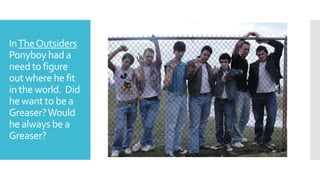
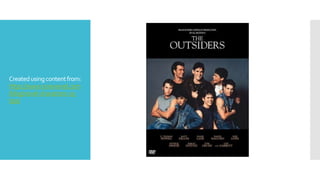
InTheOutsiders
Ponyboy had a
need to figure
out where he fit
in the world. Did
he want to be a
Greaser?Would
he always be a
Greaser?
2: Make each
novel
character
identifiable in
a police line-up
“My father is a tall, middle-aged man of average build. He
has green eyes and brown hair and usually wears khakis
and oxford shirts.”
This description is so mundane […] Can you imagine the
police searching for this suspect? No identifying marks, no
scars or tattoos, nothing to distinguish him. He appears as
a cardboard cutout rather than as a living, breathing
character.Yes, the details are accurate, but they don’t call
forth vivid images. We can barely make out this
character’s form; how can we be expected to remember
him?’
Make characters
real using details
of dress, gait
(the way they
walk), voice,
personality and
more.
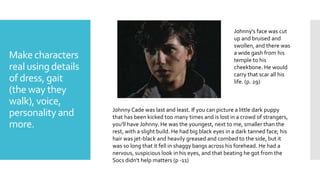
Johnny Cade was last and least. If you can picture a little dark puppy
that has been kicked too many times and is lost in a crowd of strangers,
you'll have Johnny. He was the youngest, next to me, smaller than the
rest, with a slight build. He had big black eyes in a dark tanned face; his
hair was jet-black and heavily greased and combed to the side, but it
was so long that it fell in shaggy bangs across his forehead. He had a
nervous, suspicious look in his eyes, and that beating he got from the
Socs didn't help matters (p -11)
Johnny's face was cut
up and bruised and
swollen, and there was
a wide gash from his
temple to his
cheekbone. He would
carry that scar all his
life. (p. 29)
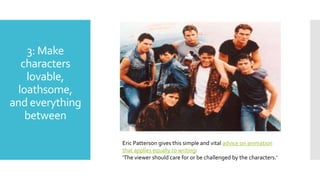
3: Make
characters
lovable,
loathsome,
and everything
between
Eric Patterson gives this simple and vital advice on animation
that applies equally to writing:
‘The viewer should care for or be challenged by the characters.’
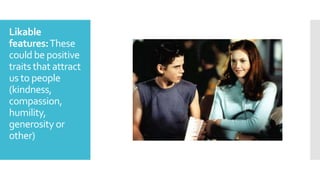
Likable
features:These
could be positive
traits that attract
us to people
(kindness,
compassion,
humility,
generosity or
other)
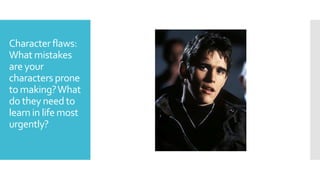
Character flaws:
What mistakes
are your
characters prone
to making?What
do they need to
learn in life most
urgently?
Featuresthatchallenge
readers:Givingyourcharacters
elementsthattheaverage
personcan’trelatetoalso
createsinterest.Thinkofseries
thathaveserialkillersas
protagonists.Westillfeeltense
abouttheirpredicaments,even
iftheirbehaviourdoesn’tfitour
ownethicalnorms.Readers
don’thavetolikeevery
character.Yourprotagonist
doesn’tnecessarilyhaveto
embody‘good’,heroicornoble
features.Ifyouwantan
audience,thefirstruleisto
makeyourcharacters
interesting
4:Create
interesting
dynamics
between
characters and
environment
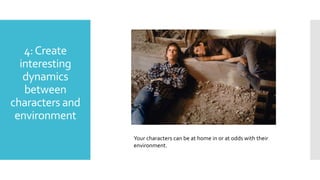
Your characters can be at home in or at odds with their
environment.
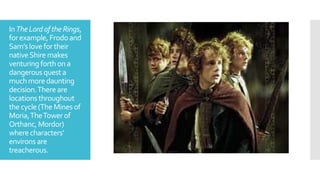
InTheLordofthe Rings,
forexample, Frodoand
Sam’s love fortheir
nativeShire makes
venturing forthona
dangerousquesta
muchmoredaunting
decision.There are
locations throughout
the cycle(The Mines of
Moria,TheTower of
Orthanc, Mordor)
where characters’
environs are
treacherous.
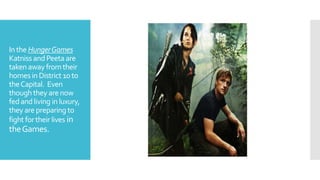
Inthe HungerGames
Katniss andPeeta are
takenaway fromtheir
homesin District 10 to
theCapital. Even
thoughthey arenow
fedandliving inluxury,
they are preparingto
fight fortheir lives in
theGames.
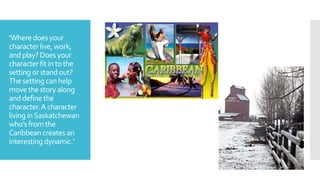
‘Wheredoes your
characterlive, work,
andplay? Doesyour
characterfit into the
setting orstand out?
The setting canhelp
movethe storyalong
anddefine the
character.A character
living inSaskatchewan
who’s fromthe
Caribbeancreates an
interesting dynamic.’
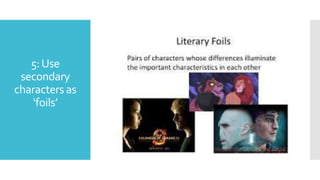
5:Use
secondary
characters as
‘foils’
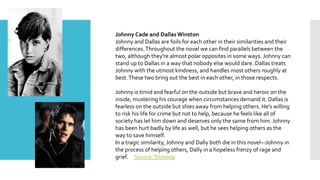
Johnny Cade and DallasWinston
Johnny and Dallas are foils for each other in their similarities and their
differences.Throughout the novel we can find parallels between the
two, although they're almost polar opposites in some ways. Johnny can
stand up to Dallas in a way that nobody else would dare. Dallas treats
Johnny with the utmost kindness, and handles most others roughly at
best.These two bring out the best in each other, in those respects.
Johnny is timid and fearful on the outside but brave and heroic on the
inside, mustering his courage when circumstances demand it. Dallas is
fearless on the outside but shies away from helping others. He's willing
to risk his life for crime but not to help, because he feels like all of
society has let him down and deserves only the same from him. Johnny
has been hurt badly by life as well, but he sees helping others as the
way to save himself.
In a tragic similarity, Johnny and Dally both die in this novel—Johnny in
the process of helping others, Dally in a hopeless frenzy of rage and
grief. Source: Shmoop
6:Create
profiles to
develop your
novel’s
characters
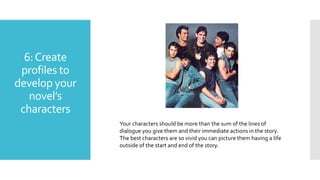
Your characters should be more than the sum of the lines of
dialogue you give them and their immediate actions in the story.
The best characters are so vivid you can picture them having a life
outside of the start and end of the story.
Make notes on elements such us:
• Where your character was born and grew up
• What your character’s political, philosophical or
religious views are
• Your character’s greatest fears and desires
• What your character is most proud and most
ashamed of
• What your character values and dislikes most in
others
• Stock phrases or physical mannerisms that your
character uses – these should be consistent with
your character’s background and psychology
7: Deepen
characters by
incorporating
research
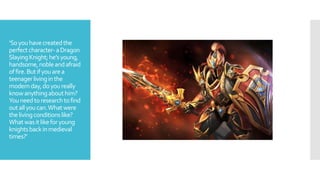
‘Soyouhavecreatedthe
perfectcharacter-aDragon
SlayingKnight;he’syoung,
handsome,nobleandafraid
offire.Butifyouarea
teenagerlivinginthe
modernday,doyoureally
knowanythingabouthim?
Youneedtoresearchtofind
outallyoucan.Whatwere
thelivingconditionslike?
Whatwasitlikeforyoung
knightsbackinmedieval
times?’
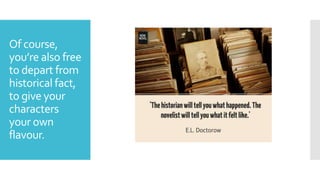
Of course,
you’re also free
to depart from
historical fact,
to give your
characters
your own
flavour.
8:Show your
narrator and
other
characters’
views of others
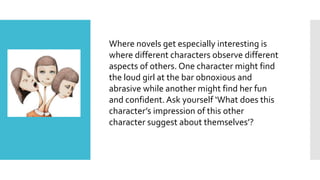
Where novels get especially interesting is
where different characters observe different
aspects of others. One character might find
the loud girl at the bar obnoxious and
abrasive while another might find her fun
and confident. Ask yourself ‘What does this
character’s impression of this other
character suggest about themselves’?
9:Give your
characters
interiority
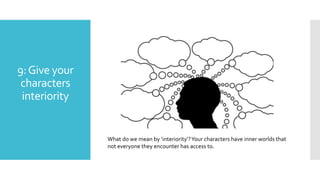
What do we mean by ‘interiority’?Your characters have inner worlds that
not everyone they encounter has access to.
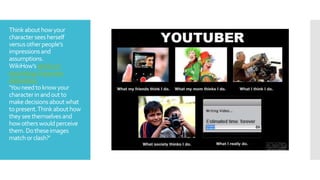
Thinkabouthowyour
characterseesherself
versusotherpeople’s
impressionsand
assumptions.
WikiHow’sarticleon
describingcharacters
elaborates:
‘Youneedtoknowyour
characterinandoutto
makedecisionsaboutwhat
topresent.Thinkabouthow
theyseethemselvesand
howotherswouldperceive
them.Dotheseimages
matchorclash?’
10: Don’t let
characters
know every
detail just
because you
do
You might know every detail about your characters’
motivations, their pasts and futures, but your characters don’t
need to (and perhaps shouldn’t) share your own omniscience.
Sometimes our own decisions and behaviours surprise or
unsettle us. Here’s what author Justine Musk says:
‘There are things we know about ourselves, and that other
people know about.
There are things we know about ourselves that other people
don’t know about.’
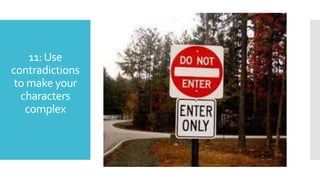
11:Use
contradictions
to make your
characters
complex
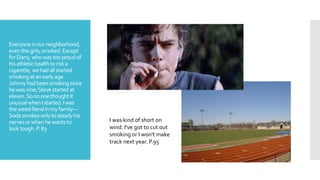
Everyoneinourneighborhood,
eventhegirls,smoked.Except
forDarry,whowastooproudof
hisathletichealthtoriska
cigarette,wehadallstarted
smokingatanearlyage.
Johnnyhadbeensmokingsince
hewasnine;Stevestartedat
eleven.Sonoonethoughtit
unusualwhenIstarted.Iwas
theweed-fiendinmyfamily---
Sodasmokesonlytosteadyhis
nervesorwhenhewantsto
looktough.P.83
I was kind of short on
wind. I've got to cut out
smoking or I won't make
track next year. P.95
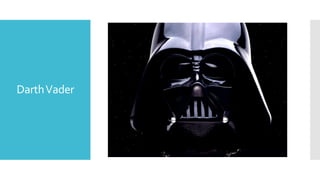
12:Use
characters’
names to
convey subtle
implications
DarthVader
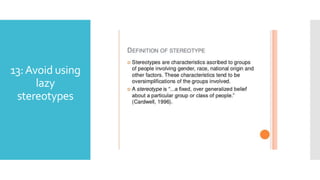
13:Avoid using
lazy
stereotypes
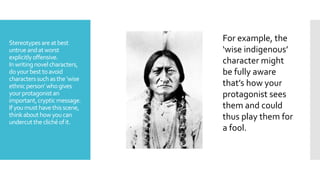
Stereotypesareatbest
untrueandatworst
explicitlyoffensive.
Inwritingnovelcharacters,
doyourbesttoavoid
characterssuchasthe‘wise
ethnicperson’whogives
yourprotagonistan
important,crypticmessage.
Ifyoumusthavethisscene,
thinkabouthowyoucan
undercuttheclichéofit.
For example, the
‘wise indigenous’
character might
be fully aware
that’s how your
protagonist sees
them and could
thus play them for
a fool.
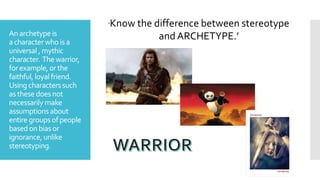
Anarchetype is
acharacterwho is a
universal , mythic
character. The warrior,
forexample, orthe
faithful, loyalfriend.
Using characterssuch
as these doesnot
necessarily make
assumptions about
entire groupsofpeople
basedonbias or
ignorance, unlike
stereotyping.
‘Know the difference between stereotype
and ARCHETYPE.’
14:Show
characters’
motives
through
interactions
‘Take your characters to parties, gas
stations, baseball games, yoga
classes and other planets, and
make them whisper, yell, confess
and interact with other characters.
Show the characters’ motives
through actions with other
characters.’ Laura Zinn Fromm
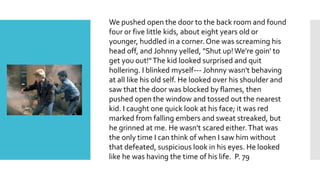
We pushed open the door to the back room and found
four or five little kids, about eight years old or
younger, huddled in a corner. One was screaming his
head off, and Johnny yelled, "Shut up!We're goin' to
get you out!"The kid looked surprised and quit
hollering. I blinked myself--- Johnny wasn't behaving
at all like his old self. He looked over his shoulder and
saw that the door was blocked by flames, then
pushed open the window and tossed out the nearest
kid. I caught one quick look at his face; it was red
marked from falling embers and sweat streaked, but
he grinned at me. He wasn't scared either.That was
the only time I can think of when I saw him without
that defeated, suspicious look in his eyes. He looked
like he was having the time of his life. P. 79
15: Don’t be
afraid to
change your
viewpoint
character if
necessary
Here is CreativeWriting Now’s advice:
‘Is there a character who’s stealing the show from
your main character? A character who intrigues
you more?Whenever this character comes on
stage, the writing flows, and the scene comes to
life.
Maybe it’s your character’s funny best friend …
[or]her boyfriend. Maybe it’s even your
character’s enemy.
Consider LETTING this character steal the show.
Change your story around so that this character
becomes the focus.’
Createdusingcontentfrom:
https://www.nownovel.com
/blog/novel-characters-15-
tips/

15 Tips for Creating Characters