Prepared by
HadeelAl Sadoun
WBC manual count using
hemocytometer
Objectives
 To accurately countWBC in Chamber.
 To perform reliable dilution of blood cells
 To calculate the number of cells/µL
Principle
 Whole blood collected in EDTA is diluted according to the
type of cell count obtained.
 The diluted blood suspension is then placed in a chamber and
the cell counted
 The count is multiplied by dilution factor and reported as
number of cells per microlitter (µL) of whole blood
Material
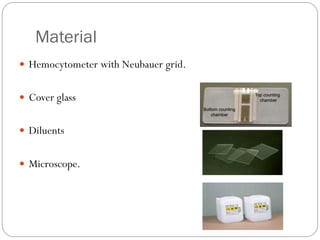
 Hemocytometer with Neubauer grid.
 Cover glass
 Diluents
 Microscope.
Methodology
 Put the cover slip or glass slip on the top of grid area in the
Chamber (use air tight technique)
 Dilute you sample:
 1: 20 forWBC count
 1:200 for RBC count and platelets
 Load your sample into the laoding area in the chamber
 Count the cells in the 4 large squares forWBC
 calculate the number of cells counted / µL
Sample dilution
 Dilution of whole blood sample:
 Diluents:
 Acetic acid (CH3COOH)
 Or : dis. H2O
 Purpose:
 Dilute the amount ofWBC , RBC to be able to count it. (NR RBC: M
4.3-6.2 x 10⁶ /µL) (F: 3.8-5.5 x 10⁶ /µL)
(NRWBC: 4.3-10.8 x 10³/µL)
 To lyses the RBC and platelets ( the diluents lyses also theWBC
but takes longer time) (time factor is critical)
Methodology
 Dilution:
 1:20 dilution or 1:50 (ex: chronic lukemia)
 (1+19=20)
 (50µL of blood + 950 µL diluent)
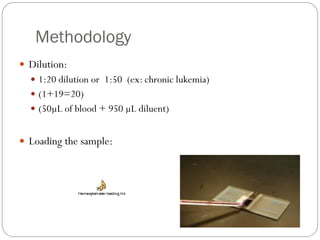
 Loading the sample:
WBC count
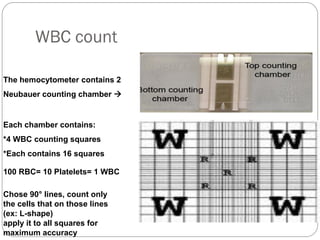
The hemocytometer contains 2
Neubauer counting chamber 
Each chamber contains:
*4 WBC counting squares
*Each contains 16 squares
100 RBC= 10 Platelets= 1 WBC
Chose 90° lines, count only
the cells that on those lines
(ex: L-shape)
apply it to all squares for
maximum accuracy
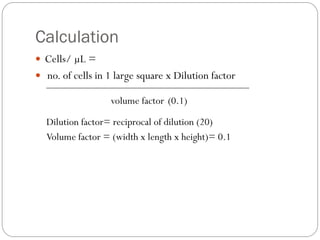
Calculation
 Cells/ µL =
 no. of cells in 1 large square x Dilution factor
_________________________________________________________
volume factor (0.1)
Dilution factor= reciprocal of dilution (20)
Volume factor = (width x length x height)= 0.1

60503_WBC manual count using hemocytometer.pdf

  • 1.
    Prepared by HadeelAl Sadoun WBCmanual count using hemocytometer
  • 2.
    Objectives  To accuratelycountWBC in Chamber.  To perform reliable dilution of blood cells  To calculate the number of cells/µL
  • 3.
    Principle  Whole bloodcollected in EDTA is diluted according to the type of cell count obtained.  The diluted blood suspension is then placed in a chamber and the cell counted  The count is multiplied by dilution factor and reported as number of cells per microlitter (µL) of whole blood
  • 4.
    Material  Hemocytometer withNeubauer grid.  Cover glass  Diluents  Microscope.
  • 5.
    Methodology  Put thecover slip or glass slip on the top of grid area in the Chamber (use air tight technique)  Dilute you sample:  1: 20 forWBC count  1:200 for RBC count and platelets  Load your sample into the laoding area in the chamber  Count the cells in the 4 large squares forWBC  calculate the number of cells counted / µL
  • 6.
    Sample dilution  Dilutionof whole blood sample:  Diluents:  Acetic acid (CH3COOH)  Or : dis. H2O  Purpose:  Dilute the amount ofWBC , RBC to be able to count it. (NR RBC: M 4.3-6.2 x 10⁶ /µL) (F: 3.8-5.5 x 10⁶ /µL) (NRWBC: 4.3-10.8 x 10³/µL)  To lyses the RBC and platelets ( the diluents lyses also theWBC but takes longer time) (time factor is critical)
  • 7.
    Methodology  Dilution:  1:20dilution or 1:50 (ex: chronic lukemia)  (1+19=20)  (50µL of blood + 950 µL diluent)  Loading the sample:
  • 8.
    WBC count The hemocytometercontains 2 Neubauer counting chamber  Each chamber contains: *4 WBC counting squares *Each contains 16 squares 100 RBC= 10 Platelets= 1 WBC Chose 90° lines, count only the cells that on those lines (ex: L-shape) apply it to all squares for maximum accuracy
  • 9.
    Calculation  Cells/ µL=  no. of cells in 1 large square x Dilution factor _________________________________________________________ volume factor (0.1) Dilution factor= reciprocal of dilution (20) Volume factor = (width x length x height)= 0.1