RESTing in the ALPS
Generic Hypermedia and Domain-Specific
                APIs

               @mamund
             Mike Amundsen
         Principal API Architect,
         Layer 7 Technologies
A simple story
  In three parts...
The bona fides
 How we got here...
The confession
 I left some stuff out...
Where I make amends
      The payoff
Ok, let's begin...
How we got here...
    The bona fides
Let's start with a quote from 2002
Fielding and Taylor, 2002


          "REST provides [this] by
    focusing on a shared understanding
       of data types with metadata..."
That phrase struck me.
It has become a prime motivator for me.
focusing
focusing
   on
focusing
         on
shared understanding
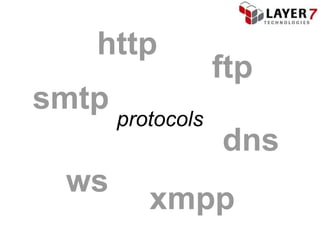
How do we share understanding
        on the Web?
protocols
http
                   ftp
smtp
       protocols
                   dns
 ws
          xmpp
But that's not all...
Fielding & Taylor, 2002


    "REST components communicate by
  transferring a representation of the data
        in a format matching one of
  an evolving set of standard data types..."
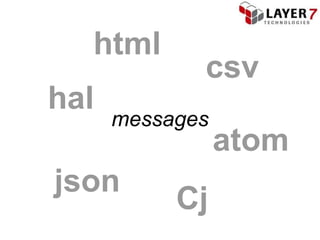
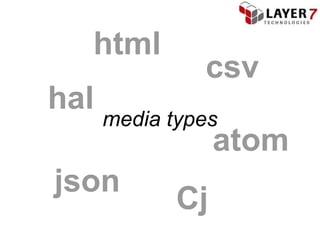
html
               csv
hal
 standard data types
                 atom
json
            Cj
html
               csv
hal
registered media types
                 atom
json
            Cj
html
             csv
hal
      messages
                 atom
json
           Cj
We share understanding via messages.
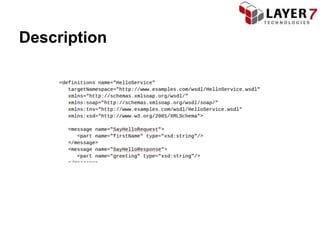
Description
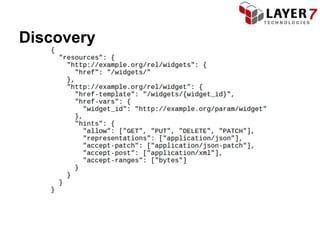
Discovery
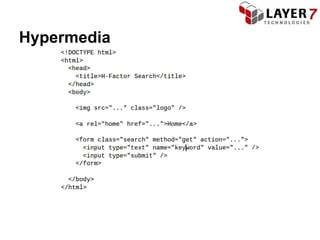
Hypermedia
These messages tell us what
protocol actions are possible.
These messages tell us what
protocol actions are possible.
How is this done in a message?
affordances
hypermedia
affordances
protocol
hypermedia
affordances
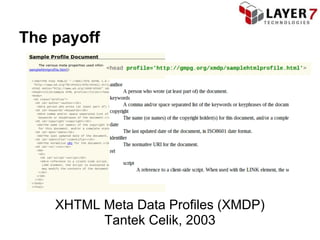
Back in 2010, I called those...
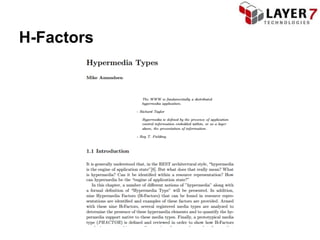
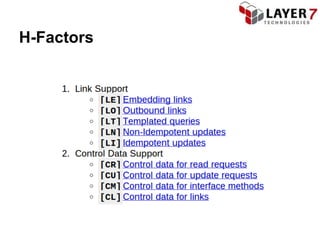
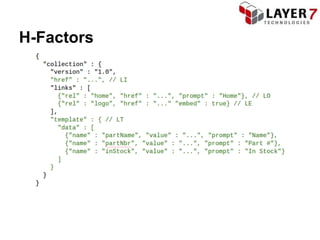
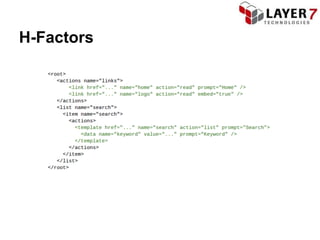
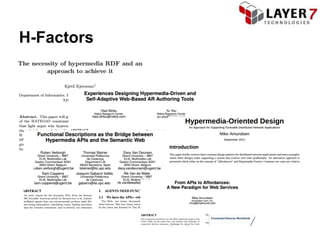
H-Factors
H-Factors
H-Factors


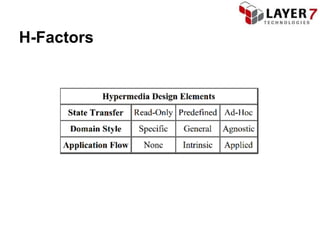
        Identify nine features for
         sharing understanding
         about protocol actions.
H-Factors
H-Factors
H-Factors
H-Factors


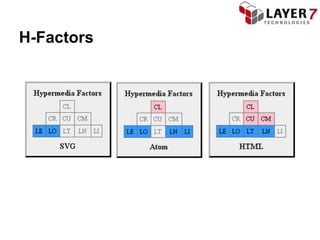
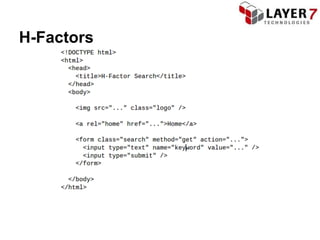
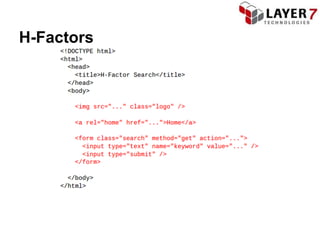
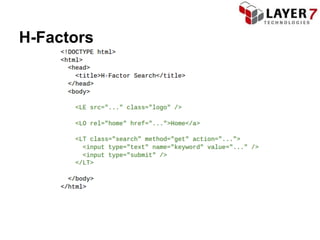
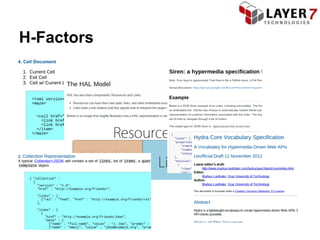
        Identify the affordances
H-Factors
H-Factors


            Categorize them.
H-Factors
H-Factors


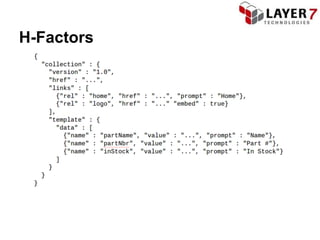
      For lots of media type designs.
H-Factors
H-Factors
H-Factors
H-Factors
H-Factors


   This gives us a tool for lots of tasks...
H-Factors


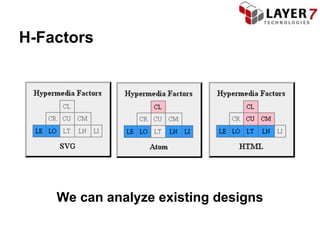
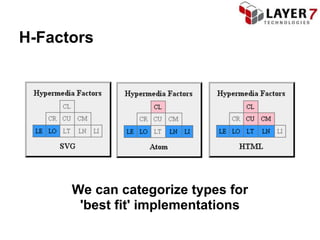
    We can analyze existing designs
H-Factors


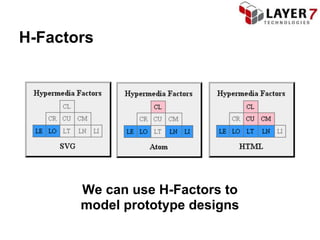
      We can categorize types for
       'best fit' implementations
H-Factors


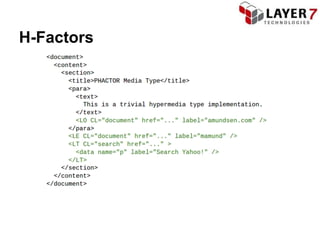
       We can use H-Factors to
       model prototype designs
H-Factors
H-Factors


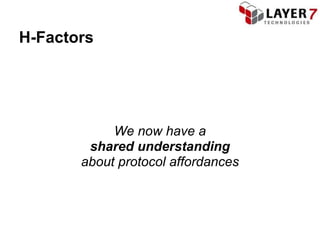
            We now have a
        shared understanding
       about protocol affordances
H-Factors
H-Factors
H-Factors


            And this is all good.
H-Factors


            But...
H-Factors


       There's a problem here.
H-Factors


     An important piece is missing.
H-Factors


           There is a "gap"
      between theory and practice
H-Factors


           There is a "gap"
 between H-Factors and "the real world"
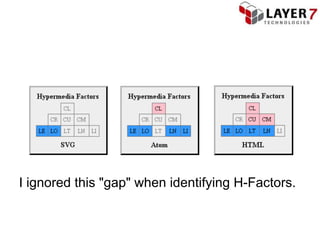
I ignored this "gap" when identifying H-Factors.
I side-stepped the "gap" in the last book.
H-Factors
And this "gap" is a key theme in the next book.
H-Factors


            Yep, you might say...
I left some stuff out.
      The confession
The confession


      I ignored the "hard" parts ...
The confession
The confession


          What are those?
The confession
The confession


        They're rather specific.
The confession
The confession


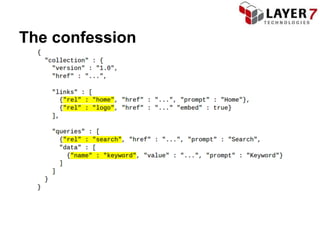
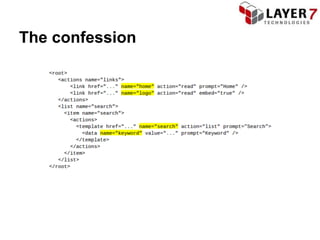
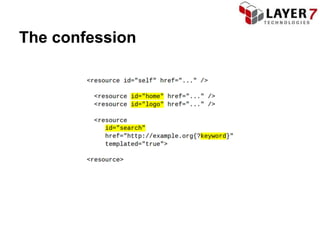
           affordances?
The confession
The confession


          Well, they are not
        protocol affordances
The confession


              I call them
       application affordances
The confession


  But there is another name for these...
Vocabularies
    Srsly?
Vocabularies


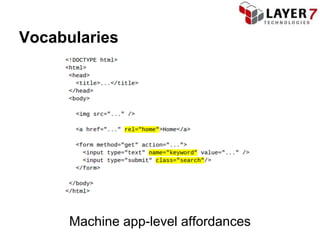
              On the Web,
         representations contain
        protocol AND application
               affordances
Vocabularies


        We share understanding
       at the application-level, too.
Vocabularies


      Well, "we" means us humans.
Vocabularies


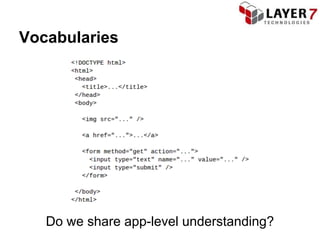
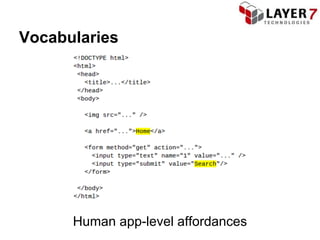
   Do we share app-level understanding?
Vocabularies


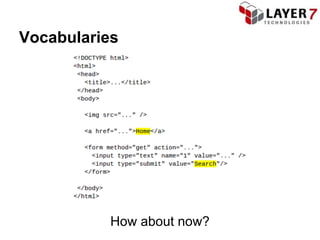
           How about now?
Vocabularies


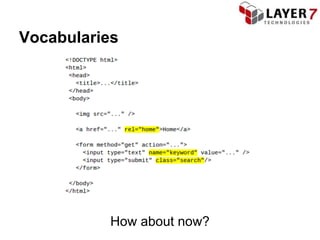
           How about now?
Vocabularies


      Human app-level affordances
Vocabularies


      Machine app-level affordances
Vocabularies


       Of course, we've known this
            for quite a while.
Vocabularies
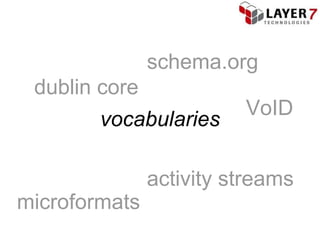
                     schema.org
 dublin core
                                  VoID
    There has been quite a bit of work
            on vocabularies

                  activity streams
microformats
Vocabularies


       Vocabularies can provide
          shared understanding
                  of the
     application-specific affordances
Vocabularies


         And this is all good.
Vocabularies


               But...
Vocabularies


       There's a problem here.
Vocabularies


     An important piece is missing.
Vocabularies


           There is a "gap"
      between theory and practice
Vocabularies


           There is a "gap"
between Vocabularies and "the real world"
Vocabularies


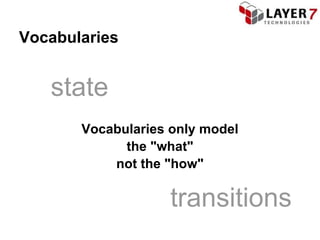
   state
       Vocabularies only model
             the "what"
Vocabularies


   state
       Vocabularies only model
             the "what"
           not the "how"

                    transitions
Vocabularies


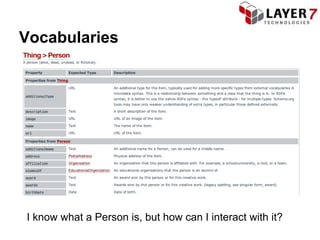
I know what a Person is, but how can I interact with it?
Vocabularies


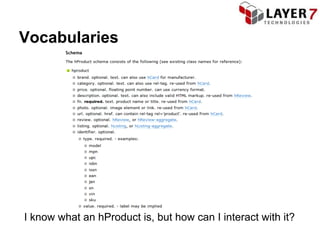
I know what an hProduct is, but how can I interact with it?
Vocabularies


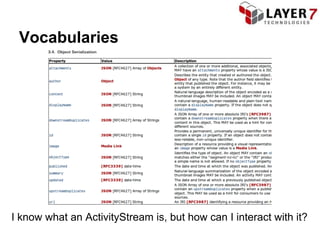
I know what an ActivityStream is, but how can I interact with it?
The payoff
Where I make amends
The payoff


   state
         What if we combined
       the "what" of vocabularies
The payoff


   state
          What if we combined
       the "what" of vocabularies
                   with
         the "how" of protocols?


                     transitions
The payoff


   state
       What would that look like?


                     transitions
The payoff


    XHTML Meta Data Profiles (XMDP)
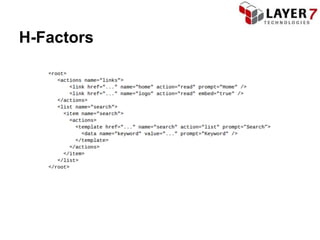
          Tantek Celik, 2003
The payoff


   A few years on, a similar approach...
The payoff


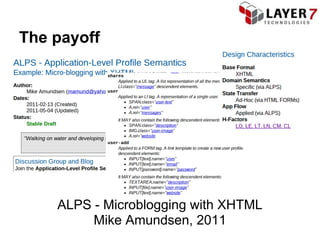
    ALPS - Microblogging with XHTML
         Mike Amundsen, 2011
The payoff


 ALPS includes both state and transitions
The payoff


             ALPS(mb) hackathon
              at 2011 RESTFest.
     Initial experiment was a success.
  Independently built apps could interop.
The payoff


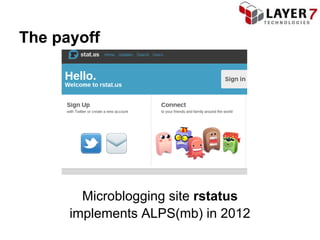
        Microblogging site rstatus
      implements ALPS(mb) in 2012
The payoff


      ALPS(mb) was a good idea
        but we can do better.
The payoff


       How about a profile spec
          that includes both
         state and transitions
            that works for
             a wide range
           of media types?
Application-Level Profile
       Semantics
         The sequel
ALPS


                Warning!
       What follows is early-stage,
            tentative design
ALPS


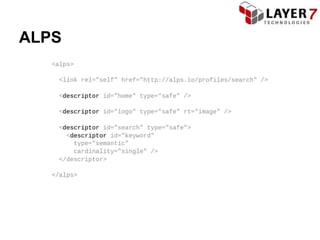
 Design and register two media types for
      describing problem domains.

       application/alps+xml (or +json)
ALPS
ALPS
ALPS
ALPS
ALPS
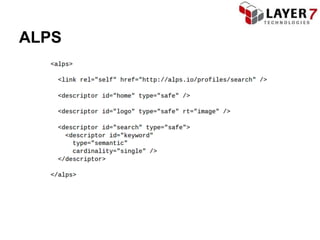
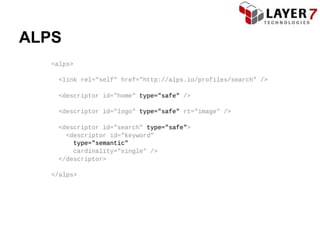
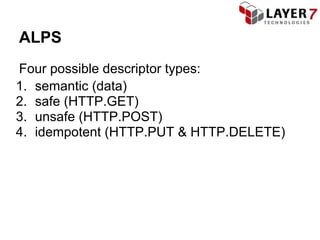
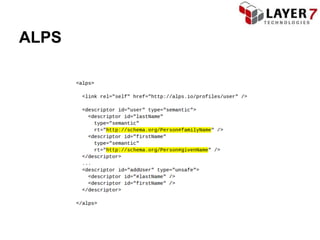
Four possible descriptor types:
1. semantic (data)
2. safe (HTTP.GET)
3. unsafe (HTTP.POST)
4. idempotent (HTTP.PUT & HTTP.DELETE)
ALPS
ALPS
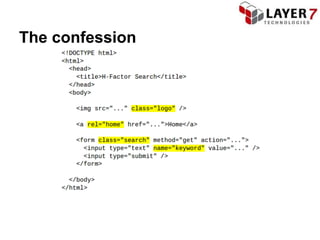
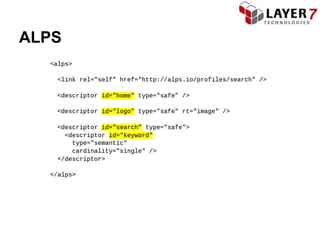
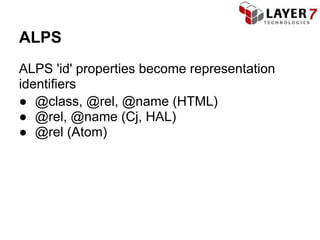
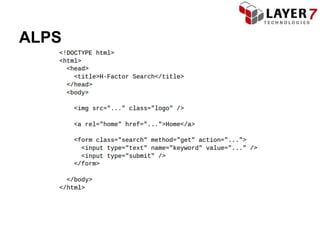
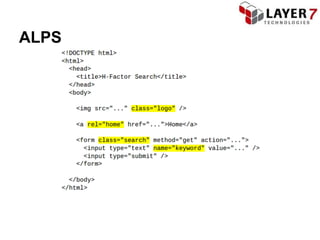
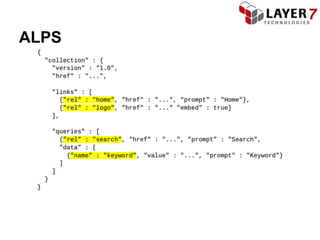
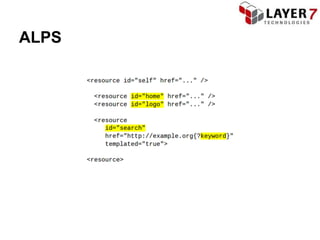
ALPS 'id' properties become representation
identifiers
● @class, @rel, @name (HTML)
● @rel, @name (Cj, HAL)
● @rel (Atom)
ALPS


Apply these semantics to a wide range of
          existing media types
ALPS
ALPS


       There will be a set of rules for
         applying ALPS semantics
            to each media type.
ALPS
ALPS


   By applying semantic descriptors
            consistently...
ALPS
ALPS


                  selecting
       an implementation media type
         can be independent of the
            state and transition
                 semantics.
ALPS
ALPS


   selecting a reference vocabulary
      can be independent of the
          protocol semantics
ALPS
ALPS


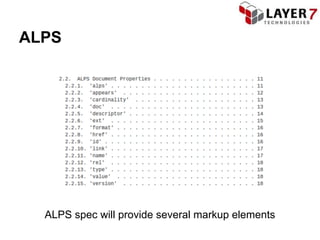
  ALPS spec will provide several markup elements
ALPS


         Now we have a way
       to share understanding
ALPS


         Now we have a way
       to share understanding
       about a problem domain
ALPS


         Now we have a way
       to share understanding
       about a problem domain


       Not a service document (WSDL)
ALPS


         Now we have a way
       to share understanding
       about a problem domain


   Not a discovery document (Google, @mnot)
ALPS


          Now we have a way
        to share understanding
        about a problem domain


   Not a hypermedia type (HAL, Cj, Siren, etc.)
ALPS


         Now we have a way
       to share understanding
       about a problem domain


         Not a vocabulary repository
ALPS


         Now we have a way
       to share understanding
       about a problem domain


           Not an object graph
ALPS


This could give us tools for lots of tasks...
ALPS


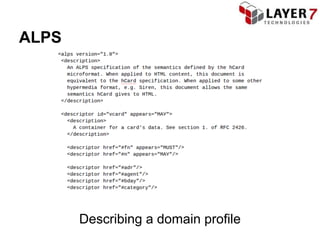
       Describing a domain profile
ALPS


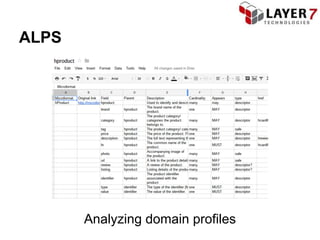
       Analyzing domain profiles
ALPS


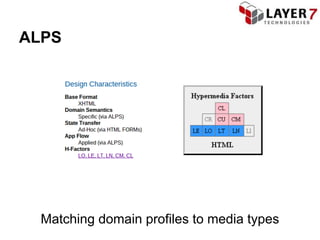
  Matching domain profiles to media types
ALPS
            contacts
gift lists          school pals
        schema.org/Person
    photos       matchmaker
         ancestry tree
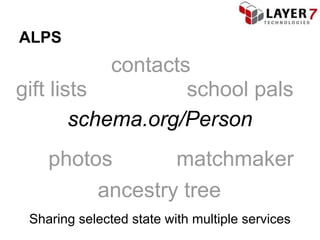
 Sharing selected state with multiple services
ALPS


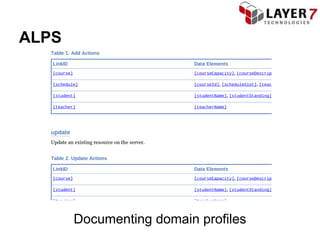
       Documenting domain profiles
ALPS


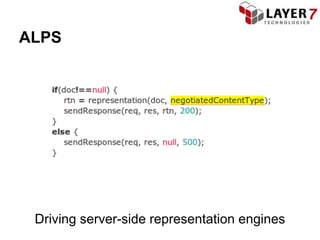
 Driving server-side representation engines
ALPS


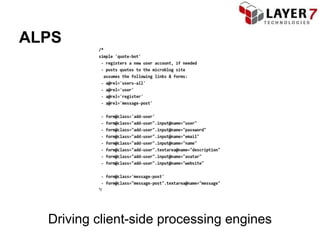
  Driving client-side processing engines
ALPS
Possible benefits of ALPS Repositories:
● Share your domain profiles
● Search for profiles by topic
● Match abstracts w/ favored vocabularies
● Reflect aggregate profile use/reference data
Summary


    So, where are we headed now?
Summary


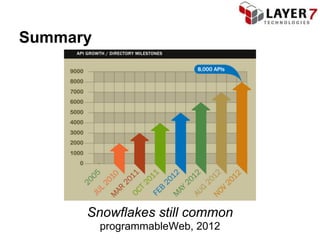
      Snowflakes still common
          programmableWeb, 2012
Summary


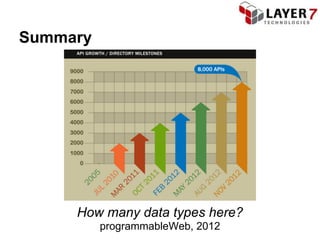
     How many data types here?
          programmableWeb, 2012
Summary


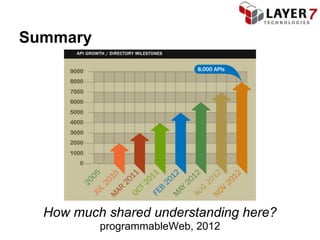
  How much shared understanding here?
          programmableWeb, 2012
Fielding & Taylor, 2002


     "REST components communicate by
   transferring a representation of the data
         in a format matching one of
 an evolving set of standard data types..."
Summary


         standard data types
            includes both
      state and transition types
Summary


        shared understanding
            includes both
      state and transition types
Summary


          because the Web
            includes both
      state and transition types
http
                   ftp
smtp
       protocols
                   dns
 ws
          xmpp
html
               csv
hal
      media types
                  atom
json
             Cj
schema.org
 dublin core
                         VoID
        vocabularies

               activity streams
microformats
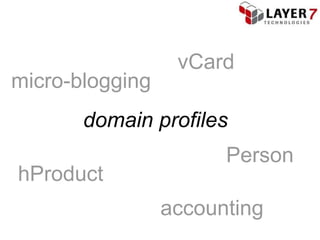
vCard
micro-blogging
       domain profiles
                       Person
hProduct
                 accounting
Summary
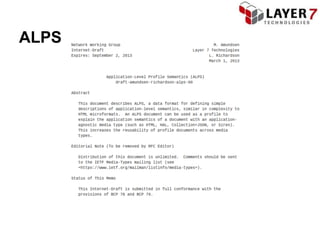
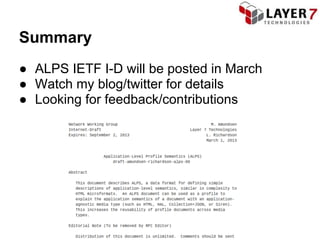
● ALPS IETF I-D will be posted in March
● Watch my blog/twitter for details
● Looking for feedback/contributions
Let's talk!


   RESTing in the ALPS
Generic Hypermedia and Domain-Specific
                APIs

               @mamund
             Mike Amundsen
         Principal API Architect,
         Layer 7 Technologies

RESTing in the ALPS Mike Amundsen's Presentation from QCon London 2013