REST 
in theory 
by Alex Muntada / @alexmuntada
What makes Internet a success? 
World Wide Web
What makes the Web a success? 
easy 
customized 
linked 
pervasive
Timeline
Architectural Styles and the 
Design of Network-based 
Software Architectures 
Roy Fielding (2000)
SOAP 1.2 
W3C recommendation (2003)
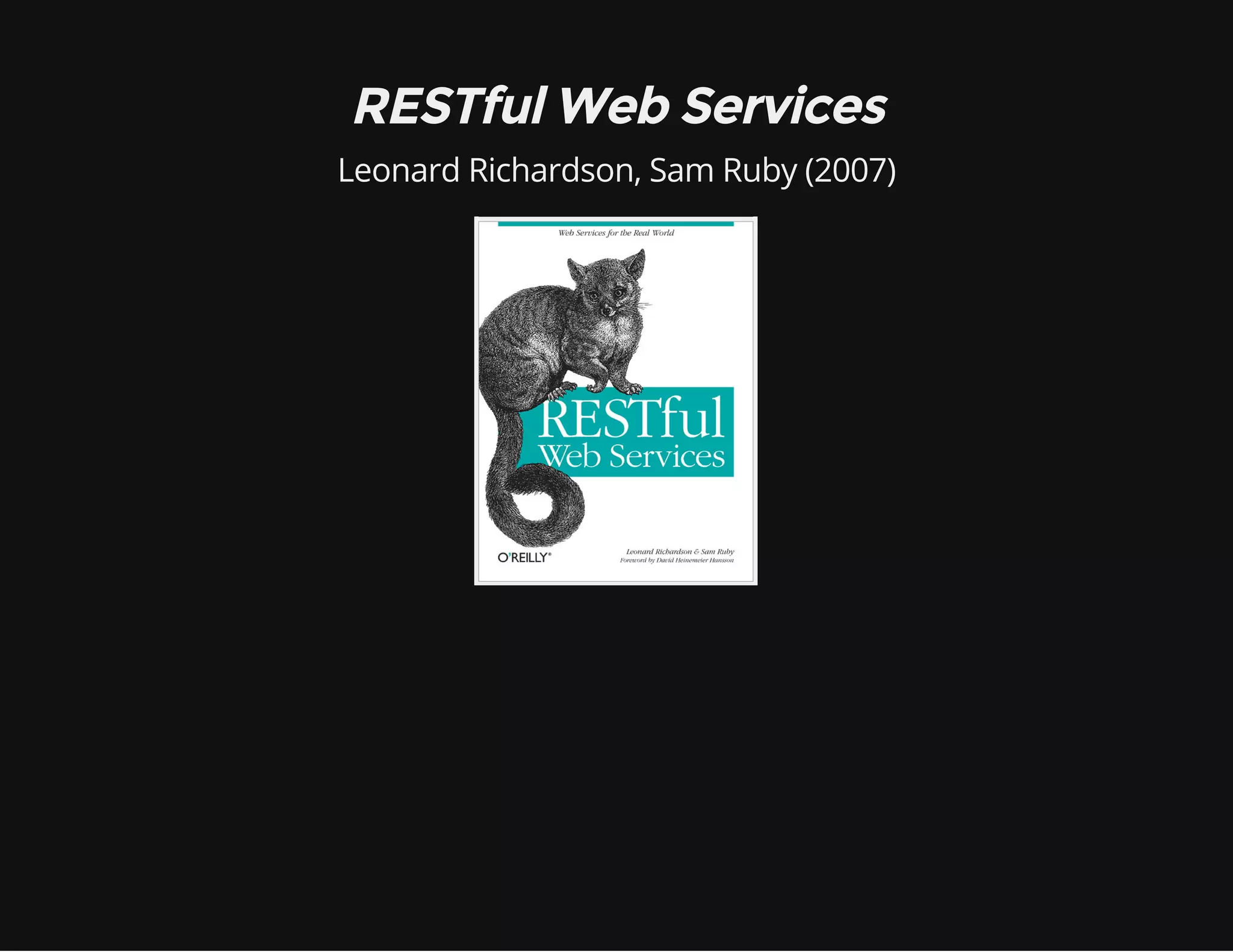
RESTful Web Services 
Leonard Richardson, Sam Ruby (2007)
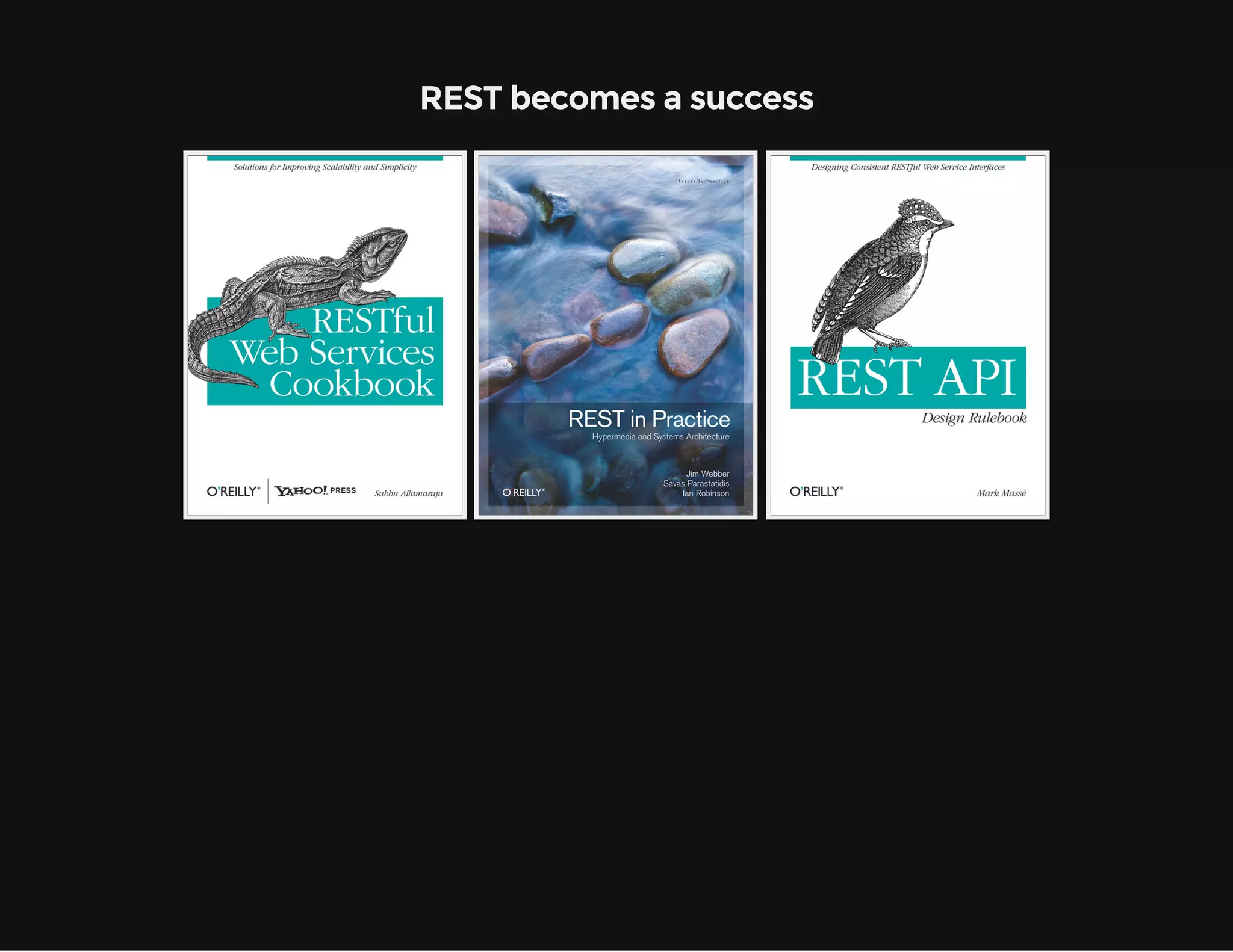
REST becomes a success
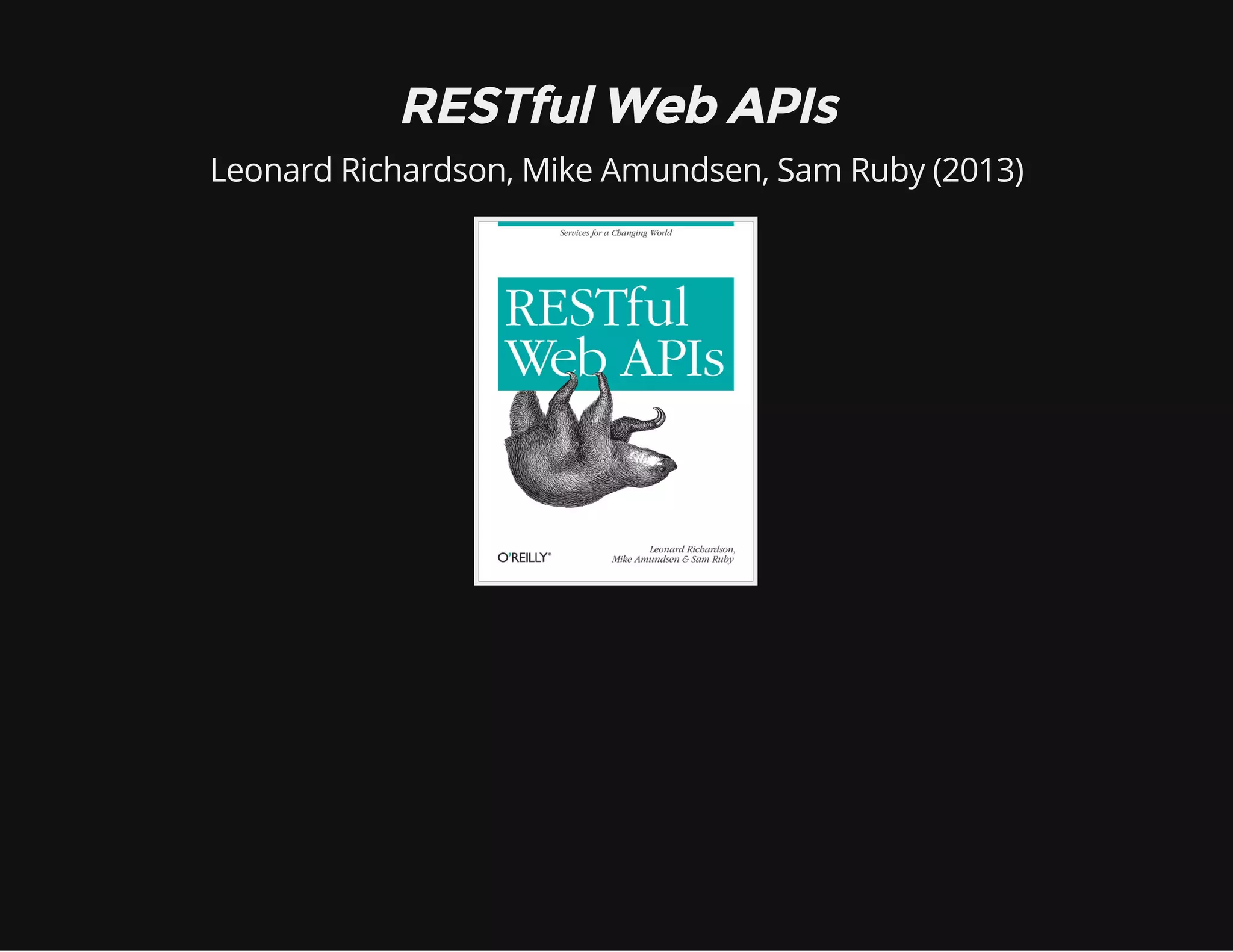
RESTful Web APIs 
Leonard Richardson, Mike Amundsen, Sam Ruby (2013)
REST(ful) 
“Representational state transfer (REST) is a software 
architectural style consisting of a coordinated set of 
architectural constraints applied to components, 
connectors, and data elements, within a distributed 
hypermedia system.”
Architectural Properties of the Web 
Low Entry-Barrier (easy) 
Extensibility (customized) 
Distributed Hypermedia (linked) 
Internet-Scale (pervasive)
Interface Constraints 
Identification of Resources (URIs) 
Manipulation of Resources Through Representations 
Self-Descriptive Messages (stateless) 
The Hypermedia Constraint (HATEOAS)
HATEOAS 
“Hypermedia as the engine of application state.” 
All application state is kept on the client side. 
The client can only change it through HTTP requests and responses. 
The client can find next actions through hypermedia controls. 
Hypermedia controls drive changes in application state.
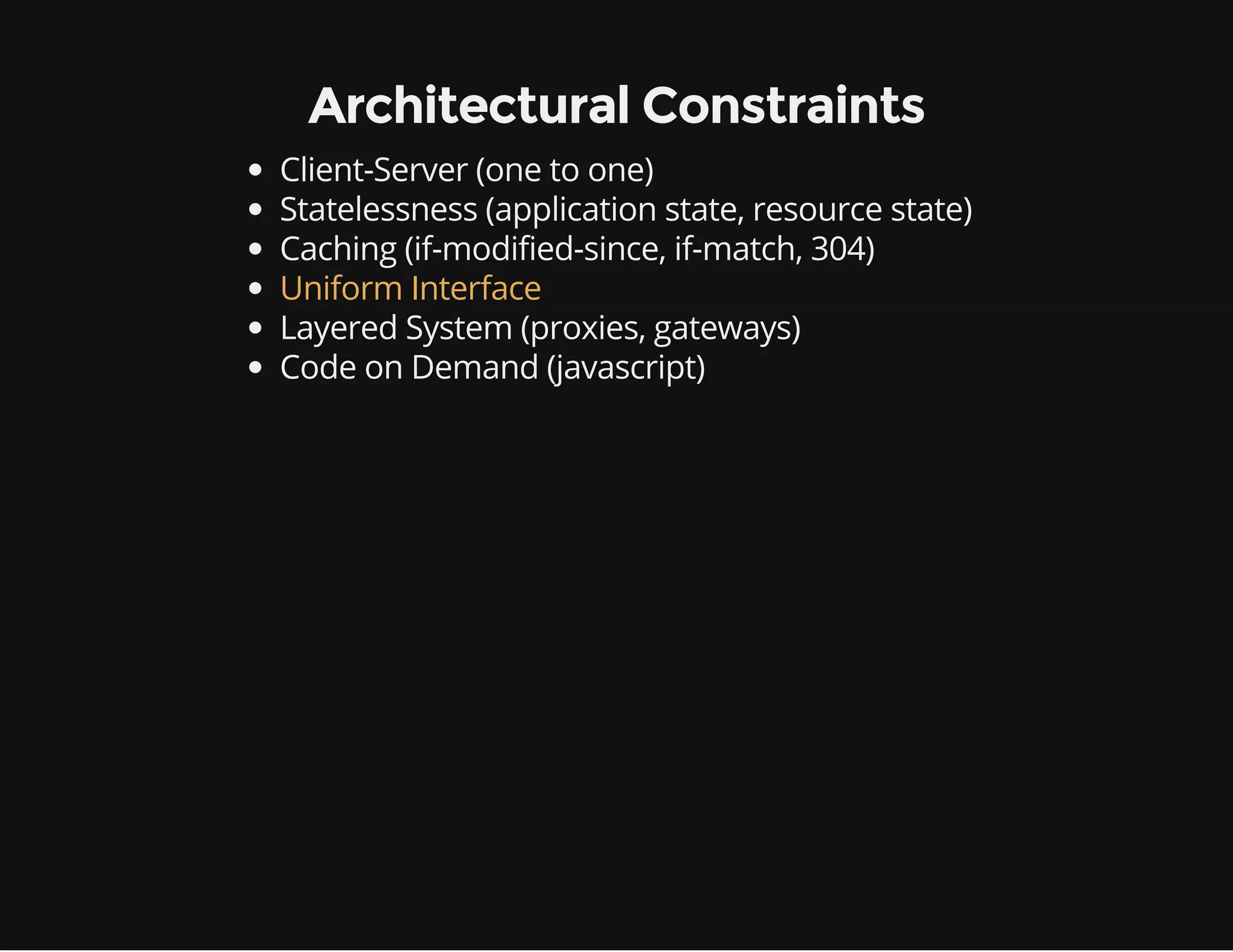
Architectural Constraints 
Client-Server (one to one) 
Statelessness (application state, resource state) 
Caching (if-modified-since, if-match, 304) 
Uniform Interface 
Layered System (proxies, gateways) 
Code on Demand (javascript)
APIs
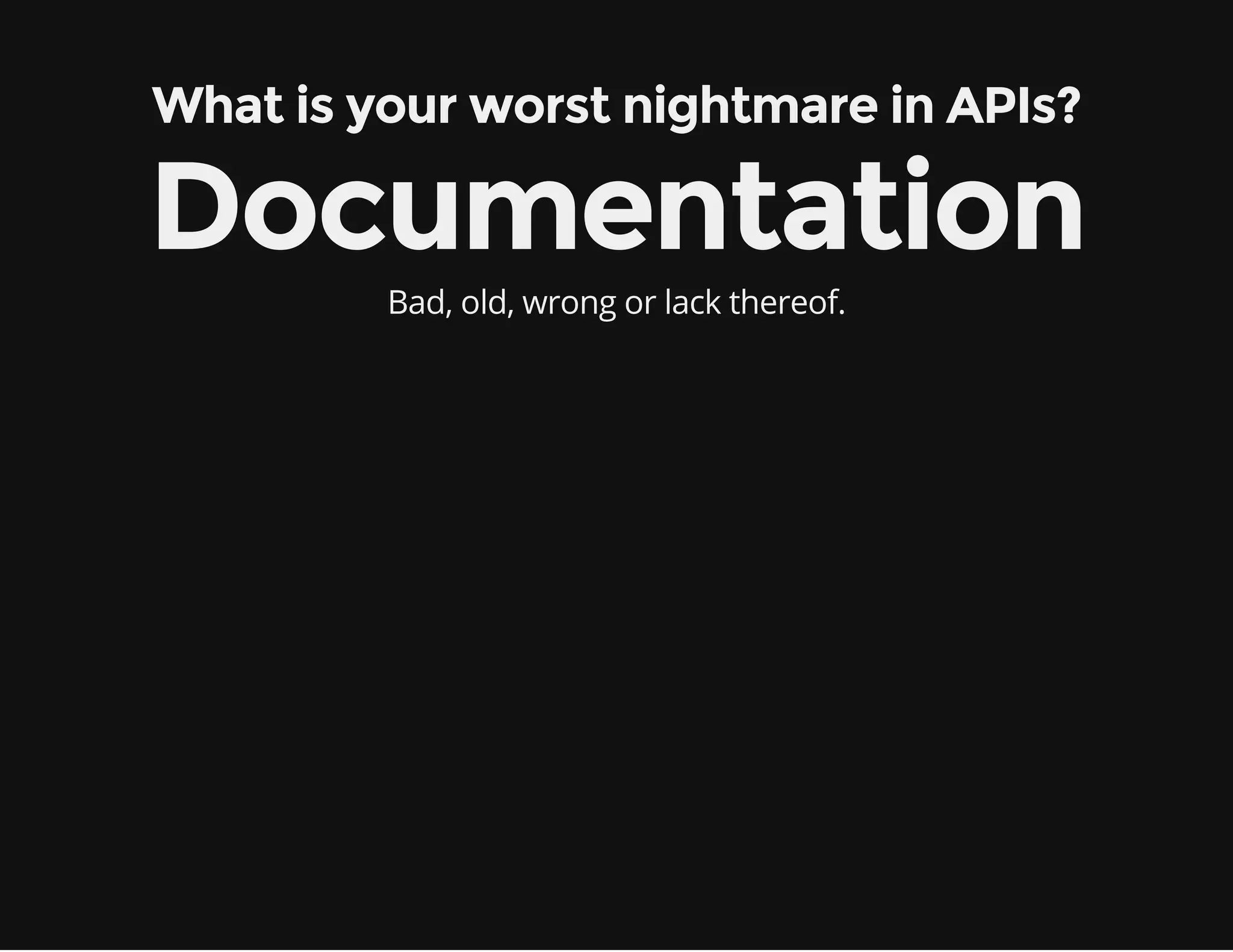
What is your worst nightmare in APIs? 
Documentation 
Bad, old, wrong or lack thereof.
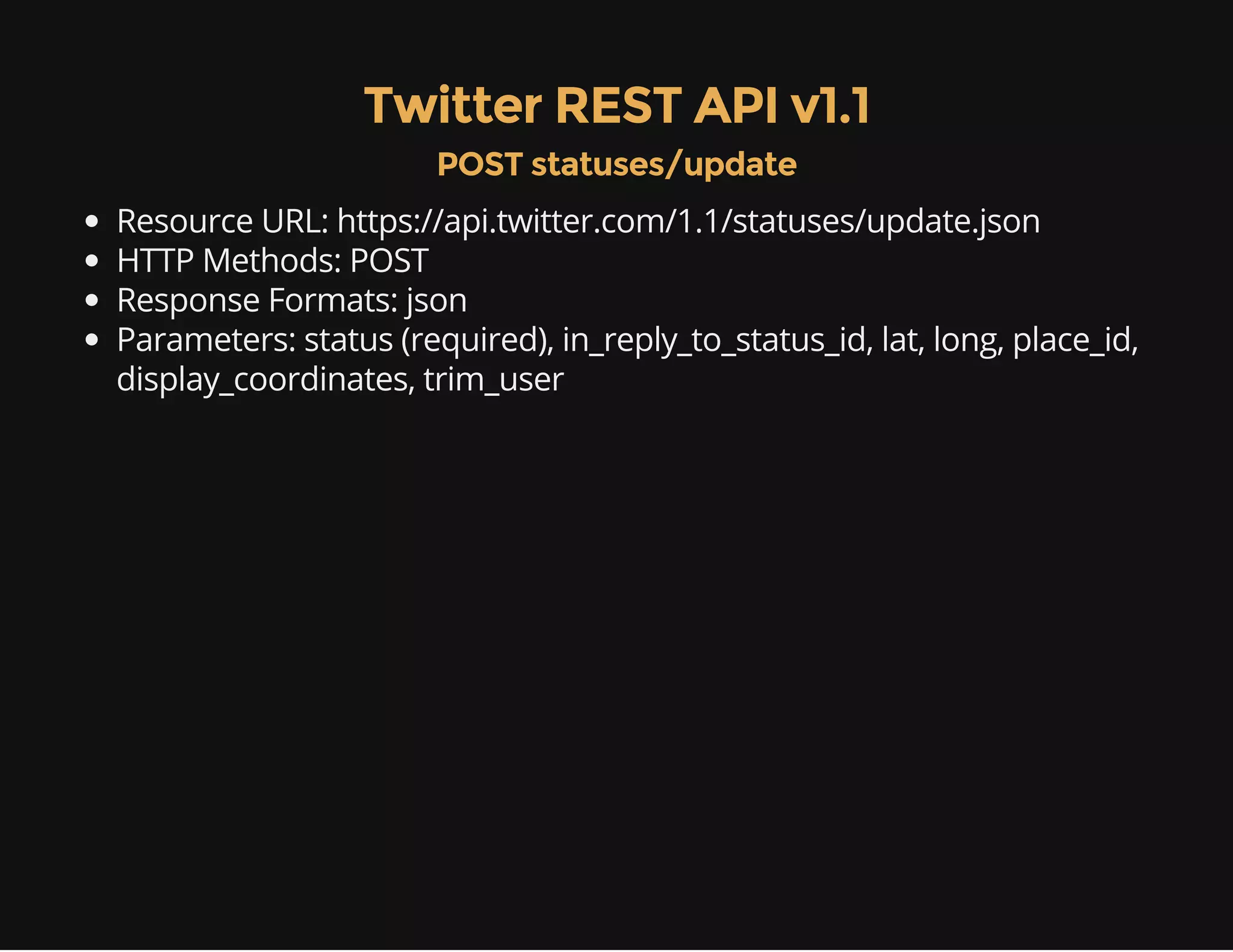
Twitter REST API v1.1 
POST statuses/update 
Resource URL: https://api.twitter.com/1.1/statuses/update.json 
HTTP Methods: POST 
Response Formats: json 
Parameters: status (required), in_reply_to_status_id, lat, long, place_id, 
display_coordinates, trim_user
What is missing in this example? 
POST /1.1/statuses/update.json HTTP/1.1 
User-Agent: curl/7.35.0 
Host: api.twitter.com 
Accept: */* 
Content-Length: 68 
Content-Type: application/x-www-form-urlencoded 
status=Maybe%20he%27ll%20finally%20find%20his%20keys.%20%23peterfalk 
HTTP/1.1 400 Bad Request 
content-length: 61 
content-type: application/json; charset=utf-8 
date: Sun, 18 May 2014 19:30:43 UTC 
server: tfe 
set-cookie: guest_id=v1%3A140044144371735781; Domain=.twitter.com; Path=/; Expires=Tue, 17-May-2016 19:30:43 strict-transport-security: max-age=631138519 
x-tfe-logging-request-category: API 
{"errors":[{"message":"Bad Authentication data","code":215}]}
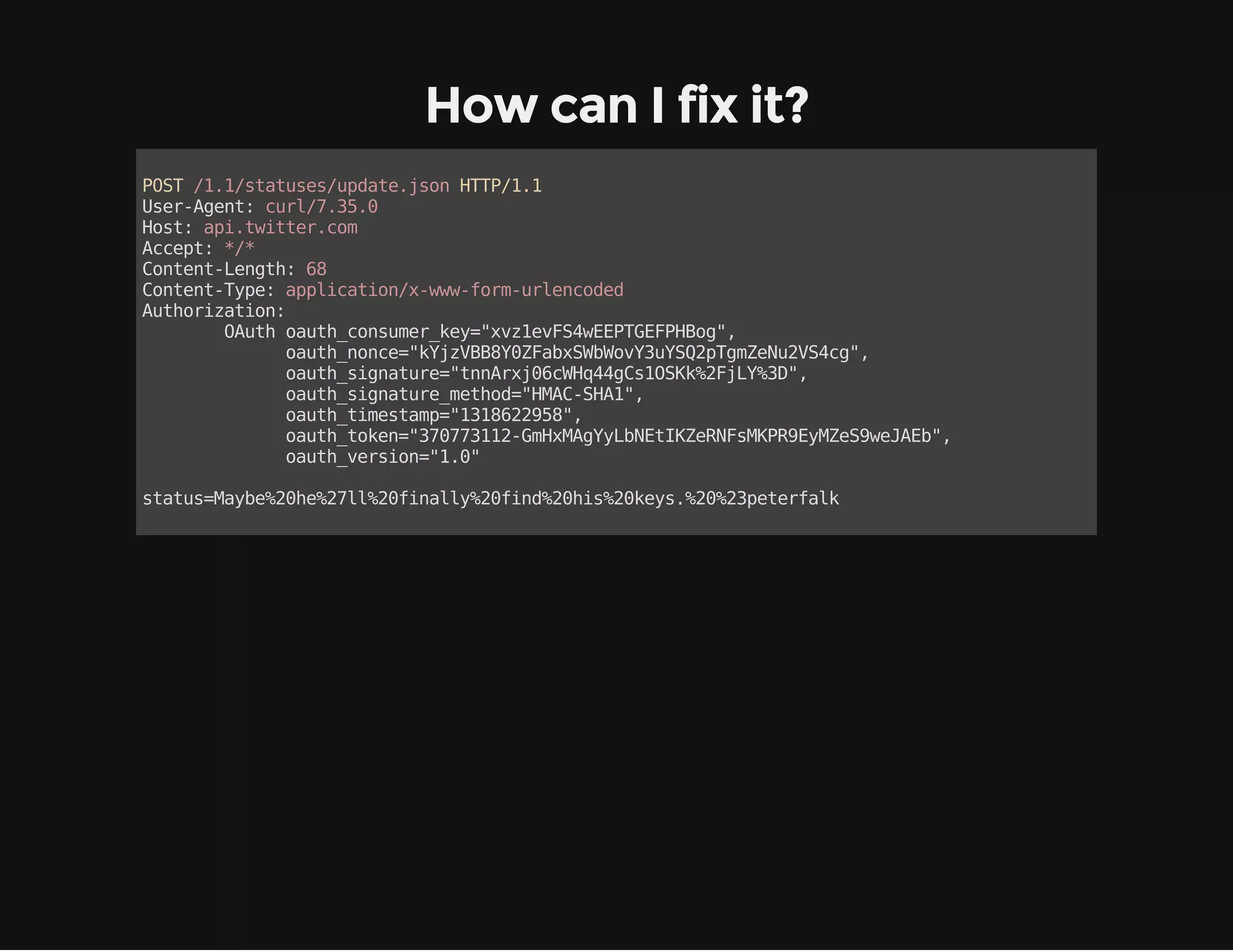
How can I fix it? 
POST /1.1/statuses/update.json HTTP/1.1 
User-Agent: curl/7.35.0 
Host: api.twitter.com 
Accept: */* 
Content-Length: 68 
Content-Type: application/x-www-form-urlencoded 
Authorization: 
OAuth oauth_consumer_key="xvz1evFS4wEEPTGEFPHBog", 
oauth_nonce="kYjzVBB8Y0ZFabxSWbWovY3uYSQ2pTgmZeNu2VS4cg", 
oauth_signature="tnnArxj06cWHq44gCs1OSKk%2FjLY%3D", 
oauth_signature_method="HMAC-SHA1", 
oauth_timestamp="1318622958", 
oauth_token="370773112-GmHxMAgYyLbNEtIKZeRNFsMKPR9EyMZeS9weJAEb", 
oauth_version="1.0" 
status=Maybe%20he%27ll%20finally%20find%20his%20keys.%20%23peterfalk
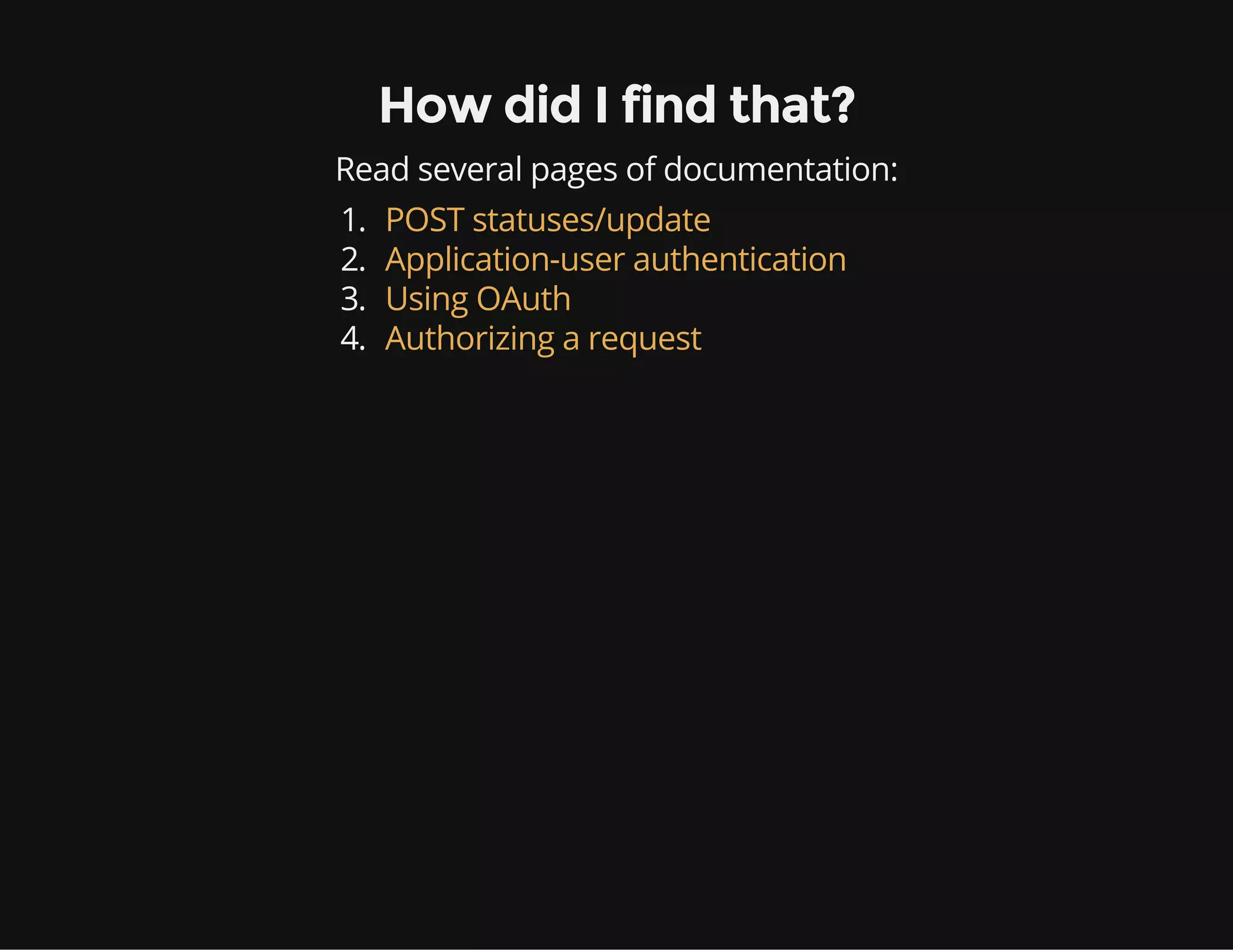
How did I find that? 
Read several pages of documentation: 
1. 
POST statuses/update 
2. 
Application-user authentication 
3. 
Using OAuth 
4. 
Authorizing a request
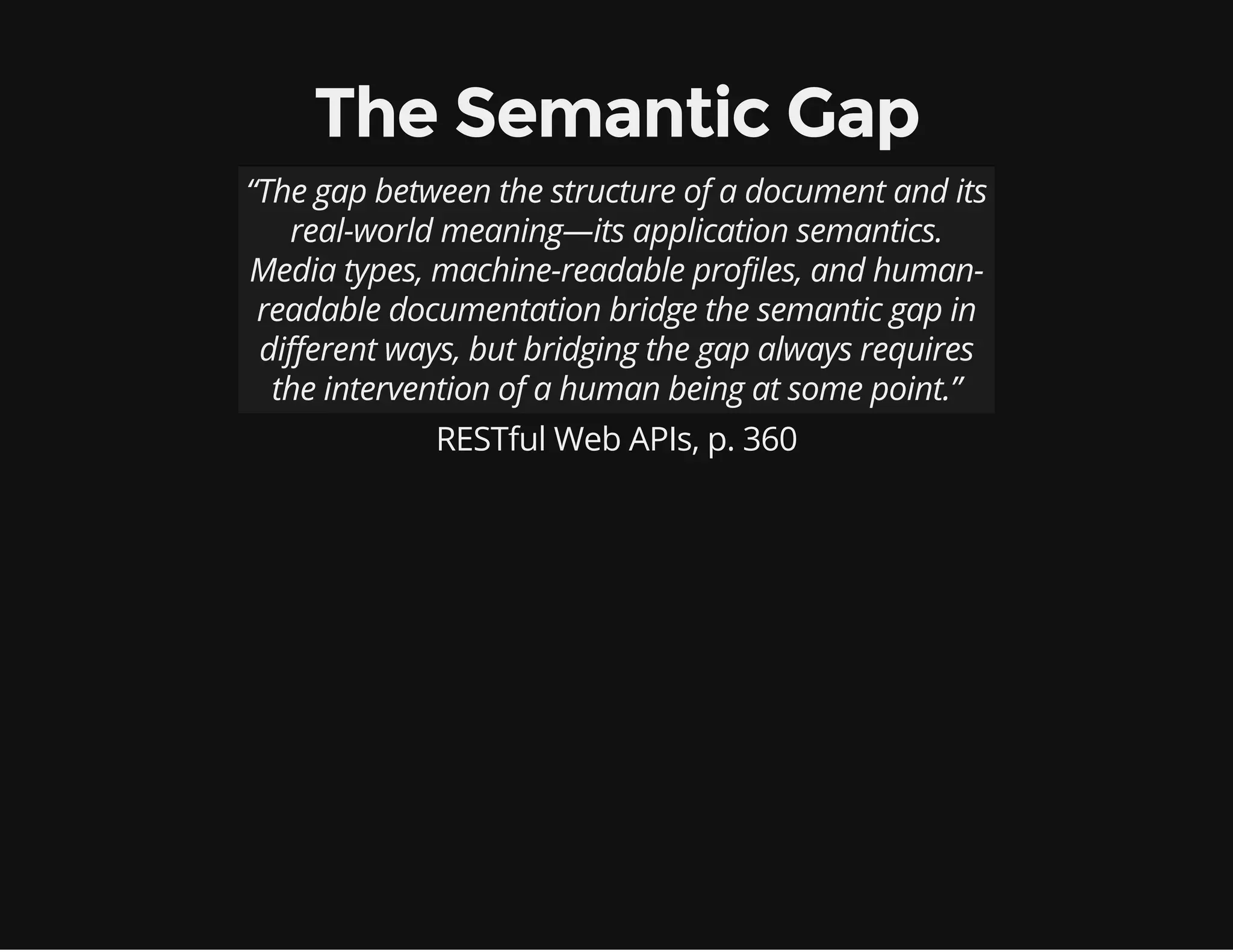
The Semantic Gap 
“The gap between the structure of a document and its 
real-world meaning—its application semantics. 
Media types, machine-readable profiles, and human-readable 
documentation bridge the semantic gap in 
different ways, but bridging the gap always requires 
the intervention of a human being at some point.” 
RESTful Web APIs, p. 360
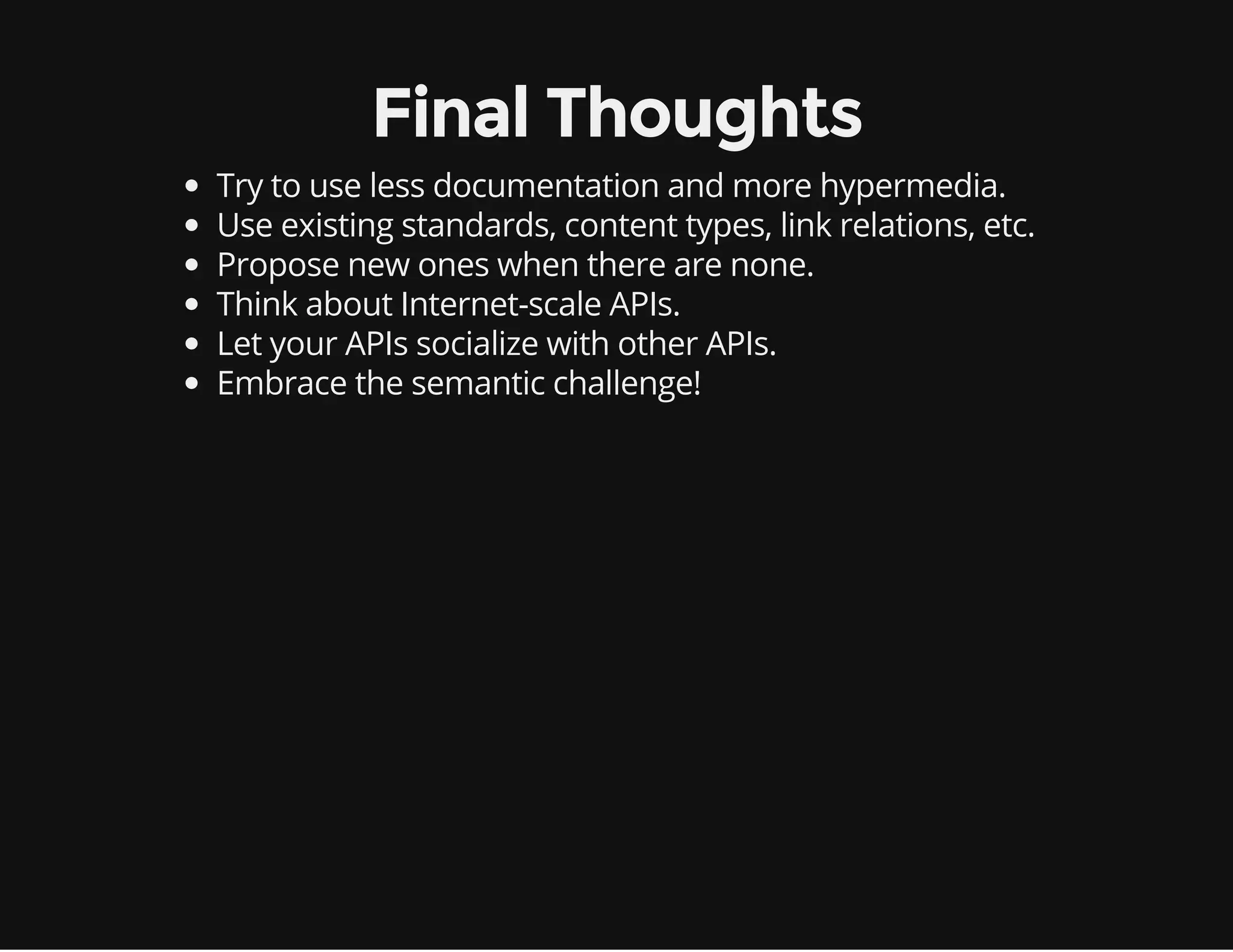
Final Thoughts 
Try to use less documentation and more hypermedia. 
Use existing standards, content types, link relations, etc. 
Propose new ones when there are none. 
Think about Internet-scale APIs. 
Let your APIs socialize with other APIs. 
Embrace the semantic challenge!
Questions? 
by Alex Muntada / @alexmuntada
REST in peace!

REST in theory

  • 1.
    REST in theory by Alex Muntada / @alexmuntada
  • 2.
    What makes Interneta success? World Wide Web
  • 3.
    What makes theWeb a success? easy customized linked pervasive
  • 4.
  • 5.
    Architectural Styles andthe Design of Network-based Software Architectures Roy Fielding (2000)
  • 6.
    SOAP 1.2 W3Crecommendation (2003)
  • 7.
    RESTful Web Services Leonard Richardson, Sam Ruby (2007)
  • 8.
  • 9.
    RESTful Web APIs Leonard Richardson, Mike Amundsen, Sam Ruby (2013)
  • 10.
    REST(ful) “Representational statetransfer (REST) is a software architectural style consisting of a coordinated set of architectural constraints applied to components, connectors, and data elements, within a distributed hypermedia system.”
  • 11.
    Architectural Properties ofthe Web Low Entry-Barrier (easy) Extensibility (customized) Distributed Hypermedia (linked) Internet-Scale (pervasive)
  • 12.
    Interface Constraints Identificationof Resources (URIs) Manipulation of Resources Through Representations Self-Descriptive Messages (stateless) The Hypermedia Constraint (HATEOAS)
  • 13.
    HATEOAS “Hypermedia asthe engine of application state.” All application state is kept on the client side. The client can only change it through HTTP requests and responses. The client can find next actions through hypermedia controls. Hypermedia controls drive changes in application state.
  • 14.
    Architectural Constraints Client-Server(one to one) Statelessness (application state, resource state) Caching (if-modified-since, if-match, 304) Uniform Interface Layered System (proxies, gateways) Code on Demand (javascript)
  • 15.
  • 16.
    What is yourworst nightmare in APIs? Documentation Bad, old, wrong or lack thereof.
  • 17.
    Twitter REST APIv1.1 POST statuses/update Resource URL: https://api.twitter.com/1.1/statuses/update.json HTTP Methods: POST Response Formats: json Parameters: status (required), in_reply_to_status_id, lat, long, place_id, display_coordinates, trim_user
  • 18.
    What is missingin this example? POST /1.1/statuses/update.json HTTP/1.1 User-Agent: curl/7.35.0 Host: api.twitter.com Accept: */* Content-Length: 68 Content-Type: application/x-www-form-urlencoded status=Maybe%20he%27ll%20finally%20find%20his%20keys.%20%23peterfalk HTTP/1.1 400 Bad Request content-length: 61 content-type: application/json; charset=utf-8 date: Sun, 18 May 2014 19:30:43 UTC server: tfe set-cookie: guest_id=v1%3A140044144371735781; Domain=.twitter.com; Path=/; Expires=Tue, 17-May-2016 19:30:43 strict-transport-security: max-age=631138519 x-tfe-logging-request-category: API {"errors":[{"message":"Bad Authentication data","code":215}]}
  • 19.
    How can Ifix it? POST /1.1/statuses/update.json HTTP/1.1 User-Agent: curl/7.35.0 Host: api.twitter.com Accept: */* Content-Length: 68 Content-Type: application/x-www-form-urlencoded Authorization: OAuth oauth_consumer_key="xvz1evFS4wEEPTGEFPHBog", oauth_nonce="kYjzVBB8Y0ZFabxSWbWovY3uYSQ2pTgmZeNu2VS4cg", oauth_signature="tnnArxj06cWHq44gCs1OSKk%2FjLY%3D", oauth_signature_method="HMAC-SHA1", oauth_timestamp="1318622958", oauth_token="370773112-GmHxMAgYyLbNEtIKZeRNFsMKPR9EyMZeS9weJAEb", oauth_version="1.0" status=Maybe%20he%27ll%20finally%20find%20his%20keys.%20%23peterfalk
  • 20.
    How did Ifind that? Read several pages of documentation: 1. POST statuses/update 2. Application-user authentication 3. Using OAuth 4. Authorizing a request
  • 21.
    The Semantic Gap “The gap between the structure of a document and its real-world meaning—its application semantics. Media types, machine-readable profiles, and human-readable documentation bridge the semantic gap in different ways, but bridging the gap always requires the intervention of a human being at some point.” RESTful Web APIs, p. 360
  • 22.
    Final Thoughts Tryto use less documentation and more hypermedia. Use existing standards, content types, link relations, etc. Propose new ones when there are none. Think about Internet-scale APIs. Let your APIs socialize with other APIs. Embrace the semantic challenge!
  • 23.
    Questions? by AlexMuntada / @alexmuntada
  • 24.