Details:
Building Using The NetflixOSS
Architecture
May 2013
Adrian Cockcroft
@adrianco #netflixcloud @NetflixOSS
http://www.linkedin.com/in/adriancockcroft
Architectures for High Availability
Cassandra Storage and Replication
NetflixOSS Components
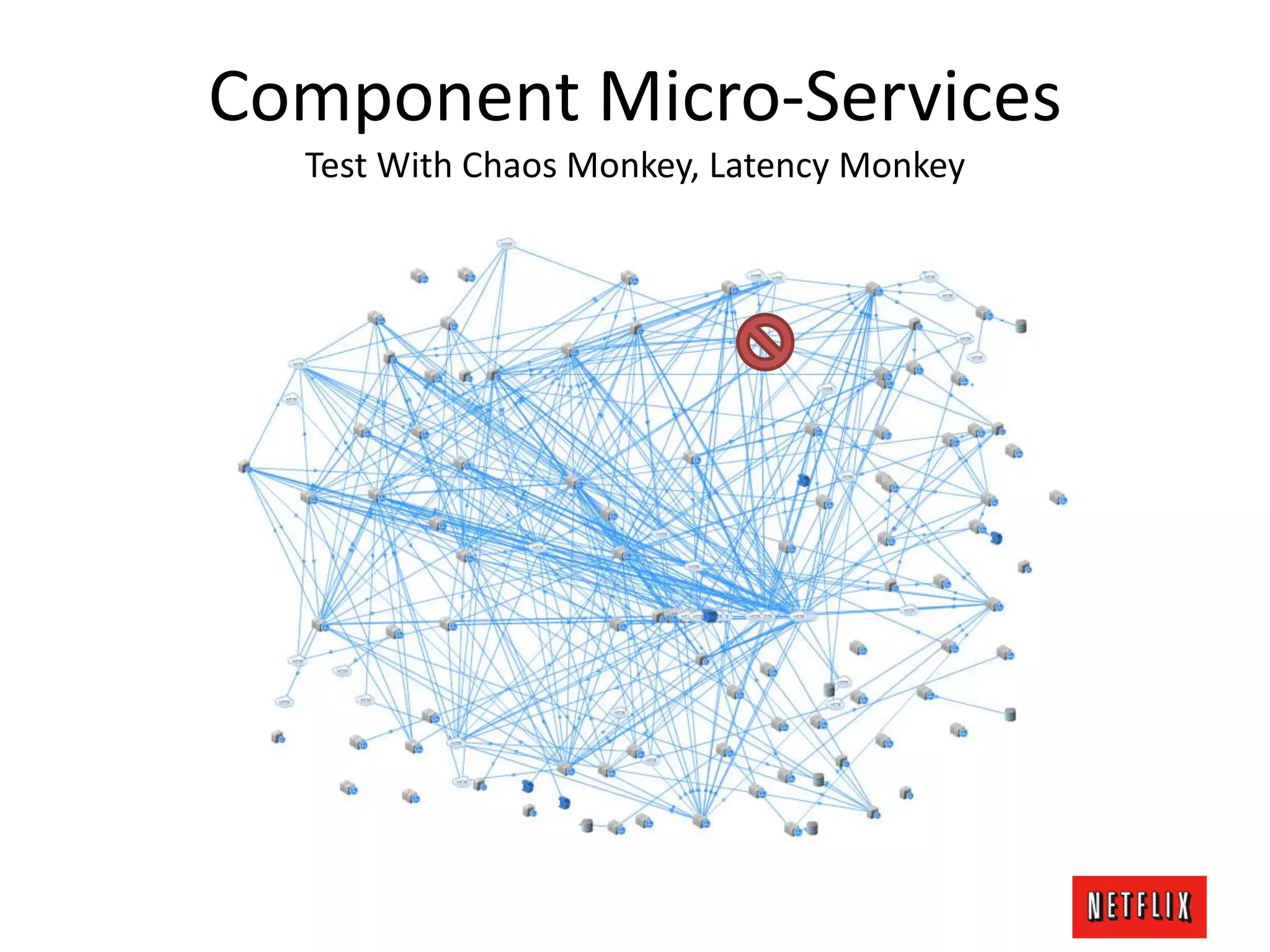
Component Micro-Services
Test With Chaos Monkey, Latency Monkey
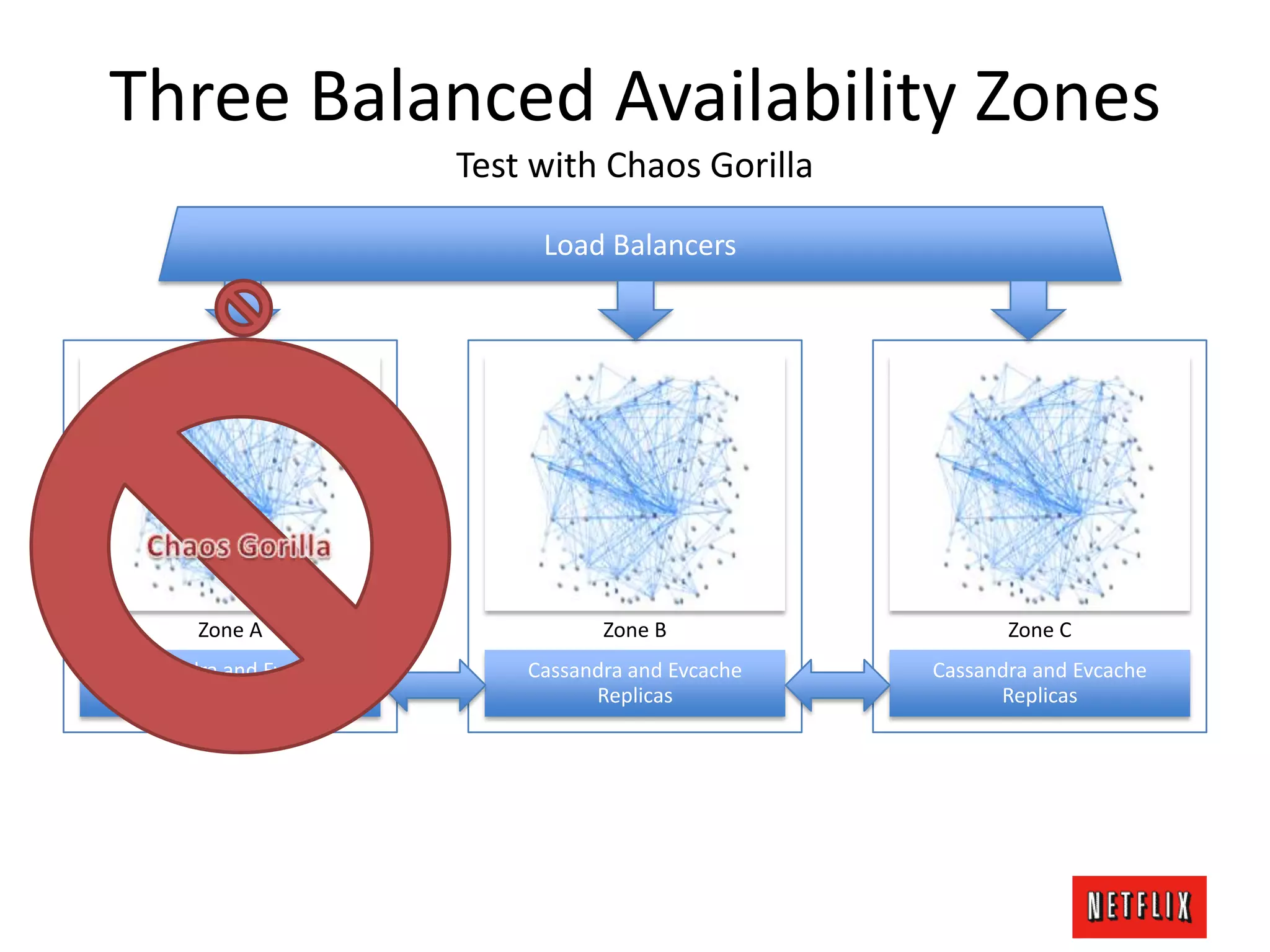
Three Balanced Availability Zones
Test with Chaos Gorilla
Cassandra and Evcache
Replicas
Zone A
Cassandra and Evcache
Replicas
Zone B
Cassandra and Evcache
Replicas
Zone C
Load Balancers
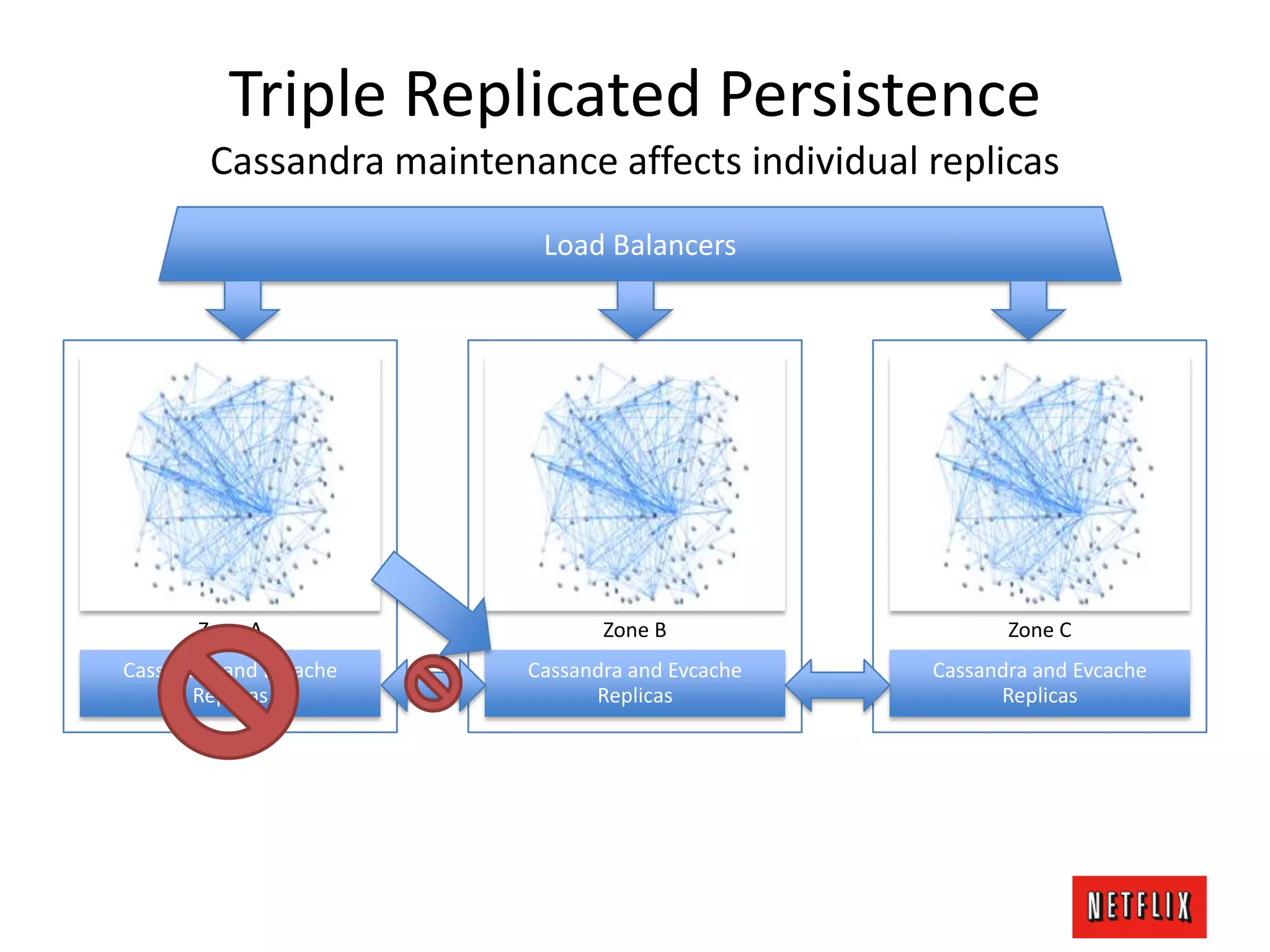
Triple Replicated Persistence
Cassandra maintenance affects individual replicas
Cassandra and Evcache
Replicas
Zone A
Cassandra and Evcache
Replicas
Zone B
Cassandra and Evcache
Replicas
Zone C
Load Balancers
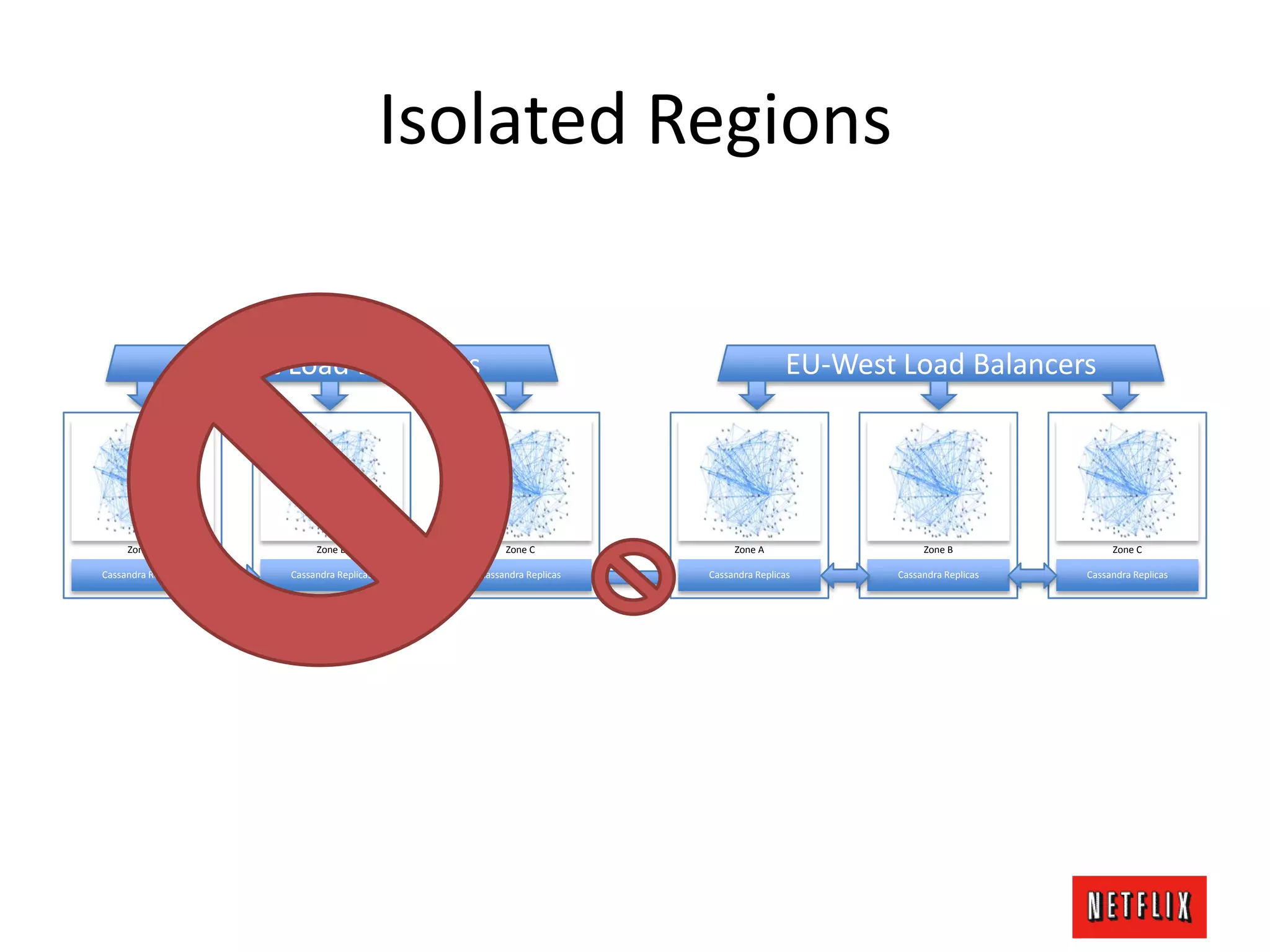
Isolated Regions
Cassandra Replicas
Zone A
Cassandra Replicas
Zone B
Cassandra Replicas
Zone C
US-East Load Balancers
Cassandra Replicas
Zone A
Cassandra Replicas
Zone B
Cassandra Replicas
Zone C
EU-West Load Balancers
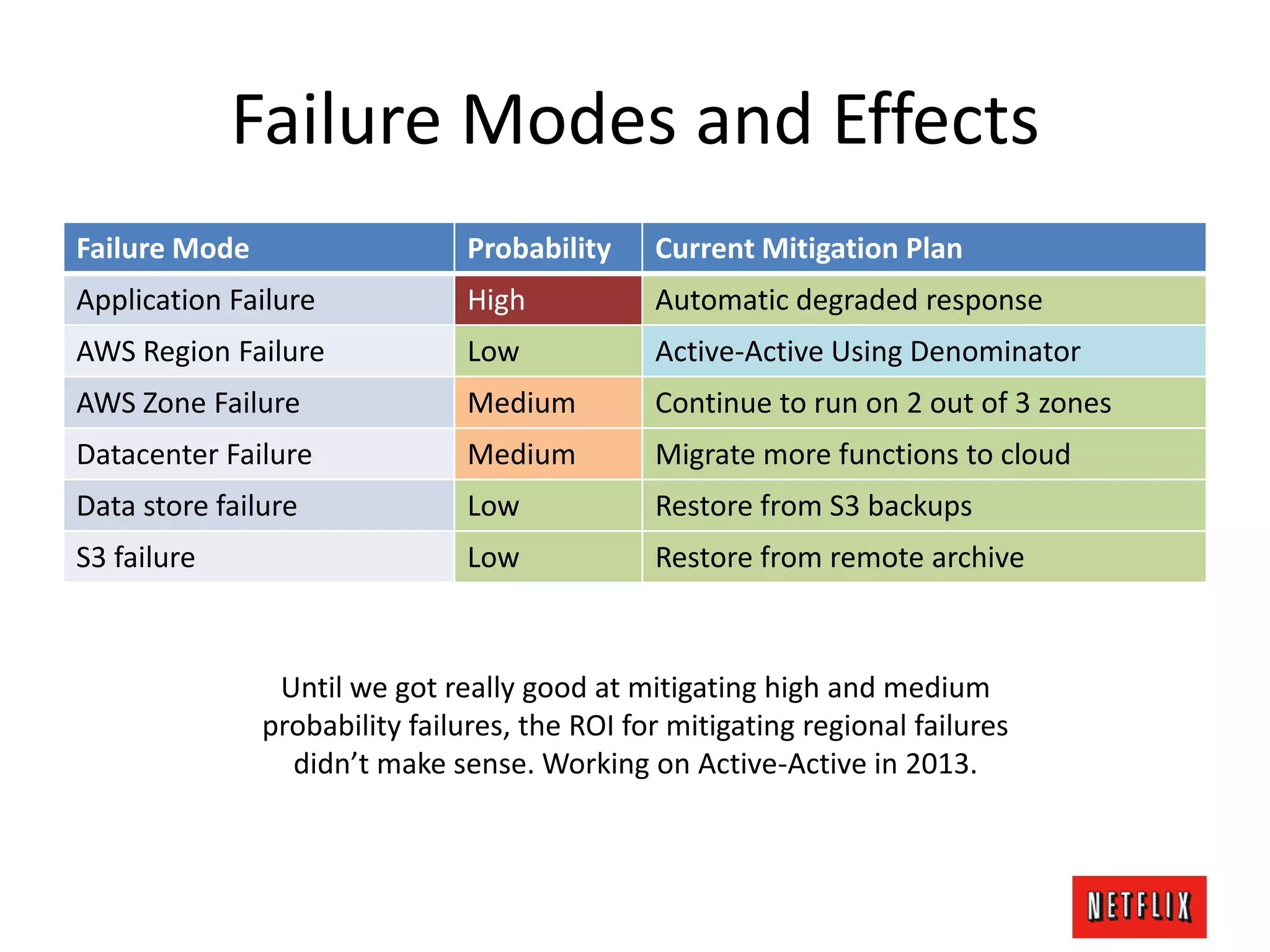
Failure Modes and Effects
Failure Mode Probability Current Mitigation Plan
Application Failure High Automatic degraded response
AWS Region Failure Low Active-Active Using Denominator
AWS Zone Failure Medium Continue to run on 2 out of 3 zones
Datacenter Failure Medium Migrate more functions to cloud
Data store failure Low Restore from S3 backups
S3 failure Low Restore from remote archive
Until we got really good at mitigating high and medium
probability failures, the ROI for mitigating regional failures
didn’t make sense. Working on Active-Active in 2013.
Application Resilience
Run what you wrote
Rapid detection
Rapid Response
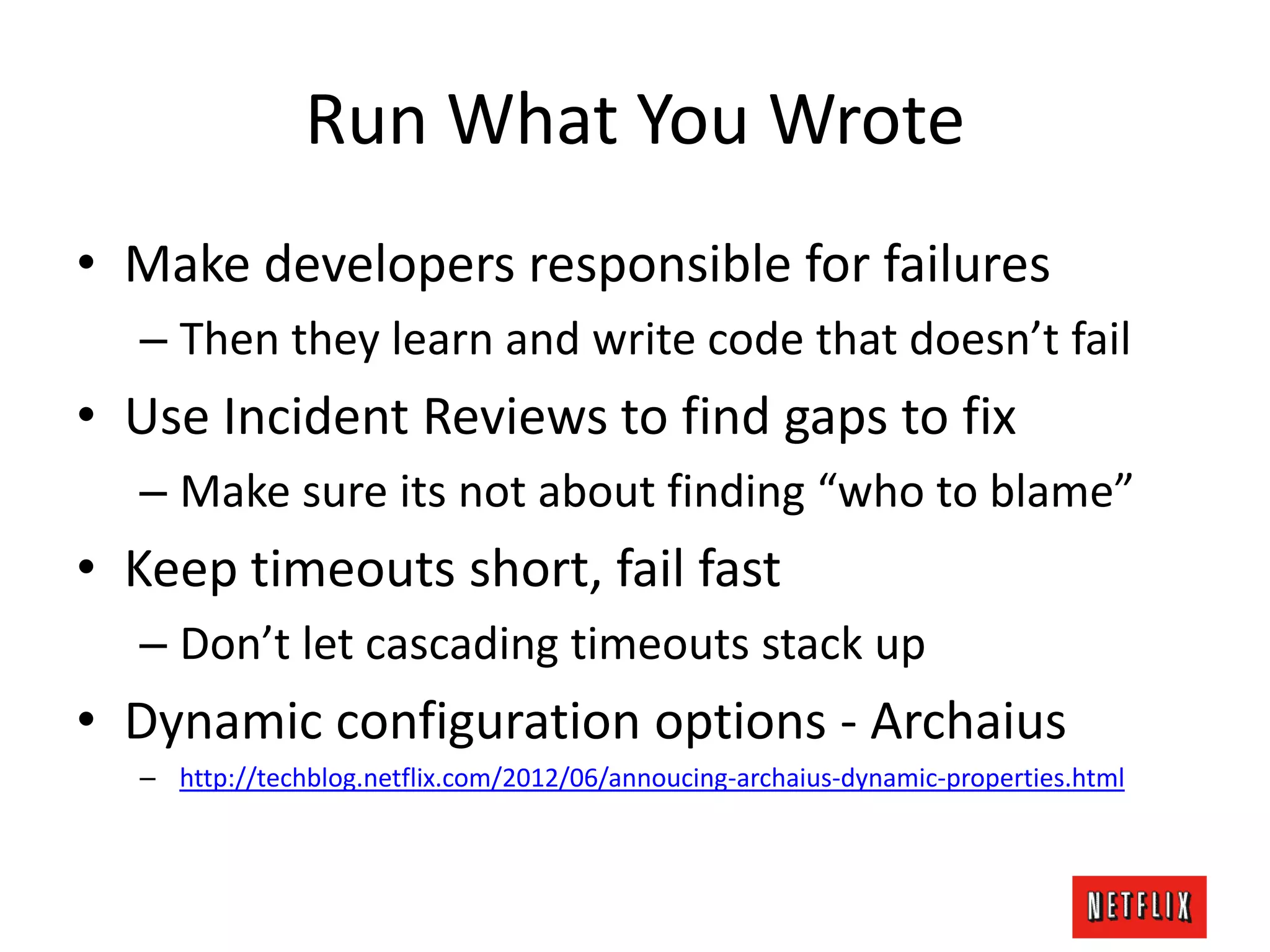
Run What You Wrote
• Make developers responsible for failures
– Then they learn and write code that doesn’t fail
• Use Incident Reviews to find gaps to fix
– Make sure its not about finding “who to blame”
• Keep timeouts short, fail fast
– Don’t let cascading timeouts stack up
• Dynamic configuration options - Archaius
– http://techblog.netflix.com/2012/06/annoucing-archaius-dynamic-properties.html
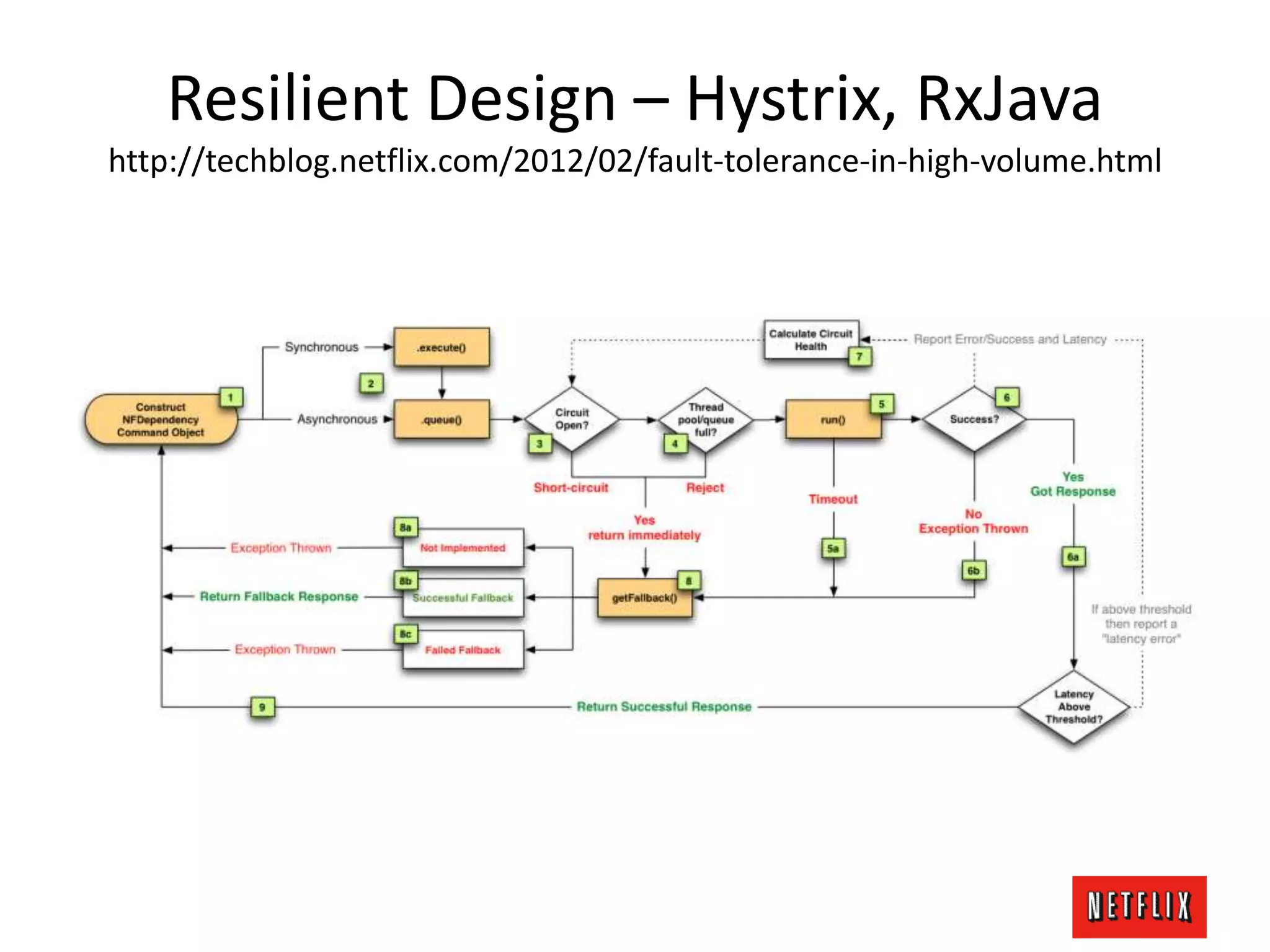
Resilient Design – Hystrix, RxJava
http://techblog.netflix.com/2012/02/fault-tolerance-in-high-volume.html
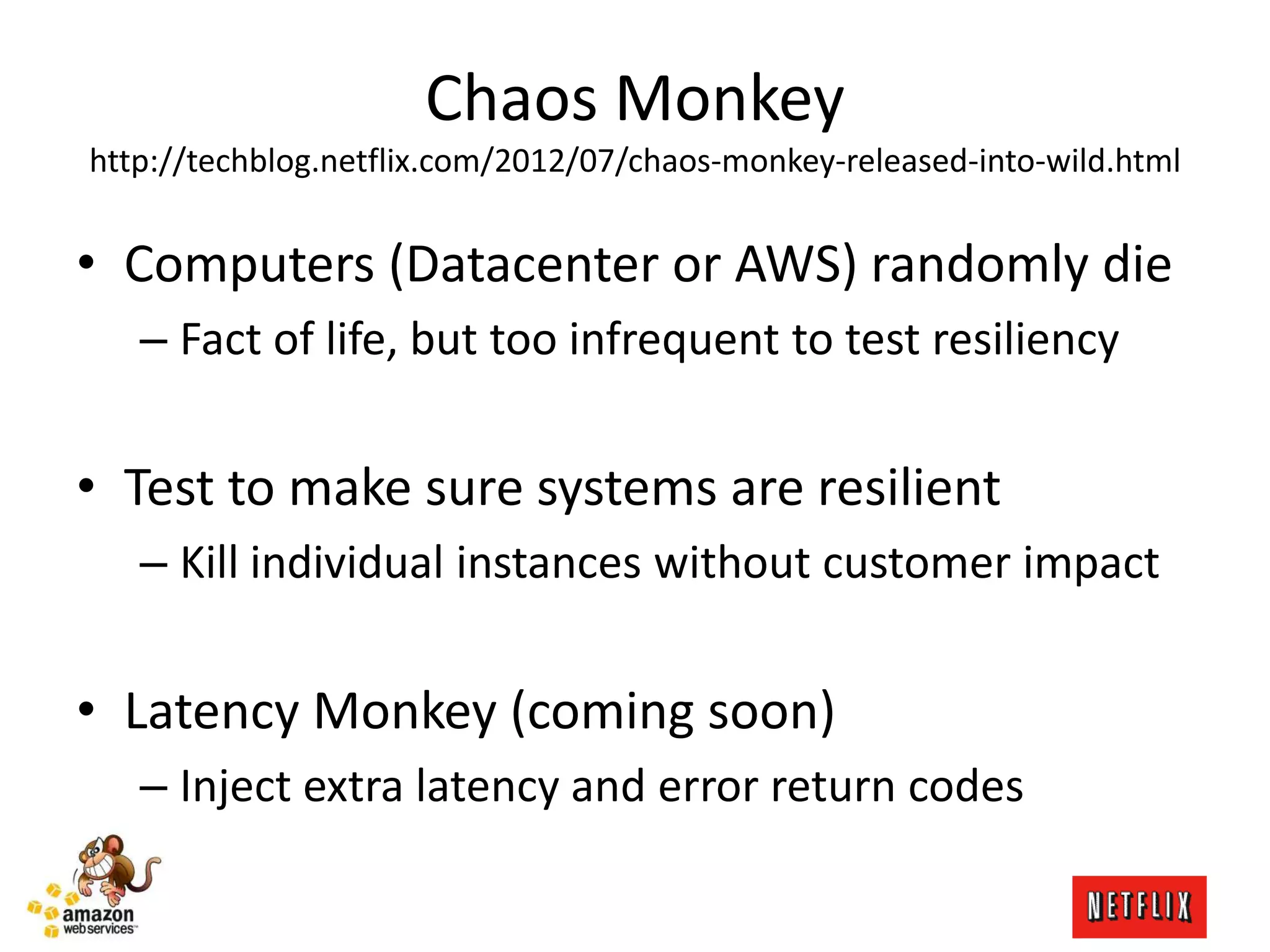
Chaos Monkey
http://techblog.netflix.com/2012/07/chaos-monkey-released-into-wild.html
• Computers (Datacenter or AWS) randomly die
– Fact of life, but too infrequent to test resiliency
• Test to make sure systems are resilient
– Kill individual instances without customer impact
• Latency Monkey (coming soon)
– Inject extra latency and error return codes
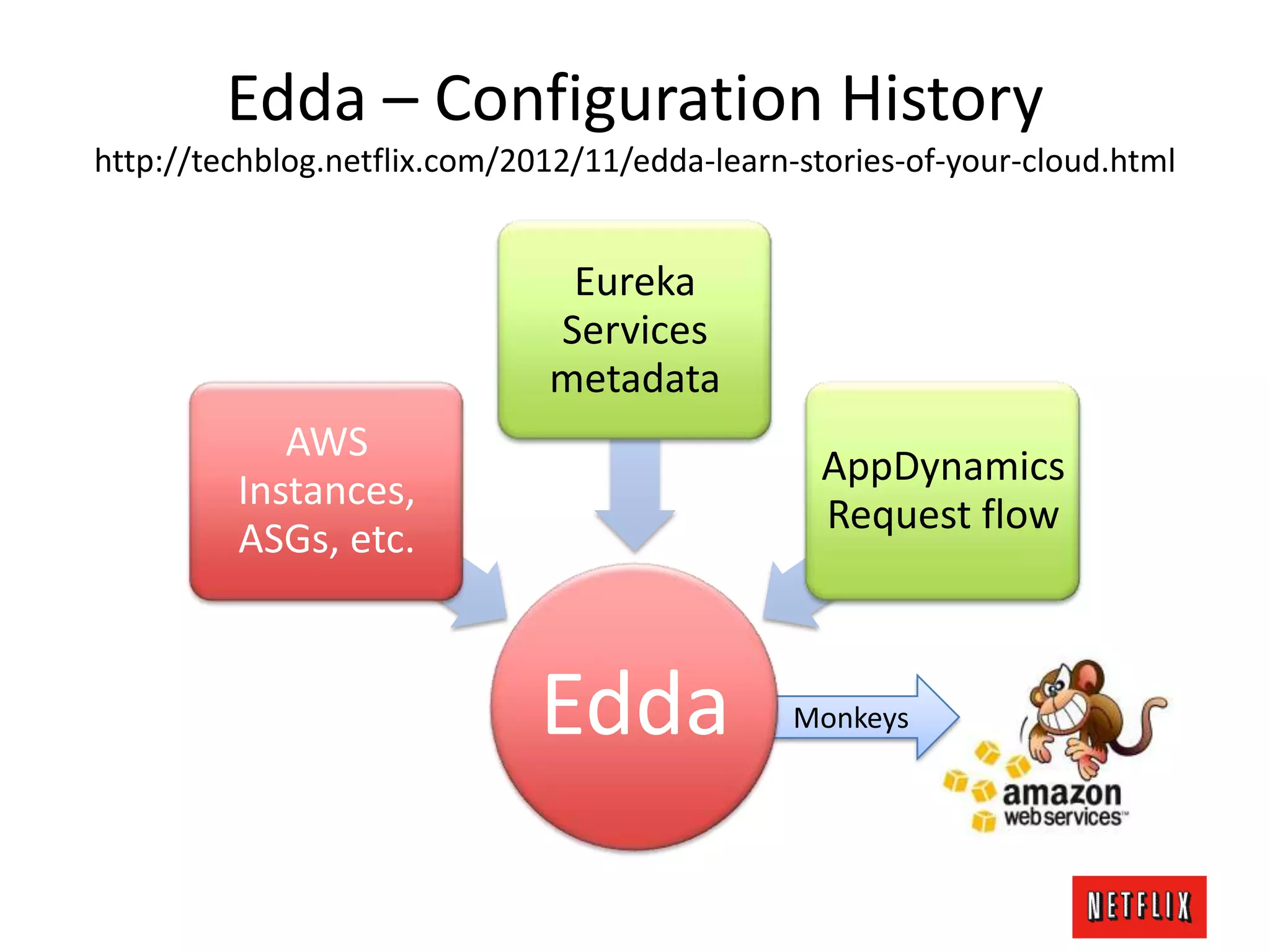
Monkeys
Edda – Configuration History
http://techblog.netflix.com/2012/11/edda-learn-stories-of-your-cloud.html
Edda
AWS
Instances,
ASGs, etc.
Eureka
Services
metadata
AppDynamics
Request flow
Edda Query Examples
Find any instances that have ever had a specific public IP address
$ curl "http://edda/api/v2/view/instances;publicIpAddress=1.2.3.4;_since=0"
["i-0123456789","i-012345678a","i-012345678b”]
Show the most recent change to a security group
$ curl "http://edda/api/v2/aws/securityGroups/sg-0123456789;_diff;_all;_limit=2"
--- /api/v2/aws.securityGroups/sg-0123456789;_pp;_at=1351040779810
+++ /api/v2/aws.securityGroups/sg-0123456789;_pp;_at=1351044093504
@@ -1,33 +1,33 @@
{
…
"ipRanges" : [
"10.10.1.1/32",
"10.10.1.2/32",
+ "10.10.1.3/32",
- "10.10.1.4/32"
…
}
Platform Outage Taxonomy
Classify and name the different types
of things that can go wrong
YOLO
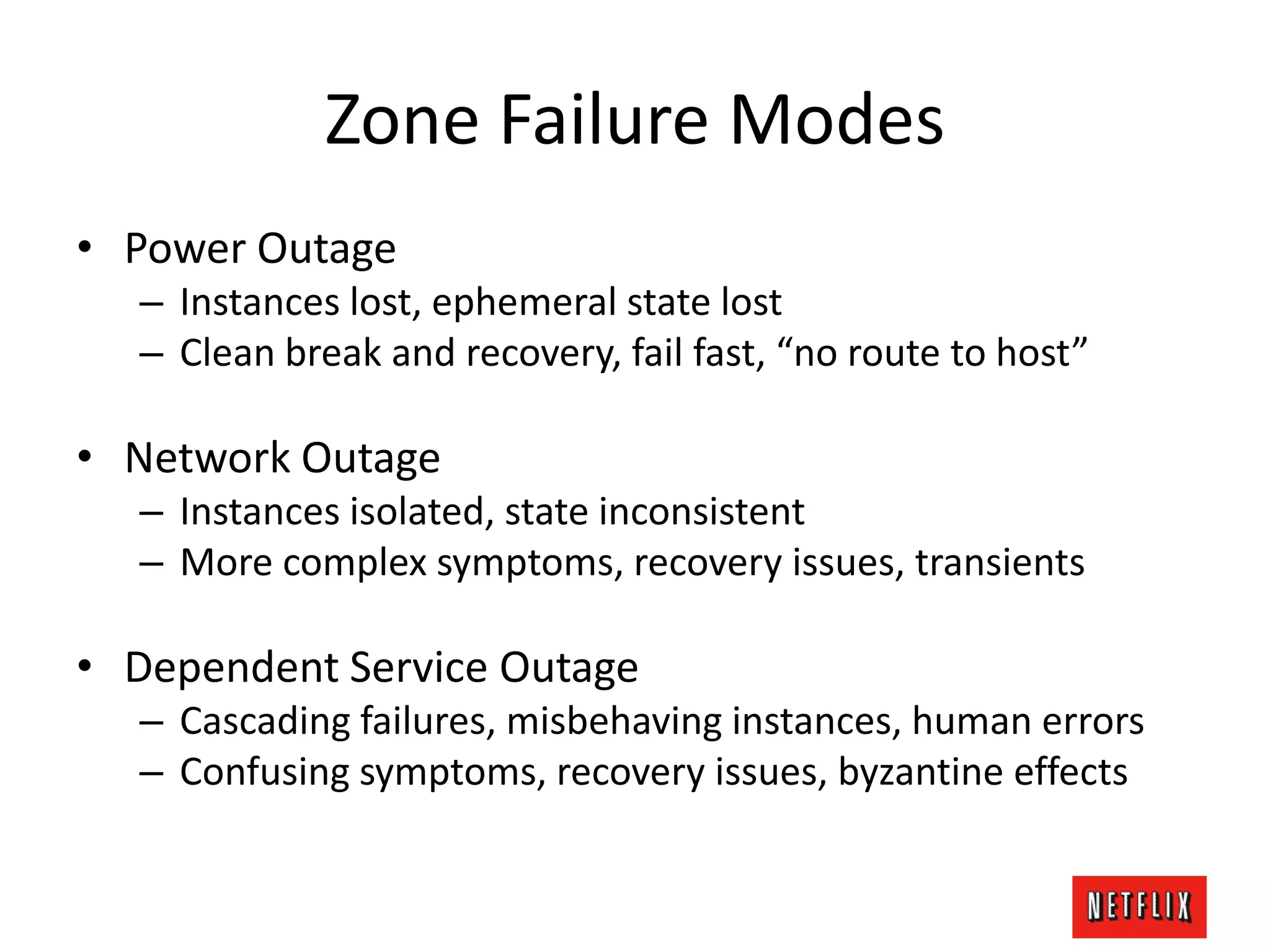
Zone Failure Modes
• Power Outage
– Instances lost, ephemeral state lost
– Clean break and recovery, fail fast, “no route to host”
• Network Outage
– Instances isolated, state inconsistent
– More complex symptoms, recovery issues, transients
• Dependent Service Outage
– Cascading failures, misbehaving instances, human errors
– Confusing symptoms, recovery issues, byzantine effects
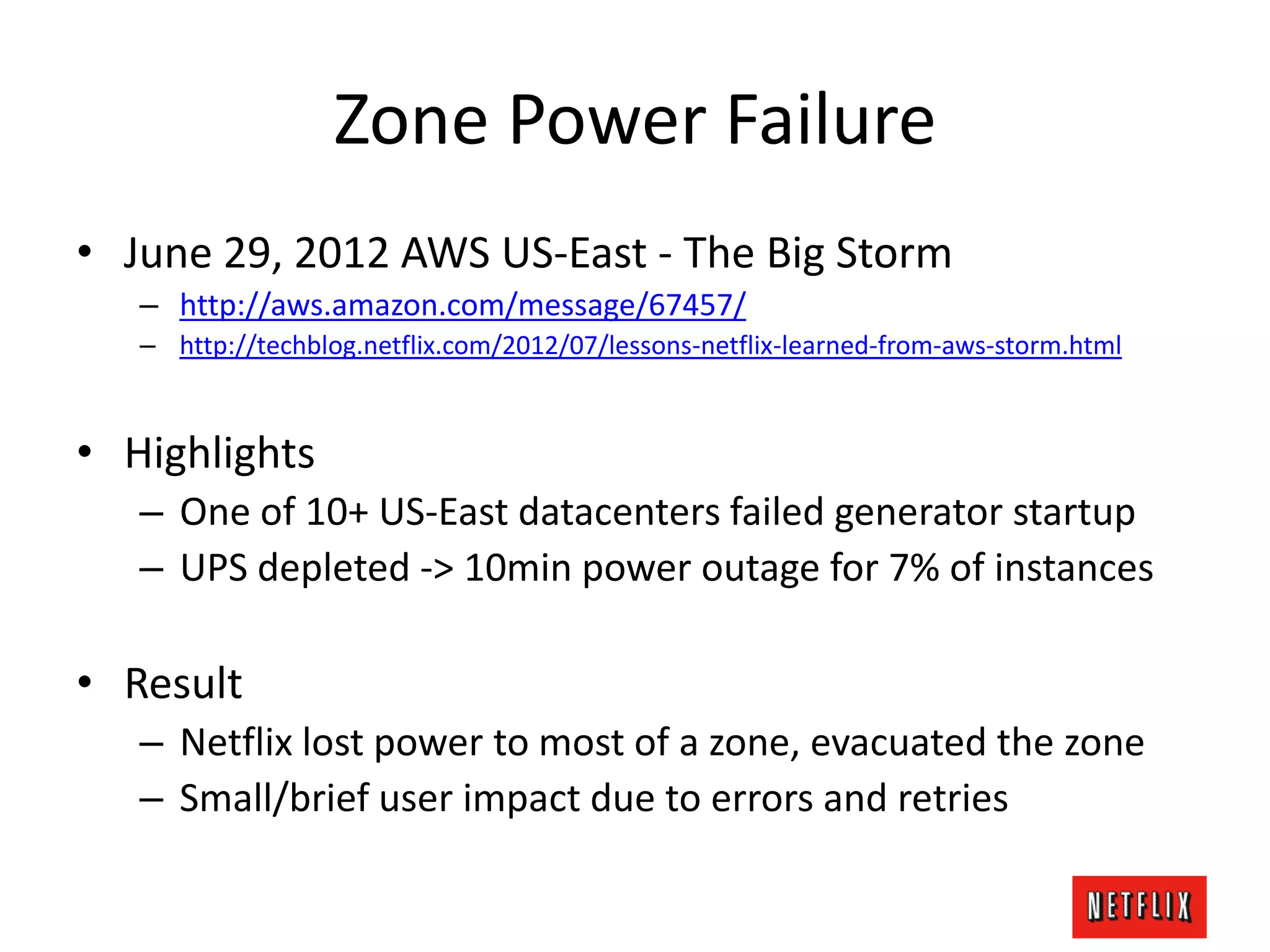
Zone Power Failure
• June 29, 2012 AWS US-East - The Big Storm
– http://aws.amazon.com/message/67457/
– http://techblog.netflix.com/2012/07/lessons-netflix-learned-from-aws-storm.html
• Highlights
– One of 10+ US-East datacenters failed generator startup
– UPS depleted -> 10min power outage for 7% of instances
• Result
– Netflix lost power to most of a zone, evacuated the zone
– Small/brief user impact due to errors and retries
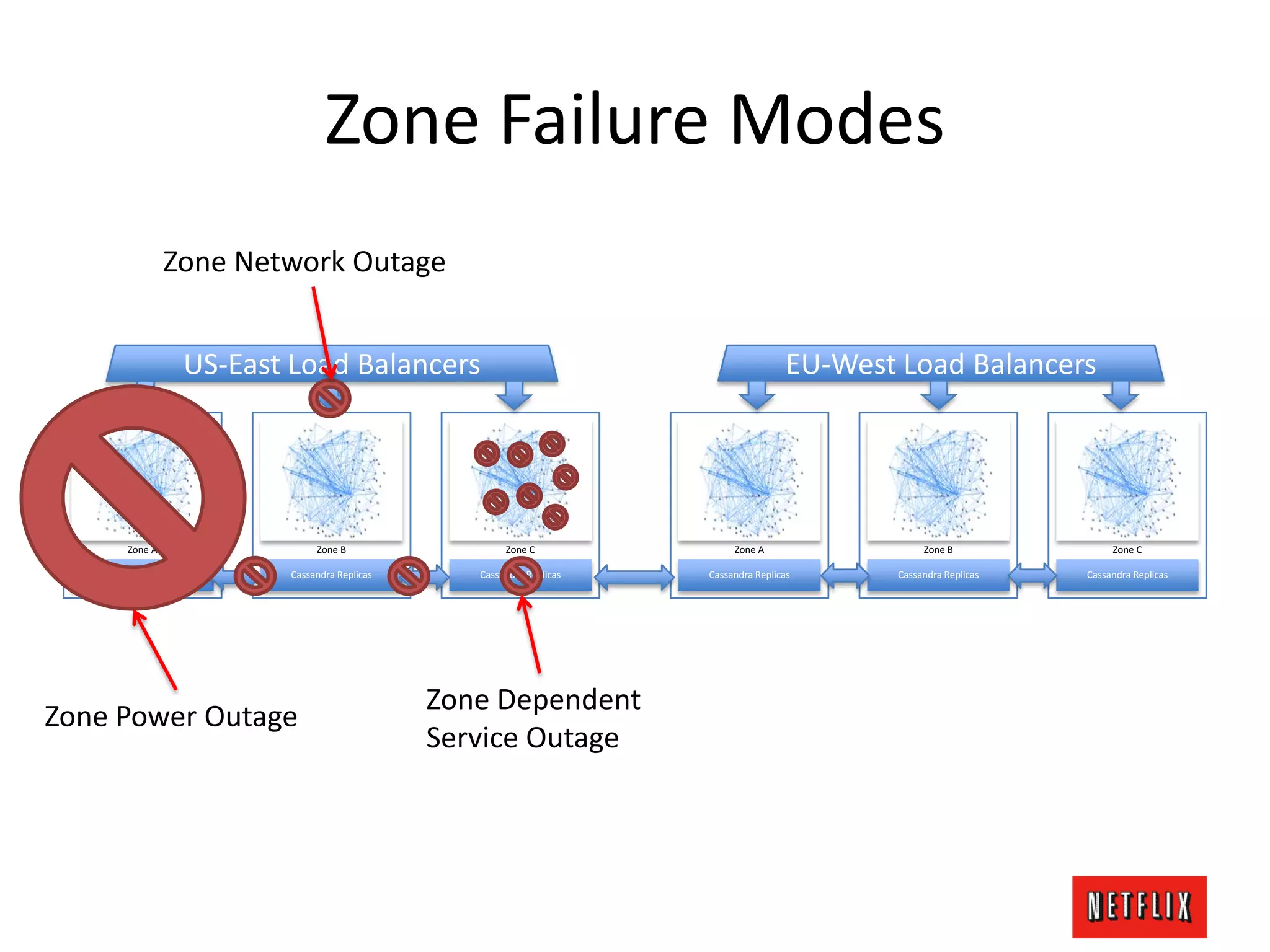
Zone Failure Modes
Cassandra Replicas
Zone A
Cassandra Replicas
Zone B
Cassandra Replicas
Zone C
US-East Load Balancers
Cassandra Replicas
Zone A
Cassandra Replicas
Zone B
Cassandra Replicas
Zone C
EU-West Load Balancers
Zone Power Outage
Zone Network Outage
Zone Dependent
Service Outage
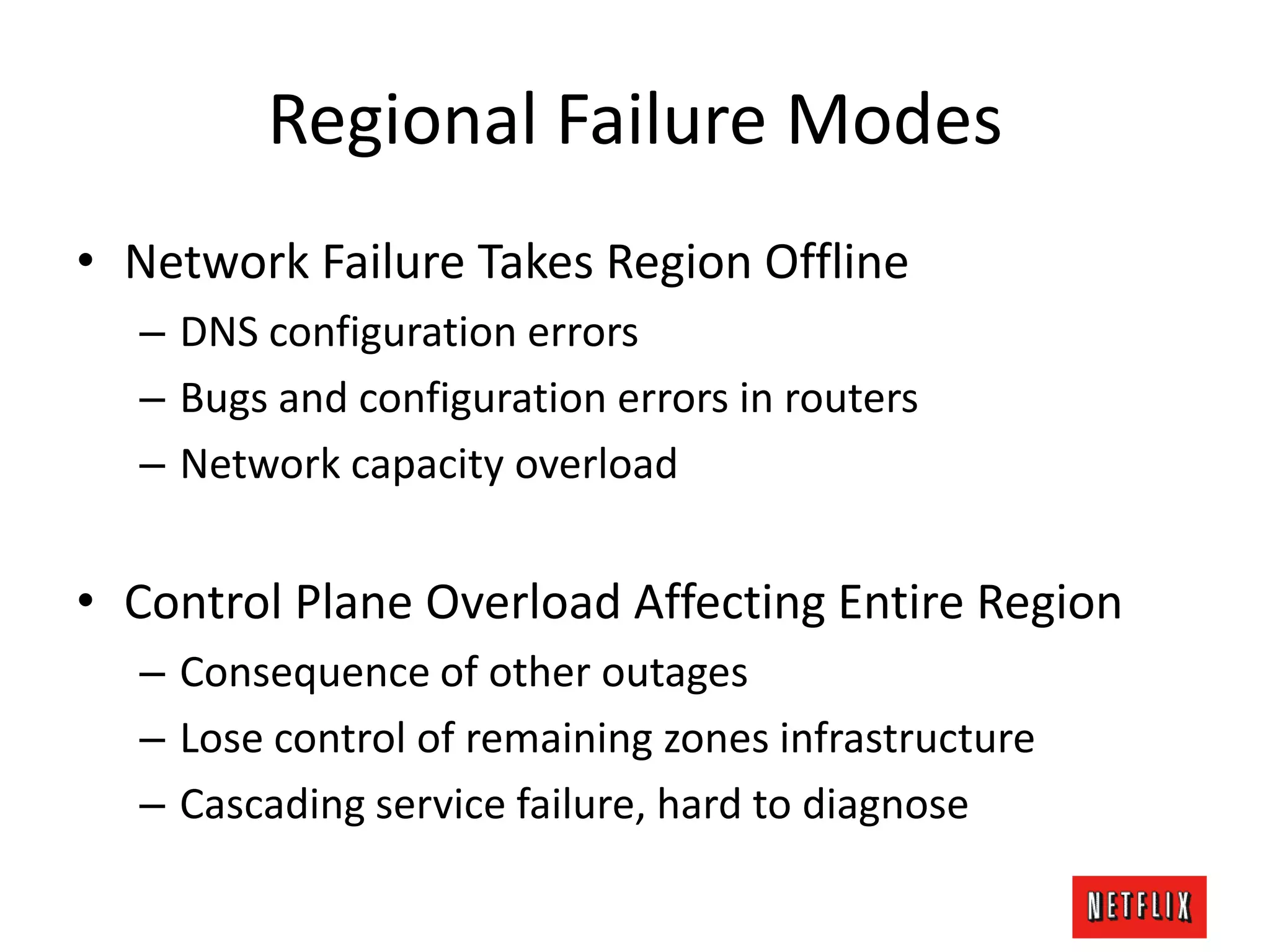
Regional Failure Modes
• Network Failure Takes Region Offline
– DNS configuration errors
– Bugs and configuration errors in routers
– Network capacity overload
• Control Plane Overload Affecting Entire Region
– Consequence of other outages
– Lose control of remaining zones infrastructure
– Cascading service failure, hard to diagnose
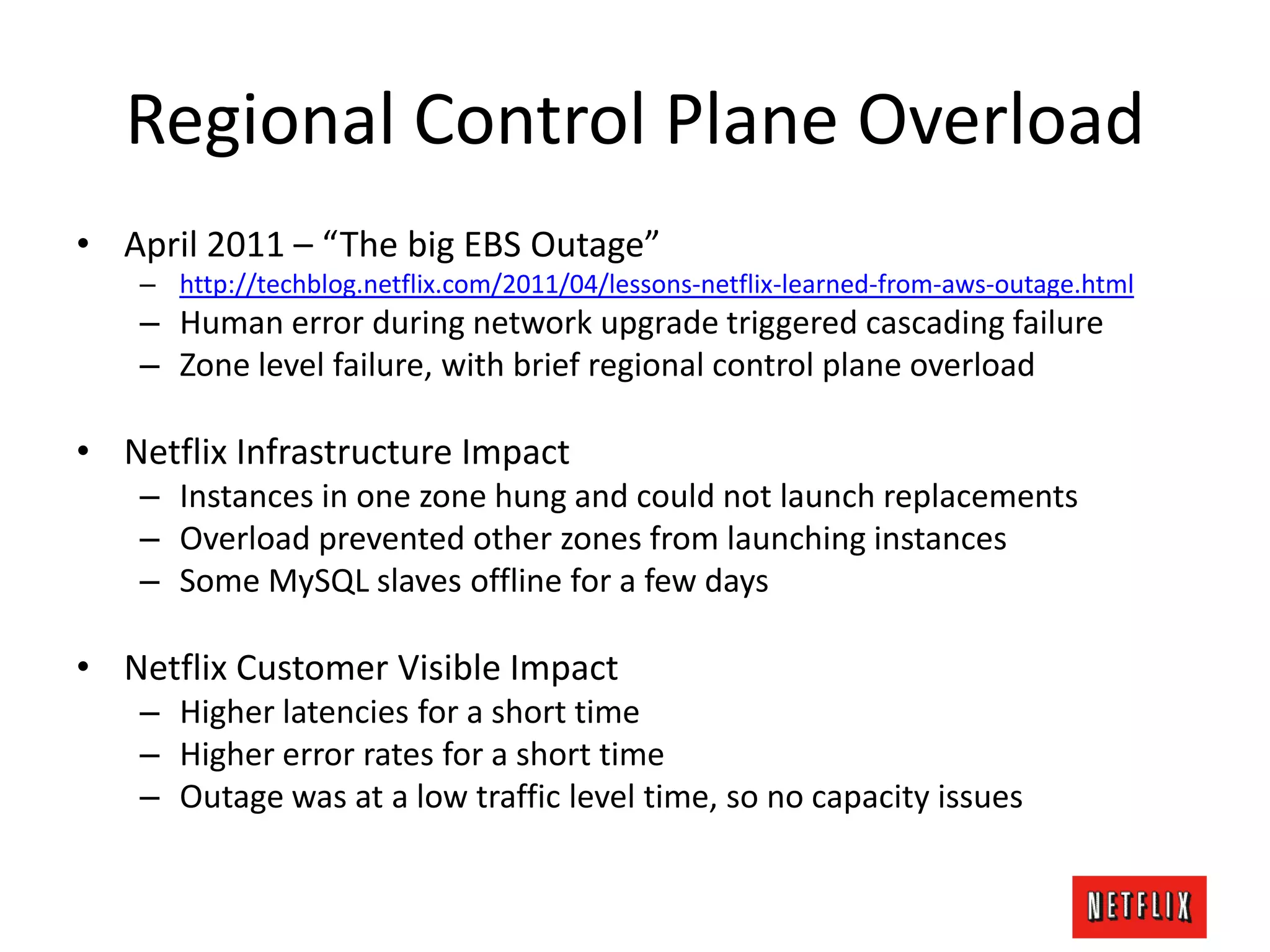
Regional Control Plane Overload
• April 2011 – “The big EBS Outage”
– http://techblog.netflix.com/2011/04/lessons-netflix-learned-from-aws-outage.html
– Human error during network upgrade triggered cascading failure
– Zone level failure, with brief regional control plane overload
• Netflix Infrastructure Impact
– Instances in one zone hung and could not launch replacements
– Overload prevented other zones from launching instances
– Some MySQL slaves offline for a few days
• Netflix Customer Visible Impact
– Higher latencies for a short time
– Higher error rates for a short time
– Outage was at a low traffic level time, so no capacity issues
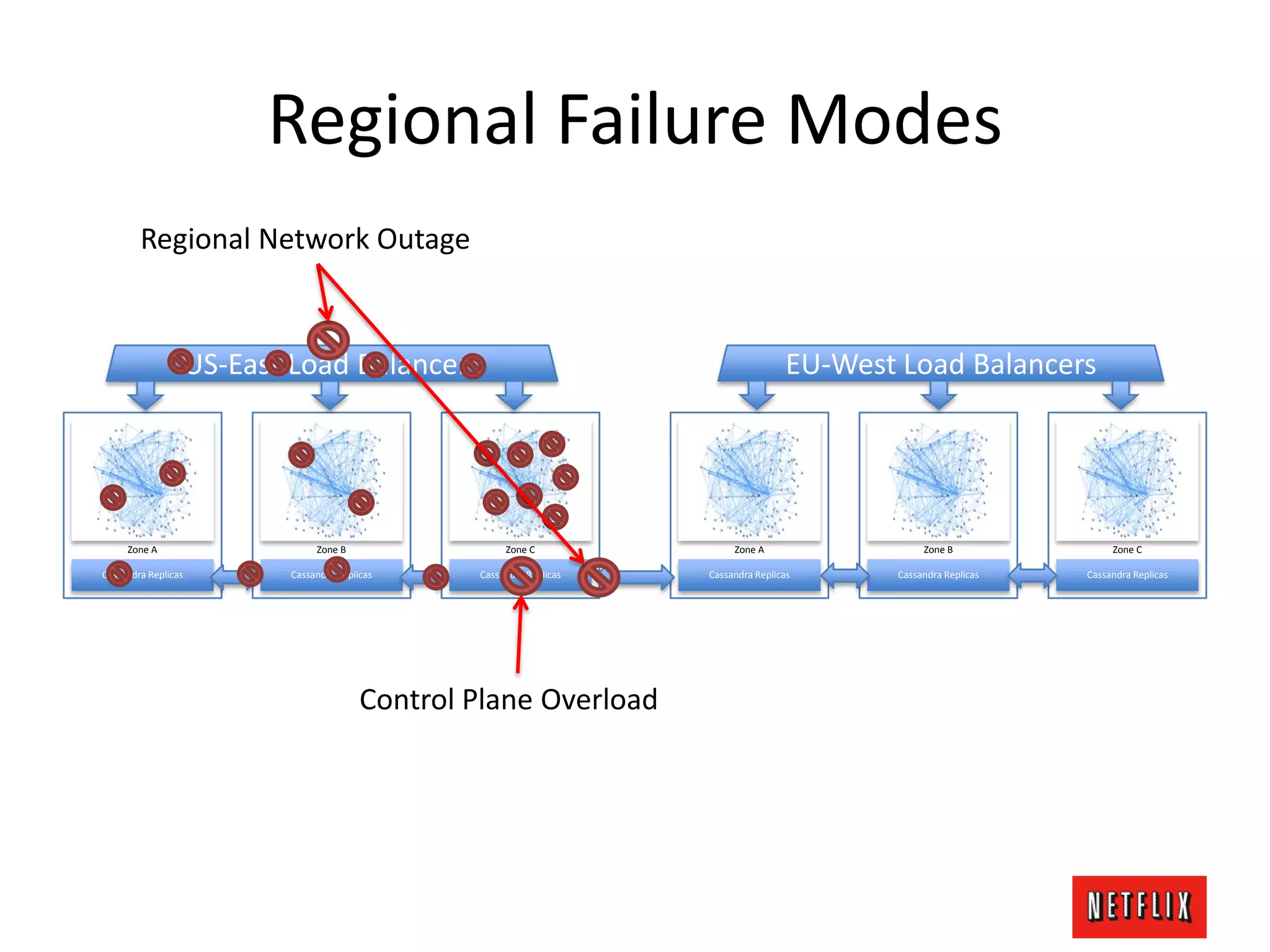
Regional Failure Modes
Cassandra Replicas
Zone A
Cassandra Replicas
Zone B
Cassandra Replicas
Zone C
US-East Load Balancers
Cassandra Replicas
Zone A
Cassandra Replicas
Zone B
Cassandra Replicas
Zone C
EU-West Load Balancers
Regional Network Outage
Control Plane Overload
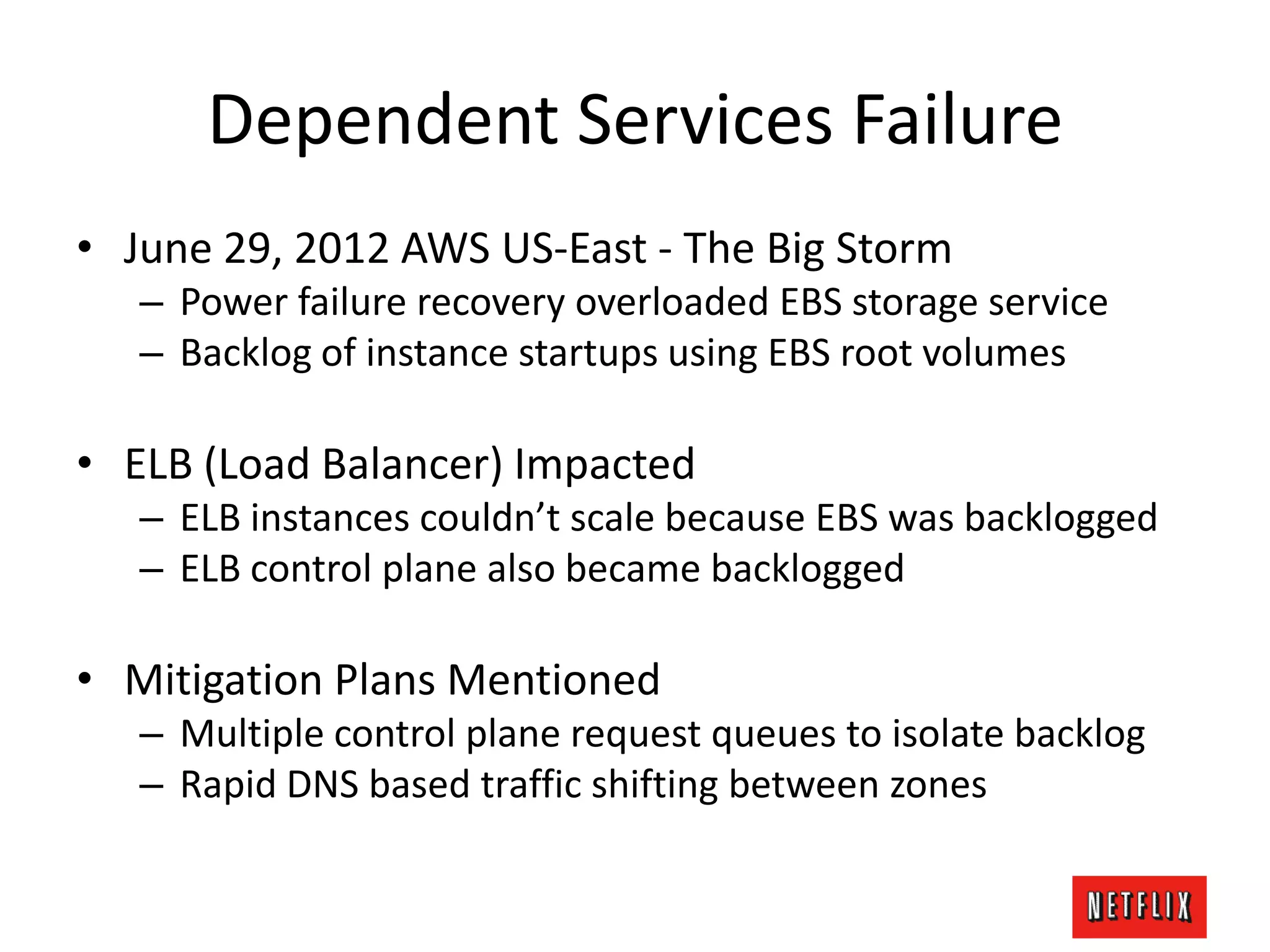
Dependent Services Failure
• June 29, 2012 AWS US-East - The Big Storm
– Power failure recovery overloaded EBS storage service
– Backlog of instance startups using EBS root volumes
• ELB (Load Balancer) Impacted
– ELB instances couldn’t scale because EBS was backlogged
– ELB control plane also became backlogged
• Mitigation Plans Mentioned
– Multiple control plane request queues to isolate backlog
– Rapid DNS based traffic shifting between zones
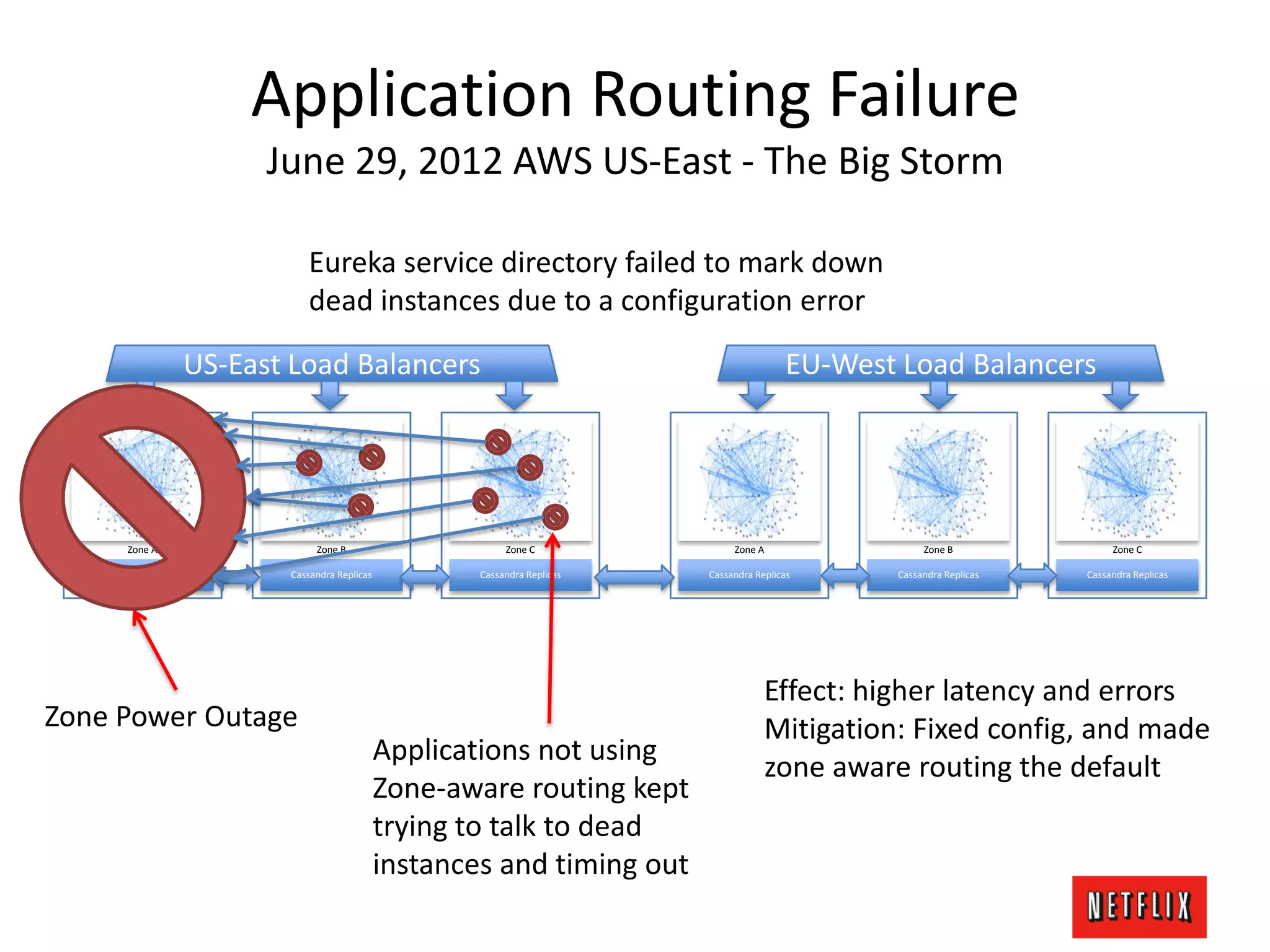
Application Routing Failure
June 29, 2012 AWS US-East - The Big Storm
Cassandra Replicas
Zone A
Cassandra Replicas
Zone B
Cassandra Replicas
Zone C
US-East Load Balancers
Cassandra Replicas
Zone A
Cassandra Replicas
Zone B
Cassandra Replicas
Zone C
EU-West Load Balancers
Zone Power Outage
Applications not using
Zone-aware routing kept
trying to talk to dead
instances and timing out
Eureka service directory failed to mark down
dead instances due to a configuration error
Effect: higher latency and errors
Mitigation: Fixed config, and made
zone aware routing the default
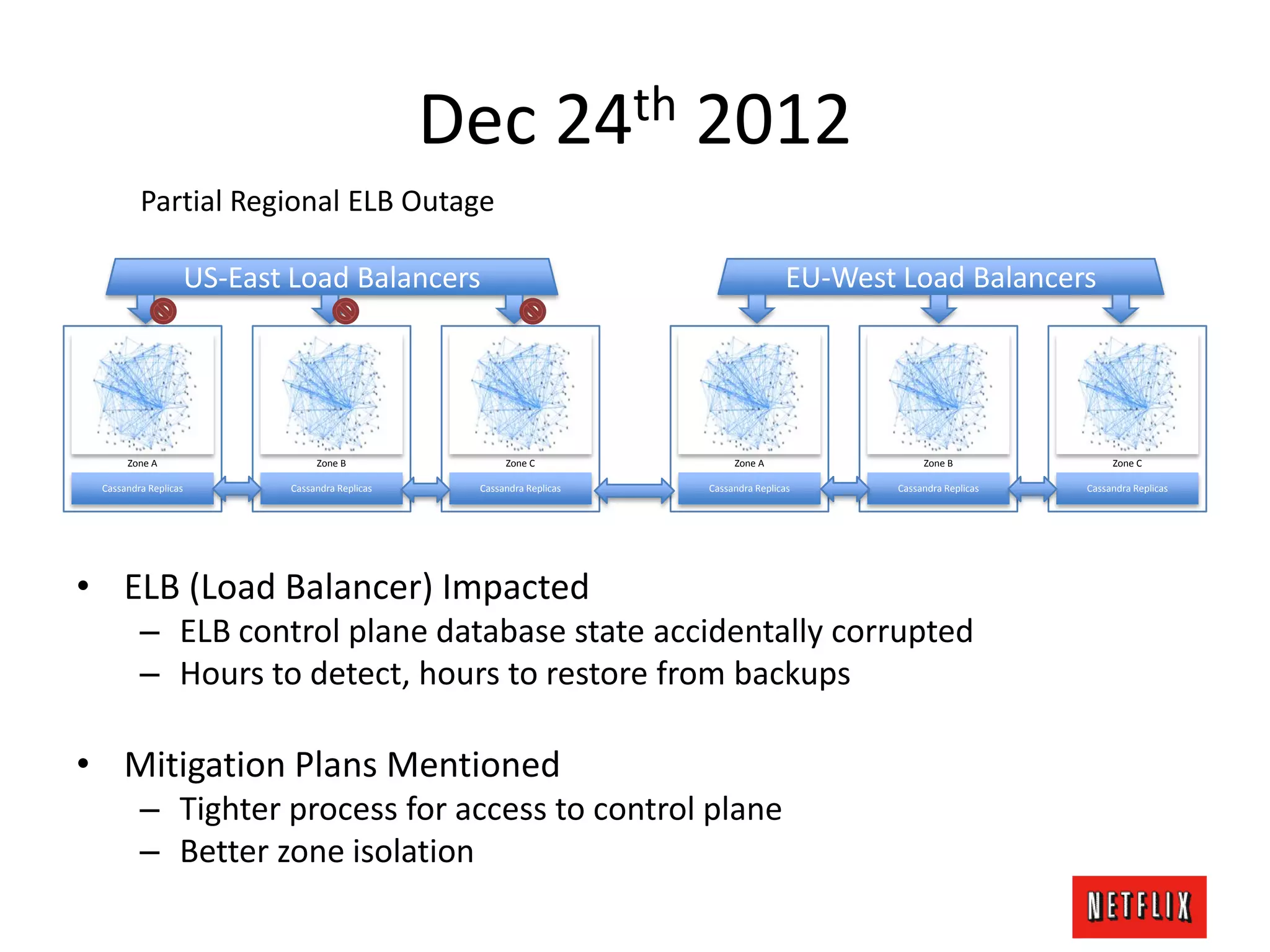
Dec 24th 2012
Cassandra Replicas
Zone A
Cassandra Replicas
Zone B
Cassandra Replicas
Zone C
US-East Load Balancers
Cassandra Replicas
Zone A
Cassandra Replicas
Zone B
Cassandra Replicas
Zone C
EU-West Load Balancers
Partial Regional ELB Outage
• ELB (Load Balancer) Impacted
– ELB control plane database state accidentally corrupted
– Hours to detect, hours to restore from backups
• Mitigation Plans Mentioned
– Tighter process for access to control plane
– Better zone isolation
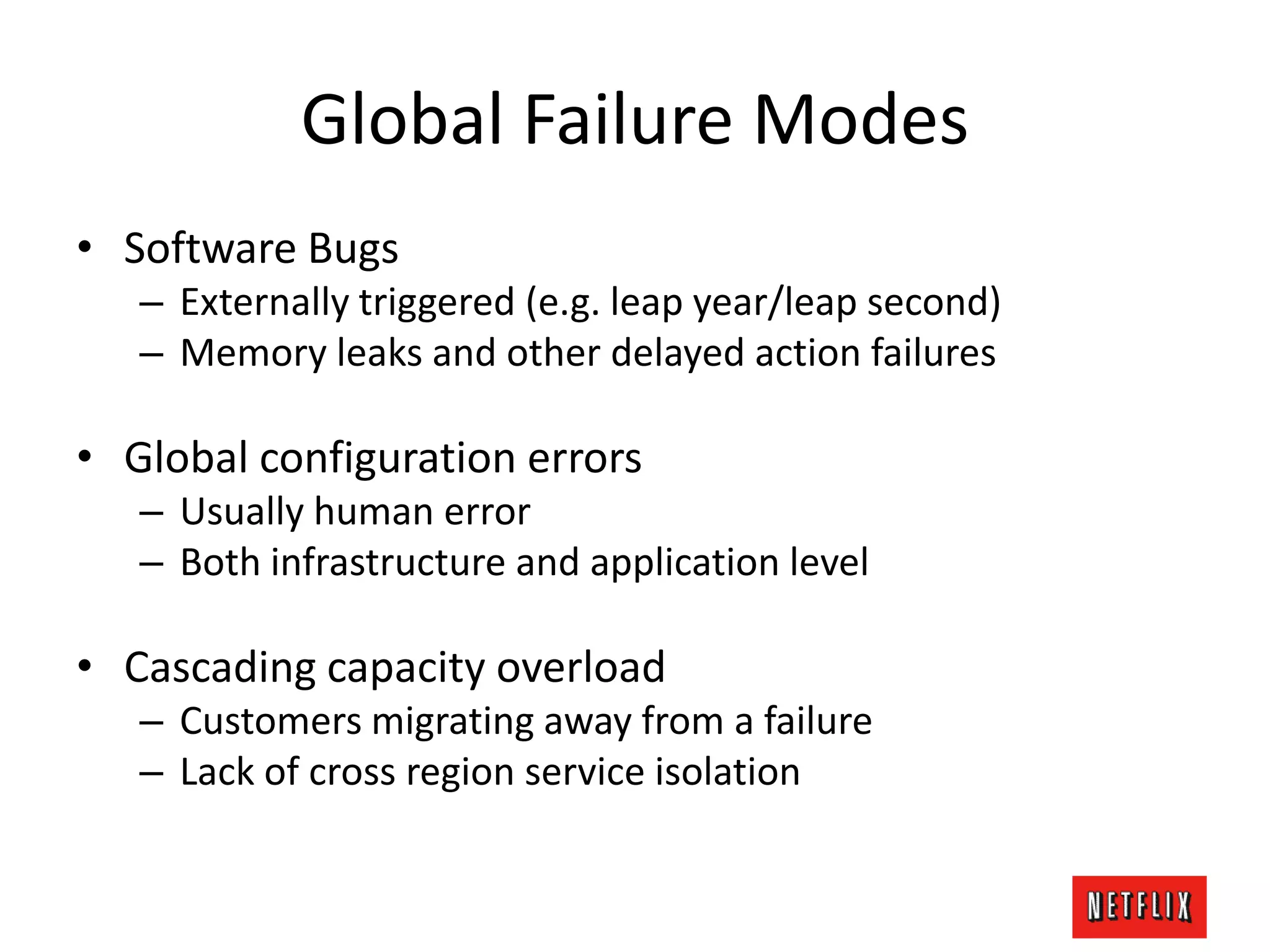
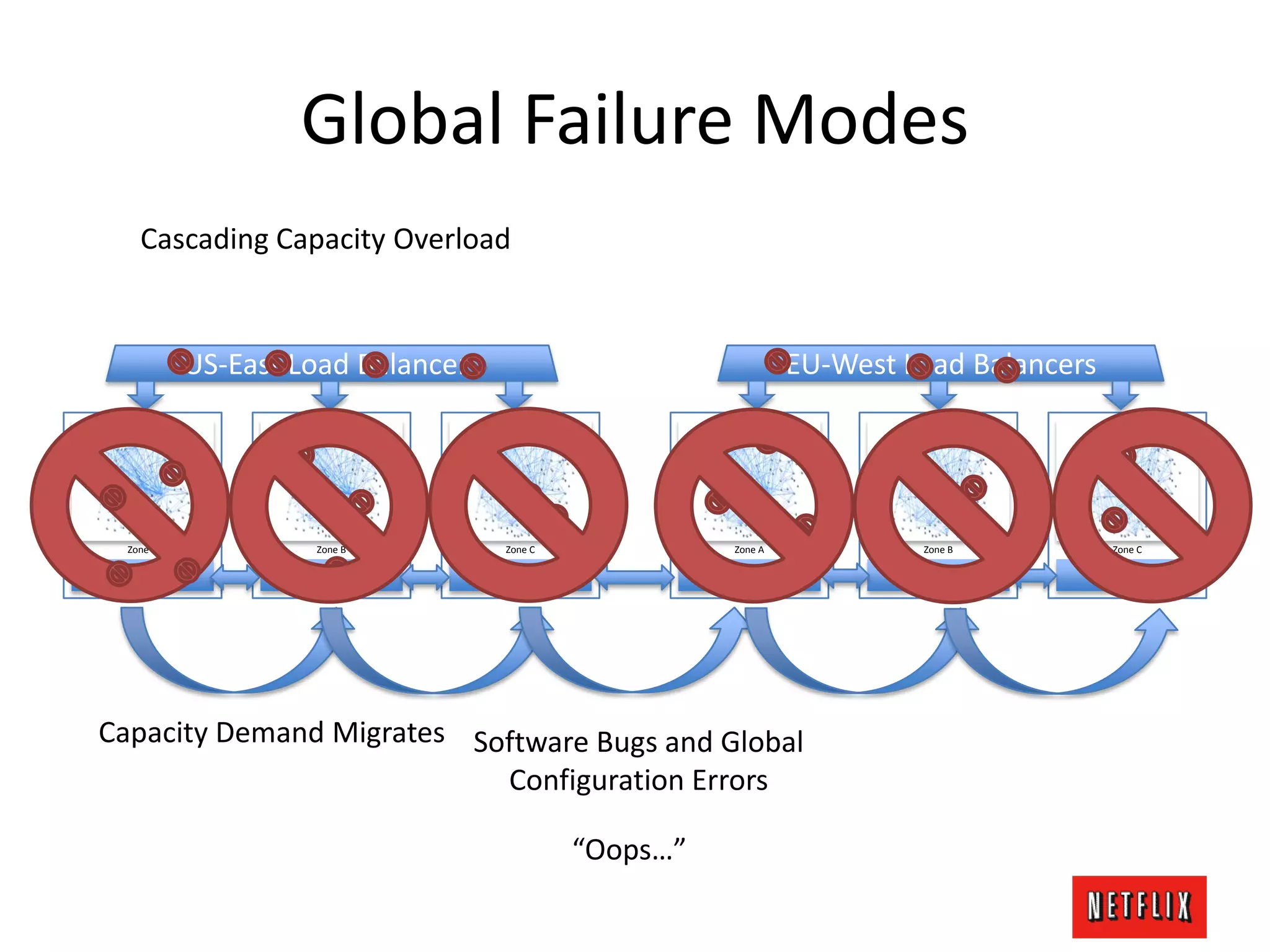
Global Failure Modes
• Software Bugs
– Externally triggered (e.g. leap year/leap second)
– Memory leaks and other delayed action failures
• Global configuration errors
– Usually human error
– Both infrastructure and application level
• Cascading capacity overload
– Customers migrating away from a failure
– Lack of cross region service isolation
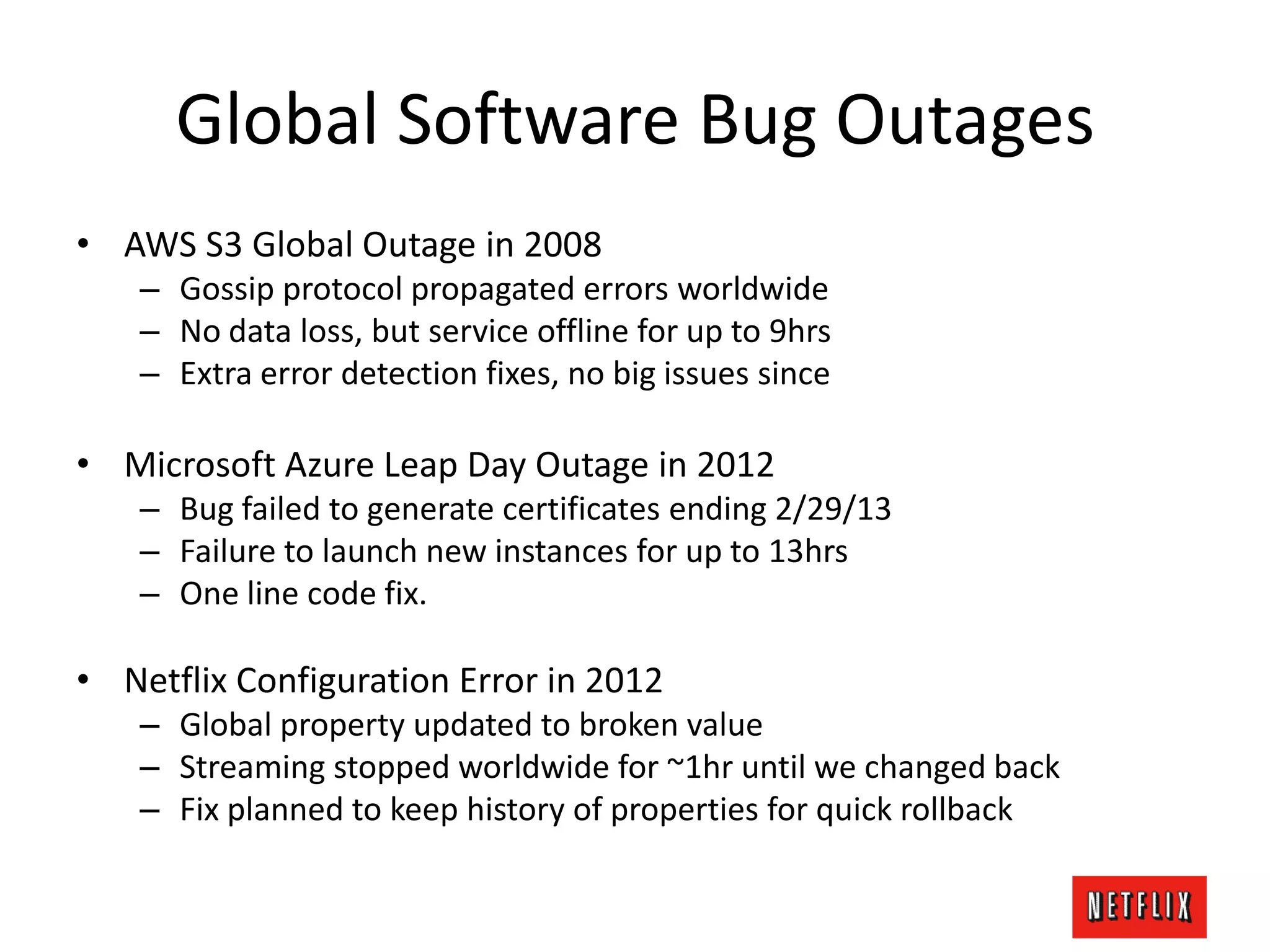
Global Software Bug Outages
• AWS S3 Global Outage in 2008
– Gossip protocol propagated errors worldwide
– No data loss, but service offline for up to 9hrs
– Extra error detection fixes, no big issues since
• Microsoft Azure Leap Day Outage in 2012
– Bug failed to generate certificates ending 2/29/13
– Failure to launch new instances for up to 13hrs
– One line code fix.
• Netflix Configuration Error in 2012
– Global property updated to broken value
– Streaming stopped worldwide for ~1hr until we changed back
– Fix planned to keep history of properties for quick rollback
Global Failure Modes
Cassandra Replicas
Zone A
Cassandra Replicas
Zone B
Cassandra Replicas
Zone C
US-East Load Balancers
Cassandra Replicas
Zone A
Cassandra Replicas
Zone B
Cassandra Replicas
Zone C
EU-West Load Balancers
Cascading Capacity Overload
Software Bugs and Global
Configuration Errors
Capacity Demand Migrates
“Oops…”
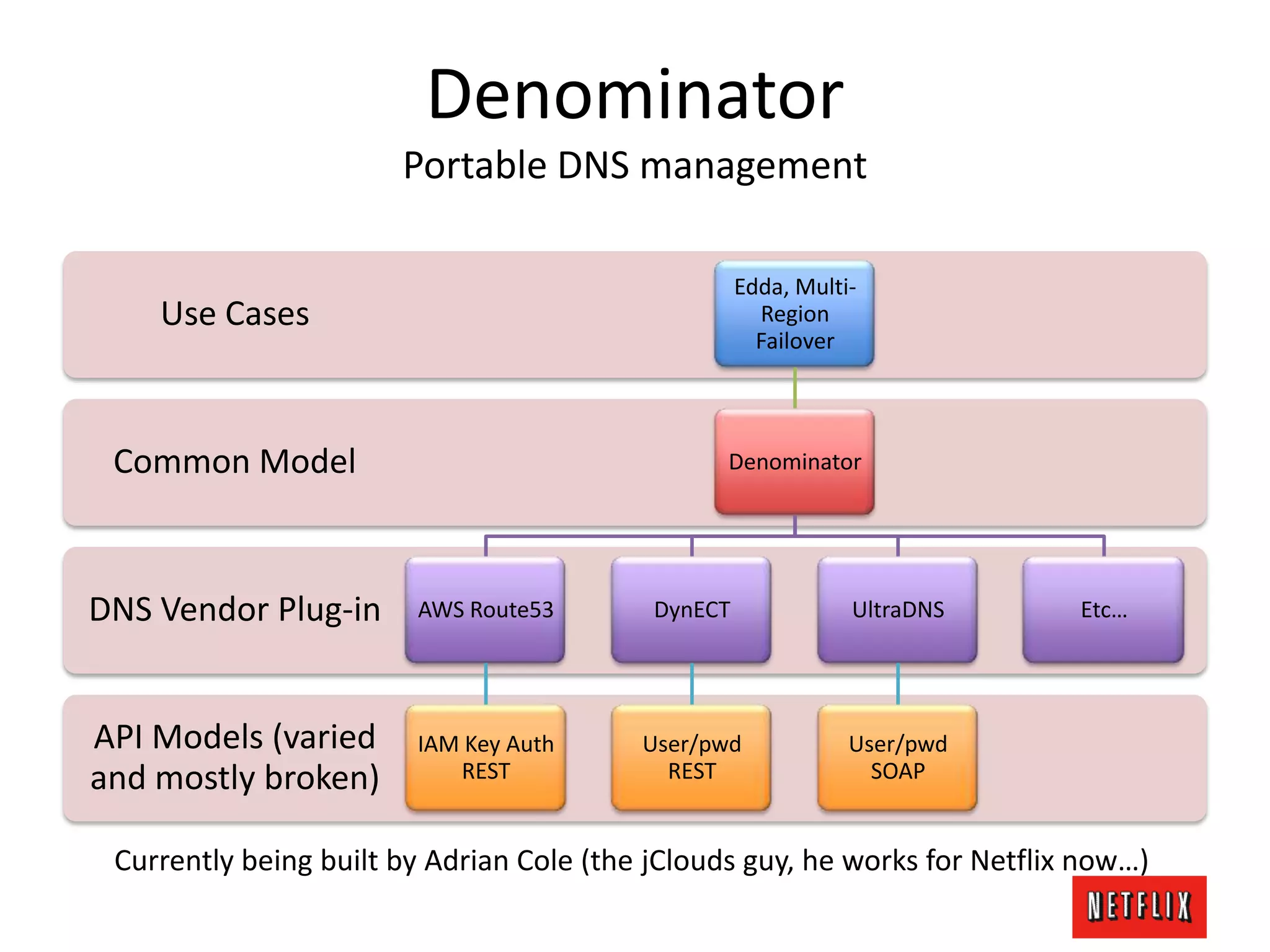
Denominator
Portable DNS management
API Models (varied
and mostly broken)
DNS Vendor Plug-in
Common Model
Use Cases
Edda, Multi-
Region
Failover
Denominator
AWS Route53
IAM Key Auth
REST
DynECT
User/pwd
REST
UltraDNS
User/pwd
SOAP
Etc…
Currently being built by Adrian Cole (the jClouds guy, he works for Netflix now…)
Highly Available Storage
A highly scalable, available and
durable deployment pattern
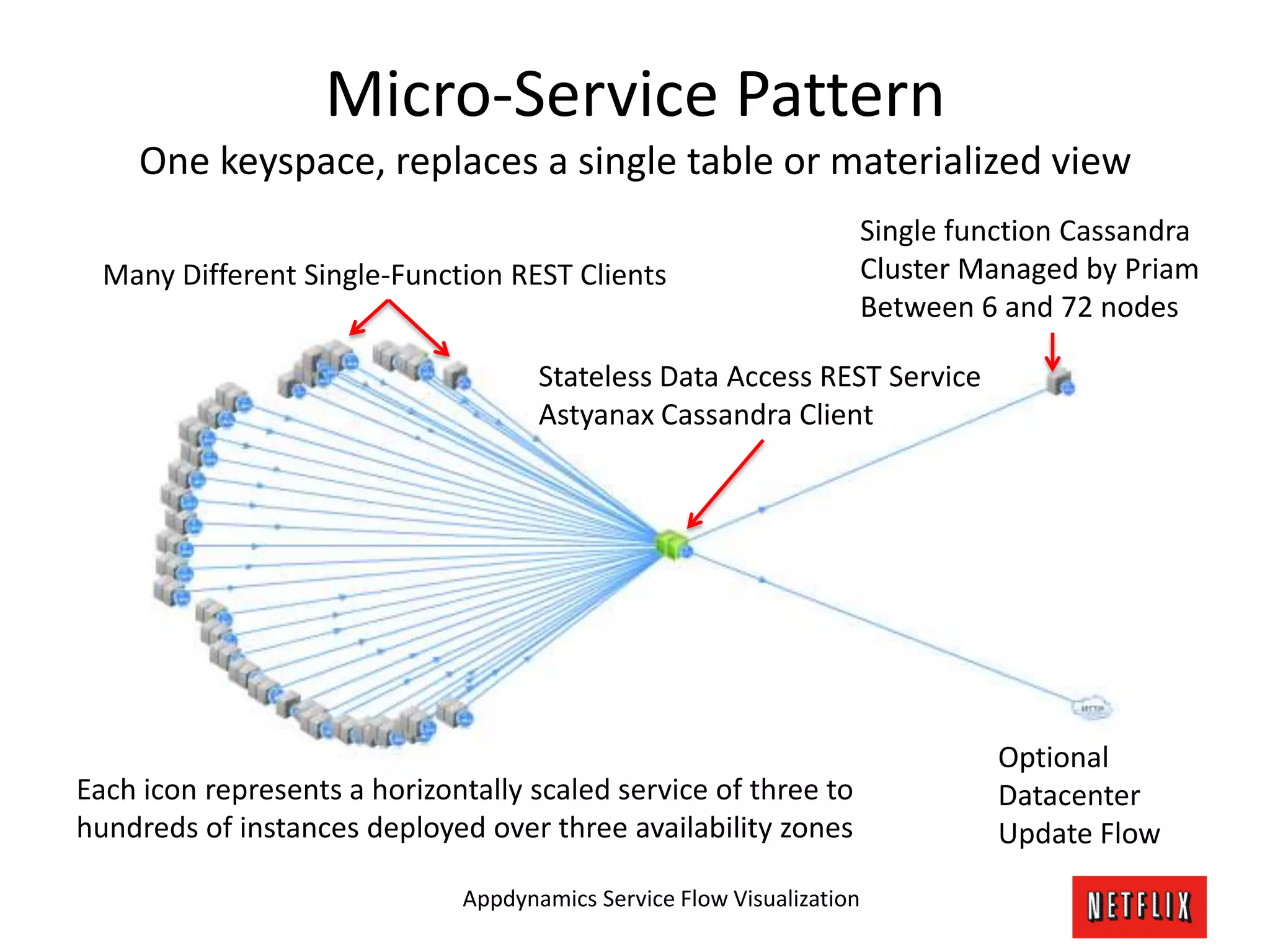
Micro-Service Pattern
One keyspace, replaces a single table or materialized view
Single function Cassandra
Cluster Managed by Priam
Between 6 and 72 nodes
Stateless Data Access REST Service
Astyanax Cassandra Client
Optional
Datacenter
Update Flow
Many Different Single-Function REST Clients
Appdynamics Service Flow Visualization
Each icon represents a horizontally scaled service of three to
hundreds of instances deployed over three availability zones
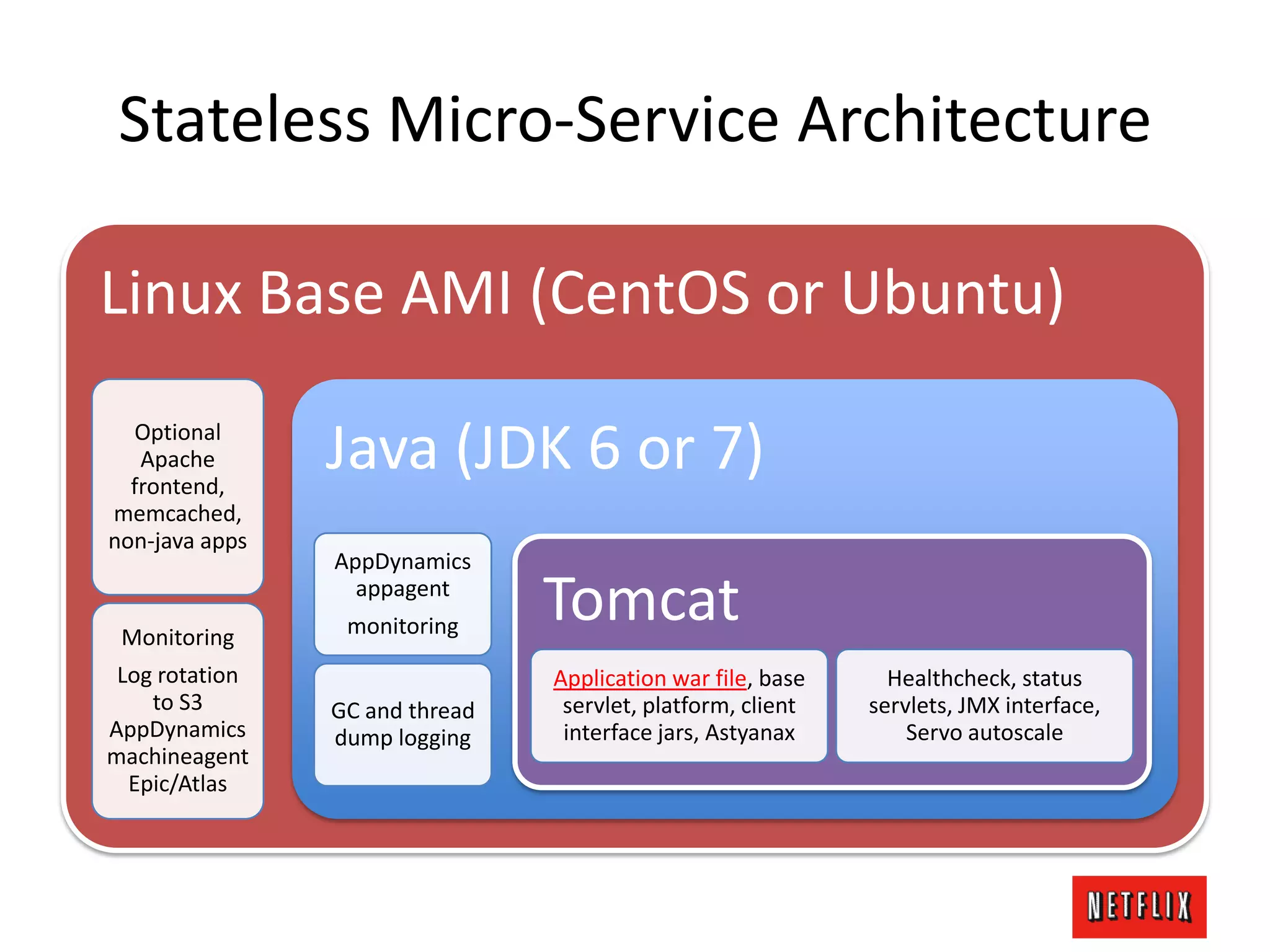
Stateless Micro-Service Architecture
Linux Base AMI (CentOS or Ubuntu)
Optional
Apache
frontend,
memcached,
non-java apps
Monitoring
Log rotation
to S3
AppDynamics
machineagent
Epic/Atlas
Java (JDK 6 or 7)
AppDynamics
appagent
monitoring
GC and thread
dump logging
Tomcat
Application war file, base
servlet, platform, client
interface jars, Astyanax
Healthcheck, status
servlets, JMX interface,
Servo autoscale
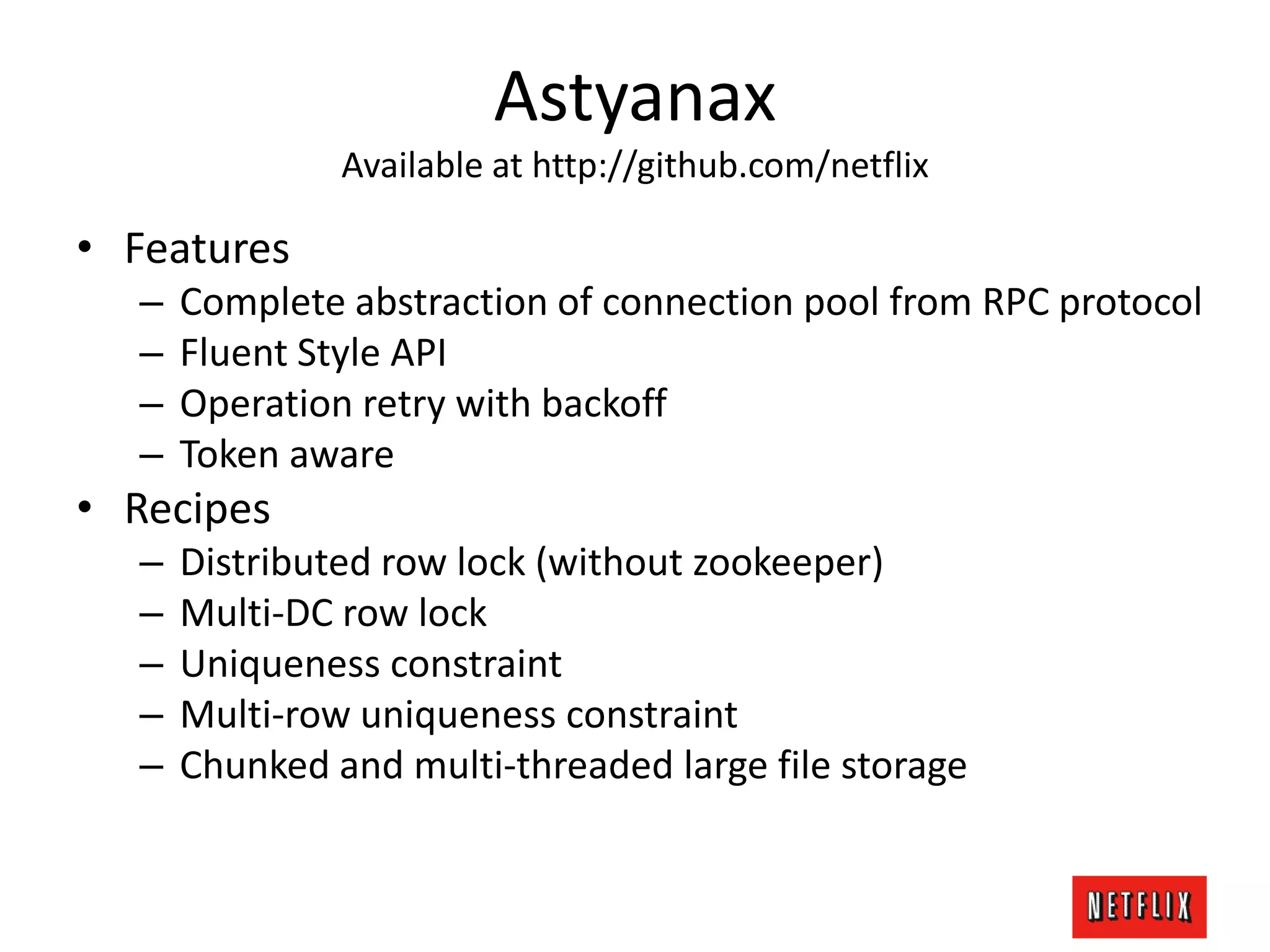
Astyanax
Available at http://github.com/netflix
• Features
– Complete abstraction of connection pool from RPC protocol
– Fluent Style API
– Operation retry with backoff
– Token aware
• Recipes
– Distributed row lock (without zookeeper)
– Multi-DC row lock
– Uniqueness constraint
– Multi-row uniqueness constraint
– Chunked and multi-threaded large file storage
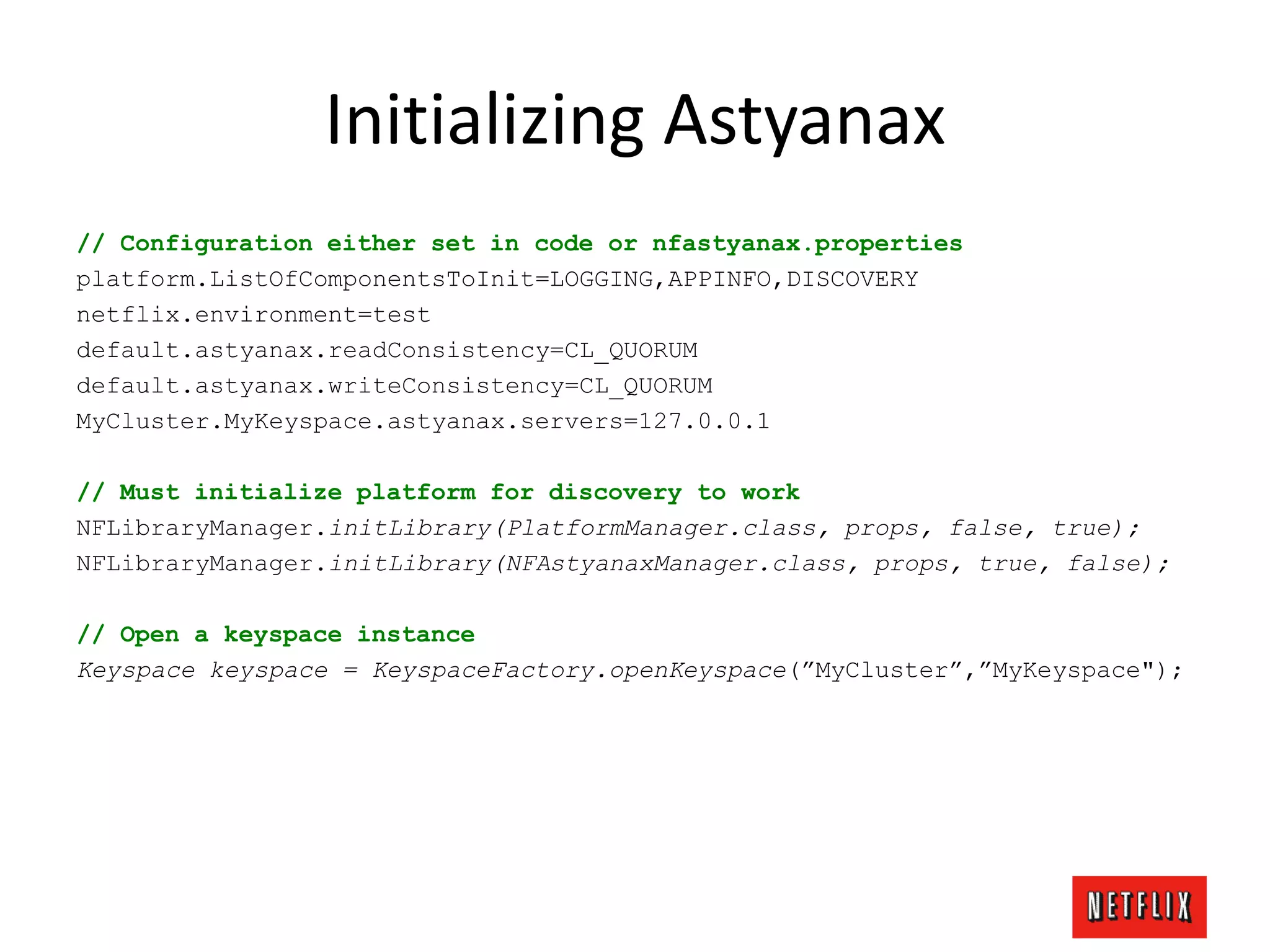
Initializing Astyanax
// Configuration either set in code or nfastyanax.properties
platform.ListOfComponentsToInit=LOGGING,APPINFO,DISCOVERY
netflix.environment=test
default.astyanax.readConsistency=CL_QUORUM
default.astyanax.writeConsistency=CL_QUORUM
MyCluster.MyKeyspace.astyanax.servers=127.0.0.1
// Must initialize platform for discovery to work
NFLibraryManager.initLibrary(PlatformManager.class, props, false, true);
NFLibraryManager.initLibrary(NFAstyanaxManager.class, props, true, false);
// Open a keyspace instance
Keyspace keyspace = KeyspaceFactory.openKeyspace(”MyCluster”,”MyKeyspace");
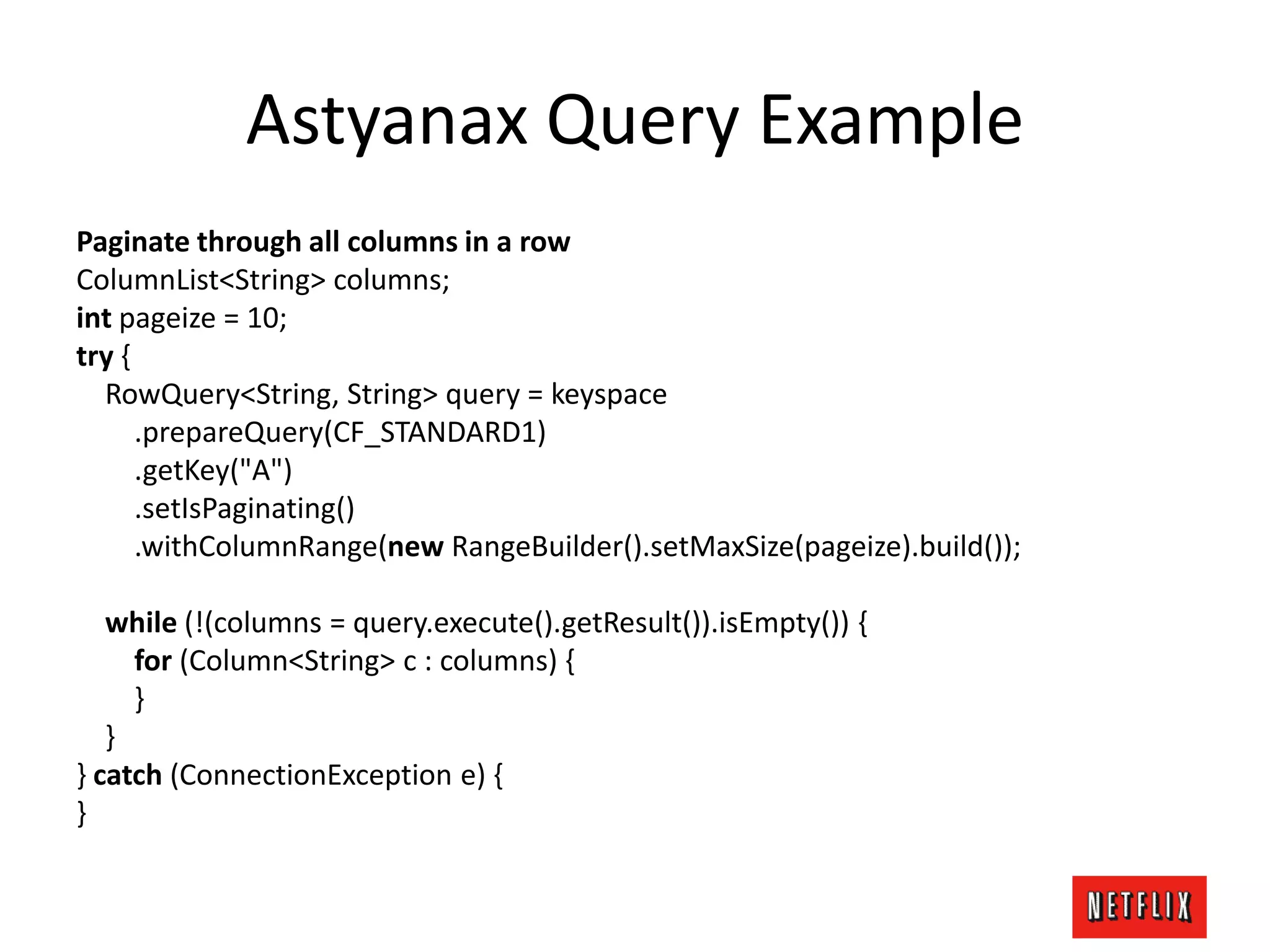
Astyanax Query Example
Paginate through all columns in a row
ColumnList<String> columns;
int pageize = 10;
try {
RowQuery<String, String> query = keyspace
.prepareQuery(CF_STANDARD1)
.getKey("A")
.setIsPaginating()
.withColumnRange(new RangeBuilder().setMaxSize(pageize).build());
while (!(columns = query.execute().getResult()).isEmpty()) {
for (Column<String> c : columns) {
}
}
} catch (ConnectionException e) {
}
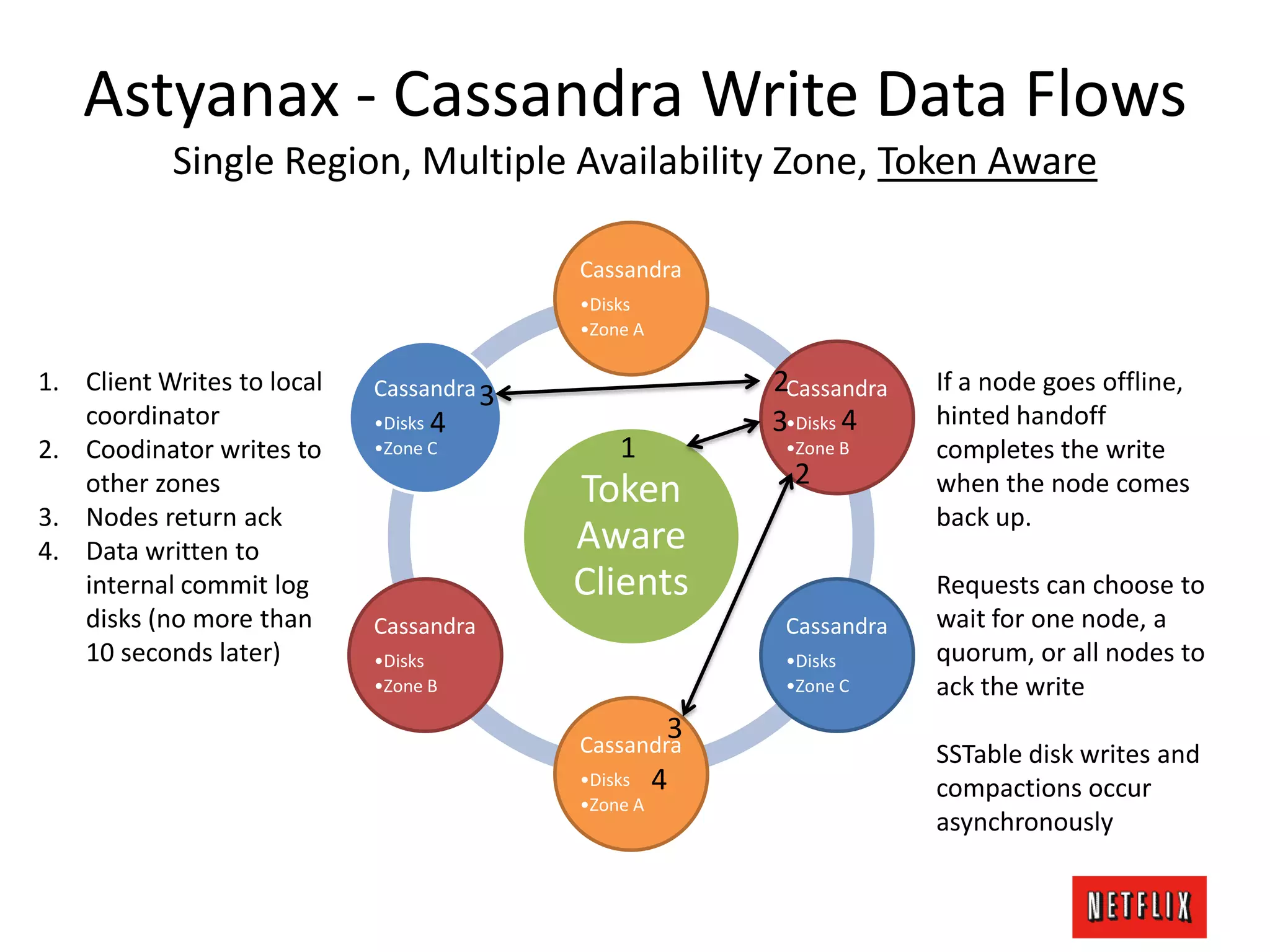
Astyanax - Cassandra Write Data Flows
Single Region, Multiple Availability Zone, Token Aware
Token
Aware
Clients
Cassandra
•Disks
•Zone A
Cassandra
•Disks
•Zone B
Cassandra
•Disks
•Zone C
Cassandra
•Disks
•Zone A
Cassandra
•Disks
•Zone B
Cassandra
•Disks
•Zone C
1. Client Writes to local
coordinator
2. Coodinator writes to
other zones
3. Nodes return ack
4. Data written to
internal commit log
disks (no more than
10 seconds later)
If a node goes offline,
hinted handoff
completes the write
when the node comes
back up.
Requests can choose to
wait for one node, a
quorum, or all nodes to
ack the write
SSTable disk writes and
compactions occur
asynchronously
1
4
4
4
2
3
3
3
2
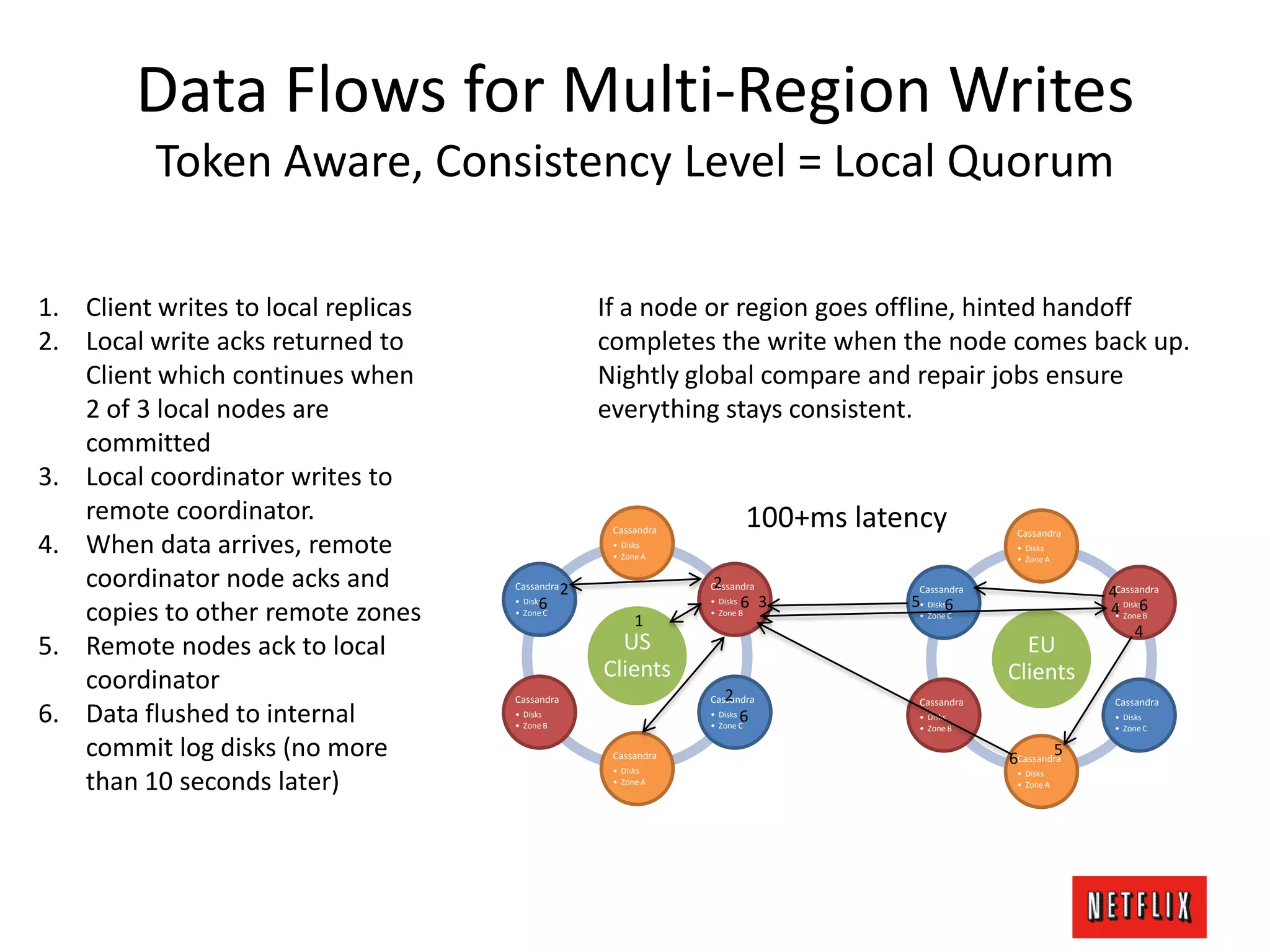
Data Flows for Multi-Region Writes
Token Aware, Consistency Level = Local Quorum
US
Clients
Cassandra
• Disks
• Zone A
Cassandra
• Disks
• Zone B
Cassandra
• Disks
• Zone C
Cassandra
• Disks
• Zone A
Cassandra
• Disks
• Zone B
Cassandra
• Disks
• Zone C
1. Client writes to local replicas
2. Local write acks returned to
Client which continues when
2 of 3 local nodes are
committed
3. Local coordinator writes to
remote coordinator.
4. When data arrives, remote
coordinator node acks and
copies to other remote zones
5. Remote nodes ack to local
coordinator
6. Data flushed to internal
commit log disks (no more
than 10 seconds later)
If a node or region goes offline, hinted handoff
completes the write when the node comes back up.
Nightly global compare and repair jobs ensure
everything stays consistent.
EU
Clients
Cassandra
• Disks
• Zone A
Cassandra
• Disks
• Zone B
Cassandra
• Disks
• Zone C
Cassandra
• Disks
• Zone A
Cassandra
• Disks
• Zone B
Cassandra
• Disks
• Zone C
6
5
5
6 6
4
4
4
1
6
6
6
2
2
2
3
100+ms latency
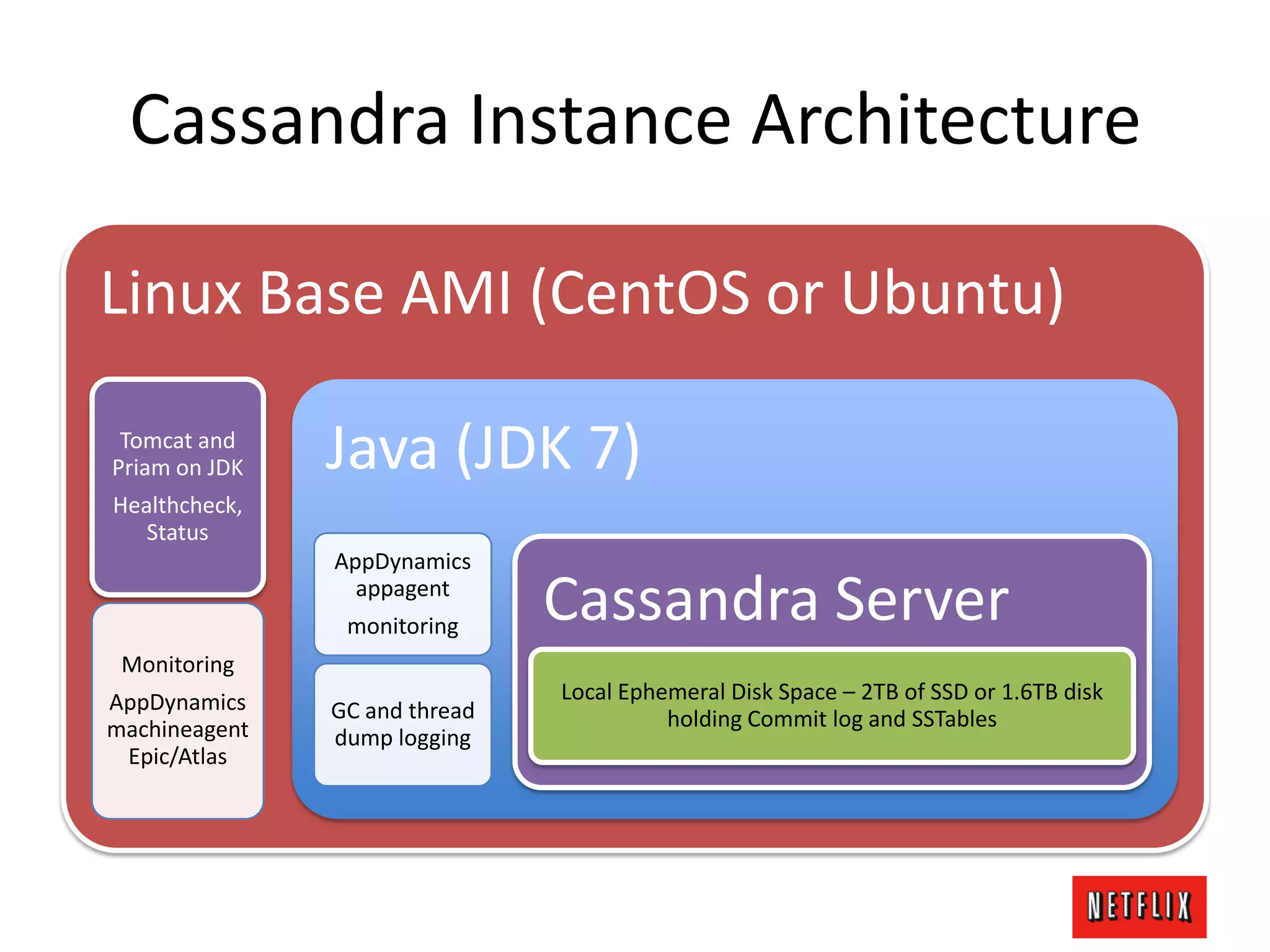
Cassandra Instance Architecture
Linux Base AMI (CentOS or Ubuntu)
Tomcat and
Priam on JDK
Healthcheck,
Status
Monitoring
AppDynamics
machineagent
Epic/Atlas
Java (JDK 7)
AppDynamics
appagent
monitoring
GC and thread
dump logging
Cassandra Server
Local Ephemeral Disk Space – 2TB of SSD or 1.6TB disk
holding Commit log and SSTables
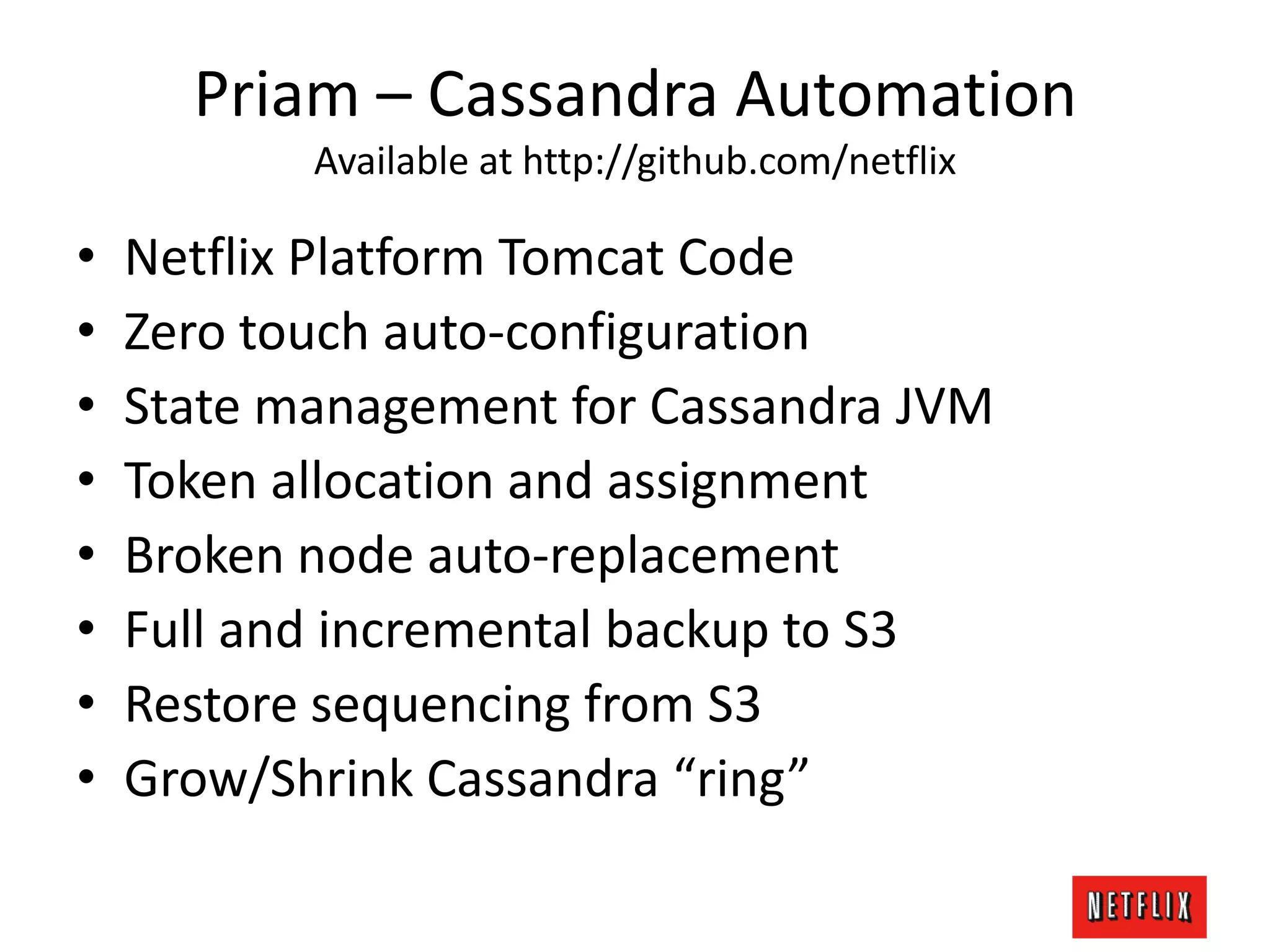
Priam – Cassandra Automation
Available at http://github.com/netflix
• Netflix Platform Tomcat Code
• Zero touch auto-configuration
• State management for Cassandra JVM
• Token allocation and assignment
• Broken node auto-replacement
• Full and incremental backup to S3
• Restore sequencing from S3
• Grow/Shrink Cassandra “ring”
ETL for Cassandra
• Data is de-normalized over many clusters!
• Too many to restore from backups for ETL
• Solution – read backup files using Hadoop
• Aegisthus
– http://techblog.netflix.com/2012/02/aegisthus-bulk-data-pipeline-out-of.html
– High throughput raw SSTable processing
– Re-normalizes many clusters to a consistent view
– Extract, Transform, then Load into Teradata
Cloud Architecture Patterns
Where do we start?
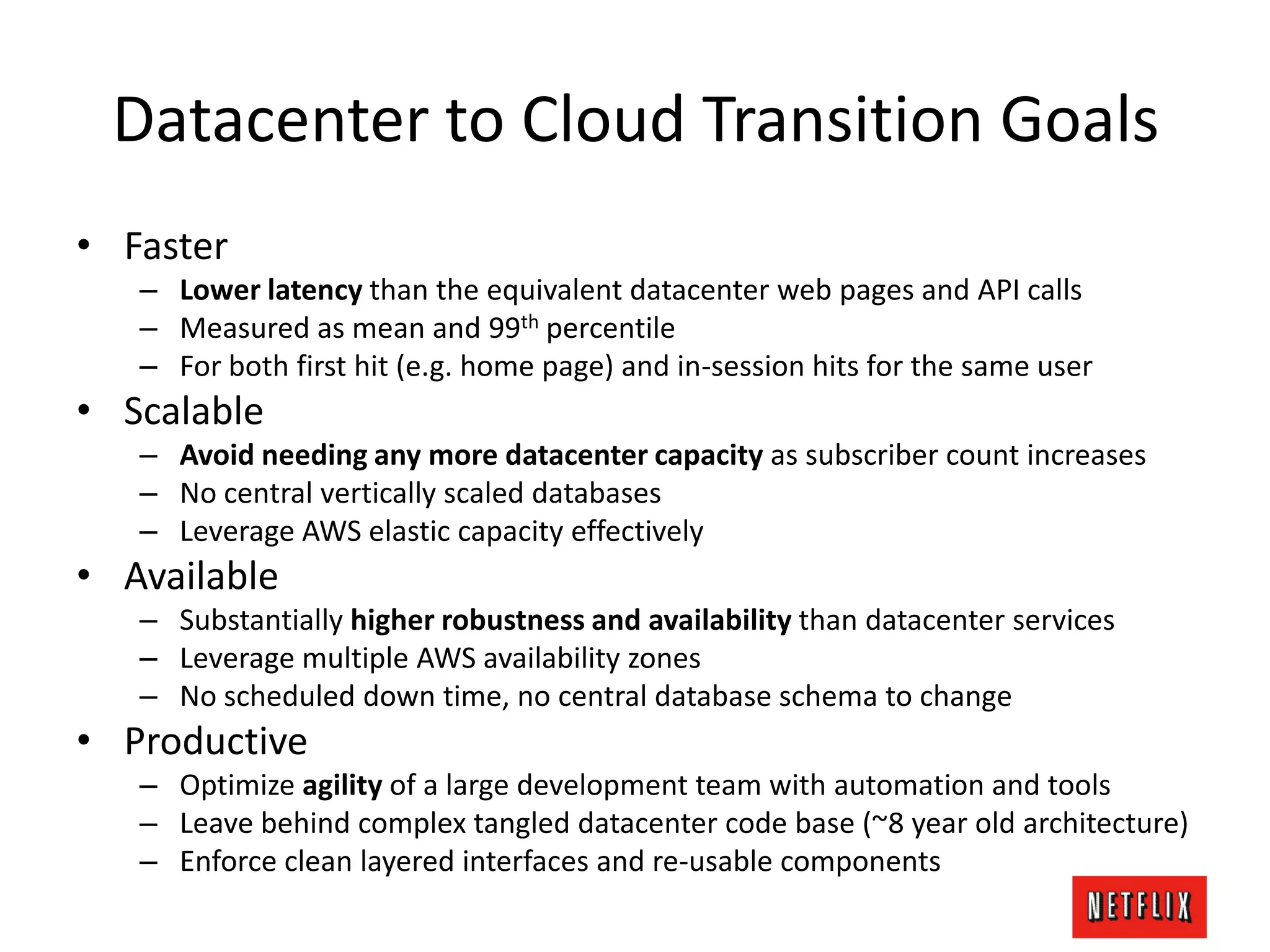
Datacenter to Cloud Transition Goals
• Faster
– Lower latency than the equivalent datacenter web pages and API calls
– Measured as mean and 99th percentile
– For both first hit (e.g. home page) and in-session hits for the same user
• Scalable
– Avoid needing any more datacenter capacity as subscriber count increases
– No central vertically scaled databases
– Leverage AWS elastic capacity effectively
• Available
– Substantially higher robustness and availability than datacenter services
– Leverage multiple AWS availability zones
– No scheduled down time, no central database schema to change
• Productive
– Optimize agility of a large development team with automation and tools
– Leave behind complex tangled datacenter code base (~8 year old architecture)
– Enforce clean layered interfaces and re-usable components
Datacenter Anti-Patterns
What do we currently do in the
datacenter that prevents us from
meeting our goals?
Rewrite from Scratch
Not everything is cloud specific
Pay down technical debt
Robust patterns
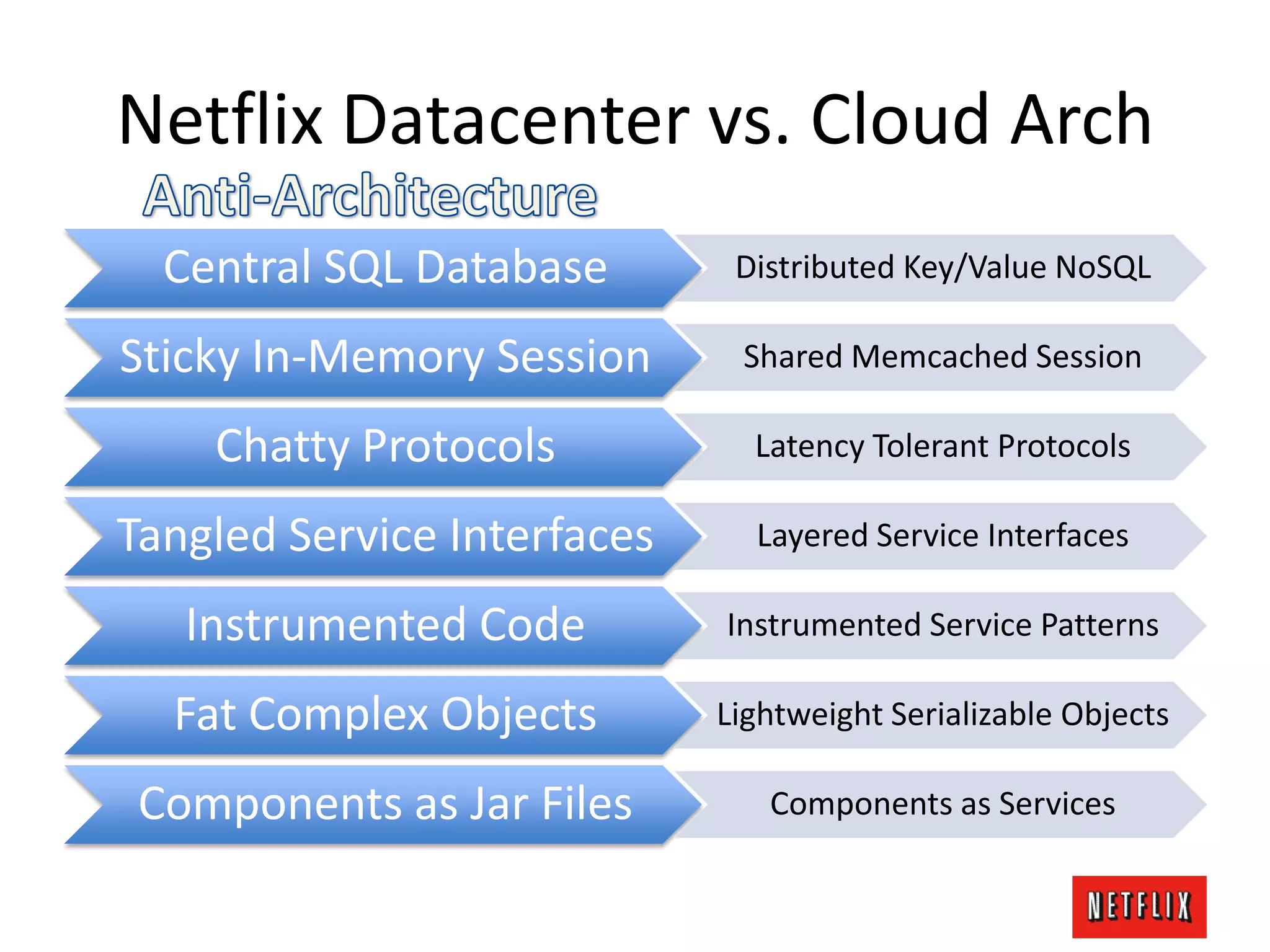
Netflix Datacenter vs. Cloud Arch
Central SQL Database Distributed Key/Value NoSQL
Sticky In-Memory Session Shared Memcached Session
Chatty Protocols Latency Tolerant Protocols
Tangled Service Interfaces Layered Service Interfaces
Instrumented Code Instrumented Service Patterns
Fat Complex Objects Lightweight Serializable Objects
Components as Jar Files Components as Services
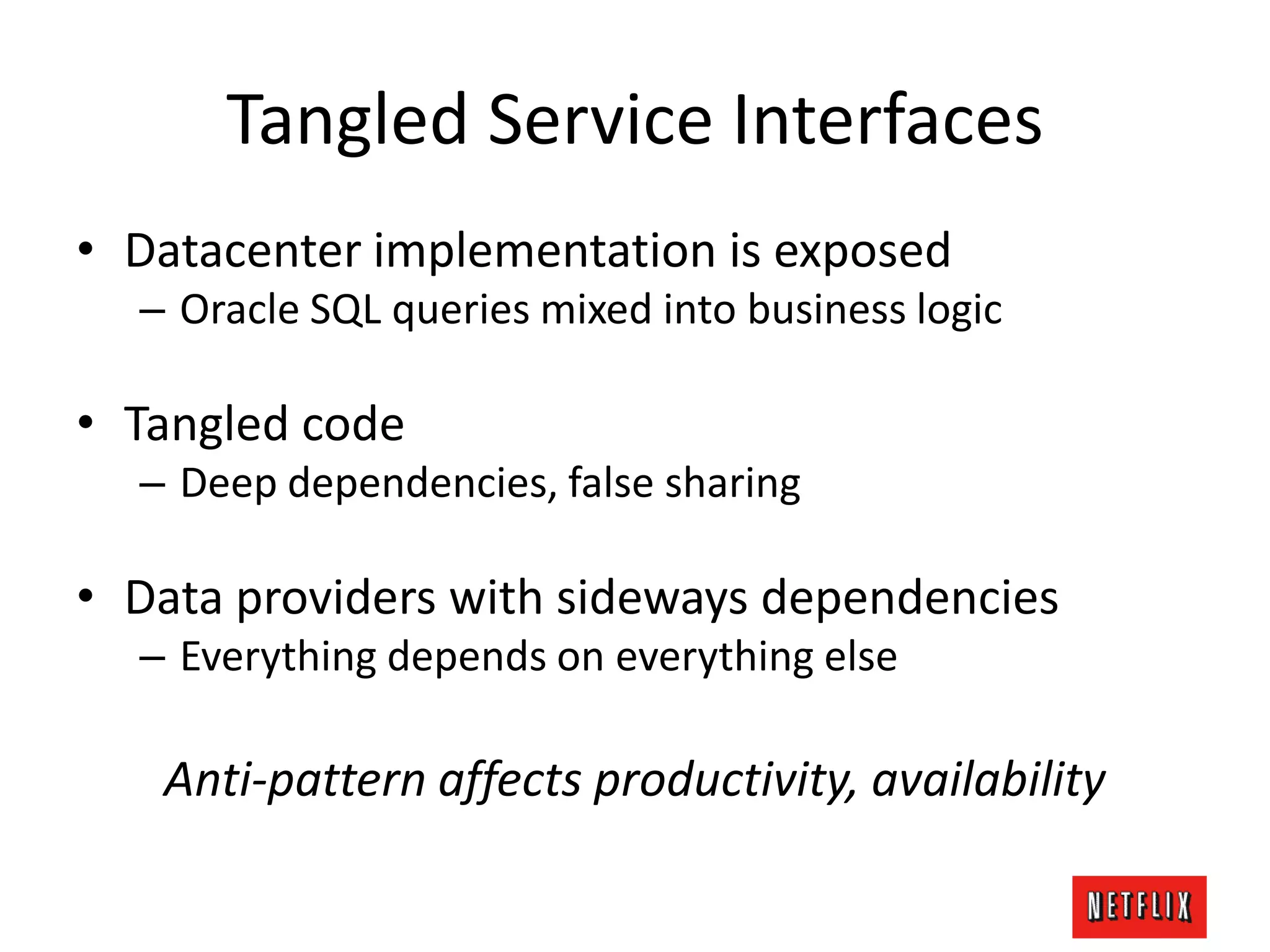
Tangled Service Interfaces
• Datacenter implementation is exposed
– Oracle SQL queries mixed into business logic
• Tangled code
– Deep dependencies, false sharing
• Data providers with sideways dependencies
– Everything depends on everything else
Anti-pattern affects productivity, availability
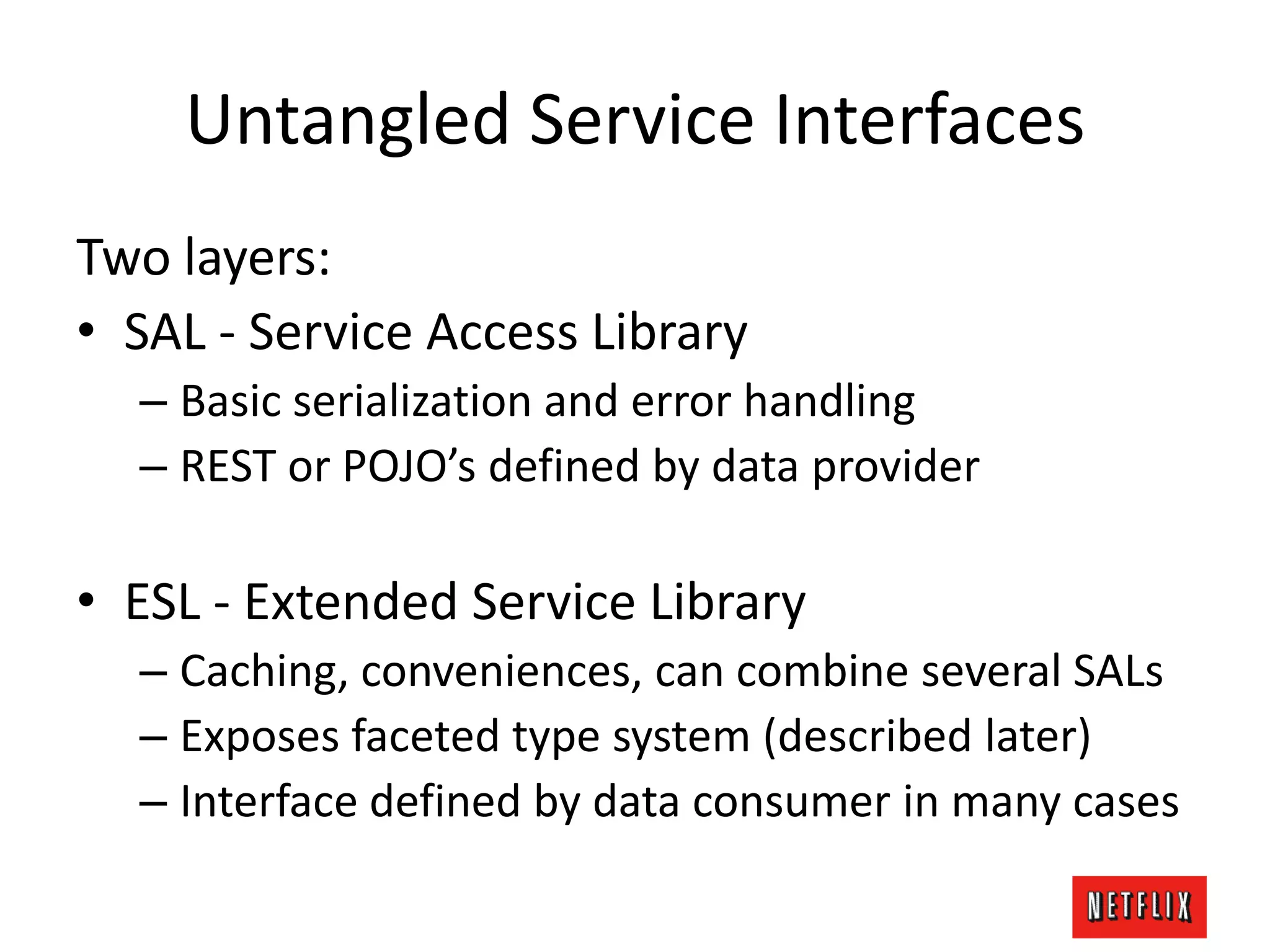
Untangled Service Interfaces
Two layers:
• SAL - Service Access Library
– Basic serialization and error handling
– REST or POJO’s defined by data provider
• ESL - Extended Service Library
– Caching, conveniences, can combine several SALs
– Exposes faceted type system (described later)
– Interface defined by data consumer in many cases
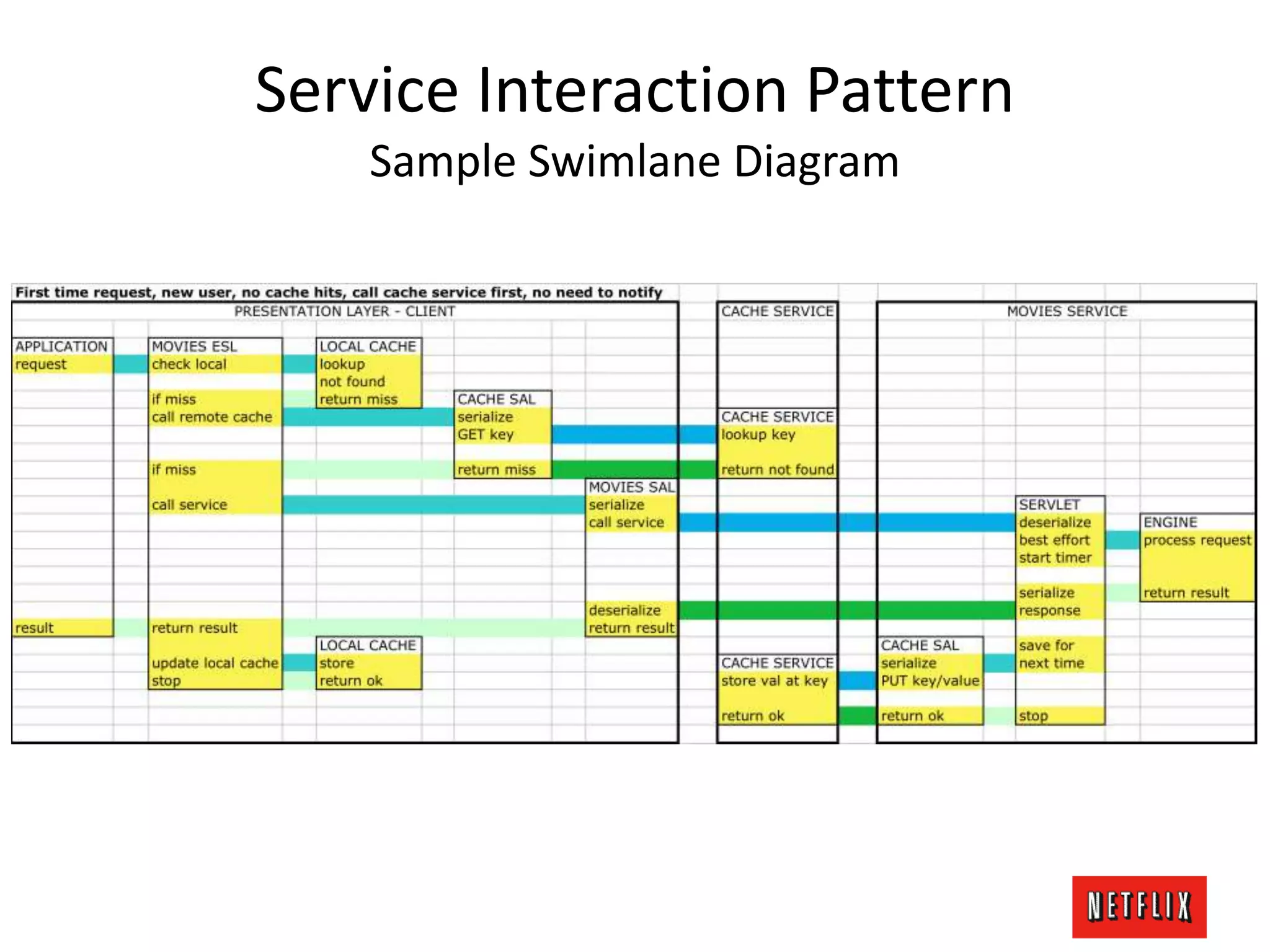
Service Interaction Pattern
Sample Swimlane Diagram
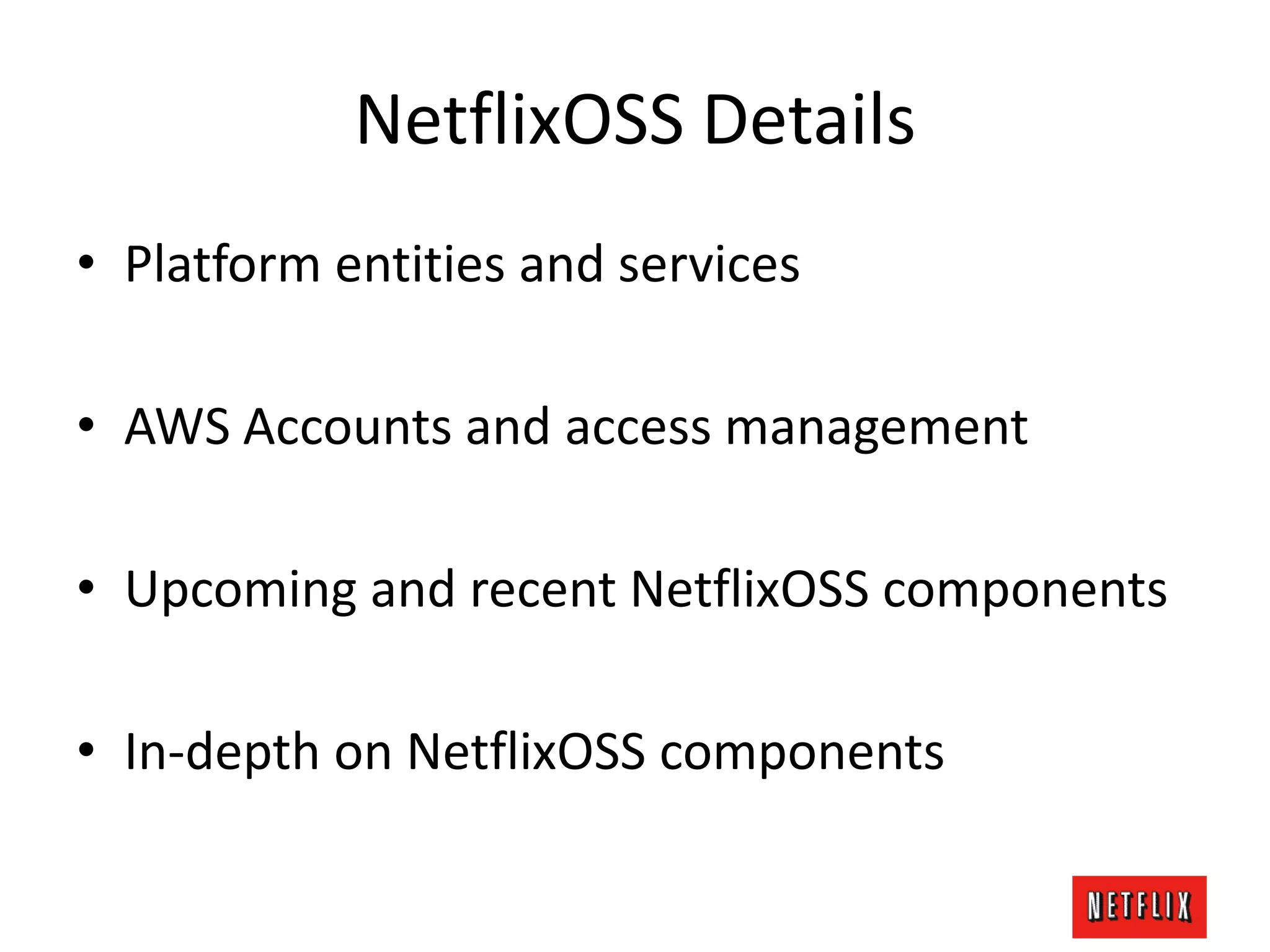
NetflixOSS Details
• Platform entities and services
• AWS Accounts and access management
• Upcoming and recent NetflixOSS components
• In-depth on NetflixOSS components
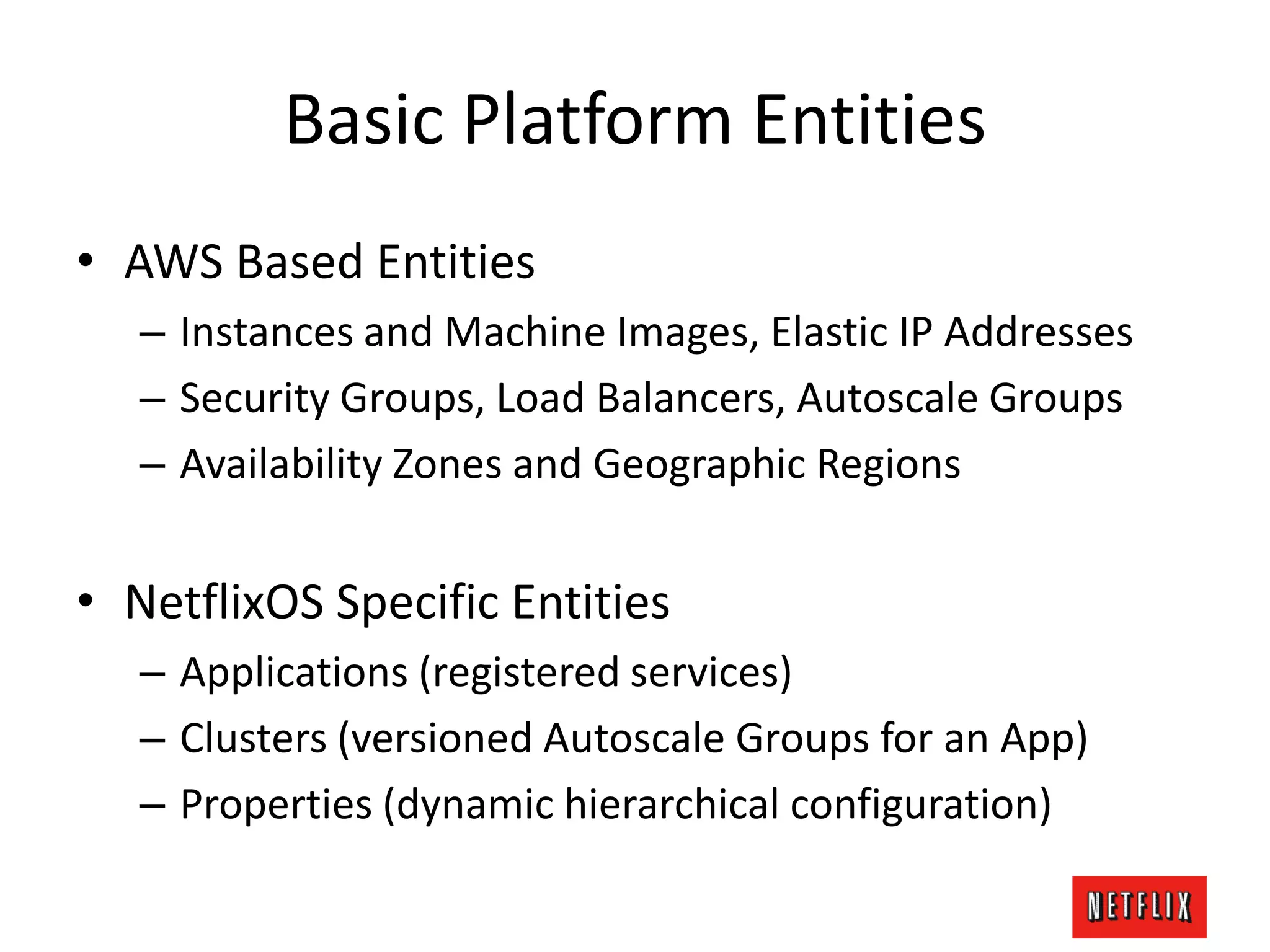
Basic Platform Entities
• AWS Based Entities
– Instances and Machine Images, Elastic IP Addresses
– Security Groups, Load Balancers, Autoscale Groups
– Availability Zones and Geographic Regions
• NetflixOS Specific Entities
– Applications (registered services)
– Clusters (versioned Autoscale Groups for an App)
– Properties (dynamic hierarchical configuration)
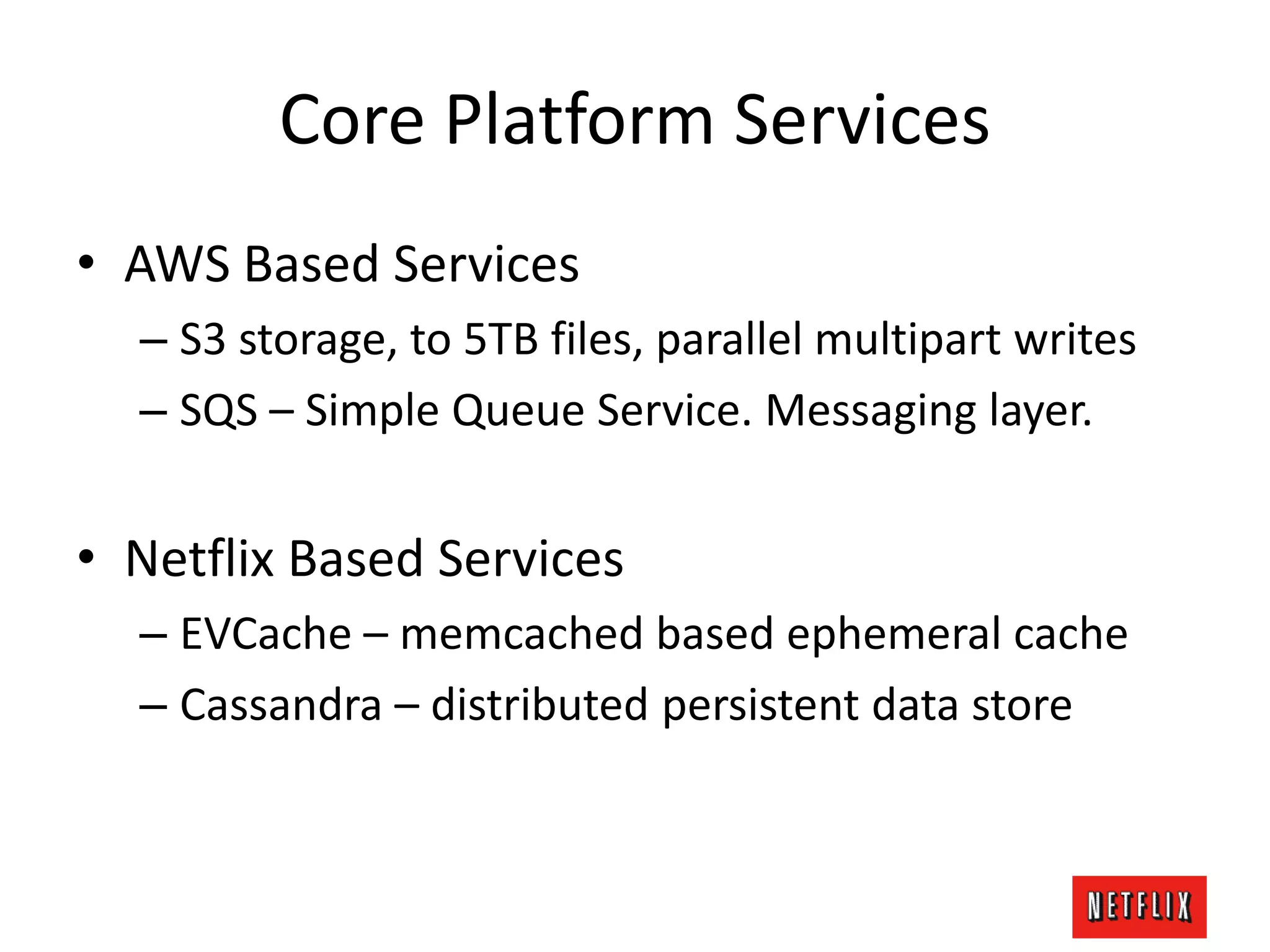
Core Platform Services
• AWS Based Services
– S3 storage, to 5TB files, parallel multipart writes
– SQS – Simple Queue Service. Messaging layer.
• Netflix Based Services
– EVCache – memcached based ephemeral cache
– Cassandra – distributed persistent data store
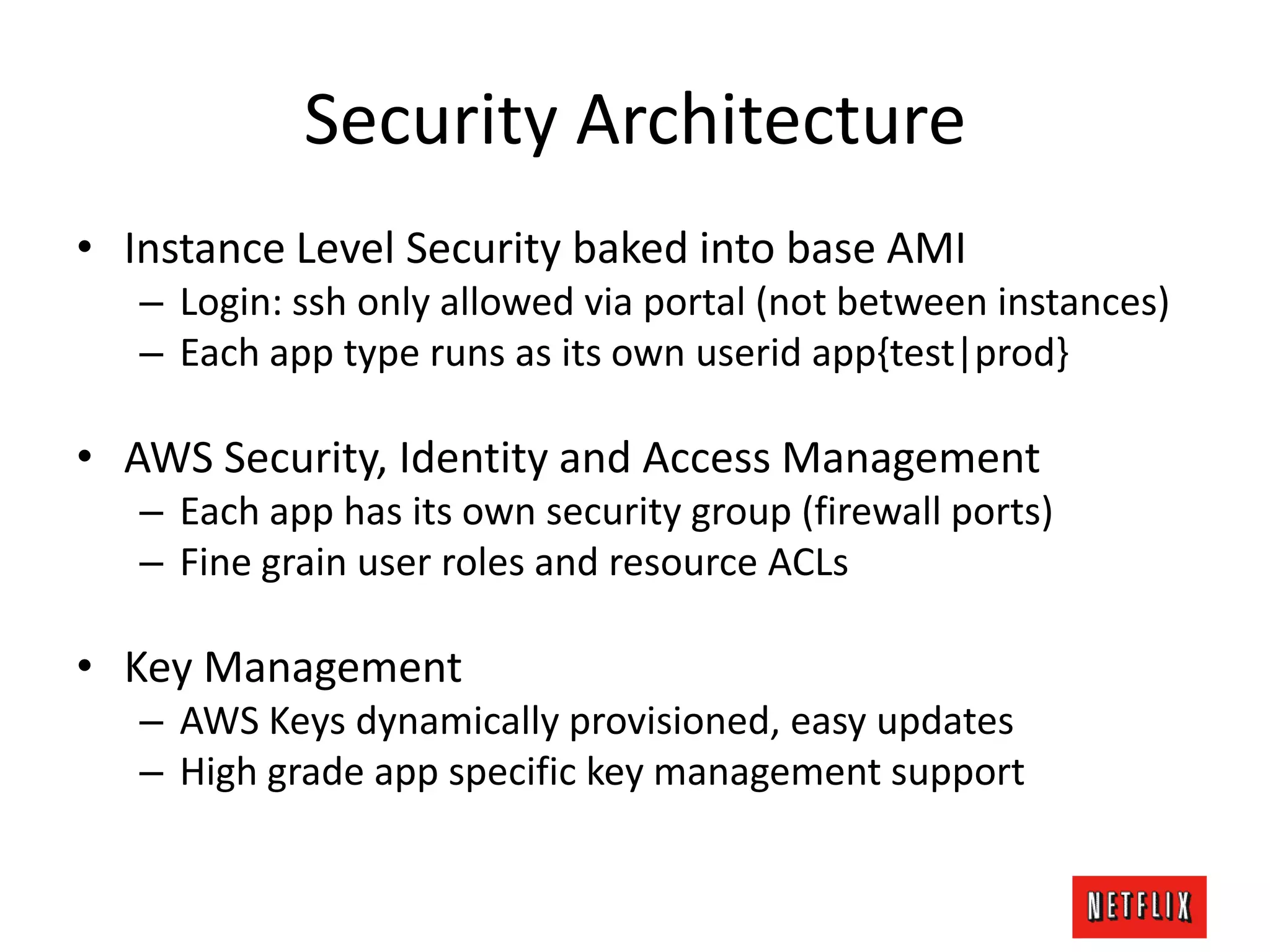
Security Architecture
• Instance Level Security baked into base AMI
– Login: ssh only allowed via portal (not between instances)
– Each app type runs as its own userid app{test|prod}
• AWS Security, Identity and Access Management
– Each app has its own security group (firewall ports)
– Fine grain user roles and resource ACLs
• Key Management
– AWS Keys dynamically provisioned, easy updates
– High grade app specific key management support
AWS Accounts
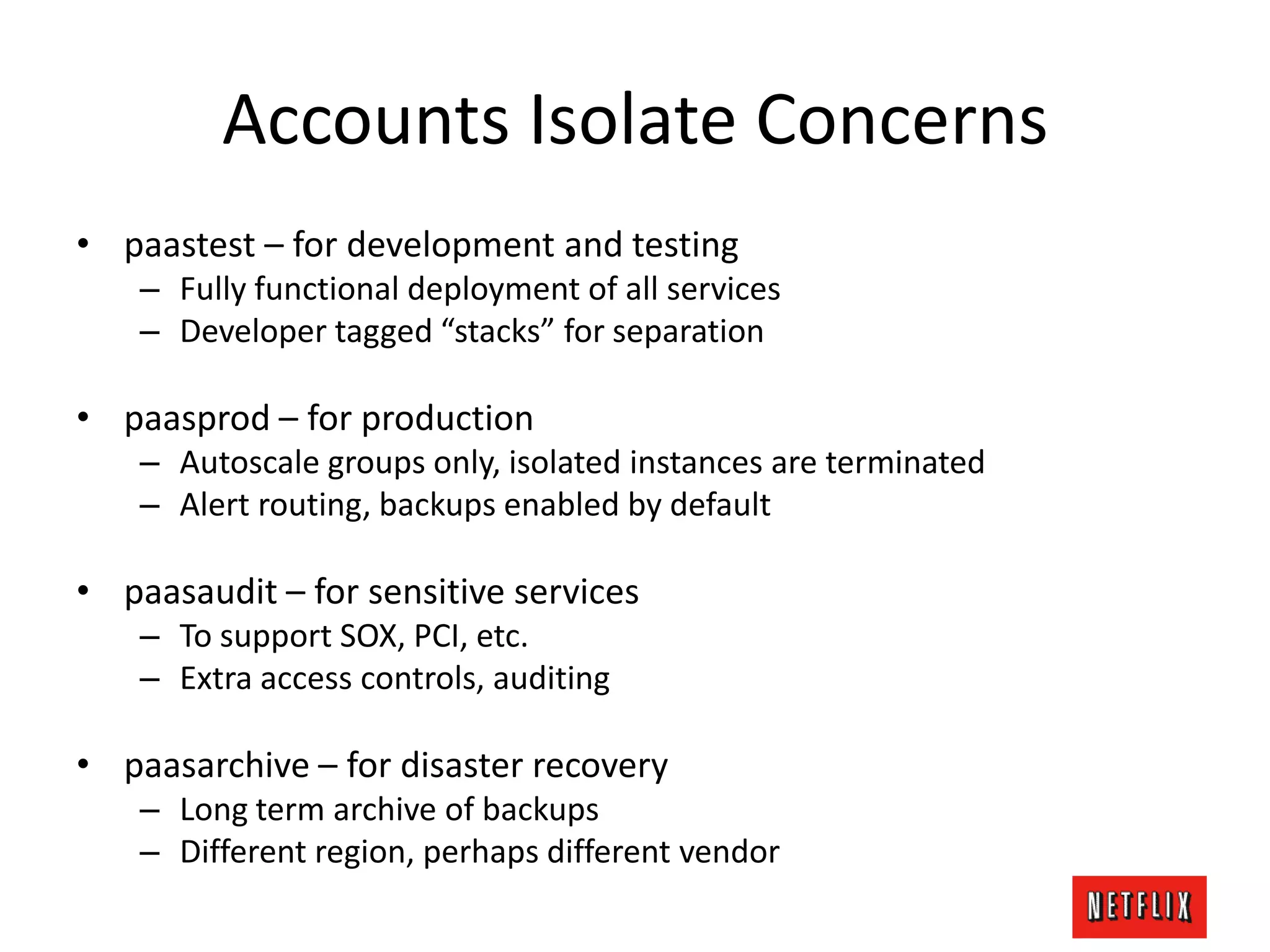
Accounts Isolate Concerns
• paastest – for development and testing
– Fully functional deployment of all services
– Developer tagged “stacks” for separation
• paasprod – for production
– Autoscale groups only, isolated instances are terminated
– Alert routing, backups enabled by default
• paasaudit – for sensitive services
– To support SOX, PCI, etc.
– Extra access controls, auditing
• paasarchive – for disaster recovery
– Long term archive of backups
– Different region, perhaps different vendor
Reservations and Billing
• Consolidated Billing
– Combine all accounts into one bill
– Pooled capacity for bigger volume discounts
http://docs.amazonwebservices.com/AWSConsolidatedBilling/1.0/AWSConsolidatedBillingGuide.html
• Reservations
– Save up to 71% on your baseline load
– Priority when you request reserved capacity
– Unused reservations are shared across accounts
Cloud Access Gateway
• Datacenter or office based
– A separate VM for each AWS account
– Two per account for high availability
– Mount NFS shared home directories for developers
– Instances trust the gateway via a security group
• Manage how developers login to cloud
– Access control via ldap group membership
– Audit logs of every login to the cloud
– Similar to awsfabrictasks ssh wrapper
http://readthedocs.org/docs/awsfabrictasks/en/latest/
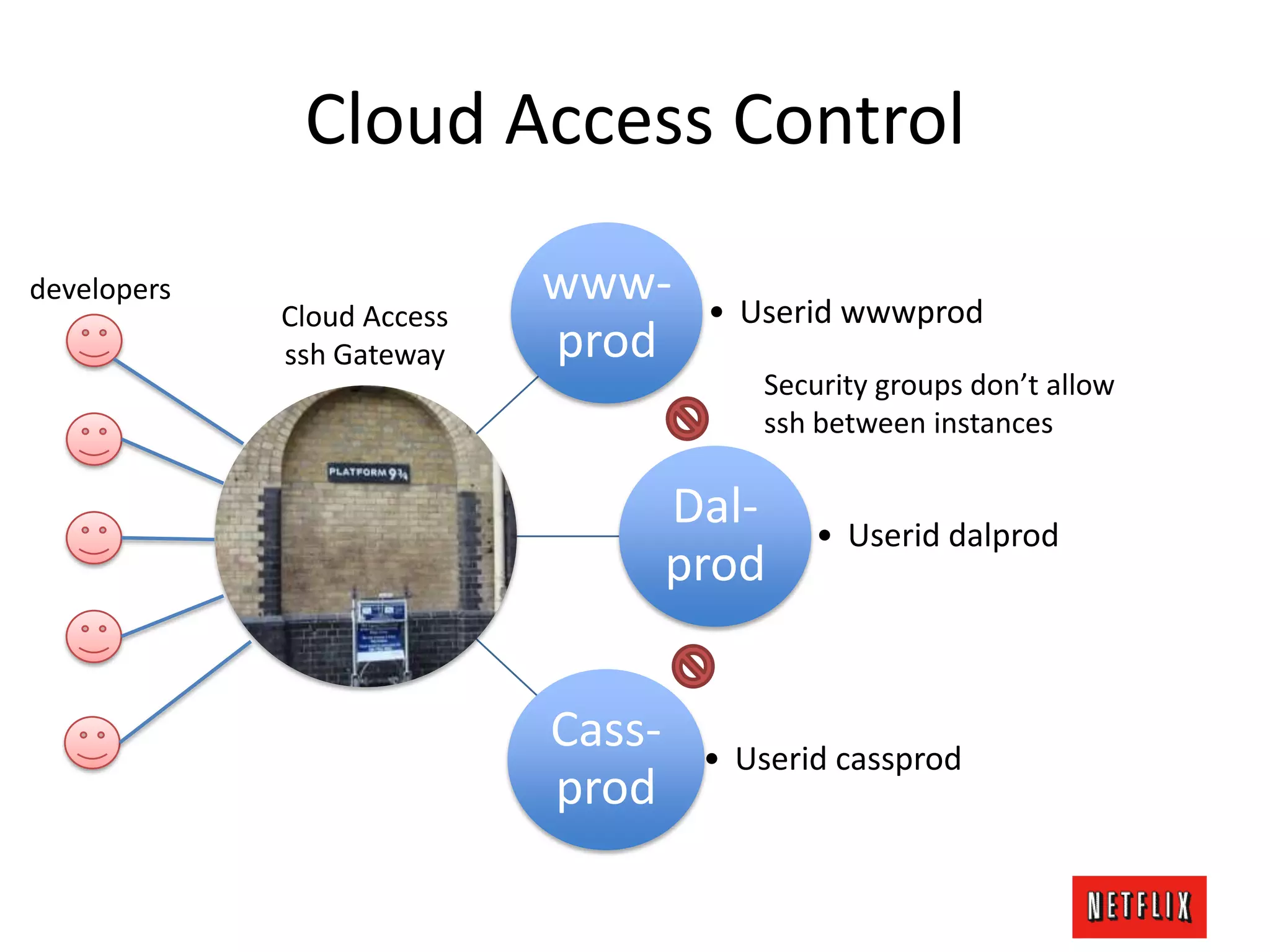
Cloud Access Control
www-
prod
• Userid wwwprod
Dal-
prod
• Userid dalprod
Cass-
prod
• Userid cassprod
Cloud Access
ssh Gateway
Security groups don’t allow
ssh between instances
developers
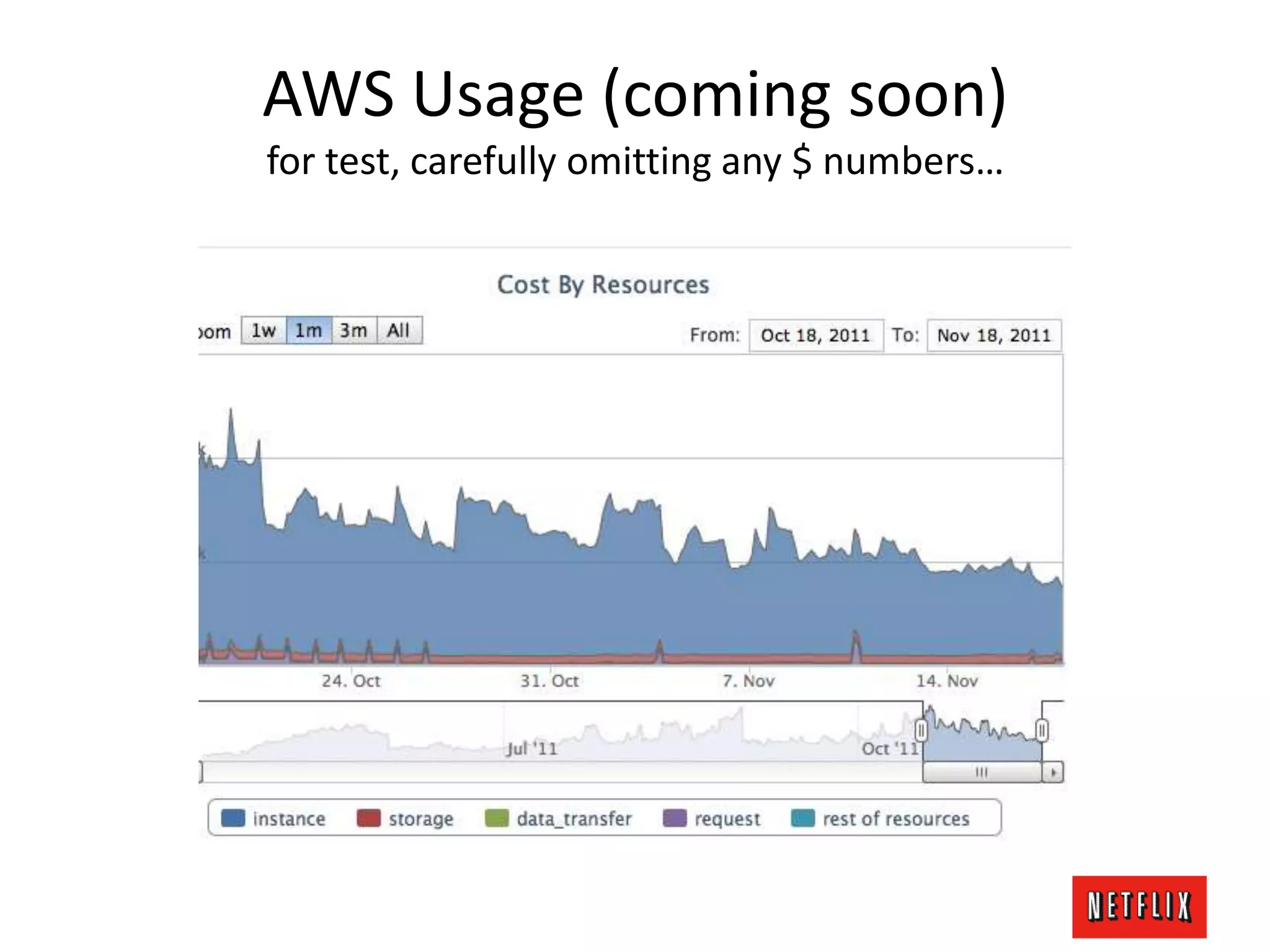
AWS Usage (coming soon)
for test, carefully omitting any $ numbers…
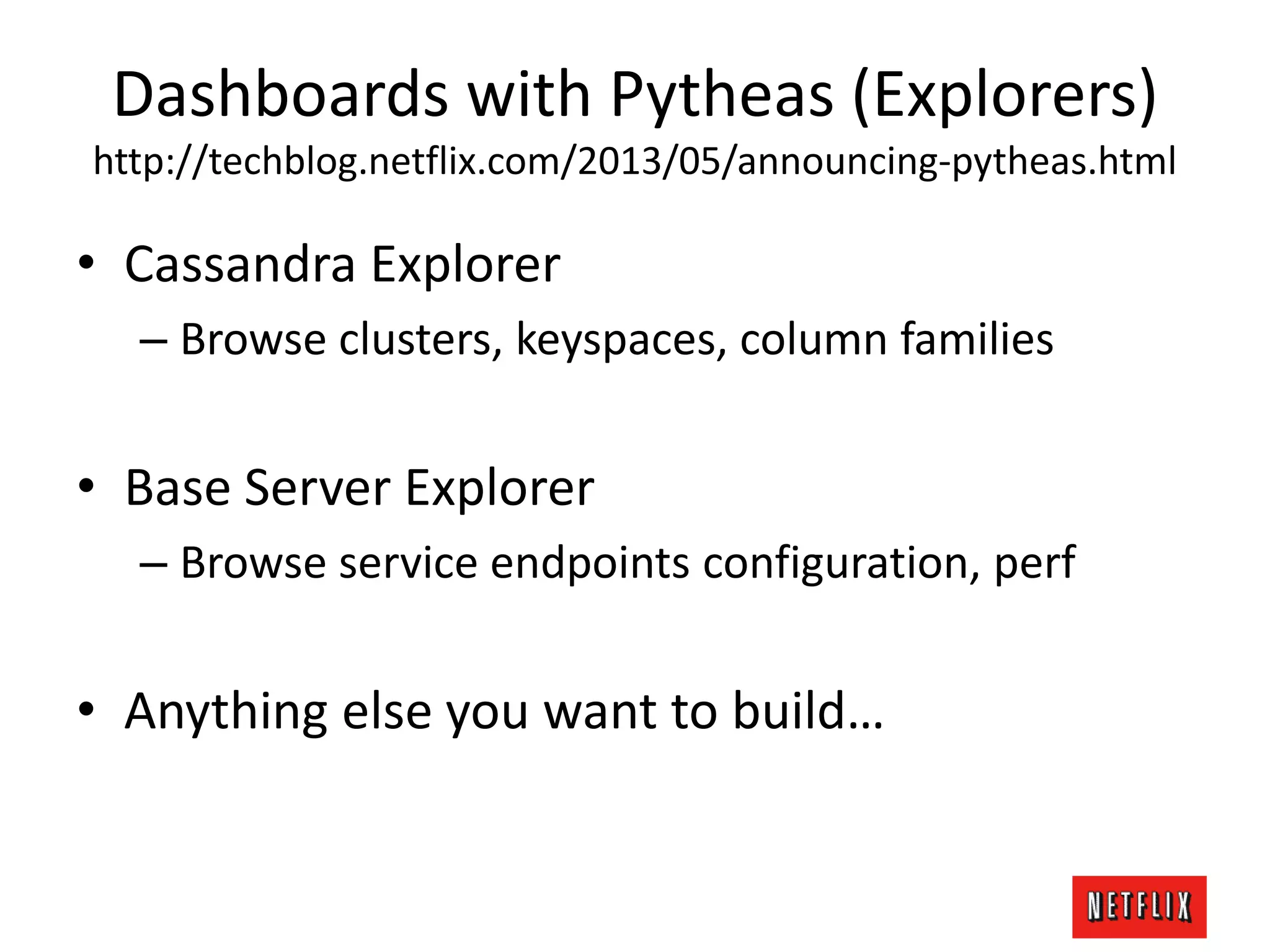
Dashboards with Pytheas (Explorers)
http://techblog.netflix.com/2013/05/announcing-pytheas.html
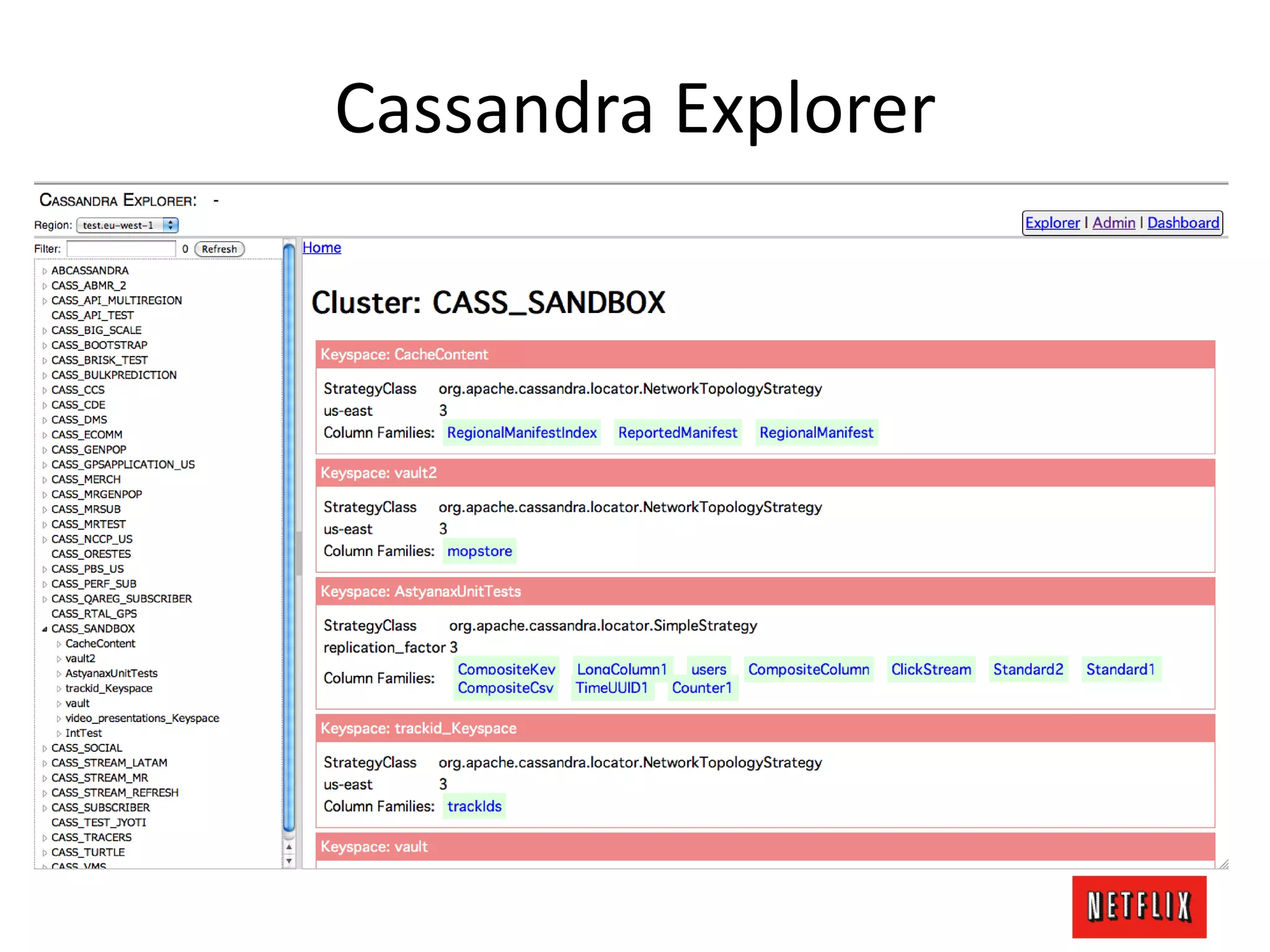
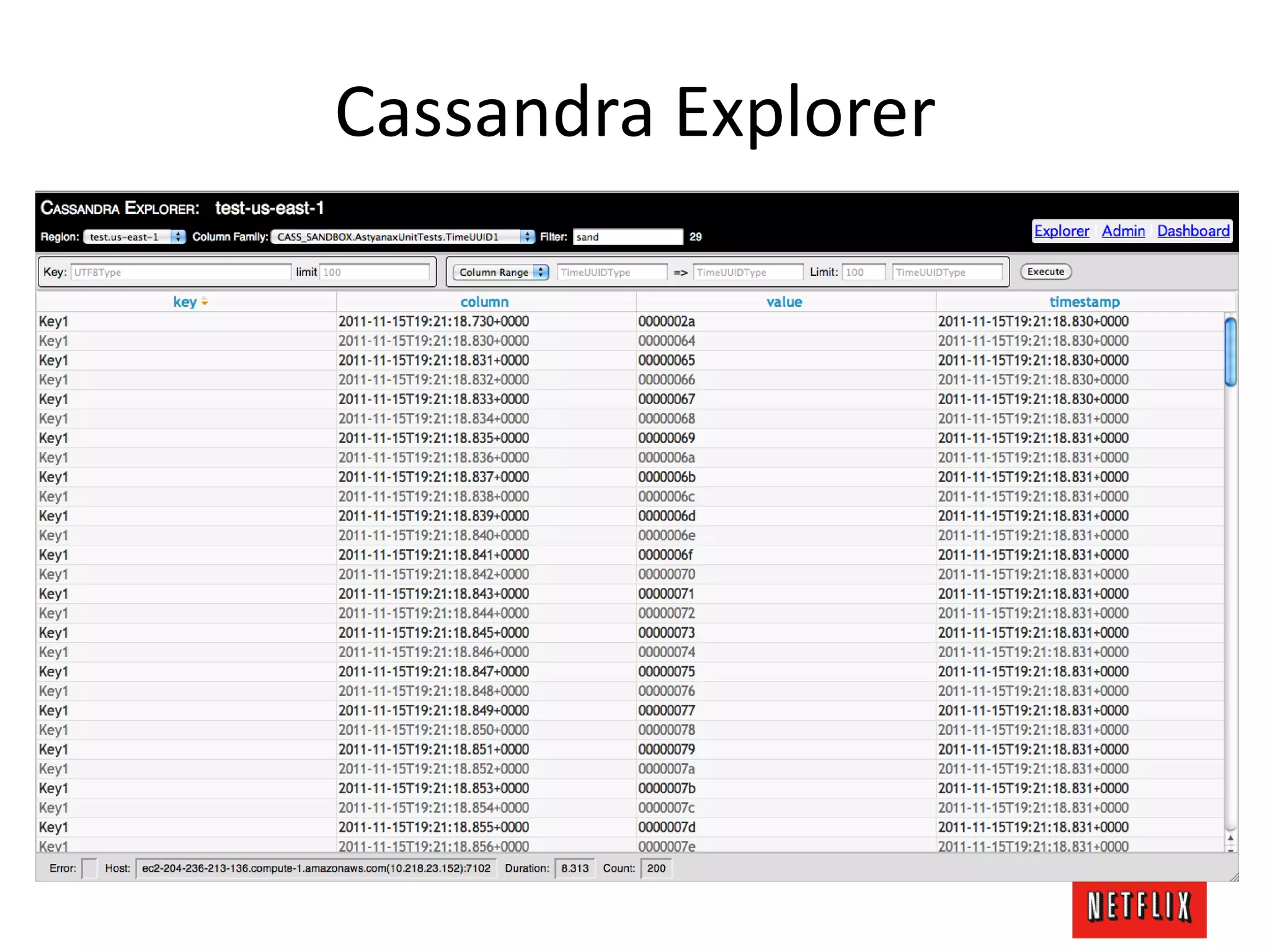
• Cassandra Explorer
– Browse clusters, keyspaces, column families
• Base Server Explorer
– Browse service endpoints configuration, perf
• Anything else you want to build…
Cassandra Explorer
Cassandra Explorer
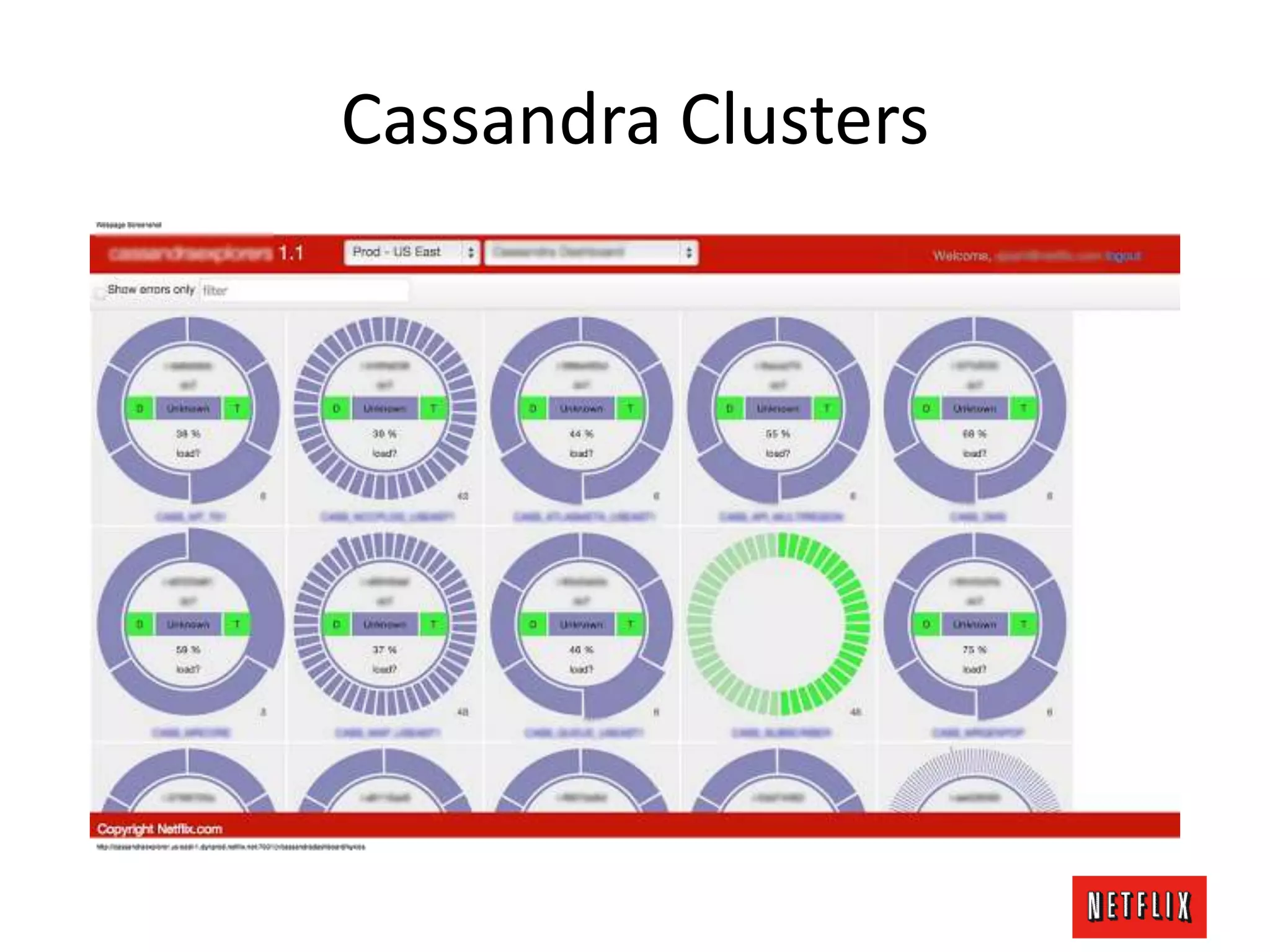
Cassandra Clusters
Bubble Chart
Slideshare NetflixOSS Details
• Lightning Talks Feb S1E1
– http://www.slideshare.net/RuslanMeshenberg/netflixoss-open-house-lightning-talks
• Asgard In Depth Feb S1E1
– http://www.slideshare.net/joesondow/asgard-overview-from-netflix-oss-open-house
• Lightning Talks March S1E2
– http://www.slideshare.net/RuslanMeshenberg/netflixoss-meetup-lightning-talks-and-
roadmap
• Security Architecture
– http://www.slideshare.net/jason_chan/resilience-and-security-scale-lessons-learned
• Cost Aware Cloud Architectures – with Jinesh Varia of AWS
– http://www.slideshare.net/AmazonWebServices/building-costaware-architectures-jinesh-
varia-aws-and-adrian-cockroft-netflix
Amazon Cloud Terminology Reference
See http://aws.amazon.com/ This is not a full list of Amazon Web Service features
• AWS – Amazon Web Services (common name for Amazon cloud)
• AMI – Amazon Machine Image (archived boot disk, Linux, Windows etc. plus application code)
• EC2 – Elastic Compute Cloud
– Range of virtual machine types m1, m2, c1, cc, cg. Varying memory, CPU and disk configurations.
– Instance – a running computer system. Ephemeral, when it is de-allocated nothing is kept.
– Reserved Instances – pre-paid to reduce cost for long term usage
– Availability Zone – datacenter with own power and cooling hosting cloud instances
– Region – group of Avail Zones – US-East, US-West, EU-Eire, Asia-Singapore, Asia-Japan, SA-Brazil, US-Gov
• ASG – Auto Scaling Group (instances booting from the same AMI)
• S3 – Simple Storage Service (http access)
• EBS – Elastic Block Storage (network disk filesystem can be mounted on an instance)
• RDS – Relational Database Service (managed MySQL master and slaves)
• DynamoDB/SDB – Simple Data Base (hosted http based NoSQL datastore, DynamoDB replaces SDB)
• SQS – Simple Queue Service (http based message queue)
• SNS – Simple Notification Service (http and email based topics and messages)
• EMR – Elastic Map Reduce (automatically managed Hadoop cluster)
• ELB – Elastic Load Balancer
• EIP – Elastic IP (stable IP address mapping assigned to instance or ELB)
• VPC – Virtual Private Cloud (single tenant, more flexible network and security constructs)
• DirectConnect – secure pipe from AWS VPC to external datacenter
• IAM – Identity and Access Management (fine grain role based security keys)

Gluecon 2013 - Netflix Cloud Native Tutorial Details (part 2)

  • 1.
    Details: Building Using TheNetflixOSS Architecture May 2013 Adrian Cockcroft @adrianco #netflixcloud @NetflixOSS http://www.linkedin.com/in/adriancockcroft
  • 2.
    Architectures for HighAvailability Cassandra Storage and Replication NetflixOSS Components
  • 3.
    Component Micro-Services Test WithChaos Monkey, Latency Monkey
  • 4.
    Three Balanced AvailabilityZones Test with Chaos Gorilla Cassandra and Evcache Replicas Zone A Cassandra and Evcache Replicas Zone B Cassandra and Evcache Replicas Zone C Load Balancers
  • 5.
    Triple Replicated Persistence Cassandramaintenance affects individual replicas Cassandra and Evcache Replicas Zone A Cassandra and Evcache Replicas Zone B Cassandra and Evcache Replicas Zone C Load Balancers
  • 6.
    Isolated Regions Cassandra Replicas ZoneA Cassandra Replicas Zone B Cassandra Replicas Zone C US-East Load Balancers Cassandra Replicas Zone A Cassandra Replicas Zone B Cassandra Replicas Zone C EU-West Load Balancers
  • 7.
    Failure Modes andEffects Failure Mode Probability Current Mitigation Plan Application Failure High Automatic degraded response AWS Region Failure Low Active-Active Using Denominator AWS Zone Failure Medium Continue to run on 2 out of 3 zones Datacenter Failure Medium Migrate more functions to cloud Data store failure Low Restore from S3 backups S3 failure Low Restore from remote archive Until we got really good at mitigating high and medium probability failures, the ROI for mitigating regional failures didn’t make sense. Working on Active-Active in 2013.
  • 8.
    Application Resilience Run whatyou wrote Rapid detection Rapid Response
  • 9.
    Run What YouWrote • Make developers responsible for failures – Then they learn and write code that doesn’t fail • Use Incident Reviews to find gaps to fix – Make sure its not about finding “who to blame” • Keep timeouts short, fail fast – Don’t let cascading timeouts stack up • Dynamic configuration options - Archaius – http://techblog.netflix.com/2012/06/annoucing-archaius-dynamic-properties.html
  • 10.
    Resilient Design –Hystrix, RxJava http://techblog.netflix.com/2012/02/fault-tolerance-in-high-volume.html
  • 11.
    Chaos Monkey http://techblog.netflix.com/2012/07/chaos-monkey-released-into-wild.html • Computers(Datacenter or AWS) randomly die – Fact of life, but too infrequent to test resiliency • Test to make sure systems are resilient – Kill individual instances without customer impact • Latency Monkey (coming soon) – Inject extra latency and error return codes
  • 12.
    Monkeys Edda – ConfigurationHistory http://techblog.netflix.com/2012/11/edda-learn-stories-of-your-cloud.html Edda AWS Instances, ASGs, etc. Eureka Services metadata AppDynamics Request flow
  • 13.
    Edda Query Examples Findany instances that have ever had a specific public IP address $ curl "http://edda/api/v2/view/instances;publicIpAddress=1.2.3.4;_since=0" ["i-0123456789","i-012345678a","i-012345678b”] Show the most recent change to a security group $ curl "http://edda/api/v2/aws/securityGroups/sg-0123456789;_diff;_all;_limit=2" --- /api/v2/aws.securityGroups/sg-0123456789;_pp;_at=1351040779810 +++ /api/v2/aws.securityGroups/sg-0123456789;_pp;_at=1351044093504 @@ -1,33 +1,33 @@ { … "ipRanges" : [ "10.10.1.1/32", "10.10.1.2/32", + "10.10.1.3/32", - "10.10.1.4/32" … }
  • 14.
    Platform Outage Taxonomy Classifyand name the different types of things that can go wrong
  • 15.
  • 16.
    Zone Failure Modes •Power Outage – Instances lost, ephemeral state lost – Clean break and recovery, fail fast, “no route to host” • Network Outage – Instances isolated, state inconsistent – More complex symptoms, recovery issues, transients • Dependent Service Outage – Cascading failures, misbehaving instances, human errors – Confusing symptoms, recovery issues, byzantine effects
  • 17.
    Zone Power Failure •June 29, 2012 AWS US-East - The Big Storm – http://aws.amazon.com/message/67457/ – http://techblog.netflix.com/2012/07/lessons-netflix-learned-from-aws-storm.html • Highlights – One of 10+ US-East datacenters failed generator startup – UPS depleted -> 10min power outage for 7% of instances • Result – Netflix lost power to most of a zone, evacuated the zone – Small/brief user impact due to errors and retries
  • 18.
    Zone Failure Modes CassandraReplicas Zone A Cassandra Replicas Zone B Cassandra Replicas Zone C US-East Load Balancers Cassandra Replicas Zone A Cassandra Replicas Zone B Cassandra Replicas Zone C EU-West Load Balancers Zone Power Outage Zone Network Outage Zone Dependent Service Outage
  • 19.
    Regional Failure Modes •Network Failure Takes Region Offline – DNS configuration errors – Bugs and configuration errors in routers – Network capacity overload • Control Plane Overload Affecting Entire Region – Consequence of other outages – Lose control of remaining zones infrastructure – Cascading service failure, hard to diagnose
  • 20.
    Regional Control PlaneOverload • April 2011 – “The big EBS Outage” – http://techblog.netflix.com/2011/04/lessons-netflix-learned-from-aws-outage.html – Human error during network upgrade triggered cascading failure – Zone level failure, with brief regional control plane overload • Netflix Infrastructure Impact – Instances in one zone hung and could not launch replacements – Overload prevented other zones from launching instances – Some MySQL slaves offline for a few days • Netflix Customer Visible Impact – Higher latencies for a short time – Higher error rates for a short time – Outage was at a low traffic level time, so no capacity issues
  • 21.
    Regional Failure Modes CassandraReplicas Zone A Cassandra Replicas Zone B Cassandra Replicas Zone C US-East Load Balancers Cassandra Replicas Zone A Cassandra Replicas Zone B Cassandra Replicas Zone C EU-West Load Balancers Regional Network Outage Control Plane Overload
  • 22.
    Dependent Services Failure •June 29, 2012 AWS US-East - The Big Storm – Power failure recovery overloaded EBS storage service – Backlog of instance startups using EBS root volumes • ELB (Load Balancer) Impacted – ELB instances couldn’t scale because EBS was backlogged – ELB control plane also became backlogged • Mitigation Plans Mentioned – Multiple control plane request queues to isolate backlog – Rapid DNS based traffic shifting between zones
  • 23.
    Application Routing Failure June29, 2012 AWS US-East - The Big Storm Cassandra Replicas Zone A Cassandra Replicas Zone B Cassandra Replicas Zone C US-East Load Balancers Cassandra Replicas Zone A Cassandra Replicas Zone B Cassandra Replicas Zone C EU-West Load Balancers Zone Power Outage Applications not using Zone-aware routing kept trying to talk to dead instances and timing out Eureka service directory failed to mark down dead instances due to a configuration error Effect: higher latency and errors Mitigation: Fixed config, and made zone aware routing the default
  • 24.
    Dec 24th 2012 CassandraReplicas Zone A Cassandra Replicas Zone B Cassandra Replicas Zone C US-East Load Balancers Cassandra Replicas Zone A Cassandra Replicas Zone B Cassandra Replicas Zone C EU-West Load Balancers Partial Regional ELB Outage • ELB (Load Balancer) Impacted – ELB control plane database state accidentally corrupted – Hours to detect, hours to restore from backups • Mitigation Plans Mentioned – Tighter process for access to control plane – Better zone isolation
  • 25.
    Global Failure Modes •Software Bugs – Externally triggered (e.g. leap year/leap second) – Memory leaks and other delayed action failures • Global configuration errors – Usually human error – Both infrastructure and application level • Cascading capacity overload – Customers migrating away from a failure – Lack of cross region service isolation
  • 26.
    Global Software BugOutages • AWS S3 Global Outage in 2008 – Gossip protocol propagated errors worldwide – No data loss, but service offline for up to 9hrs – Extra error detection fixes, no big issues since • Microsoft Azure Leap Day Outage in 2012 – Bug failed to generate certificates ending 2/29/13 – Failure to launch new instances for up to 13hrs – One line code fix. • Netflix Configuration Error in 2012 – Global property updated to broken value – Streaming stopped worldwide for ~1hr until we changed back – Fix planned to keep history of properties for quick rollback
  • 27.
    Global Failure Modes CassandraReplicas Zone A Cassandra Replicas Zone B Cassandra Replicas Zone C US-East Load Balancers Cassandra Replicas Zone A Cassandra Replicas Zone B Cassandra Replicas Zone C EU-West Load Balancers Cascading Capacity Overload Software Bugs and Global Configuration Errors Capacity Demand Migrates “Oops…”
  • 28.
    Denominator Portable DNS management APIModels (varied and mostly broken) DNS Vendor Plug-in Common Model Use Cases Edda, Multi- Region Failover Denominator AWS Route53 IAM Key Auth REST DynECT User/pwd REST UltraDNS User/pwd SOAP Etc… Currently being built by Adrian Cole (the jClouds guy, he works for Netflix now…)
  • 29.
    Highly Available Storage Ahighly scalable, available and durable deployment pattern
  • 30.
    Micro-Service Pattern One keyspace,replaces a single table or materialized view Single function Cassandra Cluster Managed by Priam Between 6 and 72 nodes Stateless Data Access REST Service Astyanax Cassandra Client Optional Datacenter Update Flow Many Different Single-Function REST Clients Appdynamics Service Flow Visualization Each icon represents a horizontally scaled service of three to hundreds of instances deployed over three availability zones
  • 31.
    Stateless Micro-Service Architecture LinuxBase AMI (CentOS or Ubuntu) Optional Apache frontend, memcached, non-java apps Monitoring Log rotation to S3 AppDynamics machineagent Epic/Atlas Java (JDK 6 or 7) AppDynamics appagent monitoring GC and thread dump logging Tomcat Application war file, base servlet, platform, client interface jars, Astyanax Healthcheck, status servlets, JMX interface, Servo autoscale
  • 32.
    Astyanax Available at http://github.com/netflix •Features – Complete abstraction of connection pool from RPC protocol – Fluent Style API – Operation retry with backoff – Token aware • Recipes – Distributed row lock (without zookeeper) – Multi-DC row lock – Uniqueness constraint – Multi-row uniqueness constraint – Chunked and multi-threaded large file storage
  • 33.
    Initializing Astyanax // Configurationeither set in code or nfastyanax.properties platform.ListOfComponentsToInit=LOGGING,APPINFO,DISCOVERY netflix.environment=test default.astyanax.readConsistency=CL_QUORUM default.astyanax.writeConsistency=CL_QUORUM MyCluster.MyKeyspace.astyanax.servers=127.0.0.1 // Must initialize platform for discovery to work NFLibraryManager.initLibrary(PlatformManager.class, props, false, true); NFLibraryManager.initLibrary(NFAstyanaxManager.class, props, true, false); // Open a keyspace instance Keyspace keyspace = KeyspaceFactory.openKeyspace(”MyCluster”,”MyKeyspace");
  • 34.
    Astyanax Query Example Paginatethrough all columns in a row ColumnList<String> columns; int pageize = 10; try { RowQuery<String, String> query = keyspace .prepareQuery(CF_STANDARD1) .getKey("A") .setIsPaginating() .withColumnRange(new RangeBuilder().setMaxSize(pageize).build()); while (!(columns = query.execute().getResult()).isEmpty()) { for (Column<String> c : columns) { } } } catch (ConnectionException e) { }
  • 35.
    Astyanax - CassandraWrite Data Flows Single Region, Multiple Availability Zone, Token Aware Token Aware Clients Cassandra •Disks •Zone A Cassandra •Disks •Zone B Cassandra •Disks •Zone C Cassandra •Disks •Zone A Cassandra •Disks •Zone B Cassandra •Disks •Zone C 1. Client Writes to local coordinator 2. Coodinator writes to other zones 3. Nodes return ack 4. Data written to internal commit log disks (no more than 10 seconds later) If a node goes offline, hinted handoff completes the write when the node comes back up. Requests can choose to wait for one node, a quorum, or all nodes to ack the write SSTable disk writes and compactions occur asynchronously 1 4 4 4 2 3 3 3 2
  • 36.
    Data Flows forMulti-Region Writes Token Aware, Consistency Level = Local Quorum US Clients Cassandra • Disks • Zone A Cassandra • Disks • Zone B Cassandra • Disks • Zone C Cassandra • Disks • Zone A Cassandra • Disks • Zone B Cassandra • Disks • Zone C 1. Client writes to local replicas 2. Local write acks returned to Client which continues when 2 of 3 local nodes are committed 3. Local coordinator writes to remote coordinator. 4. When data arrives, remote coordinator node acks and copies to other remote zones 5. Remote nodes ack to local coordinator 6. Data flushed to internal commit log disks (no more than 10 seconds later) If a node or region goes offline, hinted handoff completes the write when the node comes back up. Nightly global compare and repair jobs ensure everything stays consistent. EU Clients Cassandra • Disks • Zone A Cassandra • Disks • Zone B Cassandra • Disks • Zone C Cassandra • Disks • Zone A Cassandra • Disks • Zone B Cassandra • Disks • Zone C 6 5 5 6 6 4 4 4 1 6 6 6 2 2 2 3 100+ms latency
  • 37.
    Cassandra Instance Architecture LinuxBase AMI (CentOS or Ubuntu) Tomcat and Priam on JDK Healthcheck, Status Monitoring AppDynamics machineagent Epic/Atlas Java (JDK 7) AppDynamics appagent monitoring GC and thread dump logging Cassandra Server Local Ephemeral Disk Space – 2TB of SSD or 1.6TB disk holding Commit log and SSTables
  • 38.
    Priam – CassandraAutomation Available at http://github.com/netflix • Netflix Platform Tomcat Code • Zero touch auto-configuration • State management for Cassandra JVM • Token allocation and assignment • Broken node auto-replacement • Full and incremental backup to S3 • Restore sequencing from S3 • Grow/Shrink Cassandra “ring”
  • 39.
    ETL for Cassandra •Data is de-normalized over many clusters! • Too many to restore from backups for ETL • Solution – read backup files using Hadoop • Aegisthus – http://techblog.netflix.com/2012/02/aegisthus-bulk-data-pipeline-out-of.html – High throughput raw SSTable processing – Re-normalizes many clusters to a consistent view – Extract, Transform, then Load into Teradata
  • 40.
  • 41.
    Datacenter to CloudTransition Goals • Faster – Lower latency than the equivalent datacenter web pages and API calls – Measured as mean and 99th percentile – For both first hit (e.g. home page) and in-session hits for the same user • Scalable – Avoid needing any more datacenter capacity as subscriber count increases – No central vertically scaled databases – Leverage AWS elastic capacity effectively • Available – Substantially higher robustness and availability than datacenter services – Leverage multiple AWS availability zones – No scheduled down time, no central database schema to change • Productive – Optimize agility of a large development team with automation and tools – Leave behind complex tangled datacenter code base (~8 year old architecture) – Enforce clean layered interfaces and re-usable components
  • 42.
    Datacenter Anti-Patterns What dowe currently do in the datacenter that prevents us from meeting our goals?
  • 43.
    Rewrite from Scratch Noteverything is cloud specific Pay down technical debt Robust patterns
  • 44.
    Netflix Datacenter vs.Cloud Arch Central SQL Database Distributed Key/Value NoSQL Sticky In-Memory Session Shared Memcached Session Chatty Protocols Latency Tolerant Protocols Tangled Service Interfaces Layered Service Interfaces Instrumented Code Instrumented Service Patterns Fat Complex Objects Lightweight Serializable Objects Components as Jar Files Components as Services
  • 45.
    Tangled Service Interfaces •Datacenter implementation is exposed – Oracle SQL queries mixed into business logic • Tangled code – Deep dependencies, false sharing • Data providers with sideways dependencies – Everything depends on everything else Anti-pattern affects productivity, availability
  • 46.
    Untangled Service Interfaces Twolayers: • SAL - Service Access Library – Basic serialization and error handling – REST or POJO’s defined by data provider • ESL - Extended Service Library – Caching, conveniences, can combine several SALs – Exposes faceted type system (described later) – Interface defined by data consumer in many cases
  • 47.
  • 48.
    NetflixOSS Details • Platformentities and services • AWS Accounts and access management • Upcoming and recent NetflixOSS components • In-depth on NetflixOSS components
  • 49.
    Basic Platform Entities •AWS Based Entities – Instances and Machine Images, Elastic IP Addresses – Security Groups, Load Balancers, Autoscale Groups – Availability Zones and Geographic Regions • NetflixOS Specific Entities – Applications (registered services) – Clusters (versioned Autoscale Groups for an App) – Properties (dynamic hierarchical configuration)
  • 50.
    Core Platform Services •AWS Based Services – S3 storage, to 5TB files, parallel multipart writes – SQS – Simple Queue Service. Messaging layer. • Netflix Based Services – EVCache – memcached based ephemeral cache – Cassandra – distributed persistent data store
  • 51.
    Security Architecture • InstanceLevel Security baked into base AMI – Login: ssh only allowed via portal (not between instances) – Each app type runs as its own userid app{test|prod} • AWS Security, Identity and Access Management – Each app has its own security group (firewall ports) – Fine grain user roles and resource ACLs • Key Management – AWS Keys dynamically provisioned, easy updates – High grade app specific key management support
  • 52.
  • 53.
    Accounts Isolate Concerns •paastest – for development and testing – Fully functional deployment of all services – Developer tagged “stacks” for separation • paasprod – for production – Autoscale groups only, isolated instances are terminated – Alert routing, backups enabled by default • paasaudit – for sensitive services – To support SOX, PCI, etc. – Extra access controls, auditing • paasarchive – for disaster recovery – Long term archive of backups – Different region, perhaps different vendor
  • 54.
    Reservations and Billing •Consolidated Billing – Combine all accounts into one bill – Pooled capacity for bigger volume discounts http://docs.amazonwebservices.com/AWSConsolidatedBilling/1.0/AWSConsolidatedBillingGuide.html • Reservations – Save up to 71% on your baseline load – Priority when you request reserved capacity – Unused reservations are shared across accounts
  • 55.
    Cloud Access Gateway •Datacenter or office based – A separate VM for each AWS account – Two per account for high availability – Mount NFS shared home directories for developers – Instances trust the gateway via a security group • Manage how developers login to cloud – Access control via ldap group membership – Audit logs of every login to the cloud – Similar to awsfabrictasks ssh wrapper http://readthedocs.org/docs/awsfabrictasks/en/latest/
  • 56.
    Cloud Access Control www- prod •Userid wwwprod Dal- prod • Userid dalprod Cass- prod • Userid cassprod Cloud Access ssh Gateway Security groups don’t allow ssh between instances developers
  • 57.
    AWS Usage (comingsoon) for test, carefully omitting any $ numbers…
  • 58.
    Dashboards with Pytheas(Explorers) http://techblog.netflix.com/2013/05/announcing-pytheas.html • Cassandra Explorer – Browse clusters, keyspaces, column families • Base Server Explorer – Browse service endpoints configuration, perf • Anything else you want to build…
  • 59.
  • 60.
  • 61.
  • 62.
  • 63.
    Slideshare NetflixOSS Details •Lightning Talks Feb S1E1 – http://www.slideshare.net/RuslanMeshenberg/netflixoss-open-house-lightning-talks • Asgard In Depth Feb S1E1 – http://www.slideshare.net/joesondow/asgard-overview-from-netflix-oss-open-house • Lightning Talks March S1E2 – http://www.slideshare.net/RuslanMeshenberg/netflixoss-meetup-lightning-talks-and- roadmap • Security Architecture – http://www.slideshare.net/jason_chan/resilience-and-security-scale-lessons-learned • Cost Aware Cloud Architectures – with Jinesh Varia of AWS – http://www.slideshare.net/AmazonWebServices/building-costaware-architectures-jinesh- varia-aws-and-adrian-cockroft-netflix
  • 64.
    Amazon Cloud TerminologyReference See http://aws.amazon.com/ This is not a full list of Amazon Web Service features • AWS – Amazon Web Services (common name for Amazon cloud) • AMI – Amazon Machine Image (archived boot disk, Linux, Windows etc. plus application code) • EC2 – Elastic Compute Cloud – Range of virtual machine types m1, m2, c1, cc, cg. Varying memory, CPU and disk configurations. – Instance – a running computer system. Ephemeral, when it is de-allocated nothing is kept. – Reserved Instances – pre-paid to reduce cost for long term usage – Availability Zone – datacenter with own power and cooling hosting cloud instances – Region – group of Avail Zones – US-East, US-West, EU-Eire, Asia-Singapore, Asia-Japan, SA-Brazil, US-Gov • ASG – Auto Scaling Group (instances booting from the same AMI) • S3 – Simple Storage Service (http access) • EBS – Elastic Block Storage (network disk filesystem can be mounted on an instance) • RDS – Relational Database Service (managed MySQL master and slaves) • DynamoDB/SDB – Simple Data Base (hosted http based NoSQL datastore, DynamoDB replaces SDB) • SQS – Simple Queue Service (http based message queue) • SNS – Simple Notification Service (http and email based topics and messages) • EMR – Elastic Map Reduce (automatically managed Hadoop cluster) • ELB – Elastic Load Balancer • EIP – Elastic IP (stable IP address mapping assigned to instance or ELB) • VPC – Virtual Private Cloud (single tenant, more flexible network and security constructs) • DirectConnect – secure pipe from AWS VPC to external datacenter • IAM – Identity and Access Management (fine grain role based security keys)