Advocacy and Social Mobilization:
Implementation Strategies
University of the Philippines -Open University
Myrene Agustin Magabo
Doctoral Student
March 18, 2017
Overview:
Coverage of this Report
I.Module 6 Objectives and Guide
II.ACSM Strategies: The URC’s Framework and
USAID’s FALAH in Pakistan
III.URC’s Implementation Strategies
IV.An Outline of WHO’s Strategies
V.Reflections and Concluding Thoughts
VI.Collaboration and Discussion Questions
VII.Proposed 15 Steps Behavior Change
Strategies
Part I
Module 6 Objectives and Guide
At the end of this module, students are expected to
be able to:
1.Discuss the various strategies which can be employed in implementing
advocacy and social mobilization programs
2.Develop own strategy based on the context of the implementation of your
advocacy and social mobilization programs.
Module 6 Guide provides two important materials:
•URC. Health Communication and Behavior Change. Retrieved from
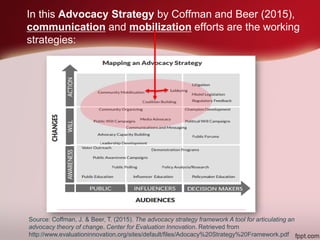
http://www.urc-chs.com/health_communication_and_behavior_change
•USAID. Social Mobilization Strategy. Retrieved from
http://www.popcouncil.org/uploads/pdfs/2011RH_FALAH-
SocialMobilization.pdf
Part II
USAID’s ACSM Strategies placed
under the lenses of URC’s 5-step
Cyclical Framework
USAID’s Implementation Strategies vis-à-vis
URC’s Framework
USAID’s Family Advancement for
Life and Health (FALAH) is
examined using URC’s 5-step
Communication Intervention Cycle
Towards Social Mobilization
(Bandalaria, 2017).
The URC proposed framework for its
Communication Intervention Cycle Towards
Social Mobilization (Bandalaria, 2017)
Bandalaria, M. (2017). Module 6 Guide [COMM 380 Class handout]. University of the
Philippines Open University
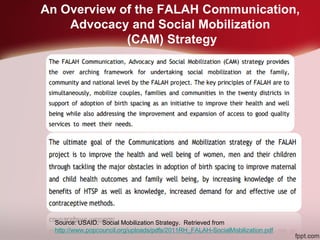
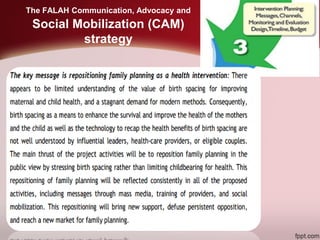
An Overview of the FALAH Communication,
Advocacy and Social Mobilization
(CAM) Strategy
Source: USAID. Social Mobilization Strategy. Retrieved from
http://www.popcouncil.org/uploads/pdfs/2011RH_FALAH-SocialMobilization.pdf
In the implementation stage formative
research or assessment can be done to
analyze:
1. Outcomes of Advocacy Efforts
2. Impacts of Communication
3. Continuing or new barriers
4. Existing Opportunities
5. Unique Cases that arise
6. Effectiveness of Efforts
7. Need for New Strategies
As can be seen in from USAID’s Family Advancement
for Life and Health (FALAH) in Pakistan (“Social
Mobilization Strategy,” pp. 1 – 6)
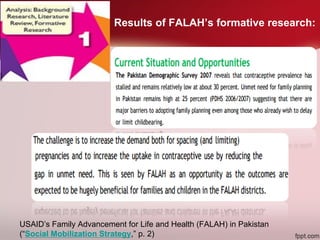
Results of FALAH’s formative research:
USAID’s Family Advancement for Life and Health (FALAH) in Pakistan
(“Social Mobilization Strategy,” p. 2)
Results also revealed barriers as areas
for ACSM target efforts:
USAID’s Family Advancement for Life and Health (FALAH) in Pakistan
(“Social Mobilization Strategy,” p. 2)
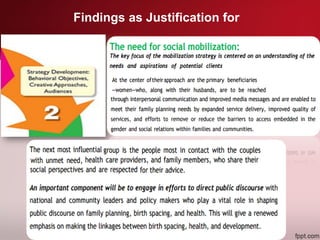
1. Gender Relations – women in Pakistan are less
empowered economically
2. Social or Religious concerns– family planning is
perceived as “unnatural or wrong”
3. Fear of side-effects thus limiting adaption and continued
use
4. Lack of knowledge on available services
Findings as Justification for
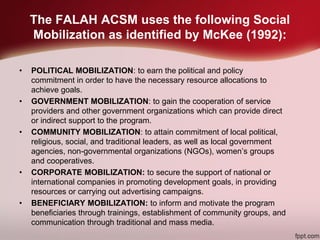
The FALAH ACSM uses the following Social
Mobilization as identified by McKee (1992):
• POLITICAL MOBILIZATION: to earn the political and policy
commitment in order to have the necessary resource allocations to
achieve goals.
• GOVERNMENT MOBILIZATION: to gain the cooperation of service
providers and other government organizations which can provide direct
or indirect support to the program.
• COMMUNITY MOBILIZATION: to attain commitment of local political,
religious, social, and traditional leaders, as well as local government
agencies, non-governmental organizations (NGOs), women’s groups
and cooperatives.
• CORPORATE MOBILIZATION: to secure the support of national or
international companies in promoting development goals, in providing
resources or carrying out advertising campaigns.
• BENEFICIARY MOBILIZATION: to inform and motivate the program
beneficiaries through trainings, establishment of community groups, and
communication through traditional and mass media.
The FALAH Communication, Advocacy and
Social Mobilization (CAM)
strategy
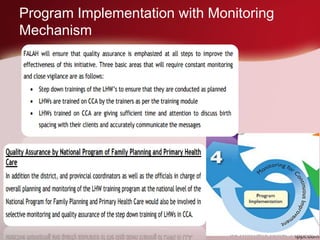
Program Implementation with Monitoring
Mechanism
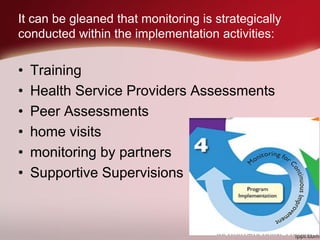
It can be gleaned that monitoring is strategically
conducted within the implementation activities:
• Training
• Health Service Providers Assessments
• Peer Assessments
• home visits
• monitoring by partners
• Supportive Supervisions
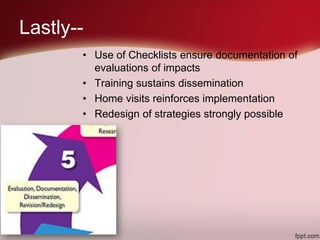
Lastly--
• Use of Checklists ensure documentation of
evaluations of impacts
• Training sustains dissemination
• Home visits reinforces implementation
• Redesign of strategies strongly possible
Part III
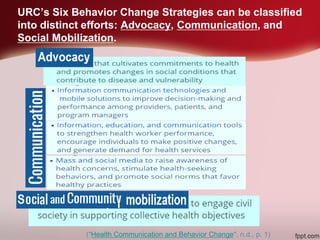
URC’s Implementation Strategies
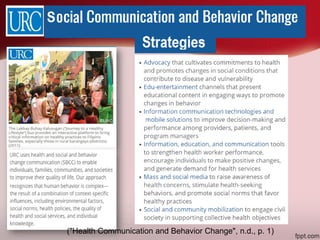
("Health Communication and Behavior Change", n.d., p. 1)
URC’s Six Behavior Change Strategies can be classified
into distinct efforts: Advocacy, Communication, and
Social Mobilization.
Part IV
Outline of WHO’s Strategies
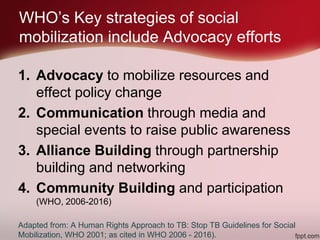
WHO’s Key strategies of social
mobilization include Advocacy efforts
1. Advocacy to mobilize resources and
effect policy change
2. Communication through media and
special events to raise public awareness
3. Alliance Building through partnership
building and networking
4. Community Building and participation
(WHO, 2006-2016)
Adapted from: A Human Rights Approach to TB: Stop TB Guidelines for Social
Mobilization, WHO 2001; as cited in WHO 2006 - 2016).
Part V
Reflections and Concluding Thoughts
In the review of URC, USAID, and WHO ACSM
Strategies, three salient insights surface:
1. Advocacy is the engine that drives Social Mobilization.
2. Communication propels advocacy & mobilization efforts.
3. Social Mobilization is advocacy in full realization.
However, looking through other strategic frameworks,
some questions also seem to remain at large, such as:
• Aren’t Advocacy and Social Mobilization so highly
intertwined?
• Is there really a clear distinction between the two when it
comes to implementation strategies?
• Advocacy activities are within the Social
Mobilization efforts?
• Social Mobilization is within the advocacy
efforts?
• Social Mobilization has no formal advocacy
program?
Does it make any difference if…
These reflective questions triggered
by the advocacy framework
(Coffman and beer, 2015) as shown
in slide 30, and social mobilization
strategies (Castillo, 2013) as shown
in slide 31.
In this Advocacy Strategy by Coffman and Beer (2015),
communication and mobilization efforts are the working
strategies:
Source: Coffman, J. & Beer, T. (2015). The advocacy strategy framework A tool for articulating an
advocacy theory of change. Center for Evaluation Innovation. Retrieved from
http://www.evaluationinnovation.org/sites/default/files/Adocacy%20Strategy%20Framework.pdf
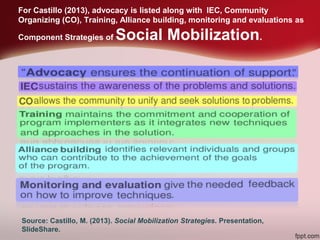
Source: Castillo, M. (2013). Social Mobilization Strategies. Presentation,
SlideShare.
For Castillo (2013), advocacy is listed along with IEC, Community
Organizing (CO), Training, Alliance building, monitoring and evaluations as
Component Strategies of Social Mobilization.
In the spirit of collaboration, you may opt to
share in our discussion any of the following
frameworks or implementation strategies that:
1. Provide or show distinct or separate
Advocacy, Communication, and Social
Mobilization strategies
2. Advocacy strategies that utilize social
mobilization and/or vice-versa
3. Successful social mobilization through
Communication and not necessarily though a
specific advocacy program
Part V
Proposed 15 steps to successful
behavior change programs
(adapted from Craig Lefebvre’s (2016) 12 Features for
Successful Obesity Prevention and Control Programs)
The success of ACSM rely on behavior change and the following
behavior change guidelines are hereby proposed:
1. Identify the Barriers, Challenges and Opportunities
2. Select and concentrate on priority groups or beneficiaries
3. Identify the value that each priority group could find in adopting the desired behaviors
4. Understand and address the incentives and costs of change – financial, opportunity, psychological,
social, scarcity, etc.
5. Design messages, materials, services and behaviors that fit people’s reality
6. Position the new behavior as more compelling, relevant, and potentially more valuable to people when
they practice it, in comparison to the alternatives
7. Test program strategies and elements before implementation
8. Do not rely solely on mass communication campaigns but communicate at the individual, interpersonal,
group, and organizational and community levels.
9. Increase access to information, places, food choices and services that reinforce desired behaviors
10. Establish centers in strategic locations for distribution of materials and services, and create
opportunities for members of the priority group to engage in behavior changing activities
11. Utilize community-based programs and citizen engagement to facilitate collaborations and create
healthier environments and policies
12. Consider policies that include incentives and disincentives for activity behavior
13. Explore how social networks and social media can influence norms and diffusion of desired behaviors
14. Utilize Edu-entertainment (such as use of compelling stories through print, video blogs, tapping the
Power of THONS, etc.)
15. Develop ACSM framework grounded on Communication Theories and Tactical Theories of Change
References
Advocacy, communication, and social mobilization to fight TB A 10-year framework for action. (2006).
http://www.stoptb.org. Retrieved from
http://www.stoptb.org/assets/documents/countries/acsm/tb_advocacy_isbn.pdf
Castillo, M. (2013). Social Mobilization Strategies. Presentation, SlideShare.
Coffman, J. & Beer, T. (2015). The advocacy strategy framework A tool for articulating an advocacy
theory of change. Center for Evaluation Innovation. Retrieved from
http://www.evaluationinnovation.org/sites/default/files/Adocacy%20Strategy%20Framework.pdf
dela Pena-‐Bandalaria, Melinda (2012) Advocacy and Social Mobilization COMM380
Module Guide University of the Philippines Open University
Health Communication and Behavior Change. URC. Retrieved from http://www.urc-chs.com/health-
communication-behavior-change
McKee, N. (1992) Social Mobilization & Social Marketing in Developing Communities: Lessons for
Communicators. Panang, Malaysia: Southbound.
ACSM Implementation Strategies

ACSM Implementation Strategies

  • 1.
    Advocacy and SocialMobilization: Implementation Strategies University of the Philippines -Open University Myrene Agustin Magabo Doctoral Student March 18, 2017
  • 2.
    Overview: Coverage of thisReport I.Module 6 Objectives and Guide II.ACSM Strategies: The URC’s Framework and USAID’s FALAH in Pakistan III.URC’s Implementation Strategies IV.An Outline of WHO’s Strategies V.Reflections and Concluding Thoughts VI.Collaboration and Discussion Questions VII.Proposed 15 Steps Behavior Change Strategies
  • 3.
    Part I Module 6Objectives and Guide
  • 4.
    Module 6 Objectivesand Guide At the end of this module, students are expected to be able to: 1.Discuss the various strategies which can be employed in implementing advocacy and social mobilization programs 2.Develop own strategy based on the context of the implementation of your advocacy and social mobilization programs. Module 6 Guide provides two important materials: •URC. Health Communication and Behavior Change. Retrieved from http://www.urc-chs.com/health_communication_and_behavior_change •USAID. Social Mobilization Strategy. Retrieved from http://www.popcouncil.org/uploads/pdfs/2011RH_FALAH- SocialMobilization.pdf
  • 5.
    Part II USAID’s ACSMStrategies placed under the lenses of URC’s 5-step Cyclical Framework
  • 6.
    USAID’s Implementation Strategiesvis-à-vis URC’s Framework USAID’s Family Advancement for Life and Health (FALAH) is examined using URC’s 5-step Communication Intervention Cycle Towards Social Mobilization (Bandalaria, 2017).
  • 7.
    The URC proposedframework for its Communication Intervention Cycle Towards Social Mobilization (Bandalaria, 2017) Bandalaria, M. (2017). Module 6 Guide [COMM 380 Class handout]. University of the Philippines Open University
  • 8.
    An Overview ofthe FALAH Communication, Advocacy and Social Mobilization (CAM) Strategy Source: USAID. Social Mobilization Strategy. Retrieved from http://www.popcouncil.org/uploads/pdfs/2011RH_FALAH-SocialMobilization.pdf
  • 9.
    In the implementationstage formative research or assessment can be done to analyze: 1. Outcomes of Advocacy Efforts 2. Impacts of Communication 3. Continuing or new barriers 4. Existing Opportunities 5. Unique Cases that arise 6. Effectiveness of Efforts 7. Need for New Strategies As can be seen in from USAID’s Family Advancement for Life and Health (FALAH) in Pakistan (“Social Mobilization Strategy,” pp. 1 – 6)
  • 10.
    Results of FALAH’sformative research: USAID’s Family Advancement for Life and Health (FALAH) in Pakistan (“Social Mobilization Strategy,” p. 2)
  • 11.
    Results also revealedbarriers as areas for ACSM target efforts: USAID’s Family Advancement for Life and Health (FALAH) in Pakistan (“Social Mobilization Strategy,” p. 2) 1. Gender Relations – women in Pakistan are less empowered economically 2. Social or Religious concerns– family planning is perceived as “unnatural or wrong” 3. Fear of side-effects thus limiting adaption and continued use 4. Lack of knowledge on available services
  • 12.
  • 13.
    The FALAH ACSMuses the following Social Mobilization as identified by McKee (1992): • POLITICAL MOBILIZATION: to earn the political and policy commitment in order to have the necessary resource allocations to achieve goals. • GOVERNMENT MOBILIZATION: to gain the cooperation of service providers and other government organizations which can provide direct or indirect support to the program. • COMMUNITY MOBILIZATION: to attain commitment of local political, religious, social, and traditional leaders, as well as local government agencies, non-governmental organizations (NGOs), women’s groups and cooperatives. • CORPORATE MOBILIZATION: to secure the support of national or international companies in promoting development goals, in providing resources or carrying out advertising campaigns. • BENEFICIARY MOBILIZATION: to inform and motivate the program beneficiaries through trainings, establishment of community groups, and communication through traditional and mass media.
  • 14.
    The FALAH Communication,Advocacy and Social Mobilization (CAM) strategy
  • 15.
    Program Implementation withMonitoring Mechanism
  • 16.
    It can begleaned that monitoring is strategically conducted within the implementation activities: • Training • Health Service Providers Assessments • Peer Assessments • home visits • monitoring by partners • Supportive Supervisions
  • 17.
    Lastly-- • Use ofChecklists ensure documentation of evaluations of impacts • Training sustains dissemination • Home visits reinforces implementation • Redesign of strategies strongly possible
  • 18.
  • 19.
    ("Health Communication andBehavior Change", n.d., p. 1)
  • 20.
    ("Health Communication andBehavior Change", n.d., p. 1) URC’s Six Behavior Change Strategies can be classified into distinct efforts: Advocacy, Communication, and Social Mobilization.
  • 21.
    Part IV Outline ofWHO’s Strategies
  • 22.
    WHO’s Key strategiesof social mobilization include Advocacy efforts 1. Advocacy to mobilize resources and effect policy change 2. Communication through media and special events to raise public awareness 3. Alliance Building through partnership building and networking 4. Community Building and participation (WHO, 2006-2016) Adapted from: A Human Rights Approach to TB: Stop TB Guidelines for Social Mobilization, WHO 2001; as cited in WHO 2006 - 2016).
  • 23.
    Part V Reflections andConcluding Thoughts
  • 24.
    In the reviewof URC, USAID, and WHO ACSM Strategies, three salient insights surface: 1. Advocacy is the engine that drives Social Mobilization. 2. Communication propels advocacy & mobilization efforts. 3. Social Mobilization is advocacy in full realization.
  • 25.
    However, looking throughother strategic frameworks, some questions also seem to remain at large, such as: • Aren’t Advocacy and Social Mobilization so highly intertwined? • Is there really a clear distinction between the two when it comes to implementation strategies?
  • 26.
    • Advocacy activitiesare within the Social Mobilization efforts? • Social Mobilization is within the advocacy efforts? • Social Mobilization has no formal advocacy program? Does it make any difference if…
  • 27.
    These reflective questionstriggered by the advocacy framework (Coffman and beer, 2015) as shown in slide 30, and social mobilization strategies (Castillo, 2013) as shown in slide 31.
  • 28.
    In this AdvocacyStrategy by Coffman and Beer (2015), communication and mobilization efforts are the working strategies: Source: Coffman, J. & Beer, T. (2015). The advocacy strategy framework A tool for articulating an advocacy theory of change. Center for Evaluation Innovation. Retrieved from http://www.evaluationinnovation.org/sites/default/files/Adocacy%20Strategy%20Framework.pdf
  • 29.
    Source: Castillo, M.(2013). Social Mobilization Strategies. Presentation, SlideShare. For Castillo (2013), advocacy is listed along with IEC, Community Organizing (CO), Training, Alliance building, monitoring and evaluations as Component Strategies of Social Mobilization.
  • 30.
    In the spiritof collaboration, you may opt to share in our discussion any of the following frameworks or implementation strategies that: 1. Provide or show distinct or separate Advocacy, Communication, and Social Mobilization strategies 2. Advocacy strategies that utilize social mobilization and/or vice-versa 3. Successful social mobilization through Communication and not necessarily though a specific advocacy program
  • 31.
    Part V Proposed 15steps to successful behavior change programs (adapted from Craig Lefebvre’s (2016) 12 Features for Successful Obesity Prevention and Control Programs)
  • 32.
    The success ofACSM rely on behavior change and the following behavior change guidelines are hereby proposed: 1. Identify the Barriers, Challenges and Opportunities 2. Select and concentrate on priority groups or beneficiaries 3. Identify the value that each priority group could find in adopting the desired behaviors 4. Understand and address the incentives and costs of change – financial, opportunity, psychological, social, scarcity, etc. 5. Design messages, materials, services and behaviors that fit people’s reality 6. Position the new behavior as more compelling, relevant, and potentially more valuable to people when they practice it, in comparison to the alternatives 7. Test program strategies and elements before implementation 8. Do not rely solely on mass communication campaigns but communicate at the individual, interpersonal, group, and organizational and community levels. 9. Increase access to information, places, food choices and services that reinforce desired behaviors 10. Establish centers in strategic locations for distribution of materials and services, and create opportunities for members of the priority group to engage in behavior changing activities 11. Utilize community-based programs and citizen engagement to facilitate collaborations and create healthier environments and policies 12. Consider policies that include incentives and disincentives for activity behavior 13. Explore how social networks and social media can influence norms and diffusion of desired behaviors 14. Utilize Edu-entertainment (such as use of compelling stories through print, video blogs, tapping the Power of THONS, etc.) 15. Develop ACSM framework grounded on Communication Theories and Tactical Theories of Change
  • 33.
    References Advocacy, communication, andsocial mobilization to fight TB A 10-year framework for action. (2006). http://www.stoptb.org. Retrieved from http://www.stoptb.org/assets/documents/countries/acsm/tb_advocacy_isbn.pdf Castillo, M. (2013). Social Mobilization Strategies. Presentation, SlideShare. Coffman, J. & Beer, T. (2015). The advocacy strategy framework A tool for articulating an advocacy theory of change. Center for Evaluation Innovation. Retrieved from http://www.evaluationinnovation.org/sites/default/files/Adocacy%20Strategy%20Framework.pdf dela Pena-‐Bandalaria, Melinda (2012) Advocacy and Social Mobilization COMM380 Module Guide University of the Philippines Open University Health Communication and Behavior Change. URC. Retrieved from http://www.urc-chs.com/health- communication-behavior-change McKee, N. (1992) Social Mobilization & Social Marketing in Developing Communities: Lessons for Communicators. Panang, Malaysia: Southbound.