EM083
BondMachine
Reconfigurable Computing
Mirko Mariotti,
Loriano Storchi,
Daniele Spiga
Dept of Physics and Geology – University of Perugia
INFN Perugia
EM083
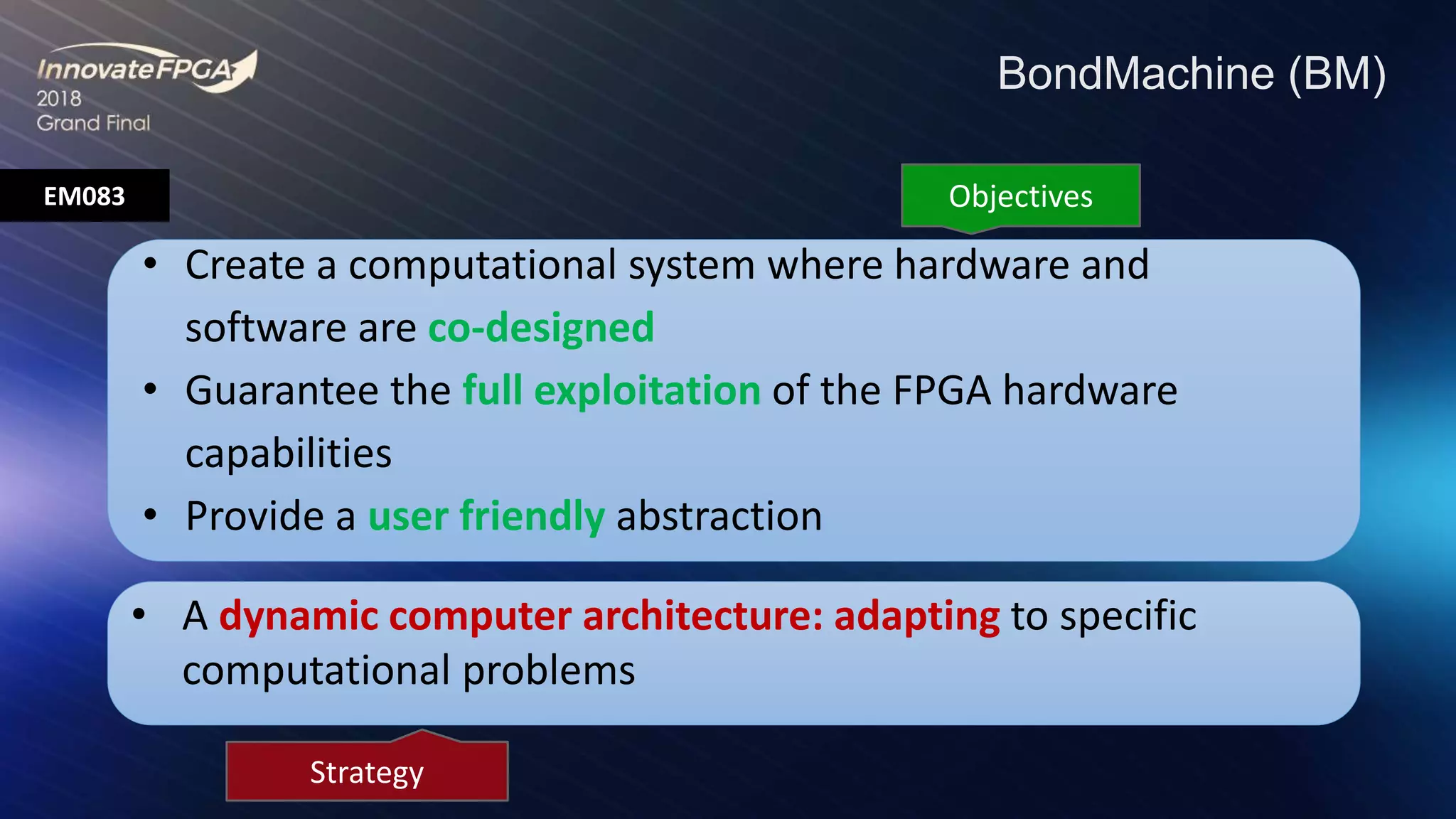
• Create a computational system where hardware and
software are co-designed
• Guarantee the full exploitation of the FPGA hardware
capabilities
• Provide a user friendly abstraction
Objectives
• A dynamic computer architecture: adapting to specific
computational problems
Strategy
BondMachine (BM)
EM083
BM Computer Architecture Components
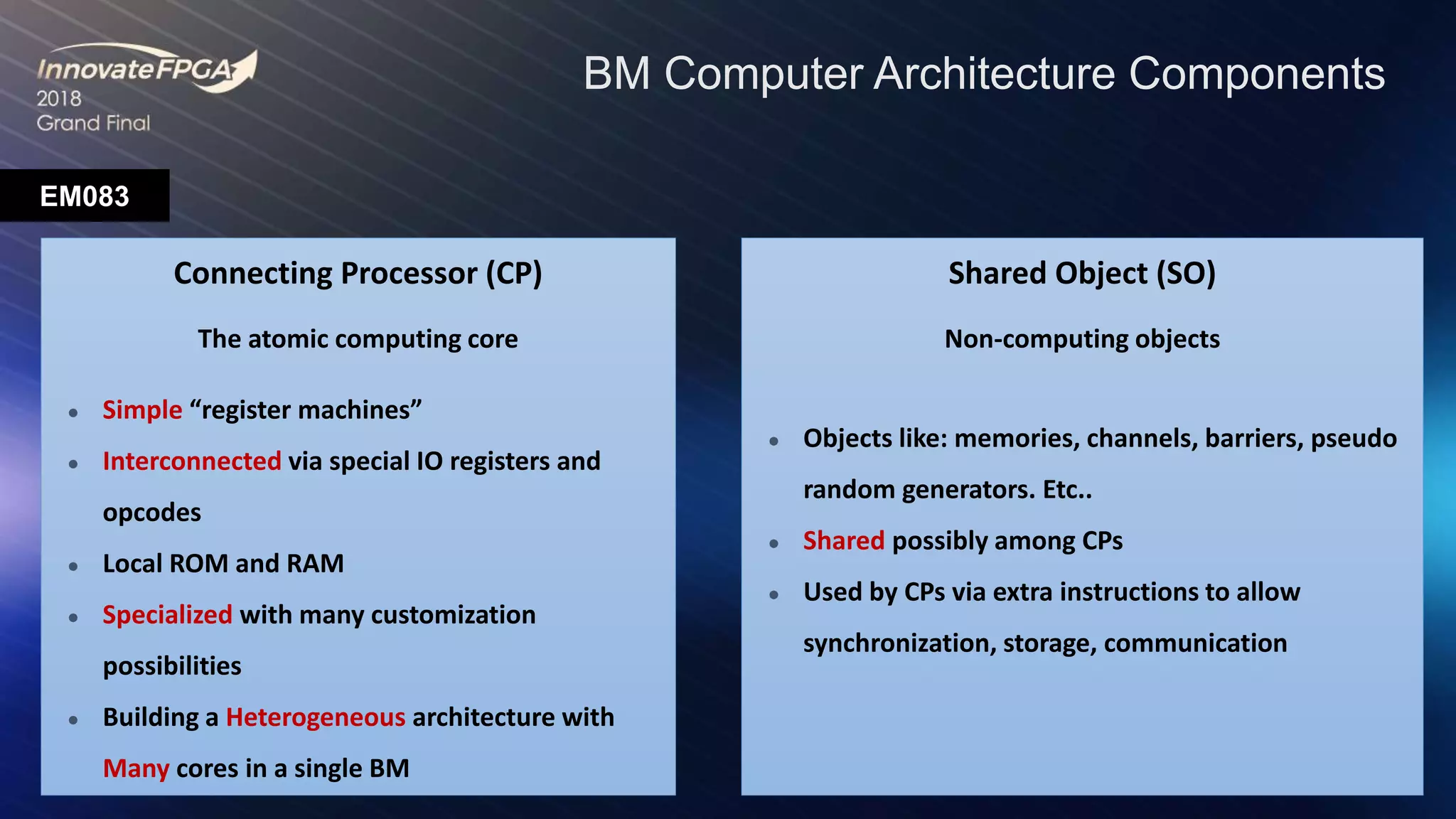
Connecting Processor (CP)
The atomic computing core
● Simple “register machines”
● Interconnected via special IO registers and
opcodes
● Local ROM and RAM
● Specialized with many customization
possibilities
● Building a Heterogeneous architecture with
Many cores in a single BM
Shared Object (SO)
Non-computing objects
● Objects like: memories, channels, barriers, pseudo
random generators. Etc..
● Shared possibly among CPs
● Used by CPs via extra instructions to allow
synchronization, storage, communication
EM083
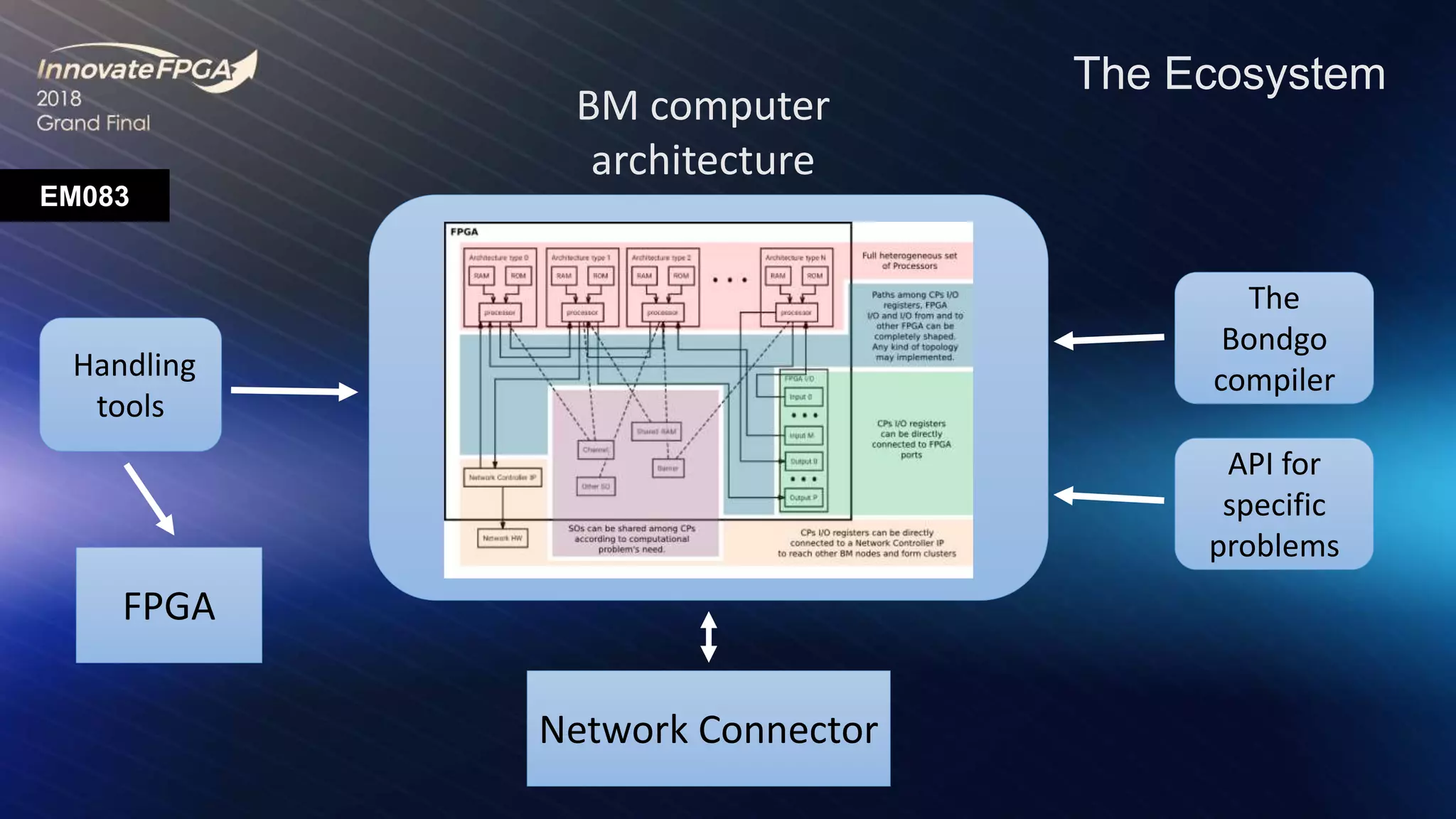
BM computer
architecture
Handling
tools
FPGA
The
Bondgo
compiler
API for
specific
problems
The Ecosystem
Network Connector
EM083
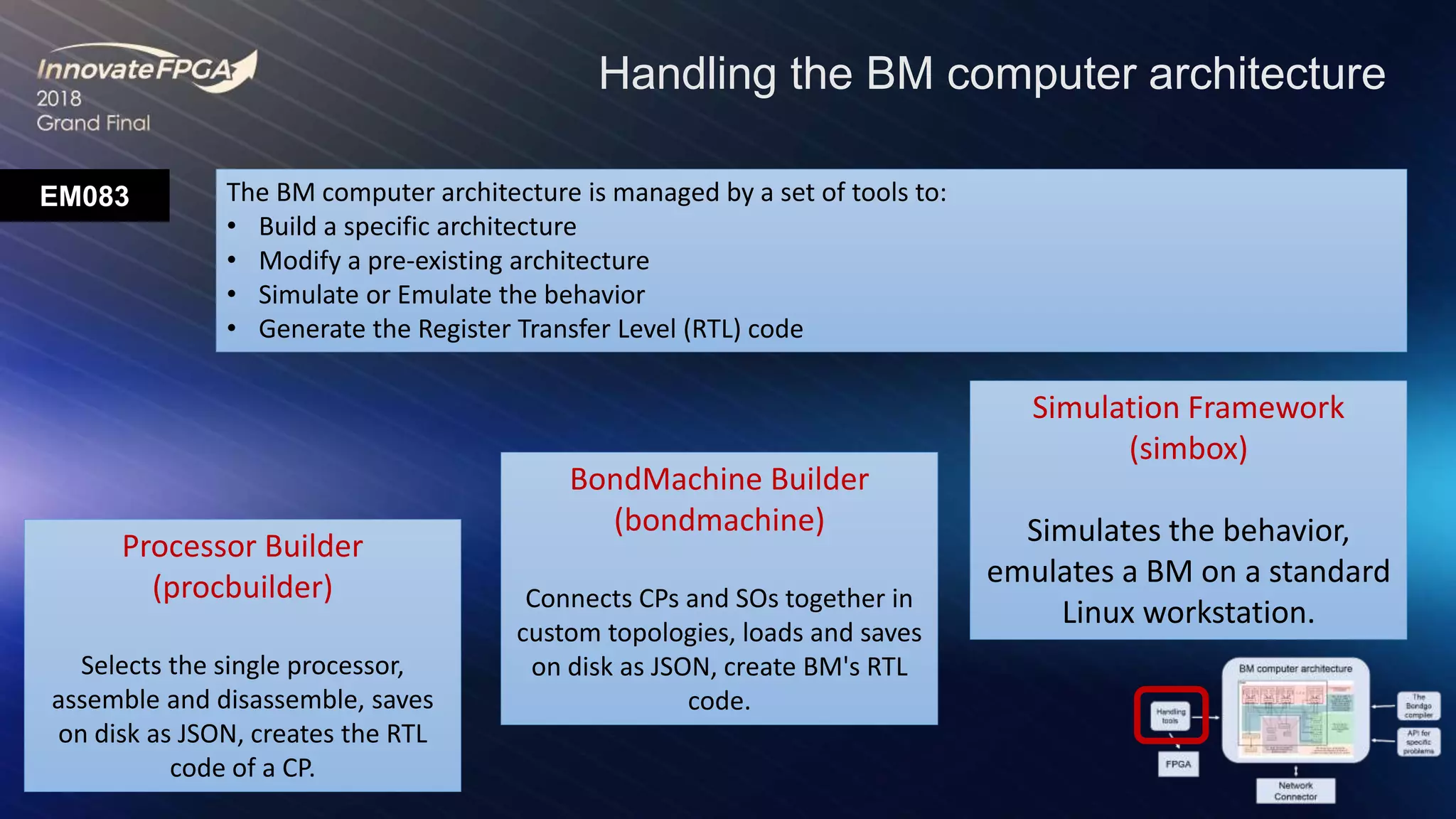
Handling the BM computer architecture
The BM computer architecture is managed by a set of tools to:
• Build a specific architecture
• Modify a pre-existing architecture
• Simulate or Emulate the behavior
• Generate the Register Transfer Level (RTL) code
Processor Builder
(procbuilder)
Selects the single processor,
assemble and disassemble, saves
on disk as JSON, creates the RTL
code of a CP.
Simulation Framework
(simbox)
Simulates the behavior,
emulates a BM on a standard
Linux workstation.
BondMachine Builder
(bondmachine)
Connects CPs and SOs together in
custom topologies, loads and saves
on disk as JSON, create BM's RTL
code.
BondMachine
EM083
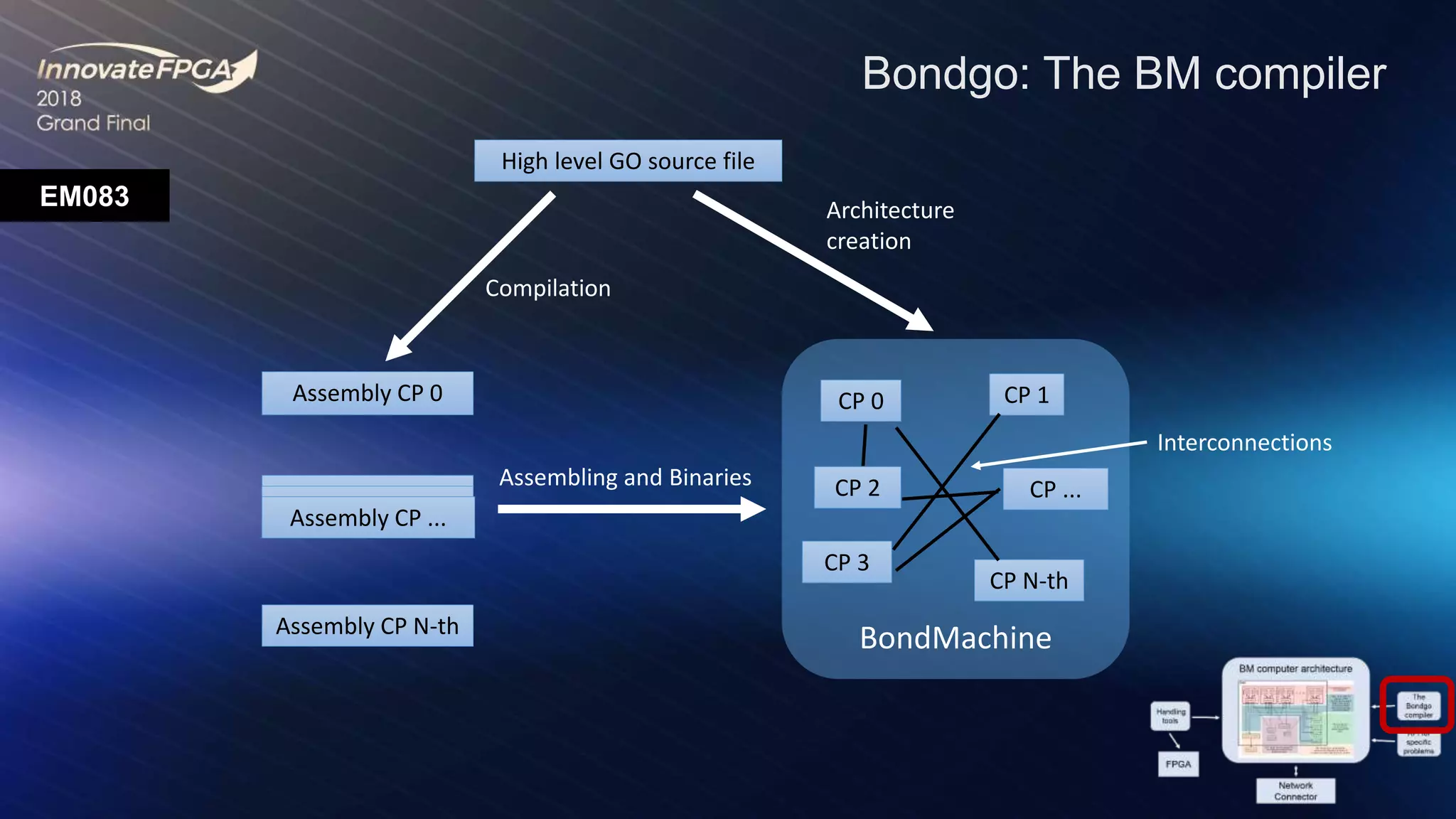
Bondgo: The BM compiler
High level GO source file
Assembly CP 0Assembly CP 0Assembly CP ...
Assembly CP 0
Assembly CP N-th
Compilation
Assembling and Binaries
CP 0
CP 2 CP ...
CP 3
CP N-th
CP 1
Architecture
creation
Interconnections
EM083
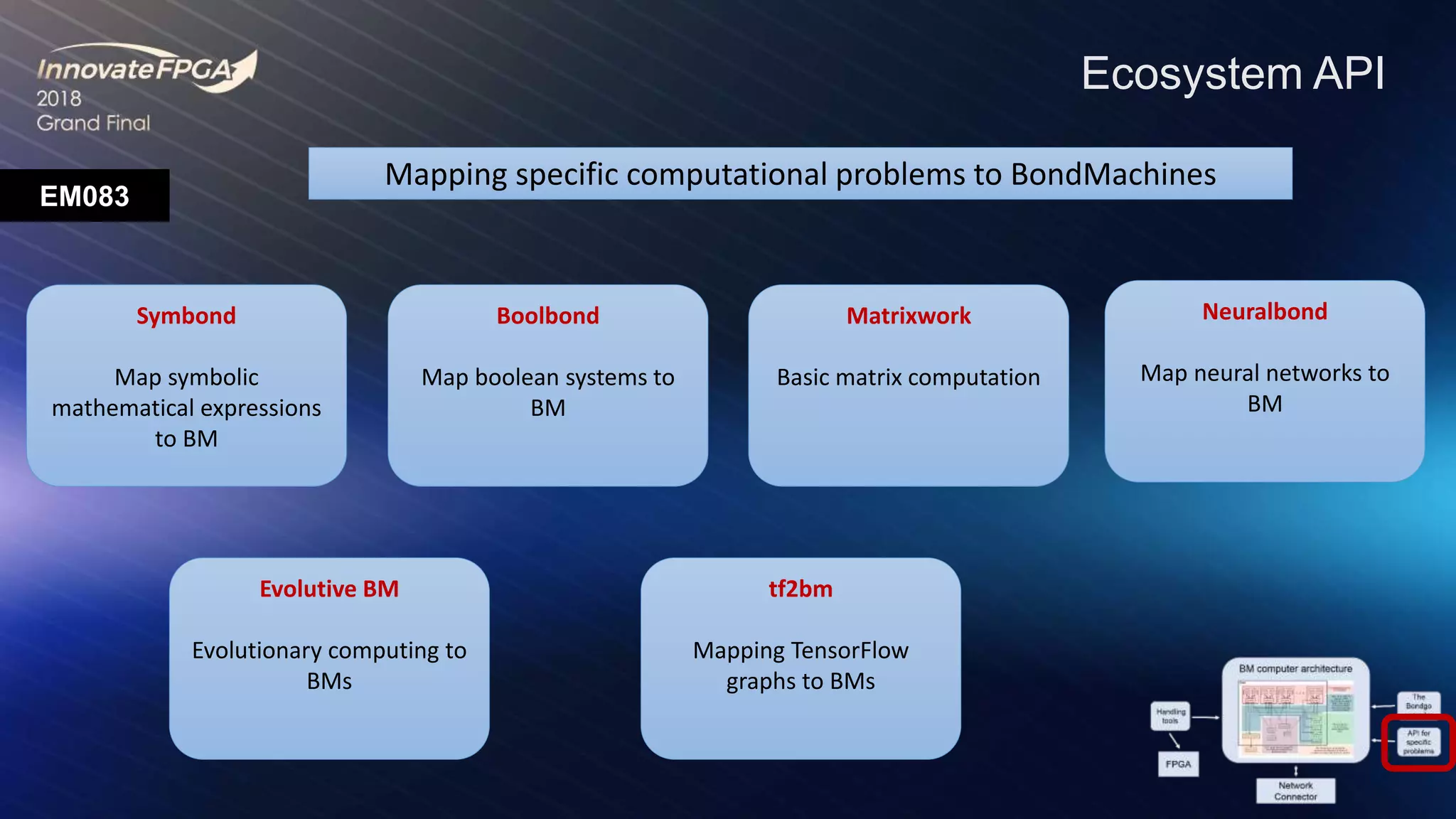
Ecosystem API
Mapping specific computational problems to BondMachines
Symbond
Map symbolic
mathematical expressions
to BM
Matrixwork
Basic matrix computation
Boolbond
Map boolean systems to
BM
tf2bm
Mapping TensorFlow
graphs to BMs
Neuralbond
Map neural networks to
BM
Evolutive BM
Evolutionary computing to
BMs
EM083
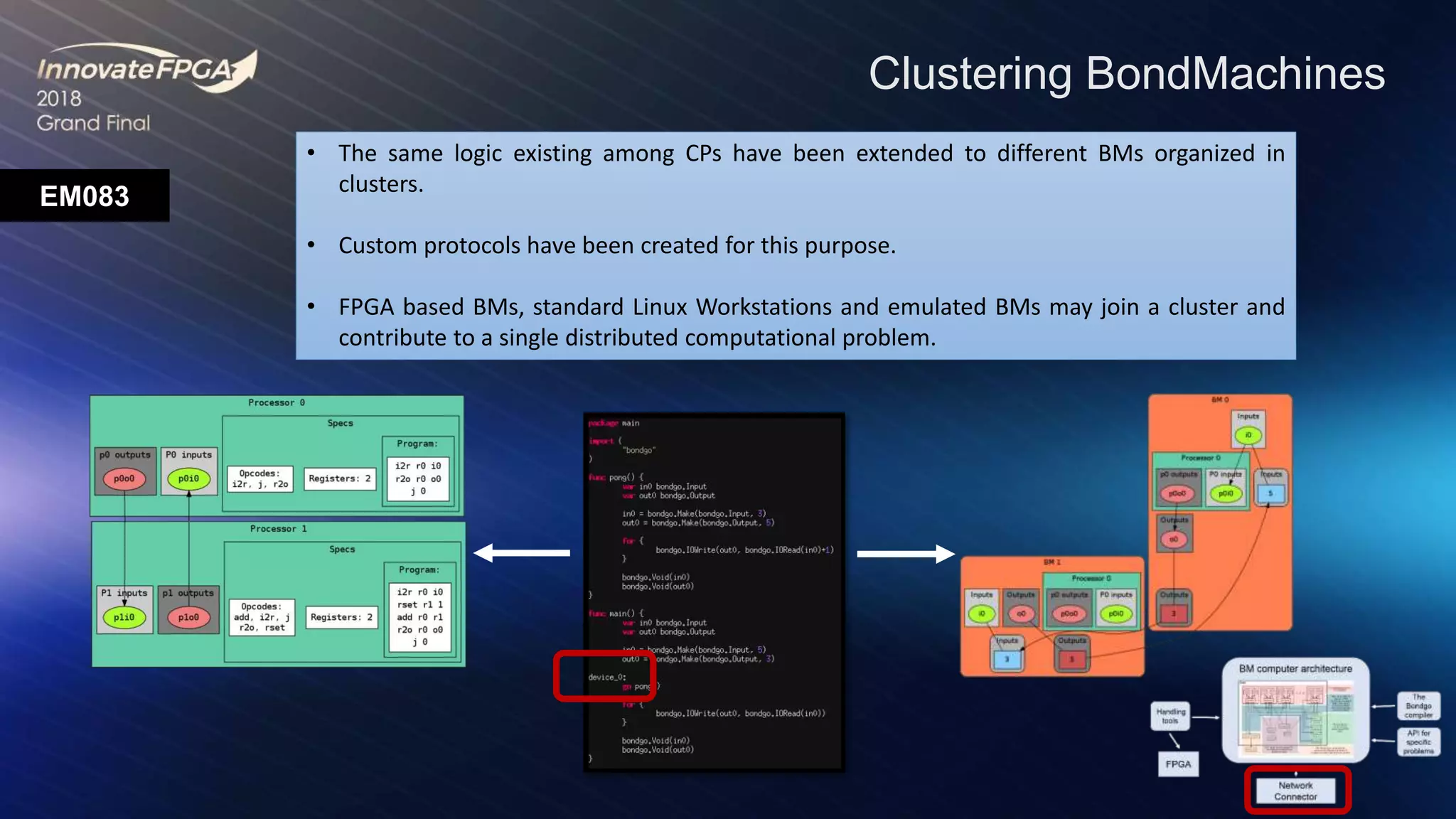
Clustering BondMachines
• The same logic existing among CPs have been extended to different BMs organized in
clusters.
• Custom protocols have been created for this purpose.
• FPGA based BMs, standard Linux Workstations and emulated BMs may join a cluster and
contribute to a single distributed computational problem.
EM083
Conclusion and Future work
• The result of this project is the construction of a computer architecture that is
not anymore a static constraint where computing occurs but its creation becomes
a part of the computing process, gaining computing power and flexibility
• Over this abstraction is it possible to create a full computing Ecosystem
• Keeping the register machine abstraction it is possible to borrow well known
languages and techniques to keep the programming simple
Future work:
• New instructions and SO
• Support for new interconnection
devices
Uses in Physics experiments:
• Real time pulse shape analysis in
neutron detectors
• Space experiments test beams

BondMachine slides for the InnovateFPGA 2018 Grand Final

  • 1.
    EM083 BondMachine Reconfigurable Computing Mirko Mariotti, LorianoStorchi, Daniele Spiga Dept of Physics and Geology – University of Perugia INFN Perugia
  • 2.
    EM083 • Create acomputational system where hardware and software are co-designed • Guarantee the full exploitation of the FPGA hardware capabilities • Provide a user friendly abstraction Objectives • A dynamic computer architecture: adapting to specific computational problems Strategy BondMachine (BM)
  • 3.
    EM083 BM Computer ArchitectureComponents Connecting Processor (CP) The atomic computing core ● Simple “register machines” ● Interconnected via special IO registers and opcodes ● Local ROM and RAM ● Specialized with many customization possibilities ● Building a Heterogeneous architecture with Many cores in a single BM Shared Object (SO) Non-computing objects ● Objects like: memories, channels, barriers, pseudo random generators. Etc.. ● Shared possibly among CPs ● Used by CPs via extra instructions to allow synchronization, storage, communication
  • 4.
  • 5.
    EM083 Handling the BMcomputer architecture The BM computer architecture is managed by a set of tools to: • Build a specific architecture • Modify a pre-existing architecture • Simulate or Emulate the behavior • Generate the Register Transfer Level (RTL) code Processor Builder (procbuilder) Selects the single processor, assemble and disassemble, saves on disk as JSON, creates the RTL code of a CP. Simulation Framework (simbox) Simulates the behavior, emulates a BM on a standard Linux workstation. BondMachine Builder (bondmachine) Connects CPs and SOs together in custom topologies, loads and saves on disk as JSON, create BM's RTL code.
  • 6.
    BondMachine EM083 Bondgo: The BMcompiler High level GO source file Assembly CP 0Assembly CP 0Assembly CP ... Assembly CP 0 Assembly CP N-th Compilation Assembling and Binaries CP 0 CP 2 CP ... CP 3 CP N-th CP 1 Architecture creation Interconnections
  • 7.
    EM083 Ecosystem API Mapping specificcomputational problems to BondMachines Symbond Map symbolic mathematical expressions to BM Matrixwork Basic matrix computation Boolbond Map boolean systems to BM tf2bm Mapping TensorFlow graphs to BMs Neuralbond Map neural networks to BM Evolutive BM Evolutionary computing to BMs
  • 8.
    EM083 Clustering BondMachines • Thesame logic existing among CPs have been extended to different BMs organized in clusters. • Custom protocols have been created for this purpose. • FPGA based BMs, standard Linux Workstations and emulated BMs may join a cluster and contribute to a single distributed computational problem.
  • 9.
    EM083 Conclusion and Futurework • The result of this project is the construction of a computer architecture that is not anymore a static constraint where computing occurs but its creation becomes a part of the computing process, gaining computing power and flexibility • Over this abstraction is it possible to create a full computing Ecosystem • Keeping the register machine abstraction it is possible to borrow well known languages and techniques to keep the programming simple Future work: • New instructions and SO • Support for new interconnection devices Uses in Physics experiments: • Real time pulse shape analysis in neutron detectors • Space experiments test beams