Physics Learning Object
SIMPLE HARMONIC MOTION OF
A MASS ON A VERTICAL SPRING
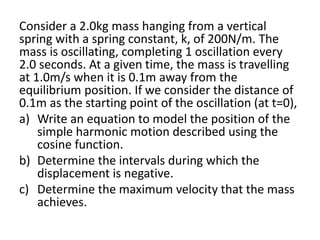
Consider a 2.0kg mass hanging from a vertical
spring with a spring constant, k, of 200N/m. The
mass is oscillating, completing 1 oscillation every
2.0 seconds. At a given time, the mass is travelling
at 1.0m/s when it is 0.1m away from the
equilibrium position. If we consider the distance of
0.1m as the starting point of the oscillation (at t=0),
a) Write an equation to model the position of the
simple harmonic motion described using the
cosine function.
b) Determine the intervals during which the
displacement is negative.
c) Determine the maximum velocity that the mass
achieves.
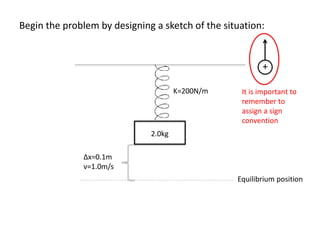
Begin the problem by designing a sketch of the situation:
Equilibrium position
K=200N/m
Δx=0.1m
v=1.0m/s
2.0kg
+
It is important to
remember to
assign a sign
convention
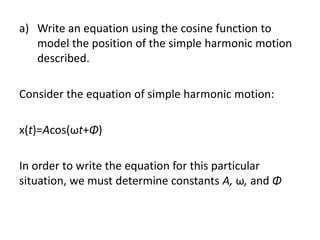
a) Write an equation using the cosine function to
model the position of the simple harmonic motion
described.
Consider the equation of simple harmonic motion:
x(t)=Acos(ωt+Φ)
In order to write the equation for this particular
situation, we must determine constants A, ω, and Φ
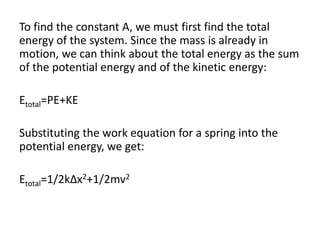
To find the constant A, we must first find the total
energy of the system. Since the mass is already in
motion, we can think about the total energy as the sum
of the potential energy and of the kinetic energy:
Etotal=PE+KE
Substituting the work equation for a spring into the
potential energy, we get:
Etotal=1/2kΔx2+1/2mv2
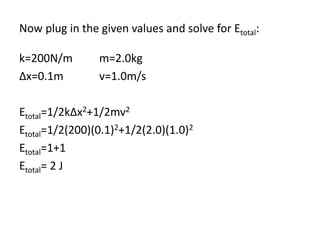
Now plug in the given values and solve for Etotal:
k=200N/m m=2.0kg
Δx=0.1m v=1.0m/s
Etotal=1/2kΔx2+1/2mv2
Etotal=1/2(200)(0.1)2+1/2(2.0)(1.0)2
Etotal=1+1
Etotal= 2 J
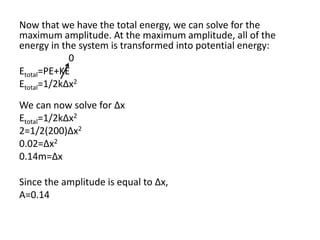
Now that we have the total energy, we can solve for the
maximum amplitude. At the maximum amplitude, all of the
energy in the system is transformed into potential energy:
Etotal=PE+KE
Etotal=1/2kΔx2
We can now solve for Δx
Etotal=1/2kΔx2
2=1/2(200)Δx2
0.02=Δx2
0.14m=Δx
Since the amplitude is equal to Δx,
A=0.14
0
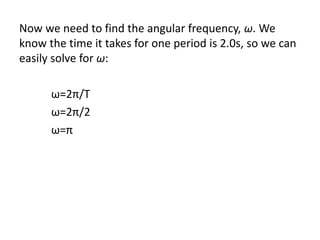
Now we need to find the angular frequency, ω. We
know the time it takes for one period is 2.0s, so we can
easily solve for ω:
ω=2π/T
ω=2π/2
ω=π
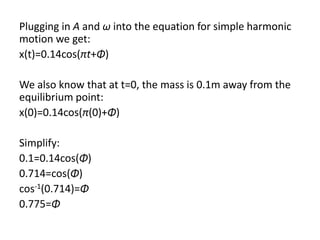
Plugging in A and ω into the equation for simple harmonic
motion we get:
x(t)=0.14cos(πt+Φ)
We also know that at t=0, the mass is 0.1m away from the
equilibrium point:
x(0)=0.14cos(π(0)+Φ)
Simplify:
0.1=0.14cos(Φ)
0.714=cos(Φ)
cos-1(0.714)=Φ
0.775=Φ
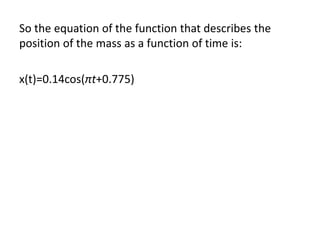
So the equation of the function that describes the
position of the mass as a function of time is:
x(t)=0.14cos(πt+0.775)
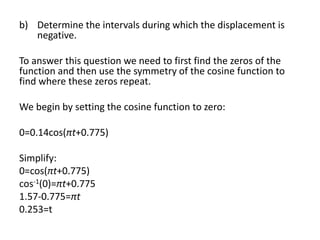
b) Determine the intervals during which the displacement is
negative.
To answer this question we need to first find the zeros of the
function and then use the symmetry of the cosine function to
find where these zeros repeat.
We begin by setting the cosine function to zero:
0=0.14cos(πt+0.775)
Simplify:
0=cos(πt+0.775)
cos-1(0)=πt+0.775
1.57-0.775=πt
0.253=t
The first zero of this function is at t=0.253 and we know
from the question that it will repeat this oscillation
every 2 seconds, crossing the x-axis once in between
this oscillation. So the zeros of the function can be
described as:
0=x(0.253)
0=x(0.253+1)
0=x(0.253+2)
0=x(0.253+2)
Etc..
0=x(0.253+n), where n is an integer
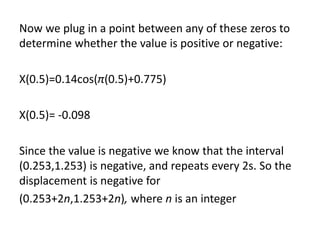
Now we plug in a point between any of these zeros to
determine whether the value is positive or negative:
X(0.5)=0.14cos(π(0.5)+0.775)
X(0.5)= -0.098
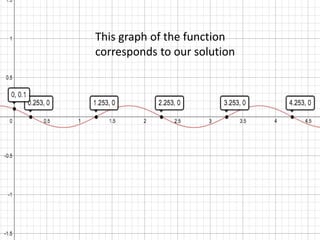
Since the value is negative we know that the interval
(0.253,1.253) is negative, and repeats every 2s. So the
displacement is negative for
(0.253+2n,1.253+2n), where n is an integer
This graph of the function
corresponds to our solution
c) Determine the maximum velocity that the mass
achieves.
Again we can think about this problem in terms of
energy. At maximum velocity, all of the potential energy
of the system has been transformed into kinetic energy.
(Note that this occurs when the object passes through
the equilibrium point).
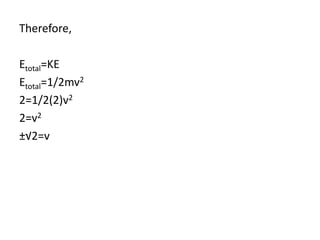
Therefore,
Etotal=KE
Etotal=1/2mv2
2=1/2(2)v2
2=v2
±√2=v
Therefore,
Etotal=KE
Etotal=1/2mv2
2=1/2(2)v2
2=v2
±√2=v
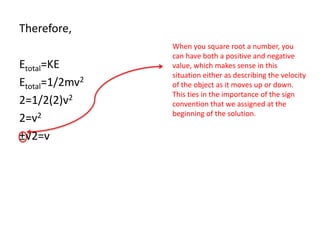
When you square root a number, you
can have both a positive and negative
value, which makes sense in this
situation either as describing the velocity
of the object as it moves up or down.
This ties in the importance of the sign
convention that we assigned at the
beginning of the solution.

Learning object harmonic motion

  • 1.
    Physics Learning Object SIMPLEHARMONIC MOTION OF A MASS ON A VERTICAL SPRING
  • 2.
    Consider a 2.0kgmass hanging from a vertical spring with a spring constant, k, of 200N/m. The mass is oscillating, completing 1 oscillation every 2.0 seconds. At a given time, the mass is travelling at 1.0m/s when it is 0.1m away from the equilibrium position. If we consider the distance of 0.1m as the starting point of the oscillation (at t=0), a) Write an equation to model the position of the simple harmonic motion described using the cosine function. b) Determine the intervals during which the displacement is negative. c) Determine the maximum velocity that the mass achieves.
  • 3.
    Begin the problemby designing a sketch of the situation: Equilibrium position K=200N/m Δx=0.1m v=1.0m/s 2.0kg + It is important to remember to assign a sign convention
  • 4.
    a) Write anequation using the cosine function to model the position of the simple harmonic motion described. Consider the equation of simple harmonic motion: x(t)=Acos(ωt+Φ) In order to write the equation for this particular situation, we must determine constants A, ω, and Φ
  • 5.
    To find theconstant A, we must first find the total energy of the system. Since the mass is already in motion, we can think about the total energy as the sum of the potential energy and of the kinetic energy: Etotal=PE+KE Substituting the work equation for a spring into the potential energy, we get: Etotal=1/2kΔx2+1/2mv2
  • 6.
    Now plug inthe given values and solve for Etotal: k=200N/m m=2.0kg Δx=0.1m v=1.0m/s Etotal=1/2kΔx2+1/2mv2 Etotal=1/2(200)(0.1)2+1/2(2.0)(1.0)2 Etotal=1+1 Etotal= 2 J
  • 7.
    Now that wehave the total energy, we can solve for the maximum amplitude. At the maximum amplitude, all of the energy in the system is transformed into potential energy: Etotal=PE+KE Etotal=1/2kΔx2 We can now solve for Δx Etotal=1/2kΔx2 2=1/2(200)Δx2 0.02=Δx2 0.14m=Δx Since the amplitude is equal to Δx, A=0.14 0
  • 8.
    Now we needto find the angular frequency, ω. We know the time it takes for one period is 2.0s, so we can easily solve for ω: ω=2π/T ω=2π/2 ω=π
  • 9.
    Plugging in Aand ω into the equation for simple harmonic motion we get: x(t)=0.14cos(πt+Φ) We also know that at t=0, the mass is 0.1m away from the equilibrium point: x(0)=0.14cos(π(0)+Φ) Simplify: 0.1=0.14cos(Φ) 0.714=cos(Φ) cos-1(0.714)=Φ 0.775=Φ
  • 10.
    So the equationof the function that describes the position of the mass as a function of time is: x(t)=0.14cos(πt+0.775)
  • 11.
    b) Determine theintervals during which the displacement is negative. To answer this question we need to first find the zeros of the function and then use the symmetry of the cosine function to find where these zeros repeat. We begin by setting the cosine function to zero: 0=0.14cos(πt+0.775) Simplify: 0=cos(πt+0.775) cos-1(0)=πt+0.775 1.57-0.775=πt 0.253=t
  • 12.
    The first zeroof this function is at t=0.253 and we know from the question that it will repeat this oscillation every 2 seconds, crossing the x-axis once in between this oscillation. So the zeros of the function can be described as: 0=x(0.253) 0=x(0.253+1) 0=x(0.253+2) 0=x(0.253+2) Etc.. 0=x(0.253+n), where n is an integer
  • 13.
    Now we plugin a point between any of these zeros to determine whether the value is positive or negative: X(0.5)=0.14cos(π(0.5)+0.775) X(0.5)= -0.098 Since the value is negative we know that the interval (0.253,1.253) is negative, and repeats every 2s. So the displacement is negative for (0.253+2n,1.253+2n), where n is an integer
  • 14.
    This graph ofthe function corresponds to our solution
  • 15.
    c) Determine themaximum velocity that the mass achieves. Again we can think about this problem in terms of energy. At maximum velocity, all of the potential energy of the system has been transformed into kinetic energy. (Note that this occurs when the object passes through the equilibrium point).
  • 16.
  • 17.
    Therefore, Etotal=KE Etotal=1/2mv2 2=1/2(2)v2 2=v2 ±√2=v When you squareroot a number, you can have both a positive and negative value, which makes sense in this situation either as describing the velocity of the object as it moves up or down. This ties in the importance of the sign convention that we assigned at the beginning of the solution.