Michael Faraday
    Michael Faraday, a British
chemist and physicist was one of
    the greatest scientists who
  contributed significantly to the
 fields of electromagnetism and
         electrochemistry.
A little background information
            about Michael Faraday
Faraday was born in a very poor family on 22nd September 1791
in Newington Butts which is now forms a part of the London
Borough of Southwark. He had three other siblings and hence
was deprived of basic necessity on account of his family’s poor
status and he only had very basic education.
At the age of 14, he was only an assistant to a local bookbinder.
During the next seven years, he took efforts to further educate
himself by reading books on a wide range of scientific subjects
and during this period he read many books that helped him to
develop a thirst for science.
In 1812 (when he was 20 y/o), he started attending lectures given
by notable people like Humphry Davy and JohnTatum. He then
applied to Davy for an employment, sending him the notes he
made during his lectures as evidence of his interest. He worked
as Davy's secretary and later on was appointed as Chemical
Assistant at the Royal Institution in 1813. Faraday's trips with
Davy helped him learn about many European scientists and
develop sound scientific ideas.
Faraday began his research in chemistry under Humphry Davy.
During this time Faraday carried out many experiments and made
new discoveries in the field of chemical science.
He died on 25 August 1867 at Hampton Court, where he had
been given official lodgings in recognition of his contribution to
science. He gave his name to the 'farad', originally describing a
unit of electrical charge but later a unit of electrical capacitance.
How has Michael Faraday
contributed to electricity?
                   1. (theory) Mutual Induction
                     2. (theory) Field Theory
        3. Electric Dynamo (modern day electric motor)
    4. Investigation of the fundamental nature of electricity
5. (theory) Faraday's concept of lines of flux emanating from
            charged bodies was crucial for the successful
        development of the electromechanical devices in the
                               19th Century.
                   6. Electromagnetic Rotation
              7. Basis of the first Law of Electrosis
                        8. “Faraday’s effect”
                         9. “Diamagnetism
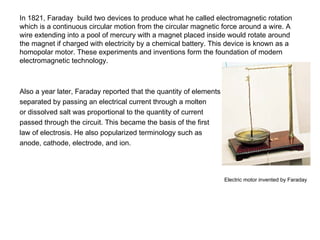
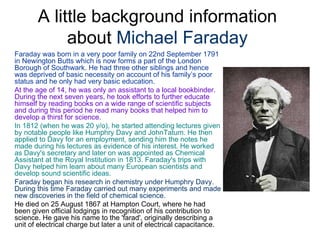
In 1821, Faraday build two devices to produce what he called electromagnetic rotation
which is a continuous circular motion from the circular magnetic force around a wire. A
wire extending into a pool of mercury with a magnet placed inside would rotate around
the magnet if charged with electricity by a chemical battery. This device is known as a
homopolar motor. These experiments and inventions form the foundation of modern
electromagnetic technology.


Also a year later, Faraday reported that the quantity of elements
separated by passing an electrical current through a molten
or dissolved salt was proportional to the quantity of current
passed through the circuit. This became the basis of the first
law of electrosis. He also popularized terminology such as
anode, cathode, electrode, and ion.


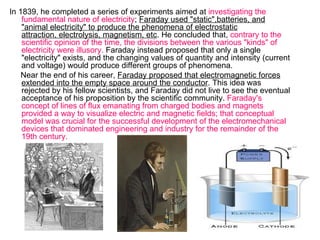
                                                                    Electric motor invented by Faraday
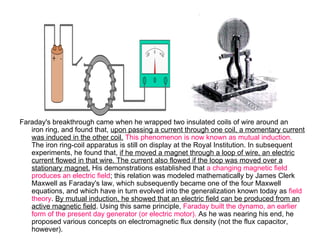
Faraday's breakthrough came when he wrapped two insulated coils of wire around an
   iron ring, and found that, upon passing a current through one coil, a momentary current
   was induced in the other coil. This phenomenon is now known as mutual induction.
   The iron ring-coil apparatus is still on display at the Royal Institution. In subsequent
   experiments, he found that, if he moved a magnet through a loop of wire, an electric
   current flowed in that wire. The current also flowed if the loop was moved over a
   stationary magnet. His demonstrations established that a changing magnetic field
   produces an electric field; this relation was modeled mathematically by James Clerk
   Maxwell as Faraday's law, which subsequently became one of the four Maxwell
   equations, and which have in turn evolved into the generalization known today as field
   theory. By mutual induction, he showed that an electric field can be produced from an
   active magnetic field. Using this same principle, Faraday built the dynamo, an earlier
   form of the present day generator (or electric motor). As he was nearing his end, he
   proposed various concepts on electromagnetic flux density (not the flux capacitor,
   however).
In 1839, he completed a series of experiments aimed at investigating the
    fundamental nature of electricity; Faraday used "static",batteries, and
    "animal electricity" to produce the phenomena of electrostatic
    attraction, electrolysis, magnetism, etc. He concluded that, contrary to the
    scientific opinion of the time, the divisions between the various "kinds" of
    electricity were illusory. Faraday instead proposed that only a single
    "electricity" exists, and the changing values of quantity and intensity (current
    and voltage) would produce different groups of phenomena.
    Near the end of his career, Faraday proposed that electromagnetic forces
    extended into the empty space around the conductor. This idea was
    rejected by his fellow scientists, and Faraday did not live to see the eventual
    acceptance of his proposition by the scientific community. Faraday's
    concept of lines of flux emanating from charged bodies and magnets
    provided a way to visualize electric and magnetic fields; that conceptual
    model was crucial for the successful development of the electromechanical
    devices that dominated engineering and industry for the remainder of the
    19th century.
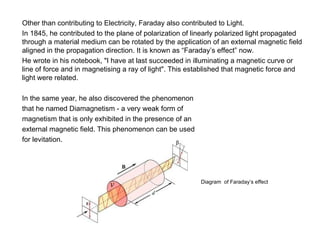
Other than contributing to Electricity, Faraday also contributed to Light.
In 1845, he contributed to the plane of polarization of linearly polarized light propagated
through a material medium can be rotated by the application of an external magnetic field
aligned in the propagation direction. It is known as “Faraday’s effect” now.
He wrote in his notebook, "I have at last succeeded in illuminating a magnetic curve or
line of force and in magnetising a ray of light". This established that magnetic force and
light were related.

In the same year, he also discovered the phenomenon
that he named Diamagnetism - a very weak form of
magnetism that is only exhibited in the presence of an
external magnetic field. This phenomenon can be used
for levitation.


                                                          Diagram of Faraday’s effect
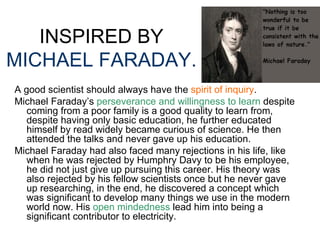
INSPIRED BY
MICHAEL FARADAY.
A good scientist should always have the spirit of inquiry.
Michael Faraday’s perseverance and willingness to learn despite
   coming from a poor family is a good quality to learn from,
   despite having only basic education, he further educated
   himself by read widely became curious of science. He then
   attended the talks and never gave up his education.
Michael Faraday had also faced many rejections in his life, like
   when he was rejected by Humphry Davy to be his employee,
   he did not just give up pursuing this career. His theory was
   also rejected by his fellow scientists once but he never gave
   up researching, in the end, he discovered a concept which
   was significant to develop many things we use in the modern
   world now. His open mindedness lead him into being a
   significant contributor to electricity.
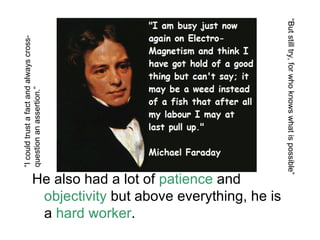
“But still try, for who knows what is possible”
“I could trust a fact and always cross-
question an assertion.”


                   He also had a lot of patience and
                    objectivity but above everything, he is
                    a hard worker.
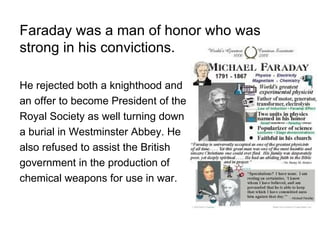
Faraday was a man of honor who was
strong in his convictions.

He rejected both a knighthood and
an offer to become President of the
Royal Society as well turning down
a burial in Westminster Abbey. He
also refused to assist the British
government in the production of
chemical weapons for use in war.
Reflections
→ What we have learnt and understood from this
 assignment. We have learnt many theories and how things like the
  electric dynamo worked. Through this assignment, we found out many of
  Michael Faraday’s contributions to electricity and that he was a major part of
  it. Also, as stated in slide 5, Michael Faraday had acknowledged the basics
  and investigated on the fundamental nature of electricity which lead him to
  his success, through this, we understood, that the basics cannot be ignored
  and that we should not neglect it.
→Issues my member and I had faced and how we
 overcame it. Information were very vague but we overcame it by
  researching on a variety of website so we can have many things to present.
  Also, some of the slides had too many words and may look too ‘boring’ or
  wordy but we highlighted and underlined the main points to provide an
  easier read.
THANK YOU FOR READING.
          ☺
   We hope you enjoyed our slides!
      Done by Low Lu Yi (13)
                &
        Chew Yan Wen (04)

Michael Faraday ppt

  • 1.
    Michael Faraday Michael Faraday, a British chemist and physicist was one of the greatest scientists who contributed significantly to the fields of electromagnetism and electrochemistry.
  • 2.
    A little backgroundinformation about Michael Faraday Faraday was born in a very poor family on 22nd September 1791 in Newington Butts which is now forms a part of the London Borough of Southwark. He had three other siblings and hence was deprived of basic necessity on account of his family’s poor status and he only had very basic education. At the age of 14, he was only an assistant to a local bookbinder. During the next seven years, he took efforts to further educate himself by reading books on a wide range of scientific subjects and during this period he read many books that helped him to develop a thirst for science. In 1812 (when he was 20 y/o), he started attending lectures given by notable people like Humphry Davy and JohnTatum. He then applied to Davy for an employment, sending him the notes he made during his lectures as evidence of his interest. He worked as Davy's secretary and later on was appointed as Chemical Assistant at the Royal Institution in 1813. Faraday's trips with Davy helped him learn about many European scientists and develop sound scientific ideas. Faraday began his research in chemistry under Humphry Davy. During this time Faraday carried out many experiments and made new discoveries in the field of chemical science. He died on 25 August 1867 at Hampton Court, where he had been given official lodgings in recognition of his contribution to science. He gave his name to the 'farad', originally describing a unit of electrical charge but later a unit of electrical capacitance.
  • 3.
    How has MichaelFaraday contributed to electricity? 1. (theory) Mutual Induction 2. (theory) Field Theory 3. Electric Dynamo (modern day electric motor) 4. Investigation of the fundamental nature of electricity 5. (theory) Faraday's concept of lines of flux emanating from charged bodies was crucial for the successful development of the electromechanical devices in the 19th Century. 6. Electromagnetic Rotation 7. Basis of the first Law of Electrosis 8. “Faraday’s effect” 9. “Diamagnetism
  • 4.
    In 1821, Faradaybuild two devices to produce what he called electromagnetic rotation which is a continuous circular motion from the circular magnetic force around a wire. A wire extending into a pool of mercury with a magnet placed inside would rotate around the magnet if charged with electricity by a chemical battery. This device is known as a homopolar motor. These experiments and inventions form the foundation of modern electromagnetic technology. Also a year later, Faraday reported that the quantity of elements separated by passing an electrical current through a molten or dissolved salt was proportional to the quantity of current passed through the circuit. This became the basis of the first law of electrosis. He also popularized terminology such as anode, cathode, electrode, and ion. Electric motor invented by Faraday
  • 5.
    Faraday's breakthrough camewhen he wrapped two insulated coils of wire around an iron ring, and found that, upon passing a current through one coil, a momentary current was induced in the other coil. This phenomenon is now known as mutual induction. The iron ring-coil apparatus is still on display at the Royal Institution. In subsequent experiments, he found that, if he moved a magnet through a loop of wire, an electric current flowed in that wire. The current also flowed if the loop was moved over a stationary magnet. His demonstrations established that a changing magnetic field produces an electric field; this relation was modeled mathematically by James Clerk Maxwell as Faraday's law, which subsequently became one of the four Maxwell equations, and which have in turn evolved into the generalization known today as field theory. By mutual induction, he showed that an electric field can be produced from an active magnetic field. Using this same principle, Faraday built the dynamo, an earlier form of the present day generator (or electric motor). As he was nearing his end, he proposed various concepts on electromagnetic flux density (not the flux capacitor, however).
  • 6.
    In 1839, hecompleted a series of experiments aimed at investigating the fundamental nature of electricity; Faraday used "static",batteries, and "animal electricity" to produce the phenomena of electrostatic attraction, electrolysis, magnetism, etc. He concluded that, contrary to the scientific opinion of the time, the divisions between the various "kinds" of electricity were illusory. Faraday instead proposed that only a single "electricity" exists, and the changing values of quantity and intensity (current and voltage) would produce different groups of phenomena. Near the end of his career, Faraday proposed that electromagnetic forces extended into the empty space around the conductor. This idea was rejected by his fellow scientists, and Faraday did not live to see the eventual acceptance of his proposition by the scientific community. Faraday's concept of lines of flux emanating from charged bodies and magnets provided a way to visualize electric and magnetic fields; that conceptual model was crucial for the successful development of the electromechanical devices that dominated engineering and industry for the remainder of the 19th century.
  • 7.
    Other than contributingto Electricity, Faraday also contributed to Light. In 1845, he contributed to the plane of polarization of linearly polarized light propagated through a material medium can be rotated by the application of an external magnetic field aligned in the propagation direction. It is known as “Faraday’s effect” now. He wrote in his notebook, "I have at last succeeded in illuminating a magnetic curve or line of force and in magnetising a ray of light". This established that magnetic force and light were related. In the same year, he also discovered the phenomenon that he named Diamagnetism - a very weak form of magnetism that is only exhibited in the presence of an external magnetic field. This phenomenon can be used for levitation. Diagram of Faraday’s effect
  • 8.
    INSPIRED BY MICHAEL FARADAY. Agood scientist should always have the spirit of inquiry. Michael Faraday’s perseverance and willingness to learn despite coming from a poor family is a good quality to learn from, despite having only basic education, he further educated himself by read widely became curious of science. He then attended the talks and never gave up his education. Michael Faraday had also faced many rejections in his life, like when he was rejected by Humphry Davy to be his employee, he did not just give up pursuing this career. His theory was also rejected by his fellow scientists once but he never gave up researching, in the end, he discovered a concept which was significant to develop many things we use in the modern world now. His open mindedness lead him into being a significant contributor to electricity.
  • 9.
    “But still try,for who knows what is possible” “I could trust a fact and always cross- question an assertion.” He also had a lot of patience and objectivity but above everything, he is a hard worker.
  • 10.
    Faraday was aman of honor who was strong in his convictions. He rejected both a knighthood and an offer to become President of the Royal Society as well turning down a burial in Westminster Abbey. He also refused to assist the British government in the production of chemical weapons for use in war.
  • 11.
    Reflections → What wehave learnt and understood from this assignment. We have learnt many theories and how things like the electric dynamo worked. Through this assignment, we found out many of Michael Faraday’s contributions to electricity and that he was a major part of it. Also, as stated in slide 5, Michael Faraday had acknowledged the basics and investigated on the fundamental nature of electricity which lead him to his success, through this, we understood, that the basics cannot be ignored and that we should not neglect it. →Issues my member and I had faced and how we overcame it. Information were very vague but we overcame it by researching on a variety of website so we can have many things to present. Also, some of the slides had too many words and may look too ‘boring’ or wordy but we highlighted and underlined the main points to provide an easier read.
  • 12.
    THANK YOU FORREADING. ☺ We hope you enjoyed our slides! Done by Low Lu Yi (13) & Chew Yan Wen (04)