The Secrets of the
Electric Guitar
Luka Deretić 3-E3
The Physics of the Electric
Guitar
• Electric guitars make use of Faraday's
discovery.
• Pick-up coils, consisting of a small
magnet wound with wire, created an
interaction with a magnetic string or wire,
which in turn creates a current in the coil.
• This current can be transmitted to a
speaker and converted to sound by a
reciprocal process.
Discoveries
• First discovered by Michael
Faraday, electromagnetic induction
is the process of using magnetic
fields to produce voltage, and in a
complete circuit, a current.
• Leo Fender created the electric
guitar in 1940s.
Michael Faraday
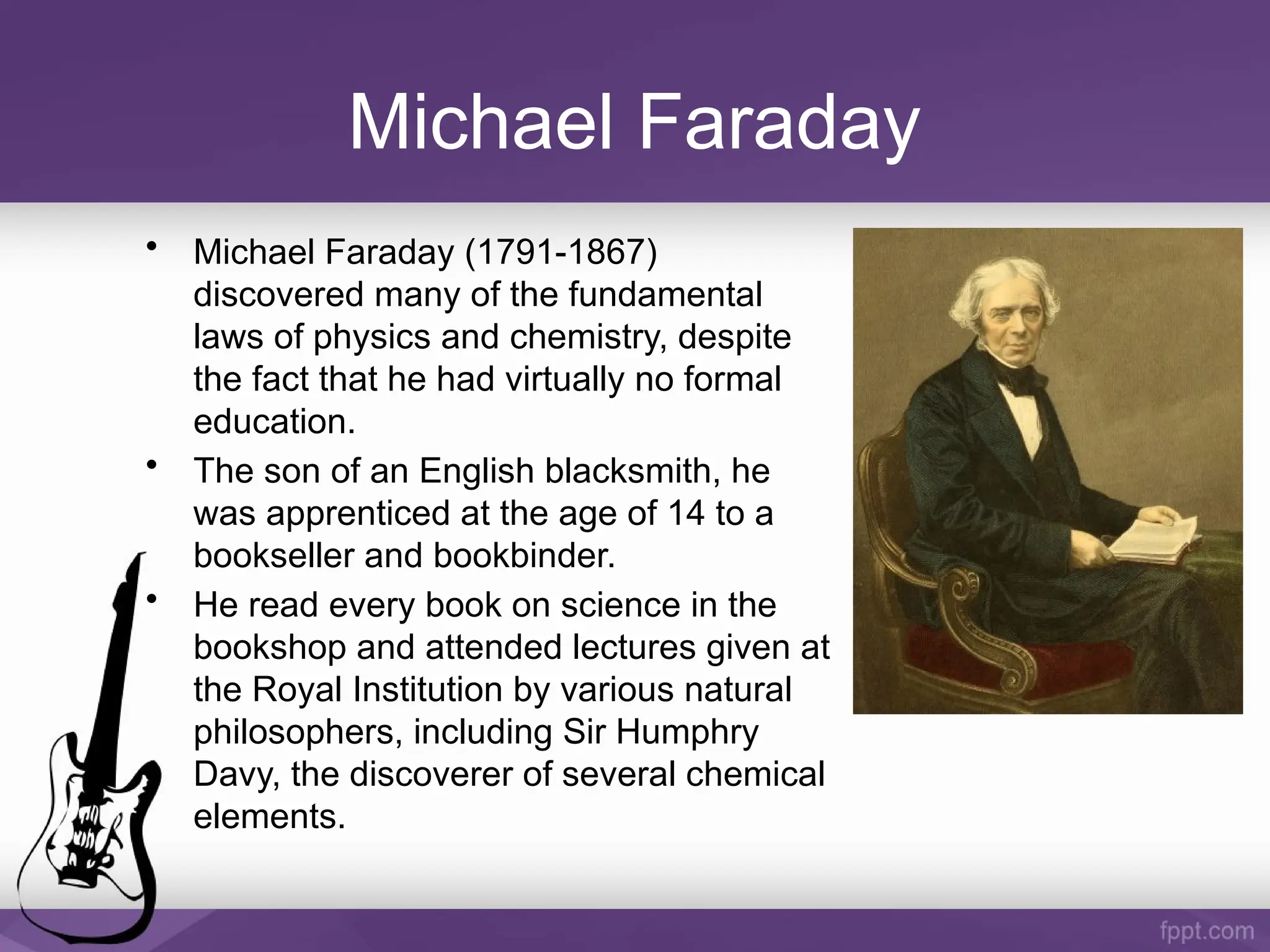
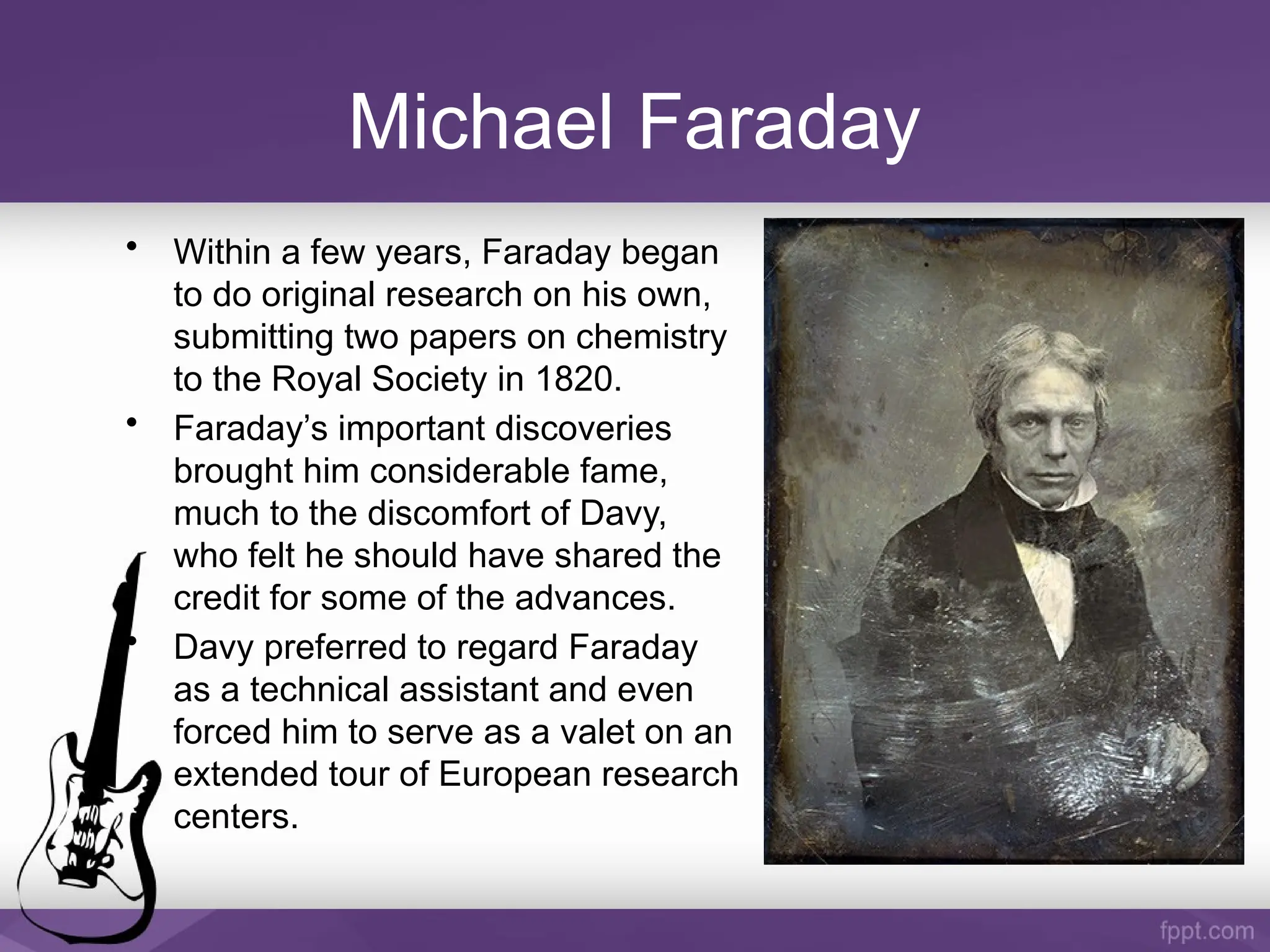
• Michael Faraday (1791-1867)
discovered many of the fundamental
laws of physics and chemistry, despite
the fact that he had virtually no formal
education.
• The son of an English blacksmith, he
was apprenticed at the age of 14 to a
bookseller and bookbinder.
• He read every book on science in the
bookshop and attended lectures given at
the Royal Institution by various natural
philosophers, including Sir Humphry
Davy, the discoverer of several chemical
elements.
Michael Faraday
• Within a few years, Faraday began
to do original research on his own,
submitting two papers on chemistry
to the Royal Society in 1820.
• Faraday’s important discoveries
brought him considerable fame,
much to the discomfort of Davy,
who felt he should have shared the
credit for some of the advances.
• Davy preferred to regard Faraday
as a technical assistant and even
forced him to serve as a valet on an
extended tour of European research
centers.
Michael Faraday
• After Faraday discovered, in 1831, that a
changing magnetic field can induce a current, he
performed a series of experiments that showed
clearly that the induced EMF is equal to the rate
of change of magnetic flux.
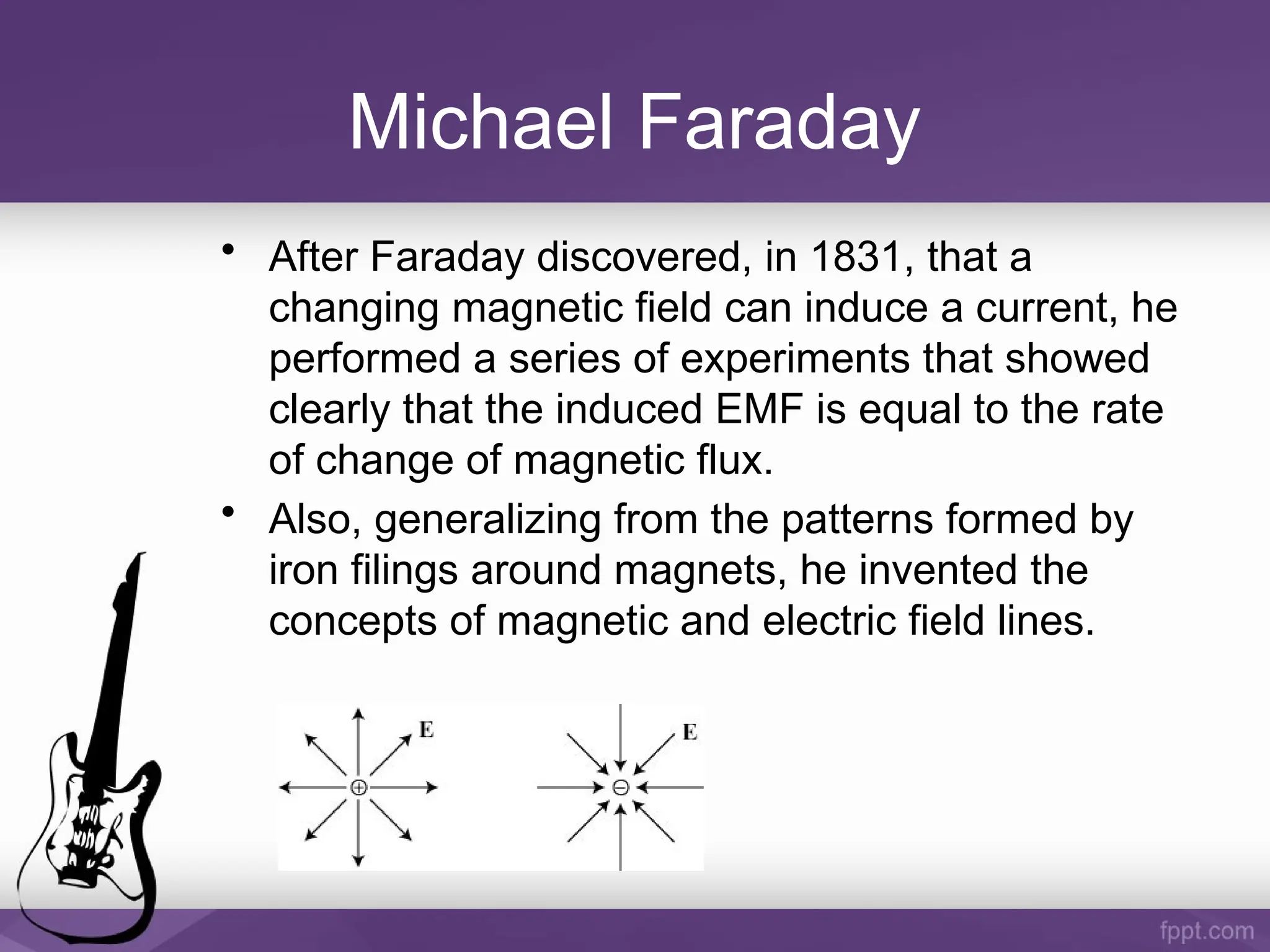
• Also, generalizing from the patterns formed by
iron filings around magnets, he invented the
concepts of magnetic and electric field lines.
Michael Faraday
• Faraday made many other notable contributions.
• During the years 1831-1855 Faraday read before
the Royal Society a series of 30 papers that were
published in his three-volume ‘Experimental
Researches in Electricity’.
Michael Faraday
• An electric charge which is placed into the
electric field will feel a force equal to the
product of the electric field (a vector
quantity) and the value of the charge itself.

2281.pptx on the topic of science (partially linked with music)

  • 1.
    The Secrets ofthe Electric Guitar Luka Deretić 3-E3
  • 2.
    The Physics ofthe Electric Guitar • Electric guitars make use of Faraday's discovery. • Pick-up coils, consisting of a small magnet wound with wire, created an interaction with a magnetic string or wire, which in turn creates a current in the coil. • This current can be transmitted to a speaker and converted to sound by a reciprocal process.
  • 3.
    Discoveries • First discoveredby Michael Faraday, electromagnetic induction is the process of using magnetic fields to produce voltage, and in a complete circuit, a current. • Leo Fender created the electric guitar in 1940s.
  • 4.
    Michael Faraday • MichaelFaraday (1791-1867) discovered many of the fundamental laws of physics and chemistry, despite the fact that he had virtually no formal education. • The son of an English blacksmith, he was apprenticed at the age of 14 to a bookseller and bookbinder. • He read every book on science in the bookshop and attended lectures given at the Royal Institution by various natural philosophers, including Sir Humphry Davy, the discoverer of several chemical elements.
  • 5.
    Michael Faraday • Withina few years, Faraday began to do original research on his own, submitting two papers on chemistry to the Royal Society in 1820. • Faraday’s important discoveries brought him considerable fame, much to the discomfort of Davy, who felt he should have shared the credit for some of the advances. • Davy preferred to regard Faraday as a technical assistant and even forced him to serve as a valet on an extended tour of European research centers.
  • 6.
    Michael Faraday • AfterFaraday discovered, in 1831, that a changing magnetic field can induce a current, he performed a series of experiments that showed clearly that the induced EMF is equal to the rate of change of magnetic flux. • Also, generalizing from the patterns formed by iron filings around magnets, he invented the concepts of magnetic and electric field lines.
  • 7.
    Michael Faraday • Faradaymade many other notable contributions. • During the years 1831-1855 Faraday read before the Royal Society a series of 30 papers that were published in his three-volume ‘Experimental Researches in Electricity’.
  • 8.
    Michael Faraday • Anelectric charge which is placed into the electric field will feel a force equal to the product of the electric field (a vector quantity) and the value of the charge itself.

Editor's Notes

  • #1 If you had to write a soundtrack for the 20th century, electric guitars would almost certainly be playing the tune.
  • #2 In 1831, using his "induction ring", Faraday made one of his greatest discoveries - electromagnetic induction: the "induction" or generation of electricity in a wire by means of the electromagnetic effect of a current in another wire. The induction ring was the first electric transformer. An electric guitar pickup consists of a black bobbin with six magnetic bars inserted, and a material such as enameled wire wound around the magnets. Six magnets are used to better pick up the sound from the six stings.
  • #8 F = qE