ELECTRICITY
by :
Askaria
F1051151052
Program Studi Pendidikan Fisika
Fakultas Keguruan dan Ilmu Pendidikan
Universitas Tanjungpura
OBJECTIVES
Students will:
Gain a useful initial acquaintance with the most common elements of electricity
and electrical equipment.
Learn about how magnets are made and what they do.
Learn about circuits, switches, conductors, resistors and batteries etc.
Learn about what capacitors are made of and what they do.
Learn the meaning of insulation and why it is necessary.
Learn some basic safety precautions.
Learn about the importance of discipline and team work.
The existence of electricity has been known to mankind almost from the beginning of time,
notably in the form of lightning. Two of the early experimenters in this field were Ben Franklin
(1706 – 1790) and Luigi Galvani of Italy (1737 – 1798). Franklin, is of course, generally known
for his experiment of flying a kite into a thunder cloud and obtaining a spark from a key
attached to the end of the kite string. (Franklin was not as foolish as might seem: see below).
Galvani is best known for his accidental discovery that when he was dissecting a frog’s leg, it
twitched when touched with a scalpel which had become electrically charged after being
wiped on a clean dry cloth. (Note the trick of rubbing a plastic pen on your sleeve and then
picking up a very small chip of paper). Galvani published his findings in 1780.
INTRODUCTION
Magnets have also been known to mankind for many centuries, in the form of compasses used by
seafarers. But the needles in these compasses were generally formed from naturally occurring
materials, or by stroking a piece of iron with another piece which was already magnetized. It was
only within the last 200 years or so that it was discovered that magnets could also be made by
passing an electric current through a coil of wire and placing pieces of iron inside the coil.
Capacitance, on the other hand is a comparatively recent discovery, dating from the early 1800’s,
and represents a means of storing very small amounts of electrical energy for very short periods of
time, even after the applied voltage has been removed. As such it should not be confused with the
storage batteries used to start cars and keep laptops going when the power is off. For more on this,
see the section on capacitors below.
INTRODUCTION
BASIC ELECTRICITY
As mentioned in the introduction above, one of the earliest known experimenters in
electricity was the American, Benjamin Franklin (1706-1790) who in 1752 flew a kite into a
thunder cloud with a key attached to the end of the string. From what we know today,
Franklin was nowhere near as foolish as it might seem. He knew what he was doing. He
stood on a large wooden box (an insulator) and attached the end of the string to an iron rod
driven deep into the ground. Today this would be known as “grounding”, which is an integral
part of all Electrical Safety Codes. Franklin, of course, was an inspired amateur rather than a
scientist, and went on to a famous career in politics, being a signer of the American
Declaration of Independence in 1776, and the Constitution in 1787.
BASIC ELECTRICITY
The first scientific inkling of what electricity might be, is attributed to the Italian, Luigi Galvani
(1737-1798). While he was dissecting a frog’s leg, he wiped the scalpel with a dry cloth,
thereby putting a slight electrostatic charge on the scalpel. When the scalpel then touched
the leg, it discharged and the leg twitched vigorously.
Galvani published his observation in 1780, but for some years after, the cause was not
understood, and of course there was no means of measuring electricity in those days. At first
it was believed that the twitch came from some mysterious energy within the leg. In memory
of Galvani, the terms “Galvanic Action”, “Galvanized coating”, and being suddenly
“Galvanized into action”, came into use.
BASIC ELECTRICITY
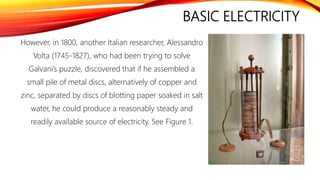
However, in 1800, another Italian researcher, Alessandro
Volta (1745-1827), who had been trying to solve
Galvani’s puzzle, discovered that if he assembled a
small pile of metal discs, alternatively of copper and
zinc, separated by discs of blotting paper soaked in salt
water, he could produce a reasonably steady and
readily available source of electricity. See Figure 1.
BASIC ELECTRICITY
Of course, at that time he had no means of measuring the strength of the voltage.
Still less could he understand what electricity really was or how it could be
measured. Volta published his findings in 1820, and the electrical term VOLT has
been adopted in his memory. It should be understood that Volta’s discovery of the
“Voltaic Pile” was one of tremendous importance, because it meant that for the first
time, a (reasonably) reliable and steady source of electricity could be made available
on demand. Unfortunately, Volta does not seem to have been accorded anywhere
near as much fame as he deserves.
BASIC ELECTRICITY
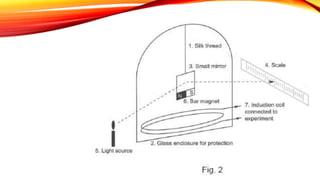
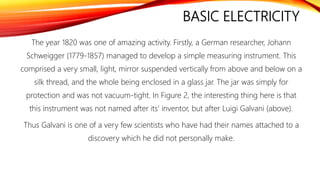
The year 1820 was one of amazing activity. Firstly, a German researcher, Johann
Schweigger (1779-1857) managed to develop a simple measuring instrument. This
comprised a very small, light, mirror suspended vertically from above and below on a
silk thread, and the whole being enclosed in a glass jar. The jar was simply for
protection and was not vacuum-tight. In Figure 2, the interesting thing here is that
this instrument was not named after its’ inventor, but after Luigi Galvani (above).
Thus Galvani is one of a very few scientists who have had their names attached to a
discovery which he did not personally make.
BASIC ELECTRICITY
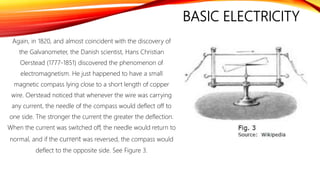
Again, in 1820, and almost coincident with the discovery of
the Galvanometer, the Danish scientist, Hans Christian
Oerstead (1777-1851) discovered the phenomenon of
electromagnetism. He just happened to have a small
magnetic compass lying close to a short length of copper
wire. Oerstead noticed that whenever the wire was carrying
any current, the needle of the compass would deflect off to
one side. The stronger the current the greater the deflection.
When the current was switched off, the needle would return to
normal, and if the current was reversed, the compass would
deflect to the opposite side. See Figure 3.
BASIC ELECTRICITY
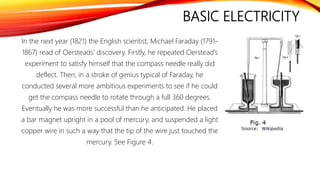
In the next year (1821) the English scientist, Michael Faraday (1791-
1867) read of Oersteads’ discovery. Firstly, he repeated Oerstead’s
experiment to satisfy himself that the compass needle really did
deflect. Then, in a stroke of genius typical of Faraday, he
conducted several more ambitious experiments to see if he could
get the compass needle to rotate through a full 360 degrees.
Eventually he was more successful than he anticipated. He placed
a bar magnet upright in a pool of mercury, and suspended a light
copper wire in such a way that the tip of the wire just touched the
mercury. See Figure 4.
BASIC ELECTRICITY
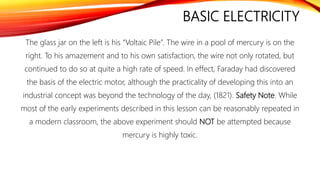
The glass jar on the left is his “Voltaic Pile”. The wire in a pool of mercury is on the
right. To his amazement and to his own satisfaction, the wire not only rotated, but
continued to do so at quite a high rate of speed. In effect, Faraday had discovered
the basis of the electric motor, although the practicality of developing this into an
industrial concept was beyond the technology of the day, (1821). Safety Note. While
most of the early experiments described in this lesson can be reasonably repeated in
a modern classroom, the above experiment should NOT be attempted because
mercury is highly toxic.
BASIC ELECTRICITY
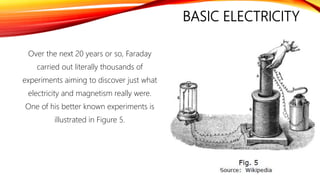
Over the next 20 years or so, Faraday
carried out literally thousands of
experiments aiming to discover just what
electricity and magnetism really were.
One of his better known experiments is
illustrated in Figure 5.
BASIC ELECTRICITY
This experiment dates from about 1831 and demonstrates his discovery that any
change in the linkages between the lines of magnetic force (See Basic Magnetism
below) and the turns of wire in his coil, would produce a small voltage which
deflected the Galvanometer. While the movable coil was stationary there was no
deflection, but when the coil was withdrawn, the deflection was in the opposite
direction. In effect, and presumably without knowing it, he had discovered the basis
of an electrical generator and a transformer. (See related Lesson Plans – “Basic Direct
Current Motors”, and “Basic Electric Transformers”.
BASIC ELECTRICITY
For the next 30 years or so, Faraday continued his meticulous experiments. In
particular, he was puzzled by the fact that magnetism and light could pass through a
vacuum, but electricity could not. Also by the discovery of others that electricity and
light seemed to travel at about the same speed (300,000 km per second). But that’s
a story for another day.
BASIC ELECTRICITY
However, if there was a limitation in Faraday’s work, it was that his results were often difficult to quantify
and predictive calculations were difficult and in fact probably not possible. This was not Faraday’s fault;
it was simply that the necessary mathematical techniques, such as vector analysis etc. had not them
been developed. It was not until some 30 years later that a young Scottish mathematician called James
Clerk Maxwell (1831-1879) managed to develop the algebra required to calculate (and to prove
correct!) the experimental work which Faraday had done. But even Maxwell’s equations were highly
complex and difficult to understand. (There were 24 equations and he required 3 volumes to explain
them). So about another 20 years later again another scientist Oliver Heaviside (1850-1925) managed
to boil them down to four “simple” equations, which only required two volumes to explain! But that’s
another story for later. It is interesting to note that Faraday lived long enough to meet Maxwell,
although his view on the 24 equations were not recorded.
BASIC MAGNETISM
The only common metal which can be easily magnetized is that which contains a large
proportion of iron. Hence this is known as a “ferrous” metal, from the Latin word ferrum,
meaning iron. Most other common metals, such as copper, aluminum and chromium etc.,
cannot be magnetized to more than a very small extent, and as soon as the magnetizing
force is removed, they relapse back into their original non-magnetic state. Ferrous metals, on
the other hand, will not only make quite strong magnets, but many (but NOT all) of them will
retain their magnetism for long periods, many years in fact. In contrast, however, ferrous
metals are generally not very good electrical conductors (relatively high resistance).
Furthermore they tend to oxidize (rust) quickly, whereas the non-ferrous metals mentioned
above are generally very good conductors of electricity (very low resistance) and do not
oxidize very much.
NORTH AND SOUTH POLES
Obtain two bar magnets. These are generally found in pairs, and are about 6” (15 cm) long. If you don’t
already have them, simply locate almost any piece of iron or steel rod and cut off two pieces, each
about 6” (15 cm) long. Precision is not necessary. Even two lengths of threaded rod available in any
hardware will do. Take these to your nearest automobile electric repair shop and ask them to
magnetize them for you. Tell them it is a school project and they will probably do it for nothing. The
magnets should be strong enough to pick up a large (steel) washer.
Note: For good measure try and locate a piece of brass, copper or aluminum. These metals are non-
magnetic and will serve as an example of what is and what is not a magnetic material.
A small quantity of iron filings will also be required. A teaspoon-full will be plenty. You can also make
these yourself by filing down an old piece of scrap iron.
MAGNETIC POLARITY
Take one of your bar magnets and suspend it from a piece of string in such a way
that it is suspended horizontally and free to swing in a circular manner. Hang this
from a hook in a doorway or similar. After a few minutes you should be able to
notice that the magnet slowly swings until it is more or less in a North-South
position. Mark the end pointing North with a piece of adhesive tape. Repeat the
exercise with the other magnet, and also mark the end pointing North. Strictly
speaking, these two ends are known as the “North Seeking” poles. However the
word “seeking” is usually dropped, and they are simply called North poles. Similarly
the other ends are known as the South poles.
MAGNETIC ATTRACTION
If you take both bar-magnets and gradually bring a north pole close to a south
pole, you will find that the two will come together with a satisfying click. And then
they will be relatively difficult to pull apart. Conversely, if you try to bring two north
poles together (or bring two south poles together), they will kick away from each
other, no matter how much you try. This illustrates the convention that “unlike poles
attract”, and “like poles repel”.
If you have made yourself a length of non-magnetic material, you will find that when
hung from a piece of string, it will not try to point in any particular direction.
Similarly, neither of your bar magnets will be able to pick it up.
LINES OF A MAGNETIC “FIELD” (OR
MAGNETIC FLUX)
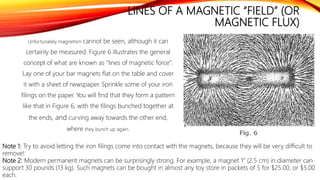
Unfortunately magnetism cannot be seen, although it can
certainly be measured. Figure 6 illustrates the general
concept of what are known as “lines of magnetic force”.
Lay one of your bar magnets flat on the table and cover
it with a sheet of newspaper. Sprinkle some of your iron
filings on the paper. You will find that they form a pattern
like that in Figure 6, with the filings bunched together at
the ends, and curving away towards the other end,
where they bunch up again.
Note 1: Try to avoid letting the iron filings come into contact with the magnets, because they will be very difficult to
remove!
Note 2: Modern permanent magnets can be surprisingly strong. For example, a magnet 1” (2.5 cm) in diameter can
support 30 pounds (13 kg). Such magnets can be bought in almost any toy store in packets of 5 for $25.00, or $5.00
each.
FLUX DENSITY
A related concept is that of “Flux Density”. In other words, the more closely the lines
are bunched together (notably close to the two ends of the magnet), represents a
higher flux density. These densities can actually be measured and calculated, but
require sensitive instruments, and we will skip that here. For many years the unit of
flux density was measured in “lines per square cm”, and the unit was known as a
Gauss, after the early German experimenter, Carl Friedrich Gauss, 1777 - 1855.
However in 1960 the international unit of flux density was changed to the Tesla, or T,
named after the famous pioneer, Nicola Tesla (1856 – 1943). A unit of one T = 10,000
Gauss.
ELECTROMAGNETS
It was during these experiments by Gauss, Oerstead, Faraday et al, that it was
discovered that the passage of an electric current through a wire (probably copper
or soft iron in those days.) produced a small magnetic field around itself. See Figures
3 and 7.
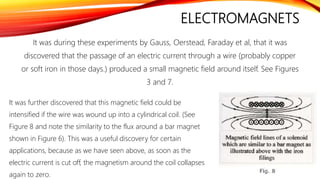
It was further discovered that this magnetic field could be
intensified if the wire was wound up into a cylindrical coil. (See
Figure 8 and note the similarity to the flux around a bar magnet
shown in Figure 6). This was a useful discovery for certain
applications, because as we have seen above, as soon as the
electric current is cut off, the magnetism around the coil collapses
again to zero.
A NOTE FOR OLDER STUDENTS
As a matter of interest, many military and research ships have what is known as a
“de-gaussing cable” looped around the full perimeter of the upper deck. A DC
current is circulated through this cable, and adjusted so that the magnetic field
produced by the current is equal to and of opposite polarity to the natural
magnetism of the ship’s hull. The effect of this is to render the ship more or less non-
magnetic and therefore (in the case of a military ship) “invisible” to magnetic mines
lying beneath the surface, and in the case of a research ship, would not interfere
with the sensitive instruments on the vessel.
• Recommended Reading
• Wikipedia “How Magnets are Made”.
• Wikipedia “Capacitor”
• Google “Van de Graaff Generator”.
• IEEE magazine “Spectrum”, “The Long Road to Maxwell’s Equations”, James C.
Rautio, December 2014.
• Faraday, Maxwell and the Electromagnetic Field, Forbes and Mahon,
Books, 2014, ISBN 978-1-61614-942-0.

Electricity

  • 1.
    ELECTRICITY by : Askaria F1051151052 Program StudiPendidikan Fisika Fakultas Keguruan dan Ilmu Pendidikan Universitas Tanjungpura
  • 2.
    OBJECTIVES Students will: Gain auseful initial acquaintance with the most common elements of electricity and electrical equipment. Learn about how magnets are made and what they do. Learn about circuits, switches, conductors, resistors and batteries etc. Learn about what capacitors are made of and what they do. Learn the meaning of insulation and why it is necessary. Learn some basic safety precautions. Learn about the importance of discipline and team work.
  • 3.
    The existence ofelectricity has been known to mankind almost from the beginning of time, notably in the form of lightning. Two of the early experimenters in this field were Ben Franklin (1706 – 1790) and Luigi Galvani of Italy (1737 – 1798). Franklin, is of course, generally known for his experiment of flying a kite into a thunder cloud and obtaining a spark from a key attached to the end of the kite string. (Franklin was not as foolish as might seem: see below). Galvani is best known for his accidental discovery that when he was dissecting a frog’s leg, it twitched when touched with a scalpel which had become electrically charged after being wiped on a clean dry cloth. (Note the trick of rubbing a plastic pen on your sleeve and then picking up a very small chip of paper). Galvani published his findings in 1780. INTRODUCTION
  • 4.
    Magnets have alsobeen known to mankind for many centuries, in the form of compasses used by seafarers. But the needles in these compasses were generally formed from naturally occurring materials, or by stroking a piece of iron with another piece which was already magnetized. It was only within the last 200 years or so that it was discovered that magnets could also be made by passing an electric current through a coil of wire and placing pieces of iron inside the coil. Capacitance, on the other hand is a comparatively recent discovery, dating from the early 1800’s, and represents a means of storing very small amounts of electrical energy for very short periods of time, even after the applied voltage has been removed. As such it should not be confused with the storage batteries used to start cars and keep laptops going when the power is off. For more on this, see the section on capacitors below. INTRODUCTION
  • 5.
    BASIC ELECTRICITY As mentionedin the introduction above, one of the earliest known experimenters in electricity was the American, Benjamin Franklin (1706-1790) who in 1752 flew a kite into a thunder cloud with a key attached to the end of the string. From what we know today, Franklin was nowhere near as foolish as it might seem. He knew what he was doing. He stood on a large wooden box (an insulator) and attached the end of the string to an iron rod driven deep into the ground. Today this would be known as “grounding”, which is an integral part of all Electrical Safety Codes. Franklin, of course, was an inspired amateur rather than a scientist, and went on to a famous career in politics, being a signer of the American Declaration of Independence in 1776, and the Constitution in 1787.
  • 6.
    BASIC ELECTRICITY The firstscientific inkling of what electricity might be, is attributed to the Italian, Luigi Galvani (1737-1798). While he was dissecting a frog’s leg, he wiped the scalpel with a dry cloth, thereby putting a slight electrostatic charge on the scalpel. When the scalpel then touched the leg, it discharged and the leg twitched vigorously. Galvani published his observation in 1780, but for some years after, the cause was not understood, and of course there was no means of measuring electricity in those days. At first it was believed that the twitch came from some mysterious energy within the leg. In memory of Galvani, the terms “Galvanic Action”, “Galvanized coating”, and being suddenly “Galvanized into action”, came into use.
  • 7.
    BASIC ELECTRICITY However, in1800, another Italian researcher, Alessandro Volta (1745-1827), who had been trying to solve Galvani’s puzzle, discovered that if he assembled a small pile of metal discs, alternatively of copper and zinc, separated by discs of blotting paper soaked in salt water, he could produce a reasonably steady and readily available source of electricity. See Figure 1.
  • 8.
    BASIC ELECTRICITY Of course,at that time he had no means of measuring the strength of the voltage. Still less could he understand what electricity really was or how it could be measured. Volta published his findings in 1820, and the electrical term VOLT has been adopted in his memory. It should be understood that Volta’s discovery of the “Voltaic Pile” was one of tremendous importance, because it meant that for the first time, a (reasonably) reliable and steady source of electricity could be made available on demand. Unfortunately, Volta does not seem to have been accorded anywhere near as much fame as he deserves.
  • 10.
    BASIC ELECTRICITY The year1820 was one of amazing activity. Firstly, a German researcher, Johann Schweigger (1779-1857) managed to develop a simple measuring instrument. This comprised a very small, light, mirror suspended vertically from above and below on a silk thread, and the whole being enclosed in a glass jar. The jar was simply for protection and was not vacuum-tight. In Figure 2, the interesting thing here is that this instrument was not named after its’ inventor, but after Luigi Galvani (above). Thus Galvani is one of a very few scientists who have had their names attached to a discovery which he did not personally make.
  • 11.
    BASIC ELECTRICITY Again, in1820, and almost coincident with the discovery of the Galvanometer, the Danish scientist, Hans Christian Oerstead (1777-1851) discovered the phenomenon of electromagnetism. He just happened to have a small magnetic compass lying close to a short length of copper wire. Oerstead noticed that whenever the wire was carrying any current, the needle of the compass would deflect off to one side. The stronger the current the greater the deflection. When the current was switched off, the needle would return to normal, and if the current was reversed, the compass would deflect to the opposite side. See Figure 3.
  • 12.
    BASIC ELECTRICITY In thenext year (1821) the English scientist, Michael Faraday (1791- 1867) read of Oersteads’ discovery. Firstly, he repeated Oerstead’s experiment to satisfy himself that the compass needle really did deflect. Then, in a stroke of genius typical of Faraday, he conducted several more ambitious experiments to see if he could get the compass needle to rotate through a full 360 degrees. Eventually he was more successful than he anticipated. He placed a bar magnet upright in a pool of mercury, and suspended a light copper wire in such a way that the tip of the wire just touched the mercury. See Figure 4.
  • 13.
    BASIC ELECTRICITY The glassjar on the left is his “Voltaic Pile”. The wire in a pool of mercury is on the right. To his amazement and to his own satisfaction, the wire not only rotated, but continued to do so at quite a high rate of speed. In effect, Faraday had discovered the basis of the electric motor, although the practicality of developing this into an industrial concept was beyond the technology of the day, (1821). Safety Note. While most of the early experiments described in this lesson can be reasonably repeated in a modern classroom, the above experiment should NOT be attempted because mercury is highly toxic.
  • 14.
    BASIC ELECTRICITY Over thenext 20 years or so, Faraday carried out literally thousands of experiments aiming to discover just what electricity and magnetism really were. One of his better known experiments is illustrated in Figure 5.
  • 15.
    BASIC ELECTRICITY This experimentdates from about 1831 and demonstrates his discovery that any change in the linkages between the lines of magnetic force (See Basic Magnetism below) and the turns of wire in his coil, would produce a small voltage which deflected the Galvanometer. While the movable coil was stationary there was no deflection, but when the coil was withdrawn, the deflection was in the opposite direction. In effect, and presumably without knowing it, he had discovered the basis of an electrical generator and a transformer. (See related Lesson Plans – “Basic Direct Current Motors”, and “Basic Electric Transformers”.
  • 16.
    BASIC ELECTRICITY For thenext 30 years or so, Faraday continued his meticulous experiments. In particular, he was puzzled by the fact that magnetism and light could pass through a vacuum, but electricity could not. Also by the discovery of others that electricity and light seemed to travel at about the same speed (300,000 km per second). But that’s a story for another day.
  • 17.
    BASIC ELECTRICITY However, ifthere was a limitation in Faraday’s work, it was that his results were often difficult to quantify and predictive calculations were difficult and in fact probably not possible. This was not Faraday’s fault; it was simply that the necessary mathematical techniques, such as vector analysis etc. had not them been developed. It was not until some 30 years later that a young Scottish mathematician called James Clerk Maxwell (1831-1879) managed to develop the algebra required to calculate (and to prove correct!) the experimental work which Faraday had done. But even Maxwell’s equations were highly complex and difficult to understand. (There were 24 equations and he required 3 volumes to explain them). So about another 20 years later again another scientist Oliver Heaviside (1850-1925) managed to boil them down to four “simple” equations, which only required two volumes to explain! But that’s another story for later. It is interesting to note that Faraday lived long enough to meet Maxwell, although his view on the 24 equations were not recorded.
  • 18.
    BASIC MAGNETISM The onlycommon metal which can be easily magnetized is that which contains a large proportion of iron. Hence this is known as a “ferrous” metal, from the Latin word ferrum, meaning iron. Most other common metals, such as copper, aluminum and chromium etc., cannot be magnetized to more than a very small extent, and as soon as the magnetizing force is removed, they relapse back into their original non-magnetic state. Ferrous metals, on the other hand, will not only make quite strong magnets, but many (but NOT all) of them will retain their magnetism for long periods, many years in fact. In contrast, however, ferrous metals are generally not very good electrical conductors (relatively high resistance). Furthermore they tend to oxidize (rust) quickly, whereas the non-ferrous metals mentioned above are generally very good conductors of electricity (very low resistance) and do not oxidize very much.
  • 19.
    NORTH AND SOUTHPOLES Obtain two bar magnets. These are generally found in pairs, and are about 6” (15 cm) long. If you don’t already have them, simply locate almost any piece of iron or steel rod and cut off two pieces, each about 6” (15 cm) long. Precision is not necessary. Even two lengths of threaded rod available in any hardware will do. Take these to your nearest automobile electric repair shop and ask them to magnetize them for you. Tell them it is a school project and they will probably do it for nothing. The magnets should be strong enough to pick up a large (steel) washer. Note: For good measure try and locate a piece of brass, copper or aluminum. These metals are non- magnetic and will serve as an example of what is and what is not a magnetic material. A small quantity of iron filings will also be required. A teaspoon-full will be plenty. You can also make these yourself by filing down an old piece of scrap iron.
  • 20.
    MAGNETIC POLARITY Take oneof your bar magnets and suspend it from a piece of string in such a way that it is suspended horizontally and free to swing in a circular manner. Hang this from a hook in a doorway or similar. After a few minutes you should be able to notice that the magnet slowly swings until it is more or less in a North-South position. Mark the end pointing North with a piece of adhesive tape. Repeat the exercise with the other magnet, and also mark the end pointing North. Strictly speaking, these two ends are known as the “North Seeking” poles. However the word “seeking” is usually dropped, and they are simply called North poles. Similarly the other ends are known as the South poles.
  • 21.
    MAGNETIC ATTRACTION If youtake both bar-magnets and gradually bring a north pole close to a south pole, you will find that the two will come together with a satisfying click. And then they will be relatively difficult to pull apart. Conversely, if you try to bring two north poles together (or bring two south poles together), they will kick away from each other, no matter how much you try. This illustrates the convention that “unlike poles attract”, and “like poles repel”. If you have made yourself a length of non-magnetic material, you will find that when hung from a piece of string, it will not try to point in any particular direction. Similarly, neither of your bar magnets will be able to pick it up.
  • 22.
    LINES OF AMAGNETIC “FIELD” (OR MAGNETIC FLUX) Unfortunately magnetism cannot be seen, although it can certainly be measured. Figure 6 illustrates the general concept of what are known as “lines of magnetic force”. Lay one of your bar magnets flat on the table and cover it with a sheet of newspaper. Sprinkle some of your iron filings on the paper. You will find that they form a pattern like that in Figure 6, with the filings bunched together at the ends, and curving away towards the other end, where they bunch up again. Note 1: Try to avoid letting the iron filings come into contact with the magnets, because they will be very difficult to remove! Note 2: Modern permanent magnets can be surprisingly strong. For example, a magnet 1” (2.5 cm) in diameter can support 30 pounds (13 kg). Such magnets can be bought in almost any toy store in packets of 5 for $25.00, or $5.00 each.
  • 23.
    FLUX DENSITY A relatedconcept is that of “Flux Density”. In other words, the more closely the lines are bunched together (notably close to the two ends of the magnet), represents a higher flux density. These densities can actually be measured and calculated, but require sensitive instruments, and we will skip that here. For many years the unit of flux density was measured in “lines per square cm”, and the unit was known as a Gauss, after the early German experimenter, Carl Friedrich Gauss, 1777 - 1855. However in 1960 the international unit of flux density was changed to the Tesla, or T, named after the famous pioneer, Nicola Tesla (1856 – 1943). A unit of one T = 10,000 Gauss.
  • 24.
    ELECTROMAGNETS It was duringthese experiments by Gauss, Oerstead, Faraday et al, that it was discovered that the passage of an electric current through a wire (probably copper or soft iron in those days.) produced a small magnetic field around itself. See Figures 3 and 7. It was further discovered that this magnetic field could be intensified if the wire was wound up into a cylindrical coil. (See Figure 8 and note the similarity to the flux around a bar magnet shown in Figure 6). This was a useful discovery for certain applications, because as we have seen above, as soon as the electric current is cut off, the magnetism around the coil collapses again to zero.
  • 25.
    A NOTE FOROLDER STUDENTS As a matter of interest, many military and research ships have what is known as a “de-gaussing cable” looped around the full perimeter of the upper deck. A DC current is circulated through this cable, and adjusted so that the magnetic field produced by the current is equal to and of opposite polarity to the natural magnetism of the ship’s hull. The effect of this is to render the ship more or less non- magnetic and therefore (in the case of a military ship) “invisible” to magnetic mines lying beneath the surface, and in the case of a research ship, would not interfere with the sensitive instruments on the vessel.
  • 26.
    • Recommended Reading •Wikipedia “How Magnets are Made”. • Wikipedia “Capacitor” • Google “Van de Graaff Generator”. • IEEE magazine “Spectrum”, “The Long Road to Maxwell’s Equations”, James C. Rautio, December 2014. • Faraday, Maxwell and the Electromagnetic Field, Forbes and Mahon, Books, 2014, ISBN 978-1-61614-942-0.