Value Chain
Analysis
Prepared by: Mered Ezra
The Value Chain
Analysis
 The idea of a value chain was first
suggested by Michael Porter (1985) to
depict how customer value accumulates
along a chain of activities that lead to an
end product or service.
Value Chain Analysis
 Value Chain analysis is concerned
with detailed examination of each sub
system in a supply chain and every
activity within these sub systems with a
view to delivering maximum value at the
least possible to total cost there by
enhancing value and synergy
throughout the entire chain.
 The chain consists of a series of
activities that create and build value.
The Value Chain
 A framework for identifying core
competencies
◦ Inside the firm
◦ In the supply chain
 Can be used to
◦ Identify strengths and weaknesses
◦ Identify sources of competitive advantage
◦ Identify market opportunities
VCA Cont..
 A firm’s value chain must be compared to
competitors’ value chains to determine where
competitive advantages exist.
 To be a source of competitive advantage a
resource or capability must allow a firm to:
◦ Perform an activity in a manner that is superior
to competitor’s performances
◦ Perform a value-creating activity that
competitors cannot complete
VCA Cont…
 The organization is split into: primary
activities' and 'support activities.‘
 Primary activities are directly
involved in transforming inputs into
outputs and in delivery and after-sales
support.
 Support activities support primary
activities and other support activities.
The Value Chain
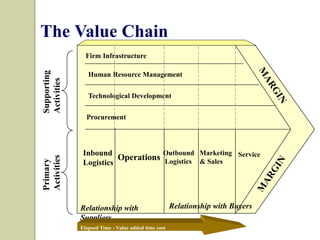
Firm Infrastructure
Human Resource Management
Technological Development
Procurement
Inbound
Logistics
Operations
Outbound
Logistics
Marketing
& Sales
Service
Supporting
Activities
Relationship with
Suppliers
Relationship with Buyers
Elapsed Time - Value added time cost
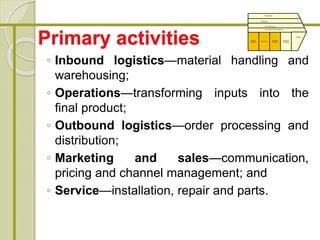
◦ Inbound logistics—material handling and
warehousing;
◦ Operations—transforming inputs into the
final product;
◦ Outbound logistics—order processing and
distribution;
◦ Marketing and sales—communication,
pricing and channel management; and
◦ Service—installation, repair and parts.
Primary activities Inbound
Logistics
Marketing
and Sales
Outbound
Logistics
Operations
Technology
Human Resource management
Procurement
Firm Infrastructure
Service
Support activities
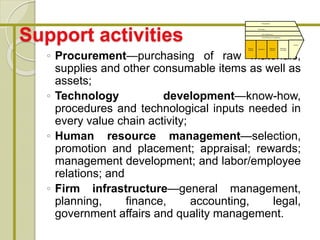
◦ Procurement—purchasing of raw materials,
supplies and other consumable items as well as
assets;
◦ Technology development—know-how,
procedures and technological inputs needed in
every value chain activity;
◦ Human resource management—selection,
promotion and placement; appraisal; rewards;
management development; and labor/employee
relations; and
◦ Firm infrastructure—general management,
planning, finance, accounting, legal,
government affairs and quality management.
Inbound
Logistics
Marketing
and Sales
Outbound
Logistics
Operations
Technology
Human Resource management
Procurement
Firm Infrastructure
Service
The Result of the Value Chain
 Margins
◦ Capture the value from performing value-creating
activities as cheaply as possible
◦ The basic idea is that the consumer is willing to
pay a certain amount for the value you create.
◦ Thus, the smaller the size of the individual activity
boxes relative to the value the consumer is willing
to pay, the greater the MARGIN will be for the
firm.
Linkages within the Value Chain
Optimization and coordination of activities in
the value chain
 Linkages exist between support activities and
primary activities and between separate primary
activities
 Generic causes for linkages
◦ Same function can be performed in different ways
◦ Efforts in indirect activities
◦ Activities performed inside the firm reduce the
need for activities in the field
◦ Quality Assurance can be performed in different
ways
How VCA is Used
 Activity Analysis: First, you identify
the activities you undertake to deliver
your product or service;
 Value Analysis: Second, for each
activity, you think through what you
would do to add the greatest value for
your customer; and
 Evaluation and Planning: Thirdly,
you evaluate whether it is worth
making changes, and then plan for
action.
 It is a very flexible strategy tool for looking at your
business, your competitors and the respective places
in the industry’s value system.
 It can be used to diagnose and create competitive
advantages on both cost and differentiation.
 It helps you to understand the organization issues
involved with the promise of making customer
value commitments and promises because it focuses
attention on the activities needed to deliver the
value proposition.
Advantages & Disadvantages of VCA
Advantages
 Comparing your business model with your
competitors using the value chain can give you
a much deeper understanding of your
strengths and weaknesses to be included in
your SWOT Analysis.
 It can be adapted for any type of business
 The value chain has developed into an extra
model, the industry value chain or value
system which lets you get a better
understanding of the much broader
competitive arena
Disadvantages
 It’s very strengths of flexibility mean that it has to be adapted to a
particular business situation and that can be a disadvantage since, to get
the best from the value chain, it’s not “plug and play”.
 The scale and scope of a value chain analysis can be intimidating. It can
take a lot of work to finish a full value chain analysis for your company
and for your main competitors so that you can identify and understand the
key differences and strategy drivers.
 Many people are familiar with the value chain but few are experts in its
use.
 Business information systems are often not structured in a way to make it
easy to get information for value chain analysis.
Thank
You

Value chain analysis

  • 1.
  • 2.
    The Value Chain Analysis The idea of a value chain was first suggested by Michael Porter (1985) to depict how customer value accumulates along a chain of activities that lead to an end product or service.
  • 3.
    Value Chain Analysis Value Chain analysis is concerned with detailed examination of each sub system in a supply chain and every activity within these sub systems with a view to delivering maximum value at the least possible to total cost there by enhancing value and synergy throughout the entire chain.  The chain consists of a series of activities that create and build value.
  • 4.
    The Value Chain A framework for identifying core competencies ◦ Inside the firm ◦ In the supply chain  Can be used to ◦ Identify strengths and weaknesses ◦ Identify sources of competitive advantage ◦ Identify market opportunities
  • 5.
    VCA Cont..  Afirm’s value chain must be compared to competitors’ value chains to determine where competitive advantages exist.  To be a source of competitive advantage a resource or capability must allow a firm to: ◦ Perform an activity in a manner that is superior to competitor’s performances ◦ Perform a value-creating activity that competitors cannot complete
  • 6.
    VCA Cont…  Theorganization is split into: primary activities' and 'support activities.‘  Primary activities are directly involved in transforming inputs into outputs and in delivery and after-sales support.  Support activities support primary activities and other support activities.
  • 7.
    The Value Chain FirmInfrastructure Human Resource Management Technological Development Procurement Inbound Logistics Operations Outbound Logistics Marketing & Sales Service Supporting Activities Relationship with Suppliers Relationship with Buyers Elapsed Time - Value added time cost
  • 8.
    ◦ Inbound logistics—materialhandling and warehousing; ◦ Operations—transforming inputs into the final product; ◦ Outbound logistics—order processing and distribution; ◦ Marketing and sales—communication, pricing and channel management; and ◦ Service—installation, repair and parts. Primary activities Inbound Logistics Marketing and Sales Outbound Logistics Operations Technology Human Resource management Procurement Firm Infrastructure Service
  • 9.
    Support activities ◦ Procurement—purchasingof raw materials, supplies and other consumable items as well as assets; ◦ Technology development—know-how, procedures and technological inputs needed in every value chain activity; ◦ Human resource management—selection, promotion and placement; appraisal; rewards; management development; and labor/employee relations; and ◦ Firm infrastructure—general management, planning, finance, accounting, legal, government affairs and quality management. Inbound Logistics Marketing and Sales Outbound Logistics Operations Technology Human Resource management Procurement Firm Infrastructure Service
  • 10.
    The Result ofthe Value Chain  Margins ◦ Capture the value from performing value-creating activities as cheaply as possible ◦ The basic idea is that the consumer is willing to pay a certain amount for the value you create. ◦ Thus, the smaller the size of the individual activity boxes relative to the value the consumer is willing to pay, the greater the MARGIN will be for the firm.
  • 11.
    Linkages within theValue Chain Optimization and coordination of activities in the value chain  Linkages exist between support activities and primary activities and between separate primary activities  Generic causes for linkages ◦ Same function can be performed in different ways ◦ Efforts in indirect activities ◦ Activities performed inside the firm reduce the need for activities in the field ◦ Quality Assurance can be performed in different ways
  • 12.
    How VCA isUsed  Activity Analysis: First, you identify the activities you undertake to deliver your product or service;  Value Analysis: Second, for each activity, you think through what you would do to add the greatest value for your customer; and  Evaluation and Planning: Thirdly, you evaluate whether it is worth making changes, and then plan for action.
  • 13.
     It isa very flexible strategy tool for looking at your business, your competitors and the respective places in the industry’s value system.  It can be used to diagnose and create competitive advantages on both cost and differentiation.  It helps you to understand the organization issues involved with the promise of making customer value commitments and promises because it focuses attention on the activities needed to deliver the value proposition. Advantages & Disadvantages of VCA Advantages
  • 14.
     Comparing yourbusiness model with your competitors using the value chain can give you a much deeper understanding of your strengths and weaknesses to be included in your SWOT Analysis.  It can be adapted for any type of business  The value chain has developed into an extra model, the industry value chain or value system which lets you get a better understanding of the much broader competitive arena
  • 15.
    Disadvantages  It’s verystrengths of flexibility mean that it has to be adapted to a particular business situation and that can be a disadvantage since, to get the best from the value chain, it’s not “plug and play”.  The scale and scope of a value chain analysis can be intimidating. It can take a lot of work to finish a full value chain analysis for your company and for your main competitors so that you can identify and understand the key differences and strategy drivers.  Many people are familiar with the value chain but few are experts in its use.  Business information systems are often not structured in a way to make it easy to get information for value chain analysis.
  • 16.

Editor's Notes

  • #5 Business Strengths
  • #6 Business Strengths
  • #8 Business Strengths
  • #11 Business Strengths
  • #12 Business Strengths