Sap flow : Calcium, and what
about N and P?
Background
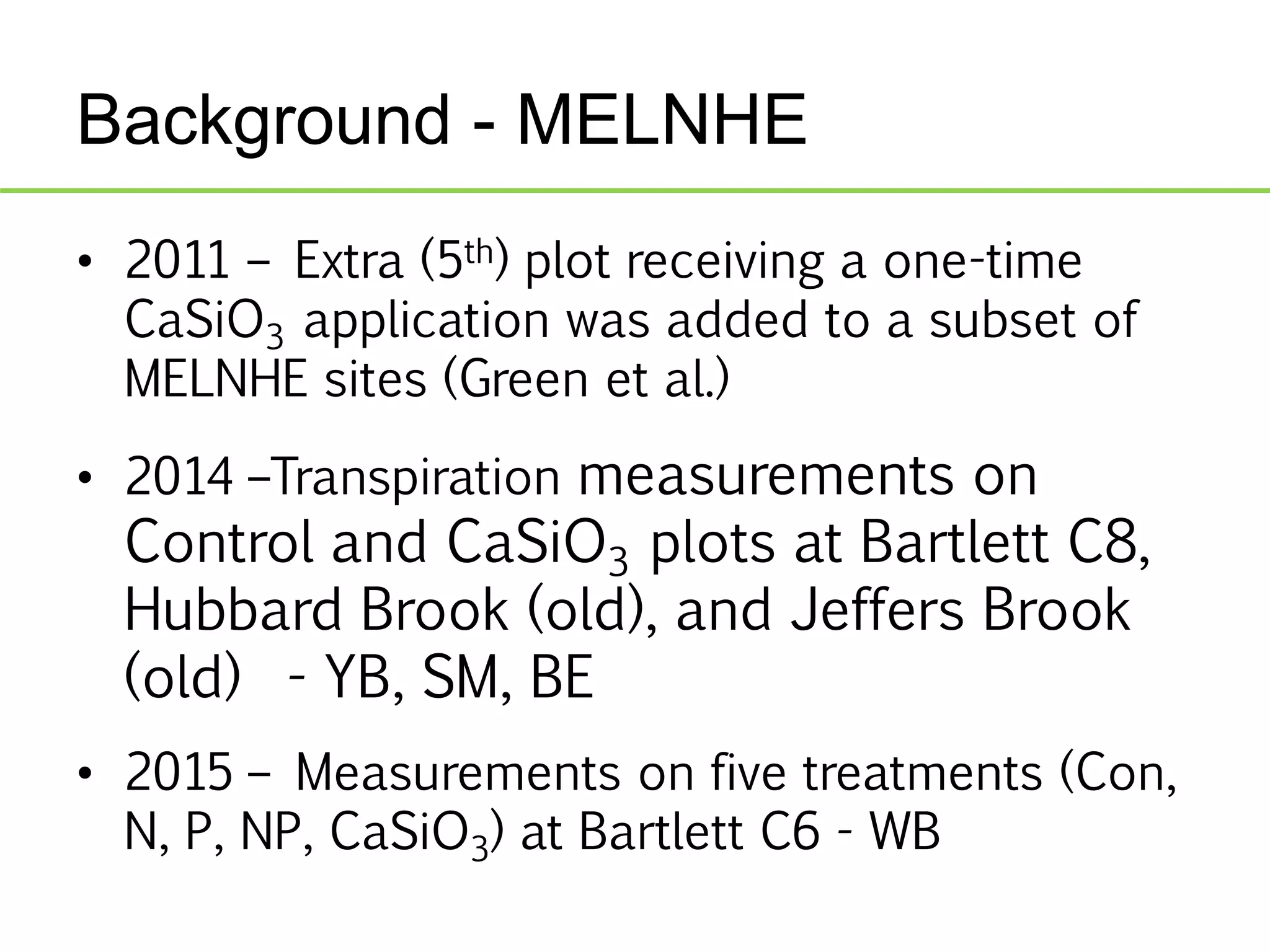
• Hubbard Brook whole-watershed transpiration response
to 1999 wollastonite (CaSiO3)
(M. Green, A. Bailey, S. Bailey, J. Battles, J. Campbell, C. Driscoll,
T. Fahey, L. Lepine, G. Likens, S. Ollinger, P. Schaberg, 2013)
Background - MELNHE
• 2011 – Extra (5th) plot receiving a one-time
CaSiO3 application was added to a subset of
MELNHE sites (Green et al.)
• 2014 –Transpiration measurements on
Control and CaSiO3 plots at Bartlett C8,
Hubbard Brook (old), and Jeffers Brook
(old) - YB, SM, BE
• 2015 – Measurements on five treatments (Con,
N, P, NP, CaSiO3) at Bartlett C6 - WB
About measuring transpiration . . .
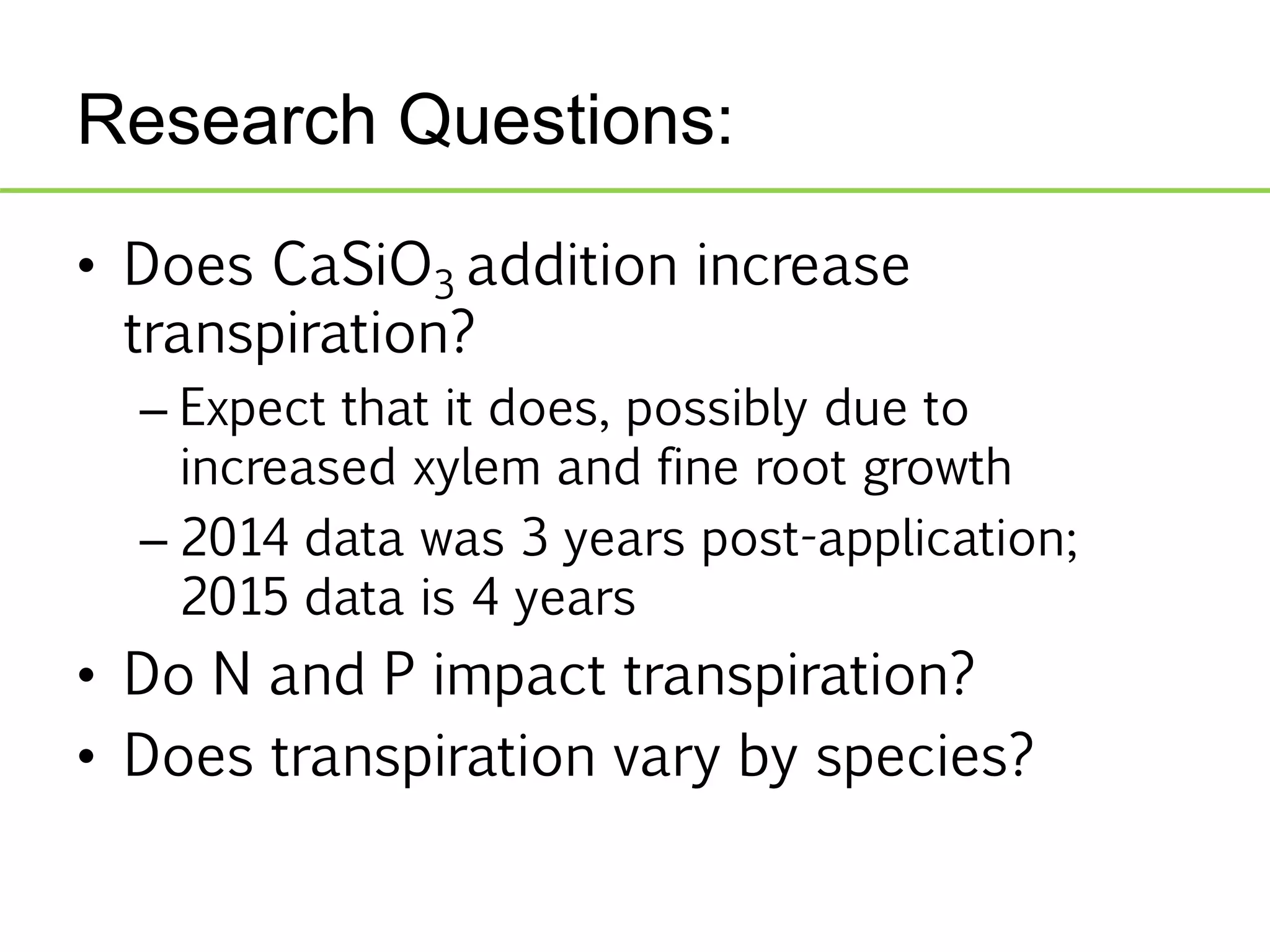
• Granier method: reference probe 10 cm below a heated probe,
measures temperature difference (ΔT) (Granier, 1987)
• Measurements collected by data logger every 30 seconds,
average recorded every 15 minutes
• ΔT converted to sapflux (Js, g x m2 x s-1) using BaseLiner
software (Oren and Parashkevov, 2012)
Research Questions:
• Does CaSiO3 addition increase
transpiration?
– Expect that it does, possibly due to
increased xylem and fine root growth
– 2014 data was 3 years post-application;
2015 data is 4 years
• Do N and P impact transpiration?
• Does transpiration vary by species?
Field Methods
• Install probes, hook up data logger and
batteries
• Visit data logger routinely to download
and check data
Statistical Analysis
• Three data sets
• 2014 SM, YB on C8 (June), HB(July), JB (Aug)
• 2014 BE (pooled C8, HB)
• 2015 WB on C6 (5 treatments)
• Mixed Model Analysis
• Random: Time (curvilinear)
• Explanatory: Weather covariates vs PET
• Predictors: treatment, species
• 3 weather
covariates
was a better
model fit
• Single PET
covariate was
an easier
model fit
Results – YB-SM Treatment Effects
(2014)
Type 3 fixed effects
Site p= 0.01
Treatment p= 0.26
Site*Trt*Time p= 0.03
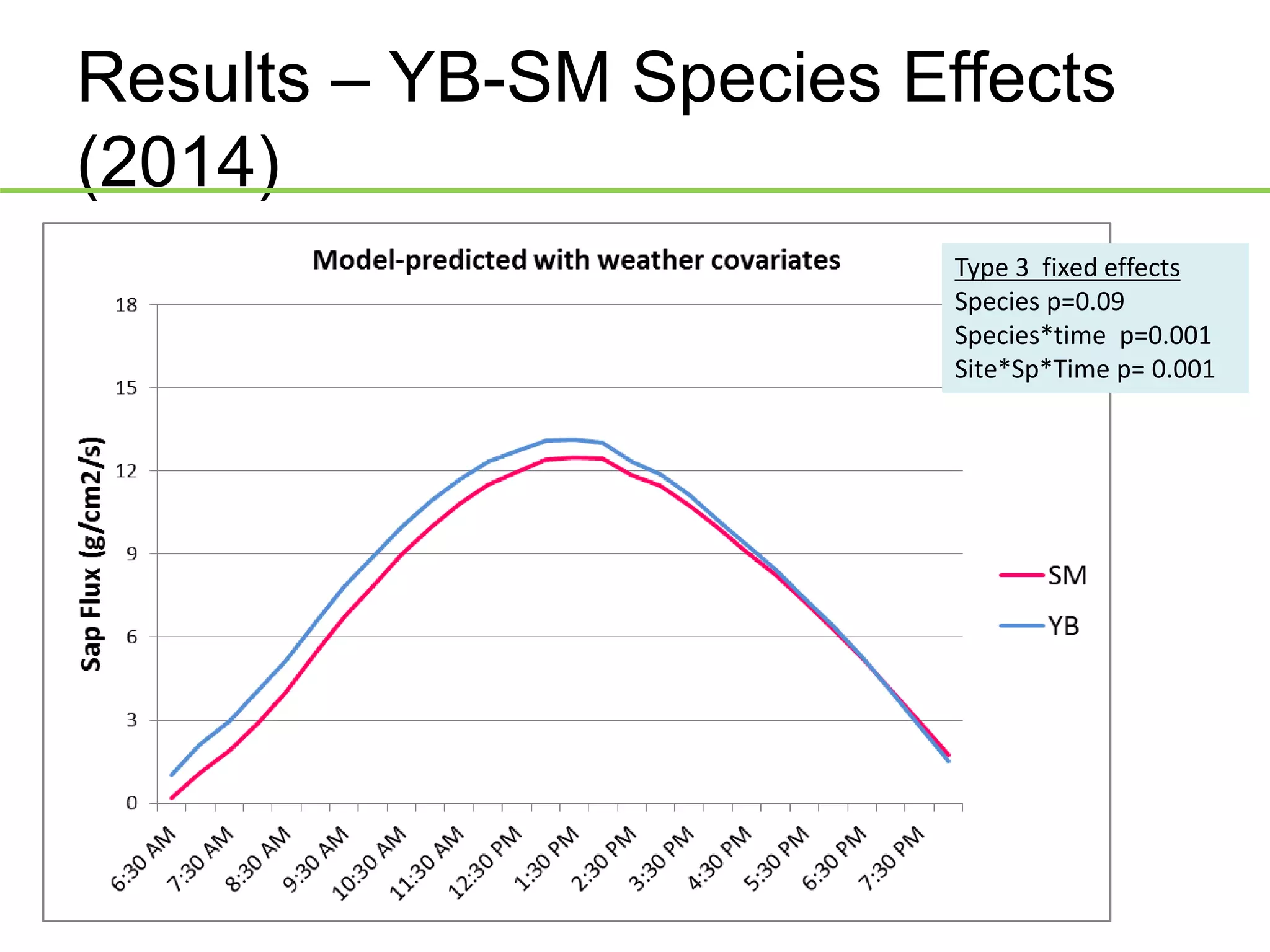
Results – YB-SM Species Effects
(2014)
Type 3 fixed effects
Species p=0.09
Species*time p=0.001
Site*Sp*Time p= 0.001
Results – BE Treatment Effects
(2014)
Type 3 fixed effects
Treat p=0.42
Treat * Time p=0.05
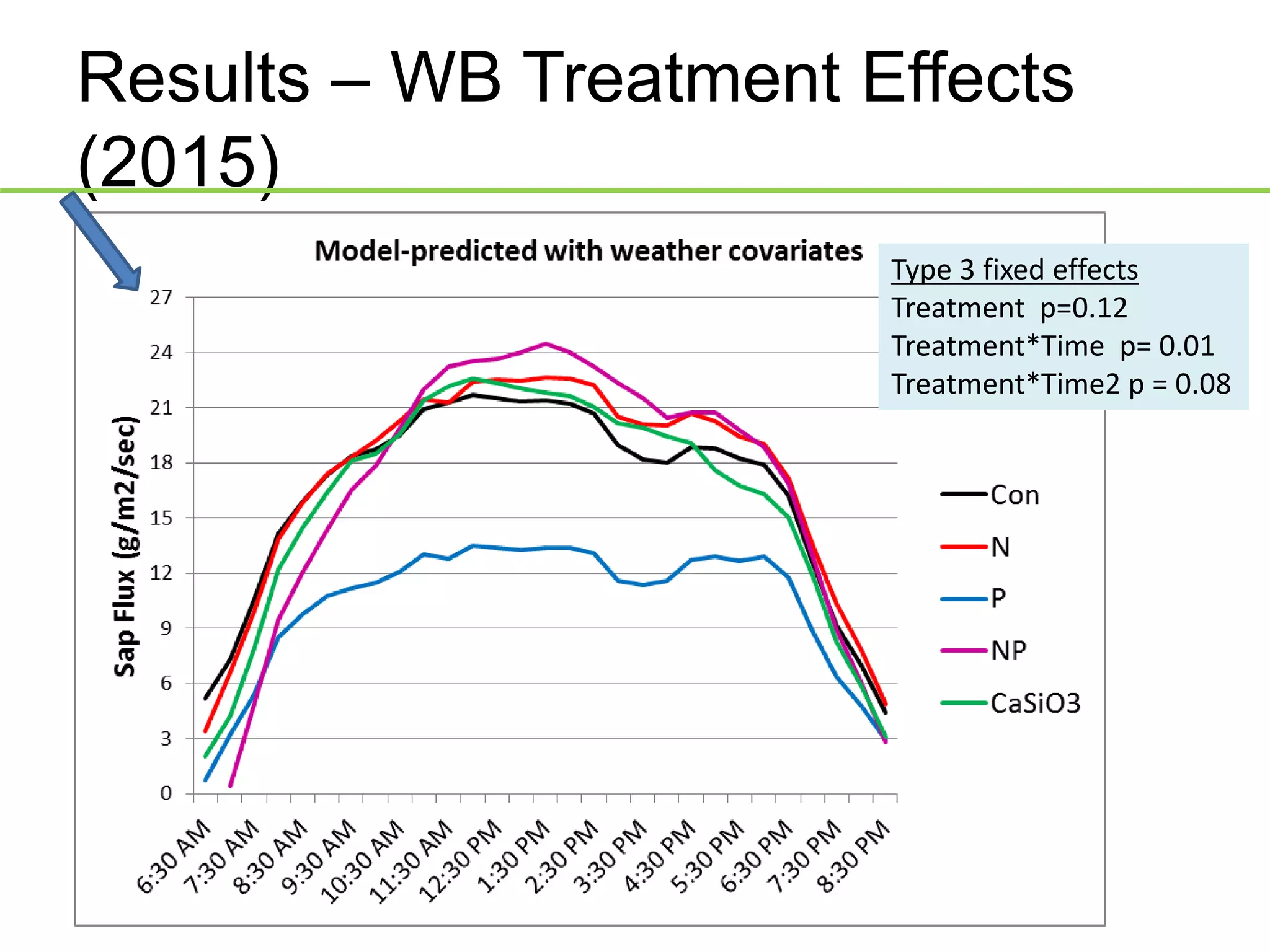
Results – WB Treatment Effects
(2015)
Type 3 fixed effects
Treatment p=0.12
Treatment*Time p= 0.01
Treatment*Time2 p = 0.08
Results- Summary
• 2014 (YB, SM, BE)
– CaSiO3 increased transpiration over Con
– YB had higher transpiration than SM (BE even higher)
– YB-SM interacted with time and site/date
• 2015 (WB)
– P decreased transpiration in WB
– WB in mid-age stand had higher transpiration (except P!)
than anything in 2014
• Thank you HB Sta 1 and Bartlett Flux Tower!
– Explanatory effects were immensely important in being
able to detect effects of interest
Acknowledgements
• Michele Pruyn!!!!!
• Sophie Harrison
• Adam Wild
• Mark Green
• NSRC
• Ruth Yanai
• Matt Vadeboncoeur
• 2015 Shoestring Crew

Sap flow: Calcium, and what about N and P?

  • 1.
    Sap flow :Calcium, and what about N and P?
  • 2.
    Background • Hubbard Brookwhole-watershed transpiration response to 1999 wollastonite (CaSiO3) (M. Green, A. Bailey, S. Bailey, J. Battles, J. Campbell, C. Driscoll, T. Fahey, L. Lepine, G. Likens, S. Ollinger, P. Schaberg, 2013)
  • 3.
    Background - MELNHE •2011 – Extra (5th) plot receiving a one-time CaSiO3 application was added to a subset of MELNHE sites (Green et al.) • 2014 –Transpiration measurements on Control and CaSiO3 plots at Bartlett C8, Hubbard Brook (old), and Jeffers Brook (old) - YB, SM, BE • 2015 – Measurements on five treatments (Con, N, P, NP, CaSiO3) at Bartlett C6 - WB
  • 4.
    About measuring transpiration. . . • Granier method: reference probe 10 cm below a heated probe, measures temperature difference (ΔT) (Granier, 1987) • Measurements collected by data logger every 30 seconds, average recorded every 15 minutes • ΔT converted to sapflux (Js, g x m2 x s-1) using BaseLiner software (Oren and Parashkevov, 2012)
  • 5.
    Research Questions: • DoesCaSiO3 addition increase transpiration? – Expect that it does, possibly due to increased xylem and fine root growth – 2014 data was 3 years post-application; 2015 data is 4 years • Do N and P impact transpiration? • Does transpiration vary by species?
  • 6.
    Field Methods • Installprobes, hook up data logger and batteries • Visit data logger routinely to download and check data
  • 7.
    Statistical Analysis • Threedata sets • 2014 SM, YB on C8 (June), HB(July), JB (Aug) • 2014 BE (pooled C8, HB) • 2015 WB on C6 (5 treatments) • Mixed Model Analysis • Random: Time (curvilinear) • Explanatory: Weather covariates vs PET • Predictors: treatment, species
  • 8.
    • 3 weather covariates wasa better model fit • Single PET covariate was an easier model fit
  • 9.
    Results – YB-SMTreatment Effects (2014) Type 3 fixed effects Site p= 0.01 Treatment p= 0.26 Site*Trt*Time p= 0.03
  • 10.
    Results – YB-SMSpecies Effects (2014) Type 3 fixed effects Species p=0.09 Species*time p=0.001 Site*Sp*Time p= 0.001
  • 11.
    Results – BETreatment Effects (2014) Type 3 fixed effects Treat p=0.42 Treat * Time p=0.05
  • 12.
    Results – WBTreatment Effects (2015) Type 3 fixed effects Treatment p=0.12 Treatment*Time p= 0.01 Treatment*Time2 p = 0.08
  • 13.
    Results- Summary • 2014(YB, SM, BE) – CaSiO3 increased transpiration over Con – YB had higher transpiration than SM (BE even higher) – YB-SM interacted with time and site/date • 2015 (WB) – P decreased transpiration in WB – WB in mid-age stand had higher transpiration (except P!) than anything in 2014 • Thank you HB Sta 1 and Bartlett Flux Tower! – Explanatory effects were immensely important in being able to detect effects of interest
  • 14.
    Acknowledgements • Michele Pruyn!!!!! •Sophie Harrison • Adam Wild • Mark Green • NSRC • Ruth Yanai • Matt Vadeboncoeur • 2015 Shoestring Crew

Editor's Notes

  • #3 My project also aimed at figuring out what happened at W1. Justin already introduced this whole-watershed transpiration response to the 1999 wollastonite addition, but I’ll show you this graph again. ET deviation is derived from precipitation minus streamflow. This graph shows that ET increased significantly from 2000-2002, and then began to decrease again. This was unexpected and puzzling and it’s still not well understood.
  • #5 From Sophie (2014) When there is higher sap flow up through the xylem, it cools the heating probe and the logger measures a lower temperature difference. (Lower differential = higher sap flow) Shout out to Michelle Pruyn for teaching me everything I know about sap flow. She loaned us most of the equipment we used, her precious data loggers that have names. I got to know Lenny and Ella and Ivan real well, Joey and Kaylee were temperamental and stayed home most of the time.
  • #12 Treatment accounted for an additional 11.5% of the intercept (between-tree) variation after species was accounted for. Treatment was significant in the final model (p=0.0219)