Automated Deployment
of OpenStack with Chef
    Texas Linux Fest
      April 2, 2011
                         1
Introductions

            Matt Ray
            Senior Technical Evangelist
            matt@opscode.com
            @mattray
            GitHub:mattray

                                          2
What is OpenStack?


                     3
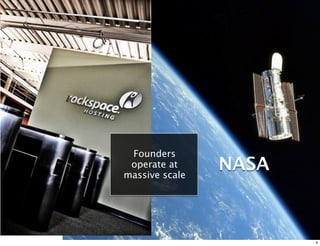
Founders
 operate at
massive scale
                 NASA


                         4
OpenStack: The Mission

           "To produce the ubiquitous Open
           Source cloud computing platform
           that will meet the needs of public
           and private cloud providers
           regardless of size, by being simple to
           implement and massively scalable."


                                                    5
OpenStack Founding Principles

          Apache 2.0 license (OSI), open development process
          Open design process, 2x year public Design
          Summits
          Publicly available open source code repositories
          Open community processes documented and
          transparent
          Commitment to drive and adopt open standards
          Modular design for deployment flexibility via APIs


                                                               6
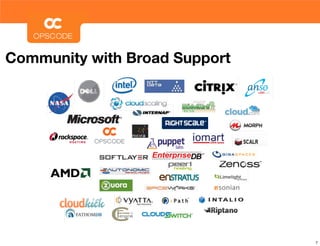
Community with Broad Support


                               7
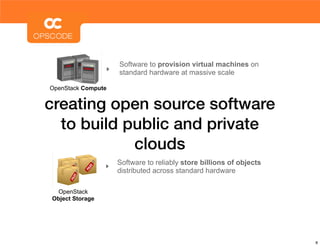
Software to provision virtual machines on
                    standard hardware at massive scale

OpenStack Compute


creating open source software
  to build public and private
            clouds
                    Software to reliably store billions of objects
                    distributed across standard hardware

 OpenStack
Object Storage


                                                                     8
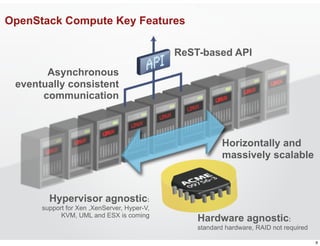
OpenStack Compute Key Features

                                             ReST-based API
       Asynchronous
 eventually consistent
      communication


                                                        Horizontally and
                                                        massively scalable


        Hypervisor agnostic:
      support for Xen ,XenServer, Hyper-V,
            KVM, UML and ESX is coming
                                                 Hardware agnostic:
                                                 standard hardware, RAID not required

                                                                                        9
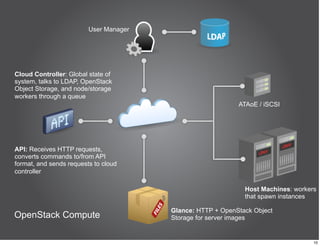
User Manager


Cloud Controller: Global state of
system, talks to LDAP, OpenStack
Object Storage, and node/storage
workers through a queue
                                                            ATAoE / iSCSI


API: Receives HTTP requests,
converts commands to/from API
format, and sends requests to cloud
controller

                                                              Host Machines: workers
                                                              that spawn instances

                                        Glance: HTTP + OpenStack Object
OpenStack Compute                       Storage for server images


                                                                                   10
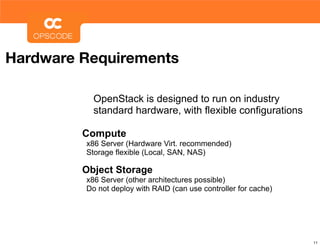
Hardware Requirements

           OpenStack is designed to run on industry
           standard hardware, with flexible configurations

         Compute
         x86 Server (Hardware Virt. recommended)
         Storage flexible (Local, SAN, NAS)

         Object Storage
         x86 Server (other architectures possible)
         Do not deploy with RAID (can use controller for cache)


                                                                  11
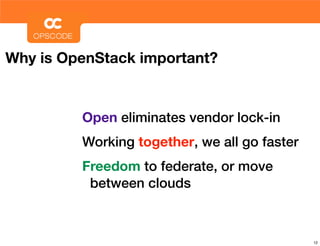
Why is OpenStack important?


         Open eliminates vendor lock-in
         Working together, we all go faster
         Freedom to federate, or move
          between clouds


                                              12
What is Chef?


                13
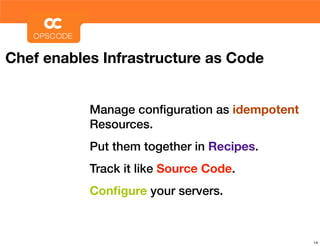
Chef enables Infrastructure as Code


           Manage configuration as idempotent
           Resources.
           Put them together in Recipes.
           Track it like Source Code.
           Configure your servers.


                                               14
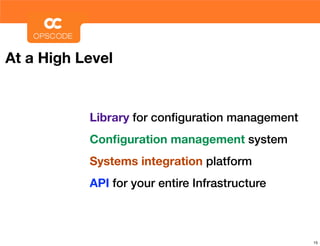
At a High Level


           Library for configuration management
           Configuration management system
           Systems integration platform
           API for your entire Infrastructure


                                                 15
Fully automated
 Infrastructure


                  16
Principles


             Idempotent
             Data-driven
             Sane defaults
             Hackability
             TMTOWTDI

                             17
Open Source and Community


          Apache 2 licensed
          Large and active community
          Over 300 individual contributors
          (60+ corporate)
          Community is Important!


                                             18
19
How does it Work?


                    20
How does it Work?
    Miracles!

                    21
How does it Work?
    Miracles!
   (no really)
                    22
Chef Client runs on
  your System


                      23
Chef Client runs on
  your System
       ohai!


                      24
Clients talk to the
   Chef Server


                      25
The Opscode Platform
is a hosted Chef Server


                          26
We call each system
 you configure a
        Node

                      27
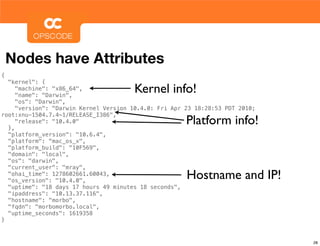
Nodes have Attributes
{
  "kernel": {
     "machine": "x86_64",
     "name": "Darwin",
                                       Kernel info!
     "os": "Darwin",
     "version": "Darwin Kernel Version 10.4.0: Fri Apr 23 18:28:53 PDT 2010;
root:xnu-1504.7.4~1/RELEASE_I386",

  },
     "release": "10.4.0"                               Platform info!
  "platform_version": "10.6.4",
  "platform": "mac_os_x",
  "platform_build": "10F569",
  "domain": "local",
  "os": "darwin",
  "current_user": "mray",
  "ohai_time": 1278602661.60043,
  "os_version": "10.4.0",
                                                       Hostname and IP!
  "uptime": "18 days 17 hours 49 minutes 18 seconds",
  "ipaddress": "10.13.37.116",
  "hostname": "morbo",
  "fqdn": "morbomorbo.local",
  "uptime_seconds": 1619358
}


                                                                               28
Nodes have a Run List
  What Roles and Recipes
    to Apply in Order


                           29
Nodes have Roles
webserver, database, monitoring, etc.


                                        30
Roles have a Run List
  What Roles and Recipes
    to Apply in Order


                           31
name "webserver"
description "Systems that serve HTTP traffic"

run_list(
  "role[base]",
  "recipe[apache2]",
  "recipe[apache2::mod_ssl]"
)

default_attributes(
  "apache" => {
    "listen_ports" => [ "80", "443" ]
  }
)

override_attributes(
  "apache" => {
    "max_children" => "50"
  }
)
                                                32
                                                32
name "webserver"
description "Systems that serve HTTP traffic"

run_list(
  "role[base]",
                                 Can include
  "recipe[apache2]",             other roles!
  "recipe[apache2::mod_ssl]"
)

default_attributes(
  "apache" => {
    "listen_ports" => [ "80", "443" ]
  }
)

override_attributes(
  "apache" => {
    "max_children" => "50"
  }
)
                                                32
                                                32
Chef manages
Resources on Nodes


                     33
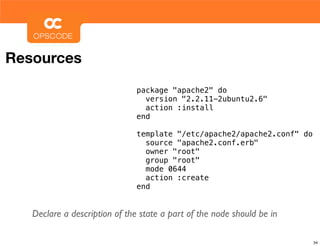
Resources


   Declare a description of the state a part of the node should be in

                                                                        34
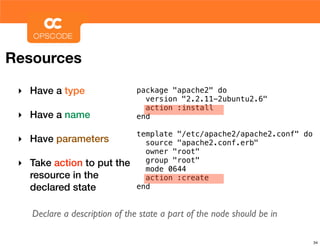
Resources
                               package "apache2" do
                                 version "2.2.11-2ubuntu2.6"
                                 action :install
                               end

                               template "/etc/apache2/apache2.conf" do
                                 source "apache2.conf.erb"
                                 owner "root"
                                 group "root"
                                 mode 0644
                                 action :create
                               end


   Declare a description of the state a part of the node should be in

                                                                         34
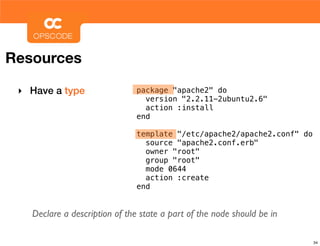
Resources

 ‣ Have a type                 package "apache2" do
                                 version "2.2.11-2ubuntu2.6"
                                 action :install
                               end

                               template "/etc/apache2/apache2.conf" do
                                 source "apache2.conf.erb"
                                 owner "root"
                                 group "root"
                                 mode 0644
                                 action :create
                               end


   Declare a description of the state a part of the node should be in

                                                                         34
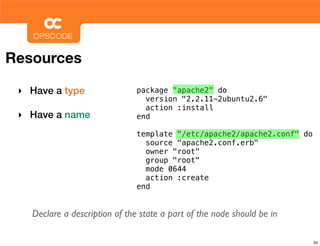
Resources

 ‣ Have a type                 package "apache2" do
                                 version "2.2.11-2ubuntu2.6"
                                 action :install
 ‣ Have a name                 end

                               template "/etc/apache2/apache2.conf" do
                                 source "apache2.conf.erb"
                                 owner "root"
                                 group "root"
                                 mode 0644
                                 action :create
                               end


   Declare a description of the state a part of the node should be in

                                                                         34
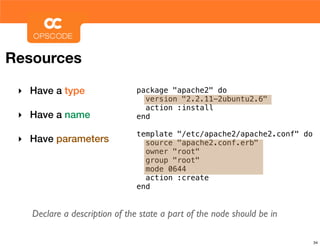
Resources

 ‣ Have a type                 package "apache2" do
                                 version "2.2.11-2ubuntu2.6"
                                 action :install
 ‣ Have a name                 end

                               template "/etc/apache2/apache2.conf" do
 ‣ Have parameters               source "apache2.conf.erb"
                                 owner "root"
                                 group "root"
                                 mode 0644
                                 action :create
                               end


   Declare a description of the state a part of the node should be in

                                                                         34
Resources

 ‣ Have a type                  package "apache2" do
                                  version "2.2.11-2ubuntu2.6"
                                  action :install
 ‣ Have a name                  end

                                template "/etc/apache2/apache2.conf" do
 ‣ Have parameters                source "apache2.conf.erb"
                                  owner "root"
 ‣ Take action to put the         group "root"
                                  mode 0644
   resource in the                action :create
   declared state               end


    Declare a description of the state a part of the node should be in

                                                                          34
Resources take action
  through Providers


                        35
Recipes are lists of
   Resources


                       36
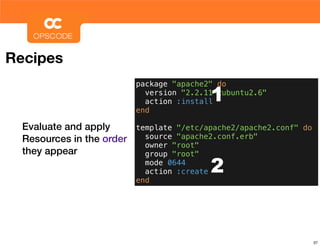
Recipes

                                           1
                           package "apache2" do
                             version "2.2.11-2ubuntu2.6"
                             action :install
                           end

  Evaluate and apply       template "/etc/apache2/apache2.conf" do
  Resources in the order     source "apache2.conf.erb"
                             owner "root"
  they appear                group "root"
                             mode 0644
                             action :create2
                           end


                                                                     37
Order Matters


                38
Recipes are just Ruby!
extra_packages = case node[:platform]
  when "ubuntu","debian"
    %w{
      ruby1.8
      ruby1.8-dev
      rdoc1.8
      ri1.8
      libopenssl-ruby
    }
  end

extra_packages.each do |pkg|
  package pkg do
    action :install
  end
end


                                        39
Cookbooks are
packages for Recipes


                       40
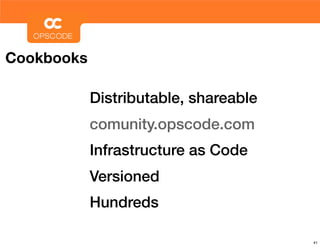
Cookbooks

            Distributable, shareable
            comunity.opscode.com
            Infrastructure as Code
            Versioned
            Hundreds

                                       41
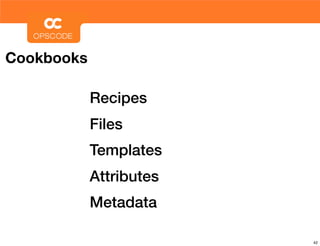
Cookbooks

            Recipes
            Files
            Templates
            Attributes
            Metadata

                         42
Data bags store
 arbitrary data


                  43
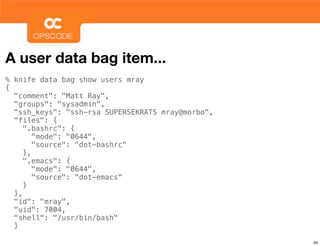
A user data bag item...
% knife data bag show users mray
{
  "comment": "Matt Ray",
  "groups": "sysadmin",
  "ssh_keys": "ssh-rsa SUPERSEKRATS mray@morbo",
  "files": {
     ".bashrc": {
        "mode": "0644",
        "source": "dot-bashrc"
     },
     ".emacs": {
        "mode": "0644",
        "source": "dot-emacs"
     }
  },
  "id": "mray",
  "uid": 7004,
  "shell": "/usr/bin/bash"
  }

                                                   44
Environments manage
versioned infrastructure


                           45
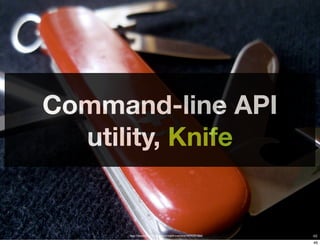
Command-line API
  utility, Knife


       http://www.flickr.com/photos/myklroventine/3474391066/
     Copyright © 2011 Opscode, Inc - All Rights Reserved       46
                                                               46
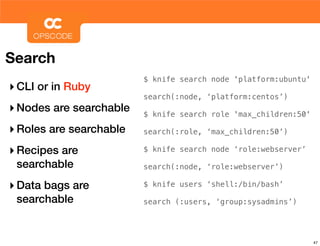
Search
                         $ knife search node 'platform:ubuntu'
‣ CLI or in Ruby
                         search(:node, ‘platform:centos’)
‣ Nodes are searchable   $ knife search role 'max_children:50'

‣ Roles are searchable   search(:role, ‘max_children:50’)

‣ Recipes are            $ knife search node ‘role:webserver’

 searchable              search(:node, ‘role:webserver’)

‣ Data bags are          $ knife users ‘shell:/bin/bash’

 searchable              search (:users, ‘group:sysadmins’)


                                                                 47
48
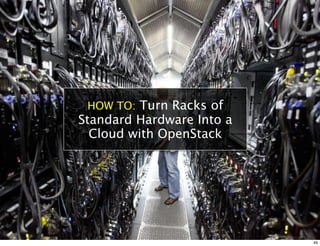
HOW TO: Turn Racks of
Standard Hardware Into a
  Cloud with OpenStack


                           49
What Works Today?


                    50
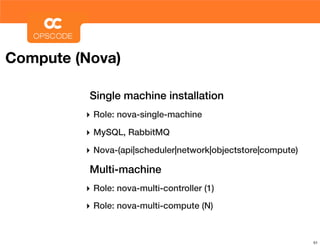
Compute (Nova)

          Single machine installation
         ‣ Role: nova-single-machine
         ‣ MySQL, RabbitMQ
         ‣ Nova-(api|scheduler|network|objectstore|compute)
          Multi-machine
         ‣ Role: nova-multi-controller (1)
         ‣ Role: nova-multi-compute (N)


                                                              51
Role: nova-single-machine
name "nova-single-machine-install"

description "Installs everything required to run Nova on a single
machine"

run_list(
            "role[nova-multi-controller]",
            "role[nova-multi-compute]"
            )


                                                                    52
Role: nova-multi-controller
name "nova-multi-controller"

description "Installs requirements to run the Controller node in a
Nova cluster"

run_list(
            "role[nova-support-server]",
            "role[nova-head]",
            "role[nova-cloud-controller]",
            "role[nova-super-user-setup]"
            )


                                                                     53
Role: nova-multi-compute
name "nova-multi-compute"

description "Installs requirements to run a Compute node in a Nova
cluster"

run_list(
    "recipe[nova::compute]"
)


                                                                     54
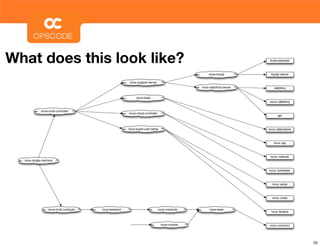
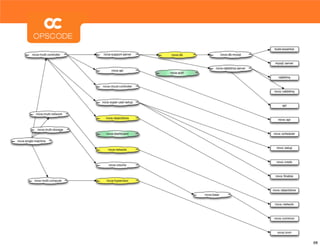
What does this look like?


                            55
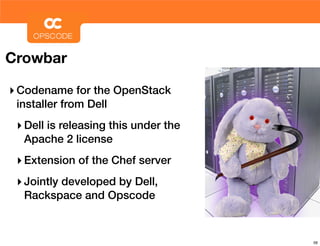
Crowbar

‣ Codename for the OpenStack
 installer from Dell
 ‣ Dell is releasing this under the
  Apache 2 license
 ‣ Extension of the Chef server
 ‣ Jointly developed by Dell,
  Rackspace and Opscode


                                      56
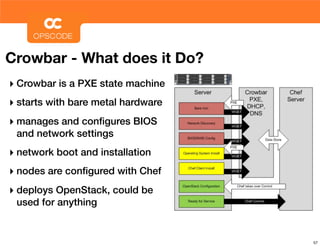
Crowbar - What does it Do?
‣ Crowbar is a PXE state machine
‣ starts with bare metal hardware
‣ manages and configures BIOS
 and network settings
‣ network boot and installation
‣ nodes are configured with Chef
‣ deploys OpenStack, could be
 used for anything


                                    57
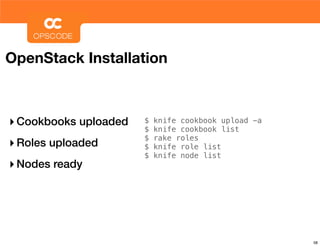
OpenStack Installation


‣ Cookbooks uploaded   $
                       $
                           knife cookbook upload -a
                           knife cookbook list
                       $   rake roles
‣ Roles uploaded       $   knife role list
                       $   knife node list
‣ Nodes ready


                                                      58
AMIs
name "nova-ami-urls"
description "Feed in a list URLs for AMIs to download"
default_attributes(
  "nova" => {
    "images" =>
["http://192.168.11.7/ubuntu1010-UEC-localuser-image.tar.gz”]
      }
  )

$ knife role from file roles/nova-ami-urls.rb


‣ Use an existing AMI
‣ Update URL to your own

                                                                59
Assign the Roles
$ knife node run_list add crushinator.localdomain "role[nova-ami-
urls]"
{
  "run_list": [
    "role[nova-ami-urls]"
  ]
}

$ knife node run_list add crushinator.localdomain "role[nova-single-
machine-install]"
{
  "run_list": [
    "role[nova-ami-urls]"
    "role[nova-single-machine-install]",
  ]
}


                                                                       60
chef-client
mray@ubuntu1010:~$ sudo chef-client
[Fri, 25 Feb 2011 11:52:59 -0800] INFO:   Starting Chef Run (Version
0.9.12)
...
[Fri, 25 Feb 2011 11:56:05 -0800] INFO:   Chef Run complete in
5.911955 seconds
[Fri, 25 Feb 2011 11:56:05 -0800] INFO:   cleaning the checksum cache
[Fri, 25 Feb 2011 11:56:05 -0800] INFO:   Running report handlers
[Fri, 25 Feb 2011 11:56:05 -0800] INFO:   Report handlers complete


                                                                        61
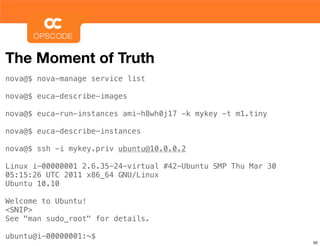
The Moment of Truth
nova@$ nova-manage service list

nova@$ euca-describe-images

nova@$ euca-run-instances ami-h8wh0j17 -k mykey -t m1.tiny

nova@$ euca-describe-instances

nova@$ ssh -i mykey.priv ubuntu@10.0.0.2

Linux i-00000001 2.6.35-24-virtual #42-Ubuntu SMP Thu Mar 30
05:15:26 UTC 2011 x86_64 GNU/Linux
Ubuntu 10.10

Welcome to Ubuntu!
<SNIP>
See "man sudo_root" for details.

ubuntu@i-00000001:~$
                                                               62
How Did We Get Here?


                       63
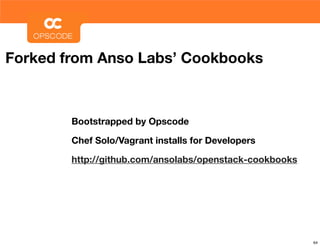
Forked from Anso Labs’ Cookbooks


        Bootstrapped by Opscode

        Chef Solo/Vagrant installs for Developers

        http://github.com/ansolabs/openstack-cookbooks


                                                         64
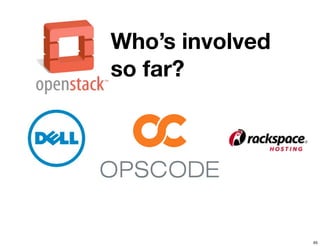
Who’s involved
so far?


                 65
What’s Next?


               66
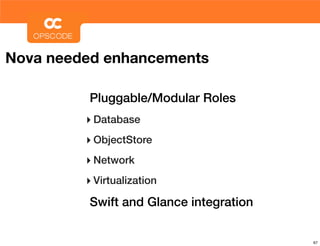
Nova needed enhancements

         Pluggable/Modular Roles
         ‣ Database
         ‣ ObjectStore
         ‣ Network
         ‣ Virtualization
         Swift and Glance integration


                                        67
68
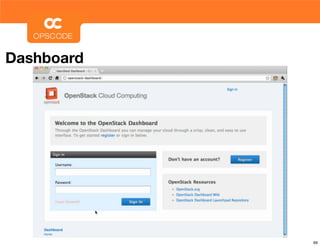
Dashboard


            69
Knife


        ‣ http://github.com/opscode/knife-openstack
        ‣ Nova has same API as Amazon
        ‣ Fog supports OpenStack already
        ‣ knife openstack server create ‘role
         [base]’ -i ami-a403f6xd -f m1.micro -
         A “OpenStack instance”


                                                      70
Object Storage (Swift)


           ‣ Recipes originated from Anso Labs’ repository
           ‣ Will be managed with Chef and Crowbar
           ‣ Included in the ‘bexar’ branch
           ‣ Untested so far (Cactus will tackle)


                                                             71
Image Registry (Glance)


          ‣ Recipes originated from Anso Labs’ repository
          ‣ Will be managed with Chef and Crowbar
          ‣ Included in the ‘bexar’ branch
          ‣ Untested so far (Cactus!)


                                                            72
Scaling changes how
we deploy OpenStack!


                       73
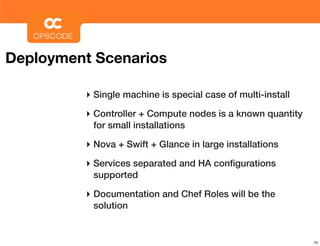
Deployment Scenarios

         ‣ Single machine is special case of multi-install
         ‣ Controller + Compute nodes is a known quantity
          for small installations

         ‣ Nova + Swift + Glance in large installations
         ‣ Services separated and HA configurations
          supported

         ‣ Documentation and Chef Roles will be the
          solution


                                                             74
Cactus, Diablo, ...


            Development continues...
            Branches for each stable release
            Design Summit later this month
            Design Summit in the Fall


                                               75
Rackspace Cloud Builders

          Commercial support and Training for
          OpenStack
          ‣ Opscode
          ‣ Dell
          ‣ Equinix
          ‣ Cloudscaling
          ‣ Citrix


                                                76
Get Involved!

    https://github.com/mattray/openstack-cookbooks/tree/bexar
    http://lists.openstack.org
    http://lists.opscode.com
    #chef on irc.freenode.net
    #openstack on irc.freenode.net
    matt@opscode.com
    jordan@openstack.com


                                                                77

TXLF: Automated Deployment of OpenStack with Chef

  • 1.
    Automated Deployment of OpenStackwith Chef Texas Linux Fest April 2, 2011 1
  • 2.
    Introductions Matt Ray Senior Technical Evangelist matt@opscode.com @mattray GitHub:mattray 2
  • 3.
  • 4.
  • 5.
    OpenStack: The Mission "To produce the ubiquitous Open Source cloud computing platform that will meet the needs of public and private cloud providers regardless of size, by being simple to implement and massively scalable." 5
  • 6.
    OpenStack Founding Principles Apache 2.0 license (OSI), open development process Open design process, 2x year public Design Summits Publicly available open source code repositories Open community processes documented and transparent Commitment to drive and adopt open standards Modular design for deployment flexibility via APIs 6
  • 7.
  • 8.
    Software to provisionvirtual machines on standard hardware at massive scale OpenStack Compute creating open source software to build public and private clouds Software to reliably store billions of objects distributed across standard hardware OpenStack Object Storage 8
  • 9.
    OpenStack Compute KeyFeatures ReST-based API Asynchronous eventually consistent communication Horizontally and massively scalable Hypervisor agnostic: support for Xen ,XenServer, Hyper-V, KVM, UML and ESX is coming Hardware agnostic: standard hardware, RAID not required 9
  • 10.
    User Manager Cloud Controller:Global state of system, talks to LDAP, OpenStack Object Storage, and node/storage workers through a queue ATAoE / iSCSI API: Receives HTTP requests, converts commands to/from API format, and sends requests to cloud controller Host Machines: workers that spawn instances Glance: HTTP + OpenStack Object OpenStack Compute Storage for server images 10
  • 11.
    Hardware Requirements OpenStack is designed to run on industry standard hardware, with flexible configurations Compute x86 Server (Hardware Virt. recommended) Storage flexible (Local, SAN, NAS) Object Storage x86 Server (other architectures possible) Do not deploy with RAID (can use controller for cache) 11
  • 12.
    Why is OpenStackimportant? Open eliminates vendor lock-in Working together, we all go faster Freedom to federate, or move between clouds 12
  • 13.
  • 14.
    Chef enables Infrastructureas Code Manage configuration as idempotent Resources. Put them together in Recipes. Track it like Source Code. Configure your servers. 14
  • 15.
    At a HighLevel Library for configuration management Configuration management system Systems integration platform API for your entire Infrastructure 15
  • 16.
  • 17.
    Principles Idempotent Data-driven Sane defaults Hackability TMTOWTDI 17
  • 18.
    Open Source andCommunity Apache 2 licensed Large and active community Over 300 individual contributors (60+ corporate) Community is Important! 18
  • 19.
  • 20.
    How does itWork? 20
  • 21.
    How does itWork? Miracles! 21
  • 22.
    How does itWork? Miracles! (no really) 22
  • 23.
    Chef Client runson your System 23
  • 24.
    Chef Client runson your System ohai! 24
  • 25.
    Clients talk tothe Chef Server 25
  • 26.
    The Opscode Platform isa hosted Chef Server 26
  • 27.
    We call eachsystem you configure a Node 27
  • 28.
    Nodes have Attributes { "kernel": { "machine": "x86_64", "name": "Darwin", Kernel info! "os": "Darwin", "version": "Darwin Kernel Version 10.4.0: Fri Apr 23 18:28:53 PDT 2010; root:xnu-1504.7.4~1/RELEASE_I386", }, "release": "10.4.0" Platform info! "platform_version": "10.6.4", "platform": "mac_os_x", "platform_build": "10F569", "domain": "local", "os": "darwin", "current_user": "mray", "ohai_time": 1278602661.60043, "os_version": "10.4.0", Hostname and IP! "uptime": "18 days 17 hours 49 minutes 18 seconds", "ipaddress": "10.13.37.116", "hostname": "morbo", "fqdn": "morbomorbo.local", "uptime_seconds": 1619358 } 28
  • 29.
    Nodes have aRun List What Roles and Recipes to Apply in Order 29
  • 30.
    Nodes have Roles webserver,database, monitoring, etc. 30
  • 31.
    Roles have aRun List What Roles and Recipes to Apply in Order 31
  • 32.
    name "webserver" description "Systemsthat serve HTTP traffic" run_list( "role[base]", "recipe[apache2]", "recipe[apache2::mod_ssl]" ) default_attributes( "apache" => { "listen_ports" => [ "80", "443" ] } ) override_attributes( "apache" => { "max_children" => "50" } ) 32 32
  • 33.
    name "webserver" description "Systemsthat serve HTTP traffic" run_list( "role[base]", Can include "recipe[apache2]", other roles! "recipe[apache2::mod_ssl]" ) default_attributes( "apache" => { "listen_ports" => [ "80", "443" ] } ) override_attributes( "apache" => { "max_children" => "50" } ) 32 32
  • 34.
  • 35.
    Resources Declare a description of the state a part of the node should be in 34
  • 36.
    Resources package "apache2" do version "2.2.11-2ubuntu2.6" action :install end template "/etc/apache2/apache2.conf" do source "apache2.conf.erb" owner "root" group "root" mode 0644 action :create end Declare a description of the state a part of the node should be in 34
  • 37.
    Resources ‣ Havea type package "apache2" do version "2.2.11-2ubuntu2.6" action :install end template "/etc/apache2/apache2.conf" do source "apache2.conf.erb" owner "root" group "root" mode 0644 action :create end Declare a description of the state a part of the node should be in 34
  • 38.
    Resources ‣ Havea type package "apache2" do version "2.2.11-2ubuntu2.6" action :install ‣ Have a name end template "/etc/apache2/apache2.conf" do source "apache2.conf.erb" owner "root" group "root" mode 0644 action :create end Declare a description of the state a part of the node should be in 34
  • 39.
    Resources ‣ Havea type package "apache2" do version "2.2.11-2ubuntu2.6" action :install ‣ Have a name end template "/etc/apache2/apache2.conf" do ‣ Have parameters source "apache2.conf.erb" owner "root" group "root" mode 0644 action :create end Declare a description of the state a part of the node should be in 34
  • 40.
    Resources ‣ Havea type package "apache2" do version "2.2.11-2ubuntu2.6" action :install ‣ Have a name end template "/etc/apache2/apache2.conf" do ‣ Have parameters source "apache2.conf.erb" owner "root" ‣ Take action to put the group "root" mode 0644 resource in the action :create declared state end Declare a description of the state a part of the node should be in 34
  • 41.
    Resources take action through Providers 35
  • 42.
    Recipes are listsof Resources 36
  • 43.
    Recipes 1 package "apache2" do version "2.2.11-2ubuntu2.6" action :install end Evaluate and apply template "/etc/apache2/apache2.conf" do Resources in the order source "apache2.conf.erb" owner "root" they appear group "root" mode 0644 action :create2 end 37
  • 44.
  • 45.
    Recipes are justRuby! extra_packages = case node[:platform] when "ubuntu","debian" %w{ ruby1.8 ruby1.8-dev rdoc1.8 ri1.8 libopenssl-ruby } end extra_packages.each do |pkg| package pkg do action :install end end 39
  • 46.
  • 47.
    Cookbooks Distributable, shareable comunity.opscode.com Infrastructure as Code Versioned Hundreds 41
  • 48.
    Cookbooks Recipes Files Templates Attributes Metadata 42
  • 49.
    Data bags store arbitrary data 43
  • 50.
    A user databag item... % knife data bag show users mray { "comment": "Matt Ray", "groups": "sysadmin", "ssh_keys": "ssh-rsa SUPERSEKRATS mray@morbo", "files": { ".bashrc": { "mode": "0644", "source": "dot-bashrc" }, ".emacs": { "mode": "0644", "source": "dot-emacs" } }, "id": "mray", "uid": 7004, "shell": "/usr/bin/bash" } 44
  • 51.
  • 52.
    Command-line API utility, Knife http://www.flickr.com/photos/myklroventine/3474391066/ Copyright © 2011 Opscode, Inc - All Rights Reserved 46 46
  • 53.
    Search $ knife search node 'platform:ubuntu' ‣ CLI or in Ruby search(:node, ‘platform:centos’) ‣ Nodes are searchable $ knife search role 'max_children:50' ‣ Roles are searchable search(:role, ‘max_children:50’) ‣ Recipes are $ knife search node ‘role:webserver’ searchable search(:node, ‘role:webserver’) ‣ Data bags are $ knife users ‘shell:/bin/bash’ searchable search (:users, ‘group:sysadmins’) 47
  • 54.
  • 55.
    HOW TO: TurnRacks of Standard Hardware Into a Cloud with OpenStack 49
  • 56.
  • 57.
    Compute (Nova) Single machine installation ‣ Role: nova-single-machine ‣ MySQL, RabbitMQ ‣ Nova-(api|scheduler|network|objectstore|compute) Multi-machine ‣ Role: nova-multi-controller (1) ‣ Role: nova-multi-compute (N) 51
  • 58.
    Role: nova-single-machine name "nova-single-machine-install" description"Installs everything required to run Nova on a single machine" run_list( "role[nova-multi-controller]", "role[nova-multi-compute]" ) 52
  • 59.
    Role: nova-multi-controller name "nova-multi-controller" description"Installs requirements to run the Controller node in a Nova cluster" run_list( "role[nova-support-server]", "role[nova-head]", "role[nova-cloud-controller]", "role[nova-super-user-setup]" ) 53
  • 60.
    Role: nova-multi-compute name "nova-multi-compute" description"Installs requirements to run a Compute node in a Nova cluster" run_list( "recipe[nova::compute]" ) 54
  • 61.
    What does thislook like? 55
  • 62.
    Crowbar ‣ Codename forthe OpenStack installer from Dell ‣ Dell is releasing this under the Apache 2 license ‣ Extension of the Chef server ‣ Jointly developed by Dell, Rackspace and Opscode 56
  • 63.
    Crowbar - Whatdoes it Do? ‣ Crowbar is a PXE state machine ‣ starts with bare metal hardware ‣ manages and configures BIOS and network settings ‣ network boot and installation ‣ nodes are configured with Chef ‣ deploys OpenStack, could be used for anything 57
  • 64.
    OpenStack Installation ‣ Cookbooksuploaded $ $ knife cookbook upload -a knife cookbook list $ rake roles ‣ Roles uploaded $ knife role list $ knife node list ‣ Nodes ready 58
  • 65.
    AMIs name "nova-ami-urls" description "Feedin a list URLs for AMIs to download" default_attributes( "nova" => { "images" => ["http://192.168.11.7/ubuntu1010-UEC-localuser-image.tar.gz”] } ) $ knife role from file roles/nova-ami-urls.rb ‣ Use an existing AMI ‣ Update URL to your own 59
  • 66.
    Assign the Roles $knife node run_list add crushinator.localdomain "role[nova-ami- urls]" { "run_list": [ "role[nova-ami-urls]" ] } $ knife node run_list add crushinator.localdomain "role[nova-single- machine-install]" { "run_list": [ "role[nova-ami-urls]" "role[nova-single-machine-install]", ] } 60
  • 67.
    chef-client mray@ubuntu1010:~$ sudo chef-client [Fri,25 Feb 2011 11:52:59 -0800] INFO: Starting Chef Run (Version 0.9.12) ... [Fri, 25 Feb 2011 11:56:05 -0800] INFO: Chef Run complete in 5.911955 seconds [Fri, 25 Feb 2011 11:56:05 -0800] INFO: cleaning the checksum cache [Fri, 25 Feb 2011 11:56:05 -0800] INFO: Running report handlers [Fri, 25 Feb 2011 11:56:05 -0800] INFO: Report handlers complete 61
  • 68.
    The Moment ofTruth nova@$ nova-manage service list nova@$ euca-describe-images nova@$ euca-run-instances ami-h8wh0j17 -k mykey -t m1.tiny nova@$ euca-describe-instances nova@$ ssh -i mykey.priv ubuntu@10.0.0.2 Linux i-00000001 2.6.35-24-virtual #42-Ubuntu SMP Thu Mar 30 05:15:26 UTC 2011 x86_64 GNU/Linux Ubuntu 10.10 Welcome to Ubuntu! <SNIP> See "man sudo_root" for details. ubuntu@i-00000001:~$ 62
  • 69.
    How Did WeGet Here? 63
  • 70.
    Forked from AnsoLabs’ Cookbooks Bootstrapped by Opscode Chef Solo/Vagrant installs for Developers http://github.com/ansolabs/openstack-cookbooks 64
  • 71.
  • 72.
  • 73.
    Nova needed enhancements Pluggable/Modular Roles ‣ Database ‣ ObjectStore ‣ Network ‣ Virtualization Swift and Glance integration 67
  • 74.
  • 75.
  • 76.
    Knife ‣ http://github.com/opscode/knife-openstack ‣ Nova has same API as Amazon ‣ Fog supports OpenStack already ‣ knife openstack server create ‘role [base]’ -i ami-a403f6xd -f m1.micro - A “OpenStack instance” 70
  • 77.
    Object Storage (Swift) ‣ Recipes originated from Anso Labs’ repository ‣ Will be managed with Chef and Crowbar ‣ Included in the ‘bexar’ branch ‣ Untested so far (Cactus will tackle) 71
  • 78.
    Image Registry (Glance) ‣ Recipes originated from Anso Labs’ repository ‣ Will be managed with Chef and Crowbar ‣ Included in the ‘bexar’ branch ‣ Untested so far (Cactus!) 72
  • 79.
    Scaling changes how wedeploy OpenStack! 73
  • 80.
    Deployment Scenarios ‣ Single machine is special case of multi-install ‣ Controller + Compute nodes is a known quantity for small installations ‣ Nova + Swift + Glance in large installations ‣ Services separated and HA configurations supported ‣ Documentation and Chef Roles will be the solution 74
  • 81.
    Cactus, Diablo, ... Development continues... Branches for each stable release Design Summit later this month Design Summit in the Fall 75
  • 82.
    Rackspace Cloud Builders Commercial support and Training for OpenStack ‣ Opscode ‣ Dell ‣ Equinix ‣ Cloudscaling ‣ Citrix 76
  • 83.
    Get Involved! https://github.com/mattray/openstack-cookbooks/tree/bexar http://lists.openstack.org http://lists.opscode.com #chef on irc.freenode.net #openstack on irc.freenode.net matt@opscode.com jordan@openstack.com 77