IMPLEMENTATIONS OF PRINCIPLES
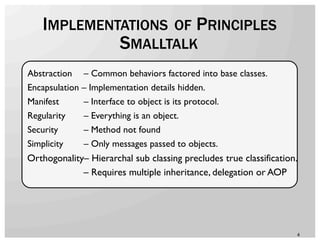
            SMALLTALK
Abstraction – Common behaviors factored into base classes.
Encapsulation – Implementation details hidden.
Manifest      – Interface to object is its protocol.
Regularity    – Everything is an object.
Security      – Method not found
Simplicity    – Only messages passed to objects.
Orthogonality– Hierarchal sub classing precludes true classification.
             – Requires multiple inheritance, delegation or AOP


                                                                    4
IMPLEMENTATIONS OF PRINCIPLES
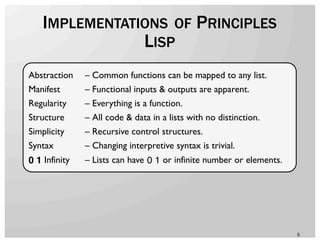
                LISP
Abstraction    – Common functions can be mapped to any list.
Manifest       – Functional inputs & outputs are apparent.
Regularity     – Everything is a function.
Structure      – All code & data in a lists with no distinction.
Simplicity     – Recursive control structures.
Syntax         – Changing interpretive syntax is trivial.
0 1 Infinity   – Lists can have 0 1 or infinite number or elements.


                                                                      5
IMPLEMENTATIONS OF PRINCIPLES
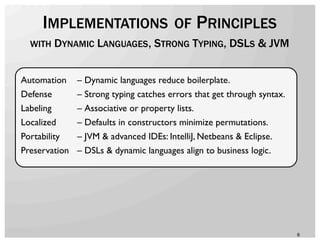
  WITH   DYNAMIC LANGUAGES, STRONG TYPING, DSLS & JVM


Automation    – Dynamic languages reduce boilerplate.
Defense       – Strong typing catches errors that get through syntax.
Labeling      – Associative or property lists.
Localized     – Defaults in constructors minimize permutations.
Portability  – JVM & advanced IDEs: IntelliJ, Netbeans & Eclipse.
Preservation – DSLs & dynamic languages align to business logic.


                                                                        6
LANGUAGE PARADIGMS
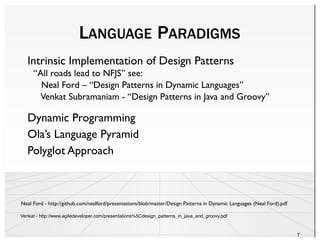
   Intrinsic Implementation of Design Patterns
     “All roads lead to NFJS” see:
       Neal Ford – “Design Patterns in Dynamic Languages”
       Venkat Subramaniam - “Design Patterns in Java and Groovy”

   Dynamic Programming
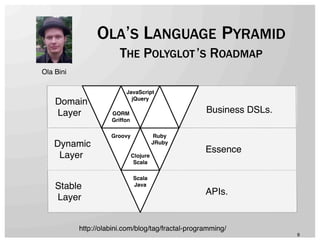
   Ola’s Language Pyramid
   Polyglot Approach


Neal Ford - http://github.com/nealford/presentations/blob/master/Design Patterns in Dynamic Languages (Neal Ford).pdf

Venkat - http://www.agiledeveloper.com/presentations%5Cdesign_patterns_in_java_and_groovy.pdf


                                                                                                                        7
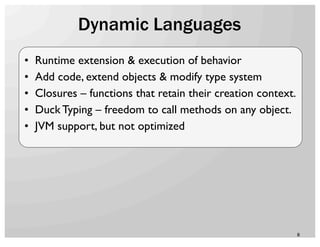
Dynamic Languages
•   Runtime extension & execution of behavior
•   Add code, extend objects & modify type system
•   Closures – functions that retain their creation context.
•   Duck Typing – freedom to call methods on any object.
•   JVM support, but not optimized


                                                               8
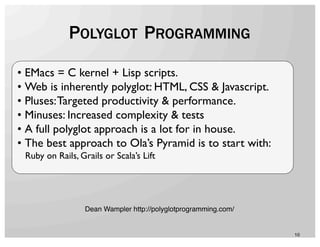
POLYGLOT PROGRAMMING

• EMacs = C kernel + Lisp scripts.
• Web is inherently polyglot: HTML, CSS & Javascript.
• Pluses: Targeted productivity & performance.
• Minuses: Increased complexity & tests
• A full polyglot approach is a lot for in house.
• The best approach to Ola’s Pyramid is to start with:
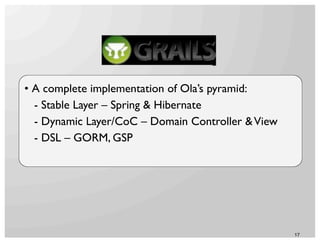
 Ruby on Rails, Grails or Scala’s Lift


                  Dean Wampler http://polyglotprogramming.com/


                                                                 10
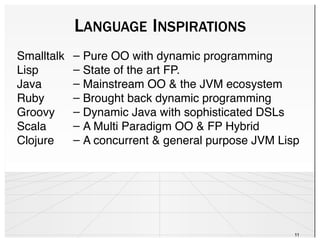
LANGUAGE INSPIRATIONS
Smalltalk   – Pure OO with dynamic programming
Lisp        – State of the art FP.
Java        – Mainstream OO & the JVM ecosystem
Ruby        – Brought back dynamic programming
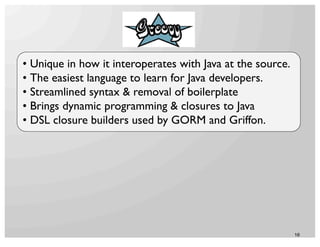
Groovy      – Dynamic Java with sophisticated DSLs
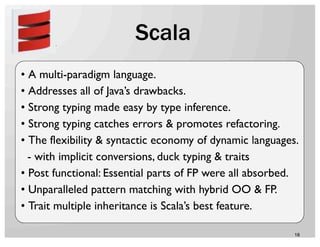
Scala       – A Multi Paradigm OO & FP Hybrid
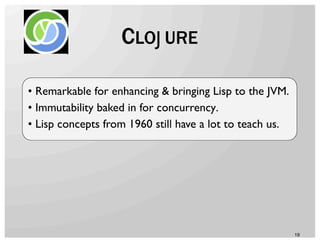
Clojure     – A concurrent & general purpose JVM Lisp


                                                    11
LISP
• In 1987 & 1991 I wrote symbolic math libraries in Lisp.
• FP & recursion were a positive influence on my C++ apps.
• Integration with C scientific & OpenGL libs was tough.
• Lisp needed a bigger ecosystem with JVM APIs.


                                                         12
SMALLTALK

• In 1993 I wrote a Smalltalk persistence library ~ GORM.
• But team wanted a fully transparent ORM.
• Smalltalk had great dynamic programming.
• But team went to too far seeking instant OO nirvana.
• For individuals the GUI was great. The first IDE.
• But the GUI had a bubble effect, adverse to SCM.


                                                        13
JAVA
• Implemented Smalltalk’s OO & simulation paradigm.
• Brought OO & the JVM to a large group of developers.
• But bloated frameworks threaten productivity.
• Java 7 closures & dynamic invocation are significant.
• We would probably not be meeting if not for Java.


                       JAVA FX
• Innovative scene graph approach.
• Scene graph API should be have callable by Java.
• Would have made a great Groovy / Griffon DSL.
• A missed opportunity for revitalizing Java GUI.

                                                          14
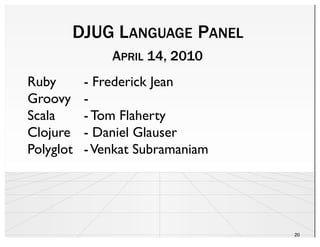
DJUG LANGUAGE PANEL
               APRIL 14, 2010
Ruby       - Frederick Jean
Groovy     -
Scala      - Tom Flaherty
Clojure    - Daniel Glauser
Polyglot   - Venkat Subramaniam


                                  20

Principles Of Programing Languages

  • 4.
    IMPLEMENTATIONS OF PRINCIPLES SMALLTALK Abstraction – Common behaviors factored into base classes. Encapsulation – Implementation details hidden. Manifest – Interface to object is its protocol. Regularity – Everything is an object. Security – Method not found Simplicity – Only messages passed to objects. Orthogonality– Hierarchal sub classing precludes true classification. – Requires multiple inheritance, delegation or AOP 4
  • 5.
    IMPLEMENTATIONS OF PRINCIPLES LISP Abstraction – Common functions can be mapped to any list. Manifest – Functional inputs & outputs are apparent. Regularity – Everything is a function. Structure – All code & data in a lists with no distinction. Simplicity – Recursive control structures. Syntax – Changing interpretive syntax is trivial. 0 1 Infinity – Lists can have 0 1 or infinite number or elements. 5
  • 6.
    IMPLEMENTATIONS OF PRINCIPLES WITH DYNAMIC LANGUAGES, STRONG TYPING, DSLS & JVM Automation – Dynamic languages reduce boilerplate. Defense – Strong typing catches errors that get through syntax. Labeling – Associative or property lists. Localized – Defaults in constructors minimize permutations. Portability – JVM & advanced IDEs: IntelliJ, Netbeans & Eclipse. Preservation – DSLs & dynamic languages align to business logic. 6
  • 7.
    LANGUAGE PARADIGMS Intrinsic Implementation of Design Patterns “All roads lead to NFJS” see: Neal Ford – “Design Patterns in Dynamic Languages” Venkat Subramaniam - “Design Patterns in Java and Groovy” Dynamic Programming Ola’s Language Pyramid Polyglot Approach Neal Ford - http://github.com/nealford/presentations/blob/master/Design Patterns in Dynamic Languages (Neal Ford).pdf Venkat - http://www.agiledeveloper.com/presentations%5Cdesign_patterns_in_java_and_groovy.pdf 7
  • 8.
    Dynamic Languages • Runtime extension & execution of behavior • Add code, extend objects & modify type system • Closures – functions that retain their creation context. • Duck Typing – freedom to call methods on any object. • JVM support, but not optimized 8
  • 10.
    POLYGLOT PROGRAMMING • EMacs= C kernel + Lisp scripts. • Web is inherently polyglot: HTML, CSS & Javascript. • Pluses: Targeted productivity & performance. • Minuses: Increased complexity & tests • A full polyglot approach is a lot for in house. • The best approach to Ola’s Pyramid is to start with: Ruby on Rails, Grails or Scala’s Lift Dean Wampler http://polyglotprogramming.com/ 10
  • 11.
    LANGUAGE INSPIRATIONS Smalltalk – Pure OO with dynamic programming Lisp – State of the art FP. Java – Mainstream OO & the JVM ecosystem Ruby – Brought back dynamic programming Groovy – Dynamic Java with sophisticated DSLs Scala – A Multi Paradigm OO & FP Hybrid Clojure – A concurrent & general purpose JVM Lisp 11
  • 12.
    LISP • In 1987& 1991 I wrote symbolic math libraries in Lisp. • FP & recursion were a positive influence on my C++ apps. • Integration with C scientific & OpenGL libs was tough. • Lisp needed a bigger ecosystem with JVM APIs. 12
  • 13.
    SMALLTALK • In 1993I wrote a Smalltalk persistence library ~ GORM. • But team wanted a fully transparent ORM. • Smalltalk had great dynamic programming. • But team went to too far seeking instant OO nirvana. • For individuals the GUI was great. The first IDE. • But the GUI had a bubble effect, adverse to SCM. 13
  • 14.
    JAVA • Implemented Smalltalk’sOO & simulation paradigm. • Brought OO & the JVM to a large group of developers. • But bloated frameworks threaten productivity. • Java 7 closures & dynamic invocation are significant. • We would probably not be meeting if not for Java. JAVA FX • Innovative scene graph approach. • Scene graph API should be have callable by Java. • Would have made a great Groovy / Griffon DSL. • A missed opportunity for revitalizing Java GUI. 14
  • 20.
    DJUG LANGUAGE PANEL APRIL 14, 2010 Ruby - Frederick Jean Groovy - Scala - Tom Flaherty Clojure - Daniel Glauser Polyglot - Venkat Subramaniam 20