A First Book of C++
Chapter 1(Pt 2)
Programming Design
&
Paradigm
A First Book of C++
Programming Design
 Step 1 - Analyze the problem
 Outline the problem and its requirements
 Design steps (algorithm) to solve the problem
 Step 2 - Implement the algorithm
 Implement the algorithm in code
 Verify that the algorithm works
 Step 3 - Maintenance
 Use and modify the program if the problem domain
changes
Problem Solving Process
(revisit)
C++ Programming: From Problem Analysis to Program
Design, Third Edition
3
 Thoroughly understand the problem
 Understand problem requirements
 Does program require user interaction?
 Does program manipulate data?
 What is the output?
 If the problem is complex, divide it into sub-
problems
 Analyze each sub-problem as above
Analyze the Problem
C++ Programming: From Problem Analysis to Program
Design, Third Edition
5
 If problem was broken into sub-problems
 Design algorithms for each sub-problem
 Check the correctness of algorithm
 Can test using sample data
 Some mathematical analysis might be required
Design an Algorithm
C++ Programming: From Problem Analysis to Program
Design, Third Edition
6
 Once the algorithm is designed and correctness
verified
 Write the equivalent code in high-level language
 Type the program using text editor
Write the Code
C++ Programming: From Problem Analysis to Program
Design, Third Edition
7
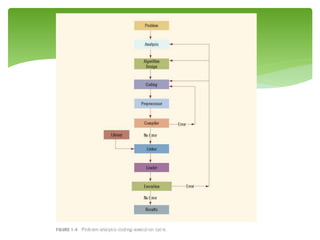
 Run code through compiler
 If compiler generates errors
 Look at code and remove errors
 Run code again through compiler
 If there are no syntax errors
 Compiler generates equivalent machine code
 Linker links machine code with system resources
Compiling and Linking
C++ Programming: From Problem Analysis to Program
Design, Third Edition
8
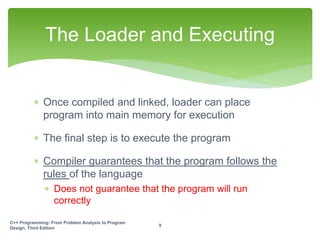
 Once compiled and linked, loader can place
program into main memory for execution
 The final step is to execute the program
 Compiler guarantees that the program follows the
rules of the language
 Does not guarantee that the program will run
correctly
The Loader and Executing
C++ Programming: From Problem Analysis to Program
Design, Third Edition
9
A First Book of C++
Programming Paradigm
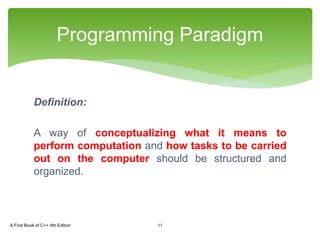
Definition:
A way of conceptualizing what it means to
perform computation and how tasks to be carried
out on the computer should be structured and
organized.
Programming Paradigm
A First Book of C++ 4th Edition 11
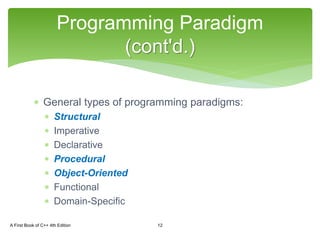
 General types of programming paradigms:
 Structural
 Imperative
 Declarative
 Procedural
 Object-Oriented
 Functional
 Domain-Specific
Programming Paradigm
(cont'd.)
A First Book of C++ 4th Edition 12
 Structured programming (or modular
programming) is a problem solving strategy
and a programming methodology that
includes the following guidelines:
 The flow of control in the program should be as
simple as possible.
 The construction of a program should embody
top-down design.
Programming Paradigm
(cont'd.)
A First Book of C++ 4th Edition 13
 Top-down design means:
 It repeatedly decomposing a problem into
smaller problems.
 Eventually leads to:
 a collection of small problems or tasks.
 each can be easily coded
Programming Paradigm
(cont'd.)
A First Book of C++ 4th Edition 14
 Object-oriented programming is a method of
programming based on a hierarchy of classes, and
well-defined and cooperating objects.
 A class is a structure that defines the data and the
methods to work on that data.
 In simple definition, a class is a programmer defined
data type.
Programming Paradigm
(cont'd.)
A First Book of C++ 4th Edition 15
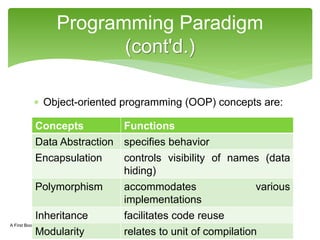
 Object-oriented programming (OOP) concepts are:
Programming Paradigm
(cont'd.)
A First Book of C++ 4th Edition 16
Concepts Functions
Data Abstraction specifies behavior
Encapsulation controls visibility of names (data
hiding)
Polymorphism accommodates various
implementations
Inheritance facilitates code reuse
Modularity relates to unit of compilation
Structured vs. Object-Oriented
Programming
A First Book of C++ 4th Edition 17
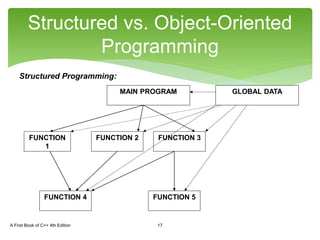
Structured Programming:
MAIN PROGRAM
FUNCTION 3FUNCTION 2
GLOBAL DATA
FUNCTION 5FUNCTION 4
FUNCTION
1
Structured Programming:
 Using functions.
 Function & program is divided into modules.
 Every module has its own data and function which
can be called by other modules.
Structured vs. Object-Oriented
Programming
A First Book of C++ 4th Edition 18
Structured vs. Object-Oriented
Programming (cont'd.)
A First Book of C++ 4th Edition 19
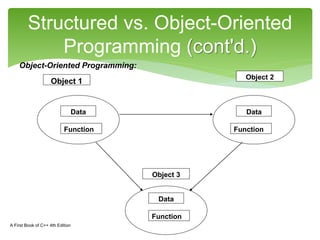
Object-Oriented Programming:
Object 1
Object 2
Data
Function
Data
Function
Object 3
Data
Function
Object-Oriented Programming:
 Objects have both data and methods.
 Objects of the same class have the same data
elements and methods.
 Objects send and receive messages to invoke
actions.
Structured vs. Object-Oriented
Programming
A First Book of C++ 4th Edition 20
 Data object
 Set of values packaged as single unit (e.g., student’s
name & grade)
 Class
 Set of objects with similar attributes
 General concept of object-oriented programming is the
difference between an object and the larger set of which
it is a member (class)
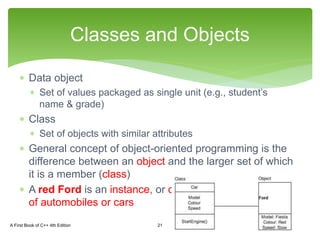
 A red Ford is an instance, or object, of a general class
of automobiles or cars
Classes and Objects
A First Book of C++ 4th Edition 21

Csc1100 lecture01 ch01 pt2-paradigm

  • 1.
    A First Bookof C++ Chapter 1(Pt 2) Programming Design & Paradigm
  • 2.
    A First Bookof C++ Programming Design
  • 3.
     Step 1- Analyze the problem  Outline the problem and its requirements  Design steps (algorithm) to solve the problem  Step 2 - Implement the algorithm  Implement the algorithm in code  Verify that the algorithm works  Step 3 - Maintenance  Use and modify the program if the problem domain changes Problem Solving Process (revisit) C++ Programming: From Problem Analysis to Program Design, Third Edition 3
  • 5.
     Thoroughly understandthe problem  Understand problem requirements  Does program require user interaction?  Does program manipulate data?  What is the output?  If the problem is complex, divide it into sub- problems  Analyze each sub-problem as above Analyze the Problem C++ Programming: From Problem Analysis to Program Design, Third Edition 5
  • 6.
     If problemwas broken into sub-problems  Design algorithms for each sub-problem  Check the correctness of algorithm  Can test using sample data  Some mathematical analysis might be required Design an Algorithm C++ Programming: From Problem Analysis to Program Design, Third Edition 6
  • 7.
     Once thealgorithm is designed and correctness verified  Write the equivalent code in high-level language  Type the program using text editor Write the Code C++ Programming: From Problem Analysis to Program Design, Third Edition 7
  • 8.
     Run codethrough compiler  If compiler generates errors  Look at code and remove errors  Run code again through compiler  If there are no syntax errors  Compiler generates equivalent machine code  Linker links machine code with system resources Compiling and Linking C++ Programming: From Problem Analysis to Program Design, Third Edition 8
  • 9.
     Once compiledand linked, loader can place program into main memory for execution  The final step is to execute the program  Compiler guarantees that the program follows the rules of the language  Does not guarantee that the program will run correctly The Loader and Executing C++ Programming: From Problem Analysis to Program Design, Third Edition 9
  • 10.
    A First Bookof C++ Programming Paradigm
  • 11.
    Definition: A way ofconceptualizing what it means to perform computation and how tasks to be carried out on the computer should be structured and organized. Programming Paradigm A First Book of C++ 4th Edition 11
  • 12.
     General typesof programming paradigms:  Structural  Imperative  Declarative  Procedural  Object-Oriented  Functional  Domain-Specific Programming Paradigm (cont'd.) A First Book of C++ 4th Edition 12
  • 13.
     Structured programming(or modular programming) is a problem solving strategy and a programming methodology that includes the following guidelines:  The flow of control in the program should be as simple as possible.  The construction of a program should embody top-down design. Programming Paradigm (cont'd.) A First Book of C++ 4th Edition 13
  • 14.
     Top-down designmeans:  It repeatedly decomposing a problem into smaller problems.  Eventually leads to:  a collection of small problems or tasks.  each can be easily coded Programming Paradigm (cont'd.) A First Book of C++ 4th Edition 14
  • 15.
     Object-oriented programmingis a method of programming based on a hierarchy of classes, and well-defined and cooperating objects.  A class is a structure that defines the data and the methods to work on that data.  In simple definition, a class is a programmer defined data type. Programming Paradigm (cont'd.) A First Book of C++ 4th Edition 15
  • 16.
     Object-oriented programming(OOP) concepts are: Programming Paradigm (cont'd.) A First Book of C++ 4th Edition 16 Concepts Functions Data Abstraction specifies behavior Encapsulation controls visibility of names (data hiding) Polymorphism accommodates various implementations Inheritance facilitates code reuse Modularity relates to unit of compilation
  • 17.
    Structured vs. Object-Oriented Programming AFirst Book of C++ 4th Edition 17 Structured Programming: MAIN PROGRAM FUNCTION 3FUNCTION 2 GLOBAL DATA FUNCTION 5FUNCTION 4 FUNCTION 1
  • 18.
    Structured Programming:  Usingfunctions.  Function & program is divided into modules.  Every module has its own data and function which can be called by other modules. Structured vs. Object-Oriented Programming A First Book of C++ 4th Edition 18
  • 19.
    Structured vs. Object-Oriented Programming(cont'd.) A First Book of C++ 4th Edition 19 Object-Oriented Programming: Object 1 Object 2 Data Function Data Function Object 3 Data Function
  • 20.
    Object-Oriented Programming:  Objectshave both data and methods.  Objects of the same class have the same data elements and methods.  Objects send and receive messages to invoke actions. Structured vs. Object-Oriented Programming A First Book of C++ 4th Edition 20
  • 21.
     Data object Set of values packaged as single unit (e.g., student’s name & grade)  Class  Set of objects with similar attributes  General concept of object-oriented programming is the difference between an object and the larger set of which it is a member (class)  A red Ford is an instance, or object, of a general class of automobiles or cars Classes and Objects A First Book of C++ 4th Edition 21