<Insert Picture Here>


The Future of the Java Platform:
Java SE 7 & Java SE 8
Terrence Barr
Senior Technologist, Mobile & Embedded Technologies
The preceding is intended to outline our general
product direction. It is intended for information
purposes only, and may not be incorporated into any
contract. It is not a commitment to deliver any
material, code, or functionality, and should not be
relied upon in making purchasing decisions.

The development, release, and timing of any
features or functionality described for Oracle’s
products remains at the sole discretion of Oracle.


                                                      2
                                                      2
Agenda

   Small
(Language)     Project Coin (JSR 334)
 Changes
Project Coin
               Small Language Changes

               The DaVinci Machine
               Multiple Languages on the JVM
               invokedynamic (JSR 292)
               Library changes
               Miscellaneous Updates

               JSR 337:
               Java SE 8 Release Contents

                                               3
                                               3
Evolving the Language
From “Evolving the Java Language” - JavaOne 2005
• Java language principles
  –   Reading is more important than writing
  –   The language should not hide what is happening
  –   Code should do what it seems to do
  –   Simplicity matters
  –   Every “good” feature adds more “bad” weight
  –   Sometimes it is best to leave things out
• One language: with the same meaning everywhere
  • No dialects
• We will evolve the Java language
  • But cautiously, with a long term view
  • “first, do no harm”
  • Beware: Changes have many downstream implications (spec, tests,
    implementation(s), tools, compatibility, future, ...)


                                                                      4
                                                                      4
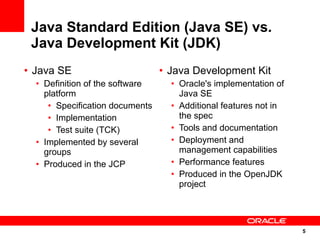
Java Standard Edition (Java SE) vs.
 Java Development Kit (JDK)
• Java SE                        • Java Development Kit
  • Definition of the software     • Oracle's implementation of
    platform                         Java SE
     • Specification documents     • Additional features not in
     • Implementation                the spec
     • Test suite (TCK)            • Tools and documentation
  • Implemented by several         • Deployment and
    groups                           management capabilities
  • Produced in the JCP            • Performance features
                                   • Produced in the OpenJDK
                                     project


                                                                  5
                                                                  5
Java SE 7

            6
            6
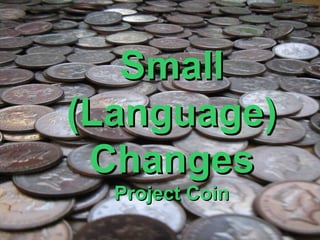
Small
Section Divider
                          <Insert Picture Here>


    (Language)
     Changes
           Project Coin
                                           7
                                           7
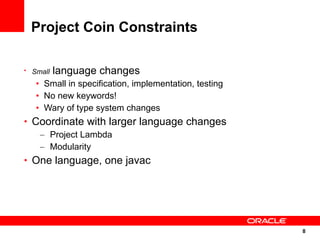
Project Coin Constraints

• Small   language changes
   • Small in specification, implementation, testing
   • No new keywords!
   • Wary of type system changes
• Coordinate with larger language changes
   – Project Lambda
   – Modularity
• One language, one javac


                                                       8
                                                       8
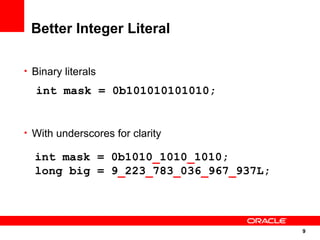
Better Integer Literal

• Binary literals

  int mask = 0b101010101010;


• With underscores for clarity

  int mask = 0b1010_1010_1010;
  long big = 9_223_783_036_967_937L;


                                       9
                                       9
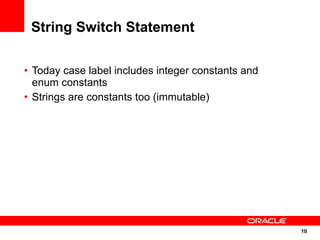
String Switch Statement

• Today case label includes integer constants and
  enum constants
• Strings are constants too (immutable)


                                                    10
                                                    10
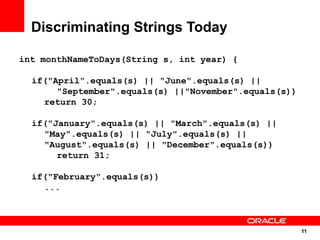
Discriminating Strings Today

int monthNameToDays(String s, int year) {

  if("April".equals(s) || "June".equals(s) ||
       "September".equals(s) ||"November".equals(s))
    return 30;

  if("January".equals(s) || "March".equals(s) ||
    "May".equals(s) || "July".equals(s) ||
    "August".equals(s) || "December".equals(s))
       return 31;

  if("February".equals(s))
    ...


                                                       11
                                                       11
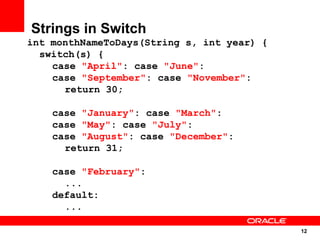
Strings in Switch
int monthNameToDays(String s, int year) {
  switch(s) {
    case "April": case "June":
    case "September": case "November":
      return 30;

    case "January": case "March":
    case "May": case "July":
    case "August": case "December":
      return 31;

    case "February":
      ...
    default:
      ...

                                            12
                                            12
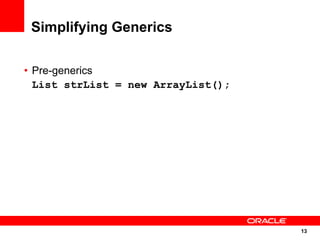
Simplifying Generics

• Pre-generics
  List strList = new ArrayList();


                                    13
                                    13
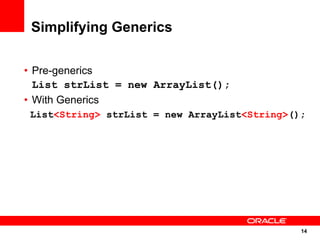
Simplifying Generics

• Pre-generics
  List strList = new ArrayList();
• With Generics
List<String> strList = new ArrayList<String>();


                                              14
                                              14
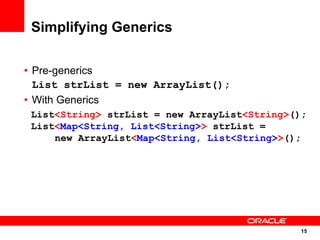
Simplifying Generics

• Pre-generics
  List strList = new ArrayList();
• With Generics
 List<String> strList = new ArrayList<String>();
 List<Map<String, List<String>> strList =
     new ArrayList<Map<String, List<String>>();


                                               15
                                               15
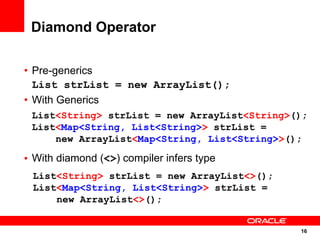
Diamond Operator

• Pre-generics
  List strList = new ArrayList();
• With Generics
 List<String> strList = new ArrayList<String>();
 List<Map<String, List<String>> strList =
     new ArrayList<Map<String, List<String>>();

• With diamond (<>) compiler infers type
 List<String> strList = new ArrayList<>();
 List<Map<String, List<String>> strList =
     new ArrayList<>();


                                              16
                                               16
Simplifying Resource Use

InputStream in = new FileInputStream(src);
OutputStream out = new FileOutputStream(dest);

byte[] buf = new byte[8192];
int n;

while (n = in.read(buf)) >= 0)
  out.write(buf, 0, n);


                                                 17
                                                 17
Simplifying Resource Use

InputStream in = new FileInputStream(src);
OutputStream out = new FileOutputStream(dest);

try {
  byte[] buf = new byte[8192];
  int n;
  while (n = in.read(buf)) >= 0)
    out.write(buf, 0, n);
} finally {
  in.close();
  out.close();
}


                                                 18
                                                 18
Simplifying Resource Use
InputStream in = new FileInputStream(src);
try {
  OutputStream out = new FileOutputStream(dest);
  try {
    byte[] buf = new byte[8192];
    int n;
    while (n = in.read(buf)) >= 0)
      out.write(buf, 0, n);
  } finally {
    out.close();
  }
} finally {
  in.close();
}

                                                   19
                                                   19
Automatic Resource Management

try (InputStream in = new FileInputStream(src),
     OutputStream out = new FileOutputStream(dest))
{
  byte[] buf = new byte[8192];
  int n;
  while (n = in.read(buf)) >= 0)
    out.write(buf, 0, n);
}


                                                 20
                                                  20
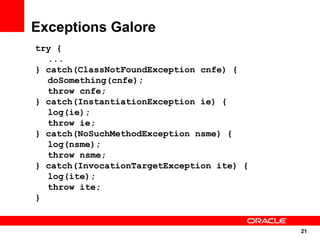
Exceptions Galore
try {
  ...
} catch(ClassNotFoundException cnfe) {
  doSomething(cnfe);
  throw cnfe;
} catch(InstantiationException ie) {
  log(ie);
  throw ie;
} catch(NoSuchMethodException nsme) {
  log(nsme);
  throw nsme;
} catch(InvocationTargetException ite) {
  log(ite);
  throw ite;
}


                                           21
                                           21
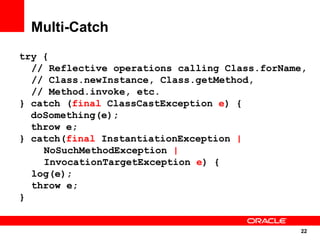
Multi-Catch
try {
  // Reflective operations calling Class.forName,
  // Class.newInstance, Class.getMethod,
  // Method.invoke, etc.
} catch (final ClassCastException e) {
  doSomething(e);
  throw e;
} catch(final InstantiationException |
    NoSuchMethodException |
    InvocationTargetException e) {
  log(e);
  throw e;
}


                                               22
                                                22
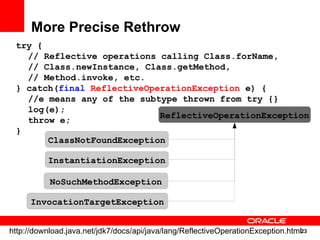
More Precise Rethrow
 try {
   // Reflective operations calling Class.forName,
   // Class.newInstance, Class.getMethod,
   // Method.invoke, etc.
 } catch(final ReflectiveOperationException e) {
   //e means any of the subtype thrown from try {}
   log(e);
                            ReflectiveOperationException
   throw e;
 }
       ClassNotFoundException

          InstantiationException

           NoSuchMethodException

     InvocationTargetException


http://download.java.net/jdk7/docs/api/java/lang/ReflectiveOperationException.html23
                                                                                  23
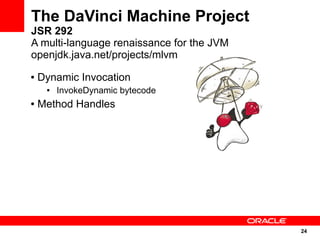
The DaVinci Machine Project
JSR 292
A multi-language renaissance for the JVM
openjdk.java.net/projects/mlvm
●   Dynamic Invocation
     ●   InvokeDynamic bytecode
●   Method Handles


                                           24
                                           24
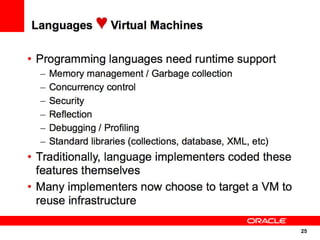
25
25
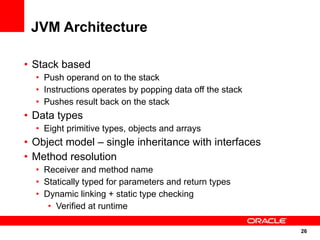
JVM Architecture

• Stack based
  • Push operand on to the stack
  • Instructions operates by popping data off the stack
  • Pushes result back on the stack
• Data types
  • Eight primitive types, objects and arrays
• Object model – single inheritance with interfaces
• Method resolution
  • Receiver and method name
  • Statically typed for parameters and return types
  • Dynamic linking + static type checking
     • Verified at runtime

                                                          26
                                                          26
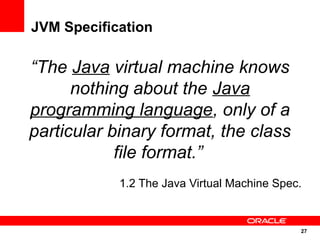
JVM Specification

“The Java virtual machine knows
      nothing about the Java
programming language, only of a
particular binary format, the class
            file format.”
            1.2 The Java Virtual Machine Spec.


                                             27
                                                 27
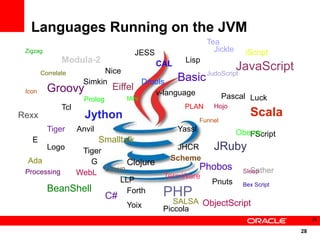
Languages Running on the JVM
                                                                 Tea
 Zigzag                                   JESS                     Jickle     iScript
               Modula-2                                  Lisp
        Correlate          Nice
                                                 CAL
                                                                 JudoScript
                                                                            JavaScript
                      Simkin                Drools   Basic
 Icon     Groovy                 Eiffel
                                               v-language               Pascal Luck
                       Prolog        Mini
               Tcl                                      PLAN       Hojo
Rexx                   Jython                                                   Scala
                                                               Funnel
          Tiger      Anvil                             Yassl                Oberon
                                                                               FScript
   E                         Smalltalk
          Logo
             Tiger                                  JHCR           JRuby
  Ada           G                                  Scheme
                      Clojure
                                                               Phobos
 Processing WebL Dawn                             TermWare
                                                                                 Sather
                                                                              Sleep
                    LLP                                            Pnuts      Bex Script
       BeanShell      Forth                       PHP
                                C#
                                     Yoix            SALSA ObjectScript
                                                  Piccola
                                                                                                28

                                                                                           28
                                                                                           28
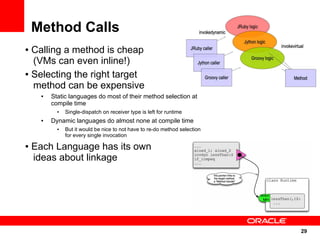
Method Calls
● Calling a method is cheap
  (VMs can even inline!)
● Selecting the right target

  method can be expensive
      ●   Static languages do most of their method selection at
          compile time
            ●   Single-dispatch on receiver type is left for runtime
      ●   Dynamic languages do almost none at compile time
            ●   But it would be nice to not have to re-do method selection
                for every single invocation
●   Each Language has its own
    ideas about linkage


                                                                             29
                                                                             29
InvokeDynamic Bytecode

• JVM currently has four ways to invoke method
  • Invokevirtual, invokeinterface, invokestatic, invokespecial
• All require full method signature data
• InvokeDynamic will use method handle
  • Effectively an indirect pointer to the method
• When dynamic method is first called bootstrap code
  determines method and creates handle
• Subsequent calls simply reference defined handle
• Type changes force a re-compute of the method
  location and an update to the handle
  • Method call changes are invisible to calling code


                                                                  30
                                                                  30
Library
Changes

           31
           31
New I/O 2 (NIO2) Libraries
 JSR 203

• Original Java I/O APIs presented challenges for
  developers
  •   Not designed to be extensible
  •   Many methods do not throw exceptions as expected
  •   rename() method works inconsistently
  •   Developers want greater access to file metadata
• Java NIO2 solves these problems


                                                         32
                                                         32
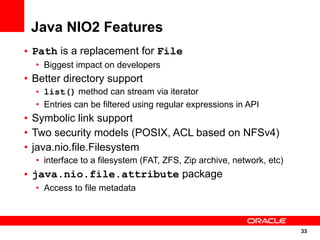
Java NIO2 Features
• Path is a replacement for File
  • Biggest impact on developers
• Better directory support
  • list() method can stream via iterator
  • Entries can be filtered using regular expressions in API
• Symbolic link support
• Two security models (POSIX, ACL based on NFSv4)
• java.nio.file.Filesystem
  • interface to a filesystem (FAT, ZFS, Zip archive, network, etc)
• java.nio.file.attribute package
  • Access to file metadata


                                                                      33
                                                                      33
Concurrency APIs

• JSR166y
  • Update to JSR166x which was an update to JSR166
• Adds a lightweight task framework
  • Also referred to as Fork/Join
• Uses ParallelArray
  • Greatly simplifies use of many cores/processors for tasks that
    can easily be separated


                                                                     34
                                                                     34
Client Libraries

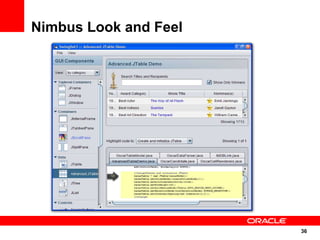
•   Nimbus Look and Feel
•   Platform APIs for shaped and translucent windows
•   JLayer (formerly from Swing labs)
•   Optimized 2D rendering


                                                       35
                                                       35
Nimbus Look and Feel


                       36
                       36
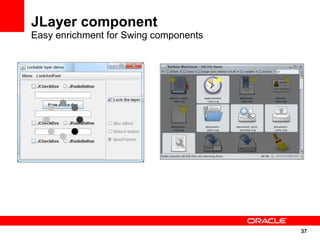
JLayer component
Easy enrichment for Swing components


                                       37
                                       37
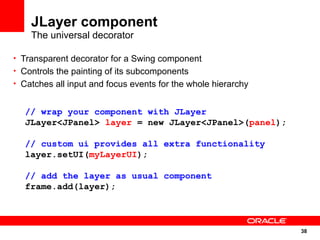
JLayer component
    The universal decorator

• Transparent decorator for a Swing component
• Controls the painting of its subcomponents
• Catches all input and focus events for the whole hierarchy


  // wrap your component with JLayer
  JLayer<JPanel> layer = new JLayer<JPanel>(panel);

  // custom ui provides all extra functionality
  layer.setUI(myLayerUI);

  // add the layer as usual component
  frame.add(layer);


                                                               38
                                                               38
Miscellaneous Updates

• Security
    • Eliptic curve cryptography
    • TLS 1.2
•   JAXP 1.4.4 (Java API for XML processing)
•   JAX-WS 2.2 (Java API for XML Web Services)
•   JAXB 2.2 (Java Architecture for XML Binding)
•   ClassLoader architecture changes
•   close() for URLClassLoader
•   Javadoc support for CSS


                                                   39
                                                   39
Platform Support

• Windows (x86)
• Linux (x86)
  • Redhat
  • Ubuntu
• Solaris (x86)
• New: Apple OSX (x86)


                         40
                         40
Java SE 8

            41
            41
Java SE 8
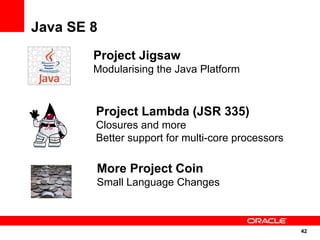
        Project Jigsaw
        Modularising the Java Platform


        Project Lambda (JSR 335)
        Closures and more
        Better support for multi-core processors

        More Project Coin
        Small Language Changes


                                                   42
                                                   42
The Modular Java Platform
• Enables escape from “JAR Hell”
   – Eliminates class path
   – Package modules for automatic download & install
   – Generate native packages – deb, rpm, ips, etc
• Enables significant performance improvements
   – Incremental download → fast classloading
   – Optimise module content during installation
• Platform scalability – down to small devices
   – Well-specified SE subsets can fit into small devices


                                                            43
                                                            43
module-info.java


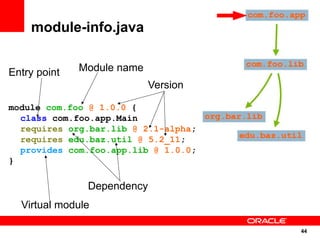
Entry point   Module name
                            Version

module com.foo @ 1.0.0 {
  class com.foo.app.Main
  requires org.bar.lib @ 2.1-alpha;
  requires edu.baz.util @ 5.2_11;
  provides com.foo.app.lib @ 1.0.0;
}

               Dependency
  Virtual module

                                      44
                                      44
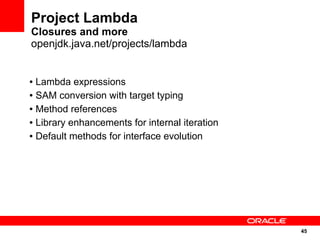
Project Lambda
Closures and more
openjdk.java.net/projects/lambda


● Lambda expressions
● SAM conversion with target typing


● Method references


● Library enhancements for internal iteration


● Default methods for interface evolution


                                                45
                                                45
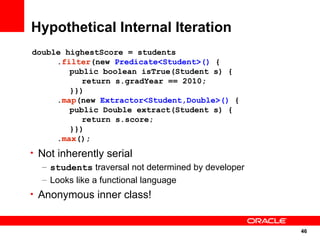
Hypothetical Internal Iteration
double highestScore = students
     .filter(new Predicate<Student>() {
        public boolean isTrue(Student s) {
           return s.gradYear == 2010;
        }})
     .map(new Extractor<Student,Double>() {
        public Double extract(Student s) {
           return s.score;
        }})
     .max();
• Not inherently serial
   – students traversal not determined by developer
   – Looks like a functional language
• Anonymous inner class!


                                                      46
                                                      46
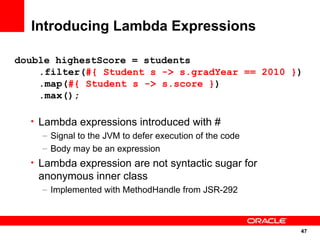
Introducing Lambda Expressions

double highestScore = students
    .filter(#{ Student s -> s.gradYear == 2010 })
    .map(#{ Student s -> s.score })
    .max();

  • Lambda expressions introduced with #
     – Signal to the JVM to defer execution of the code
     – Body may be an expression
  • Lambda expression are not syntactic sugar for
    anonymous inner class
     – Implemented with MethodHandle from JSR-292


                                                          47
                                                          47
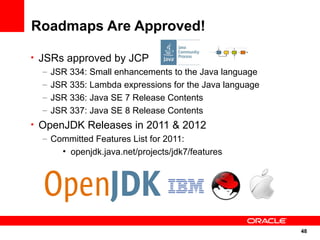
Roadmaps Are Approved!

• JSRs approved by JCP
   – JSR 334: Small enhancements to the Java language
   – JSR 335: Lambda expressions for the Java language
   – JSR 336: Java SE 7 Release Contents
   – JSR 337: Java SE 8 Release Contents
• OpenJDK Releases in 2011 & 2012
  – Committed Features List for 2011:
      • openjdk.java.net/projects/jdk7/features


                                                         48
                                                         48
Conclusions

• Java SE 7
  • Incremental changes
  • Evolutionary, not revolutionary
  • Good solid set of features to make developers life easier
• Java SE 8
  • Major new features: Modularisation and Closures
  • More smaller features to be defined
• Java Evolution Continues
  • Grow and adapt to the changing world of IT
  • Oracle and its partners are committed to a vibrant and
    evolving Java ecosystem


                                                                49
                                                                49
50
50

Terence Barr - jdk7+8 - 24mai2011

  • 1.
    <Insert Picture Here> TheFuture of the Java Platform: Java SE 7 & Java SE 8 Terrence Barr Senior Technologist, Mobile & Embedded Technologies
  • 2.
    The preceding isintended to outline our general product direction. It is intended for information purposes only, and may not be incorporated into any contract. It is not a commitment to deliver any material, code, or functionality, and should not be relied upon in making purchasing decisions. The development, release, and timing of any features or functionality described for Oracle’s products remains at the sole discretion of Oracle. 2 2
  • 3.
    Agenda Small (Language) Project Coin (JSR 334) Changes Project Coin Small Language Changes The DaVinci Machine Multiple Languages on the JVM invokedynamic (JSR 292) Library changes Miscellaneous Updates JSR 337: Java SE 8 Release Contents 3 3
  • 4.
    Evolving the Language From“Evolving the Java Language” - JavaOne 2005 • Java language principles – Reading is more important than writing – The language should not hide what is happening – Code should do what it seems to do – Simplicity matters – Every “good” feature adds more “bad” weight – Sometimes it is best to leave things out • One language: with the same meaning everywhere • No dialects • We will evolve the Java language • But cautiously, with a long term view • “first, do no harm” • Beware: Changes have many downstream implications (spec, tests, implementation(s), tools, compatibility, future, ...) 4 4
  • 5.
    Java Standard Edition(Java SE) vs. Java Development Kit (JDK) • Java SE • Java Development Kit • Definition of the software • Oracle's implementation of platform Java SE • Specification documents • Additional features not in • Implementation the spec • Test suite (TCK) • Tools and documentation • Implemented by several • Deployment and groups management capabilities • Produced in the JCP • Performance features • Produced in the OpenJDK project 5 5
  • 6.
  • 7.
    Small Section Divider <Insert Picture Here> (Language) Changes Project Coin 7 7
  • 8.
    Project Coin Constraints •Small language changes • Small in specification, implementation, testing • No new keywords! • Wary of type system changes • Coordinate with larger language changes – Project Lambda – Modularity • One language, one javac 8 8
  • 9.
    Better Integer Literal •Binary literals int mask = 0b101010101010; • With underscores for clarity int mask = 0b1010_1010_1010; long big = 9_223_783_036_967_937L; 9 9
  • 10.
    String Switch Statement •Today case label includes integer constants and enum constants • Strings are constants too (immutable) 10 10
  • 11.
    Discriminating Strings Today intmonthNameToDays(String s, int year) { if("April".equals(s) || "June".equals(s) || "September".equals(s) ||"November".equals(s)) return 30; if("January".equals(s) || "March".equals(s) || "May".equals(s) || "July".equals(s) || "August".equals(s) || "December".equals(s)) return 31; if("February".equals(s)) ... 11 11
  • 12.
    Strings in Switch intmonthNameToDays(String s, int year) { switch(s) { case "April": case "June": case "September": case "November": return 30; case "January": case "March": case "May": case "July": case "August": case "December": return 31; case "February": ... default: ... 12 12
  • 13.
    Simplifying Generics • Pre-generics List strList = new ArrayList(); 13 13
  • 14.
    Simplifying Generics • Pre-generics List strList = new ArrayList(); • With Generics List<String> strList = new ArrayList<String>(); 14 14
  • 15.
    Simplifying Generics • Pre-generics List strList = new ArrayList(); • With Generics List<String> strList = new ArrayList<String>(); List<Map<String, List<String>> strList = new ArrayList<Map<String, List<String>>(); 15 15
  • 16.
    Diamond Operator • Pre-generics List strList = new ArrayList(); • With Generics List<String> strList = new ArrayList<String>(); List<Map<String, List<String>> strList = new ArrayList<Map<String, List<String>>(); • With diamond (<>) compiler infers type List<String> strList = new ArrayList<>(); List<Map<String, List<String>> strList = new ArrayList<>(); 16 16
  • 17.
    Simplifying Resource Use InputStreamin = new FileInputStream(src); OutputStream out = new FileOutputStream(dest); byte[] buf = new byte[8192]; int n; while (n = in.read(buf)) >= 0) out.write(buf, 0, n); 17 17
  • 18.
    Simplifying Resource Use InputStreamin = new FileInputStream(src); OutputStream out = new FileOutputStream(dest); try { byte[] buf = new byte[8192]; int n; while (n = in.read(buf)) >= 0) out.write(buf, 0, n); } finally { in.close(); out.close(); } 18 18
  • 19.
    Simplifying Resource Use InputStreamin = new FileInputStream(src); try { OutputStream out = new FileOutputStream(dest); try { byte[] buf = new byte[8192]; int n; while (n = in.read(buf)) >= 0) out.write(buf, 0, n); } finally { out.close(); } } finally { in.close(); } 19 19
  • 20.
    Automatic Resource Management try(InputStream in = new FileInputStream(src), OutputStream out = new FileOutputStream(dest)) { byte[] buf = new byte[8192]; int n; while (n = in.read(buf)) >= 0) out.write(buf, 0, n); } 20 20
  • 21.
    Exceptions Galore try { ... } catch(ClassNotFoundException cnfe) { doSomething(cnfe); throw cnfe; } catch(InstantiationException ie) { log(ie); throw ie; } catch(NoSuchMethodException nsme) { log(nsme); throw nsme; } catch(InvocationTargetException ite) { log(ite); throw ite; } 21 21
  • 22.
    Multi-Catch try { // Reflective operations calling Class.forName, // Class.newInstance, Class.getMethod, // Method.invoke, etc. } catch (final ClassCastException e) { doSomething(e); throw e; } catch(final InstantiationException | NoSuchMethodException | InvocationTargetException e) { log(e); throw e; } 22 22
  • 23.
    More Precise Rethrow try { // Reflective operations calling Class.forName, // Class.newInstance, Class.getMethod, // Method.invoke, etc. } catch(final ReflectiveOperationException e) { //e means any of the subtype thrown from try {} log(e); ReflectiveOperationException throw e; } ClassNotFoundException InstantiationException NoSuchMethodException InvocationTargetException http://download.java.net/jdk7/docs/api/java/lang/ReflectiveOperationException.html23 23
  • 24.
    The DaVinci MachineProject JSR 292 A multi-language renaissance for the JVM openjdk.java.net/projects/mlvm ● Dynamic Invocation ● InvokeDynamic bytecode ● Method Handles 24 24
  • 25.
  • 26.
    JVM Architecture • Stackbased • Push operand on to the stack • Instructions operates by popping data off the stack • Pushes result back on the stack • Data types • Eight primitive types, objects and arrays • Object model – single inheritance with interfaces • Method resolution • Receiver and method name • Statically typed for parameters and return types • Dynamic linking + static type checking • Verified at runtime 26 26
  • 27.
    JVM Specification “The Javavirtual machine knows nothing about the Java programming language, only of a particular binary format, the class file format.” 1.2 The Java Virtual Machine Spec. 27 27
  • 28.
    Languages Running onthe JVM Tea Zigzag JESS Jickle iScript Modula-2 Lisp Correlate Nice CAL JudoScript JavaScript Simkin Drools Basic Icon Groovy Eiffel v-language Pascal Luck Prolog Mini Tcl PLAN Hojo Rexx Jython Scala Funnel Tiger Anvil Yassl Oberon FScript E Smalltalk Logo Tiger JHCR JRuby Ada G Scheme Clojure Phobos Processing WebL Dawn TermWare Sather Sleep LLP Pnuts Bex Script BeanShell Forth PHP C# Yoix SALSA ObjectScript Piccola 28 28 28
  • 29.
    Method Calls ● Callinga method is cheap (VMs can even inline!) ● Selecting the right target method can be expensive ● Static languages do most of their method selection at compile time ● Single-dispatch on receiver type is left for runtime ● Dynamic languages do almost none at compile time ● But it would be nice to not have to re-do method selection for every single invocation ● Each Language has its own ideas about linkage 29 29
  • 30.
    InvokeDynamic Bytecode • JVMcurrently has four ways to invoke method • Invokevirtual, invokeinterface, invokestatic, invokespecial • All require full method signature data • InvokeDynamic will use method handle • Effectively an indirect pointer to the method • When dynamic method is first called bootstrap code determines method and creates handle • Subsequent calls simply reference defined handle • Type changes force a re-compute of the method location and an update to the handle • Method call changes are invisible to calling code 30 30
  • 31.
  • 32.
    New I/O 2(NIO2) Libraries JSR 203 • Original Java I/O APIs presented challenges for developers • Not designed to be extensible • Many methods do not throw exceptions as expected • rename() method works inconsistently • Developers want greater access to file metadata • Java NIO2 solves these problems 32 32
  • 33.
    Java NIO2 Features •Path is a replacement for File • Biggest impact on developers • Better directory support • list() method can stream via iterator • Entries can be filtered using regular expressions in API • Symbolic link support • Two security models (POSIX, ACL based on NFSv4) • java.nio.file.Filesystem • interface to a filesystem (FAT, ZFS, Zip archive, network, etc) • java.nio.file.attribute package • Access to file metadata 33 33
  • 34.
    Concurrency APIs • JSR166y • Update to JSR166x which was an update to JSR166 • Adds a lightweight task framework • Also referred to as Fork/Join • Uses ParallelArray • Greatly simplifies use of many cores/processors for tasks that can easily be separated 34 34
  • 35.
    Client Libraries • Nimbus Look and Feel • Platform APIs for shaped and translucent windows • JLayer (formerly from Swing labs) • Optimized 2D rendering 35 35
  • 36.
    Nimbus Look andFeel 36 36
  • 37.
    JLayer component Easy enrichmentfor Swing components 37 37
  • 38.
    JLayer component The universal decorator • Transparent decorator for a Swing component • Controls the painting of its subcomponents • Catches all input and focus events for the whole hierarchy // wrap your component with JLayer JLayer<JPanel> layer = new JLayer<JPanel>(panel); // custom ui provides all extra functionality layer.setUI(myLayerUI); // add the layer as usual component frame.add(layer); 38 38
  • 39.
    Miscellaneous Updates • Security • Eliptic curve cryptography • TLS 1.2 • JAXP 1.4.4 (Java API for XML processing) • JAX-WS 2.2 (Java API for XML Web Services) • JAXB 2.2 (Java Architecture for XML Binding) • ClassLoader architecture changes • close() for URLClassLoader • Javadoc support for CSS 39 39
  • 40.
    Platform Support • Windows(x86) • Linux (x86) • Redhat • Ubuntu • Solaris (x86) • New: Apple OSX (x86) 40 40
  • 41.
  • 42.
    Java SE 8 Project Jigsaw Modularising the Java Platform Project Lambda (JSR 335) Closures and more Better support for multi-core processors More Project Coin Small Language Changes 42 42
  • 43.
    The Modular JavaPlatform • Enables escape from “JAR Hell” – Eliminates class path – Package modules for automatic download & install – Generate native packages – deb, rpm, ips, etc • Enables significant performance improvements – Incremental download → fast classloading – Optimise module content during installation • Platform scalability – down to small devices – Well-specified SE subsets can fit into small devices 43 43
  • 44.
    module-info.java Entry point Module name Version module com.foo @ 1.0.0 { class com.foo.app.Main requires org.bar.lib @ 2.1-alpha; requires edu.baz.util @ 5.2_11; provides com.foo.app.lib @ 1.0.0; } Dependency Virtual module 44 44
  • 45.
    Project Lambda Closures andmore openjdk.java.net/projects/lambda ● Lambda expressions ● SAM conversion with target typing ● Method references ● Library enhancements for internal iteration ● Default methods for interface evolution 45 45
  • 46.
    Hypothetical Internal Iteration doublehighestScore = students .filter(new Predicate<Student>() { public boolean isTrue(Student s) { return s.gradYear == 2010; }}) .map(new Extractor<Student,Double>() { public Double extract(Student s) { return s.score; }}) .max(); • Not inherently serial – students traversal not determined by developer – Looks like a functional language • Anonymous inner class! 46 46
  • 47.
    Introducing Lambda Expressions doublehighestScore = students .filter(#{ Student s -> s.gradYear == 2010 }) .map(#{ Student s -> s.score }) .max(); • Lambda expressions introduced with # – Signal to the JVM to defer execution of the code – Body may be an expression • Lambda expression are not syntactic sugar for anonymous inner class – Implemented with MethodHandle from JSR-292 47 47
  • 48.
    Roadmaps Are Approved! •JSRs approved by JCP – JSR 334: Small enhancements to the Java language – JSR 335: Lambda expressions for the Java language – JSR 336: Java SE 7 Release Contents – JSR 337: Java SE 8 Release Contents • OpenJDK Releases in 2011 & 2012 – Committed Features List for 2011: • openjdk.java.net/projects/jdk7/features 48 48
  • 49.
    Conclusions • Java SE7 • Incremental changes • Evolutionary, not revolutionary • Good solid set of features to make developers life easier • Java SE 8 • Major new features: Modularisation and Closures • More smaller features to be defined • Java Evolution Continues • Grow and adapt to the changing world of IT • Oracle and its partners are committed to a vibrant and evolving Java ecosystem 49 49
  • 50.