Voting systems in elections
• First past the post system
• Supplementary vote
system
• Additional vote system
• Single transferable vote
system
First-past-the-post system
• Used in elections for the House of Commons
• 1 seat per constituency
• Voters cast one
vote for the
candidate of their
choice
• The candidate
with the largest
number of votes is
elected
First past the post system
Advantages
• Close tie between
MP and constituency
• Tends to produce a
majority for the
party that gains most
seats
• Produces more
stable governments
with little need for
coalitions
Disadvantages
• Many seats are safe seats where
many voters may feel their votes
are ‘wasted’.
• Proportion of candidates for a
party elected is not in proportion
to votes cast
• A government can gain a large
majority of seats even though it
only gained a minority of votes
nationally
• Smaller parties tend to go
unrepresented
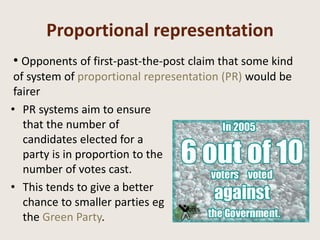
Proportional representation
• PR systems aim to ensure
that the number of
candidates elected for a
party is in proportion to the
number of votes cast.
• This tends to give a better
chance to smaller parties eg
the Green Party.
• Opponents of first-past-the-post claim that some kind
of system of proportional representation (PR) would be
fairer
Supplementary vote (SV) system
• Used for electing Mayor of
London
• Used for elections where there is
only one person to be elected
• Voters indicate first and second
choice candidates
• If a candidate receives a majority
of first choices then he/she is
elected
• If not, then all candidates apart
from top two are eliminated and
second choice votes redistributed
to remaining candidates
Supplementary vote (SV) system
Advantage
• A candidate cannot be elected who although
achieving the largest number of votes is
unpopular with the majority of voters
Disadvantage
• This system would not necessarily produce
proportional representation if it were used for
a whole parliament or assembly
Additional vote (AV+) system
• Used to elect members of the European Parliament,
the Scottish Parliament, the Welsh Assembly and
the Greater London Assembly
• Voters vote twice - first for a list of candidates who
they list in order of preference, they then also vote
for a party.
• If a candidate gains a majority he/she is elected if
not the second choices of the bottom candidate are
transferred to other candidates. This is repeated
until one candidate has a majority
• The second set of votes for the parties are then used to assess how a number
of remaining ‘top up’ seats are allocated to ensure that each party ends up with
seats in proportion to the votes they have received.
Additional vote (AV+) system
Example of
ballot paper
for the
Scottish
Parliament
Additional vote (AV+) system
Advantages
• Tends to produce a legislature
where seats held by parties are
in proportion to votes cast
• Most of those elected are still
linked to a constituency
• Smaller parties which fail to get
elected in a constituency can
still achieve representation via
top up seats
Disadvantages
• Candidates
elected in top up
seats are not linked
to a particular
constituency
• More likelihood
of coalition
governments
Single transferable vote (STV) system
• Constituencies are usually multi-member –
typically 3-5 seats
• Voters number candidates in order of preference
• Counting votes in this system is a complex
process whereby the votes of candidates who
have achieved a quota and been elected as well
as those of candidates with too few votes are
transferred to other candidates until all seats
have been filled
• This system is not currently used in any UK
elections
Single transferable vote (STV) system
Advantages
• Tends to produce proportional
representation better than most
other systems
• Allows voters to vote for more than
one candidate eg may not want to
cast all votes for one party
Disadvantages
• Complex system to administer
• Constituencies are large so link
between representatives and voters
less close

Voting systems in elections

  • 1.
    Voting systems inelections • First past the post system • Supplementary vote system • Additional vote system • Single transferable vote system
  • 2.
    First-past-the-post system • Usedin elections for the House of Commons • 1 seat per constituency • Voters cast one vote for the candidate of their choice • The candidate with the largest number of votes is elected
  • 3.
    First past thepost system Advantages • Close tie between MP and constituency • Tends to produce a majority for the party that gains most seats • Produces more stable governments with little need for coalitions Disadvantages • Many seats are safe seats where many voters may feel their votes are ‘wasted’. • Proportion of candidates for a party elected is not in proportion to votes cast • A government can gain a large majority of seats even though it only gained a minority of votes nationally • Smaller parties tend to go unrepresented
  • 4.
    Proportional representation • PRsystems aim to ensure that the number of candidates elected for a party is in proportion to the number of votes cast. • This tends to give a better chance to smaller parties eg the Green Party. • Opponents of first-past-the-post claim that some kind of system of proportional representation (PR) would be fairer
  • 5.
    Supplementary vote (SV)system • Used for electing Mayor of London • Used for elections where there is only one person to be elected • Voters indicate first and second choice candidates • If a candidate receives a majority of first choices then he/she is elected • If not, then all candidates apart from top two are eliminated and second choice votes redistributed to remaining candidates
  • 6.
    Supplementary vote (SV)system Advantage • A candidate cannot be elected who although achieving the largest number of votes is unpopular with the majority of voters Disadvantage • This system would not necessarily produce proportional representation if it were used for a whole parliament or assembly
  • 7.
    Additional vote (AV+)system • Used to elect members of the European Parliament, the Scottish Parliament, the Welsh Assembly and the Greater London Assembly • Voters vote twice - first for a list of candidates who they list in order of preference, they then also vote for a party. • If a candidate gains a majority he/she is elected if not the second choices of the bottom candidate are transferred to other candidates. This is repeated until one candidate has a majority • The second set of votes for the parties are then used to assess how a number of remaining ‘top up’ seats are allocated to ensure that each party ends up with seats in proportion to the votes they have received.
  • 8.
    Additional vote (AV+)system Example of ballot paper for the Scottish Parliament
  • 9.
    Additional vote (AV+)system Advantages • Tends to produce a legislature where seats held by parties are in proportion to votes cast • Most of those elected are still linked to a constituency • Smaller parties which fail to get elected in a constituency can still achieve representation via top up seats Disadvantages • Candidates elected in top up seats are not linked to a particular constituency • More likelihood of coalition governments
  • 10.
    Single transferable vote(STV) system • Constituencies are usually multi-member – typically 3-5 seats • Voters number candidates in order of preference • Counting votes in this system is a complex process whereby the votes of candidates who have achieved a quota and been elected as well as those of candidates with too few votes are transferred to other candidates until all seats have been filled • This system is not currently used in any UK elections
  • 11.
    Single transferable vote(STV) system Advantages • Tends to produce proportional representation better than most other systems • Allows voters to vote for more than one candidate eg may not want to cast all votes for one party Disadvantages • Complex system to administer • Constituencies are large so link between representatives and voters less close