Canada’s Economy
What do you like on a Sundae?
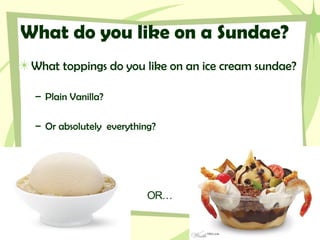
What toppings do you like on an ice cream sundae?
– Plain Vanilla?
– Or absolutely everything?
OR…
What do you like on a Sundae?
Chances are, you were somewhere between
plain and everything.
– When discussing economies, most countries are
somewhere “in between”
When a country is not completely a
command economy and not completely a
market economy, but “in between”, it is
called a Mixed Economy.
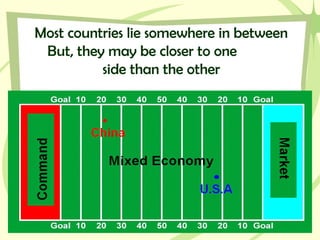
Most countries lie somewhere in between
But, they may be closer to one
side than the other
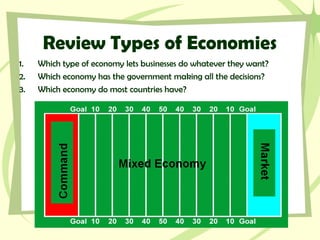
Review Types of Economies
1. Which type of economy lets businesses do whatever they want?
2. Which economy has the government making all the decisions?
3. Which economy do most countries have?
3 Economic Questions…
What to Produce?
– Businesses decide and government approves/denies it
How to produce it?
– Businesses decide & government regulates procedures
For whom to produce?
– Businesses decide based on supply & demand (price)
Which economic system does Canada have?…
Canada’s Economic System
Canada has a Mixed economic system
– It’s pretty close to a Market economy; however, there
is some government regulation among industries
– It does have Free Enterprise (competition between
businesses)
Canada is economically strong!
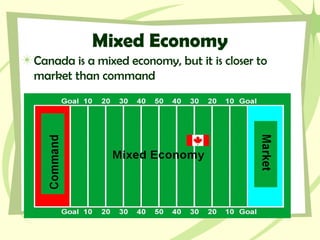
Mixed Economy
Canada is a mixed economy, but it is closer to
market than command
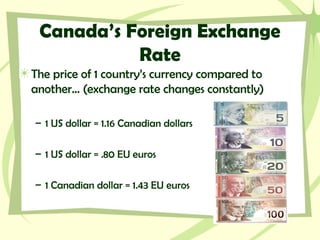
Canada’s Foreign Exchange
Rate
The price of 1 country’s currency compared to
another… (exchange rate changes constantly)
– 1 US dollar = 1.16 Canadian dollars
– 1 US dollar = .80 EU euros
– 1 Canadian dollar = 1.43 EU euros
Canada’s Natural Resources
What’s available?
– Minerals: iron ore, nickel, zinc, copper, gold,
lead, molybdenum, potash, diamonds, and
silver
– Other Resources: fish, timber, wildlife, coal,
petroleum, natural gas, hydroelectric power
Canada’s Land Use
Only 5% of the land is arable (capable of being
farmed)?
– 5 = only in Southern Canada (Northern Canada’s
terrain is permafrost!)
– This is actually a large amount, considering Canada is
the world’s 2nd
largest country
What are the major agricultural products?
– Wheat, barley, oilseed, tobacco, fruits, vegetables,
dairy products, forest products, fish
Canada’s Industries
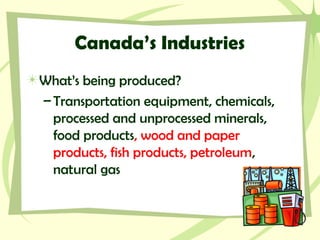
What’s being produced?
–Transportation equipment, chemicals,
processed and unprocessed minerals,
food products, wood and paper
products, fish products, petroleum,
natural gas
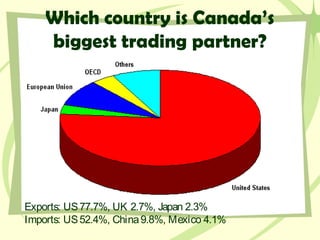
Which country is Canada’s
biggest trading partner?
Exports: US77.7%, UK 2.7%, Japan 2.3%
Imports: US52.4%, China9.8%, Mexico 4.1%
Canada’s Literacy Rate
99% (percentage of people over the age
of 15 can read and write)
How long are students required to stay in
school?
–17 years old
Canada’s GDP
$1.518 trillion (2013)
– 14th
in the world
GDP Per Capita--What is the value of
goods and services produced per person?
– $43,100 (2013)
– 19th
in the world
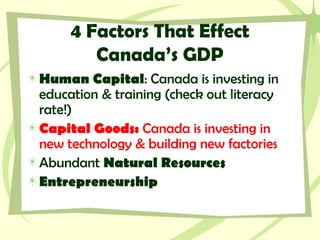
4 Factors That Effect
Canada’s GDP
Human Capital: Canada is investing in
education & training (check out literacy
rate!)
Capital Goods: Canada is investing in
new technology & building new factories
Abundant Natural Resources
Entrepreneurship
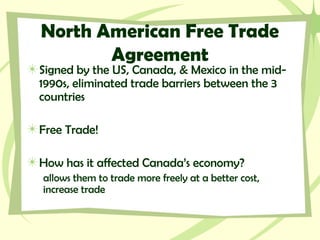
North American Free Trade
Agreement
Signed by the US, Canada, & Mexico in the mid-
1990s, eliminated trade barriers between the 3
countries
Free Trade!
How has it affected Canada’s economy?
allows them to trade more freely at a better cost,
increase trade
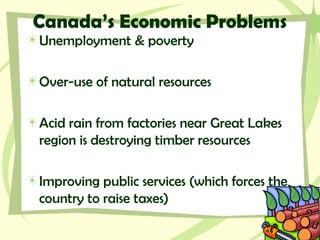
Canada’s Economic Problems
Unemployment & poverty
Over-use of natural resources
Acid rain from factories near Great Lakes
region is destroying timber resources
Improving public services (which forces the
country to raise taxes)

Canadas economy

  • 1.
  • 2.
    What do youlike on a Sundae? What toppings do you like on an ice cream sundae? – Plain Vanilla? – Or absolutely everything? OR…
  • 3.
    What do youlike on a Sundae? Chances are, you were somewhere between plain and everything. – When discussing economies, most countries are somewhere “in between” When a country is not completely a command economy and not completely a market economy, but “in between”, it is called a Mixed Economy.
  • 4.
    Most countries liesomewhere in between But, they may be closer to one side than the other
  • 5.
    Review Types ofEconomies 1. Which type of economy lets businesses do whatever they want? 2. Which economy has the government making all the decisions? 3. Which economy do most countries have?
  • 6.
    3 Economic Questions… Whatto Produce? – Businesses decide and government approves/denies it How to produce it? – Businesses decide & government regulates procedures For whom to produce? – Businesses decide based on supply & demand (price) Which economic system does Canada have?…
  • 7.
    Canada’s Economic System Canadahas a Mixed economic system – It’s pretty close to a Market economy; however, there is some government regulation among industries – It does have Free Enterprise (competition between businesses) Canada is economically strong!
  • 8.
    Mixed Economy Canada isa mixed economy, but it is closer to market than command
  • 9.
    Canada’s Foreign Exchange Rate Theprice of 1 country’s currency compared to another… (exchange rate changes constantly) – 1 US dollar = 1.16 Canadian dollars – 1 US dollar = .80 EU euros – 1 Canadian dollar = 1.43 EU euros
  • 10.
    Canada’s Natural Resources What’savailable? – Minerals: iron ore, nickel, zinc, copper, gold, lead, molybdenum, potash, diamonds, and silver – Other Resources: fish, timber, wildlife, coal, petroleum, natural gas, hydroelectric power
  • 11.
    Canada’s Land Use Only5% of the land is arable (capable of being farmed)? – 5 = only in Southern Canada (Northern Canada’s terrain is permafrost!) – This is actually a large amount, considering Canada is the world’s 2nd largest country What are the major agricultural products? – Wheat, barley, oilseed, tobacco, fruits, vegetables, dairy products, forest products, fish
  • 12.
    Canada’s Industries What’s beingproduced? –Transportation equipment, chemicals, processed and unprocessed minerals, food products, wood and paper products, fish products, petroleum, natural gas
  • 13.
    Which country isCanada’s biggest trading partner? Exports: US77.7%, UK 2.7%, Japan 2.3% Imports: US52.4%, China9.8%, Mexico 4.1%
  • 14.
    Canada’s Literacy Rate 99%(percentage of people over the age of 15 can read and write) How long are students required to stay in school? –17 years old
  • 15.
    Canada’s GDP $1.518 trillion(2013) – 14th in the world GDP Per Capita--What is the value of goods and services produced per person? – $43,100 (2013) – 19th in the world
  • 16.
    4 Factors ThatEffect Canada’s GDP Human Capital: Canada is investing in education & training (check out literacy rate!) Capital Goods: Canada is investing in new technology & building new factories Abundant Natural Resources Entrepreneurship
  • 17.
    North American FreeTrade Agreement Signed by the US, Canada, & Mexico in the mid- 1990s, eliminated trade barriers between the 3 countries Free Trade! How has it affected Canada’s economy? allows them to trade more freely at a better cost, increase trade
  • 18.
    Canada’s Economic Problems Unemployment& poverty Over-use of natural resources Acid rain from factories near Great Lakes region is destroying timber resources Improving public services (which forces the country to raise taxes)