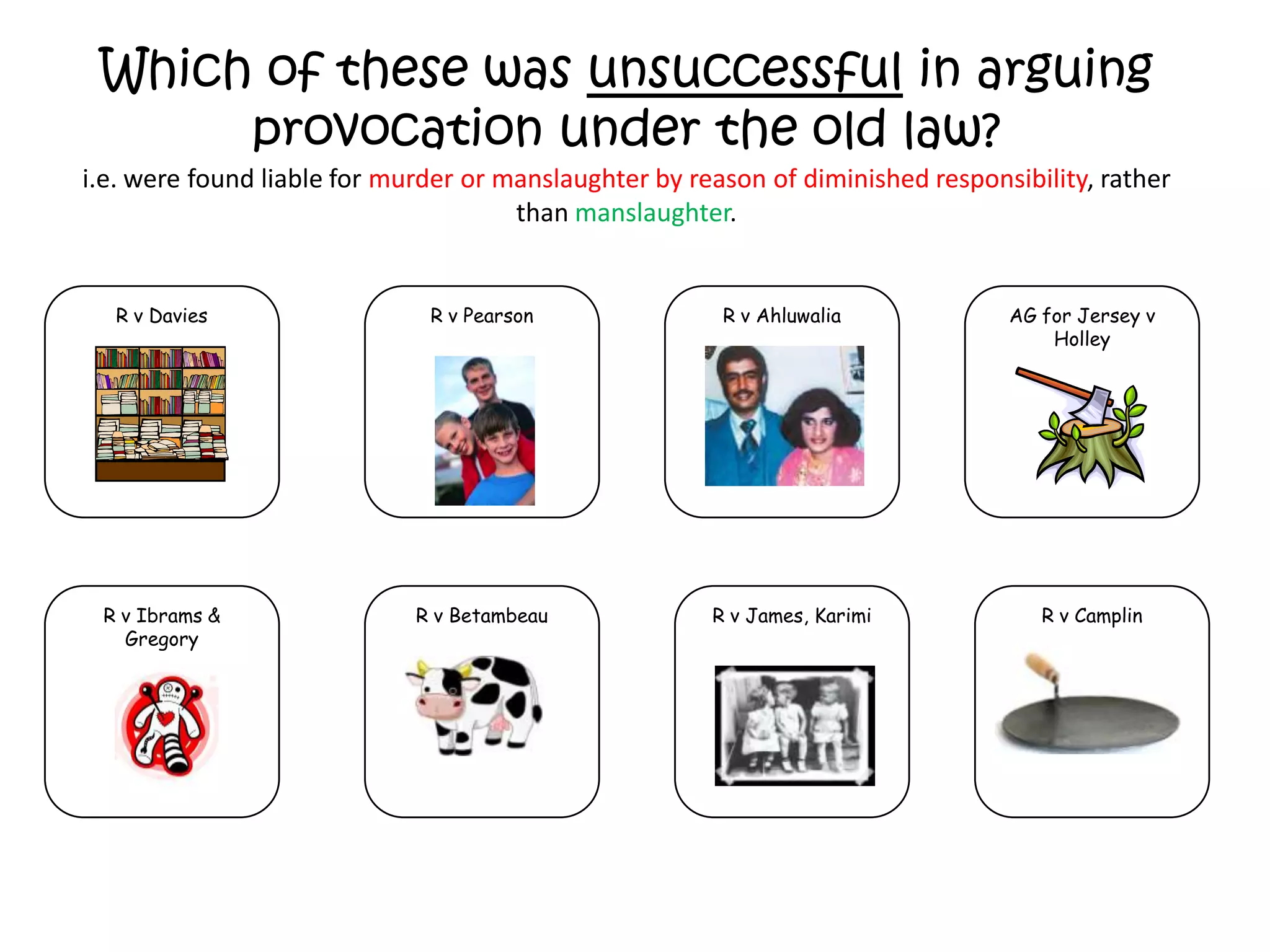
Which of these was unsuccessful in arguing
      provocation under the old law?
i.e. were found liable for murder or manslaughter by reason of diminished responsibility, rather
                                      than manslaughter.


  R v Davies                  R v Pearson               R v Ahluwalia            AG for Jersey v
                                                                                     Holley


 R v Ibrams &                R v Betambeau             R v James, Karimi            R v Camplin
   Gregory
And now a little reminder of theory…

Before we look at the current law, we need to consider why we
have developed this partial defence, and what it should aim to do.
Then we can work it if it‟s doing what it should!

Why do we allow people who lose their self-control to
have this partial defence?


Why might it not be suitable for it to be a complete
defence?

Is it an excuse or a justification? Professor Norrie
argues that it is currently an excuse, but should work
more as ‘imperfect justification’.
Issues with the old law

„Sudden and temporary‟ loss of control


Role of the jury


Meaning of the reasonable man


Range of behaviour that could be „provoking‟


    Whilst we look at the new law, have these in the back of your mind:
         Does the new law adequately address the issues raised?
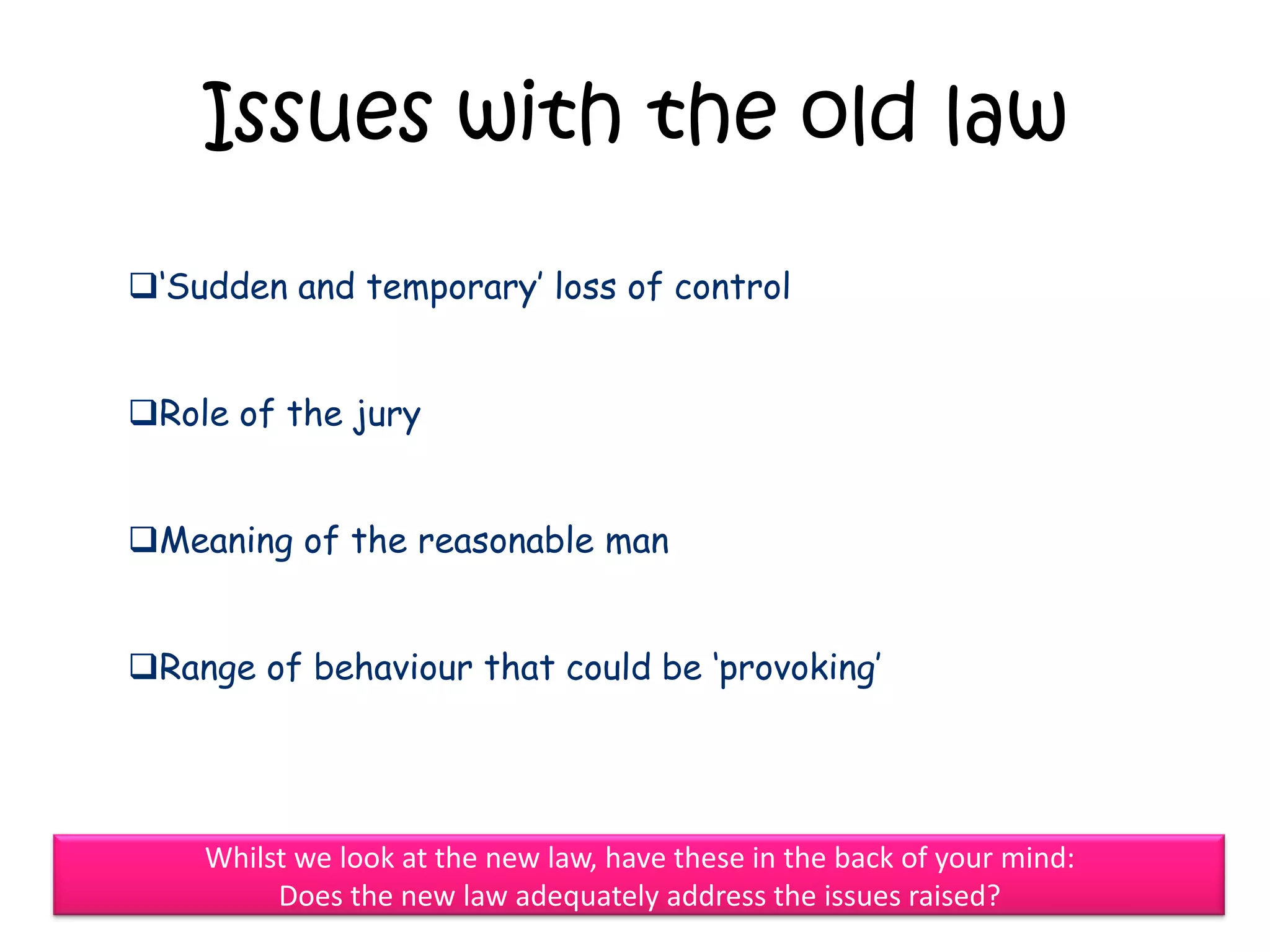
New law
Coroners and Justice Act 2009 s.54-5
Some basics:
Role of the Judge in loss of control pleas


                      in the opinion of the trial judge, a
                         jury, properly directed, could
                         reasonably conclude that the
                             defence might apply.
                                      s.54


                      Look at these previous cases...
                 Do you think they would meet the new threshold?
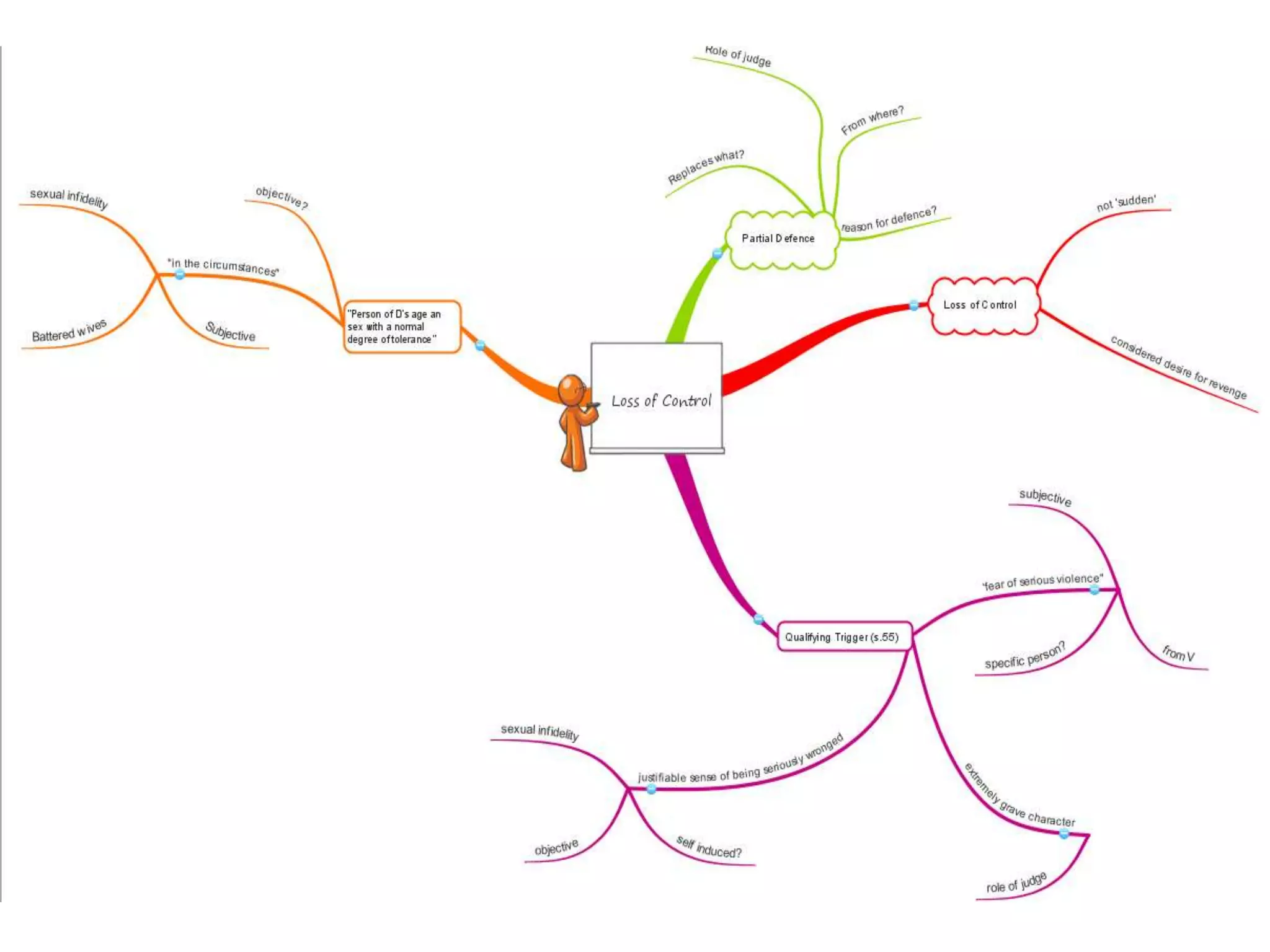
What’s the phrase?


of


     Loss of self control
Element One:

             Loss of Self Control
         (2) For the purposes of subsection (1)(a), it does not matter whether or not
                               the loss of control was sudden.


     Issues with the section:                                    R v Duffy 1949

                                                                    “Sudden and
 The longer the gap, the more likely the                         temporary loss of
judge will withdraw it.                                               control”

 Allows for a ‘cooling off period’ per
Ahluwalia.
                                                            Still must be a loss of control
 Law Commission didn’t want to keep these                      R v Cocker 1989
words.

 Allows a whole category history of
provoking actions or words to be taken into
account.
Subsection (1) does not apply if, in doing or being a party to the killing, D acted in a
                          considered desire for revenge.


 Why might these words cause problems?


How might this have affected these older cases?


                R v Mohammed         R v Ibrams &         R v Pearson
                                       Gregory
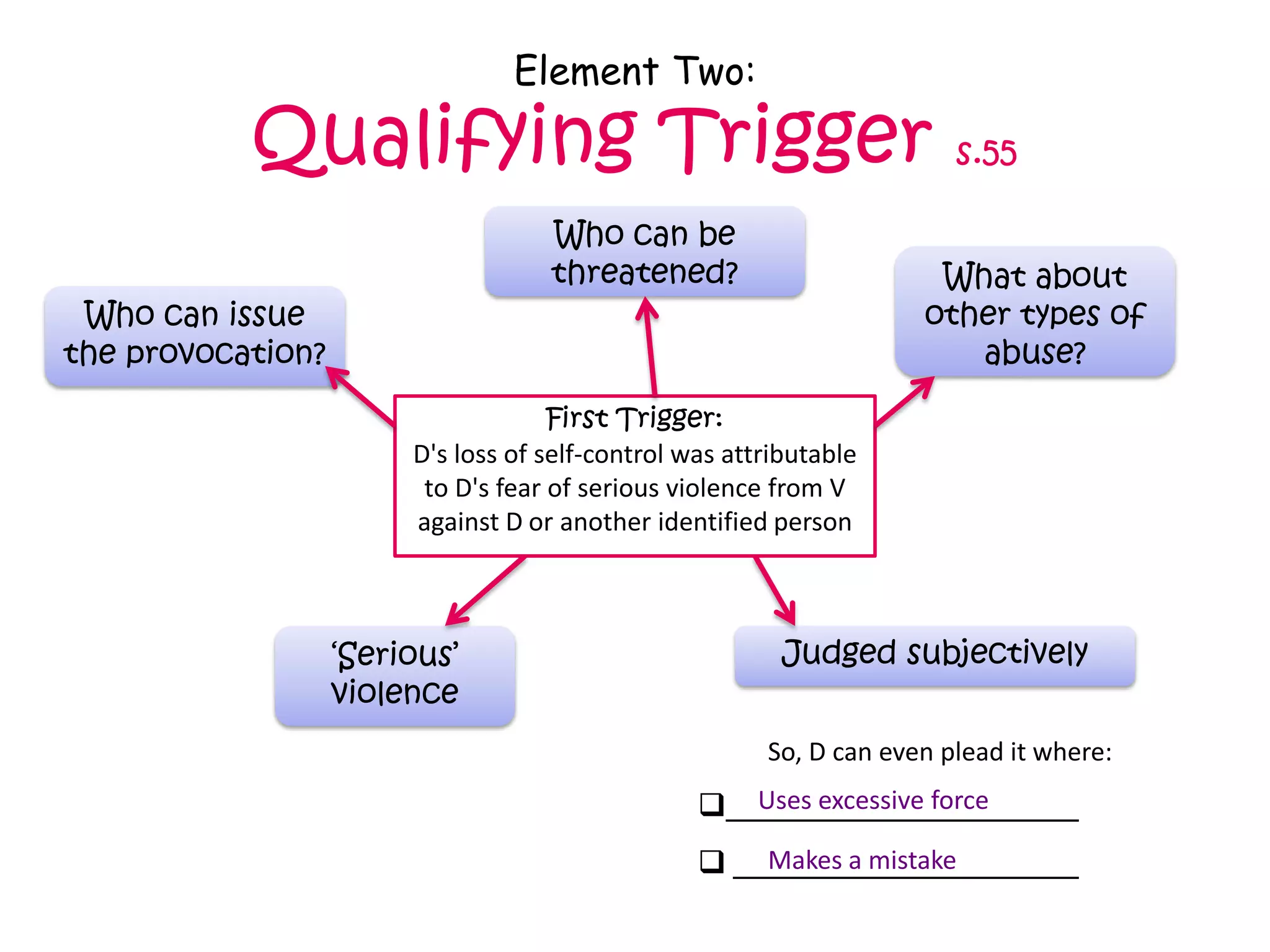
Element Two:

           Qualifying Trigger s.55
                                    Who can be
                                    threatened?                       What about
 Who can issue                                                       other types of
the provocation?                                                        abuse?

                                     First Trigger:
                        D's loss of self-control was attributable
                         to D's fear of serious violence from V
                        against D or another identified person


                   ‘Serious’                              Judged subjectively
                   violence
                                                        So, D can even plead it where:
                                                   Uses excessive force
                                                       Makes a mistake
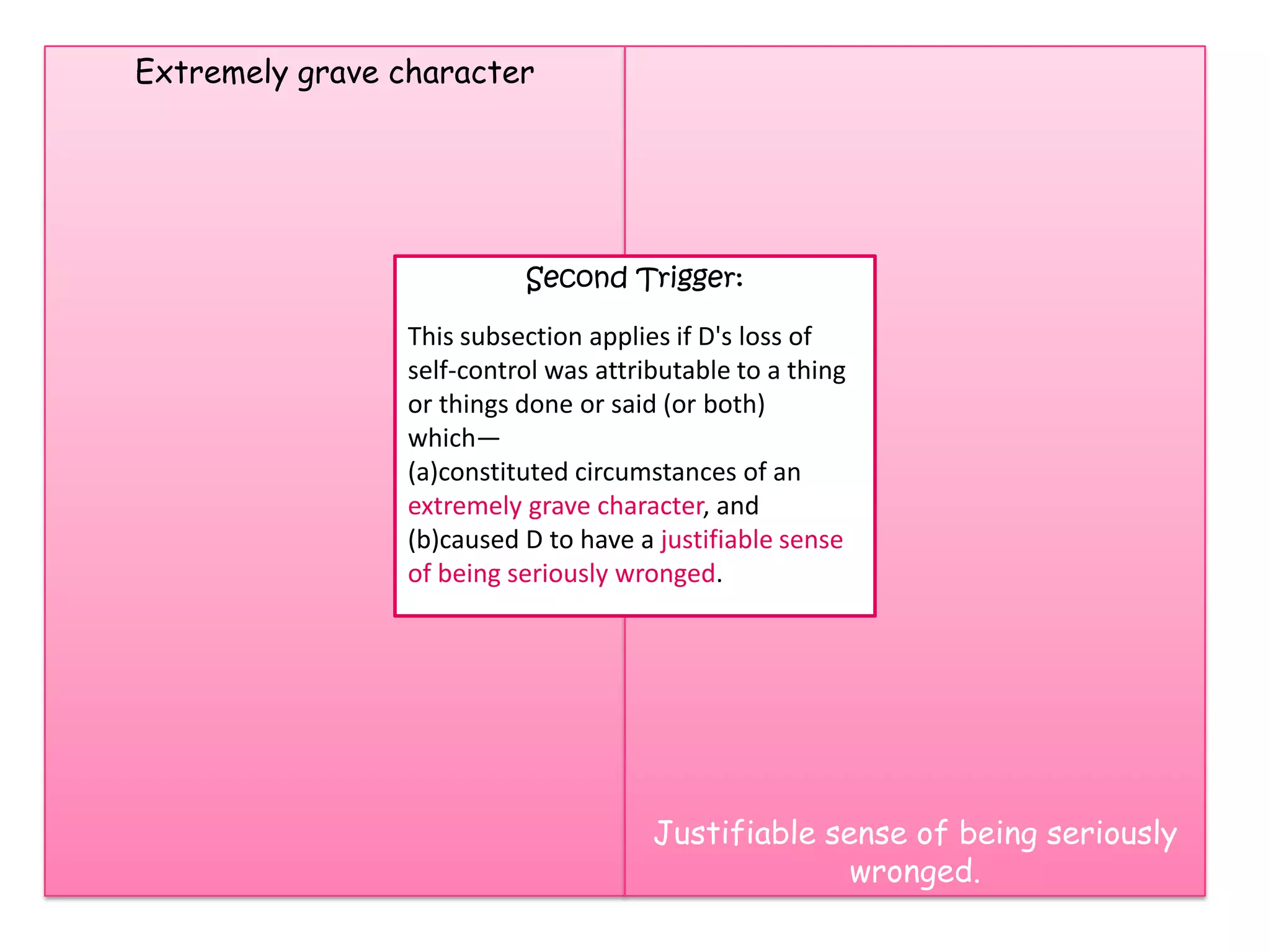
Extremely grave character


                           Second Trigger:

                 This subsection applies if D's loss of
                 self-control was attributable to a thing
                 or things done or said (or both)
                 which—
                 (a)constituted circumstances of an
                 extremely grave character, and
                 (b)caused D to have a justifiable sense
                 of being seriously wronged.


                                       Justifiable sense of being seriously
                                                     wronged.
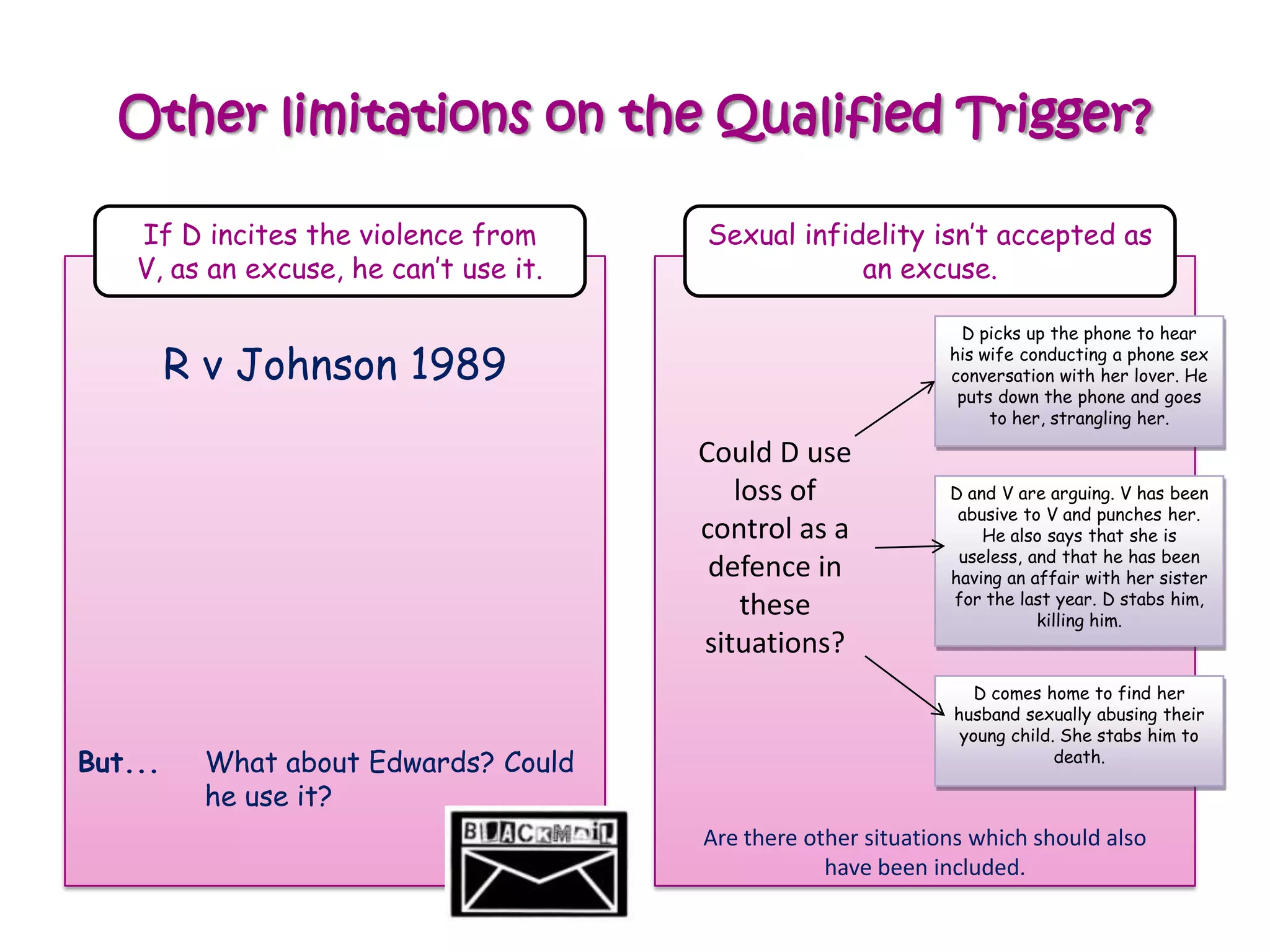
Other limitations on the Qualified Trigger?

    If D incites the violence from      Sexual infidelity isn‟t accepted as
    V, as an excuse, he can‟t use it.               an excuse.

                                                                 D picks up the phone to hear

         R v Johnson 1989                                       his wife conducting a phone sex
                                                                conversation with her lover. He
                                                                 puts down the phone and goes
                                                                     to her, strangling her.

                                        Could D use
                                           loss of              D and V are arguing. V has been
                                                                 abusive to V and punches her.
                                        control as a                He also says that she is
                                                                 useless, and that he has been
                                         defence in             having an affair with her sister
                                                                for the last year. D stabs him,
                                            these                          killing him.
                                        situations?
                                                                   D comes home to find her
                                                                husband sexually abusing their
                                                                 young child. She stabs him to
But...    What about Edwards? Could                                          death.

          he use it?
                                        Are there other situations which should also
                                                    have been included.
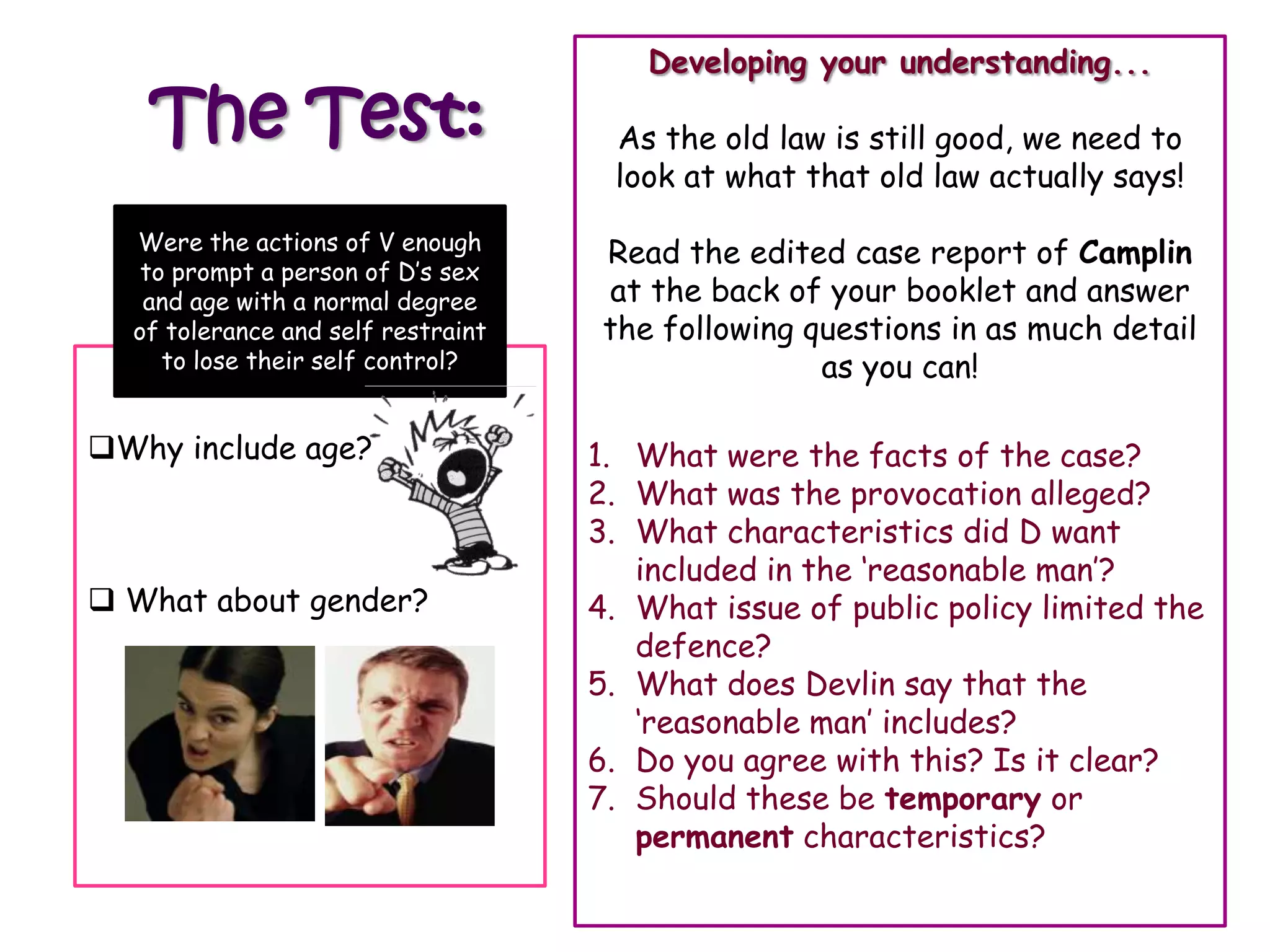
Developing your understanding...

   The Test:                         As the old law is still good, we need to
                                     look at what that old law actually says!

  Were the actions of V enough
                                     Read the edited case report of Camplin
   to prompt a person of D‟s sex                Was it enough that D in those
   and age with a normal degree      at the back circumstances lost their answer
                                                  of your booklet and
  of tolerance and self restraint    the following questions in as much detail
                                                          control?
     to lose their self control?                     as you can!

Why include age?                   1. What were the facts of the case?
                                    2. What was the provocation alleged?
                                    3. What characteristics did D want
                                       included in the „reasonable man‟?
 What about gender?                4. What issue of public policy limited the
                                       defence?
                                    5. What does Devlin say that the
                                       „reasonable man‟ includes?
                                    6. Do you agree with this? Is it clear?
                                    7. Should these be temporary or
                                       permanent characteristics?
Is Camplin the right way to go?
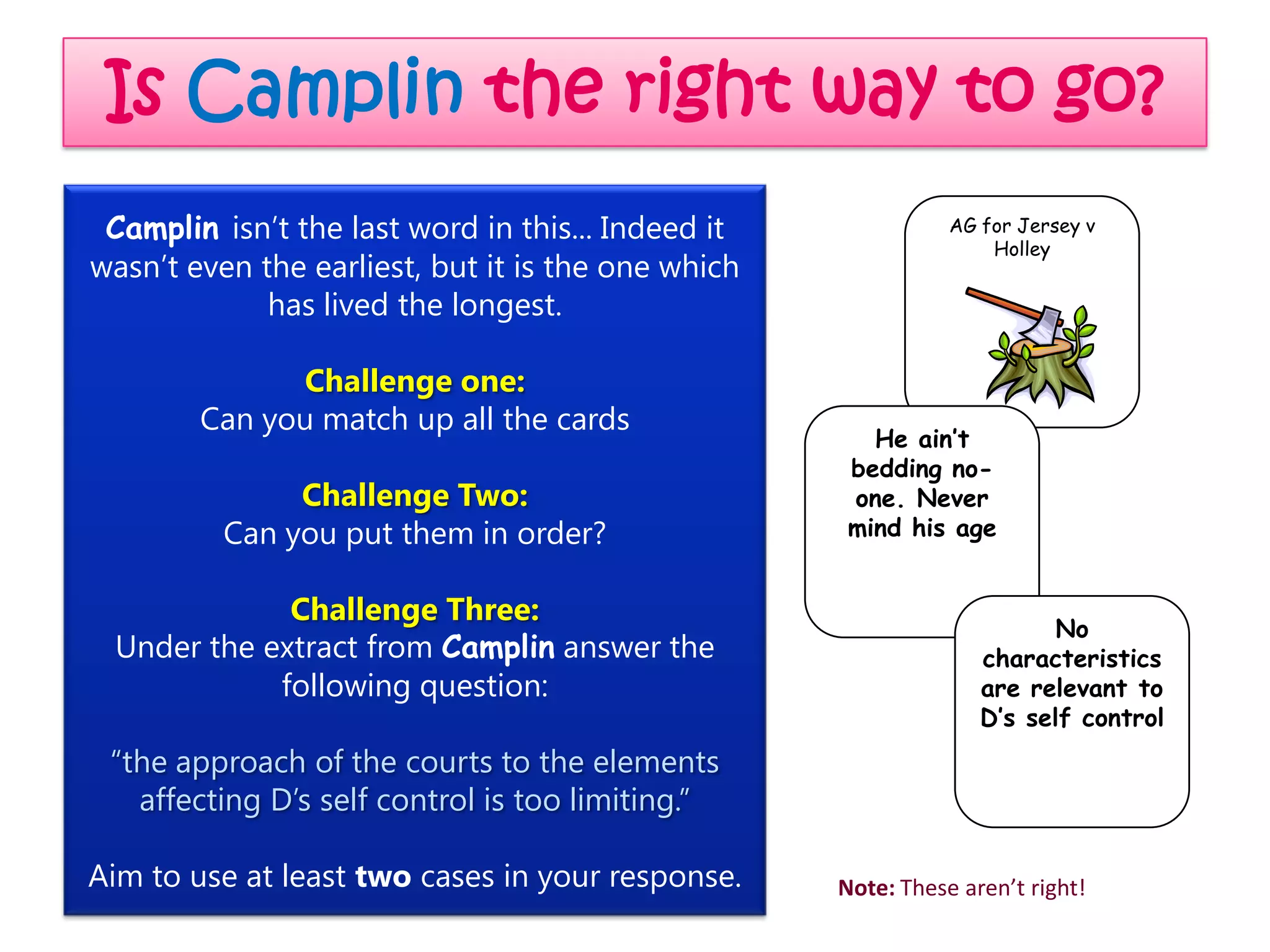
 Camplin isn’t the last word in this... Indeed it              AG for Jersey v
                                                                   Holley
wasn’t even the earliest, but it is the one which
             has lived the longest.

              Challenge one:
        Can you match up all the cards
                                                       He ain’t
                                                     bedding no-
               Challenge Two:                        one. Never
          Can you put them in order?                 mind his age


             Challenge Three:
                                                                         No
 Under the extract from Camplin answer the                        characteristics
            following question:                                   are relevant to
                                                                  D’s self control
 “the approach of the courts to the elements
   affecting D’s self control is too limiting.”

Aim to use at least two cases in your response.     Note: These aren’t right!
Can you be better than Miss Hart?
     Correct the paragraph below, to show your understanding of last lesson

 Loss of of Control a partialdefence to murder. It comes from the Judges and
   Loss Control is is a full defence to murder. It comes from the Coroners and
Criminal Justice Act 2009 ss.54-5. It was designed to replace the old defence of
  provocation under s.3 of the Homicide Act 1957. The old Act had was heavily
    taunting under s.3 of the Homcide Act 1957. The old Act had was heavily
criticised as itit allowed a very narrow rangesituations to be put put before the
 criticised as allowed a very wide range of of situations to be before the jury.
In jury. In addition, the Duffy had decided that loss that loss of control meant
   addition, the case of case of Stuffy had decided of control meant sudden and
sudden. This meant that many people could not not use it including battered wives
temporary. This meant that many people could use it including deep fried wives as
      as they often waited until their victim posed less threat (e.g. asleep).
       they often waited until their victim posed less threat (e.g. asleep).


 To use the new Act, D must have a qualifying trigger, as defined in s.54 of the
                                                                     s.55
Act. The trigger is either a fear of serious violence from V against an identifiable
   Act. The trigger is either a fear of serious anger from V against anyone, or
something or something which or said which constitutes circumstances of a grave
  person, done or said done constitutes circumstances of a deadly character and
character and an justifiable sense of beingsense of being seriously wronged. This
leaves D with leaves D with an justifiable seriously upset. This latter trigger is
       latter trigger is objectively, and includesexcludes sexual infidelity.
                judged judged objectively, and sexual infidelity.
Developing your understanding...
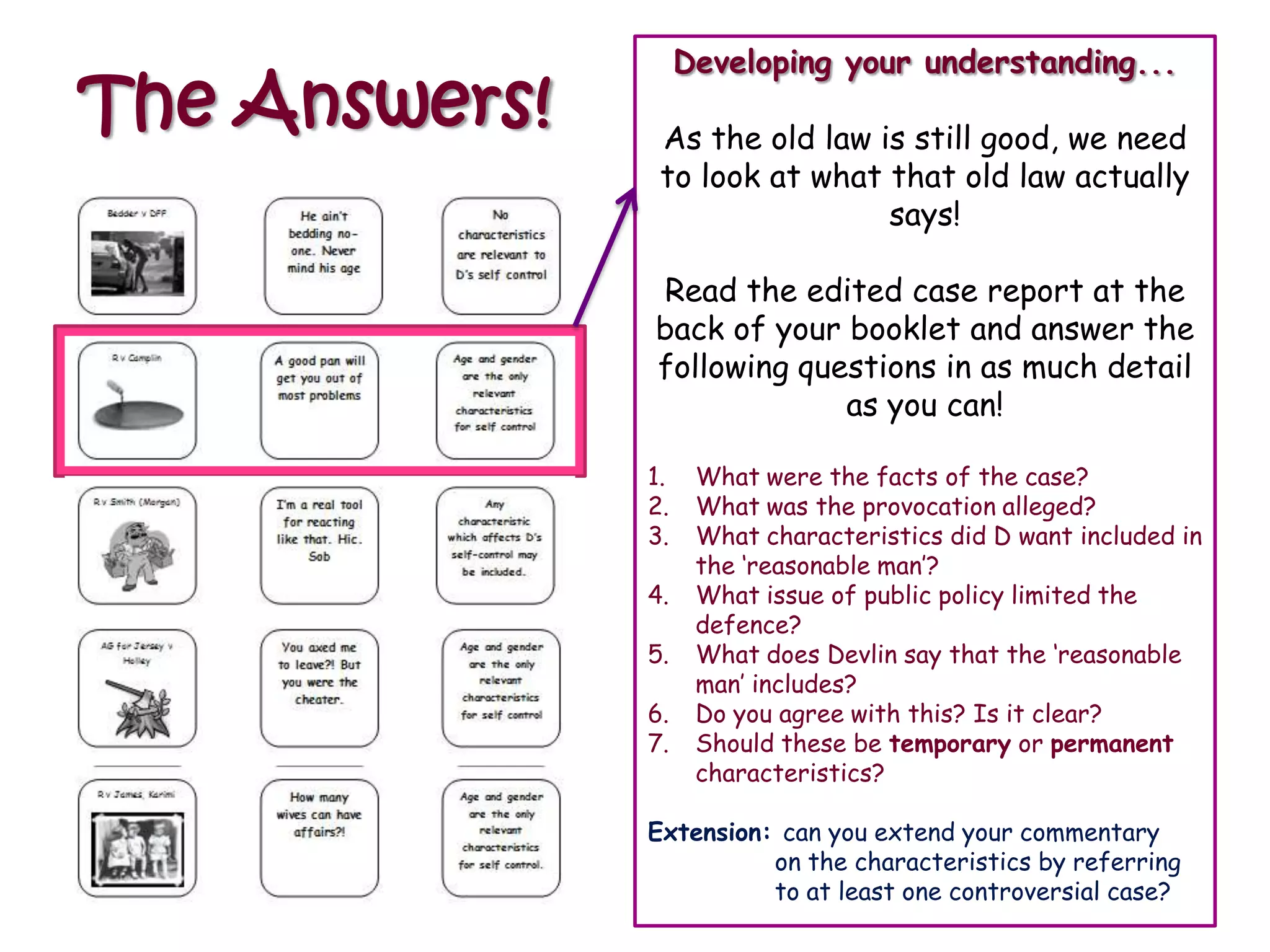
The Answers!    As the old law is still good, we need
                to look at what that old law actually
                                says!

               Read the edited case report at the
               back of your booklet and answer the
               following questions in as much detail
                            as you can!

               1.    What were the facts of the case?
               2.    What was the provocation alleged?
               3.    What characteristics did D want included in
                     the „reasonable man‟?
               4.    What issue of public policy limited the
                     defence?
               5.    What does Devlin say that the „reasonable
                     man‟ includes?
               6.    Do you agree with this? Is it clear?
               7.    Should these be temporary or permanent
                     characteristics?

               Extension: can you extend your commentary
                         on the characteristics by referring
                         to at least one controversial case?
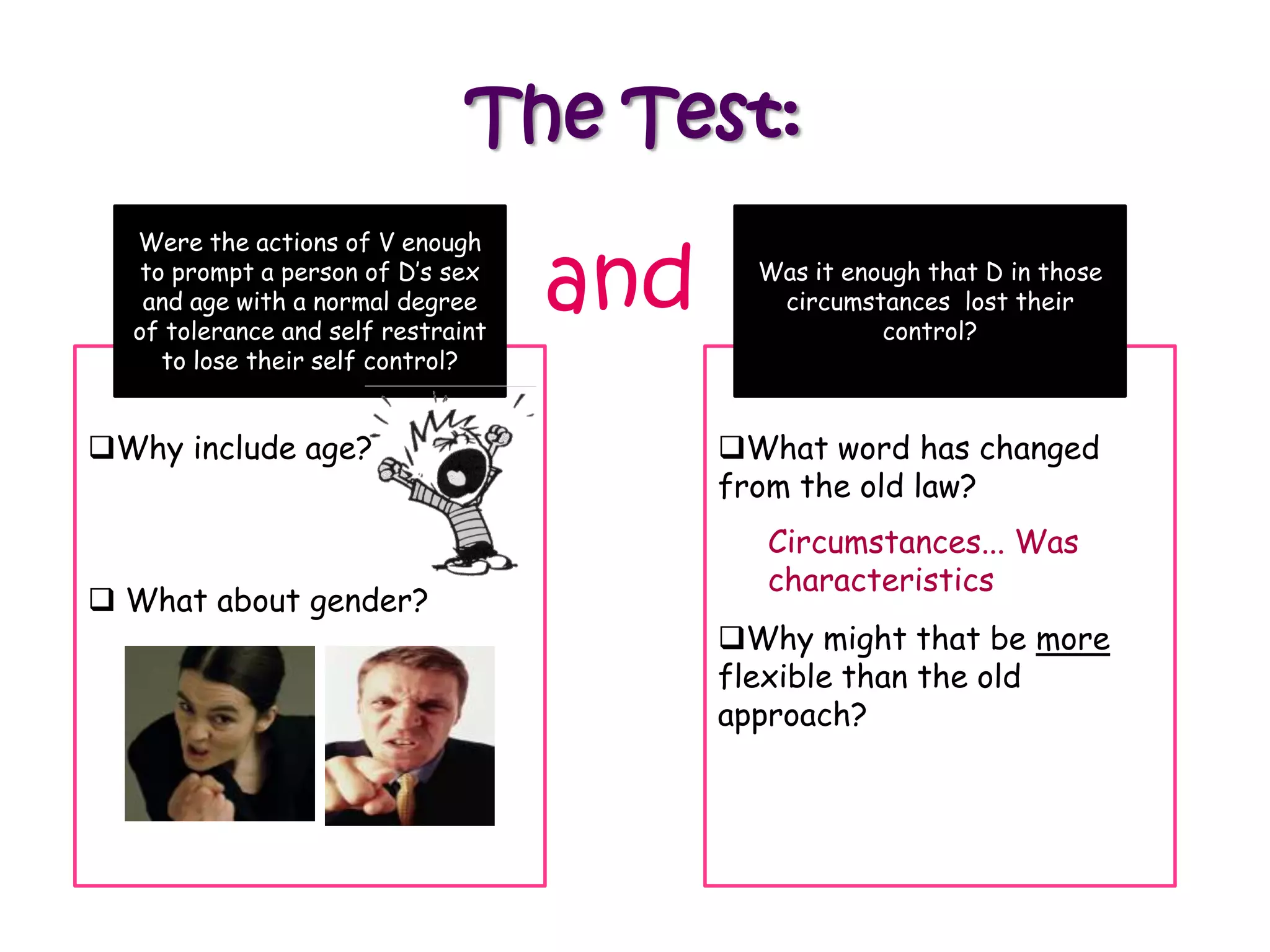
The Test:

                                    and
  Were the actions of V enough
   to prompt a person of D‟s sex            Was it enough that D in those
   and age with a normal degree              circumstances lost their
  of tolerance and self restraint                     control?
     to lose their self control?


Why include age?                         What word has changed
                                          from the old law?
                                            Circumstances... Was
                                            characteristics
 What about gender?
                                          Why might that be more
                                          flexible than the old
                                          approach?
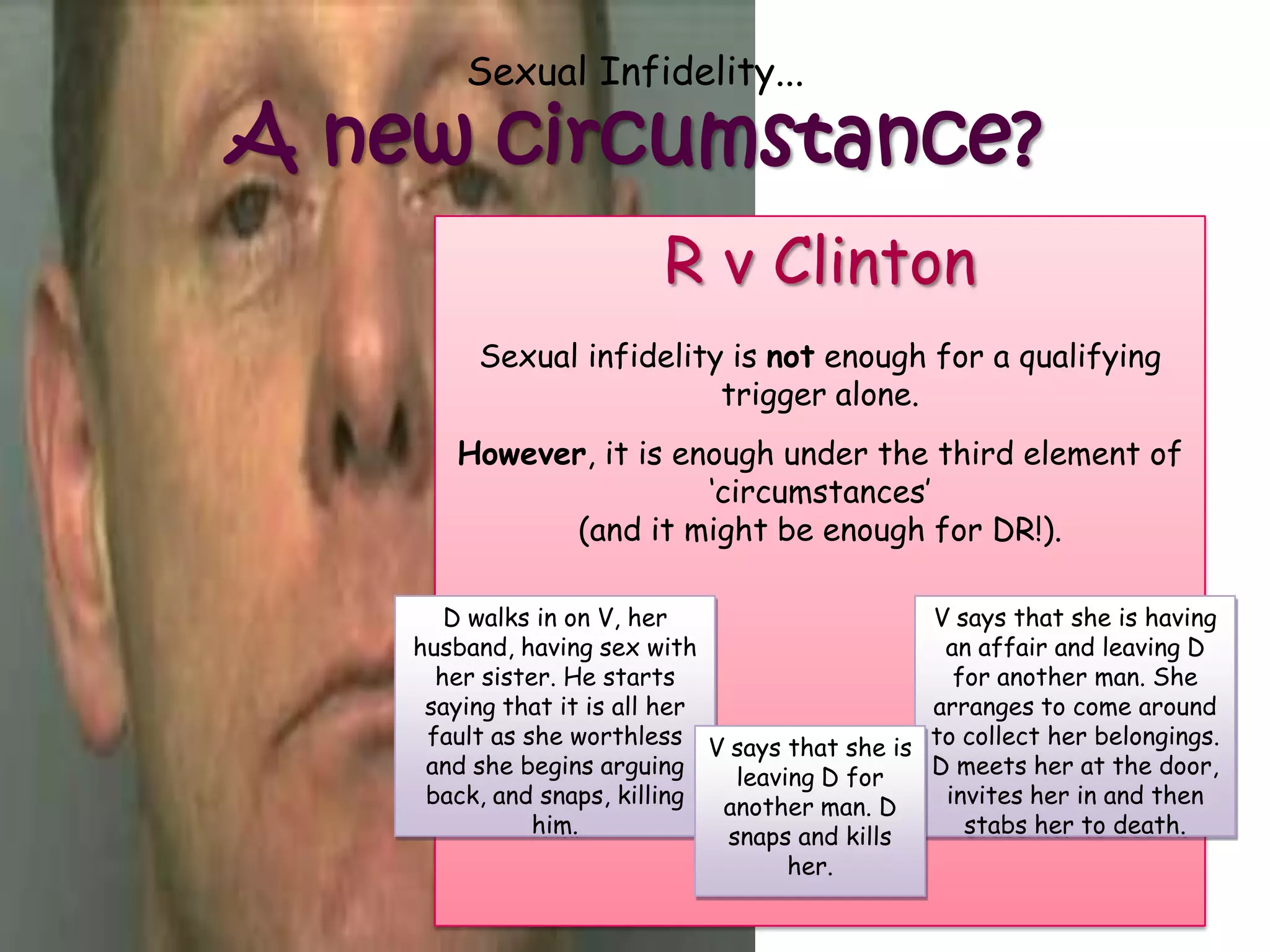
Sexual Infidelity...

A new circumstance?
                         R v Clinton
         Sexual infidelity is not enough for a qualifying
                          trigger alone.
       However, it is enough under the third element of
                        „circumstances‟
             (and it might be enough for DR!).

       D walks in on V, her                      V says that she is having
    husband, having sex with                      an affair and leaving D
      her sister. He starts                        for another man. She
     saying that it is all her                   arranges to come around
     fault as she worthless V says that she is   to collect her belongings.
     and she begins arguing     leaving D for    D meets her at the door,
     back, and snaps, killing  another man. D     invites her in and then
               him.            snaps and kills      stabs her to death.
                                     her.
Thinking:

Is this evidence of sexual infidelity?
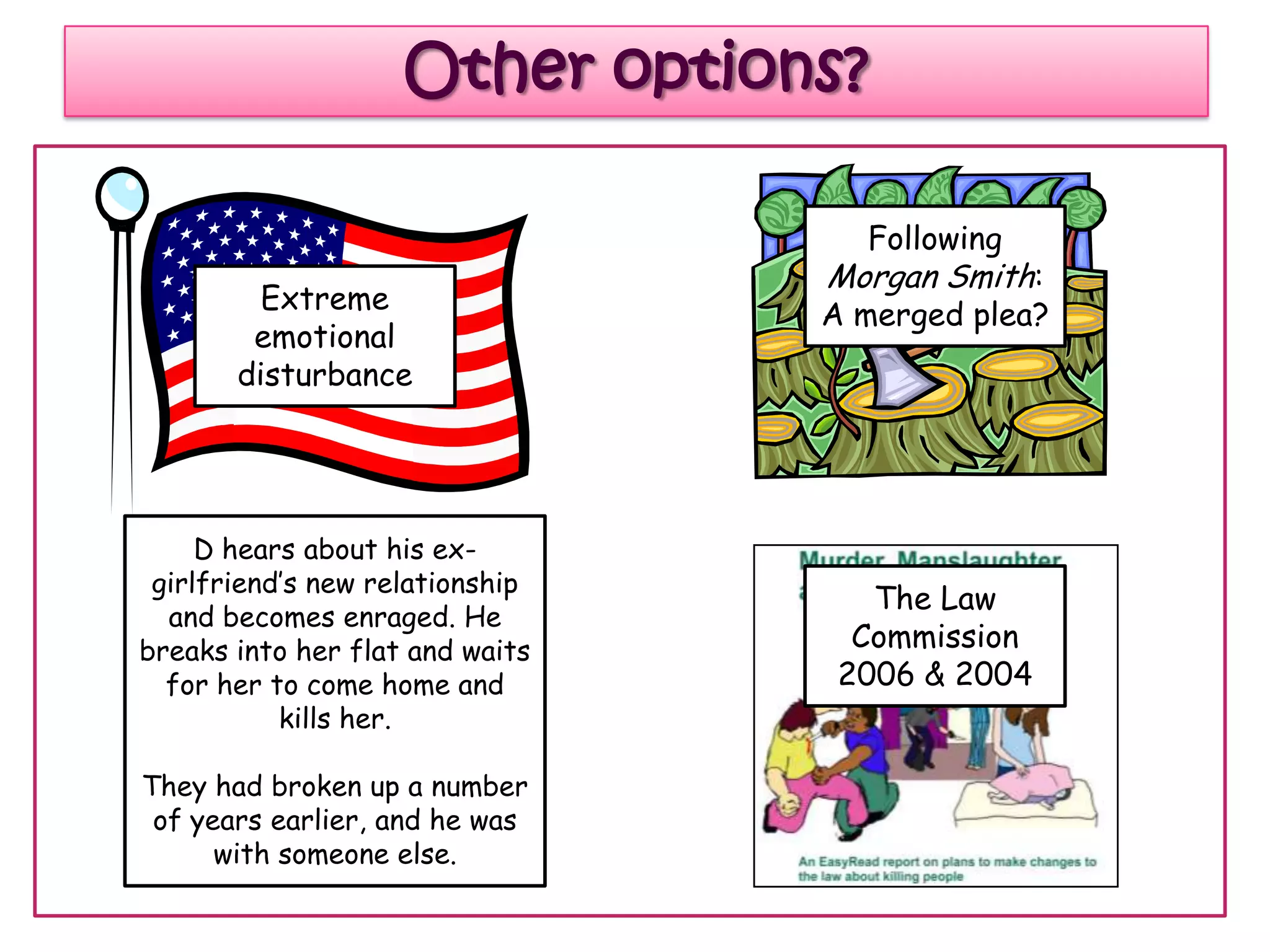
Other options?

                                   Following
                                 Morgan Smith:
         Extreme
                                 A merged plea?
        emotional
       disturbance


     D hears about his ex-
 girlfriend‟s new relationship
                                    The Law
  and becomes enraged. He
breaks into her flat and waits     Commission
  for her to come home and        2006 & 2004
           kills her.

They had broken up a number
 of years earlier, and he was
      with someone else.
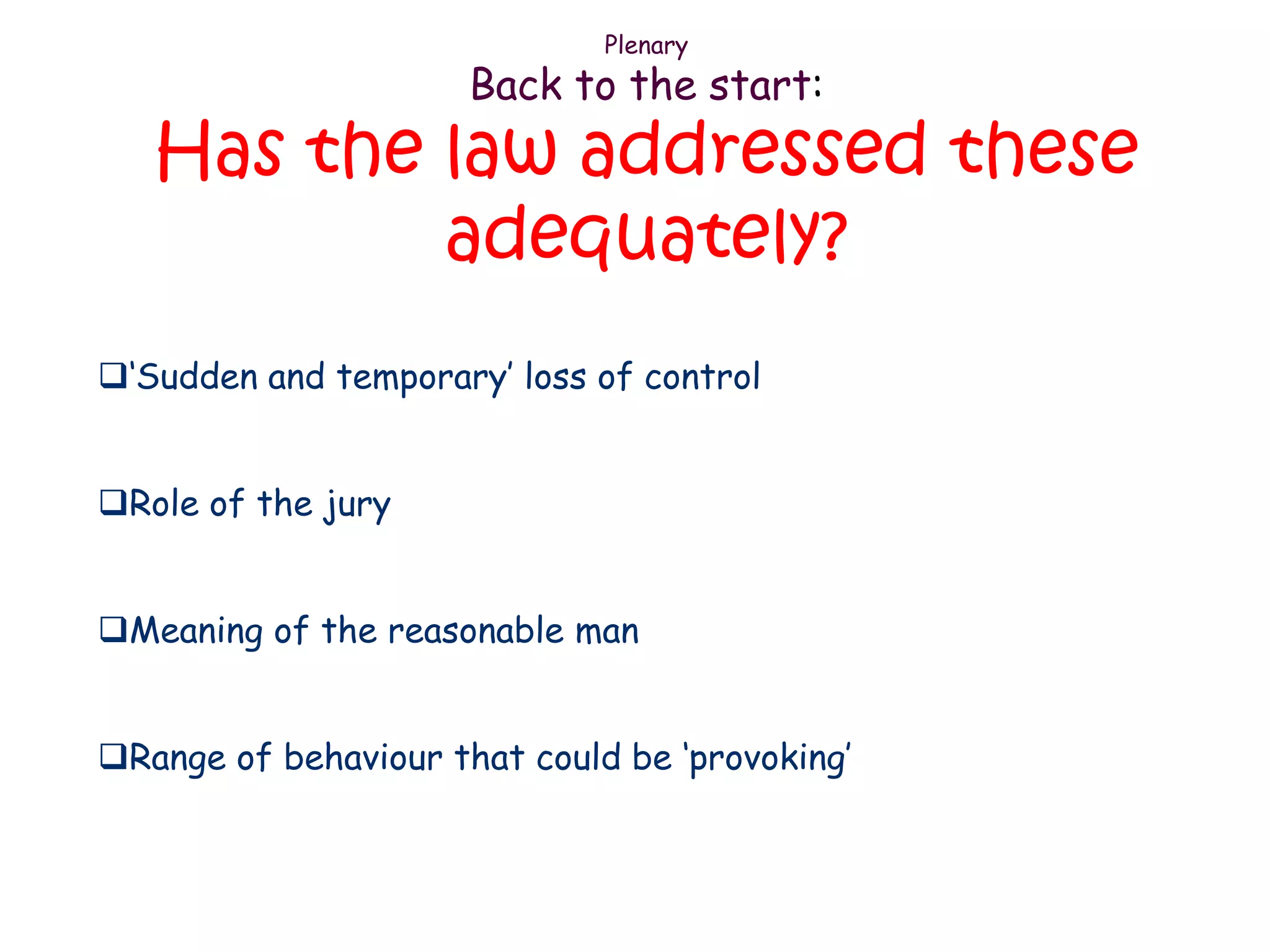
Plenary
                      Back to the start:
   Has the law addressed these
           adequately?
„Sudden and temporary‟ loss of control


Role of the jury


Meaning of the reasonable man


Range of behaviour that could be „provoking‟
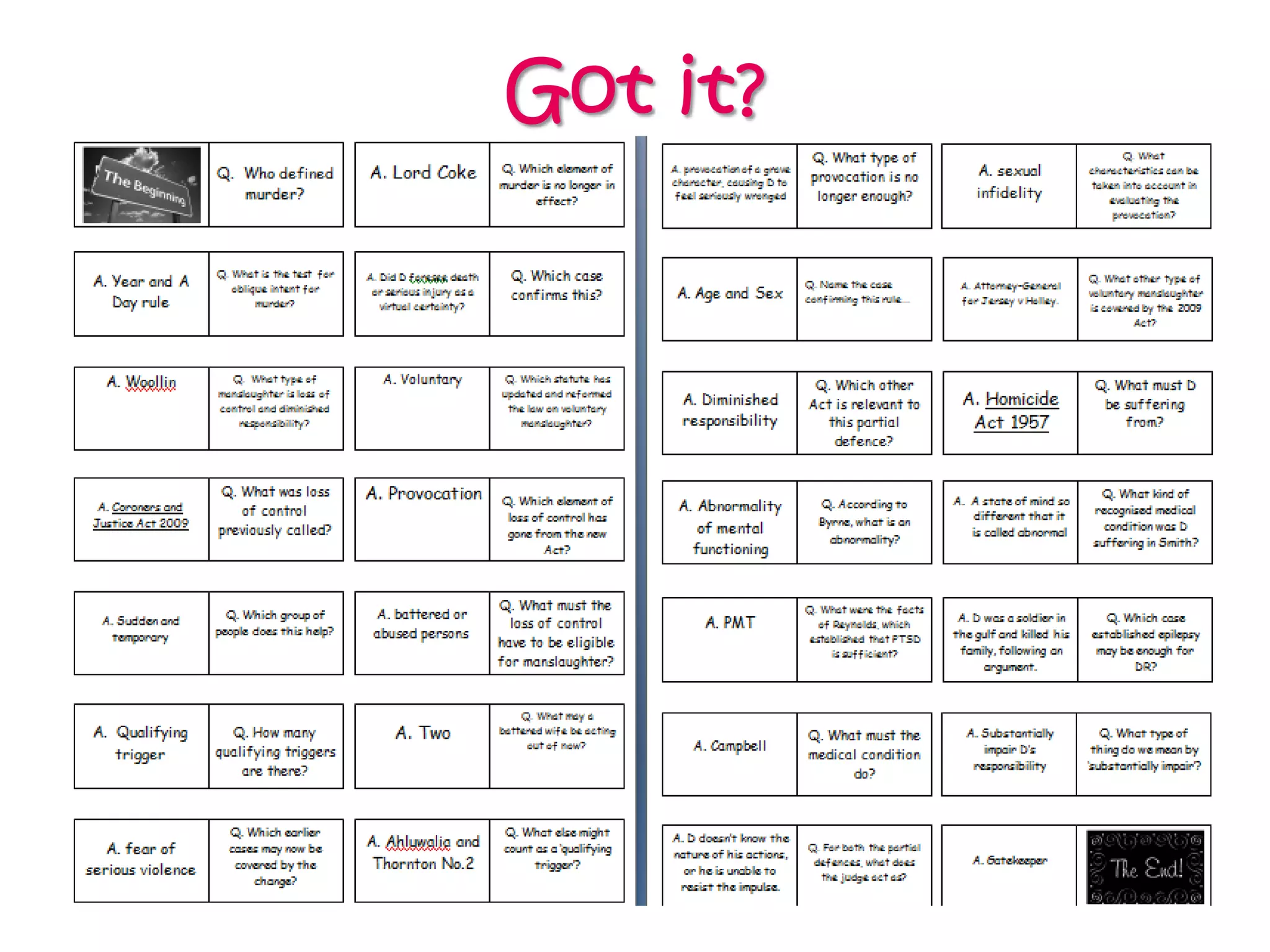
Can you sort it all?
 Can you use
    your
understandin
     g to
complete the
 dominoes?
 15 minutes
   NO MORE!
Got it?
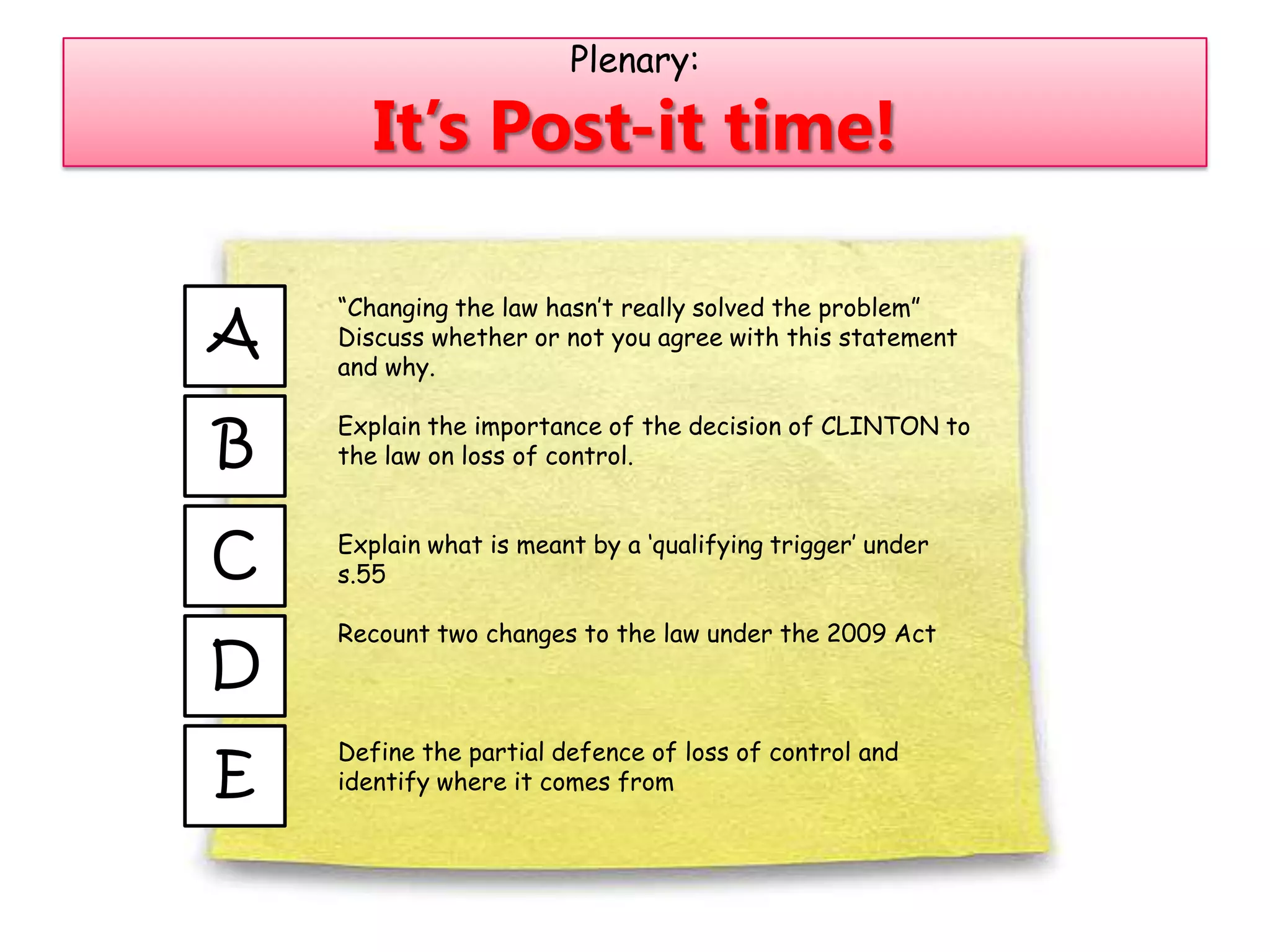
Plenary:

       It’s Post-it time!

    “Changing the law hasn‟t really solved the problem”
A   Discuss whether or not you agree with this statement
    and why.


B
    Explain the importance of the decision of CLINTON to
    the law on loss of control.


C   Explain what is meant by a „qualifying trigger‟ under
    s.55

    Recount two changes to the law under the 2009 Act
D
    Define the partial defence of loss of control and
E   identify where it comes from
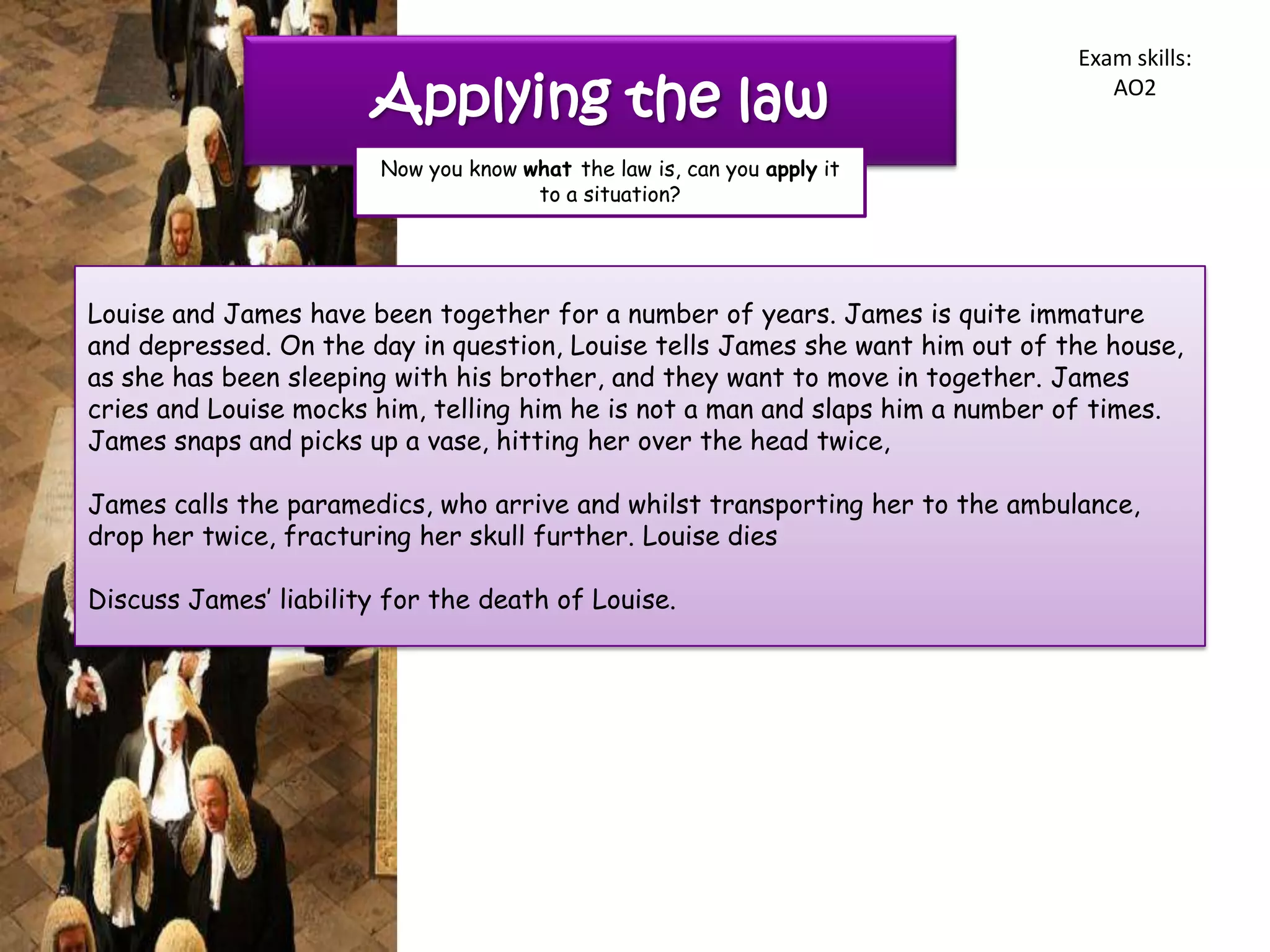
Exam skills:

                       Applying the law                                           AO2


                        Now you know what the law is, can you apply it
                                      to a situation?


Louise and James have been together for a number of years. James is quite immature
and depressed. On the day in question, Louise tells James she want him out of the house,
as she has been sleeping with his brother, and they want to move in together. James
cries and Louise mocks him, telling him he is not a man and slaps him a number of times.
James snaps and picks up a vase, hitting her over the head twice,

James calls the paramedics, who arrive and whilst transporting her to the ambulance,
drop her twice, fracturing her skull further. Louise dies

Discuss James‟ liability for the death of Louise.
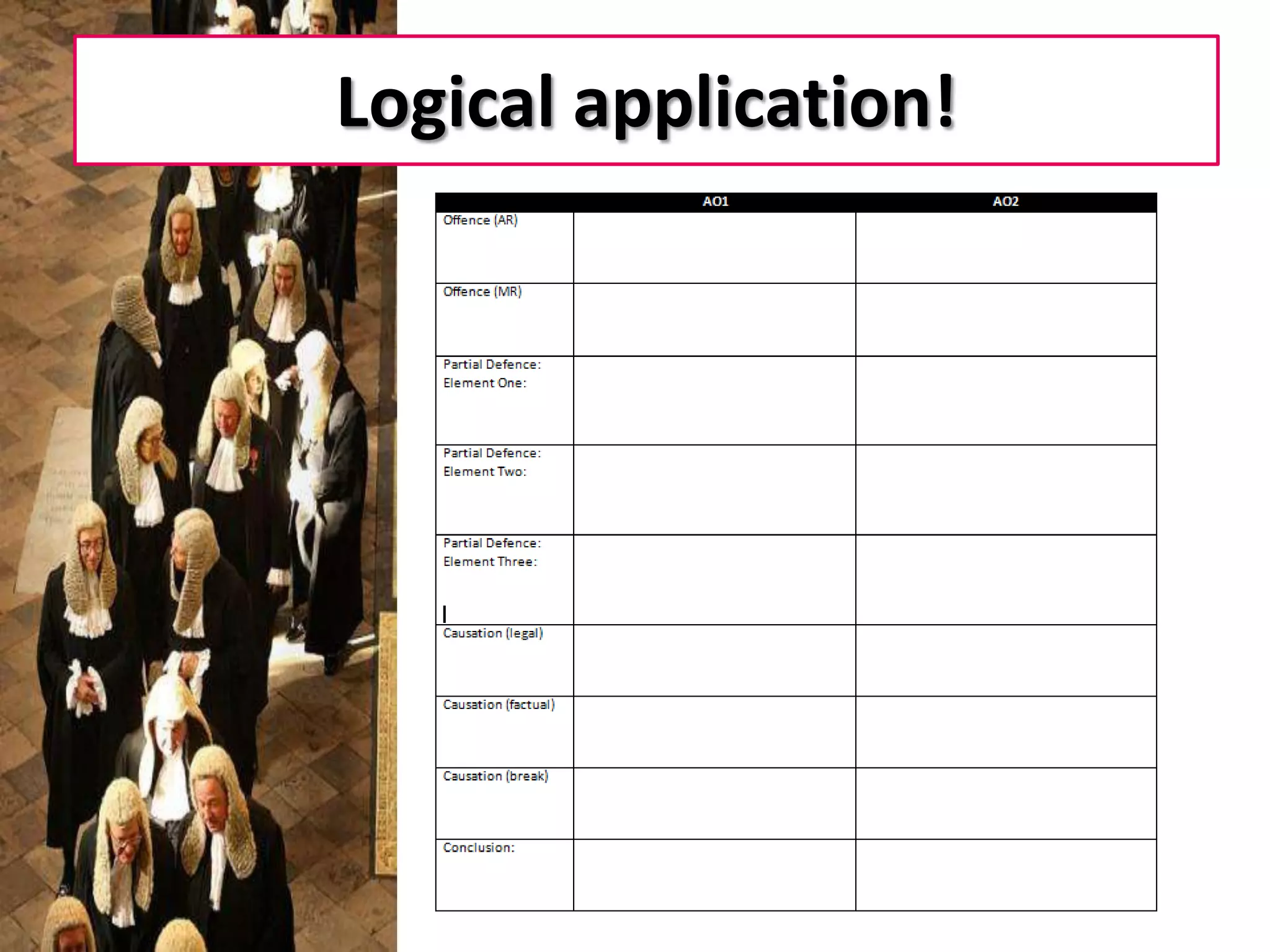
Logical application!
Now it’s over to you

Working in pairs, you are going to complete your own analysis of
a problem, creating a chain of causation and applying the law.

To answer them properly, you will have to recall some of the law
which we have looked at earlier in the term, and remember how
we approached James and Louise... OCD

          Murder: Actus Reus

          Murder: Mens Rea

          Loss of Control

          Qualifying trigger?

          Enough to provoke the person with the age and sex
          of D in the circumstances

          Causation?

          Finally: would they be successful       or not      ?
It’s time to be creative!
1. Write up your response to the Louisa and James problem question.
2. Revise for a DRAG test on murder and voluntary manslaughter on 18th
   October 2012

                  Due Thursday 11th October 2012

Loss of control 2012-3

  • 1.
    Which of thesewas unsuccessful in arguing provocation under the old law? i.e. were found liable for murder or manslaughter by reason of diminished responsibility, rather than manslaughter. R v Davies R v Pearson R v Ahluwalia AG for Jersey v Holley R v Ibrams & R v Betambeau R v James, Karimi R v Camplin Gregory
  • 2.
    And now alittle reminder of theory… Before we look at the current law, we need to consider why we have developed this partial defence, and what it should aim to do. Then we can work it if it‟s doing what it should! Why do we allow people who lose their self-control to have this partial defence? Why might it not be suitable for it to be a complete defence? Is it an excuse or a justification? Professor Norrie argues that it is currently an excuse, but should work more as ‘imperfect justification’.
  • 3.
    Issues with theold law „Sudden and temporary‟ loss of control Role of the jury Meaning of the reasonable man Range of behaviour that could be „provoking‟ Whilst we look at the new law, have these in the back of your mind: Does the new law adequately address the issues raised?
  • 4.
    New law Coroners andJustice Act 2009 s.54-5
  • 5.
    Some basics: Role ofthe Judge in loss of control pleas in the opinion of the trial judge, a jury, properly directed, could reasonably conclude that the defence might apply. s.54 Look at these previous cases... Do you think they would meet the new threshold?
  • 6.
    What’s the phrase? of Loss of self control
  • 7.
    Element One: Loss of Self Control (2) For the purposes of subsection (1)(a), it does not matter whether or not the loss of control was sudden. Issues with the section: R v Duffy 1949 “Sudden and  The longer the gap, the more likely the temporary loss of judge will withdraw it. control”  Allows for a ‘cooling off period’ per Ahluwalia. Still must be a loss of control  Law Commission didn’t want to keep these R v Cocker 1989 words.  Allows a whole category history of provoking actions or words to be taken into account.
  • 8.
    Subsection (1) doesnot apply if, in doing or being a party to the killing, D acted in a considered desire for revenge. Why might these words cause problems? How might this have affected these older cases? R v Mohammed R v Ibrams & R v Pearson Gregory
  • 9.
    Element Two: Qualifying Trigger s.55 Who can be threatened? What about Who can issue other types of the provocation? abuse? First Trigger: D's loss of self-control was attributable to D's fear of serious violence from V against D or another identified person ‘Serious’ Judged subjectively violence So, D can even plead it where:  Uses excessive force  Makes a mistake
  • 10.
    Extremely grave character Second Trigger: This subsection applies if D's loss of self-control was attributable to a thing or things done or said (or both) which— (a)constituted circumstances of an extremely grave character, and (b)caused D to have a justifiable sense of being seriously wronged. Justifiable sense of being seriously wronged.
  • 11.
    Other limitations onthe Qualified Trigger? If D incites the violence from Sexual infidelity isn‟t accepted as V, as an excuse, he can‟t use it. an excuse. D picks up the phone to hear R v Johnson 1989 his wife conducting a phone sex conversation with her lover. He puts down the phone and goes to her, strangling her. Could D use loss of D and V are arguing. V has been abusive to V and punches her. control as a He also says that she is useless, and that he has been defence in having an affair with her sister for the last year. D stabs him, these killing him. situations? D comes home to find her husband sexually abusing their young child. She stabs him to But... What about Edwards? Could death. he use it? Are there other situations which should also have been included.
  • 12.
    Developing your understanding... The Test: As the old law is still good, we need to look at what that old law actually says! Were the actions of V enough Read the edited case report of Camplin to prompt a person of D‟s sex Was it enough that D in those and age with a normal degree at the back circumstances lost their answer of your booklet and of tolerance and self restraint the following questions in as much detail control? to lose their self control? as you can! Why include age? 1. What were the facts of the case? 2. What was the provocation alleged? 3. What characteristics did D want included in the „reasonable man‟?  What about gender? 4. What issue of public policy limited the defence? 5. What does Devlin say that the „reasonable man‟ includes? 6. Do you agree with this? Is it clear? 7. Should these be temporary or permanent characteristics?
  • 13.
    Is Camplin theright way to go? Camplin isn’t the last word in this... Indeed it AG for Jersey v Holley wasn’t even the earliest, but it is the one which has lived the longest. Challenge one: Can you match up all the cards He ain’t bedding no- Challenge Two: one. Never Can you put them in order? mind his age Challenge Three: No Under the extract from Camplin answer the characteristics following question: are relevant to D’s self control “the approach of the courts to the elements affecting D’s self control is too limiting.” Aim to use at least two cases in your response. Note: These aren’t right!
  • 14.
    Can you bebetter than Miss Hart? Correct the paragraph below, to show your understanding of last lesson Loss of of Control a partialdefence to murder. It comes from the Judges and Loss Control is is a full defence to murder. It comes from the Coroners and Criminal Justice Act 2009 ss.54-5. It was designed to replace the old defence of provocation under s.3 of the Homicide Act 1957. The old Act had was heavily taunting under s.3 of the Homcide Act 1957. The old Act had was heavily criticised as itit allowed a very narrow rangesituations to be put put before the criticised as allowed a very wide range of of situations to be before the jury. In jury. In addition, the Duffy had decided that loss that loss of control meant addition, the case of case of Stuffy had decided of control meant sudden and sudden. This meant that many people could not not use it including battered wives temporary. This meant that many people could use it including deep fried wives as as they often waited until their victim posed less threat (e.g. asleep). they often waited until their victim posed less threat (e.g. asleep). To use the new Act, D must have a qualifying trigger, as defined in s.54 of the s.55 Act. The trigger is either a fear of serious violence from V against an identifiable Act. The trigger is either a fear of serious anger from V against anyone, or something or something which or said which constitutes circumstances of a grave person, done or said done constitutes circumstances of a deadly character and character and an justifiable sense of beingsense of being seriously wronged. This leaves D with leaves D with an justifiable seriously upset. This latter trigger is latter trigger is objectively, and includesexcludes sexual infidelity. judged judged objectively, and sexual infidelity.
  • 15.
    Developing your understanding... TheAnswers! As the old law is still good, we need to look at what that old law actually says! Read the edited case report at the back of your booklet and answer the following questions in as much detail as you can! 1. What were the facts of the case? 2. What was the provocation alleged? 3. What characteristics did D want included in the „reasonable man‟? 4. What issue of public policy limited the defence? 5. What does Devlin say that the „reasonable man‟ includes? 6. Do you agree with this? Is it clear? 7. Should these be temporary or permanent characteristics? Extension: can you extend your commentary on the characteristics by referring to at least one controversial case?
  • 16.
    The Test: and Were the actions of V enough to prompt a person of D‟s sex Was it enough that D in those and age with a normal degree circumstances lost their of tolerance and self restraint control? to lose their self control? Why include age? What word has changed from the old law? Circumstances... Was characteristics  What about gender? Why might that be more flexible than the old approach?
  • 17.
    Sexual Infidelity... A newcircumstance? R v Clinton Sexual infidelity is not enough for a qualifying trigger alone. However, it is enough under the third element of „circumstances‟ (and it might be enough for DR!). D walks in on V, her V says that she is having husband, having sex with an affair and leaving D her sister. He starts for another man. She saying that it is all her arranges to come around fault as she worthless V says that she is to collect her belongings. and she begins arguing leaving D for D meets her at the door, back, and snaps, killing another man. D invites her in and then him. snaps and kills stabs her to death. her.
  • 18.
    Thinking: Is this evidenceof sexual infidelity?
  • 19.
    Other options? Following Morgan Smith: Extreme A merged plea? emotional disturbance D hears about his ex- girlfriend‟s new relationship The Law and becomes enraged. He breaks into her flat and waits Commission for her to come home and 2006 & 2004 kills her. They had broken up a number of years earlier, and he was with someone else.
  • 20.
    Plenary Back to the start: Has the law addressed these adequately? „Sudden and temporary‟ loss of control Role of the jury Meaning of the reasonable man Range of behaviour that could be „provoking‟
  • 21.
    Can you sortit all? Can you use your understandin g to complete the dominoes? 15 minutes NO MORE!
  • 22.
  • 24.
    Plenary: It’s Post-it time! “Changing the law hasn‟t really solved the problem” A Discuss whether or not you agree with this statement and why. B Explain the importance of the decision of CLINTON to the law on loss of control. C Explain what is meant by a „qualifying trigger‟ under s.55 Recount two changes to the law under the 2009 Act D Define the partial defence of loss of control and E identify where it comes from
  • 25.
    Exam skills: Applying the law AO2 Now you know what the law is, can you apply it to a situation? Louise and James have been together for a number of years. James is quite immature and depressed. On the day in question, Louise tells James she want him out of the house, as she has been sleeping with his brother, and they want to move in together. James cries and Louise mocks him, telling him he is not a man and slaps him a number of times. James snaps and picks up a vase, hitting her over the head twice, James calls the paramedics, who arrive and whilst transporting her to the ambulance, drop her twice, fracturing her skull further. Louise dies Discuss James‟ liability for the death of Louise.
  • 26.
  • 27.
    Now it’s overto you Working in pairs, you are going to complete your own analysis of a problem, creating a chain of causation and applying the law. To answer them properly, you will have to recall some of the law which we have looked at earlier in the term, and remember how we approached James and Louise... OCD Murder: Actus Reus Murder: Mens Rea Loss of Control Qualifying trigger? Enough to provoke the person with the age and sex of D in the circumstances Causation? Finally: would they be successful or not ?
  • 28.
    It’s time tobe creative! 1. Write up your response to the Louisa and James problem question. 2. Revise for a DRAG test on murder and voluntary manslaughter on 18th October 2012 Due Thursday 11th October 2012

Editor's Notes

  • #2 AG for Jersey v Holley